Tuesday, December 23, 2025
Home Blog Page 4706

Parting of the ways: Has JCPOA divided principlists?

Larijani-Zakani-Rasaee

A political analyst says that principlists will try in the future to form an alliance and take softer lines on foreign policy issues, and this would naturally split up their two main wings, namely the Islamic Revolution Stability Front and the Followers of the Leader [Rahrovan-e Velayat].

The bill on the implementation of the Joint Comprehensive Plan of Action (JCPOA) finally cleared the Islamic Consultative Assembly, but deep divisions emerged between the two main principlist wings during the parliamentary debate on the JCPOA bill. Their division even went so far as getting physical. This has raised doubts over the possibility of principlists forming an alliance in the next parliament.

Experts say that what happened in parliament during its debate of JCPOA has made it even harder for principlists to form a united front. Fararu.com on October 13 published a report on the rift which has opened up within the ranks of principlists and the outlook of their performance: will the principlists pull together or part ways. The following is the translation of the report which includes the viewpoints of two political experts:


Heshmatollah Falahatpisheh: JCPOA widened rift between hardliners and fellow principlists
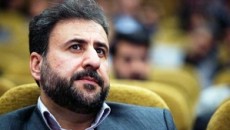
Falahat Pisheh
Heshmatollah Falahatpisheh

Regardless of divisions among principlists over JCPOA, the nuclear issue has turned into one of the main election issues in Iran. The nuclear program and the impact of JCPOA on the country’s development have been even raised in pre-elections meetings.

What unfolded in parliament on Sunday and Tuesday – during which an anti-JCPOA group was formed in the chamber – caused the issue [JCPOA and its impacts] to turn into a more serious question and helped JCPOA become [the core of] the election debate.

As a result of these developments, a number of principlists who pursue extremism and radicalism in their policies have an outside chance of being included in the broad-based principlist alliance. In the past, not-too-hotly debated political issues created a rift among the principlists, and now the nuclear issue will likely to widen the gap between the hardliners and their fellow principlist groups.

When it comes to JCPOA, it is still unclear who has emerged the winner [the government or the pro-JCPOA principlist group in parliament] and who has become the ultimate loser. I have always talked in favor of JCPOA. I think it is significant because of the threats it withdraws and the opportunities it creates.

But the stage is not set yet to interpret the Iran nuclear deal and select its winner and loser, because the other side, especially the US which is involved in the deal, is also a factor. Infringement of commitments, especially in dealing with Iran, has always been part of US policies.

JCPOA would turn into an edge for Iran if and when it served the country’s national interests, removed the threats and created opportunities. It is premature to judge JCPOA and say that its result will show itself in the upcoming parliamentary elections.

I should say that the likely results – both positive and negative – of JCPOA can be tracked in the next presidential elections. If the government can tap into JCPOA to pursue the country’s policies, it would turn into a trump card for Mr. Rouhani to play in the next elections. But JCPOA, which the government supports, would turn into the Rouhani administration’s Achilles’ heel if the impacts of JCPOA implementation are not felt in the country’s domestic affairs, the economy in particular.

Whether a boon or a bane, JCPOA should not be treated as an election issue; I mean JCPOA can turn into a talking point in elections, but the fact remains that an election issue should not be put above a national issue.

In case JCPOA fails to achieve its stated objectives and kills Mr. Rouhani’s chances of winning reelection, principlists should not be joyful, because what matters most is that JCPOA can leave positive impacts on the country.


Sadegh Zibakalam: JCPOA created a yawning chasm among principlists
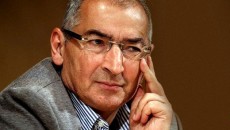
Sadegh Zibakalam
Sadegh Zibakalam

The Joint Comprehensive Plan of Action opened up a wide chasm among principlists, with some favoring JCPOA and others, including members of the Stability Front, opposing it.

This shows that there is little uniformity and unity among principlists. Opposition to the reformist camp is the sole thing principlists unanimously agree on, but they are divided over JCPOA or the way they should cooperate with the Cabinet. It does not seem unlikely that their divisions find their way into the parliamentary elections.

It is also likely that in certain constituencies supporters of the government and moderate principlists become united and agree on a number of candidates, but hardline principlists, including the Stability Front, fail to align with fellow principlists.

As a matter of course, this is not unprecedented or something new in Iran. The stage is usually set for the moderate movements to become united, whereas hardline and extremist movements cannot unite even with like-minded radicals.

I think we will witness a rift among principlists in the upcoming parliamentary elections, in certain constituencies at least. In Tehran, the ticket of hardline principlists and that of moderate principlists are likely to share simply a few names.

If the reformists participate in the elections (with leading figures running on their straight ticket), a large number of hardline principlists will not be willing to align with moderate principlists, even if they are assured that their refusal [to align] will come at the expense of losing that [particular] constituency to reformist and pro-government candidates.

[Will JCPOA benefit moderate principlists in parliament in addition to the government?] What is certain is the fact that the popularity of MPs such as Messrs. Larijani and Kazem Jalali is on the rise among people, especially among university students and youth, thanks to their stance on JCPOA. Definitely this will greatly help them in the upcoming parliamentary elections.

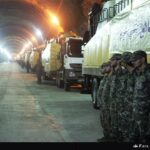
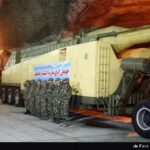
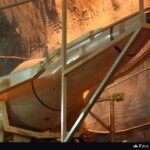
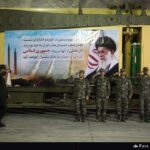
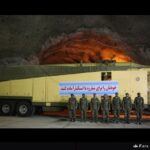
IRGC’s long-range missiles in underground tunnels (PHOTOS)

IRGC-4

The Islamic Revolution Guards Corps (IRGC) Aerospace Force has – for the first time ever – allowed the release of footage of its underground site where the force’s long-range ballistic missiles are based.

The images, aired by Islamic Republic of Iran Broadcasting (IRIB) and released by media, feature labyrinthine tunnels which are home to multiple long-range missiles, among them Ghadr missiles which come in two types: Ghadr-F (with a range of 2,000 km) and Ghadr-H (with a range of 1,700 km).

Sejil is another IRGC ballistic missile with a 2,000-km range [seen at the underground facility].

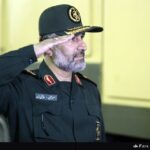
After inspecting the underground facility which has been built 500 meters underground deep under high mountains, Commander of the IRGC Aerospace Force Brigadier General Amir Ali Hajizadeh said that the force’s current missiles will be replaced with new generations of long-range missiles as of next year.

He further said that IRGC Aerospace Force has a missile base in almost every city.

The following are the images Fars News Agency released on October 14 of the underground facility:


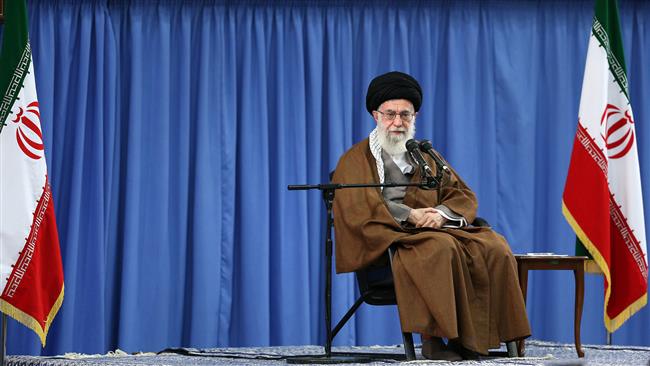
Iran progress tied with revolutionary ideology: Ayatollah Khamenei

Supreme Leader

Leader of the Islamic Revolution Ayatollah Seyyed Ali Khamenei says as long as the revolutionary movement and ideology continue to exist, Iran’s progress, influence, grandeur and spiritual dominance will increase in the region and beyond.

Ayatollah Khamenei made the remarks in a Wednesday meeting with a number of Iranian elites in Tehran.

International scientific centers which determine indicators for scientific progress bear testimony to Iran’s development, said the Leader.

The Leader warned against certain “individuals and elements” who, making use of print media and other forums, keep frustrating the people and youth and “negating” the country’s scientific developments as well as key accomplishments.

Ayatollah Khamenei urged officials to remain on the watch regarding such moves, saying, “The country’s major scientific developments in the fields of nano, stem cells and nuclear issue are not an illusion, but rather realities which the whole world is aware of.”

Therefore, said the Leader, to disappoint the youth and deny the scientific and technological momentum in the country would be a betrayal of the country and of national honor.

The Leader said the Iranian young generation can be proud of taking the credit for leading the country to top levels of scientific progress.


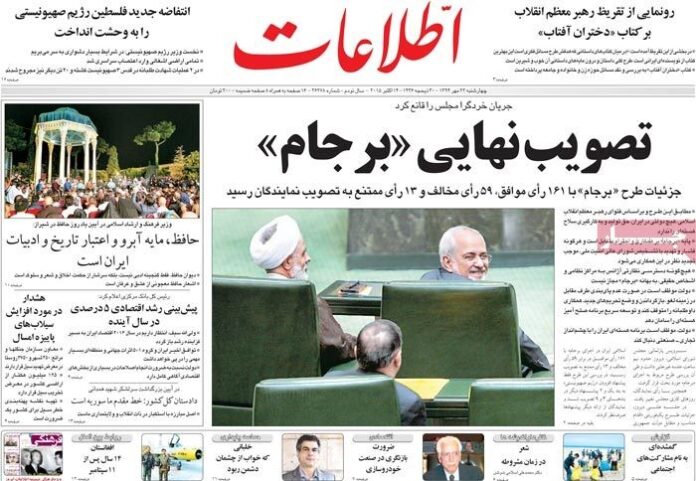
Highlights of Ettela’at newspaper on October 14

Ettelaat-14-oct

The final approval of the Joint Comprehensive Plan of Action

One-hundred-sixty-one MPs voted for the JCPOA bill; 59 voted against and 13 abstained.

 A note by the Supreme Leader in praise of The Daughters of Sun has been unveiled.

In the note, the Leader has hailed the book as “the best by an Iranian author in raising an intellectual question”.

 A new Palestinian Intifada has sent panic through the ranks of the Zionists.

We are in very difficult conditions, the Israeli prime minister has admitted.

 In a ceremony to mark Hafez Day, the minister of culture and Islamic guidance hailed the renowned 14th century poet as a source of pride for the Iranian history and literature.

 The governor of the Central Bank said next year’s economic growth is estimated to stand at five percent.

He further said the recent deal between Iran and P5+1 will have important impacts on a regional and global scale.

 Authorities have warned citizens about autumnal torrents.

 The attorney general has said that Syria is the forefront of the battle.

Ebrahim Raeesi made the comment at a service in memory of IRGC’s Brigadier General Hossein Hamedani, who was martyred in Aleppo, Syria last week.

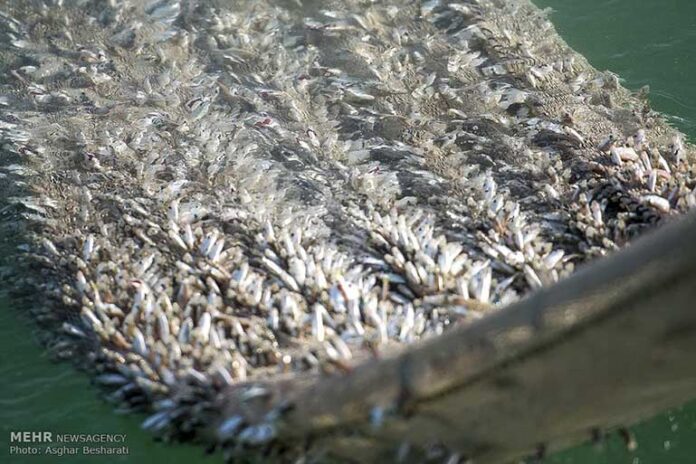
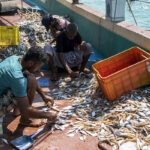
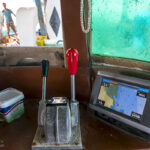
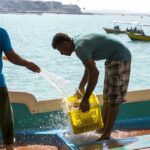
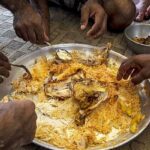
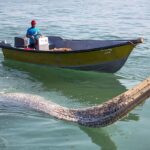
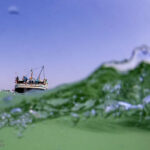
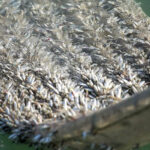
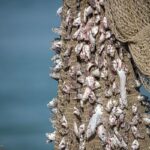
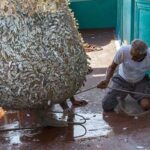
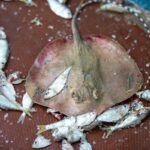
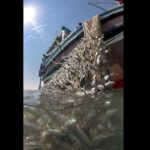
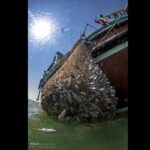
Shrimp hunting on Qeshm Island (PHOTOS)

Shrimp hunting_0

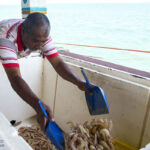
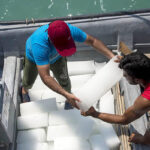
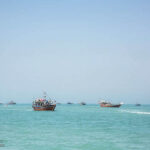
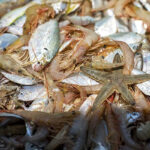
Hormozgan Province in the south is one of the shrimp farming hubs in Iran with great potential in raising and hunting shrimp which is a low-calorie food but rich in nutrients.

The following are the pictures Mehr News Agency has released on shrimp hunting on Qeshm Island in Hormozgan Province:

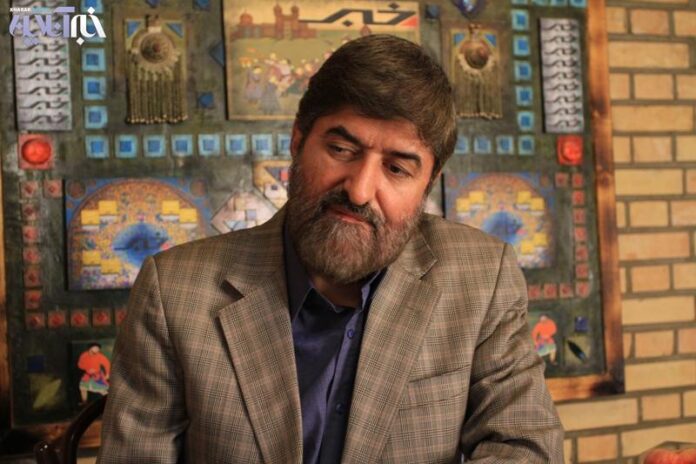
Having ties with US is not bad, but time is not ripe: MP

Ali Motahari

Tehran MP Ali Motahari has said that student movements are as much needed now as before the revolution, citing the fact that the establishment needs to be critiqued at all times and that the absence of such criticism renders the governments corrupt.

He recalled the comments of Imam Ali, the first Shiite Imam, his own father Martyr Morteza Motahari [a prominent philosopher] and the Supreme Leader in praise of critiquing and said, “Those who go about critiquing others should be fair and have thorough knowledge about the field they are commenting on, and their critical comments should be well-intentioned.”

He said that critiquing is a happy medium between fawning on the one hand and mudslinging on the other.

The following is the translation of what Khabaronline.ir, a news website, quoted the principlist MP as telling a gathering on the Islamic Revolution Discourse and the Student Movement in Qom on October 13:

Freedom and justice as well as political, economic and cultural independence are the ideals that should be monitored by students at all times. The level of freedom in society is not ideal. It is not right to establish red lines for the media.

Although we have been criticizing the West for placing a ban on researching and debating the Holocaust, we have acted in a similar fashion in dealing with the aftermath of the 2009 Sedition [a reference to widespread unrest in the country when two presidential candidates questioned the results of the polls]. Similarly, we have put individuals under house arrest or placed a ban on the coverage of news stories about them without a court order.

We need to act in line with the change in the attitude of American officials, just as the late Imam Khomeini once underlined that the US might come to its senses. No doubt, the rise to power of President Obama has ushered in changes in American attitude. All you need to do is to compare his behavior with President Bush. Obama is more sensible and just. He has a bond with the Muslims, he supports the Zionists, though. He is an intelligent person, because he knew instead of cooperating with Persian Gulf sheikhs in whose countries democracy is non-existent, he’d better reach out to Iran, which is a more moderate regional power with relative democracy.

At the beginning of the revolution Iran was not supposed to cut its ties with the United States. Something happened and relations were severed. Today we have ties with Britain, France, Germany and the like. They are like the US. Having ties with the US is not something bad in nature. It may be helpful, but we need to be cautious about political, economic and cultural infiltration. Of course, time is not ripe for establishment of relations now.

A look at Iranian newspaper front pages on Oct. 14

Iranian Newspapers Headlines

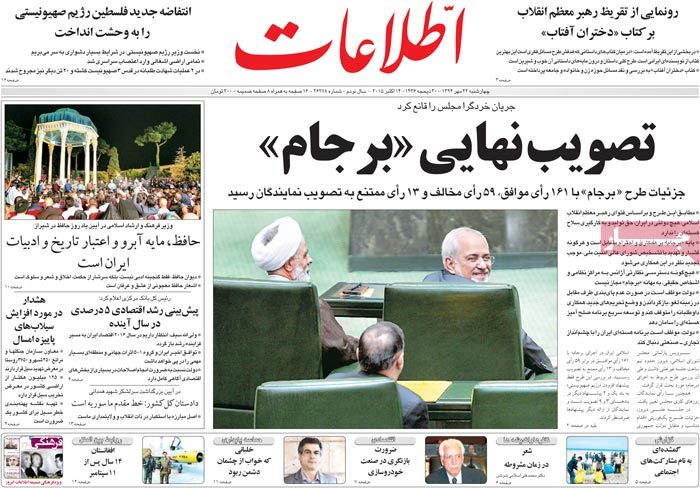
Dominating the front pages of Iranian newspapers on Wednesday were: Adoption by parliament of a bill that allows the Rouhani administration to implement the Joint Comprehensive Plan of Action and the president’s comments about the country’s prospects now that parliament has voted for the Iran nuclear deal.


Ettela’at: The final approval of the Joint Comprehensive Plan of Action

One-hundred-sixty-one MPs voted for the JCPOA bill; 59 voted against and 13 abstained.


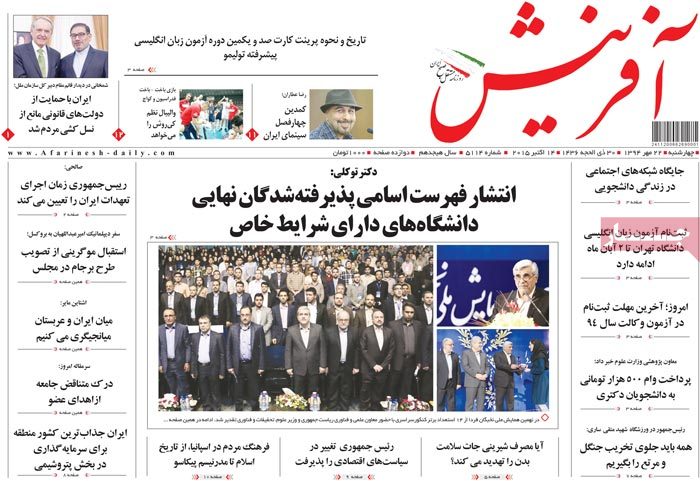
Afarinesh: The president determines the timing for the implementation by Iran of its JCPOA obligations, said the director of the Atomic Energy Organization.


A look at Iranian newspaper front pages on Oct. 14


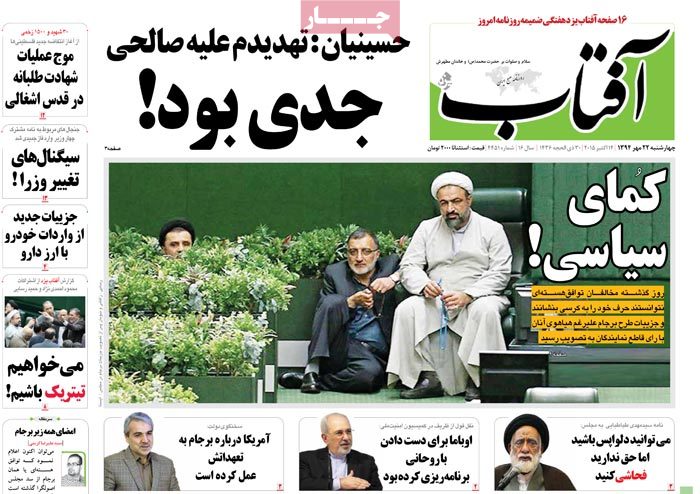
Aftab-e Yazd: Political coma

The opponents of the nuclear deal failed to have it their way yesterday; despite their ballyhoo an overwhelming number of MPs voted for the JCPOA bill.

Aftab-e Yazd: The US has complied with its JCPOA commitments, said the Iranian government spokesman.


A look at Iranian newspaper front pages on Oct. 14


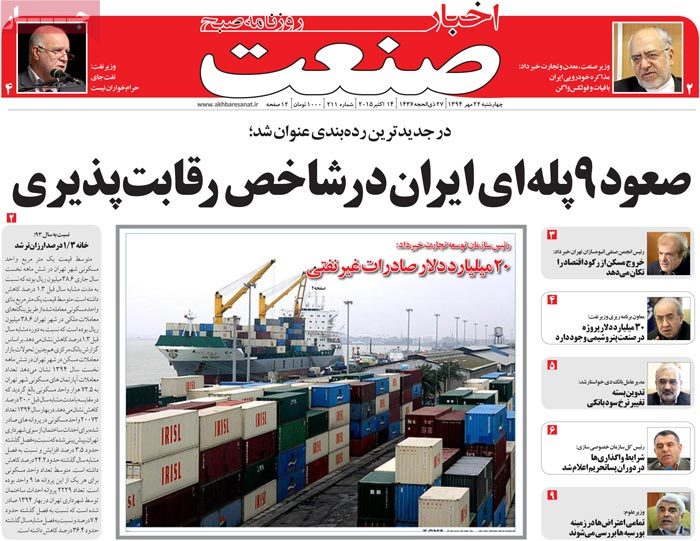
Akhbar Sanat: Iran’s position has improved by nine notches in the new rankings of global competitiveness.


A look at Iranian newspaper front pages on Oct. 14


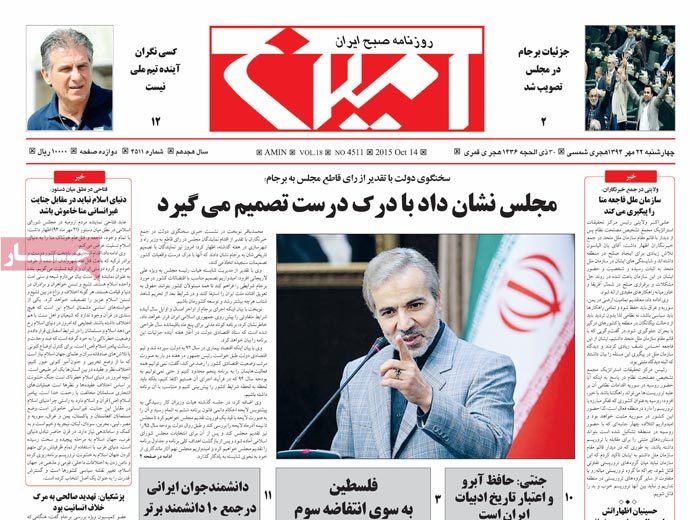
Amin: Parliament showed that it decides prudently, said the government spokesman as he praised the chamber for its overwhelming vote for JCPOA.


A look at Iranian newspaper front pages on Oct. 14


Arman-e Emrooz: President Rouhani: There are only two months to go before termination of sanctions.
In a televised interview, the president said new conditions lie ahead for the country.

Arman-e Emrooz: An almost $270 million fraud involving car imports

Those involved used foreign currency dedicated to imports of medicine to bring in foreign-made cars.


A look at Iranian newspaper front pages on Oct. 14


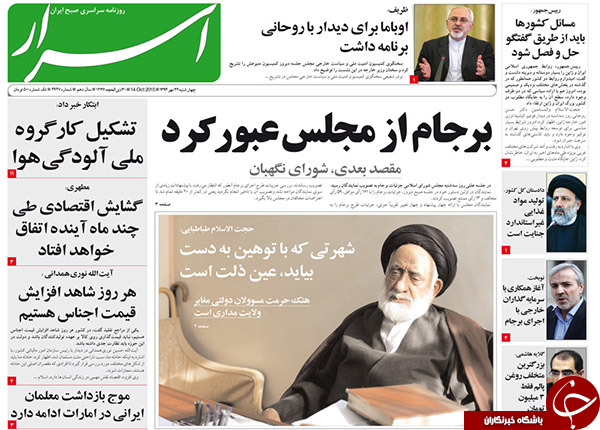
Asrar: President Obama had plans to shake hands with President Rouhani, the spokesman of parliament’s National Security and Foreign Policy Committee has quoted Foreign Minister Zarif as saying.

Asrar: Production of non-standard foodstuff amounts to committing crime, said the attorney general.

Asrar: The wave of arrests targeting Iranian teachers in the UAE continues.


A look at Iranian newspaper front pages on Oct. 14


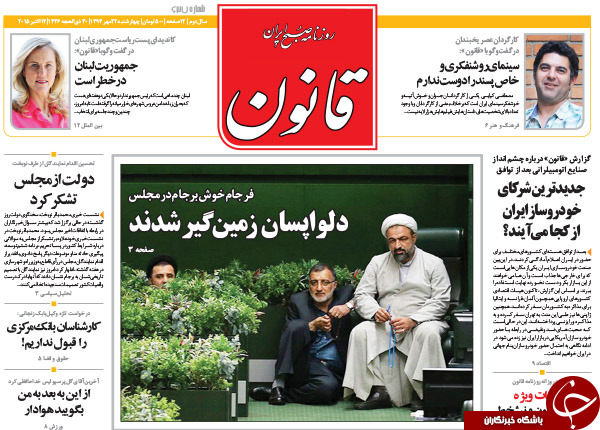
Ghanoon: The Worriers were incapacitated.


A look at Iranian newspaper front pages on Oct. 14


Hemayat: The details of the bill on the implementation of the Joint Comprehensive Plan of Action cleared the Islamic Consultative Assembly in 20 minutes!

Hemayat: The Saudi foreign minister is likely to be replaced soon.

It comes after the failure of the kingdom’s diplomacy.


A look at Iranian newspaper front pages on Oct. 14


Jahan-e Sanat: Iran has prevented genocide in the region, said the secretary of the Supreme National Security Council in a meeting with the visiting deputy secretary general of the UN.


A look at Iranian newspaper front pages on Oct. 14


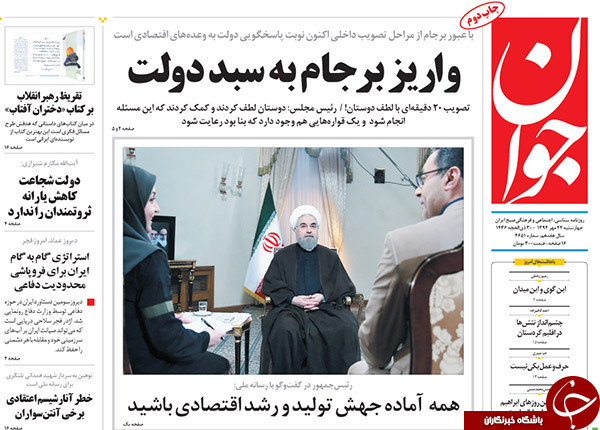
 Javan: JCPOA in government’s basket

Javan: Ayatollah Nasser Makarem Shirazi said that the government is not brave enough to cut the cash subsidies of the wealthy.


A look at Iranian newspaper front pages on Oct. 14


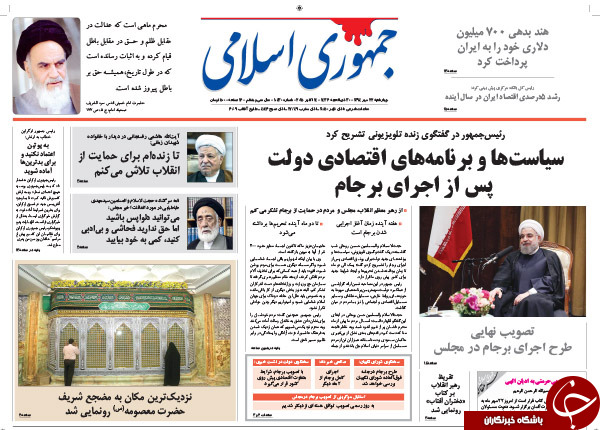
Jomhouri Islami: India has paid its $700 million debts to Iran.

Jomhouri Islami: “You are entitled to be worried, but don’t have the right to be abusive and impolite. Come to your senses,” said Seyyed Mehdi Tabatabai in a letter aimed at critics of the nuclear deal.

The letter by the former MP came in reaction to recent developments [a reference to threats being issued to the foreign minister and the nuclear chief] in parliament.


A look at Iranian newspaper front pages on Oct. 14


Kaenat: Twenty-nine trade delegations from 14 countries have visited Iran.


A look at Iranian newspaper front pages on Oct. 14


Kayhan: Parliament made a decision in 15 minutes for 15 years to come!

Kayhan: The Saudi royal family is auctioning off its assets in Europe to cover the costs of the Yemen war.


A look at Iranian newspaper front pages on Oct. 14


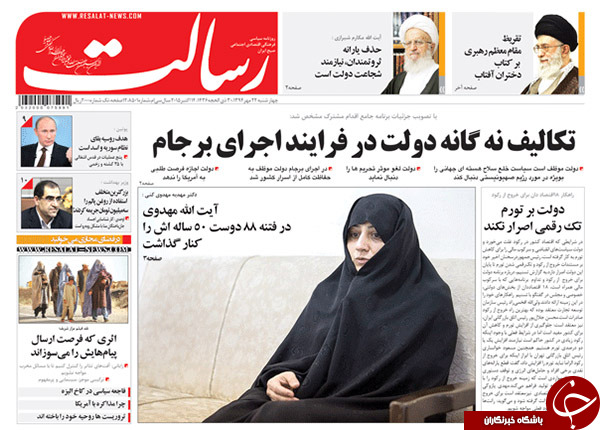
Resalat: The health minister has said that the company that played the lead role in the case involving the unauthorized use of palm oil has been fined only $1,000.


A look at Iranian newspaper front pages on Oct. 14


Rooyesh Mellat: A national air pollution workgroup will be formed soon.


A look at Iranian newspaper front pages on Oct. 14


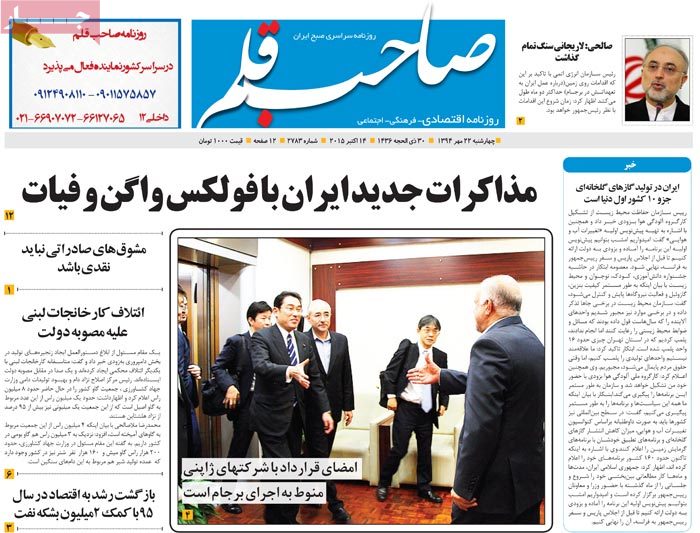
Saheb Ghalam: Iran has held fresh talks with Volkswagen and Fiat.


A look at Iranian newspaper front pages on Oct. 14


Shahrvand: The president has said the stage is set for an economic leap.


A look at Iranian newspaper front pages on Oct. 14


Sharq: The establishment has decided to implement the Joint Comprehensive Plan of Action.

It came after Speaker Ali Larijani acted prudently and a majority of MPs voted in favor of the nuclear deal.

Sharq: “Babak Zanjani [the young billionaire who is on trial for corruption] has not paid back a single cent [of the billions he has allegedly siphoned off],” said the director of the Legal Department of the National Iranian Oil Company.


A look at Iranian newspaper front pages on Oct. 14


Iran president praises parliament bill endorsing nuclear deal

Rouhani-TV

President Rouhani has hailed the parliamentary bill endorsing Iran’s landmark nuclear agreement with six world powers.

In a live televised interview on Tuesday, President Rouhani thanked lawmakers for adopting a bill which gives his administration the go-ahead to implement the Islamic Republic’s nuclear deal with six world powers, known as the Joint Comprehensive Plan of Action (JCPOA).

He said Iran and P5+1 start implementing the agreement next week, three months after the UN Security Council endorsed the agreement.

Parliament on Tuesday approved a bill which allows the administration to voluntarily implement its July 14 nuclear agreement with P5+1 under certain conditions.
The outlines of the bill were approved in parliament on Sunday.

Iran’s Guardian Council is set to examine the bill on Wednesday before signing it into law.

Under the Iranian Constitution, the Guardian Council, a 12-member body consisting of six Islamic law experts and six jurists, is tasked with vetting legislative and presidential candidates, supervising elections and overseeing the bills passed in parliament for conformity with the Constitution and Islamic principles.

[…]

Sanctions-defeating policies

The president pointed to the illegal US-led economic restrictions against the Islamic Republic, saying, although trade and oil bans had not been unprecedented, Iran was the first country in the world to be subjected to banking sanctions.
Rouhani said his administration’s economic policies had caused the West to realize that imposing sanctions against Iran was ineffective, adding that this also gave the country the upper hand in the nuclear negotiations with P5+1.

“The administration’s measures carried the message that the sanctions would no longer be effective. Why were the sanctions lifted? Because they saw that the sanctions were no longer effective,” said the president.

“We will see the effects of sanctions relief in our economy,” said Rouhani.

He noted that the unprecedented fall in oil prices was also a plot to make Iran step back from its demands throughout the nuclear talks. But, the president said, this scheme failed too.

Rouhani referred to his administration’s economic policy for curbing the country’s inflation. He said that his administration managed to slash inflation which stood at over 40 percent in 2013 to around 15 percent the following year.

The president said his administration would continue the same inflation curbing policy in the future.

Rouhani said Iran is expected to gain $25 billion from selling oil this year, the lowest in ten years. The president added that Iran’s oil revenues reached $119 billion in 2011 when his predecessor Mahmoud Ahmadinejad was in office.

He added that the expected sanctions relief would let Iran sell oil without any restrictions in the coming years.

Need for Hajj stampede clarification

President Rouhani once again expressed his condolences over the September 24 deadly crush during the Hajj rituals in Mina, near the holy Saudi city of Mecca, and said the causes of the tragic incident should be clarified for the Muslim world and the Iranian nation.

He added that the clarification of the aspects of the Mina stampede would prevent the recurrence of such incidents in the future.

Rouhani said the tragic incident showed lack of foresight on the part of Saudi rulers which led to the deaths of thousands of men and women from across the Muslim world, including Iran.

According to tallies given by foreign officials, the death toll from the deadly Mina stampede has reached 1,674.  The Saudi kingdom, however, has yet to provide a complete report on the tragedy including an update on its earlier death toll of 769.

Officials at Iran’s Hajj and Pilgrimage Organization say about 4,700 people, including 464 Iranians, lost their lives in the tragedy.

Implementing JCPOA opens way for foreign investment: Nobakht

Nobakht-Press

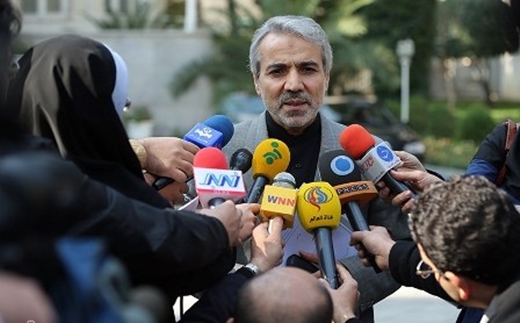
Director of the Management and Planning Organization Mohammad Bagher Nobakht said Tuesday that implementation of the Joint Comprehensive Plan of Action will mark the beginning of cooperation with foreign companies and investors.

Since the government has initiated the resistance-based economy which requires boosting non-oil exports, the economy needs joint investment, Nobakht said after a meeting with the Japanese foreign minister.

“We also need modern knowledge and technology to secure our share of the world markets. Iran’s share of the world markets which has now reached its minimum level should be increased,” he said, adding, “We select the countries for investment which have modern technology to help create markets for Iranian exports.”

Nobakht, who also serves as the government spokesman, said that the Japanese companies have voiced their readiness for cooperation with Iran in the post-sanctions era. They enjoy the advantage of having a good image in the Iranians’ historical memory compared with other countries.

He said that the Japanese companies have capabilities in different fields and thus could be a suitable economic partner for the Iranian firms.

Nobakht said that the Japanese delegation has been told that Iran is not an 80-million market for foreign exports; rather it is a big factory for producing valuable goods in collaboration with various companies under joint venture deals.

The Japanese companies are interested in direct investment in Iran, given Iran’s capacities, they can undertake activities in jointly-run plants and roll out high-quality products, he added.

Leader aide urges immediate end to wars in Syria, Yemen

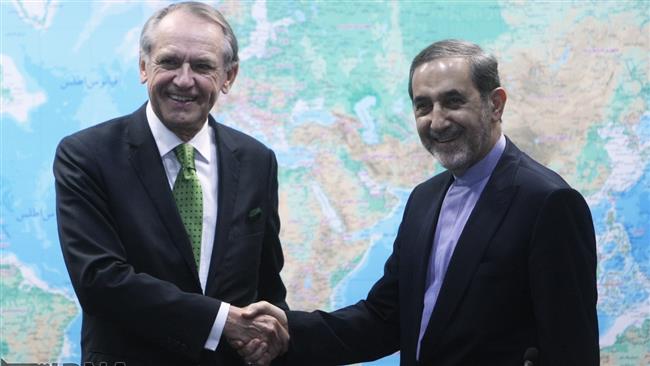
Velayati-UN

A senior Iranian official has called for an immediate end to ongoing conflicts in Yemen and Syria, saying these countries are bogged down in critical conditions.
“War in Yemen and Syria must end quickly and we must exhaust [our potential] in favor of establishing peace,” Ali Akbar Velayati, a foreign affairs advisor to Leader of the Islamic Revolution Ayatollah Seyyed Ali Khamenei, said in a meeting with United Nations Deputy Secretary General Jan Eliasson in Tehran Tuesday.

“Terrorists from more than 80 world countries are present in the [Middle East] region and have engaged in a war against legitimate governments in the region through forming extremist groups,” he added.

Velayati also said that Saudi Arabia is conducting airstrikes on residential areas across Yemen and damaging the country’s infrastructure.

[…]

The UN envoy, for his part, pointed to the critical situation in the Middle East and urged more efforts to establish peace and security in the region.

Eliasson said the UN would spare no efforts to improve peace and security in the region.

UN inaction on Yemen war unacceptable

Secretary of the Supreme National Security Council (SNSC) Ali Shamkhani said the UN failure to show serious reaction to foreign intervention in Yemen is “unacceptable.”

At a meeting with Eliasson Tuesday, Shamkhani said that the United Nations refrained from taking decisive action to end military aggression, arms supply and financial aid to terrorists as well as suppression of Muslims in the occupied Palestinian territories. Such failures raise serious questions about the UN performance.
The SNSC secretary added that Iran has staved off the spread of terrorism and genocide in Syria and Iraq by supporting the legal and popular governments of Syria and Iraq.

“Western countries must change their approach toward the establishment of lasting security in the region through a genuine fight against terrorism,” Shamkhani said.

The UN deputy chief, for his part, hailed Iran’s efforts in settling refugees over the past decades and said Iran’s experience is needed for dealing with refugee crises in other countries.

Political solutions needed

Iran’s Foreign Minister Mohammad Javad Zarif also met with the UN official, stressing the importance of solving the ongoing crises in the region through political approaches.

He said that the intensity of the regional crises is directly linked to the conduct of political leaders in the region.

“The realities of the region must be discussed in a realistic way,” Zarif said.

He added that all world countries must prioritize countering threats posed to regional countries.