Wednesday, April 8, 2026
Home Blog Page 5121

Russia builds 5 power plants for Iran

Iran and Russia Russia builds 5 power plants for Iran
Russia builds 5 power plants for Iran

Two months after signing an agreement between Islamic Republic and Russia, Technoprom and ministry of energy met in the new rounds of talks on planning, installing, and operating of 5 power plants commissioned in Tehran- Moscow $ 10b agreement.

A Technoprom deputy-Director General who was visiting Eastern Azerbaijan province power plants told the press that the firm had constructed Ahvaz’s Ramin 2100 mW and Isfahan’s Shahid Montazeri 1600 mW power plants. “Russia is prepared to construct a new 1725 mW power plant in the province,” he said. “If the talks are positive, Technoprom will construct 5 power plants in the vicinity of Sahand power plant in Bonab and Tabriz power plant,” he said, asserting that “the province is an industrially-growing region, which necessitates adding to the number of power plants.”

Technoprom official also assessed Iran as a ‘pioneer’ country in the Middle East in terms of power plant technology and facilities. “Russian Technoprom has the technical capability to construct natural gas-fired combined-cycle power plant, steam, geothermal turbines, boilers, and supply of spare parts and small units,” the official said.

‘Ganjineh’ teaches ‘proper social behavior’

Iranian Ganjineh animation

The animation (Persian for ‘treasure’) is a product of Saba Animation Center. Each episode of the animation focuses upon social maladies, and tries to rectify the social vice through delineation of good and bad behaviors.

The animation is a silent 2D work where it conveys messages through audio, music, and image to the audience. Small simple paper characters are the main cast of the animation which depicts great concepts in simple words.

The animation uses simple, ironic, and symbolic graphics, and would be appealing for both children and adults alike. It features a host of topics including respecting the law, security, social discipline, solidarity, productivity, social equality, cooperation, education, welfare, class conflict, street traffic, science and technology, economics, and capital.

Produced by Saba Animation Center, Ganjineh targets the public audience. It has participated in main section of 30th Short Film Festival and 100-second very short film festival. The animation was awarded with the first prize in 1404 Arts Festival.
 

Daesh and Iraq

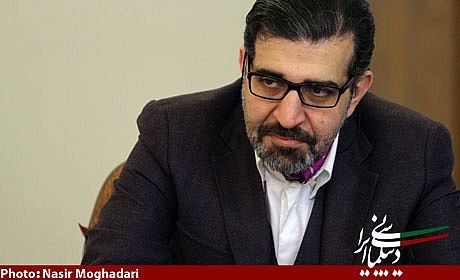
mohammad sadegh kharazi

Since some time ago, Iraq and the Levant are burning in a fire of lies, treason, and conspiracy. Muslims are trapped by the rage of the earth. It seems as though blood, misery, pain and suffering have surrounded them. What is happening in Iraq these days and what happened in Syria before is a crime which unfortunately has become a common phenomenon. The creation of Daesh more than a year ago needs to be seriously studied. A deeper look at this group without any prejudice shows that the indifference of the world powers with regard to the oppressed people of Syria and Iraq, the shameful unity of some of regional governments including Turkey, Saudi Arabia and the UAE, the paradoxical behavior of the US and Britain, and the ambitions of the Ba’athist way of thinking in this area have all played serious roles in this matter. It would seem appropriate to patiently study the marginal issues of this matter which are sometimes more important than the main issue itself. Either the US’ political, military and security systems have differences with each other or they are based on paradoxical behaviors. At the height of the Mosul massacre, President Obama appeared indifferently on US television networks and stated that this is Iraq’s domestic issue and the result of their political differences and so long as these differences are not resolved and the dissatisfaction of the Sunnis and their non-participation in the social scene are not redefined one cannot be optimistic about a serious plan although there are options of military and security cooperation. After a few hours, the catastrophe worsened and the Takfiri Daesh terrorist group interpreted Obama’s speech as US support for this group with the strategy of silence, thus, increased the scope of its crimes against the people. The US Secretary of Defense immediately studied the situation in Iraq and the Pentagon Spokesperson invited all of Iraq’s neighboring countries and the countries of the region, including Iran, to support the legitimate government of Iraq and take positions against the behavior and advances made by Daesh and enter the scene. Hagel gave orders to the Chief Commander of the US forces in the region in the Oman Sea and the Persian Gulf and also to the Incirlik Air Base in Turkey and its central base in Kuwait to remain in complete readiness and ordered the US warship to move towards the Persian Gulf and Iraq. Besides having remote control systems by air, space and sea, this ship has long-range missiles and 560 operational forces and 256 special guards to defend and support the US embassy in Baghdad. The US Chief Commander ordered the US drones to help the Iraqi army when they attempt to attack the positions of Daesh. Immediately, John Kerry, the US Secretary of State, took an official position with regard to the future of Iran-US negotiations and with regard to Daesh while confirming the state of readiness for the US Army.

The US’ security and military forces are extremely concerned about the phenomenon of the new al-Qaeda, Daesh, and their radical and harsh slogans. Treason, inconsideration and the games played by the politicians will be another trap for US security inside and outside of these countries and the region. History has shown that the Takfiri groups can never be trusted. It is surprising how the US President and the British Prime Minister and some western officials are influenced by the information given by the security and intelligence institutions of Saudi Arabia, Turkey and the UAE and remain silent against all of these bitter events whose firm objective is the suppression of their regional forces. The same positions in Pakistan and Afghanistan led by the ISI and the security systems of the Arab states and al-Qaeda and the Taliban once caused George Bush and the security and military system of the US to take positions against Iran. It was very regretful that at that time they were not able to realize Iran’s extra-territorial capacity and they know well that if Iran had not helped in the suppression of al-Qaeda and the Taliban, the US would have been drowned in the blood bath of Afghanistan.

Another important point is the support of the intelligence systems of Saudi Arabia and Turkey for Daesh and propaganda for this group and the creation of a psychological war to revive their spirit. It is interesting to note that the incident of the occupation of the Turkish Consulate in Mosul was only a deceitful act. The Turkish Consulate in Mosul is Daesh’s central command room in the occupation of this city and the staff of the consulate have not been taken hostage, but are rather protected by this group and those who were announced to have been taken hostage are the ones who sent missiles and weapons to Daesh forces.

The hospital located in the border between Turkey and Iraq is the hospital for Daesh forces and the issue of the occupation of the consulate is a mere lie. The interesting point is that Turkey has supported the al-Nusra Front and Daesh in Syria during all this time. A few days ago, the Syrian army forces in the southeastern part of Damascus attacked a base and found documents which showed that the members of the al-Nusra Front had achieved 16 pipes of sarin chemical gas through a senior Turkish security officer from the Bulgarian black market, each one of which was capable of poisoning 500 square meters. These poisonous pipes were supposed to be used in the swearing-in ceremony of Bashar Assad a few days ago via mid-range missile thrown towards the center of Damascus.

Saudi Arabia has used all of its financial, military and propaganda possibilities against the government of Noori al-Maleki. All of the media which is supported by Saudi Arabia including al-Arabiya, al-Hadas, al-Sharghiya, al-Babeliya and al-Rafedin pursue the same line and state that Daesh is not a small group and this is the revolution of the deprived tribes and ethnic groups of Iraq. They constantly interview them and create psychological wars. It is interesting that during the past 4 days they have been stressing that Tal Afar, which is a strategic city located between Syria and Mosul has fallen into the hands of the revolutionary nomads with 200000 residents. 45% of the population of this city are Shiites, 42% Sunnis and 7% Kurds and non-Muslims. The MKO in Iraq, the Arab media in the region, Saudi Arabia, BBC and some of Turkey’s media outlets claim that this is a popular revolution when Daesh criminals massacre more than 1700 people in Tikrit, the majority of whom were the university students of the Iraqi Air Force and were Sunnis. News of this crime was censored in the media. Since the entrance of the terrorist Ba’athist forces of Daesh, 12 mosque preachers have been executed. The majority of the heads of the Sunni nomad tribes have now joined the military forces of the government. The fatwa of Jihad issued by the religious scholars in Iraq caused the army to regain its confidence. More than two million people have registered under the name of the Alawi Basij. With this religious decree and other new developments in Iraq wherein Daesh has lost some of its positions, the Ba’athist group, under its new name, the Naghshbandi Army, commanded by Izzat Ibrahim al-Douri, Saddam’s First Deputy who is now the leader of the Ba’ath Party, have clashed with the Salafis of Daesh which led to the killing of more than 24 senior forces of Daesh and the son and son-in-law of Izzat Ibrahim. Abu Musab al-Zarqawi’s younger brother has also been arrested in one of the army attacks. Ali Ghaidan, the commander of the ground forces, and Abboud Ghanbar, the commander of Iraq’s army operations ,who, along with 500 forces, had fled to Erbil from Mosul have been arrested and transferred to Baghdad. The interesting point is that both commanders who have committed treason against the people and government of Iraq were considered as Saddam’s loyal forces until 2003.

I would like to attract the attention of the respected readers to the point that the Daesh group has a Nasebi, Salafi and Ba’athist ideology with blood-thirsty behavior and was formed by Saddam’s loyal forces and the leaders of the Ba’ath party of Iraq and Syria and is financially supported by Saudi Arabia, Turkey and the UAE and there are deep ideological differences between Abu Bakr Baghdadi, Izzat Ibrahim and all the Ba’athists and Takfiris but they all pursue the same objective. That objective is to destroy the resistance in Iraq and Syria and Iran’s dominance in the Middle East. Could it be said that the political, security and military forces of the West are dissatisfied with such horrific phenomena? It is up to the readers to judge!

US Demands Flexibility from Maleki, not Resignation

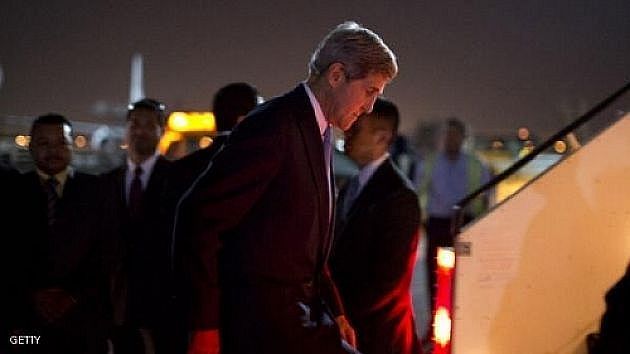
John Kerry
John Kerry

Why doesn’t the US enter into a war with Daesh? Is it because, based on statements made by Senator Rand Paul, one of the influential faces of the US Republican Party, this terrorist group is supported by the US and according to him “We have been united with Daesh in Syria”?

There are two reasons behind the US’ unwillingness to enter into a direct war with Daesh. The first is that the Obama administration’s policy, in general, is defined based on not entering into a direct war with the developments of the region. Contrary to the Bush administration, which pursued an aggressive approach in its foreign policy in the Middle East and sought preemptive wars, the Obama administration attempts to be less involved in the crises of the Middle East. As a result, in 2011, it withdrew the US’ forces from Iraq and did not insist on the continuation of the presence of these forces in this country. In another case, it was obvious that the US was not interested in direct military confrontation in other crises including the crisis in Syria. That is why it did not pursue such an approach with regard to Iraq either. Despite the fact that the US has considered Daesh as a terrorist threat and it is ready to give ammunitions, advice and intelligence information to the government of Iraq, they are not interested in becoming directly involved in a war with Daesh with the presence of its military forces. The other point is that the US sees this issue as going beyond the presence of Daesh in Iraq, because Daesh is not merely the Daesh in Iraq and many of the regional countries including Saudi Arabia and Turkey and some Arab states consider themselves involved in the developments of Iraq. This issue has somehow been transformed into a Shiite-Sunni issue. That is why any type of expanded US intervention could have a negative impact on the relations of this country with its regional allies such as Saudi Arabia and Turkey. That is why they are less interested in taking direct military measures.

During the past few days, some of the news media have talked about the possibility of the US’ removal of its support for Noori al-Maleki and some of them have even claimed that John Kerry has proposed the issue of him stepping down in his visit. Is Maleki still the best choice for the US in Iraq or are they thinking about bypassing him?

The US’ criticisms are against Maleki and his policies and they were increased after the crisis. Nonetheless, the US did not directly mention Maleki’s resignation, because under the present conditions, the change of the prime minister might affect the arrangement and the actions of the armed forces in Iraq. That is why the removal of Mr. Maleki in the short run is a difficult decision and they are not emphasizing that he should step down in a short period of time. But the US believes that the political forces and Mr. Maleki must be more flexible and form the government of national reconciliation through political dialogue and solutions so that they would be able to act more successfully in their military measures against Daesh based on the alignment between political forces.

To what extent would the fatwas of the Shiite scholars, particularly Ayatollah Sistani, and the enlistment of two and a half million people in the army to fight against Daesh impact the US’ approach with regard to Iraq?

The US approach in Iraq after 2003 was to emphasize democratic political solutions. On one hand, considering the fact that the majority of the Iraqis are Shiites, the US believes that it cannot easily ignore the Shiites in this country and doing so would practically lead to the defeat of the political process in this country. Now they consider this point and believe that the situation and the interests of the Shiites cannot be ignored. Nevertheless, they attempt to establish some type of balance between the ethnic and religious groups so that the minorities would somehow have an effective presence and serious participation in the political trends of this country. Certainly, the Maraje’ and the fatwas and statements that are issued impact the decisions made by the US. The US is well aware of the impacts of the viewpoints of the Shiite scholars on the people of Iraq and the developments of this country.

One Republican senator has said that the US becomes less involved in this region because, although Ghaddafi was overthrown in Libya, this country became the land of the terrorists. Is the decision to not directly get involved in Iraq made due to this viewpoint?

The US involvement in Libya was not similar to France’s direct intervention. In fact, they did not become directly involved in Libya as they did in Iraq in 2003 or Afghanistan in 2001. This is the dominant viewpoint of the Obama administration which is shown in the region. Right now, the US is more inclined towards eastern Asia and balancing itself against China and believes that it is not clear whether the issues will be resolved through their involvement in the Middle East. The reason is that these crises are very complicated and deep and must somehow be coped with.

It seems that the Sunni countries of the region are not interested in fighting against the Daesh forces. Even Vali Nasr, in an interview with CNN, has stressed that the Sunnis are satisfied with the killing of the Shiites by Daesh. Meanwhile, Barack Obama has said that he is not solely able to contain Daesh. In such an atmosphere, is cooperation with Iran the only option?

There is no united viewpoint among the Arab states. Some countries like Saudi Arabia and to some extent Turkey and Qatar consider Daesh as a force which could disrupt the balance in the region against Iran. At the same time, considering the situation which existed in Syria and their failures, they intend to use the Daesh forces at a regional level. Therefore, they consider Daesh as one of the opposition groups and the Sunni revolution against Mr. Maleki and his policies as the reason behind the crisis in Iraq. Some countries are concerned about the threat of Daesh and terrorism in Iraq. Kuwait is one of them which the Daesh forces could rapidly move closer to. The same holds true for Jordan and Egypt. There are such viewpoints with regard to Daesh among the Sunnis.

Could the deepening of the crisis in Iraq force the US to return to this country within the framework of supportive and not aggressive military forces?

This seems impossible. The US will, at most, engage itself in air strikes in order to target the positions of the Daesh forces; unless the conditions change and the threat of Daesh increases to the point that the threat of the downfall of the government would be imminent. In that case, they might make new decisions. But it seems impossible that, under the present conditions, the US would be willing to enter its military forces into Iraq, even supportive ones.

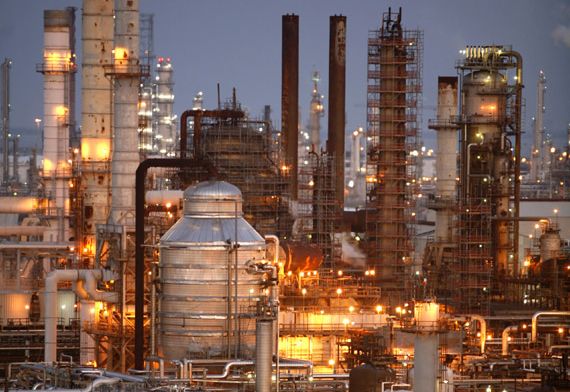
IRGC Commander: Enemies Lack Courage to Invade Iran

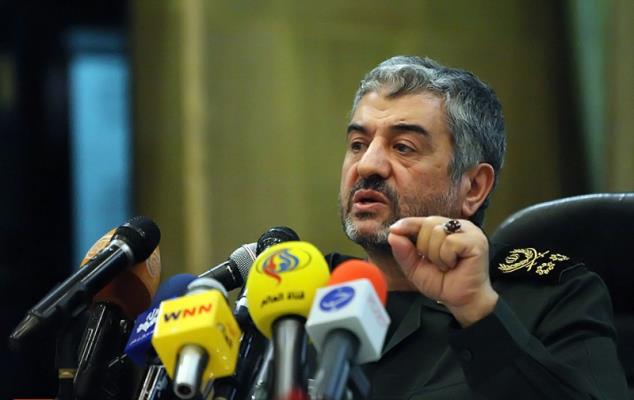
IRGC Commander Aziz Jafari : Enemies Lack Courage to Invade Iran

Addressing a cultural ceremony on Monday, Major General Mohammad Ali Jafari said Iran is now regarded by many of the world countries as a “stable island in an insecure region.”

The commander explained that such a high degree of security in Iran emanates from its success to thwart the plots hatched by the enemies, who he said sough to destabilize the country by imposing an eight-year-long war in the 1980s.

The US used the September 11 as a pretext to invade Afghanistan and Iraq, Major General Jafari noted, saying it had plotted to invade Iran afterwards.

But, he added, the US became disheartened to attack our country when it realized the full preparedness of the Iranian armed forces to defend the country.

Amid the escalating security situation in neighboring Iraq, Iranian security officials have ensured that no security problem exists at the borders.

“There is no particular problem along our common border with Iraq, however, the necessary measures have been taken by the Interior Ministry and border police” Iran’s Interior Ministry spokesman, Hossein Ali Amiri, said on Monday.

In early June, following its large-scale offensives in Iraq, the so-called Islamic State in Iraq and the Levant (ISIL) seized control of most parts of Mosul, the second most populous city in Iraq, its surrounding Nineveh province. ISIL militants have been in control of Fallujah city since December.

The terrorists’ attacks have reportedly forced more than half a million people in and around Mosul, the capital of Nineveh Province, to flee their homes.

The Takfiri militants have vowed to march toward the capital, Baghdad.

They are said to have entered Iraq from neighboring Syria and Saudi Arabia to destabilize the Arab country.

Iraq unrest plot against Muslim world: Iran FM

Iran, Japan Confer on Ways to Broaden Ties
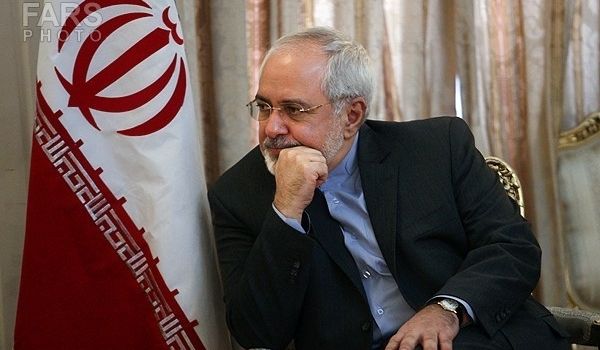
Iran FM Japan ties

The Iranian foreign minister made the remarks on Monday in a meeting with Sudanese Minister of Human Resources, Development and Labor Ishraqa Sayed Mahmoud.

Referring to the ongoing crisis in Iraq, Zarif said, “What is happening is a foreign conspiracy with the aim of preventing the strong presence of the Muslim world in the arena of regional and international developments.”

Zarif added that Islamic countries must be vigilant and have a strategic view on the developments, noting that they should not allow enemies to sow seeds of discord among them.

The Iranian official further pointed to the relations between the two countries and said, “We have a strategic view of the relations between the two countries, and highly value our ties with the Sudanese government and people.”

The Sudanese minister, for her part, called for further cooperation among Muslim nations, particularly Iran and Sudan, in the face of common challenges.

“Nothing can disrupt the trend of the age-old, friendly and brotherly relations between the two Muslim countries and Sudan will always remain allied [to Iran] and stand by Iran,” the Sudanese official added.

Militants of the so-called Islamic State of Iraq and the Levant are wreaking havoc on Iraq.

Iraqi Premier Nouri al-Maliki has repeatedly said that Saudi Arabia, Qatar and some other Persian Gulf Arab states are supporting the militancy in Iraq.

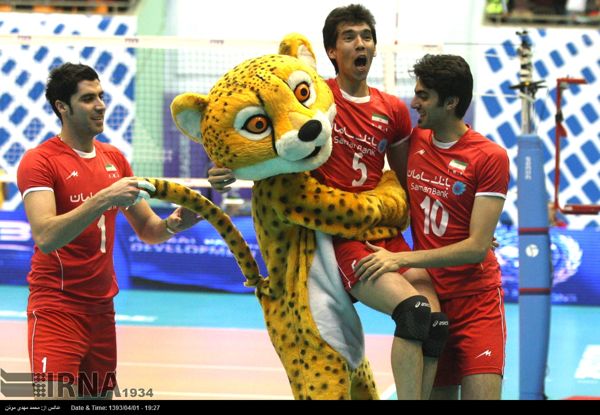
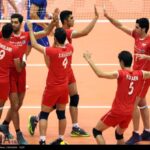
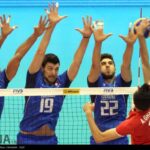
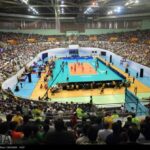
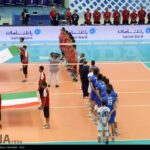
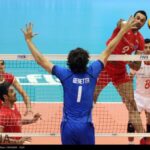
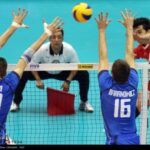
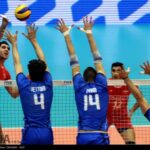
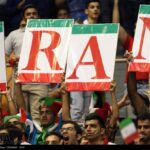
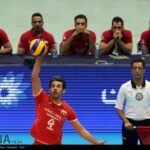
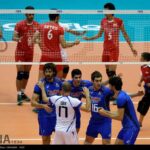
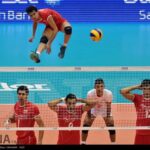
Iran Beats Italy in Volleyball World League

Iran Italy volleyball match world league


Iran won in the first, second and fourth sets, but lost in the third set.

The results were 25 to 22, 25 to 19, 25 to 20 for Iran and 25 to 19 for Italy.

Iran had already lost two matches to Italy in the second week of the league in Rome.

The next match of Iran in the preliminary competitions of Volleyball World League is with Poland.The two teams will play four times with each other, 2 in Tehran and 2 in Warsaw.

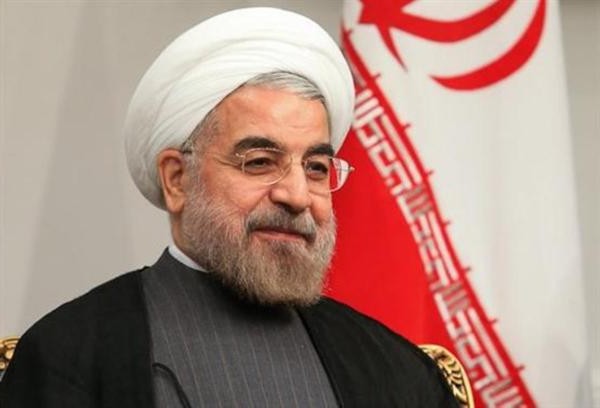
President thanks Iranˈs national football team

President thanks Iranˈs natˈl football team

The Iranian president in his message said that the Islamic Iranˈs brave youth once again proved their will and meritocracy to the world.

I hereby thank the assiduous football players of Iranˈs national football team and their technical managers who with their heroic performance made the Iranian nation happy and created astonishment,ˈ President Rouhani said.

Although Argentina scored at the last minute, but your beautiful performance in 90 minutes and the hope that you had until the last minute to the victory was a source of honor. More power to you elbow. I pray to God for your further success,ˈ he added.

Queiroz: Two personalities in the game made the difference! The referee and Messi

Iran Argentina world cup

The Iranians missed several chances for netting the ball, and a goal from Lionel Messi sealed a victory for the South American side.

Iran resisted Argentina’s pressure for 90 minutes and seemed destined for another draw at the tournament until Barcelona star Lionel Messi scored Argentina’s winner in the 91st minute of the match on Saturday.

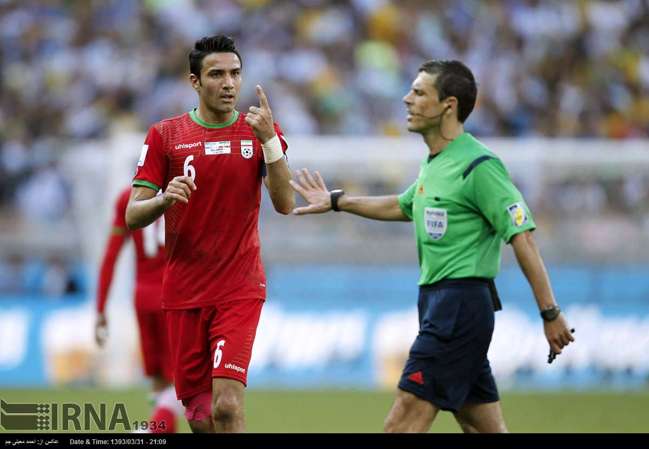
To much surprise the Serbian referee overlooked the Argentinesˈ tackle in the box which brought down Iranˈs Ashkan Dejagah.

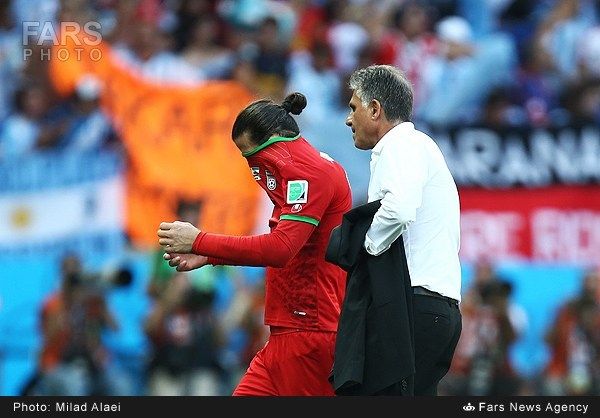
Iranˈs manager Carlos Queiroz criticized the referee, saying the fate of the match was determined by him and Messi.

The chance is still much in play for Iranˈs national football team, but now theyˈll almost certainly have to beat Bosnia-Herzegovina in their last match on Wednesday.

Iranˈs Javad Nekounam and Masoud Shojaei earned a yellow card in this match.

Argentina leads Group F with six points, while Iran and Nigeria have one each and Bosnia-Herzegovina have zero point before the last match of group F in the second round between Nigeria and Bosnia.

Argentina play Nigeria and Iran play Bosnia-Herzegovina in group F on Wednesday.

Argentina advanced into the final 16 of the World Cup with six points. The South Americans opened their campaign with a 2-1 win over Bosnia-Herzegovina.

In the opening 45 minutes, Argentina made several attempts in Iran’s half which were blocked by Iran’s defenders and goalkeeper Alireza Haghighi.

Iran held the match well in the second half and managed Argentina’s heavyweight attacks.

Right after the break, the Iranian squad caught Argentina off-guard with a Reza Ghoochannejad header that very nearly rattled the South Americanˈs net.

In the 56th minute of the match, Ashkan Dejagah was tackled by Manchester City right-back Pablo Zabaleta inside the Argentina box. Replays showed that Zabaleta did not get a touch to the ball and that Iran should have had a penalty.

Dejagah, the Fulham star, almost scored Iran’s first goal in the 67th minute. But Argentina goalkeeper Sergio Romero tipped Dejagah’s header over the bar.

Iran missed another brilliant chance in the 86th minute after Ghoochannejad lumbered through on goal at the other end after a splendid pass from the substitute Alireza JahanBakhsh. His shot was saved by Romero.

Iran’s coach Carlos Queiroz told reporters right after the match that two people made the difference in the match, the referee and Messi.

The match was the first World Cup encounter between Iran and Argentina. The two had played a friendly match in 1977 in Madrid, with the game ending 1-1.

Iran won its first point of the games in a goalless match against Nigeria on June 16.

The three-time Asian champions are back at the FIFA World Cup after it missed the 2010 tournament in South Africa.

Iran Defeated by Argentina after Referee Mistake against Queiroz’s Men

Iran Argentina world cup

The Iranians missed several chances for netting the ball, and a goal from Lionel Messi sealed a victory for the South American side.

To much surprise the Serbian referee overlooked the Argentines’ tackle in the box which brought down Iran’s Ashkan Dejagah.

Iran’s manager Carlos Queiroz criticized the referee, saying the fate of the match was determined by him and Messi.

The chance is still much in play for Iran’s national football team, but now they’ll almost certainly have to beat Bosnia-Herzegovina in their last match on Wednesday.

Iran’s Javad Nekounam and Masoud Shojaei earned a yellow card in this match.

Argentina leads Group F with six points, while Iran and Nigeria have one each and Bosnia-Herzegovina have zero point before the last match of group F in the second round between Nigeria and Bosnia.

Argentina play Nigeria and Iran play Bosnia-Herzegovina in group F on Wednesday.

Iran’s lineup in the match:

Goalkeeper: Alireza Haqiqi

Defenders: Jalal Hosseini, Amir Hossein Sadeqi, Pejman Montazeri, Mehrdad Pouladi

Midfielders: Javad Nekounam, Andranik Teymourian, Ashkan Dejagah, Masoud Shojaei, Ehsan Hajsafi

Forwards: Reza Ghoochannejhad