Wednesday, December 24, 2025
Home Blog Page 4704

A message of seriousness: Iran sanctions should be terminated

Frank-Walter Steinmeier

The German foreign minister has said that his Tehran trip carries one key message: the world is seriously pursuing efforts to terminate sanctions against Iran.

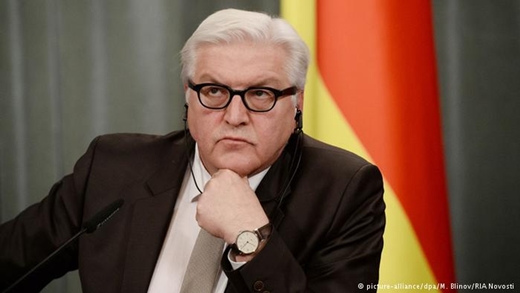
Foreign Minister Frank-Walter Steinmeier arrived in Tehran on Saturday to talk with Iranian officials about the outlook of Iran’s ties with the world after the Joint Comprehensive Plan of Action (JCPOA) and Berlin-Tehran ties. Prior to his trip he said in an exclusive interview with Iran newspaper on Friday that by clinching the Iran nuclear deal, all negotiating countries showed they have the political will to end the nuclear dispute and open a new chapter in their ties. The following is the translation of the interview in its entirety:
 

A message of seriousness: Iran sanctions should be terminated


Q: Has a new chapter opened for Iran and Germany in their diplomatic ties?  

A: This is the first official visit of a German foreign minister to Iran in more than ten years. There is a long list of issues the two sides can talk about, among them: implementation of the Vienna nuclear accord, exchange of political viewpoints, boosting economic ties and developing cultural exchanges. We have opened talks on a cultural agreement. A quick breakthrough can signify that we are seeking to build our ties based on new, bigger foundations.

More than anything else, I hope we can make progress on the ways to reduce conflicts in Syria, Iraq, Yemen and Afghanistan which pose a threat to the stability of the entire region and have resulted in the biggest refugee crisis since the Second World War.

Germany has assumed a heavy responsibility in accepting refugees and offering humanitarian assistance [to stricken people]. Iran which holds political sway in the region has a great responsibility to find a solution to serve the interests of peoples. We believe peaceful coexistence with all neighbors, Israel included, are in line with such coexistence.

Q: German Vice Chancellor and Minister for Economic Affairs and Energy Sigmar Gabriel was the first Western official who came to Tehran after the Iran nuclear deal. Does it mean that German officials attach special significance to economic ties with Iran?

A: With no doubt! Iran and Germany have many things, including on the economic front, to exchange. You can find very few countries in the world whose survival is as much tied to global trade as Germany. Like in the past, the German companies are popular in Iran. A number of German firms had a strong position in and close trade ties with Iran before the nuclear dispute emerged.

Naturally after years of inactivity caused by the nuclear dispute, the German industries are very much interested in reviewing the opportunities that will arise in post-sanctions Iran. We also wanted to convey this message: We are determined to lift the sanctions. If Iran keeps its side of the bargain, the economic situation will rapidly and remarkably pay off and this will set the stage for the revival and improvement of economic relations.

Q: Prior to the Iran nuclear deal, the German Chamber of Commerce and Industry predicted that the volume of Berlin-Tehran trade transactions will reach €12 billion in a year after the conclusion of a nuclear accord, with German imports from Iran accounting for half of that volume. What are Germany’s main imports from Iran and where does oil stand in your country’s imports?

A: Today Iran’s exports half of what it used to send to global oil markets before the introduction of sanctions. We know that speedy modernization of the oil sector is of great significance to Iran so that it can export more oil and boost what lies at the core of its foreign revenues. That’s why Iran is trying to take in foreign investment, including from Germany. I think it would be more sensible for Iran to diversify its economy. I believe in addition to [different] forms of energy, the German market can absorb other [Iranian] products and services.

Q: Tehran is interested in foreign investment and imports of technology. What areas are the Germans more interested in when it comes to investment and technology transfer?

A: During a recent visit to Bonn, an Iranian deputy oil minister put the estimated volume of investment needed in the oil sector alone at €100 billion. A large number of medium- and large-sized German firms are interested in using their experience and capital to get involved in this sector in the long run. Clearly, the stage should be set for investment, but I see enormous potential for cooperation in this sector.

German firms want long-term involvement; they are not fixated on short-term profits. That is why they want stability and legal guarantees for investment. Iran is interested in developing renewable energies. As you know Germany’s energy transformation project has given it a pioneering position. In fact, German companies are at the forefront of renewable energy technology in the world. Besides, development of transportation infrastructure will be of great importance. Economic growth requires modern transportation modes compatible with modern needs.

Iran also needs to be connected via land, sea and air to continental transportation corridors. German firms have good experience in this regard.

Q: Can the settlement of Iran’s nuclear case through dialogue serve as a model for solutions to regional crises involving warring parties and big powers?

A: The Vienna accord revealed one thing, to say the least: in our time and in the world’s crisis-hit regions, diplomacy can settle the disputes through peaceful means and work out ways to compromise, even in a place where two distrustful, hostile sides [of the conflict] have lined up against each other.

Nuclear talks demonstrated that a framework such as E3+3 helps – if parties involved show willingness – to leave behind the deep political divisions among different players and focus on common interests.  We jointly decided in New York to hold talks with Iran on regional issues within the framework of E3+3.

Whether and how this model can be used for other disputes cannot be determined now. But what is certain is the fact that the region urgently needs mechanisms to facilitate dialogue between warring parties and pave the way for peaceful solutions to the disputes.

When the Munich Security Conference Core Group Meeting is held for the first time in Tehran on Saturday, we will raise the same issue. The MSC Core Group Meeting which is a unique meeting of its kind will bring together representatives of governments and security experts from around the world.

The Syrian crisis has turned into a crisis of attrition in the region whose impacts can be traced to the waves of the Syrian refugees who are fleeing to European countries, including Germany. The influx of the refugees has made Europe more determined to solve the Syrian crisis.

Q: Where does Germany stand when it comes to Iran’s participation in international efforts to take on ISIS?

A: It is no secret that Germany and Iran do not see eye to eye as far as the Syrian question is concerned. Nonetheless, we all need to pursue one common goal: bloodshed should come to an end and Syria should survive as a country in which people from all ethnic and religious background can one day live together. But this will not become a reality as long as the main players [in the crisis] simply stress military solutions.

I wish Iran tapped into the influence it holds and made the Syrian government come to the negotiating table so that the country can enter a political transition period. We can successfully take on extremist ISIS terrorists – who grow amid the chaos by the day like a cancerous tumor – when we can bring fratricide in Syria to an end.

The most urgent thing [we can do] for the Syrian people is that decisions of the UN Security Council on the protection of civilian lives can be finally enforced. When cluster bombs and artillery attacks against residential areas are stopped, relief workers can be easily dispatched to all regions [in that country]. We can also properly tap into Iran’s assistance in this regard.

Q: What are the main reasons behind the breakthrough that was produced in nuclear talks?

A: The two sides were distrustful of each other at the beginning of the talks and they were deeply divided over core issues at the negotiations. It was important to create a win-win situation. The two sides reached a political agreement that it was possible to arrive at a deal which could serve the interests of all sides. The international community was seeking guarantees that Iran was not moving toward developing a bomb and Iran wanted to see the back of sanctions and a better prospect for its non-military atomic program.

When an agreement serves the interests of the two sides, diplomacy can step in and work out a solution in a calm atmosphere, even when the two sides do not trust each other or show hostility toward each other. That’s why I am hopeful that we can overcome other crises in the region. To that end, more than anything else we need political farsightedness, courage and an insight that [resorting to] war and violence and relying on military solutions will bring neither peace nor stability anywhere, even in Syria.

Q: What do you think the challenges would be in the way of implementing the joint executive plans? Are you optimistic about compliance by the two sides with the agreement?

A: By the Vienna accord, all negotiating countries – especially the United States and Iran – proved that we have the political power and will to terminate the nuclear dispute and open a new chapter in ties between our countries. Another point which makes me even more optimistic is that all sides have remained committed to the Geneva Statement for about two years.

Honesty propels me to add this: the real test has yet to come. As of Sunday, the basic rules of the Vienna accord are officially put into force. A few months after the two sides openly honor their commitments in practice, we can say that the Vienna accord has been a success. It is now Iran’s turn to meet the conditions the two sides agreed on for lifting [Iran] sanctions.

Q: How do you evaluate the performance of FM Zarif and Iran’s nuclear team in the talks?

A: Javad Zarif is a tough negotiator. It would not be an enjoyable task to want to sell him a second-hand car, but toughness alone is not an art and does not lead to success. The outstanding achievement of Zarif and his team was that they insistently represented Iran’s interests. At the same time, they were insistently looking for solutions acceptable to both sides.

Another factor which contributed to a breakthrough in the talks was that since the fall of 2013 we were of the belief that – even during the toughest conditions – that the other side [Iran] is honestly willing to reach an agreement.

Q: Germany played a key role in reducing differences and the conclusiveness of the talks. As a person who was present during most of the meetings, when do you think the hardest times were, the time when the negotiators faced tough times and the risk of failure threatened the talks?

A: Trust cannot be built overnight. It takes time. We sat together for weeks in Geneva, Lausanne, Vienna and elsewhere and we often held talks into the wee hours to exchange our viewpoints. As you may know, some records were broken during the nuclear talks.

It is no secret that finding a solution to [the question of] uranium enrichment was the result of tough talks. The same thing holds true about transparency measures. All commitments under the deal should be verifiable. These are the two issues we spent hours to hammer out in Lausanne. In the end, we managed to work out a solution acceptable to all parties.
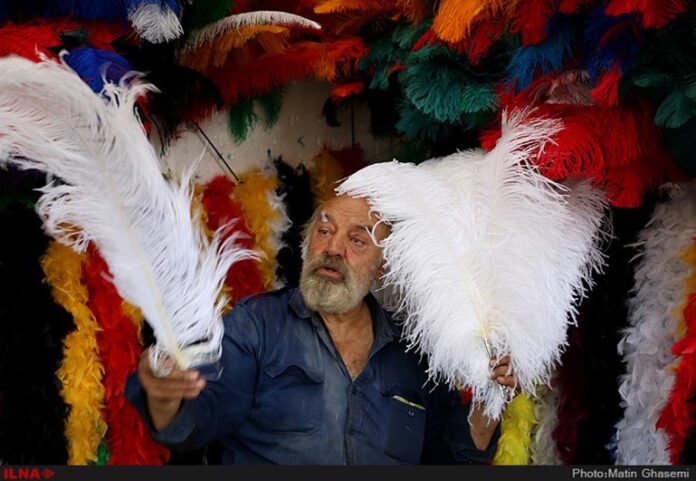
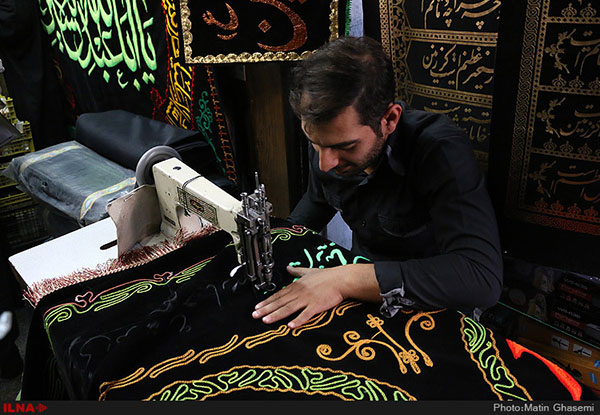
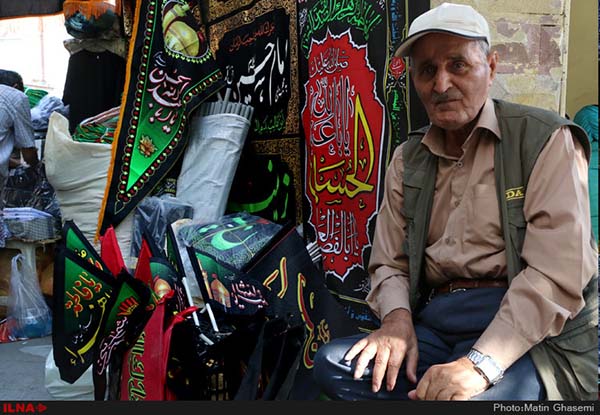
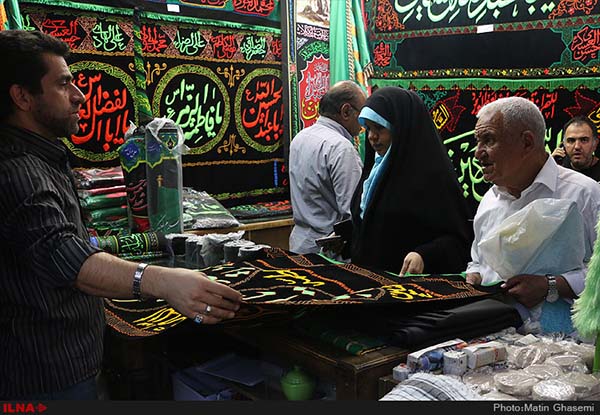
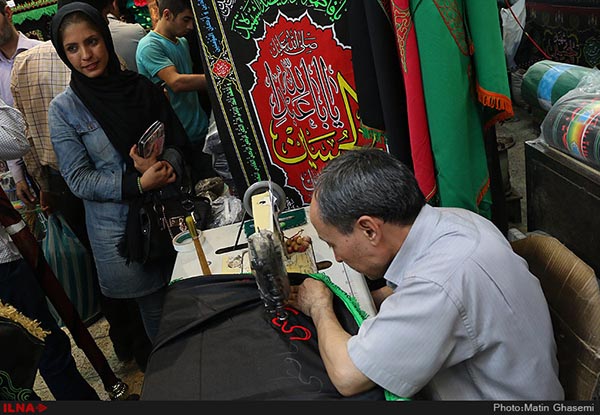
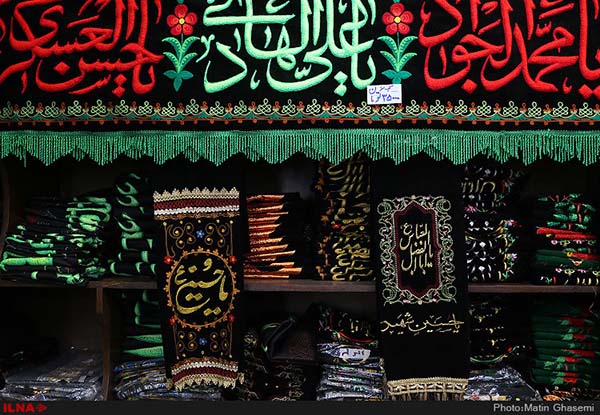
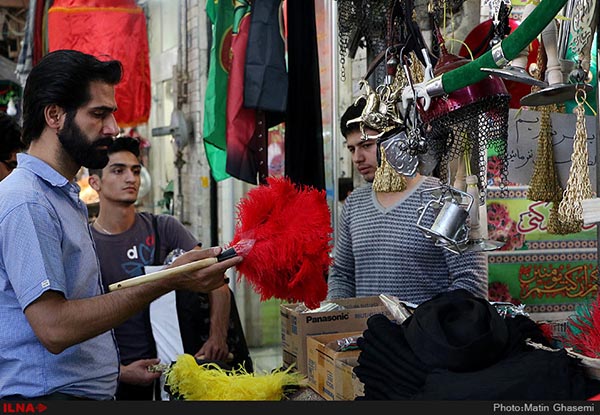
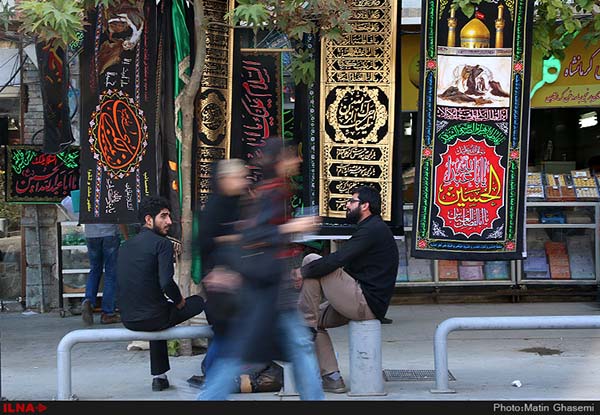
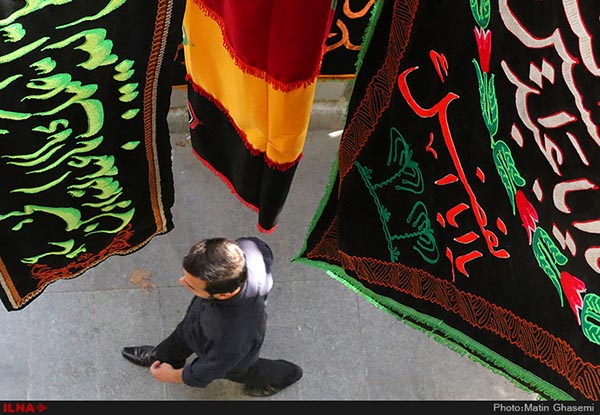
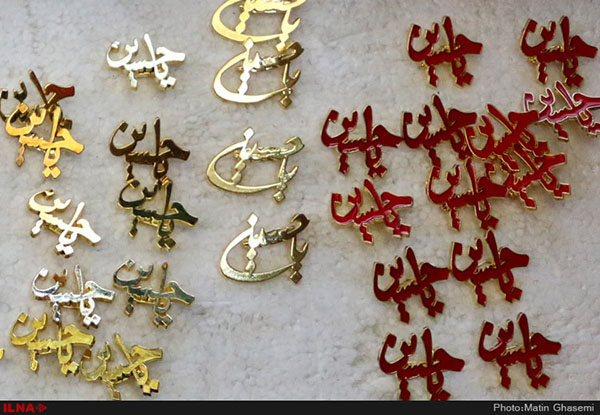
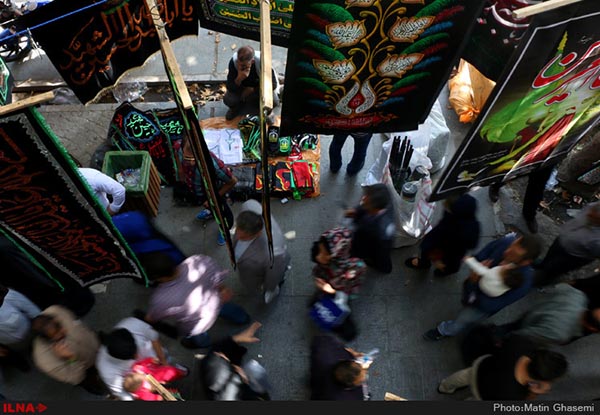
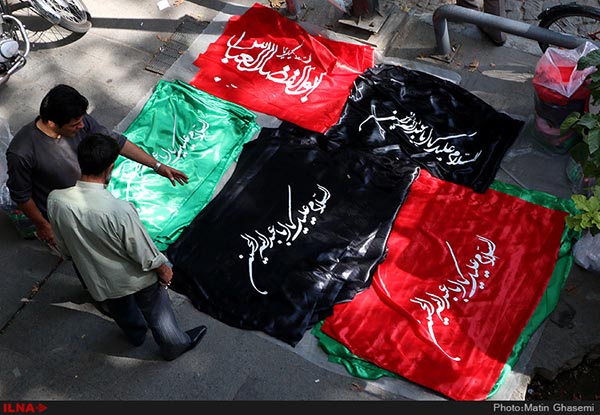
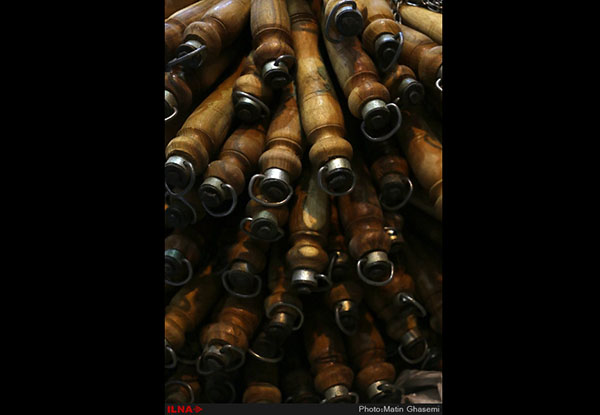
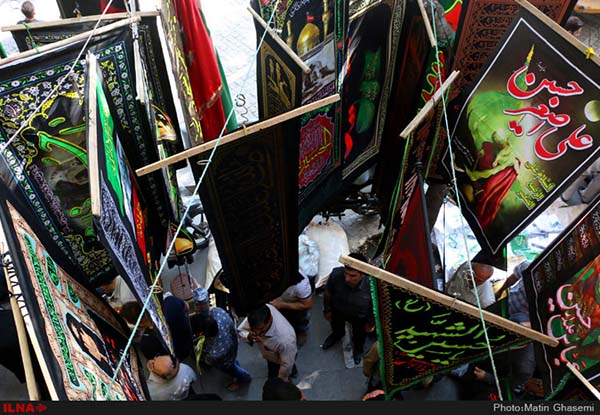
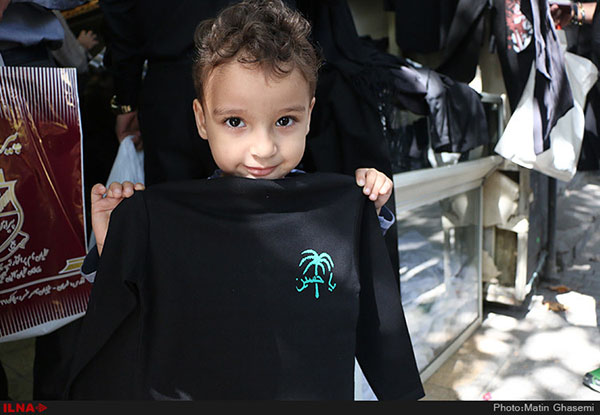
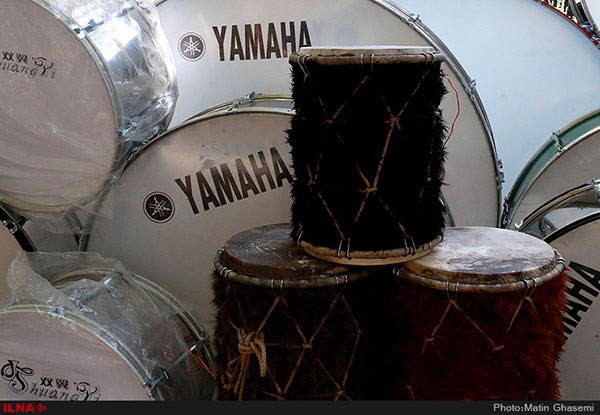
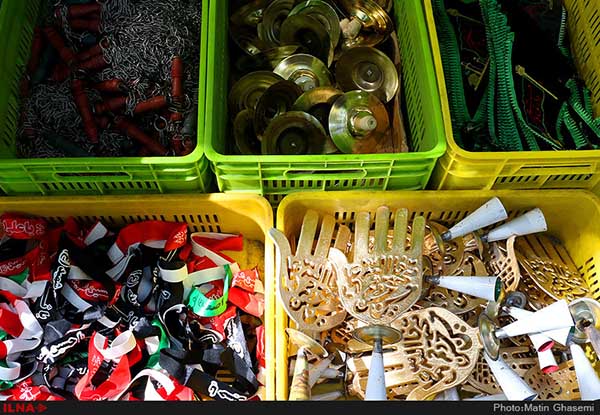
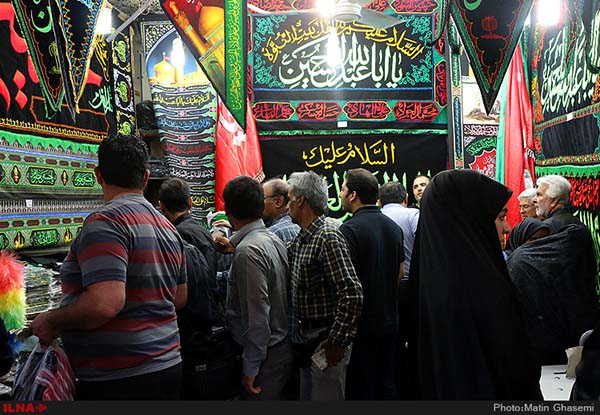
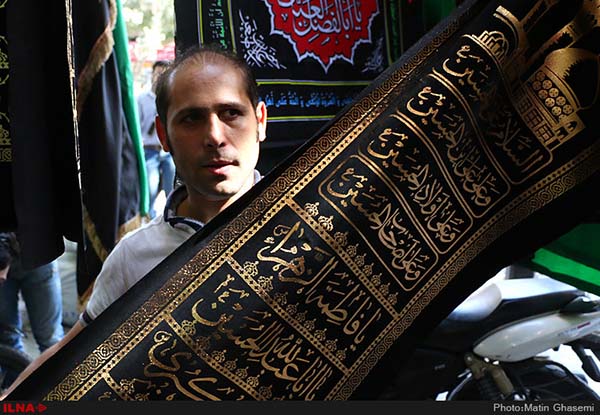
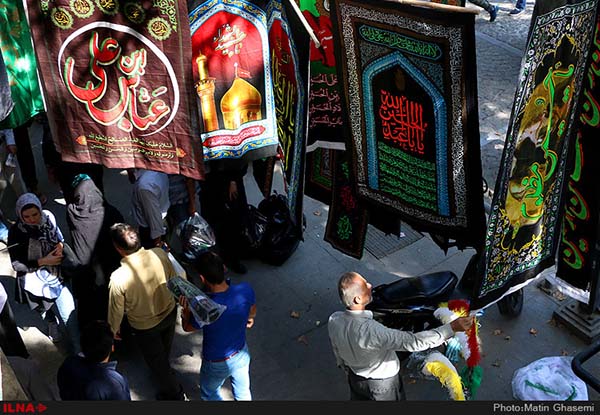
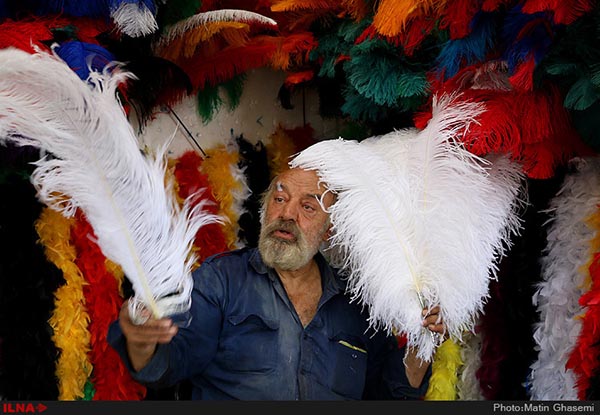
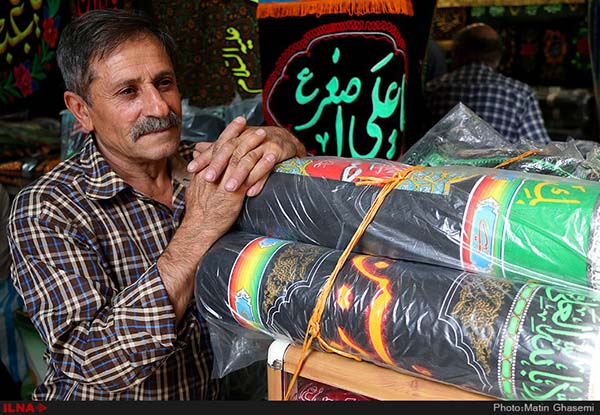
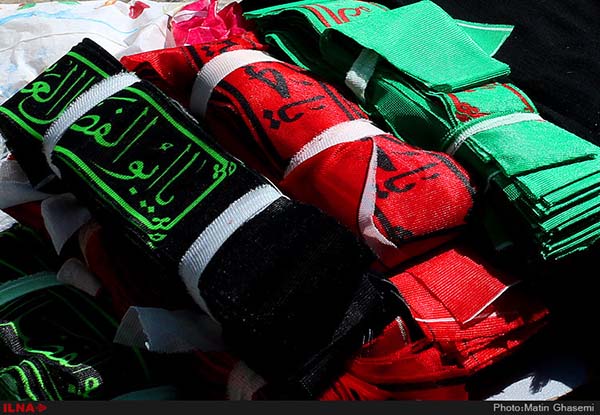
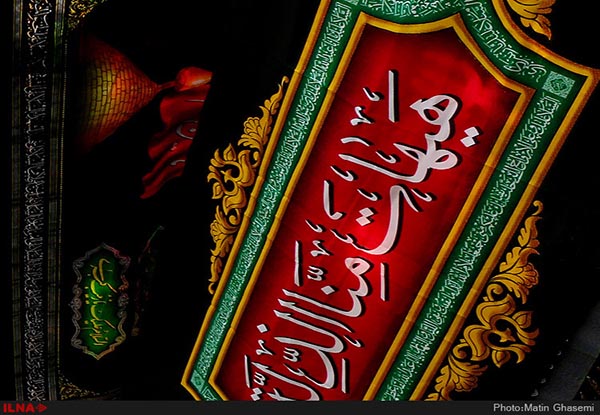
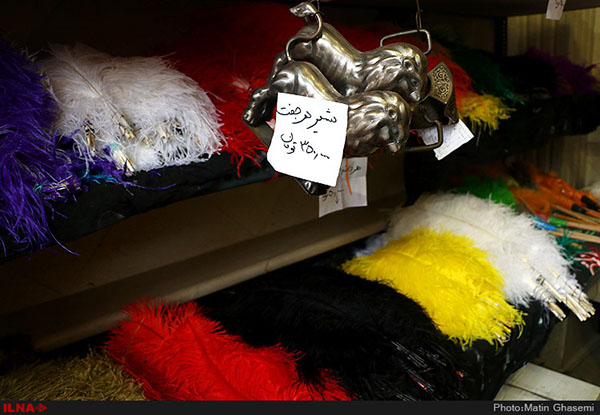
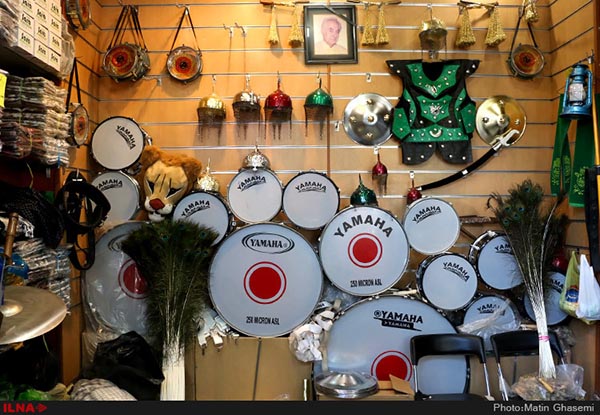
Market for Muharram instruments

Muharram0

In the lunar month of Muharram each year, Shiite Muslims mourn the martyrdom of Imam Hussein (the grandson of the Prophet Muhammad).

Ceremonies to mark the occasion begin on the first day of Muharram and come to their peak on the 10th.

The following images released by the Iranian Labor News Agency take you to a market where mourning instruments and other items used in the ceremonies are up for sale:

Iran won’t allow Saudi Arabia to exclude it from regional equations: Zarif

1872059

Iranian Foreign Minister Mohammad Javad Zarif says the Islamic Republic will never allow Saudi Arabia to exclude it from regional equations.

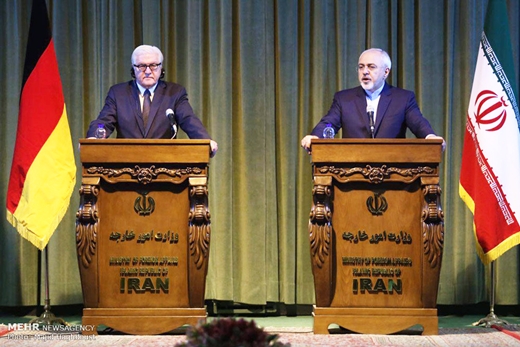
Speaking at a joint presser with his German counterpart Frank-Walter Steinmeier in Tehran on Saturday, Zarif said Iran is after good neighborly ties with its neighbors.

“Security must be provided for all as we all live next to each other in the region,” he said.

“We are not after eliminating Saudi Arabia, and, on the other hand, do not allow Saudi Arabia to eliminate Iran from the region,” he said.

Saudi Arabia’s “attempt to eliminate Iran has led to bloodshed and the stoking of confrontations in the region, and this has to stop,” he said.

On Syria

Responding to a question on Syria, Zarif said the Islamic Republic is ready to cooperate with all concerned governments to resolve the Syrian crisis. He said Iran believes that measures taken by the Russian government in Syria are in line with fighting the Takfiri IS terrorist group.

He said military operations against IS are only one dimension of the fight against the terrorist group, adding, among other measures, financial support for IS should stop.

The Iranian top diplomat also said that foreign intervention in Syria should serve the purpose of expediting conflict resolution there.

Such an outcome, he said, has so far proven elusive due to some countries’ insistence on excluding certain individuals from Syria’s political future.

Resolution 2231 not violated by Iran missile tests

In response to another question about recent remarks by US officials about Iranian missile tests, Zarif said the US has a history of adopting wrong stances, emphasizing that Iranian missile tests have nothing to do with United Nations Security Council Resolution 2231 (2015) as the Iranian missiles have not been designed to carry nuclear warheads.

He reiterated that Iran has never had and will never have a nuclear weapons program.

Iran-German ties

Zarif said Tehran-Berlin ties are “age-old” and are based on “mutual respect and common interest.”

He said the ties “can serve as a decent model for Iran’s relations with other European countries.”

Steinmeier, for his part, said the two sides to the recent agreement between Iran and P5+1 should build trust in order to reduce potential tensions.

The German top diplomat arrived in Tehran on Saturday on a two-day visit, a first such visit by a German foreign minister in 12 years.

Munich Security Conference (MSC) meeting

Following the press conference, the officials proceeded to attend a core group meeting of the Munich Security Conference (MSC).

Chaired by Wolfgang Ischinger, the chairman of the MSC, and the Iranian foreign minister, the meeting is to address the implementation of the July 14 nuclear agreement between Iran and six other countries, Iran’s regional role, the security architecture in the Middle East as well as the economic and energy policy implications of the Vienna agreement.

The meeting is also joined, among others, by Afghan Foreign Minister Salahuddin Rabbani, Iraqi Foreign Minister Ibrahim al-Jaafari, Prime Minister of Iraqi Kurdistan Region Nechirvan Idris Barzani, UN Deputy Special Envoy for Syria Ramzy Ezzeldin Ramzy, Deputy Secretary General of the European External Action Service Helga Schmid, President of the Foreign Affairs Committee of the French National Assembly Elisabeth Guigou, and Chairman of the German Bundestag Foreign Affairs Committee Norbert Rottgen.

The MSC has been serving as an international platform for dialog on foreign and security policy since its foundation in 1963.

[…]

WTO accession, the first thing after JCPOA

wto-building

The head of the Trade Promotion Organization (TPO) says that the first thing Iran should do after the Joint Comprehensive Plan of Action is to join the World Trade Organization (WTO). If not, he stresses, Iran will face multiple trade challenges down the line.

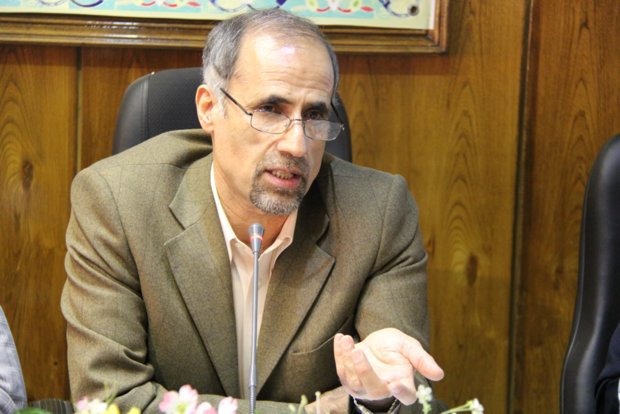
Valiollah Afkhamirad

Valiollah Afkhamirad made the comment in a press conference which focused on Iran’s National Exports Day (October 21) and further said that his agency is pursuing efforts to review the Preferential Trade Agreement (PTA). He expressed hope the country can build on the support of the Foreign Ministry and other related bodies to change its observer status at WTO to an official member of the world body.

SMT, an Iranian daily, on October 14 published a report on what Iran’s trade chief said in the news conference about measures his organization has taken to streamline trade in the country, especially during the first half of the Iranian year (March 21- September 22). The following is the translation of part of that report:

Afkhamirad said that Iran is the world’s only big economy which is not a WTO member, adding that WTO membership carries much weight and that a special department – the Office for WTO Entry – has been set up at the TPO. He also said that worthwhile measures have been taken so far to clear the way for Iran to get accession to the WTO.

A rise in technical engineering services

The TPO director, who is also a deputy minister of industries, mines and trade, said as far as technical engineering services are concerned Iran had good conditions in the first half of the year, adding that statistics show a 40-plus percent increase in the deals registered for such services in the five months to August 23.

Petrochemical products are the staple of Iran’s exports, he said, adding that other products such as iron and steel, minerals and chemical fertilizers, pistachios, and cement are among the country’s top ten export items.

The TPO chief went on to say that different trade and economic teams [from other countries] have come in recent days to Iran – either as part of official or unofficial delegations – to talk business with Iranian tradesmen and industrialists. He added that these teams are reviewing and evaluating investment and partnership opportunities and are seeking to establish cooperation with Iran once the Joint Comprehensive Plan of Action is finalized and the unjust sanctions against the country are lifted.

The deputy industry minister also said that during the past six months the Austrian delegation was the biggest team which visited Iran, adding that the Austrian president was accompanied by 250 economic players during his Tehran trip. He said that Iran also hosted small teams of four to five businesspeople.

In the March-September period last year, Iran sent five teams (comprising 90 people) to five countries and hosted six delegations from as many countries (88 people in total), he said.

In the same period this year, the country sent five teams (98 people) to four countries and welcomed 29 delegations from 14 countries (540 people), he added.

Afkhamirad said that more than 1,400 people have traveled to Iran as representatives of large Asian and European companies. In the latest such visit, representatives of 30 big Japanese companies came along with the country’s foreign minister to Tehran and met with officials with Iran’s ministry of industries, mines and trade and discussed [bilateral] cooperation in the post-sanctions era.
Iran’s businesspeople are not in good economic conditions because sanctions have yet to be terminated, he said, adding that banking sanctions which are the most painful embargoes are still in place.

“To add insult to injury, I should say production costs have gone up in the country and the cost of goods sold (COGS) Iranian businessmen should pay for sending their products to target export markets is higher than what their counterparts pay in other countries,” the TPO chief said.

He then said that despite these challenges, the wheels of industrial units in the country are still turning, and expressed hope that the conditions in the country will improve by the day.

[…]

A look at Iranian newspaper front pages on Oct. 17

Iranian Newspapers Headlines

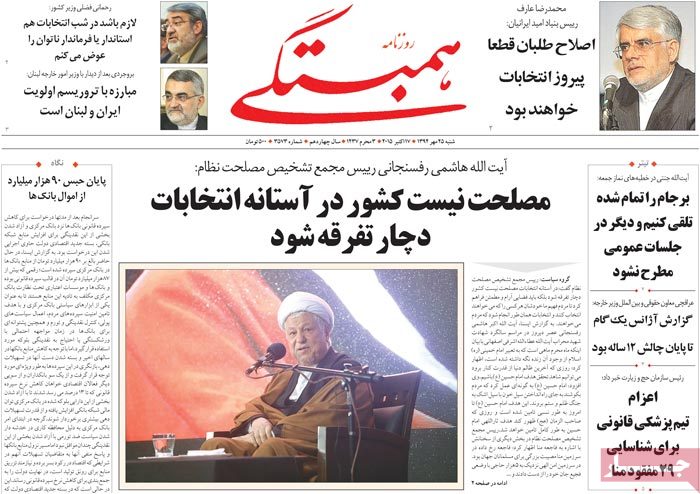
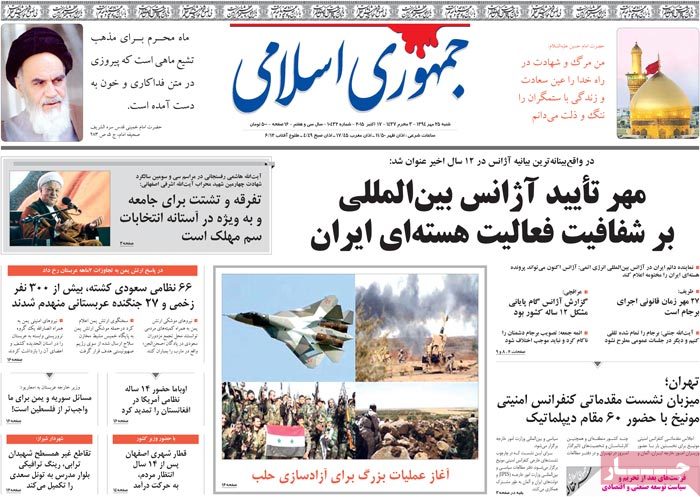
The comments of Ayatollah Rafsanjani on a wide range of issues, including the upcoming elections, and the imminent implementation of the Joint Comprehensive Plan of Action, the nuclear deal Iran and P5+1 struck in July, dominated the front pages of Iranian newspapers on Saturday.


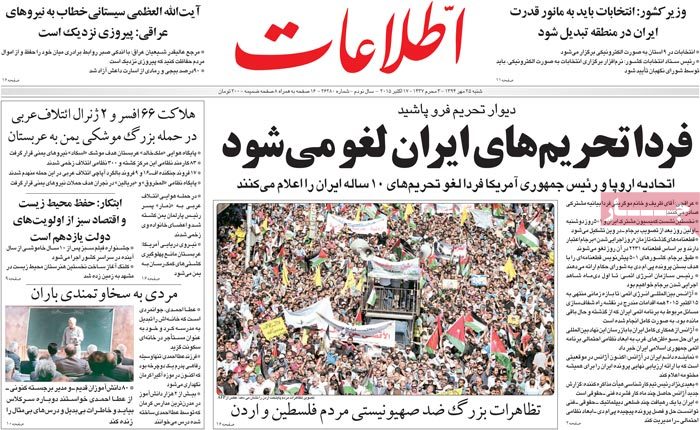
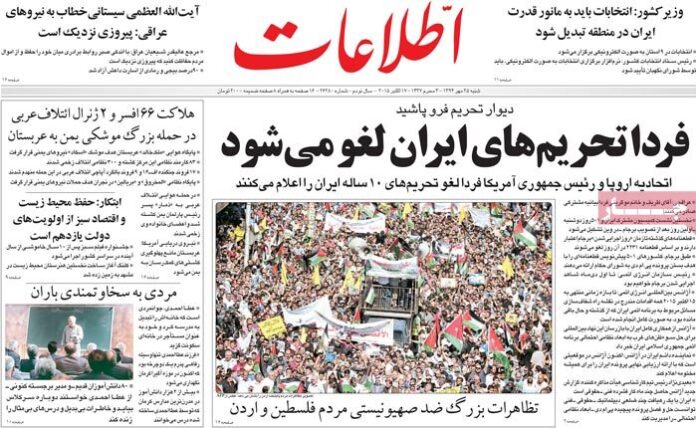
Ettela’at: The walls of sanctions will come tumbling down tomorrow.

The European Union and the US president are set to announce the termination of decade-long sanctions against Iran.


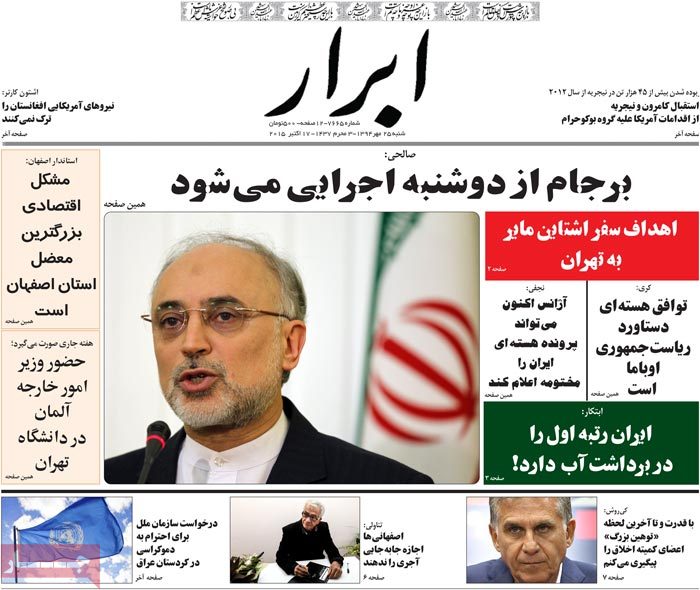
Abrar: The director of the Atomic Energy Organization of Iran has said the Joint Comprehensive Plan of Action will become operational on Monday.

Abrar: The German foreign minister attends a meeting in the University of Tehran this week.


A look at Iranian newspaper front pages on Oct. 17


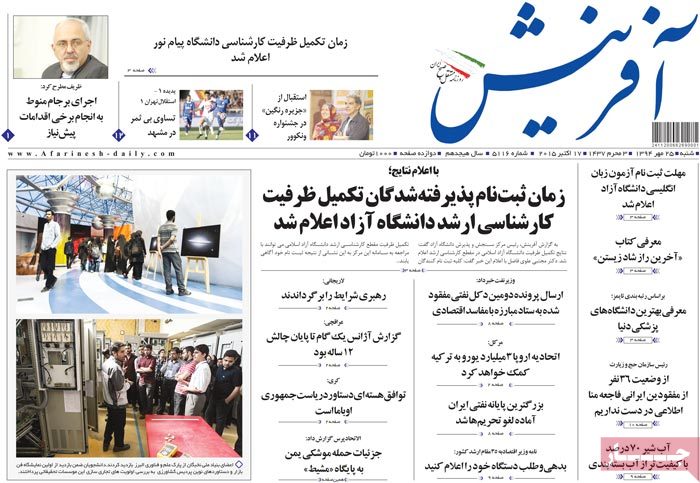
Afarinesh: Iran’s largest oil terminal is ready for the post-sanctions flurry of activity.


A look at Iranian newspaper front pages on Oct. 17


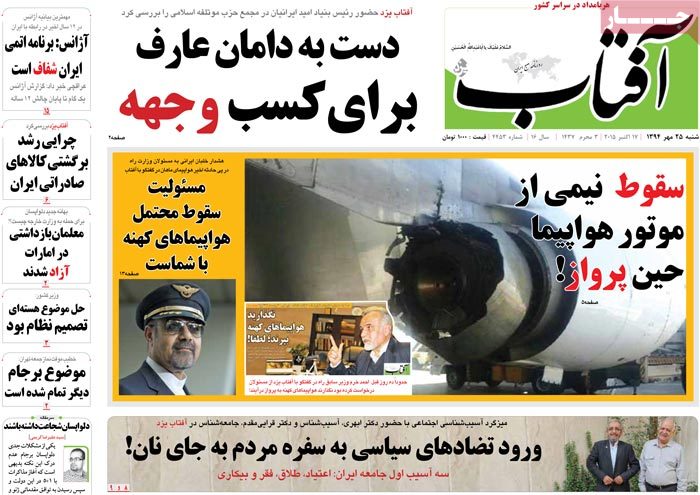
Aftab-e Yazd: After part of the engine of a passenger aircraft en route from Tehran to Bandar Abbas came off in mid-air, a pilot has warned the Ministry of Roads and Urban Development that it will be responsible for the likely crash of old aircraft.

Aftab-e Yazd: The interior minister has said that settling the nuclear case was a decision the entire establishment made.


A look at Iranian newspaper front pages on Oct. 17


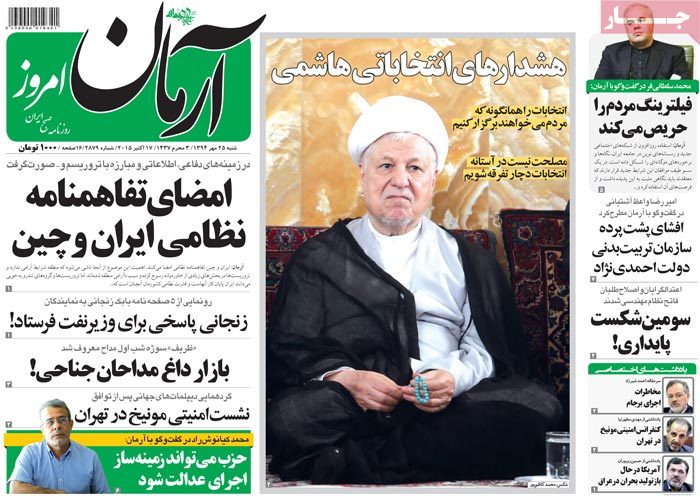
Arman-e Emrooz: Iran and China have signed a military MOU that covers cooperation in areas such as defense, intelligence and the fight against terrorism.


A look at Iranian newspaper front pages on Oct. 17


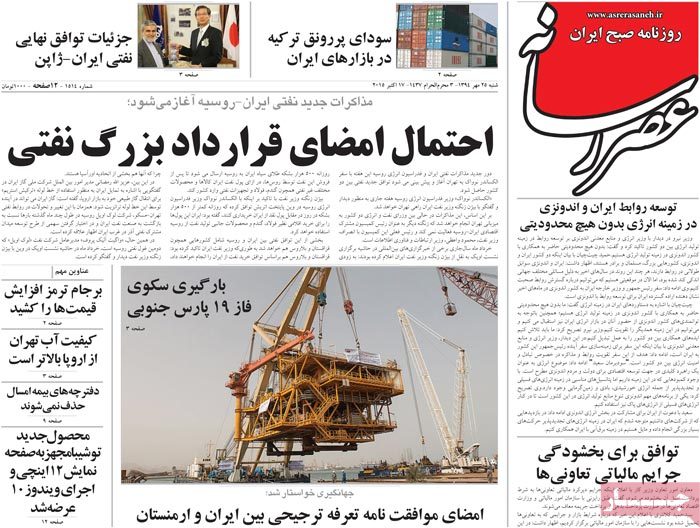
Asr-e Rasaneh: Iran and Russia are likely to sign a grand oil deal.

Asr-e Rasaneh: The vice-president has called for conclusion of a preferential tariffs deal between Iran and Armenia.


A look at Iranian newspaper front pages on Oct. 17


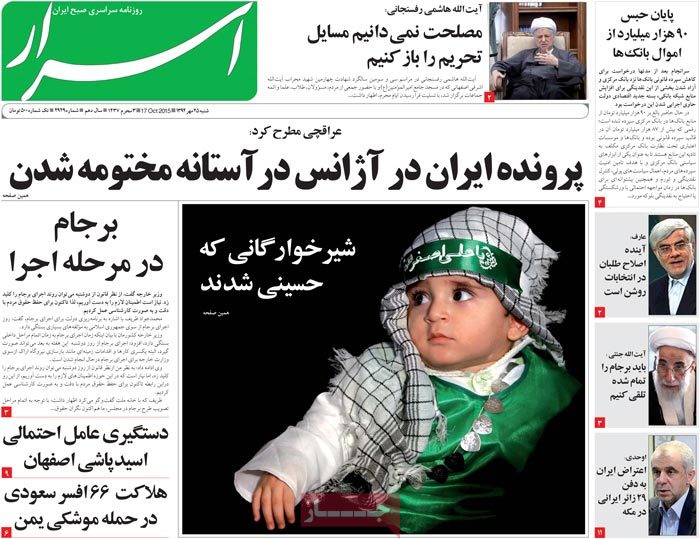
Asrar: A person likely to have been behind last year’s acid attacks in Isfahan has been arrested.


A look at Iranian newspaper front pages on Oct. 17


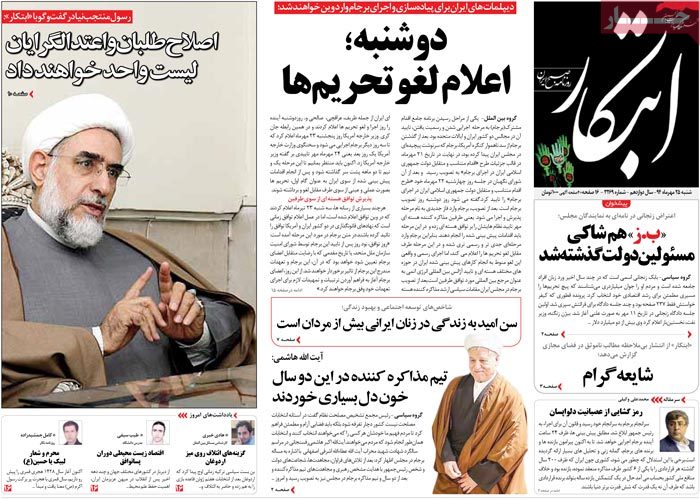
Ebtekar: “The Iranian nuclear negotiating team went through a lot over the past two years,” said Chairman of the Expediency Council Ayatollah Akbar Hashemi Rafsanjani.

Ebtekar: Reformists and moderates will release a single ticket in the upcoming elections, said Rasoul Montajabnia, a reformist leader.


A look at Iranian newspaper front pages on Oct. 17


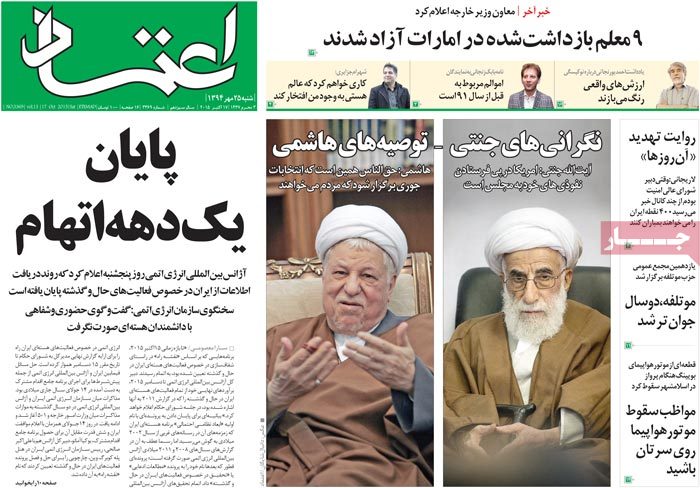
Etemad: The deputy foreign minister has said that nine Iranian teachers who had been taken to custody [for working in al-Ain with a Dubai work permit] have been freed.

Etemad: Jannati’s concerns; Hashemi’s recommendations

Ayatollah Jannati: The US seeks to send its infiltrators to the Islamic Consultative Assembly.

Ayatollah Hashemi: Holding the elections the way people want is a manifestation of respect for the rights of the public.


A look at Iranian newspaper front pages on Oct. 17


Hambastegi: Fighting terrorism is a priority for Iran and Lebanon, a top Iranian MP said after meeting with the Lebanese foreign minister.


A look at Iranian newspaper front pages on Oct. 17


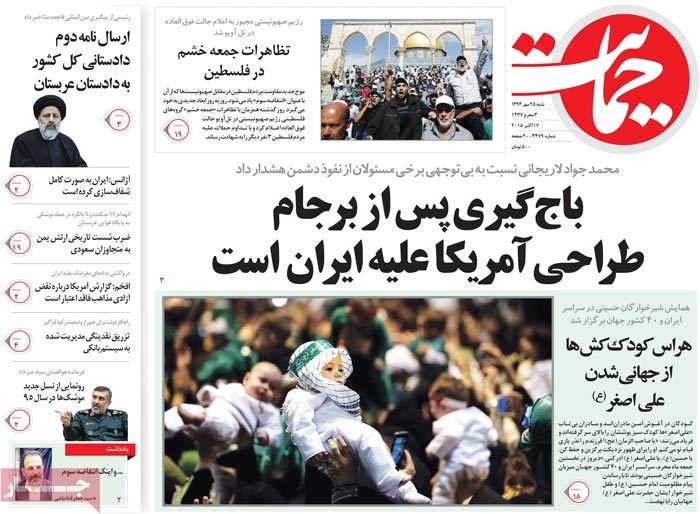
Hemayat: The Iranian attorney general has sent a second letter to Saudi prosecutors to follow up on the investigation into the deadly stampede in Mina, near Mecca.

Hemayat: Mohammad Javad Larijani has warned officials that the US eyes extortion in the wake of the Joint Comprehensive Plan of Action.


A look at Iranian newspaper front pages on Oct. 17


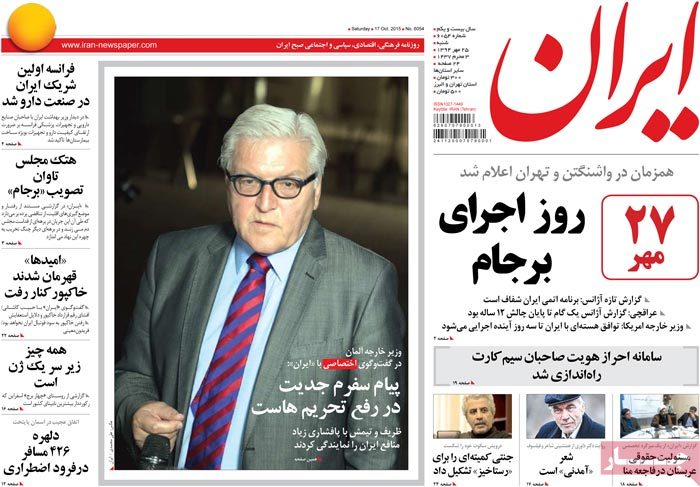
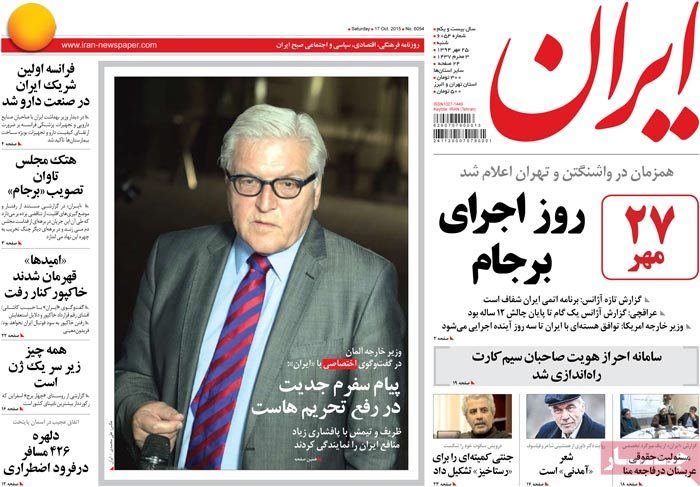
Iran: The message my Iran visit sends is one of seriousness [on the part of the world] to terminate sanctions, the German foreign minister said in an exclusive interview with the daily before leaving for Tehran.

Frank-Walter Steinmeier further said Foreign Minister Zarif and the negotiating team he led stood their ground to represent Iran’s interests.


A look at Iranian newspaper front pages on Oct. 17


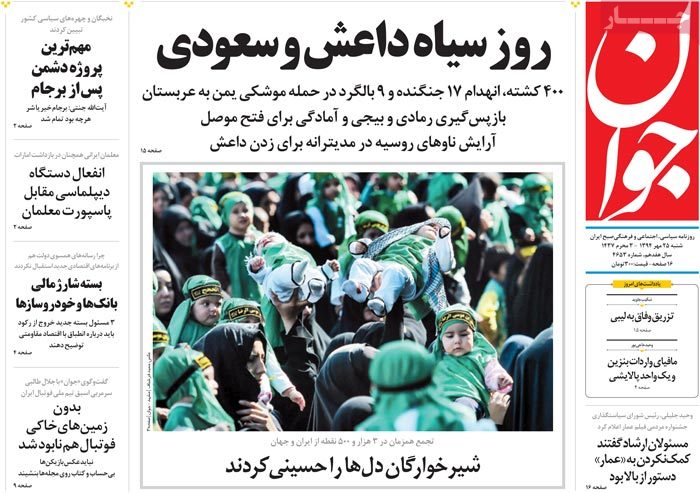
Javan: A black day for IS and the Saudis

Ramadi and Baiji are all but liberated as the Iraqi forces prepare to take back Mosul.


A look at Iranian newspaper front pages on Oct. 17


Jomhouri Islami: “Discord and tension, especially in the run-up to the election, are like a deadly poison for society,” said Chairman of the Expediency Council Ayatollah Akbar Hashemi Rafsanjani.

Jomhouri Islami: Tehran hosts the preliminary meeting of the Munich Security Conference with 60 diplomats in attendance.


A look at Iranian newspaper front pages on Oct. 17


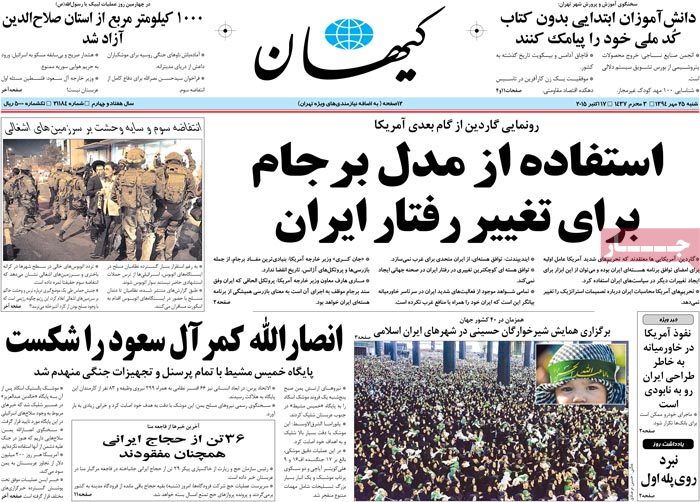
Kayhan: Thirty-six Iranian pilgrims are still unaccounted for in Saudi Arabia.


A look at Iranian newspaper front pages on Oct. 17


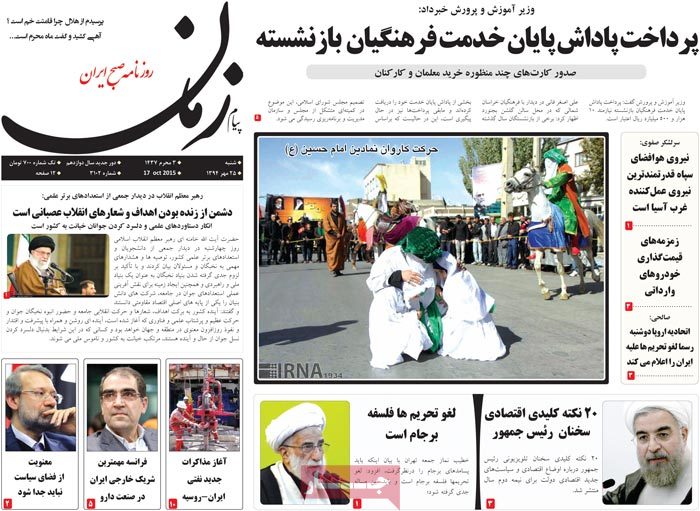
Payam-e Zaman: France is the most important partner of Iran in the pharmaceutical industry.


A look at Iranian newspaper front pages on Oct. 17


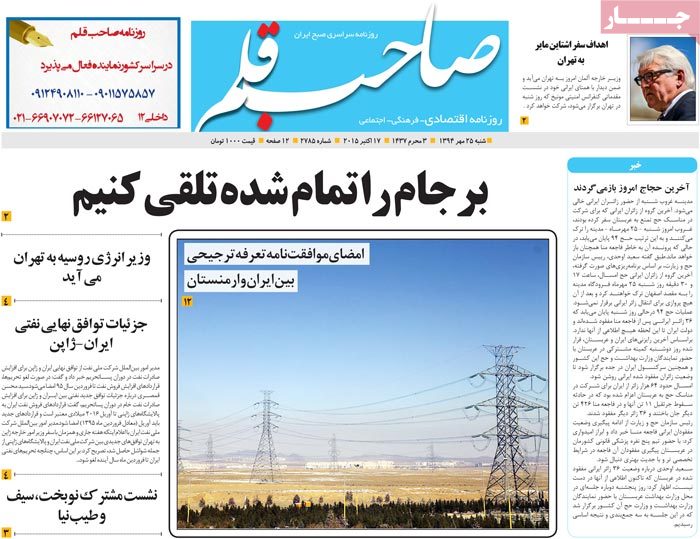
Saheb Ghalam: “We have to consider the Joint Comprehensive Plan of Action a done deal,” said the secretary of the Guardian Council.

Saheb Ghalam: The Russian energy minister is to visit Iran.


A look at Iranian newspaper front pages on Oct. 17


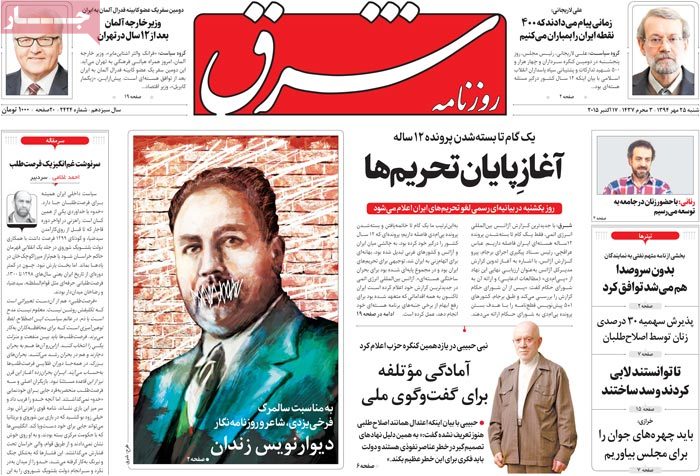
Sharq: The beginning of the end of sanctions

There is one step left to close the chapter on a 12-year case.


A look at Iranian newspaper front pages on Oct. 17


Highlights of Ettela’at newspaper on October 17

Ettelaat

 The walls of sanctions will come tumbling down tomorrow.

The European Union and the US president are set to announce the termination of decade-long sanctions against Iran.

 People in Jordan and Palestine have held massive anti-Zionist rallies.
 “Elections should turn into a maneuver to demonstrate Iran’s power in the region,” said the interior minister.

In another development, the head of the Electoral Commission said that the software to be used in electronic voting in nine provinces should secure the approval of the Guardian Council.

 Grand Ayatollah Ali al-Sistani has told the Iraqi forces that victory is imminent.

In another development, Iraqi forces wrested control of 90 percent of Baiji and Ramadi from IS terrorists.
 A Yemeni missile strike against Saudi Arabia left 66 Saudi-led coalition officers and two generals dead.
 “Protecting the environment and introducing a green economy are among the priorities of the 11th government,” said the director of the Environment Protection Organization.

 A man as generous as rain

Ata Ahmadi is a real gentleman who turned the house he owned into a school and rented an apartment to live in.


Iranian teachers detained in UAE released

Ghashghavi

The United Arab Emirates (UAE) has released nine Iranian teachers who were detained following allegations about the invalidity of their work permits, said an Iranian deputy foreign minister.

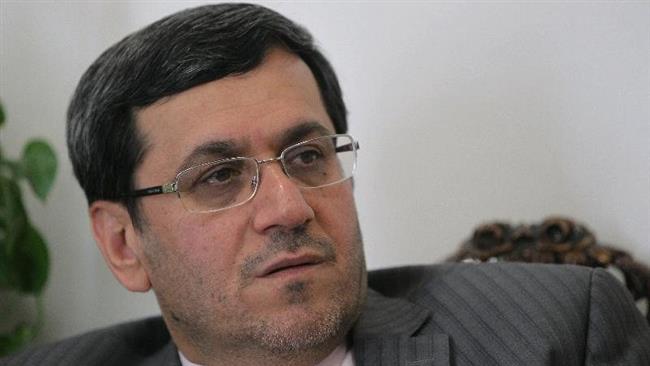
Hassan Ghashghavi said the nine teachers detained in the UAE were released Friday night on the back of efforts by Iran’s Foreign Ministry and the Islamic Republic’s ambassador to the UAE.

At the time of their arrest, the teachers were working in al-Ain.

Emirati officials claimed that the teachers did not have a work permit for employment in al-Ain. They claimed the permit was for employment in Dubai.

On October 11, Iran’s Foreign Ministry summoned the United Arab Emirates’ charge d’affaires in Tehran over the detention of the Iranian teachers.

The charge d’affaires, called upon in the absence of the UAE ambassador to Iran, was asked to swiftly secure the release of the group of Iran’s Ministry of Education teachers, who were detained despite their years of lawful service in an Iranian school there.

Iran condemns terrorist bombing in Nigeria

Afkham

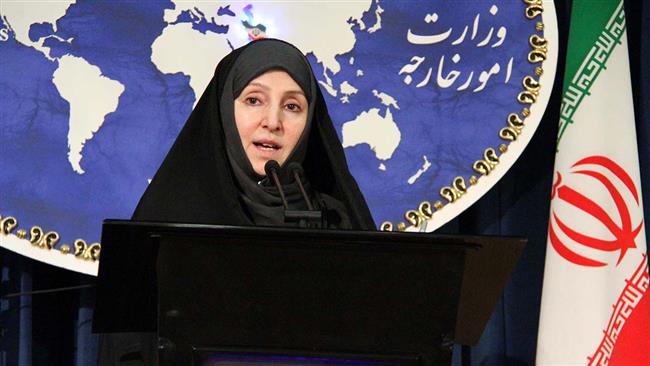
Foreign Ministry Spokeswoman Marzieh Afkham has strongly condemned the Thursday’s terrorist bombing at a mosque in northeastern Nigeria which resulted in the deaths of dozens of worshippers and injury of dozens more.

“The massacre of innocent women and men is an inhumane unjustifiable act,” Afkham said late Friday.

The Iranian Foreign Ministry spokeswoman expressed sympathy with families of the victims, the Nigerian government and nation, and underlined the need for an all-out fight against terrorism and extremism in different parts of the world.

At least 42 people lost their lives when two bombs ripped through the mosque in Nigeria’s restive northeastern state of Borno.

There was no immediate claim of responsibility for the attack. However, Nigerian officials usually blame such assaults on Boko Haram Takfiri terrorists.

Boko Haram terrorists have recently pledged allegiance to the Takfiri Daesh militant group, which is primarily operating in Syria and Iraq.

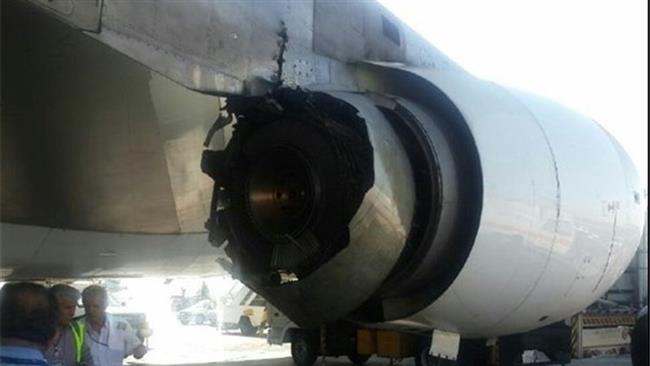
Iran probes jumbo jet engine break-off

engine of Boeing 747

Iranian experts are investigating to find out why a section of a Boeing 747’s engine broke off during flight on Thursday.

The mid-air horror ended after the aircraft with 426 passengers and crew on board safely landed at Tehran’s Mehrabad Airport.

A committee has been formed to examine the cause of the incident which happened during the jumbo jet’s flight from Tehran to Bandar Abbas.

“The committee will carefully examine the cause of the technical failure,” head of the engineering and safety office of the Civil Aviation Organization (CAO) Mohammad Shahbazi said.

“Prior to departure, all necessary checks had been conducted on the plane but during the flight, engine number 3 of the plane developed technical malfunction and a piece of the engine came off,” he said.

“Thanks to the pilot’s prudence, the plane fortunately returned to Mehrabad Airport with no injuries to passengers,” Shahbazi said.

The passengers were flown to Bandar Abbas on two back-up flights, he added.

Deputy head of Mahan Air Faramarz Sarvi said the aircraft was among the private airline’s modern airliners in service since about 1990.

An Iran-140 with 48 people on board crashed near Mehrabad Airport in August 2014, killing at least 39 people.

Iranian airlines have been plagued by a series of crashes because of Western sanctions which block the country from buying parts and renovating its ageing fleet.

The July conclusion of nuclear talks and an imminent lifting of the sanctions has raised hopes of a buying spree by Iranian airlines.

Boeing has said it was seeing a good opportunity for business in Iran, citing its “long history” in the country.

Iranian officials have said the country would need between 400-500 new aircraft worth at least $20 billion to renovate its aging fleet and that initial negotiations have begun with the likes of Boeing and Airbus.

Iran missile tests no violation of JCPOA: Top diplomat

araghchii

A senior Iranian diplomat says the Islamic Republic’s missile tests are not a breach of the recent nuclear agreement struck between Tehran and six world powers.

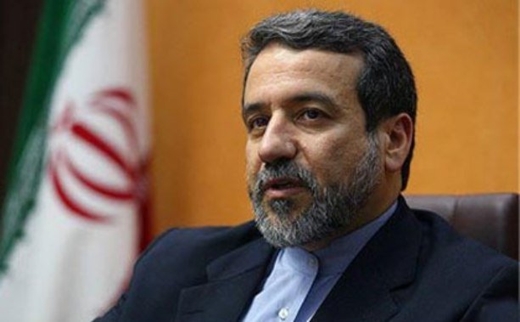
Tehran’s “missile tests are by no means a violation of the Joint Comprehensive Plan of Action (JCPOA),” Deputy Foreign Minister for Legal and International Affairs Seyyed Abbas Araghchi said Friday.

His remarks came after Iran successfully test-fired a new precision-guided long-range surface-to-surface ballistic missile, dubbed Emad, on October 11.

“None of Iran’s missiles, including ballistic ones, have been designed to carry a nuclear warhead, and thus their production and test are not contrary to [UN Security Council] Resolution 2231,” Araghchi stressed.

Araghchi also noted that Tehran will continue taking necessary measures to reinforce defensive capabilities to safeguard its sovereignty, independence, and territorial integrity and to counter any act of aggression and terrorist threats.

He made the remarks a few hours after US Ambassador to the UN Samantha Power claimed that Iran’s recent ballistic missile test was “a clear violation” of UN sanctions, and that Washington will seek action from the Security Council.

Iran has repeatedly said its missiles would never carry a nuclear warhead as it has no plans to produce atomic weapons.

Tehran has also announced that under the fatwa (decree) issued by Leader of the Islamic Revolution Ayatollah Seyyed Ali Khamenei, its long-established policy is to oppose the acquisition, production, stockpiling, and use of nuclear weapons.