Friday, January 2, 2026
Home Blog Page 4672

Roknabadi died of thirst, heat in Mina crush: Iran diplomat

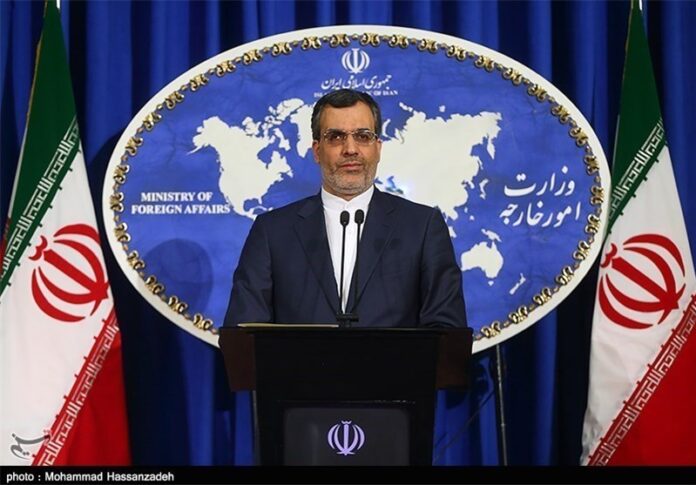
Hossein Amir-Abdollahian

A senior Iranian official says former Iranian ambassador to Lebanon, who lost his life in the September crush during Hajj rituals in Saudi Arabia, died of extremely hot weather, thirst and lack of proper treatment.

The former Iranian diplomat, Ghazanfar Roknabadi, had been missing since the September 24 crush in Saudi Arabia until his body was identified following DNA testing late last month. His body was returned to the Iranian capital, Tehran, on November 27.

The crush in Saudi Arabia occurred when two large masses of pilgrims were directed by Saudi authorities toward one another and fused at a crossroads in Mina, a few kilometers east of the holy city of Mecca, as they were on their way to participate in the symbolic stoning of Satan in Jamarat.

Iran’s Deputy Foreign Minister for Arab and African Affairs Hossein Amir-Abdollahian said on Friday that the fate of 14 Iranian pilgrims, who went missing in the Mina crush, has not been determined yet and added that investigations are still underway.

He added that Iran is pursuing the issue through legal channels and noted that some international NGOs have compiled documents to help determine the exact causes of the incident.

Amir-Abdollahian emphasized that Iran would certainly continue with investigations to determine the fate of the missing pilgrims.

Saudi Arabia claims nearly 770 people were killed in the incident, but officials with Iran’s Hajj and Pilgrimage Organization say about 4,700 people, including 464 Iranians, lost their lives in the tragedy.

The number of the Iranian fatalities exceeds that of other countries.

Iran has criticized Saudi Arabia for failing to responsibly carry out its duties during Hajj, saying Riyadhs incompetence in handling safety at the rituals caused the deadly incident.

Iran takes back purchased artworks from US after nearly 40 years

Iranian Artworks

Iran has taken back over a dozen pieces of American art pieces purchased nearly 40 years ago but blocked for export due to a break in bilateral relations since Iran’s Islamic Revolution.

According to an informed source with Iran’s Center for International Law of the Presidential Office, 10 of the 14 pieces were drawn by late Michael Graves and the remaining four by Robert A. M. Stern, both highly acclaimed American architects.

The artworks were purchased by Tehran Museum of Contemporary Art in 1978, a year prior to the Islamic Revolution, the unnamed source said, adding the art delivery was the outcome of a lawsuit filed by Iranian officials two years ago with a tribunal created in 1981 under an agreement known as the Algiers Accords.

The tribunal, based in The Hague, Netherlands, created a mechanism for Iranians and Americans to seek impounded assets from each other after their bilateral relations were severed in 1979.

The Iranian official also further noted that the artworks were first transferred to Amsterdam and once experts from Iran’s Ministry of Culture and Islamic Guidance confirmed their authenticity, they were taken to the Islamic Republic.

The New York Times said in a report on Friday that an unnamed US State Department official has confirmed the delivery.

“A claim was brought before the tribunal related to various pieces of artwork Iran contracted to purchase prior to 1979,” the official said, adding that the claim “has now been resolved and the specific pieces of artwork have been transferred to Iran,” and that the transfer had been completed “in the last couple of months.”

The value of the masterpieces has not been disclosed.

Troop deployment to Iraq, Turkey’s reaction to post-JCPOA era

Turkey military

There are many speculations as to what prompted Turkey to send its forces across the border to Iraq. Some suggest it has been designed to support Daesh; others say it was part of a wider plot to oversee the breakup of Iraq; still, some others argue it was meant to kill the Kurdish insurgency once and forever.

The following is the translation of a case Mostafa Fahimi, a Middle East expert, made on Khabaronline.ir about the Turkish military buildup on Iraqi soil:


In 2001, eight years before Ahmet Davutoglu took office to take the helm of Turkey’s foreign policy, in a book titled: “Strategic Depth” the current prime minister wrote: “An increase in Turkey’s strategic depth in the region would be possible when Turkey had no problems with its neighbors. Hence, Turkey should move toward a zero-problems foreign policy.”

In the book he also wrote: “Turkey should have a fair attitude toward all regional players and avoid entering any regional grouping or coalition for or against one such player.”

Fence-mending policy in theory; increase in tension with neighbors in action

With Davutoglu leading the foreign policy apparatus of the Erdogan-Gul led governments of the Justice and Development Party, many believed that Turkey would go ahead with a fence-mending policy and would avoid the repeat of the mistakes it had made in the past, mistakes which led to confrontation with Greece, Syria, Iran and some other countries. They also believed Turkey would solve the remaining problems in the Mediterranean and Middle East.

However, it was a short-lived belief and Turkey’s foreign policy squared off against the policies which had been mapped out in Davutoglu’s famous book. Such a strategy did not only not bring about a zero-problems-with-neighbors policy, but sparked new differences with all neighboring countries, thus adding to previous problems.

Turkey first meddled in Iraq’s affairs and then put on the agenda the mobilization of Arab hardline groups against the Iraqi government.

After Nouri al-Maliki took office in 2006, the Turkish government’s ties with the then Iraqi government plummeted. The Turkish government did not spare any effort to stop Nouri al-Maliki from winning a second term, but al-Maliki was finally re-elected and that amounted to an embarrassing defeat for Turkey.
 

Defeat of the new Ottoman project, Turkey’s embarrassment in the world

In the wake of the Islamic Awakening described by Arabs as the “Arab Spring” and the fall of governments in Tunisia, Libya and Egypt, Turkey pursued its Iraq policy, especially the policy of getting closer to the officials of the Iraqi Kurdistan Region, and watered down its European focus, as it followed a more active policy toward North Africa.

With the “New Ottoman” empire on the agenda, Turkish officials tried to impose themselves on North Africa and put themselves in the limelight through Erdogan’s numerous trips to North African countries.

However, in Egypt, with General el-Sisi’s coup against the then Egyptian President Mohamed Morsi, Turkey’s policy failed spectacularly; consequently ties between Turkey and Egypt sank to historic lows. Their relations have since been at its lowest level.

The level of Turkey’s relations with Libya has been downgraded too and, contrary to Turks’ expectations, there are normal relations with Tunisia. Besides political ties, Turkish producers have suffered, losing their position in the vast markets of the region.

After Abdullah Gul left office, the Erdogan-led government of Justice and Development Party seriously followed a policy of direct intervention in Syria. Qatar and Saudi Arabia sent direct financial aid as Turkey lent logistical and intelligence support to the so-called opposition which carried real or fake names such as the Al-Nusra Front, Jund al-Islam, Daesh, Jaish al-Ahrar and several more other names.

Turkey paved the way for the recruitment of thousands of Daesh forces from Europe and all over the world. It also sent, via its territory, all the military equipment these groups needed in Syria.

It is worth mentioning that all weapons plundered from Gaddafi’s military bases in Libya were transferred to Turkey via sea and from there on to Syria and northern Iraq.


The path to conquer Baghdad goes through Damascus!

When Turkey failed to achieve its goals in Iraq, it resorted to the slogan of “The path to conquer Baghdad goes through Damascus” and carried on with its efforts to topple Bashar al-Assad’s government through constant pressure on Iraq by Daesh and other Ba’athist groups.

The Turks believed they could, in a few months, finish off both the Syrian and Iraqi governments and dislodge their rivals. But what Turkey obtained was contrary to the theoretical strategies of the Justice and Development Party. What was achieved put the Turks at odds with other regional players, and Turkey lost the profitable markets of Syria and Iraq.

Turkey not only failed to achieve its objectives in these regions, but by internationalizing the issue of Syria, Ankara made it more complicated and finally caused the presence of more forces and foreign players in this region.

The continuation of Turkey’s policies made Russia directly enter Syria to practically shift the balance of power to the detriment of Turkey.

Instead of remedying the problems and developing new methods, this time Turkey decided to intensify its confrontation with Russia and shot down a Russian aircraft claiming the aircraft had entered its airspace for a few seconds. By doing so, Turkey practically upped the ante, opening new military and economic fronts and losing Russia’s big market as well as the Russian tourists.


Attack on Iraq, reaction of Turkey to post-JCPOA and post-Daesh eras

In the most recent measure, Turkey, which has failed to gain any tangible achievement other than political and economic damage, deployed its forces to Iraq and took another provocative action in the region.

Under the present conditions, a number of questions pop up: What is Turkey looking for in the region? What methods is it following in its foreign policy? Despite numerous confrontations with others, why has Turkey ramped up its unprecedented anti-Iran rhetoric? Do Turks believe that the policy of “The path to conquer Baghdad goes through Damascus” has not worked and that they need to enter Iraq directly?

It seems that Turkey’s direct move is a reaction to the post-JCPOA era on the one hand, and to the post-Daesh era on the other. Almost ten years after Turkey first began to play the terrorism and Daesh cards in Iraq and Syria, Ankara seems unable to resist international pressures to carry on with its support for Takfiri terrorists. Apparently, it is now thinking of a post-Daesh era, and by that, I mean the military aspect of the terrorist group.


Why do Turks find troop deployment useful?

Another question that arises here has to do with the reasons why Turkish officials have concluded that direct military intervention both on the ground and in the air could work in the post-Daesh era. To answer to that question, the following reasons should be explored:

1. Turkey thinks that the presence of the Russian military alongside Syrian ground troops and resistance forces is tilting the balance in Assad’s favor and this can pose threats to Turkey via its southern border.

2. The balance of power in Syria’s Kurdish northeast and along Turkey’s southern border is being upset. Kurdish independence or autonomy in those areas which are run by Kurds allied to PKK is a Turkish red line and poses a grave threat to Ankara. That was why Turkey deployed its military to the Mosul area to threaten the Kurdish opposition and cut their supply lines running through Iraq.

3. Efforts to form an allied Sunni Arab region in Mosul to serve as a security belt in southern Turkey in coordination with Daesh and elements affiliated to Turkey in the region and the subsequent declaration of victory over Daesh like what happened in Sinjar.

4. Ramping up pressure on the Iraqi central government to get more oil and economic concession

5. Lending more support to Masoud Barzani, its ally in the Iraqi Kurdistan Region

6. Taking advantage of Barzani’s enmity toward PKK and setting the stage for a more effective fight against PKK in Iraq.

A message from Darul Quran to Al-Azhar

Alazhar

Two Egyptians have been banned from reciting the holy Koran for their trips to Iran. In reaction, the Islamic Republic of Iran’s Darul Quran institute has sent a message to the Egyptian Ministry of Religious Endowment (Awqaf) and Al-Azhar University.

Entekhab.ir on December 15 released the message on the two banned Egyptian Qaris [a person who recites the Koran with the proper rules of recitation (Tajwid)]. The following is the translation of the message:

Dar-al-QuranWhen we heard reports that a recitation ban has been placed on two Egyptian Qaris for their trips to Iran, we found it regretful that you act against what you have repeatedly listened to in the cradle of Koranic recitation: “Muhammad is the Messenger of Allah; and those with him are forceful against the disbelievers, merciful among themselves.” [Al-Fath (The Victory), 29]

Now that you have placed a ban on the Egyptian reciters for their Iran visit, can you please provide answers to the following questions?

Don’t we all make up the Ummah of the Prophet of Affection and isn’t the holy Koran our divine book? Or under the influence of Wahhabist efforts to promote this deviant sect, you believe that our Koran is different from yours?

If the answer is yes, those two Qaris – who have been the target of your anger – should be asked whether the Koran they recited in Islamic Iran was different from the version they read in your country.

If not, what wrong have we done that you treat us unfairly and as your enemies? What a pity! We wish you had treated the real enemies of the holy Koran and the world of Islam that way.

The day the great Egyptian nation was liberated from the hegemony of an unjust ruler and overwhelmed by the joy of its victory thanks to the Islamic Awakening, your Iranian brothers – unlike the US, Israel and those who lend financial and military support to seditionist ISIS and Al-Qaeda rebels – expressed their support for your revolution.

Isn’t the behavior of the enemies of the Egyptian Islamic Awakening who spared no plot [against the revolution] an example of what the holy Koran says, “If good touches you, it distresses them; but if harm strikes you, they rejoice at it” [Ali Imran (Family of Imran), 120]? Doesn’t it mean that you have made a mistake in identifying your real enemy?

Now that a corrupt, pillaging, stone-hearted and ruthless group sheds the blood of innocent people in Islamic lands and other countries in the name of the Islamic State and paints a hateful and disgusting picture of Islam which is a religion of affection, isn’t it time [for you] to stop opposing us and putting the wind in the enemy’s sail by creating divisions [among people]?

Isn’t it time to help your frontline brethren – even kind words would be enough – in the fight against these savage beasts [ISIS terrorists] that are trained by US and Israeli intelligence services, and dissuade them from creating rifts in the world of Islam?

If you set aside the destructive prejudices and choose the second option [helping your brothers in the fight against terrorists], haven’t you actually complied with divine orders such as, “Those with him are forceful against the disbelievers and merciful among themselves” and “And hold firmly to the rope of Allah all together and do not become divided” [Ali Imran (Family of Imran), 103]?

For years, the great clerics in Al-Azhar and Qom Seminary School have tried to bring the viewpoints [of Muslims in Egypt and Iran] closer together and highlight their common ground in order to frustrate the efforts of those who seek to benefit from a chasm in the Islamic world.

How do you think viewing the recitation of the holy Koran by Egyptian reciters in Iran as a crime will serve those efforts? Will such a move benefit or harm those efforts?

Dear brothers! Iranians who are the followers of the Prophet’s Household treat you the way they treat their Palestinian brothers and treat you as their own flesh and blood.

As the great leader of the Islamic Revolution – the late Imam Khomeini who was rightfully a harbinger of Muslim unity in the contemporary world – has put it, “We take proud, and the dear Iranian nation which is fully committed to Islam and the holy Koran takes pride in following a faith that seeks to save the Koranic truths – which mainly focus on unity among Muslims and the entire humanity – from the tombs and cemeteries, and cast them as the biggest savior of humans. This prescription rescues humans from all that restricts their physical, mental and emotional activities, and takes them toward annihilation, destruction, slavery and serving the despots.”

The Iranians have practically proven – as the great Iranian poet, Saadi, has put it – that “If one member is afflicted with pain; Other members uneasy will remain”.

You can clearly witness that today the Shiite Iranian people are uneasy about the painful sufferings of their Sunni brothers in Palestine, Syria, Yemen and other Islamic nations, and do not hesitate to offer their lives and money to defend the territory and honor of the Islamic Ummah.

The holy Koran, which is the common divine rope between you and us, says, “Indeed, the disbelievers are ever to you a clear enemy” [An-Nisa (The Women), 101].

Let’s think about it in order not to make a strategic mistake in telling friends from foes.

“And Allah is most knowing of your enemies; and sufficient is Allah as an ally, and sufficient is Allah as a helper” [An-Nisa (The Women), 45].

Iran president says PMD closure ‘big success’

Rouhani

Iranian President Hassan Rouhani says the UN nuclear monitoring body’s resolution closing the book on the so-called possible military dimensions (PMD) of the country’s nuclear program constituted a big victory for the Iranian nation .

Addressing the Iranian nation live on state television on Wednesday, Rouhani said the International Atomic Energy Agency (IAEA) vindicated the Islamic Republic after nearly 14 years of investigation.

“After nearly 14 years, it became clear that this [Islamic] establishment has been speaking honestly with its own people and the world. It has never lied. It does not lie, [and] it remains committed to its promise,” he said.

Rouhani reiterated that the Islamic Republic will continue to respect its obligations under its agreement with six world powers.

The Iranian president was speaking one day after the IAEA’s Board of Governors overwhelmingly voted in favor of a draft resolution which brings down the curtain on its investigation into the past and present outstanding issues regarding Iran’s nuclear program.

The draft resolution on Iran’s past nuclear activities had been submitted by P5+1 on December 7.

Rouhani said the “resolution of the PMD issue” removed one of the “important obstacles to the implementation” of Iran’s nuclear deal with the world powers, known under the Joint Comprehensive Plan of Action (JCPOA).

“The ground is now prepared for the implementation of JCPOA,” he said.

Rouhani said international sanctions imposed against the Islamic Republic will have been removed early next year.

“We hope that the other side would take one or two remaining steps in the coming weeks. We also can take positive steps in the coming one to two weeks,” he said.

Iran and P5+1 – the United States, Britain, France, China, and Russia plus Germany – concluded the Joint Comprehensive Plan of Action in Vienna on July 14.

Under JCPOA, limits are put on Iran’s nuclear activities in exchange for, among other things, the removal of all nuclear-related economic and financial bans against the Islamic Republic.

Female leopard fitted with GPS tracking neckband (PHOTOS)

940923_iran-tandure-00

A fifth Persian leopard has been captured alive in Tandooreh National Park and fitted with a GPS tracking neckband.

Unlike the previous four, the leopard is a three-year female weighing in at 40 kg.

The leopard which has yet to give birth has been named Iran.

The following images have been released by the website of Iran Environment and Wildlife:


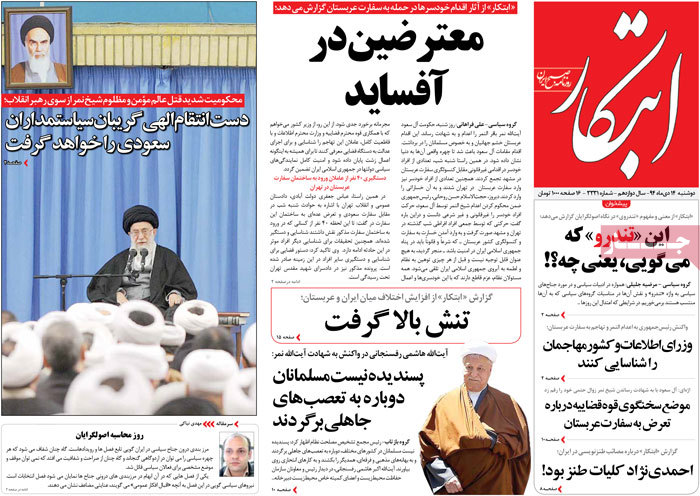
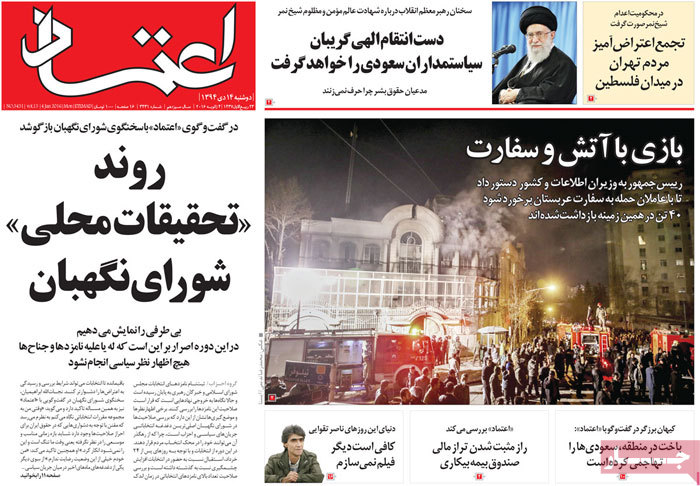
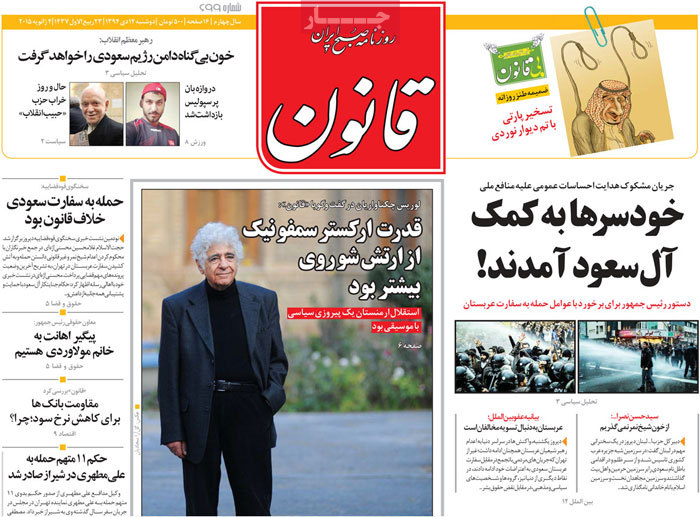
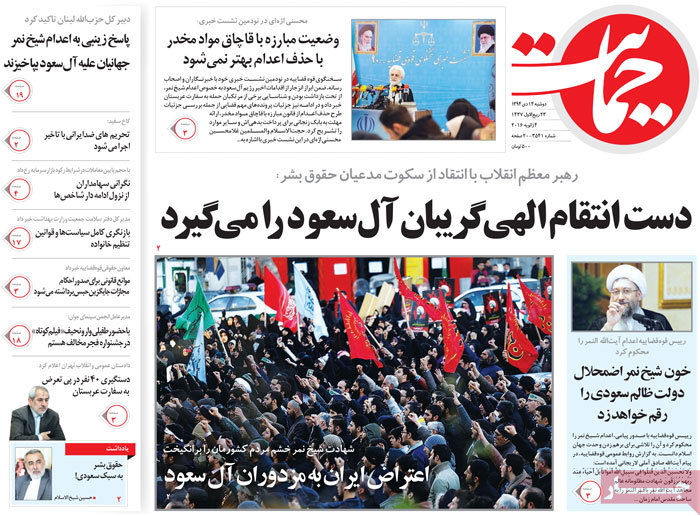
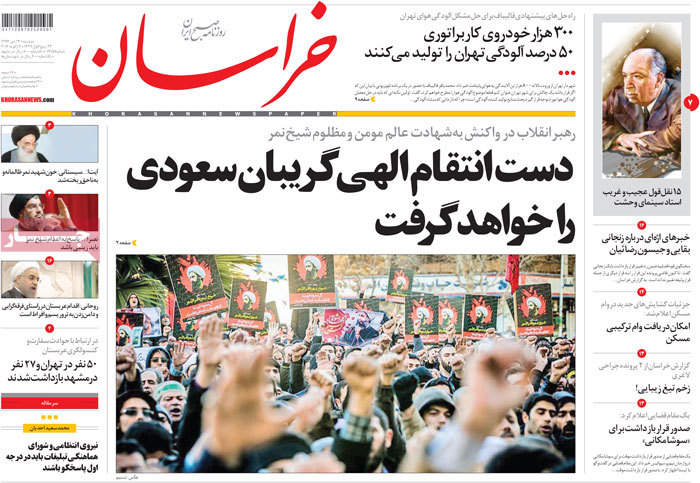
A look at Iranian newspaper front pages on Dec. 17

Iranian Newspapers Headlines

The comments of President Rouhani that his administration has honored the promise it made to the nation dominated the front pages of Iranian newspapers on Thursday.   


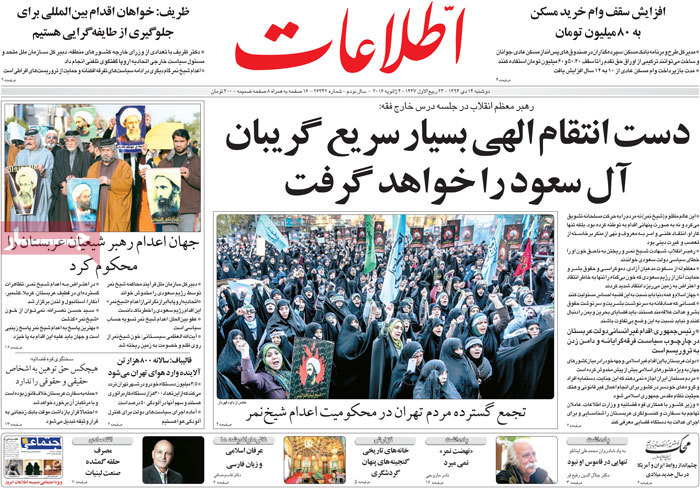
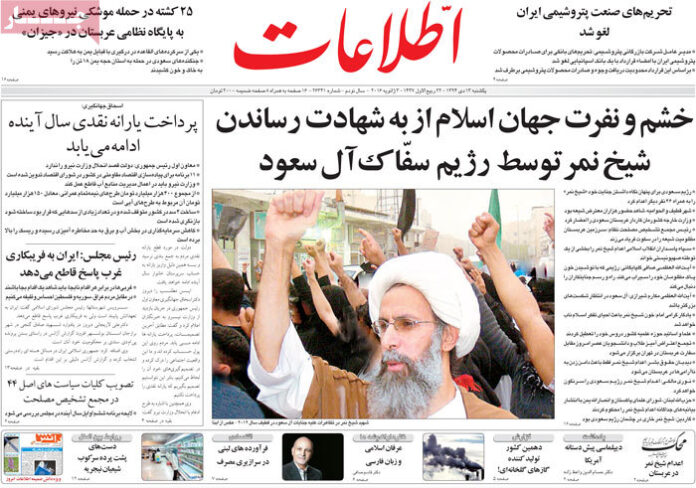
Ettela’at: The victory of the Iranian nation at the [IAEA] Board of Governors was a moral, political and technical triumph, said President Rouhani in a televised speech.

After almost 12 years it became clear that the establishment is honest with its people and with world nations; did and does not lie; and honors its commitments.

Ettela’at: Some 43 percent of the economy is tax exempt.

The minister of economy has said that tax has yet to find its place as a financing tool for the government.

Ettela’at: A new wave of crackdown in Nigeria has left four Shiites martyred and 500 others arrested.

Grand Ayatollahs Javadi Amoli, Makarem Shirazi and Sobhani have condemned the Nigerian army attack on the Shiites and appealed for the release of Sheikh Zakzaky.

Ettela’at: Parliament Speaker Ali Larijani has said that efforts to protect the environment are now a global imperative.

He further said that the country’s costly overreliance on oil does not sound rational.

Ettela’at: Individuals seeking to run for the Assembly of Experts have started fielding their candidacy.

Enrollment of those who want to run for parliament gets underway on Saturday.

Ettela’at: Construction of the biggest water transfer channel in Kerman Province has gotten underway.

Ettela’at: A plan to introduce a single currency rate is being drawn up.

A lieutenant governor of the Central Bank has said that the monetary pact Iran and Russia have signed will soon take effect.

Ettela’at: Top researchers and technology experts of the country have been named.


A look at Iranian newspaper front pages on Dec. 17


Afkar: Iran is fully ready to join the World Trade Organization.


A look at Iranian newspaper front pages on Dec. 17


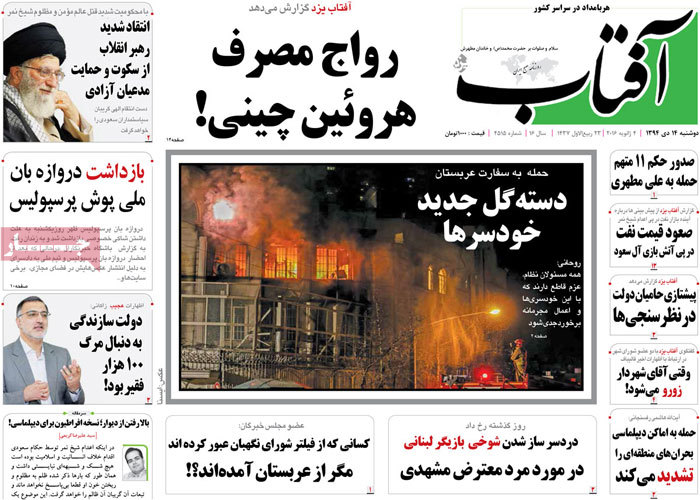
Aftab-e Yazd: The Saudi foreign minister has said that Riyadh is mulling the deployment of ground forces to Syria.


A look at Iranian newspaper front pages on Dec. 17


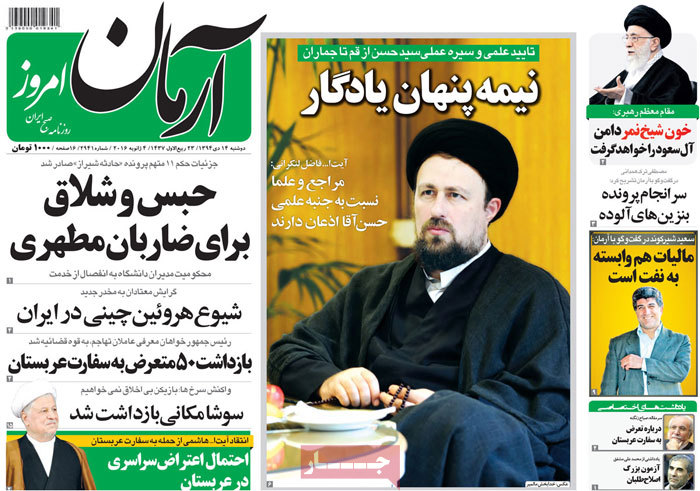
Arman-e Emrooz: Chairman of the Expediency Council Ayatollah Akbar Hashemi Rafsanjani has congratulated President Rouhani on the closure of the PMD case.

In a message, the top councilor likened the “sweet nuclear victory” to Resolution 598 [which brought the Iran-Iraq war to an end in the late 1980s].


A look at Iranian newspaper front pages on Dec. 17


Asrar: Tourism growth in Iran is three times the global average, said the director of the Cultural Heritage, Tourism and Handicrafts Organization.

Asrar: Parliament Speaker Ali Larijani has said that with the ruling of the IAEA Board of Governors [to declare the PMD case closed] Iran negotiated a major bend.


A look at Iranian newspaper front pages on Dec. 17


Ebtekar: President Rouhani has promised that sanctions will be lifted in January.

In a televised speech, he further said that leveling criticism at the Joint Comprehensive Plan of Action is no longer in order.


A look at Iranian newspaper front pages on Dec. 17


Emtiaz: The remains of a giant ancient creature have been unearthed in Ardebil [in northwestern Iran.]

Emtiaz: The industry minister has said that the Iranian private sector stands ready to boost its cooperation with Oman.


A look at Iranian newspaper front pages on Dec. 17


Etemad: Iranians will stage demonstrations after Friday prayers to protest the killing of Nigerian Shiites.

Etemad: The Iranian nuclear chief has said that Iran honorably beat the nuclear challenge.


A look at Iranian newspaper front pages on Dec. 17


Ghanoon: The closing of the PMD case amounts to a victory for diplomacy, said the parliament speaker.

Ghanoon: I did keep the promise I made, said President Rouhani. “Sanctions will be lifted next month.”


A look at Iranian newspaper front pages on Dec. 17


Hemayat: The presuppositions of Western human rights are not acceptable to us, said the Judiciary chief.

Hemayat: The law which turns up the heat on drug trafficking remains in effect, said the attorney general.


A look at Iranian newspaper front pages on Dec. 17


Javan: John Kerry has said that the US does not seek a regime change in Syria.

A major change of heart on the part of the US in the face of Iran and Russia


A look at Iranian newspaper front pages on Dec. 17


Jomhouri Islami: President Rouhani has said the country needs to get ready for an economic leap; sanctions will be removed next month.

Jomhouri Islami: Iran is ready for the worst-case scenario as far as the plunge in oil prices is concerned.


A look at Iranian newspaper front pages on Dec. 17


Kaenat: The defense minister has said that militarily advanced countries have proposed to cooperate with Iran.

Kaenat: Iran is to hold oil tenders soon.


A look at Iranian newspaper front pages on Dec. 17


Kayhan: The commander of the Islamic Revolution Guard Corps has said that as long as Iran’s revolution remains on its original path, US enmity toward Iran won’t ease.


A look at Iranian newspaper front pages on Dec. 17


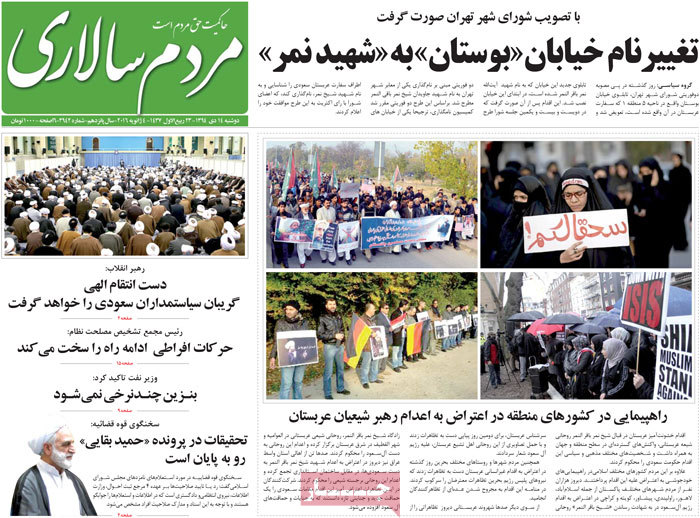
Mardomsalari: People in Mashhad have staged a rally outside UN offices to protest the silence of the international community over the killings of Nigerian Shiites.

Mardomsalari: The Iranian nuclear chief has said that a neighboring country has asked Iran to build a nuclear research plant for it.


A look at Iranian newspaper front pages on Dec. 17


Qods: Foreign Minister Zarif has left for New York.

Finding a solution to the Syrian crisis is on the agenda.


A look at Iranian newspaper front pages on Dec. 17


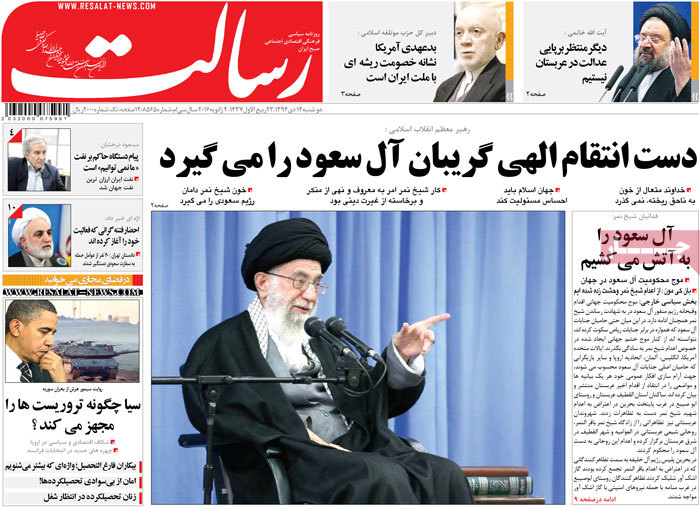
Resalat: The world has accepted to live with an Iran in possession of nuclear technology, said the defense minister.

Resalat: Haddad Adel [a former parliament speaker] has become the spokesman of a principlist coalition.


A look at Iranian newspaper front pages on Dec. 17


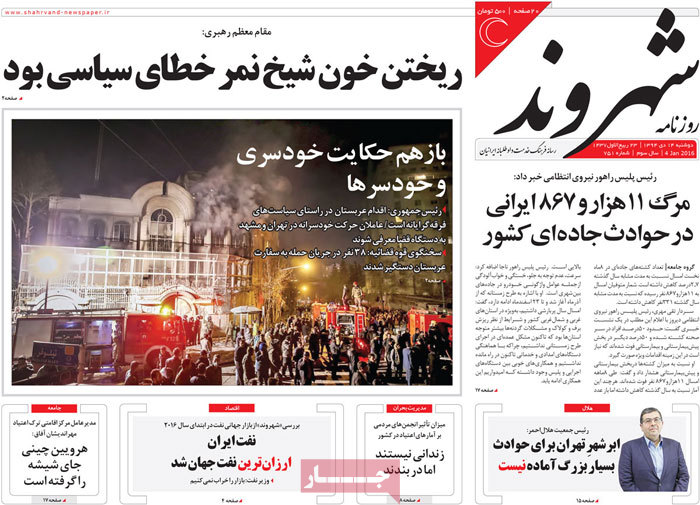
Shahrvand: Government kept the promise it made to the nation, President Rouhani said as he urged the Iranian people to prepare for an economic leap in the post-sanctions era.


A look at Iranian newspaper front pages on Dec. 17


Sharq: Yasser Hashemi has said that his father [Ayatollah Hashemi Rafsanjani] has yet to visit Mehdi in prison. [Mehdi Hashemi is in jail after he was found guilty in a corruption case].


A look at Iranian newspaper front pages on Dec. 17


Sobh-e Eghtesad: The director of the Atomic Energy Organization has said that a report on Iran’s long-term nuclear activities will soon be sent to the IAEA.


A look at Iranian newspaper front pages on Dec. 17


Vaghaye-e Etefaghiyeh: The first post-revolution Iranian female ambassador has arrived in Malaysia.

Vaghaye-e Etefaghiyeh: A state manager the Ahmadinejad administration appointed has been replaced six years later.


A look at Iranian newspaper front pages on Dec. 17


Turkey should be the Turkey it used to be: Iran MP

Erdogan

If Turkey wants to avoid serious harms down the line, it needs to be just that: Turkey, Abbasali Mansouri Arani, a member of parliament’s National Security and Foreign Policy Committee said in an interview with the Islamic Consultative Assembly News Agency (ICANA).

The following is the translation of what else the MP said in an interview ICANA published on December 15:

Manouri AraniAs a result of self-inflicted blows, Turkey, which was a progressive country on the economic and political fronts until a few years ago, has now turned into a country at odds with what upholds security in the Middle East, the MP said.

He added when Turkey’s economic revenues swelled, Ankara mistakenly decided to blend Ottoman strategies and Ataturk principles to expand the sphere of its influence. “The wrong approach [President Recep Tayyip] Erdogan adopted introduced a chain of political, social and security blunders.”

Warning of the consequences of measures Turkey is adopting, the MP said that opting for aggressiveness to expand the realm of influence will not only not produce the intended result, but will raise the incurred costs because it gives rise to tensions.

Arani further said with the passage of time any country that walks into the trap of the vicious circle of strategic blunders will pay incremental costs and see its interests take a blow. “By getting involved in the Syrian conflict, Turkey committed a strategic mistake. Its support for the Syrian opposition paved the way for multinational terrorists to set foot on its soil. Besides, Turkey has had to pay for the financial and security costs of a stream of refugees crossing its border.”

The Iranian MP went on to say that on top of those hefty costs, there are ominous signs that an economic crisis is around the corner for Turkey. “It is true that Turkey has got its hand on cheap oil, but its manufacturers have lost the markets of neighboring countries.”

Over the past few years, the Turkish government coffers have swelled, but its lack of heavy industries and overreliance on tourism revenues will see its income drop dramatically when tensions run high. In fact, the past few months have seen a steep decline in its tourism-related income, the MP said.

The former president of the War University said that economic crises in different countries can spark social crises. What makes the threat Ankara is facing graver is that thanks to the presence of Kurdish, Alawite, Kemalist and leftist groups, Turkey’s society is politically and socially wobbly.

The Iranian deputy further said that unfortunately President Erdogan insists on the wrong strategies that date back to the Ottoman Empire. “Deployment of troops to Iraq and provoking the Iraqi Kurdistan Region are the latest examples of mistakes Ankara has made. Unfortunately, Ankara is so badly mired in its problems that it has ratcheted up tensions with Iran too.”

Recalling the comments of President Erdogan that normalization of ties with Israel would serve the interests of the entire region, he said this dramatic change of heart in dealing with the most despised regime in the world, is a painful sign of the decline in morality among Turkish rulers. Turkey should be what it used to be: Turkey, and should redress its wrong policies.

He said that the recent downing by Turkey of a Russian warplane in Syrian airspace was another glaring mistake. Having its economy revived, Russia built on its energy hegemony in Europe and on its infrastructural and industrial might to become as powerful as the Soviet Union.

He said that Russia has boosted its naval power to the levels of its military might on the ground. That was why it has sent a naval fleet to the Mediterranean. The grave mistake of Turkey is that it thinks NATO would rush to its assistance against Russia in case something happens.

US Visa Waiver Program will push foreign investment in Iran down to zero

investment

An Iranian economist says that changes to the US Visa Waiver Program (VWP) will violate the provisions of the Joint Comprehensive Plan of Action (JCPOA) and will eventually lead foreign investment toward a no-growth future.

BakhshiLotfali Bakhshi, a professor of economics at Allameh Tabatabai University in Tehran, made the remark in an interview and added that if the US Visa Waiver Bill passes the US Congress, which is highly likely, it would view travel to Iran by any Americans as a blight on their record.

Nasimonline.ir on December 14 published the interview and the following is the translation of the remarks of the economist:

Compared with the sanctions imposed on Iran, the new US decision – if it clears the US Congress, which is very much likely – will take a more devastating toll on foreign investment, the tourism industry and trade in the country.

The new Visa Waiver Bill, which infringes on JCPOA, amounts to deep hostility the US government has shown to the Iranian nation. Under JCPOA, the Americans have committed themselves to dropping hostile acts against the Iranian nation, but the congressional decision on visa waiver will violate the US commitments in dealing with Iran.

The Europeans seem to have objected to the US move, and the Iranian officials are expected to inform the American side that Tehran views Washington’s new decision as a hostile act against the Iranian people and violation of JCPOA.

The new US bill will target foreign investment in Iran. This reveals the hostility America bears toward the Iranian people and government, because the decision will virtually cut the foreign investment Iran absorbs and will make it very hard for tourists to travel to Iran.

The visa waiver legislation will also undermine Iran’s normal trade with other nations. It bans foreign investors and businessmen who make a trip to Iran from easily traveling to the United States and elsewhere in the world.

The Europeans and Americans as well as the South Koreans and the Japanese are the main foreign investors in Iran, with countries such as China, the UAE and Turkey which are known as Iran’s trading partners claiming no share of Iran’s foreign investment.

The new visa law in the US will target 80-90 percent of foreign investment in Iran. Countries such as Turkey or the UAE which benefit the most from Iran’s economy have yet to make remarkable investments in Iran. The Chinese have tried to make investment in Iran, but Iran’s economy has yet to reap revenues from what they have done.

During the years Iran was reeling under the weight of sanctions, a number of countries, including Turkey, the UAE and China, could make investment in Iran, but they didn’t. And the new visa legislation will provide them with a new pretext not to put their money into [different sectors in] Iran.


A congressional resolution on the US Visa Waiver Program – resolution, H.R. 158 – has already passed the House of Representatives and has been sent to the Senate for its consideration, along with a similar Senate resolution.
According to the bill, which was passed by 407 to 19 on Tuesday, visitors from the 38 “visa waiver” countries will need to obtain a visa to travel to the US if they have been to Syria, Iraq, Iran or Sudan in the past five years.

Presence of foreign banks spurs competitiveness: MP

Bank

Nothing stands in the way of foreign bank presence in Iran because such presence will give a boost to competitiveness of the banking system, Mousa al-Reza Servati, a member of parliament’s Planning and Budget Committee, told the Islamic Consultative Assembly News Agency (ICANA).

Mousa al-Reza ServatiHe further said that under the laws the chamber has voted for foreign banks that meet the requirements face no restrictions in setting up branches here in Iran. “Of course, the laws determine the stake of foreigners in such banks. Their Iranian partners should claim a bigger share.”

The following is the translation of what else Servati told ICANA:

He said that such presence would infuse liquidity into the national economy which could help production flourish, if managed properly.

The MP, who represents Bojnourd in the chamber, further said to ease concerns about the presence of foreign banks in the country, a team of experts can make all the necessary assessments and remove the legal problems, if any.

He said the presence of foreign banks can also inject competitiveness to efforts to adjust interest rates.

Servati also hailed the Central Bank of Iran’s decision to streamline the currency exchanges and said that measures to clamp down on unauthorized dealers in foreign currencies should continue in cooperation with Law Enforcement.