Friday, January 2, 2026
Home Blog Page 4671

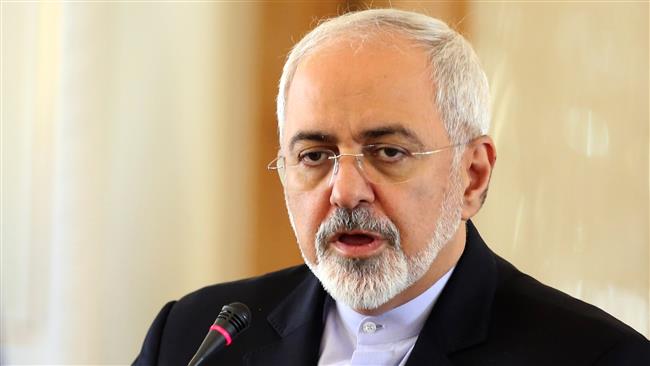
Zarif: Iran sees ‘mixed signals’ from US, proposed visa waiver changes ‘absurd’

Zarif and Kerry

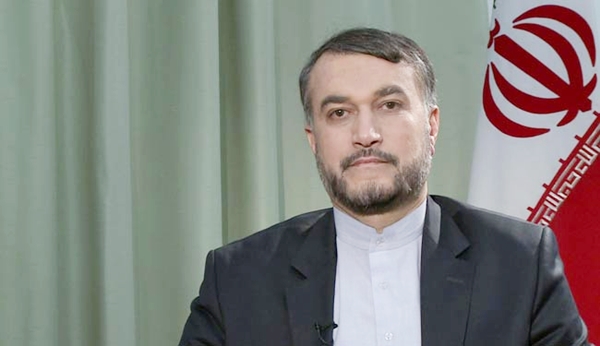
Iran’s Foreign Minister Mohammad Javad Zarif, speaking to Al-Monitor in New York following a UN Security Council meeting on Syria on Dec. 18, said it remains to be seen if US-Iran relations would ease in the wake of the implementation of the Iran nuclear deal as early as next month. But he said Iran was disturbed by recent proposed changes to the US Visa Waiver Program that could require European travelers who had visited Iran to apply for a visa to travel to the United States, and he had been discussing the matter with US Secretary of State John Kerry.

“We will have to wait and see,” Zarif told Al-Monitor in an interview at Iran’s ambassadorial residence in New York on Dec. 18, regarding whether US-Iran ties would ease up a bit after the United States lifts sanctions when the Iran nuclear deal, the Joint Comprehensive Plan of Action (JCPOA), is implemented as early as January.

“Unfortunately, there are mixed signals coming from Washington, mostly negative signals, including the Visa Waiver Program restrictions” proposed in a Congressional omnibus spending bill Dec. 18, Zarif said. “Now we await for the decision by the administration on how it wants to bring itself into compliance with its obligations under JCPOA.”

“I have had discussions with Secretary Kerry and others on this for the past several days since it’s become known that this was the intention,” Zarif said. “And I wait for them to take action.”

Predominantly Shiite Iran, which is considered a mortal enemy of the Islamic State (IS), an extremist Sunni terrorist group, and is engaged in fighting it in Iraq and Syria, has nothing to do with recent IS-linked terrorist attacks in Paris and San Bernardino, California, Zarif said, calling the proposed changes to the US Visa Waiver Program targeting travelers to Iran “absurd.”

“Now it is clear that this new legislation is simply absurd because no Iranian nor anybody who visited Iran had anything to do with the tragedies that have taken place in Paris or in San Bernardino or anywhere else,” Zarif said. “But they’re being the targets. I think it discredits those who pass these legislations, those who adopt them and those who implement them more than anything else. And it sends a very bad signal to the Iranians that the US is bent on hostile policy towards Iran, no matter what.”

Zarif, speaking after the conclusion of a third round of meetings of some 20 nations and international bodies that comprise the International Syria Support Group, said he appreciated that the international Syria diplomatic process had brought Iran and the Kingdom of Saudi Arabia into direct discussions again, which Iran has sought but Riyadh had rebuffed until October. But he expressed misgivings about the intentions of some members of the international body about whether they really supported a diplomatic resolution to the Syria conflict.

He confirmed that Iran has had sideline bilateral conversations with Saudi Arabia in recent weeks, but he said the interactions were brief.

“There have been some short conversations, very welcomed though,” Zarif said. “And I’ve had a couple of exchanges with my Saudi counterpart [Saudi Foreign Minister Adel al-Jubeir]. Iran’s ambassador has had a couple of exchanges in the yard. We hope that is a good beginning. But that’s not even near where we should be.”

“We have always been ready to engage with our neighbors, and we believe that our neighbors are our priority,” Zarif said. “And once our Saudi friends are ready to engage in serious dialogue, they will find Iran to be … ready.”

As to the considerable efforts of Kerry and the Obama administration, as well as Russia and the European Union, to persuade Saudi Arabia to include Iran in direct talks on regional matters, Zarif did not offer Washington too much credit. “The fact that people allowed certain players to exclude others from this process was the anomaly, not having a table around which all the significant players can sit and discuss,” Zarif said. “So, I mean, I have to say that what happened in the past [keeping Iran out of the Geneva meetings on Syria] was the anomaly, not what is happening now.”

On Syria, Zarif said he believed the international community was becoming more “realistic” about trying to facilitate a dialogue among the Syrian regime and opposition “without setting preconditions” — presumably referring to when in a transition process Syrian President Bashar al-Assad would be required to leave power.

“I think as soon as people realized that this was not possible, that if you wanted to find a political solution to the Syrian nightmare, you needed to be able to sit down at the table without setting preconditions. And I think that that’s the realization,” Zarif said. “It’s not kicking the can down the road, but rather being realistic. That you need to start negotiating, and through the negotiation process, achieve the outcome; not achieve the outcome before the negotiation process.”

“Of course there are disagreements,” Zarif said. “We have disagreements about who [the] terrorists are. Unfortunately, reincarnations of al-Qaeda, Daesh [IS] and Jabhat al-Nusra are being used by some of our friends and neighbors as oppositions rather than as terrorists. … And we certainly do have differences about how the political process should lead to a national unity government.”

“I think another area of possible disagreement is that some of our friends continue to believe that there is a military solution,” Zarif said. “I think that’s an illusion. Of course there has to be a military element to this, but it has to be a political solution. And then we need to engage in a comprehensive approach to settle the problem of these extremist groups.”

A transcript of the interview, conducted by Al-Monitor’s managing editor, slightly edited for clarity, follows below.

Al-Monitor: Today was a very productive day. Was the decision not to mention Assad in the resolution the outcome of simply an agreement to disagree, thereby kicking the can down the road, or is there an understanding beyond that of Syrians being free to “decide the future of Syria” in internationally supervised elections?

Zarif: Well, I think what’s important is for the international community to try to facilitate a dialogue among Syrians rather than to try to dictate the terms of that dialogue. Over the past four and a half years, or at least after the first few months where everybody thought on both sides that this would be over within a few months, after that for the past almost four years, the attempt to put an end to this has been thwarted because of an inclination to determine the outcome of the negotiations before the negotiations started, almost as a precondition for the negotiations.

And so I think as soon as people realized that this was not possible, that if you wanted to find a political solution to the Syrian nightmare, you needed to be able to sit down at the table without setting preconditions. And I think that that’s the realization. It’s not kicking the can down the road, but rather being realistic. That you need to start negotiating, and through the negotiation process, achieve the outcome; not achieve the outcome before the negotiation process.

Now the outcome is what the Syrian people will decide it to be, not what those of us should think in this room, in a nice hotel room in New York or in Vienna or anywhere else, decide for the Syrians. And I think that that’s important. Of course there are disagreements. We have disagreements about who [the] terrorists are. Unfortunately, reincarnations of al-Qaeda, Daesh [IS] and Jabhat al-Nusra are being used by some of our friends and neighbors as oppositions rather than as terrorists. So that is something to be sorted out.

And we certainly do have differences about how the political process should lead to a national unity government. Ah, we have presented our views in a rather transparent way, and we hope others are prepared to do the same, and at the same time, help the Syrians get together and put an end to this bloodshed.

I think another area of possible disagreement is that some of our friends continue to believe that there is a military solution. I think that’s an illusion. Of course there has to be a military element to this, but it has to be a political solution. And then we need to engage in a comprehensive approach to settle the problem of these extremist groups.

Al-Monitor: Speaking of these terrorist groups, the UNSC [United Nations Security Council] Resolution bars terrorist groups from the negotiation process. Is there a consensus on how these groups are defined? You made a reference today [Dec. 18] in your op-ed in the Guardian that there are those “pushing for self-proclaimed al-Qaeda affiliates to have a prominent place at the negotiating table.” How would you define such groups?

Zarif: Well, I mean it’s not that difficult. There are groups that have al-Qaeda affiliations, ah, have issued statements that they sympathize with al-Qaeda or basically branches of al-Qaeda and Syria. They cannot, all of a sudden, be baptized as legitimate opposition groups. These are terrorist organizations usually composed of mostly non-Syrians. It’s simply not acceptable to try to just repackage them and present them as democratic opposition.

Al-Monitor: Following on that, how would you define what constitutes a legitimate opposition group that should be encouraged to enter the dialogue?

Zarif: Well, we have set a red line that Daesh [IS], Jabhat al-Nusra and other al-Qaeda affiliates would not be recognized as legitimate oppositions. So whoever is not among them and whoever is prepared to sit down and seek a political solution, if they meet the criteria, then that’s the criteria. Unfortunately, people are trying to avoid that criteria from being set.

Al-Monitor:  Has Iran been able to help with local cease-fire efforts to get more access for humanitarian aid into Syria?

Zarif: Well, we have in the past several years tried and, in cases, successfully to get humanitarian access, to get even temporary cease-fires for civilians to get out. Even in cases to get those combatants who did not want to engage in combat anymore out of areas under siege. So we think that’s possible provided there is political will to engage in Syria’s work.

Some people have made it a business of continuing to see bloodshed in Syria because that’s politically useful for those who want to wage a propaganda campaign. It’s a very sad statement, and I’m very sorry to make this statement. But it is important for people to realize that they cannot make political mileage out of the misery of the Syrian people. And once that is the case, then we will try to work for whatever we can get. If it’s a localized cease-fire, if it’s a general cease-fire, if it’s a temporary humanitarian cease-fire. Whatever we can do, we need to do it in order to relieve the Syrians of the pain and suffering that they’ve been going through.

Al-Monitor: When you were here in New York in the fall, you said that you’d been trying to get talks with the Saudis, but the Saudis did not accept, as of yet. After intense efforts by the US, among others, the US helped to persuade the Saudis to accept Iran being a part of the international Syria support group, to help get you both to the table. What is your view on this effort, and how have you seen the cooperation go during this past day and a half?

Zarif: Well, we have always been ready to engage with our neighbors, and we believe that our neighbors are our priority. And once our Saudi friends are ready to engage in serious dialogue, they will find Iran to be, to be ready. The fact that people allowed certain players to exclude others from this process was the anomaly, not having a table around which all the significant players can sit and discuss.

So, I mean, I have to say that what happened in the past [keeping Iran out of the Geneva meetings on Syria] was the anomaly, not what is happening now.”

Al-Monitor: Your deputy, [Hossein Amir-] Abdollahian, was recently cited by Iranian media saying that there has been more Saudi and Iran talks as of late. Have you been able to advance that channel?

Zarif: There have been some short conversations, very welcomed though. And I’ve had a couple of exchanges with my Saudi counterpart [Saudi Foreign Minister Adel al-Jubeir]. Iran’s ambassador has had a couple of exchanges in the yard. We hope that is a good beginning. But that’s not even near where we should be.

Al-Monitor: Have you been able to discuss the ongoing conflict in Yemen?

Zarif: No. We are trying to help, through the United Nations, in the negotiations, as they’re taking place in Geneva. We facilitated the negotiations, and we will continue to help with the negotiations that are undergoing right now. And it’s moving, I hope, in the right direction.

Al-Monitor: On the nuclear deal, do you think the implementation and the US fulfilling its obligations under the JCPOA to lift sanctions will make for an easing in the chill in the US/Iran relations?

Zarif: Well, we will have to wait and see. Unfortunately, there are mixed signals coming from Washington, mostly negative signals, including the Visa Waiver Program restrictions that’s been adopted by the House and today by the Senate, which in our view are not in line with US obligations under JCPOA. Now we await for the decision by the administration on how it wants to bring itself into compliance with its obligations under JCPOA.

I have had discussions with Secretary Kerry and others on this for the past several days since it’s become known that this was the intention. And I wait for them to take action.

Well what’s important is that the United States needs to send a signal to the Iranian people that it is prepared to modify its behavior and its policy vis-a-vis Iran. Now it is clear that this new legislation is simply absurd because no Iranian nor anybody who visited Iran had anything to do with the tragedies that have taken place in Paris or in San Bernardino or anywhere else. But they’re being the targets. I think it discredits those who pass these legislations, those who adopt them and those who implement them more than anything else. And it sends a very bad signal to the Iranians that the US is bent on hostile policy towards Iran, no matter what.

Al-Monitor: Since it sounds like Iran views this as a violation of the US commitments, will Iran take any corresponding actions?

Zarif: I mean we don’t care about what’s happening within the US legal system. What’s important is what the United States government, as the authority responsible before its national law and in interstate relations, takes as its own course of action. I believe there are remedial measures that the US government can take, and it should take, in order to mitigate the negative consequences of this legislation and bring the United States into compliance with JCPOA. So we are waiting for action to be taken.

Al-Monitor: Following up on one more question on the Iran deal. One of the changes in Iran’s handling of the nuclear negotiations after President [Hassan] Rouhani’s election was the transfer of the nuclear file from the Supreme National Security Council to the Foreign Ministry. And mindful of the AEOI’s [Atomic Energy Organization of Iran] extensive role in the implementation of Iran’s commitments under the JCPOA, which Iranian government body is in charge of the implementation of the nuclear agreement?

Zarif: Well, it’s an interagency process. The foreign ministry was responsible to lead the negotiations, but we always benefitted both from the expertise as well as from the actual political participation of our Atomic Energy Organization, particularly toward the last episodes of the negotiations. We had with the head of the agency, Dr. [Ali Akbar] Salehi, engaging his American counterpart, [Secretary of Energy, Ernest] Moniz, in the negotiations, which proved to be extremely useful.

And now it is an interagency exercise in Iran with a body under the National Security Council that basically exercises oversight on the implementation of the JCPOA. So it’s a complicated process, but it is mostly because Iran’s actions to implement its side of the bargain will be verified by the IAEA [International Atomic Energy Agency]. It is important for us to make sure that the United States and Europe, particularly the United States, remain in compliance with their part of the obligations under the treaty. And that is why that oversight body exists in Iran to, to make sure that the United States is in compliance.

Al-Monitor: Turning directions a little bit, talking about Russia. Russia has surfaced as a strategic partner of Iran in the region. Mindful that your country’s current trade volume with Turkey is 10 times that of your trade with Russia, Iran has an obvious interest in maintaining good relations with both Ankara and Moscow. What, if any, steps are being taken by Iran to reduce tensions between Russia and Turkey?

Zarif: Well, we have tried to exercise restraint when it comes to statements that have been made. And we have tried to talk to our Turkish friends about statements that they are making about Iraq. We believe that the focus of attention has to be on fighting Daesh [IS] and terrorist organizations in Syria and in Iraq, rather than on attempts to divert attention from the actual problem, and that is extremism and terrorism in the region.

So we certainly hope that the development in our region, both in the relations between Turkey and Russia, as well as in the relations between Turkey and Iraq, are contained. And we do not see further exacerbation of tension. Because any tension between regional players plays directly in the hands of Daesh [IS].

Al-Monitor: And one final question. There is a report in Al-Hayat about Jordan having submitted a list of 167 terrorist groups in Syria. According to this report, the IRGC [Islamic Revolution Guards Corps] and Hezbollah are on this list. Have you heard of this report?

Zarif: Well, Jordan had the responsibility of coordinating. So it compiled a list of various organizations that had been claimed by one or several countries to be considered as terrorist organizations. One or two actually tried to use this as a political ploy to score, in my view, rather childish political scores. And while there is unanimity on a number of organizations, like Daesh [IS] and Nusra, and a very large majority, including certain organizations like Ahrar ash-Sham, who were unfortunately invited to the meeting in Saudi Arabia as terrorist organizations.

There were one or two who just put certain names in there, and that list has been officially withdrawn now. So there is no list with organizations or entities that are actually in Syria under request of the Syrian government fighting Daesh [IS] and terrorist groups that is around.

It is a very sad situation where people, instead of focusing their attention on known terrorist organizations like al-Qaeda, Daesh [IS] and Jabhat al-Nusra, Ahrar ash-Sham, and Jaish al-Islam — organizations which everybody consider to be extremist terrorist organizations — are trying to use them as leverage or play games or try to bargain. I mean, as if they are announcing that these guys are all allies.

And we want to use every possible avenue in order to keep them alive. That sends a very bad signal, but I think it is being addressed. There are no such lists. If anybody is reporting that a list exists, I could say categorically. And if anybody kept any record of the meeting, the record of the meeting indicates that any possibilities have now been officially withdrawn.


UN resolution against Daesh funding belated: Leader’s aide

Velayati-Iran

A UN Security Council resolution aimed at clogging up Daesh Takfiri group’s revenue stream has been adopted “belatedly,” a top adviser to Leader of the Islamic Revolution Ayatollah Seyyed Ali Khamenei, says.

Speaking to reporters on Saturday, Ali-Akbar Velayati welcomed the adoption of the resolution, but said that the UN should have taken action against the Daesh funding sooner.

The Security Council’s resolution earned the blessing of the 15-member body’s finance ministers on Thursday.

It considered Daesh to be posing as much threat as al-Qaeda, threatened sanctions on parties buying oil from the terrorist group, and advised that countries resist its demands for ransom payments.

The Security Council, which had last month called on all countries to take “all necessary measures” to fight Daesh terrorists, also voiced concern that some countries were failing to implement long-standing sanctions against Daesh.

Velayati said Western countries must be held accountable for crimes committed by Daesh terrorists in the global scene, adding, “Those who created Daesh [terrorist group] must also be held responsible in international bodies.”

He emphasized that those who have formed Daesh Takfiri group must be tried in international courts as war criminals.

He said the UN resolution was adopted after Daesh Takfiri terrorist group committed numerous crimes in Iraq, Syria and other countries such as Nigeria, adding that the group’s crimes have brought disgrace on the Western countries.

“Policies of certain regional countries and Daesh have failed due to the resistance of the Iraqi and Syrian people and countries that helped them such as Iran,” the senior Iranian official added.

The US along with some of its allies has been launching attacks against alleged positions of Daesh Takfiri terrorists since August 2014 without any authorization from Damascus or a UN mandate.

Syria has slammed Washington and its allies for damaging Damascus’ infrastructure and killing and injuring civilians.

Bashar al-Assad, Iran’s red line

Velayati further described Syrian President Bashar al-Assad as Iran’s red line, noting that the Syrian government has managed to stand firm against the foreign-backed war on the Arab country over the past five years.

He added that despite some restrictions and problems, the Syrian government and nation have been resisting against some powerful world countries and their regional allies over the past five years.

The Supreme Leader’s aide emphasized that no extra-regional country has the right to make a decision about the future government of Syria.

“The next Syrian government should be elected by the [Syrian] people. No decision must be made from outside the region at all,” he pointed out.

The crisis in Syria, which flared in March 2011, has so far claimed the lives of over 250,000 people and displaced nearly half of the Arab country’s population within or out of its borders.


Instrumental use of terrorism leads to its escalation: Larijani

Larijani-French

Iran’s Parliament Speaker Ali Larijani says the instrumental use of terrorism and the lack of a genuine anti-terror fight have led to the spread of the menace.

“The use of terrorism as a tool is a factor that has helped its spread because certain countries seek to control and not combat and eradicate terrorist groups,” Larijani said in a meeting with President of the French Senate Gerard Larcher in Tehran on Saturday.

He added that crises in many regional countries can be resolved only through the formation of national unity governments, warning that conflicts would otherwise persist in the region.

The Iranian speaker said Western countries need to realize that it is the people who should decide their country’s government through elections.

Larijani further stressed the importance of increasing parliamentary and economic cooperation between Tehran and Paris in a bid to reach common solutions on the establishment of security in the region.

France determination to fight terrorism: Larcher

The French senate president said his country, which has been recently targeted by terrorist attacks, is determined to contribute to the resolution of crises.

At least 130 people were killed and 352 others injured when assailants struck at least six different venues in and around the French capital on November 13.

In a statement the day after, the Daesh Takfiri terrorist group claimed responsibility for the attacks.

Larcher pointed to the adoption of a resolution by the United Nations Security Council on putting an end to the nearly five-year-long crisis in Syria and urged a serious international fight against Daesh terrorist group as well as the establishment of democracy in the Arab country.

The Security Council’s resolution, adopted on Friday, calls for Syrian peace talks on a transitional government to begin in early January. It also calls for a nationwide ceasefire in the war-torn country.

According to the resolution, a “credible, inclusive and non-sectarian” government should be established in Syria within six months and UN-supervised “free and fair elections” should be held within 18 months.

Larcher arrived in Tehran at the head of a delegation on Saturday. He is set to hold talks with Iran’s President Hassan Rouhani on Sunday.

New determination to end US monopoly of the Internet

Internet conference

The US is trying to stick to its monopoly on the Internet forever but with the discussions raised at the second World Internet Conference, its seems new determination is taking shape to put an end to this monopoly, Iranian Communications Minister Mahmoud Vaezi told IRNA at the end of the summit in Wuzhen, China.

Vaezi-Iran
Iranian Communications Minister Mahmoud Vaezi

Vaezi further said, “All countries call for respect for the nations’ sovereignty in cyberspace and want that infrastructures of the cyberspace should be safe and void of any threat, and this significant matter is feasible only and only through international efforts.

“This issue is so paramount that even many Western countries participating in the Wuzhen summit stressed the need for serious confrontation with cybercrimes and cyber-terrorism.”

The Iranian communications minister also underlined, “The Internet governance should be democratic, transparent and at the same time lend support to governments to enable all countries and nations to access the security they all expect the cyberspace to provide.”

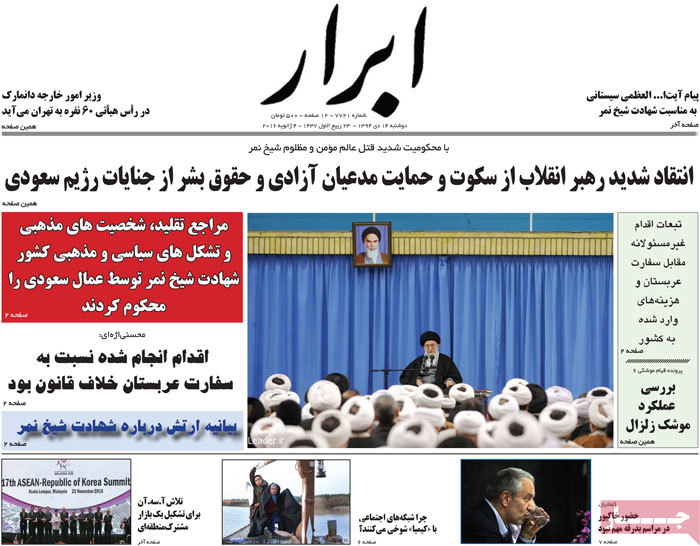
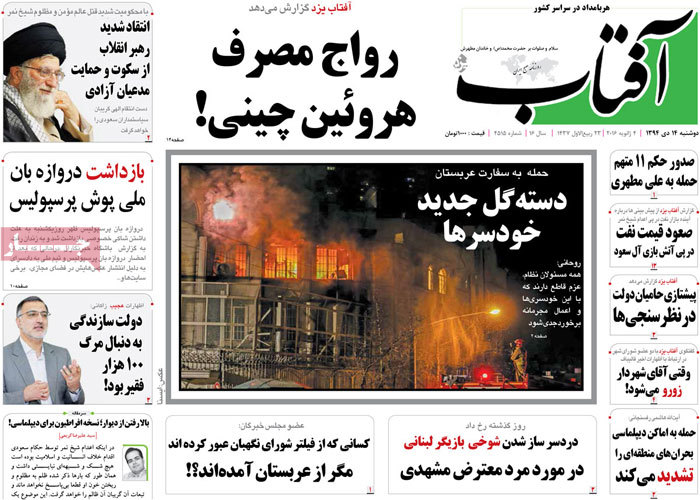
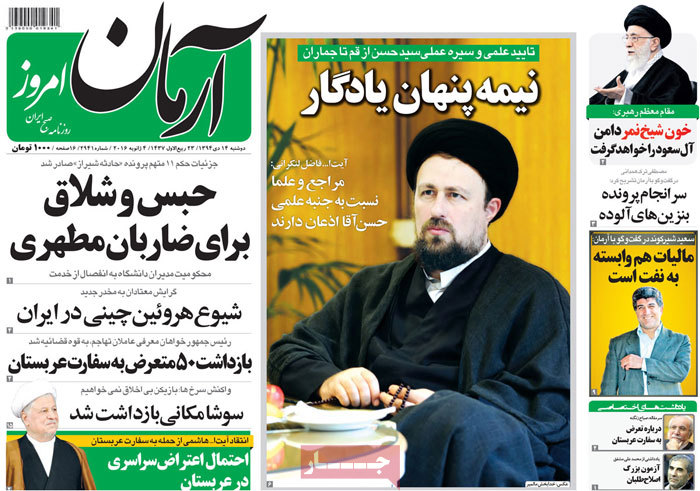
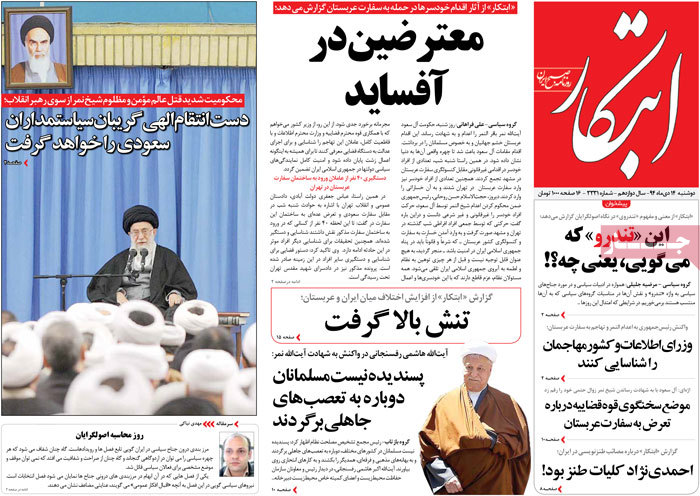
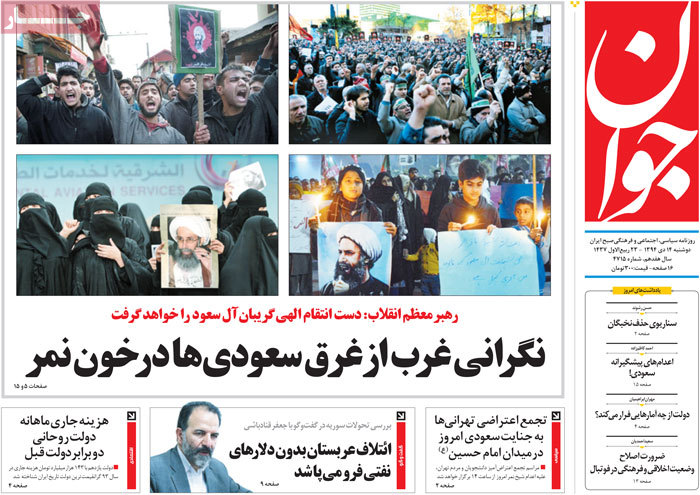
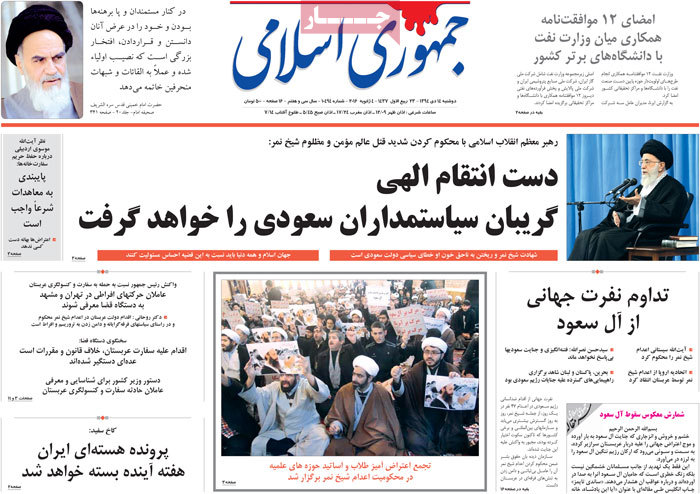
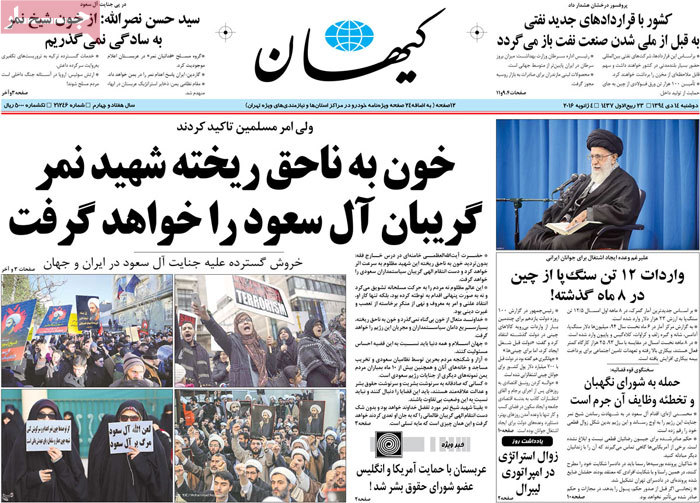
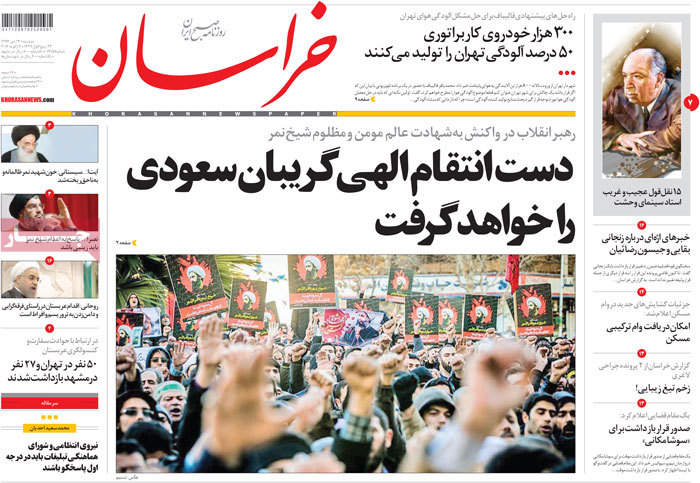
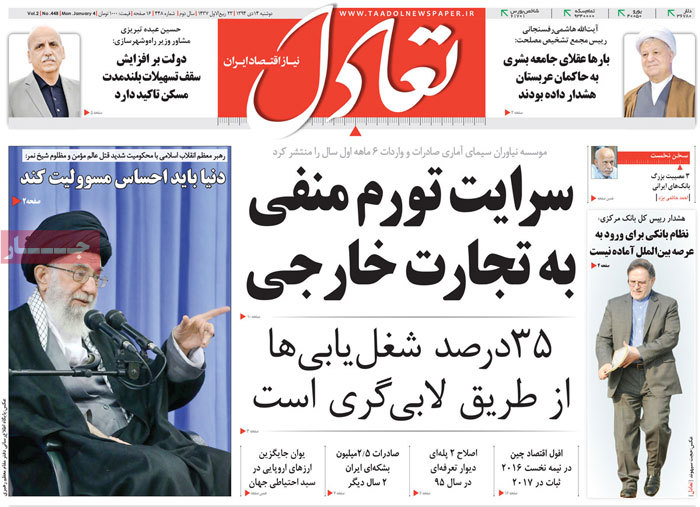
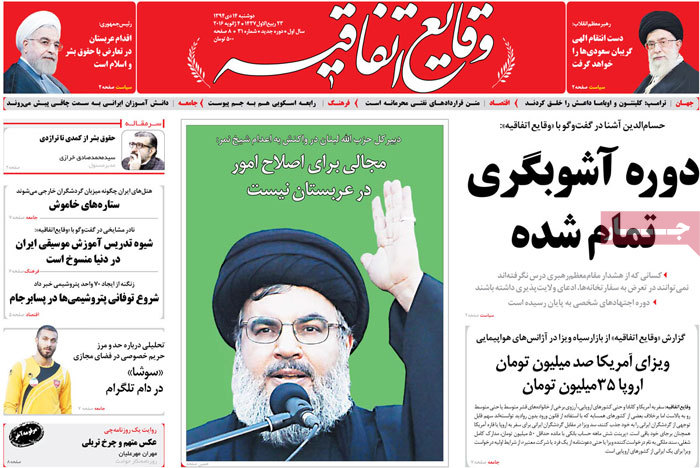
A look at Iranian newspaper front pages on Dec. 19

Iranian Newspapers Headlines

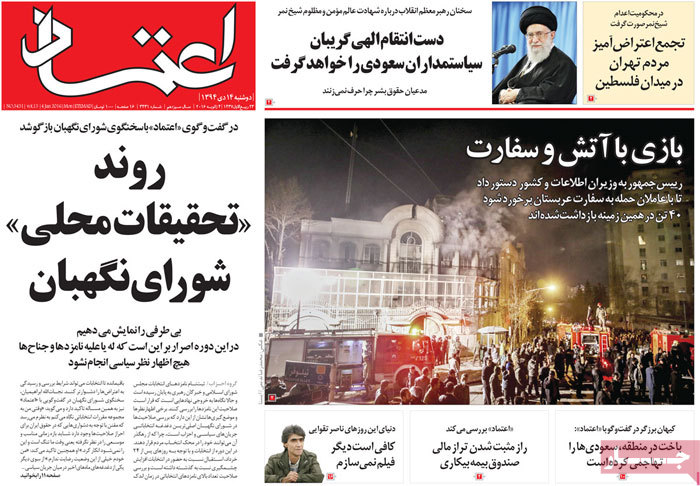
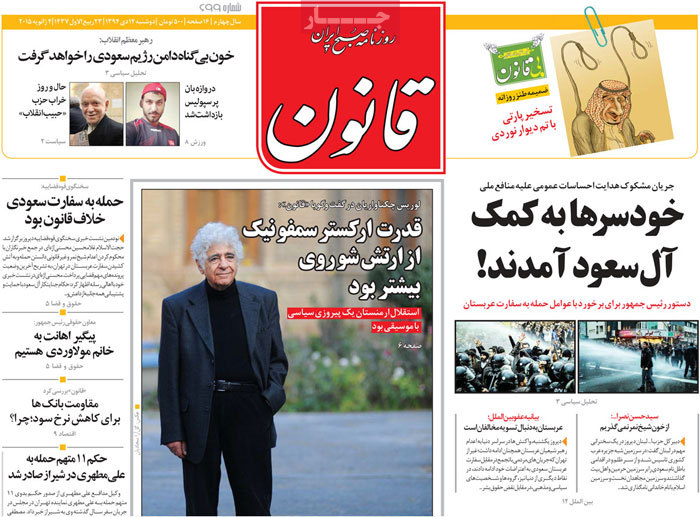
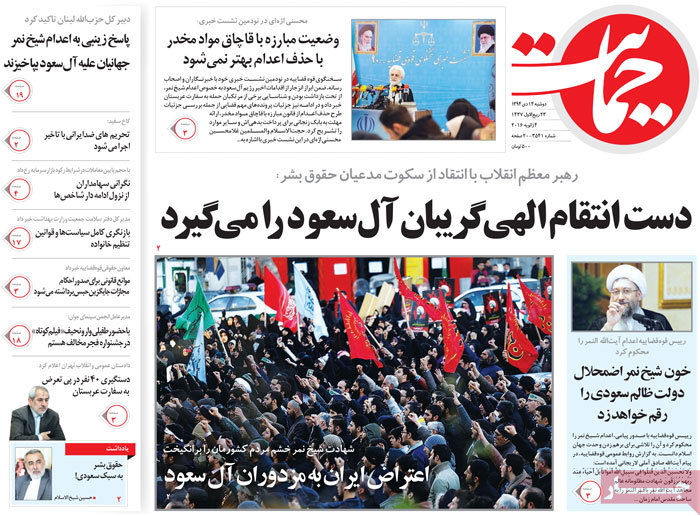
The start of registration of those who seek to contest the Assembly of Experts elections on February 26 dominated the front pages of Iranian newspapers on Saturday with reformist-leaning dailies highlighting the registration of the grandson of the late founder of the Islamic Republic.


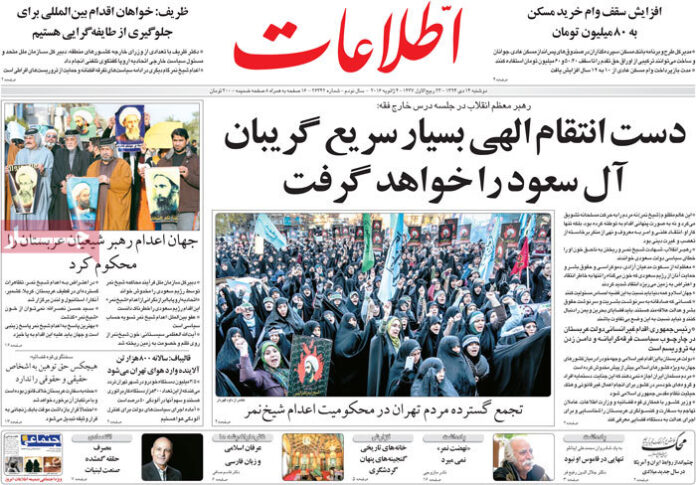
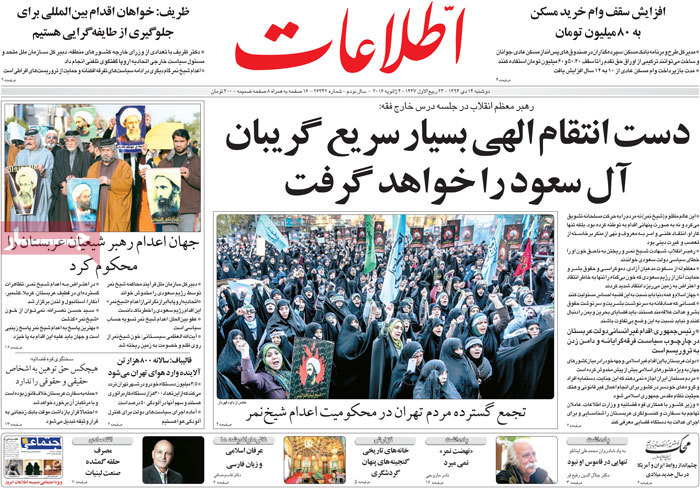
Ettela’at: A warm welcome by [political] figures on early days of registration for the Assembly of Experts

As many as 86 people have fielded their candidacy for the Assembly of Experts in the first two days of registration.

The registration of those running for the Islamic Consultative Assembly will get underway as of Saturday (December 19).   

Ettela’at: The pensioners are top on the list of those who will be given the credit cards the government is expected to issue.

A deputy minister of cooperatives, labor and welfare has said that the pilot distribution of the pre-paid cards [people are to be provided with to purchase Iranian-made goods] will get underway in a province near Tehran and in the south as of this week.

Ettela’at: Russian President Vladimir Putin has said that Turkey and the West are to be blame for the emergence of ISIS [Daesh].

President Putin further said that peace with Turkey is a distant possibility as long as [Turkish President Recep Tayyip] Erdogan is in power.

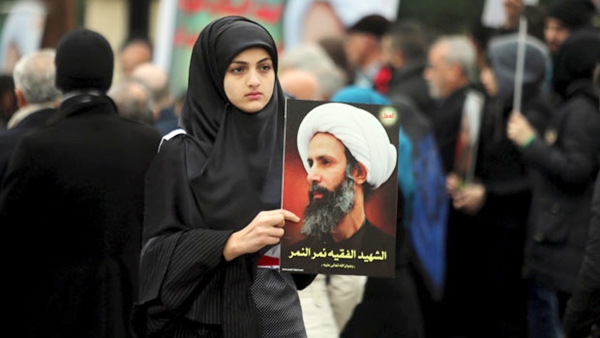
Ettela’at: TheIranian people held rallies after Friday prayers in protest at the massacre of the Shiites in Nigeria.

Worshippers in Tehran and other provincial centers across the country staged rallies to protest the killings of Shiites and disrespect for religious sanctities in Nigeria.

Ettela’at: Deputy Foreign Minister Abbas Araghchi [who is also the head of the JCPOA Implementation Commission] has said that the Joint Comprehensive Plan of Action will be implemented in three weeks.

In another development, the US secretary of state has sent a letter to the US Senate Committee on Foreign Relations confirming Iran’s compliance with the conditions and provisions of JCPOA.

Ettela’at: The first edition of the National Congress of Iran’s Peace Soldiers has introduced six role models of peace and authority.

The national congress hailed Commander of the Quds Force of the Islamic Revolution Guards Corps (IRGC) Major General Ghasem Soleimani, Foreign Minister Mohammad Javad Zarif, a former commander of the Army ground troops Brigadier General Ahmad Dadbin, General Habib Baghaei, Director of the Atomic Energy Organization Ali Akbar Salehi and IRGC’s Brigadier General Morteza Ghorbani.


A look at Iranian newspaper front pages on Dec. 19


Abrar: FM Zarif has met with UN Secretary General Ban ki-moon.


A look at Iranian newspaper front pages on Dec. 19


Afarinesh: The speaker of the Islamic Consultative Assembly has said that the closure of the possible military dimensions (PMD) file is a valuable achievement.


A look at Iranian newspaper front pages on Dec. 19


Afkar: Ali Akbar Salehi, a nuclear diplomat, has been named one of Nature’s “ten people who mattered” in 2015. [The science journal has recently named ten people in science who mattered in 2015].


A look at Iranian newspaper front pages on Dec. 19


Aftab-e Yazd: “If I were like [Mahmoud] Khavari [a former managing director of Bank Melli who has fled to Canada], I would have traveled to Britain, not Karbala,” said Saeed Mortazavi [a former judge and director of the Social Security Organization who is on trial for corruption].


A look at Iranian newspaper front pages on Dec. 19


Arman-e Emrooz: Critics cannot be treated as infiltrators, said Abdollah Nouri, a former interior minister.

He also said that pressures on Rouhani will grow in the build-up to the elections.


A look at Iranian newspaper front pages on Dec. 19


Asrar: Director of the Atomic Energy Organization of Iran Ali Akbar Salehi has said that people’s security cannot be restricted in the name of security.

Asrar: Next year [starting March 21, 2016] will be the honeymoon of Iran’s economy, said Head of Iran’s Chamber of Commerce, Industries, Mines and Agriculture Mohsen Jalalpour.


A look at Iranian newspaper front pages on Dec. 19


Bahar: Parviz Parastui, a famous Iranian actor, said, “I am concerned about the future of Iran’s cinema.”


A look at Iranian newspaper front pages on Dec. 19


Etemad: “I will put on the line my reputation for this [carrying out my responsibility]”, said Seyyed Hassan Khomeini, the grandson of the late Imam Khomeini.


A look at Iranian newspaper front pages on Dec. 19


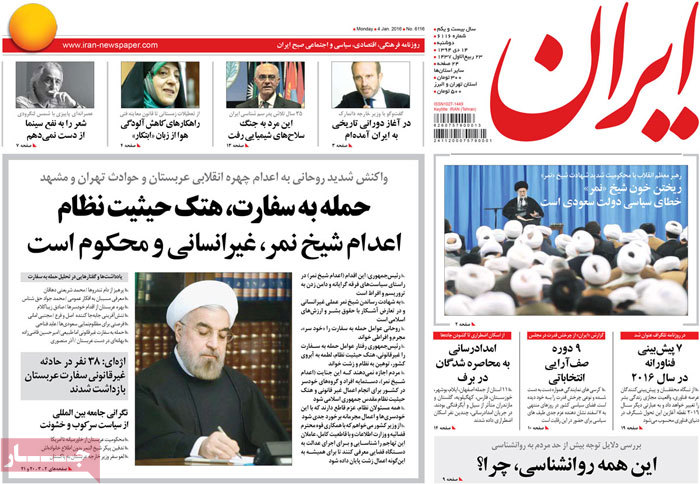
Iran: Deputy Foreign Minister Abbas Araghchi has said termination of Iran’s sanctions will begin sometime in January.


A look at Iranian newspaper front pages on Dec. 19


Javan: Chief of Staff of the Iranian armed forces Major General Hassan Firouzabadi has warned that the new gambit of having a “Leadership Council” is against the Rule of Religious Jurisprudent and the authority of the establishment.

[His comments seem to be in reaction to recent remarks by the chairman of the Expediency Council who floated the idea of a leadership council.]


A look at Iranian newspaper front pages on Dec. 19


Jomhouri Islami: Turkish President Recep Tayyip Erdogan has expressed satisfaction over the upgrading of Turkey-Zionist regime relations.

Jomhouri Islami: The Presidential Center For International Legal Affairs (CILA) said the US, after 37 years, returned another part of Iran’s assets.


A look at Iranian newspaper front pages on Dec. 19


Kayhan: The sale of French-made cars has grown in Iran ten-fold in one month.


A look at Iranian newspaper front pages on Dec. 19


Rah-e Mardom: Tehran’s air is not breathable.

People expect authorities; Authorities expect rainfall!


A look at Iranian newspaper front pages on Dec. 19


Resalat: Seyyed Hassan Khomeini, the grandson of late Imam Khomeini, has said, “My presence in [Assembly of Experts] elections is meant to defend the principles of the Islamic Republic.”


A look at Iranian newspaper front pages on Dec. 19


Sharq: Former President Ahmadinejad has said, “I saved the revolution from the secularists.”

Sharq: Authorities at Tehran’s Imam Khomeini Hospital have failed to discharge a rough sleeper because she could not afford the medical charges.


A look at Iranian newspaper front pages on Dec. 19


Vaghaye-e Etefaghiyeh: The 2016 Academy Awards (Oscars) ignored Muhammad, the Messenger of God.

The Oscars Foreign-Language shortlist is out [with nine films going to the final].


A look at Iranian newspaper front pages on Dec. 19


Iran’s Javad Zarif on Syria, Russia, and Donald Trump

Zarif

Fars News Agency published a translation of Foreign Minister Zarif’s interview with the New Yorker’s Robin Wright.

The following is the full text of the interview the New Yorker put on its website on December 18:

Two years of transformative diplomacy between the United States and Iran—after almost four decades of hostility—are reaping tentative benefits on other Middle East flashpoints. Foreign Minister Mohammad Javad Zarif, whom I wrote about in the magazine, is meeting again today with Secretary of State John Kerry, in New York, as part of the new, seventeen-nation initiative to end Syria’s savage civil war. Washington and Tehran support rival parties in the conflict. But, in an interview, Zarif said he sees a “more realistic” tone from the West and “rather promising” statements from the United States recently. The effort faces a January 1st deadline to bring the government of President Bashar al-Assad and the myriad opposition groups to the negotiating table.

Zarif’s visit to the United States, where he was educated and where his children were born, comes as Iran moves into the final days of implementing the historic nuclear deal, known as the Joint Comprehensive Plan of Action. He said that Tehran may be able to fulfill its commitments within two weeks, an estimate confirmed by the State Department. In an interview at the elegant residence of Iran’s U.N. Ambassador, Zarif also discussed Iran’s recent missile test, the Senate move to restore sanctions, and the U.S. Presidential campaign. The interview has been condensed and edited for clarity.

THE SYRIAN PEACE PROCESS

What do you think the prospects are that this Syrian peace process will actually produce something tangible and enduring?

Zarif: Our purpose here is to facilitate a process of national unity and reconciliation between those Syrians who are interested in finding a peaceful resolution—and not those who are bent on destroying Syria for a perverted ideology. This is a tall order.

What role does Iran see for President Assad during the six-month transition government?

Zarif: It’s not for us to decide what would be the role of anybody in the process. Nor is it the role of anybody else to decide.

The peace process talks about convening the Syrian opposition and the government by January 1st, a ceasefire, the creation of a transitional government that is “credible, inclusive, and non-sectarian” within six months, leading to a new constitution and democratic elections within eighteen months. The agreement also requires all countries involved in the negotiations to insure that their allies honor the ceasefire.

Zarif: It is important for everybody to insure that the process will go on, that the ceasefire will hold. Of course, there is no ceasefire against Daesh [the Islamic State], Jabhat al Nusra, and Al Qaeda. . . . So there are two separate tracks. One track is for the Syrian government and the opposition that is interested in a peaceful future of Syria to come together for national unity, for the political process. At the same time, it is a requirement for everybody to stop supporting the extremist groups, to stop allowing them safe passage, to stop allowing them to receive weapons, to stop allowing them to receive financial assistance, and to come together in actually fighting them.

Is Iran prepared to insure that President Assad and his forces engage in a full ceasefire, stop dropping barrel bombs, and stop the campaign against rebel groups?

Zarif: People have been fed misinformation. The fact is that the fighting that is going on on the ground in Syria is with Al Qaeda, with Jabhat al Nusra, with Daesh. The pockets, small pockets, of other groups are usually surrounded by these various extremist groups. . . . Once they stop fighting, there is nothing for the Syrian government to hit other than the terrorist organizations.

You’ve heard the language coming out of Washington recently, with Secretary Kerry saying the U.S. is not looking for “regime change.” Do you sense a change of tone or position in Washington on the role of President Assad?

Zarif: I certainly sense a more realistic tone coming out of Europe and the West in general, and sometimes from the United States. Of course, there have been fluctuations in statements that come from Washington. The latest statements are rather promising. Of course, we believe that it was never up to Iran, the United States, Russia, or anybody else to decide the role of President Assad.

Do you think President Assad is prepared to step aside to facilitate peace?

Zarif: I think we are making an assumption that that is the outcome of the negotiations. I think President Assad will be prepared to accept whatever the outcome of the intra-Syrian dialogue and the decision of the Syrian people is. But people are trying to decide and determine the outcome of the negotiation before even we agree to start the negotiations.

I ask you this question every time I see you. Is Iran wedded to President Assad?

Zarif: Tehran believes it’s none of our business or anybody else’s to decide the future of personalities in other countries.

Do Moscow and Tehran think identically on every issue on Syria?

Zarif: Nobody thinks identically on Syria. But we share the same view with Russia that the future of the personalities in Syria will be determined by the people of Syria and not by people outside Syria.

Iran has played an increasingly visible role in Syria. By my last count, eight generals have died in Syria in the past year and a half.

Zarif: That shows that we are serious about fighting Daesh. We consider ISIS and extremism to be a threat to all of us in the region. . . . Our position is that we help the legitimate governments in the region that have representation in the United Nations. We help the Iraqi government on their request through advisers; we help the Syrian government on their request to help with advisers to fight extremists. . . . So it’s both lawful and legitimate.

But most of the advisers have been helping the Syrians fight the opposition. The Syrian government is notably not really engaged as much in fighting ISIS.

Zarif: No, it is. Who else is engaged in fighting ISIS? The United States?

The array of rebel groups.

Zarif: That’s a joke. The United States wanted to send its trained rebel groups to Syria to fight ISIS. Out of twenty-five hundred rebels they had trained, only seventy accepted to go to Syria to fight ISIS. Everybody else wanted to go to Syria to fight the government. So you’ve got to wake up and smell the coffee. . . . The rebel groups have not fired a shot against ISIS.

How much are Tehran and Moscow coordinating, either about what’s happening on the ground in Syria or in trying to negotiate peace?

Zarif: We try to coordinate regularly with Russia, as well as with others—except for the United States—on what is happening in the region. And we’re open to discussing with everybody the situation in Syria, because we believe it’s a common threat.

IMPLEMENTING THE NUCLEAR AGREEMENT

Where does the Iran nuclear deal stand? What is your timetable to complete steps pledged in dismantling part of the program?

Zarif: We’re not dismantling anything. We are uninstalling some centrifuges and reconstructing the Arak reactor, modernizing it. . . . The remaining activities that we need undertake will not take more than several days, less than two weeks.

Is there a projected day for implementation?

Zarif: Well, we need to resolve still some political issues. . . . There are obligations on the other side that we have to make sure are implemented before we start the final stage of our implementation. . . . So once these are finalized, the practical measures that need to be implemented on our side will start. So I’m not saying two weeks from today. I’m saying two weeks from the time we settle all the difficulties.

What does Iran see as the challenges to implementation that remain?

Zarif: I think the most important challenge that remains is this mentality in Washington that sanctions have been an asset, and some people want to find even an excuse to keep them or an excuse to reintroduce them. I don’t know whether they’ve looked at the record of how sanctions actually produce exactly the opposite of what they wanted to produce. . . .

About three dozen senators have written a letter to the President and called on him not to lift sanctions.

Zarif: They didn’t want the President to accept the Joint Comprehensive Plan of Action to begin with. There are more than three dozen members of our parliament who do not want us to implement J.C.P.O.A. So I think that we’re even.

The Senate letter refers to the Iranian missile test on October 10th.Why is it so important for Iran to test launch a missile?

Zarif: It’s our legitimate defense. These are not missiles that are designed to be capable of carrying nuclear warheads and, therefore, it is within our right to self-defense.

So there’s no prospect there will be an agreement down the road on missiles.

Zarif: None whatsoever. Why should there be? Your allies are spending tens of billions of dollars on buying weaponry that they don’t need in this region. Iran’s military hardware is less than a fraction of that of any of the countries in this region.

Congress has just passed legislation modifying the visa-waiver program. It requires travellers to apply for visas and go through a security check—rather than have visas automatically waived—if they have been to countries on the U.S. list of state sponsors of terrorism. And Iran is on that list.

Zarif: This visa-waiver thing is absurd. Has anybody in the West been targeted by any Iranian national, anybody of Iranian origin, or anyone travelling to Iran? Whereas many people have been targeted by the nationals of your allies, people visiting your allies, and people transiting the territory of, again, your allies. So you’re looking at the wrong address. . . .

You know where the people who killed people in San Bernardino came from. You know where people who did 9/11 came from. You know where the people who did Paris came from, where they transited, where they went. None of them even set foot in Iran. So why are you punishing people who are visiting Iran for that? . . . We’re not going to radicalize them. We never have. Your allies have radicalized people who visited.
There are the cases of some Iranian-Americans who are held in Iran. That really resonates throughout this country.

Zarif: I’ve been doing my best in order to resolve this as humanitarian issue. And I will continue to do my best in this regard.

The case of Jason Rezaian, of the Washington Post, is particularly visible. The government of Iran announced that there had been a verdict but didn’t announce what it was, and then said there was a sentence, but has still not said what it is. Do you know what the sentence is?

Zarif: I’m not privy to that.

DOMESTIC POLITICS

You have elections coming up. How much do you think the success of diplomacy by the Rouhani government and the lifting of sanctions might affect the political mood?

Zarif: It will certainly affect the political mood in Iran, but we’re not running for an election. The Presidential elections are a couple of years away.

Speaking of politics, Iran has come up often in the U.S. campaign debates. On Tuesday, Donald Trump said the nuclear deal was a “horrible, disgusting, absolutely horrible deal” with a “terrorist nation.”

Zarif: That’s not the first interesting statement that he has made. It won’t be the last, probably. But I said “interesting statement.” I didn’t use a derogatory remark.

Governor Chris Christie said that we need to focus our attention on Iran because, “if you miss Iran, you are not going to get ISIS. The two are inextricably connected, because one causes the other.”

Zarif: If anything caused ISIS, it was the 2003 U.S. invasion of Iraq.

Ted Cruz said, “The regime we should change is in Iran, because Iran has declared war on us.”

Zarif: We’ve never declared war on anybody. We defended ourselves against wars that were imposed on us. We have no desire to engage in confrontation with anybody.

Do you have any messages for the American candidates?

Zarif: Wake up to the real world. Look at what’s happening in the region. Look at where people are going, how people react to humiliation and marginalization. I do not think a few more votes is worth making this menace—that we all face—far more complicated. People have to wake up to that and respond to that, not politicize it.
Opposition groups must contribute to peace in Syria: Iran FM

Mohammad Javad Zarif

Iran’s Foreign Minister Mohammad Javad Zarif says the activities of opposition forces in Syria must comply with international rules and regulations, stressing that they should also contribute to the promotion of peace in the crisis-hit country.

Speaking to reporters following a meeting with United Nations Secretary General Ban Ki-moon in New York on Friday, Zarif added that they discussed the latest developments in Syria and Yemen as well as ways to implement a nuclear agreement reached between Iran and the P5+1 group of countries, dubbed the Joint Comprehensive Plan of Action (JCPOA), in July.

“We emphasized the importance of the proper presence of opposition [groups] based on international regulations, which would be acceptable to the Syrian people and which would contribute to peace in Syria,” the Iranian foreign minister added.

He said the opposition group in Syria should have no link with terrorist groups, including al-Qaeda, Daesh, al-Nusra Front and Ahrar al-Sham.

“We have not seen an acceptable list of the names of the existing opposition and terrorist groups in Syria yet,” Zarif pointed out.

The Iranian foreign minister arrived in New York on Wednesday to participate in the third round of international talks aimed at finding a solution to the Syria crisis. The first two rounds of talks on Syria were held in the Austrian capital, Vienna, onOctober 30 and November 14.

Iran-China interaction on Syria

In a meeting with Chinese Foreign Minister Wang Yi in New York on Friday, Zarif said Iran is keen to interact with China to help settle the Syrian crisis.

He added that China played a constructive role during the two previous rounds of international talks on Syria and emphasized that Tehran and Beijing can reach better outcomes in cooperation with other participants in the New York meeting.

He said despite all efforts, there are still different views about certain issues but expressed hope that the parties would manage to reach better and more positive results in the third round of Syria talks.

The Chinese minister, for his part, expressed his country’s readiness to help solve the Syrian conflict and said Beijing would make use of its utmost capacity in this regard.

It is important to differentiate between opposition groups and terrorists in Syria, Wang added.


Ali Akbar Salehi on Nature’s “Ten people who mattered this year” list

Ali Akbar Salehi

Director of the Atomic Energy Organization of Iran Ali Akbar Salehi has secured a berth on Nature’s list of “Ten people who mattered this year”.

Also appearing on the list alongside Ali Akbar Salehi are Christiana Figueres: Climate guardian; Junjiu Huang: Embryo editor; Alan Stern: Pluto hunter; Zhenan Bao: Master of materials;; Joan Schmelz: A voice for women; David Reich: Genome archaeologist; Mikhail Eremets: Super conductor; Christina Smolke: Fermenting revolution; Brian Nosek: Bias blaster.

The following is the Salehi part of an article the science journal’s Davide Castelvecchi wrote:

ALI AKBAR SALEHI: Nuclear diplomat

The head of Iran’s nuclear programme helped to forge a pact to keep it peaceful.
On 14 July 2015, Iran signed an agreement with six world powers to limit the country’s nuclear development in exchange for lifted international-trade sanctions. If the deal is implemented successfully — still far from certain — it could ease years of tension over Iran’s alleged efforts to build nuclear weapons and so allow the country to become a major player in global science. That an accord was reached at all, however, was due in no small measure to nuclear engineer Ali Akbar Salehi, who is head of the Atomic Energy Organization of Iran. He worked closely with his US counterpart, energy secretary Ernest Moniz, to iron out the deal’s technical aspects.

Educated at the American University of Beirut and the Massachusetts Institute of Technology in Cambridge, Salehi returned to Iran after the Islamic Revolution of 1979 and quickly rose to top posts in both academia and the government. By the 2000s, he had become the international face of Iran’s nuclear programme — a man described as fiercely loyal to his country, but also a voice of reason to whom negotiators could appeal in times of crisis.

Salehi is said to be a deeply spiritual person who has the trust — and the ear — of the country’s supreme leader, Ayatollah Ali Khamenei. And he is one of very few people to have held senior posts in both hardline and comparatively liberal governments.

This talent for building bridges is what enabled Salehi to work so effectively with Moniz during the negotiations, says Reza Mansouri, an astronomer at the Institute for Research in Fundamental Sciences in Tehran and a former deputy science minister of Iran; they shared the language of science. Mansouri, who has known Salehi for more than three decades, says that he has the modern, rational frame of mind that enables people to “agree on how to talk to each other”.

Iran’s Zarif: Peace in Syria Vital

Zarif-Iran

Iran’s Foreign Minister Mohammad Javad Zarif in an article published by The Guardian on Friday underlined the significance of peace in the war-hit Syria.

The full text of Zarif’s article is as follows:

The International Syria Support Group has provided a unique forum for important discussions among a number of significant players, and there is genuine potential to turn the existing political will to help forge peace into tangible action towards this noble end.

Focus must turn to the political process, and the imperative of a unified front against extremist violence. Yet progress continues to be hindered by preconditions which have prolonged the violence and bloodshed for four years. Indeed, what is most ironic and distressing about these preconditions is that they do not represent the wishes of the Syrian people; rather, they reflect the agendas of outside actors, none of whom have the right to impose their will on an independent nation.

The Syrian people do not need guardians. The age of mandates and protectorates is long gone. It is utterly absurd that those who have denied their own population the most rudimentary tenets of democracy, such as a constitution and elections, are now self-declared champions of democracy in Syria. Their democracy, however, is not to give Syrians a voice, but instead to thwart the political process by stonewalling a ceasefire, while pushing for self-proclaimed al-Qaida affiliates to have a prominent place at the negotiating table.

Indeed, it is alarming that some are oblivious to how bands of villains such as Isis or al-Qaida’s multiple incarnations and reincarnations are a common threat to all of us, including their patrons. It is delusional to believe that sponsoring these terrorists, directly or through their newborn ideological siblings, can ever be an asset or leverage to achieve even short-term political objectives. Yet those who support militant extremism are not only continuing to do so, but they sponsor terror with impunity. They even use their political patronages and web of lobbyists to seek to legitimise such assistance, and its recipients, by differentiating between “good terrorists” and “bad terrorists”.

Beyond slaughtering countless innocents, the hooded villains have proven that while terrorism has no religion, no nationality or ethnic background, it certainly has backers with known addresses and horrific agendas. Ask Syrians. Or Iraqis, who during the past 12 years have been the target of almost 2,000 suicide bombings. The perpetrators of these atrocities, and those who created carnage in New York, London, Madrid, Peshawar, Beirut, Tunis, Paris and San Bernardino all have one common thread. They were all radicalised by demagogues preaching the same petro-fuelled perversion of Islam.

What happened in New York that fateful September morning 14 years ago, and the response, is directly linked to the tragedies in Paris, Beirut and San Bernardino during the past few weeks. Despite its immense cost of hundreds of thousands of lives and more than $400tn, the so-called “war on terror” has failed to achieve its purported objective. The perverted ideology behind groups such as al-Qaida not only lives, but thrives. It has spawned ever more vile manifestations of raw hatred and open thirst for blood. Hooded villains are now ravaging the cradle of civilization.

Terrorists should never have been allowed to set the agenda, or dictate the response. These villains are the offspring of indiscriminate retribution, failure to unite in confronting the roots of terrorism, and continued impunity extended to those so-called allies who perceive extremism as an asset or leverage. We must all recognise that security cannot be achieved at the expense of the insecurity of others. Unless there is a serious change in the course of action, violent extremism will haunt us all, including the hands that feed it.

Make no mistake: for the past four years, Syria has been ground zero in nothing short of a paramount fight for our future. I say “our” – repeating the theme of a recent message by Ayatollah Khamenei, who called the menace of perverted extremism “our common worry” – because the world’s fate is common. No one is immune from the consequences of the outcome of the existential battle that we need to fight.

From the outset of the Syrian crisis, Iran’s position has rested on three pillars: respect for the wishes and free will of the Syrian nation to decide its own destiny and to manage its own affairs; opposition to foreign interference geared to impose the wishes of outside actors on an independent people; and rejection of terrorism as a tool to achieve political objectives.

Based on these pillars, Iran has always insisted that there is no military solution to the Syrian crisis. Only ballots – not bullets – can ultimately usher in a new era in Syria. To this end, Iran has consistently advocated an immediate ceasefire and an end to the bloodshed; dialogue between the Syrian government and the opposition groups who reject terrorism; a concerted and genuine international effort to uproot extremist violence; and a global campaign to address the humanitarian catastrophe now, and to rebuild Syria once the flames of war subside.

The International Syria Support Group should encourage, facilitate and enable Syrians to change the course of their future, and by extension, change the course of our collective future. To do so, all must join hands to put into effect an immediate end to the bloodshed and vigorously focus on promoting an inclusive intra-Syrian political process, bringing together all Syrians with a vested interest in a brighter tomorrow. We must close ranks in the fight against extremist violence and terror, while not allowing rage to come in the way of collective reflection and wisdom for a rational and joint response.

Most importantly, we must together work to confront the roots of extremist violence, including double standards, marginalisation, repression, xenophobia and Islamophobia. If not, our children, and their children, will be forced to. And at much greater cost.

Turkmen thoroughbred horses (PHOTOS)

horse 00

North Khorasan Province in northeastern Iran leads the country’s thoroughbred horse breeding programs.

For generations, methods of horse breeding have been passed from fathers to sons in the area.

The following images have been released by Mehr News Agency: