Sunday, December 21, 2025
Home Blog Page 4667

A look at Iranian newspaper front pages on August 19

Iranian Newspapers Headlines

The comments of the government spokesman about parliament’s role in the approval of the Joint Comprehensive Plan of Action and those of the defense minister about the delivery of S300 missile defense system by Russia to Iran dominated the front pages of Iranian newspapers on Wednesday.


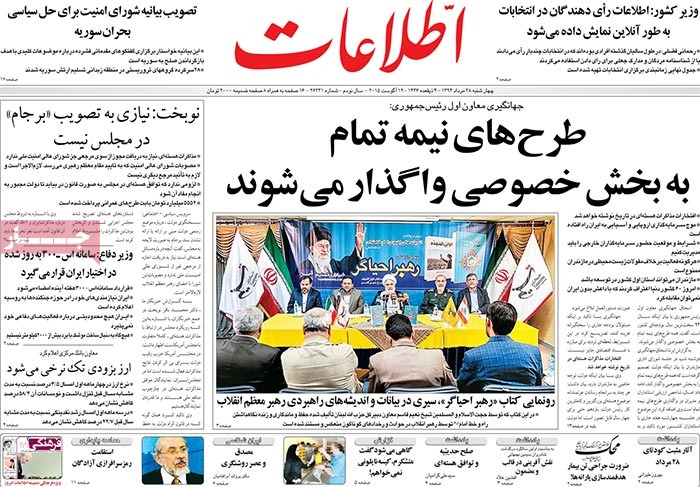
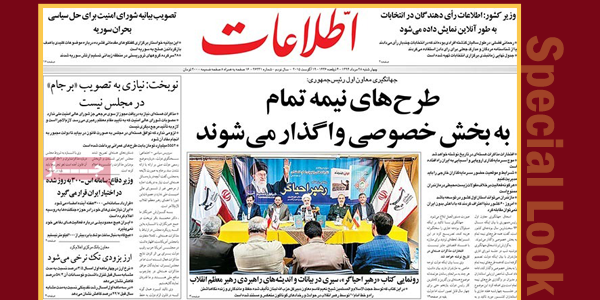
Ettela’at: “Unfinished projects will be given to the private sector to be completed,” First Vice-President Eshagh Jahangiri said.

He further said what Iran achieved in nuclear talks will go down in history.


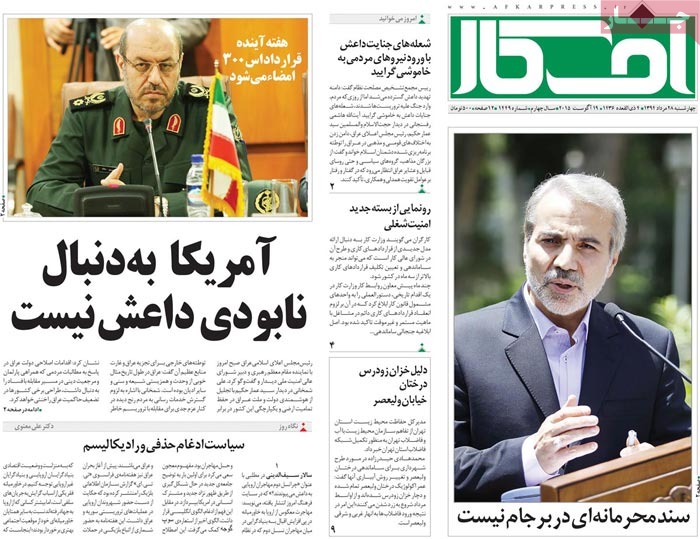
Afkar: “With the arrival of popular forces on [Iraqi] battlefronts, the flames of IS atrocities began to die down,” said Ayatollah Hashemi Rafsanjani at a meeting with the head of the Islamic Supreme Council of Iraq.

Afkar: “The Joint Comprehensive Plan of Action contains no secret sections,” said the Iranian government spokesman.


A look at Iranian newspaper front pages on August 19


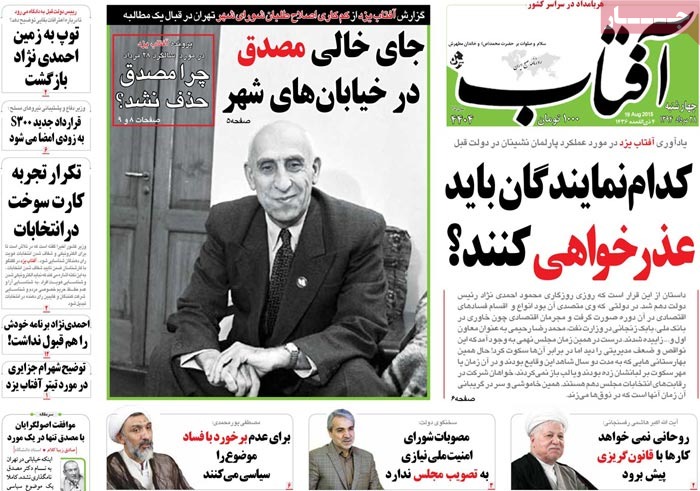
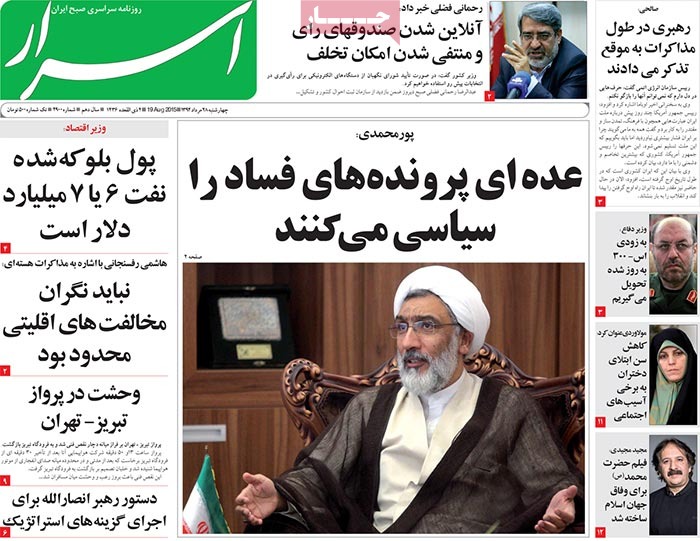
Aftab-e Yazd: “Some are politicizing things to allow corruption [cases they have been involved in] to slip through the net,” said Justice Minister Mostafa Pour-Mohammadi.


A look at Iranian newspaper front pages on August 19


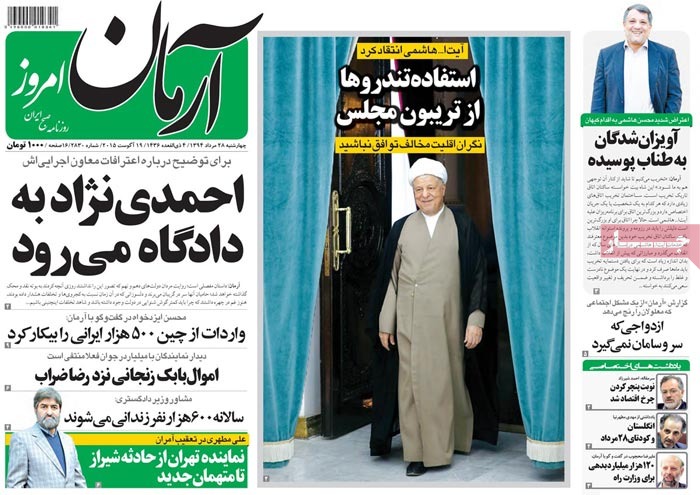
Arman-e Emrooz: Ahmadinejad is [likely] to appear in court to answer for the confessions made by his executive deputy.

Arman-e Emrooz: Imports from China have cost 500,000 Iranian jobs.

Arman-e Emrooz: “As many as 600,000 individuals are imprisoned each year,” said an advisor to the justice minister.


A look at Iranian newspaper front pages on August 19


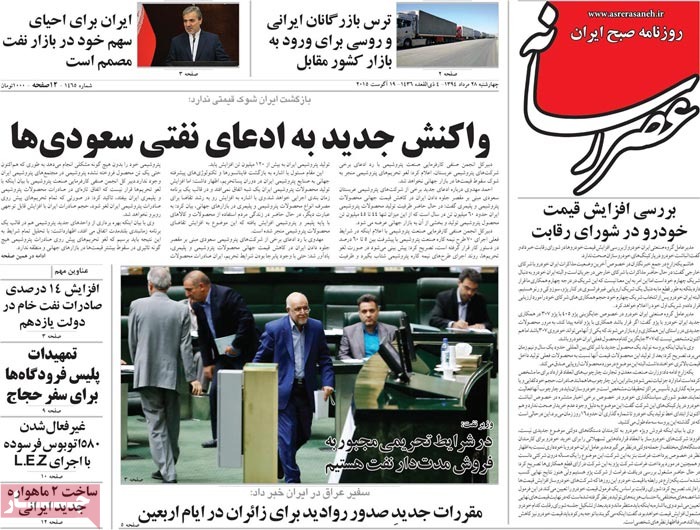
Asr-e Rasaneh: Crude exports have been up 14 percent ever since the 11th government took office [in 2013].


A look at Iranian newspaper front pages on August 19


Asrar: “Throughout the talks, the Supreme Leader advised us whenever deemed necessary,” said Iranian nuclear negotiator Ali Akbar Salehi.

Asrar: “We should not be worried about the opposition of a small minority [to the nuclear deal],” said Chairman of the Expediency Council Akbar Hashemi Rafsanjani.

Asrar: “Muhammad has been produced to promote Islamic solidarity,” said Majid Majidi, the director of the film.


A look at Iranian newspaper front pages on August 19


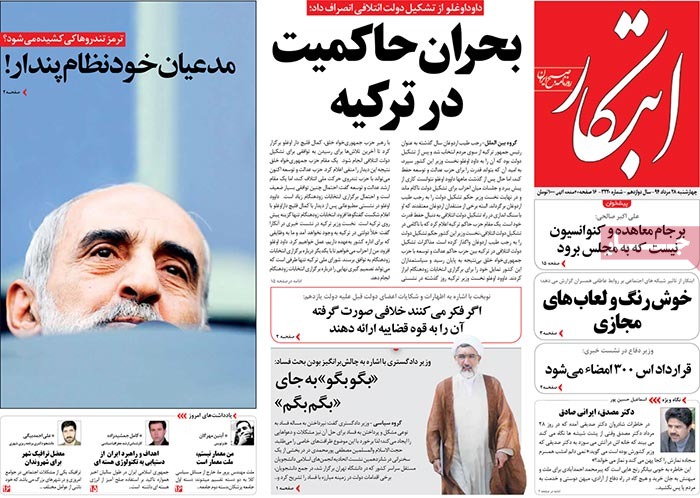
Ebtekar: Leadership crisis in Turkey

Ahmet Davutoglu has abandoned efforts to form a coalition government.


A look at Iranian newspaper front pages on August 19


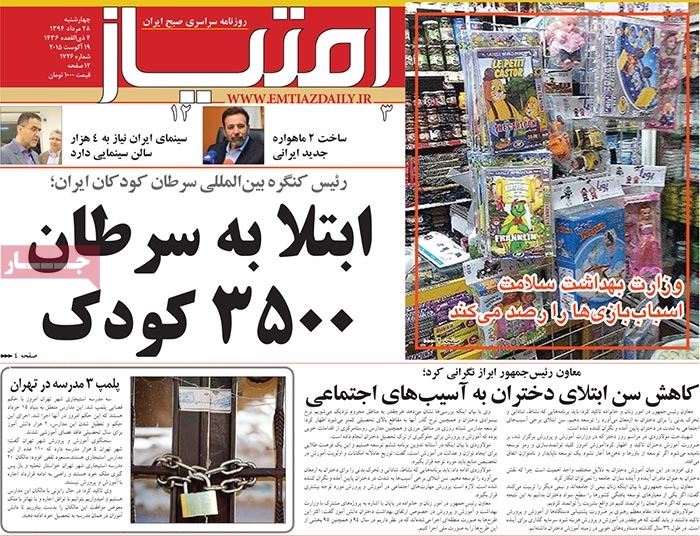
Emtiaz: The vice-president for women and family affairs has expressed concern about the drop in the age of girls’ exposure to social harms.


A look at Iranian newspaper front pages on August 19


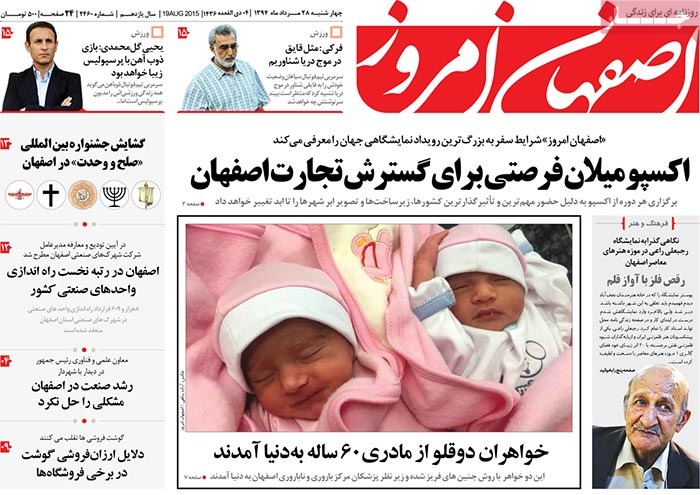
Esfahan Emrooz: A 60-year-old woman has given birth to twins.


A look at Iranian newspaper front pages on August 19


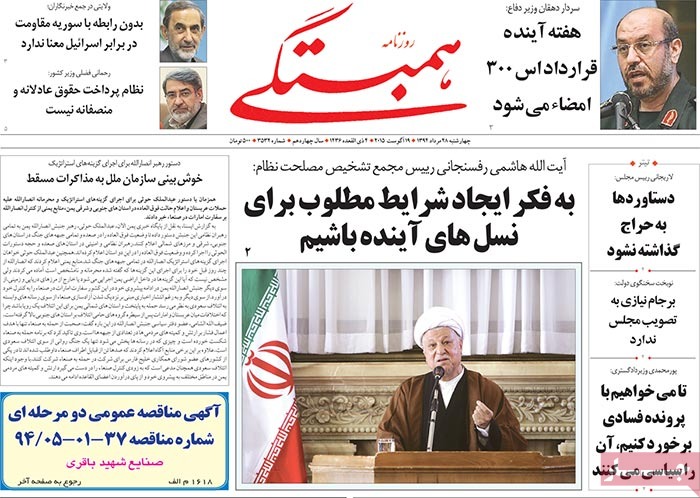
Hambastegi: “The achievements of the country should not go under the hammer,” said the parliament speaker.


A look at Iranian newspaper front pages on August 19


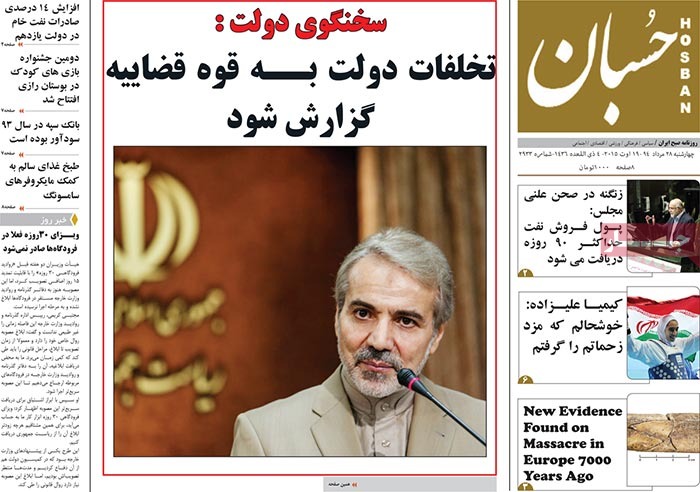
Hosban: The government spokesman has called on [officials of the previous government that accuse the Rouhani administration of acting against the law] to report the alleged offenses to the judiciary.


A look at Iranian newspaper front pages on August 19


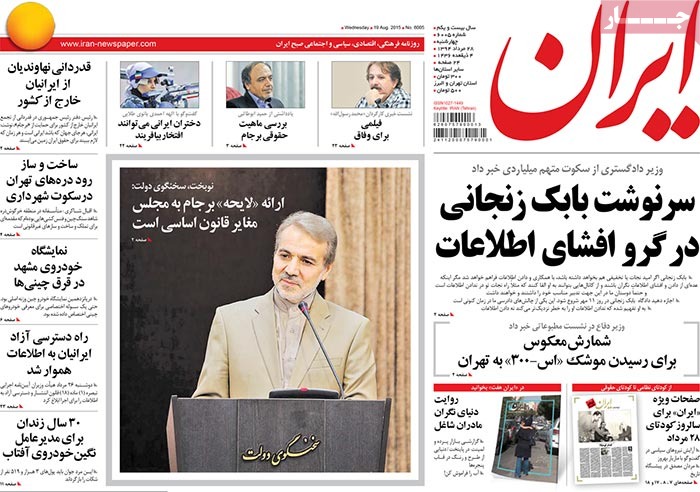
Iran: President Rouhani’s chief of staff has thanked Iranian expatriates for their support of the Iran nuclear deal.


A look at Iranian newspaper front pages on August 19


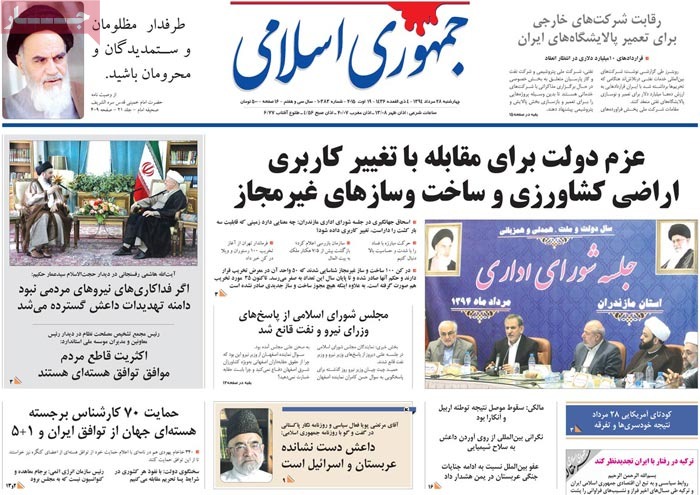
Jomhouri Islami: MPs found satisfying the explanations provided by the ministers of oil and energy [about the conduct of their respective ministries].

Jomhouri Islami: Seventy top nuclear experts in the world have supported the nuclear deal between Iran and P5+1.


A look at Iranian newspaper front pages on August 19


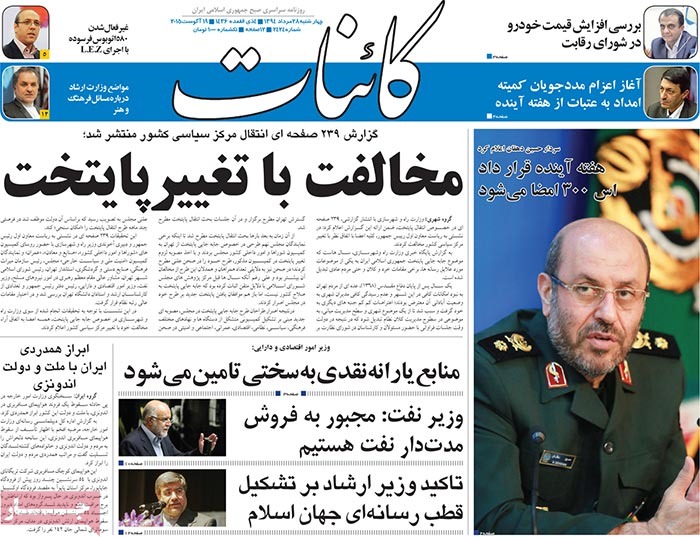
Kaenat: The plan to move the political capital from Tehran has been rejected.


A look at Iranian newspaper front pages on August 19


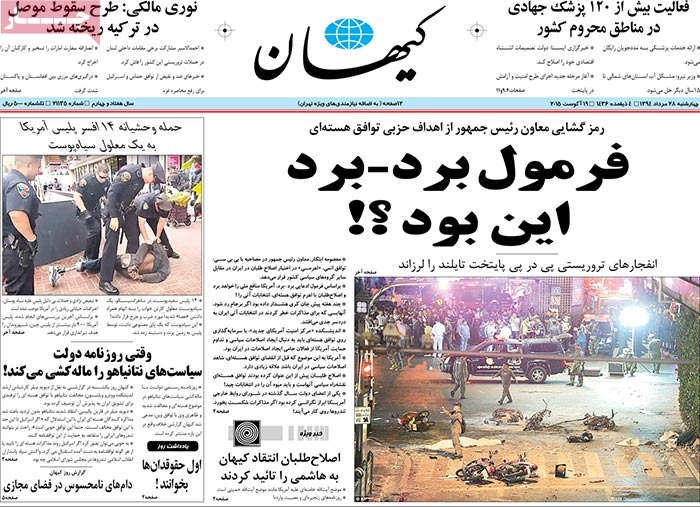
Kayhan: Was this the win-win formula you were talking about?!

The vice-president has admitted there have been partisan goals behind the nuclear deal.


A look at Iranian newspaper front pages on August 19


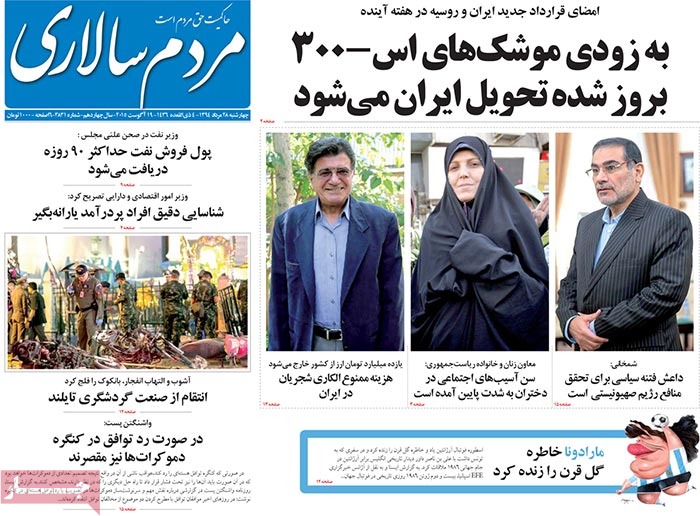
Mardomsalari: “IS is a political ploy to serve the interests of the Zionist regime,” said the secretary of the Supreme National Security Council.


A look at Iranian newspaper front pages on August 19


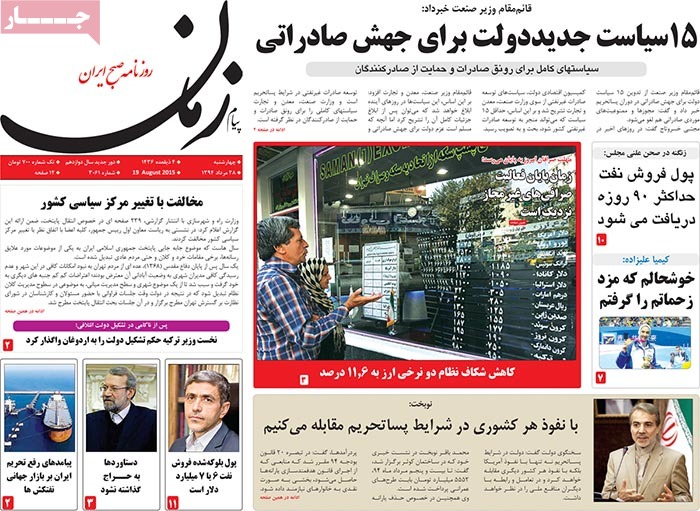
Payam-e Zaman: The Iranian economy minister has said that oil money frozen overseas because of sanctions is around $6-$7 billion.


A look at Iranian newspaper front pages on August 19


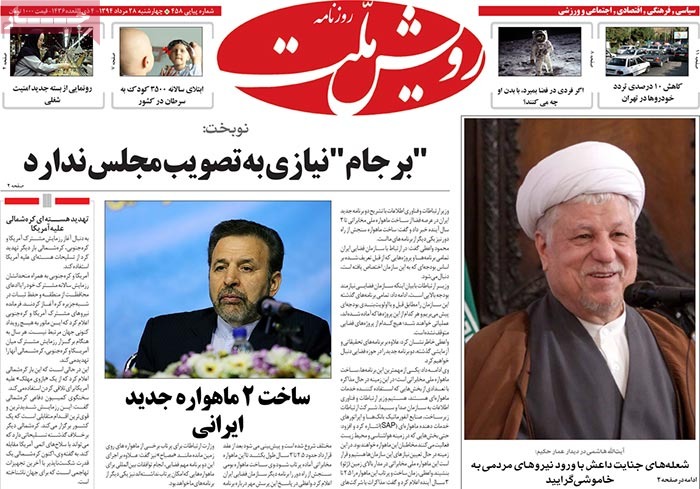
Rooyesh-e Mellat: “Iran is to build two new satellites,” said the minister of communications and information technology.


A look at Iranian newspaper front pages on August 19


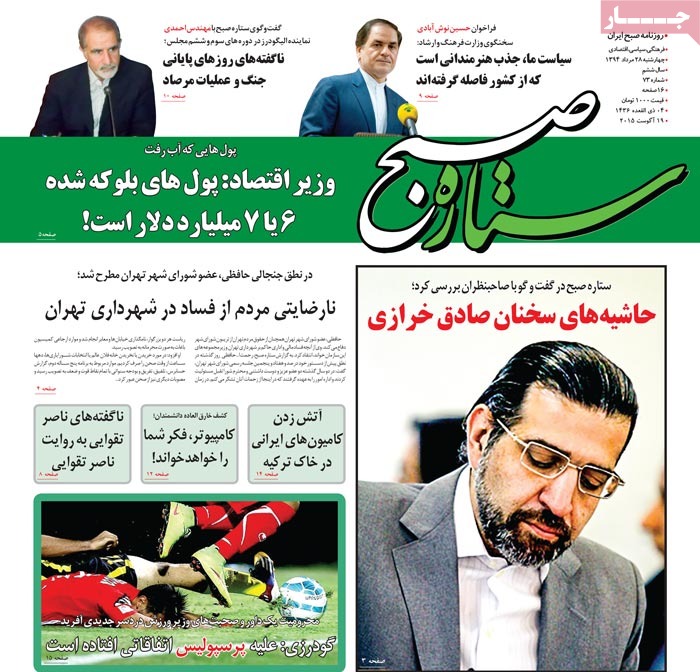
Setareh Sobh: “Our policy is to woo artists who are away from home,” said the spokesman of the Ministry of Culture and Islamic Guidance.

Setareh Sobh: Iranian trucks have been set on fire on Turkish soil.


A look at Iranian newspaper front pages on August 19


Highlights of Ettela’at newspaper on August 19

Ettelaat Highlights-post

 “Unfinished projects will be given to the private sector to be completed,” First Vice-President Eshagh Jahangiri said.

He further said what Iran achieved in nuclear talks will go down in history.

 “Details of voters will be available to electoral authorities online [to prevent electoral fraud],” said the interior minister.

Rahmani Fazli further said that over the years there have been instances of individuals casting ballot more than once or using fake IDs to vote.

 The UN Security Council voted for a statement calling for a political solution to the Syrian crisis.

In another development, 28 leaders of terror groups operating in Syria surrendered to the Syrian Army.

 “The Joint Comprehensive Plan of Action does not need to be approved by parliament,” said Government Spokesman Mohammad Bagher Nobakht.

 The defense minister has said that an updated version of Russia’s S300 will be delivered to Iran.

The agreement on the delivery of the missile defense system will be signed next week.

 The lieutenant governor of the Central Bank of Iran has said that a single foreign exchange rate will be introduced shortly.

He further said liquidity growth in the first quarter was down 22.7 percent over corresponding period last year.

 A Revivalist Leader, which takes a close look at the strategic thoughts of the Supreme Leader, has been unveiled.

The book has been penned by Naim Qassem, the deputy secretary-general of Lebanon’s Hezbollah Movement.


Leader’s letter outstanding model for dialogue with Western youth

Moghaddam Far

Cultural deputy of the World Assembly of Islamic Awakening described Supreme Leader of the Islamic Revolution Ayatollah Seyyed Ali Khamenei’s letter to the European and North American youth as an outstanding model for effective dialogue with the West’s younger generation.

Addressing the eighth General Assembly of Islamic Radios and TVs Union (IRTVU) in Tehran on Monday, Hamidreza Moghaddam-Far called on Muslim intellectuals to study various aspects of the Supreme Leader’s letter and use it as a model to formulate the policies for dialogue with the West.

Back in January, Ayatollah Khamenei wrote a letter asking the European and North American youth to gain direct and firsthand knowledge of Islam in reaction to the flood of prejudgments and disinformation campaigns.

What follows is the full text of Mr. Moghaddam-Far’s speech at the conference:

Honorable guests, ladies and gentlemen,

The current status in the world is a status of fundamental changes and developments and the world is on the verge of a historic and landmark turning point. In general, the new global condition can be defined as general and public discontent of humanity – even in developed and rich societies – about the existing conditions, unjust and oppressive management of the world order and also can be defined as people’s constant quest for change.

As the Western culture and thought is declining, we are witnessing a gradual but remarkable growth of the awakening movement and a tendency toward spirituality and a renewed desire for faith and religions throughout the world, the Western societies in particular, in a way that secular scientific and academic circles in the West are paying more attention to the role of religion.

Scholars are now talking about the return of religion from exile and have named the upcoming decades the “Post-secularism” era. Among all religions, Islam, as the sole religion which remained free from deviation and a religion with a comprehensive and collective paradigm for different aspects of the life of humanity, enjoys the highest capacity for introducing itself as an alternative model to replace dominant Western models.

This divine, dynamic and live religion with over one billion followers and with highest rate of new converts throughout the world, is the sole entity that, as acknowledged by the Western analysts, can challenge the dominant order, model and discourse of the West. Accordingly, Islam is considered the alternative for Western discourse and identity. For that reason, the Western rulers’ grave concern about the daily growth of Islam and the threat posed by the expansion of the Islamic thought to their global dominance, have pushed them “since two decades ago, namely after the collapse of the former Soviet Union, to portray this great religion as a terrible enemy, and target Islam and Muslims in an unprecedented manner by using the old policy of fear and hatred.”

Unfortunately, the emergence and growth of Salafi-Takfiri extremist current inside the Islamic countries’ territories in the past years under overt and covert support by some Western governments, have provided Westerners with the chance to use media campaign to picture a fake and fabricated link between Muslims and concepts such as terrorism, extremism, violence, and sabotage.

To that end, an extensive plan was devised in partnership with American scholars, politicians, media activists and filmmakers in order to spread a fabricated fear and hatred of Muslims around the world within the project of Islamophobia, and enable the Western politicians to introduce their hired terrorists as the representatives of Islam in a hypocritical manner.

It is crystal clear that the media have had and continue to have a pivotal role in the process of masterminding and implementing the Islamophobia project, and their actions in serving the objectives of the super powers in countering Islam have been very significant and influential. The powerful Western media outlets employ various techniques and modern ploys to deceive minds and take control of opinions. They are trying to create an emotional barrier between people and the facts through presenting insulting and cheap images, in a bid to prevent people from making an evenhanded judgment and restrict them inside fabricated and mental barriers.

Now the question is about the Islamic world’s duty in the face of the Western-led hegemonic system and its anti-Islamic measures in the current sensitive and decisive juncture, which could be a major milestone in the history of humanity. It seems that the leaders, clerics, scholars, the intelligentsia and media in the Islamic societies need to gain a deep understanding of the volatile situation in the contemporary world and believe in the alternative role that the Islamic model could play vis-à-vis the ineffective existing model, and should use different methods to develop a strategy to destroy the foundation of the oppressive and unfair order that prevails in the world.

This major strategy could be carried out in two stages:

In the first step, an approach of criticism should be adopted to question the legitimacy of the global order that has been established under the management of the Western powers, which is at the same time quite unfair, illegitimate and improper and is a clear symbol of injustice, inequality, discrimination and hegemony. During the second step, the idea and model of “Islamic world order” should be introduced to the world as the best alternative model and the only procedure for saving humanity from the unsolvable crises brought by modernity.

The letter that Supreme Leader of the Islamic Revolution sent to the youth in Europe and North America a few months ago is undoubtedly considered a testimony of a wise and smart measure to destroy the foundation of the hegemonic world order and introduce an alternative Islamic model. Such an innovative move is remarkable from many aspects, and contains a lot of informative points whose deep understanding could be very effective for defining the future path for the Muslim propagators and media outlets.

First of all, the timing of the Supreme Leader’s letter was outstanding.

The letter’s content clearly shows that the author has a great knowledge about the developments in the world on the verge of a historic turning point, and that he has penned the letter in a bid to open a new field for proactive reaction to the enemy’s movements.

Secondly, this was the first time that the Supreme Leader addressed all the youth in Western countries rather than their politicians. This initiative is a clear example of using informal diplomacy to leave direct impact on the public opinion beyond borders and to pave the way for mutual understanding. It also reveals the Supreme Leader’s awareness of the increasingly significant position of the public opinion in the equations of world policy.

In fact, the Letter per se serves as a medium that uses a creative way and a gentle, fluent, friendly, informal, and non-imperative tone to launch a “questioning movement”. It just asks its audience to think about a number of fundamental questions in an open atmosphere without any pressure, prejudice, and necessity for accepting the author’s views.

Thirdly, the letter was first published in the cyberspace and through social networks. Given the deep influence of such media and new means of communication on the lives of people, especially the youth, in modern era, this innovative move showed that one should not take a passive approach in reaction to the massive influx of Western propaganda. Rather, offensive approach should be adopted and the same means should be used to counter their attacks and gain the upper-hand in a field that seemingly belongs to the opponent.

Fourthly, the letter’s content, though short in length, includes important and considerable topics, in a way that it takes both of the two necessary steps to deconstruct the global hegemony.

The mainstream media which sponsors the dominant discourse intends to tarnish the image of Islam in the eyes of the world and has always tried to portray an ugly, dark, violent, terrifying and threatening picture of Muslims at the global level. As a result, the need for the similarity between offense and defense requires the Islamic world to thwart the conspiracies of the enemies and take action to improve its image through media diplomacy. Joint action and further solidarity among media outlets and institutions in the Muslim world, like the Islamic Radio and Television Union can be effective in achieving better results.

Massive developments in the field of communication technology have made the media diplomacy to go through the traditional media and enter into the cyberspace and modern media. In the vast area of cyberspace, in which social networks, websites, blogs and mobile applications connect millions of people around the world, cyber diplomacy or (Twiplomacy) is growing fast and diplomats and political officials of different countries use its great capacity to communicate directly with the World public opinion. Therefore, the absence of diplomacy in the Muslim world in this field is tantamount to deprivation of an easy and cheap opportunity to convey political messages on a global scale which is never acceptable or justifiable.

The Supreme Leader’s letter to the young people in Europe and North America, which was published directly online for the first time, is a shining example in the arena of cyber-diplomacy which was well received by youth around the world.
This paradigm needs to be continued by other Islamic world’s leaders, scholars, elites and government officials. The letter by the Leader should not slip into oblivion as its content is very instructive and unmatched and is also full techniques on how to attract target audience.

Sticking to the following guidelines could be helpful for the world’s media:

1. Setting up a strategic center for leading and directing media campaigns and projecting specific news items on important international issues and issues related to Islam.

2. Studying and delving into various aspects of the Supreme Leader’s letter and using the letter’s coherent and targeted structure in order to formulate the policies and devise practical models of dialogue with the West.

3. Tapping into the letter’s capacity and focusing on it as a central point and interesting topic for raising the issue of widespread talks with the Western youth and intellectuals.

4. Necessity of identifying inclinations, fields of interest, sensitivities, and needs of non-Muslim audience that have been left abandoned by Western media and addressing their needs through Islamic world media outlets.

5. Echoing the voice and message of social activists like anti-war and anti-racial groups whose needs have been left unanswered by Western media.

6. Making use of the capacity of new media and social networks for sharing media products.

Although the West’s media campaign enjoys better technical equipment and huge funding and also outnumbers the Islamic world’s media outlets, Muslim media can also enjoy great privileges of conformity of their message to the truth-seeking nature of mankind and honesty in speech via learning more about the potential capacities. The Islamic world’s media will certainly succeed in overcoming the enemies and reverberating Islam’s right-seeking call all across the globe based upon a verse of the Holy Quran which says: “How many a small company has overcome a large company by permission of Allah.”

Anti-Iran sanctions could be lifted by yearend: AEOI chief

139405251657585785888384

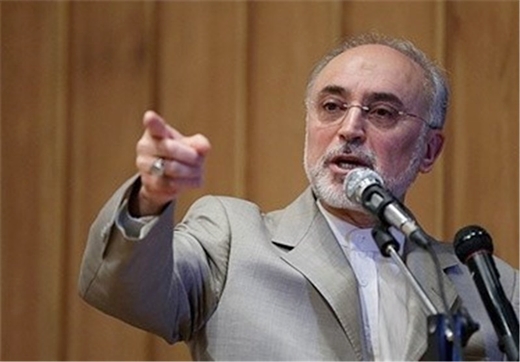
Director of the Atomic Energy Organization of Iran (AEOI) Ali Akbar Salehi said if everything goes according to plan and Tehran and six world powers meet their commitments, anti-Iran sanctions will have been lifted by the yearend.

“The Joint Comprehensive Plan of Action (JCPOA) states that the European Union should remove European embargoes on Iran after 90 days and US President (Barack Obama) should also lift Congress-imposed sanctions” Salehi said on Tuesday.

He added that in return, Iran has also some commitments regarding its nuclear program.

“Therefore, if all commitments by Iran and P5+1 (Russia, China, the US, Britain, France and Germany) are met according to schedule, the sanctions will be lifted in the month of Azar (November 22 – December 21),” he noted.

Iran and P5+1 on July 14 reached a conclusion on a lasting nuclear agreement that would terminate all sanctions imposed on Tehran over its nuclear energy program after coming into force.

The 159-page deal has its own opponents and proponents both in Iran and the other countries that are parties to JCPOA, including the US.

While the United Nations Security Council has adopted a resolution to endorse the deal, the text of the document needs to be ratified by both Iran’s parliament and the US Congress.

Fanning sectarian crises in Iraq ordered by enemies: Rafsanjani

jpg

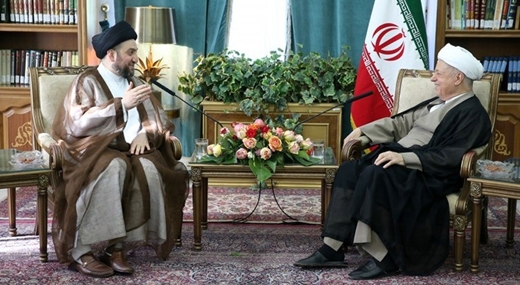
Beating the drum of war among followers of different Islamic schools of thought and other religious minorities in Iraq is a plot hatched by the enemies of Islam, said Chairman of Expediency Council Ayatollah Akbar Hashemi Rafsanjani Tuesday.

“The prominent religious scholars, leaders of political groups and parties, and even heads of tribes in Iraq are expected to promote harmony, cooperation and solidarity in their words and their deeds,” said Ayatollah Rafsanjani at a meeting with Seyyed Ammar Hakim, the chairman of the Islamic Supreme Council of Iraq.

Stressing the immense importance of Iraq’s strategic position and rich resources, he said that Iraq has potential for both positive and negative developments in political and economic fields.

“If the central Iraqi government manages to strengthen the security index in that country, the outcomes of the development will benefit the entire region,” he added.

Hakim, for his part, said that the implementation of a moderate approach in a society which has suffered from dictatorship for decades and the scourge of terrorist groups is a very tough task.

“One of the factors for backwardness of such societies is that the people are not in harmony with the political groups,” he added.

On the latest status of the IS terrorists in Iraq, he said that with the vast mobilization of the popular forces in the war against terrorism, the retreat of IS from Iraq is gradually accelerating, adding that the terrorists are no longer capable of recruiting forces even from the Iraqi Sunni Muslims.

“The crimes those terrorists have committed against people, particularly women and children, and even Sunni Muslims have created hate among the Iraqi nation for the terrorist group,” he said.

Ammar Hakim also met with Secretary of the Supreme National Security Council Ali Shamkhani.

Iran supports Iraq fight against IS: Zarif

Zarif-Hakim

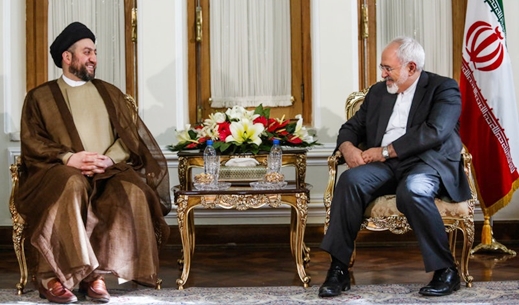
Iran’s Foreign Minister Mohammad Javad Zarif says the Islamic Republic throws its weight behind the Iraqi government’s fight against Daesh (an Arabic acronym for IS) terrorists.

“The Islamic Republic of Iran always views the expansion of Tehran-Baghdad ties as one of its priorities and supports the Iraqi government’s campaign against Daesh that aims to destabilize Iraq’s security and unity,” Zarif said in a meeting with Chairman of the Islamic Supreme Council of Iraq (ISCI) Ammar Hakim in Tehran on Tuesday.

Daesh’s heinous campaign of terror spread from Syria to the northern and western parts of Iraq in June 2014.

The militants have been committing heinous crimes against all ethnic and religious groups in Iraq, including Shias, Sunnis, Kurds, Christians and others.

The Iranian foreign minister further said during his recent visits to Lebanon and Syria, he had held consultation with senior Lebanese and Syrian officials to find solutions to the ongoing crises in the two countries.

Zarif traveled to the Lebanese capital of Beirut on August 11 before visiting Syria, Pakistan and India.

The Iranian minister also assessed as “constructive and useful” his talks with Russian officials in Moscow, which, he said, focused on support for Syria’s sovereignty, respect for Syrian people’s demands and finding reasonable solutions to the Syrian conflict.

He said Tehran and Moscow agreed that serious threats posed by Daesh’s growing extremism and anti-human violence should be prioritized in regional talks.

Iraq’s major steps to fight Daesh

For his part, Hakim said Iraq has taken effective and major steps in the fight against Daesh, adding that cooperation between the Iraqi Army and popular forces has contributed to better security conditions in the country.

The ISCI chief said all Iraqi people, including Shiite and Sunni Muslims and Christians, have closed ranks in their efforts against Daesh threats.

Iran-Syria ties backbone of Mideast relations: Velayati

de396c60-0589-4d28-86a0-b6b30419a4e6

A senior Iranian official says the Islamic Republic’s ties with Syria constitute the cornerstone of Tehran’s relations with other states in the Middle East.

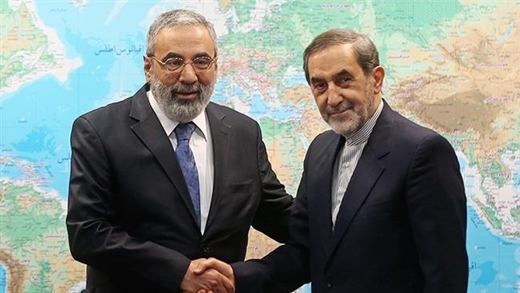
“Since the beginning of the [Islamic] Revolution [in 1979], relations between Iran and Syria have been strategic and these relations are the backbone of Iran’s aggregate ties with the region, i.e. Iraq, Lebanon and Palestine,” Ali Akbar Velayati, an advisor to Leader of the Islamic Revolution Ayatollah Seyyed Ali Khamenei, told reporters in Tehran on Tuesday after a meeting with Syrian Minister of Information Omran Ahid al-Zoubi.

Noting that the Syrian nation must decide its own fate, he said the approval rating of Syria’s President Bashar al-Assad among the Syrian people has been increasing with time.

“We believe that the Syrian government and nation will emerge victorious in the end and that it will certainly be the Americans and the Zionist regime (Israel) who will suffer defeat,” Velayati said.

He added that Iran rejects as “unacceptable” any regional and international solutions proposed for the Syrian conflict that do not have the approval of the Syrian people and government.

In a statement on Monday, the 15-member UN Security Council endorsed the initiative by the UN special envoy for Syria, Staffan de Mistura, which calls for resolving the Syrian crisis through talks among “intra-Syrian working groups.”

The statement emphasized that “The only sustainable solution to the current crisis in Syria is through an inclusive and Syrian-led political process that meets the legitimate aspirations of the Syrian people.”

Velayati further said, “Iran is the top power in the region and plays an important role in supporting the resistance front against the American expansionism and the Zionist regime’s hegemony and will not allow the US and its allies to infiltrate the region anew.”

Velayati’s remarks came a day after Ayatollah Khamenei said the Islamic Republic will counter Washington’s policies to hold sway in the region to pursue its objectives.

“They are after disintegrating Iraq and Syria,” the Leader said, adding that Washington’s plots will fall flat.

Zoubi, for his part, told reporters that Iran and Syria enjoy cordial relations and hailed the Islamic Republic’s support for Damascus.

He said cooperation between Damascus and Tehran helped the Syrian government and nation resist enemies’ pressure.

The Syrian minister added that the Leader’s guidelines helped Syria stand against terrorist attacks.

Syria has been grappling with a deadly crisis over the past four years. According to reports, close to a quarter of a million Syrians have been killed in the crisis and 12 million people have fled their homes.

Expansion of ties with neighbors tops Iran foreign policy: Minister

n2849054-4274539

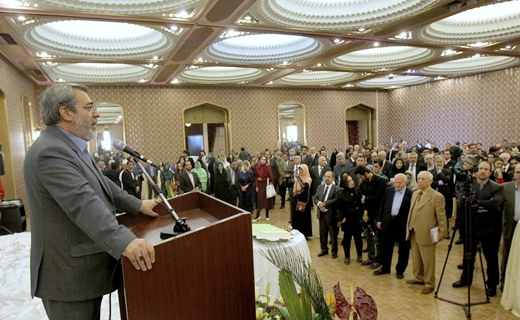
Interior Minister Abdolreza Rahmani Fazli said on Tuesday that closer cooperation with neighboring countries is the principal strategy in the foreign policy of Iran.

Speaking at a ceremony to mark National Day of Afghanistan, he said President Rouhani has always underscored a boost in all-out ties with Iran’s neighbors.

Recalling common religion, language, culture, history and geography between Iran and Afghanistan, he said Iran stood by Afghan people during the country’s occupation by Soviet army, against Taliban militia and in the reconstruction period.

He welcomed the formation of a national reconciliation government in Afghanistan and said common viewpoints of Tehran and Kabul outnumber their disagreements on certain bilateral issues.

He said that Iran cannot remain indifferent to insecurity at its borders and added that we are ready for closer cooperation in regional and international plans against terrorism and narcotics despite its huge costs.

To restore security in Afghanistan, he added, there is no need for the presence of foreign troops since Afghan forces who have gained considerable experience can defend the sovereignty of the country.

The minister said Iran has spent $370 million on development projects in Afghanistan and is ready to help in the fight against narcotics and terrorism in cooperation with regional countries and the international community.

He also said that some 850,000 Afghan refugees are in Iran and 97 percent of them live in urban areas while in other countries, people with similar status are held in camps or special centers.

Cabbie returns briefcase worth $25,000 to owner

Untitled-1

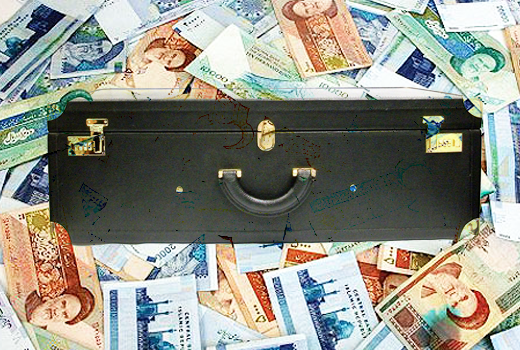
A few days ago, a cabdriver in the northeastern Iranian city of Bojnurd found a briefcase – which turned out to contain a lot of cash – left behind in his taxi by a passenger he had just dropped off.

The following is the translation of a report filed by Mehr News Agency (August 18) on what the cabdriver did next:

To find the owner of the briefcase and return it, the cabbie opens the case and much to his surprise, he finds it full of cash, traveler’s checks and valuable documents.

Untempted to take the money for himself, Mahmoud Garivani searches in the papers in the case for a phone number to return the briefcase to its owner.

Finally, he finds a number and calls the owner who coincidentally is in a nearby town without knowing that he has left behind his briefcase.

The good-natured cabbie drives all the way from Bojnurd to Shirvan, another town in North Khorasan Province, to hand in the briefcase.

Despite insistence by the owner of the case, he turns down an award and even refuses to charge for the out-of-town trip.

In a ceremony held at a mosque in his hometown on August 17, officials with Bojnurd City Council and Municipality praised Garivani for his faithfulness.

In a similar incident three years ago, Ahmad Rabani, a 39-year-old dustman in North Khorasan Province, found a portfolio containing more than $330,000 in cash, gold and documents and returned it to its owner.

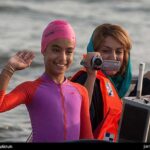
10-year-old Iranian girl sets Asian swimming record in Caspian Sea (PHOTOS)

girl-swimming000

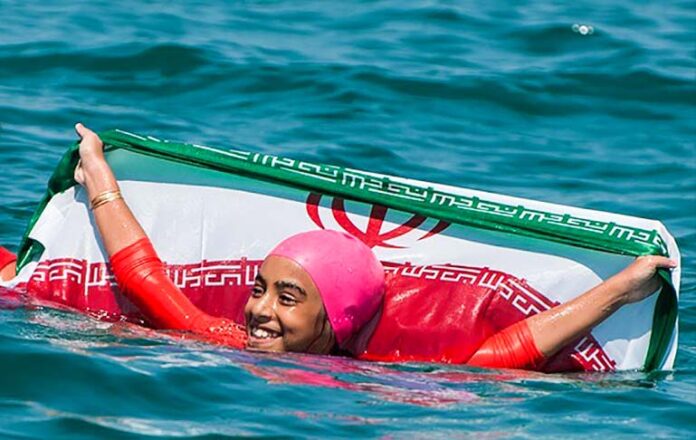
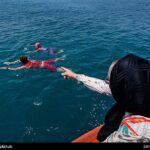
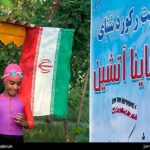
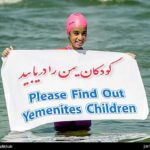
Saina Atashin, aged 10, has swum for more than seven hours in the Caspian Sea, covering 10.2 km and setting an Asian record.

Images of the young girl swimming at sea released online by jamejamonline.ir: