Sunday, December 21, 2025
Home Blog Page 4668

Cabbie returns briefcase worth $25,000 to owner

Untitled-1

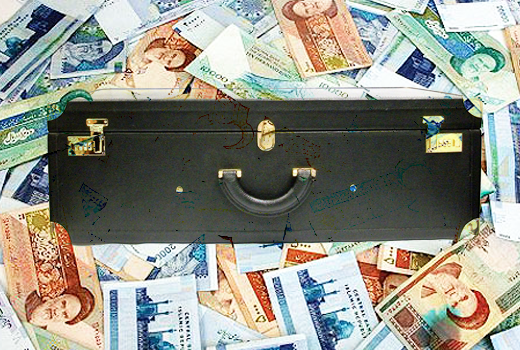
A few days ago, a cabdriver in the northeastern Iranian city of Bojnurd found a briefcase – which turned out to contain a lot of cash – left behind in his taxi by a passenger he had just dropped off.

The following is the translation of a report filed by Mehr News Agency (August 18) on what the cabdriver did next:

To find the owner of the briefcase and return it, the cabbie opens the case and much to his surprise, he finds it full of cash, traveler’s checks and valuable documents.

Untempted to take the money for himself, Mahmoud Garivani searches in the papers in the case for a phone number to return the briefcase to its owner.

Finally, he finds a number and calls the owner who coincidentally is in a nearby town without knowing that he has left behind his briefcase.

The good-natured cabbie drives all the way from Bojnurd to Shirvan, another town in North Khorasan Province, to hand in the briefcase.

Despite insistence by the owner of the case, he turns down an award and even refuses to charge for the out-of-town trip.

In a ceremony held at a mosque in his hometown on August 17, officials with Bojnurd City Council and Municipality praised Garivani for his faithfulness.

In a similar incident three years ago, Ahmad Rabani, a 39-year-old dustman in North Khorasan Province, found a portfolio containing more than $330,000 in cash, gold and documents and returned it to its owner.

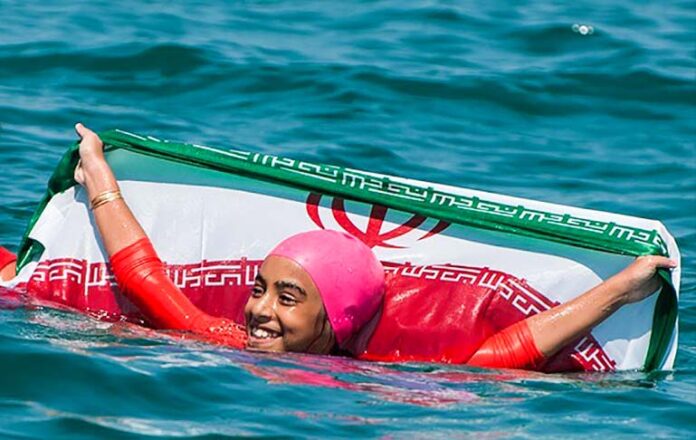
10-year-old Iranian girl sets Asian swimming record in Caspian Sea (PHOTOS)

girl-swimming000

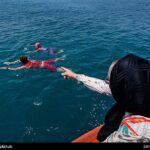
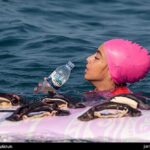
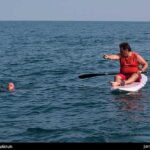
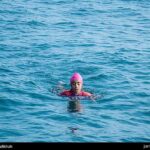
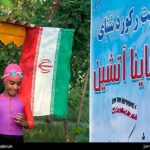
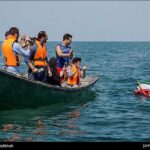
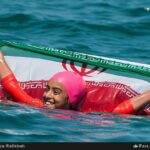
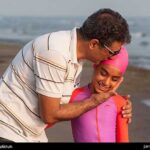
Saina Atashin, aged 10, has swum for more than seven hours in the Caspian Sea, covering 10.2 km and setting an Asian record.

Images of the young girl swimming at sea released online by jamejamonline.ir:

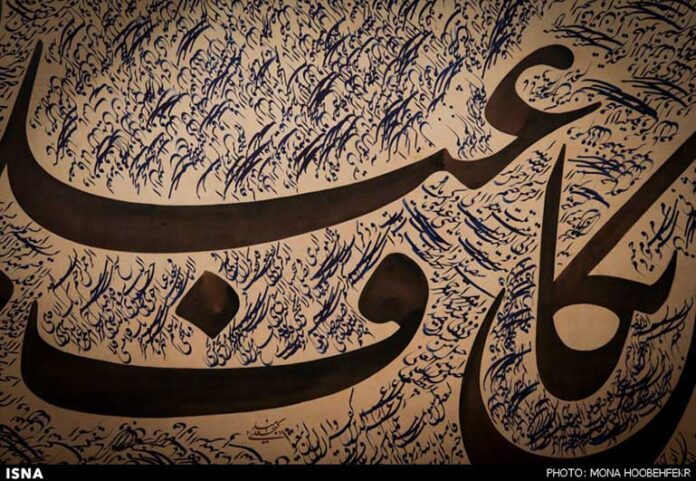
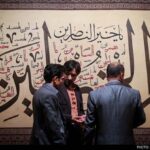
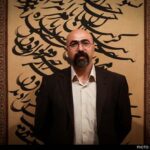
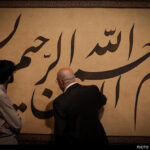
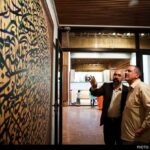
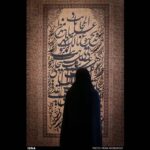
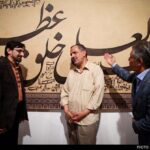
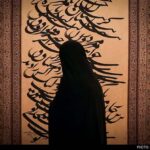
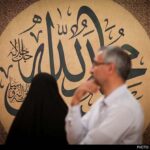
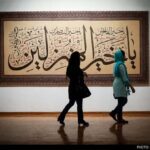
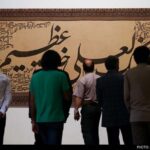
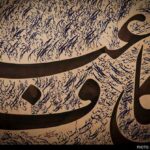
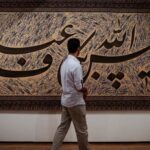
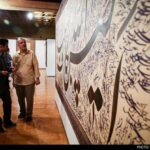
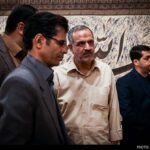
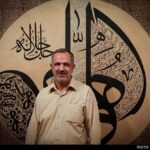
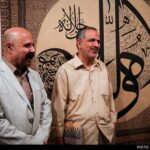
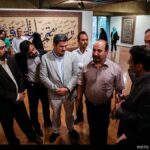
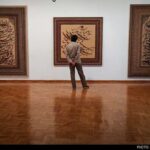
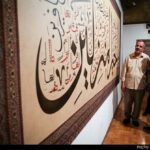
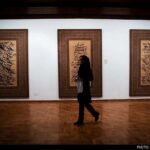
Calligraphy exhibition at Niavaran Cultural Center (PHOTOS)

Iran Objects to Turkey’s “Islamic Calligraphy” Proposal to UNESCO

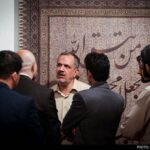
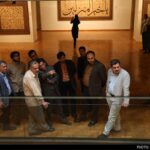
Traditional Iranian arts would be sponsored by royal funds and kept along with precious jewelry in royal treasuries. In this day and age, however, artworks need spiritual support and more publicity, Ahmad Masjed Jamei, a Tehran City Council member, said at the opening ceremony of a calligraphy and textile printing exhibition in the capital.

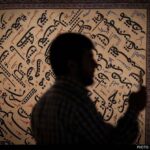
Rafi Razavi, an organizer of the exhibition at Niavaran Cultural Center, said, “The 36 works of art on display at the expo depict an integration of calligraphy and textile printing. The collection is the result of efforts of seven artists during a 32-month period. ”

He further said calligraphers Omid Ganjali and Mohsen Soleimani have cooperated with a team of professional textile printing artists to craft the artworks on display.

He added, “Istanbul [where the collection was previously on display] was a great experience. Although, Istanbul is a global calligraphy hub, Turkish calligraphers were impressed by Iranian calligraphy and the thick pens used by Iranian artists.”

Razavi said the exhibition is scheduled to be held in the United Arab Emirates in late October.

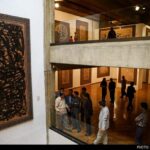
Images of the Tehran calligraphy and textile printing exhibition released by the Iranian Students’ News Agency:

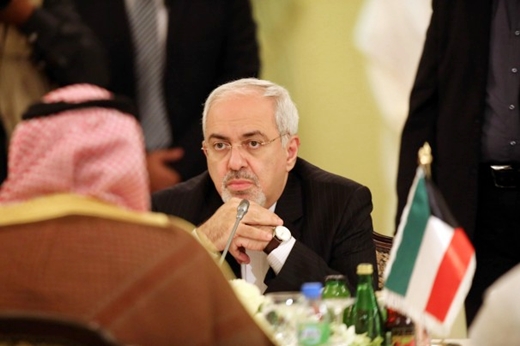
What do Zarif’s regional trips signify? Will his plan bring Saudi Arabia to the negotiating table?

452736851

The multiphase plan Foreign Minister Mohammad Javad Zarif has devised is like a puzzle whose pieces are gradually falling into place. The Iranian top diplomat’s initiative will ultimately get Saudi Arabia to accept a new regional order.

Khabaronline.ir on August 17 published a piece by Saeed Jafari on the foreign minister’s new regional initiative. The following is the translation of that piece:

Zarif has traveled to Qatar, Kuwait, Syria, Lebanon, Iraq, India and Pakistan over the past two weeks with his trips drawing global attention. A closer look at comments by officials meeting Zarif shows that these countries all want to improve their ties with Tehran. This comes after the regional isolation of Iran courtesy of the previous government’s policies [both at home and] on the world stage.

During his regional tour and in an interview with an Iranian monthly, Zarif revealed his new plan which first drew the attention of Lebanon’s As-Safir newspaper. In an article in the Lebanese newspaper, Zarif floated the idea of establishing a regional security forum to encounter potential threats the Middle Eastern countries are exposed to.

This is nothing new. Since the establishment of the Islamic Republic, Iran has always stressed the need for regional countries to solve their issues themselves, without the involvement of world powers, but the mechanism Zarif has put forward this time is new. Furthermore, the foreign minister’s recent remarks suggest that he has developed a good mechanism for this initiative and is seeking to put it into effect.

Why does Saudi Arabia have issues with Iran?

After the establishment of the Islamic Republic, Arab countries in the Middle East kept their guard up when they heard Iran was to export the Islamic Revolution and became concerned about the rise to power of a nascent government in Tehran. This concern caused Arab brothers to stand by [Iraq’s] Saddam Hossein so that they could nip the new regional player in the bud.

That Arab dream never came true and certain players in the Persian Gulf and Middle East started to improve their ties with Tehran, but the big brother of the Arabs [a reference to Saudi Arabia] did little to hide its dissatisfaction with the growth of Iran’s strategic depth.

According to Mohammad Kazem Sajjadpour, a former Iranian diplomat, blunders of other players and Iran’s good gambit over the past three decades have strengthened Iran’s hand in regional disputes and weakened that of Iran’s rivals. This has left a bad taste in the mouth of the Saudis and others. That’s why Riyadh has expressed dissatisfaction and taken practical measures to undermine Tehran’s strategic depth.

The growth of Salafi and Takfiri movements in Syria and Iraq which led to the emergence of ISIL, support for the radical opponents of the Assad government, assistance to the March 14 Alliance led by Saad Hariri [in Lebanon], and finally military action against Yemen are chief among those measures.

Impartial observers believe these measures have not brought about benefits for Saudi Arabia; rather, they have plunged the kingdom deeper into trouble. The futility of Riyadh’s individual efforts has made this country reach out to Israel, whose regime is the No. one enemy of the Islamic Republic.

At this juncture, Iran took the right path and refrained from fuelling tensions with Saudi Arabia. At a time when Israel sternly sought to entrap Tehran in a direct military confrontation with Riyadh, the astute statesmanship of Iran’s Foreign Ministry [in particular] and the eleventh government [in general] helped the country insightfully and calmly avoid this trap.

What does Saudi Arabia want?

Saudi Arabia – which is unhappy with regional developments because it has realized that Iran holds sway in areas the kingdom used to wield its influence – has a special demand. Riyadh is asking Tehran to leave Syria, Lebanon, Iraq and even Yemen and then open talks. A demand Iran will undoubtedly reject.

What should be done? Should the tensions be heightened? The answer is definitely in the negative, because the balance in the Middle East region is being tipped in favor of Iran.

Today a relative calm has taken hold in Syria, but two years ago the whole world was unanimously talking about the inevitability of Assad’s departure and the clouds of war were hanging over Damascus. Or, to say the least, things in Syria have gone so far that the US secretary of state is now echoing remarks Iranian officials were making three years ago. “There is no military solution. [There is only a political solution” to the Syrian crisis.]

The situation in Iraq and Lebanon is similar. The internal developments in these two countries are to the benefit of Iran. Consequently, Iran is about to turn into a conservative player that is willing to maintain the status quo, and Saudi Arabia – which was traditionally the conservative player in regional developments – is to change into a revisionist element.

With that being the case, Iran has to avoid getting caught in a serious confrontation with Saudi Arabia. Instead, it should try to stabilize the status quo. The question is whether the status quo will be maintained by sitting idly by and doing nothing and just talking about the betterment of ties between regional Muslim countries. Definitely not! How such stabilization can be pursued should be sought in Zarif’s hands.


Zarif’s fruitful plan

After the successful end of nuclear talks, Zarif once again took the first step [and moved his piece] to say “Check” to Saudi Arabia before his king is in check. By traveling to regional countries and meeting with different players in the Middle East and on the [Indian] Subcontinent, Zarif did his best to outline his security forum plan. What he did helps Iran get the upper hand vis-à-vis Saudi Arabia.

Although he knows this idea is hard to materialize, he – in his meetings – stresses the need for discussing such a plan and says Iran is determined to form a regional forum to provide the Middle East’s security. What is the fruit of such efforts? Will such a security forum form? In Saudi Arabia’s absence, this plan will certainly lead nowhere.

What’s the use of such a plan? Firstly, Iran will be identified as an active regional player which seeks to maintain regional stability and peace and supports the security of its neighbors; and secondly, Saudi Arabia is characterized as a disgruntled player which refuses to accept a mechanism for regional stability.

Zarif has built on accurate calculations to be part of this win-win game for Iran. Iran knows well that regional disputes will not be defused through unilateralism and that the presence of Saudi Arabia, especially for the equations in the Persian Gulf, seems necessary.

Iran has time and again emphasized that it views the security of its neighbors as its own and never seeks to pose a security threat to Saudi Arabia. But all Riyadh cares about is its identity, and it sees any ideological advances by Shiite Iran in regional countries as a threat to the ideology of Salafism and Wahhabism.

But adherence to the current policy of Iran, that is to say insistence on achievements and thoughts, along with continued efforts as a powerful regional power which favors a peaceful solution to regional crises, will prompt Saudi Arabia to believe in these changes and come to the negotiating table not to miss out on opportunities anymore.

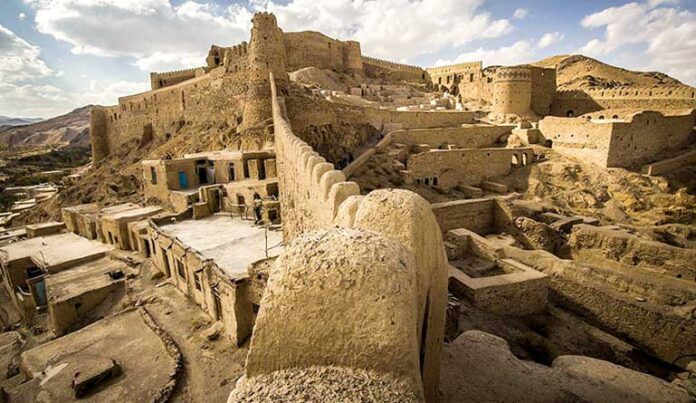
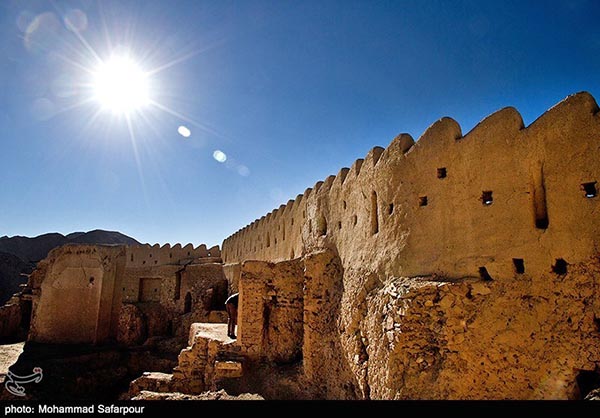
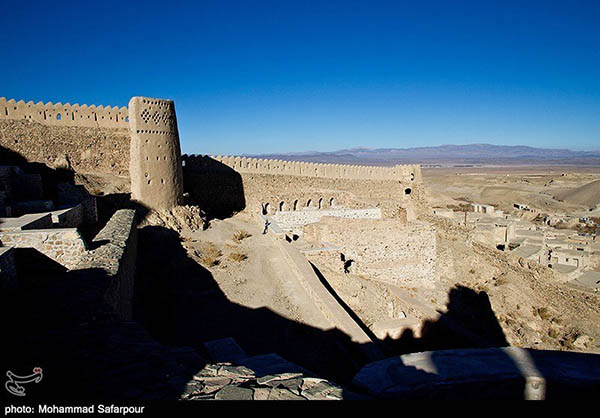
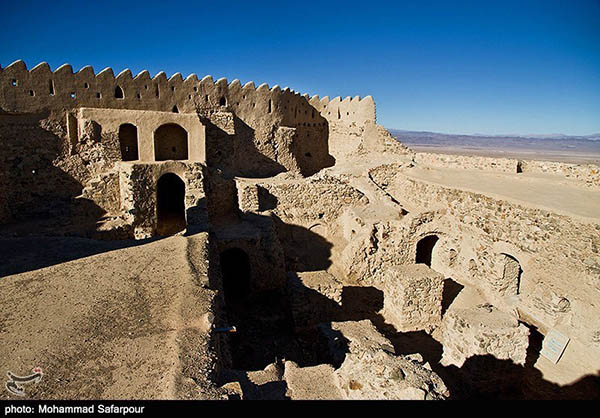
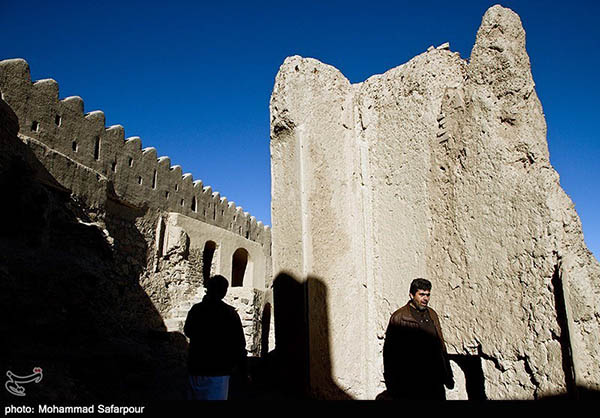
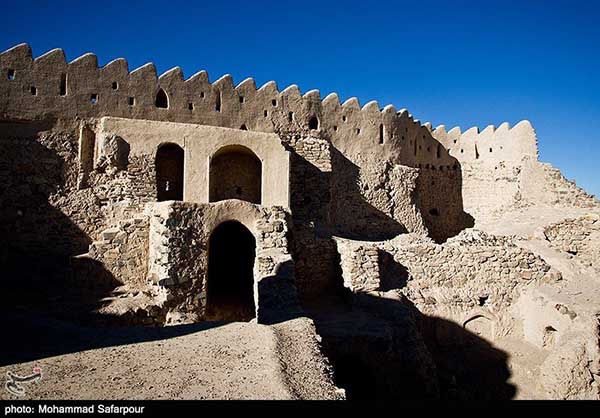
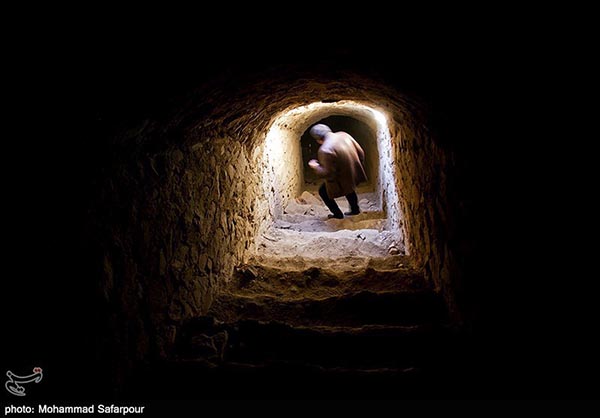
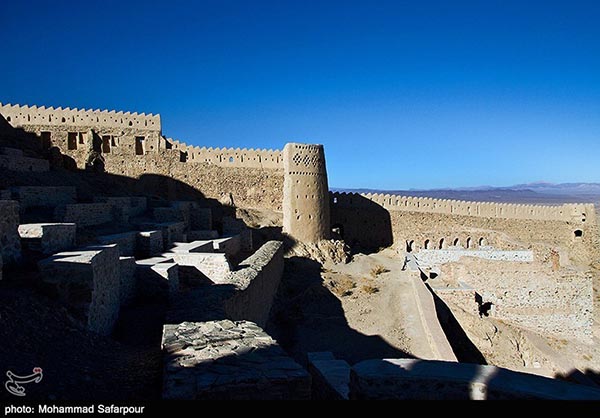
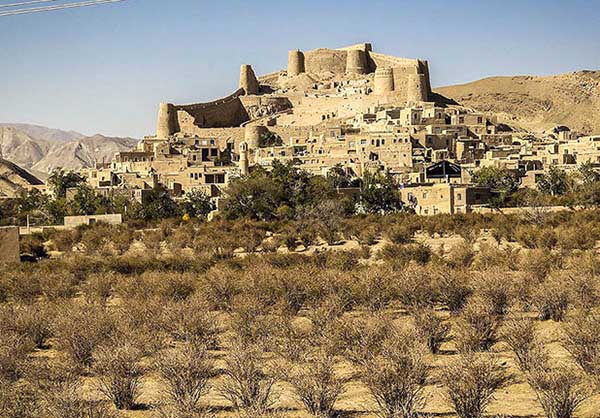
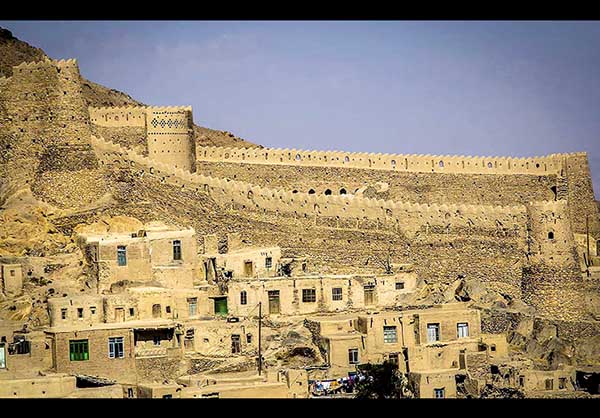
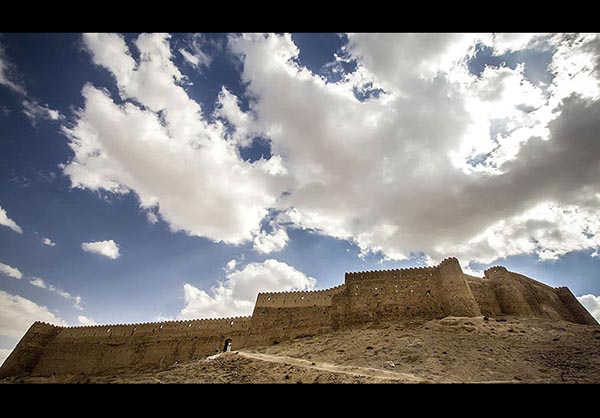
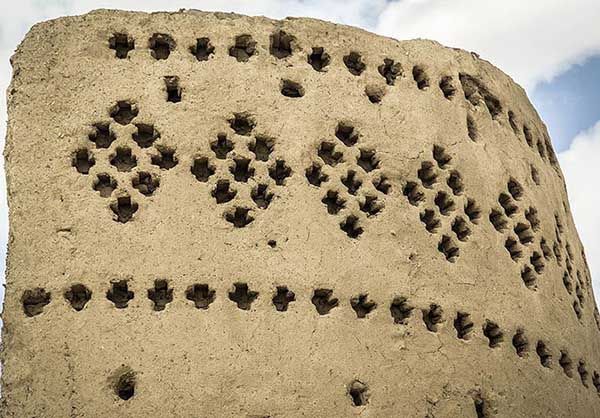
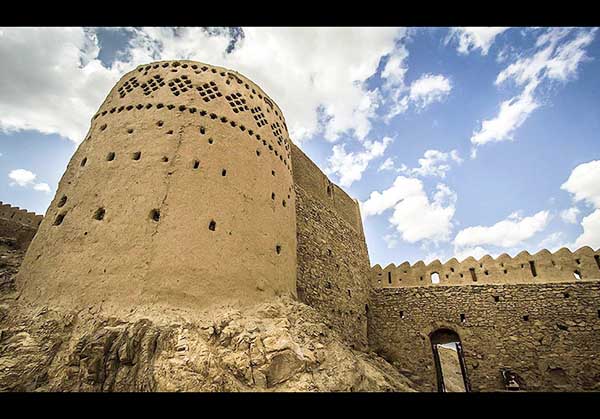
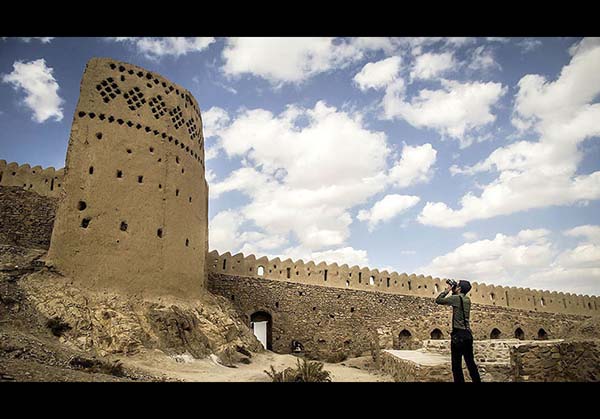
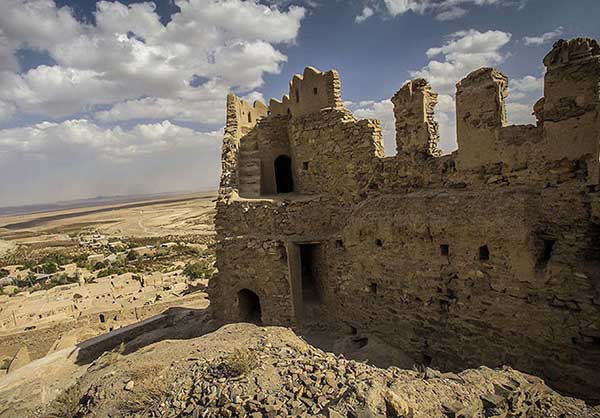
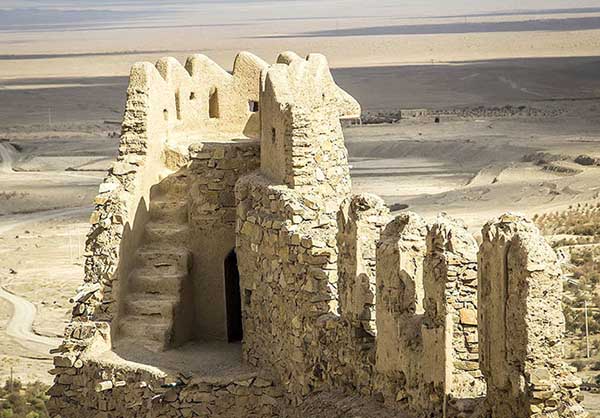
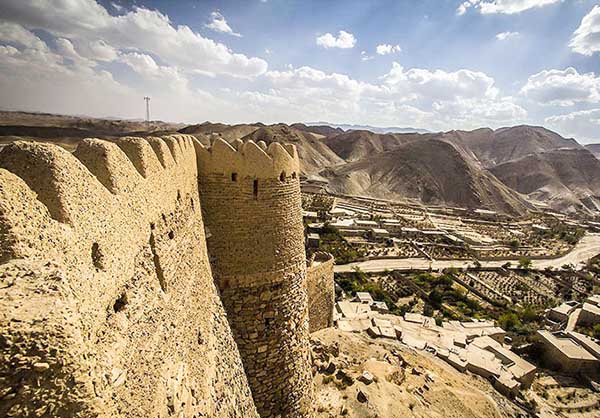
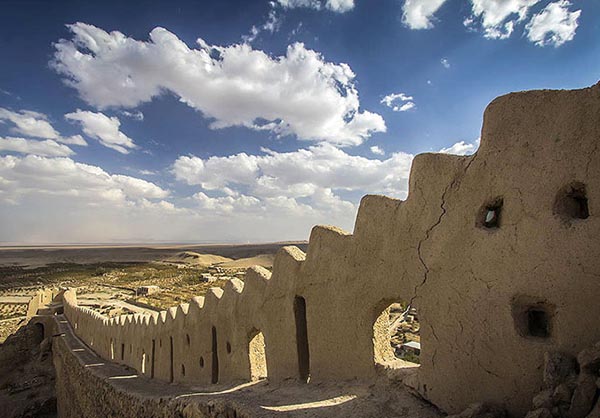
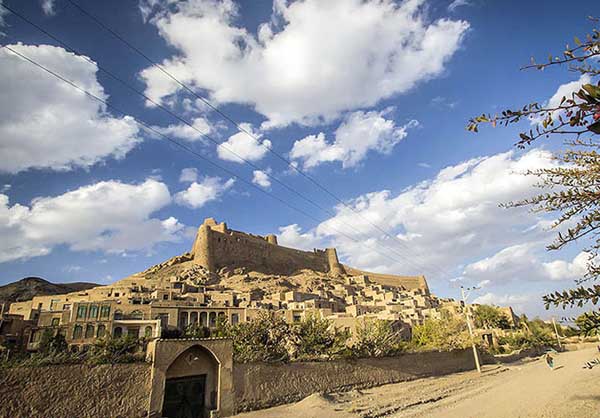
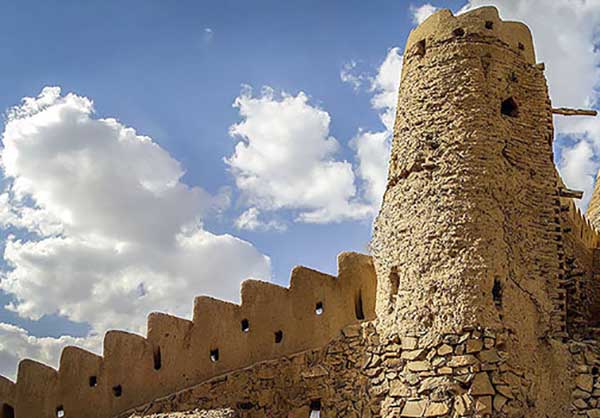
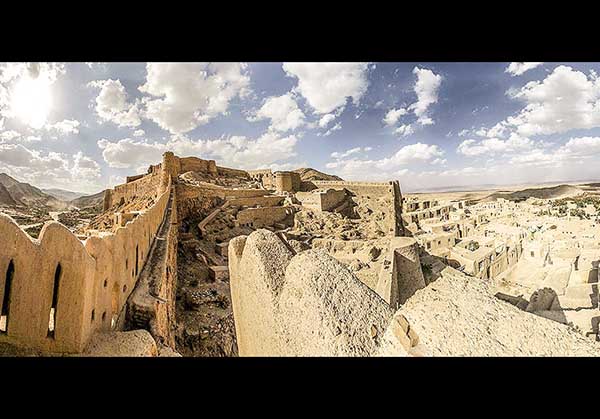
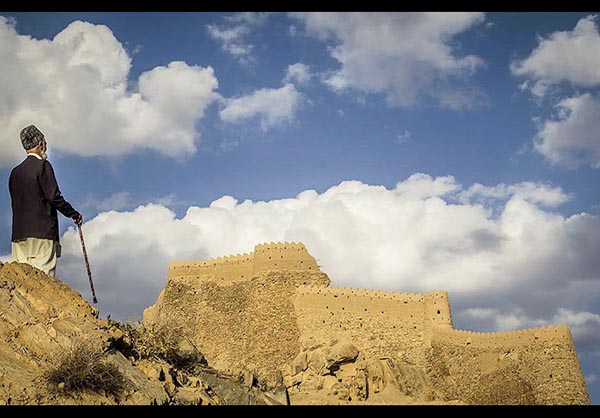
Furg Citadel in eastern Iran (PHOTOS)

Furg Citadel000

Furg Citadel in South Khorasan was built in 1747 when Nader Shah [King of Persia (1736–47)] was in power.

Stones, bricks, stucco, and lime were used in the construction of the fort, which was the second most important training site for the followers of Nizari Ismaili after the Alamut Castle.

Furg has 18 round watchtowers which overlook nearby villages and roads. The interior of the structure shows that it has been renovated a few times to meet the need for more space during the Afsharid and Qajar eras.

The following are images of the citadel released by different websites:

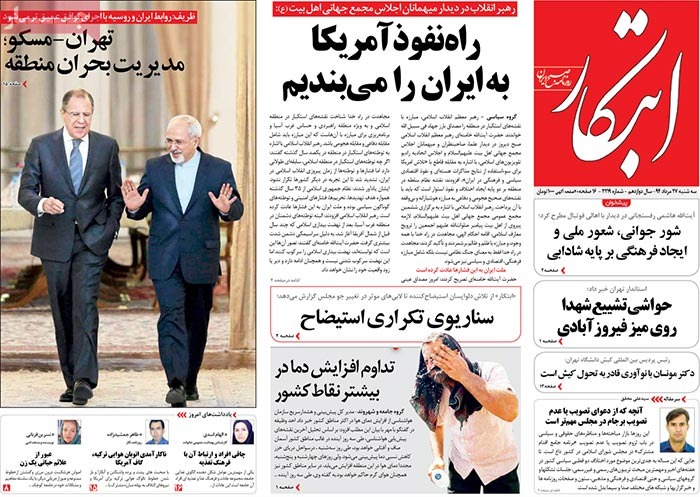
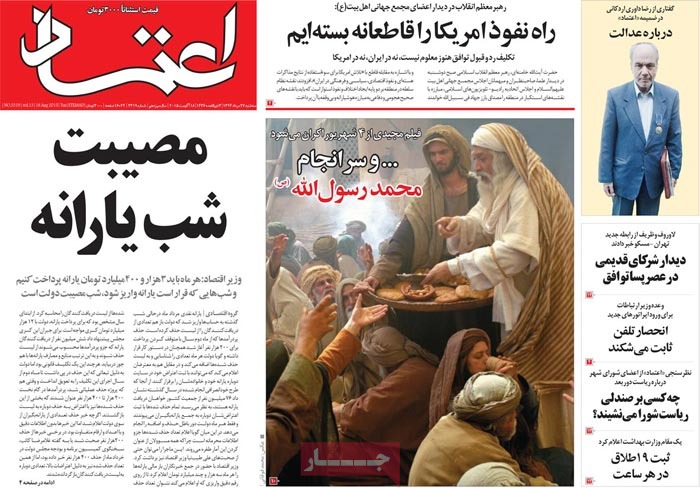
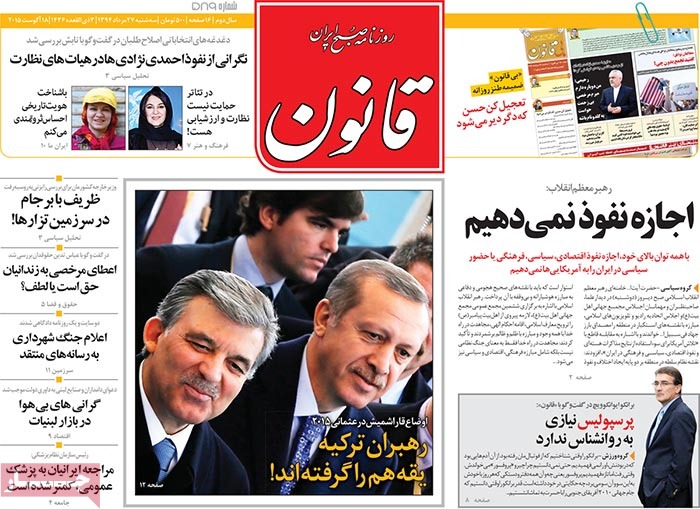
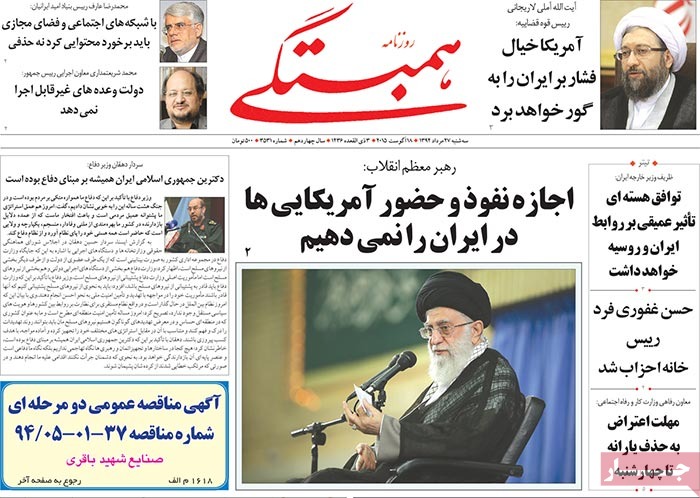
A look at Iranian newspaper front pages on August 18

Iranian Newspapers Headlines

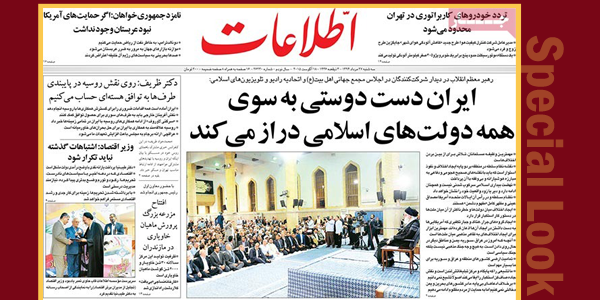
The comments of the Supreme Leader about the stance of the Islamic Republic vis-à-vis the US and Muslim unity dominated the front pages of Iranian newspapers on Tuesday.


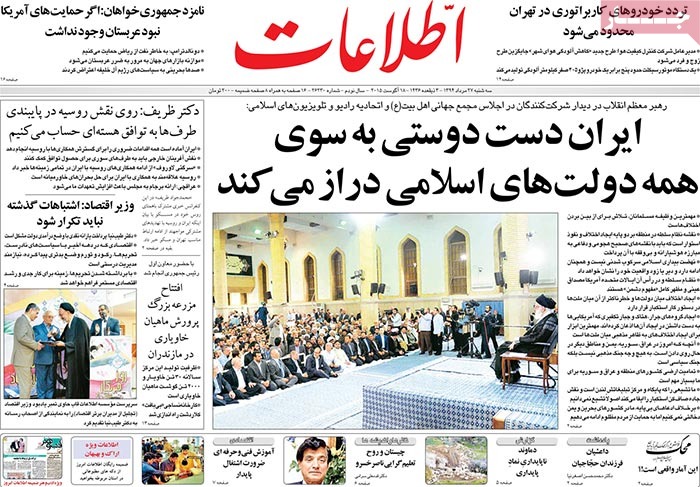
Ettela’at: “Iran extends a hand of friendship to all Islamic states,” the Supreme Leader said at a meeting with those who participated in the general assembly of an Islamic Radio and Television Union and the AhlulBayt World Assembly in Tehran.

Ayatollah Khamenei further said the most important responsibility of Muslims is to make efforts to eliminate divisions among themselves.


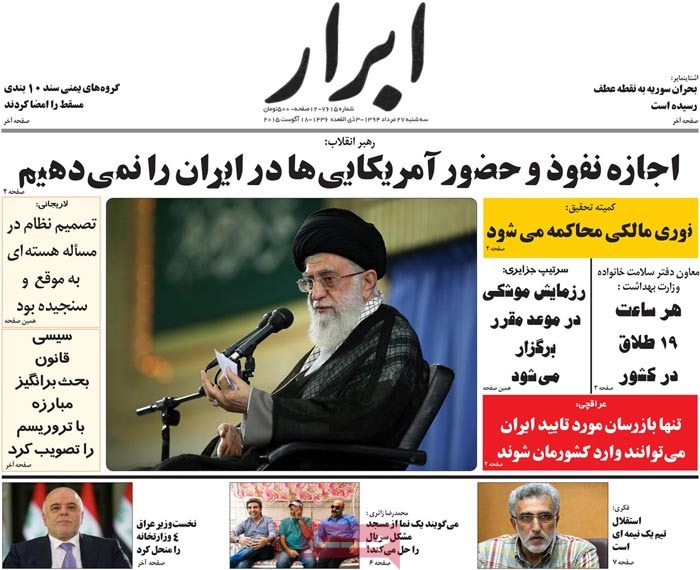
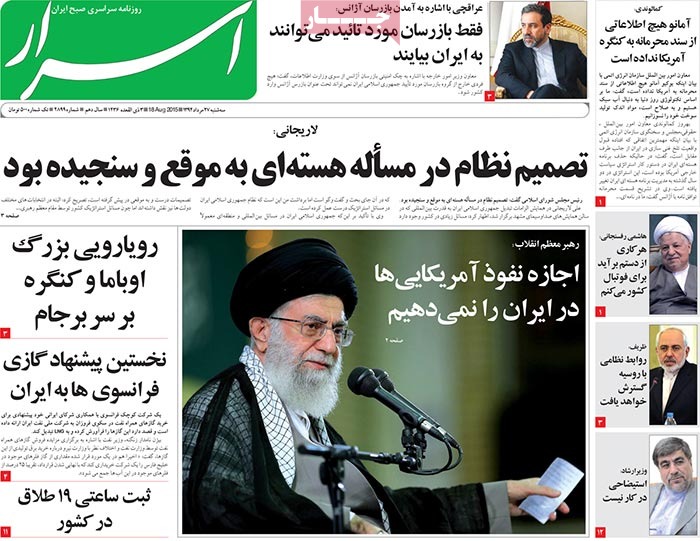
Abrar: “[IAEA] Inspectors who are approved of by Iran are the only ones who can arrive here for inspections,” said Iranian nuclear negotiator Abbas Araghchi.

Abrar: “The decision the establishment made on the nuclear issue was timely and well-founded,” said Parliament Speaker Ali Larijani.


A look at Iranian newspaper front pages on August 18


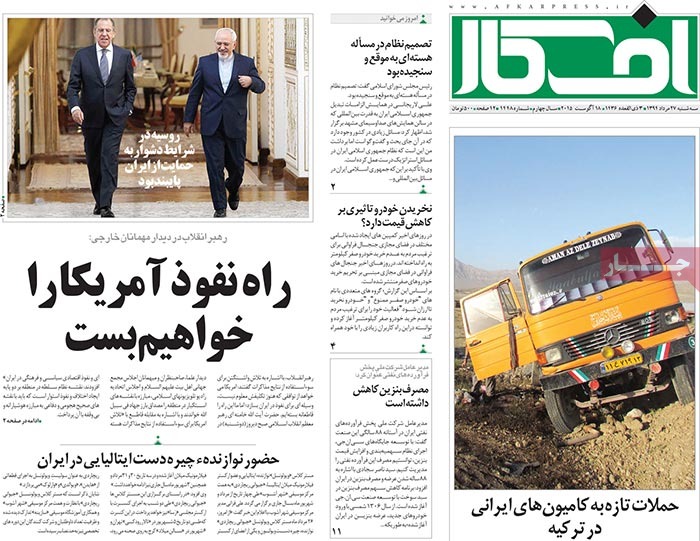
Afkar: There have been fresh attacks on Iranian trucks in Turkey.

Afkar: A veteran Italian musician is in Tehran to teach a master class.


A look at Iranian newspaper front pages on August 18


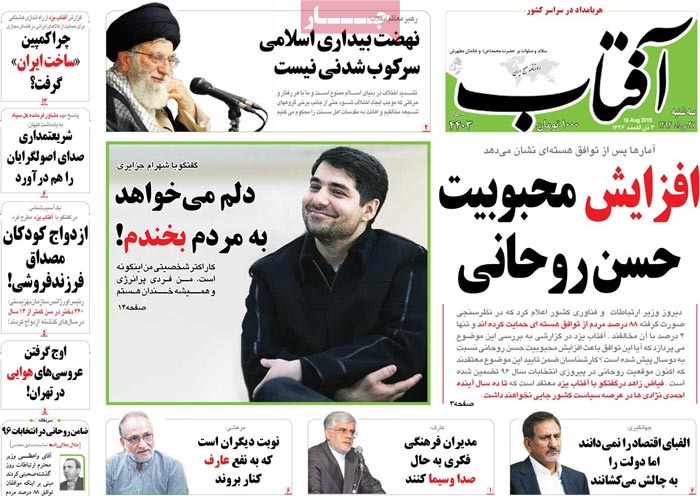
Aftab-e Yazd: Following the conclusion of the Vienna deal, the popularity of President Rouhani has increased.

Aftab-e Yazd: “Some individuals who do not know the ABCs of economy doubt the economic policies of the government!” First Vice-President Eshagh Jahangiri complained.


A look at Iranian newspaper front pages on August 18


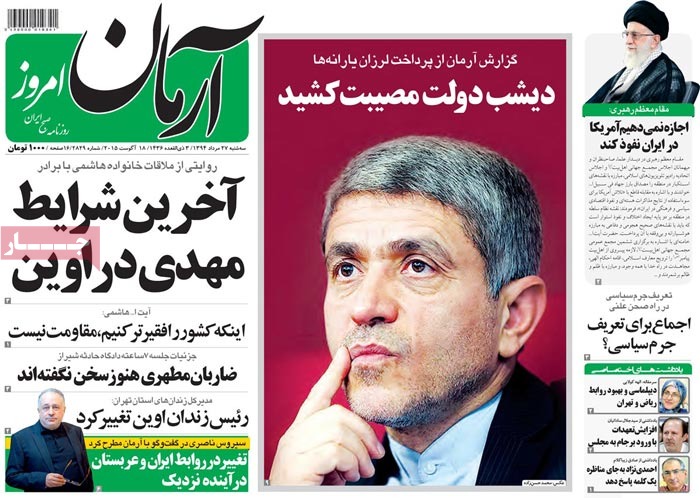
Arman-e Emrooz: “Rendering the country poorer is not resistance,” said Chairman of the Expediency Council Ayatollah Akbar Hashemi Rafsanjani.

Arman-e Emrooz: Assailants who attacked Tehran MP in Shiraz earlier this year have yet to talk in their defense in court.


A look at Iranian newspaper front pages on August 18


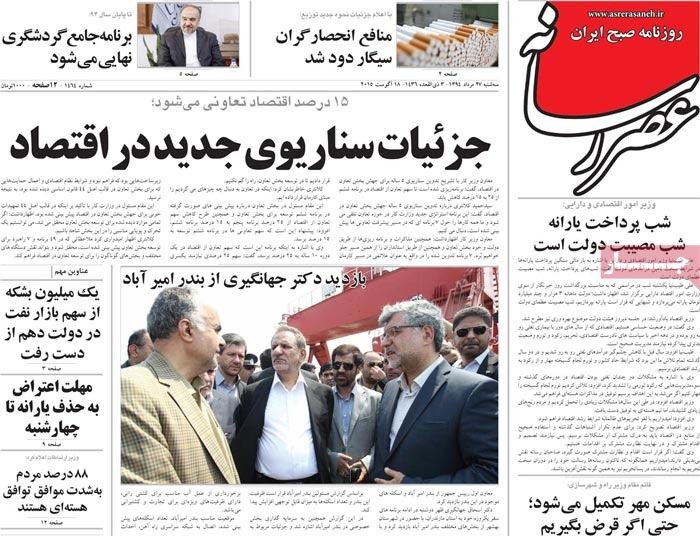
Asr-e Rasaneh: The minister of communications and information technology has said that 88 percent of Iranians are strongly in favor of the nuclear deal.


A look at Iranian newspaper front pages on August 18


Asrar: The chairman of the Expediency Council has said he will do anything within his powers to shore up football in the country.

Ayatollah Rafsanjani made the comment at a meeting with senior officials of the Football Federation.

Asrar: Foreign Minister Zarif has said that military ties with Russia will be boosted.


A look at Iranian newspaper front pages on August 18


Ebtekar: Temperatures will continue to hike in much of the country.


A look at Iranian newspaper front pages on August 18


Etemad: An official with the Health Ministry has said that each hour as many as 19 divorces are registered in the country.


A look at Iranian newspaper front pages on August 18


Ghanoon: Turkish leaders are at each other’s throats.

Disarray reigns in Ottoman Empire 2015!


A look at Iranian newspaper front pages on August 18


Hambastegi: “Iran’s military doctrine has always been defensive,” said the Iranian defense minister.

Hambastegi: “Government does not make promises it cannot keep,” said the Iranian vice-president for executive affairs.


A look at Iranian newspaper front pages on August 18


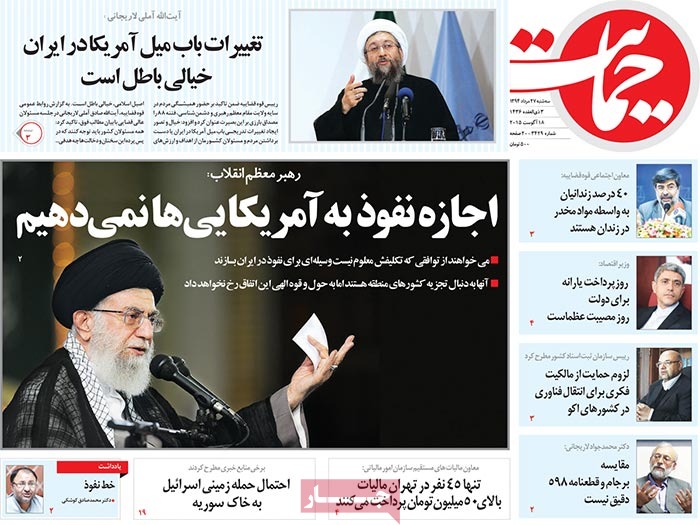
Hemayat: “American-style changes in Iran are only a pipe dream,” said the judiciary chief.

Hemayat: “Some 40 percent of all prisoners in Iran are behind bars for drug-related offenses,” said a judiciary official.

Hemayat: Some news sources say Israel may launch a ground offensive against Syria.


A look at Iranian newspaper front pages on August 18


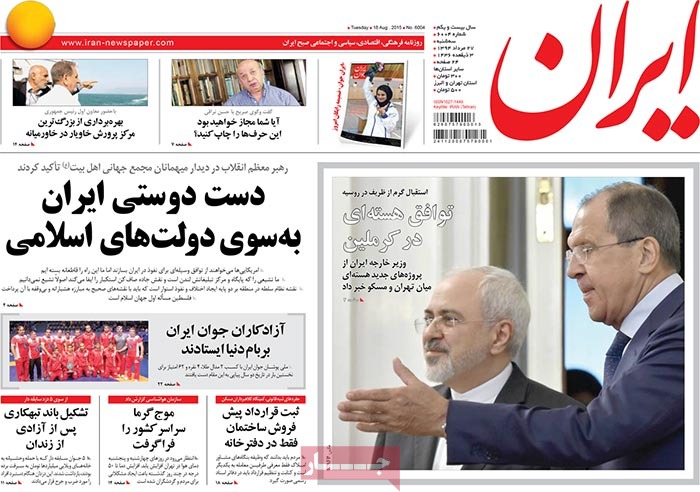
Iran: Iranian Foreign Minister Zarif has been warmly welcomed by Russian officials in Moscow.

Zarif said Iran and Russia will implement new nuclear projects.

Iran: Iran’s junior wrestlers have been crowned world champions in Brazil.


A look at Iranian newspaper front pages on August 18


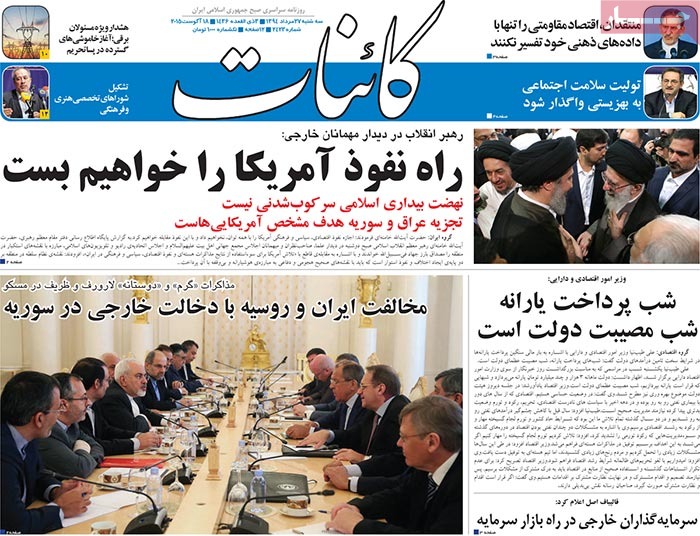
Kaenat: Iran and Russia are opposed to foreign interference in Syria.


A look at Iranian newspaper front pages on August 18


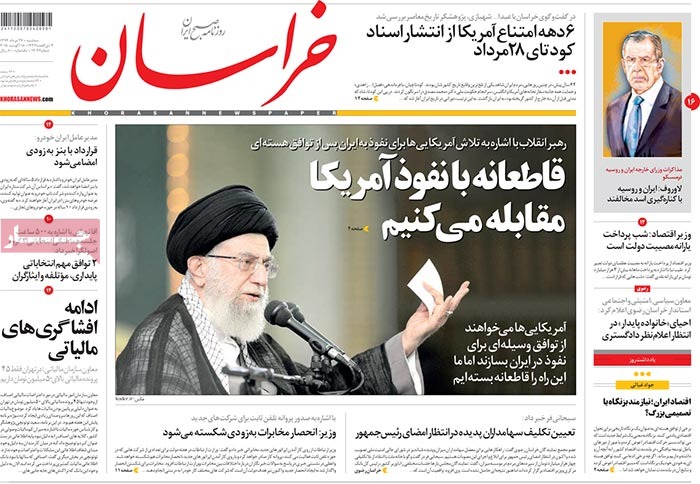
Khorasan:”We will firmly stand up against American inroads,” said the Supreme Leader as he recalled American attempts to find its way back into Iran following the nuclear deal.

Khorasan: “The telecommunications monopoly will soon be broken,” said the minister of communications.


A look at Iranian newspaper front pages on August 18


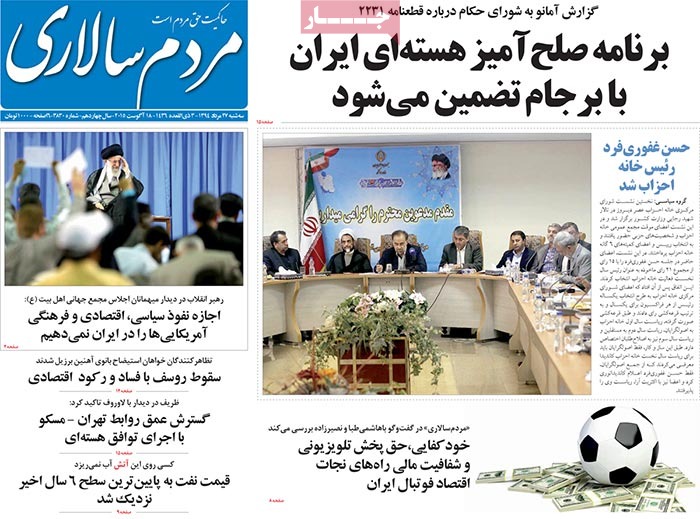
Mardomsalari: Hassan Ghafurifard, a onetime MP and Cabinet minister, has been named chairman of the House of Political Parties.

Mardomsalari: Oil prices are closing in on 6-year lows.


A look at Iranian newspaper front pages on August 18


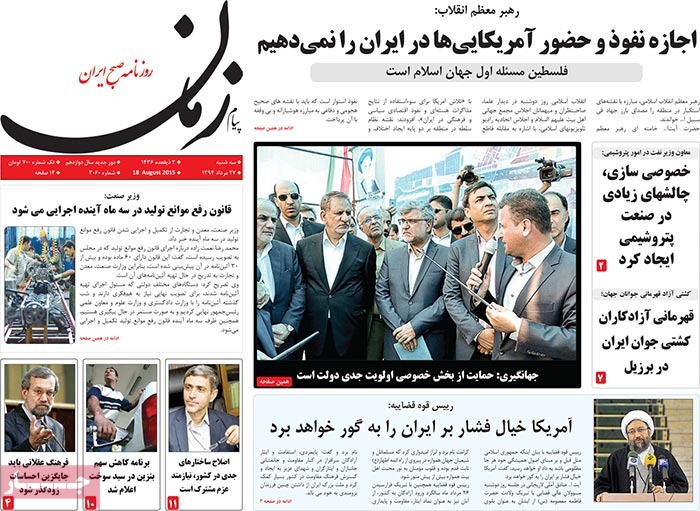
Payam-e Zaman: “The law that eliminates the obstacles standing in the way of production will be implemented in three months,” the industry minister said.


A look at Iranian newspaper front pages on August 18


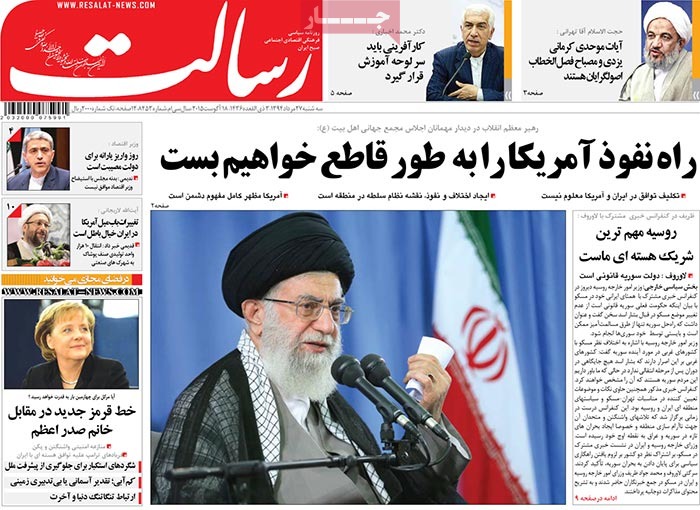
Resalat: “The day cash subsidies are paid is a very sad day for government,” said the economy minister as he talked about existing monetary problems to sustain cash handouts [introduced by the government of Ahmadinejad].


A look at Iranian newspaper front pages on August 18


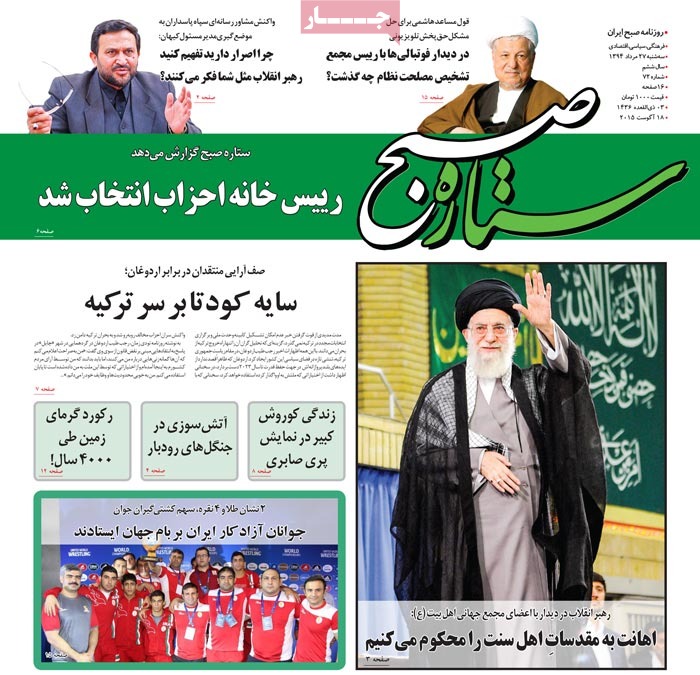
Setareh Sobh: “We condemn any measure disrespectful of Sunni sanctities,” the Supreme Leader said.


A look at Iranian newspaper front pages on August 18


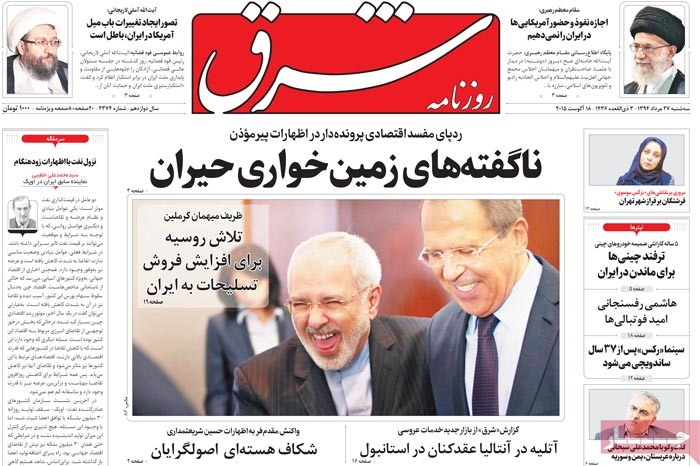
Sharq: Russia is trying to increase its arms sales to Iran.

Sharq: The Chinese ploy to remain on the Iranian market: five-year warranties on Chinese-made cars.


A look at Iranian newspaper front pages on August 18


Highlights of Ettela’at newspaper on August 18

Ettelaat Highlights-post

 “Iran extends a hand of friendship to all Islamic states,” the Supreme Leader said at a meeting with those who participated in the general assembly of an Islamic Radio and Television Union and the AhlulBayt World Assembly in Tehran.

Ayatollah Khamenei further said the most important responsibility of Muslims is to make efforts to eliminate divisions among themselves.

 In Tehran, the movement of cars with carburation system will become restricted.

The air pollution caused by a motorcycle is five times that of a brand new Peugeot 405.

 US Republican presidential candidate Donald Trump has said, “If it weren’t for us, they [a reference to the Saudis] wouldn’t be here. They wouldn’t exist.”
 “We count on Russia’s role in keeping parties [to nuclear talks] committed to the nuclear deal,” Iranian Foreign Minister Mohammad Javad Zarif said.

The top diplomat, who was in Moscow, also signaled Iran’s readiness to take all the necessary measures to expand ties with Moscow.

 “The past mistakes should not be repeated,” said the minister of economy and financial affairs.

Ali Tayyebnia further said given the current revenues of government, sustaining cash subsidies is difficult.

 A sturgeon fish farm has opened in Mazandaran Province.
The farm, the biggest in the Middle East, is expected to produce more than 30 tons of caviar each year.
 The head of Ettela’at Institute has handed a framed stamp to the minister of economy and financial affairs in praise of his services as a top economy manager.


Nuclear agreement not equal to shared regional policies with US: Speaker

13931030000343_PhotoI (1)

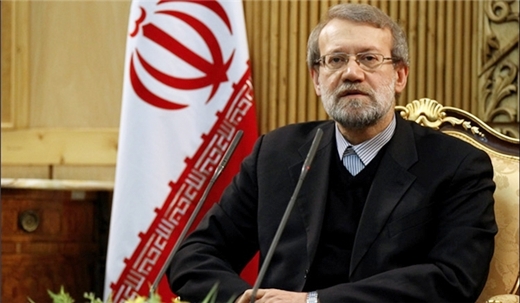
Iranian Parliament Speaker Ali Larijani recalled Washington’s hostile policies against Tehran, and underlined that the nuclear agreement signed between Iran and world powers in Vienna in mid-July would not mean that the Islamic Republic and the US have the same regional policies.

“The question is whether the recent developments and (Vienna) negotiations mean that Iran and Western countries are moving in the same direction; the response is surely negative because Iran has always followed its own path and it is them (Western countries) who need us,” Larijani said, addressing a ceremony in the city of Mashhad, northeastern Iran, on Monday.

The Iranian parliament speaker reiterated that Western countries have realized that their problems in the region will not be resolved without Iran playing a role.
“Recognition of Iran’s right to enrichment by the West showed that European countries and the US have come to terms with Iran’s progress in different fields; Iran’s resistance and endurance helped the country achieve its goals and foiled Western efforts to prevent Iran from continuing its peaceful nuclear program,” Larijani said.
[…]

Iran to resume carpet exports to US: Official

139303141521469002919194

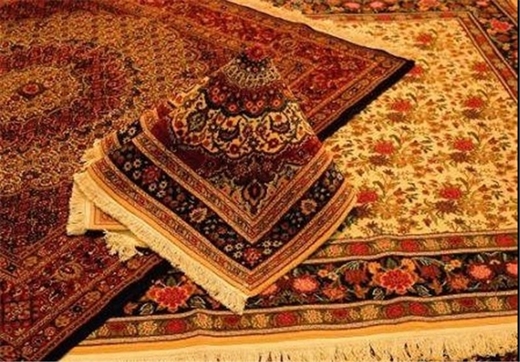
Head of Iran’s National Carpet Center Hamid Kargar said the country plans to resume the export of carpets to the US once the economic sanctions on Iran are lifted.

“Before the embargoes, Iran used to export more than $80 million worth of carpets to the US annually,” Kargar told Tasnim News Agency.

The exports were halted in 2010 due to direct US sanctions on Iran’s carpet industry, he added.

The termination of general and direct sanctions against Iran will have a major impact on the increase of carpet experts to the US, the official said.

The National Carpet Center is preparing and optimizing the conditions for Iran to reclaim its market share in the US, Kargar noted.

His remarks come against the backdrop of a wave of renewed interest in ties with Iran after the country and P5+1 (Russia, China, the US, Britain, France and Germany) on July 14 reached a conclusion over the text of a comprehensive 159-page deal on Tehran’s nuclear program.

The comprehensive nuclear deal between Tehran and six world powers will eventually terminate all nuclear-related sanctions imposed on Iran.

Experts believe that Iran’s economic growth will rise remarkably after the final nuclear deal takes effect.

Iran gets first ever associated gas offer

326d68b9-1bb9-47bc-ac02-cfa53a0de560

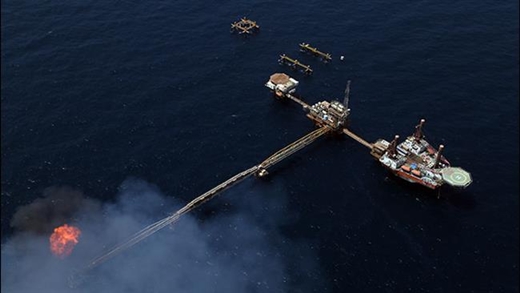
A French company has proposed to buy associated gas from an offshore Iranian oilfield in the Persian Gulf in order to convert it into liquefied natural gas (LNG), Oil Minister Bijan Namdar Zanganeh said.

The offer marks the first of its kind to Iran by a foreign company to use natural gas associated with oil production instead of burning it off as the country often does in a practice known as flaring.

With the finalization of the agreement, nearly 25% of flaring at the Forouzan platform will be halted, Zanganeh told Channel 1 of the national television without naming the French company.

The Fars News Agency said the French company has proposed to partner with Iranian firms for processing the associated gas from Forouzan oil wells at a separate platform which they plan to build nearby before converting it into liquefied natural gas (LNG).

Iran planned to pump the associated gas from the Forouzan field, which it shares with Kuwait, through pipeline to an LNG facility at Kharg Island before intensified sanctions prevented the scheme from taking off.

According to figures released by the Ministry of Petroleum, about 5.4 million cubic meters (189 million cubic feet) of associated gas is burnt off per day at the Forouzan platform.

The deal with the French company would cut Iran’s flaring of the associated gas in the offshore Persian Gulf fields by one-fourth.

A possible deal comes in the wake of intensive negotiations held in recent months for the sale of associated gas, with the talks reportedly stuck over the period of the contract.

The overall associated gas from the offshore Persian Gulf oil wells is estimated at 20 million cubic meters per day, which equals the flow from a single phase of the giant South Pars field.

Beside the energy loss, the flaring of associated gas significantly harms the environment.

Iran holds the largest natural gas reserves and fourth largest oil reserves in the world.