Tuesday, December 23, 2025
Home Blog Page 4635

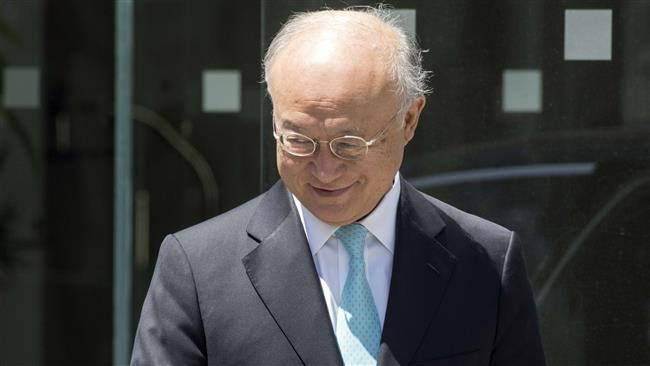
IAEA chief Yukiya Amano visits Parchin military site

Amano

Director General of the International Atomic Energy Agency (IAEA) Yukiya Amano has visited Parchin military site as a formality arranged during his brief stay in Tehran.

The spokesman of the Atomic Energy Organization of Iran (AEOI) said that Amano paid a visit to the military site on Sunday.

“In this tour, Yukiya Amano visited some of the workshop locations at the compound that have been the subject of unfounded allegations, especially the process of the repair and reconstruction of the access road to the Mamlou Dam near Parchin, which has gone down in a landslide due to recent rainfall,” Behrouz Kamalvandi said.

Iran has repeatedly denied Western allegations about secret nuclear activity at the site.

In remarks marking a deviation from past claims in the US about Parchin, the US Department of State on August 27 acknowledged that the site is a “conventional” military facility.

“I think it’s important to remember that when you’re talking about a site like Parchin, you’re talking about a conventional military site, not a nuclear site,” US State Department Spokesman John Kirby said.

Kamalvandi added that, apart from meeting with President Rouhani, Amano has also met with his host, AEOI chief Ali Akbar Salehi. The UN nuclear chief traveled to Tehran at the head of a delegation on a one-day trip at the invitation of Salehi. Amano also met with Foreign Minister Mohammad Javad Zarif.

The AEOI spokesman said Amano also participated in a session of parliament’s JCPOA Review Committee at the request of Iranian lawmakers.

Roadmap, JCPOA discussed

In a statement on Amano’s visit, the IAEA said the UN nuclear watchdog chief’s discussions with high-level Iranian officials focused on “continued implementation of the Road-map to resolve all past and present outstanding issues.”

“As part of the implementation of the Road-map, the Director General visited the site of Parchin, together with the Head of the Department of Safeguards, Tero Varjoranta,” the statement added.

In his meetings with high-level Iranian officials, Amano also discussed issues pertaining to the verification and monitoring of nuclear-related measures under the Joint Comprehensive Plan of Action (JCPOA), the statement read.

[…]
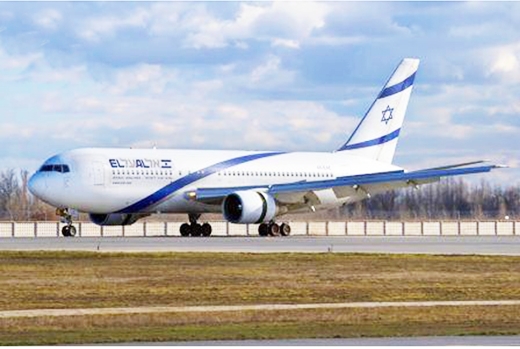
Israel bound to weaken; no military action needed: Expert

israeal

Having made a strategic miscalculation, the Zionists wrongly assume that they are locked in a showdown with a political current or an opposition party in the Palestinian territories.

In an opinion piece, Seyyed Yadollah Shirmardi has described the collapse of the Zionist regime of Israel as inevitable, predicting a “post-Israel challenge” for the West.

He has predicted that without resort to war or invasion, by 2030 people living in Gaza and the West Bank, including Muslims, Christians and Jews will have formed the state of Palestine in a democratic way in a land where there will be no trace of the Zionist regime of Israel.

What follows is the translation of part of the piece published by Tasnim News Agency on September 16:

The Supreme Leader’s comments that the Zionist regime of Israel won’t be around 25 years from now have raised the ire of senior Zionist officials and Israeli media.

The Leader openly said, “After the conclusion of nuclear talks between Iran and P5+1, the Zionists in the occupied territories have said that the talks have alleviated their concern about Iran for 25 years and that they will address the issue in 25 years. In response, I must say that first of all, you won’t last that long and hopefully, with God’s grace there will be no such thing as the Zionist regime in the region in 25 years. Secondly, the spirit of Islamic jihad in the meantime won’t let the Zionists feel comfortable for a moment. Nations have awakened and they know who their enemies are although governments and propaganda machines seek to misrepresent friends as foes; they should know that those efforts will lead nowhere.”

The judicious Leader has highlighted a concrete and inevitable fact that even Israeli allies have admitted to. A 2009 report by the Central Intelligence Agency (CIA) has predicted that Israel will collapse in 20 years and afterwards the 1948 and 1967 refugees will return home.

Recalling the return of over 1.5 million Israelis to Russia and Europe, the study has warned the US about a danger and said that there are over 500,000 Israelis with American passports; more than 300,000 of them live in California alone.

In fact, today US intelligence agencies are preoccupied with the post-Israel era more than ever before, wondering what will become of millions of Israelis living in the occupied territories in case the false regime collapses.

In the aftermath of 9/11, the Americans assumed that through deployment of troops to Western Asia, they could throw a lifeline to this illegitimate regime. However, they were ignorant of the fact that the noose is around the neck of Israel and as it is pulled further up, it pushes the regime closer to suffocation.

The final war has its roots in a number of cultural, social and economic factors which have imploded the regime already.

Among other things, the reverse migration of the Zionists to their ancestral lands, growing insecurity in the occupied territories, mounting pressures [on Israel] generated by the armament of the West Bank and possession by Hamas of modern military equipment in Gaza, the political and military ascendance of the Lebanese Hezbollah to the north of Israel, corruption and unethical behavior of Zionist citizens, a decline in religious zeal of the third and fourth generation Zionists in the occupied territories in comparison with the previous generation, and the higher reproduction rate of Palestinians as opposed to the Zionists have weakened the regime which is already as wobbly as a spider’s web.

In 2030, there will be no need for military unity among Muslim countries to take on Israel and with God’s grace, the Palestinian people in Gaza and the West Bank will settle the issue of Israel on their own once and for all and form a Palestinian state where Muslims, Christens and Jews share power in proportion to their population.

Having made a strategic miscalculation, the Zionists wrongly assume that they are locked in a showdown with a political current or an opposition party in Palestinian territories. However, the resistance forces of Lebanon and the Palestinian territories are more like a social movement which has developed across the world of Islam in recent years and come to fruition in Lebanon, the Palestinian territories, Iraq, Syria, Yemen and Bahrain. Throughout history, there has been no record of the annihilation of a social movement.

At the close of the piece, Shirmardi recalled the plots of the US and its allies to infiltrate the Islamic Republic of Iran’s pillars of power to chip away at the resolve of the Iranian nation to resist and said, “The US and its allies need to brace for the post-Israel era.”

Anticipating sweet cooperation with the world

17687_695

Tehran hosted a 14th international exhibition of biscuits, sweets and chocolate machinery and raw materials earlier in September.

What appears next is the translation of part of what Milad Masoumi, the executive manager of the event which was warmly welcomed by visitors had to say to SMT daily on September 19:

This year, the exhibition brought together 320 domestic producers and about 40 companies from 17 other countries, including Italy, Germany, France, Denmark, Japan, China, Turkey, the United Arab Emirates, Britain, Austria, Spain, India and Ukraine.

Including the open space, the entire exhibition venue was about 34,000 square meters in area.

The impact of the nuclear deal between Iran and P5+1 has yet to be felt, because top foreign companies usually do their planning before January.

Given that the deal was clinched a few months after their planning deadline, we were unable to secure much foreign contribution, but we are sure that the exhibition will be greatly welcomed next year.

ISM, the world’s best fair for sweets and snacks which is held in Germany, is way ahead of us in terms of facilities and experience, and we always look up to it as a role model and take into account its strengths to promote our exhibition.

In fact, big exhibitions in the world have been held for at least 30 years while our exhibition is only 14 years old. In other words, we do not have much experience in this field. We definitely have a long way ahead to meet up to world standards. To get there, we need better infrastructure and long-term planning. Of course, that point is within reach.

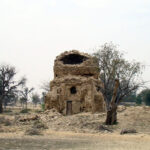
Tomsenati Village and Its Historical Shrine in Qeshm Island

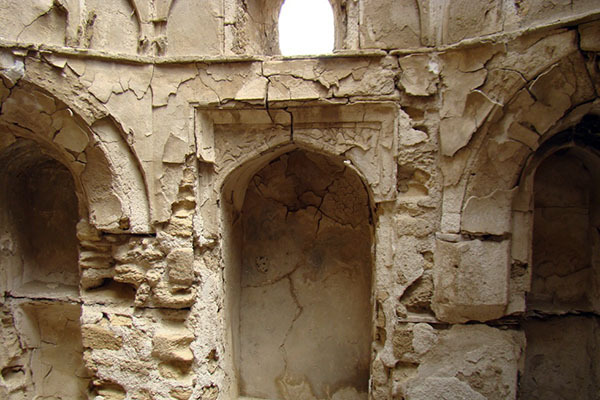
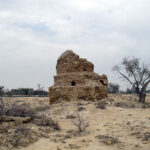
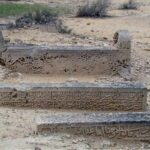
Shrine of Tomsenati Historical Village in Qeshm Island

Bogh-e Pir, meaning Pir shrine, is located in the Tomsenati village close to the Tourian region, Iran’s Qeshm Island. The shrine’s half-ruined building is still beautiful and lovely, and a main tourist attraction of the island.

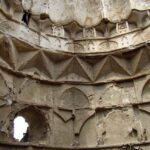
Beautiful semi-circular mortar plasterworks are seen around the neck of the dome. A short, narrow and small door forms the entrance of the shrine, with the Pir Shrine lying below the ground surface. This shows that the building is likely to have been a temple of Mithraism- a place of worship Mithra, the ancient Iranian god of Mehr- prior to the Seljuq dynasty; before Pir was buried there. Future excavations are expected to prove this.

Tomsenati is in fact the name the Spaniards have used for Bogh-e Pir; it is perhaps a variation of Tomb Saint.


Delegation of authority: US seeks to leave Syria to Russia

atvan

After five years of futile attempts to topple the Syrian government, the United States is now grappling with new problems such as terrorism and the refugee crisis. The White House has now come to the conclusion that it should drop its insistence on the ouster of Bashar Assad and get along with Russia as far as the Syrian conflict is concerned.

With the refugee crisis getting closer to a boiling point, things are changing on the ground in Syria. Five years have passed since the Syrian crisis erupted. Now the West and certain Arab countries have lost hope in efforts to overthrow the Syrian government, and the US and Europe – more than Saudi Arabia and Turkey – have come to realize that they have to come to terms with a [new] Russian role in Syria and with the survival of Bashar Assad.

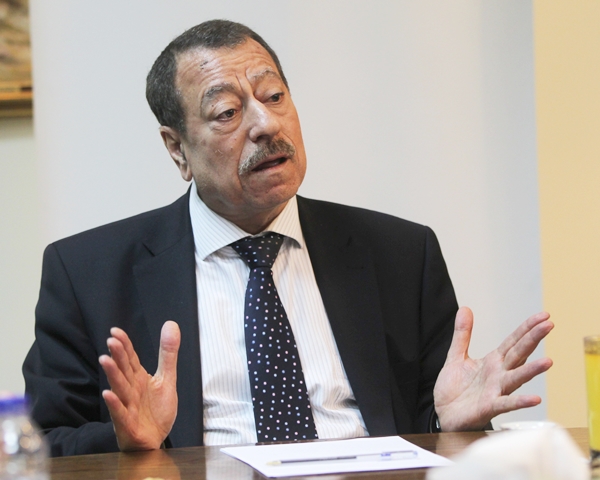
Fars News Agency on September 19 published a report on the Russian role in the Syrian civil war and the new US Syria strategy, quoting remarks by Abdel Bari Atwan, the editor-in-chief of Rai al-Youm – an Arab world digital news and opinion website – on the Syrian crisis and its twists and turns. The following is the translation of that report:

Abdel Bari Atwan writes [in his editorial] that US Secretary of State John Kerry dropped a political bombshell when he – in a joint press conference with United Arab Emirates Foreign Minister Abdullah bin Zayed in London on Friday – welcomed talks with Russia on the fight against ISIL in Syria. [“The president believes that mil-to-mil conversation is an important next step and hopefully will take place very shortly and help to define some of the different options available to us as we consider next steps in Syria”.]

Atwan goes on to say that the [US] acceptance of talks with Moscow on the Syrian conflict has given Russia the opportunity to station its state-of-the-art military hardware in Syria. Russia, which has announced Bashar Assad as its red line, is getting prepared to help him stay on the job.

He then puts forward a question as to what has caused the US to change tack and welcome cooperation with Russia on the Syrian issue, and sets out the following reasons for such a change of heart:

1. After conducting around 6,000 sorties against ISIL positions, Washington has learned that it has achieved nothing [in its fight against ISIL]: not only has the terror group not retreated from its positions, but it has also captured Ramadi in Iraq and Palmyra in Syria.

2. Saudi Arabia, Turkey and Qatar – all three US allies – are opposed to deployment of ground troops to take on ISIL. Forces of the Iraqi Army have withdrawn from Ramadi and Mosul, Saudi Arabia has got embroiled in a bloody war against Yemen, and Turkey has been caught in a war of attrition against PKK [Kurdistan Workers’ Party].

3. All plans to train the Syrian opposition have ended in failure and the trainees have fled the conflict before taking one single shot at ISIL.

4. Expression of readiness by Moscow to send troops to Syria – if and when Syria asks for them – means that Russia is seriously committed to helping Bashar Assad survive even if it takes a third world war.

5. Following the conclusion of a nuclear deal with Iran and its passage at Congress, the United States is ready to implement a phased-out departure from the Middle East simply toward [pursuing its policies on] East Asia, especially at a time when it is close to becoming independent of the Middle East’s oil.

6. The exodus of thousands of Syrian refugees who are fleeing the crisis [in their homeland] toward Europe has left an impact on the [green] continent and sparked off a demographic crisis there. Europe has been divided into two parts: Germany, France, Britain and Belgium vis-à-vis the New Europe which comprises Poland, Hungary, Romania and Bulgaria. There are fears that the European Union can be splintered.

Abdel Bari Atwan continues to say that the reasons above are good enough to say that the US administration has handed over the Syrian case to Russia and is trying to devolve its responsibilities toward the Syrian opposition and its supporters (Saudi Arabia, Qatar and Turkey).

He adds nothing happens in Europe and the US by chance. Spanish Foreign Minister Jose Manuel Garcia-Margallo’s insistence (1) on the need for holding talks with Bashar Assad and remarks by British Foreign Secretary Philip Hammond (2) on the presence of Bashar Assad in the transitional period together with comments by German Chancellor Angela Merkel (3) on Moscow’s role in Syria have all aimed to [prepare the world public opinion and] set the stage for the US withdrawal from Syria.

Close military talks between Russia and the US will soon create a US-Russian coalition for the fight against ISIL. This will be the first time ever that two world powers agree to take on one single enemy. The Syrian government or Iran seems likely to be part of this coalition. The new coalition will possibly inflict the most painful losses on Saudi Arabia, Turkey and Qatar – three sides of a triangle.

1. [“The time has come to start negotiations with the Assad regime if we do not want this war, which has already killed 250,000 people, to keep causing human tragedies”.]
2. [“If there is a sensible plan for transition that involves Assad remaining in some way involved in the process for a period of time we will look at that, we will discuss it. We are not saying he must go on day one”.]
3. [Germany and other western European powers need to work with Russia as well as the United States to solve the crisis in Syria]

Iran government, nation do not trust US officials: FM Zarif

zarif

Foreign Minister Mohammad Javad Zarif has said that the lack of trust on the part of the Iranian nation and government in US statesmen is the main problem in relations between Tehran and Washington.

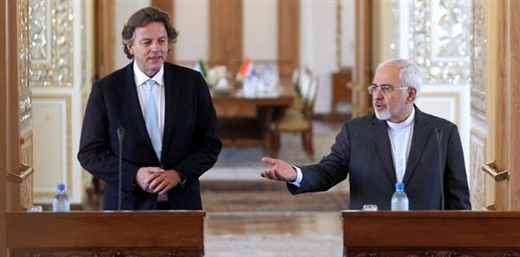
“What the American officials have done in recent months, particularly after [the finalization of] JCPOA [the Joint Comprehensive Plan of Action], to satisfy critics inside the US has unfortunately failed to help restore the trust,” Zarif said in a joint press conference with visiting Dutch Foreign Minister Bert Koenders in Tehran Sunday.

Zarif expressed hope that the US will live up to its obligations in the implementation of the nuclear agreement with Iran to help resolve the mistrust.

[…]
Iran-Netherlands ties

Zarif said Iran and the Netherlands are determined to improve relations in all fields.

He added that relations between the two countries date back to several centuries ago but due to the conditions the level of ties has downgraded over the past few years.

“There have been extensive political and economic relations between Iran and the Netherlands,” Zarif said, adding, “Today, we have the opportunity to overcome the obstacles [that existed] in the past and achieve a favorable level in relations [between the two nations].”

The Iranian top diplomat said that in addition to oil, gas and energy sectors, Tehran and Amsterdam can cooperate in the fields of water management, agriculture and other areas in which the Netherlands has made considerable progress.

He also expressed Iran’s readiness to interact with its partners in the European Union in various political, economic and cultural fields.

“The expansion of economic relations will provide an appropriate ground for Iran’s cooperation with the Netherlands and other countries in the European Union,” Foreign Minister Zarif said.

The Dutch foreign minister, for his part, said that the “historic” nuclear agreement on July 14 was a victory for multilateral diplomacy and the policy of engagement.

Koenders said Iran and the Netherlands have deep-rooted relations, adding that the Dutch government is eager to work with Iran in oil and gas sectors.

The Dutch top diplomat arrived in Tehran Sunday at the invitation of his Iranian counterpart. He is set to hold talks with President Rouhani and other senior Iranian officials.

Larijani: Islamic world sound asleep in face of Palestine developments

Ali Larijani

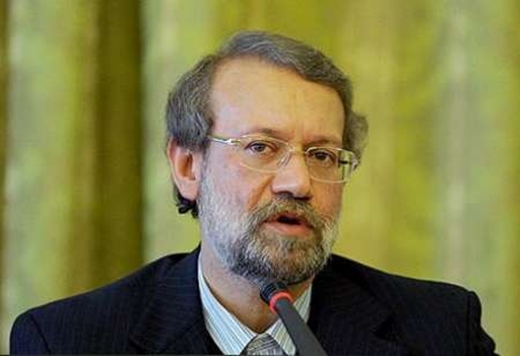
Parliament Speaker Ali Larijani said the Islamic world is sound asleep in the face of what is going on in Palestine.

He said in parliament on Sunday that the Islamic world is feigning sleep as far as the Palestinian developments are concerned, giving the Zionist regime the chance to misuse the situation as best as it could.

He touched upon the “very horrendous and insulting” incidents in the Al-Aqsa Mosque in the occupied Palestine over the past few days and said that the Zionist regime is misusing this to insult the first Qibla of Muslims.

The speaker condemned the Zionist regime’s heinous act and called on all international bodies including the Organization of the Islamic Cooperation to play an active role in this regard.

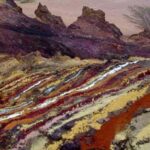
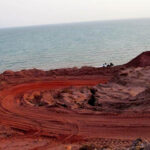
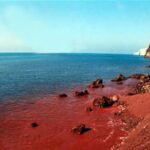
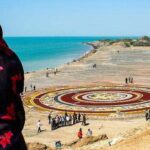
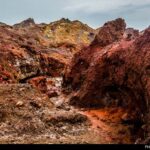
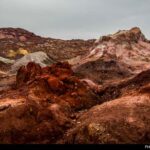
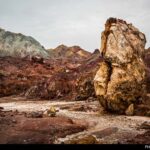
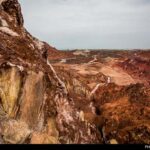
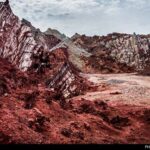
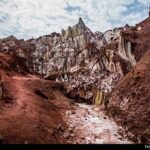
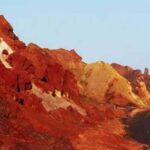
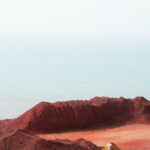
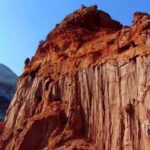
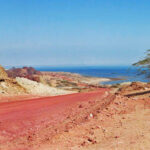
World’s best red soil on Hormuz Island (PHOTOS)

red soil00

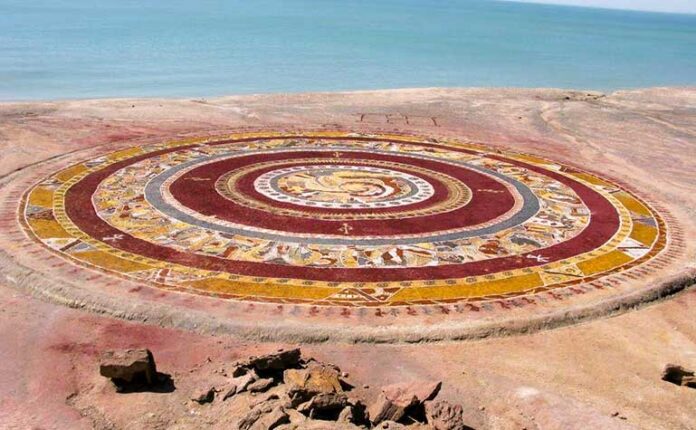
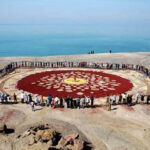
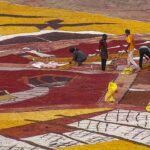
Hormuz, an Iranian island in the Strait of Hormuz, is a secluded spot loved by environmentalists and those who long for peace and quiet.

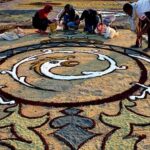
The oval island, known as the key to the Persian Gulf because of its geographical position, has gained popularity with artists too.

Its beaches which are covered with colorful soil are the canvas of artists.

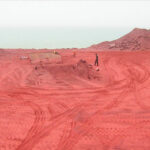
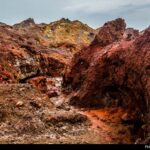
Among green, brown, white, ochre, red and black mountains, the island’s Red Mountains are distinctive. Locals use its soil for baking special bread and add it to pickles as spice.

The following images have been published by the Iranian Students’ News Agency:

A world-wide-web fight against a terror group on the ground

Ghostsec

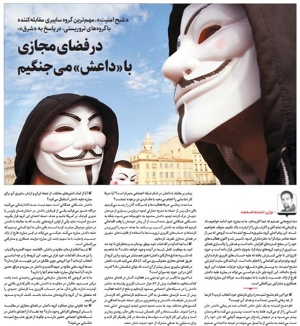
We are the ghosts that you created. We continue our fight. We will not rest until we eliminate them [the terrorist groups] and their manifestations from the net. This is the main message of Ghost Security, a cyber-group which was founded after Charlie Hebdo’s offices [a French satirical weekly magazine] were attacked by fundamentalist elements and has now expanded its activities to other areas. The [hacking] group, which targets ISIL affiliated accounts, says its mission is to remove extremist groups, ISIL in particular, from cyberspace and stymie their recruitment and limit their ability to organize international terrorist efforts.

sharq-ghostsecThe group of hacktivists has extended its activities and taken measures against accounts of Boko Haram [an extremist group based in northeastern Nigeria] supporters. The online group has answered questions asked by Sharq daily’s Nozhan Etezad Saltaneh.

Ghost Security says everybody – regardless of their race, gender or nationality – can join the anti-terror group in its fight against ISIL, arguing that the anti-ISIL fight needs international cooperation and partnership. The following is the translation of part of the interview Sharq daily published on September 15:

[…]
Q: Does a foreign (Western or Arab) government support you? Who supports you? Where is the source of the finances your website receives?

A: Currently, no government supports our measures against ISIL. The success of our operations is credited to the financial support we get from our backers.

[…]
Q: There were reports that you hand over intelligence on ISIL members to foreign intelligence services. Do you confirm such reports? What intelligence services do you cooperate with? Doesn’t it affect your independence?

A: When we trace a terror plot against governments and nations, we analyze the intelligence on that plot. If it poses an imminent threat, we contact the officials of the countries which might be exposed to that threat and let them in on it. They can take necessary measures to foil the plot or capture suspected individuals or groups.

We are primarily an intelligence and cyber-attack source which monitors the activities of ISIL operatives and their relatives. We cannot foil ISIL attacks without contacting government intelligence agencies. To stop that group’s plans, we direly need to tap into the legitimate use of force which is only available to governments. We can simply intercept [their plots].

[…]
Q: Do you welcome assistance by different countries, including Iran and its Cyber Army, to take on ISIL?

A: ISIL is a global problem. Wherever you live does not matter because you can still be a victim of ISIL attacks; in a Paris street or a small town in the US, you can be targeted by members of this group.

Ghost Security is perhaps one of the first groups to embark on countering ISIL in the digital world, but we are not the only people who are fighting against ISIL. Irrespective of race, gender and nationality, everybody can join the fight [against ISIL]. This fight takes international partnership [to prove effective].

Q: You have said that in addition to ISIL, you will target Al-Qaeda, the al-Nusra Front [a militant group in Syria] and Al-Shabaab [an al-Qaeda affiliate in Somalia]. What have you based your picks on? How come a group like the Taliban is not on your list? There are hundreds of Salafi groups – in addition to al-Nusra Front and ISIL – in Syria and Iraq. Can you take on all of them?

A: We are engaged in [a fight against] any group which has been registered as a terrorist organization. Compared with ISIL, the Taliban hold little sway on the Internet. We discover and block any new website or account which belongs to ISIL or similar groups.

Q: How does the online performance of ISIL differ from that of other extremist groups? How many ISIL members are active on social networking sites? How are they intercepted by Ghost Security?

A: ISIL fares better than any other terrorist groups in organizing and managing its presence on social networking sites and websites. It has managed to relay its message in the cyber world and recruit new members. That’s why we have focused our attention on this group’s activities. Nonetheless, if we discover a website or account with links to other terrorist groups, we will take action against them as well.

[…]

Q: Are you going to take on non-Islamic or non-religious fundamental groups made up of Christian, Buddhist or Neo-Nazi extremists?

A: Currently it is not on our agenda, but perhaps in the future.

Q: What are Ghost Security’s future plans?

A: We aim to continue the fight against ISIL and other terrorist groups until we can completely foil their online activities and cause them to lose their effectiveness on the web. We fight against ISIL in the virtual world so that human lives can be saved and protected in the real world and on the ground. We will go ahead with our fight and we will not rest until we eliminate the terror group and its manifestations on the Internet. We are the ghosts they have created.

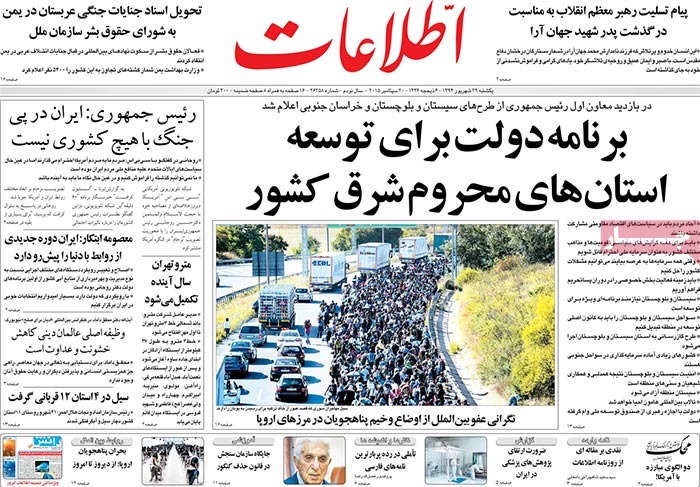
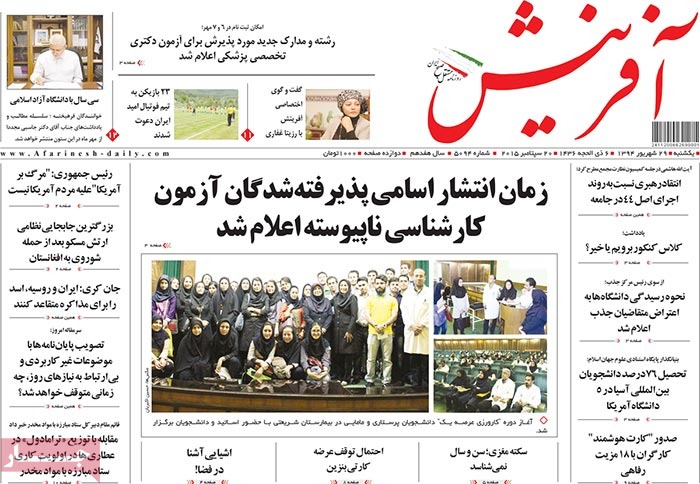
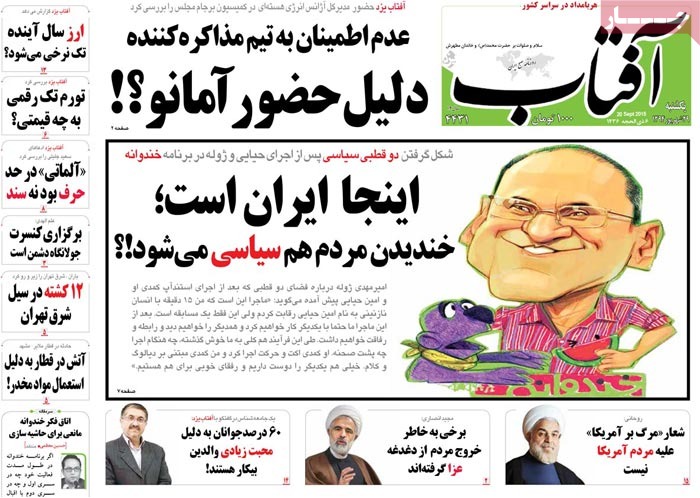
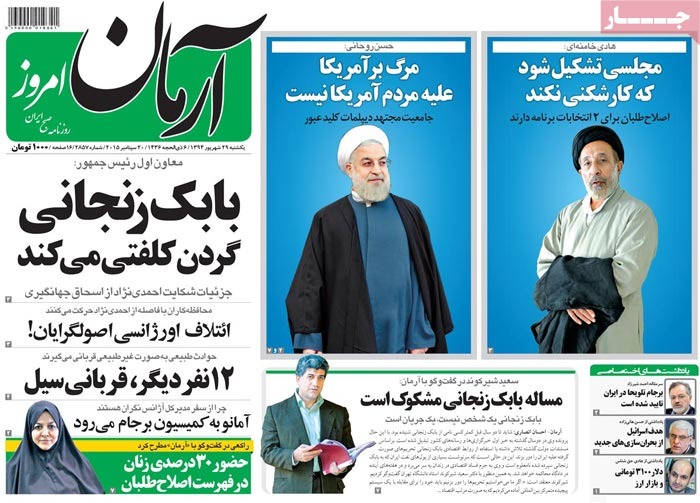
A look at Iranian newspaper front pages on September 20

Iranian Newspapers Headlines

The comments of President Rouhani on relations between Iran and the United States and those of his deputy on development and corruption dominated the front pages of Iranian newspapers on Sunday.


Ettela’at: First Vice-President Eshagh Jahangiri has announced government’s development plans for impoverished provinces in the east.

He urged the public to contribute to the implementation of policies on the resistance-based economy.


Afarinesh: “‘Down with the US’ is not aimed at the American people,” President Rouhani said.


A look at Iranian newspaper front pages on September 20


Aftab-e Yazd: “Some are struck by grief over the fact that people are no longer concerned [about pocketbook issues],” said Vice-President for Parliamentary Affairs Majid Ansari.


A look at Iranian newspaper front pages on September 20


Arman-e Emrooz: “Women seek to have a 30 percent presence on the reformist ticket,” said Fatemeh Rakei, a former MP.


A look at Iranian newspaper front pages on September 20


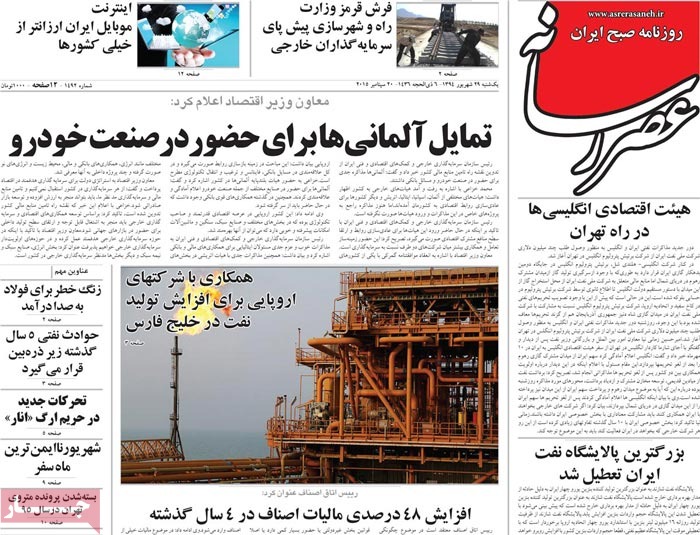
Asr-e Rasaneh: The deputy economy minister has said that Germans are willing to have a presence in Iran’s automotive industry.

Asr-e Rasaneh: A British trade delegation is to visit Iran.


A look at Iranian newspaper front pages on September 20


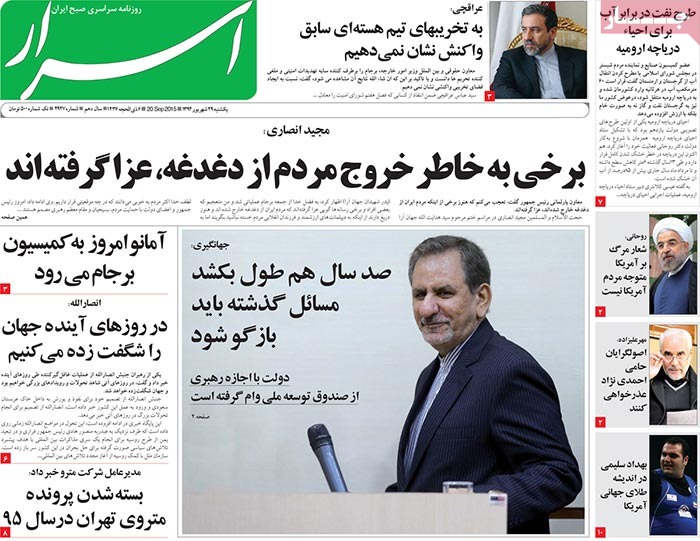
Asrar: “We won’t react to the mudslinging of the previous nuclear team,” said nuclear negotiator Abbas Araghchi.

Asrar: “The issues of the past should be raised even 100 years after the fact,” said First Vice-President Eshagh Jahangiri [in reaction to those who argue that government should let go of corruption cases of the past].

He further said that government has taken out a loan from the National Development Fund after securing the go-ahead of the Leader.


A look at Iranian newspaper front pages on September 20


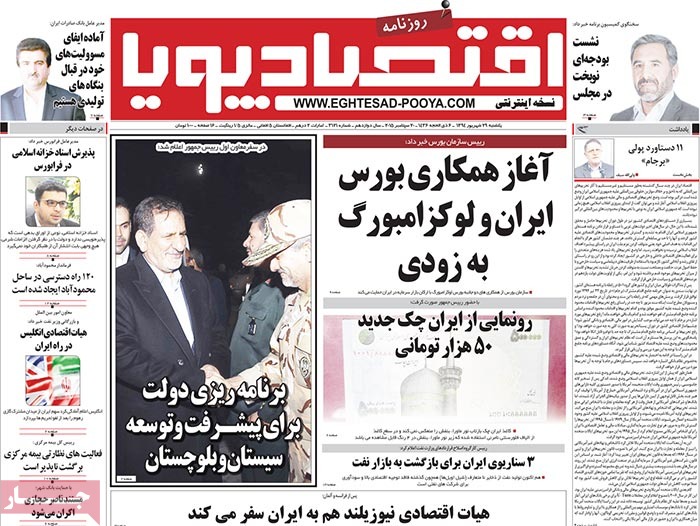
Eghtesad-e Pooya: Iran and Luxemburg stock markets will soon launch cooperation.

Eghtesad-e Pooya: A New Zealand economic delegation will travel to Iran.


A look at Iranian newspaper front pages on September 20


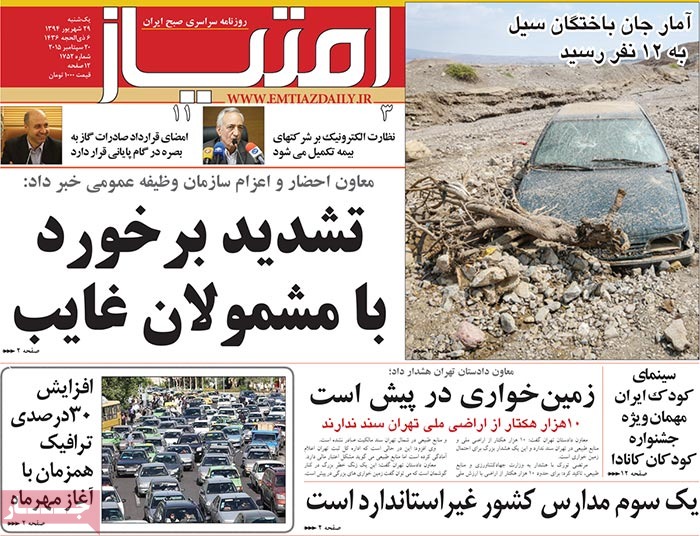
Emtiaz: The deal to export natural gas to Basra, Iraq is in its final stages.


A look at Iranian newspaper front pages on September 20


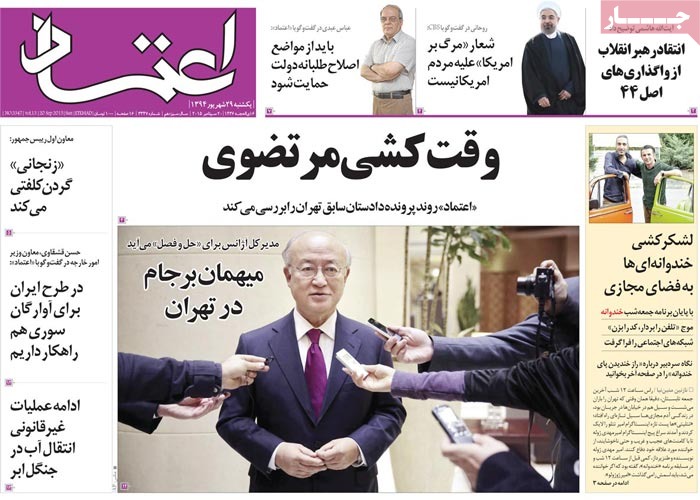
Etemad: Saeed Mortazavi is dragging his feet

Etemad takes a closer look at the case involving former Tehran prosecutor.


A look at Iranian newspaper front pages on September 20


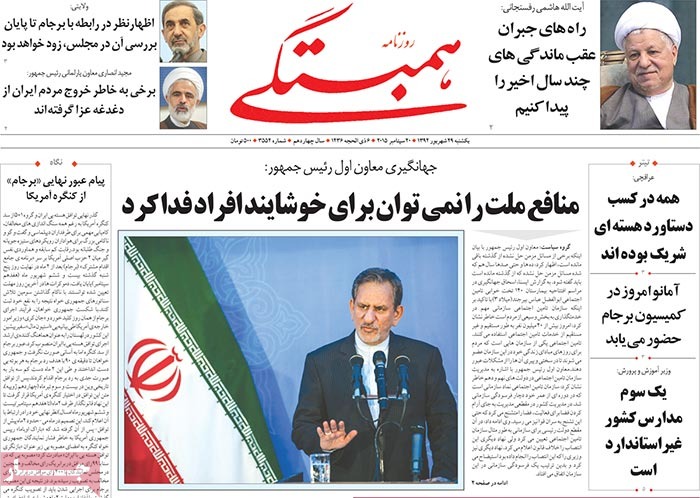
Hambastegi: The education minister has said that one third of the country’s schools are sub-standard.

Hambastegi: “The interests of the nation cannot be sacrificed simply to appease certain individuals,” said the first vice-president.


A look at Iranian newspaper front pages on September 20


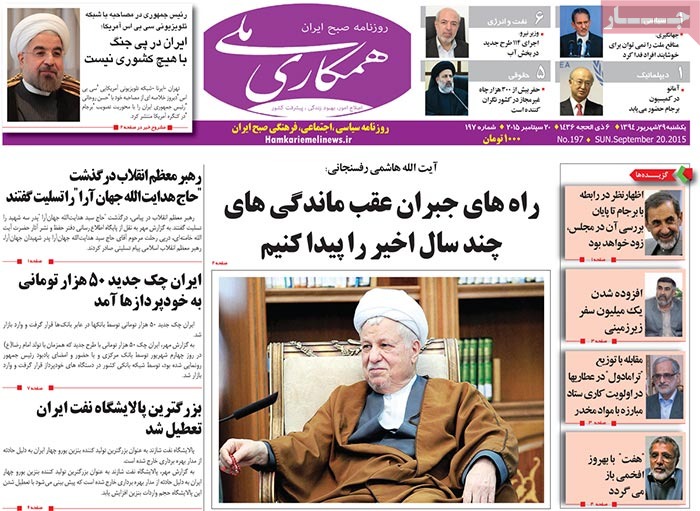
Hamkari Melli: “Ways of making up for the shortcomings of the past should be found,” said the chairman of the Expediency Council.


A look at Iranian newspaper front pages on September 20


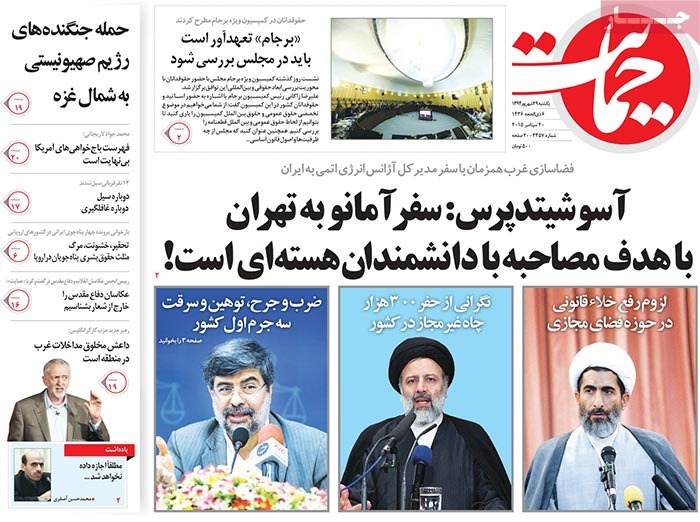
Hemayat: In light of the fact that the nuclear deal is binding it should be reviewed in parliament, jurists have told the JCPOA Review Committee.


A look at Iranian newspaper front pages on September 20


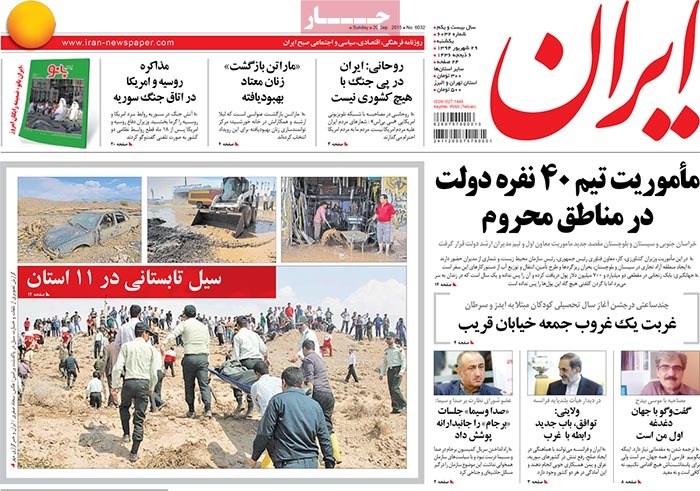
Iran: Ali Akbar Velayati, an advisor to the Supreme Leader, has told a French delegation that the nuclear deal opens the way for new ties with the West.


A look at Iranian newspaper front pages on September 20


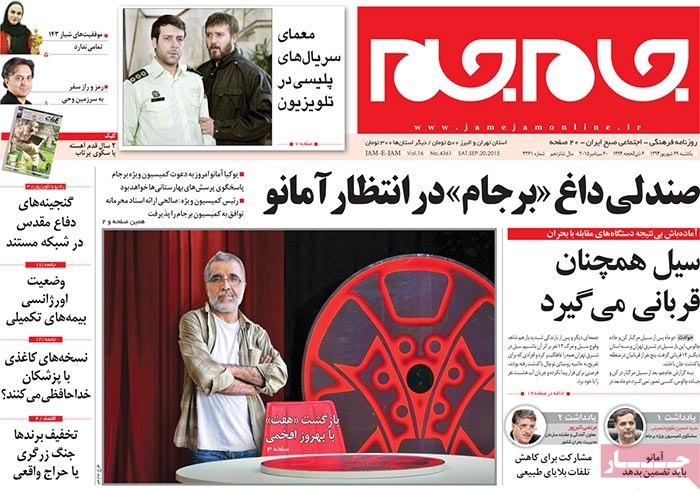
Jamejam: The hot seat of the Joint Comprehensive Plan of Action waiting for IAEA director.


A look at Iranian newspaper front pages on September 20


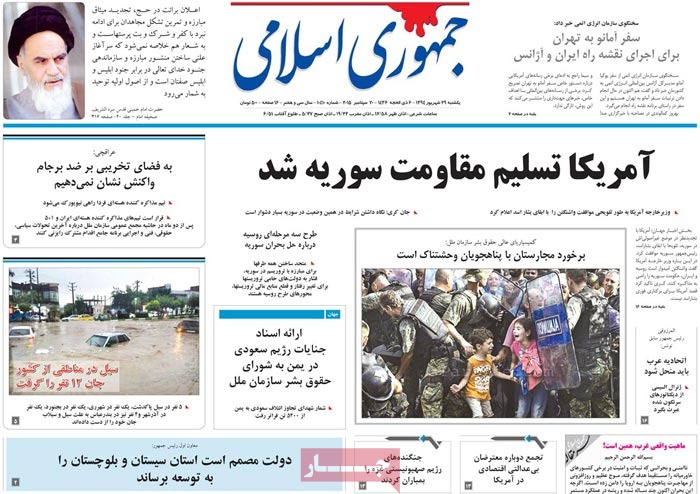
Jomhouri Islami: The US gave in to Syrian resistance.

The US Secretary of State has implicitly signaled Washington’s approval of Assad’s reinstatement.


A look at Iranian newspaper front pages on September 20


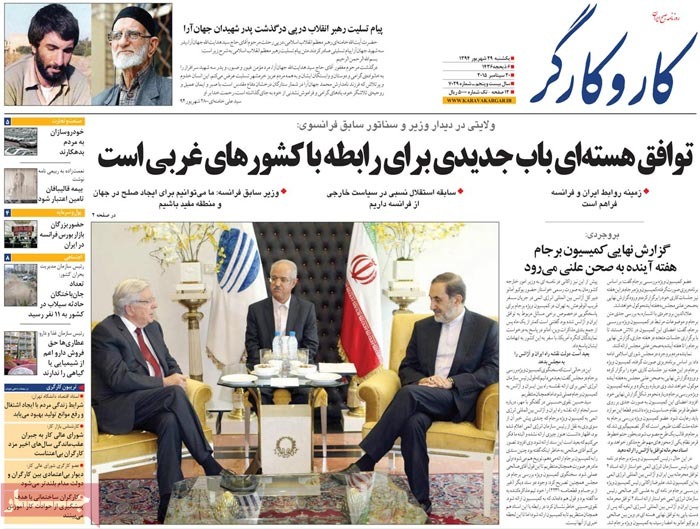
Kar va Kargar: “The final report of the JCPOA Review Committee will be read on parliament floor next week,” said the chairman of the chamber’s National Security and Foreign Policy Committee.


A look at Iranian newspaper front pages on September 20


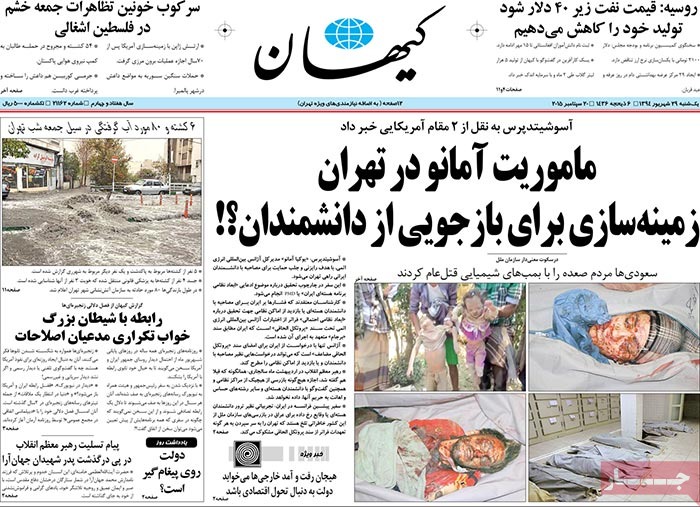
Kayhan: Reestablishment of ties with the Great Satan is the repeat dream of the so-called reformists.

Kayhan: The Saudis have dropped chemical bombs on Saada, Yemen.


A look at Iranian newspaper front pages on September 20


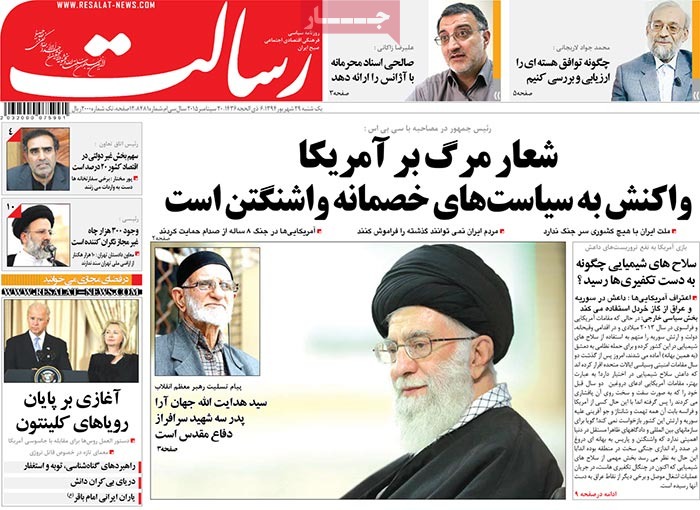
Resalat: “The share of the private sector of Iran’s economy is 20 percent,” said the chairman of the Cooperatives Chamber.


A look at Iranian newspaper front pages on September 20


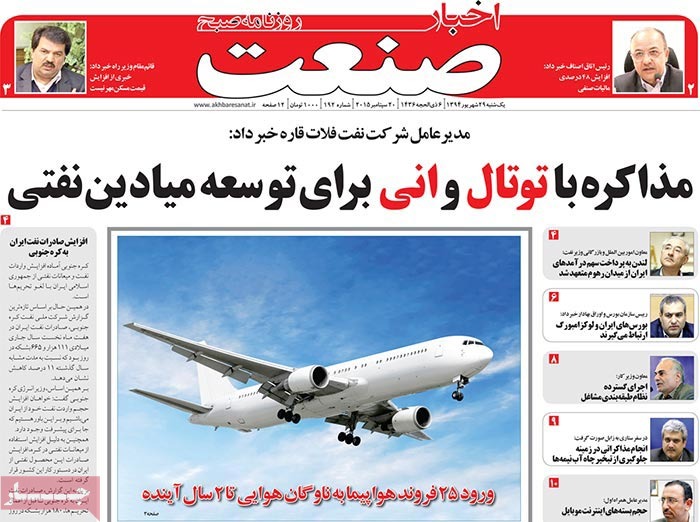
Sanat: Talks are underway with Total and Eni on development of Iran’s oil fields.


A look at Iranian newspaper front pages on September 20


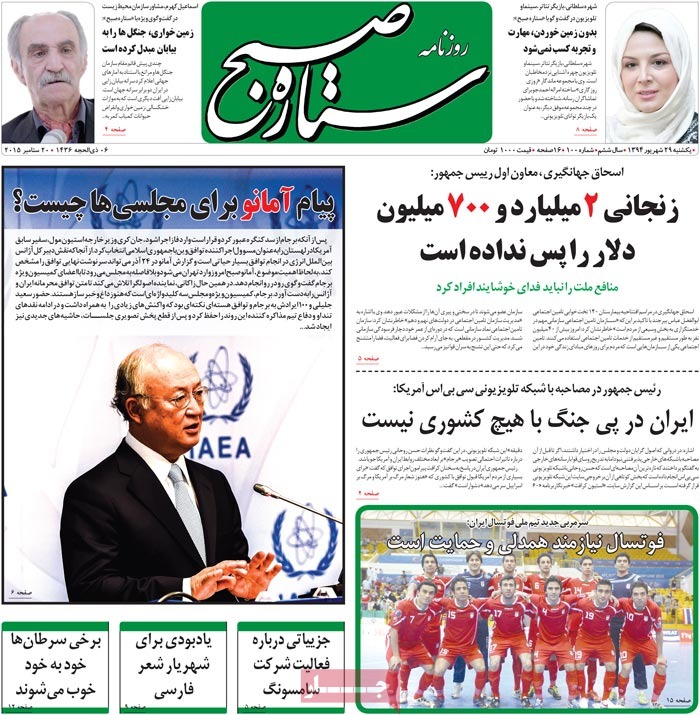
Setareh Sobh: “Zanjani has failed to return $2.7 billion,” said First Vice-President Eshagh Jahangiri.


A look at Iranian newspaper front pages on September 20