
Muslim Chinese students of Al Mustafa International University in Gorgan, Golestan province, celebrated the Chinese New Year on Sunday.
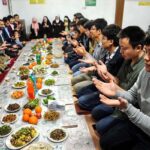
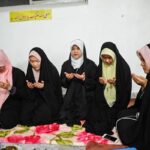
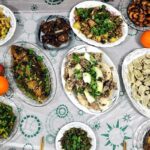
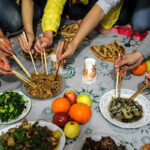
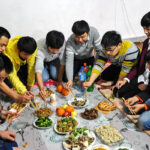
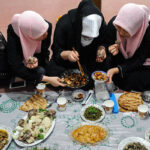

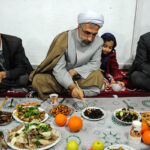
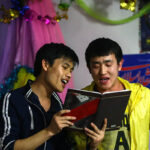
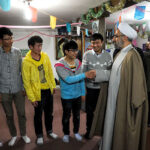
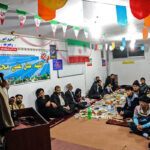
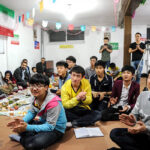
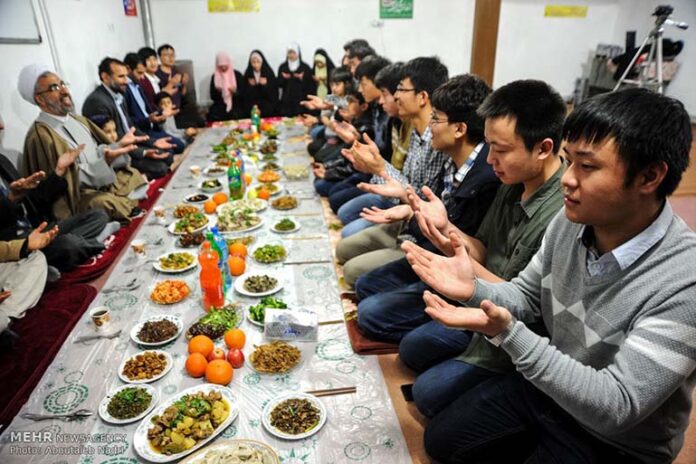
Muslim Chinese students of Al Mustafa International University in Gorgan, Golestan province, celebrated the Chinese New Year on Sunday.
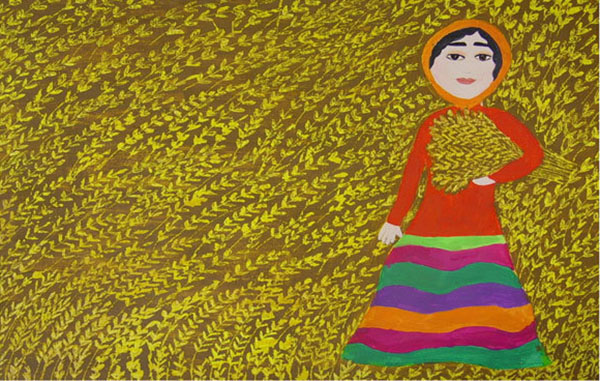
As reported by Mehr News Agency, Voices of the Earth was the subject of this competition, in which a third Iranian participant also received an honorary award.
Mahsa Kazemeini, an eleven-year-old girl from Shiraz, won award for best drawing, portraying a gentle breeze in a wheat farm where a local female farmer stands, wearing a colorful traditional dress, embracing a golden bushel of wheat.
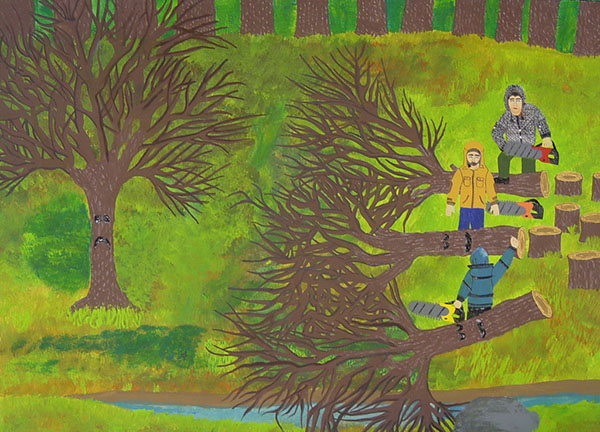
The second prize was received by Milad Sadeghi, a 15-year-old boy from Ardebil, for bringing a terrible scene of tree-cutting to the attention of the world. His drawing depicts the sorrowful face of a man sitting on a tree branch, bearing witness to the horror of this violent act.
Last year, a young Iranian girl from Kerman was among the top winners of this competition. This year, apart from the two winners mentioned above, the judges also awarded the 11-year-old Negin Sadeqian from Isfahan with an honorary diploma. She drew a farm beside a village at the foot of a mountain, where girls are playing happily wearing traditional dress, and birds are flying overhead. Unconsciously, the image of the village mosque reminds Muslims of the peaceful sound of Azan.
25 Iranian drawings from IIDCYA (Iranian Institute for the Intellectual Development of Children and Young Adults) were entered into this well-known competition in 2015. They competed with 18,299 drawings from 85 countries around the world. Apart from the awards for the winners, selected drawings will be given to all participants in the form of a postcard.
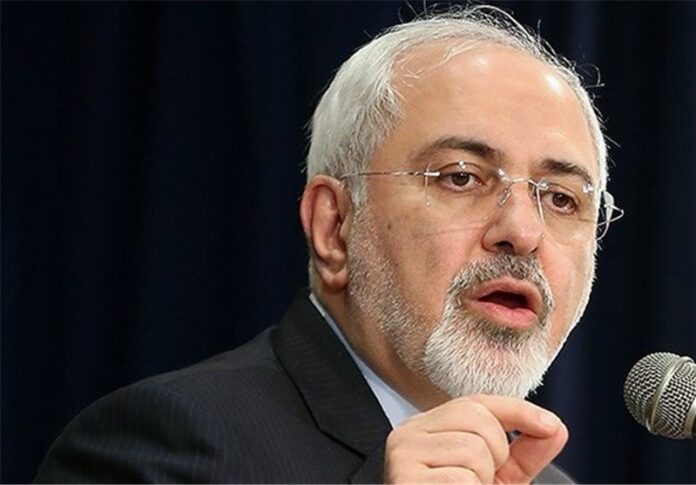
In an op-ed published in Italian daily La República as well as Spain’s El País, Zarif wrote that a proper momentum toward a just political solution in Syria has been generated and that European countries can play an effective role in strengthening this process.
Following is the full text of the Iranian foreign minister’s piece:
A New Chapter in Diplomacy
President Rouhani’s recent visit to Italy and France marked the historic beginning of a new season of economic, political, and cultural cooperation beneficial to both sides, after roughly a decade of being interrupted.
Italy and France, as two pillars and founders of the European Union as well as traditional bridges between the West and the Middle East, have often had constructive relationship with Iran, although at times this relationship has experienced ups and downs and even passing crises, still the desire of both sides to overcome the problems and fix the difficulties reflects their deep connections. Even though the unnecessary so-called nuclear “crisis” and the intrusion of certain third parties created some interruptions in the traditional relations between Iran and Europe, both the warm welcome for President Rouhani, the various and serious high ranking meetings that transpired during this trip, as well as the important agreements that were reached, represent the restoration of economic relations and cooperation in all energy, technology, political, cultural, and even security fields.
Also, President Rouhani’s meeting with Pope Francis, marked a mutual commitment to join efforts to create a World Against Violence and Extremism (WAVE). To recall, in September 2013, newly-elected President Rouhani made this initiative at the UN General Assembly as a key foreign policy agenda of Iran; the General Assembly adopted this initiative by consensus and thus sparked the hope for creating a prudent global campaign to fight the menace of terrorism and extremism.
On a broader level, from ancient times Europe and Iran have been each other’s civilizational neighbors. With the start of the implementation of the nuclear agreement, which has put an end to unnecessary decade-old tensions, it is now time to focus on more important matters, above all a common search on how to achieve the mechanisms for Iran and other influential countries to expand their cooperation based on shared interests and the need to confront the common threats.
Indeed, Europe and Iran have common interests in several areas. In light of their historical and traditional bilateral relations as well as other positive sources, such as the existence of complementary economies, mutually-beneficial cooperation in the fields of energy and technology, cultures of Indo-European languages, and other long-standing cultural connections, their sustained cooperation with each other is guaranteed. In addition, through both collective and bilateral mechanisms, it is possible to actively pursue the struggle against the important threats such as terrorism, violence, extremism, drug trafficking, and the like.
The missing link alongside economic and technological cooperation, which should generate sufficient attention, is the necessity for the two sides to increase cooperation in the fight against violence and extremism and to quickly restore peace and stability in the Middle East; the lack of sufficient attention to this is a threat to both Iran and Europe.
Iran, as a country located in the heart of the Middle East and Europe as an immediate neighbor of the region, share legitimate concerns about the continuation of hostilities and bloodshed in the region, especially the crisis of displaced persons in three countries — Syria, Iraq, and Yemen.
Iran for quite some time has proposed and updated two four-point proposals to solve the current crises in Syria and Yemen, a large part of which have been incorporated in Security Council resolution 2254. The common points of these plans include an immediate cease-fire, humanitarian assistance to the non-combatants, facilitating dialogue among the groups from inside of the country and guiding them to form inclusive government of national unity – that would have the potential to restore peace and stability to the region.
After the Vienna 1 and 2 and the New York talks on Syria, and the adoption of UN Security Council Resolution 2254, a proper momentum toward a just political solution in Syria has been generated and the European countries can play an effective role in this connection to strengthen and sustain this process.
Also, confronting the roots and manifestations of structural violence and the effects of extremism, including the fight against poverty and economic inequality, promoting the mechanisms for democracy, avoiding the violent and sectarian conflicts, and opposing unilateral military actions, these are important foreign priorities that can help restore the stability of the Middle East and the European Union can definitely play a positive role in this framework.
Security can never be achieved in expense of insecurity for the others. No nation can truly pursue its interests without taking into consideration the interests of others. No one can combat Al-Qaeda and its ideological siblings, such as the so-called Islamic State, which is neither a state nor Islamic, in Iraq while effectively assisting their expansion in Yemen or Syria. In this regard, European countries by encouraging other countries in the Middle East to accept a political solution for this crisis play a positive role in the region.
A final word: the world community that includes Iran and Europe cannot afford to avoid addressing the root causes of instability in the Middle East any longer. At the same time, this presents a unique opportunity for interaction and cooperation that should not be missed. Peace and stability is the fundamental need of civilization in the Middle East, Europe, and indeed the world. In today’s interconnected world marked with growing mutual interdependence, this is not a choice, rather it is an inescapable necessity.

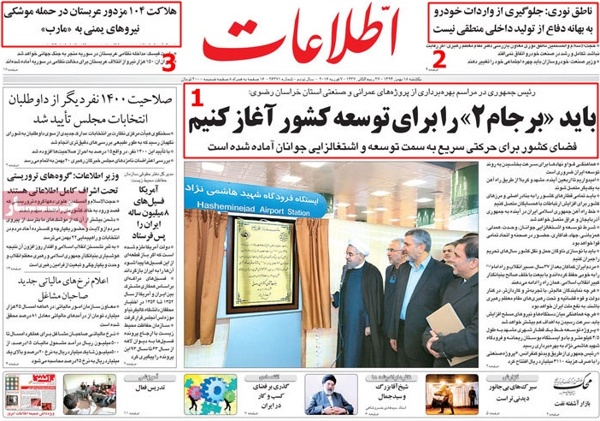
Ettela’at:
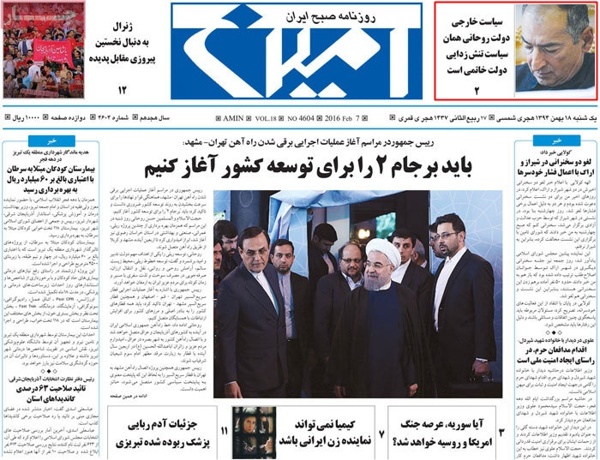
1- President urges initiation of JCPOA 2 for Iran development
2- Leader advisor describes restriction of car imports as illogical to save domestic production
3- 104 Saudi mercenaries killed by Yemenis rocket attacks
Units of the Yemeni army and Popular Committees fired Tochka-type ballistic missile at an assembly point of the Saudi-led coalition forces at Mass military camp in Marib.
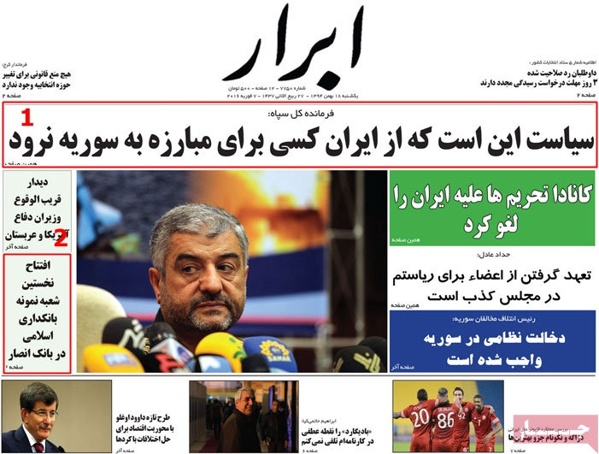
Abrar:
1- IRGC Chief says Iran has no policy of sending troops to Syria
2- Bank Ansar opens first top Islamic banking branch
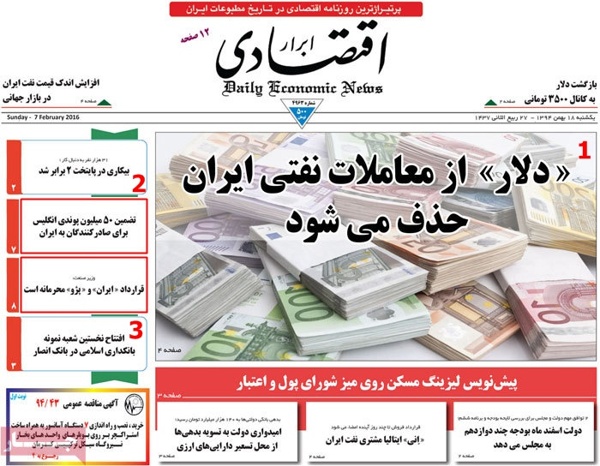
Abrar-e Eqtesadi:
1- Iran to dump dollar in trade
2- €50m guarantee for exporters of goods to Iran
3- Iran, Peugeot deal confidential: Minister of Industry
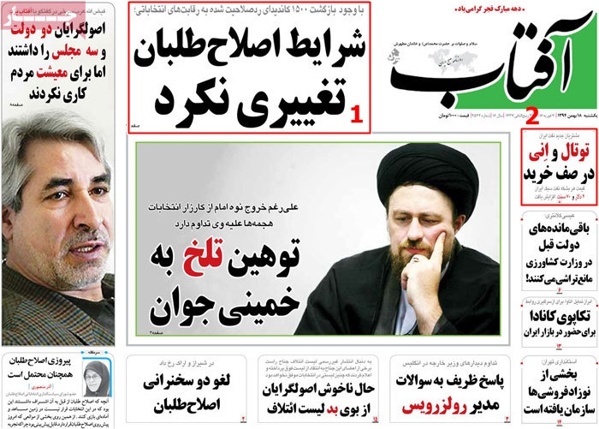
Aftab-e Yazd:
1- Nothing has changed for reformists despite 1,500 more candidates are qualified for elections
2- Total, Eni line up to buy crude oil from Iran
Amin:
– Rouhani foreign policy much the same as Khatami’s policy of détente: analyst
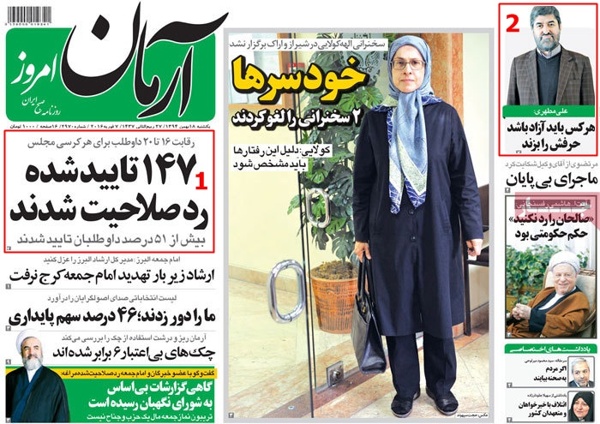
Arman-e Emrouz:
1- MP: Everyone must be free to speak
2- Over 51% of hopefuls qualified
Only 147 parliament hopefuls have been disqualified by the vetting body.
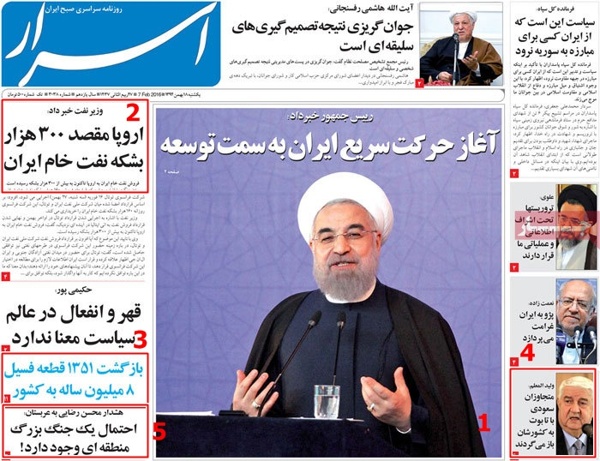
Asrar:
1- Rouhani: Iran starts rapid move toward development
2- 300kb/d of oil destined to Europe: Petroleum Minister
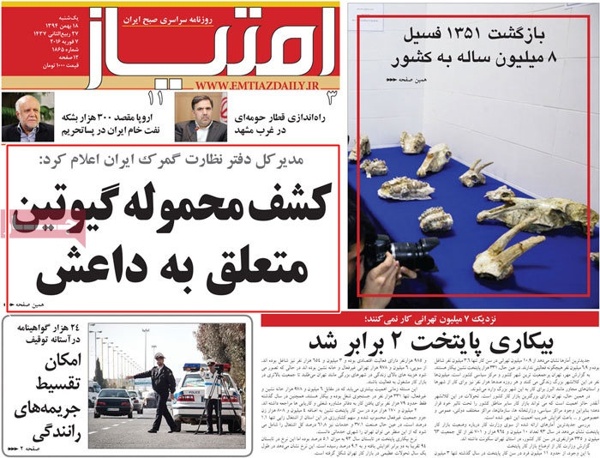
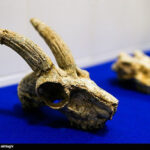
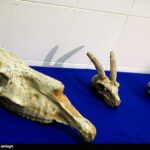
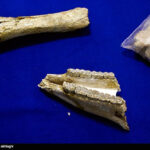
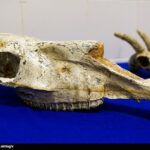
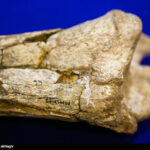
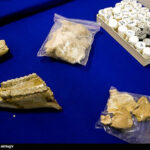
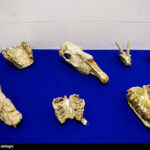
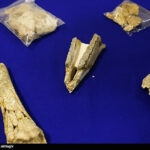
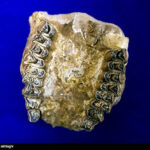
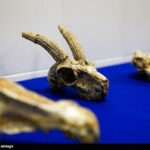
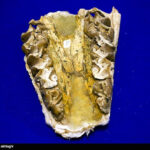
3- Iran brings 1,351 fossils belonging to 8 million years ago from US
4- Syria FM: Foreign troops entering Syria would return ‘in coffins’
5- Official warns Saudis against major regional war
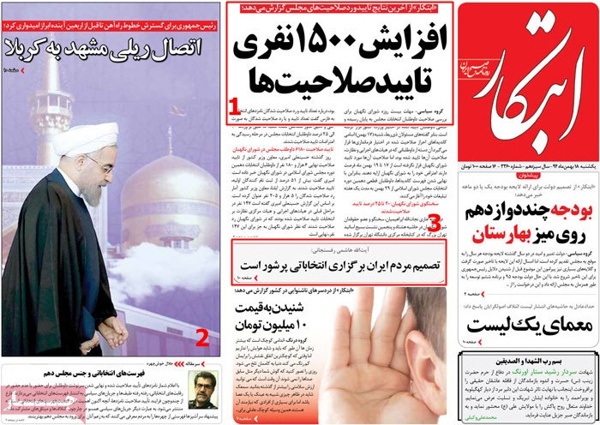
Ebetekar:
1- 1500 candidates added to qualified hopefuls
2- Mashad-Karabala railroad link
Iran’s President Hassan Rouhani said the country is working on a railroad to connect country’s railway network to Iraqi railway at southern Iraqi city of Basra, hoping that citizens living in the northeastern city of Mashhad would be able to make a pilgrimage to Iraq’s holy city of Karbala by train next year.
3- Ayatollah Hashemi Rafsanjani: Nation decides to hold vibrant election
Emtiaz:
– Iranian Customs Department seizes ISIS guillotine cargo
Hemayat:
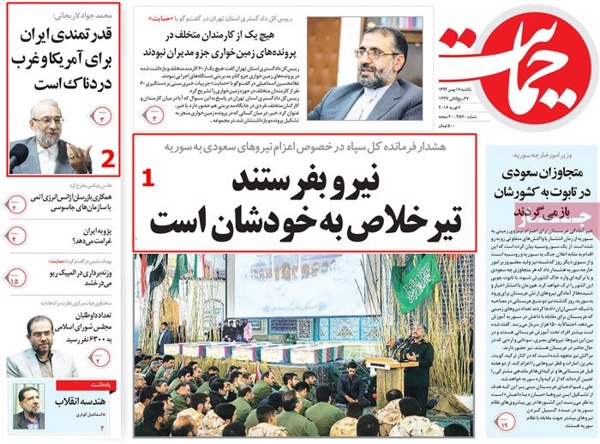
1- IRGC Chief to Riyadh: Sending troops to Syria is death blow to Saudi regime
2- Mohammad Javad Larijani: Powerful Iran, painful to US, West
Iran:
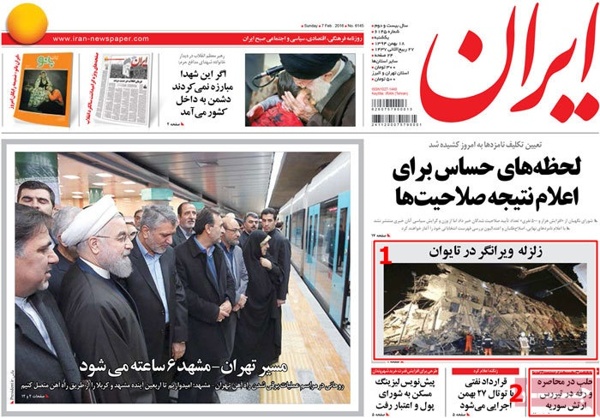
1- Devastating earthquake shakes Thailand
2- Siege of Aleppo; Raqqa by the Syrian Army
Jame Jam:
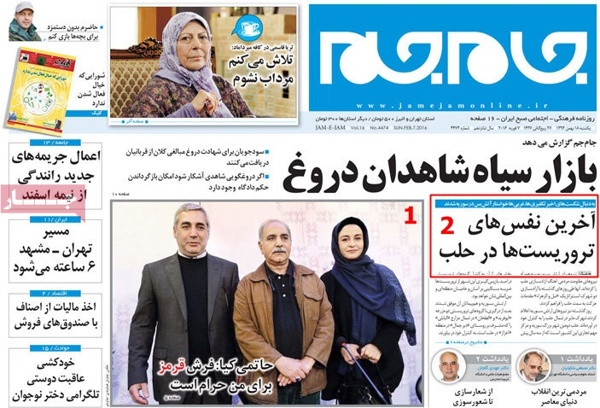
1- For me, red carpet is [religiously] forbidden: Hatamikia at Fajr Film Festival
Ebrahim Hatamikia is a celebrated director in Iranian cinema.
2- Terrorists have their last breath in Aleppo
Javan:
– All political parties enjoy full-member lists as 1,500 newly qualified hopefuls added to candidates’ list
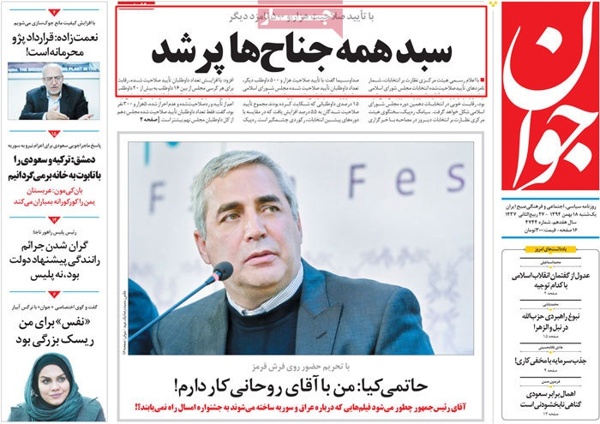
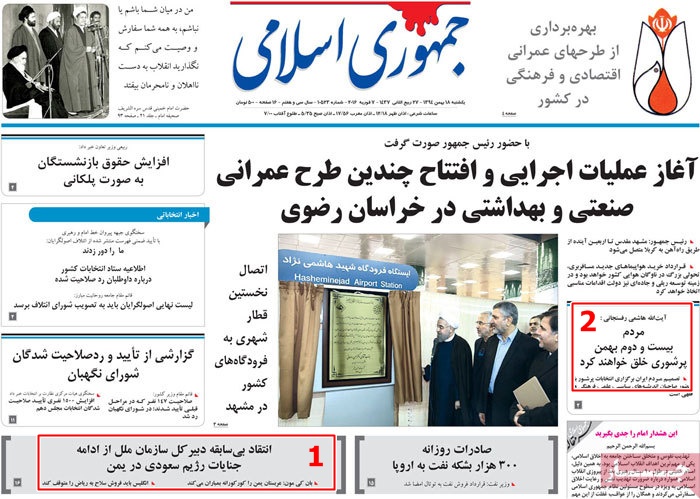
Jomhouri Islami:
1- UN Chief hits Saudi crimes in Yemen
2- Rafsanjani: Nation poised to stage glorious Bahman 22 rallies
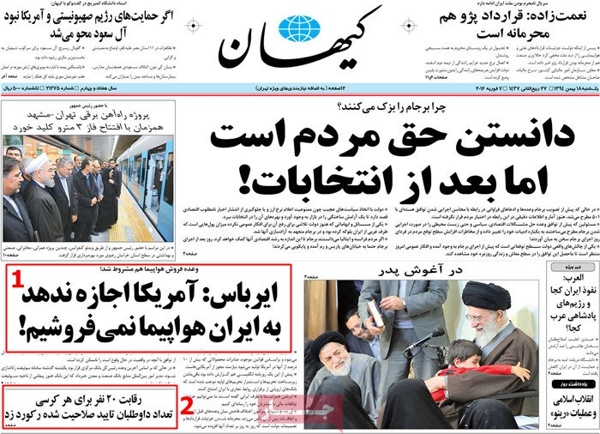
Kayhan:
1- Airbus says will stop delivery of planes to Iran if US says so
2- 20 contenders for every parliament seat; number of qualified hopefuls breaks record
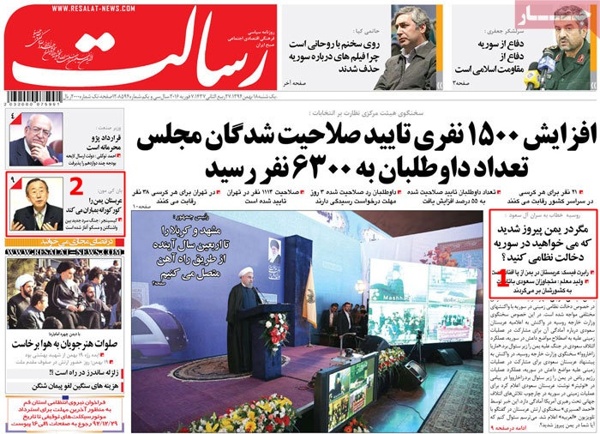
Resalat:
1- Russia to Saudi Regime: Have you won anything in Yemen to start invading Syria?
2- Ban Ki-Moon: Saudis strike Yemen indiscriminately
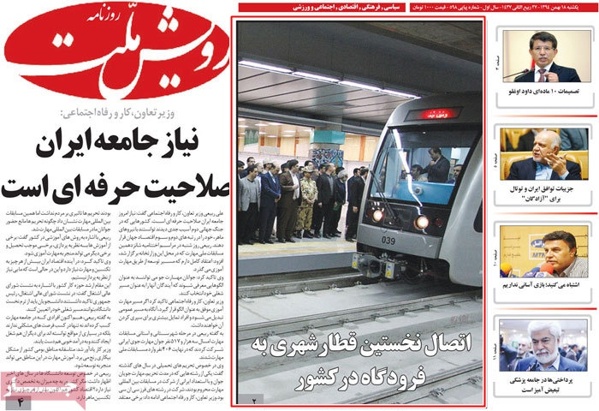
Rooyesh Mellat:
– Iran links first electric train to airport
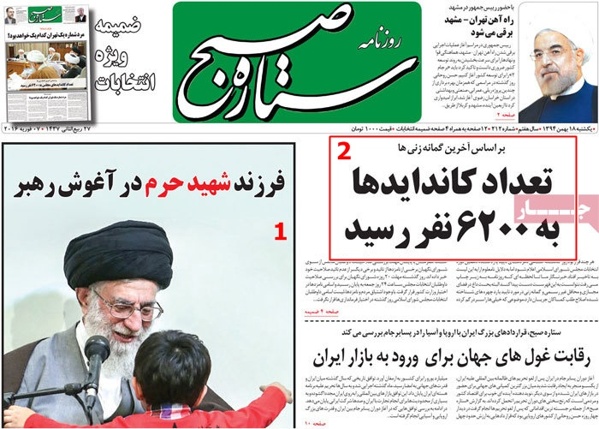
Setareh Sobh:
1- Leader hugs son of martyred defender of Haram (holy shrine)
2- 6,200: Number of candidates
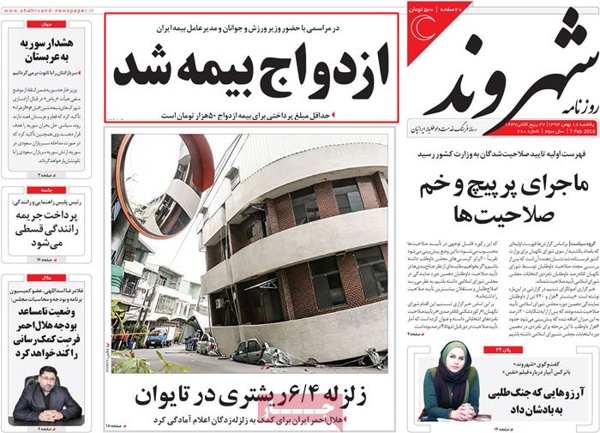
Shahrvand:
– Insurance for marriage
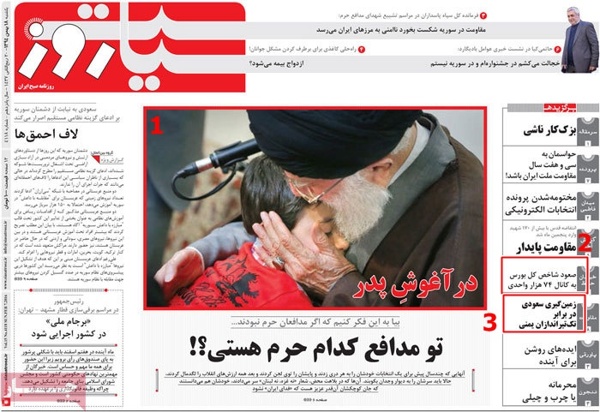
Siasat-e Rooz:
1- Embraced by “Father”
2- Stock exchange index rises
3-Yemeni snipers cripple Saudi forces
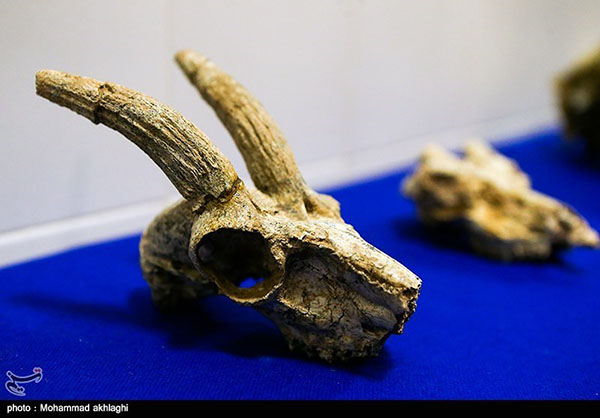
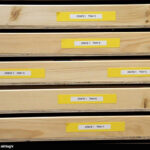
A ceremony was held to unveil 1,351 ancient fossils which were taken
to the US 40 years ago for research studies.
Speaking in the third National Conference on Probiotic and Functional Foods, Maryam Taj Abadi said that industrial food is one the most important causes of non-communicable diseases.
She expressed hope for probiotics to become internationally standardized in the near future.
The third National Conference on Probiotic and Functional Foods is underway in Shahid Beheshti University.
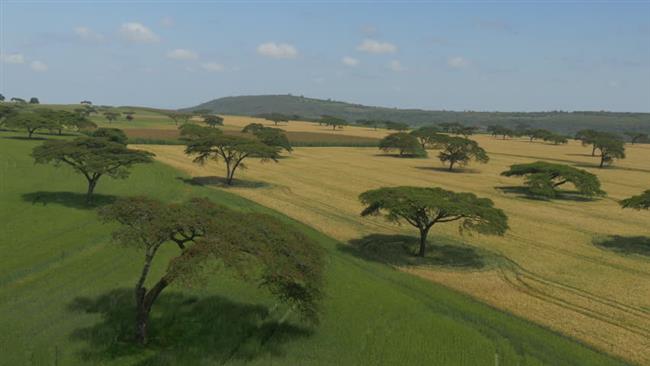
More than 10 Iranian companies have expressed interest in growing and processing rice, corn and wheat in East Africa, Iranian Ambassador to Kenya Hadi Farajvand has said.
He said Iran is supporting mechanized agriculture beyond its borders, with companies leasing huge chunks of land and applying modern agricultural methods to grow food for export to Iran.
The companies are willing to establish manufacturing plants in the region to cater to the local market and to export to Iran, Farajvand said.
The move is also aimed at narrowing trade deficit with the Horn Africa countries, which is in Iran’s favor, he added.
The East African Community (EAC) mainly exports unprocessed agricultural products like tea, coffee and meat to Iran. It imports oil products, machinery and telecommunication equipment from the Middle Eastern country.
Local trade experts said the region should strive to export more processed goods to Iran, beginning this year.
“The lifting of sanctions on Iran will pave the way for EAC member states to forge closer ties with Iran, but we need to export value-added products if we are to tilt the balance of trade in our favor,” Peter Kiguta, director-general of Customs and Trade at the EAC, told the Geeska Afrika news agency.
The East African Tea Trade Association (EATTA) expects exports to Iran to grow five-fold in one year with the opening of the market, it said.
Farajvand said the biggest challenge in fostering stronger trade ties between Iran and the EAC countries is the lack of political will in the region and limited information on the available opportunities in Iran.
He said many products from Iran are imported into the region through other countries, making the final product expensive. These imports include oil products, bitumen, ceramics and electricity equipment.
Iran’s Agriculture Minister Mahmoud Hojjati has said the government had envisioned investment on 500,000 hectares of farmland in a number of countries to produce food.
Last August, Agriculture Ministry’s Mohammad Reza Shafeinia said Iran had launched agricultural cultivation in Kazakhstan, marking its first farmland investment overseas.
Water-intensive rice and corn crops as well as oilseeds and livestock inputs have been cited by Agriculture Ministry officials as the target products which Iran seeks to grow on farmlands overseas.
Iran is pushing for development of 60,000 hectares of land to cultivate agricultural products in Brazil, Hojjati has said.
Food prices are a key driver of Iran’s double-digit inflation which shot over 40% under former president Mahmoud Ahmadinejad.
Food security is a serious matter for Iran, given the size of its population which has grown over 80 million and seen its food basket grow smaller.
“Between 38-40% of the Iranian families’ economy is related to food which requires us to build a base for reducing prices of nutritional products and providing for facile access to them,” Shafeinia said.
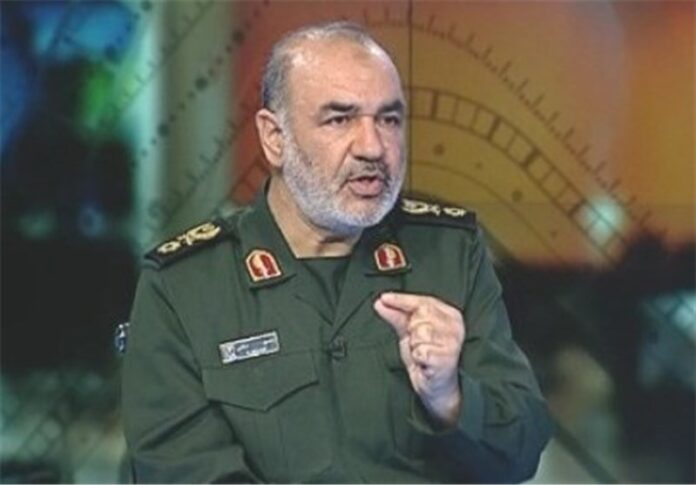
Speaking at a television talk show on Saturday night, Lieutenant Commander of the Islamic Revolution Guards Corps (IRGC) Brigadier General Hossein Salami highlighted Saudi Arabia’s incapability to influence on the region’s developments militarily.
“Saudis might deploy forces to certain locations symbolically, but those forces will never make any determining function,” the general said.
He also touched on the Al Saud’s long experience of pursuing vicious policies, including financial supports for the Takfiri groups, provoking tensions in the region and causing chaos in the Muslim nations.
In separate comments earlier in the day, IRGC Commander Major General Mohammad Ali Jafari also shrugged off the Saudi regime’s threat to deploy forces to war-stricken Syria as empty bravado.
“I don’t think that they (Saudis) would dare do so… This is because their forces are in the form of a classic army and history has proven that they do not have the ability (to enter asymmetric war),” he said.
Syria has been gripped by civil war since March 2011 with Takfiri terrorists from various groups, including Daesh (ISIL), currently controlling parts of it.
According to the United Nations, more than 250,000 people have been killed and one million wounded during the conflict.
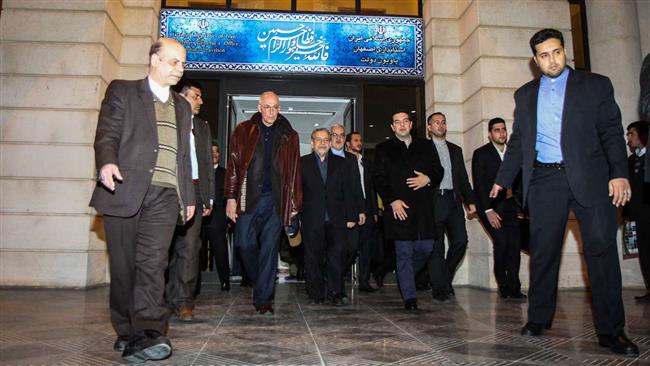
The Greek premier, heading a politico-economic delegation, was welcomed upon arrival by Isfahan’s Governor General Rassoul Zargarpour.
Greek Minister of Foreign Affairs Nikos Kotzias, Minister of Environment and Energy Panagiotis Skourletis, Minister of Economy, Development and Tourism Georgios Stathakis and Deputy Foreign Minister Dimitris Mardas as well as a 50-member team of industrialists and businessmen are accompanying the prime minister.
During their day-long stay in Isfahan, Tsipras and his accompanying delegation will visit historical and cultural monuments in the city.
They are scheduled to leave Isfahan for Tehran later on Sunday to hold talks with senior authorities on ways of improving mutual relations and the latest regional and international developments in light of the implementation of the nuclear agreement between Iran and the P5+1 group of countries.
Iran and Greece are set to sign agreements to boost cooperation in such sectors as trade, finance, tourism, cultural relations, housing and road construction, agriculture and pharmaceuticals.
Iran and the five permanent members of the UN Security Council – the United States, France, Britain, China and Russia – plus Germany started to implement their nuclear agreement, known as the Joint Comprehensive Plan of Action (JCPOA), on January 16.
After the JCPOA went into effect, all nuclear-related sanctions imposed on Iran by the European Union, the Security Council and the US were lifted. Iran has, in return, put some limitations on its nuclear activities.
The nuclear agreement was signed on July 14, 2015, following two and a half years of intensive talks.
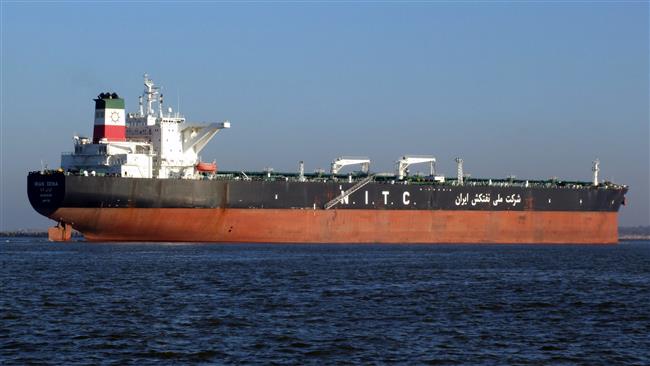
According to Iranian Oil Ministry’s official SHANA news agency, Zangeneh noted that the National Iranian Oil Company (NIOC) will soon finalize a contract with the French Total to sell 160,000 barrels per day of crude oil to the company.
He added that the Total contract will be officially singed on February 16.
In addition to buying oil from Iran, “Total has indicated its readiness to take part in the development of South Azadegan oil field and Iran LNG project,” he added.
The Iranian oil minister said necessary information with regard to the two projects will be provided to the French company, after which it will offer its proposals to the Iranian side.
“This means that we have not reached an agreement to put them in charge of the project, but the agreement is for Total to carry out necessary studies on these projects,” Zangeneh said.
Elsewhere in his interview, Zangeneh said officials of Italy’s Eni have also indicated their willingness to work in the Iranian oil sector.
The Iranian oil minister stated that no contract was signed between the two sides during a recent visit to Rome by Iran’s President Hassan Rouhani, but “the company’s officials are to visit Tehran soon in order to sign a contract for purchasing Iran’s crude oil.”
Zangeneh added that Eni has also indicated its interest in taking part in development of one of the Iranian oil fields.
“In addition, Italy’s Saras refinery has demanded to buy between 60,000 to 70,000 barrels of Iran’s crude oil per day,” he said.
Earlier on Saturday, Zangeneh was quoted by SHANA as saying thatIran is putting finishing touches to the new format of its oil contracts, known as the Iran Petroleum Contracts, to attract more international investment in the country’s oil sector.
“So far, no contract has been signed and even the text of this model of contracts has not been readied yet,” Zangeneh said, adding, “The drafting of the contracts is under way and we will negotiate with [foreign] companies after finalization.”
IPC is replacing buyback deals. Under a buyback deal, the host government agrees to pay the contractor an agreed price for all volumes of hydrocarbons the contractor produces. However, under the IPC, the National Iranian Oil Company will set up joint ventures for crude oil and gas production with international companies, which will be paid with a share of the output.
More than 100 energy companies, including Britain’s BP, France’s Total, Italy’s Eni and Spain’s Repsol attended a conference in Tehran last November to hear about the IPC.
Under the IPC, different stages of exploration, development and production will be offered to contractors as an integrated package, with the emphasis laid on enhanced and improved recovery.
Architects of the new contract say foreign companies can no longer dash out of their contractual obligations if sanctions are ever re-imposed on Iran. But critics cite numerous shortcomings which seriously plague the new formula.
© All Content by IFP News ( Iran Front Page ) is licensed under a Creative Commons Attribution 4.0 International License.
