Saturday, December 27, 2025
Home Blog Page 4594

A look at Iranian newspaper front pages on Feb 18

Iran Newspaper front pages

The downward trend of global crude oil prices has brought them down at least 75% over the past 18 months, putting so much pressure on producers whose economies are deeply dependent on crude oil revenues. To tackle the price slump, major producers including Saudi Arabia, Russia and Iran has decided to take measures to prevent further fall in prices. In the latest move, Tehran and Riyadh hosted meetings of oil and energy officials from major crude oil suppliers to the world market. The Tehran meeting was attended by Iranian Minister of Petroleum Bijan Zangeneh who hosted oil ministers from Venezuela, Qatar and Iraq. The meeting ended with an understanding to freeze crude exports at January levels. Many Iranian papers highlighted the Tehran meeting on their front pages.

In another development, the Supreme Leader of the Islamic Revolution addressing large number of people from East Azerbaijan Province, called for maximum turnout in late February elections. The leader stressed that a parliament fearful of America would lead the nation to misery.

Here are the top headlines:


Abrar:

  1. Nuclear negotiator: CBI, 15 other banks linked to SWIFT
  2. NY Times: US Had Cyber attack Plan if Iran Nuclear Dispute Led to Conflict
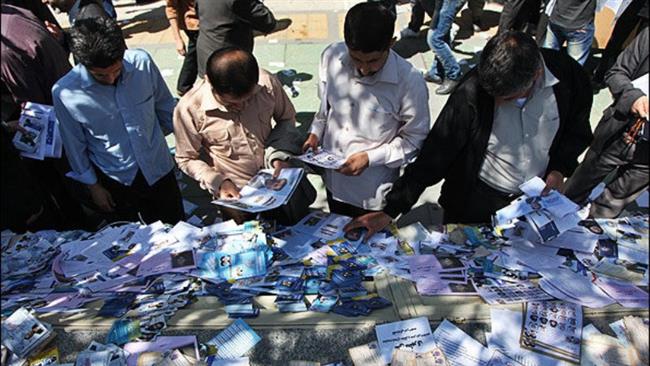
  3. Candidates start election campaigns today
  4. North Korea Preparing 5th Nuclear Test: nuclear observers
  5. Jordan calls for industrial partnership with Iran
  6. Iran, Russia to Sign Su-30 Fighter Jet Production Deal: Russian official
  7. Russia to deliver S-300 missile system to Iran Thursday
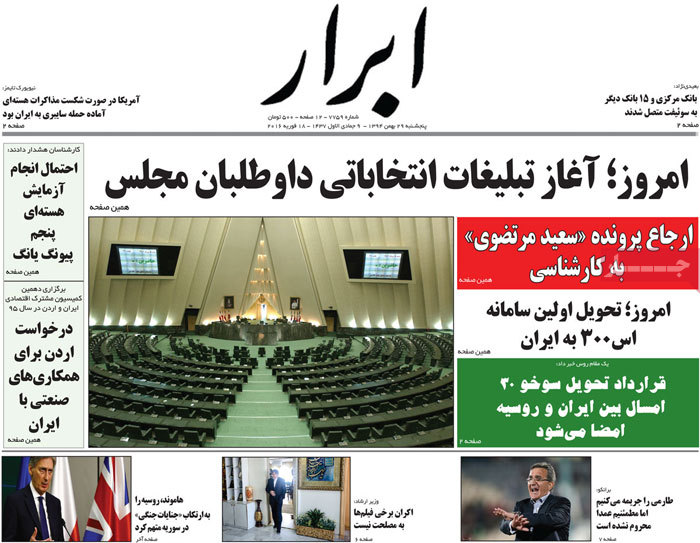
 

A look at Iranian newspaper front pages on Feb 18


Afkar:

  1. Leader: They seek to influence the election
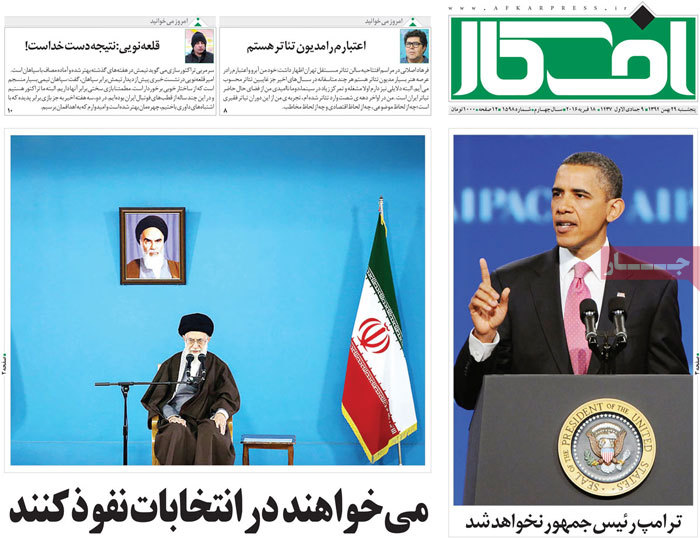
 

A look at Iranian newspaper front pages on Feb 18


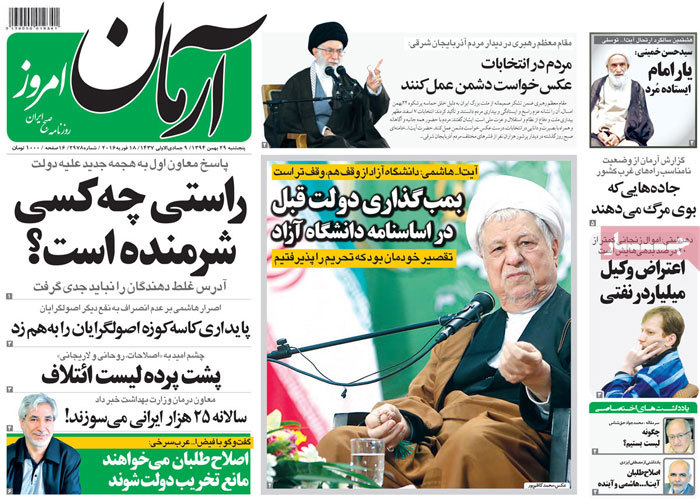
Arman-e Emrouz:

  1. Leader urges nation to act contrary to enemy’s will in election
  2. 25,000 Iranian burn annually: Deputy Health Minister
 

A look at Iranian newspaper front pages on Feb 18


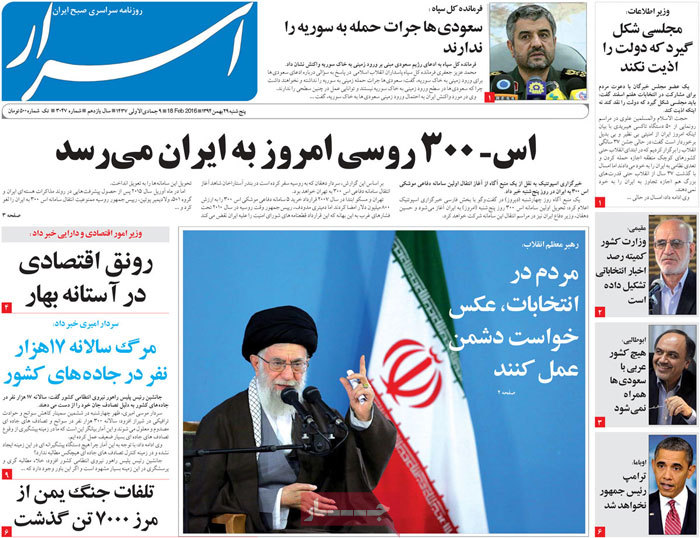
Asrar:

  1. Leader to nation: Act exactly opposite to enemies’ will in election
  2. Economic boom before spring
  3. 17,000 die in road accidents annually: according to Iranian police
  4. Over 7,000 killed so far in Yemen conflict
 

A look at Iranian newspaper front pages on Feb 18


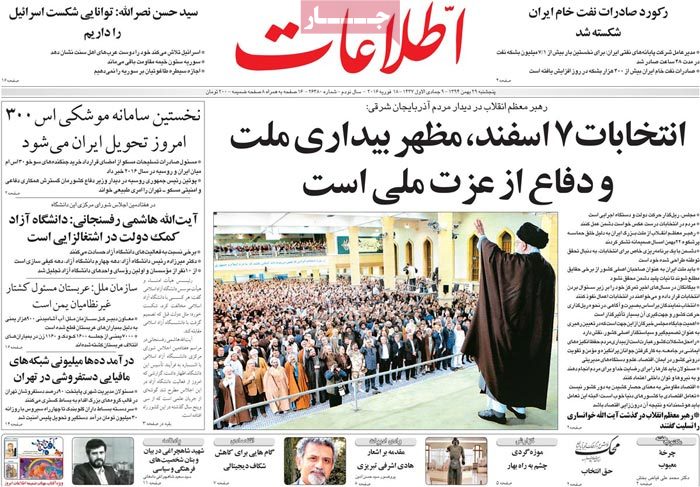
Ettela’at:

  1. Leader: Feb 26 election manifestation of nation’s vigilance, defense for national dignity
  2. Iran sets new crude oil export record
  3. Nasrallah: Hezbollah can beat Israel
  4. UN: Riyadh responsible for killing of Yemeni civilians
 

A look at Iranian newspaper front pages on Feb 18


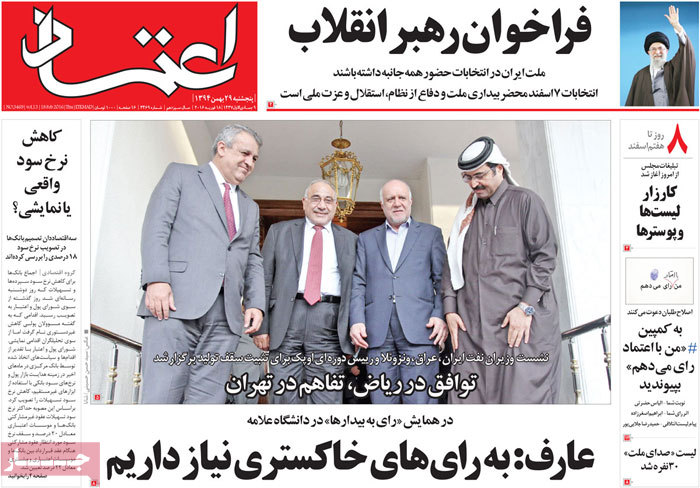
Etemad:

  1. Leader urges high election turnout

“February 26 election will be the manifestation of nation’s vigilance and defense for national dignity

  1. Agreement in Riyadh; Understanding in Tehran

Iran hosted a 4-way meeting of oil and energy ministers from Iraq, Venezuela, Iran and Qatar to discuss ways to stop the downward trend in oil prices.
 

A look at Iranian newspaper front pages on Feb 18


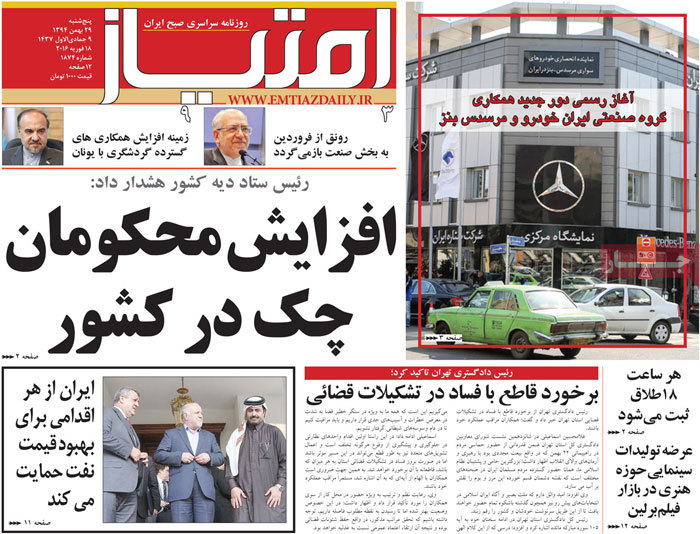
Emtiaz:

  1. IKCO (leading carmaker), Benz start new round of ties
  2. Minister says industries will start flourishing by spring
  3. Iran, Greece eye enhanced tourism ties
  4. Iran supports every measure to promote prices: Petroleum Minister
  5. Justice chief: Iran to step up measures to curb judicial corruption
 

A look at Iranian newspaper front pages on Feb 18


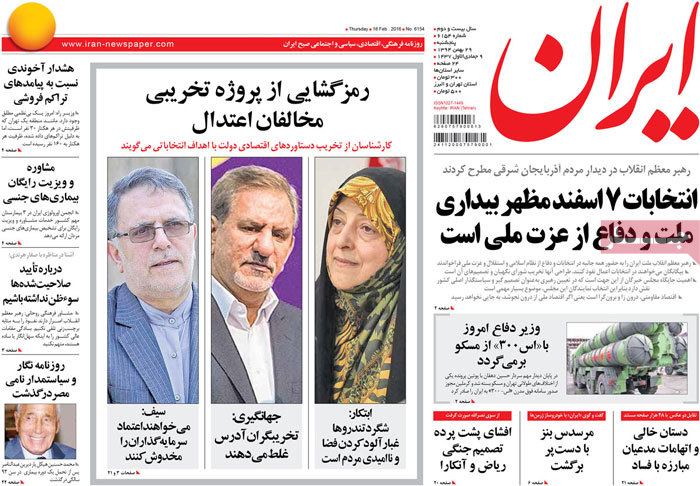
Iran:

  1. No visit, consultation charges for STD patients in Iran
 

A look at Iranian newspaper front pages on Feb 18


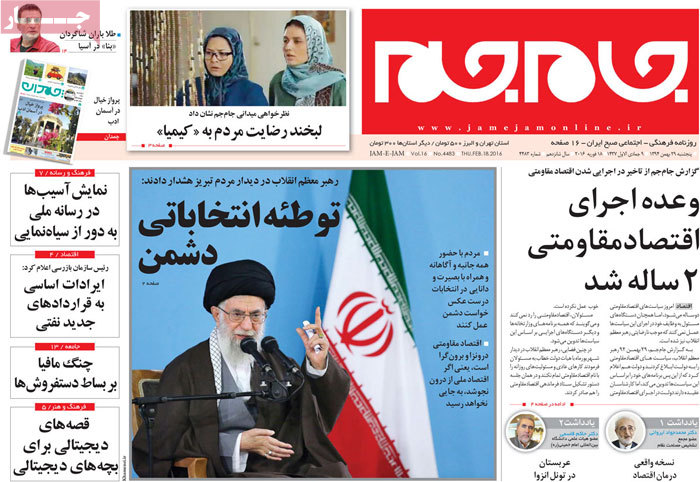
Jamejam:

  1. Leader warns against enemies’ election plot
  2. Digital tales for digital kids, international gathering of story tellers
  3. GIO Chief: Serious flaws in new oil contract model

Head of the General Inspection Office of Iran Nasser Seraj says there are serious flaws in the newly-introduced oil contact model, known as Iran petroleum contract or IPC.

  1. Viewpoint: Saudi Arabia in the tunnel of isolation
 

A look at Iranian newspaper front pages on Feb 18


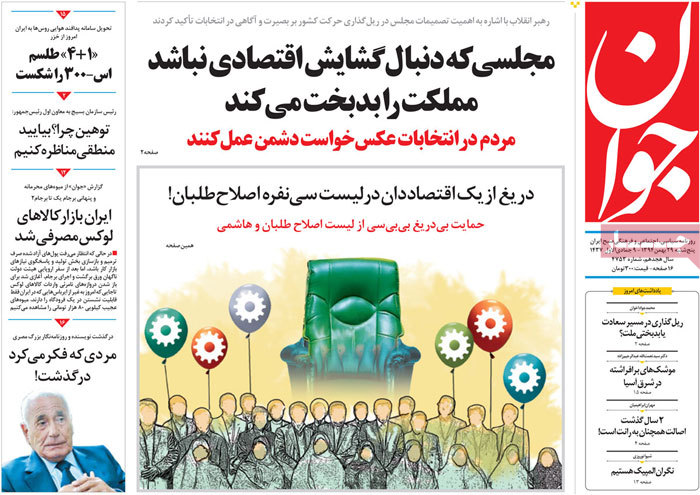
Javan:

  1. Leader: A parliament not seeking economic prosperity heaps misery on country
  2. Iran becomes market of luxuries consumer goods
  3. BBC supports Hashemi’s list of candidates relentlessly

Not even one economist in the list of reformist hopefuls
 

A look at Iranian newspaper front pages on Feb 18


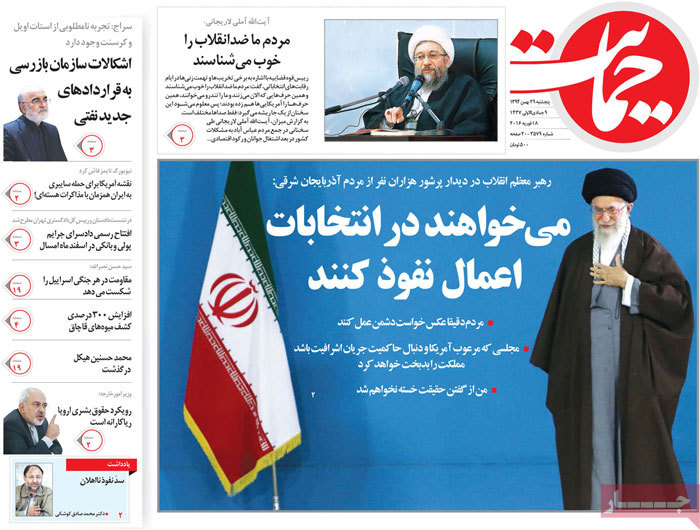
Hemayat:

  1. Judiciary Chief: Our nation easily recognize anti-revolutionaries
  2. Iran to launch court for financial, banking crimes
  3. EU hypocritical in human rights approaches : Iran FM
  4. Egyptian renowned journalist and commentator, Mohamed Hassanein Heikal dies
 

A look at Iranian newspaper front pages on Feb 18


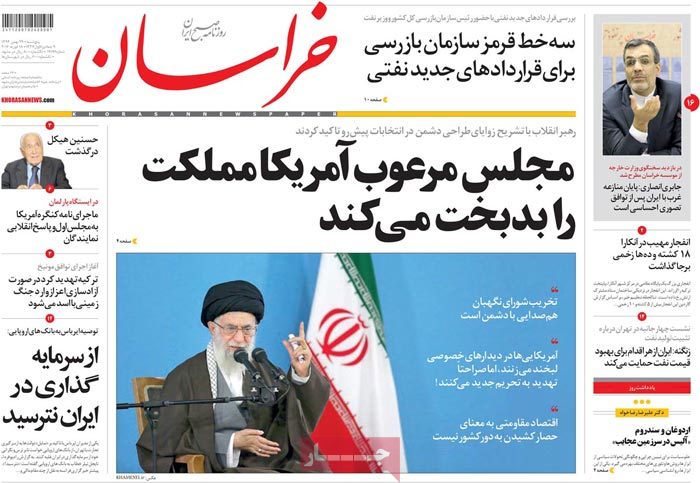
Khorasan:

  1. Leader: US-intimidated parliament heaps misery on nation
  2. Airbus to EU banks: Do not fear investments in Iran
  3. Ankara blast kills 18, injures dozens


A look at Iranian newspaper front pages on Feb 18


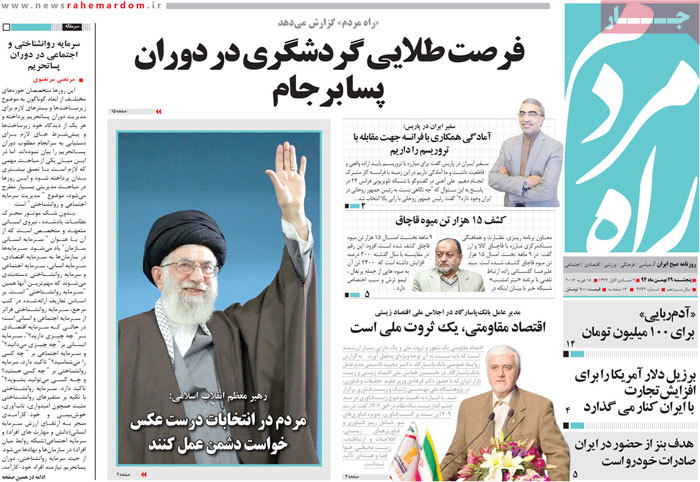
Rah-e Mardom:

  1. Report: Golden chance for Iran tourism industry in post-sanctions era
  2. Envoy: Iran ready to help France to fight terrorism
  3. 15,000t of smuggled fruit seized
  4. Brazil to dump US dollar in trade with Iran
  5. Benz’s return to Iran aimed at exporting cars
 

A look at Iranian newspaper front pages on Feb 18


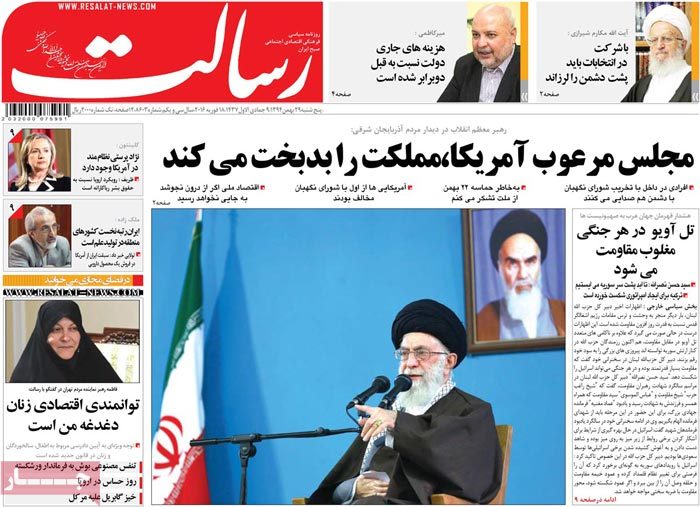
Resalat:

  1. Official: Iran top Middle East country in science production
  2. Cleric: High election turnout sends chill down enemy spine
 

A look at Iranian newspaper front pages on Feb 18


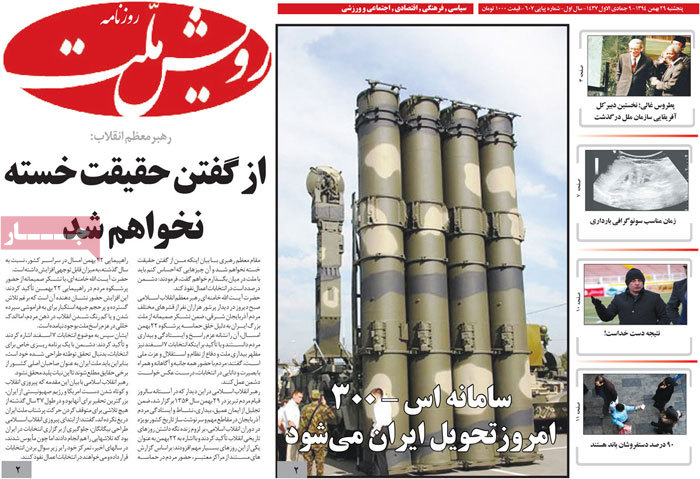
Rooysh Mellat:

  1. Leader: I will never get tired of telling the truth
 

A look at Iranian newspaper front pages on Feb 18


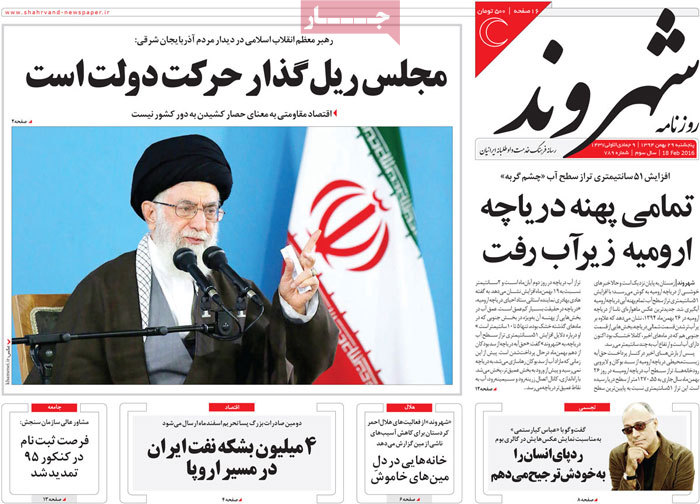
Shahrvand:

  1. Leader: Parliament lays down rails for administration’s movement
  2. Urmia basin fully under water

The water surface of Lake Urmia in the extreme north western Iran has risen 51 centimeters as hopes are growing for reviving the lake.
 

A look at Iranian newspaper front pages on Feb 18


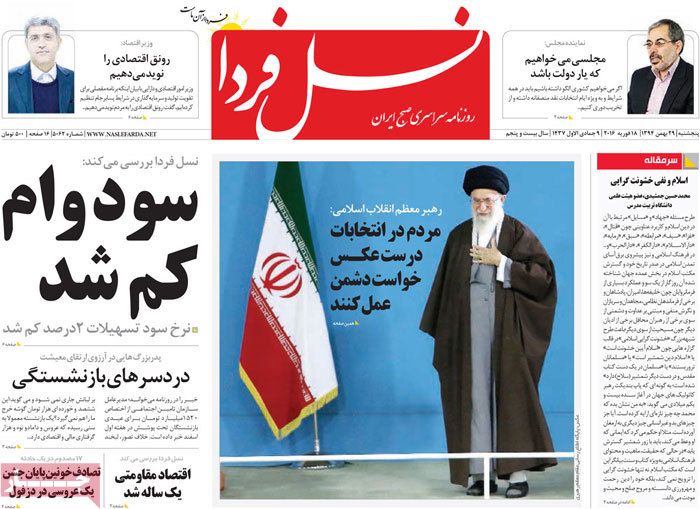
Nasl-e Farda:

  1. Interest rates lowered

Iran has lowered interest rates of bank loans by at least 2%.
 

A look at Iranian newspaper front pages on Feb 18


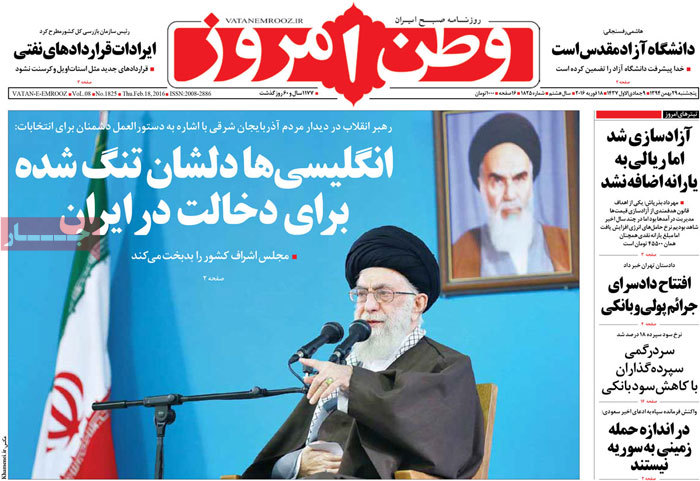
Vatan-e Emrouz:

Leader: Brits miss Iran interference
 

A look at Iranian newspaper front pages on Feb 18


Campaigning begins in crucial Iran elections

As many as 6,300 candidates, including 586 women, are campaigning for a place in the country’s 290-seat parliament.

Earlier this week, Iran’s Interior Ministry finalized the full list of approved candidates for the parliamentary election, due on 26 February, after the Guardian Council endorsed their qualifications.

According to Siyamak Rahpeyk, the spokesman for Iran’s Central Elections Supervising Committee, some 55 percent of those registered have received approval, setting a record in the history of the parliamentary elections.

At least 21 people will compete for each seat in parliament, said the official.

In the capital Tehran, over 1000 candidates are competing for just 30 seats.

Parliament’s members are elected every four years, and former and current members can be re-elected.

On the same day, Iran will also hold the election for the next Assembly of Experts.

The body elects and oversees the activities of the Leader of the Islamic Revolution, and is in a position of authority to either appoint or dismiss the Leader.

Members of the Assembly are directly elected to office by people for an eight-year term. The body holds meetings twice a year to review major national issues and every other year to appoint a new chairman.

On Wednesday, Leader of the Islamic Revolution Ayatollah Seyyed Ali Khamenei warned of “enemy plots to influence” the upcoming elections.

The Leader said that the US plans to challenge the Guardian Council’s decisions and portray the elections as illegal.

“Since the first day of the [Islamic] Revolution, Americans have opposed certain basic organs, including the Guardian Council, but they could not do away with it. Now they want to call into question its decisions,” the Leader said.


Iran exports 7.1mn barrels of oil only in 2 days

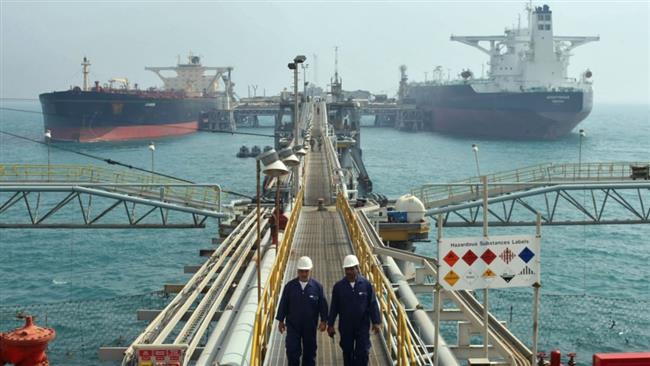
Pirouz Mousavi, the managing director of the Iranian Oil Terminals Company (IOTC), has been quoted by the media as saying that the exports of 7.1 million barrels of oil were made over the past few days through the southern Kharg terminal.

Mousavi said four million barrels were shipped to Europe and the remaining 3.1 million barrels were shipped to Iran’s traditional clients.

The official further added that Iran’s oil export terminals can simultaneously host 9 tankers for loading crude oil.

Mousavi further emphasized that with the arrival of new tankers within the next few days a new phase in the rise of Iran’s oil exports to Europe will take place.

He also said that based on an authorization that has been issued by the National Iranian Oil Company (NIOC), Iran’s oil exports are expected to rise by above 500,000 barrels per day (bpd) within a month.

The NIOTC chief said the National Iranian Tanker Company (NITC) is taking measures to resolve problems over providing the insurance for Iran’s oil shipments to Europe.  Once those problems are resolved, Iran will use NITC tankers for exports to Europe.

NITC is a subsidiary of NIOC and transports Iranian crude to export markets. The company has a fleet of 60 VLCC supertankers with a total transport capacity of 100 million tons and is considered as the biggest tanker company in the Middle East and 4th in the world.  It is currently a main target in the long list of economic sanctions against Iran.


Iran condemns Ankara terror attack

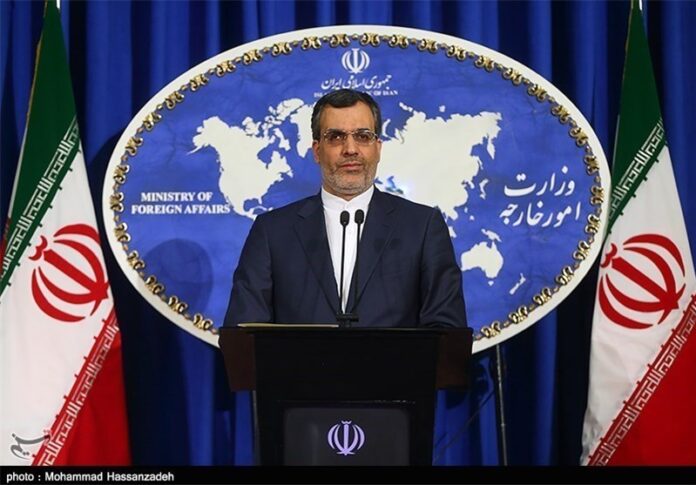
Voicing Iran’s strong condemnation of the terrorist blast, Foreign Ministry Spokesman Hossein Jaberi Ansari offered condolences to the Turkish government and nation and the bereaved families of the victims.

He said the incident once again highlights the necessity for concerted action against terrorism, which is a common threat to the international community.

An explosion hit military vehicles at an intersection in Ankara on Wednesday evening, in what the military called a terror attack.

28 people were killed and 61 others were injured, according to Deputy Prime Minister Numan Kurtulmus.

The explosion hit three military vehicles and a private vehicle in city center, near Turkish Parliament buildings.

No group has claimed responsibility for the attack so far.

“Our determination to respond in kind against such attacks against our unity and future from outside and inside is even more strengthened through such attacks,” Turkish President Recep Tayyip Erdogan said in a statement. “Turkey will not hesitate to use its right to self-defense anytime, anywhere, and in all situations.”

Fighting against Iran is a religious duty and against Israel religiously forbidden

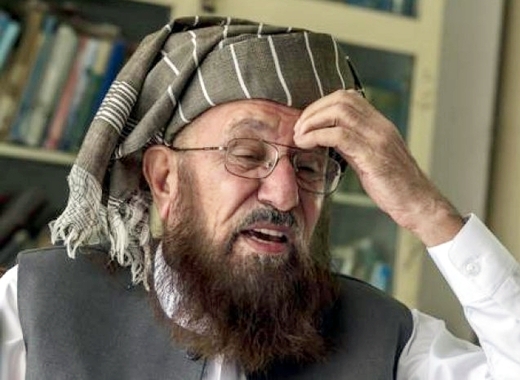
The spiritual father of Taliban has declared war with Iran as a religious duty and with Israel religiously forbidden.

According to Persian daily Jomhouri Eslami on Wednesday Feb. 17, 2016, Molana Sami Ul Haq, known as spiritual father of Taliban in one his latest pamphlets has ruled that the most important religious duty is to fight against Iranians and that losing life in such war is considered as the highest worship.

He has written that fighting Israel is not our priority because Palestinians have made peace with Israel and therefore our fight against Israel is religiously forbidden.

According to this Persian daily, the Zionist regime has welcomed the statements made by Sami Ul Haq and said that we should help such intellectual cleric because instead of speaking against Israel he has talked about Iranian threat.

Iran Supports Moves to Improve Oil Price: Zangeneh

Speaking to reporters following a joint meeting among ministers of oil and energy of Iran, Iraq, Venezuela, and Qatar here on Wednesday, he said, “Today we had a good meeting and the report of yesterday’s meeting (in Doha) was presented. We welcome cooperation between OPEC and non-OPEC (producers).”

“The decision taken so that OPEC members and non-OPEC (countries) freeze their production ceiling in a bid to stabilize the market and improve prices in the interest of consumer and producer is also supported by us,” he told reporters.

He added that participants of the Tehran meeting were briefed about Iran’s return to the market in the post-sanctions era and said, “We discussed about this issue with the Iraqi, Qatari, and Venezuelan ministers of oil and energy and they viewed the reality with a logical view.”

“I hope that with the efforts which have been initiated, we would witness improvement of the market’s situation in future,” Zangeneh said.

Regarding the effect of a recent meeting between OPEC members and non-OPEC countries, the Iranian minister said, “One should wait to see its effect on prices.”

“As I said, this is the initial step and we have to look at it positively. Buy I think everybody agrees that we have to monitor the market situation and reaction and to consult on the next steps if necessary,” he said.

Referring to non-OPEC countries’ readiness to cooperate, Zangeneh said, “As I was told, Russia in the capacity of the world’s largest oil producer, Oman and other countries have expressed their joining up which is a positive move and we approach it in a positive way.”

“This is good start,” the Iranian minister said.

Tehran Quartet Ministerial Meeting Opens to Tackle Oil Price Slump

Iranian Minister of Petroleum Bijan Zangeneh, Venezuelan Oil Minister Eulogio del Pino, Iraqi Oil Minister Adil Abdul-Mahdi and OPEC President and Qatari Minister of Industry and Energy Mohammed al-Sada are to confer measures to curb falling oil prices.

Oil price tailspin has continued for the past 18 months and have plunged by at least 70% since July 2014.

The Tehran meeting comes only one day after oil and energy ministers of Russia, Saudi Arabia, Qatar and Venezuela met in Doha for the same purpose. The four crude oil exporters agreed to freeze market supplies to January level.

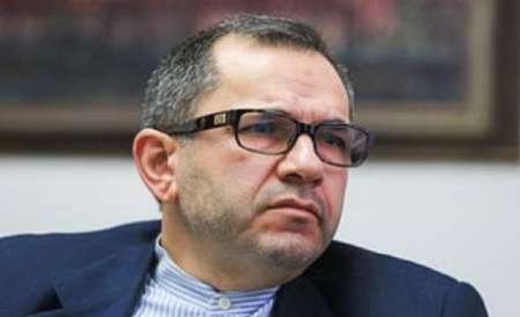
Deputy FM: Post-sanction era appropriate opportunity for development of cooperation with EU

UN Security Council Weakened by US Support for Israel: Iran Envoy

Ravanchi made the remarks in the sixth round of talks between Iran and Norway
in Oslo.
In the meeting, Ravanchi referred to existing opportunity for cooperation in the fields of fishery, oil, gas, renewable energy, environment, banking, marine and related industries and termed the prospect of mutual ties as positive.
Brende welcomed recent developments in Iran and expressed Norwegian companies’ desire to revive their past cooperation with Iran.
Ravanchi also held talks with Secretary General of Norway Foreign Ministry Vegra Strommen.

80-year-old post graduate completes degree

Firooz Aghdamifar’s thesis appraisal session was held at the university’s Sciences & Research Branch on February 13 and the post-graduate student defended his dissertation on analysis of the translation of the first novel by French author Jean Daniel.

‘The main reason for me to continue studying at the university despite old age was getting familiar with techniques and methods used by translators in advanced countries,’ Aghdamifar said.

‘Instead of spending my time sitting on park benches during retirement years, I decided to make the maximum use of my free time and realize my dream,’ he added.

The eighty-year old student said that everybody should maintain his or her perseverance and remember that it is never too late to learn. One can even study at difficult majors like MBA.

‘My next goal is getting a PhD,’ he said.

Russia to send S-300 air defense system to Iran

According to the Sputnik News Agency, Iranian Defense Minister Hossein Dehghan will participate in a ceremony dedicated to the first delivery of the Russian S-300 air defense system to Iran via the Caspian Sea on February 18, a source told Sputnik Persian on Wednesday.

Dehghan is currently in Russia and will travel to Astrakhan on the Caspian Sea for the closed ceremony.

“Hossein Dehghan will participate in the ceremony of delivering the S-300 in Astrakhan on Thursday,” the source said.

In 2007, Moscow and Tehran signed an $800-million deal for the delivery of five S-300 missile systems to Iran. In 2010, Russia suspended the contract, citing a UN Security Council resolution that placed an arms embargo on Tehran until it proved the peaceful nature of its nuclear project.

Tehran filed a lawsuit against Moscow over the incident.

In April, Moscow repealed the S-300 delivery ban, after Iran and six global powers, including Russia, reached a framework nuclear agreement to remove the anti-Tehran sanctions in exchange for guarantees of the peaceful nature of its nuclear activities.