Friday, April 17, 2026
Home Blog Page 4588

A look at Iranian newspaper front pages on March 12

Iran Newspaper front pages

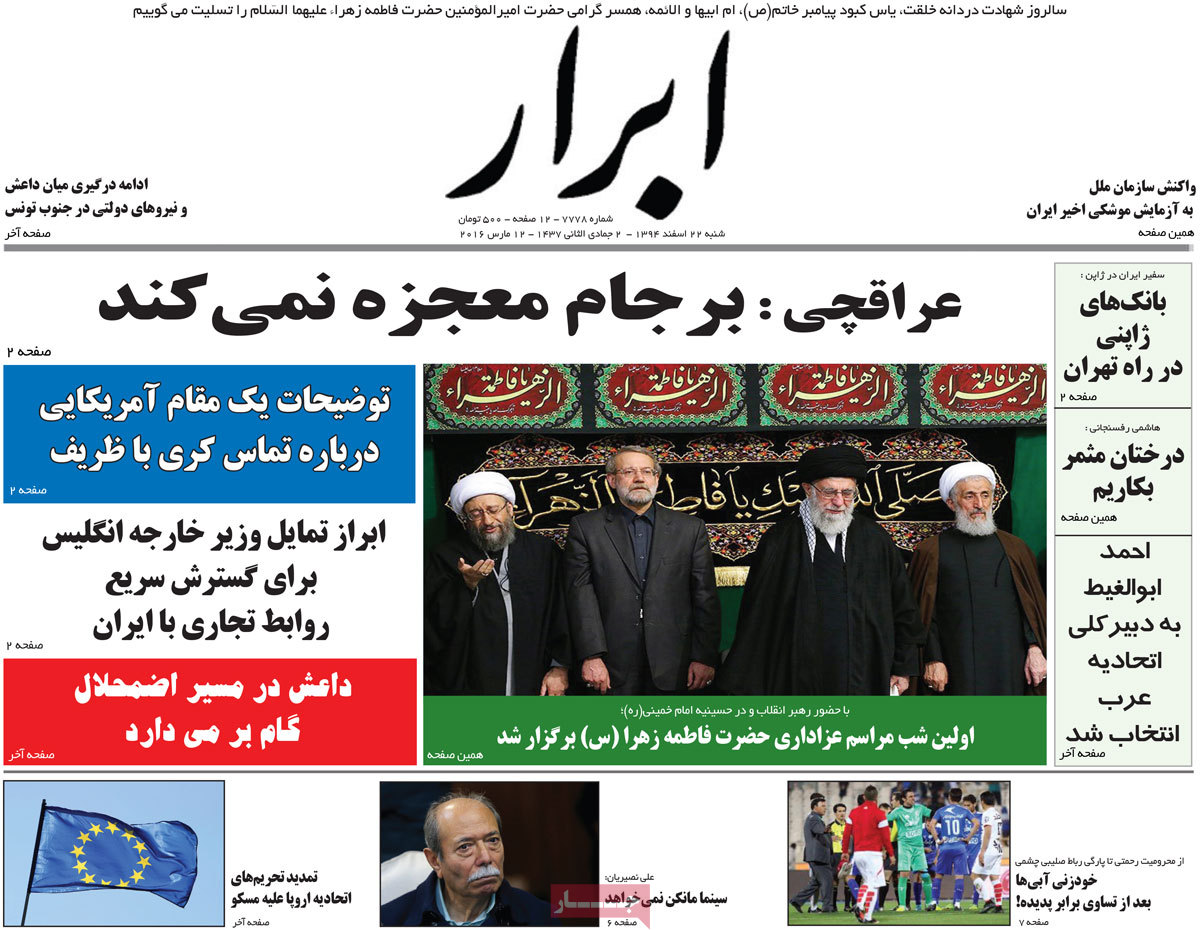
Abrar:

  1. ISIL, Tunisia continue fierce border clashes
  2. UN reaction to recent Iran missile test
  3. Araqchi: No miracles expected by JCPOA
  4. American figure expounds on Kerry-Zarif phone conversation
  5. UK eyes bolstered trade ties with Iran
  6. ISIL on the path to dissolution
  7. Japanese banks coming to Iran


A look at Iranian newspaper front pages on March 12


Afkar:

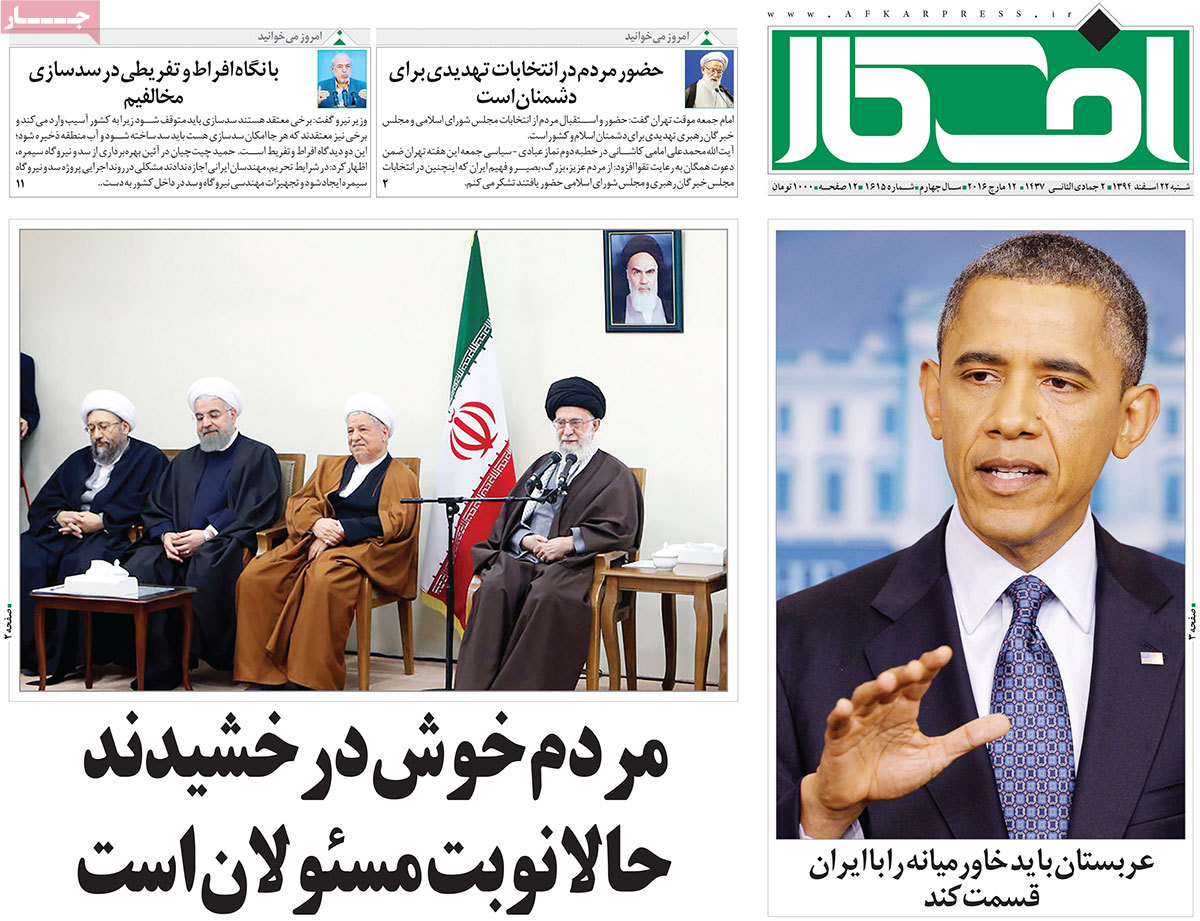
  1.  Saudi Arabia needs to share regions with Iran: Obama
  2. Nation did great; now its officials’ turn: Leader
 

A look at Iranian newspaper front pages on March 12


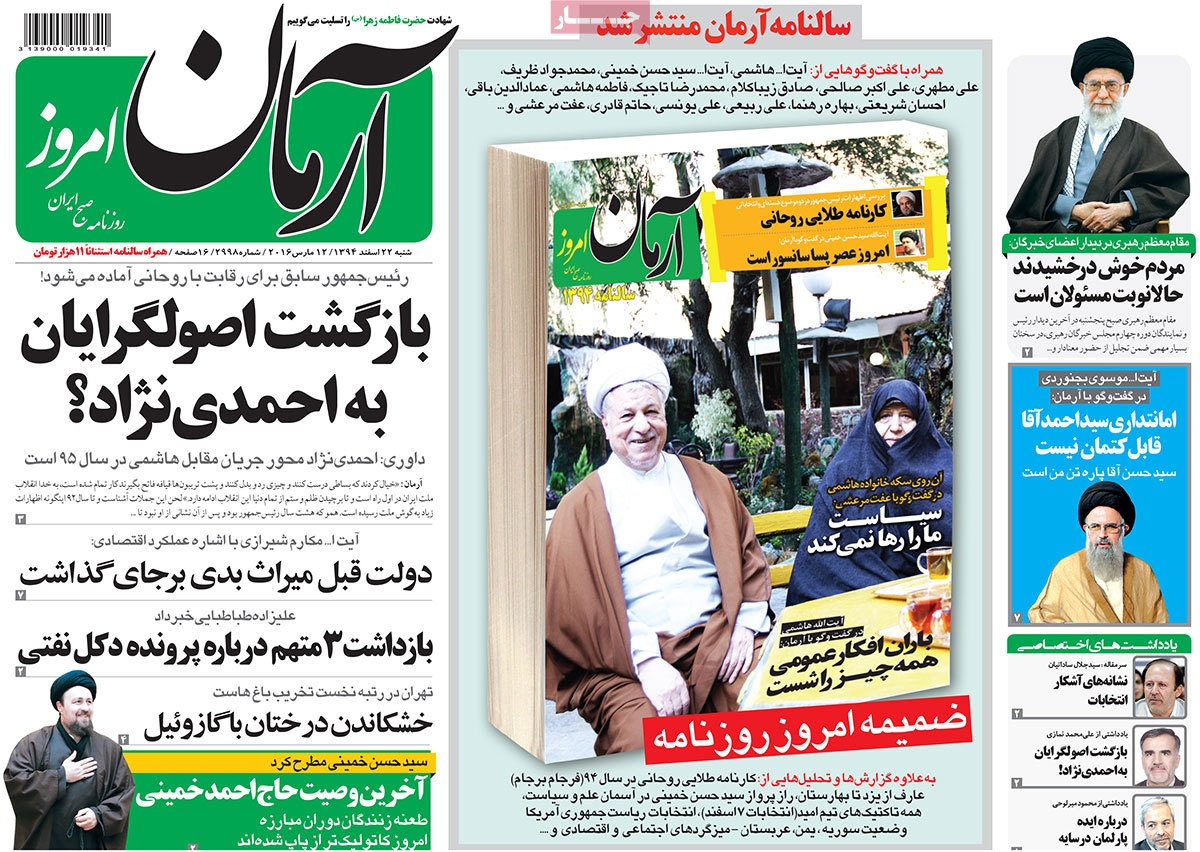
Arman-e Emrouz:

  1. Ex-President readies for presidential campaign

Mahmoud Ahmadinejad is said to be preparing for the upcoming presidential election in 2017 in Iran.

  1. Cleric: Last admin left bad [economi] legacy
  2. Three captured for oil rig case
  3. Leader hail’s nation for election turnout, calls on officials to take turns
 

A look at Iranian newspaper front pages on March 12


Ebtekar:

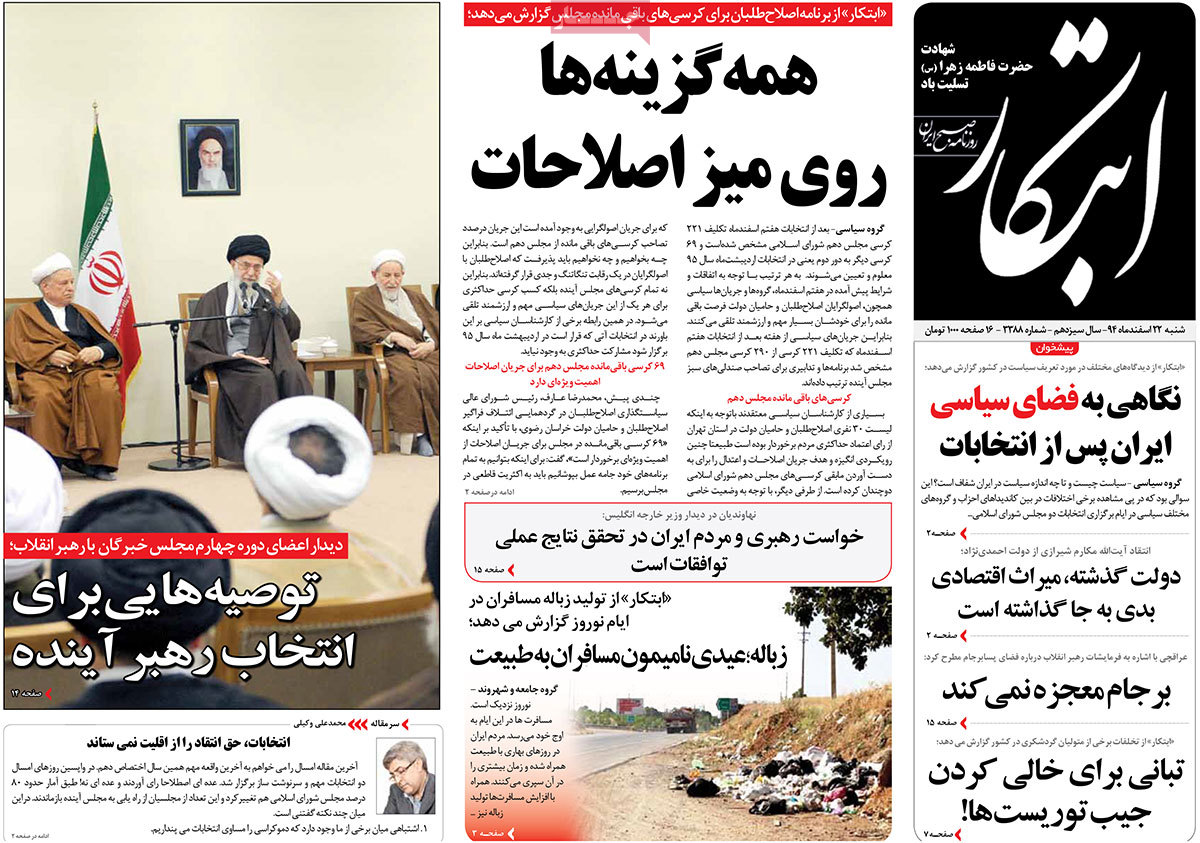
  1. All options on reformists’ table

A report about plans considered by the reformist front in the next Iranian parliament

  1. Leader offers advice for selecting next leader
  2. No miracles expected in JCPOA: Araqchi
 

A look at Iranian newspaper front pages on March 12


Ettela’at:

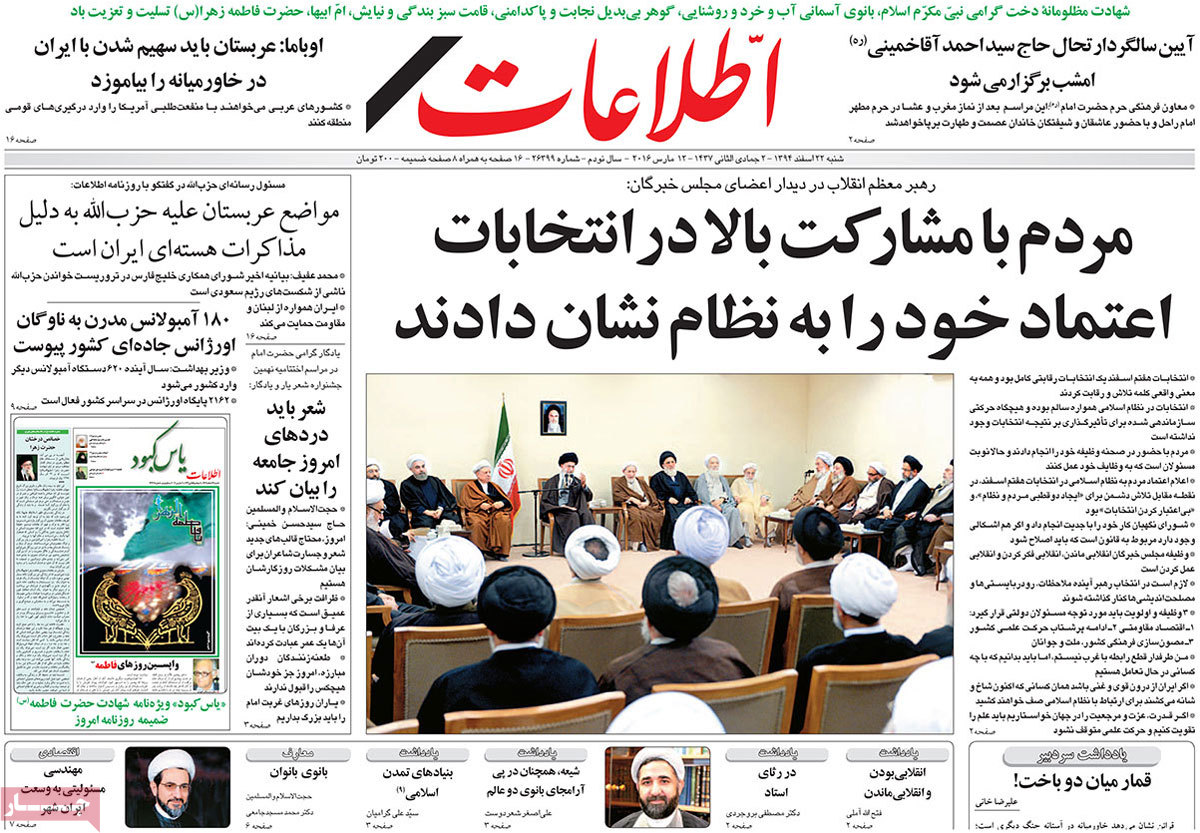
  1. Saudi Arabia must learn to share Mideast with Iran
  2. Nation displayed their trust to establishment through high election turnout: Leader
  3. Saudi stance against Hezbollah stems from Iran nuclear talks: Hezbollah figure
  4. Iran adds 180 modern ambulances to road relief fleet
 

A look at Iranian newspaper front pages on March 12


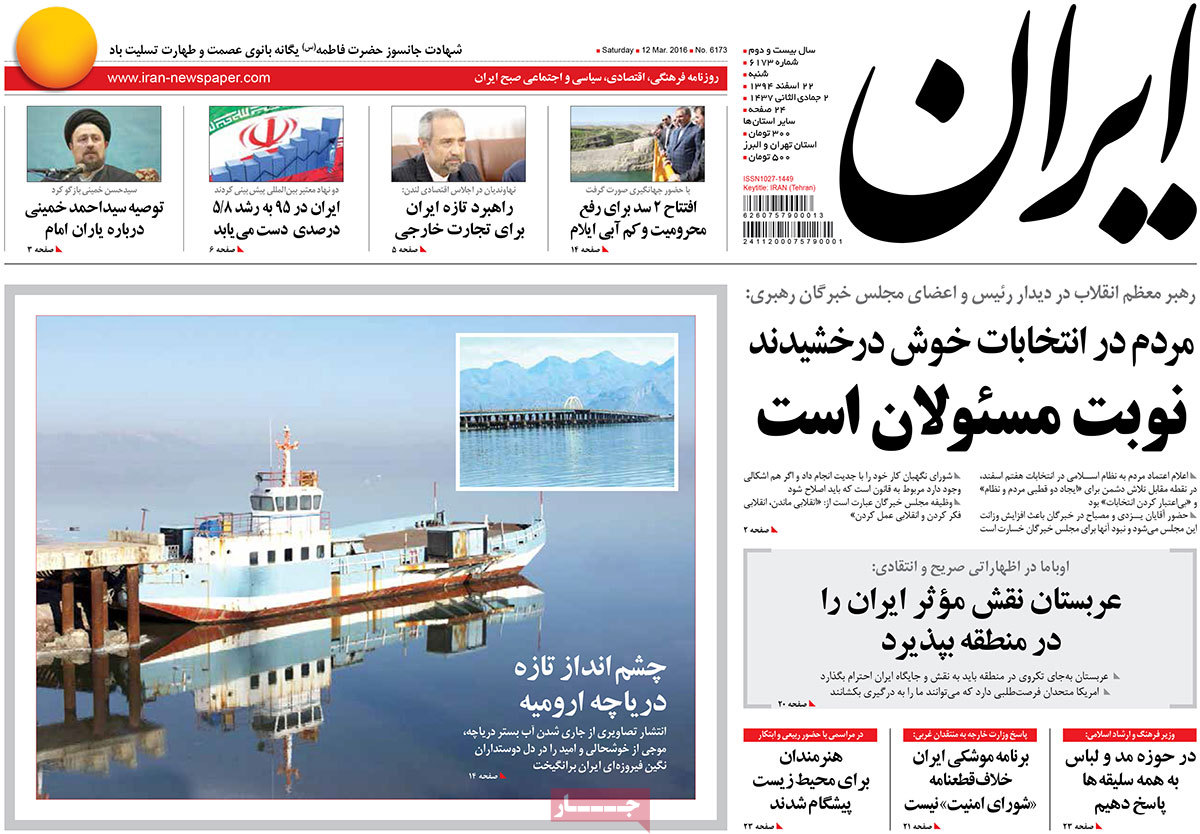
Iran:

  1. Iran launches two dams to address water shortage in western regions
  2. Iran adopts fresh strategy in foreign trade
  3. Iran eyes 5.8% economic growth next year
  4. Obama calls on Saudi Arabia to recognize Iran’s role in Mideast
  5. Iran missile test no violation of UNSC resolution
  6. New horizons before Lake Urmia


A look at Iranian newspaper front pages on March 12


Payam Zaman:

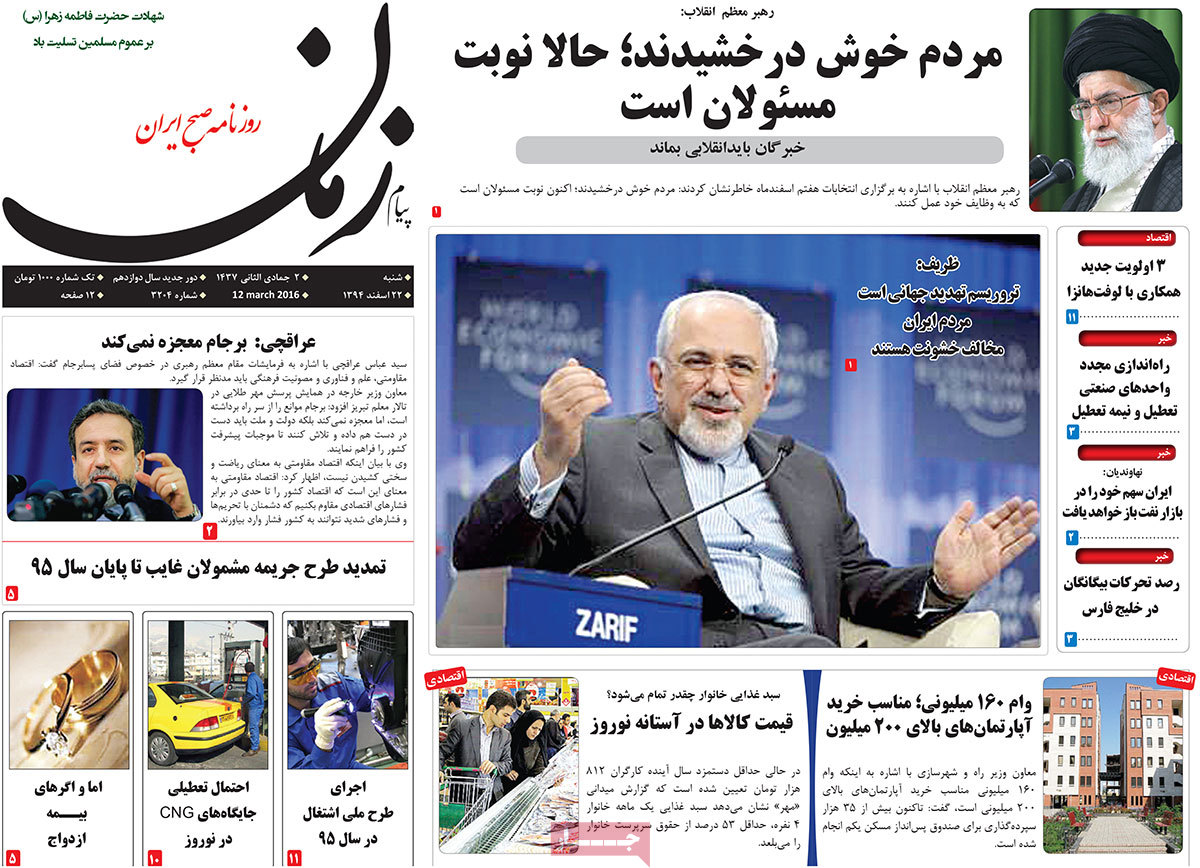
  1. Zarif: Terrorism, global threat; Iranian people oppose aggression
  2. Three priorities in cooperation with Lufthansa
  3. Plans to reopen idle industrial units [in Iran]
  4. Iran monitors alien activities in Persian Gulf
 

A look at Iranian newspaper front pages on March 12


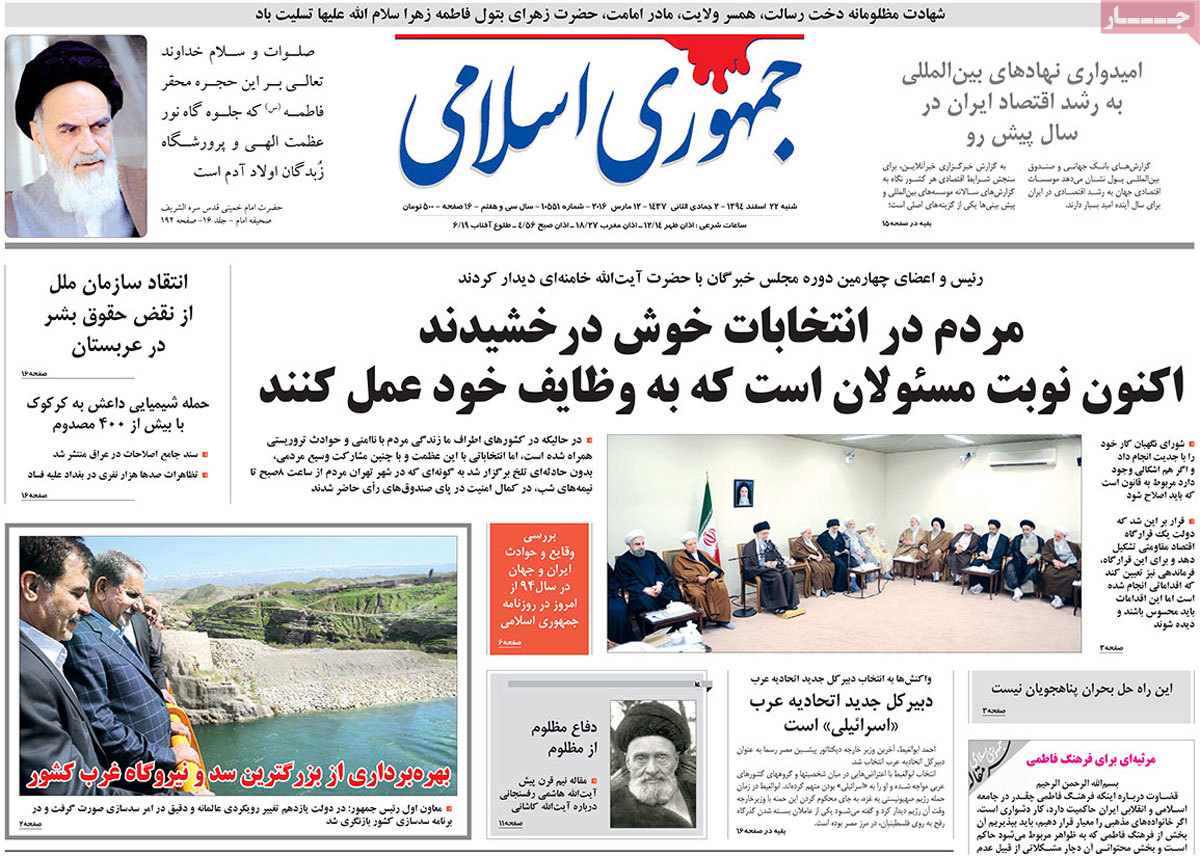
Jomhouri Islami:

  1. Int’l bodies expect economic growth in Iran next year
  2. UN condemns human rights violation in Saudi Arabia
  3. New Arab League Sec. Gen. Israeli
  4. Iran launches biggest dam, power plant in western regions
 

A look at Iranian newspaper front pages on March 12


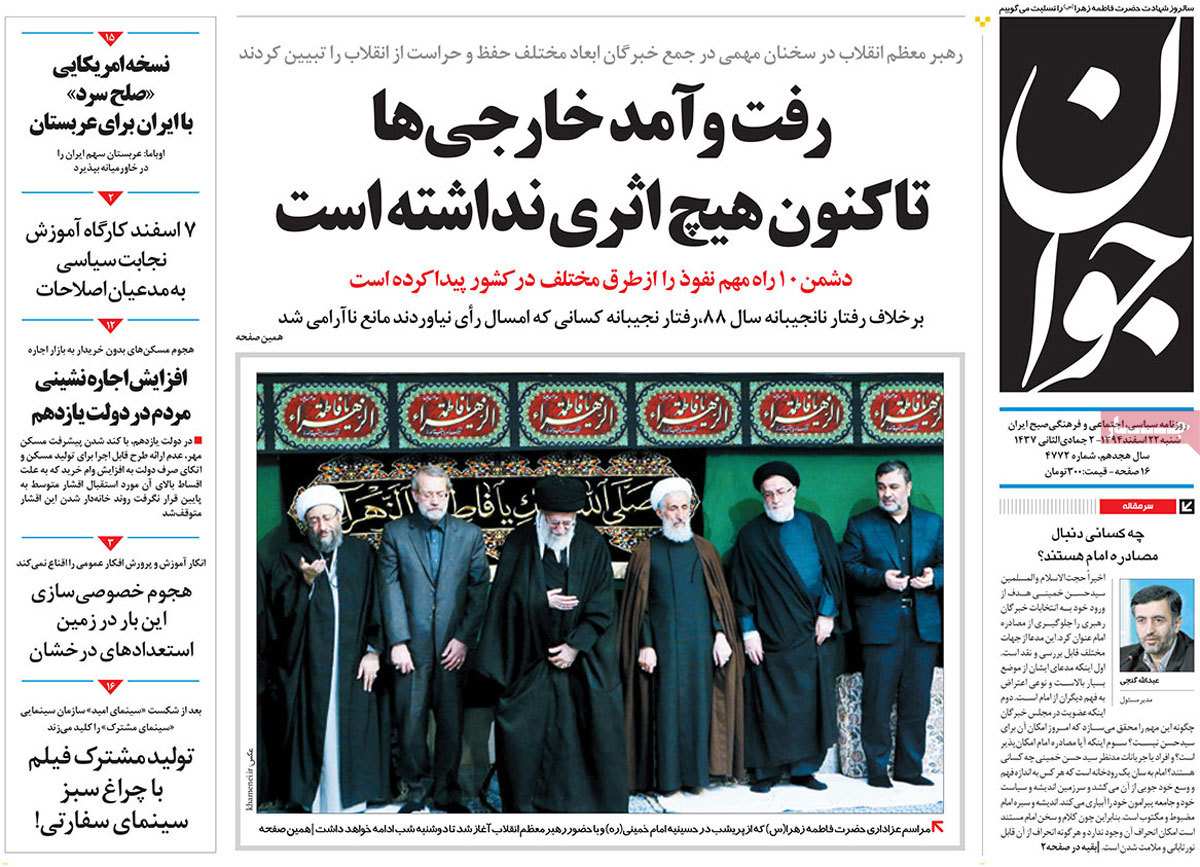
Javan:

  1. Nothing gained from foreign delegations yet: Leader

Enemy has located 10 ways to influence Iran: Leader

Leader hails modest reaction of election losers and compares it with the post-presidential election unrest in Iran in 2009
 

A look at Iranian newspaper front pages on March 12


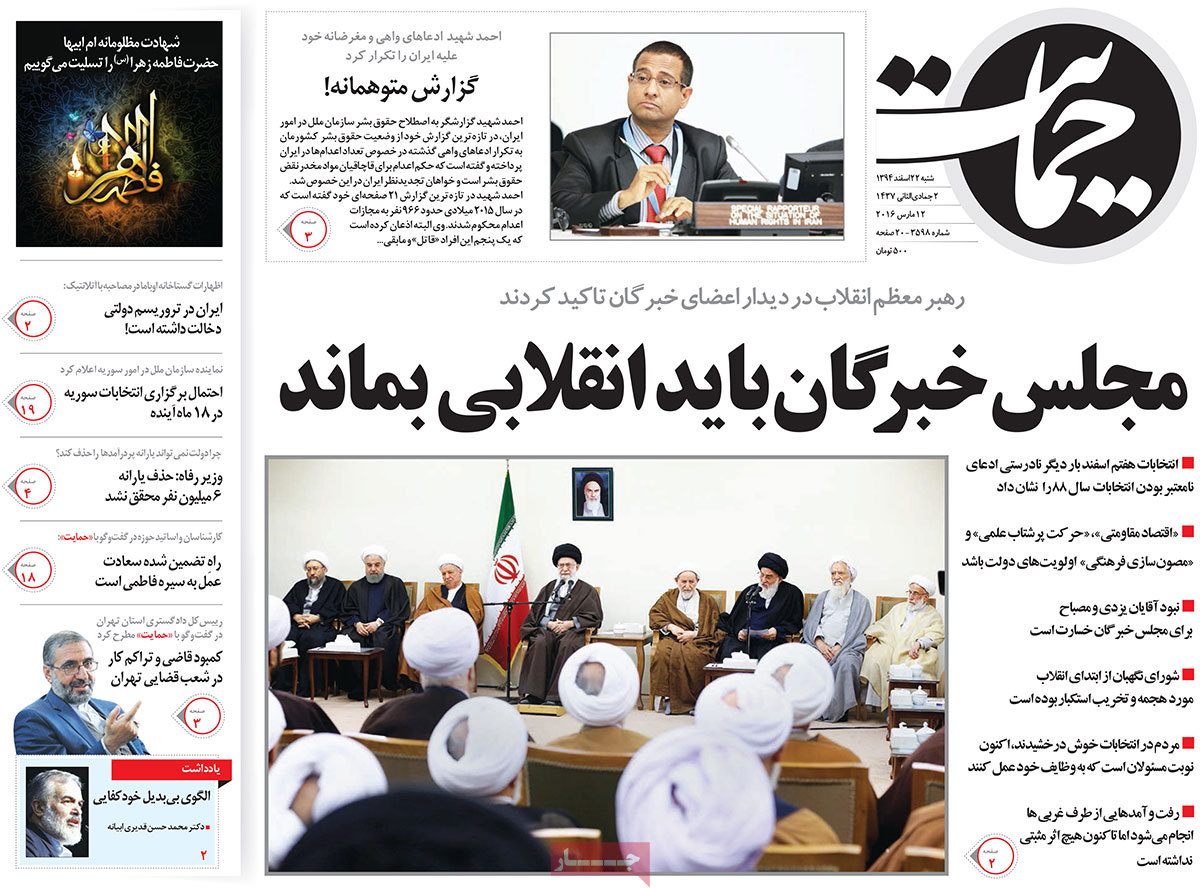
Hemayat:

  1. Leader calls on Assembly of Experts to remain revolutionary
  2. Obama accuses Iran of involvement in state terrorism
 

A look at Iranian newspaper front pages on March 12


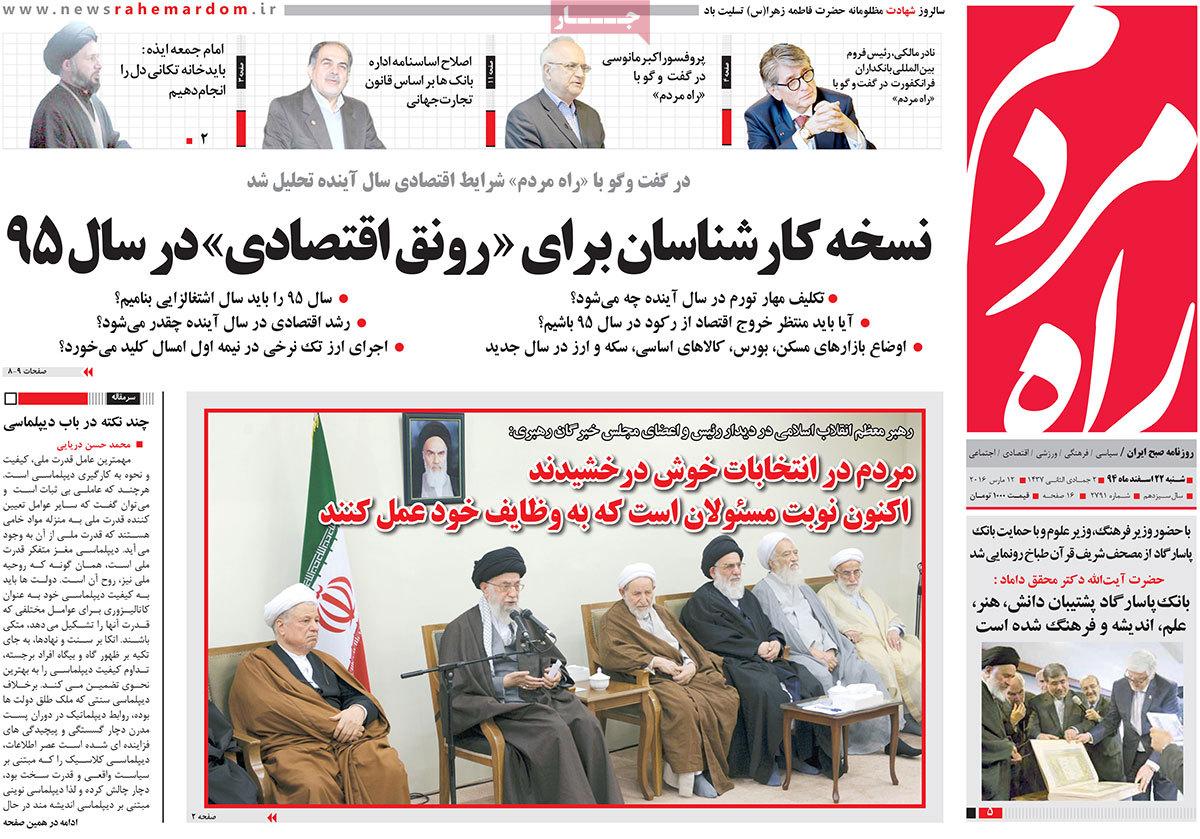
Rah-e Mardom:

  1. Experts outline economic prosperity for next year
  2. Bank Pasargad supports knowledge, arts, sciences, thinking and culture: Cleric
 

A look at Iranian newspaper front pages on March 12


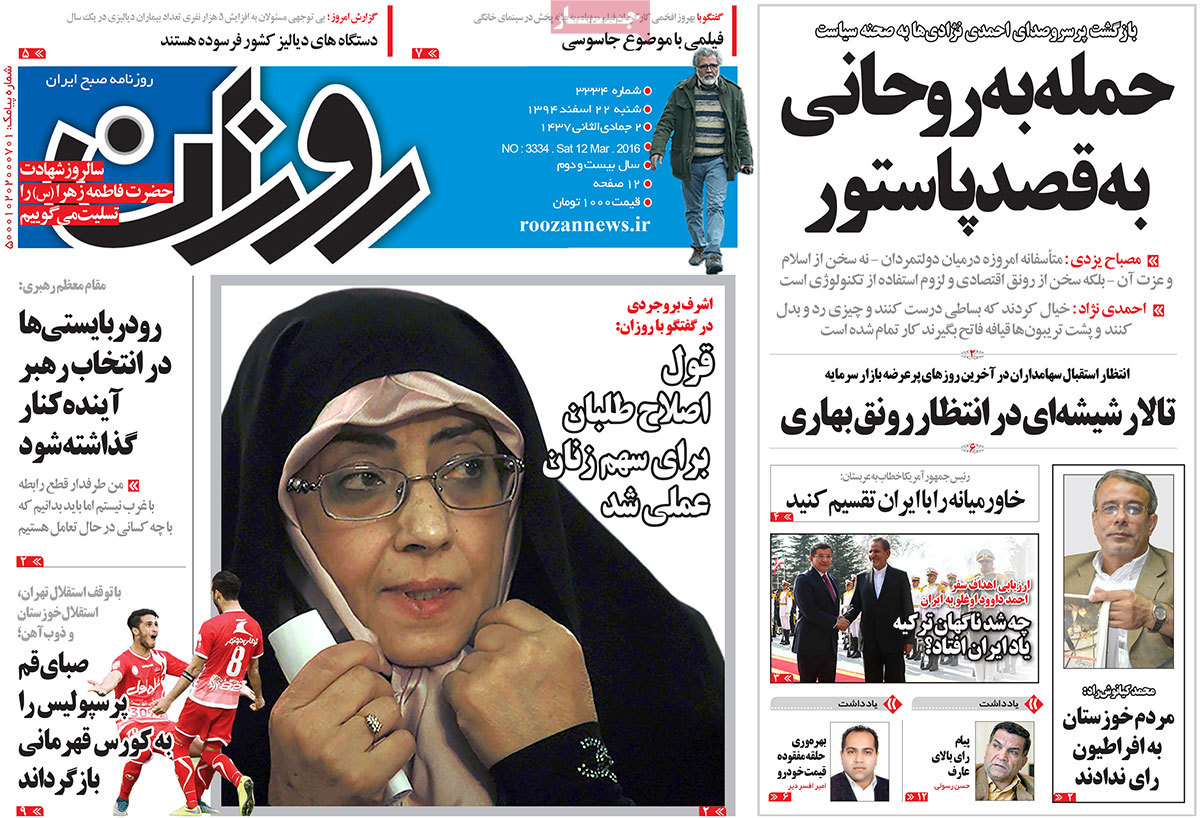
Roozan:

  1. Ahmadinejad’s uproarious return to politics

Attack on Rouhani aimed at presidential office

  1. Reformists’ promise for women’s share in parliament fulfilled: Woman activist
  2. Leader calls for refraining from formalities while selecting next leader
 

A look at Iranian newspaper front pages on March 12


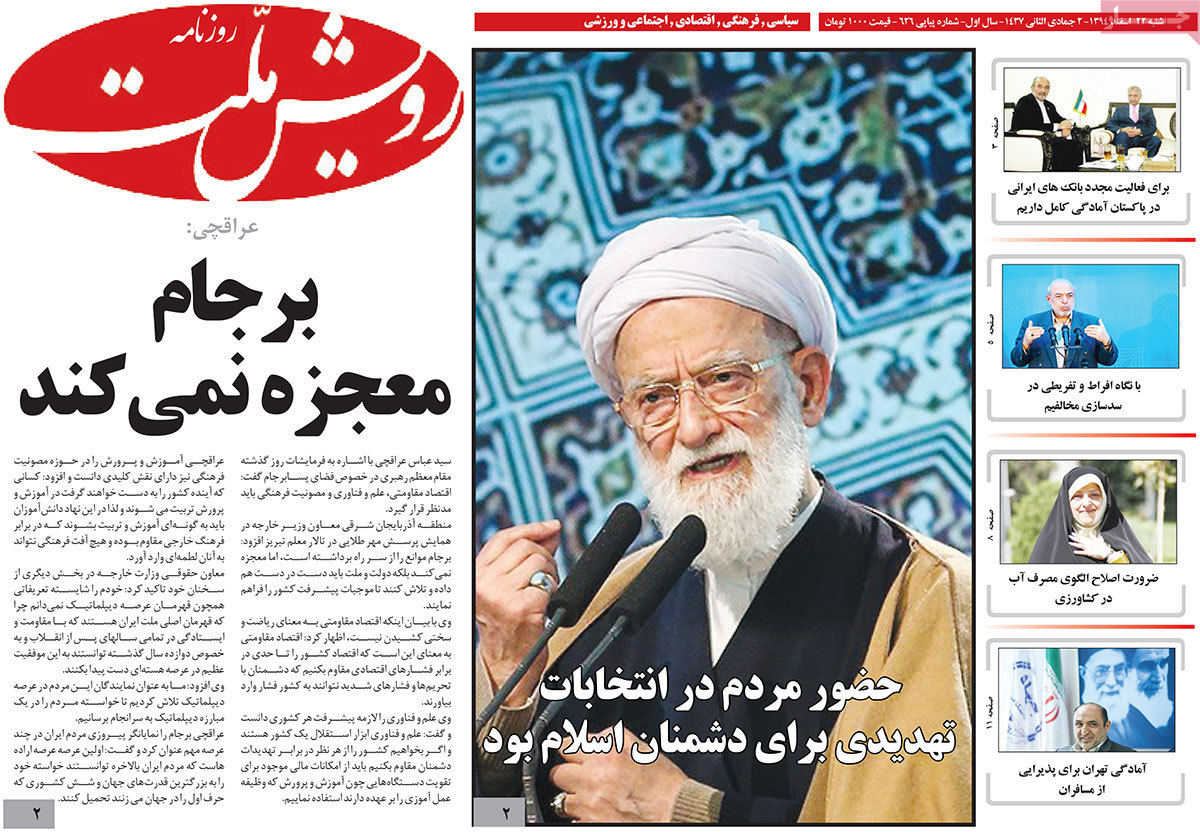
Rooyesh Mellat:

  1. Election turnout, threat to enemies of Islam: Friday prayer imam
  2. Araqchi: No miracles expected by JCPOA
 

A look at Iranian newspaper front pages on March 12


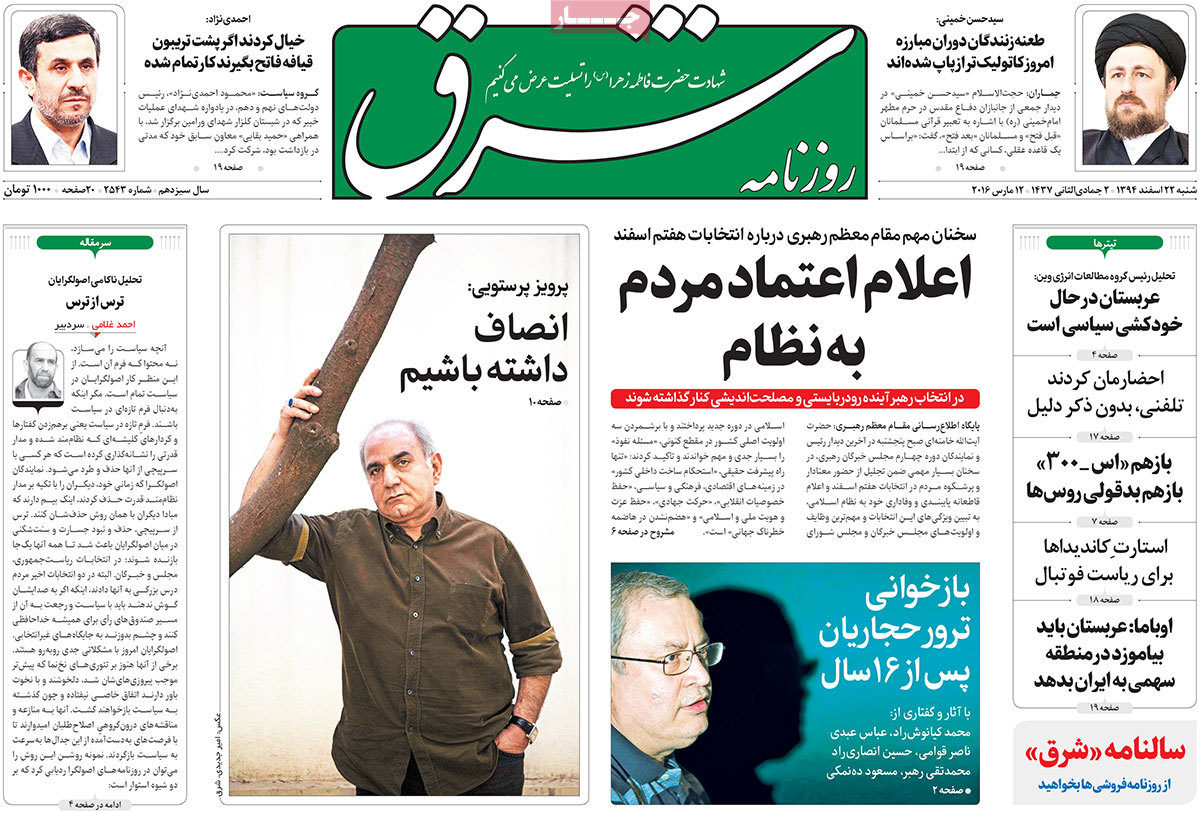
Shargh:

  1. They thought by looking like a winner at podium does everything: Ahmadinejad
  2. Analyst: Saudi Arabia committing political suicide
  3. Russians re-renege on S300 delivery


A look at Iranian newspaper front pages on March 12


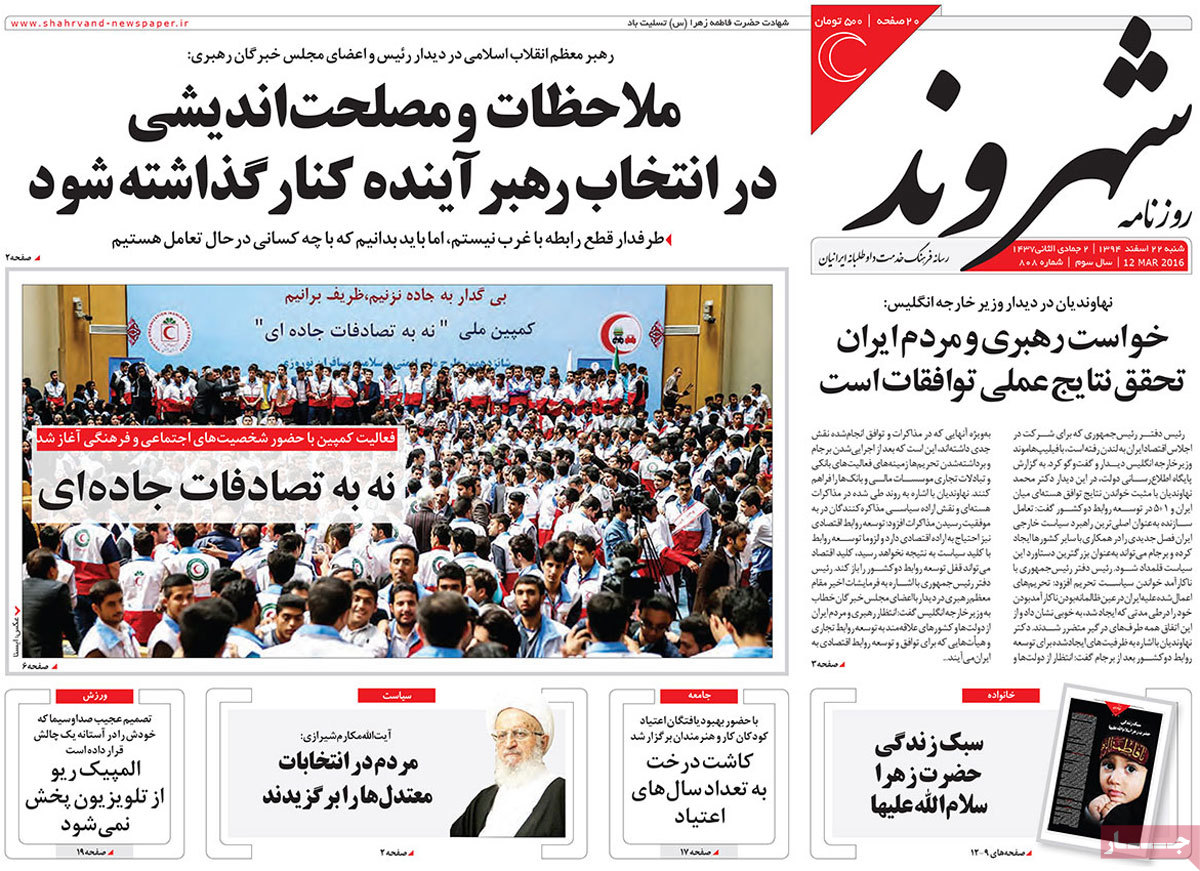
Shahrvand:

  1. Nahavandian: Leader, nation seek practical materialization of agreements’ outcome
 

A look at Iranian newspaper front pages on March 12


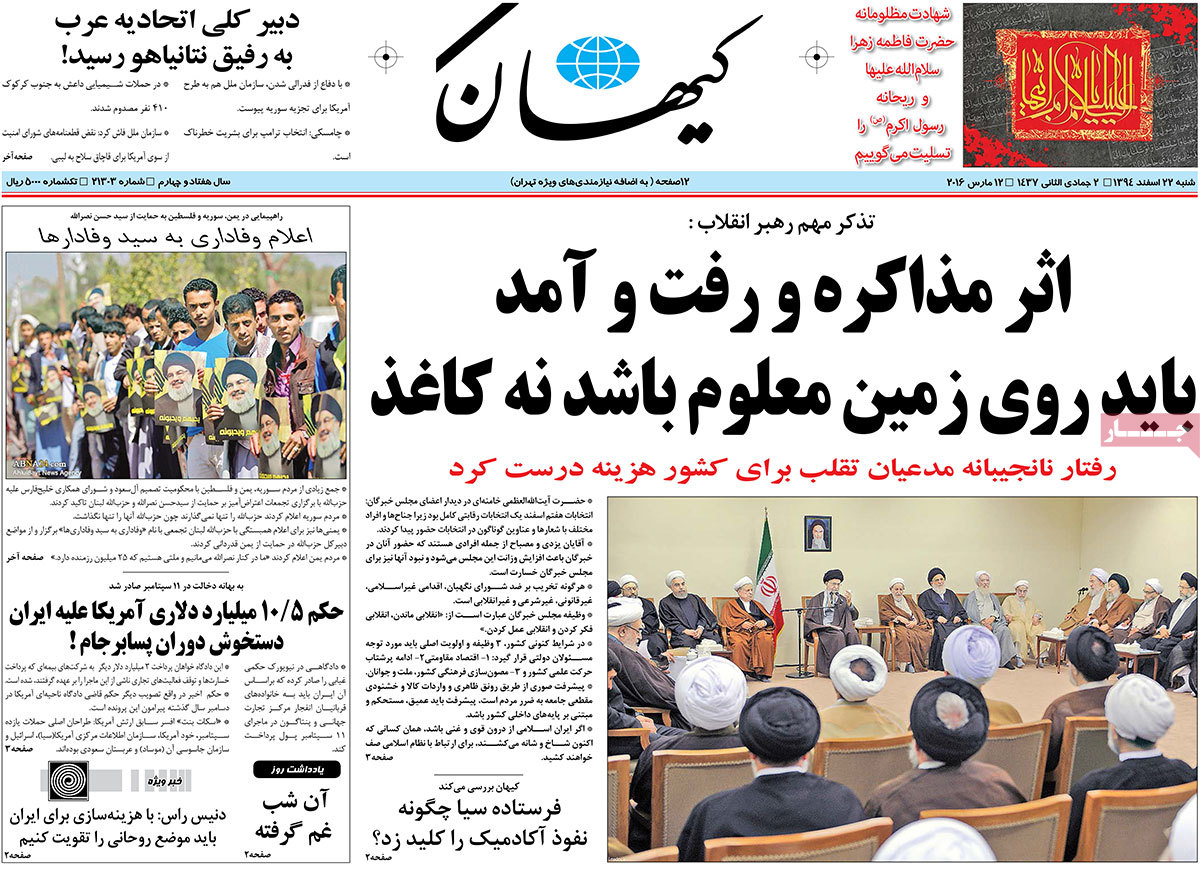
Kayhan:

  1. Leader: Result of talks, business delegations must be seen on ground on paper
  2. Iran ordered to pay $10.5 billion for 9/11 by US judge

A US judge ordered Iran to pay over $10 billion in damages to families of victims who died on September 11, 2001 – even though there is no evidence of Tehran’s direct connection to the attack. The same judge earlier cleared Saudi Arabia from culpability.

  1. Analysis: How CIA agent planned academic infiltration in Iran
 

A look at Iranian newspaper front pages on March 12


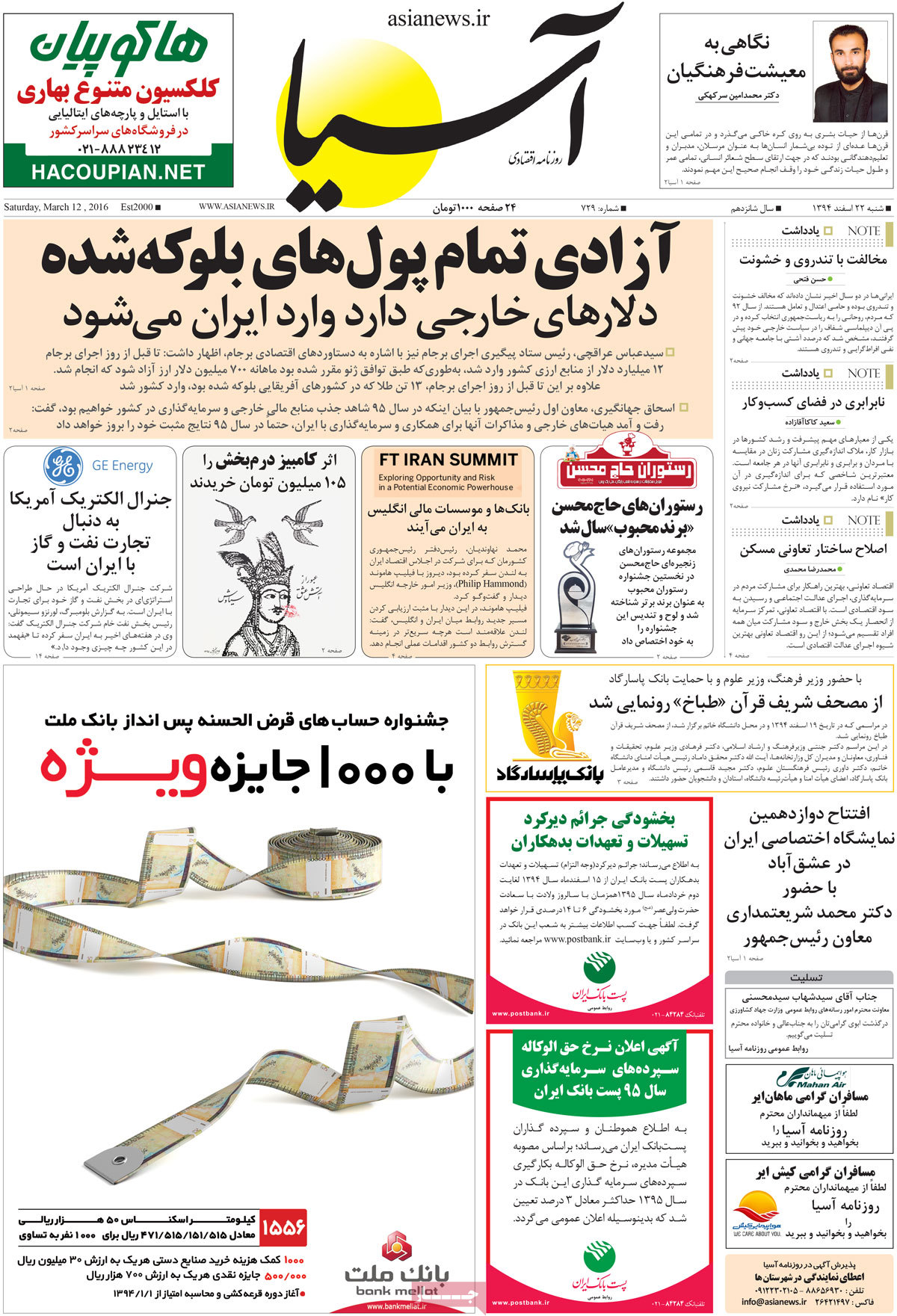
Asia:

  1. All frozen assets unblocked
  2. GE seeks oil, gas trade with Iran


A look at Iranian newspaper front pages on March 12


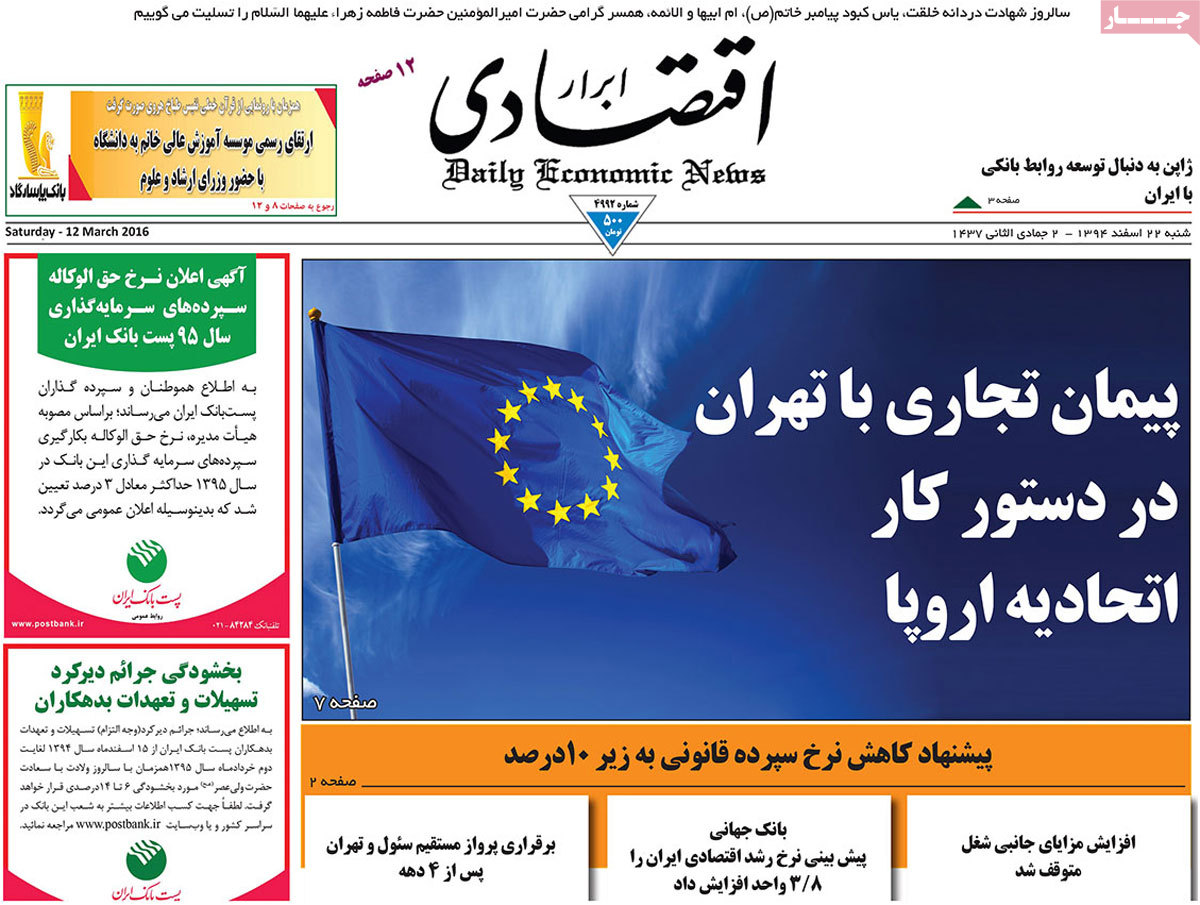
Abrar Eqtesadi:

  1. EU seeks trade pact with Iran
  2. World Bank estimates raise Iran economic growth 3.8%
A look at Iranian newspaper front pages on March 12

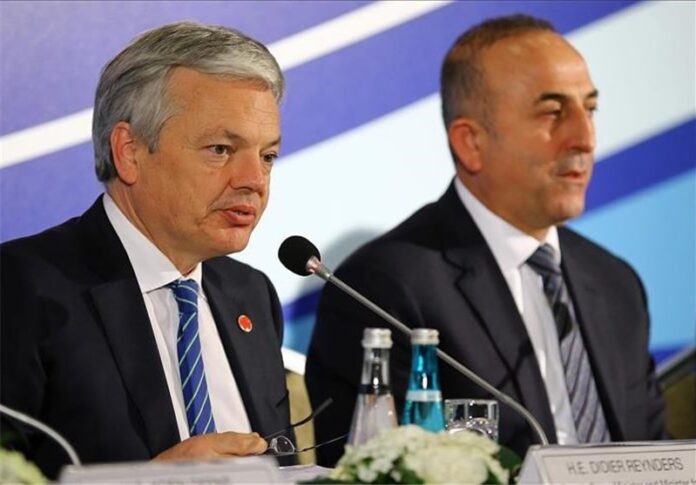
Belgium, Turkey Eye Presence in Iran’s Gas, Energy Market

Didier Reynders said Friday that Belgium and Turkey have agreed to cooperate for construction of natural gas power plants and renewable energy projects in Iran in the wake of the removal of anti-Tehran sanctions.

“With the lifting of the embargos on Iran, there will be many changes in the energy sector and we will see new investments in the country,” Reynders said as quoted by Anadolu Agency.

“Turkish and Belgian companies are already cooperating in a number of projects,” he added.

There has been growing international interest in trade ties with Iran since Tehran and the Group 5+1 (Russia, China, the US, Britain, France and Germany) on July 14, 2015 finalized a comprehensive deal on Iran’s nuclear program and implemented it on January 16.

The comprehensive nuclear deal, also known as the Joint Comprehensive Plan of Action (JCPOA), terminated all nuclear-related sanctions on Iran after coming into force.

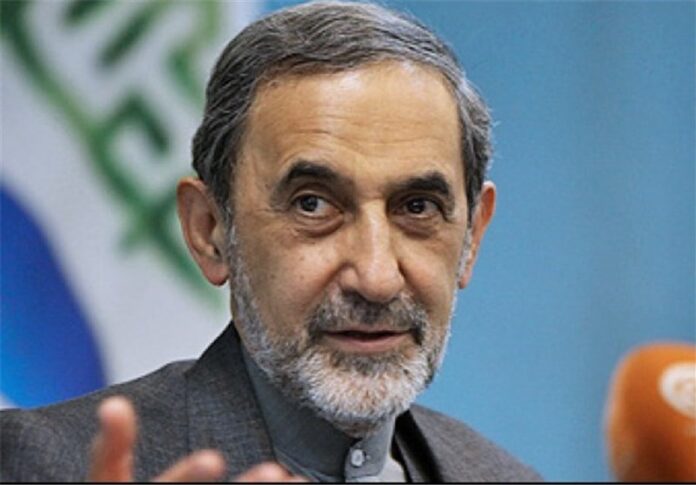
Iran’s Velayati Warns Arab League, PGCC against Unilateral Stances

It was not the Persian Gulf Cooperation Council (PGCC) that called Lebanon’s Hezbollah a terrorist organization; it was rather Saudi Arabia that did it under the guise of the PGCC, Velayati told the Tasnim News Agency on Saturday.

“Kuwait, Qatar, and Oman have already somehow parted their way from other countries on such stances, and have indeed indirectly refused to confirm the PGCC statement,” he went on to say.

In the Arab League, too, he added, it was made clear that Saudi Arabia cannot speak or decide on behalf of other Arab states, because Algeria, Tunisia, Lebanon, and Iraq later renounced the positions held by Saudi Arabia in the Arab League in the name of the Arab world.

Therefore, Velayati said, calling Hezbollah a terrorist organization was more a stance held by Saudi Arabia than the PGCC or Arab League.

Even the Emirati Minister of State for Foreign Affairs recently retweeted an anti-Riyadh post in his Twitter account to publicly express his concern about, opposition to, and dissatisfaction with Saudi Arabia’s unilateral stances, he added.

The remarks came as Arab League foreign ministers on Friday declared Hezbollah a “terrorist organization” for the second time since January, with the abstention of Lebanon and Iraq, and a reservation by Algeria.

Last week, the Arab monarchies of the Persian Gulf had declared Hezbollah, which has been fighting terrorist groups in Syria and the Israeli occupation, a “terrorist group.”

The six-nation council officially added Hezbollah and all affiliated groups to its so-called list of terrorist organizations, a move that drew widespread criticism booth in the Arab world and elsewhere.

China Eyes Major Investment in Iran’s Railway, Shipping Sectors

China’s National Transportation Equipment & Engineering Co Ltd (CTC) is about to finalize an agreement on the $3 billion rail project to link Tehran with the northeastern holy city of Mashhad, a Chinese source told Reuters earlier.

China’s Export and Import Bank (EXIM) is likely to fund 85 percent of the cost for the 930-km (580 mile) high-speed rail project, the source added.

Dalian Shipbuilding Industry Co has likewise been in talks on building container ships and oil tankers for Iran, according to the report.

It added that Iran would need $8-12 billion to modernize its fleet of container, cargo and oil tanker ships by around 2022.

There has been growing international interest in trade ties with Iran since Tehran and the Group 5+1 (Russia, China, the US, Britain, France and Germany) on July 14, 2015 finalized a comprehensive deal on Tehran’s nuclear program and implemented it on January 16.

The comprehensive nuclear deal, also known as the Joint Comprehensive Plan of Action (JCPOA), terminated all nuclear-related sanctions on Iran after coming into force.

Australia ready to boost trade with Iran

The country’s Department of Foreign Affairs and Trade in a special bulletin highlighted the potentials for trade with Iran after the removal of the sanctions.

“Sectors identified for good early prospects for Australian exporters include agriculture and food; water sustainability and management; education and skills training; and the health care and well-being sectors,” it wrote in its Business Envoy.

“In the medium term there are also likely to be opportunities for Australian companies in mining and oil and gas-related areas.”

Accordingly, Australia’s Minister for Trade and Investment Steven Ciobo in the same bulletin has emphasized that the removal of sanctions against Iran “opens up the real possibilities for trade and investment with the second biggest country in the Middle East”.

“There are some unique challenges to doing business in Iran and international competition will be stiff, so it is imperative businesses prepare carefully on the basis of sound advice,” Ciobo emphasized.

Meanwhile, Australia’s Ambassador to Tehran Paul Foley has also emphasized in the bulletin that the lifting of the nuclear sanctions has already provided increased opportunities for Australian businesses to approach the vast Iranian market.

Ambassador Foley has written that there will be strong international competition for business in Iran but stressed that a number of key factors could assist Australian businesses in approaching the Iranian market.

“These include a long-standing presence by Australia in the market, a familiarity and respect between the business communities of both countries, the strong reputation for the quality of our products and a positive view of Australia and Australians by many in Iran,” he wrote in his article in the Business Envoy.

“There is good potential for increasing exports to Iran. But this will require a hard-headed focus by business on areas of Australian competitive advantage.”

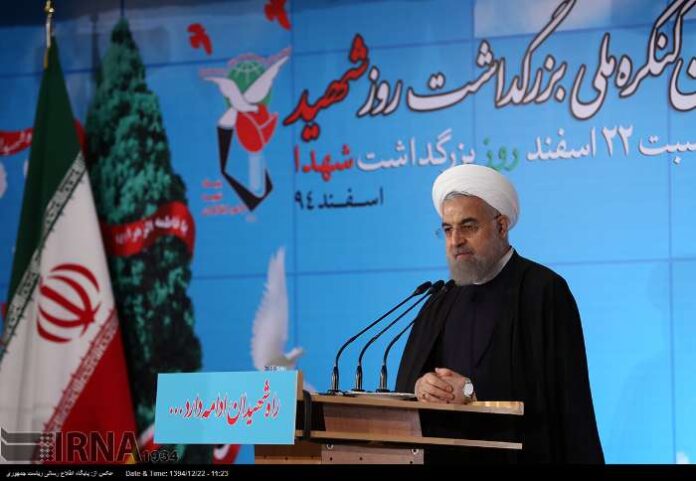
Rouhani: Ahl al-Bayt shrines, redline in Iran

Addressing the third national conference on martyrs, Rouhani said Ahl al-Bayt is among Iran’s redlines.

‘There is no question of Iraq, Syria or other countries, Iran will stand against terrorists if they want to cause any aggression against Ahl al-Bayt shrines,’ stressed the President.

Ahl al-Bayt are the family members of great Prophet Mohammad.

Speaking to the families of the martyrs in the conference, Rouhani said ‘Your youth indicated that they will defend Iran, Islamic land and Ahl al-Bayt shrines wherever they are.

‘We are seeking Islamic unity and Islamic Iran,’ he said adding ‘…we will bow down to any one who does some service for Iran and our national power.’

Talking about the February 26 elections in Iran, President Rouhani appreciated the nation for attending the elections to preserve the country’s dignity.

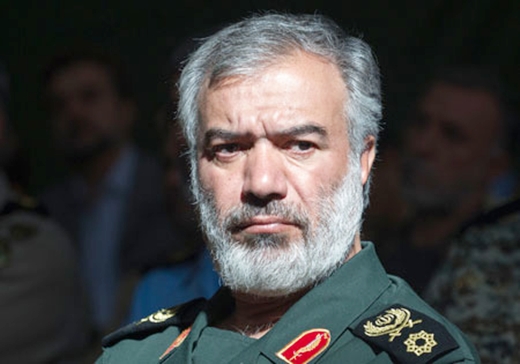
Commander: Enemy has passive role in Persian Gulf

Speaking in the commemoration ceremony of 100 martyrs in Kashan, Fadavi said the US is now certain that it will sustain damage if it does any action against Iran.

On IRGC’s courage in capturing US marines in the Persian Gulf waters, he said that it was the fourth time that English and American forces were captured by IRGC.

Referring to the fact that the U.S had no success in preventing Islamic Revolution’s expansion, he added that the United States’ attempts in Syria for five years bore no result and the Americans admitted that their failure in Syria was because of of Iran’s support.

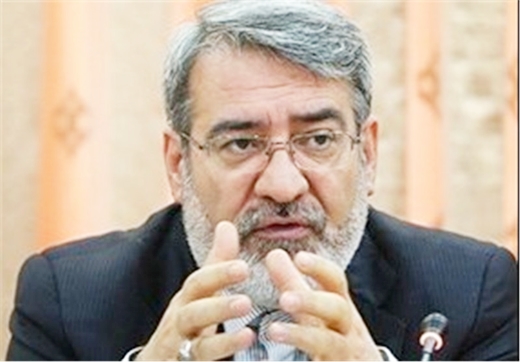
Preparations for Iran’s 2017 Presidential Elections to Begin in Early Fall

The executive phase of 2017 presidential votes will be kicked off in late September or early October 2016, Rahmani Fazli noted in a meeting with the country’s governor-generals held here in Tehran.

He further referred to the recent polls held across Iran on February 26, and noted that there was no ambiguity or doubt about the health of parliamentary and Assembly of Experts elections.

“We did not even have a handful of objections and protests at the organization of recent elections,” he added.

Earlier on Thursday, Leader of the Islamic Revolution Ayatollah Seyed Ali Khamenei also praised the tranquility and peace in which Iran’s elections were held recently, saying that while other Middle Eastern nations are experiencing insecurity, the polls were held in full security.

“While life in the countries around us has been associated with insecurity and terrorist incidents, the elections were held with such glory and massive participation of people without any bitter incident,” the Leader said in a meeting with the chairman and members of the Assembly of Experts in Tehran.

Ayatollah Khamenei added that the security of the polls was such that people in Tehran were flocking to polling stations to cast their ballots from 8 a.m. to midnight without facing any problems.

The Leader also expressed his gratitude to the efforts made by the Iranian security forces and the interior and intelligence ministries to ensure the safety of the votes.

Elsewhere in his remarks, Ayatollah Khamenei lauded the “healthy” polls, saying that despite the enemies’ propaganda campaign and claims by some inside the country, all elections held by the Islamic Establishment have been healthy and there has never been an organized move to influence the outcome of the elections.

The Leader further referred to the 62-percent turnout in the polls as “very meaningful and significant”, stressing that with such massive presence at the polling stations, the Iranian people practically demonstrated their confidence in the Islamic Establishment.

More than 60 percent of some 55 million eligible voters cast their ballots at around 53,000 polling stations across the country.

4,844 and 161 candidates ran for the parliament and the Assembly of Experts, respectively.

There are 290 seats in the Iranian parliament, elected by direct vote of people in nationwide election for four years.

The Assembly of Experts is also a high-ranking body that elects and oversees the activities of the leader of the Islamic Revolution.

Members of the 88-seat assembly are directly elected to office by people for an eight-year term. It holds biannual meetings to appoint a new chairman.

Japan to supply Iran with medical devices

Japan’s Nikkei newspaper has reported that about 40 mammography machines will be handed over to the Iranian Health Ministry as part of what has been described as the official development assistance program.

Using the same program as a gateway, Japanese corporations will develop the Iranian market with ultrasonic diagnostic equipment, endoscopes, and other offerings they are strong in.

Fujifilm Holdings and Toshiba unit Toshiba Medical Systems are among the companies apparently showing interest in the upcoming bidding, the Nikkei added.

With the lifting of economic sanctions, businesses around the world are rushing to take advantage of the promising Iranian market. And Japan, as part of its growth strategy, plans to help its corporations make inroads into Iran, added the report.

Japanese Prime Minister Shinzo Abe plans to visit Iran in August. The visit will be the first by a Japanese premier to Iran in 38 years.

Business leaders in industries such as trading, automobiles and energy will likely accompany him in the trip.

The Nikkei has also reported that Japan is to resume yen loans after a 15-year hiatus.

On a related front, Reza Nazar-Ahari, Iran’s ambassador to Tokyo, has announced that several key Japanese banks are preparing to open branches in Iran.

Nazar-Ahari added that the Japanese banks have already opened offices in Tehran and that the proceedings are underway for them to launch their operations in the Islamic Republic.

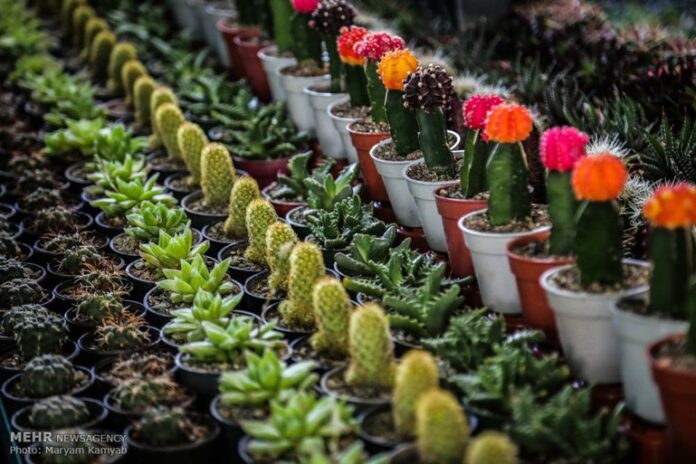
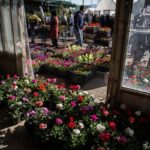
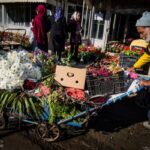
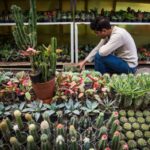
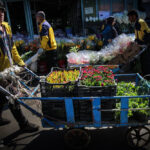
Tehran flower garden

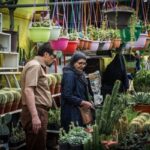
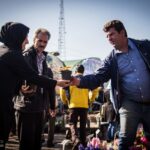
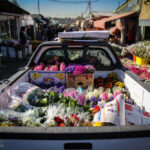
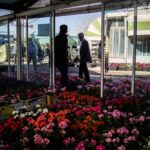
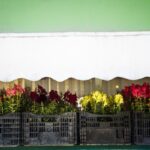
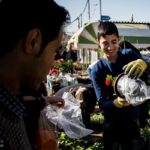
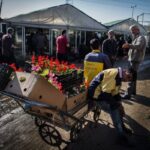
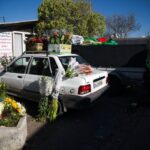
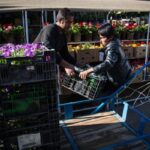
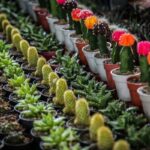
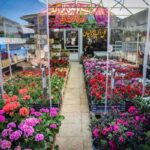
Flowers are seen on the eve of Nowrouz in Shahid Mahallati Flower Market in southeastern Tehran, where over five million flowers are traded in the market on a daily basis.

The following images have been released by Mehr News Agency: