Thursday, December 25, 2025
Home Blog Page 4565

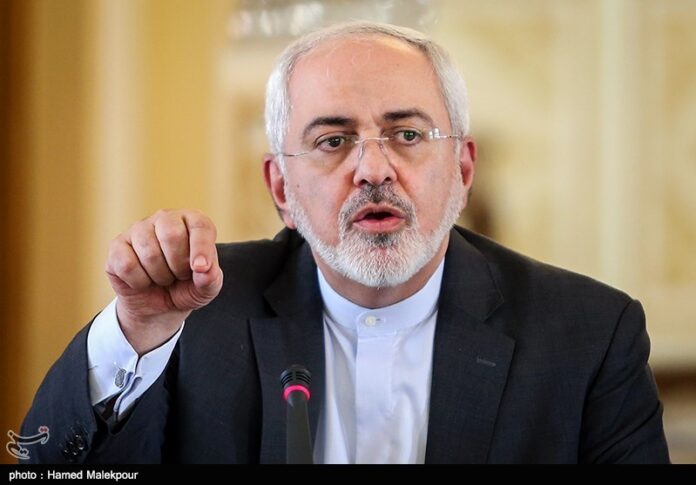
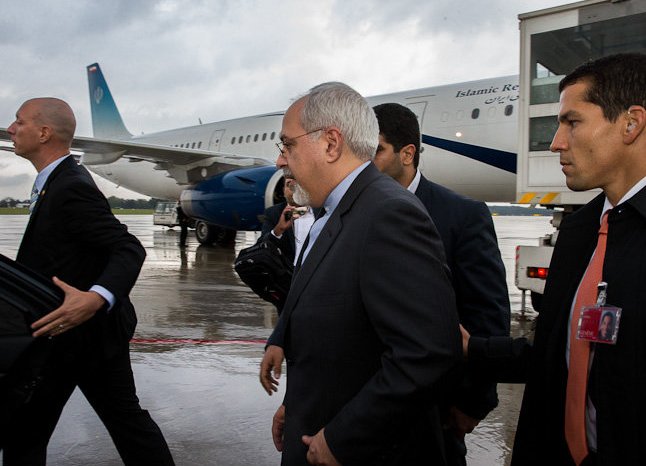
Iran FM arrives in New Zealand

Zarif wraped up his official two-day trip to Thailand and set off for New Zealand Friday evening.

During his stay in New Zealand, Zarif is scheduled to hold talks with the country’s prime minister, foreign minister and a number of other ministers and senior officials on ways to improve relations, particularly in trade and economic sectors.

He would also meet Iranian nationals residing in New Zealand and hold talks with the country’s private business people.

The Iranian foreign minister is expected to deliver a speech at a conference organized by New Zealand Institute of International Affairs and address reporters.

Zarif paid a two-day visit to Thailand and participated in the 14th Asia Cooperation Dialogue (ACD) Ministerial Meeting.

He also met with senior Thai officials, including Prime Minister Prayut Chan-o-cha and Foreign Minister Don Pramudwinai.

On Friday, Zarif sat down with Shamshad Akhtar, Under-Secretary-General of the United Nations and Executive Secretary of the UN Economic and Social Commission for Asia and the Pacific (ESCAP), dispatches reported.

The Iranian minister started his six-nation tour last Sunday and paid visits to Indonesia, Singapore, Brunei and Thailand. He would visit Australia on the last leg of his tour.

On February 19, New Zealand lifted its sanctions against Iran following the implementation of Tehran’s nuclear agreement with world powers, dubbed the Joint Comprehensive Plan of Action (JCPOA).
US fears obstructing trade with Iran – UK

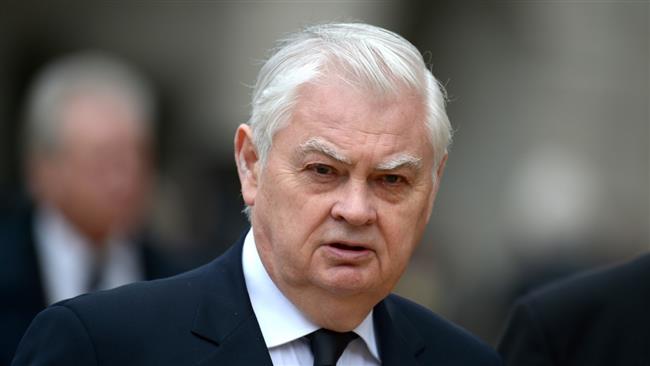
“A lot of British and American banks have been fined enormous sums of money. Some of them have deferred prosecution agreements, some are still arguing with American regulators so they are very very cautious,” Lord Norman Lamont, UK’s trade envoy to Iran, has been quoted by Iran’s media as saying.

“But I think we are beginning to see signs of some of the smaller banks coming back in and I think it will be like a pebble that starts the bigger stones rolling,” he told IRNA.

Lord Lamont also emphasized that the closure of the British Embassy in Tehran had contributed to a stalemate in trade ties between the two countries.

Lord Lamont has been appointed as the UK’s trade envoy to Iran as part of a wider government attempt to reverse Britain’s underwhelming record of exports, IRNA added.

The appointment of the former chancellor to the new role comes just three months after a series sanctions against Iran were lifted as part of a deal with the P5+1 group of countries – the five permanent members of the Security Council plus Germany – over Iran’s nuclear energy program.

The media reported this past Wednesday that UK’s Business Secretary Sajid Javid plans to visit Iran in May for high-level economic and trade talks.  Javid will head a large delegation that has been described as Britain’s biggest ever trade team travelling abroad.

The trade mission will include executives from across the oil and gas, financial services, infrastructure and engineering sectors, the Financial Times reported.

This came as Mohammad Nahavandian, the chief of staff of President Hassan Rouhani, was visiting London over the past few days to discuss the expansion of Iran-UK trade ties.

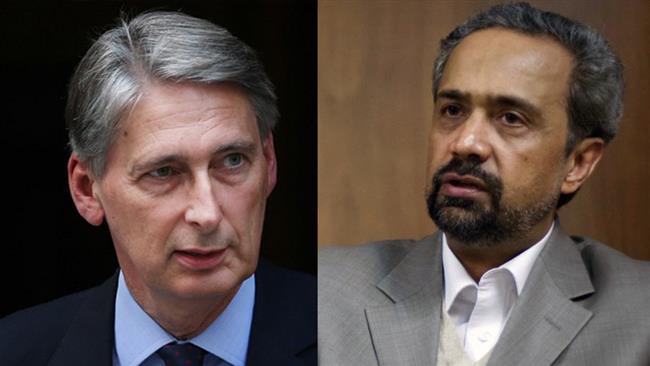
Nahavandian, in his meeting with the British Foreign Secretary Philip Hammond, called on UK to help facilitate banking transactions with Iran that are still believed to obstruct trade with the country in face of the removal of the sanctions against the country in January.

In a separate development, British Prime Minister David Cameron on Thursday was reported to have rebuked Barclays for hampering companies trying to export to Iran.

In a strongly worded letter to Jes Staley, the bank’s chief executive, Cameron said that Barclays appeared to be operating “in opposition to the policy of the UK government,” the Time reported.

Barclays is refusing to process customers’ payments from Iranian entities, despite EU and UN sanctions having been lifted, the report added.

Compassionate People and Dollars in the Street

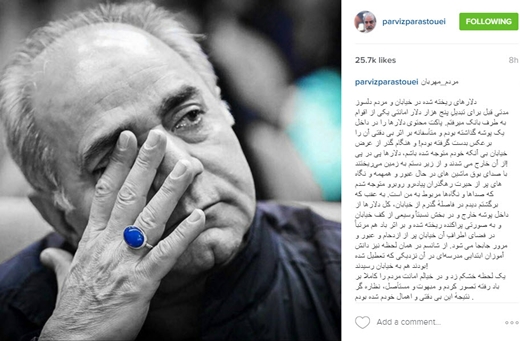
Parviz Parastouyi is one of Iran’s most famous actors, and has won several awards including Best Actor at this year’s Fajr Film Festival. In Iran, it can be a difficult job to be a famous artist without being aligned with either Reformist or Principalist causes. Parviz Parastouyi, however, seems to be an exception. He has managed to keep himself impartial while talking about the good things of both sides – perhaps this is why he has been so admired by the people as an independent character.

The following is a story shared by him on his Instagram page, narrating a story which happened to him not on the cinema screen but on a real-life Tehran street. The story has been taken from Alef News, and translated by IFP.

Parviz Parastouyi shared a story of a strange event on his Instagram page, writing about a day when he was taking a family member’s dollars to the bank.


“Compassionate People and Dollars in the Street”

“A while ago, I was going to a bank to exchange $5,000 belonging to one of my relatives. I placed the envelope of money in the middle of a file, but unfortunately, due to my carelessness, I was holding it upside down. While I was walking across the street, the notes were falling out one by one without me noticing it.

“Hearing the sound of car horns and seeing the people’s surprised faces made me glance back. I saw that all the dollars had fallen from the envelope, and were spread over a wide area of the street – spreading even more because of the wind. At that moment, some kids on their way home from school arrived on the scene as well.

“I was shocked and couldn’t move, thinking about my relative’s money being scattered to the wind, simply stunned at the result of my carelessness.

“The voice of a young woman holding a baby in her arms, who was picking dollars up from the ground, brought me back to the present: “Why are you standing there doing nothing, come on, pick them up!”

“Unbelievably, I saw lots of people all doing what I was supposed to do. There were several people on the pavement, the kids, and some young boys and girls who were stopping the cars to let others pick up the notes.

“A few minutes later, I was surrounded by compassionate people who were stretching their arms toward me holding crumpled notes. I didn’t know whether I should take the notes from them or kneel down in front of them for their honesty.

“A shopkeeper from the other side of the street came and took me into his shop. He gave me a glass of water then went and collected more notes from people who didn’t even want to be thanked for what they’d done. We counted them. Not even a single note was missing.

“After that day, I once again came to the conclusion that a good society is not necessarily one which is guided by government. We can make it ourselves. It’s not too late!”

Iran’s FM Warns of Far-Reaching Effects of Insecurity

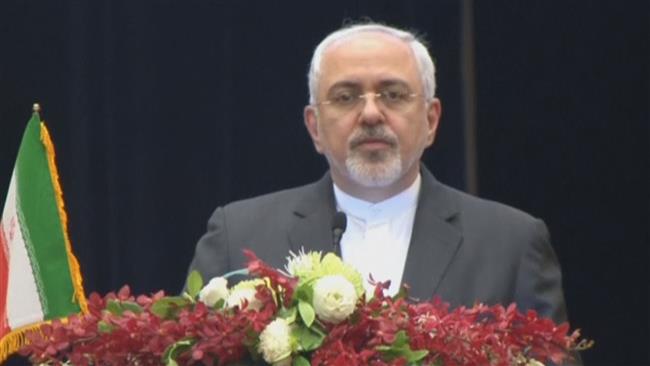
Delivering a speech at Thailand’s Foreign Ministry in Bangkok on Friday, the top Iranian diplomat called for concerted action against the sources of insecurity.

“One thing that we have failed to recognize… is (that) our security is globalized, that you cannot live in a secure world where others are suffering from insecurity. There can no longer be islands of security,” he explained.

“All of us need to recognize that in our world, today, you cannot gain at the expense of others, you cannot be secure when others are insecure, you cannot be prosperous when others are in poverty,” Zarif added.

He then reiterated that violence and extremism will not be confined to a specific region in the world.

“There is nothing that can be localized, look at our region… Some unfortunately believe that extremism, radicalism could be contained in Iraq and Syria, that radicals, extremists and the Syrian soldiers could kill each other off. Now we see the consequences, we see that extremism cannot be contained in one locality, one country, one region, one continent.”

The top Iranian diplomat is in Thailand as part of a tour of Southeast Asia and Australia.

He attended the 14th Asia Cooperation Dialogue (ACD) Ministerial Meeting in Bangkok on Thursday and held meetings with top Thai officials.


Iran’s Missile Power Non-Negotiable: General

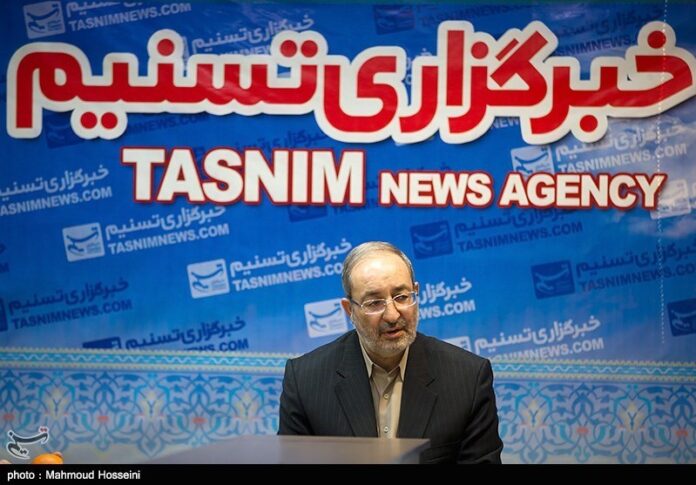
Iran’s defense capacities and its missile power are non-negotiable and are regarded as the Establishment and nation’s red lines, Deputy Chief of Staff of the Iranian Armed Forces Brigadier General Massoud Jazayeri said Friday.

He also slammed as “unjustifiable” the West’s “hasty and emotional” reaction to the military drills that the Islamic Revolution Guards Corps (IRGC) or other Iranian Armed forces stage to keep fit for defending the country’s territorial integrity.

The general described Iran’s missile power as a main deterrent factor contributing to national security in the face of ultra-regional forces with excessive demands and of the “cancerous tumor of Israel.”

His comments came after a recent missile exercise by the Islamic Revolution Guards Corps provoked hue and cry in the West.

The IRGC Aerospace Division test-fired a number of advance, ballistic missiles with pin-point accuracy in the drill.

IRGC Commander Major General Mohammad Ali Jafari had already described the message of the missile drill as security for Iran and the neighboring countries.


Iran urges facilitation of banking operations, trade exchanges

In a meeting with British Foreign Secretary Philip Hammond in London on Friday, Mohammad Nahavandian added that the implementation of Iran’s nuclear agreement with world powers, known as the Joint Comprehensive Plan of Action (JCPOA), has created great potentialities for the expansion of Tehran-London relations.

After the JCPOA went into effect on January 16, all nuclear-related sanctions imposed on Iran by the European Union, the Security Council and the US were lifted. Iran, in return, has put some limitations on its nuclear activities.

The nuclear agreement was signed between Iran and the five permanent members of the UN Security Council – the United States, France, Britain, China and Russia – plus Germany on July 14, 2015 following two and a half years of intensive talks.

Iran expects countries, particularly those involved in the nuclear agreement, to prepare the ground for banking activities and trade exchanges between financial and banking institutions, Nahavandian said.

He added that countries, which are keen to improve trade and economic cooperation with Iran, should adopt “practical measures” that would have direct and objective effects on the country’s economy.

Iran’s constructive interaction, as the main strategy in the country’s foreign policy, has opened a new chapter in its cooperation with other states, the senior official pointed out.

Practical measures to improve mutual relations

The British foreign secretary, for his part, hailed the removal of sanctions against Tehran and said his country is eager to take practical measures at the earliest to broaden relations with Iran in all fields.

Hammond expressed hope that the remaining few obstacles in the way of bolstering financial and banking cooperation with Iran would be removed as soon as possible.

Britain is resolute on the resumption of activities of its financial and banking institutions in Iran, he said.

After the implementation of the JCPOA, many European Union countries such as Italy, France and Germany signed billions of dollars worth of agreements with Iran.

British Business Secretary Sajid Javid said on Wednesday that he and other European counterparts were making efforts to ease the impact of banking restrictions on Tehran. He added that he would lead a trade delegation to Iran later this year.

Russia to ship first S-300 system to Iran in August-September

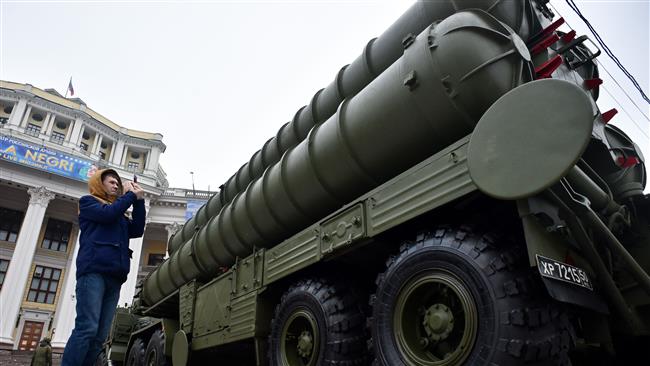
“I think we will deliver the S-300 by the end of the year…The first delivery will be in September or August,” Sergei Chemezov, the head of Russia’s industrial conglomerate Rostec said in an interview with The Wall Street Journal on Friday.

Last month, Iran’s Defense Minister Brigadier General Hossein Dehqan said the country would take delivery of the first batch of S-300 in the first quarter of 2016.

Russia committed to delivering the systems to Iran under an over USD-800-million deal in 2007. Moscow, however, refused to deliver the systems to Tehran in 2010 under the pretext that the agreement was covered by the fourth round of the United Nations Security Council sanctions against Iran over its nuclear program.

Following Moscow’s refusal to deliver the systems, Tehran filed a complaint against the relevant Russian arms firm with the International Court of Arbitration in Geneva.

In April 2015, Russian President Vladimir Putin signed a presidential decree, paving the way for the long-overdue delivery of the missile defense system to Iran.

The decision came after Iran and the P5+1 group of countries – the United States, France, Britain, China and Russia plus Germany – reached a mutual understanding on Tehran’s nuclear program in the Swiss city of Lausanne on April 2, 2015.

Tehran also developed its domestically-built Bavar-373 air defense system, which was successfully test-fired in August 2014. The Bavar-373 long-range missile defense system, which is similar to the Russian S-300, has been manufactured by Iranian defense experts, and is capable of hitting air targets at a high altitude.

In recent years, Iran has made great achievements in its defense sector and attained self-sufficiency in producing essential military equipment and systems.

Iraqi FM’s Hezbollah Remarks Anger Saudi Delegation

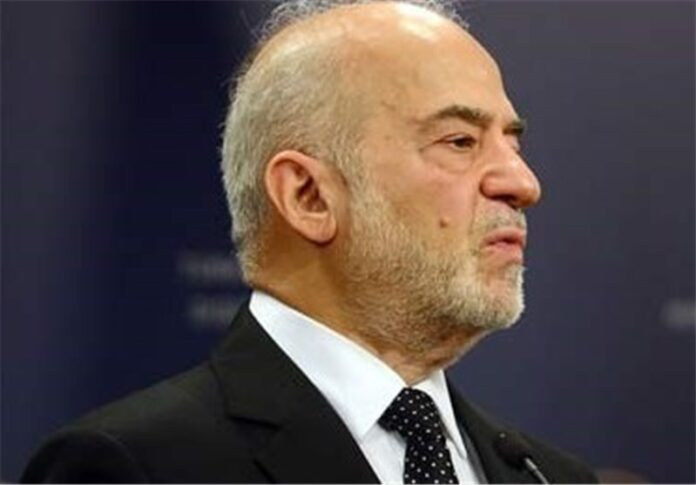
“Whoever accuses Popular Resistance for the Liberation of Iraq and Hezbollah of terrorism is the one who supports and adopts terrorism,” Jaafari said in his speech, a source in the foreign ministry told the Iraqi news agency.

Jaafari expressed solidarity with Hezbollah in his speech, underlining that the “popular resistance and Hezbollah safeguarded the dignity of Arabs,” Lebanon’s Daily Star reported.

The Iraqi minister rejected attempts to distort the image of Hezbollah, saying that the party’s Secretary-General Sayyed Hassan Nasrallah “is an Arab hero who defended values and principles.”

Tensions have intensified between Riyadh and Hezbollah since March 2015 over the war in Yemen, where the two groups support opposite sides.

The Persian Gulf Cooperation Council (PGCC) and the Arab Interior Ministers separately designated Hezbollah as a “terrorist organization” last week. The development came amid strained relations between the party and Saudi Arabia, which is a leading PGCC country.

Last month, the Persian Gulf littoral state suspended $4 billion in aid to the Lebanese Army and police in response to stances taken by Lebanese officials.


Extremism cannot be confined to a single locality: Iran FM

Speaking at the Thai Foreign Ministry in Bangkok on Friday, Zarif described how the world today has transformed into a globalized environment where nothing can be confined to a particular location.

He explained how news and emotions, among other things, can quickly reach widespread audiences throughout the world, defying borders of time and space.

“One thing that we have failed to recognize,” he said, however, “is [that] our security is globalized, that you cannot live in a secure world where others are suffering from insecurity. There can no longer be islands of security.”

“And if anybody had any doubts, September 11 [2001] proved that even the greatest military power on the face of the earth could not live securely when others, perverted as they may be, found the logic of force, the logic of power not serving their purpose, and reversed that logic in order to create terror.”

“All of us need to recognize that in our world, today, you cannot gain at the expense of others, you cannot be secure when others are insecure, you cannot be prosperous when others are in poverty,” the Iranian foreign minister said.

Zarif drew attention to the policy of some countries in believing that they can have violence in the Middle East burn the region out, and said the consequence of such a policy has only been the spread of terror.

“There is nothing that can be localized, look at our region,” he said, “Some unfortunately believe that extremism, radicalism could be contained in Iraq and Syria, that radicals, extremists and the Syrian soldiers could kill each other off. Now we see the consequences, we see that extremism cannot be contained in one locality, one country, one region, one continent.”

“Once you have extremism in one corner of the world, extremist forces all over the world will be energized and will be motivated to breed insecurity and to provide breeding ground for further extremism,” Zarif said.

He said statesmen have to realize the “simple fact” that phenomena have wide-reaching impacts beyond the region where they exist.

“We tried to do it with the nuclear issue,” he said, in reference to the Iranian administration’s attempts to resolve a long-running nuclear dispute over its nuclear program.

He said the United States had defined the nuclear dispute “in a zero-sum way.”

“The United States, during former President [George W.] Bush, had defined the nuclear issue, the Iranian nuclear program, as a program that needed to be stopped,” he said.

“Our objective was ‘this is our right, Iran has a right as an NPT member to develop nuclear technology for peaceful purposes and no one can question us,’” Zarif said.

“And that’s how we managed to hurt each other,” the top Iranian diplomat said.

He referred to how the negotiations took a shift toward the resolution of the dispute and said Iran started to redefine the problem by working on a manner of resolving the issue that everyone could consider their own.

“Therefore, a simple equation, which we can apply everywhere: zero-sum games do not exist in a globalized world, we cannot have a zero-sum game, every zero-sum game produces negative-sum results. We all end up losers,” he emphasized.

The Iranian foreign minister is in Thailand on a two-day visit to participate in the 14th Asia Cooperation Dialogue (ACD) Ministerial Meeting.

In his stay, Zarif has met with senior Thai officials, including Prime Minister Prayut Chan-o-cha and Foreign Minister Don Pramudwinai.

British Airways to resume flights to Iran

The agreement has been announced by Iran’s Civil Aviation Organization (CAO) which said the flights by British Airways to Iran will resume from 14 July 2016.

The Organization has added that based on the agreement a total of 21 passenger flights will be made from Britain to Iran per week.

It also said that there will be no restrictions on the number of cargo flights by British Airways to Iran.

British Airways had in January voiced interest in reinstating its direct flights to Iran.

“We are very interested in flying to Tehran and we are hopeful that it will form part of BA’s network in the very near future,” The Telegraph has quoted Willie Welsh, the CEO of British Airways, as saying. “We are actively looking at it as a destination,” Walsh had emphasized.

This came following other indications that there is already a growing interest by British tourists to travel to Iran.

Several other key international airlines have also expressed interest in resuming flights to Iran.

Air France-KLM said in December that it will resume direct flights to Iran after a seven-year gap. It said it plans to launch three weekly flights between Paris and Tehran from April 2016.

“Air France is showing its ambition to develop itself in a country with dynamic growth and for which the European Union is Iran’s fourth economic partner,” the company announced in a statement.

German airliner Lufthansa and its subsidiary Austrian Airlines have already said they planned to launch new flights to Iran.