Thursday, December 25, 2025
Home Blog Page 4533

British Banks Remain Reluctant to Finance Trade with Iran

“This is a problem I regret will take a little time to resolve,” said Britain’s trade envoy to Iran, former finance minister Norman Lamont, as quoted by Reuters.

“You can understand why they (banks) are extremely cautious – they have already been fined billions of dollars,” he told a City & Financial Iran Trade conference in London.

Meanwhile, Alexandra Renison, with Britain’s Institute of Directors (IoD) lobby group, said that smaller European banks were starting to move toward providing trade finance to Iran, but the “risk appetite is absolutely not there” for British lenders.

“Any banks in the UK that really have any exposure in the United States … are simply not budging,” she told the conference.

Additionally, British Trade and Investment Minister Mark Price said the UK was working on these issues with Washington, adding that Business Secretary Sajid Javid would meet with British banks ahead of an official trade delegation to Iran next month.

“His plan is to take UK banks out on that delegation,” Price told the conference. “This government would like to see the banks play their part.”

A huge delegation of British businessmen is planned to travel to Iran in May in a bid to explore business opportunities in the Islamic Republic following the termination of anti-Tehran sanctions.

Javid will lead the delegation of British businessmen to Iran.

There will be executives on the trip from across the oil and gas, financial services, infrastructure and engineering sectors.

Tehran and the Group 5+1 (Russia, China, the US, Britain, France and Germany) reached a nuclear deal on July 14, 2015 and started implementing it on January 16.

The comprehensive nuclear deal, known as the Joint Comprehensive Plan of Action (JCPOA), terminated all nuclear-related sanctions imposed on Iran, but the country is not getting the full economic fruits of the landmark deal yet.
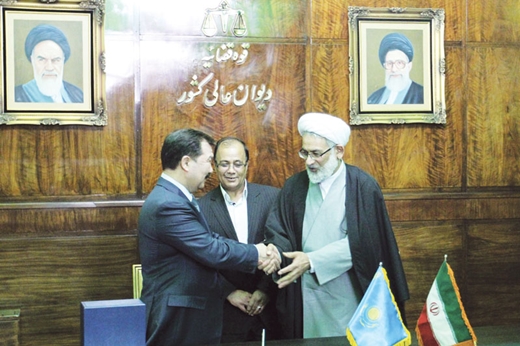
Iranian, Kazakh Judiciary officials sign MoU on judicial cooperation

Prosecutor Montazeri underlined necessity of expansion relations and legal, judicial cooperation between the two countries.
Montazeri said that terrorism is one of the major concerns of the world community and unfortunately some of the big powers are supporting them.
He said that Iran supports international peace and security in the region and that Iran is ready to offer assistance to Kazakhstan in campaign against drug-trafficking.
Montazeri said that fight against drug trafficking needs collective cooperation of the international community.
Daulbayev expressed pleasure with his visit to Iran and appreciated Iranian hospitality.
He congratulated Montazeri for his appointment to the post and said that relations between the two countries have always been upon mutual respect.
He welcomed expansion of legal, judicial relations between Iran and Kazakhstan and said that the aim of signing legal and judicial agreement was improving justice affairs and facilitating the legal issues of the people living in the two countries.
He called for using Iranian experience in the field of fight against terrorism and extremism.
Daulbayev also called for more cooperation with Iran in the field of fight against drug trafficking at international level, saying that his office is ready to exchange views with Iranian justice officials and use Iranian legal experience to address the justice issues.

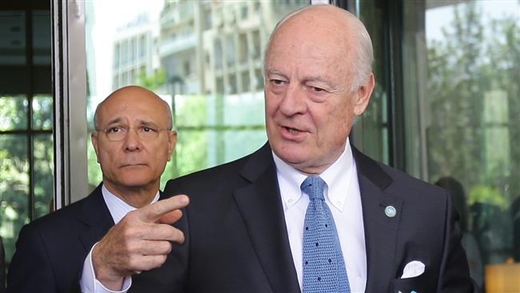
De Mistura arrives in Iran ahead of Syria peace talks

The indirect talks between the Syrian government and opposition will resume in the Swiss city on April 13.

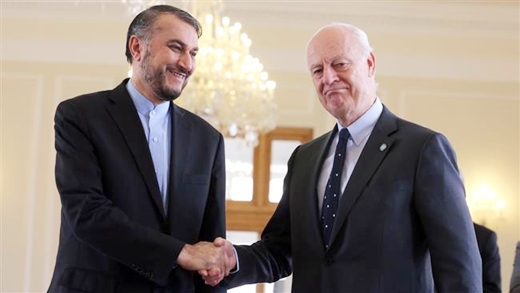
De Mistura planned to meet senior Iranian officials, including Deputy Foreign Minister Hossein Amir-Abdollahian.

The UN envoy traveled to Damascus on Sunday and met with Syrian officials there. He said there that the upcoming round of intra-Syrian dialogue would be “crucially important.”

The last round of the UN-backed peace talks for Syria came to a halt on March 24 over disagreements on the role of President Bashar al-Assad in Syria’s future.

The foreign-backed Syrian opposition says Assad must step down before a transitional government can be established.

Last month, Syrian Foreign Minister Walid Muallem reiterated that Syria “will not talk with anyone who wants to discuss the presidency,” adding, “Bashar al-Assad is a red line.”

The West and its allies in the Middle East say Assad cannot be part of a future government in Syria. Iran and Russia insist that the Syrian people must decide on their future.

Syria has been gripped by foreign-backed militancy since March 2011.

According to a February report by the Syrian Center for Policy Research, the conflict in the Arab country has claimed the lives of over 470,000 people and displaced nearly half of its pre-war population of about 23 million within or beyond its borders.

“Starless Dreams”, “Sonita” win awards at Full Frame festival

Directed by Mehrdad Oskui, the film won the grand award of the festival which was sponsored by the Reva and David Logan Foundation.

In the documentary, young women in an Iranian juvenile detention center reflect on the crimes they have committed and the harsh circumstances that have shaped their lives.

“We are presenting the Grand Jury Award to a film that took us into a world we are not normally privileged to see,” The jury composed of Rachel Boynton, Margaret Brown, and Ricki Stern stated.

“Beautifully crafted with tenderness and enormous respect for the people in it, this film left us with a bracing emotional punch,” they added.

“Starless Dreams” also received the Full Frame Inspiration Award, which was sponsored by the Hartley Film Foundation.

The jury in this category, Sarah Masters, Michael Palmieri and Malika Zouhali-Worrall said, “This award is presented to the film that best exemplifies the value and relevance of world religions and spirituality.”

Cinema Guild, the New York-Based film distributor, holds the franchise for distribution of “Starless Dreams” in the U.S., Canada and Puerto Rico.

“Sonita” directed by Rokhsareh Qaemmaqami was presented with the Center for Documentary Studies Filmmaker Award, which was provided by the Center for Documentary Studies at Duke University.

The documentary is about Sonita, an Afghan refugee living in Iran who fights to keep her dream of becoming a rap star alive, while her family attempts to sell her as a bride.

The Full Frame Jury Award for Best Short went to “Clínica   de Migrantes: Life, Liberty and the Pursuit of Happiness, directed by Maxim Pozdorovkin from the U.S.

The festival is organized by the Center for Documentary Studies, a tax-exempt nonprofit organization, and receives support from corporate sponsors, private foundations and individual donors.


Photo: A poster for “Starless Dreams”

Anniversary of ​Imam Hadi​’s Martyrdom Commemorated at Sayyida Masoumah,​ Qom

Martyrdom anniversary of Imam Hadi held at holy shrine of Sayyida Masoumah in Qom, Iran 1437-2016


Official: Political Resolve to Solve Syrian Crisis at Hand

The talks between the Syrian government, opposition groups and civil society are on the verge of a new phase. Amir-Abdollahian commented that, “We are glad to witness that the grounds for political resolution to solve the Syrian crisis have been prepared.”
Amir-Abdollahian made the remarks on the sidelines of his meeting with the UN special envoy for Syria Staffan de Mistura, in Tehran on Tuesday. Speaking to reporters, he said that they he had had very significant negotiations with the UN envoy for Syria on the continued political talks on the Syrian crisis.
In the meeting, many topics were raised, including the concern about the increase in the activities of irresponsible armed groups in Syria in recent days, and also the rise in the number of ceasefire violations, which can harm the pace of political progress in the country, Amir-Abdollahian said.
Humanitarian aid shipments are delivered quite selectively by some groups, which has created many problems, he added.
Supporting the efforts of the UN envoy for Syria to resolve the country’s crisis through political means, he said, “We are very satisfied to witness that regional and international parties are serious in the fight against terrorism, and are trying to bolster the pace of political talks and avoid taking actions against Syria’s national interests.”
“The fight against terrorism should be continued seriously, and talks between the Syrian government and opposition groups can produce satisfactory results,” he stated.
Some terrorist groups had tried to enter into talks with the Syrian government under concealed identities, he said.

Iranian oil tankers free to cross Panama Canal

In time with the visit to Tehran of Jorge Barakat Pitty, Panama’s Minister of Maritime Affairs and Administrator of the Panama Maritime Authority, and conducting final negotiations with Iranian authorities, the agreement has been reached for the Iranian tankers to commute through the Panama Canal using the flag of convenience.

Following a meeting with Jorge Barakat Pitty of Panama, Director of National Iranian Tanker Company (NITC) Ali Akbar Safaei announced the Caribbean littoral state’s readiness to cooperate with Iran in various areas including ship registration, and to allow Iranian merchant ships to fly Panama’s flag.

Panama has just three million people and little history of maritime trade yet paradoxically is home to the world’s largest fleet of ships.

As of 2009, more than half of the world’s merchant ships were registered with open registries, and the Panama flags accounted for almost 18% of the entire world fleet, in terms of deadweight tonnage.

During sanction year, Iranian tankers had to fly flags of African counties like Tanzania in order to bypass international restrictions as Panama would not cooperate with Iran in this regard.

Iran Urges End to Psychological Legacy of Sanctions Era

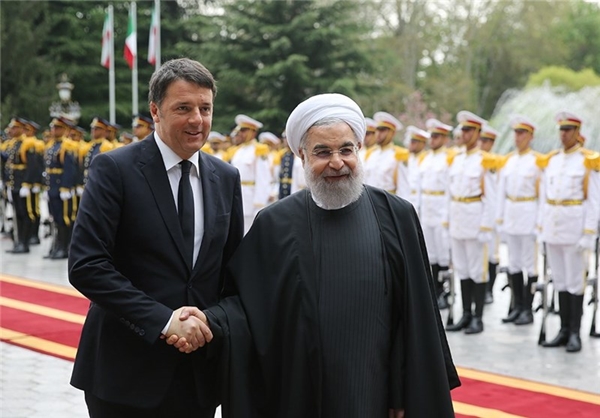
Speaking to reporters in Tehran on Tuesday after a meeting with Italy’s prime minister that concluded with the signing of six agreements, President Rouhani said although a lasting nuclear deal between Iran and the Group 5+1 (Russia, China, the US, Britain, France and Germany) has terminated the banking and trade sanctions on Tehran, there still remain some details that should be resolved more quickly.

Stepped-up efforts are required to wipe out the “psychological atmosphere” remaining from the era of sanctions, Rouhani added.

He further noted that finalization of 36 cooperation documents between Iran and Italy over the past three months would make way for closer economic relations, particularly in investment and importing new technologies from Italy.

Calling for practical measures to implement the previous agreements, President Rouhani said Italy can once again become Iran’s biggest European trade partner.

Rouhani said he has also held talks with Matteo Renzi on the need to counter Islamophobia and to ramp up efforts to settle regional conflicts, as those in Afghanistan, Yemen, Iraq, Syria, Lebanon and Libya.

Iran and Italy are resolved in the fight on terrorism and providing humanitarian help for the people of Yemen and Syria, the president added.

For his part, the visiting Italian premier hailed the new ties between Tehran and Rome as a historic chapter in their bilateral relations.

Renzi also said he is accompanied by representatives from Italy’s major banks, financial institutes and insurance companies, because strong economic relations hinge on their active role.

Making a reference to the 43rd annual summit of the Group of Seven (G7), due to be held in Italy in 2017, Renzi said Rome will try to fully end what has remained from the anti-Iran sanctions and create a better atmosphere for economic interaction with Tehran.

Heading a 250-strong business delegation, Renzi arrived in Tehran on Tuesday.

The trip comes around three months after President Rouhani made a landmark visit to Italy.

Iran seeks Finland’s coop. in environmental protection

Masoumeh Ebtekar, Iran’s VP and Head of Environmental Protection Organization, said Finland can cooperate with Iran in transfering new technologies, natural environment, preserving biodiversity and better management of protected areas, green economy, tackling air and soil pollution, as well as global warming, as terms of cooperation signed in the joint MoU between the two countries.

Ebtekar also added that the two countries can expand cooperation in preserving wetlands such as Hamoun (shared between Iran and Afghanistan) or Lake Urmia.

She noted another area for cooperation as measuring and monitoring air, water and soil quality, saying Iran has so far implemented many projects in this regard such as installing online monitoring cameras, and establishing and improving air pollution monitoring stations.

She further announced that Iran will host a conference on religion, culture and environment in the near future which aims to establish a connection between environment, peace and religions.

Antti Kaikkonen, for his part, stressed that Iran and Finland have many potentials for improving cooperation in environment, adding “Helsinki can cooperate with Tehran in various environmental fields such as production and storage of clean energy, energy efficiency and waste management.”

“Finalnd can transfer the technology of energy efficiency to Iran so that the country would be able to reduce greenhouse gas emissions,” he said.

Kaikkonen further expressed his country’s readiness to take steps toward the implementation of Iran-Finland environmental MoU.

Kaikkonen had also held a meeting with Iranian Foreign Minister Mohammad Javad Zarif on Sunday, during which the two sides conferred on the latest developments in bilateral ties and regional issues.

Jalalpour’s Complaint: German-Iranian Banking Still Limited

IFP: This article, originally from Tasnim, is a report by Mohsen Jalalpour about his recent meeting with a German Agriculture Minister and trade delegation.


According to Tasnim, Mohsen Jalalpour posted on his Telegram Channel, “I also had two foreign meetings in my compressed schedule yesterday. The first one was with Germany’s Minister of Agriculture and his delegation, then later with Estonia’s Foreign Minister. Both of the meetings were held in the presence of economic experts from the two countries.

“In my meeting with the German Minister of Agriculture, after highlighting the fact that the infrastructure for bilateral activities involves solving banking and insurance issues, I made a serious complaint about the behavior of German banking and insurance institutes during the sanctions era. I told them: During the sanctions, there was no limitation on the food industry, and even its banking transactions were also legal with the right documents. However, Germany drew serious boundaries for food-related banking transactions involving Iran. Worse than that is the fact that they’re still implementing them.  The head of the Agriculture Committee of Iran’s Chamber also talked of this stringency, saying “There is evidence that Americans sent German products to Iran during the sanctions era, using middlemen. This was while we couldn’t make any purchases from Germany.”

“Despite all those issues, the meeting with the German Agriculture Minister was still hopeful. I could see this in his reactions, and those of his delegation, towards collaboration with Iran in mutual investments in fields such as water, wastewater, desalination, modern planting technologies, environment, agricultural tourism and transferring the most recent and modern technologies.

“He also welcomed my suggestion about the importance of forming international collaborations in solving the region’s environmental issues, such as dust.

“In the end, he promised to raise the banking issue as a priority in parliament, and to make sure that Germany will catch up with Austria and Italy in that regard.”