Thursday, December 25, 2025
Home Blog Page 4521

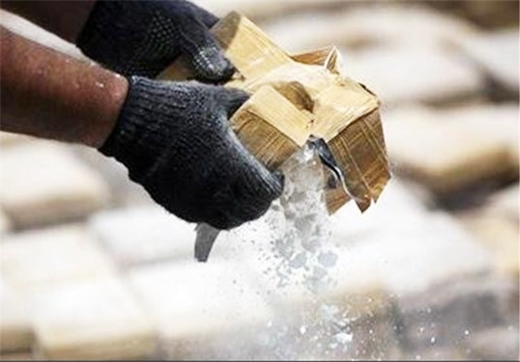
Iranian Police Seize over 2 Tons of Narcotics in Southeastern Province

Speaking to the Tasnim News Agency, Brigadier General Hossein Rahimi said that, anti-narcotics forces recently identified a major drug ring in the city of Iranshahr involved in smuggling various kinds of illicit drugs.

In an overnight operation, the police forces managed to detect the smugglers’ vehicles and chased them at a main road connecting Iranshahr to Sarbaz.

After a while, the traffickers started shooting at police officers, the commander said, adding that they soon realized they could not confront the forces and fled the scene.

General Rahimi went on to say that 1,664 kg of opium were seized from the smugglers’ vehicles in the operation.

In another operation in Saravan, he said, police forces seized 563 kg of opium and 15 kg of morphine in a vehicle.

In recent decades, Iran has been hit by drug trafficking, mainly because of its 936- kilometer shared border with Afghanistan, which produces more than 90% of the world’s opium.

According to the UN Office on Drugs and Crime, the Islamic Republic is netting eight times more opium and three times more heroin than all other countries in the world combined.

8,000-Year-Old Pottery Unearthed at Sarsakhti Castle

Extensive excavations have been made at the prehistoric site, said Ghafoor Kaka, head of the excavation team, according to an Iran Daily report.

The unearthed pottery is from the Neolithic and Chalcolithic eras, Kaka added.

Photos were taken of the Sarsakhti site for photogrammetry used in aerial and topographic mapping, he said.

Almost 1,200 ancient sites have been discovered and excavated in Markazi Province in recent years. In addition, Atashkooh Fire Temple, Jam Hill and Qiz Qaleh near the city of Saveh have been registered on the National Heritage List.

Excavation activities at ancient sites including Aveh in Saveh, Meshkin Tappeh in Zarandiyeh, Zolfabad in Farahan, rock-cut reliefs in Tahigh Village in Khomein and Khorheh in Mahallat have been undertaken in recent years.

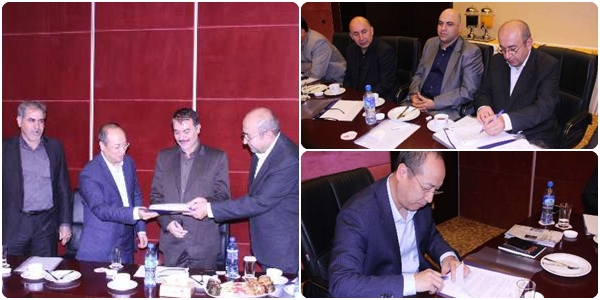
China to invest in Mehran Petrochemical construction

Managing director of the Iranian company Mohammad Reza Daqiq, said that following the implementation of the project, petrochemical products such as resin phenol and acrylic acid will be produced for the first time in the country.

Noting that the plant will be built using the latest technologies of Germany, Denmark and France, he added that products of the petrochemical unit will be used in the production of nylon, types of wash-ups, paints, aspirin and gasoline additives.

The official also hoped that following the construction Mehran power plant, the need for imports of raw materials of oil and gas downstream industries will be removed.

The project will take 40 months to complete, he said, adding that it will generate direct and indirect 3,000 jobs.

Meanwhile, assistant of CNTIC managing director, Yang Bin told IRNA that the company has been working in Iran since 25 years ago, adding that the company has so far financed lines I and II of Tehran Metro, several cement factories and certain telecommunications projects.

He put the value of Mehran petrochemical unit deal at 1.650 billion euro, saying that the company share in the project is 85 percent with the remaining 15 percent belonging to Iran.

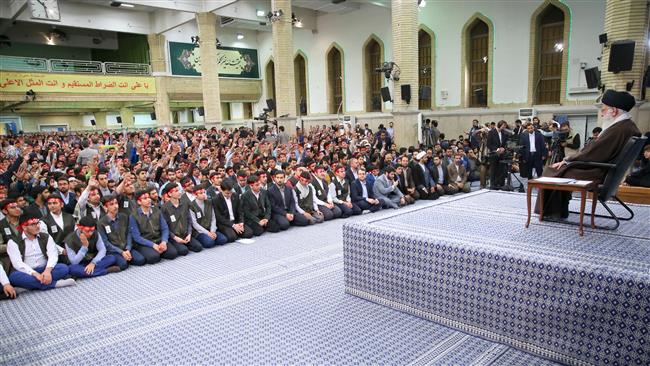
Hezbollah a source of pride for Muslims: Leader

The Leader’s remarks on Wednesday came after the Arab Parliament followed the Arab League and the Persian Gulf Cooperation Council in designing Hezbollah as a terrorist organization.

“Let’s suppose a corrupt, sycophantic, hollow regime condemns Hezbollah in a statement with money and petrodollars; to hell with it! How much does it matter?” Ayatollah Khamenei told a group of students in Tehran.

“Hezbollah and its youths are shining as the Sun and are a source of honor for the world of Islam,” Ayatollah Khamenei added.

Saudi Arabia has been leading the campaign against Hezbollah which is credited with driving Israeli troops out of southern Lebanon and defeating them in subsequent wars.

Relations between Lebanon and Saudi Arabia have been plunged into crisis since Riyadh halted $3 billion in aid to the Lebanese army. Saudi Arabia and its allies in the Persian Gulf have also advised citizens against travel to Beirut. 

In his speech, Ayatollah Khamenei also warned against any submission to new Western demands about Iran’s missile defense program and other technologies.

“If we show any leniency toward them, they will begin playing games with biotech, nanotech and scientific issues and make problems,” the Leader said.

Iran reached a nuclear agreement in July to have a raft of sanctions lifted but the country has come under new pressures from the US and its allies over its missile defense program since then.

“One of the most basic motivations which have prompted arrogant powers to square up against us is that a country, without relying on any power, has managed to reach the extraordinarily sensitive nuclear stage,” Ayatollah Khamenei said.

The Leader warned of “a covert soft war” being waged by the US against Iran. Ayatollah Khamenei said the US is trying to make Iranian youths lose trust in their officials and embrace the country’s enemies instead.

“The US would like the Iranian youth to lack courage, motivation, hope, activeness, physical and mental capability,” the Leader said.

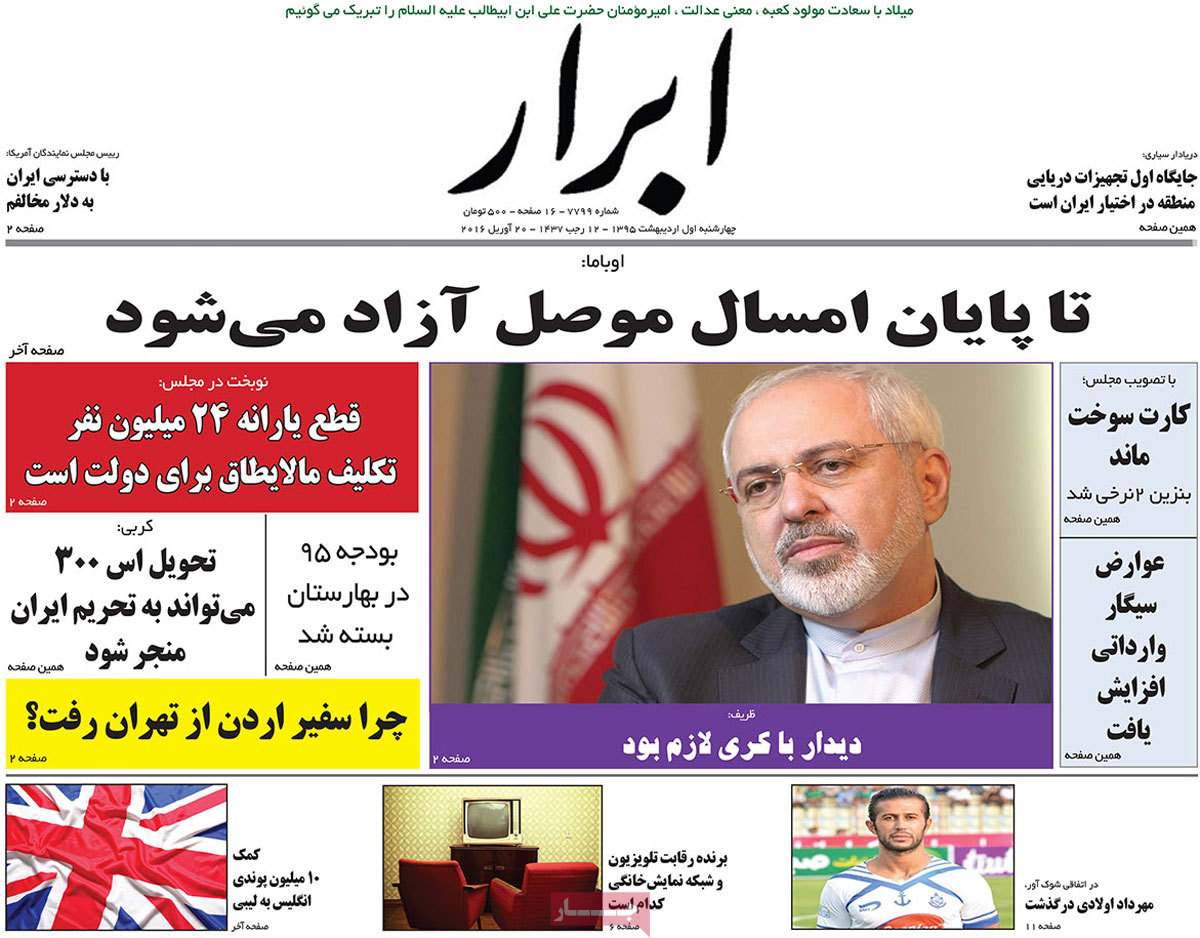
A look at Iranian newspaper front pages on April 20

Iran Newspaper front pages

Abrar:

1-Obama: Mosul to be liberated by the end of 2016

2-Zarif: meeting Kerry was needed

3-Customs duty on imported cigarettes increased


A look at Iranian newspaper front pages on April 20


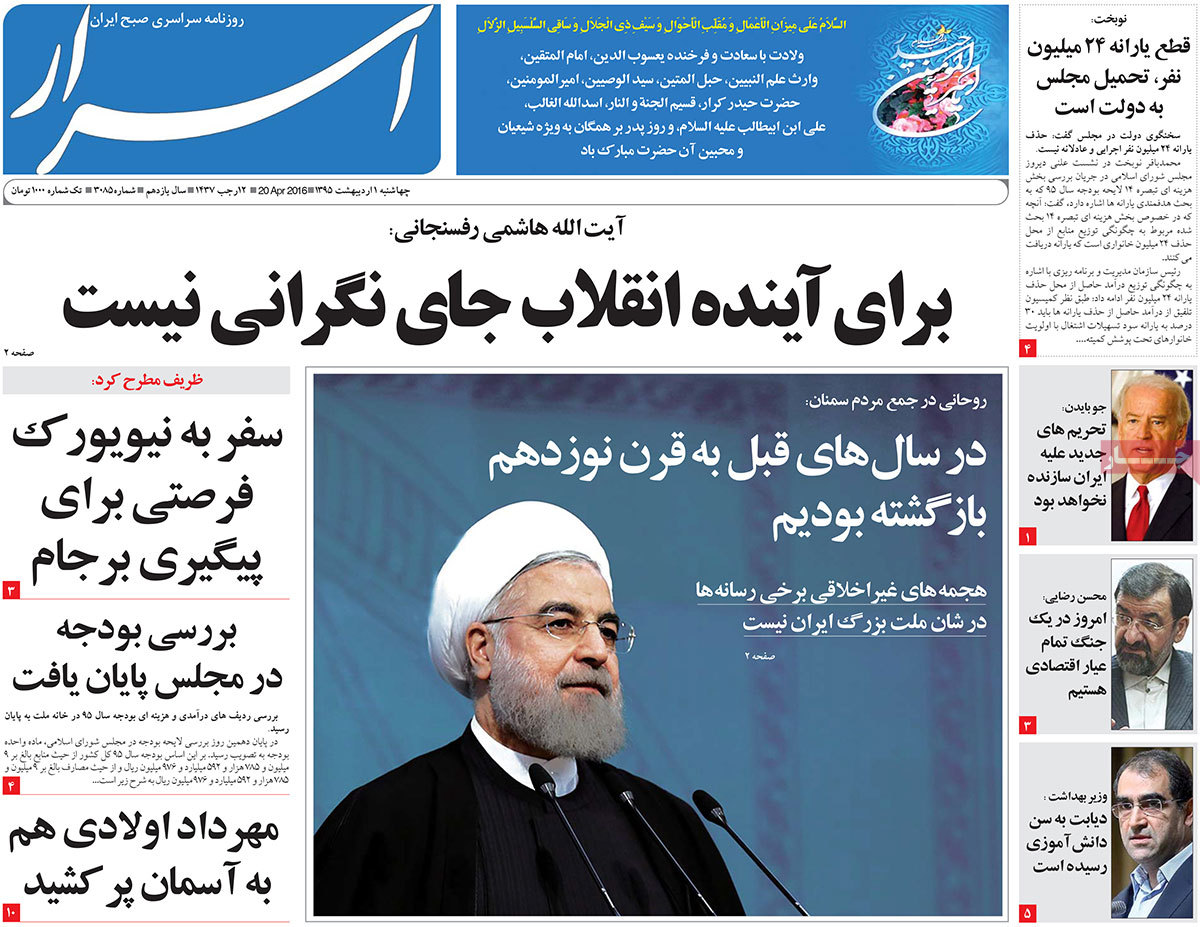
Asrar:

1-Ayatollah Hashemi Rafsanjani: No need to worry about future of Revolution

2-Joe Biden: New sanctions against Iran will be counterproductive

3-Health Minister: Diabetes affects school children


A look at Iranian newspaper front pages on April 20


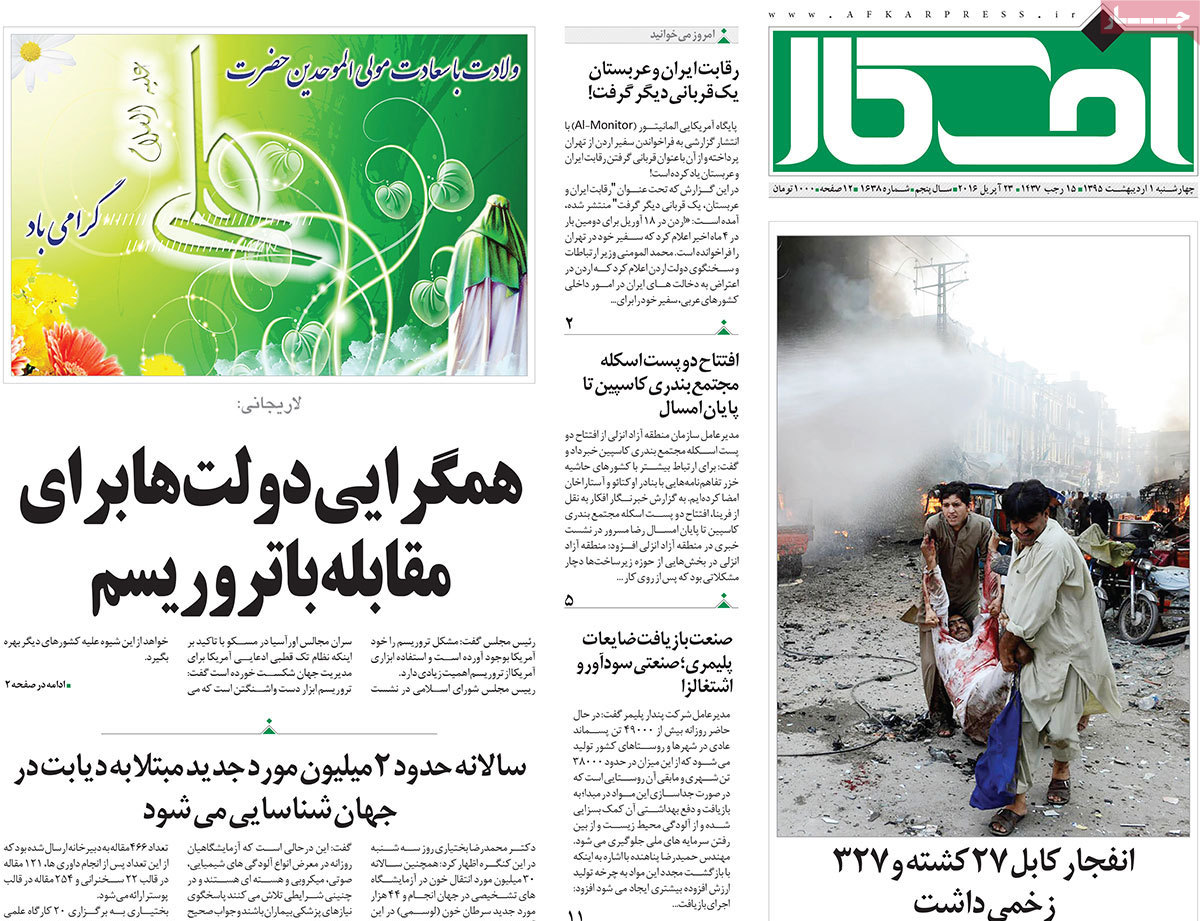
Afkar:

1-Parliament Speaker: Governments should join to counter terrorism

2-Explosion in Kabul leaves 27 dead and injured

3-2m new cases of diabetes diagnosed globally each year


A look at Iranian newspaper front pages on April 20


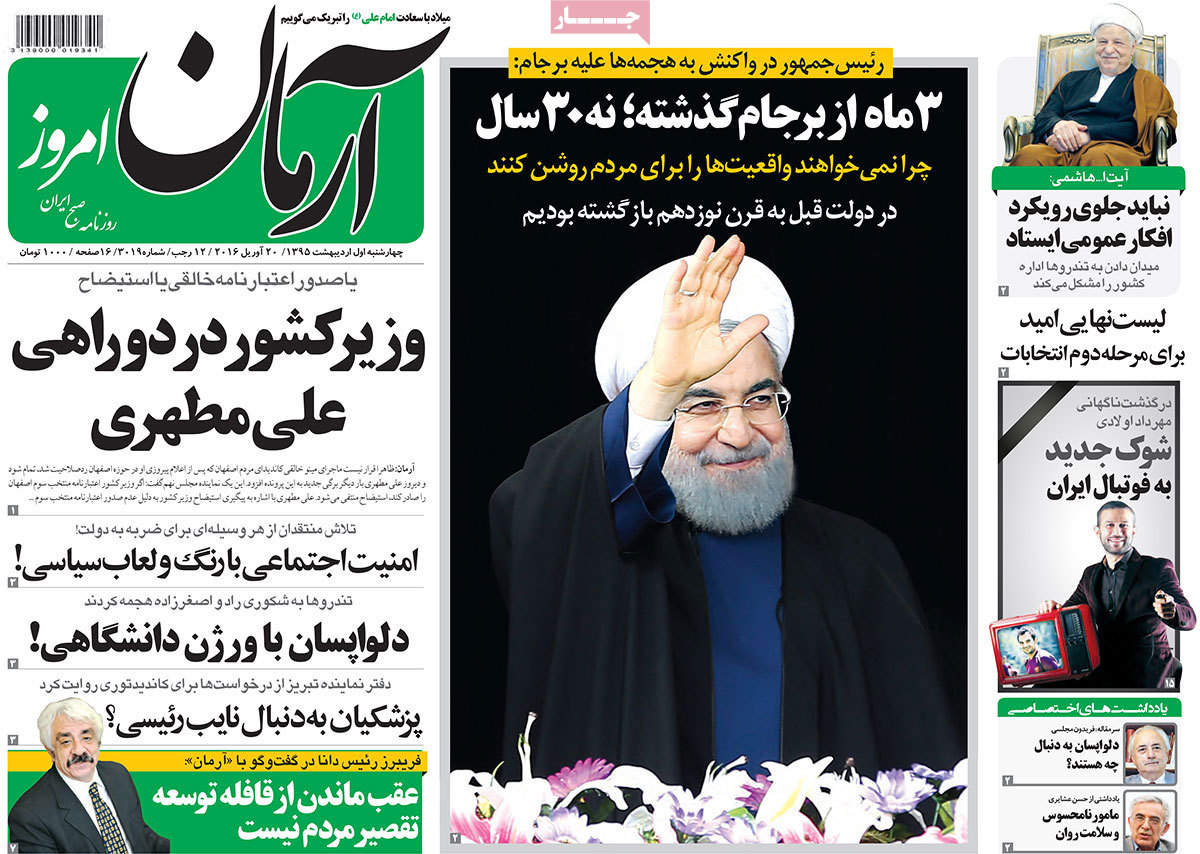
Arman-e Emrouz:

1-Rouhani: 3 months since JCPOA, not 30 years

2-Death of footballer Mehrdad Oladi, a new shock


A look at Iranian newspaper front pages on April 20


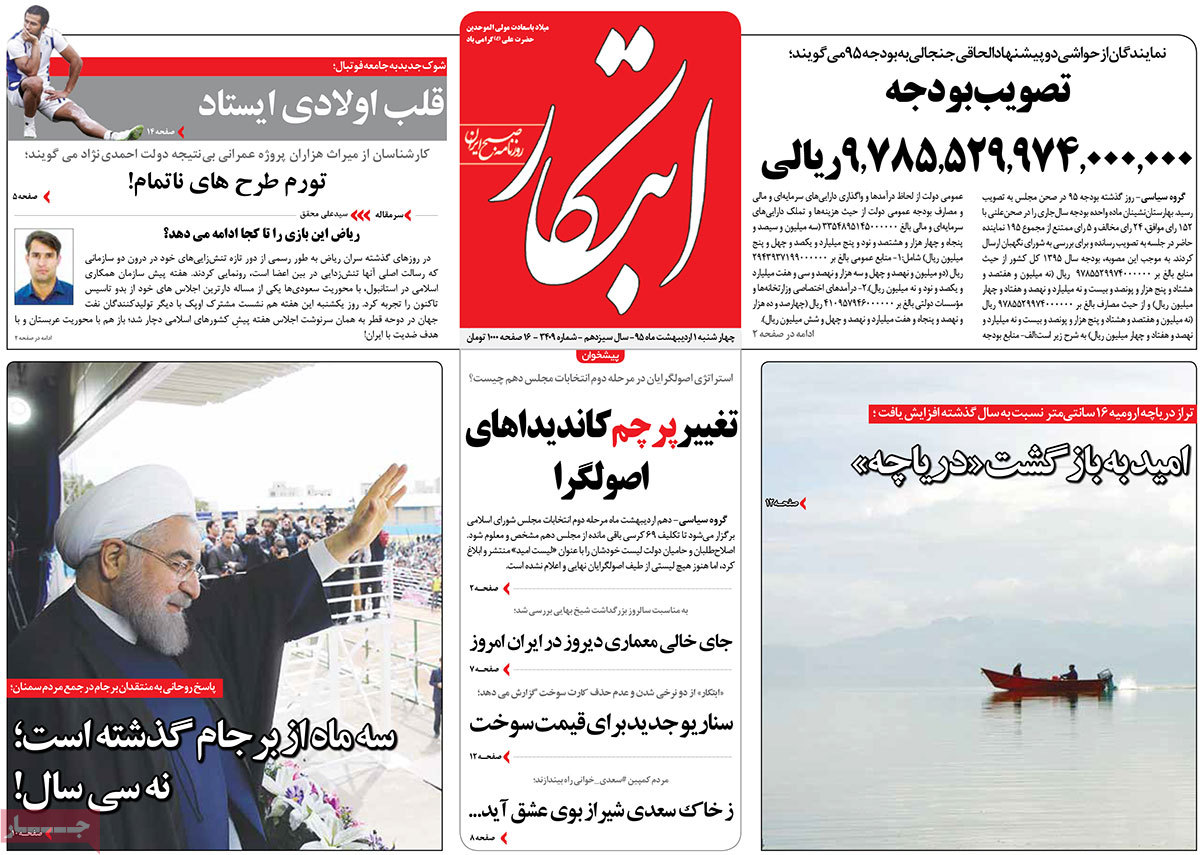
Ebtekar:

1-IRR9,785,529,974,000,000 budget for current Iranian year approved by Parliament

2-Renewed hope: Lake Urmiye water level up 16cm


A look at Iranian newspaper front pages on April 20


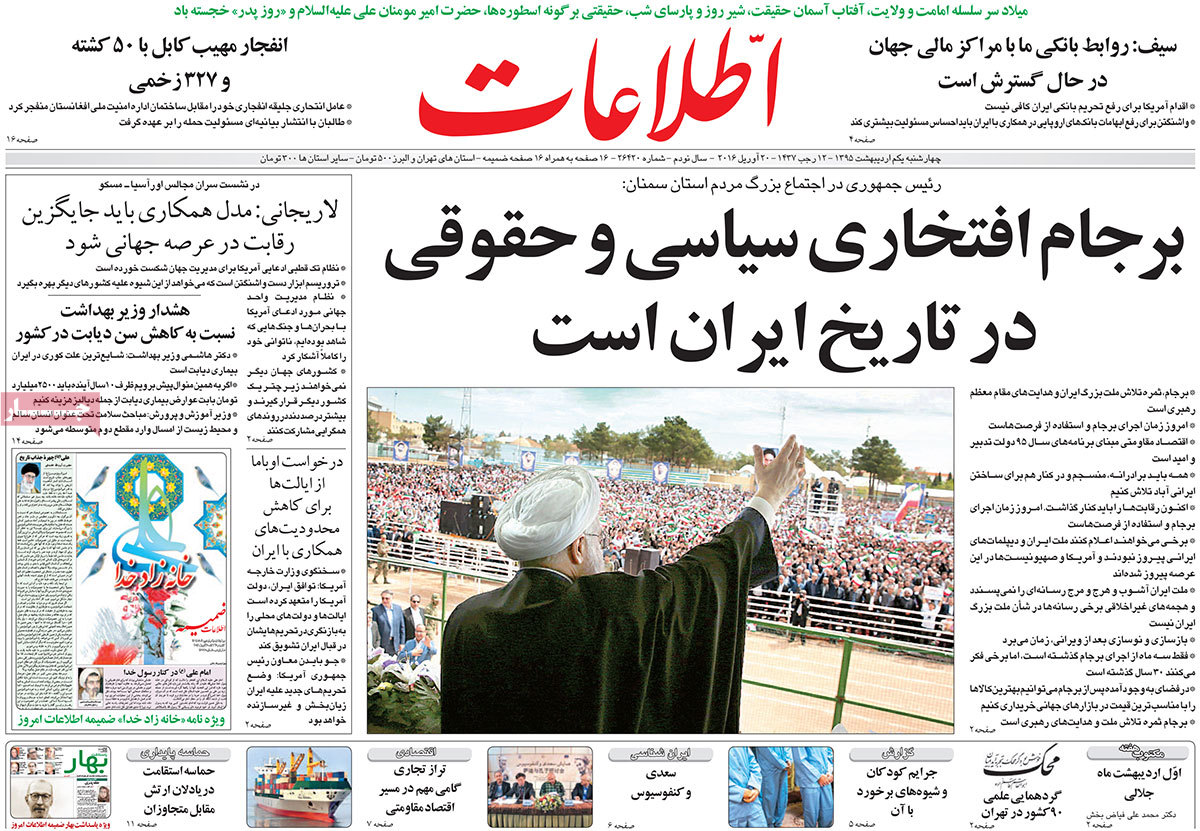
Ettela’at:

1-President Rouhani in Semnan: JCPOA is Iranian political and legal glory

2-CBI Governor Seif: Banking ties with global financial centers growing

3-Larijani addresses Eurasia Parliamentary Speakers Conference in Moscow: Cooperation should replace competition globally in the world


A look at Iranian newspaper front pages on April 20


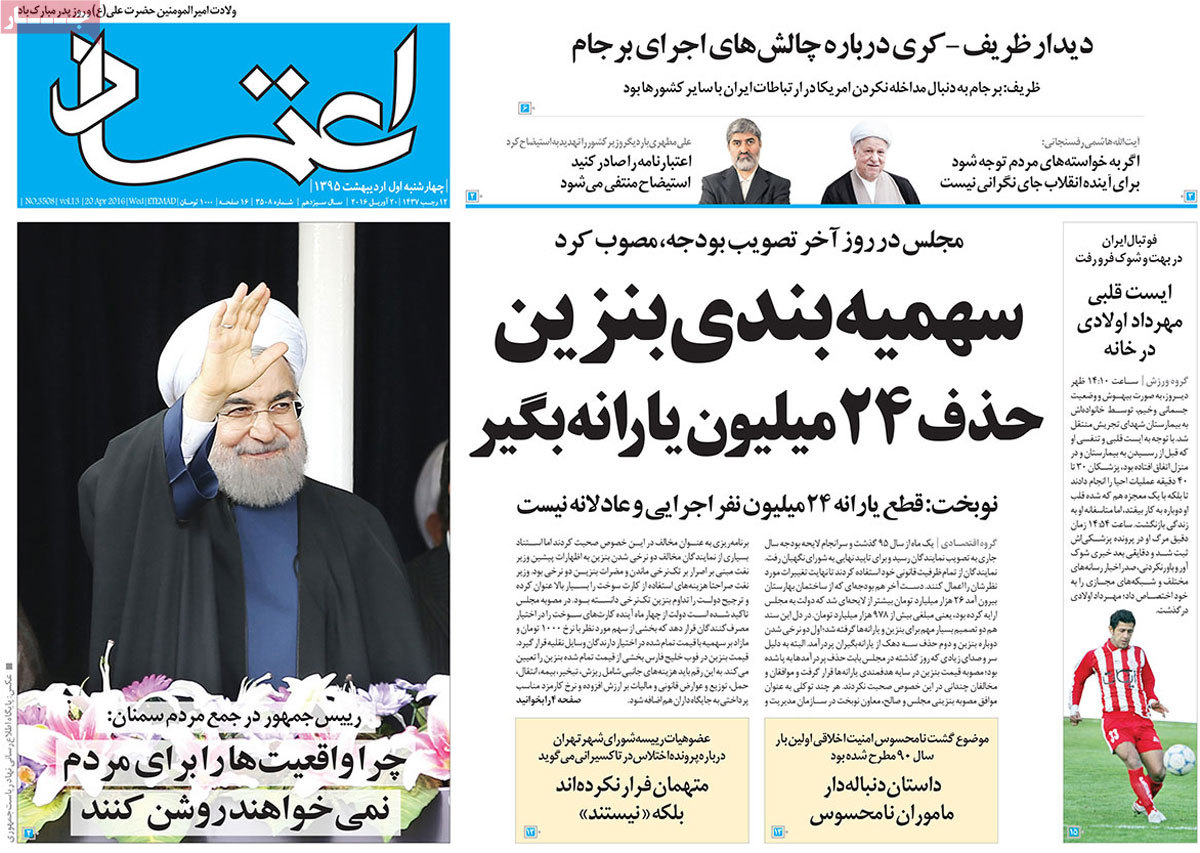
Etemad:

1-Petrol rationing and cash subsidies for 24m people

2-Zarif-Kerry: discussing challenges facing implementation of JCPOA


A look at Iranian newspaper front pages on April 20


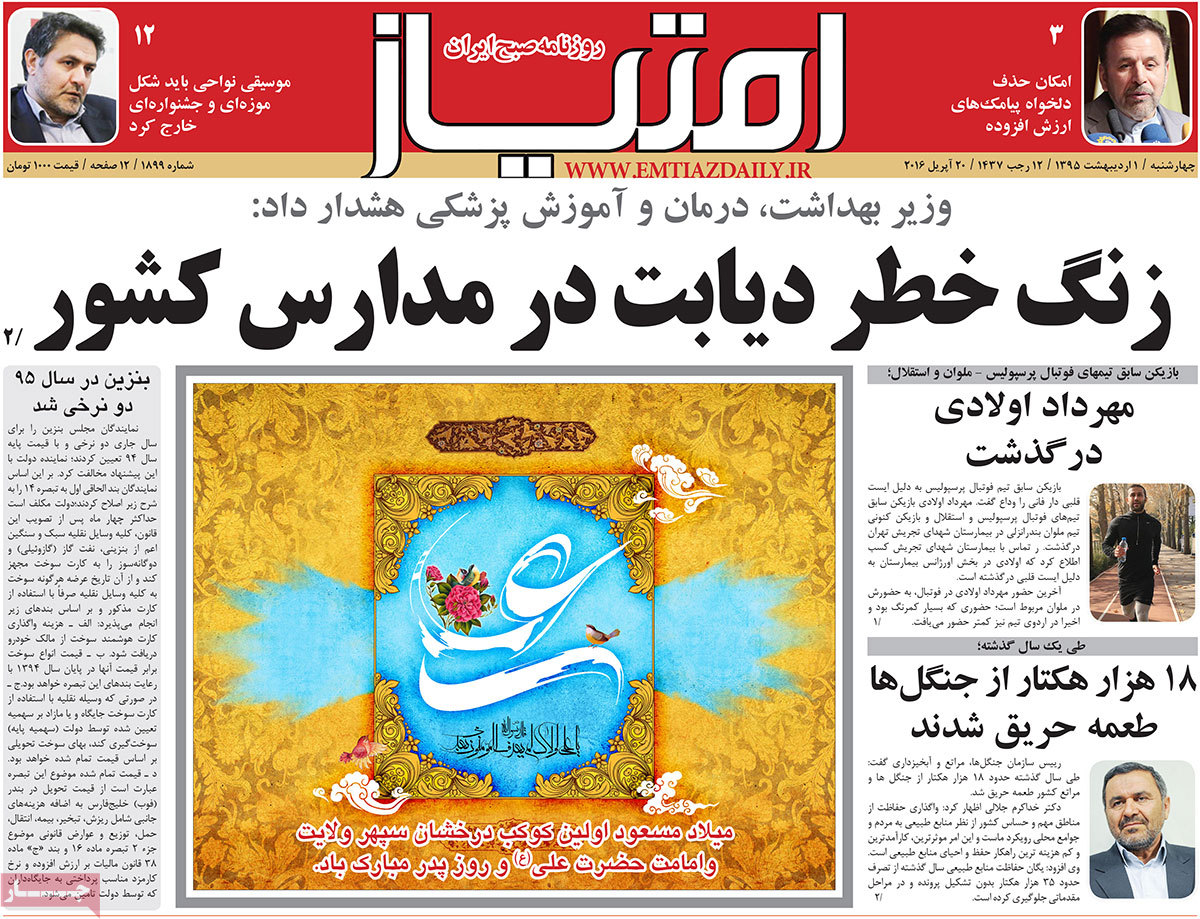
Emtiaz:

1-Health Minister: Diabetes Alarm Bell Ringing In Schools

2-18,000 Hectares of Forest Destroyed by Wildfire in Past Year


A look at Iranian newspaper front pages on April 20


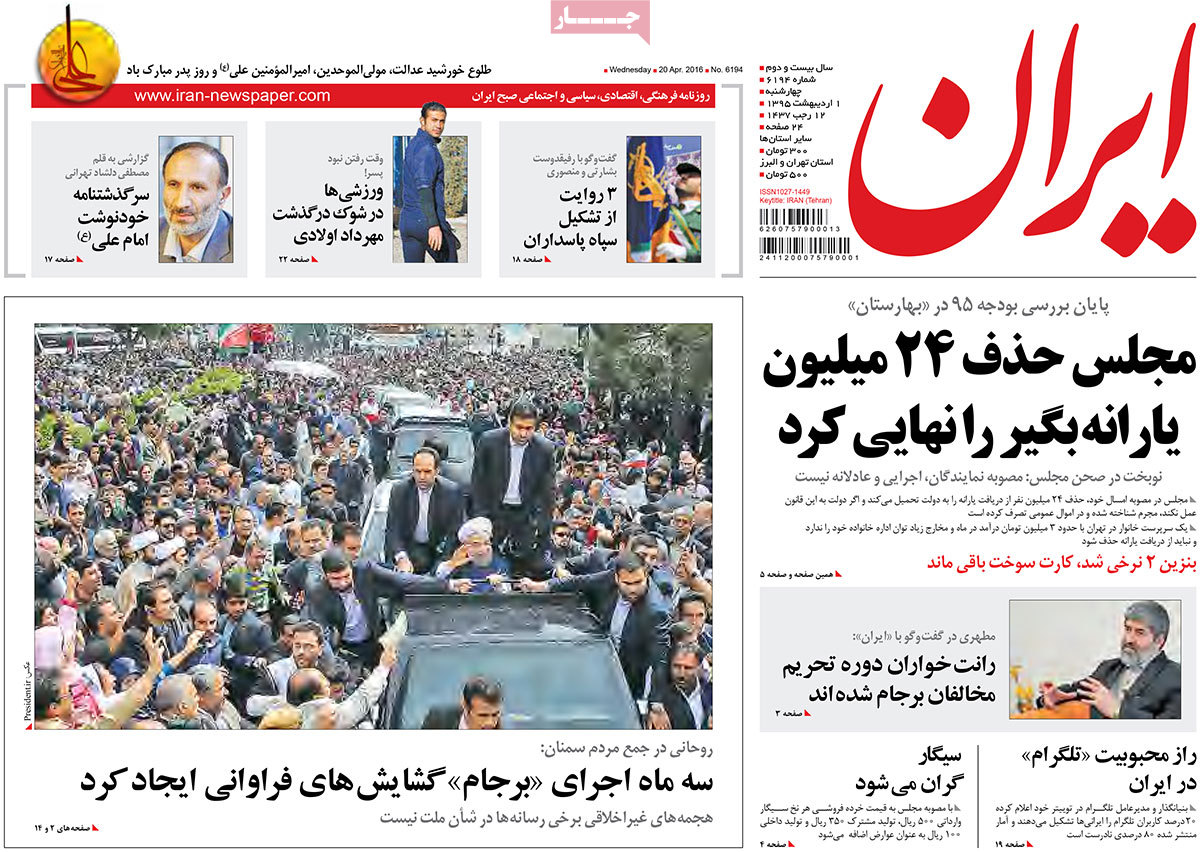
Iran:

1-Rouhani: 3 months since JCPOA has given relief


A look at Iranian newspaper front pages on April 20


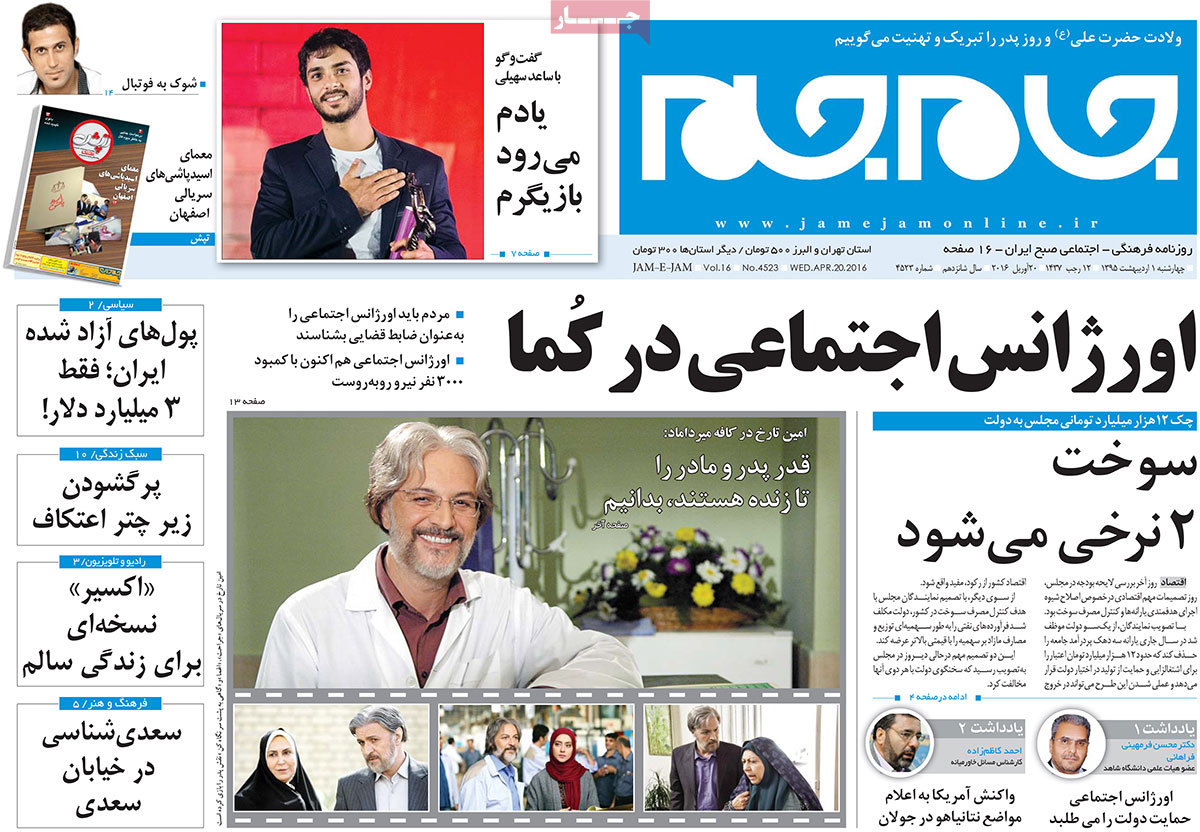
JameJam:

1-Amin Tarokh, Iranian film star: Respect your parents while they’re alive

2-Only $3bn of Iranian blocked money has been released


A look at Iranian newspaper front pages on April 20


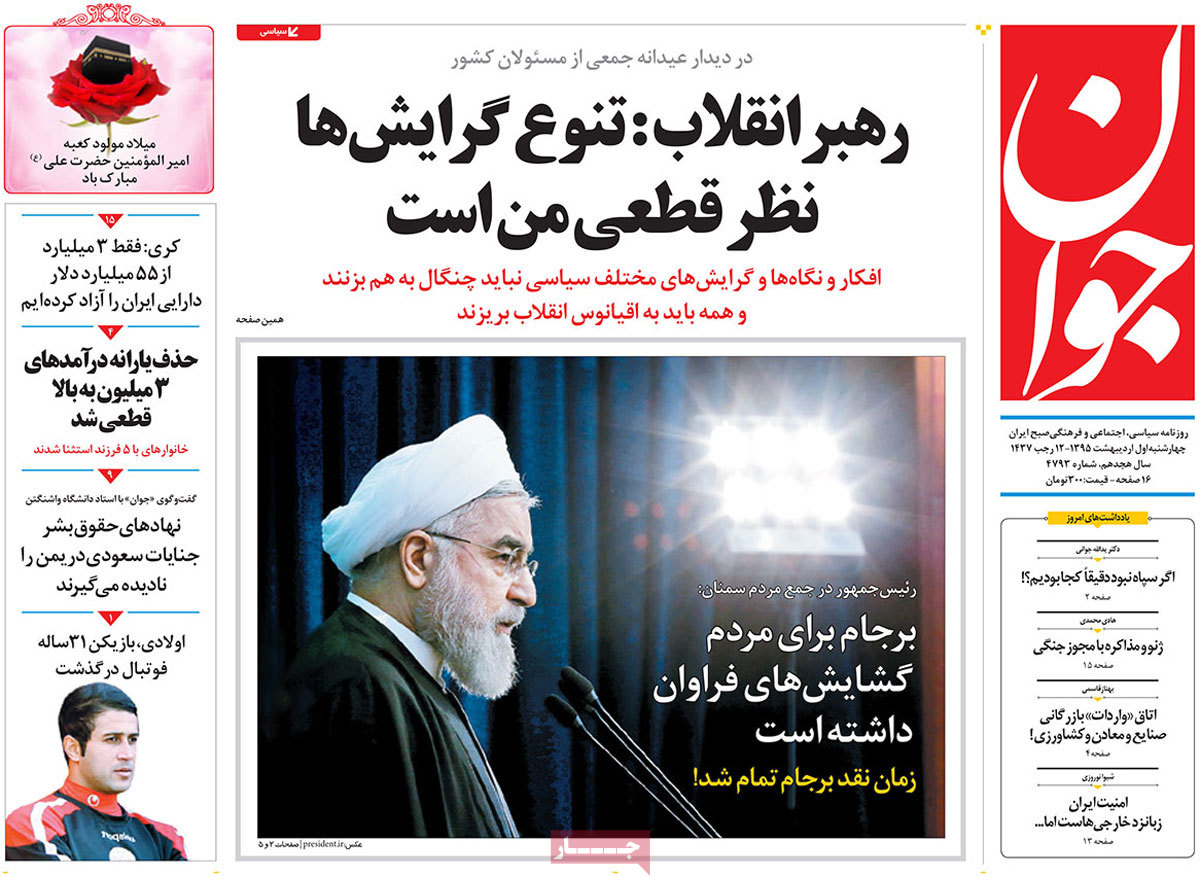
Javan:

1-Supreme Leader: Pluralism is my view

2-Rouhani: JCPOA has brought lots of relief for people

3-Human rights watchdogs close their eyes to Saudi crimes in Yemen, says Washington University Professor in interview


A look at Iranian newspaper front pages on April 20


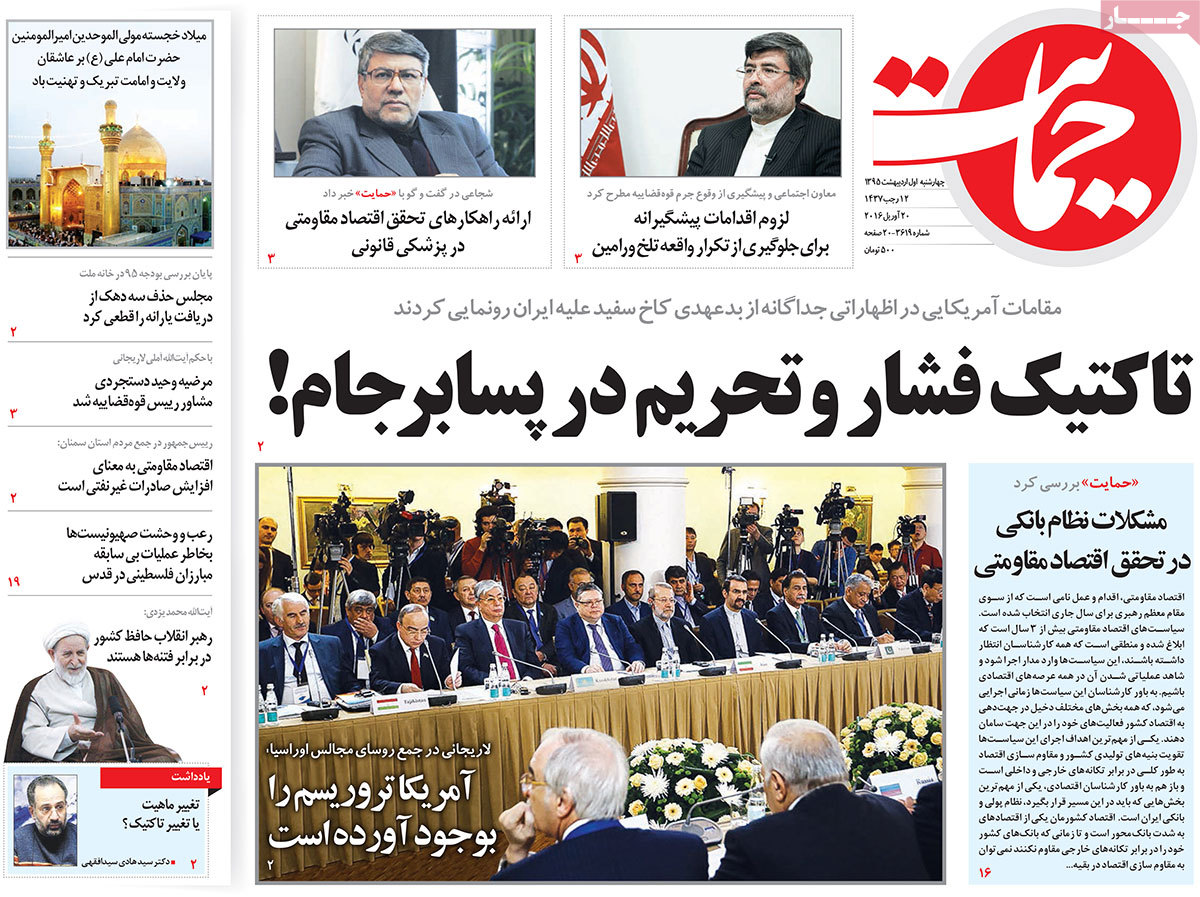
Hemayat:

1-Pressure and sanctions tactics in post-JCPOA


A look at Iranian newspaper front pages on April 20


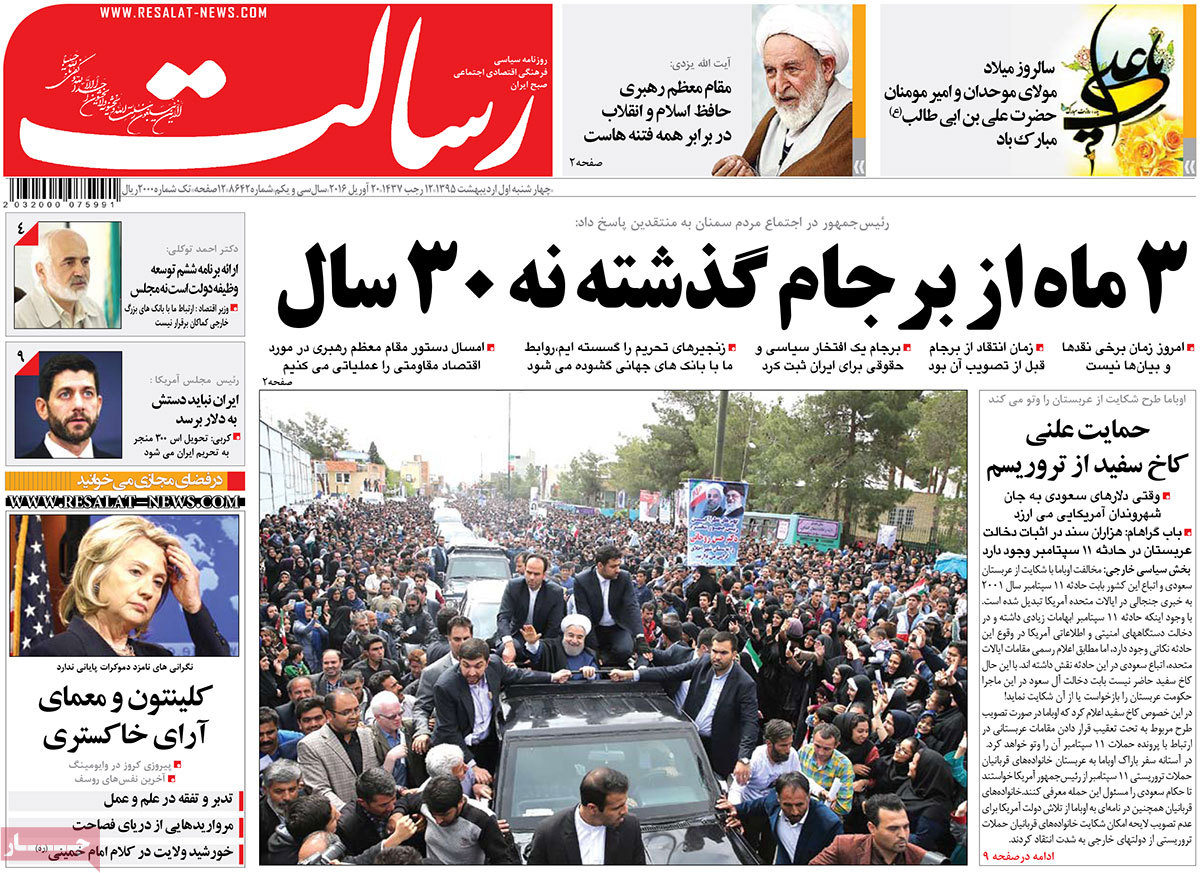
Resalat:

1- White House openly supports terrorism

Obama to veto complaint against Saudi Arabia

2-Saudi dollars worth more than lives of  US citizens

Bob Graham: Many pieces of evidence about Saudi role in September 11 attacks


A look at Iranian newspaper front pages on April 20


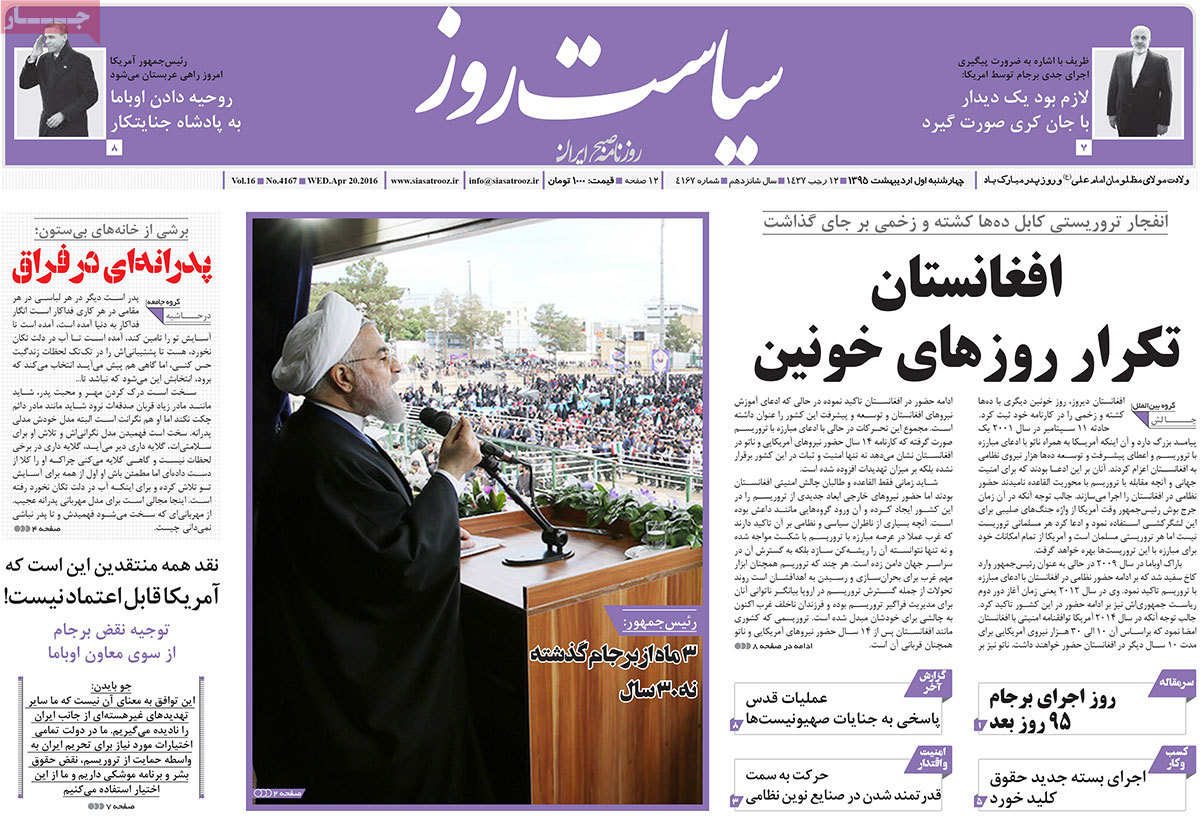
Siasat-e Rouz:

1-Afghanistan relives bloody days


A look at Iranian newspaper front pages on April 20


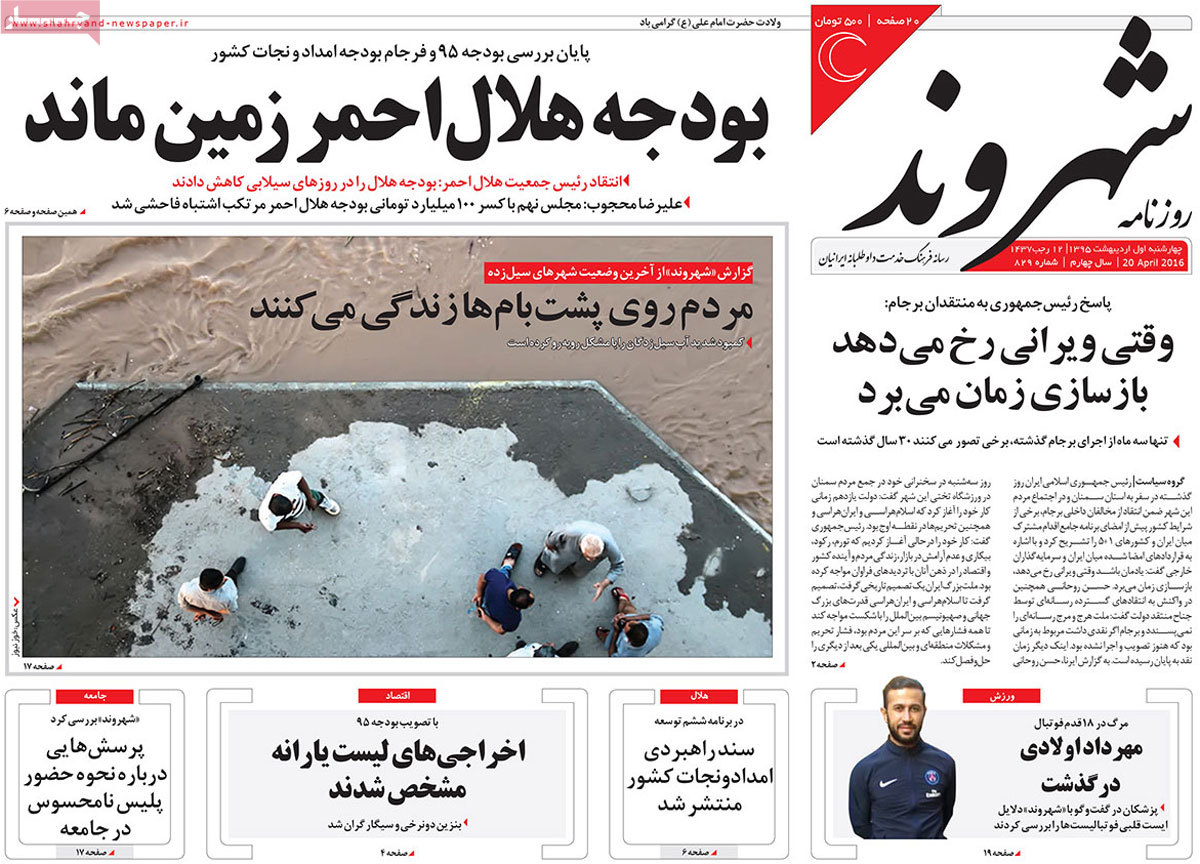
Shahrvand:

1-People are living on rooftops

A shortage of clean drinking water makes life difficult for flood-stricken people


A look at Iranian newspaper front pages on April 20


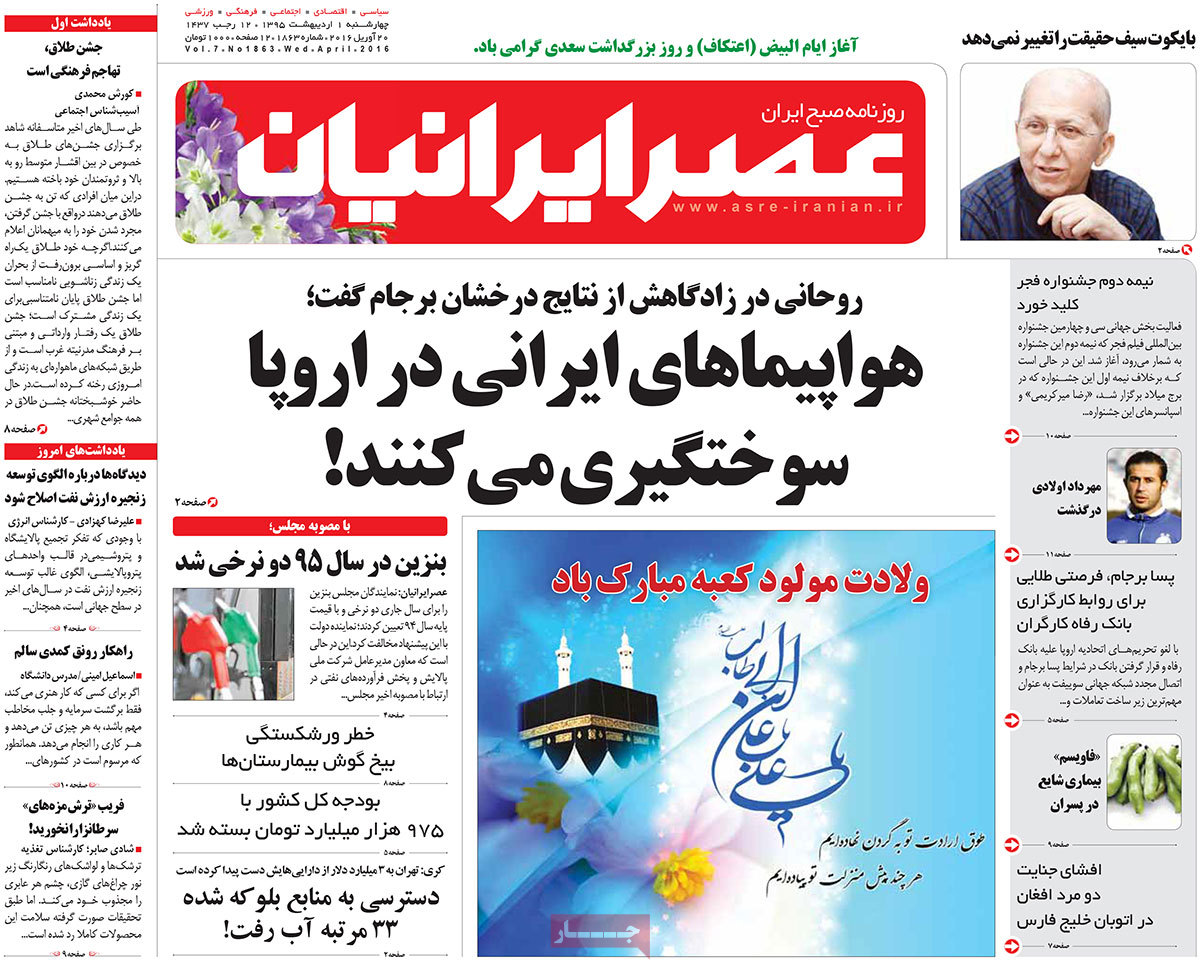
Asr-e Iranian:

1-Iranian airliners are refueled in Europe, Rouhani speaks about results of JCPOA


A look at Iranian newspaper front pages on April 20


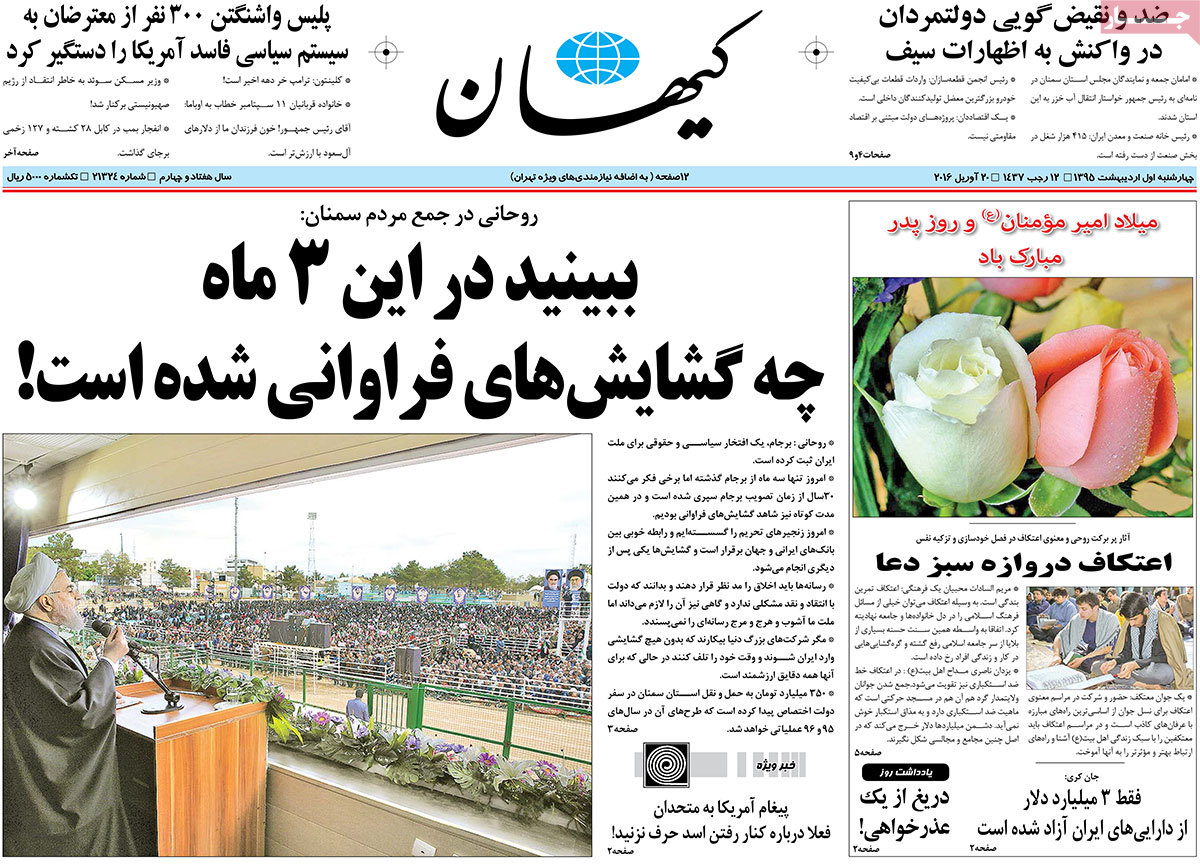
Kayhan:

1-Rouhani in Semnan: Look how much relief has taken place in 3 months!

2-US message for its allies: Don’t talk about Assad’s departure yet


A look at Iranian newspaper front pages on April 20


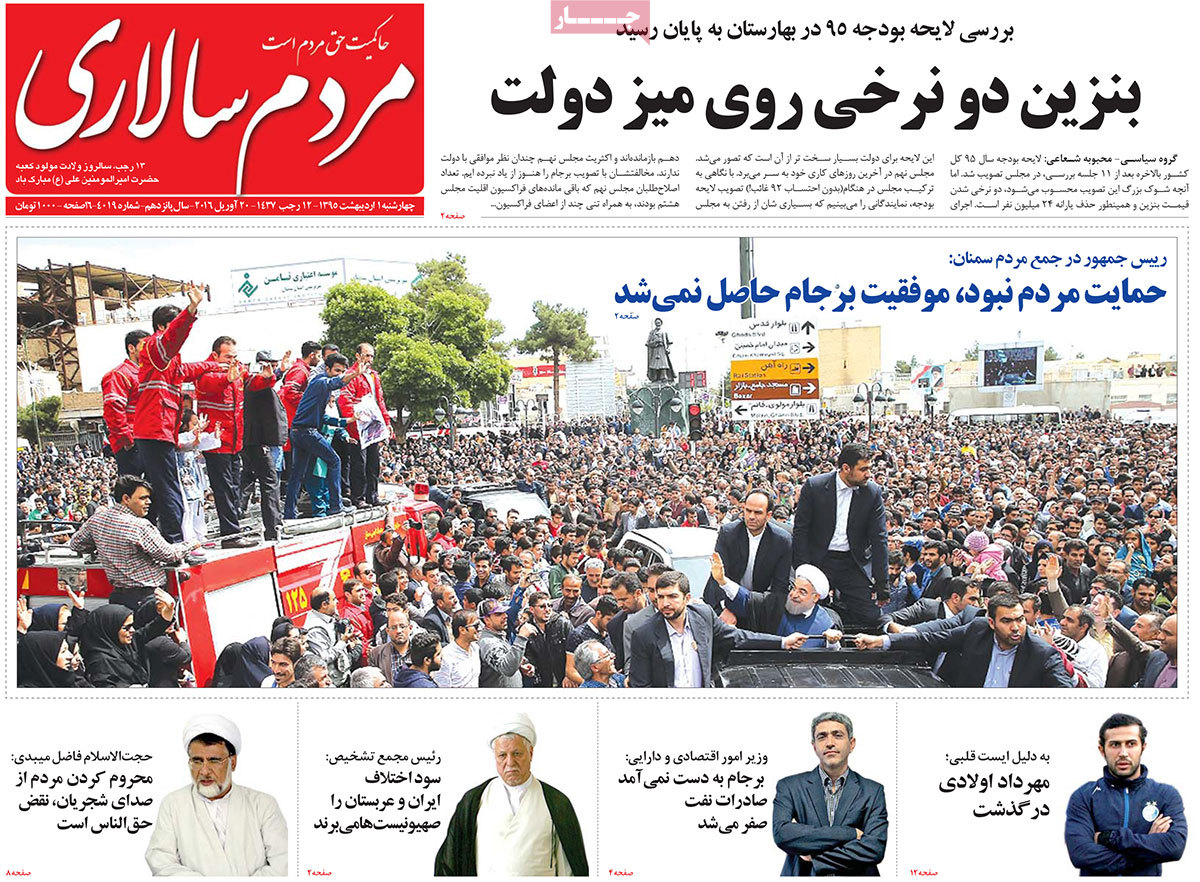
Mardom Salari:

1-President: Without people’s support, no JCPOA success


A look at Iranian newspaper front pages on April 20


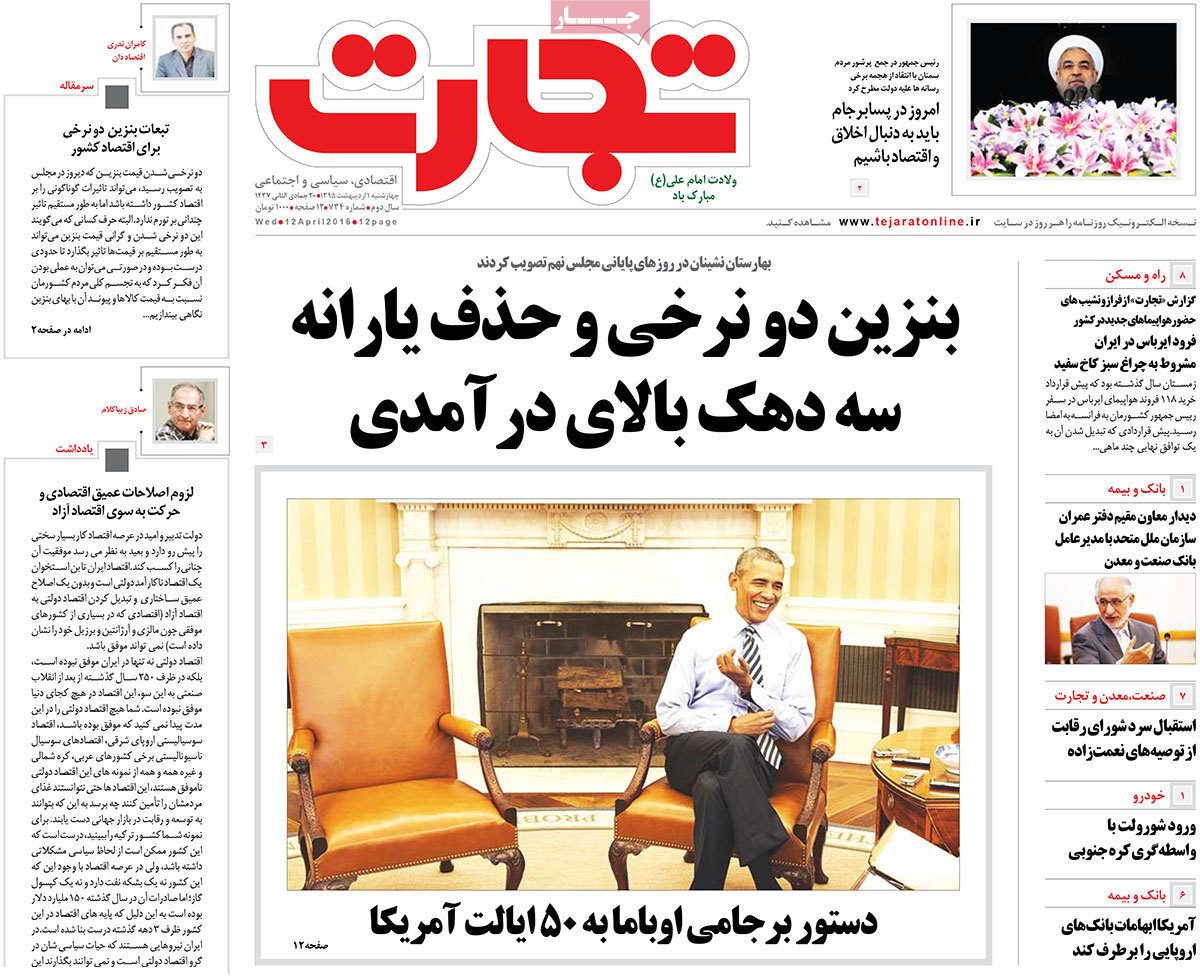
Tejarat:

1-Obama has issued orders to 50 states on JCPOA


A look at Iranian newspaper front pages on April 20


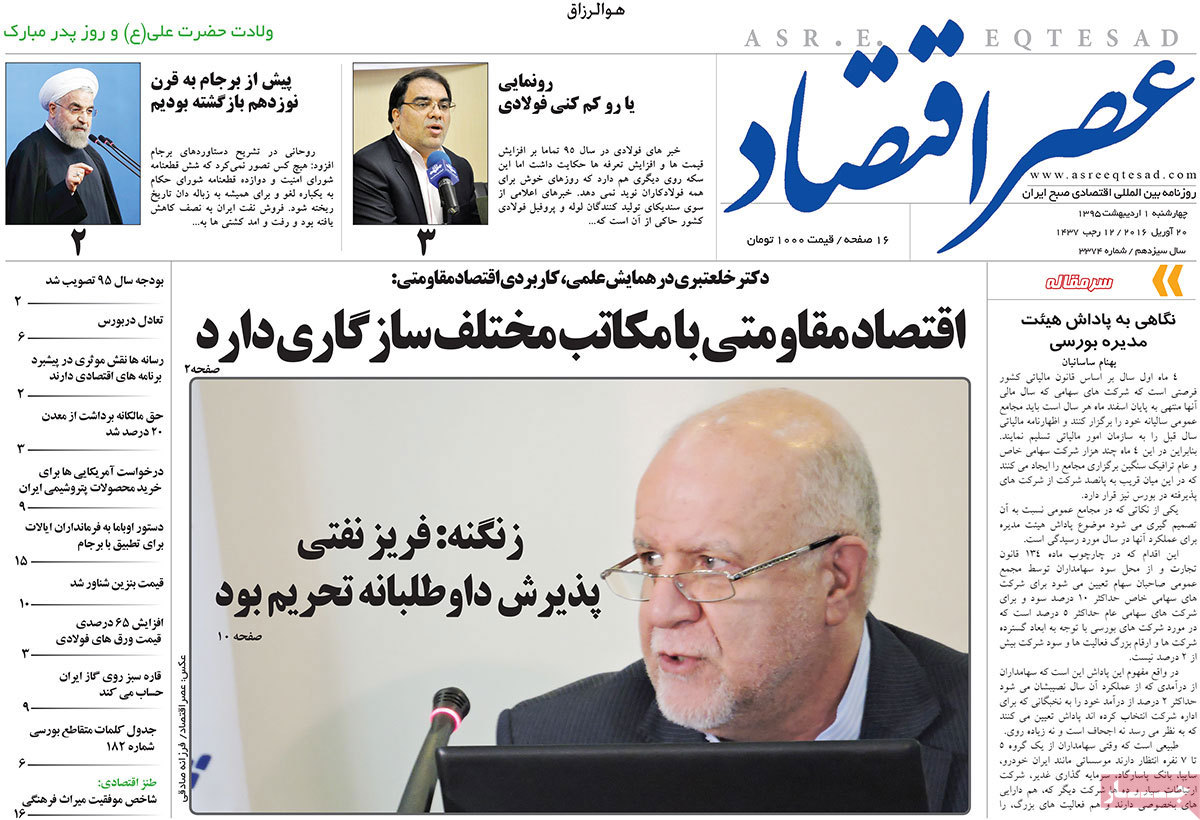
Asr-e Eghtesad:

1- Iranian Petroleum minister: Accepting oil freeze is tantamount to voluntary sanctions


A look at Iranian newspaper front pages on April 20


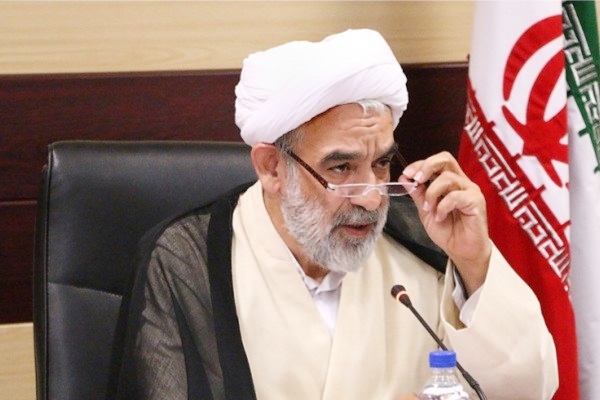
Iran Sets No Preconditions for Talks with Saudi Arabia: Cleric

“Saudi Arabia wants to increase tension with Iran, and this is a plot which the Islamic Republic’s authorities are aware of, and are cautious not to play the game the Saudis want,” Ayatollah Qomi said, according to a report by Arman.

“We have always emphasized having constructive dialogue, easing tension, and promoting unity in the Muslim world, and have always stressed that we have no religious conflict in the region,” he noted.

“We do not consider any of the ongoing developments in the region as a religious issue, including the situations in Yemen, Bahrain, Iraq, or the tension between Iran and Saudi Arabia; all of them are political problems,” Ayatollah Qomi went on to say.

“We have never set preconditions for our own talks (with others) within the framework of the Islamic Ummah’s (society) interests; however, the talks should be real ones, and the other party should show it really wants to talk,” the Iranian cleric added.

Asia-Pacific Meeting in Iran to Pave Way for Handicrafts Export

Ali Haji Shizari, the Director General for Research and Education of the Iran Handicrafts Organization said on Wednesday that the event is a significant development, which should be considered a great chance to introduce Iran’s rich handicrafts to the world.

He said that the designation of the two cities of Mashad and Laljin as “World Cities of Precious Stones” is another giant step towards improving the status of Iranian handicrafts in the world.

According to the official, Isfahan and Tabriz were announced as World Creative Cities for handicrafts and carpets.

Tabriz is to host the 7th World Crafts Council – Asia-Pacific Region (WCC-APR) on April 27, it was announced.

Participants in the council will attend two specialized workshops, and will also tour Mozafariyeh carpet market in the city of Tabriz.

During the five-day event, the masterpieces of the Iranian craftsmen of East Azarbaijan will be displayed.

The Life of a Syrian Family in Tehran

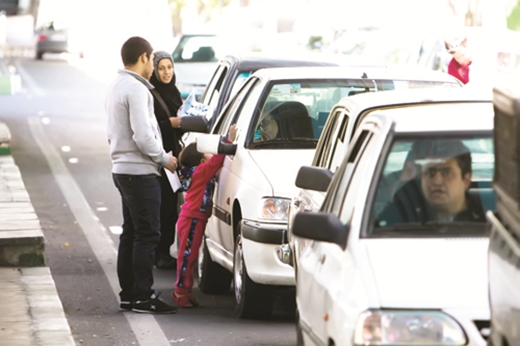
Shahrvand continues: The driver reads the paper, “I’m a homeless Syrian. I ask for help from you Muslims.” The driver reaches out and puts a note in Hassun’s hand. Hassun is young. He’s got curly hair and his first tufts of facial hair. He nods his head in thanks, then moves toward another car. The young girl has her hair tied up, and her ice-cream is dripping on the street’s asphalt and her shoes. Alif is his sister. He turns his head and notices me. He speaks no Farsi. I speak Arabic with him. I ask, “Where are you from, Syria?” In a Syrian accent he says, “Yes.”


Where did you come from in Syria?

–  We came from Aleppo.

When did you come? How?

–   It has been nearly 20 days now. I came with my family by land through Turkey. There are 10 of us.

How did you enter Iran? Weren’t you stopped by police?

–  We were in Turkey first. We had lost everything in the war. Our houses were destroyed and we had nowhere to live. So we went to Turkey and stayed there for a couple of months. No one could understand us there though, and everything was very expensive. Life was getting very difficult there. A relative who lives in Iran suggested that we come here. We were told that Iran is a Muslim country, where they would sympathize with us and help us, so we came here. We came by bus. It took us two days. The police didn’t stop us at all. We even got legal stamps in our passports, but all our relatives are still in Turkey.

You then directly came to Tehran?

–   Yes, we were told to come to Tehran.

Where do you live now?

–  When we arrived in Tehran, they told us to go to one of the pilgrimage areas. We did, and rented a place there for $15 a night.

Where are your family members, your parents?

–  My father is sick. He has diabetes. My mother was killed in the war. I live in the same place with my six sisters, my brother and his family. My sisters and brother are also around. We beg  for money and help in the streets. We came with no money at all. We must take care of our basic expenses.

Can you earn enough to take care of your basic expenses?

–   Sometimes yes, and sometimes no. Our situation has got worse since we came to Tehran. We are looking for proper jobs and a proper place to live.

Aren’t you worried for your sisters in a strange country? They speak no Farsi either.

–  No, God will keep them safe. Plus, we have no other choice.

How did you choose Hafez Street? Your relatives told you about it?

–  We chose it randomly. Our relatives didn’t help us at all.

Do you know the name of the street at all?

–  No, I just know that that place is called Aladdin.


Hassun is 13. Alif stretches her arms out for Hassun to take her in his arms. He speaks no Farsi, neither him nor his sisters who are spread out across the streets asking for help among the cars, holding the same folded paper. The note was written by a Mullah for them. He explains,” I was in the mosque doing my prayers when I saw the mullah. I asked him to write something for me so that people would help us, and he did.”

Their condition is not very good. It takes them an hour every day to get here: him, his sisters, his brother and sister-in-law all agree, saying “This is not a good life. Our job is not good. We are ashamed to do it and beg from people. Many don’t help at all.”

I ask him about their experience in Iran. “Iran is a good place but we are strangers here. No-one understands our language here,” he says.


Are there other people like you apart from your family?

–  Yes, there are many Syrian families. They are all in a bad condition. War has made us destitute. We have nothing.

How was your life in Aleppo?

–   We had a good, happy life, but we lost everything after the war.

Have you tried to get any help from the Syrian Embassy or anywhere else?

–   No we didn’t. We only spoke to the Turkish embassy, where they told us we need to apply for a visa if we want to go back there.


We are busy talking when Nesrim arrives, a thin girl wearing Arabic dress and a black shawl. Her little eyes are shining in her tanned face. She doesn’t look 20 at all. She’s Hessun’s sister-in-law. She speaks no Farsi either, “For God’s sake help us. I have a little girl. I want to buy diapers for her.”

I’ll take some out of my pocket and give it to her, “We just came from Syria. We’re looking for a place to rent. We came with Hessun’s family.” I ask, “Where is your family?”

“They are all in Turkey. We didn’t stay. It was very difficult there. The Turkish government would only give us food. We needed jobs and a place to stay.”

The shopkeepers around Hafez Bridge know them well, since they have been working there for the last three weeks. Every day at noon, they all go to the street food counters and beg for food. Around 2 or 3pm, they all gather together and leave.

One of the shopkeepers says, “There are 5 or 6 of them I guess. There are some boys and an older one, a 20-year-old girl, too.” He continues, “We sometimes help them, but we can’t do it every day.”

There are a few kids a few metres away on the pavement holding glass spray and cloths. They are the Syrian’s competitors, “They don’t sell anything here, they just beg,” one of them says. The other one continues, “Most of them are around the Bazaar, Naser Khosrow or Marvi Alley.”

I walk toward Marvi Alley – not that far. The alley is getting less crowded in the afternoon of the first day of the week. There are a few labourers sitting on the side of the pavement. One of them says, “They are everywhere. They are increasing in number. Once I asked them where were they from, and they said Syria.” A shopkeeper says, “They come to us regularly. Sometimes we help them. I hope they do something about them.”  Another one says, “They are not always around. They usually come here around midday.”

Iranian Dentist Holds Hands-On Course in Dubai World Congress

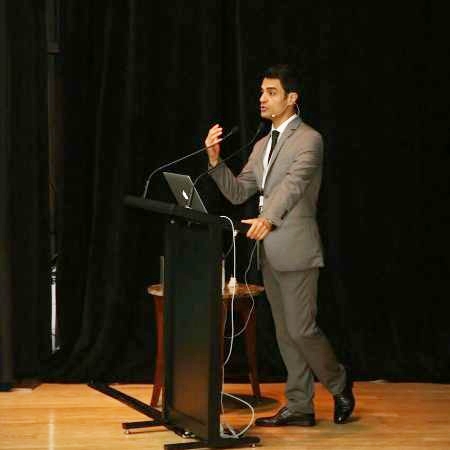
82042224-70664871Second Microvision World Congress was held on April 7-10 in Jumeirah Beach Hotel in Dubai. The conference, organised by Microvision International Group, was aimed at offering the latest therapeutic protocols and advanced technical innovations in dentistry, microsurgery in particular.

The speakers of the conference were selected by an expert panel based on their latest innovations and publications on “microscopic and minimally invasive dentistry”.

More than 200 dentists from 39 Asian, European, and North American countries including Iran, Spain, Saudi Arabia, the UAE, Russia, and Qatar participated in the four-day conference.

Dr. Shakibaie was invited to this edition of the congress as the only specialist working in the field of microscopic and minimally invasive surgeries on jawbone, gum and implant reconstructions.

On April 8, he delivered a speech entitled “Minimally invasive tooth extraction and socket preservation”.

On April 10, he also held a six-hour-long hands-on course called “Microsurgery in external sinus lifting”.

As a global pioneer in implant microsurgeries, Shakibaie has invented and published on several new techniques in the field.

The Iranian dentist is one of leading figures in such new disciplines as microscopic surgeries in jawbone, gum and implant reconstruction.

Iran Rolls Out Red Carpet for World-Class Auteurs

Iran Daily interviewed Keyvan Kassirian, the manager of the festival’s public relations and information. Excerpts of the interview follow:


IRAN DAILY: How many foreign films will be screened in the event, in how many sections?

KEYVAN KASSIRIAN: Over 50 films from 50 countries are taking part in the festival. Nine films will be screened for the first time in Iran, six others will have their first international screening in this festival, and three films will premiere in this event.

The sections of the festival are: Cinema Salvation (international competition), East Vista (Asian and Islamic Countries), which will screen short films, the Festival of Festivals (Cup of Divination), Special Screenings (documentaries and memorials) and Retrospectives and Tributes (dedicated to French Cinema).


Who are the special guests of the festival?

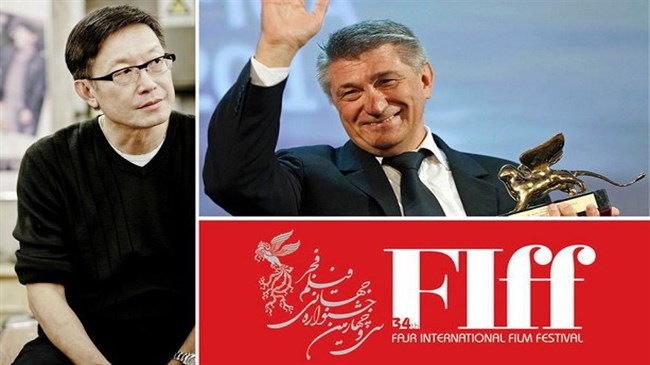
Prolific Russian director Alexander Sokurov and Hong Kong’s most acclaimed filmmaker Andrew Lau will be present at this major global film event.

Furthermore, a famous correspondent from Hollywood Reporters will also be here to cover the news.

Sokurov will attend the screening of his documentary ‘Francofonia’ (2015), which depicts the history of the Louvre during the Nazi occupation and offers a meditation on the meaning and timelessness of art. His documentary will be screened in the ‘Special Screenings and Events’ of the festival.

Sokurov is also scheduled to deliver a speech for students at the Cinema-Theater Faculty.

Andrew Lau, who holds the title of the most successful Hong Kong film director for directing 45 films, producing 33 films, and doing cinematography for more than 50 films, will also be present. He began his artistic career in the 1980s as a cinematographer for films by such great directors like Wong Kar Wai. He pioneered a special cinematography style, and won many cinematography prizes from Hong-Kong film festivals like Golden Horse. His ‘Revenge of the Green Dragons’, a 2014 crime drama film, was produced by highly-acclaimed American director Martin Scorsese.


It is said that this edition of the festival focuses more on encouraging young filmmakers. How does the festival achieve this?

Earlier, it was announced that the major purpose of the festival is to train young filmmakers and improve their knowledge. Several workshops conducted by prominent Iranian and foreign filmmakers will be held to achieve this goal.

Another section, called ‘Dar ul-Funun,’ has been established to identify promising young filmmakers. 100 of the best Iranian and foreign filmmakers (from Pakistan, Afghanistan, Tajikistan, Lebanon, Syria, Iraq and Turkey) with at least one film on their record, or those who have conducted in-depth cinematic research, have been invited to take part in Q&A sessions to exchange ideas.

In total, 8,000 individuals have registered to watch the films so far.


The 34th edition of the Fajr International Film Festival (FIFF) started on April 20, with films from two sections: Cinema Salvation and Eastern Vista in the Charsoo Cineplex, Tehran.