Thursday, January 1, 2026
Home Blog Page 4519

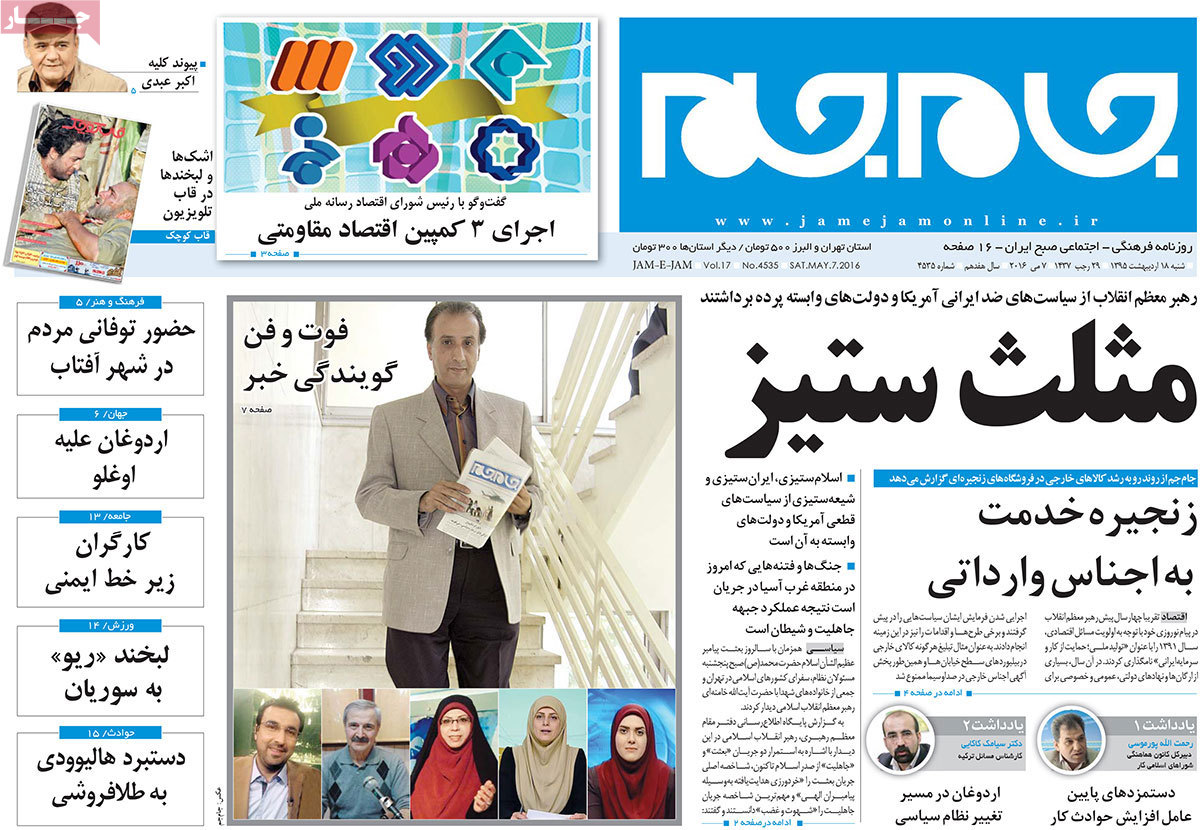
Health up for Sale in Beauty Salons

Jam-e Jam newspaper reports on the boom of health and beauty services in unlicensed beauty salons in Iran – words translated by IFP.


The extreme desire of some women to try and make themselves beautiful has rendered the means unimportant to them. For these women, make-up alone is not enough. It seems as if they want to be fully reconstructed. Many people have made it their business to fulfill the dreams of these women. The result? More than 20,000 unlicensed beauty salons in Tehran Province – though this statistic from last autumn is probably already out-of-date.

These beauty salons are more like markets now: markets for make-up services, health services, tattooing, micro-pigmentation, belly-button piercings, skin cleaning, filling, etc. Add to that sales of accessories, clothes and cosmetics. Now the profitability of this business is clear – which is the reason for such places growing like mushrooms all over Tehran.

Mohammad Mohammadi, the Head of Tehran’s Tazirat Organization [which enforces company and commercial laws], said that there are only 1,000 licensed beauty salons for women in Tehran, and warned that such places commit major infractions, as well as causing social deviance.

Afsar al-Moluk Yasan, head of the Tehran Union of Female Make-up Artists, said that any services given at the salons other those mentioned in their licenses are illegal, and you can only find such services in unlicensed salons.

She emphasized, “Botox, skin care services and skin cleaning has nothing to do with make-up artists – these are medical services. To file and design the nails is fine, but to implant nails is not their area of emmawatson-fans.com.”


Poor-Quality Products Advertised on Satellite TV Play with People’s Health 

Lasering, skin cleaning, injecting gels, removing moles, piercings, etc. – these are very popular services, which have turned certain beauty salons into multi-business centres.

Dr. Saeid Davoudi, dermatologist and a university faculty member, said, “Places that have become centres for health and medical services can jeopardize social health.”

He continued, “According to non-specialists, all patients are the same, so if one service works for one person, it will work for others too. This sort of advice has attracted so many customers.”

He criticized citizens who knowingly or unknowingly go to non-specialized beauty salons for health and/or medical services.

The very high profits from such services in salons, along with the desire of women beautify themselves are the cause of many infractions occurring in beauty salons.

This matter has eventually become a critical phenomenon in today’s society. It is not at all strange to hear from the Parliament Health and Treatment Committee that the illegal actions of beauty salons have put the health of some groups of people in serious danger.

A Canola Farm in Bloom

Its consumption is very common, and is claimed not only to be completely safe for human and animal consumption, but also to be among the healthiest plant-derived oils, having a relatively low amount of saturated fat and a high content of polyunsaturated fats.

This series of photos comes from a canola farm near Kahrizak, south of Tehran.

Plant-based motor oil introduced in Iran

Iranol Oil Company on Tuesday unveiled its latest oil product called Tetra in the presence of some government officials.

The fresh brand was reportedly synthesized with the use of environmentally friendly extracts from plants.

The new class of bio-based oil is said to improve engine performance and increase motor age, also making  it run cleaner.

It will additionally reduce sedimentation in the motor, which causes a gradual loss of engine power.

Officials, who attended the unveiling ceremony, hailed the company’s latest effort as a step toward a healthy environment, Iranian media reports said.

Studies show bio-based oils cause a reduction of at least 80% in greenhouse gas emissions as compared to similar petroleum-based synthetic oils.

A US report in 2013 said over 40% of the pollution in America’s waterways came from used motor oil.

The trend has over the past years forced many companies to look for biodegradable products to reduce pollution.

German Vice Chancellor Due in Tehran Next Week

Sigmar Gabriel will be making his second visit to Iran after last July’s nuclear deal, aimed at expanding economic relations between the two countries.

Iran-Germany Joint Economic Commission’s meeting will be held on May 2-4, for the first time after 15 years. The last meeting was held in 2001.

Gabriel will be leading an economic delegation, which consists of the country’s major companies’ representatives, while the Iranian delegation will be headed by Economy Minister Ali Tayyebnia.

German companies are mostly dissatisfied with Merkel’s distance from Iran, especially under the current circumstances where French President Francois Hollande and Italian PM Matteo Renzi have hosted President Rouhani in January and signed various MoUs with Tehran.

German investors and firm owners are hoping Gabriel’s visit will lead to one or two agreements, no matter how small, being signed.

One key factor preventing many German companies from investing in Iran and signing contracts with Iranian firms is the lack of banking guarantees. German businessmen hope the issue will be resolved during the visit.

However, Iran and Germany are poised to boost their petrochemical ties given the readiness indicated by both sides in this regard since removal of international sanctions.

Head of Iran’s National Petrochemical Company (NPC) Marziyeh Shahdaei said on wednesday that NPC and German companies are planning to boost their interactions now that US-led sanctions on Tehran’s nuclear program have been partly lifted, shana reported.

In a meeting with German Ambassador to Tehran Michael von Ungern-Sternberg, Shahdaei highlighted her recent visit to Berlin and called for enhancement of petrochemical ties with German companies.

“We are glad to enjoy the companionship and investment of German companies and we held several talk sessions with German companies during my Berlin visit,” she said.

The Iranian official said she held talks with representatives of over 250 German companies during her visit to Berlin earlier this year.

Ambassador Ungern-Sternberg underscored the historical presence of German companies in Iran, expressing hope that Iran and Germany will restore their cooperation in petrochemical projects.

“German companies have already signaled their interest to join petrochemical projects in Iran with the aim of promoting the industry in the country,” he added.

Iran Artists Forum signs MoU with Austrian counterpart

The deal signed by Majid Rajabi-Memar and Michel Pilets enshrines holding visual arts exhibitions, cultural weeks, conferences and exhibition on architecture, music concerts as well as artistic educational workshops.
Pilets expressed happiness over signing the deal, saying that as the head of Austrian House of Artists, he made many efforts to pave the way for cooperation between the two nations.
Signing the memorandum of understanding took place concurrent with economic and cultural interaction between the two countries, he said.
The Austrian director said that the two countries have longstanding cultural ties.

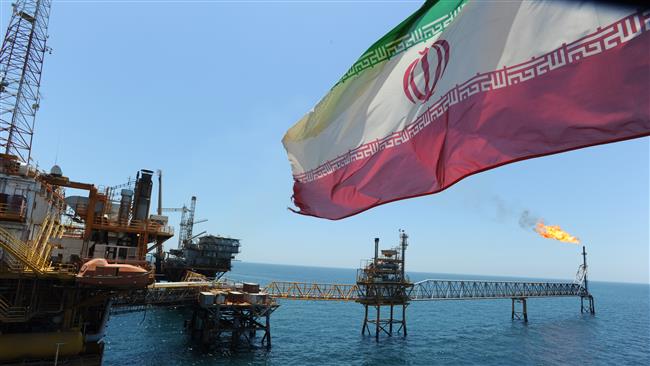
Iran Eyes 10,000 Jobs in Major Refinery Project

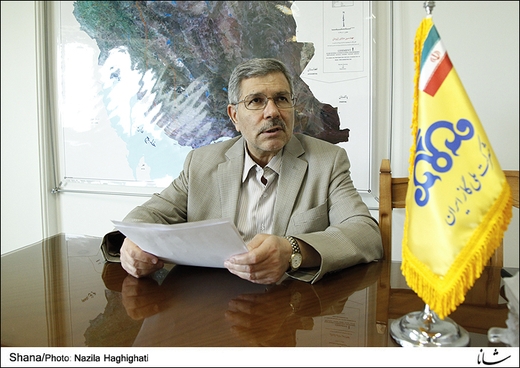
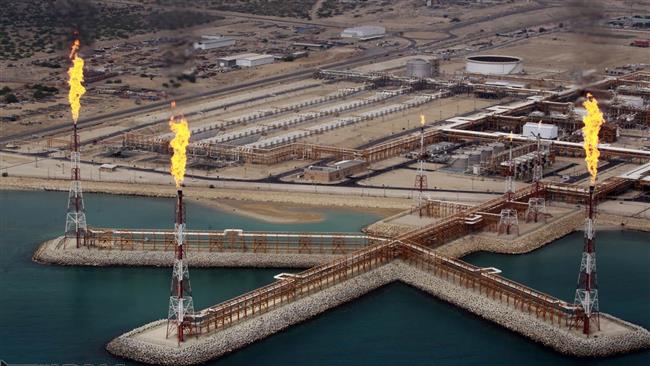
Speaking with Shana, Managing Director of Siraf Refineries Infrastructure Company (S.R.I.C) Alireza Sadeqabadi said the project is being carried out for production of 480,000 barrels of gas condensate and will be a major step for completion of the economic chain and generation of value added in Iran’s petroleum industry.

He said the project is being developed under a new partnership framework which is unprecedented in the industry in Iran.

The project, Sadeghabadi added, is being developed by 9 private companies as project developers.

“Once completed, Siraf Refinery Project will become a successful model for similar projects in petroleum industry,” he added.

14 contractors are involved in development of the refineries and 10,000 jobs will be created by the time the 8 refineries come online.

Over 80% of the project’s developers are graduates from top universities in Iran with an average age of below 35.

Ahmadinejad’s Office Reacts to Accusations over US Seizure of Iranian Assets

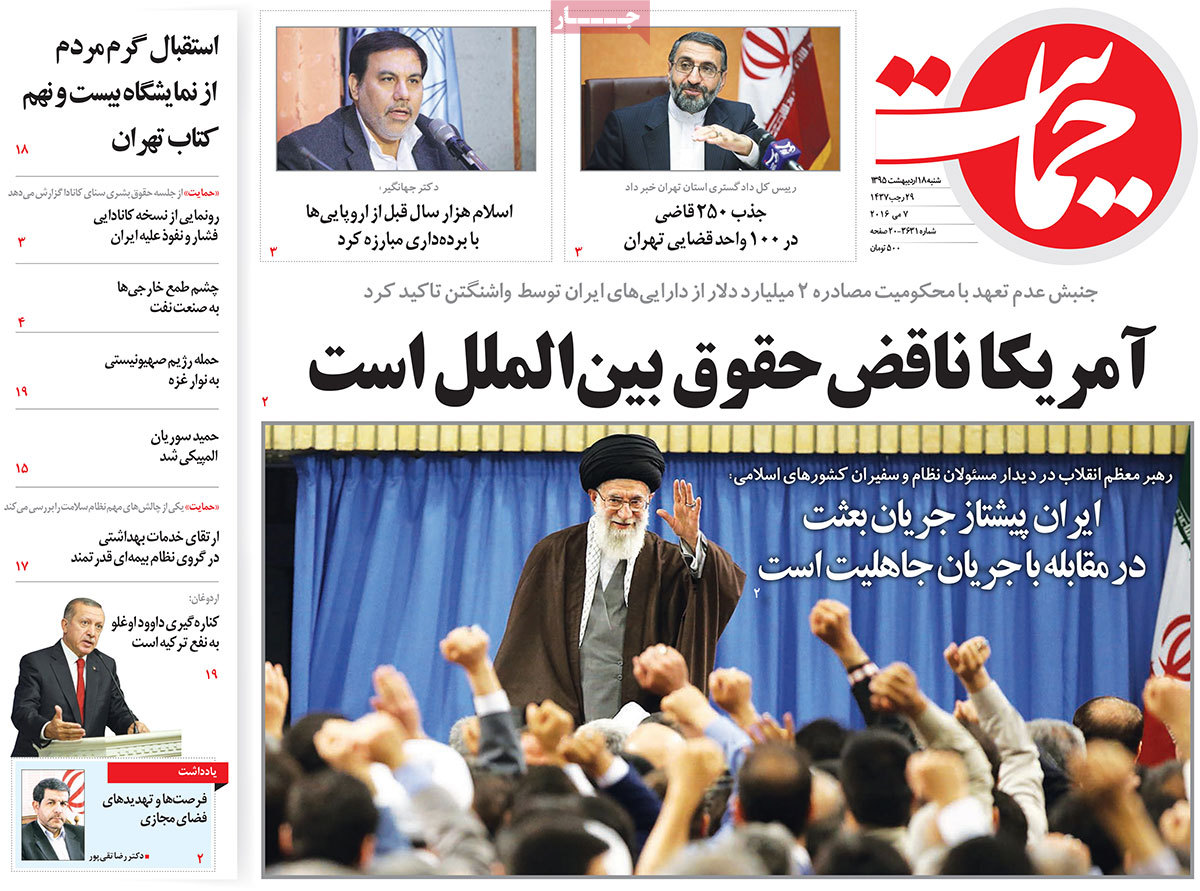
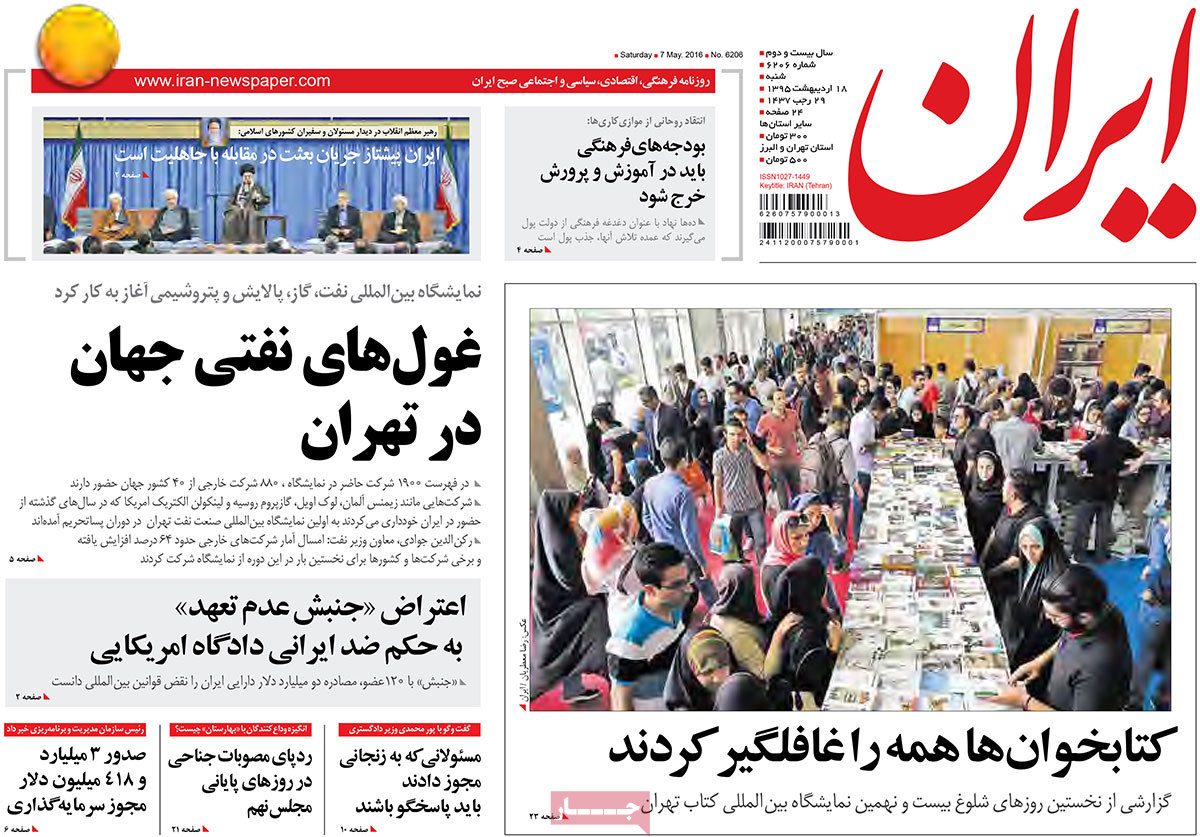
Since the recent move by the US to confiscate nearly $2bn of Iranian assets in order to give it to the families of the victims and survivors of 1983 Beirut bombing, Iranian media has been covering the issue from two perspectives. The conservatives have been blaming the incumbent administration of President Hassan Rouhani and have criticized the government’s excessive optimism towards the West (the US in particular).

On the other hand, the pro-government and reformist media, while strongly condemning the move by the US Supreme Court, have been pinning the blame on the former government for their purchases of US bonds in spite of the hostile relations at the time between Tehran and Washington.

Among the critics who have blamed the former administration are the current Governor of the Central Bank of Iran (CBI) Valiollah Seif, as well as the former CBI Chief Tahmasb Mazaheri, two of the most important figures in finance.

In a statement released on Wednesday, the Public Relations Department of the office of Mahmoud Ahmadinejad, the ex-president, rejected these criticisms and claimed that Rouhani’s government has made the country seem weak enough for the US to dare to make such a move.

Here is IFP’s translation of excerpts from the statement published by the website of Ahmadinejad’s office.


The recent move by the authoritarian US government … has become a new pretext for [Iranian] statesmen and political and media figures close to them to attack the former government.

The US administration has looted the Iranian nation’s assets in the current year and under the incumbent government, while the pretext for which the court ruling was issued dates back to 1983. It is not clear why, and for what hidden motivation, this cruel move by the US is being attributed to Ahmadinejad’s government.

They have claimed the managers of Iran’s Central Bank during the previous government were not careful enough, and should not have trusted in the international rules and regulations governing the global banking ties. They claim such trust has resulted in the assets seizure this year.

The US government did not dare to encroach upon the Iranian nation’s resources at that time, because the government of Ahmadinejad always behaved in a wise way and maintained the country’s honour and dignity.

The Iranian nation, however, has been portrayed as a weak nation in the international arena in recent years, and this has emboldened US statesmen. So the question is: isn’t this the reason behind the recent “plunder”?

The money was stolen right at the time when the Iranian foreign minister was in the US, holding private, long, secret, and repeated meetings with his US counterpart. Isn’t the seizure of assets related to the meetings and the topics discussed by the two? Isn’t this the continuation of a long-running drama to humiliate the Iranian nation and government?

The incumbent government says that Ahmadinejad’s cabinet members should not have trusted the Americans, or even in international rules and regulations. If that is true, why did they curb, dismantle, and shut down the country’s nuclear program, including facilities that were worth almost $30bn, based on the US Secretary of State John Kerry’s ambiguous promises without any guarantees?

The government’s trust in US statesmen and their promises, and the subsequent weakening of Iran’s international position in the past three years have led to a sharp drop in the Iranian nation’s most valuable asset, crude oil, from $105 to $35. If this remains unchanged, almost $150m a day and almost $55bn a year will be picked from Iran’s pocket and given to the negotiating sides [from the nuclear talks] or their allies.

People expect the government to avoid illogically pinning the blame on others, accept their own responsibilities, try to pursue the issue, and reclaim the nation’s rights.


Source: The Public Relations Department of the office of Mahmoud Ahmadinejad

Iran’s Forests Grow despite Global Shrinkage: World Bank

Based on the assessments provided by the World Bank, Iran is among the few countries that have seen an increase in their forest vegetation between 2000 and 2015, Tasnim reported.

Countries with the same status include: Iceland, China, France, Egypt, Denmark, Germany, India, Iraq, Spain, and the U.S.

Meanwhile, countries such as Argentina, Australia, Brazil, Canada, Finland, Mexico, Portugal, and Zimbabwe are countries experiencing a decrease in their vegetation.

Generally, forest vegetation in the Middle East increased by 0.88% per year, in Europe increased by 0.1% per year, in East Asia increased by 0.17% a year, in South Asia increased by 0.37% a year, and in North America increased by 0.06% a year, according to the report.

Sub-Saharan Africa set the record for the highest amount of deforestation, with an average of 0.48% annual decrease, followed by Latin America with 0.36% decrease each year over the same period.

“I’ll Come Back Again as a Tourist” – Zuma Falls in Love with Isfahan

As reported by ISNA, and translated by IFP, Jacob Zuma visited Naqsh-e-Jahan Square and Chehel Sotoun. He said, “Seeing the great pavilion of Chehel Sotoun and Naqsh-e-Jahan Square would make anyone feel awe-struck. It’s wonderful that all the buildings in the square have their own philosophy – it is not merely an open space.”

He added, “I thought I was only going to visit a square, but after my visit I realized that all the structures have a philosophy behind them. To see the great mosque among these other buildings makes you notice how religion and philosophy sit together.”

“It’s right to call Isfahan a tourist destination – we should all come to visit these sites.”

Iran’s Gasoline Exports Double

Touching upon the status of Iranian gasoline exports, Managing Director of the National Iranian Oil Refining and Distribution Company (NIORDC) Seyed Naser Sajadi noted “In the time span of March 20 to April 25, a daily average of 9 to 9.2 million litres of Iranian gasoline has been exported to world markets.”

The official highlighted that the last year’s figure was 4.5 to 5 million litres per day, asserting “The export volume of the oil product so far in the current year has experienced a twofold increase when compared with one year earlier.”

Sajadi further enumerated the main reasons for the soar in gasoline exports: “The rise in natural gas production and gas supply to industries and power plants, as well as the implementation of consumption management projects – these are the major reasons for the leap in exports,” he underlined.

“The average consumption of gasoline has approximately decreased by seven million litres since last year as the result of a new gas supply plan,” stressed the NIORDC managing director, maintaining “Since the beginning of the current Iranian year (March 20), the country’s daily gasoline consumption has been about 58 million litres.”

He recalled that the figure for the previous year had been around 73.5m litres, commenting “In other words, the consumption of the oil product in Iran has decreased by about 21.22%.”

Sajadi estimated that the export volume of Iranian gasoline will hit more than 15 million liters in the current year. “The product is currently being exported to neighboring countries and world markets through marine and land trade routes.”

“Afghanistan, Tajikistan, Pakistan, Iraq, Iraqi Kurdistan, as well as some Central Asian and Caucasus countries comprise the regional market for Iranian gasoline,” said the oil official, concluding “Moreover, several shipments of gasoline have been exported to international markets by sea.”