Thursday, January 1, 2026
Home Blog Page 4516

Iran Poised to Catch Up with Qatar Gas Production by March 2017

Ali Akbar Shabanpour, managing director of Pars Oil and Gas Company (POGC), told a televised interview Wednesday night that once 5 new phase developments of the gas field become operational by the calendar yearend to March 20, Iran’s gas recovery from the field will become tantamount to that of Qatar. 

“Development of Sough Pars gas field is a perfect manifestation of practicing the Resistive Economy policies as it boosts the country’s exports and production of value added items,” said the official.

Iran supplies nearly 50% of its gas from the gas field located in Persian Gulf waters. 

He said an investment of $50.5b has made for development of phases 12 to 24 of South Pars so far.

Shabanpour said 5 new phases of the gas field will come online by the end of the current calendar year. 

Referring to phase 19 development, he said the phase includes 4 platforms each with 5 4,000-meter wells with 900 meters dug horizontally.

Qatar
The official said Qatar started recovery of natural gas from the field in the late 80s while Iran launched the first phase of the field no sooner than the 2000s. Currently, Qatar extracts over 1,616 bcm from the field while Iran recovers 904 bcm from the field.

He said Iran is producing 55% of the gas Qatar has recovered from the field. 

Over the course of the past three years, Qatar has recovered 177 bcm of gas from the field, he added, saying that Qatari developers are mostly focused on maintenance of their activities.

Last year, Iran produced 132 bcm from the field which was 75% of that of Qatar. 

Once Iran launches 5 new phases in the field, its production will become tantamount to that of Qatar, even though, in 2005, Iran caught up with Qatar for the first time.

Phases 19 (equal to two normal phases), 20, 21 and 18 are planned to come online by the end of the current year.

Stuttgart Art Exhibit Explores Changing Life in Iran

The exhibition, which opened on April 21, is showcasing polyptych light boxes by Iranian artist Dadbeh Bassir, video stills by Amsterdam-based Iranian artist Mehraneh Atashi and installations by Berlin-based Iranian artist Mona Hakim-Schuber.

The exhibition shows “traditional technologies, old legends and Persian poetry, looking at their significance in today’s social and political contexts and reflecting the transformation of traditional norms in a rapidly changing world,” IFA Gallery stated on its website.

“Both Iranian architecture and these artistic positions question seemingly binary categories of past and present, tradition and modernity, seeking to combine them and make them productive for the future.”

The exhibition also includes “Instant Past”, which forms a section for Iranian architecture and provides an update of the presentation made for the 14th Venice Architecture Biennale.

This section examines different buildings in Iran undergoing modernization over the last century, after a process of refurbishment and reinterpretation of historical heritage had been initiated.

A video by Khosro Salarian and Sina Ahmadi juxtaposes “images of two formal idioms, Persian and modern”. Old bowls from ceramic water pipes are woven together in a net to form an installation that combines traditional elements and contemporary patterns.

IFA Visual Department Ursula Zeller and the ministerial director of the Ministry of Science, Research and the Arts Baden-Württemberg, Claudia Rose, delivered speeches at the opening ceremony of the exhibition entitled “Giving Yesterday a Tomorrow… Iran: Architecture and Art”, the Persian service of IRNA reported on Thursday.

“Iran is a land with millennia of high culture that has a population of 80 million, most of whom are young, educated people,” Zeller said.

She emphasized the need for expanding cultural relations with Iran and said it would also help Iran and Germany increase their economic ties.

Rose called Iran a stable country that needs to reconstruct its economy and added, “German companies have announced their readiness provide what Iran needs in this way.”

The exhibition will run until July 3.

Photo: A light box from Dadbeh Bassir’s series “Tehran”

Iran Ready for All-Out Cooperation with EU

President Rouhani received Belgian Senate President Ms. Christine Defraigne on Saturday morning to discuss terrorism, the Middle East, bilateral trade, and a host of other issues. Ms. Defraigne is on a tour of Iran and has already visited other Iranian officials earlier last week.

Mr. Rouhani told the meeting that terrorism was to be addressed not through ‘bombing and retaliatory measures,’ but by ‘dialogue and diplomatic efforts,’ since to address terrorism was to address its roots. President Rouhani strongly believed that these had cultural and economic causes like frustration, inequality, poverty, and under-representation, alongside political reasons.

The President also touched on possibilities of bilateral trade with Belgium; “Iran welcomes Belgian entrepreneurs and investors after the implementation of the JCPOA,” he added. Highlighting the roles played by Parliaments and legislative branches, Rouhani emphasized that parliamentary relations would help develop bilateral relations further.

He also hailed the EU’s role in cementing JCPOA; “The deal provided a precedent according to which major global issues can be addressed diplomatically,” he told the meeting. “Current laws in under-represented communities would not fulfil the public demands in parts of the world where terrorism finds conducive grounds for growth; the EU was aloof when Iraq and Afghanistan were grappling with terrorism. Now, the fires of terrorism have reached EU borders. Paying them only lip service would not serve the fight against terrorism. Double standards in dividing terrorism into bad and good would even worsen the situation for all,” Rouhani asserted.

Rouhani believed that logistical and financial aid to terrorists should be blockaded effectively to deprive them of the resources on which they feed and nurture; “They now actively and freely provide the markets with Iraqi and Syrian antiquities which are invaluable in terms of human heritage. This issue should be addressed seriously,” he said.

For her part, Ms. Defraigne said that a new chapter of Iran-Belgian relations was on the horizon; “Brussels welcomes working with Tehran in all fields of interest; we appreciate Iran’s role and contribution in fighting terrorism, and will stand with Iran in its efforts,” she added.

Tehran, Moscow in Talks to Boost Energy Cooperation: Iranian Envoy

“Iran and Russia have held useful talks on energy issues. Talks between large Russian corporations and the Iranian side are moving ahead and I believe we’ll see good results in that field shortly,” Sanaei said as quoted by the Russian Kommersant daily on Friday.

He further said that the two countries plan to boost their cooperation in the field of seaport activities as well.

Tehran and Moscow have eliminated many barriers for development of bilateral relations that existed in the past, the Iranian ambassador said.

The two countries plan to boost mutual trade turnover from the current $1.7 bln to $10 bln while one of the most serious obstacles for doing this is the impossibility of payments in dollars or euro with Iranian banks due to anti-Tehran sanctions.

While the JCPOA (Joint Comprehensive Plan of Action), a lasting nuclear deal between Tehran and world powers, came into force in January, some Iranian officials have complained about the US failure to fully implement the accord.

Last month, Leader of the Islamic Revolution Ayatollah Seyed Ali Khamenei said Americans have yet to fulfill what they were supposed to do as per the nuclear deal.

Iran still has problems in its banking transactions or in restoring its frozen assets, because Western countries and those involved in such processes are afraid of Americans, Imam Khamenei said, criticizing the US for its moves to prevent Iran from taking advantage of the sanctions removal.


Italian Professor: Malek Manuscript Collection is Valuable and Peerless

Amos Bertolacci, Professor of Islamic philosophy in the Italian Scuola Normale Superiore University, was invited by Dr. Ali Akbar Velayati to view the manuscripts of the Malek National Library and Museum. He said, “I have come to Iran to research a book called ‘Towards a Critical Edition of the Metaphysics (Ilahiyyat of Kitab al-Shifa’) of Avicenna (Ibn Sina) into English’, as well as investigating the possibilities of expanding the relations and cultural attachments with Iranian cultural, scientific, and literary centers and institutions.”

“Avicenna connected Greek philosophy to Western Latin in the European Middle Ages. This great Iranian philosopher is very significant in this regard.”

“We know that there are more than 200 versions of his Metaphysics, most of which exist in Iran. One of these is the oldest version, which dates back to 509 A.H./1115 A.D. and is being preserved in the Malek National Library and Museum.”

The professor, who is visiting Iran for the first time, said “In this trip, I visited the Malek National Library and Museum twice. In future, I will work with the Library of the Majlis [Parliamentary Library] to view its manuscripts as well. The Treasury of Manuscripts in the Malek National Library and Museum is very valuable and peerless. The services in this treasury are also rendered at the highest level, with professional expertise.”

Tehran Saudi Embassy Attackers Are in Prison: Minister

The Iranian minister noted on Friday night that the attack on the Saudi embassy, which took place on January 3 by a number of outraged Iranian demonstrators, had been condemned by all officials within the Iranian establishment.

The perpetrators were arrested and are now in prison, Jannati said, as reported by ISNA and translated by IFP.

“The Islamic Republic believes that the diplomatic embassies are immune and protected,” he went on to say.

“I truly believe all the allegations against the Islamic Republic [not respecting diplomatic immunity] have backfired,” Jannati said, criticizing attempts to show Iran as a source of insecurity.

He further cautioned against any moves to cause rifts between Muslim nations, saying, “We should be careful to avoid going to extremes – we should avoid a war between Arabs and non-Arabs. We should try to resolve problems with regional governments.”

Aerial Photos of Persian Gulf on Its National Day

National Persian Gulf Day is an annual observance in Iran that was first suggested in January 2004 and approved by the government in July 2005. It is celebrated on April 29 throughout the county, especially in the coastal cities.


Independent MPs Will Play Vital Role in Forming Parliament Majority

Iran Parliament

Tabnak’s reports came as other news outlets [e.g. KhabarOnline or Entekhab] claim that the reformists have won the elections with a large difference. The important point mentioned by almost all websites, however, is the role of the independents in the next parliament.

This is the translation of two separate reports by Tabnak, as translated by IFP.


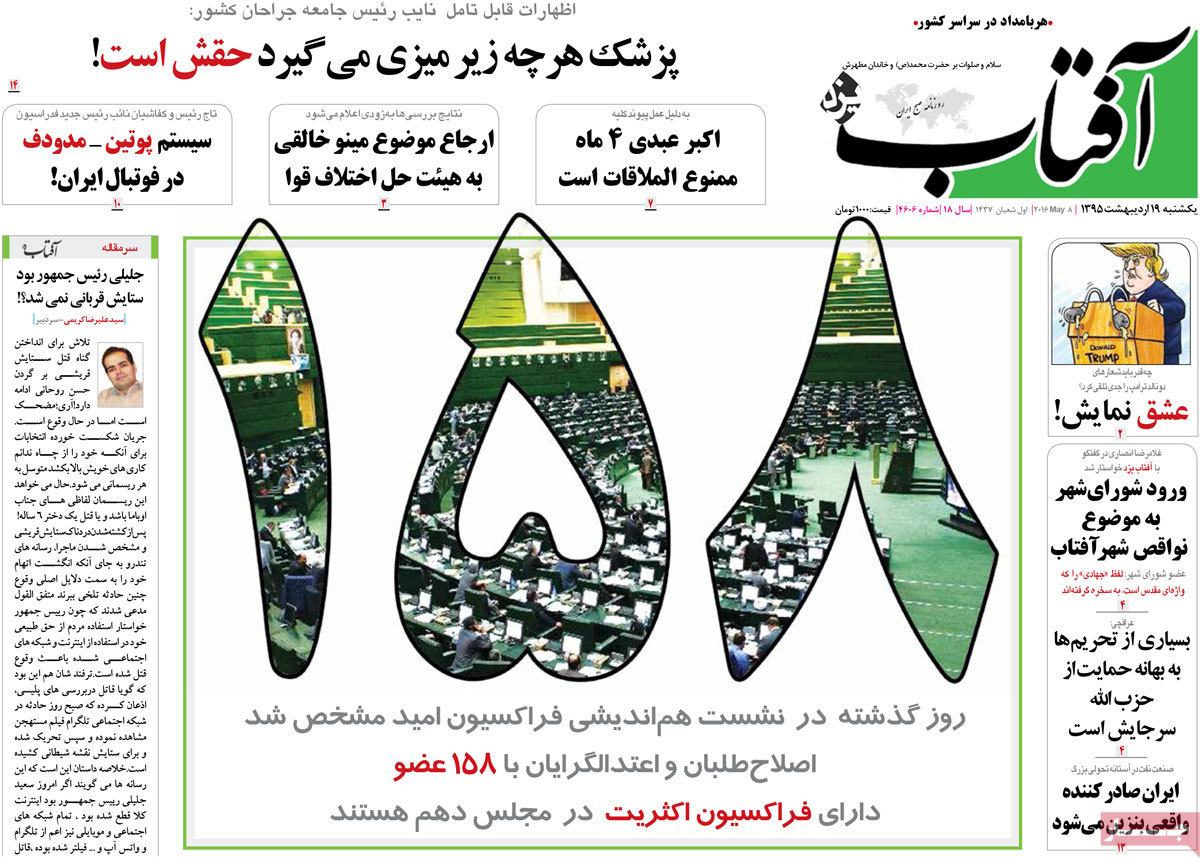
The final formation of Iran’s next parliament was finalized in the run-off elections held on Friday, April 29, in several Iranian cities. The results indicate that both factions, the reformists and the conservatives, will have the same number of seats in the parliament, and the influence of the independent lawmakers will be more than ever.

The formation seems to be a balanced one, but some self-declared independent politicians may change their position and join one of the two factions. Overall, however, neither the reformists nor the conservatives have managed to gain a majority in the next parliament.

Conservative candidates booked 102 seats [in some sources near 80 and even 60] in the first round and 18 seats in the second one. They will thus have 120 seats [in other sources between 83 and 90] in the new parliament.

On the other hand, the reformist candidates, who achieved 83 seats in the first round, managed to have a more effective performance in the second round and gain another 37 seats. Thus they also have reserved 120 seats in the final formation of Iran’s parliament. Therefore, other active political movements will have a more important role in the decision-making process in the 10th legislature.

The candidates who did not join the conservatives or reformists and termed themselves “moderates” gained 7 seats in the first round and 1 seat in the second. The independent candidates, however, will have a great influence in the Iranian parliament with the 29 seats [in some sources 55] earlier reserved in the first round and the 12 seats [in some sources 10] in the second. In a parliament with no majority party, the independents with 41 seats will play a key role for the first time in the Islamic Republic.

Given the Guardian Council’s decision to disqualify Minoo Khaleqi, the reformist member-elect of Isfahan, the constituency’s seat will be decided by a midterm election, and thus, the next parliament will start its work with 289 members, as illustrated by Tabnak’s info-graph.


Iran Parliament-Graph-Tabnak news


The graph demonstrates that neither the reformists nor the conservatives will have the final say in the parliament. The reformists will need the independents’ votes to achieve their goals, and in what seems to be a high priority after the elections, they will have to negotiate with them to increase their standing after 12 years of silence in Iran’s politics.

The conservatives will also start negotiations with those who have declared themselves independent. Their goal will be to prevent the reformists from gaining a majority, and also to create a balance in the struggle with the other faction in the next parliament.

There are also certain independent candidates in some constituencies who might originally have been reformists, but were not selected by the faction in the final list. These members could join the conservatives to demonstrate their worth to those who passed them over.

There is no doubt that, in the coming days and months, there will be lots of bargaining and negotiating as to the final composition of the parliament. We should wait and see whether the independents will stabilize the reformists’ majority, or prepare the conservatives for a balanced confrontation.

Jannati: Establishing Persian Gulf Foundation is Historical Necessity

Talking to IRNA on Friday, Jannati added that the foundation can become a major centre for cultural, historic, political, economic and social documents and data.

Music, dialect and historic traditions and documents are among the issues to be addressed by the foundation, with the ministry extending its full support to the new entity.

Describing the most important features of the International Persian Gulf Festival as being its popular approach and its cultural diversity, he said that after five editions of the event, the people have become the main organizers of the event, and that it has become a national and international movement.

Jannati arrived in Bandar Abbas to attend a ceremony marking Persian Gulf Day, which falls on April 29 when the Portuguese were expelled from the Straits of Hormuz and the Persian Gulf.

30% Rise in North Azadegan Oil Deposits

Mohammad Reza Asadi, director of engineering at Petroleum Engineering and Development Company (PEDEC), told Shana that finalization of the field’s MDP is one of the company’s agendas for development of the field.

Based on the master plan, North Azadegan field will be developed in 2 major phases, he said.
Asadi said the latest estimates show that the field holds 30% more crude oil than it was previously presumed in the MDP that was developed in 2008.
Drilling operations over 100 wells have started nearly a year ago and 60 of the wells are finalized with some being productive. 
The field was first decided to be developed by a Chinese developer, CNPCI, but Iran expelled the contractor from North Azadegan for its failure to respect its obligations.