Wednesday, December 31, 2025
Home Blog Page 4514

Sharif University to Expand Cooperation with Iraq and Afghanistan

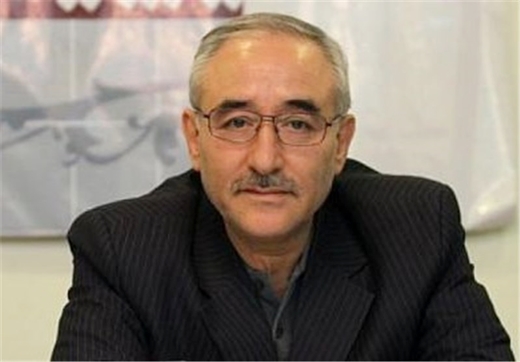
“Sharif University of Technology plans on scientific and educational cooperation with regional countries including Iraq and Afghanistan, with international student admission as a part of the cooperation,” Fotouhi told Mehr.

“To develop cooperation with countries in the region, we have carried out various activities, specifically for more cooperation with Iraq,” Fotouhi said.

He pointed to the talks for student admissions with Iraq, and said that an Iraqi academic delegation has traveled to Iran to hold meetings on advancing the bilateral plans.

We plan to increase the number of foreign students, Fotouhi said, among which is admitting students from countries in the region including Iraq, which is a priority of Sahrif University’s schedule.

Sharif University of Technology is one of the largest engineering schools in the Islamic Republic of Iran. In the 2013 Academic Ranking of World Universities – Engineering/Technology and Computer Sciences table, SUT was ranked 5th in the Middle East. It was in the top 251-275 universities in the world and 37th in Asia in the 2014 Times Higher Education World University Rankings.

No Men in the Village during Varf Chal: Locals Mark 600-Year-Old Ceremony

No man is allowed to stay in the village during the ceremony. They must all go to Varf Chal.
As shown in the photos, they carry pieces of frozen snow left from winter, and put them in a ten-metre-deep, one-meter-wide pit as they believe the snow could provide fresh water for animals and thirsty passers-by after melting in summer.


Untold Stories about the Iranian Silk Road Ultra-Marathon

There are 43 runners in the event from Iran, Italy, Canada, England, Germany, Austria, Norway, Morocco, India and Lebanon. The foreign participants arrived in Kerman last week.

Afshin Azizi, the Iranian presenter, said that Mohammad Ahansal and Rashid Al-marabeiti, several world champions and the fastest runners of world ultra-marathons will participate in the Iranian Silk Road Ultra-marathon. One blind participant from Italy will also run the 250km distance of the marathon along with other competitors.

Ultra-Marathon

There are five female runners from Iran, Italy, Canada and England.

Azizi also mentioned that there will be no great reward for the competitors at this ultra-marathon – they will only compete to strengthen their mental abilities and for humanitarian reasons. Of course, they will also have the souvenir of the visit to Iran, too.

The ultra-marathon has specific regulations. There shouldn’t be any technological device with the participants. They don’t need to be professionals, but they must be able to carry a 5 to 6kg backpack the whole week and walk, run and live with it. There will not be any food added to their rations, but they can have as much water as they want.

The Iranian Silk Road Ultra-marathon will be held in two integral and lite formats, each of which will be in 6 stages. It will start every day at 8:30am and finish by 3pm.

Representatives from Sky Sport and Rai TV channels, ANSA News from Italy and several world newspapers and news agencies will cover the event.

The slogan of the event is, “Run with us in the hottest place on Earth”. Currently, UNESCO is debating whether the Lut desert, the location of the race, will enter its list of World Natural Heritage Sites.

The city of Kerman, which for many years was on European countries’ lists of no-go areas in Iran, is now showing a different face to the world.

Ultra-Marathon (2)

Tehran to Become ‘Smart City’ with The Things Network

Ali Rahmanpour, the project manager, told Mehr that the first phase of ‘The Things Network of Tehran/Iran’ has been launched in Narmak, a neighbourhood in north-east Tehran, and will soon cover the whole of the capital.

“This gateway has been launched as a part of the global The Things Network (TTN), and is considered to be the first active TTN gateway in the Middle East,” he said.

The Things Network has been launched in Iran with an aim to establish an open, decentralized global network based on crowdsourcing, he added.

“The network uses Lora technology for its radio access, which is one of the two main technologies with low bit rate communication and long range for the Internet of Things,” said Rahmanpour.

According to him, the structure of TTN, due to its openness, is more transparent compared to other networks, and because of its high-level encryption, enjoys high security.

The Things Network was first launched in Amsterdam and in less than four weeks managed to spread its coverage to the whole city. Rahmanour told Mehr News that the lifting of sanctions against Iran following the implementation of the nuclear deal in January allowed his team to obtain the necessary permits to launch a branch of TTN in Tehran.

Erfan Taherkhani, Technical Assistant of Tehran TTN, said his team is currently working on the launch of two other gateways in central and western part of Tehran; “Preliminary estimates show that with about 10 gateways we can fully cover Tehran under The Things Network’s early coverage,” he said.

Iranian People Break Record Number of Women MPs

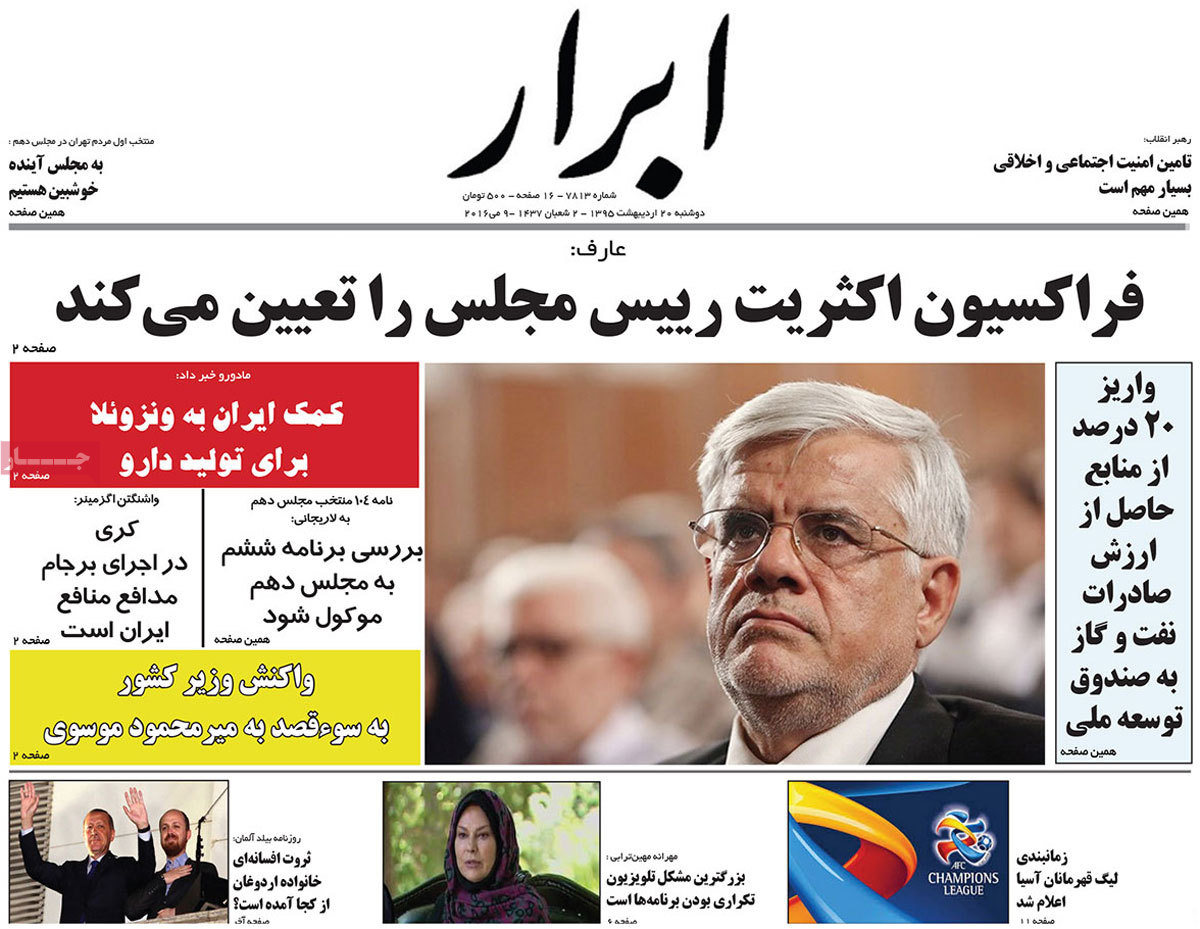
Iran’s parliamentary elections are over. 75% of lawmakers from the previous parliament have to vacate their seats for new members. Among female MPs, this figure is even higher – 100% of current female parliamentarians will leave their seats and give them to new members.

Even more importantly, the number of women in Iran’s Majlis has doubled. Here is IFP’s translation of KhabarOnline’s report on the change.


The run-off elections held on Friday, April 29, changed the formation of Iran’s parliament by 75%. It was also a great victory for the reformists, who claimed 42% of the parliament, while the conservatives only reserved 29% of the seats.

One of the most important points about the parliamentary elections is that all the female members of previous parliament (nine people) lost their seats.

All the previous female lawmakers had made it to the parliament as part of the conservative faction. Some of them, including Halimeh Aali, Mahnaz Bahmani, and Sakineh Omrani, were first-timers, but there were also veterans like Fatemeh Aalia, Fatemeh Rahbar, Nayyereh Akhavan Bitaraf, and Laleh Eftekhari, who had been in the parliament for several terms.

However, none of them managed to win the popular vote for the tenth parliament.

The new parliament, however, witnessed a sharp increase in the total number of female candidates elected.

Based on the results published by the Elections Headquarters, we will have 17 female MPs for the next four years. In terms of political orientation, unlike the ninth parliament (whose female members were all conservatives), the new parliament will host a large number of female reformists as well.

Meanwhile, certain candidates have also run as independents and managed to win the polls. Out of the 17 women, 11 are reformists and the rest have declared themselves as being independent.

Looking at the previous nine parliaments shows that the fifth one, with 14 female MPs, held the highest record before the recent elections. The Iranian people, however, broke this record by electing 17 female members this time.


Presence of Women in Different Terms of Iran’s Parliament

Term Number No. of Female MPs in Iran No. of Female MPs in Tehran
1st

4

4
2nd 4 4
3rd 4 4
4th 9 5
5th 14 7
6th 13 6
7th 12 6
8th 8 5
9th 9 4
10th 17 8

Iran’s Oil Exports Hit 2.3m bpd: President

Addressing a ceremony at an industrial plant near Tehran on Sunday, the president blamed the critics of the JCPOA for ignoring the fact that the country’s oil exports have doubled in just a few months since the enforcement of the nuclear deal.

He was speaking on the occasion of the International Workers’ Day.

The president hailed the outcomes of the lasting nuclear deal, saying that doors have now been opened for foreign investment in Iran.

Iran and the Group 5+1 (Russia, China, the US, Britain, France and Germany) on July 14, 2015 reached the lasting agreement on Iran’s peaceful nuclear program and started implementing it on January 16.

Before the sanctions were lifted, Iran said it had made the necessary preparations to boost its oil production capacity to pre-sanctions levels.

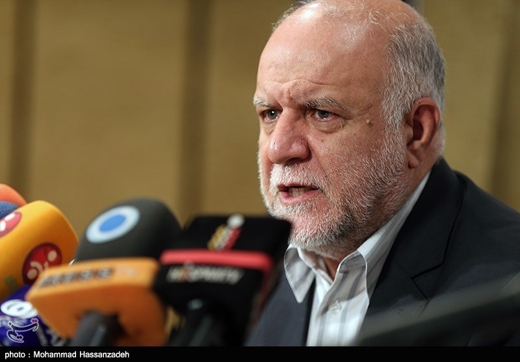
Iran’s Oil Minister Bijan Zanganeh has repeatedly emphasized that the Islamic Republic is determined to regain its share of the oil market lost as a result of the sanctions.

Indian PM Modi to Visit Iran in Late May

Indian daily newspaper The Hindu has cited government sources involved in the planning of the visit that Modi is likely to make a visit to Iran on May 21-23, although the dates are yet to be finalized. Iranian Ambassador to India Gholamreza Ansari has predicted the visit to be on May 22.

Modi is also expected to visit Chabahar and gas fields that are of India’s interest for investment, following the South Asian country’s approval for the Ashgabat Agreement in March, which is aimed at creating an International North South Transport Corridor connecting India, Russia, Iran with Europe and Central Asia.

According to the Indian media, coinciding with Modi’s visit, the Indian Ocean Region Association will host a major international summit in Chahbahar.

During the visit, India and Iran are likely to seal an MoU on the pending energy project at Farzad–B gas field, adds the Indian source.

Iran Ambassador to New Delhi Gholamreza Ansari said Prime Minister Modi is expected to invite President Rouhani for an official visit to India. He further maintained that Modi’s visit will be a significant step toward the expansion of relations between the two countries.

Iran and India have held long-standing relations and despite sanctions, the volume of their trade transactions has reached $15bn in the past years. This will be the first visit of PM Modi to Tehran since he took office in 2014.

Iran’s Interior Ministry Backs Off from Plainclothes Morality Police Plan

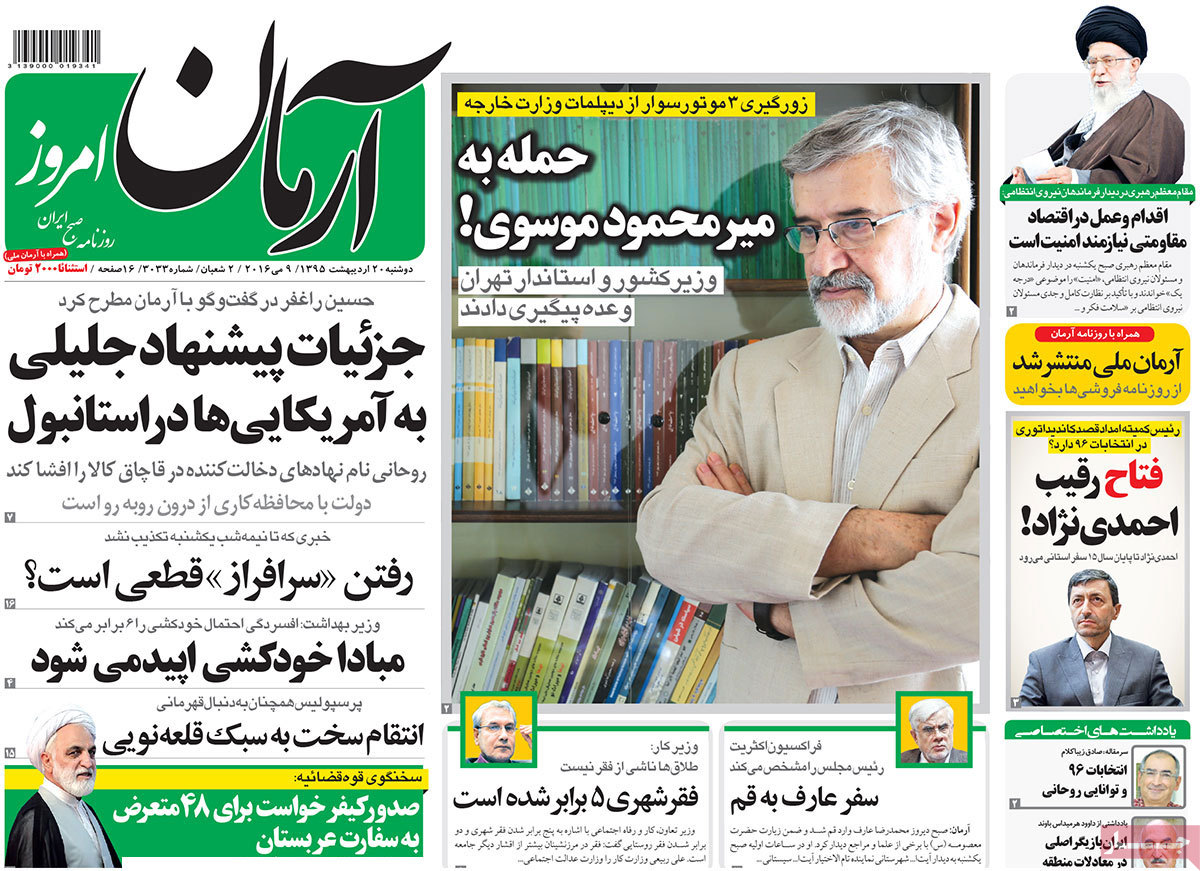
Deputy Interior Minister for Security Affairs Hossein Zolfaqari announced that a recent plan for using 7,000 plainclothes forces as morality police has been revised, and that these forces will do their job in uniform instead.

Here is IFP’s translation of a report by Ana on his remarks.


“We have received and studied the Law Enforcement’s ‘Social and Moral Security Plan’… The plan has considered actions against thugs, drug dealers, thieves, disturbers of social security, and those who do not observe the Islamic dress code (Hijab),” he noted.

After carrying out certain studies on the issue, it was decided that the plan for social security and the one for moral security should be prepared separately, because moral issues have their own mechanisms, Zolfaqari stressed.

He referred to the concerns over plainclothes morality police, saying, “Two factors caused certain concerns about the issue: first, grouping the two plans (morality and social security) together, and secondly, the plainclothes nature of these forces, about which people and officials were not well informed.”

The Interior Ministry held talks with the law enforcement officials, and it was agreed that the disciplinary forces responsible for moral security should continue their job in uniform, as they used to before, Zolfaqari said.

The plainclothes forces will only be used for social security, not issues of morality, he said, expressing the hope that people and authorities’ concerns can now be allayed.

Gergiev, Top International Conductor, Invites Rahbari to Conduct St. Petersburg Orchestra

As reported by Tasnim, and translated by IFP, Valery Gergiev, the world-renowned conductor who is directly supported by Vladimir Putin, officially invited Ali Rahbari to conduct the St. Petersburg Orchestra in the Mariinsky Opera Hall. Rahbari has accepted the invitation, and the dates for this event will be announced soon.


63-year-old Valery Gergiev, conductor and Artistic Director of the White Nights Festival in St. Petersburg, knows Ali Rahbari from many years ago, when Rahbari was the conductor of the Berlin Philharmonic Orchestra, and was also an assistant of Herbert Von Karajan, the well-known conductor.

Gergiev has invited Ali Rahbari to conduct St. Petersburg’s orchestra for the last two years, but now this invitation has been accepted.

This collaboration will play an important role in highlighting Iranian artists.

The Mariinsky Theatre is the biggest hall in the world, and is managed and directed by Gergiev. Currently, the Stravinsky Orchestra has 350 players. This hall has three large orchestras. Stravinsky Hall was opened in 1860 and became a significant performance space for glorious performances by notable late 19th Century composers such as Tchaikovsky, Mussorgsky and Rimsky-Korsakov. Today, the Mariinsky Orchestra, Opera and Ballet are all world-famous, and only significant conductors are invited to lead them.

German Firms Dissatisfied with Merkel’s Stance on Iran

Gabriel is slated to visit Tehran on May 2 for the second time since Iran and world powers clinched a comprehensive nuclear deal back in July 2015.

He is going to take part in the Iran-Germany Joint Economic Commission, which is scheduled to take place in Tehran for the first time in 15 years.

The German Vice-Chancellor’s visit is expected to help reinforce economic relations between the two countries.

Helene Rang, the CEO and Deputy Chairperson of NUMOV (the German Near and Middle East Association) told Deutsche Welle that she expected Gabriel, who is also Germany’s Economy Minister, to take serious action for the promotion of ties with Tehran.

German firms are not at all satisfied with the fact that Merkel, due to certain considerations regarding Israel, has maintained a distance in ties with Iran. Comparatively, French President François Hollande and Italian Prime Minister Matteo Renzi have received Iranian President Hassan Rouhani in their capitals.

German corporations expect Berlin to give the same sort of signals to the Iranian administration, and to demonstrate that the strengthening of mutual economic cooperation is high on Germany’s agenda.

Investors in Germany, however, are hopeful that a couple of contracts, albeit minor ones, will be finalized during the trip. They welcomed a recent agreement between Germany’s Siemens and Iran’s Mapna to manufacture gas turbines and power generators, and considered it the first step for future ventures.

The lack of banking guarantees is one of the most important reasons why many German firms are unable to invest in Iran and sign deals with Iranian companies.

“This is a key problem that should be resolved quickly, because most German banks refuse to provide the financial deposits for economic activity with Iran. Many businessmen are hopeful the issue will be settled during Gabriel’s visit to Tehran,” Rang said.

(A report published by Fararu news website and translated by IFP)