Friday, December 26, 2025
Home Blog Page 4511

Unbeatable “Buddy’s” Fish Kebabs

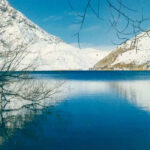
Apart from its gorgeous landscape, trees and natural features, Zrebar Lake (3km west of Marivan, Kurdistan) boasts other special characteristics, too – all of these combine to make the lake a unique destination.

All around the lake, there are 24 small kiosks spreading a wonderful smell into the air. They are famous for a special fish kebab recipe that, as they claim, is unique.

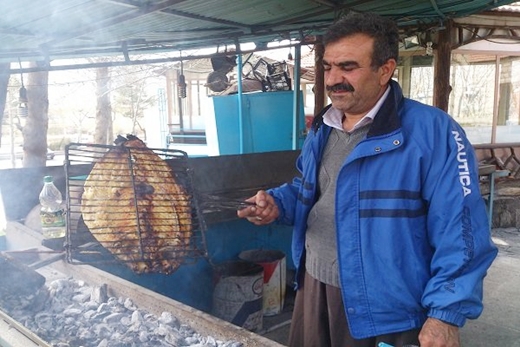
Rafigh (meaning Buddy) is one of these kiosk owners at the lake. He drops a fresh grass carp onto the chopping board and slices it into two with the tip of his knife.

He puts a couple more on the board, explaining, “Our local fish are grass carp, common carp and silver carp.”

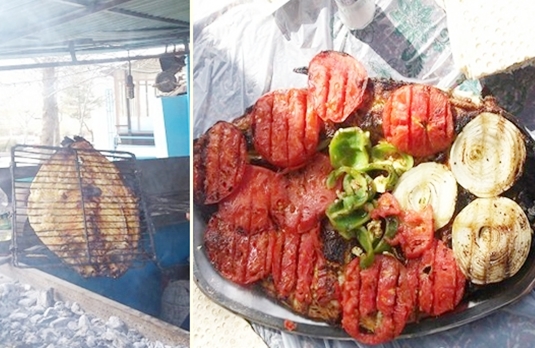
He positions the fish above the red, hot coals and turns the net every few seconds. A few minutes later, he separates the loose skin of the fish with a stick.

When the fish as red as the coals, he out takes a pot and spreads its contents all over the fish, “When the fish has cooked a bit, we add onion juice on both sides, then score the flesh with a stick so the juice gets into it.”

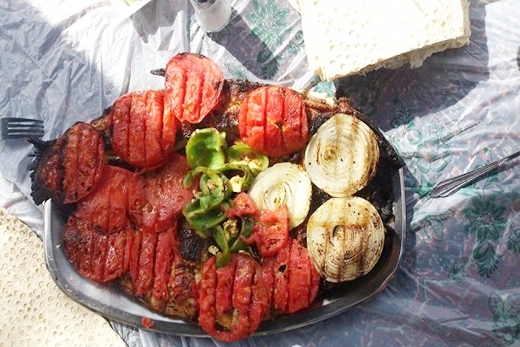
Rafigh takes the fish off the coals again and adds more things: Hawraman local sumac, oil and lemon juice. Then covers the top with onion and tomato and puts it back on the coals again.

“This type of kebab is exclusive to Zrebar Lake – nowhere else in the world can you find fish kebabs with these ingredients, and cooked in this way. It takes half an hour for the fish to be ready. All this time, we keep scratching the flesh so the ingredients get into the centre.”

He then talks about the fishing season, “There are only 36 fishermen allowed to fish in the lake, who have permission from the Iran Environmental Organization, which is limited to only six months: autumn and winter.”

The fish is now as red as the coals, and Rafigh takes it off and puts it on a tray, “Each of the lake’s fish is enough for at least two people. Some people order one for four, and some Iraqis have such great appetites that they order one fish per person!”

Rafigh has been making fish kebab in this way at Zrebar Lake for 25 years.


3 Iranian Police Killed in Clashes with Armed Drug Dealers

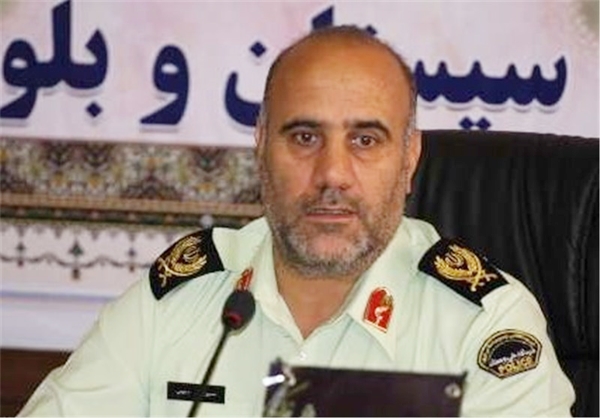
Brigadier General Hossein Rahimi confirmed the attack on the checkpoint by a group of culprits and the death of three policemen, expressing deep sorrow over the tragic incident.

He added that another police officer was injured in the attack.

General Rahimi said efforts are underway to arrest the armed group, adding that his forces will fight “until the last drop of blood” to defend Iran’s territorial integrity and security.

In recent decades, Iran has been hit by drug trafficking, mainly because of its 936km shared border with Afghanistan, which produces more than 90% of the world’s opium.

According to the UN Office on Drugs and Crime, the Islamic Republic is netting eight times more opium and three times more heroin than all other countries in the world combined.

The war on the drug trade originating from Afghanistan has claimed the lives of nearly 3,700 Iranian police officers over the past three decades.

Iran’s Foreign Exchange Reserves Soar: IMF

In its latest World Economic Outlook report, the IMF said the Iranian reserves of foreign exchange rose by $14.3 billion in 2015, registering a record of $125.9 billion.

It added, however, that the reserves could slim slightly and settle at $125.6 billion this year.

Similarly, the international financial organization forecasted the country’s gross domestic product (GDP) to hover around $386 billion in 2016 from last year’s $387.7 billion.

The report, which projected the world economy to gain 3.5% in 2016, forecasted a four-percent growth for the Iranian economy, compared to its announcement last year of zero percent.

The IMF also estimated Iran’s double-digit inflation rate of nearly 12% to lower and reach 8.9% throughout this year.

It said a prolonged period of slow growth has left the global economy more exposed to negative shocks and raised the risk that the world will slide into stagnation.

The monetary organization had earlier cut its combined growth projection for oil-exporting countries to 2.9% this year, from a forecast of 3.8% in October.

Mountain Hiking in Iran is Both Attractive and Cheap: Mountaineer

Ali Shadlou recently started the first official course for training mountaineering leaders in Iran, in collaboration with the Cultural Heritage, Handcrafts and Tourism Organization, and the I.R. Iran Mountaineering & Sport Climbing Federation. As he explained to ISNA, “Iran’s mountains have many fans because of the geographical circuit they are located on. Also, travelling to them is much cheaper than many other countries. For instance, one can buy a permit for Mount Damavand for $100, while to buy Mount Fujiyama’s, which is called Damavand twin sister, costs $4,000. Many hikers and tourists are not even aware of this fact.”

He believes that by joining the International Federation of Mountain Guides Association (IFMGA), Iran can make up for this lack of knowledge, and change the course of hiking and hiking tourism in Iran.

The IFMGA was founded in 1965 by mountain guides and tour leaders from Austria, France, Switzerland and Italy, and currently has about 6,000 guides from more than 20 countries in Europe, Asia, the Americas, and Oceania.

He added, “If we can increase the number of Iran’s mountain guides to the level where we can form a national association and become a member of the IFMGA, then we can market our mountains much better.”

According to his current statistics, based on the training course in Iran, 14 people have already graduated and 15 more will soon be joining them.

“This number must at least reach 20 in order for us to form a national association. Of course, the number of skilled leaders in Iran is much more than that, but they should go through this training process so we can register Iran’s national association, which is already recognized by the Ministry of Youth Affairs and Sports and the Ministry of the Interior. This is one of the major conditions of becoming a member in the IFMGA.”

He highlighted that the I.R. Iran Mountaineering & Sport Climbing Federation has been proactive in this regard, saying, “The federation has done well so far. It has sent a representative to IFMGA’s seminar, which help them find out about Iran’s activities in the field. It has also invited IFMGA’s Vice-President to come to Iran. These steps surely will not be ignored.”

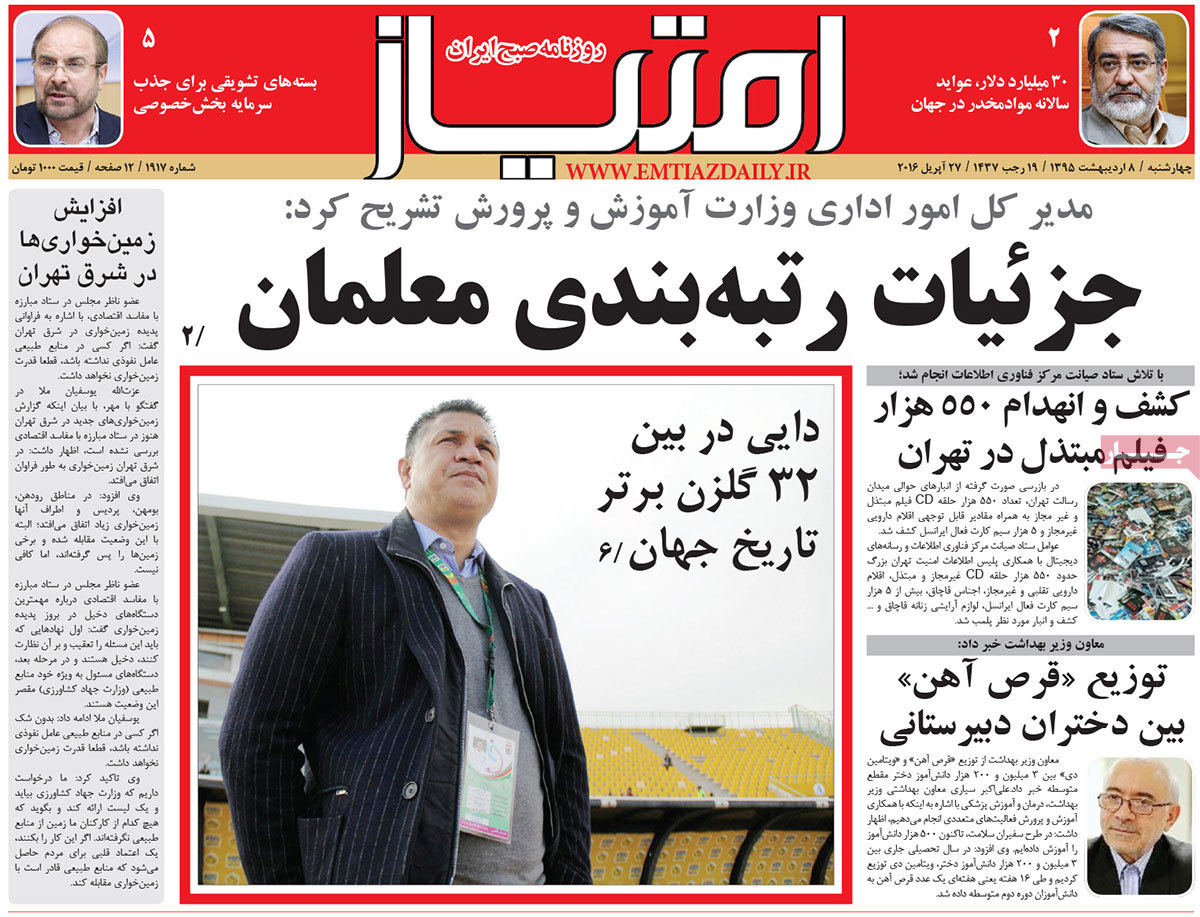
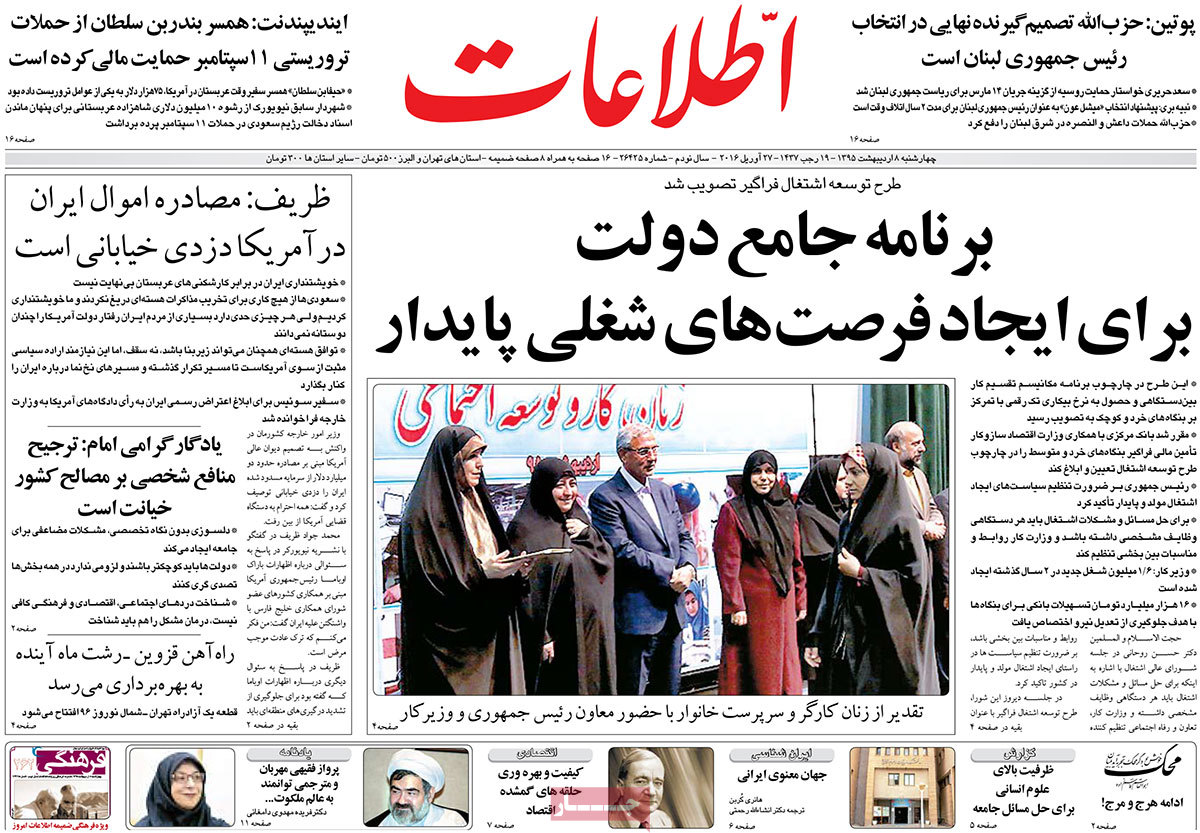
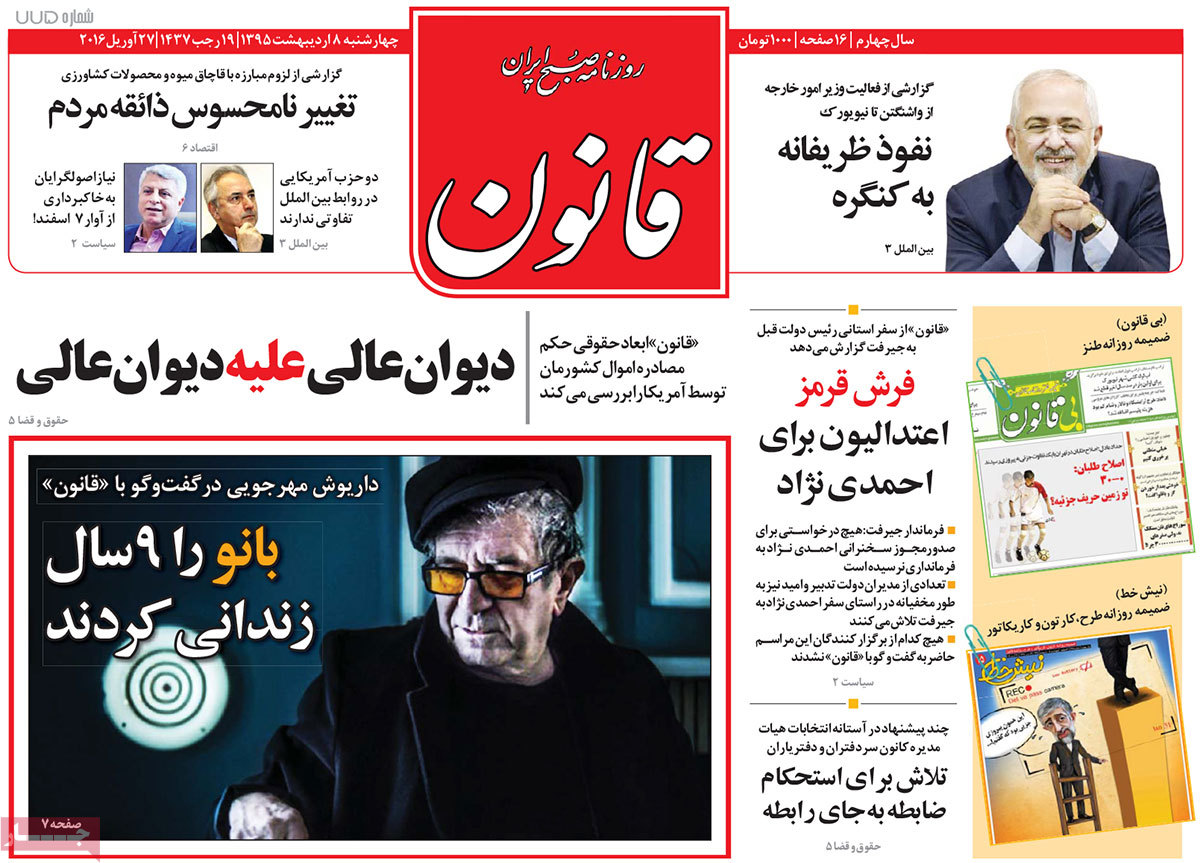
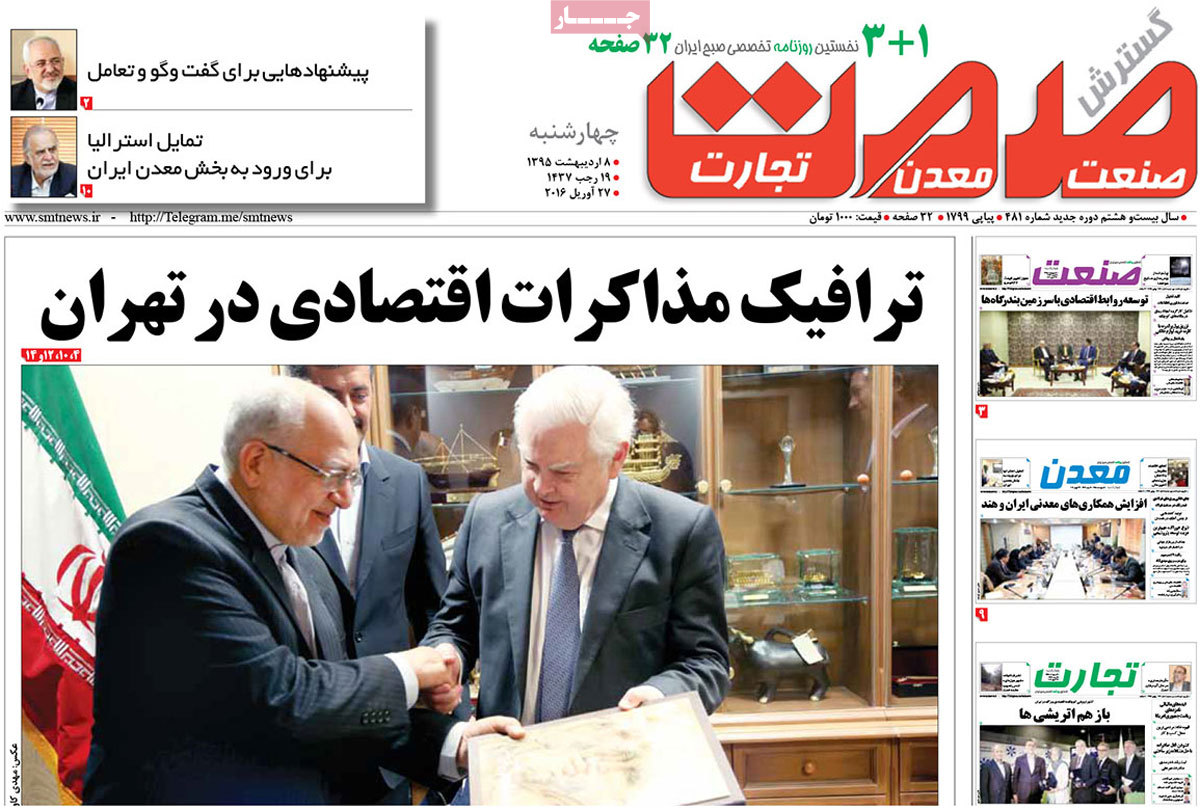
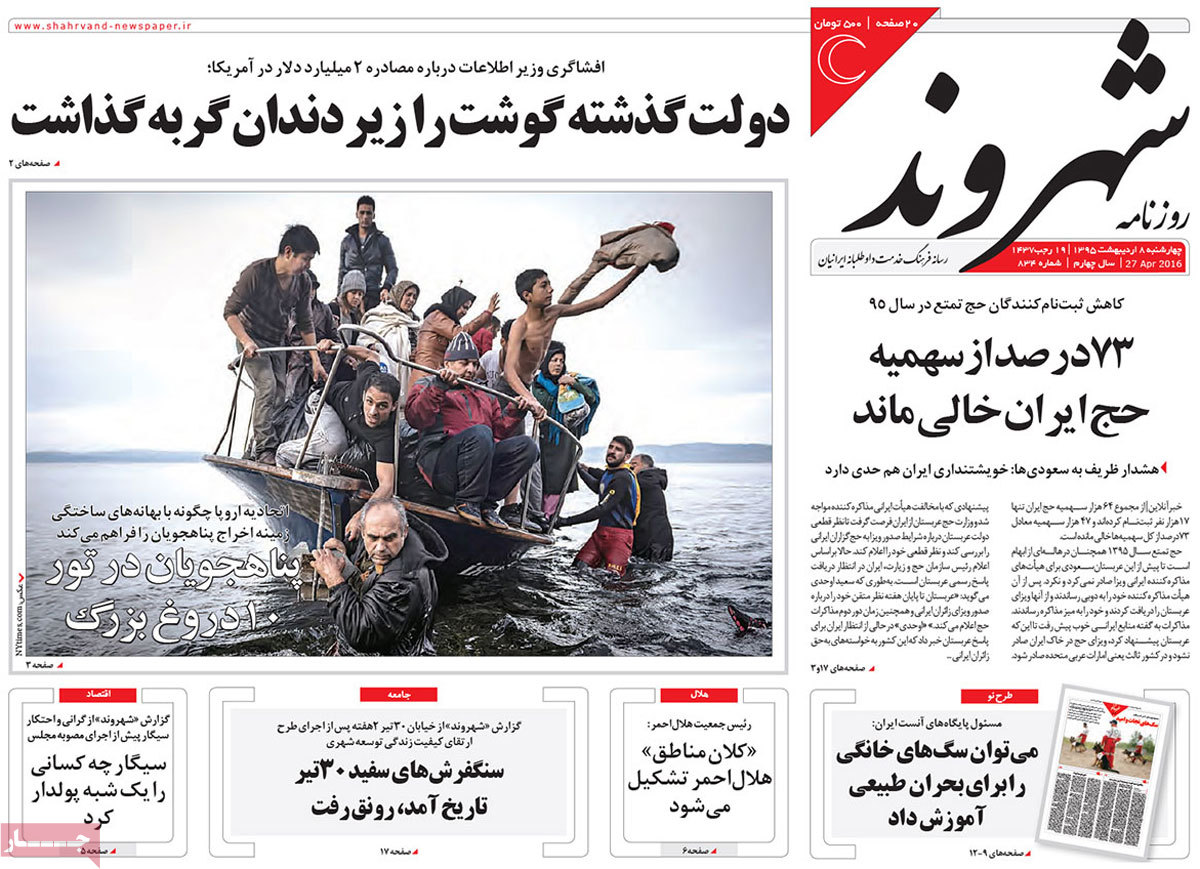
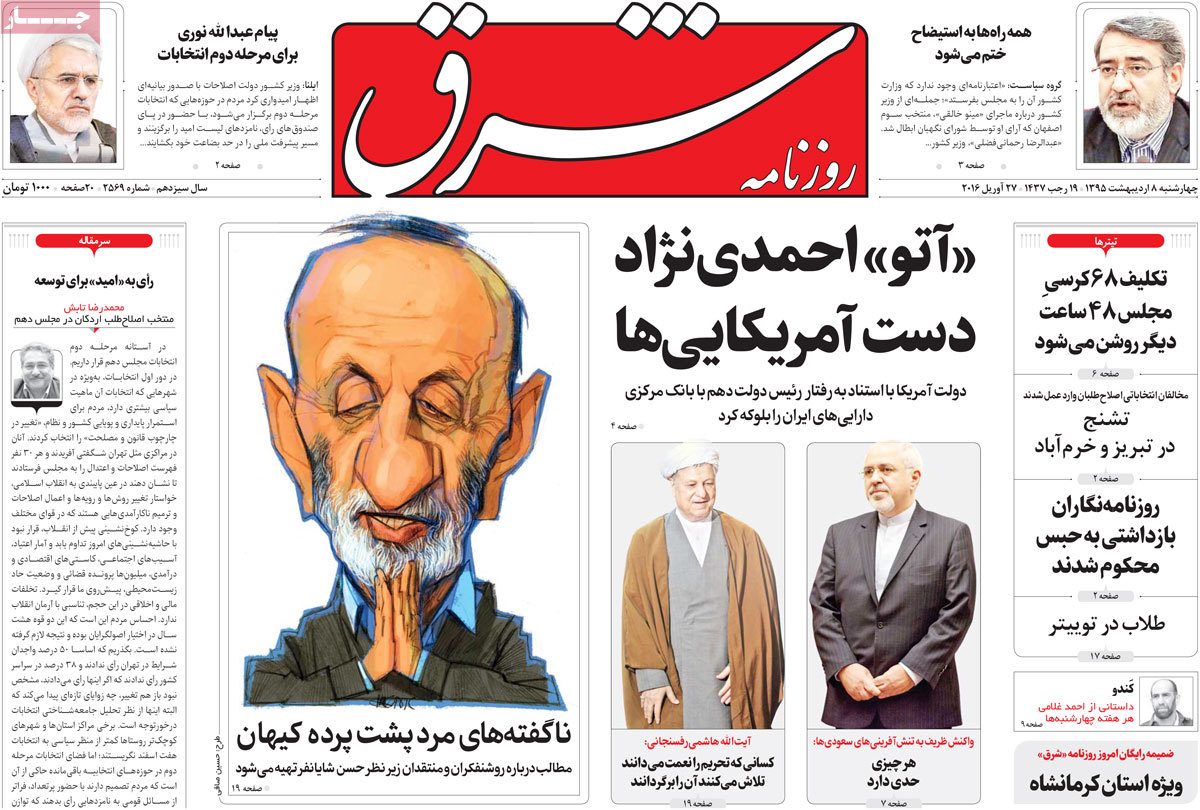
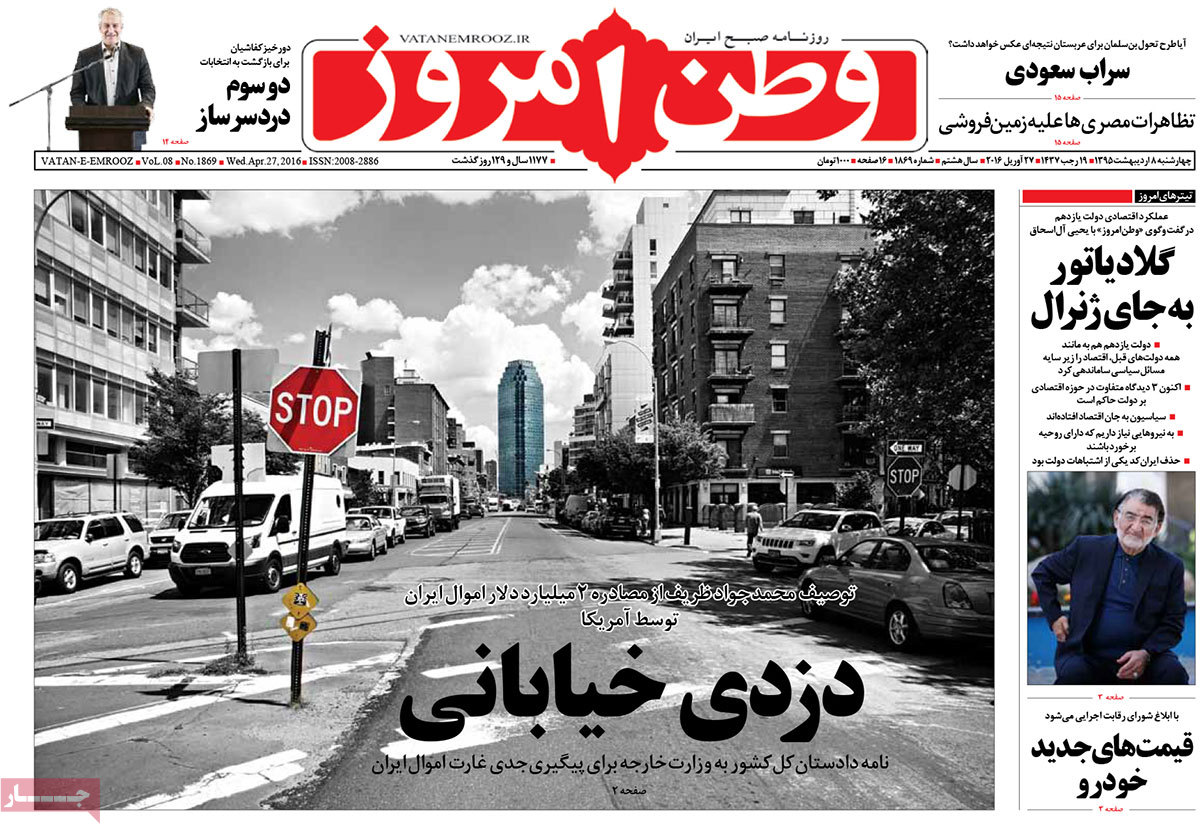
A Look at Iranian Newspaper Front Pages on Apr. 27

Iran Newspaper front pages

The recent US Supreme Court decision to seize $2bn of Iranian assets remained a top story today, continuing to receive plenty of commentary as to the legality of the decision, as well as opinions regarding who in Iran is to blame for allowing this to happen.

Foreign Minister Mohammad Javad Zarif, in particular, has made his views on the matter very clear internationally, with a much-reprinted New Yorker interview drawing a lot of attention. In addition, the Swiss envoy to Tehran was summoned to accept an official complaint from the Iranian government over the asset seizure, as Switzerland has been representing US diplomatic interests in Tehran since the embassy siege in 1979.

In other news, renowned and much-loved filmmaker Abbas Kiarostami has been discharged from hospital after a recent illness scare, saying he felt hopeful about his future health.

Both oil and gas have been showing marked improvement, year-on-year, as well as attracting new customers. Several dailies chose to draw attention to the fact that Canada and the US are set to strike new deals in the sector.


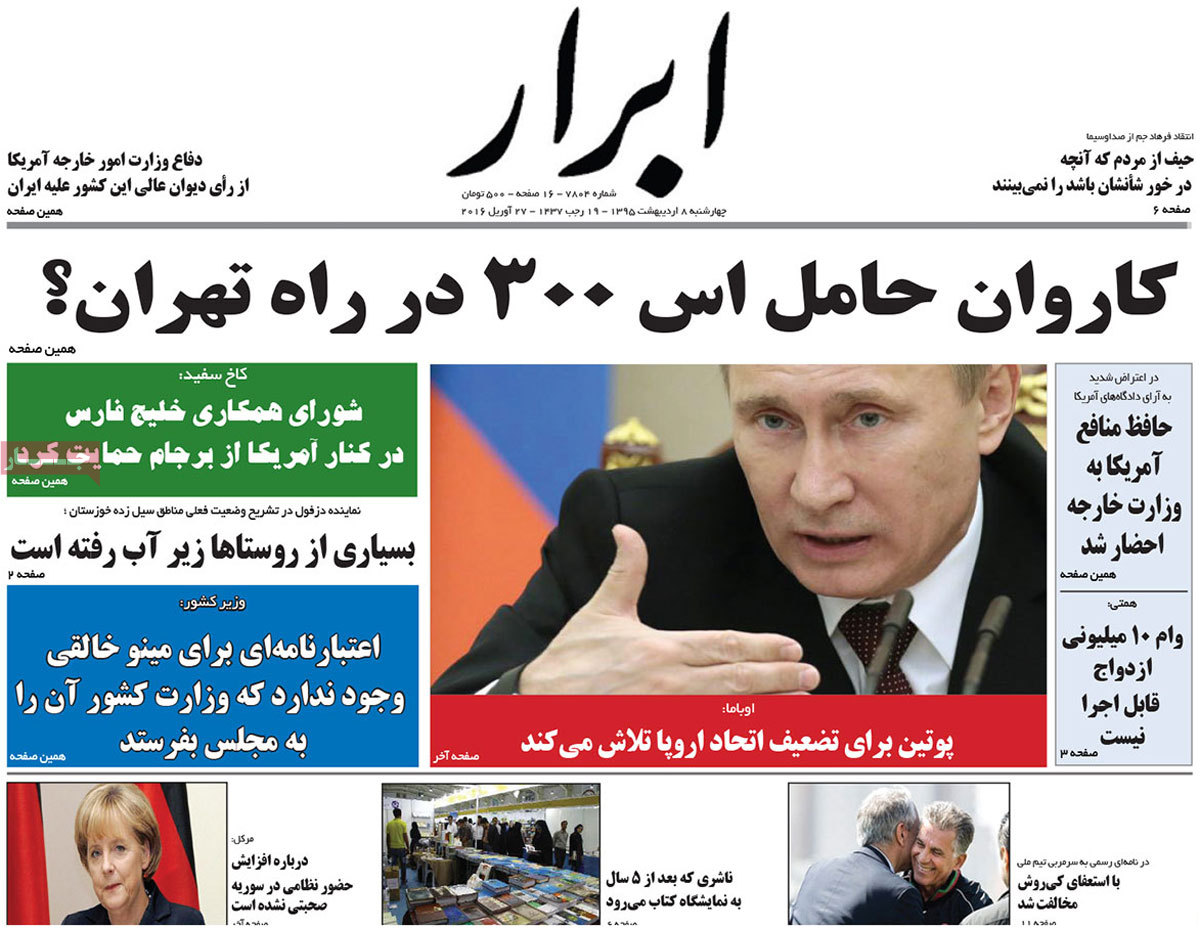
Abrar:

  1.  Is Russia’s S-300 Delivery to Iran Underway?
  2. White House: GCC Stands by US in Supporting JCPOA
  3. Resignation of Iran Football Coach Carlos Queiroz Officially Rejected


A Look at Iranian Newspaper Front Pages on Apr. 27


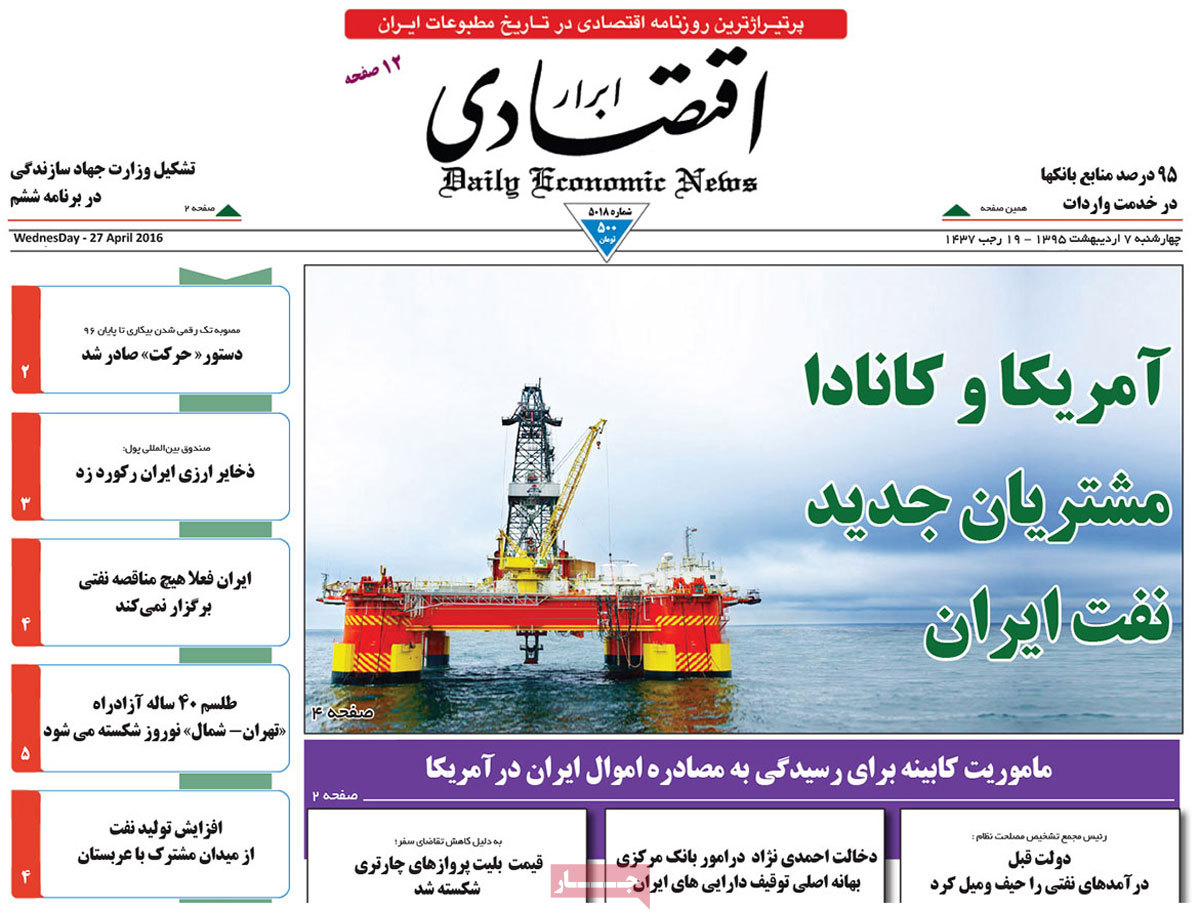
Abrar-e Eqtesadi:

  1. The US and Canada – Iran’s New Oil Customers


A Look at Iranian Newspaper Front Pages on Apr. 27


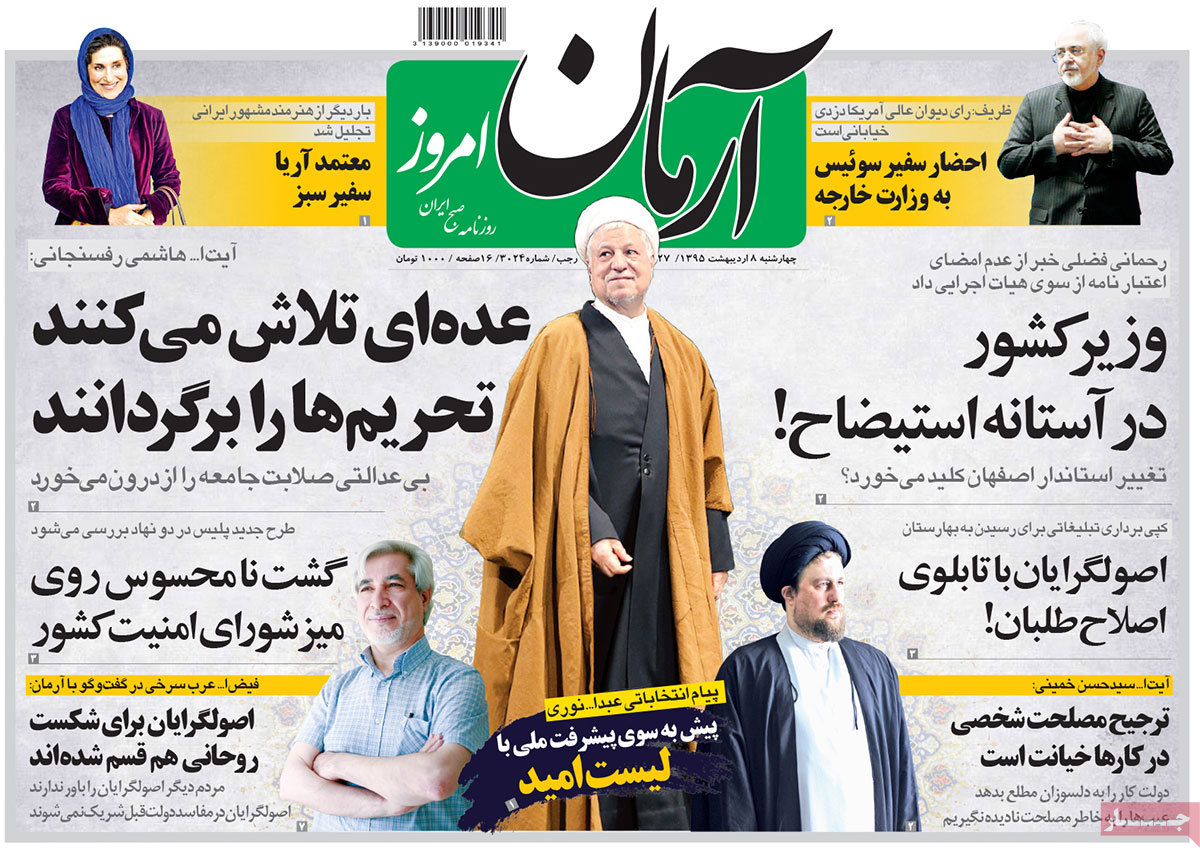
Arman-e Emrooz:

  1. US Court Ruling Is “Highway Robbery”: FM Zarif
  2. Swiss Envoy Summoned to Foreign Ministry over US Seizure of Iranian Assets
  3. Supreme National Security Council to Study “Plainclothes Morality Police” Plan


A Look at Iranian Newspaper Front Pages on Apr. 27


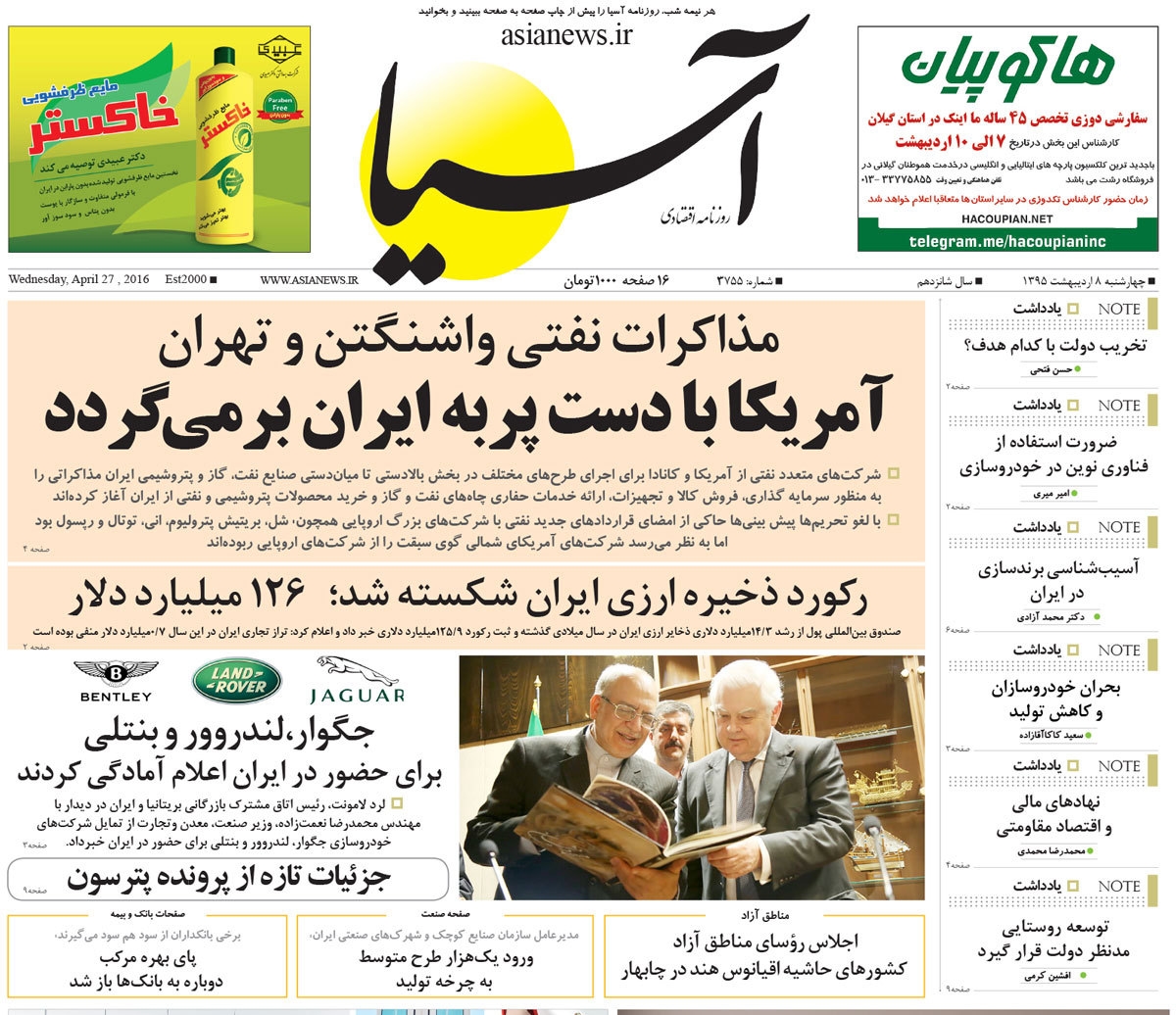
Asia:

  1. Tehran-Washington Oil Talks: US Return to Iran
  2. Jaguar, Land Rover, Bentley Ready for Presence in Iran


918317b5 (1)


Emtiaz:

  1. Ali Daei, One of the World’s 32 Best Goal Scorers


A Look at Iranian Newspaper Front Pages on Apr. 27


Ettela’at:

  1. Saudi Prince’s Wife Financially Supported 9/11 Attacks: Independent
  2. Putin: Hezbollah Has Final Decision in Lebanese Presidential Elections


A Look at Iranian Newspaper Front Pages on Apr. 27


Ghanoon:

  1. Supreme Court vs. Supreme Court: Analysis of US Court Ruling’s Legal Aspects
  2. Democrats and Republicans Not Different in Int’l Relations: Analyst


A Look at Iranian Newspaper Front Pages on Apr. 27


Samt:

  1. Visitors Coming Thick and Fast for Economic Talks in Tehran
  2. Australia Keen to Cooperate in Iranian Mining


A Look at Iranian Newspaper Front Pages on Apr. 27


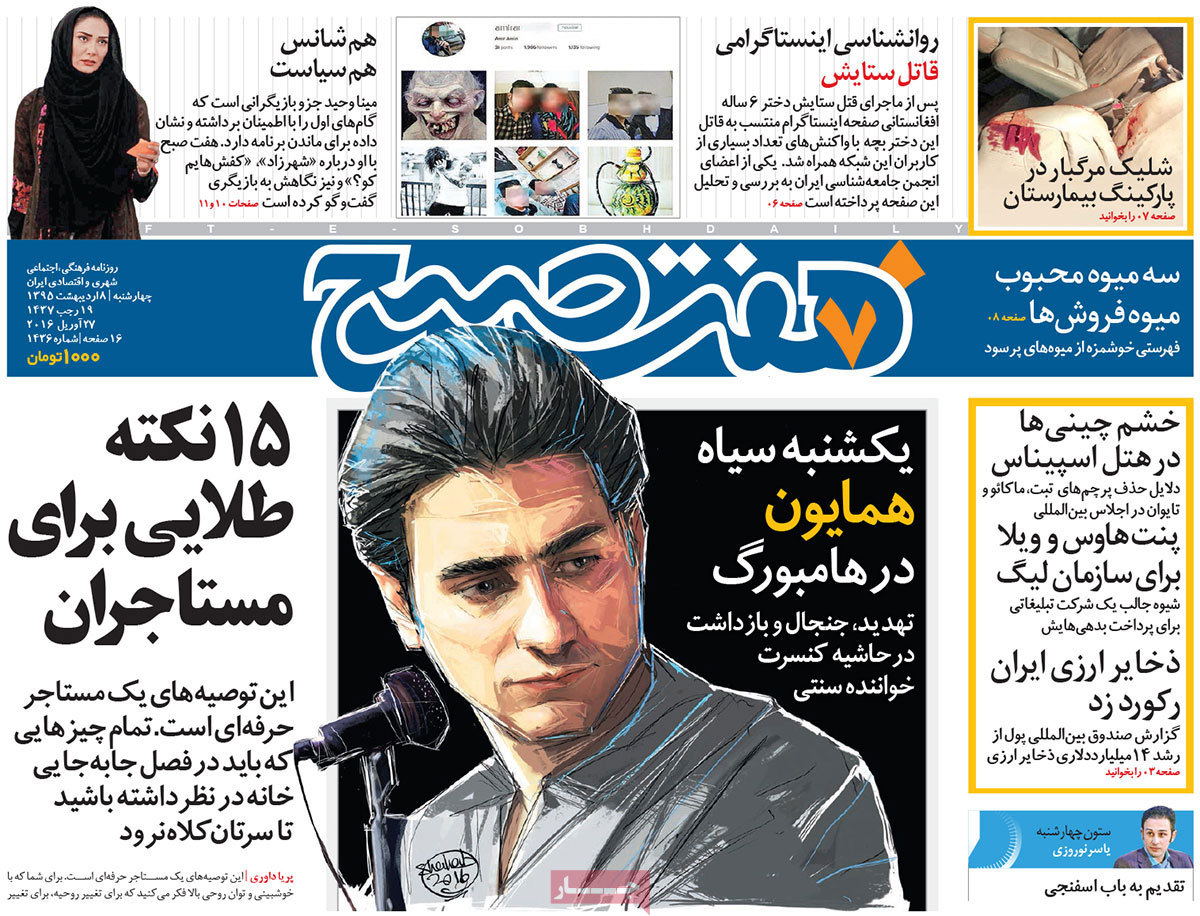
Haft-e Sobh:

  1. Record-Breaking $14bn Increase of Iran’s Foreign Exchange Reserves: IMF
  2. Flags of Macau, Tibet, Taiwan Removed from Tehran Int’l Congress after China’s Anger


A Look at Iranian Newspaper Front Pages on Apr. 27


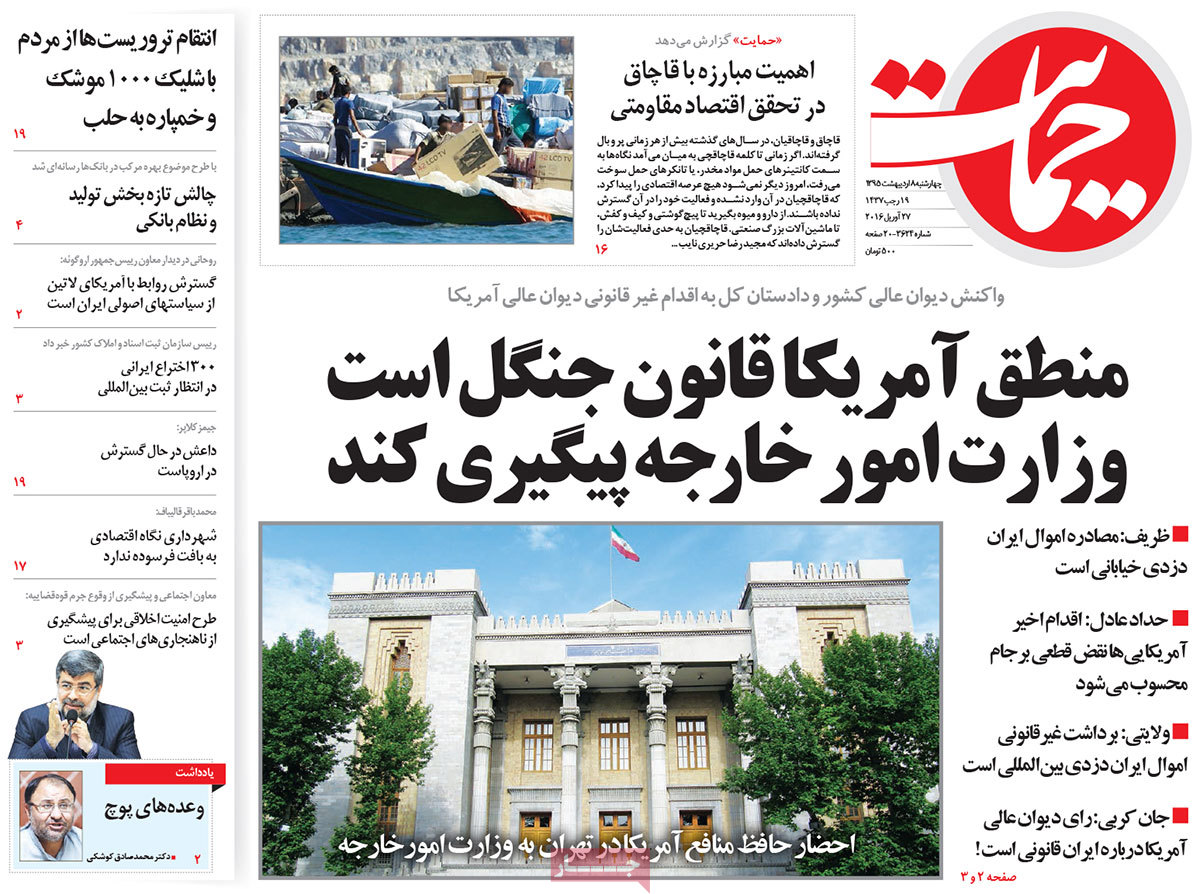
Hemayat:

  1. 300 Iranian Inventions Waiting to Be Registered Internationally
  2. Expansion of Ties with Latin American Countries Is Iran’s Policy: Rouhani


A Look at Iranian Newspaper Front Pages on Apr. 27


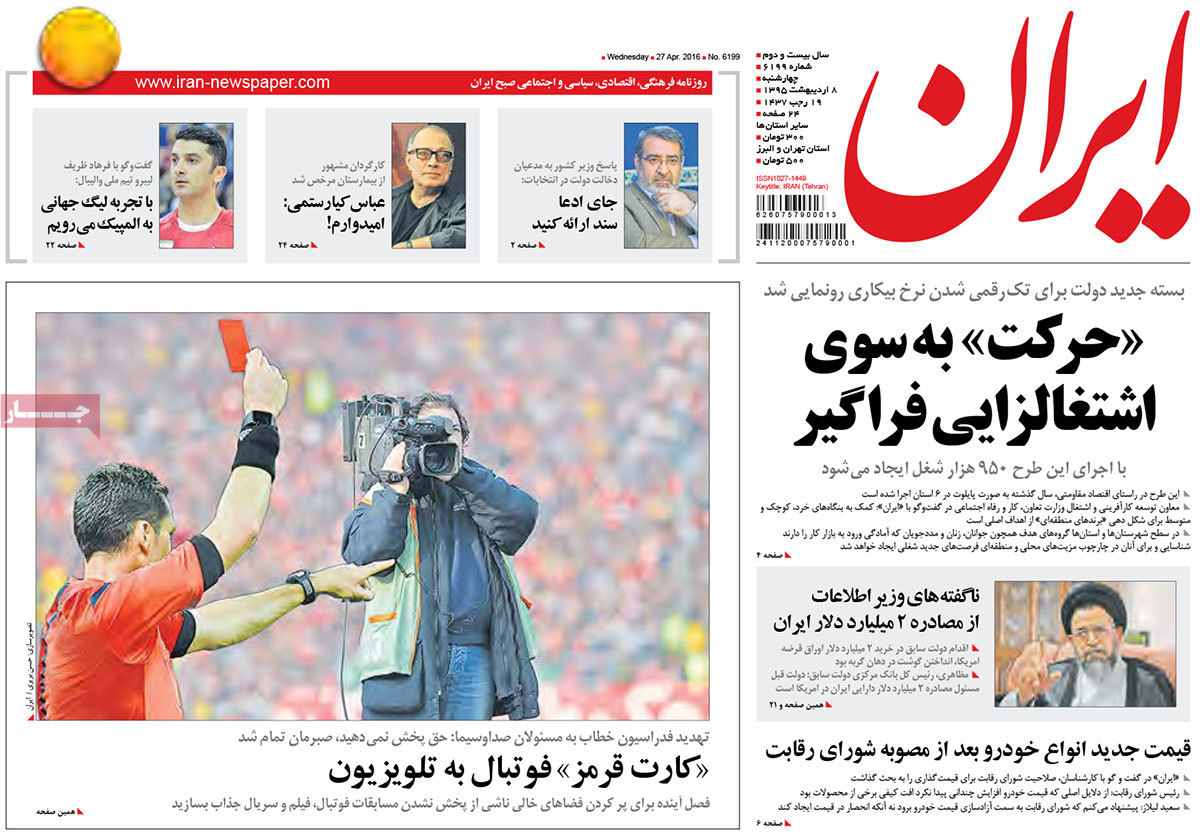
Iran:

  1. Gov’t Unveils New Plan to Reduce Unemployment Rate
  2. Abbas Kiarostami after Release from Hospital: I Am Hopeful


A Look at Iranian Newspaper Front Pages on Apr. 27


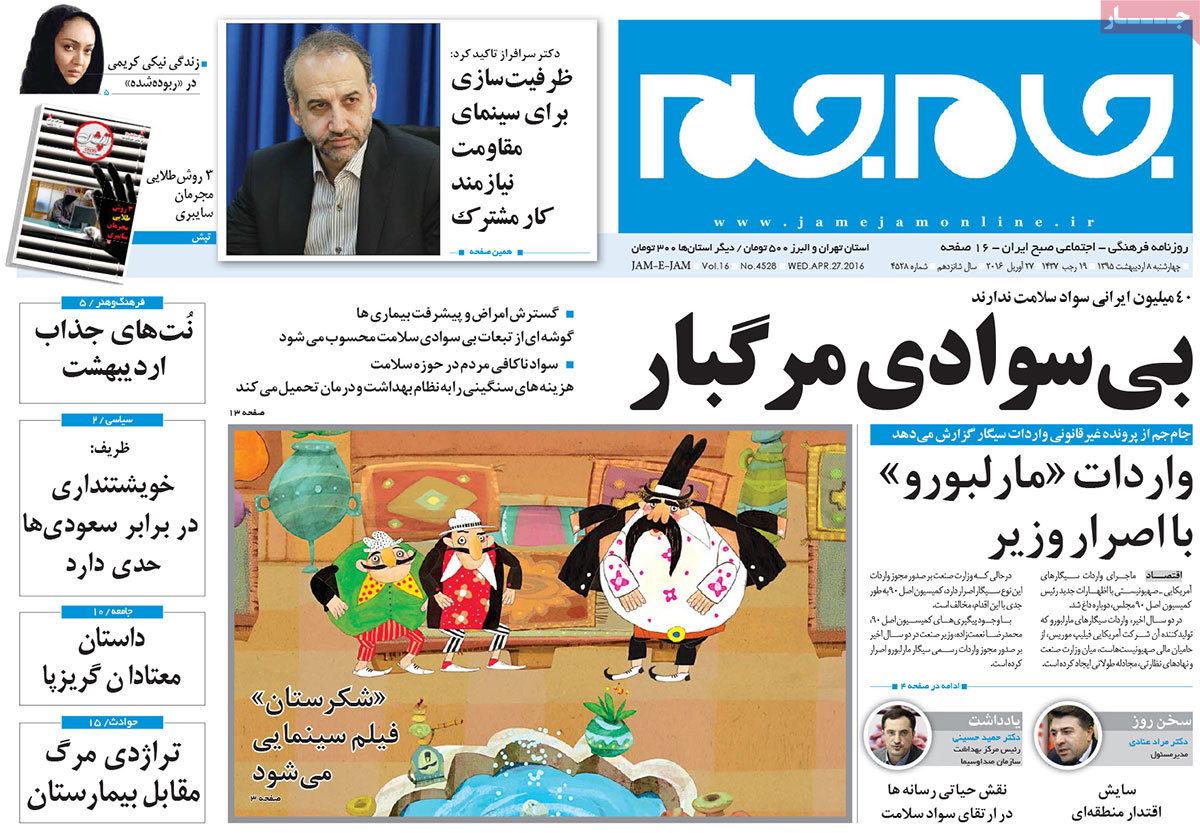
Jame Jam:

  1. Trade Minister Insists on Importing Marlboro Cigarettes despite Parliament’s Opposition


A Look at Iranian Newspaper Front Pages on Apr. 27


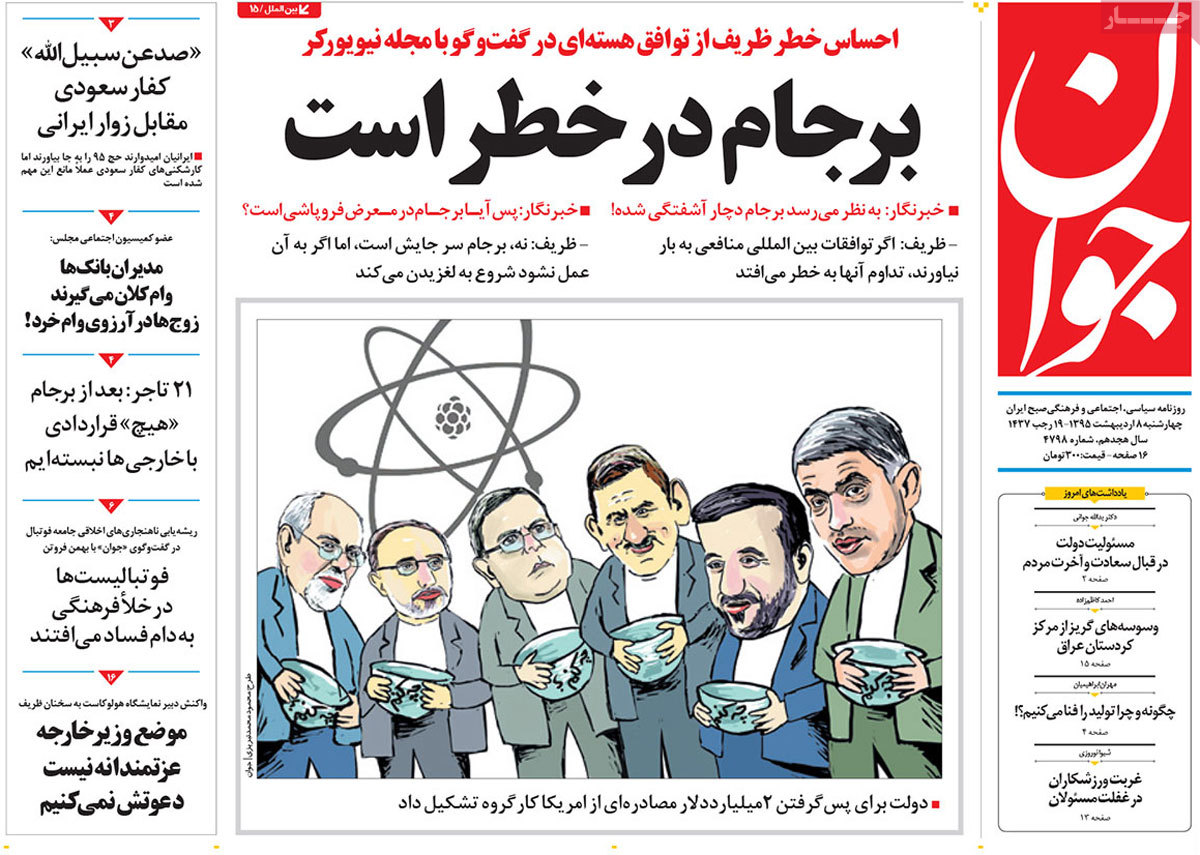
Javan:

  1.  JCPOA in Danger: Zarif Alarmed at Nuclear Deal


A Look at Iranian Newspaper Front Pages on Apr. 27


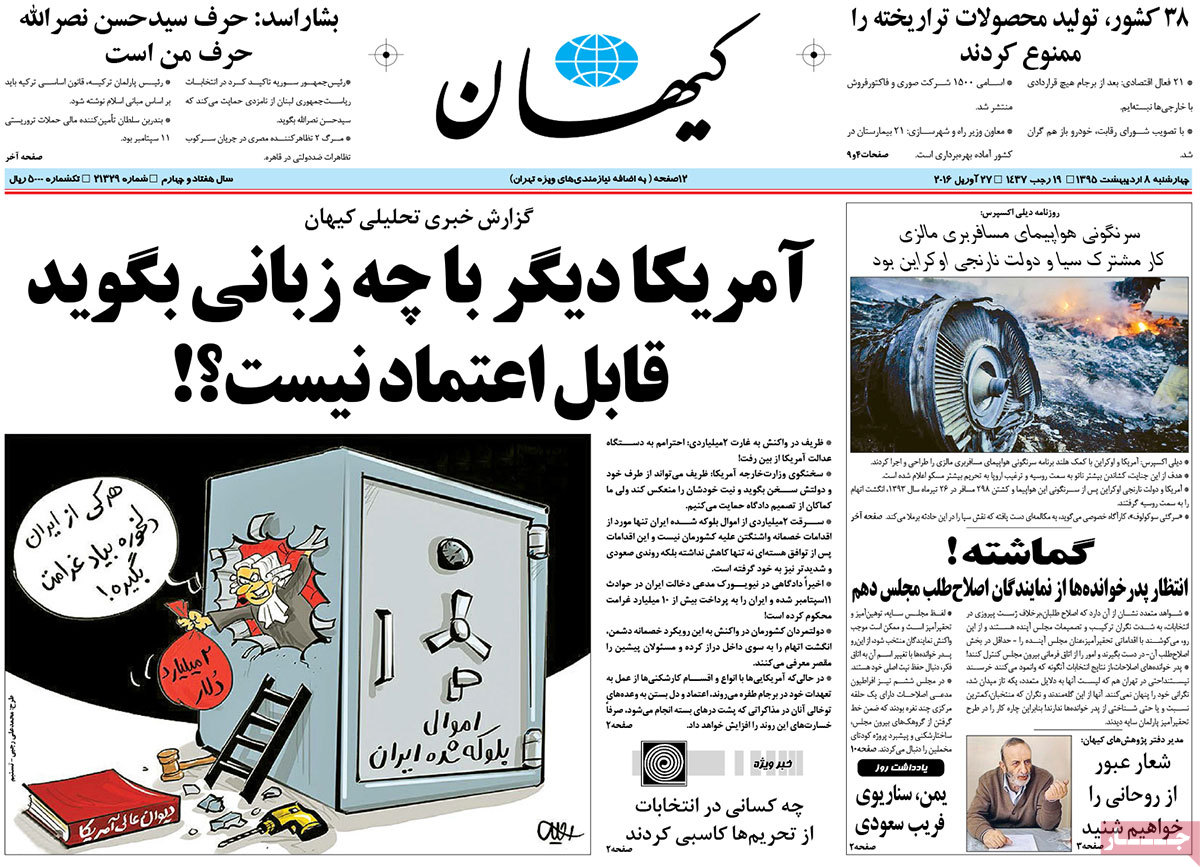
Kayhan:

  1. How Can the US Further Demonstrate Its Untrustworthiness?
  2. CIA and Ukraine’s Orange Gov’t Shot Down Malaysia Airliner: Daily Express


A Look at Iranian Newspaper Front Pages on Apr. 27


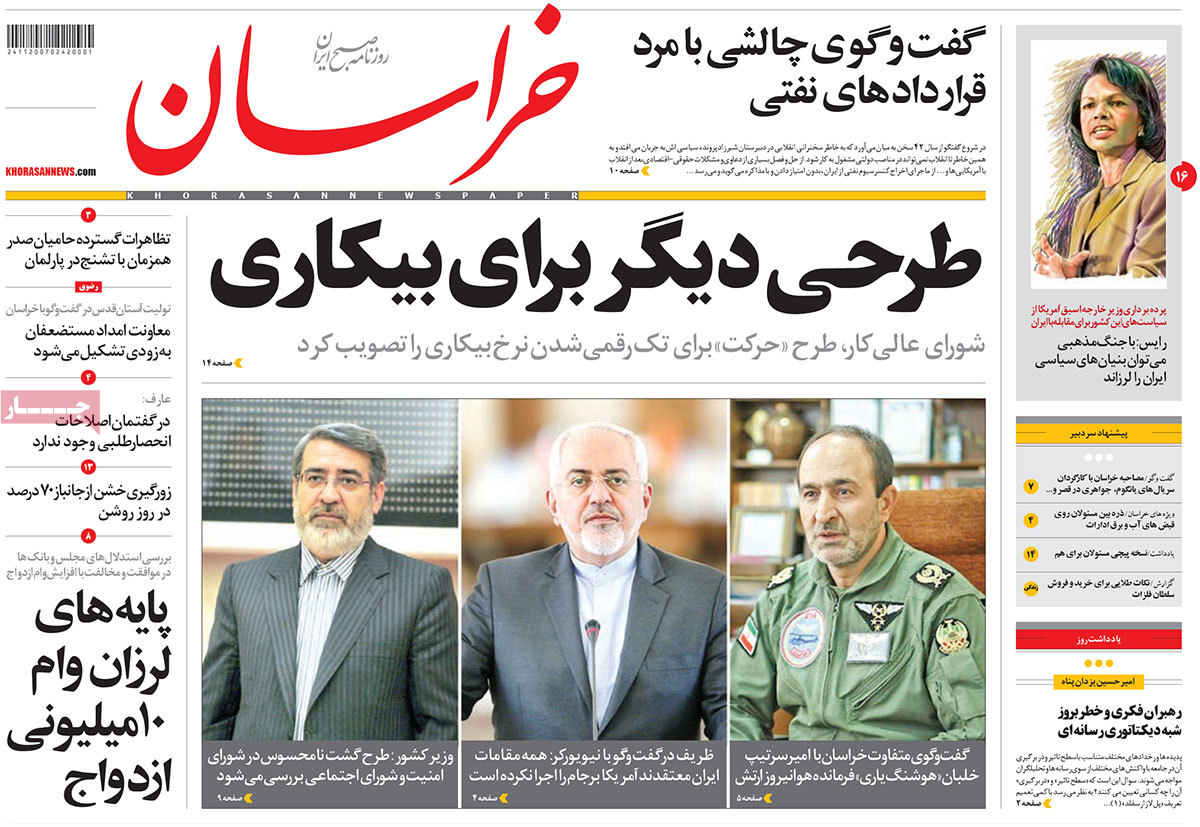
Khorasan:

  1. Iran’s Political Foundations Can Be Shaken by Religious War: Condoleezza Rice


A Look at Iranian Newspaper Front Pages on Apr. 27


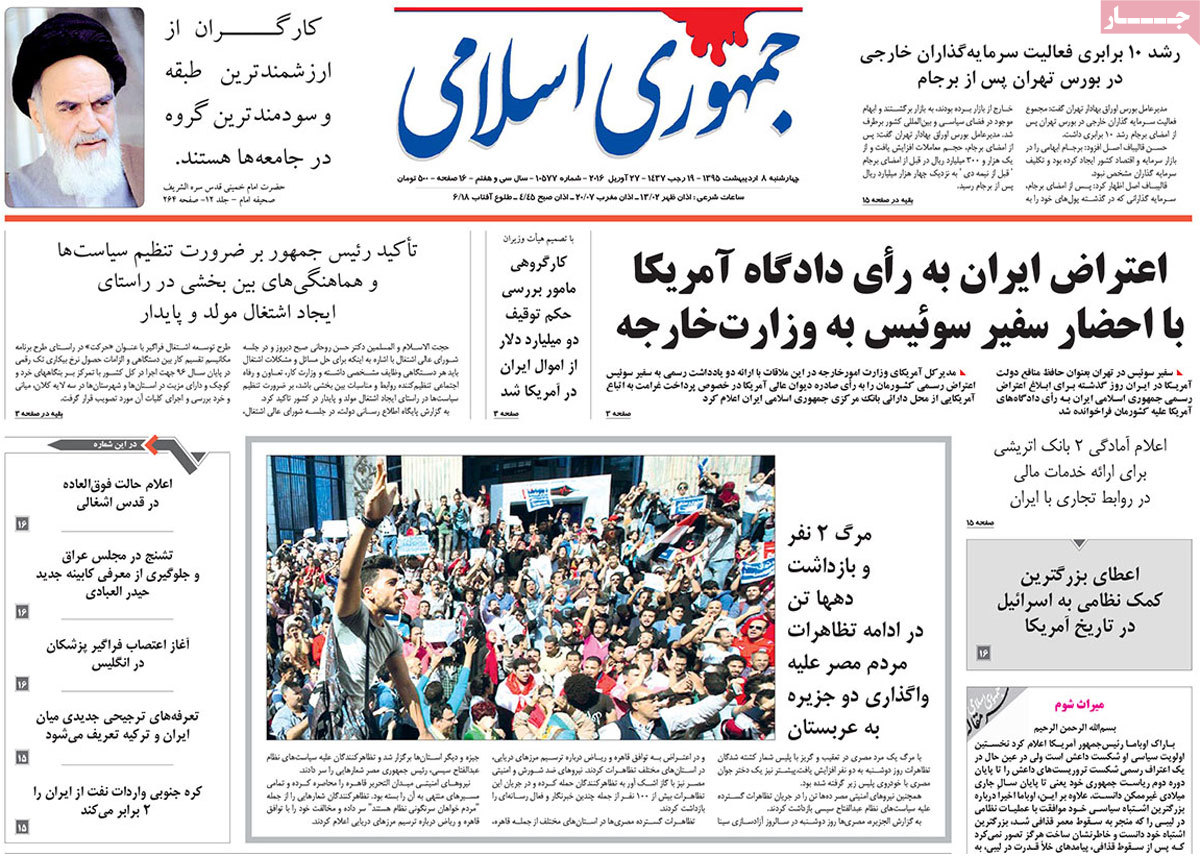
Jomhouri Eslami:

  1. South Korea to Double Crude Oil Imports from Iran
  2. 2 Killed, Several Arrested in Egypt Protests against Saudi Island Transfer
  3. US to Offer Israel Largest Aid Package in History


A Look at Iranian Newspaper Front Pages on Apr. 27


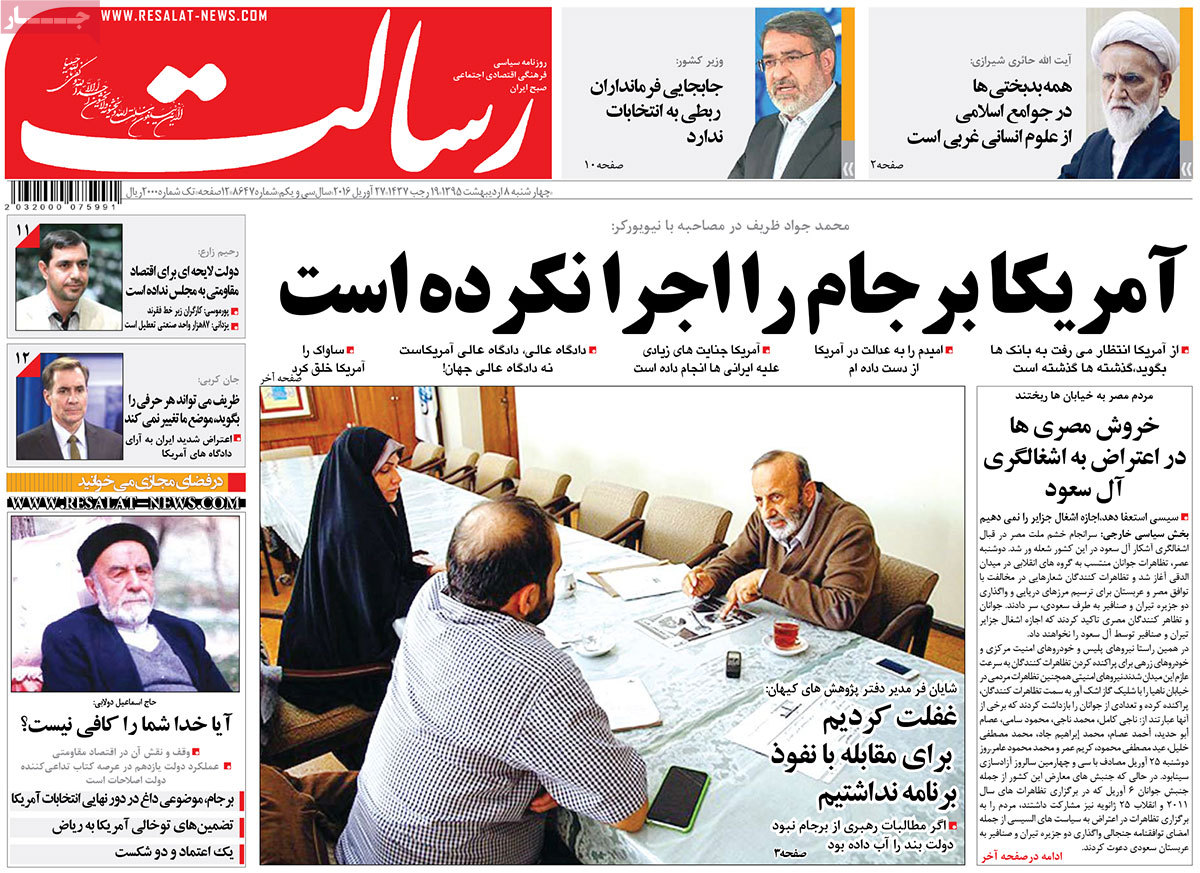
Resalat:

  1. US Has Not Implemented JCPOA: Zarif
  2. All Islamic Society Miseries Rooted in Western Human Sciences: Cleric


A Look at Iranian Newspaper Front Pages on Apr. 27


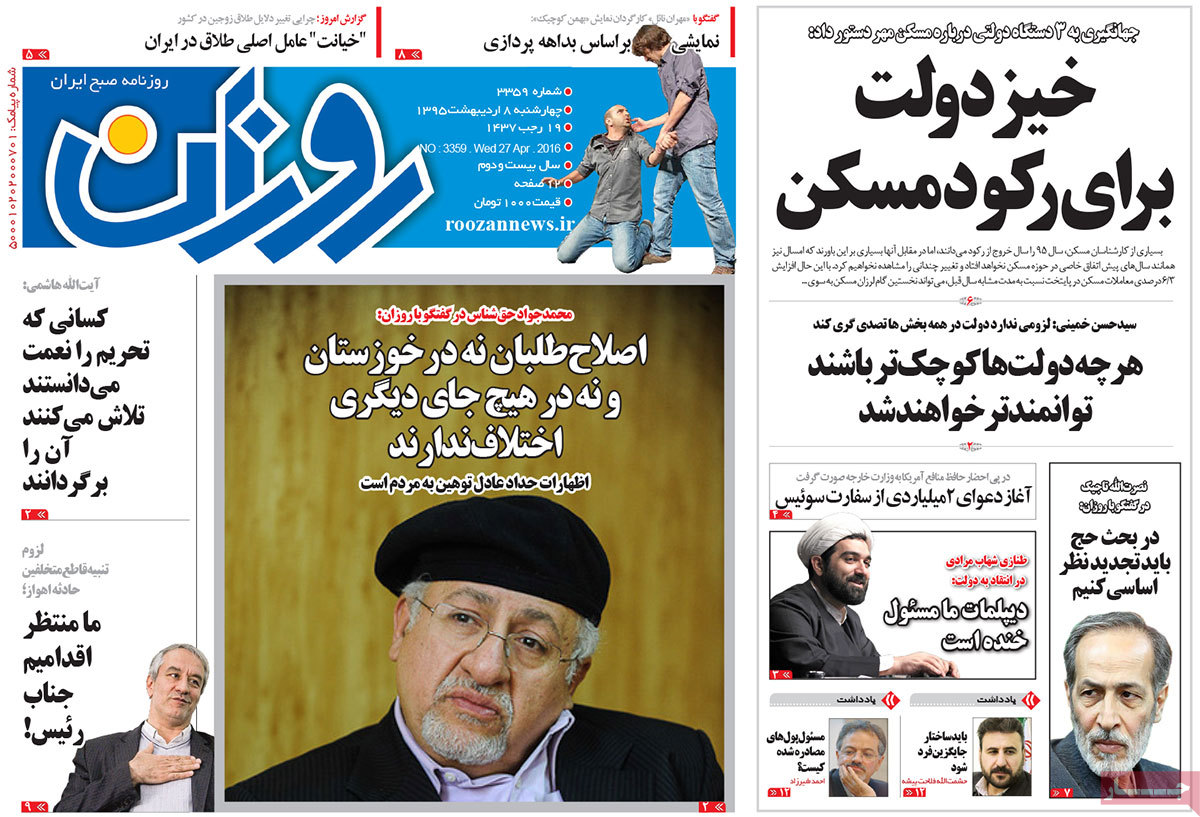
Roozan:

  1. Iran Should Reconsider Attending Hajj Pilgrimage: Analyst


A Look at Iranian Newspaper Front Pages on Apr. 27


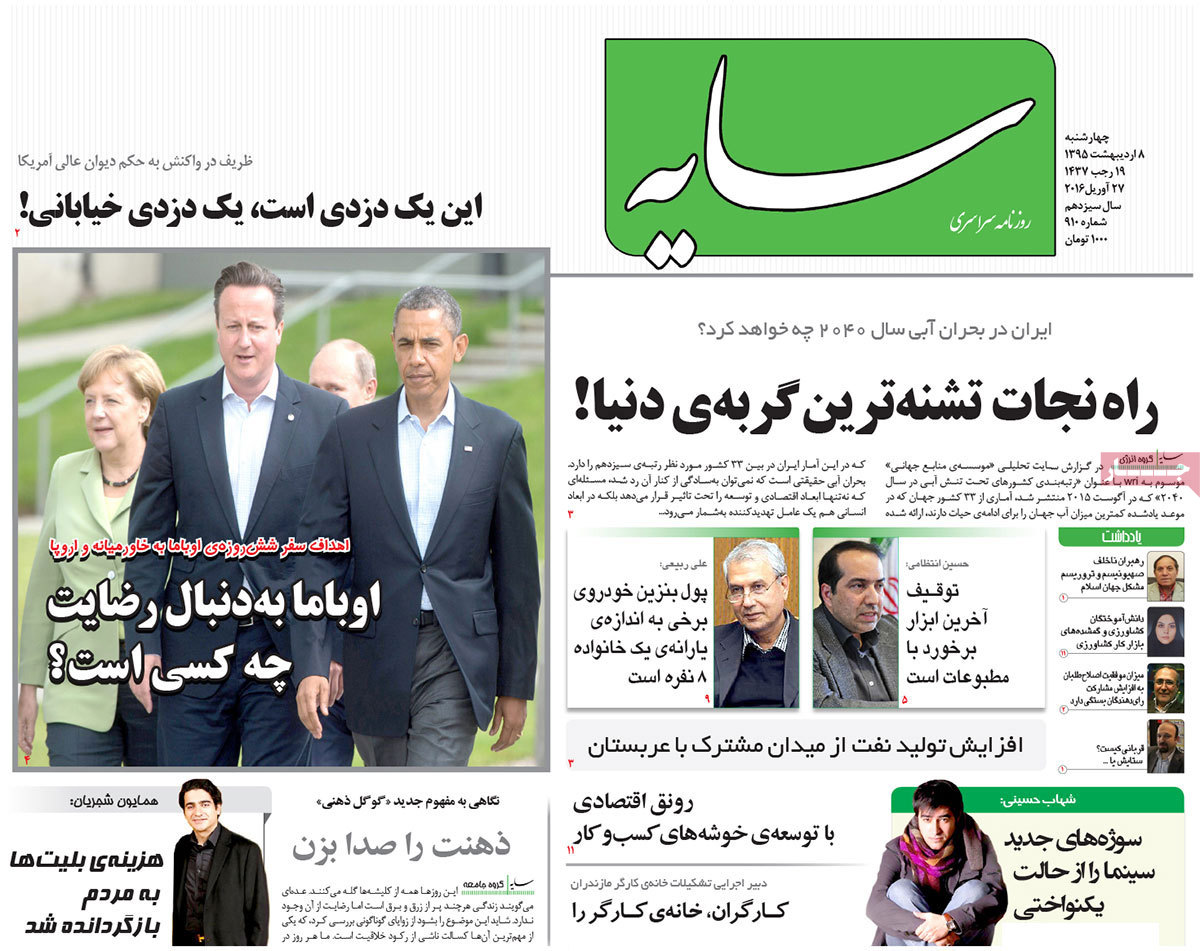
Sayeh:

  1. How to Save Iran from a Water Crisis in 2040?
  2. Iran Increases Oil Production in Joint Oilfield with Saudi Arabia


A Look at Iranian Newspaper Front Pages on Apr. 27


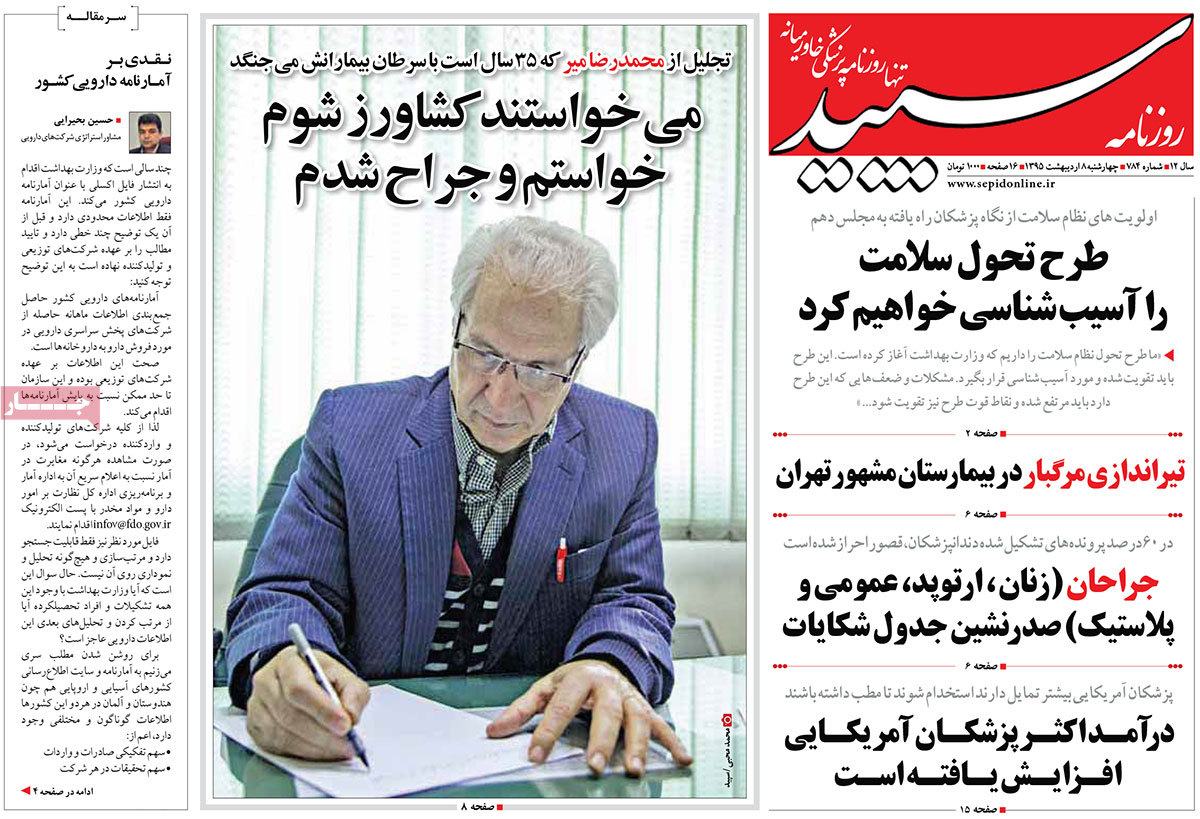
Sepid:

  1. Deadly Shootout in Famous Hospital in Tehran


A Look at Iranian Newspaper Front Pages on Apr. 27


Shahrvand:

  1. 73% of Iran’s 2016 Hajj Quota Still Available: Drop in Number of Applications
  2. Refugees Trapped by 10 Big Lies: EU Fabricating Pretexts to Deport Refugees
  3. Zarif Warns Saudis: Iran’s Self-Restraint Has a Limit


A Look at Iranian Newspaper Front Pages on Apr. 27


Sharq:

  1. Arrested Journalists in Iran Sentenced to Jail
  2. Seminary Students’ Twitter Activity


A Look at Iranian Newspaper Front Pages on Apr. 27


Vatan-e Emrooz

  1. Saudi Mirage: Will King Salman’s Development Plan Backfire for Saudi Arabia?


A Look at Iranian Newspaper Front Pages on Apr. 27

Iran and China Stress Common Views on Syria

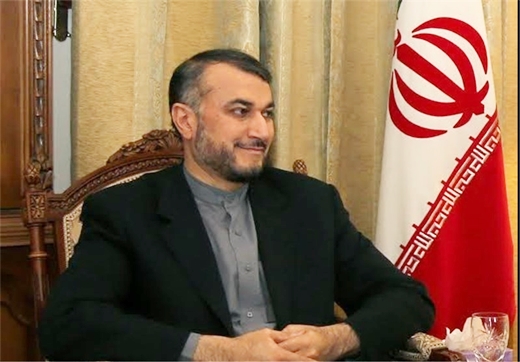
A Chinese diplomat, who has been recently appointed as the Chinese government’s representative for the Syria affairs, held a meeting with Iranian Deputy Foreign Minister for Arab and African Affairs Hossein Amir Abdollahian in Tehran on Tuesday.

Voicing Beijing’s support for a political solution to the crisis in Syria and reliance on the results of the political negotiations, the Chinese envoy insisted that shaping Syria’s future, drawing up the constitution and electing the president should be left in the hands of the Syrian nation, without any foreign interference.

The Iranian deputy minister, for his part, deplored the lack of serious international actions against terrorist groups in Syria, what the International Syria Support Group (ISSG) had agreed to pursue along with the political talks.

The Iranian and Chinese officials both denounced a violation of ceasefire by the armed opposition groups in Syria, and called for the delivery of humanitarian aid in all parts of the war-torn country.

Syria has been gripped by civil war since March 2011 with various terrorist groups, including Daesh (also known as ISIS or ISIL), currently controlling parts of it.

According to a new report by the Syrian Center for Policy Research, the conflict has claimed the lives of over 470,000 people, injured 1.9 million others, and displaced nearly half of the country’s pre-war population of about 23 million within or beyond its borders.

A Donald Trump Victory Would Benefit Iran: Academic

Trump or Clinton? Republican or Democrat? Which US presidential hopeful would be most in the interests of Iran, under the current circumstances? The question has undoubtedly been considered by many people. This issue, and more fundamentally, the way the two American parties deal with the Middle East and Iran, is discussed in an interview with Nasser Hadiyan, who teaches international relations at the University of Tehran.

He says the victory of a radical figure like Trump will not put Iran at a great disadvantage, because he is a businessman and has little legitimacy in the international community.  Hadiyan, however, thinks it is unlikely that Trump makes it to the White House. He considers Hillary Clinton as the most likely next president, and believes that she will take a harder line on Iran and on the implementation of the nuclear deal (JCPOA), compared with President Barack Obama.

The interview took place at the Strategic Research Centre of Iran’s Expediency Council in Tehran. The university professor didn’t want to dwell on the history of Iran-US ties, but in summarizing the current relationship, he predicted a difficult future for political relations between the two sides. He even believes that a strategic headquarters should be established to regulate certain issues in this field.


Given the ongoing campaigns for US presidential elections, we would like to have a comprehensive overview of the two parties, Republicans and Democrats, with regards to the Middle East and Iran. To start with, I want to know whether the two camps have a fixed behavioural pattern in dealing with the Middle East, and whether they have followed the same pattern in the history of their party.

The general belief is that the two parties follow fixed behavioural patterns. In general, the Republicans are realists and the Democrats attach importance to a series of human rights issues. But I do not totally agree with this view. We should not forget that there are councils of experts in all organizations and bodies. These councils remain intact, whether they are in the foreign ministry, in the CIA or the Pentagon. This means that when political figures take on certain issues, they will not be able to make decisions that are very different from the experts’ opinions.

Therefore, once they are elected and start their job, they become familiar with what they are and are not supposed to do. Thereafter, no considerable fluctuation is seen in their performance: they stick to the defined lines and try not to cross them.

Although it might seem that there isn’t a big difference as to which party’s candidate wins the elections, they are not totally the same. For example, under the tenure of Republican George W. Bush, the neoconservatives came to power. They believed in interfering in others’ affairs, and were totally prepared to use force. The things they did would not have been expected from such realist Republicans as George H.W. Bush. Or, for example Obama, who can be regarded as a symbol of realism, did not easily wage war and use military means on the pretext of human rights and fighting against terrorism. He resists. He even refused to stick to the red lines he had set himself on Syria, and the use of chemical weapons there, and showed a strong resistance to the use of force.


So the patterns have changed in some cases?

Yes. Within the past two decades, we have seen that what people thought of as a behavioural pattern for the two US parties has undergone certain changes. By the way, we should not forget the councils of experts, which puts certain limits on US foreign policy.


Based on what factors does the council impose such limits?

They consider various factors. One of them is the US economic situation. When economic resources are limited and under pressure, it is difficult to put military aggression on the national agenda. Another factor is the power structure. When the government and the congress are in line with each other, or when two different parties lead the two bodies, certain limitations are set for the president.

The other factor is their allies. For example, how will the Europeans treat the newly-elected president of the United States? How much legitimacy will he/she have in their view, and how much can he/she mobilise them in achieving a common objective? For instance, Obama managed to impose and implement severe sanctions against Iran thanks to his legitimacy. Although Bill Clinton had earlier managed to impose certain sanctions, he failed to make them operational. Obama, however, had both the capability and legitimacy, and made the world go along with him, while for example, George W. Bush lacked the legitimacy to do such a thing.

Therefore, the US president’s position, the way Europeans think about him/her, and the legitimacy issue all affect the formation of US foreign policy, particularly its relation with the Middle East.

There is another factor: AIPAC, or the pro-Israel lobby. They play an important role in forming US foreign policy in the Middle East – not in Asia or in Latin America, solely in the Middle East. They can play an important role in any policy planned to be adopted on the region.


Given the policies of the two parties and the history of their performance in the Middle East, we [Iranians] have traditionally feared Republicans taking power, whereas the Democrat Obama also imposed and implemented anti-Iran sanctions, and did not do much in our interest.

This is not the general interpretation. It is generally believed that Middle Eastern countries, including Iran, prefer the Republicans. The Shah of Iran, for example, had better ties with the Republicans. Or after the 1979 Revolution, the concession Iran gave to Reagan vis-à-vis Carter was an influential factor in the latter’s defeat. There is a general perception that we can work with the Republicans more easily than the Democrats. I do not agree with that, though.


What main objectives do the two parties, Republicans and Democrats, seek in the Middle East? Specifically speaking, how is their behavioural defined in the Middle East?

Based on what they themselves say, the security of Israel is a top priority for them. Also, the safe transfer of oil through the main pathways, including the Persian Gulf; the stabilisation of the region; and their support for what they call “allied governments” are among their principles.

These are the general principles on which both parties are in agreement. Of course they might have different opinions on supporting a particular ally: one of them defends arms supplies and the other talks about stabilisation through democracy. They might have different views on particular cases, but the difference does not really reflect their party and partisan view.

Right now, for example, if Trump wins the elections, his views will be different from those of Ted Cruz, and Cruz’s will be different from the others. This is the same among Democrats as well. Bernie Sanders’ viewpoints are different from those of Clinton. All of them, however, have the objective of supporting Israel and ensuring its security.


What is the policy of the two parties on Iran?

Currently, the US is following a policy that I would call “Control plus selective interaction”. US general policy is to control Iran, and this control has different indicators: in economics, they limit our capabilities; in terms of security, they put restrictions on our military capabilities; in diplomacy, they try to isolate us diplomatically; and in politics, they do their best to tell the world that Iran is not trustworthy. The US has pursued these policies to control Iran, so I have termed it the “control policy”.

However, whenever they needed, they have had selective interactions with Iran in particular cases including the Afghanistan issue, or Iraq, and recently the JCPOA. These are the selective interactions Iran and the US have had. The next US president will also follow the same general policy: “Control plus selective interaction”.


We clinched the JCPOA during Obama’s term, and using your words, a selective interaction took place. Many analysts believed that it was unlikely for Obama, or even a Democrat administration, to show such a great amount of flexibility. What is your opinion about Obama’s behaviour towards Iran?

If we want to talk about the JCPOA in particular, we should say that Obama, for certain reasons, wanted to resolve Iran’s nuclear program issue, and this was a priority for him. Although there was a possibility of war, he did not want to wage one, and the deal was a very good alternative to a war.

He also knew that the sanctions would not work, and a possible war couldn’t help him achieve what he wanted, either. This was the least expensive way to help the US realize its objective, which was preventing Iran from becoming a nuclear power.

Obama had a more important objective as well: He wanted to see whether he was able to settle the problem with Iran or not. American presidents, in their second terms, want to leave their own legacy in history. For example, a book written 200 years from now on US history would mention Obama Care in relation to domestic policy. If he manages to resolve Iran’s issue completely, this would be his special achievement in foreign policy. Then, he will be able to say “I was the one who solved the problem with Iran, 37 years after their Revolution.” He hoped that he would manage to resolve the issue and establish diplomatic ties with Tehran while making Iran give certain concessions. Therefore, he resolved to make the deal with Iran.

Of course, this would be a great advantage for any US president to solve the issue of relations with Iran. Obama was thus prepared to show even more flexibility and pay a heavier price to resolve the issue. The cost of the JCPOA was not low for Obama. He was faced with opposition even among the Democrats, but he managed to gain such a huge advantage. I am not sure, however, that someone like Clinton, who is Obama’s fellow party member, would have been ready to pay such a price to clinch the deal.


If we accept the presupposition that Clinton will be the Democrats’ final candidate in the upcoming US presidential elections, would her stance on Iran remain as harsh as it is today?

Yes. Any of the candidates, whether Republicans or Democrats, will most likely take stricter positions towards Iran compared with Obama.


Especially given the fact that Clinton, as compared with John Kerry, used to take a harder line on Iran when she was the Secretary of State.

That is right, but she is not one of those people who say they will tear up the JCPOA. Of course, even if those people come to power, they will continue the nuclear deal, but will implement it strictly. The power structure in the US puts limits on everyone.


So it will be more difficult for Iran to deal with the Republicans?

No, working with Trump will be the easiest option. Donald Trump is the best choice for Iran.


Why do you think so?

First of all, Trump is a “businessman”. Businessmen usually regard deals as important, and do not unilaterally terminate a contract. He will be strict in following up the Iran deal, but will remain committed to it.

Secondly, he does not have the required international legitimacy, and even right now, the world is against him. Inside the US, there is a deep division. I predict that Trump will be the Republicans’ final candidate, but Clinton will win the US presidential elections. Even if the Republicans decide to violate the party norms and do away with Trump, his replacement will not be able to win the elections in two to three months.

Even if Trump is chosen as the final candidate, he will lose. That is exactly the same as what happened for Marine Le Pen in France. Everyone will be afraid of Trump’s victory, and even many Republicans will vote for Clinton to avoid Trump. This is not because Hillary is a favourable candidate. No, she has a lot of critics and opponents, too. This is because Trump is considered a very unfavourable candidate due to his stances against Latin Americans, women, the US Muslim population, and his remarks about Mexico, Canada, and so on.

Therefore, many Republicans will probably vote for Clinton to prevent him from winning the elections. Assuming the impossible, even if Trump becomes president, he will not have the legitimacy to impose fresh sanctions against Iran and terminate the JCPOA. The only thing he would be able to do is to wage a war. We should be careful about that. Of course, if that happens, the world would not support him. So the best option for us is a Trump victory.

Clinton, however, has legitimacy and a normal personality. If the current circumstances remain unchanged, Clinton will win the presidential elections, because neither Cruz nor Kasich – if chosen by the Republicans – have enough time to win the elections.  Neither can Sanders be the final candidate of Democrats. If Clinton wins, we will not have an easy job in dealing with her. She knows politics, has been Secretary of State, and has lived in the White House with her husband. After her election, she will immediately initiate her plans for Iran. She will continue with JCPOA implementation and work on other issues related to Iran in a strict way.


Is it possible that negotiations begin on other issues related to Iran under Clinton? For example the talks on their allegations about Iran’s support for terrorism or the human rights conditions?

Yes, it is possible, but it is not very likely. The negotiations over the nuclear issue began when Clinton was Secretary of State. But neither we nor they are really interested in talking about other issues. Maybe they are more interested, but we are not at all willing to do so.


How close is Clinton to Israel and the Arabs? Can such relations be detrimental for us?

Israel’s lobby in the US has good ties with both parties. It has influence in both parties, spends money, and has a strong infrastructure. They have good relations with Clinton, and will continue to have influence over the Middle East. The policy of controlling Iran will be strictly pursued. This will also be the case for Saudi Arabia. The Saudis may even be harsher and more extreme than Israelis in some cases. Saudi Arabia is now looking for a war with Iran, and to disintegrate the country finally. The Saudis’ influence in Washington is much less than that of Israel, but they have their own funding and lobby groups, and exert their own pressure.

The important point here is that these two (Israel and Saudi Arabia) want to make a strategic change in the region by introducing Tehran as an enemy and putting others under pressure over the issue of Iran. Such a change can help Israel resolve many of its problems, including the legitimacy problem it always had in the Middle East. The issue can be settled by Tel Aviv’s friendship with Riyadh. In other words, they will replace Israel, the main enemy of the Arabs, with Iran.

This is currently under investigation. US foreign policy might totally support the project. In this project, the Persian Gulf Arab littoral states will downplay the Daesh (ISIS) terrorist group by approaching Israel, and will introduce Iran as the main sponsor of terrorism, which should be confronted. The strategic replacement – the replacement of Middle East’s main enemy, Israel, with Iran – is very dangerous.


So should we anticipate difficult years ahead in foreign policy?

Yes.


Don’t we have any lobby group in the US to prevent such things from happening or make them less costly?

We do, but the power of our lobby is not at all comparable with those of Israel and Saudi Arabia. They have established a powerful base there. They have huge amounts of money, resources, and media facilities.


What should we do to prepare for this dangerous future? What should be the priorities of our foreign policy?

We should first be aware that Saudi Arabia and Israel are trying to convince the US to start a war against Iran. Currently, Obama will not do that, and if Clinton wins the elections, she wouldn’t easily make such a decision. What we should do is organise our potential allies outside the country to prevent such a war from happening. The possibility of such a war is not high, maybe around 5%, but this is still too great, and we should have plans, and even establish a national headquarters for it. The HQ should then consider all solutions.

Ebtekar Speaks of “Planet” and “Peace” at the Environment, Religion and Culture Seminar

Yesterday, with all my work, I got a chance to attend the International Seminar of the Environment, Religion and Culture held in the Environmental Protection Organization headquarters, in the presence of representatives from different religions and nationalities.
In the first panel, called “Planet,” there was a talk about the knowledge and deep attachment of Indigenous communities, like American Indians, with nature. Their relations with nature go far beyond fulfilling their initial needs, and they have a spiritual and emotional relation to it. Such communities try to bring the educational process into the frameworks of spiritualism and understanding, so they can affect the human soul.
One of the people present there asked about the effect of human interference in nature, such as transgenic products. The lecturer replied, saying that the indigenous communities have an innate knowledge toward the importance and varieties of natural species, therefore they’ll protect them.

It reminded me of the Holy Quran and Yusuf Surrah, “Set me over the storehouses of the land; I will indeed guard them with full knowledge. Thus did we give full authority to Yusuf in the land, to take possession therein, as when or where he likes. We bestow of Our Mercy on whom we please, and we make not to be lost the reward of Al-Muhsinun.”

I asked to be given some time to talk briefly about being a “Full-Knowledge Guardian” of the earth’s resources, and pointed out that followers of different religions have forgotten such words and phrases in their holy books.

I then went to the second panel, called “Peace,” which was held simultaneously in another hall. As soon as I arrived, one of the foreign Christian guests made a criticism at the presence of representatives from the Vatican. They said, “The destruction of the world is a matter for civilizations, and it has its root in the fact that women and the female soul has been forgotten in the guardianship of the world – in some interpretations of religion, it has been fully denied. Some Christians believe women are the devil’s playthings, and this is the same perverted view that has led to the earth’s destruction”.

There too, I spoke to the audience, reciting a few lines about the story of Queen Saba in the Holy Quran, who was a clever manager and governor, saving her land from war and instability. She went through the “passageway of the soul,” instead of relying on common and popular solutions of the time.

I hope this seminar and its meetings become an opportunity for thinking about the environment through the eyes of various religions and cultures, which are followed by billions of people in the world.

Winter Is Coming for Iran’s Bakhtiari Nomads

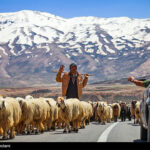
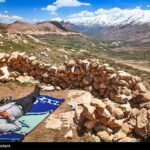
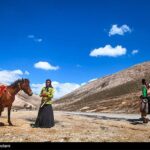
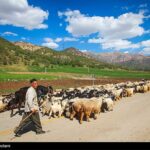
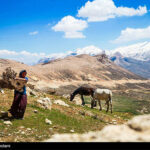
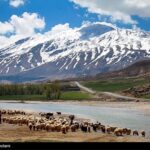
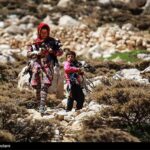
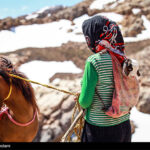
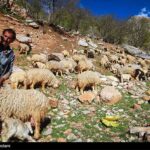
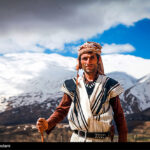
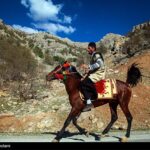
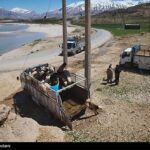
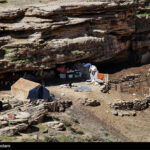
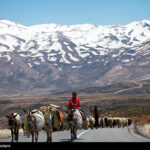
Bakhtiari tribes spend the six coldest months of the year in the southwestern province of Khuzestan, then, after climbing the cold and snowy heights of Zardkooh, arrive in the western region of Koohrang to spend the six hotter months.

These nomads walk the long distance in one month. Since Khuzestan province warms up very early in the year, and the Koohrang region very late, this one-month journey is necessary so as to prevent the cattle from dying of heatstroke.

This year, the spring snow and frost caused problems for the nomads and their cattle in the early part of their migration.

Germany to Invest in Iranian Agriculture

agriculture

Minister Schmidth made the remarks in a meeting with Iranian officials in East Azerbaijan province in Tabriz on Tuesday.

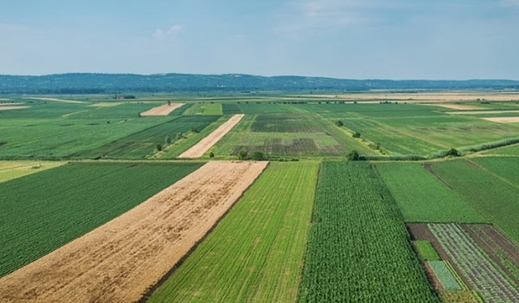
The German official said Saxony is the third major fruit producer in Germany, adding that there are plans to enter joint ventures with Iranian companies in agricultural projects of East Azerbaijan.

Director of Agricultural Jihad of East Azerbaijan Karim Mehri, for his part, said the two sides could cooperate in projects related to the production of pesticides and herbal medicine, research and training schemes, modernization of medical plants and technologies, development of micro irrigation techniques, and boosting productivity rate in the sector.

The meeting came after Iran and German Federal State of Sachsen agreed to develop cooperation and invest in agricultural projects, including in the processing and supplementary industries.

The agreement was reached during a meeting between Deputy Minister of Agriculture Ali Akbar Mehrfard and German Minister Schmidt in Tehran in April.

During the talks, Mehrfard said Iran produces some 120 million tons of crops annually, adding that Germany could help boost the sector through modern technology transfer.

Minister Schmidt, for his part, said the two sides should work together to improve ties, adding that German companies and private sector seek trade and investment opportunities in Iran, particularly in food packaging and processing.

He also invited private businesses to visit Germany to learn more about Sachsen’s technical and scientific capabilities.