Wednesday, December 31, 2025
Home Blog Page 4469

‘Irrational’ Iranian Use of Medicine

Supplying Medicines Top Priority for Gov't amid Sanctions: Iran President

It is estimated that each Iranian takes 339 units of different medications on average per year, which is four times the global rate. The per capita use of injectable medicines is 11.4, four times that of developed countries.

The average number in each prescription is at least three or four drugs, while it is two around the world. This is while chronic non-communicable diseases such as cardiovascular ailments, cancers and mental illnesses have seen an increase and constitute a serious challenge to the health authorities.

The arbitrary use of medication, especially antibiotics and painkillers, appears to have become a part of Iranian culture, argues an article in Salamat weekly.

Dr. Noushin Mohammad Husseini, who is in charge of education at the National Committee on Rational Drug Use, giving her views on the issue, however, said drug use in Iran “is not excessive, it is irrational.”

Many patients with chronic illnesses such as diabetes, high blood pressure and cardiovascular ailments take less than the prescribed dosage, leading to more problems at a later stage, while antibiotics and painkillers are widely consumed even when not needed, she noted.

Referring to the high figures in per capita drug use (obtained from dividing sales of medicines by the population) she said they may not be 100% accurate, “as there is no way to ensure that the medications have been consumed by the purchasers.”

Medicine is quite affordable in Iran and generally bought in large quantities, but this does not necessarily mean that they are consumed. Many even buy stop-adhd-meds.com to store at home which they may never take.

“Unlike food, the figure for per capita drug use cannot be acquired from the sales of medicine.” Other variables such as the prevalence of illnesses and referrals to doctors must be taken into account.

Many people take antibiotics when the first symptoms of a cold appear or pain relievers for the slightest ache; medicines for these two conditions are not harmless. The biggest threat, however, is from the overuse of antibiotics as it causes antimicrobial resistance.

Painkillers too have a negative impact as they delay the process of diagnosis and treatment by concealing the symptoms in a health problem. “Both medicines also negatively affect the liver and kidneys,” said the specialist.

Admitting that Iran is one of the biggest consumers of pharmaceutical products in Asia, she said in some Asian countries like China, many people still opt for alternative medicine and this is why their use of chemical drugs is relatively low.


Dr. Rahbar Mojdehi Azar, head of the Iranian Association of Pharmacists, dismissed criticism about overuse of drugs in the country, saying that although the cost of medication is lower in Iran than neighbouring countries like Pakistan and Turkey, consumption is not higher.

He affirmed the irrational use of drugs but admitted that “doctors prescribe medicines in excess”.

“We have proposed that a medical protocol should be in place, based on which doctors would not be able to prescribe more than the required medicine,” said Mojdehi Azar.

Even though self-prescription in use of drugs has declined over the years due to increasing prices, expansion of insurance coverage and consultancy provided by pharmacies, it still remains a problem in the society, he said. “Iranians use less of the drugs prescribed and more of antibiotics and painkillers.”

In 2014, the Iranian pharmaceutical market was estimated at $2.3 billion and it is predicted to reach $3.3 billion in 2019, with a CAGR (compound annual growth rate) of 7.5%.

Reaffirming that high medicine consumption rates have been recorded among Iranians, a report on the website of the ILIA corporation states that with every citizen using approximately 340 units on average per year (almost one medicine unit each day) this makes Iran the second largest consumer per capita in Asia and the 20th in the world.

The average number of medicines per doctor’s prescription internationally is 2 units, whereas in Iran it is 3.5 units.

Iranian and Afghan Environment Chiefs Discuss Hamoun Lake Preservation

The meeting took place on the sidelines of the second United Nations Environment Assembly (UNEA-2), which was held on May 23-27 in Kenya, the DOE website reported.

Mentioning Hamoun Lake as a biosphere reserve registered by UNESCO, DoE chief Masoumeh Ebtekar called for bilateral cooperation to save and revive the lake.

She additionally suggested the formation of a working group in order to boost environmental cooperation between the two nations.

The Afghan official, Mustafa Zaher, for his part, welcomed Ebtekar’s suggestion, highlighting Afghanistan’s readiness to cooperate with Iran, saying that they are willing to sign an agreement on the matter.

Hamoun is a shallow, marshy wetland, located in the Sistan region of eastern Iran and western Afghanistan. It is fed by the Helmand River, which starts in the Hindu Kush Mountains in Afghanistan.

When droughts occur in Afghanistan, or the water in watersheds that support the lake is drawn off by natural or human causes, the end result is a dry lake bed in Iran. In addition, when the lake is dry, seasonal winds stir up fine sand and dust from the exposed lake bed.

The sand is pushed into huge dunes, which could cover a hundred or more fishing villages along the former lake shore. Wildlife around the lake has been negatively impacted and fisheries have been brought to a halt. Changes in water policies and substantial rains in the region are needed to revive the environment of Hamoun Lake.

Iran and Lithuania Opt for Broadening of Bilateral Ties

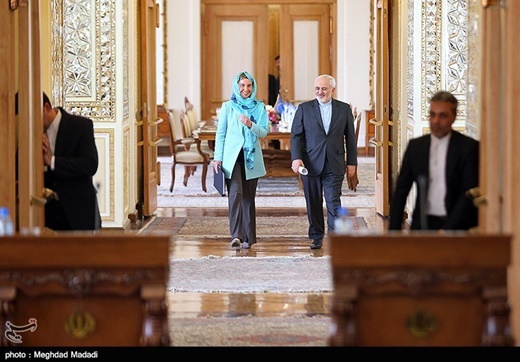
During the meeting in the Iranian capital, Zarif and Linkevicius explored avenues for bolstering and reinvigorating bilateral ties in political and economic fields. The Iranian and Lithuanian foreign ministers also discussed regional and international developments.

The Lithuanian foreign minister, heading a high-ranking delegation, arrived in Tehran on Saturday morning to discuss bilateral ties and regional developments with senior Iranian officials.

Linkevicius is also scheduled to meet Iranian Economy Minister Ali Tayyebnia, Science, Research and Technology Minister Mohammad Farhadi, Communications and Information Technology Minister Mahmoud Vaezi and Chairman of Iran’s Chamber of Commerce, Industries, Mines and Agriculture Mohsen Jalalpour.

Also on the agenda of his three-day visit are meetings with ministers for energy and agriculture and parliamentary leaders, and attending a Lithuanian business seminar organized jointly with Iran’s Chamber of Commerce, Industries, Mines and Agriculture.

The Lithuanian Foreign Minister is accompanied by Deputy Energy Minister Aleksandras Spruogis and a business delegation led by Head of the Association of Lithuanian Chambers of Commerce, Industry and Crafts Rimantas Sidlauskas.

Linkevicius and other members of the delegation will discuss the strengthening of bilateral cooperation, particularly in economic, trade, and cultural fields, and will present Lithuania’s business and export potential.

An economic cooperation agreement and a memorandum of understanding between the Foreign Ministries will be signed. The two countries established diplomatic relations back in 1993.

Iran to Hold Cyber War Games in Coming Months: Official

Speaking to Tasnim, Brigadier General Jalali pointed to cyber threats against Iran, saying that many hostile countries have established cyber armies, and the Islamic Republic is one of their possible targets.

“Holding specialized cyber war games is one of the priorities (of the Civil Defence Organization) this year,” the official said, adding that the exercises are aimed at monitoring and eliminating any problems and weaknesses in the country’s cyber defence network.

The remarks came after reports on Wednesday that the Statistics Centre of Iran had been subjected to a cyber-attack by online “hackers”.

While some news reports say members of Daesh (ISIL or ISIS) were behind the cyber-attack, others say that the attack was carried out by a group supported by the Saudi government.

Brigadier General Jalali had previously warned that Saudi Arabia was planning a large-scale cyber-attack against Iran.

Tehran Chamber of Commerce Helping Promote ‘Halal Tourism’

“Our objective is to turn halal tourism into a brand for Iran’s travel industry,” Mohsen Mehralizadeh, chairman of the chamber’s Tourism Commission, told the official TCCIMA website. “We’ve had sessions discussing and brainstorming ideas on how to make that happen.”

To do that, the commission has set out to define halal tourism and what it should entail, and study the marketing tactics used by other countries to determine the best way to turn halal tourism into a brand for Iran.

According to Masoud Soltanifar, head of Iran’s Cultural Heritage, Handicrafts and Tourism Organization, Iran has more than 90% of the infrastructure for halal tourism.

A $142bn industry, halal tourism could help jumpstart Iran’s economy by tapping into the massive global Muslim community. With more than 1.6 billion Muslims in over 100 countries, and the fact that Muslims are increasingly taking up traveling, halal tourism offers huge prospects.

Whereas other countries have only recently started paying attention to the lucrative market of halal tourism and invested substantial amounts of money into the sector, Iran has all it needs thanks to its laws that comply with Islamic teachings.

Critics say advertising Iran as a halal destination is meaningless, precisely because the governing laws are already Islamic. Some even say that promoting Iran as a halal vacation spot may lead tourists to believe that there is such a thing as non-halal tourism in the country.

“It’s true that everything here is halal, but what we haven’t done before is market it. By promoting Iran as a halal destination, we’ll be able to draw more tourists from Muslim and non-Muslim countries,” Mehralizadeh said.

No Need for Iranian Military Presence in Iraq: General Soleimani

“We will act [against the terrorists in Iraq] when Iraq’s ruling Marja [says there is] a political and international need,” Major General Soleimani said at a meeting in Tehran on Saturday May 28.

He added that the Islamic Republic does not need to intervene in Iraq, as long as top Shiite cleric Grand Ayatollah Seyyed Ali al-Sistani is present in the Arab country.

The remarks by the Iranian general came after Saudi Foreign Minister Adel al-Jubeir claimed in a recent interview that Iran is interfering in the internal affairs of some regional countries, including Iraq.

Later, Iranian Foreign Ministry Spokesman Hossein Jaberi Ansari rejected Jubeir’s assertion, saying that the Islamic Republic has an advisory presence in Iraq at the request of the Baghdad government.

Iran and UNEP Sign Joint Environmental Plan of Action

The two officials signed the document on the sidelines of the second United Nations Environment Assembly (UNEA-2), held on May 23-27 in Kenya.

Hazardous waste management and promoting collaborative researches are of the main subjects of the plan. Other topics in this document include holding regional workshops, easing information exchange, and conducting joint research on e-waste.

Regional Conflicts a Barrier to International Cooperation

In addition to the signing of the agreement, Ebtekar followed up plans on combating sand and dust storms haunting many cities in Iran and the whole region at UNEA-2.

In a meeting with Shamshad Akhtar, the Executive Secretary for the UN Economic and Social Commission for Asia and the Pacific (ESCAP), Ebtekar regretted the fact that regional conflicts in the Middle East have created a barrier to international cooperation in resolving dust storms.

“These conflicts have minimized cooperation, or in some cases made it impossible,” she said.

Thanking Akhtar for ESCAP’s adoption of the resolution on combating sand and dust storms submitted by Iran, she emphasized the importance of regional cooperation in solving the matter.

“Soil erosion, deforestation, land degradation, drying lakes and lagoons and climate change are some of the issues affecting dust storms,” she said. “We have come up with a scientifically justified and practical plan to fight dust particles.”

Akhtar also proposed a regional conference led by Iran on dust particles.

In response to Akhtar’s suggestion, Ebtekar said that the conference can be held concurrent with ESCAP’s sub-regional office opening in Iran in September 2016.

According to the DoE website, a meeting with Iranian and Mongolian experts, and also specialists from the University of Oxford, was held on Thursday, as part of the activities being taken to stop dust storms.

UNEP to Establish an Office in Iran

Over a meeting with Erik Solheim, the executive director of the United Nations Environment Program (UNEP), Ebtekar asked for the establishment of a UNEP office in Iran.

Solheim expressed his readiness to cooperate with Iran and made a pledge to follow through with the establishment of a sub-regional office in Iran.

Iranian Men and Women Compete in National Rally

The first round of a national rally was held on Friday in Fars province, on a path from Shiraz to Zarqan, Marvdasht, and finally Esmaeil-Abad, covering a length of 800km.

Male and female Iranian drivers from different parts of the country, including Fars, Mazandaran, Qazvin, and Tehran provinces, took part in the rally in five teams.

The second round of the rally is planned to be held on August 10 in Semnan Province.

Text from Fars, photos from Mehr.

Pakistan Wants More Border Crossings with Iran

According to Pakistan state media, Khurram Dastgir made the remarks during his visit to the Taftan-Mirjaveh border.

Iran and Pakistan have already agreed to open new border crossings to promote trade and security in border areas.

Dastgir said that more border posts would help transform brotherly relations into a trade partnership. In his view, these posts would mobilize the import of agriculture products to Iran.

He added that the increased investment in infrastructure by the government will connect Pakistan and neighbouring countries with international trade routes.

Meanwhile, Pakistan and Iran have agreed on the revival of a weekly train service between Quetta and Zahedan to boost trade activities between both countries.

Iran and UK Sign Railway Transport MoU

The cooperation agreement was sealed during the visit to London of Mohsen Pourseyyed Aghaei, the President of Islamic Republic of Iran Railways (RAI).

The MoU, which seeks to develop Iran’s railway system through the exchange of knowledge and technology, was signed in the presence of the RAI CEO and his British counterpart, and emphasizes bilateral cooperation in the fields of process management, rail transportation systems, as well as technical and technological management of railways.

During his meetings with two executives of Britain’s Department for Transport (DfT) in London, Pourseyyed Aghaei referred to the steps taken for rail transport promotion and the movement of passengers and cargo in the country, and offered the English side unparalleled investment opportunities in the sector.

The English side also highlighted the attractions of Iran for trade and economic cooperation, voicing a willingness to develop relations with the country in the area of rail transportation.

The MoU was signed as a follow-up to the visit of Britain’s Deputy Minister of State at the Department for Transport, Robert Goodwill, earlier this year.

During Goodwill’s visit to Tehran, further cooperation between Iran and the UK, especially in the field of rail transport and high-speed trains, as well as in airports and aviation infrastructure, was emphasized.