Wednesday, December 24, 2025
Home Blog Page 4455

Nagorno-Karabakh Conflict to Serve Interests of Daesh: Academic

What is Happening in Nagorno-Karabakh

On late April 1, clashes erupted on the line of contact between the Nagorno-Karabakh Defense Army and the Armenian Armed Forces on one side, and the Azerbaijani Armed Forces on the other side in the disputed region of Nagorno-Karabakh.

The Defense Ministry of the Azerbaijan Republic announced in a Saturday statement that Armenian troops opened fire 127 times along the border over a 24-hour period using mortars and heavy artillery shells that struck civilian regions.

According to official statements from the sides involved, 18 Armenian soldiers and 12 Azerbaijani soldiers were killed during the clashes, and several pieces of military equipment from both sides were destroyed.

18 Armenian soldiers and 12 Azerbaijani soldiers killed

On Sunday, Azerbaijan said it had decided to “unilaterally cease hostilities” and pledged to “reinforce” several strategic positions it claimed to have captured inside the Armenian-controlled territory.

Azerbaijan’s Defense Ministry said in a statement that, in response to pleas from international organizations, it will be unilaterally “suspending a counter-offensive and response on the territories occupied by Armenia.”

However, the truce failed to stop the fighting. Armenian President Serzh Sarkisian stressed that a “ceasefire would only be possible if the militaries of both sides return to the positions” that they held prior to the outbreak of hostilities.


Traditional Dispute between Azerbaijan, Armenia

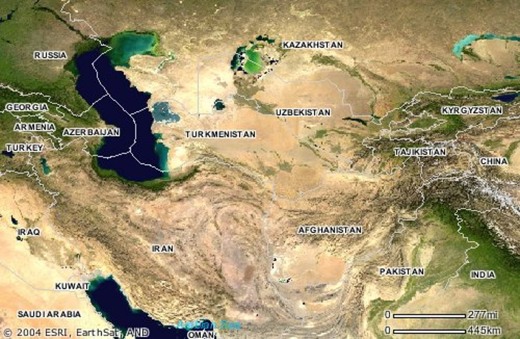
Nagorno-Karabakh has been under the control of the Armenian military and separatists since a war between Armenia and Azerbaijan ended in 1994. Years of negotiations have brought little progress in resolving the dispute, though a fragile truce has been in place.

Ethnic Armenian separatists backed by Yerevan seized control of the mountainous Nagorno-Karabakh region in a war in the early 1990s which claimed some 30,000 lives. The rival states have never signed a peace deal, despite the 1994 ceasefire.

Energy-rich Azerbaijan, whose military spending exceeds Armenia’s entire state budget, has repeatedly threatened to take back the breakaway region by force if negotiations fail to yield results. Armenia says it could crush any offensive.

Armenia says it could crush any offensive

The new fighting which broke out on Saturday has been the worst since 1994, said David Babayan, a spokesman for the region’s separatist president.


Fresh Round of Clashes: Implications for the Middle East

Rahmat Hajimineh, PhD., a university professor and Middle East expert, said in an interview with Fararu news website that the fresh round of conflicts in Karabakh between the Azerbaijan Republic and Armenia has a number of implications.

“First of all, despite two decades of ceasefire between Azerbaijan and Armenia, the recent clashes showed that the disputes between the two sides have remained in place through all these years like a fire under the ash,” he said.

“The efforts made so far had apparently just prevented all-out, serious conflicts between the two countries,” Hajimineh noted, underlining that the situation is best described as being neither at war nor at peace.

“Secondly, the resumption of clashes between the two countries indicated that territorial disputes, even in the third millennium, are still one of the major sources of tension between interested parties, particularly in underdeveloped regions,” the Middle East expert went on to say.

“territorial disputes are still a major source of tension, particularly in underdeveloped regions”

“And thirdly, the conflicts demonstrated the failure of international groups and organizations – like the Organization for Security and Co-operation in Europe (OSCE) Minsk Group – in the settlement of the Nagorno-Karabakh dispute,” Hajimineh added.

Therefore, he added, it has been shown that ultra-regional groups cannot end such conflicts without providing a comprehensive formula for the settlement of dispute based on the consent of both sides.

“The resumption of conflict between Azerbaijan and Armenia thus shows that the disputes between them are still in place as they were in the early 1990s, and there is even a risk that they would continue or even worsen,” the Iranian university professor noted.


The Main Reason behind the Resumption of the Nagorno-Karabakh Conflict

“The main reason [behind the ongoing conflicts] is the old historical and territorial dispute about the Karabakh region, which is claimed by both sides with nationalist attitudes,” Hajimineh said.

The nationalist approaches held by the two sides towards the issue, the pressures exerted by internal sides in both Azerbaijan and Armenia, and the attempts by the two sides to maintain their political legitimacy can be considered as the factors behind the continuation of crisis and dispute, he went on to say.

The nationalist dimensions of the dispute complicate its settlement

As a result, Hajimineh added, it can be said that the addition of a nationalist dimension to the territorial dispute has made its settlement more complicated, since any provocative move on the front line between the two sides’ military forces would lead to tension and conflict.


Continued Clashes to Destabilize Iran’s Borders

Asked about the stance Iran should take towards the crisis, Hajimineh noted that the exacerbation of conflict between Iran’s two northern neighbors, Azerbaijan and Armenia, would definitely result in instability along Iranian borders.

Therefore, as the Iranian Foreign Ministry has reacted to the issue, Iran should focus on the peaceful settlement of the dispute within a peaceful group framework, without resorting to force, he said.

“Given the geopolitical significance of the crisis-hit areas, increased insecurity in the region can definitely have negative consequences for Iran’s national security in the long-term,” Hajimineh underlined.

Increased insecurity in the region can definitely have negative consequences for Iran’s national security

“It is thus expected that Iran pursues an active diplomacy to help resolve the conflict peacefully in a bid to establish sustainable peace in the region,” the Middle East expert told Fararu.


Nagorno-Karabakh Conflict to Help Daesh Recruitment

The university professor further referred to the possible benefits the ongoing clashes would have for terrorist groups, including Daesh, saying that radical and extremist groups have been seen to find more room for emerging and expanding in those regions where there is a security vacuum, and with a high level of tension.

“Given the growth of extremism and radicalism, and the operation of such groups as Daesh in the Middle East, any return to conflict and tension can prepare the grounds for their activities and recruitment,” he said.

Conflict and tension can aid terrorist activities and recruitment

“Today, we are witnessing that extremist and radical forces are using fluid movement tactics in insecure geographical areas to protect themselves,” Hajimineh asserted.

If tensions run high in the region in this period of time, it would benefit extremists and radicals, at least in the sense that global attention would be diverted from the fight against terrorism and their activities in Syria and Iraq, he noted.


Russia Expected to Intervene in the Nagorno-Karabakh Conflict

“Given past experience, and the active role traditionally played by the Kremlin in the Nagorno-Karabakh dispute, and also considering the recent role Russia played in Ukraine and Syria, the Russians are again expected to try to take the initiative in this region, which is regarded as their backyard, and is of great significance to Moscow,” he said.

“However, given the major role played by the Minsk Group in settling the crisis, Russia is trying not only to prevent the exacerbation of the conflict through the Minsk Group, but also to reinforce its multilateral diplomacy in this case – as in the Syrian crisis – in co-operation with other players,” Hajimineh stated.
“Nowruz Remains Eternal in the Course of History”

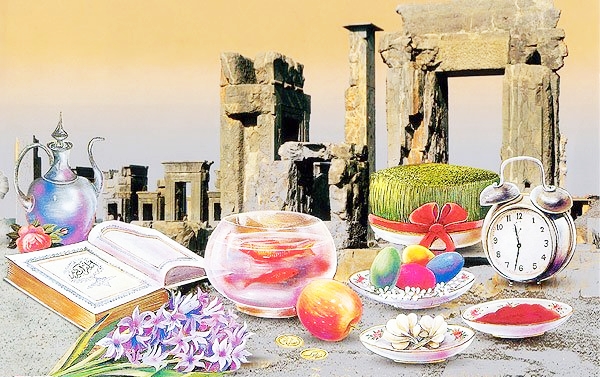
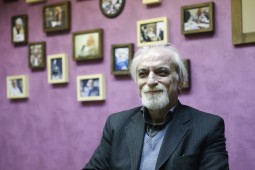
In an interview with IBNA, Dariush Mohajer, the author of Nowruz in the Four Corners of the World, acknowledged Iranian culture as a global culture and stated, “We come across many Iranian cultural elements in regions which have never been ruled by the Persian Empire.”

Dariush Mohajer, author of "Nowruz in the Four Corners of the World"
Dariush Mohajer, author of “Nowruz in the Four Corners of the World”

This author said: “Nowruz is a beautiful phenomenon and despite all persisting problems, will remain forever. There are about twenty regions in the world which are impressed by Nowruz, and in the year 2010, the Assembly of the United Nations International recognized Nowruz as a global day.

He added some points about the Mozabites and said: “The first Islamic government was formed in this region by someone of Iranian descent called Abdolrahman Ibn Rostam. He and his followers were among the Khawarij and after they came to the area, they were called ‘Rostamian’ or ‘Rostamouyeh’.”

Stating that the Mozabites had inherited some of their fathers’ features, he said: “They used to clean their houses and streets and alleys on the eve of spring and wore new clothes and visited their relatives. Therefore, despite the changes happening in the region in more than a thousand years, climatic changes have not forced them to give up some of their traditions.

Nowruz geopolitics
Geopolitics of Nowruz: Saving Farsi Culture From Elimination

In another part of his speech, Mohajer pointed to a group of people living in the Western provinces of China named Uyghurs who celebrate Nowruz. Some scholars believe that the Uyghurs were Manichaeists before they adopted Islam.

He continued, saying that it is interesting to know that this group of people use Persian vocabulary and pray in Persian. This is despite the fact that since 1947 (the time of Mao), Persian language has been banned, but these people are still using it in China. Moreover, this area has never been ruled by the Persian Empire.

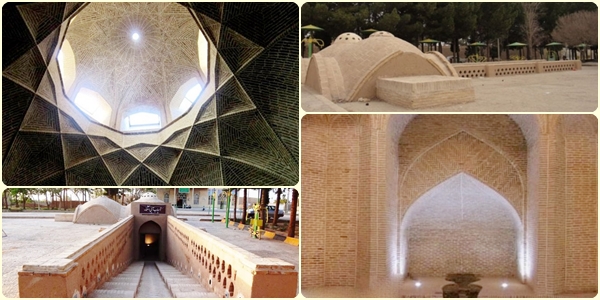
Yazd Ashkezar Water Mill architectural masterpiece

It is the oldest in Yazd Province and the largest in the country, said Mohammad-Mehdi Sherafat according to Iran Daily.

Water mills are among the historical sites of Yazd Province. They were established near villages and along the aqueducts, Sherafat added.

Ashkezar Water Mill, which dates back to the Ilkhanid era, reaches a depth of seven meters, he said.

Located 20 km from the provincial capital Yazd, it was renovated by Yazd Cultural Heritage Department, and is ready to receive visitors, he said.

The brick water mill is one of the 18 water mills in the province registered on the National Heritage List, he said.

Yazd is one of the most well-known desert cities of Iran.

Many Iranians and foreign tourists are interested in visiting Yazd to see the architecture which is typical of desert areas.

It is known as the city of wind-towers, Zoroastrians, ‘termeh’ (traditional brocade), silk weaving and sweets (such as ‘baqlava’ and ‘qotab’).

A trip to Yazd will make one familiar with life in desert towns and how people adjust to it. You learn about ‘qanat’ (underground water supply system) for which Iranians are well-known.

The water reservoirs, icehouses, wind-towers and pigeon towers make it worthwhile to visit Yazd, as tourists explore the uniqueness of this ancient city.

Yazd, located 270 km southeast of Isfahan, has a population of approximately 560,000. It attracts a growing number of tourists each year.

The city is hot and dry in summer due to its location, which is between the two main deserts of Dasht-e Kavir and the Kavir-e Lut.

A look at Iranian newspaper front pages on April 5

Iran Newspaper front pages

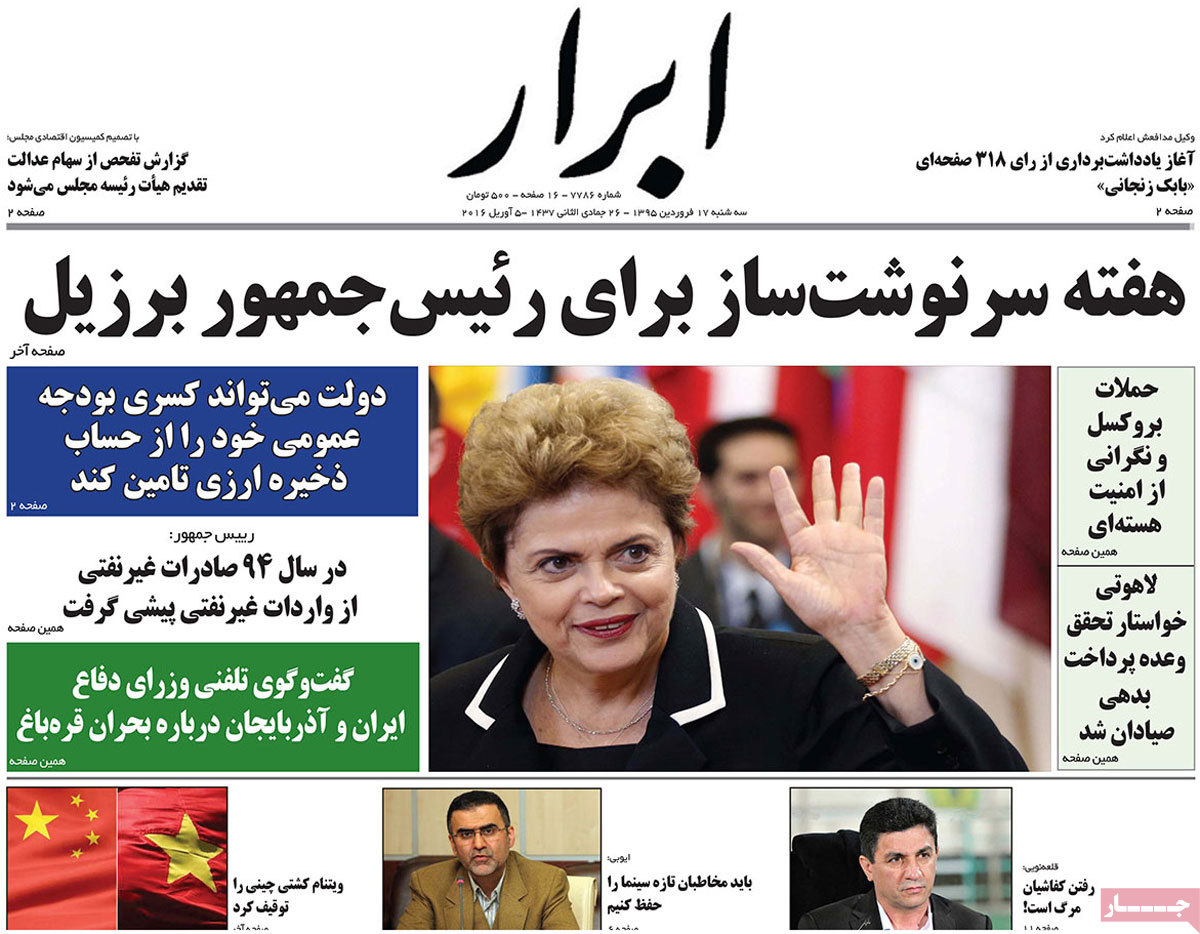
Abrar:

  1. Landmark week for Brazilian president
  2. Administration may tackle general budget deficit using reserve accounts
  3. Iran non-oil exports greater than imports: Rouhani
  4. Defense Ministers of Iran and Azerbaijan discuss Karabakh crisis on phone
  5. Brussels attacks and nuclear security concerns


A look at Iranian newspaper front pages on April 5


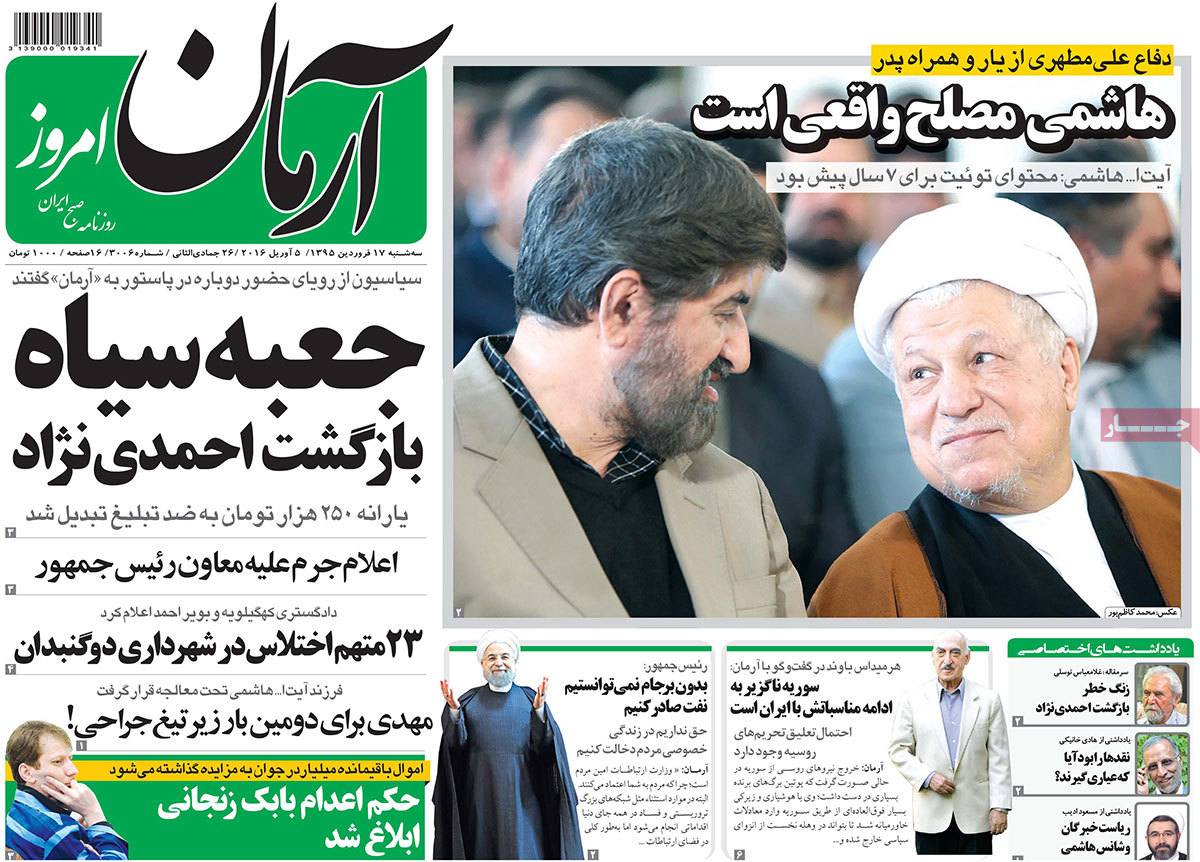
Arman-e Emrouz:


  1. Hashemi, a real reformist: MP Motahari
  2. Black box of Ahmadinejad’s return
  3. Ex-vice president indicted
  4. 23 suspects in Do-Gonbadan municipal corruption case
  5. No oil exports without nuclear deal: Rouhani


A look at Iranian newspaper front pages on April 5


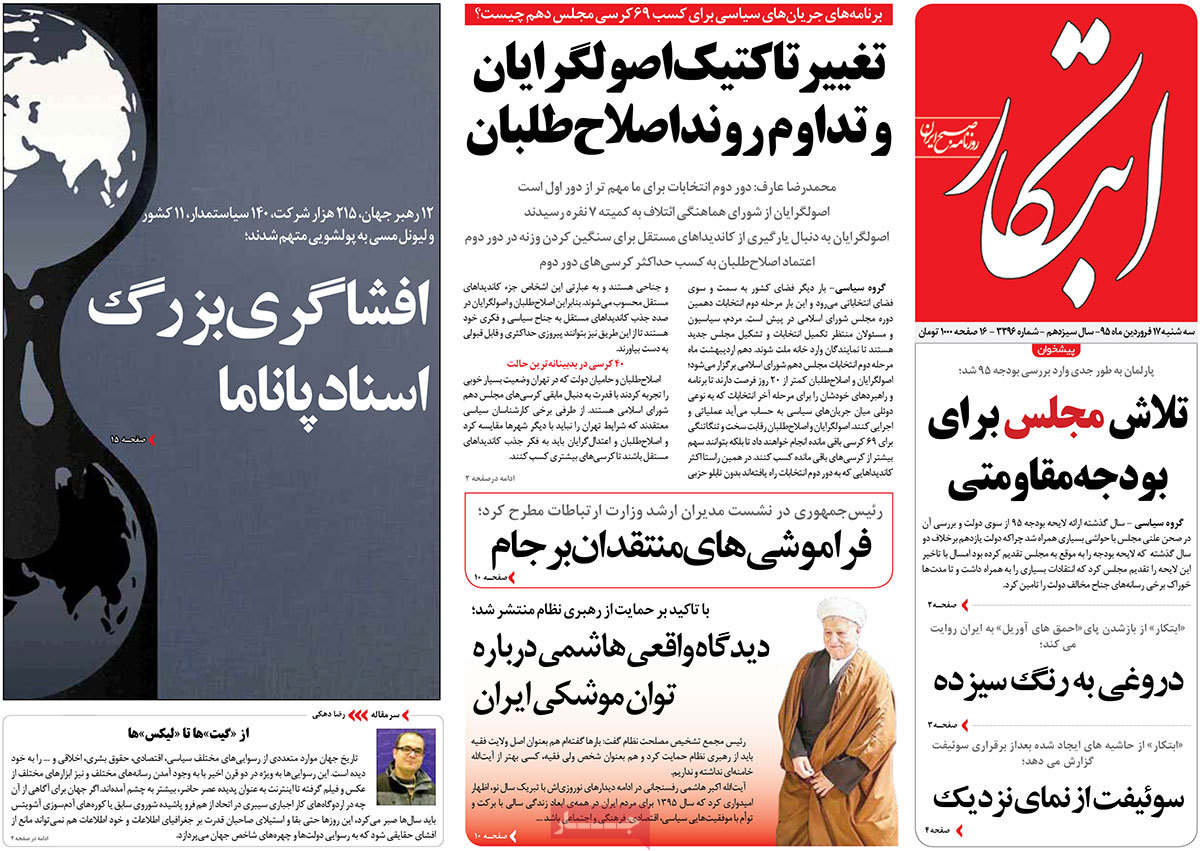
Ebtekar:

  1. The Big Reveal: Panama Papers

An unprecedented global investigation into a massive leak of secret documents from the Panamanian law firm, Mossack Fonseca & Co. opens a virtual Pandora’s Box into the shadowy world of offshore companies.

  1. Parliament deliberating resistive budget bill
  2. Hashemi’s real approach on Iran’s missile strength


A look at Iranian newspaper front pages on April 5


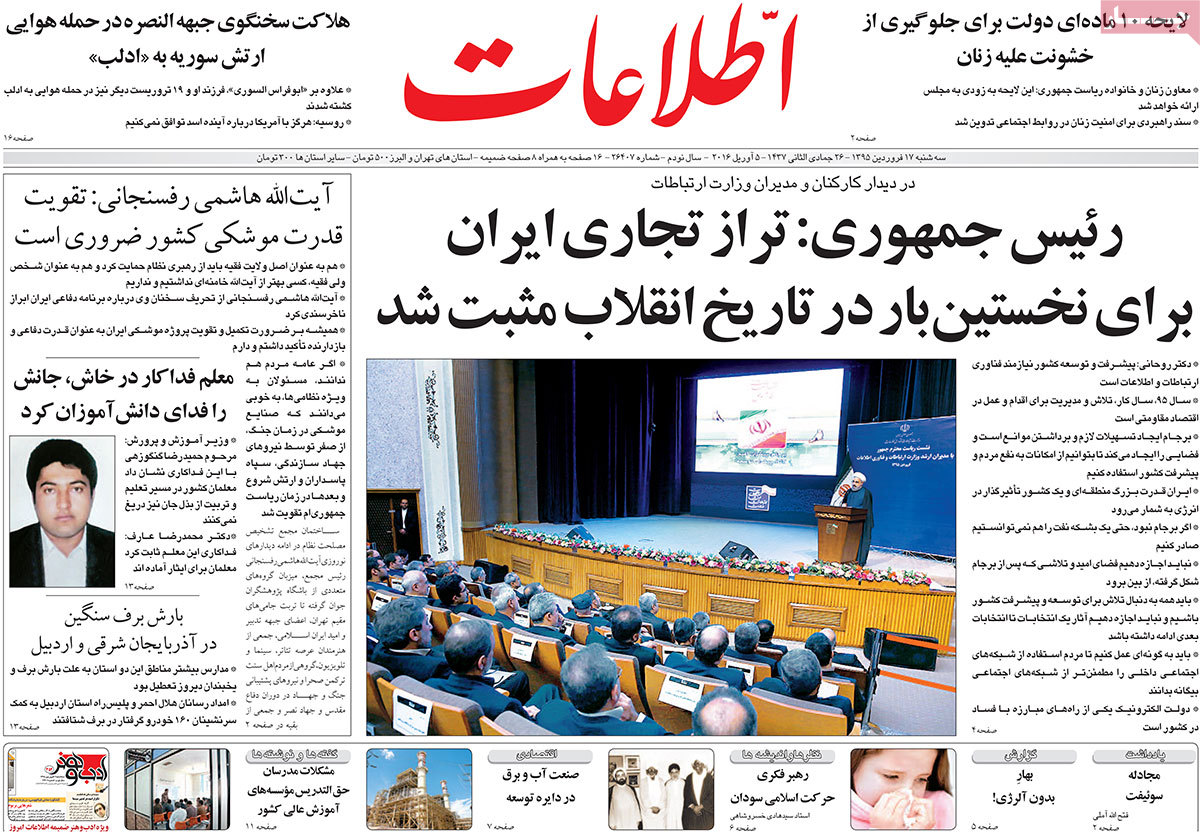
Ettela’at:

  1. Teacher sacrifices his life for students
  2. Government submits 10-article bill to curb violence against women
  3. Idlib air raid kills al-Nusra Front spokesman
  4. Bolstering missile power crucial: Rafsanjani
  5. Iran trade balance positive for first time since Islamic Revolution: Rouhani
  6. Heavy snow grips East Azerbaijan and Ardebil provinces


A look at Iranian newspaper front pages on April 5


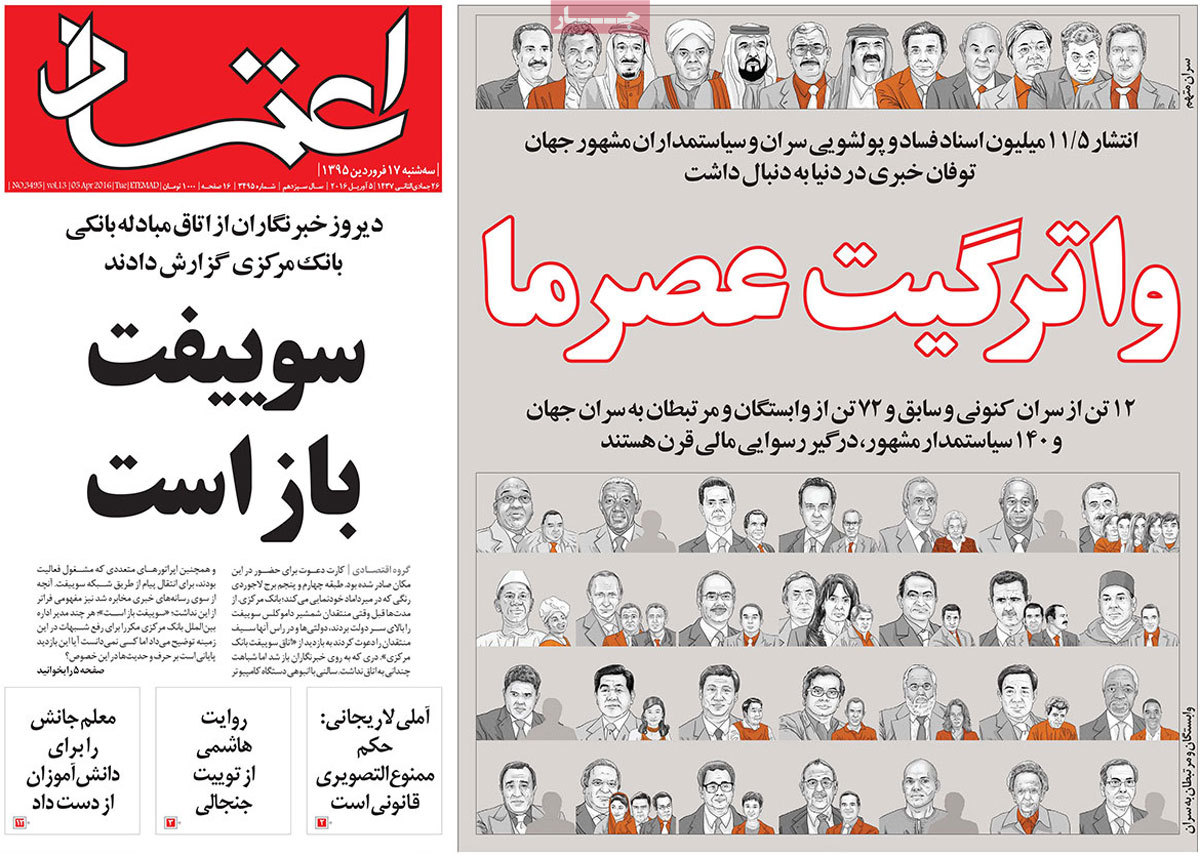
Etemad:

  1. Today’s Watergate

The Panama Papers revelation has shaken the world’s media, as the leak from the Panamanian law firm, Mossack Fonseca, continues to be investigated. It involves more than 11.5 million documents, nearly 215,000 companies and 14,153 clients of the firm, according to the German newspaper Süddeutsche Zeitung, which obtained the information and shared it with other media outlets and the International Consortium of Investigative Journalists, a nonprofit group.
  1. SWIFT is open [for Iran]
  2. Prohibition of photography for figures, legal: Top judge


A look at Iranian newspaper front pages on April 5


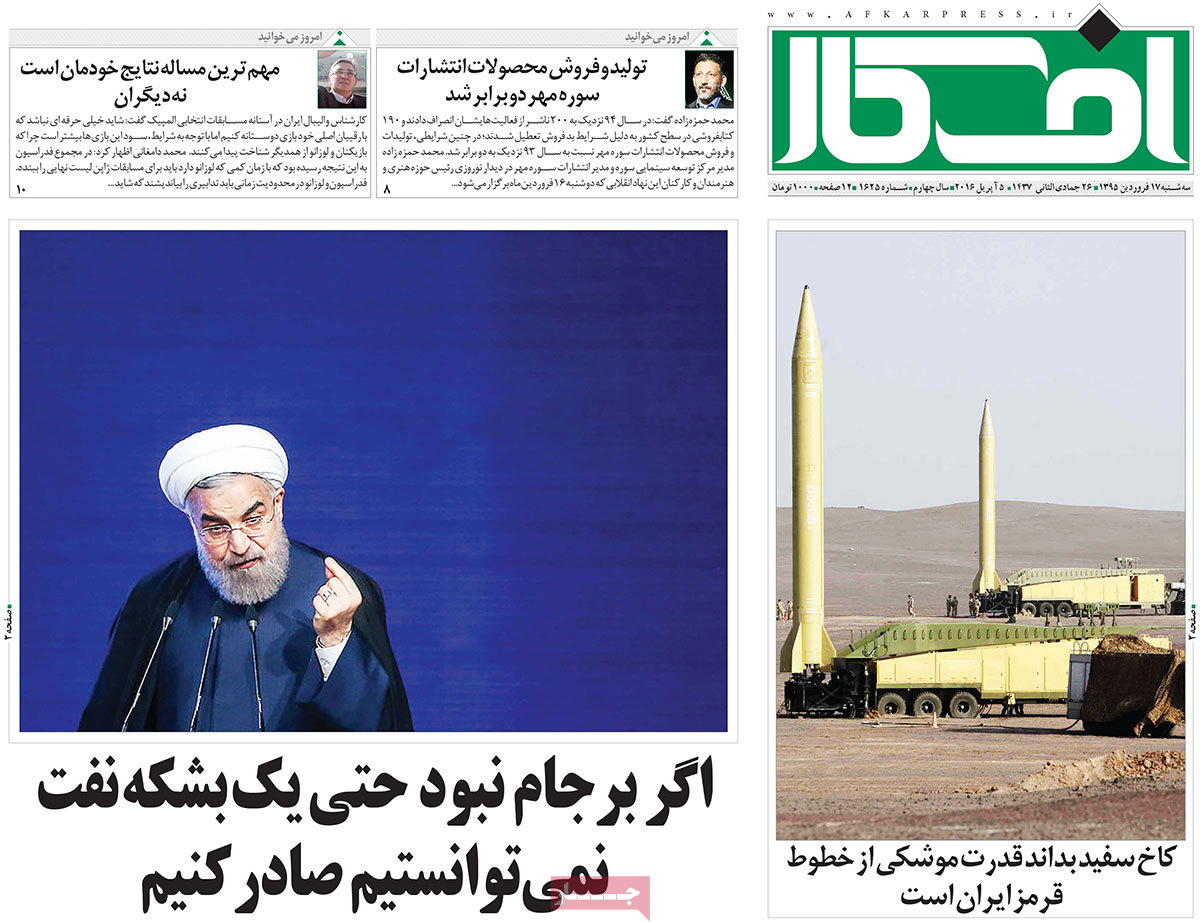
Afkar:

  1. Soureh Mehr doubles cultural output
  2. Not one single oil barrel could be exported without nuclear deal: President Rouhani
  3. For the White House’s information: Missile power is a red line for Iran


A look at Iranian newspaper front pages on April 5


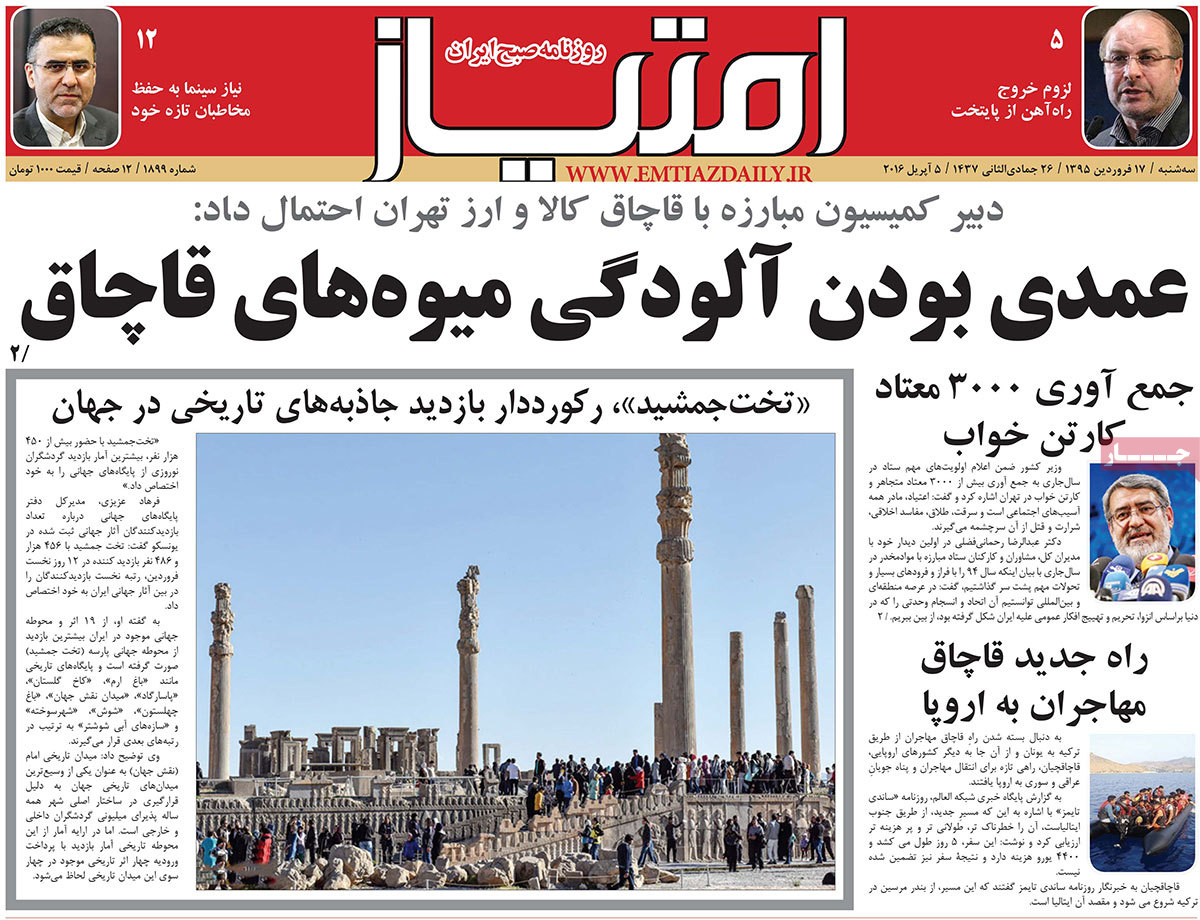
Emtiaz:

  1. Tehran mayor calls for moving railway center outside of capital
  2. Official says smuggled fruits are inadvertently tainted
  3. 3,000 homeless addicts arrested in Tehran
  4. Persepolis tops world tourist destinations


A look at Iranian newspaper front pages on April 5


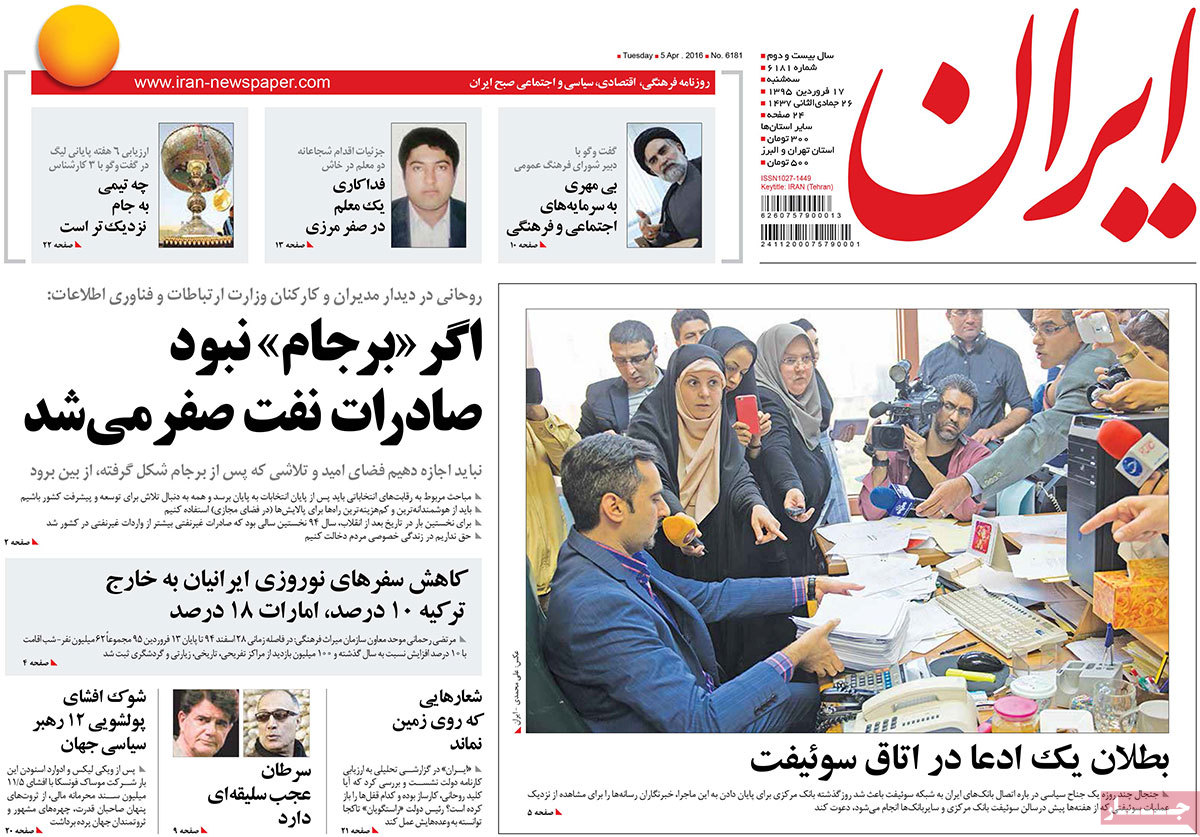
Iran:

  1. Iranian bank ends allegations that SWIFT is not open for Iran banks

It was rumored that the SWIFT international money transfer system was not operational in Iran. To disprove the allegations, the Central Bank of Iran invited reporters to its SWIFT room to let them see how the system is working.

  1. 10% drop in Iranian visits to Turkey during Nowruz

Visits to Dubai also fell by 18% during the New Year holidays.


A look at Iranian newspaper front pages on April 5


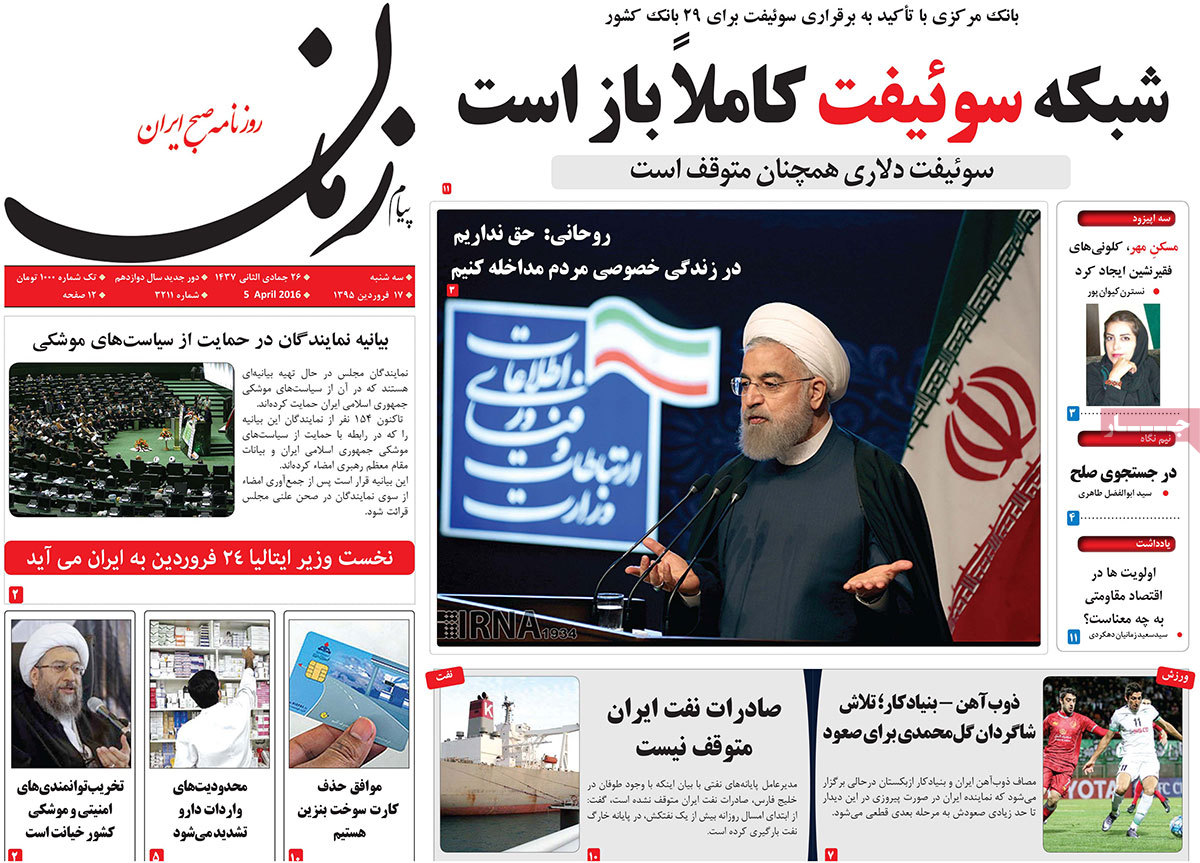
Payam Zaman:

  1.  MPs issue statement in support of Iran’s missile program
  2. Italy PM in Tehran on April 12
  3. No freeze in Iran oil exports
  4. SWIFT fully operational for Iran: CBI
  5. Rouhani: No one has any right to violate people’s privacy


A look at Iranian newspaper front pages on April 5


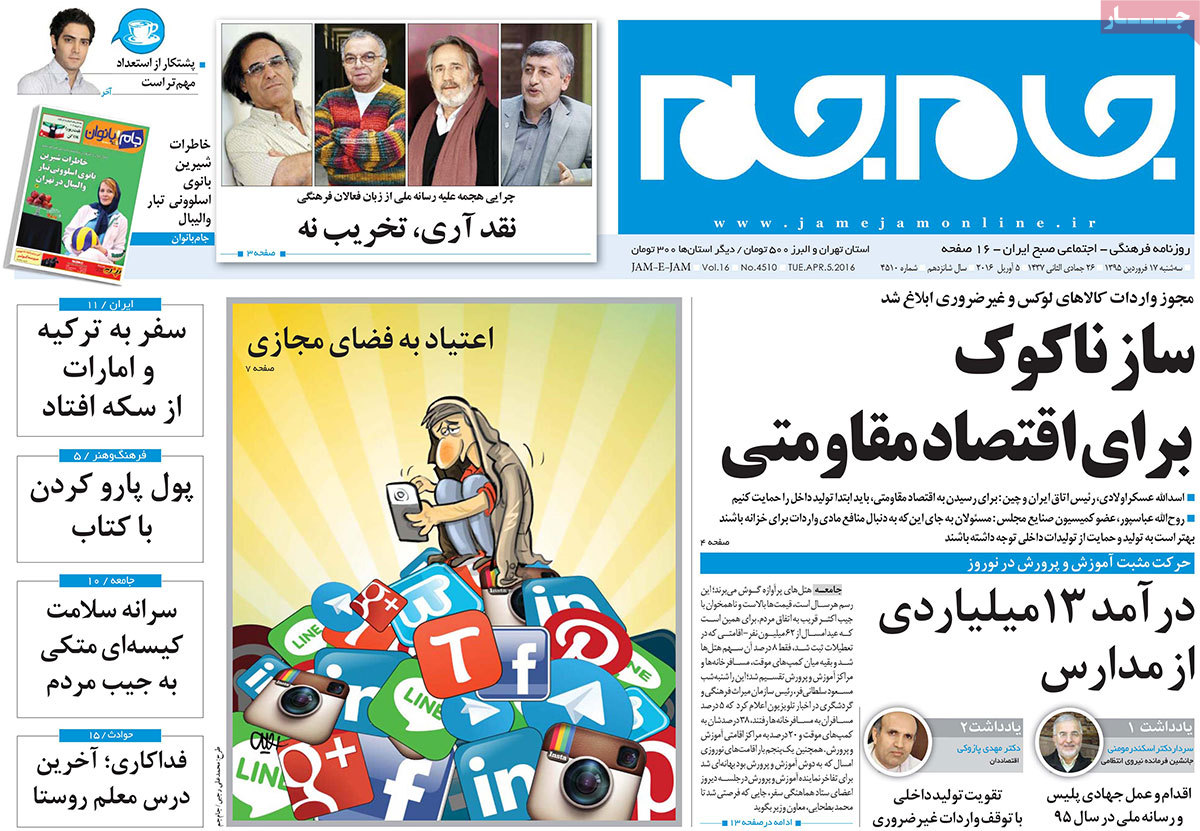
Jamejam:

  1. Turkey, UAE visits no longer in vogue
  2. Education ministry earns IRR130bn during Nowruz
  3. Iran lifts ban on import of luxurious items
  4. Cyberspace addiction


A look at Iranian newspaper front pages on April 5


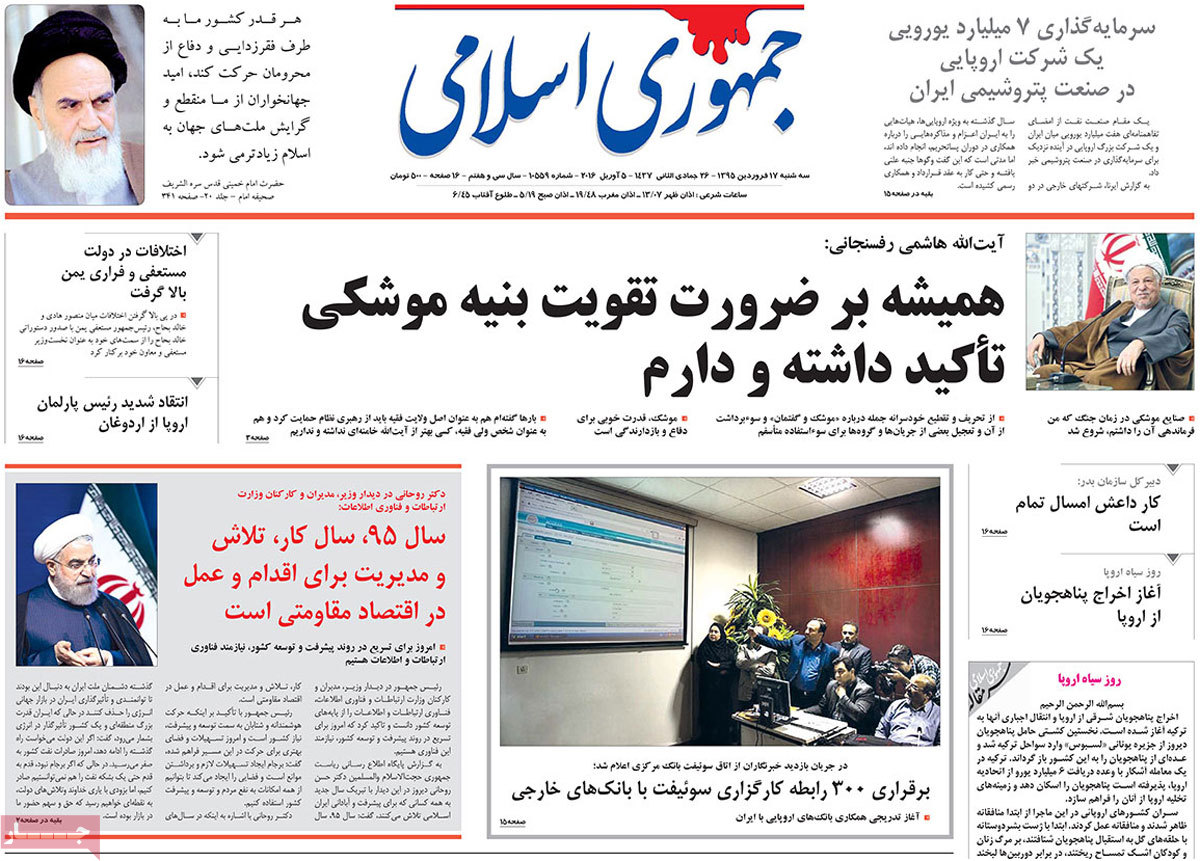
Jomhouri Islami:

  1. European firm to invest $7bn in Iran petrochemical industry
  2. I have and will always stress necessity of bolstering missile power: Rafsanjani
  3. Badr: ISIS to become history by year-end
  4. 300 SWIFT links with foreign banks
  5. EU parliament knocks Erdogan


A look at Iranian newspaper front pages on April 5


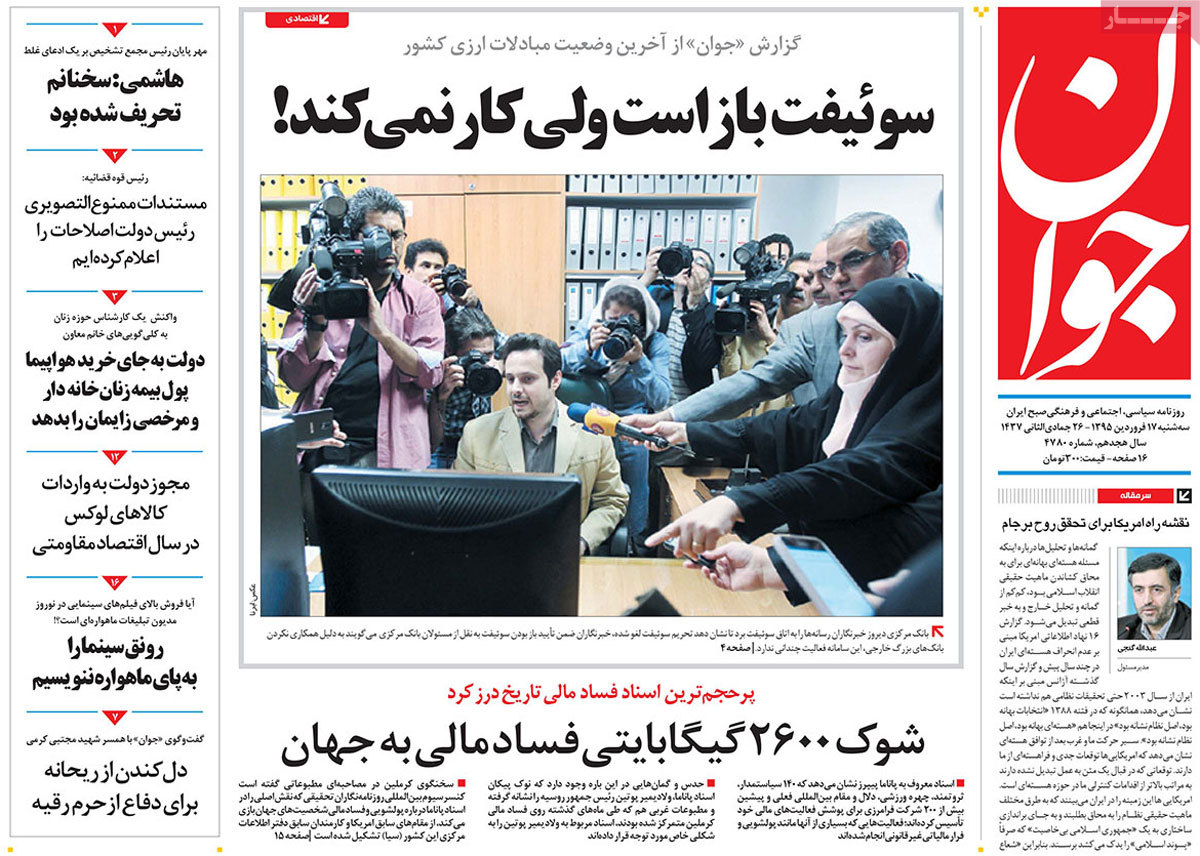
Javan:

  1. Swift open, but not functional
  2. 2,600GB world corruption shock
  3. Government lifts ban on import of luxurious goods
  4. US road map for realization of the ‘spirit of the deal’


A look at Iranian newspaper front pages on April 5


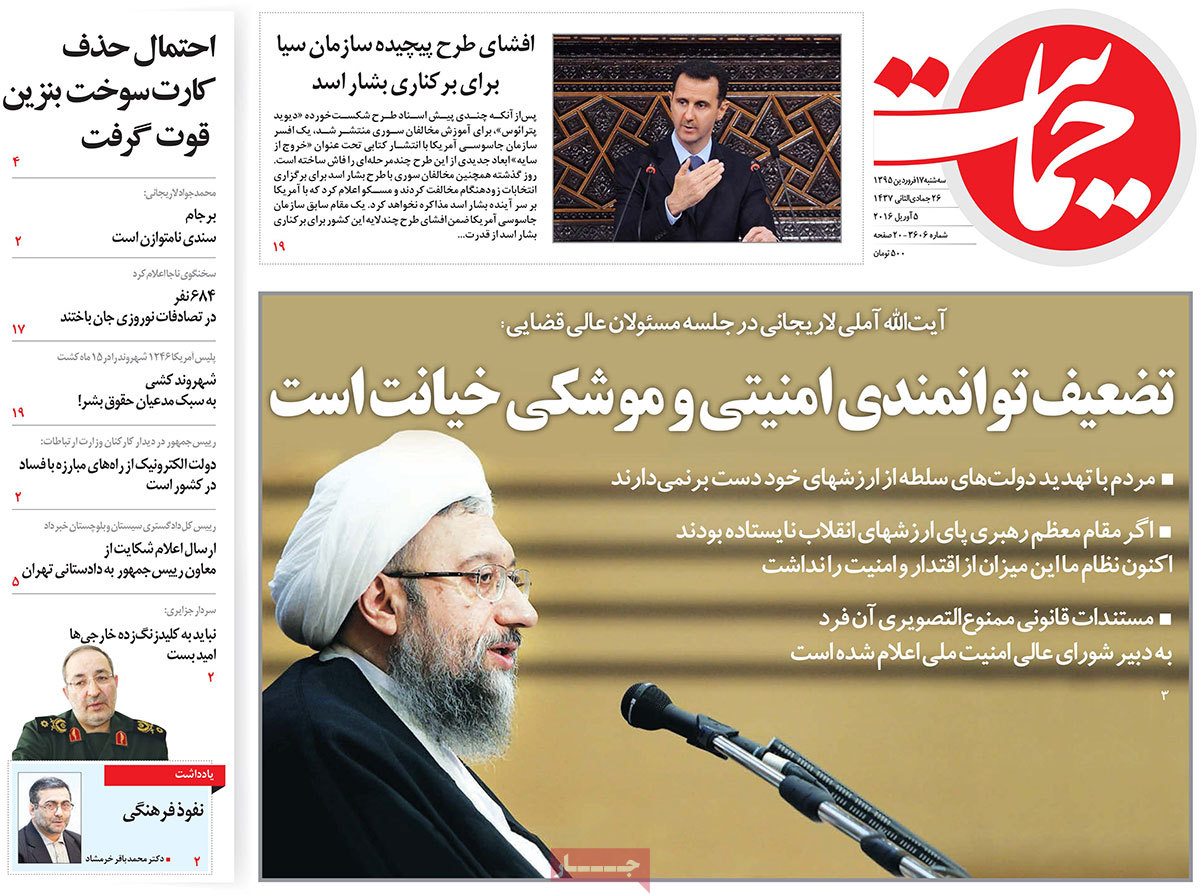
Hemayat:

  1. Weakening missile and security strength is a betrayal: Top judge
  2. Revealed: CIA master-plan for toppling Assad
  3. JCPOA an unbalanced document: Javad Larijani


A look at Iranian newspaper front pages on April 5


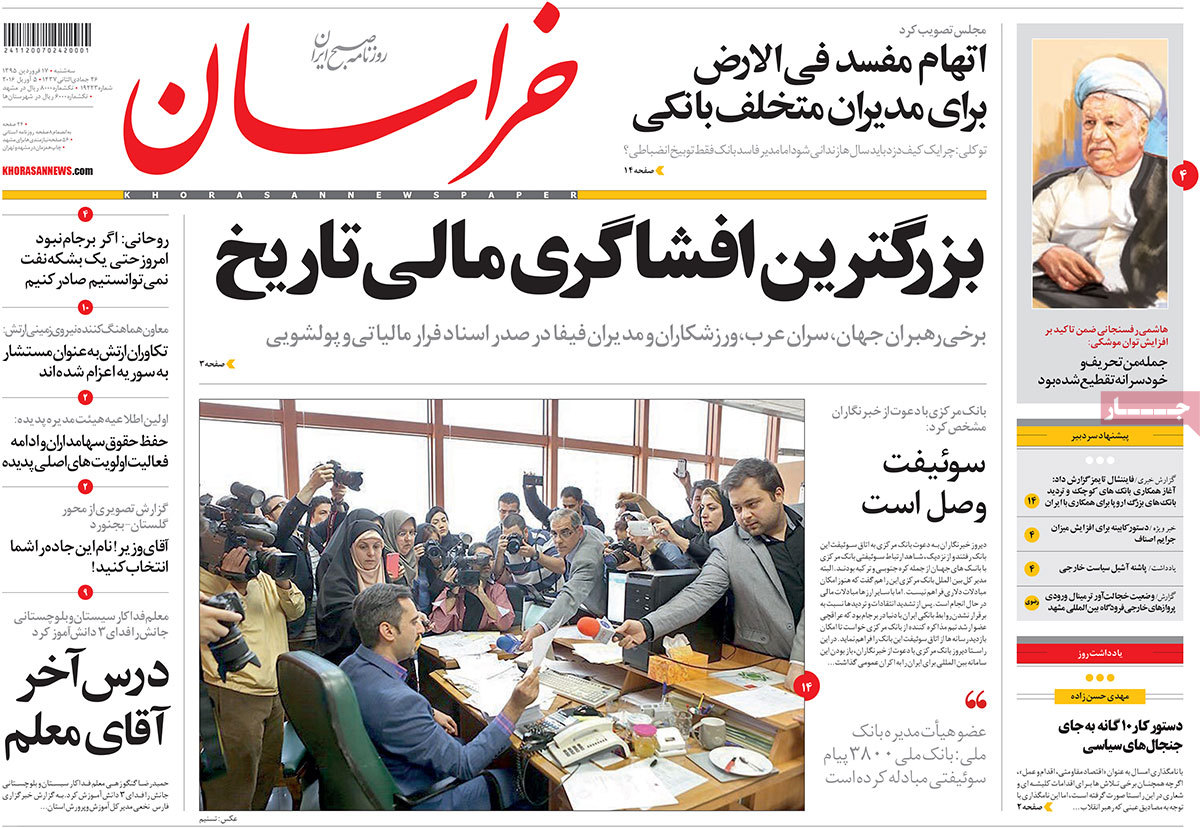
Khorasan:

  1. Corrupt banking managers charged with “corruption on earth”
  2. History’s biggest financial corruption revelation
  3. SWIFT up and running
  4. Iran sends commandos to Syria as advisors


A look at Iranian newspaper front pages on April 5


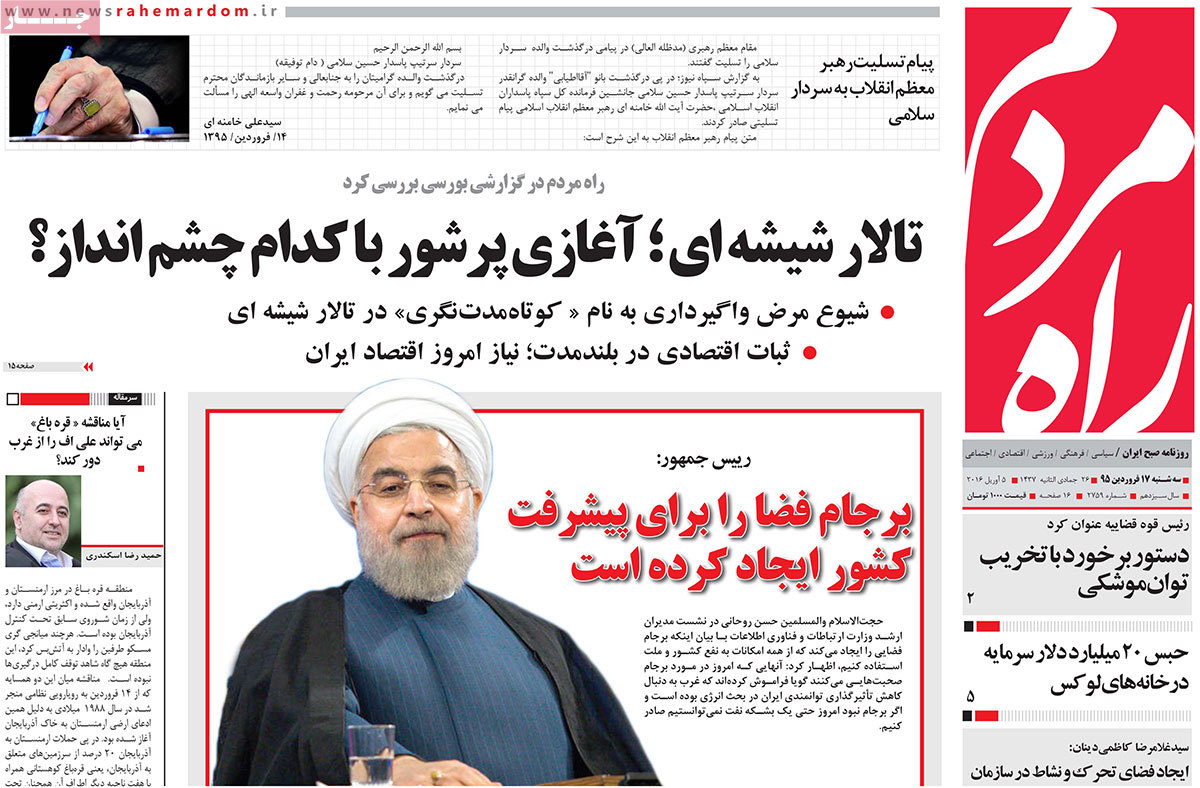
Rah-e Mardom:

  1. Leader’s condolences to General Salami for mother’s death
  2. JCPOA paves way for country’s progress: Rouhani
  3. $20bn capital trapped in luxury houses


A look at Iranian newspaper front pages on April 5


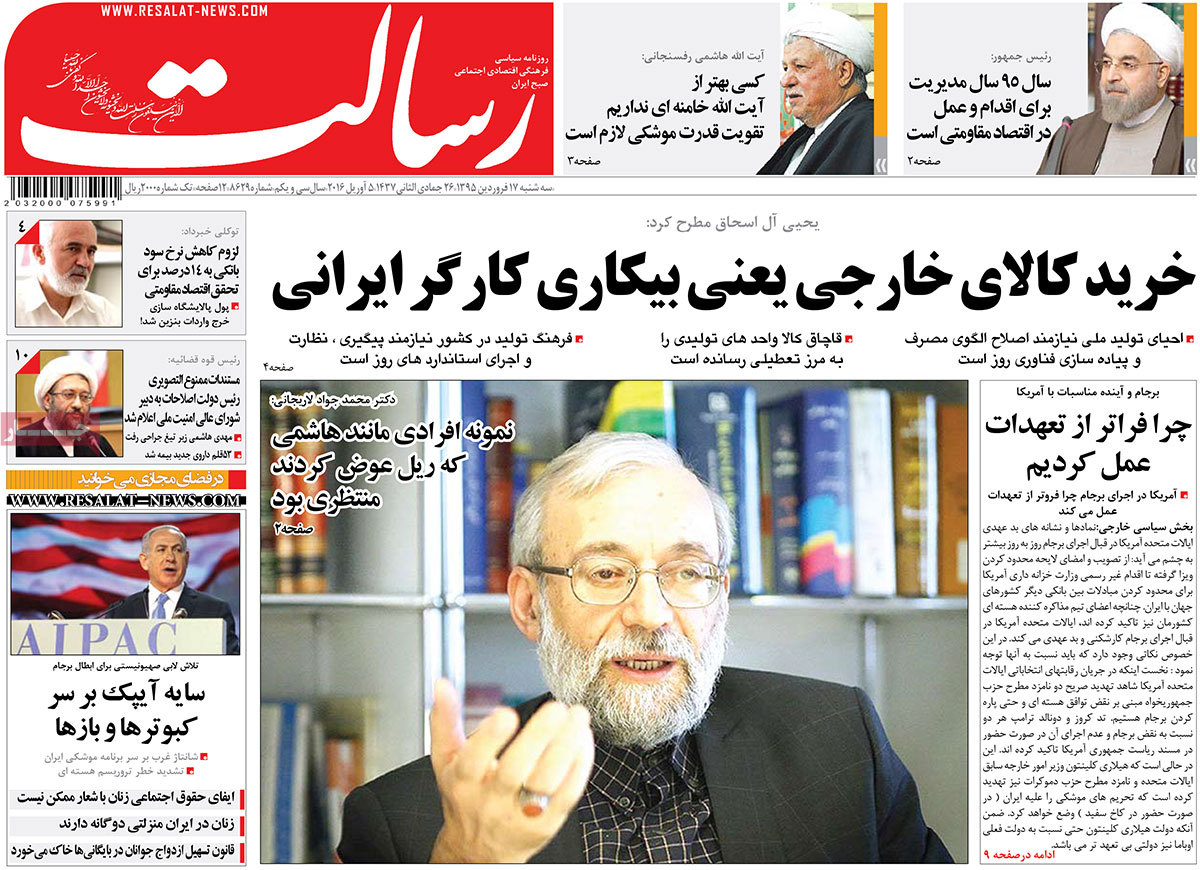
Resalat:

  1. Buying foreign goods causes domestic unemployment

Yahya Ale Eshagh, an economist, decries the purchasing of goods from overseas

  1. Why Iran exceeded commitments in nuclear deal
  2. Rouhani: Year 1395 [started March 20] is the year of management of practice and action in line with resistive economy
  3. No person better than Ayatollah Khamenei: Rafsanjani
  4. Javad Larijani: Montazeri is an example of people like Hashemi who change attitude


A look at Iranian newspaper front pages on April 5


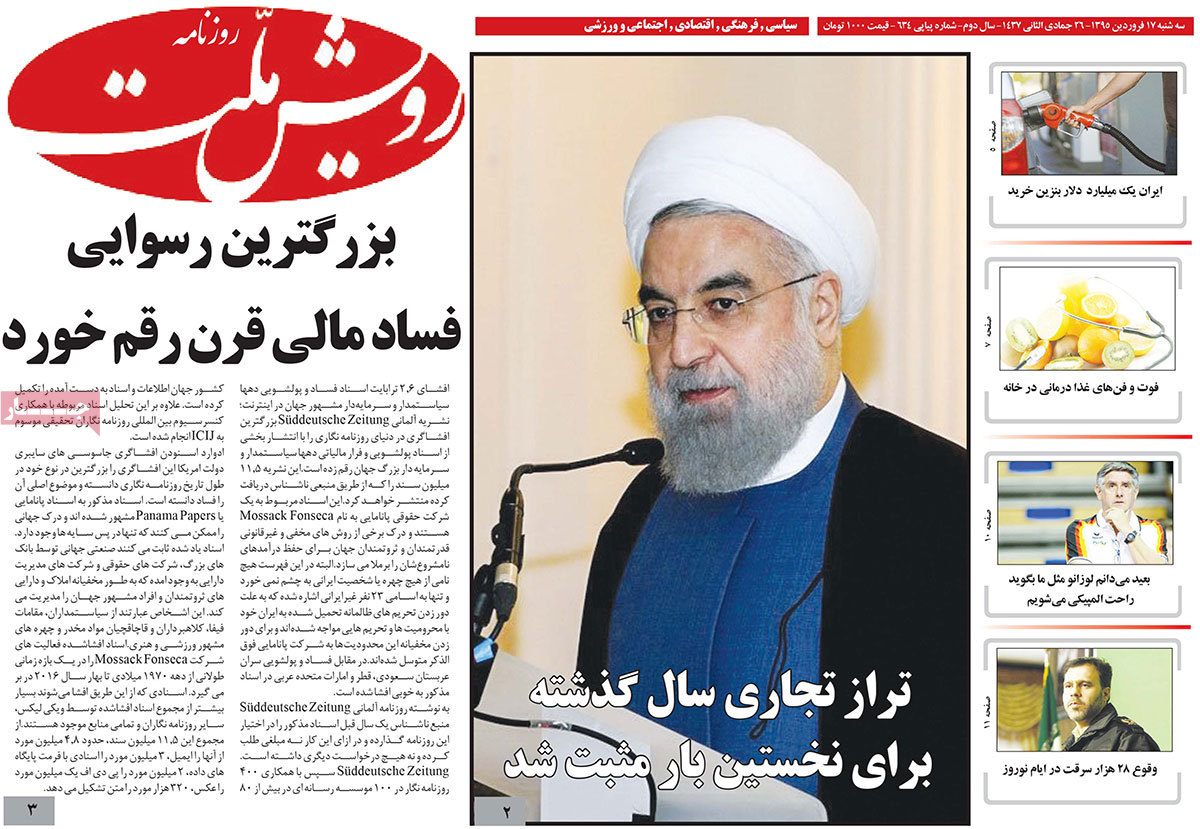
Rooyesh Mellat:

  1. Century’s biggest financial scam revealed
  2. Iran trade balance positive for first time last year: Rouhani


A look at Iranian newspaper front pages on April 5


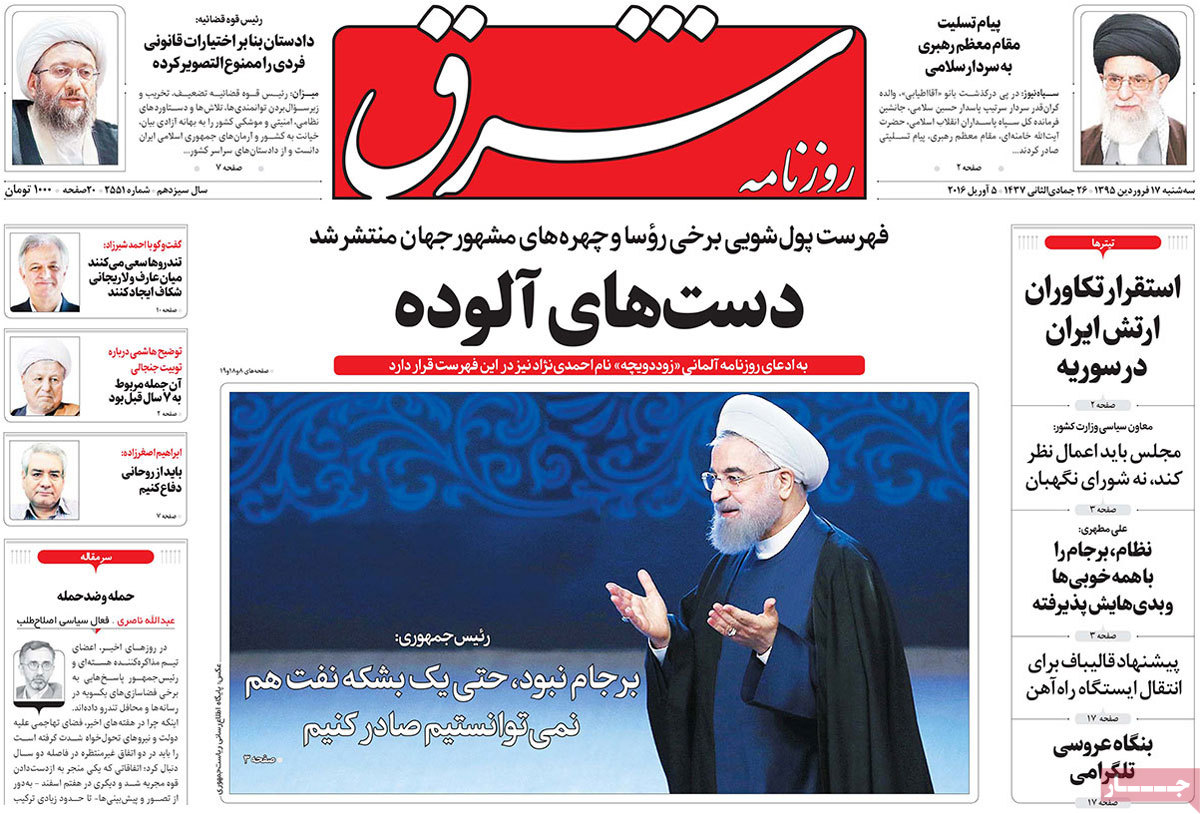
Shargh:

  1. Dirty hands: List of corrupt world leaders released
  2. Iran deploys commandos in Syria
  3. MP Motahari: Establishment endorsed JCPOA with all pros and cons


A look at Iranian newspaper front pages on April 5


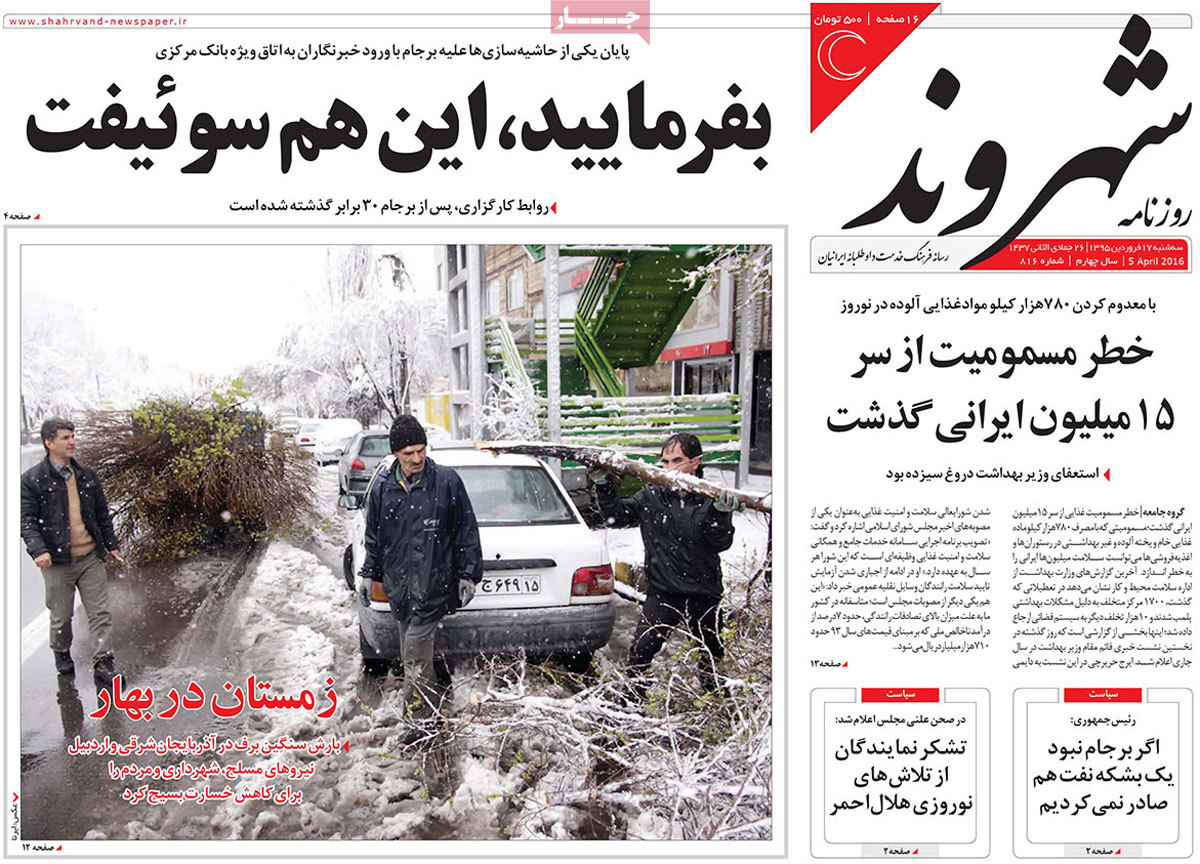
Shahrvand:

  1. Iran dumps 780k tons of tainted foodstuffs

Close shave for 15m Iranians

  1. MPs praise Red Crescent for Nowruz vigilance


A look at Iranian newspaper front pages on April 5


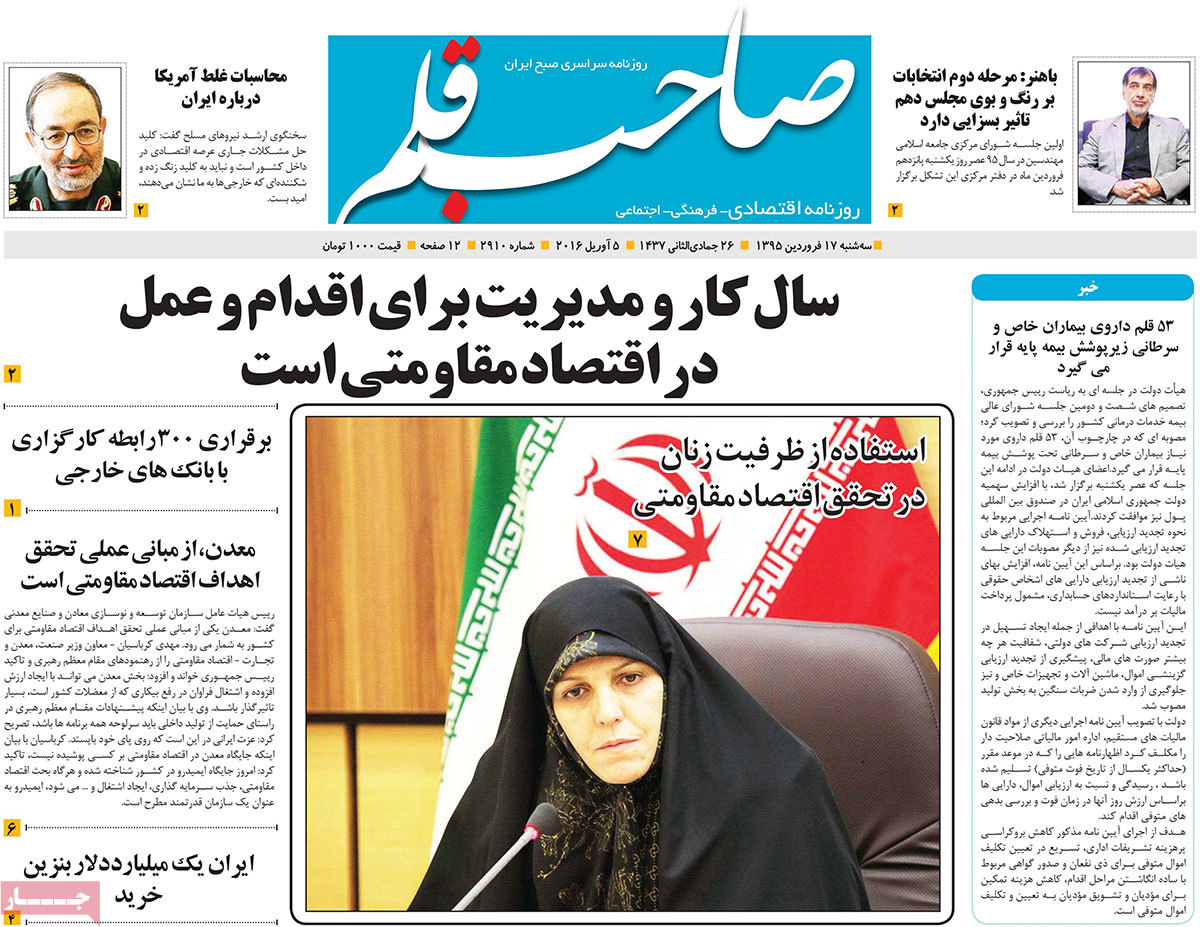
Sahib Ghalam:

  1. Election runoff determines parliamentary climate: MP
  2. US equations wrong about Iran
  3. Insurance coverage for 53 cancer and special illness drugs


A look at Iranian newspaper front pages on April 5


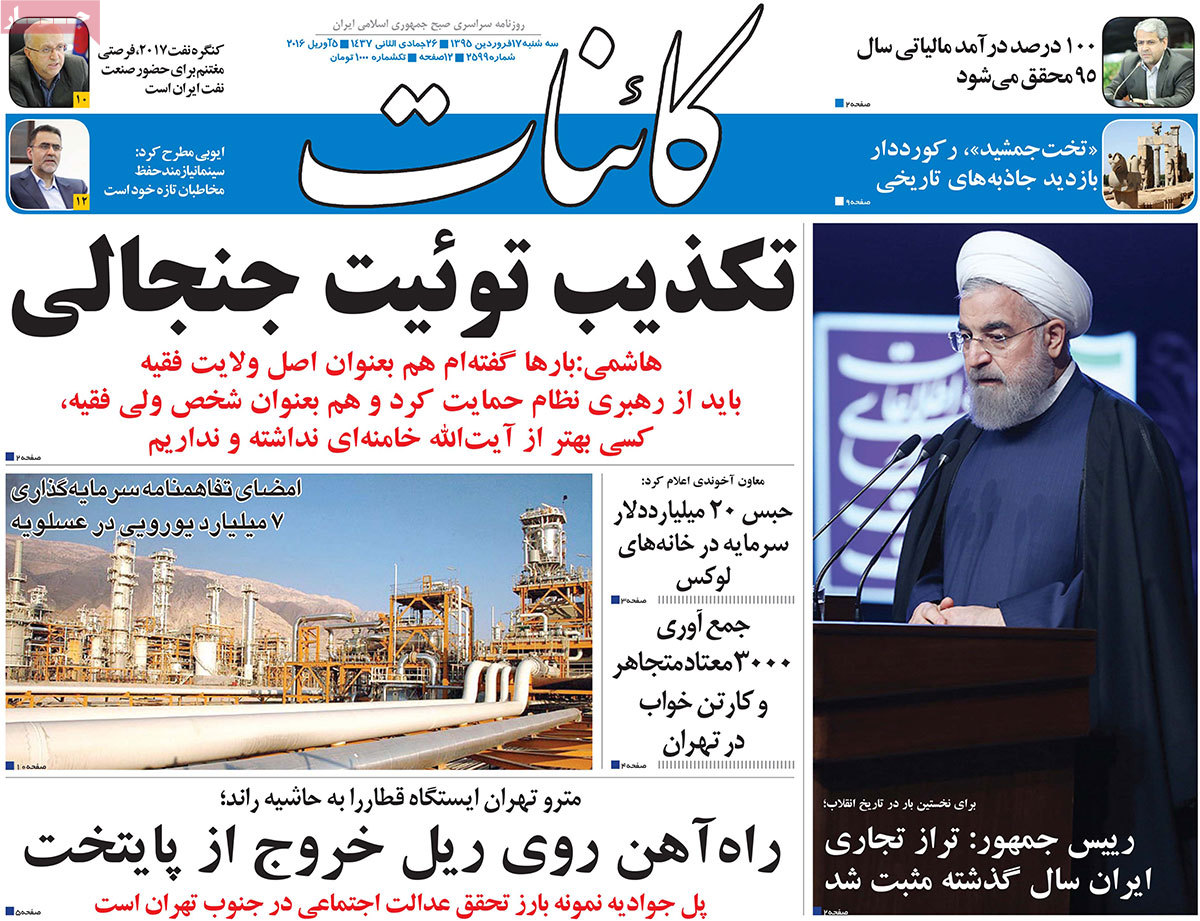
Kaenat:

  1. Iran tax earnings meet planned target


A look at Iranian newspaper front pages on April 5


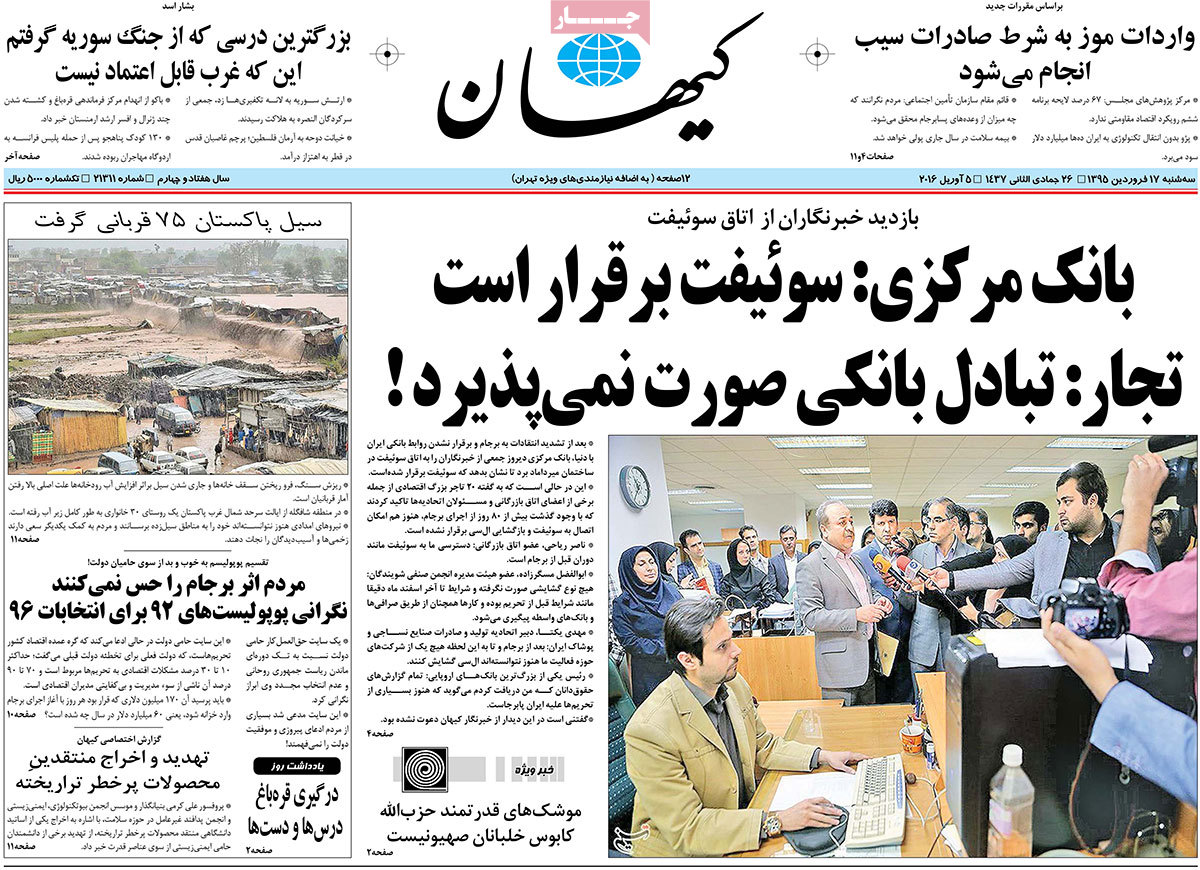
Kayhan:

  1. Banana imports allowed if apples are exported
  2. Biggest lesson in Syria war was that the West cannot be trusted: Assad
  3. CBI: SWIFT up and running

Traders: Banking transactions not possible

  1. Floods kill 75 in Pakistan
  2. Karabakh conflict: lessons and players


A look at Iranian newspaper front pages on April 5


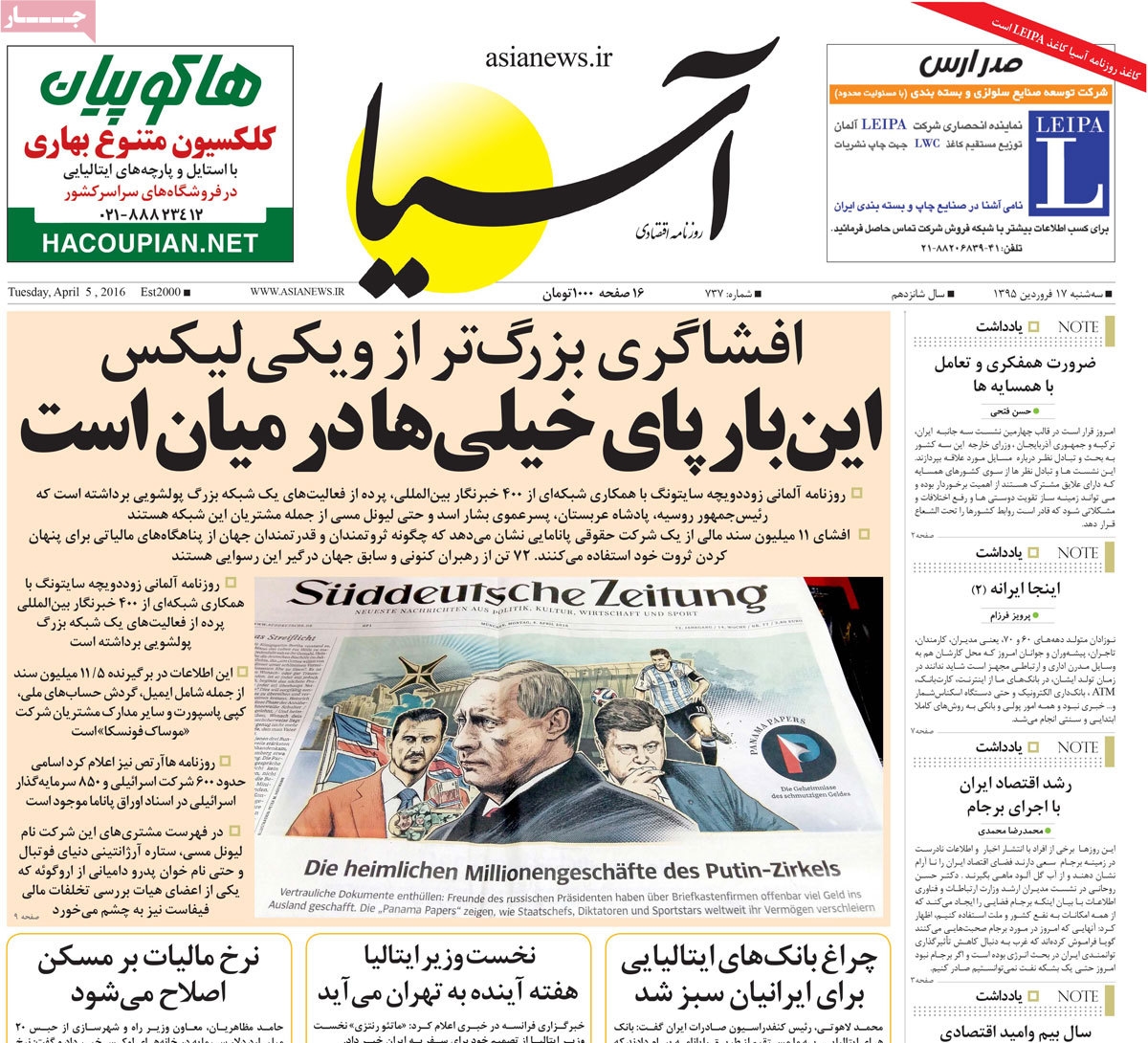
Asia:

  1. Italian banks given green light to reengage with Iranians
  2. Italian PM in Tehran next week
  3. Iran to revise housing taxes


918317b5 (1)


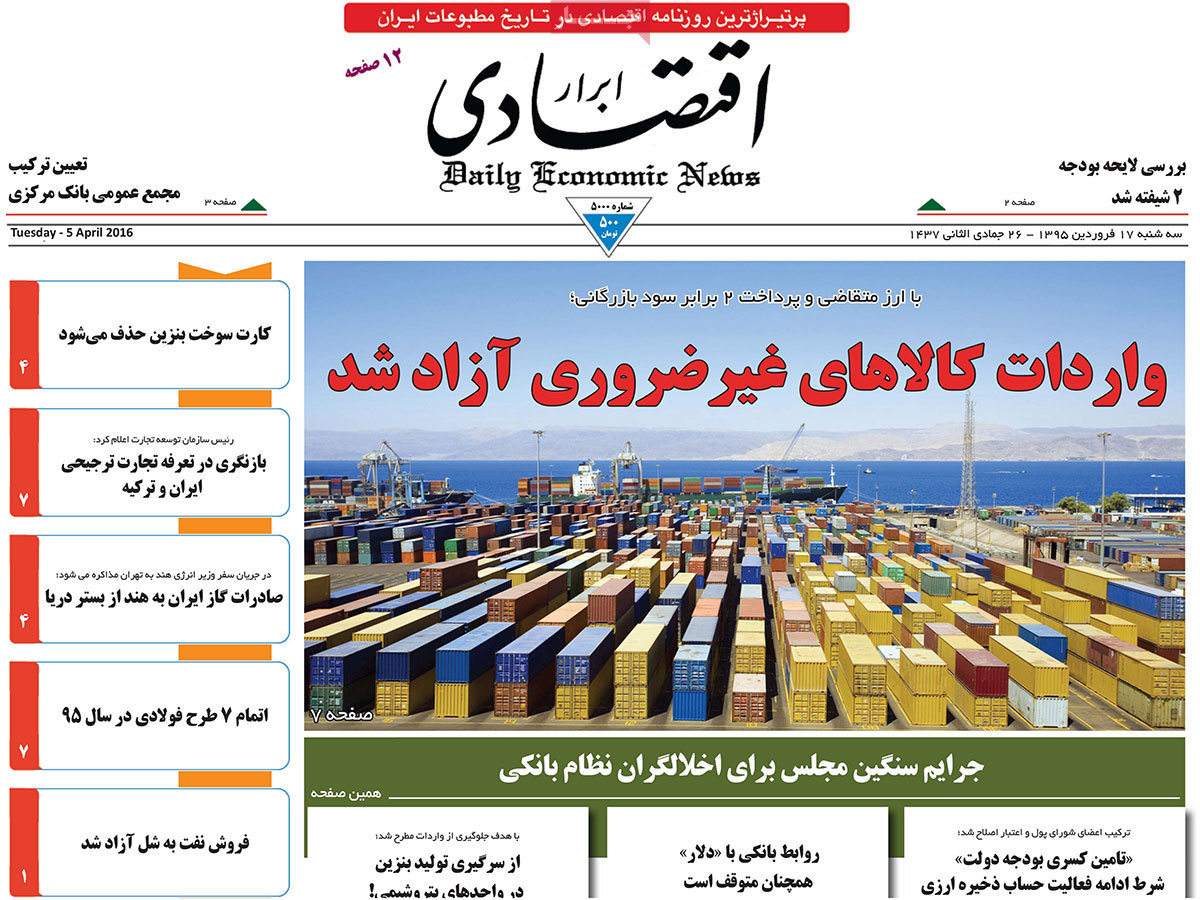
Abrar Eqtesadi:

  1. Iran to revoke fuel cards
  2. Iran and Turkey reconsider preferential trade tariffs
  3. Iran to export gas to India through undersea pipeline
  4. Iran eyes 7 steel projects by year-end in March 2017
  5. Ban on selling crude oil to Shell lifted
  6. No dollar-based banking relations


A look at Iranian newspaper front pages on April 5

Iranian Scientist’s Biosensor Makes Development in Cancer Diagnosis

The nanosensor, which fits in the palm of a hand, acts like a biological sieve, isolating a small protein molecule weighing less than 800 quadrillionths of a nanogram from an extremely dilute solution.

“This biosensing platform may help to unlock the next era of initial cancer detection,” said lead researcher Giuseppe Strangi, professor of physics at Case Western Reserve University in the US.

The research was published online in the journal Nature Materials.

“The prognosis of many cancers depends on the stage of the cancer at diagnosis” Strangi said.

“Very early, most circulating tumour cells express proteins of a very low molecular weight, less than 500 Daltons (standard unit for atomic mass),” Strangi explained.

These proteins are usually too small and in too low a concentration to detect with current test methods, yielding false negative results.

“With this platform, we’ve detected proteins of 244 Daltons, which should enable doctors to detect cancers earlier–we don’t know how much earlier yet,” he said.

The researchers believe the sensing technology will also be useful in diagnosing and monitoring other diseases as well.

Strangi and Nima Sharifi, also from Case Western Reserve University, have begun testing the sensor with proteins related to prostate cancers.

“High sensitivity detection of cancer-specific proteins in blood should enable detection of tumors when they are at an earlier disease stage,” Sharifi said.

“This new sensing technology may help us not only detect cancers, but what subset of cancer, what’s driving its growth and spread and what it’s sensitive to,” he said.

“The sensor, for example, may help us determine markers of aggressive prostate cancers, which require treatments, or indolent forms that don’t,” Sharifi explained.

Strangi’s lab is working with other oncologists worldwide to test the device and begin moving the sensor toward clinical use.

“We consider this just the beginning of our research,” he said.

Iran, Japan vow to expand consular ties

During the meeting which took place in Japan’s capital, Tokyo, the two sides also reached an agreement on boosting consular cooperation, expanding interactions among their peoples, and offering better accommodations for the nationals of the two countries, particularly businessmen, investors, tourists, students and academics.

Iranian Foreign Ministry’s Director-General for Consular Affairs Ali Chegini who headed the Iranian delegation on this visit, said talks with his Japanese counterpart, Masaki Noke, Deputy Director General for International Cooperation with Japan’s Ministry of Foreign Affairs, revolved around the Islamic Republic’s policies for increasing accommodations for its foreign businessmen, investors and tourists, particularly Japanese nationals, in the post-sanctions era aimed at expanding relations in various fields.

The Japanese side, for his part, stressed his country’s resolve in expanding relations with the Islamic Republic, particularly in the areas of economy, investment and tourism. He further attached great significance to holding regular consular meetings between the two countries.

Other topics that were discussed during the meeting included transfer of sentenced persons, the conditions of the two countries’ nationals, police cooperation, expansion of academic ties and stock exchange.

Facilitating visa issuance, health cooperation, tourism expansion, as well as residence accommodations for the nationals of both sides were also discussed in an atmosphere of agreement between the two countries’ consular delegations.

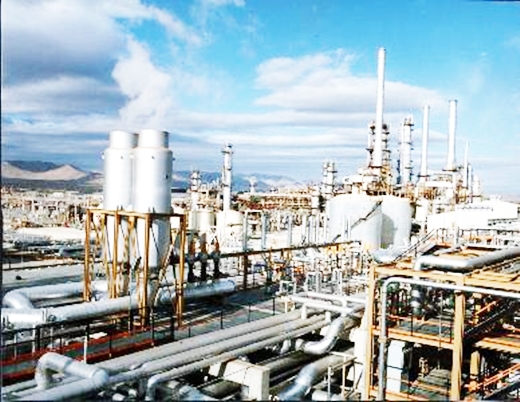
Iran plans joint oil refinery in Spain

Talking to IRNA, Kazemi said Brazil and Spain have voiced the willingness to cooperate with Iran in constructing oil refineries.

‘Once the contract is finalized and Iran makes 50-percent investment in Spain and Brazil, they would buy all of their required crude oil from Iran,’ he added.

Kazemi reiterated that a consortium will be established by Iranian private section aimed at making investment in oil refineries.

Touching upon Iran’s participation in renovation of South African refineries, he said they have presented their proposals but the Iranian side has not done any measures yet.

On Iran’s participation in buying several refineries in Greece and India, Kazemi added the petroleum ministry would follow up such plans, but he is not aware the details of the plans.

Several months ago, Kazemi said Iran is mulling a plan to build or buy refineries in other countries in order to guarantee long-term sale of its crude oil.

He noted that investing in overseas refineries is one of the most common ways used by oil producing countries to boost crude exports, saying, “Therefore, the Iranian Petroleum Ministry is planning to invest in refineries in countries whose crude oil is being supplied by Iran.”

At present, some littoral states of the Persian Gulf, which are among world’s major oil exporters, own a remarkable number of oil refineries in American, European and Asian countries, which have greatly increased their clout in global energy markets.

Iran has likewise received proposals for buying or building overseas refineries in Asian, European, African and American countries, none of which have been finalized yet.

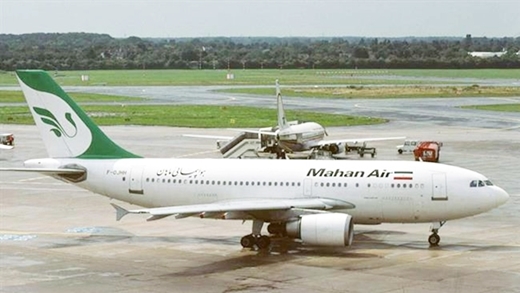
Saudi Arabia suspends Mahan Air over ‘safety’

Saudi Arabia’s General Authority of Civil Aviation (GACA) said Monday that Mahan Air was banned due to violations of local safety rules.

The GACA said in a statement that several violations related to airline safety had been committed by Mahan Air, “prompting the suspension of licenses granted to the company.”

“This decision comes in the context of the GACA (regarding) the safety of passengers and to preserve their lives,” Reuters reported.

Trade between Iran and Saudi Arabia has mostly been small and each year only Iranian pilgrims travel to the kingdom for the hajj pilgrimage.

Saudi Arabia severed diplomatic relations with Iran on January 3 following demonstrations held in front of the Saudi embassy in Tehran and its consulate in the northeastern city of Mashhad by angry protesters censuring the Al Saud family for the execution of prominent Shia cleric Sheikh Nimr al-Nimr in Riyadh on January 2.

Nimr’s execution caused international outrage and sparked anti-Saudi demonstrations in many countries.

Several countries, including Pakistan, Russia and China, have voiced readiness to mediate between Iran and Saudi Arabia to ease up their tensions.

US does not plan to grant Iran access to US financial system: Toner

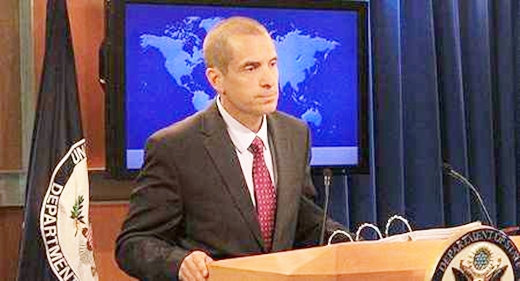
‘The administration has not been and is not planning to grant Iran access to the US financial system,’ State Department spokesman told reporters at a briefing on Monday, Reuters reported.

On Friday, President Barack Obama said the United States was not looking to permit the use of its financial system for dollar-denominated transactions with Iran, and said foreign companies could work through European banks.

CBI officials have declared that cutoff of Iran’s ability to access the US international financial system happened before imposition of sanctions against Iran under the pretext of its peaceful nuclear program.

Italian PM to Visit Iran on April 12-13: Report

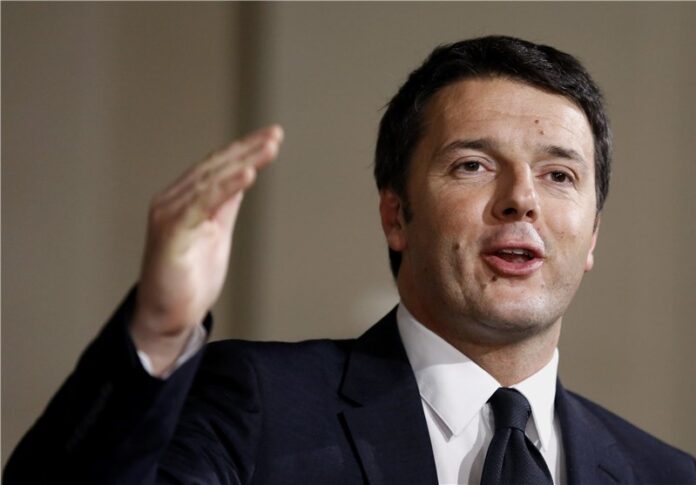
The Italian premier’s office released a statement on Monday, saying Renzi will “make an official visit to Iran on April 12 and 13″, Gazzetta del Sud news website reported.

Renzi’s visit will come after Iranian President Hassan Rouhani’s trip to Rome in late January.

Iran and Italy signed deals worth up to 17 billion euros ($18.42 billion) during Rouhani’s 48-hour stay in Italy.

Italy was one of Iran’s leading economic and trade partners before sanctions when annual exchanges amounted to 7 billion euros compared with $1.6 billion euros now.

All nuclear-related sanctions imposed on Iran were lifted after Tehran and the Group 5+1 (Russia, China, the US, Britain, France and Germany) reached a nuclear deal on July 14, 2015 and started implementing it on January 16.