Monday, January 19, 2026
Home Blog Page 4447

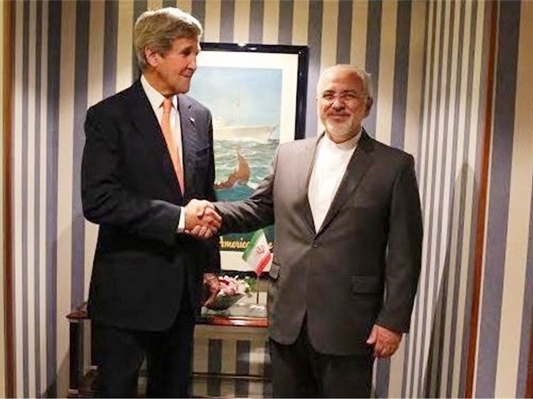
Zarif and Kerry Meet in Norway

139503261233577487927814

The meeting took place on the sidelines of the 2016 edition of the Oslo Forum, an annual international conference of armed conflict mediators and peace process actors.

In the get-together at an Oslo hotel, the two senior diplomats discussed issues about the implementation process of the JCPOA, the nuclear agreement between Iran and the Group 5+1 (Russia, China, the US, Britain, France and Germany).

Earlier on Tuesday, diplomatic delegations from Iran and the EU, led by Zarif and the EU Foreign Policy Chief Federica Mogherini, also met in Oslo and discussed ways to remove obstacles to JCPOA implementation.

While the nuclear accord came into force in January, Iran has complained about the failure of some of the parties, especially the US, to fully implement the deal.

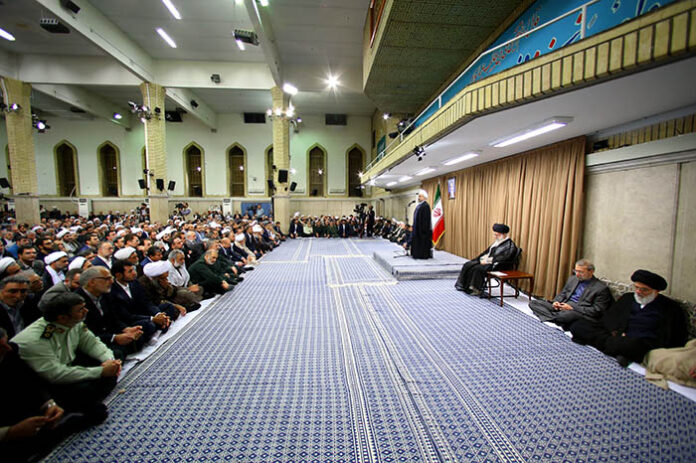
In Tehran, Leader of the Islamic Revolution Ayatollah Seyed Ali Khamenei in a Tuesday meeting with senior Iranian officials took a swipe at Washington for its failure to honour commitments under the JCPOA, saying, “The duty of the other side was removing the sanctions, but it has not fulfilled that duty, meaning that it has lifted part of the sanctions in some way, but the sanctions have not been lifted practically.”

While US officials claim verbally that there is no obstacle to banking relations with Iran, they actually take measures that the international banks “would not dare to trade with Iran,” the Leader stressed.

Imam Khamenei also noted that nobody should justify Washington’s serious breach of the deal in stifling the foreign banks’ interaction with Iran.

The Leader also touched on the US obstructive actions when it comes to insurance for the Iranian oil tankers, saying the US which is part of the “major structures” of insurance companies will not let that structure offer services to Iran.

Moreover, the Leader noted, Iran has still problems in having access to its oil incomes that have been blocked in the banks of other countries, since those assets are in US dollars and have been kept frozen due to US hostility.

Rouhani: Government Created over 1 Million Jobs

President-Rouhani

According to statistics, there are now over 22m people in the country who are employed, Rouhani said, while addressing a June 14 evening meeting, where the Supreme Leader received the heads of the three branches of the Government and a group of high ranking executive officials.

Rouhani said that control of foreign exchange market, economic growth and the exit from recession have been among the important achievements of the government since it took office in August 2013.

The government has also had great success in the fields of oil and agriculture, and in the field of foreign trade, he said, the country has experienced positive development.

In the past Iranian calendar year that ended on March 19, non-oil exports from the country were greater than non-oil imports, which was a record for the first time during the past 60 years, the president noted. Iran also could witness a positive balance of trade for the first time in eight years, he added.

On the nuclear talks, Rouhani said the nation’s rights had been stabilized and unjust anti-Iran sanctions had been lifted after negotiations.

President Rouhani called for further unity and resistance, saying they are needed to achieve the country’s goals.

Chabahar a Vital 21st Century Port: Chinese Official

Chinese official-Chabahar

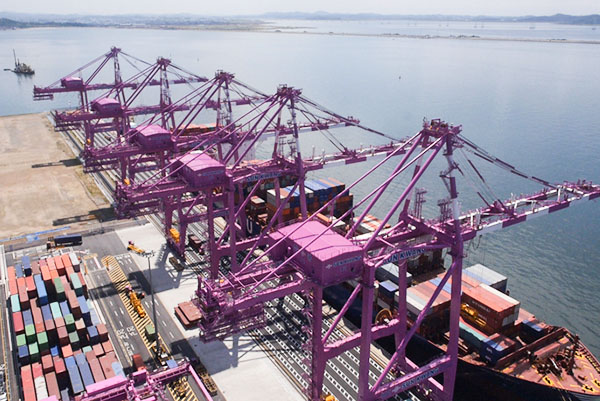
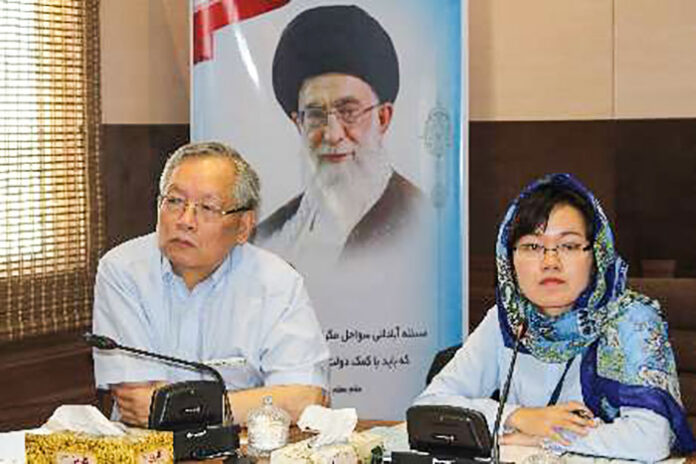
Wang Zhan, who is touring Chabahar Free Trade Zone heading a delegation, made the remarks in a meeting with several local Iranian officials in the south-eastern province. Wang said he is on a governmental mission to survey the investment opportunities in different regions across the globe.

He arrived in Chabahar on Tuesday for a two-day visit aimed at surveying the investment opportunities in petrochemical arenas, ports and Chabahar Free Trade Zone. Wang also expressed hope that the ground could be prepared for Chinese investment in Chabahar.

Last month, Iran, India and Afghanistan signed an agreement on establishment of an international corridor between the three countries – known as Chabahar agreement. The agreement was signed in Tehran in the presence of heads of state of the three countries.

Iranian President Hassan Rouhani believes that Chabahar will serve as the starting point of the transit corridor between the South and East as well as between the South and North.

Once the railway between Chabahar and Zahedan and the railway between Zahedan and Sarakhs are completed, the Port of Chabahar can become a port linking different countries, including India, Afghanistan, Central Asian countries, Caucasus and Eastern Europe, the president said.

A Look at Iranian Newspaper Front Pages on June 15

Iran Newspaper front pages

Leader of the Islamic Revolution Ayatollah Seyyed Ali Khamenei met senior Iranian officials in Tehran on Tuesday night. During the meeting, the Leader emphasized that if the other parties to the JCPOA, the nuclear deal, tear it up, Iran would set it on fire. The sentence was repeatedly mentioned by almost all Iranian newspapers on Wednesday. To avoid repetition, IFP has avoided citing all of them, and focused on other remarks quoted by newspapers from the Leader’s comments.

A meeting between Iran’s Foreign Minister Mohammad Javad Zarif and US Secretary of State John Kerry in Oslo was also a top story in many papers.

Saudi Arabia’s sponsorship of US election campaigns, as well as the huge increase of Iran’s oil output and exports were also widely covered.


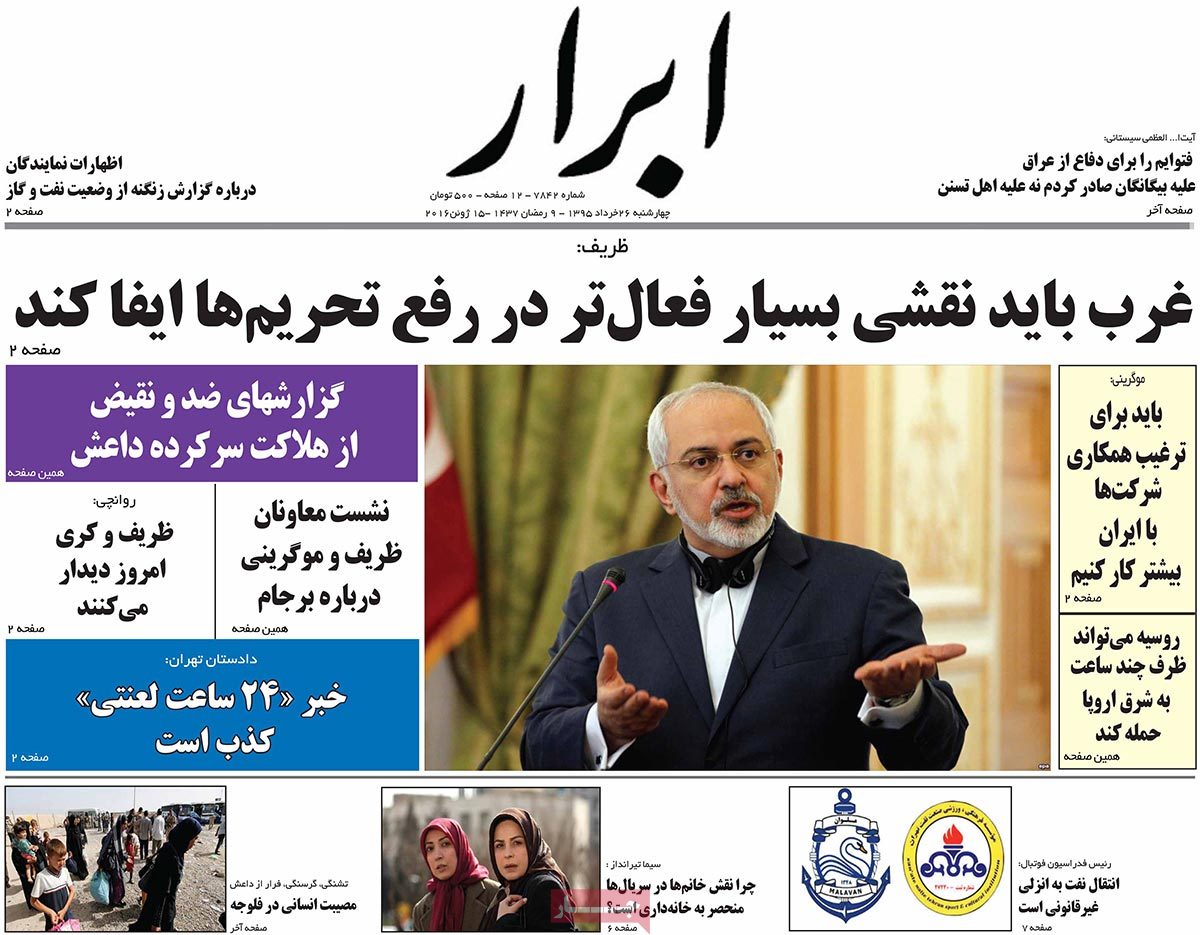
Abrar:

1- West Should Play a Far More Active Role in Removing Anti-Iran Sanctions: Zarif

2- I Issued Fatwa to Defend Iraq against Foreigners, Not Sunnis: Top Shiite Cleric Sistani

3- We Should Further Encourage Companies to Do Business with Iran: Mogherini

4- Zarif and Kerry Will Meet Today: Araqchi

5- Conflicting Reports of Death of ISIS Leader

6- Russia Can Attack Eastern Europe in Few Hours

7- Thirst, Hunger, Escape from ISIS: Humanitarian Catastrophe in Fallujah
A Look at Iranian Newspaper Front Pages on June 15


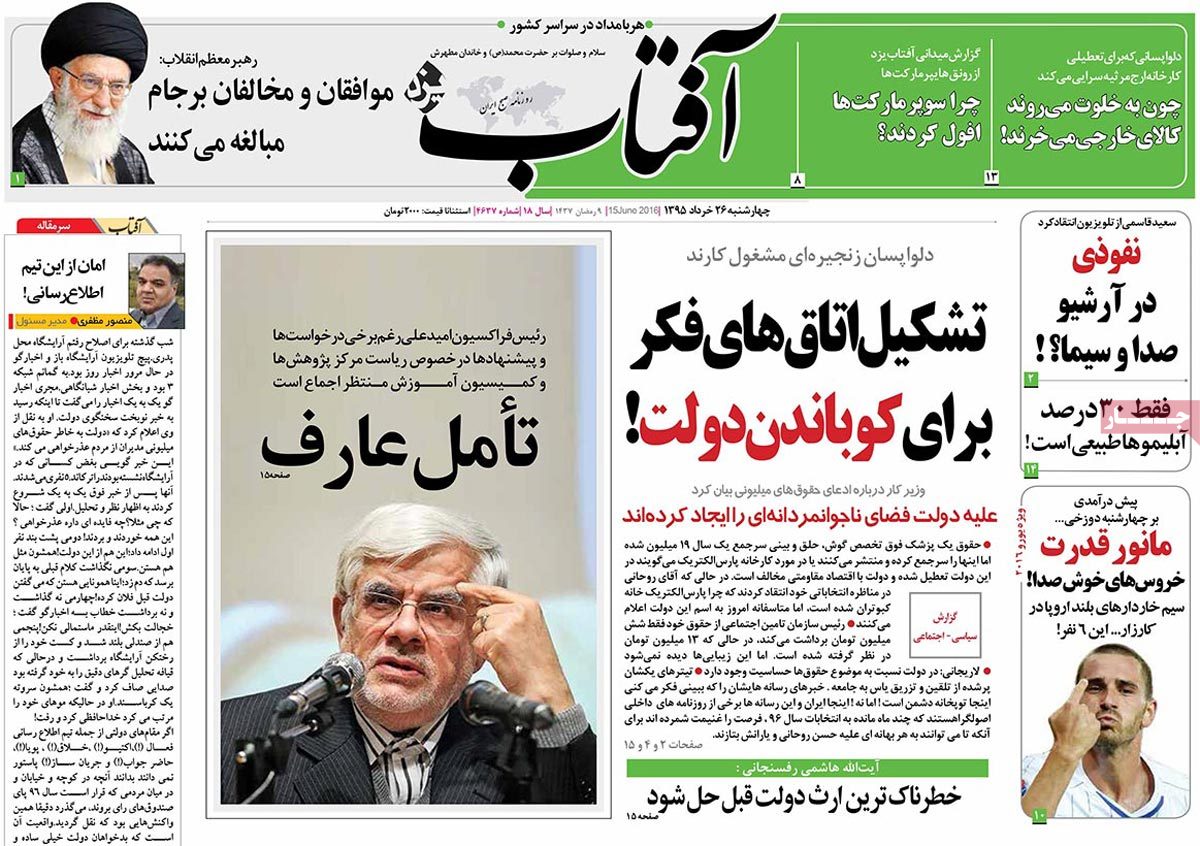
Aftab-e Yazd:

1- Think-Tanks Are Formed to Taint Gov’t

2- They Have Created an Unfair Atmosphere against Gov’t: Minister
A Look at Iranian Newspaper Front Pages on June 15


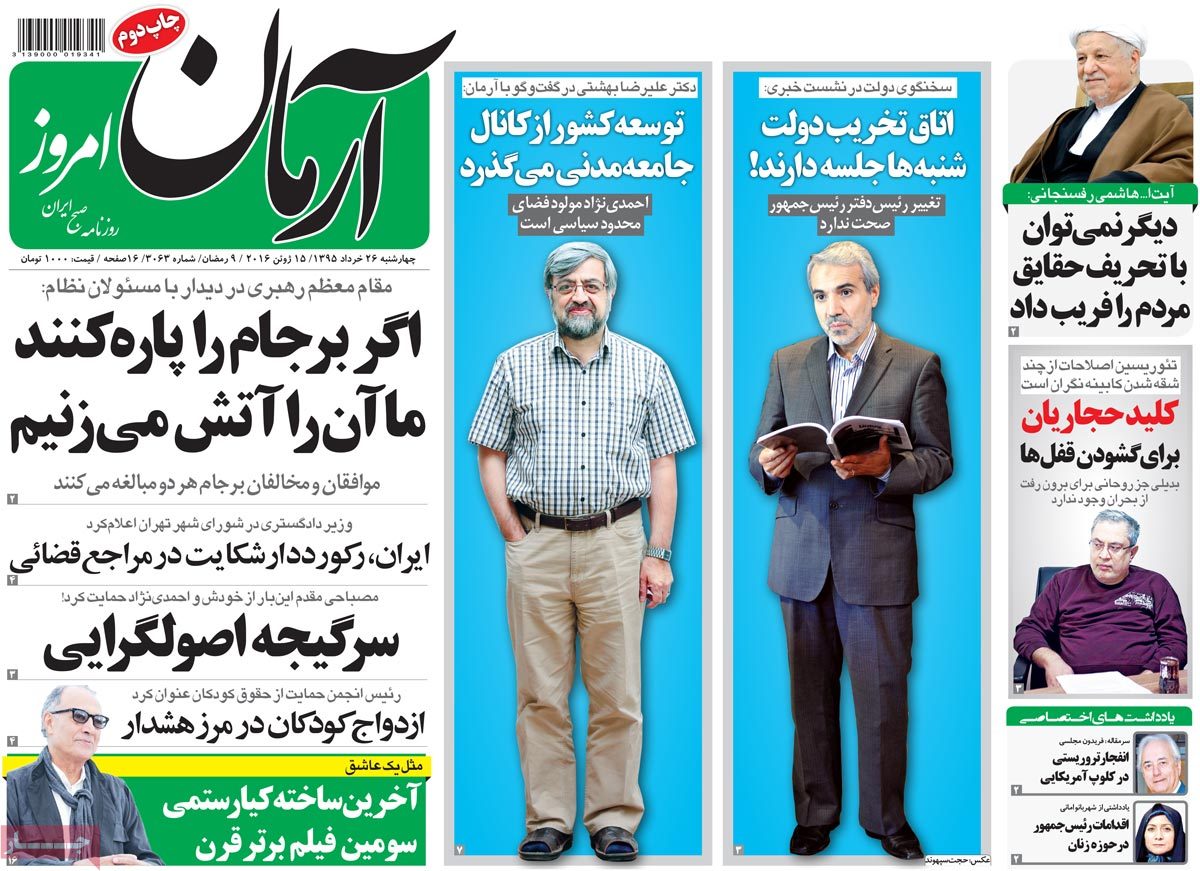
Arman-e Emrooz:

1- Government Spokesman: Opponents of Gov’t Hold Regular Meetings on Saturdays [to discuss what they are going to focus on during the week]

2- Both Opponents and Proponents of JCPOA Exaggerate: Leader

3- Impossible to Deceive People Anymore by Distorting the Facts: Rafsanjani

4- Kiarostami’s Latest Film [Like Someone in Love] Selected as Third Best Film of Century

5- Ahmadinejad Is the Product of Limited Political Space
A Look at Iranian Newspaper Front Pages on June 15


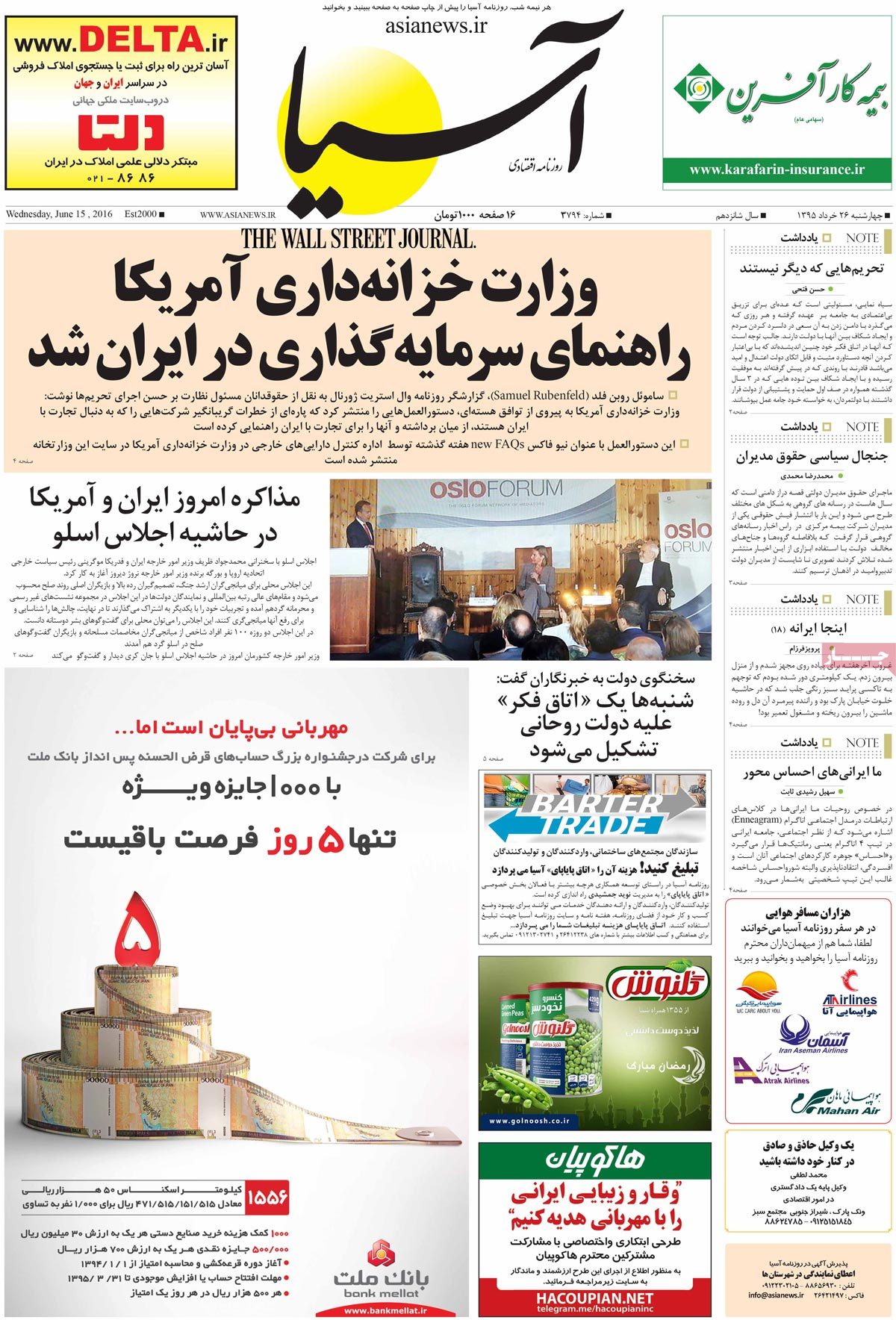
Asia:

1- US Treasury Becomes Guide to Investment in Iran

2- Iran-US Talks on Sidelines of Oslo Summit
A Look at Iranian Newspaper Front Pages on June 15


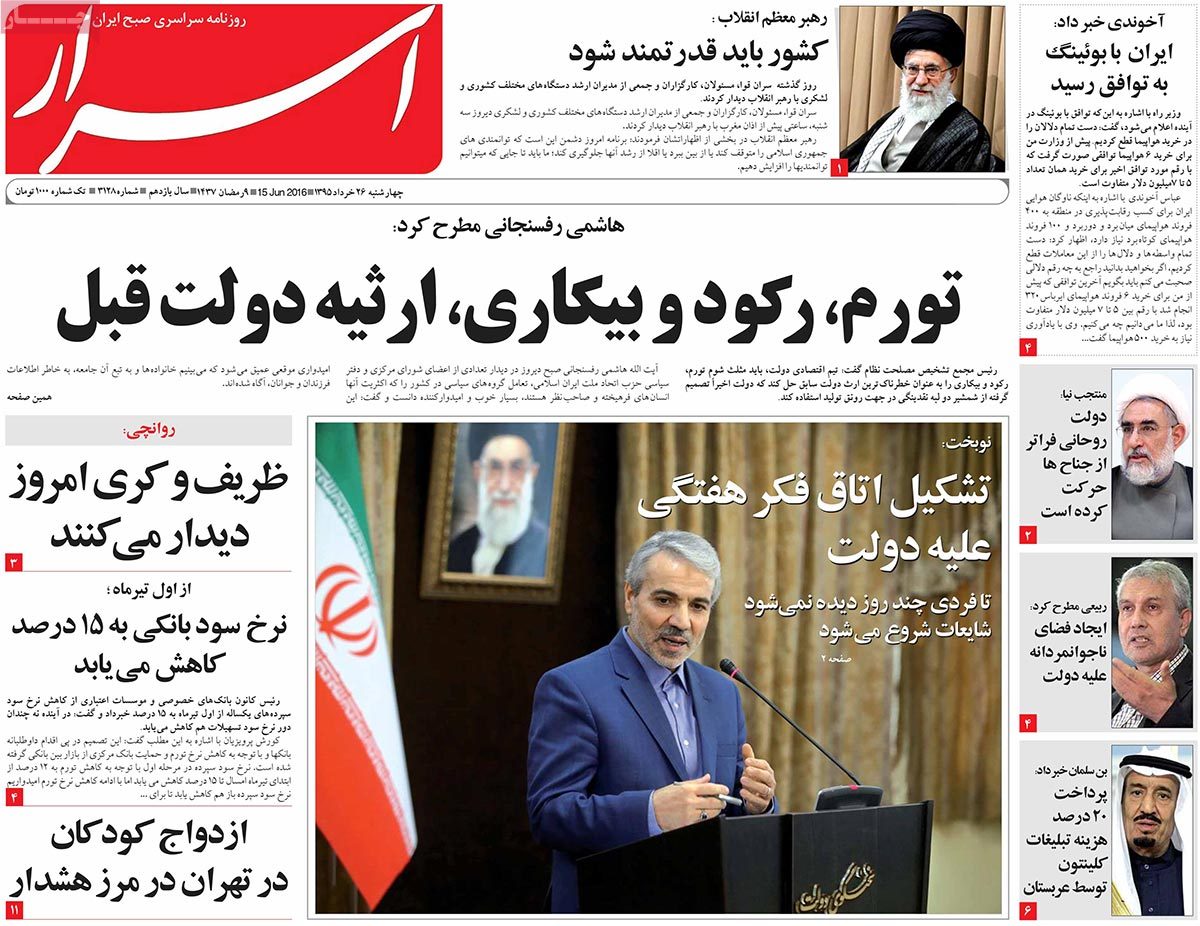
Asrar:

1- Inflation, Downturn, and Unemployment Are Inheritance of Previous Gov’t: Rafsanjani

2- Iran Reaches Agreement with Boeing: Minister

3- Alarming Rate of Child Marriage in Tehran

4- Bin Salman: 20% of Clinton’s Campaign Budget Funded by Saudi Arabia
A Look at Iranian Newspaper Front Pages on June 15


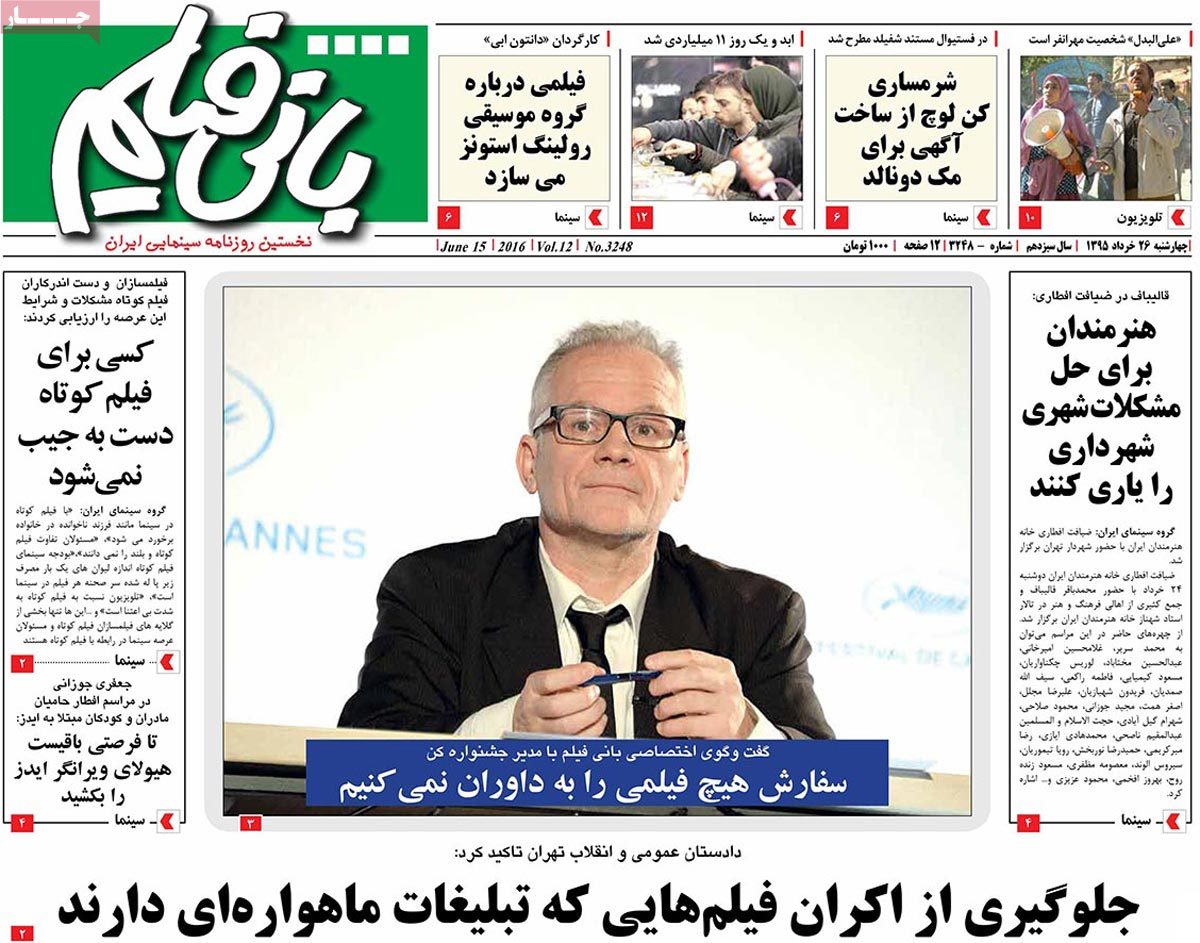
Bani Film:

1- Exclusive Interview with Cannes Film Festival’s Director [Thierry Fremaux]: We Don’t Give Recommendations to Juries for Any Movie

2- Ken Loach Ashamed of Making Ad for McDonald’s

3- Downton Abbey’s Creator to Make Film about Rolling Stones
A Look at Iranian Newspaper Front Pages on June 15


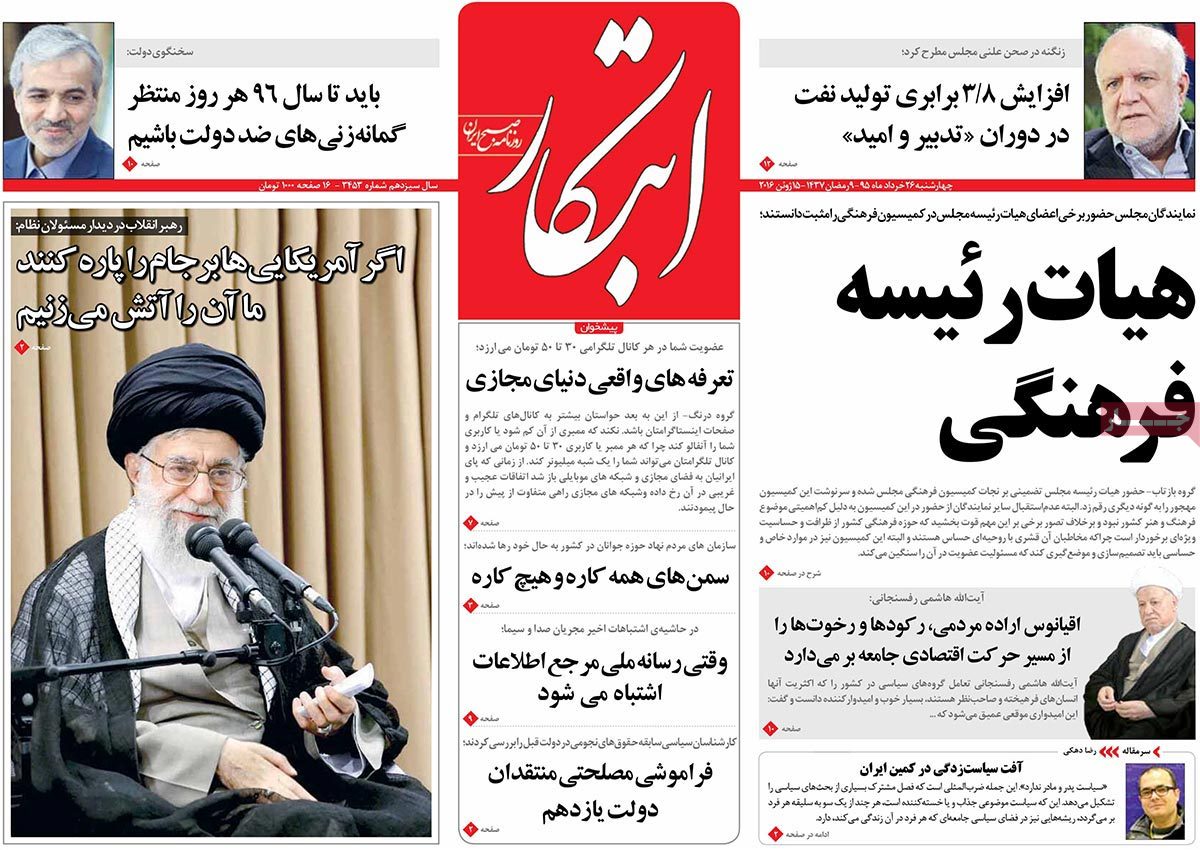
Ebtekar:

1- 3.8-Fold Increase in Oil Output under Rouhani’s Administration
A Look at Iranian Newspaper Front Pages on June 15


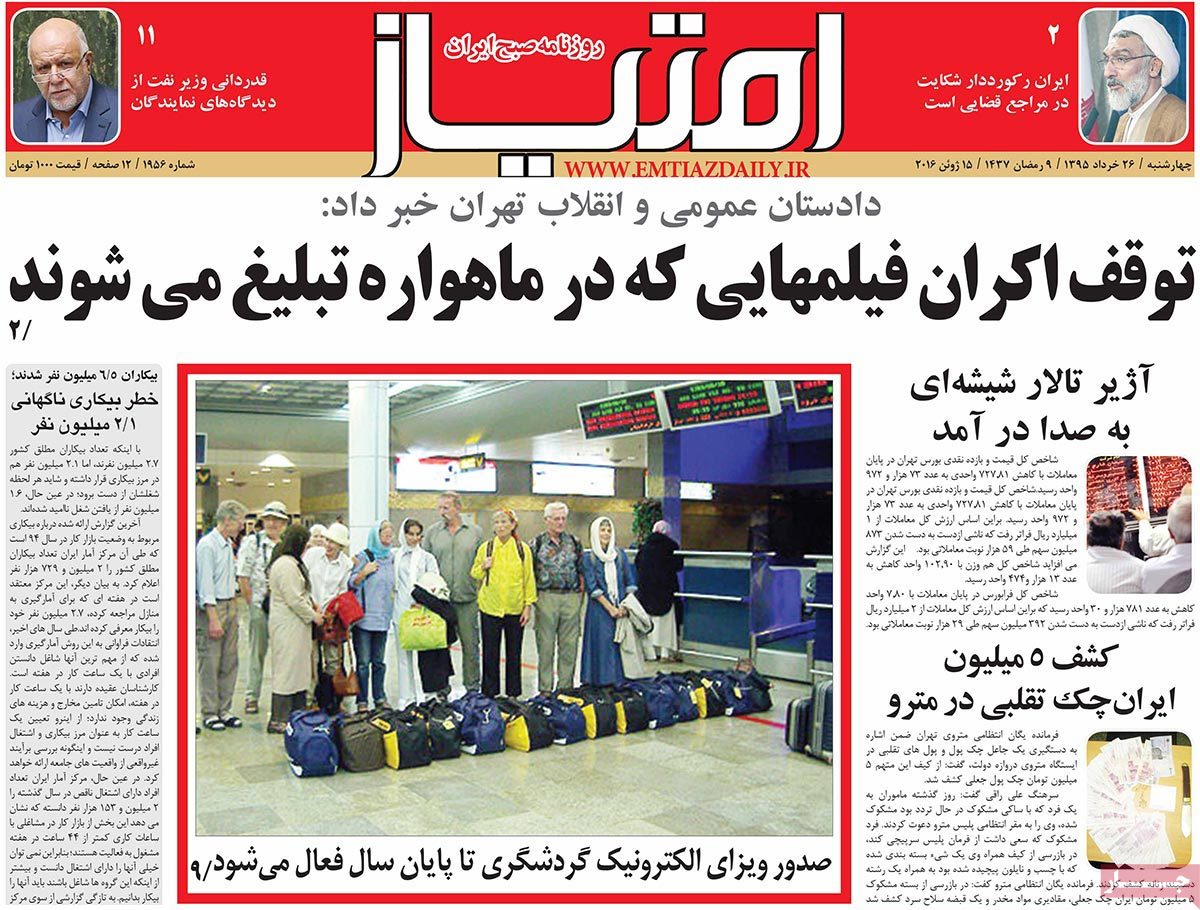
Emtiaz:

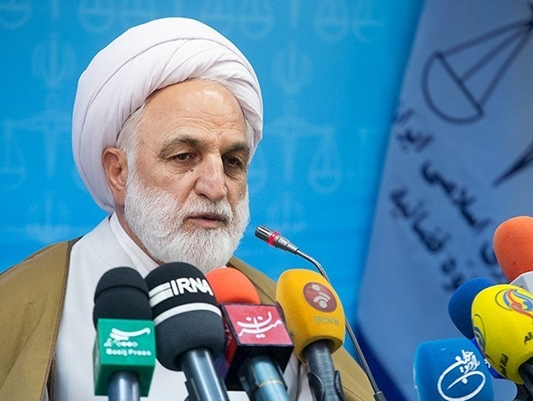
1- Iranian Films Advertised on Satellite Channels to Be Banned from Public Screening: Prosecutor-General

2- 2.1m Iranians on Verge of Sudden Unemployment

3- Issuance of E-Visas for Foreign Tourists to Begin by Year End
A Look at Iranian Newspaper Front Pages on June 15


Etemad:

1- In JCPOA, Other Party Has Failed to Fulfil Its Duty, Which Was Removing the Sanctions: Leader
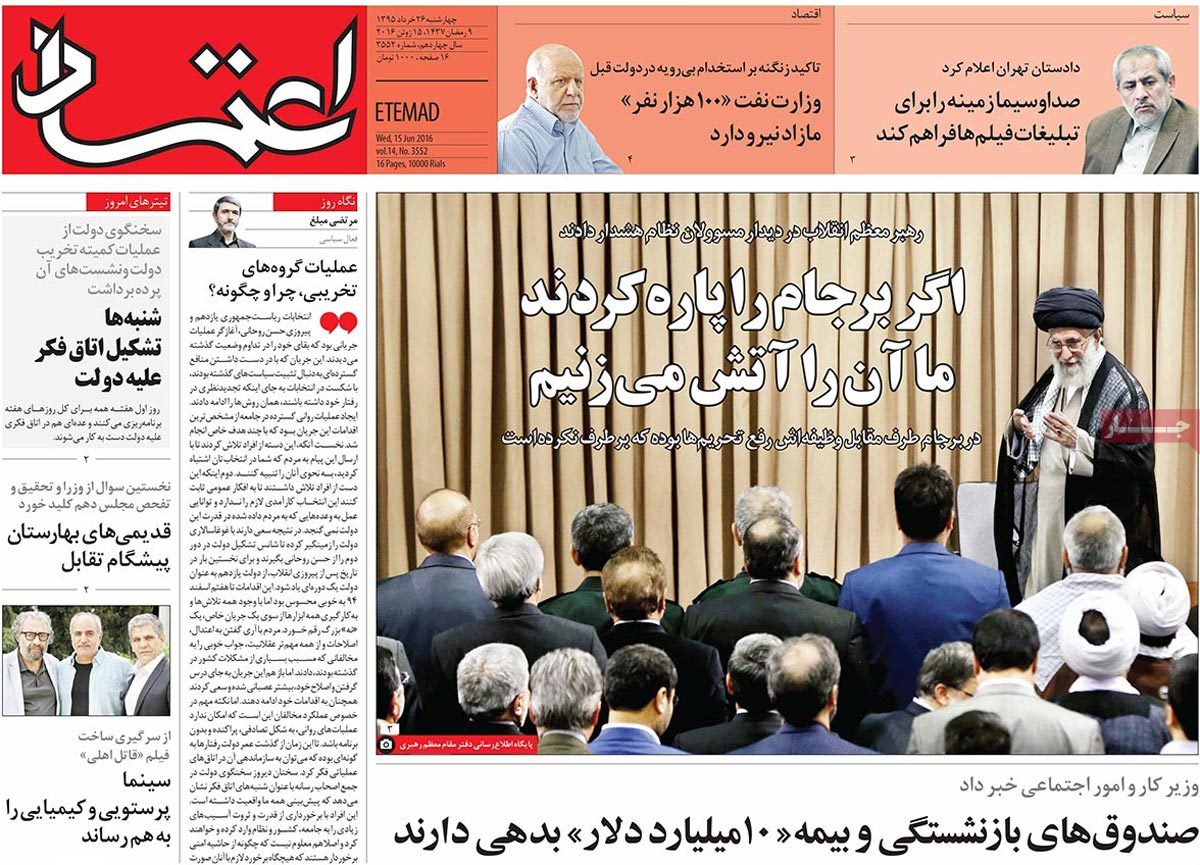
A Look at Iranian Newspaper Front Pages on June 15


Ettela’at:

1- Iran’s Oil Export Amounts to 2m bpd: Minister

2- Women Are Problem-Solvers, Not Problems: President

3- Criticism of JCPOA Is Not at All Criticism of Our Dear Brothers, It’s an Evaluation of Other Party’s Performance: Leader

4- ISIS Paris Terror Attack Once Again Fills France with Fear

5- 23 German Mountaineers Surprised by Snow in Kelardasht Heights
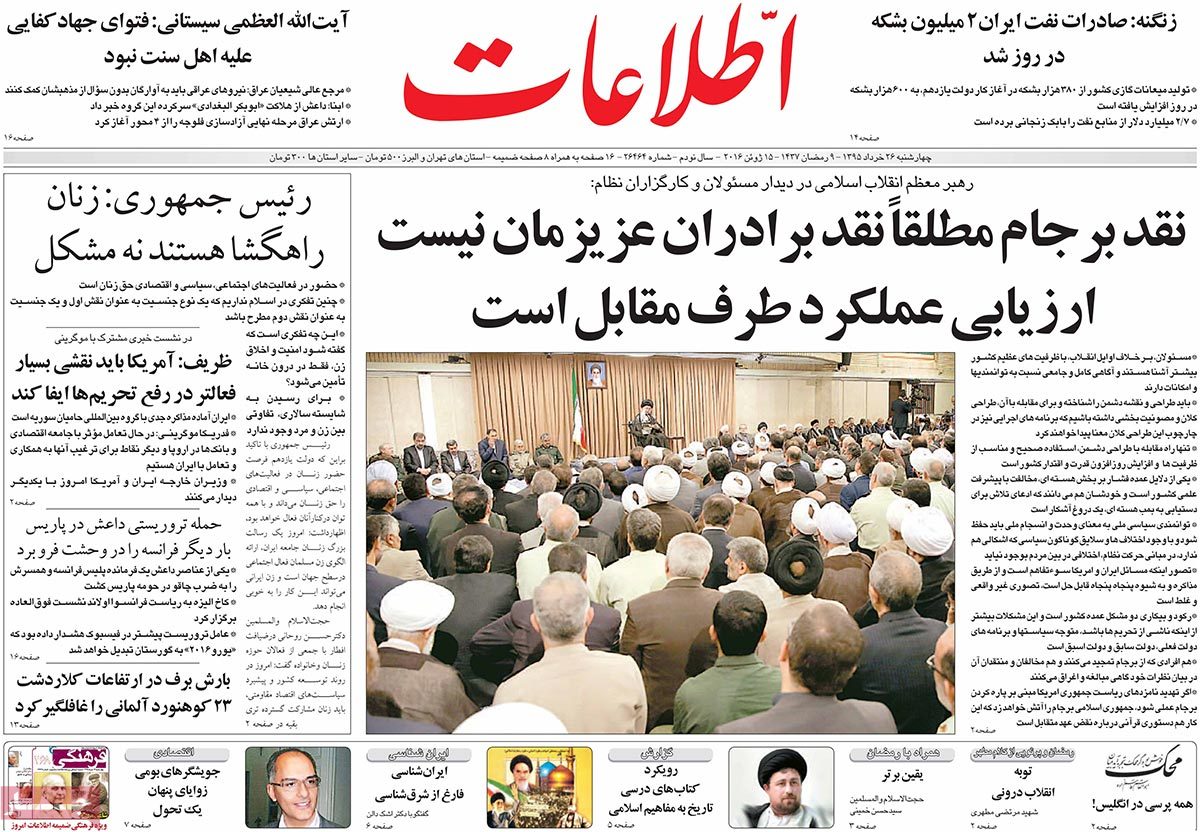
A Look at Iranian Newspaper Front Pages on June 15


Ghanoon:

1- JCPOA Has Both Positive and Negative Points: Leader

2- Resistance Economy Is Not Isolation from the World: Zarif’s Important Speech in Oslo
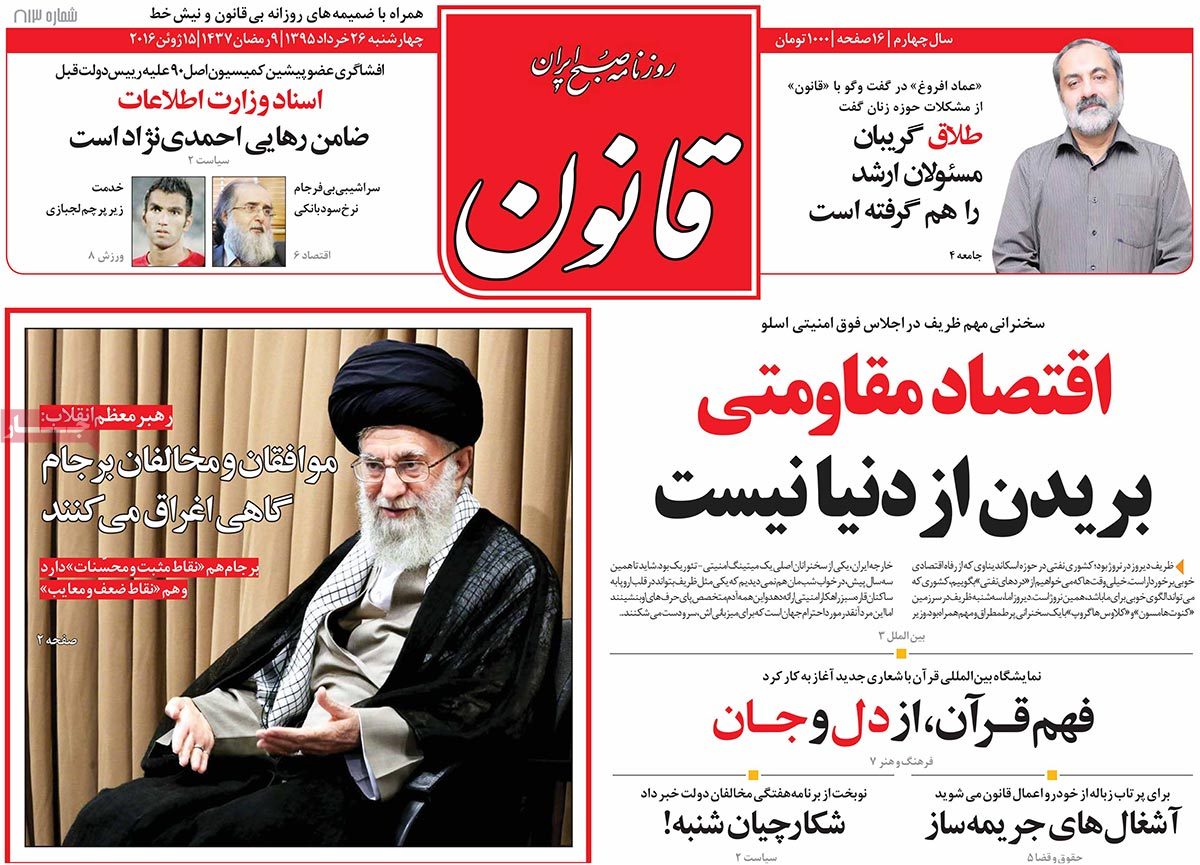
A Look at Iranian Newspaper Front Pages on June 15


Hamshahri:

1- Labour Minister Defends Payment of $68,000 Salary

2- Recession and Unemployment Are Caused More by Government’s Policies and Plans than Sanctions: Leader
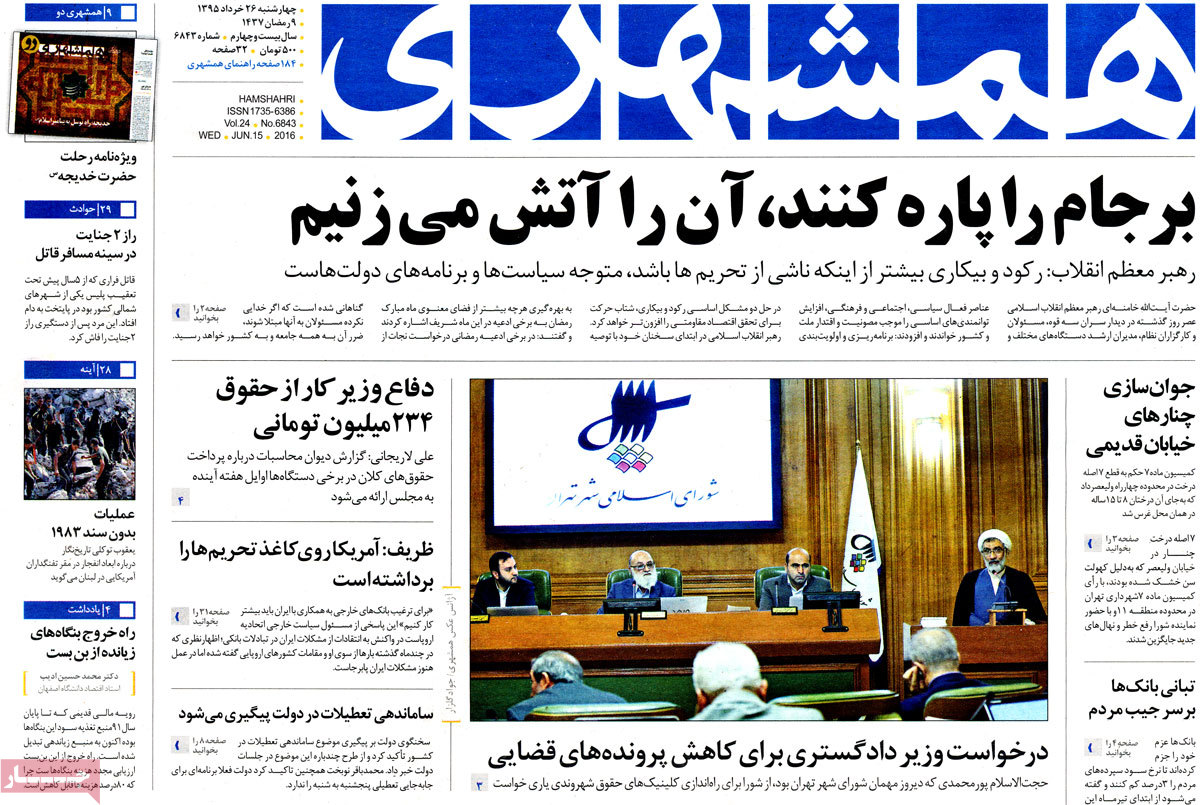
A Look at Iranian Newspaper Front Pages on June 15


Iran:

1- Parliament Speaker Praises Government’s Action on Unconventional Salaries

2- Enemies Hatching Plots to Destroy Iran’s Capabilities: Leader

3- Effective Consultation between Iran and Europe for Resolving JCPOA Problems
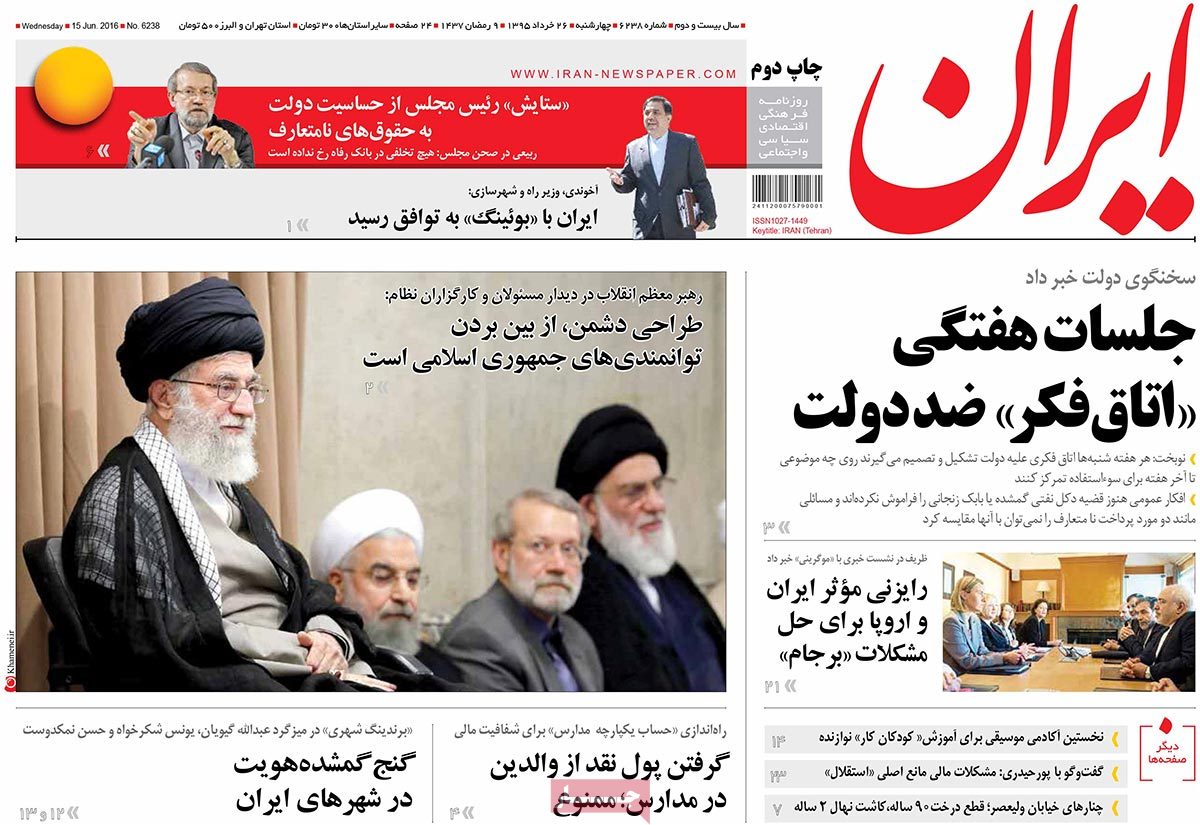
A Look at Iranian Newspaper Front Pages on June 15


Jame Jam:

1- Iran’s Government, Judiciary, and Parliament Resolved to Prevent Payment of Astronomical Salaries
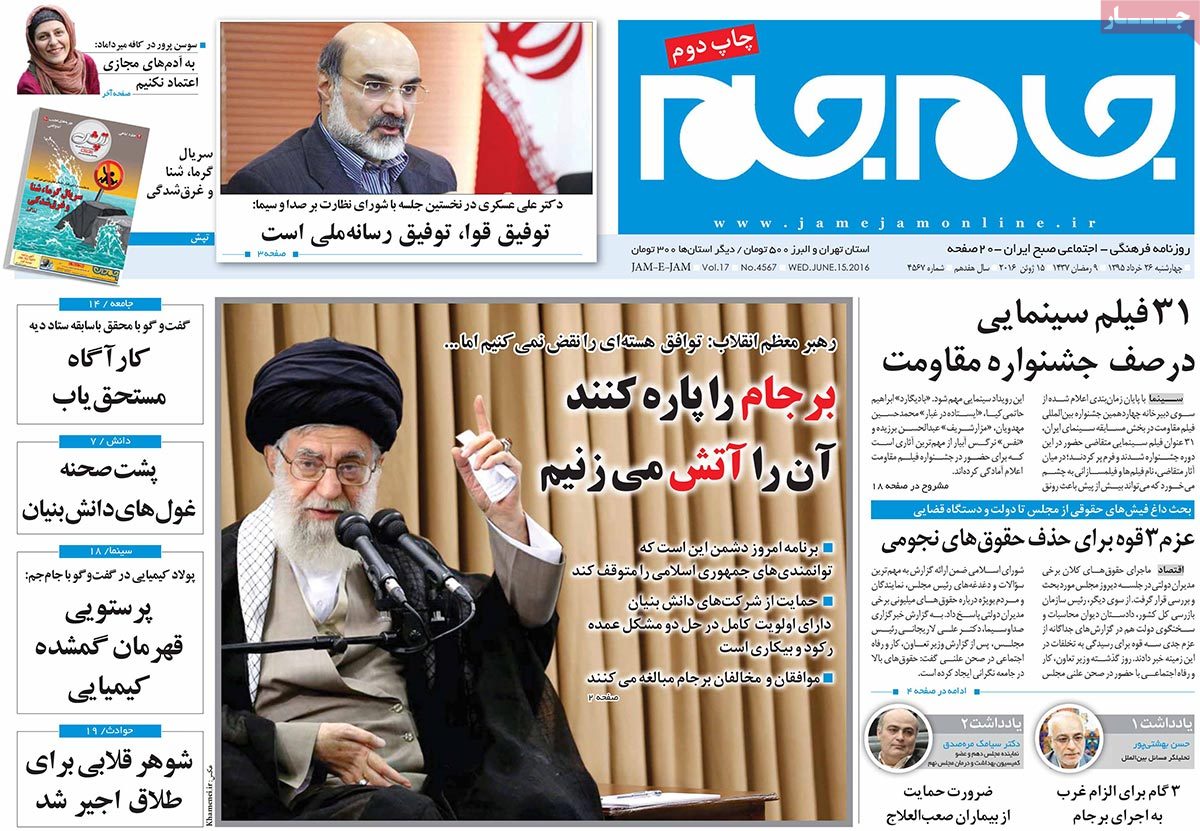
A Look at Iranian Newspaper Front Pages on June 15


Javan:

1- We Cannot Rely on Illusion of “Coming to Terms with US”: Leader

2- Telegram’s Plan to Influence Iran’s Presidential Elections

3- Zarif, Too, Joins Government “Almost Nothing” Campaign: US Has Just Removed Sanctions on Paper, FM Says
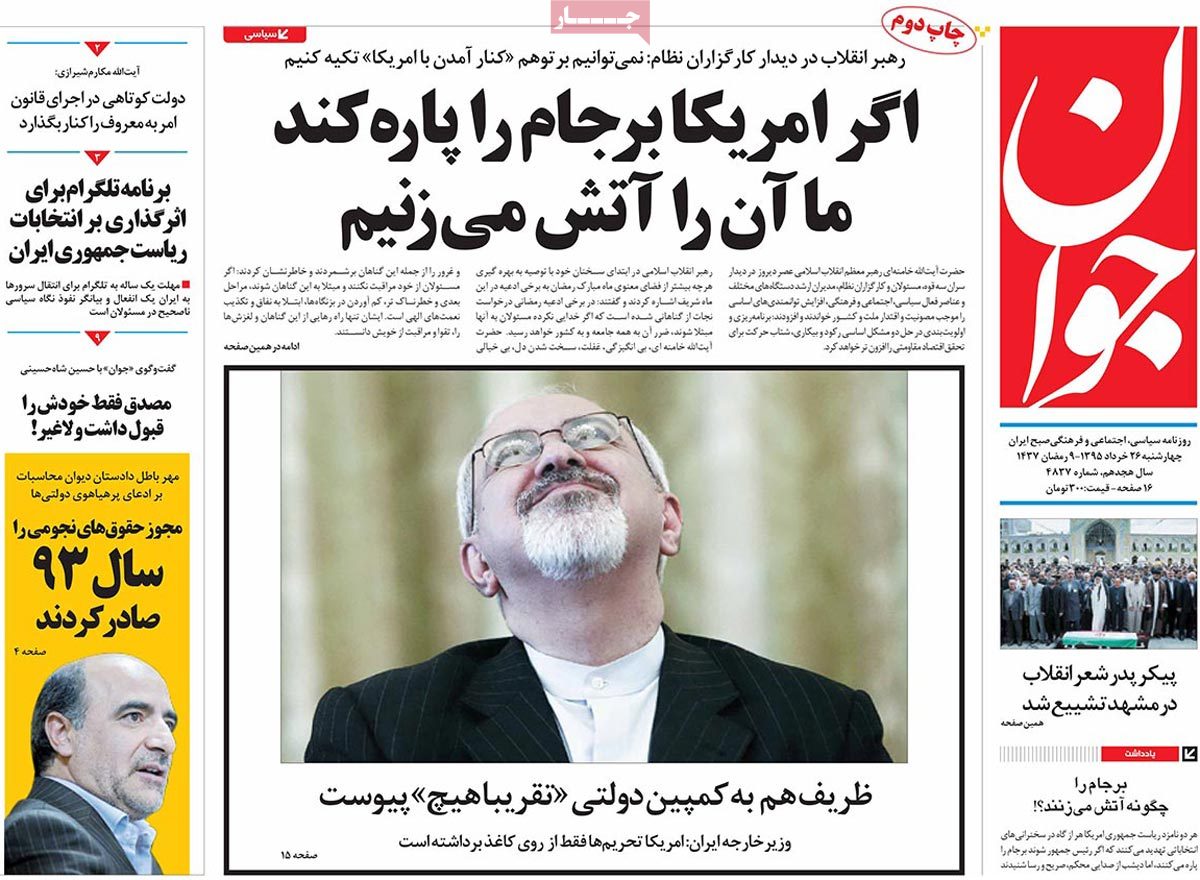
A Look at Iranian Newspaper Front Pages on June 15


Jomhouri Eslami:

1- We Should Boost the Country’s Capabilities: Ayatollah Khamenei

2- We’ll Not Violate JCPOA, But If They Tear It Up as US Republican Candidates Say, We’ll Burn It: Leader

3- Clinton Accuses Saudi Arabia, Kuwait, and Qatar of Funding Terrorists

4- Chomsky: Europe Following Washington’s Policies Blindly

5- Iran’s Oil Exports to Europe Back to Pre-Sanctions Level

6- US Treasury Department Issues New Instructions to Clear Ambiguities about Trade with Iran
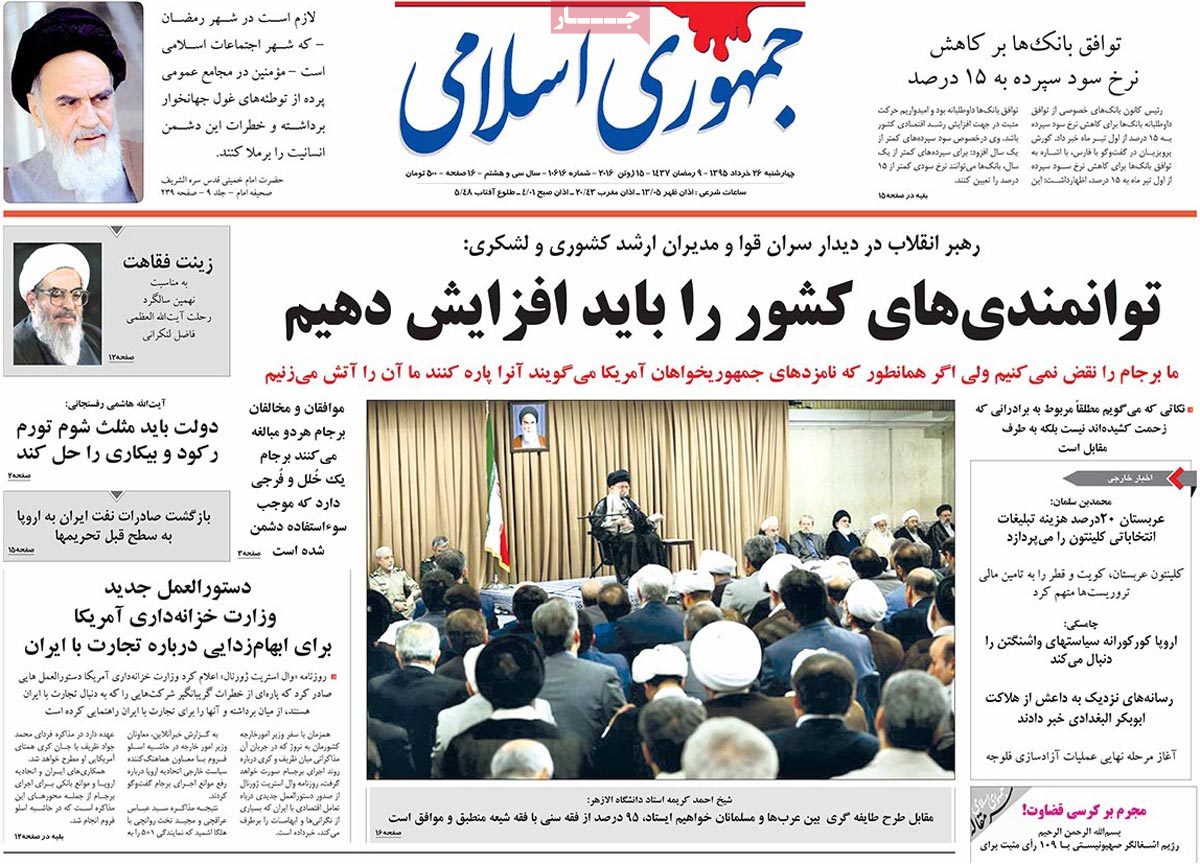
A Look at Iranian Newspaper Front Pages on June 15


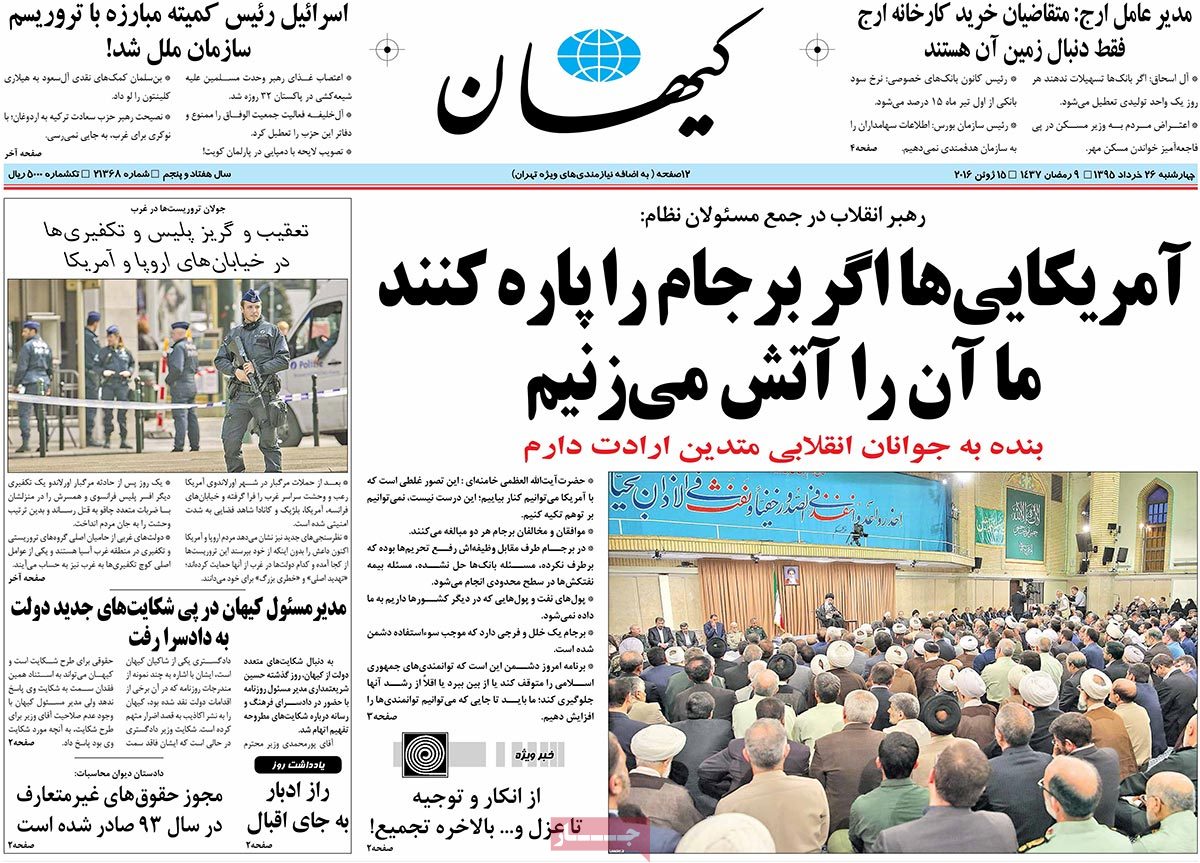
Kayhan:

1- If Americans Tear UP the JCPOA, We’ll Burn It: Leader

2- I Have Greatest Respect for Revolutionary and Religious Youth: Leader

3- Kayhan’s Manager Summoned to Court Because of Government’s New Complaints

4- Police Chasing Takfiris [terrorists] in European and American Streets

5- Israel Becomes Head of UN Counter-Terrorism Committee!
A Look at Iranian Newspaper Front Pages on June 15


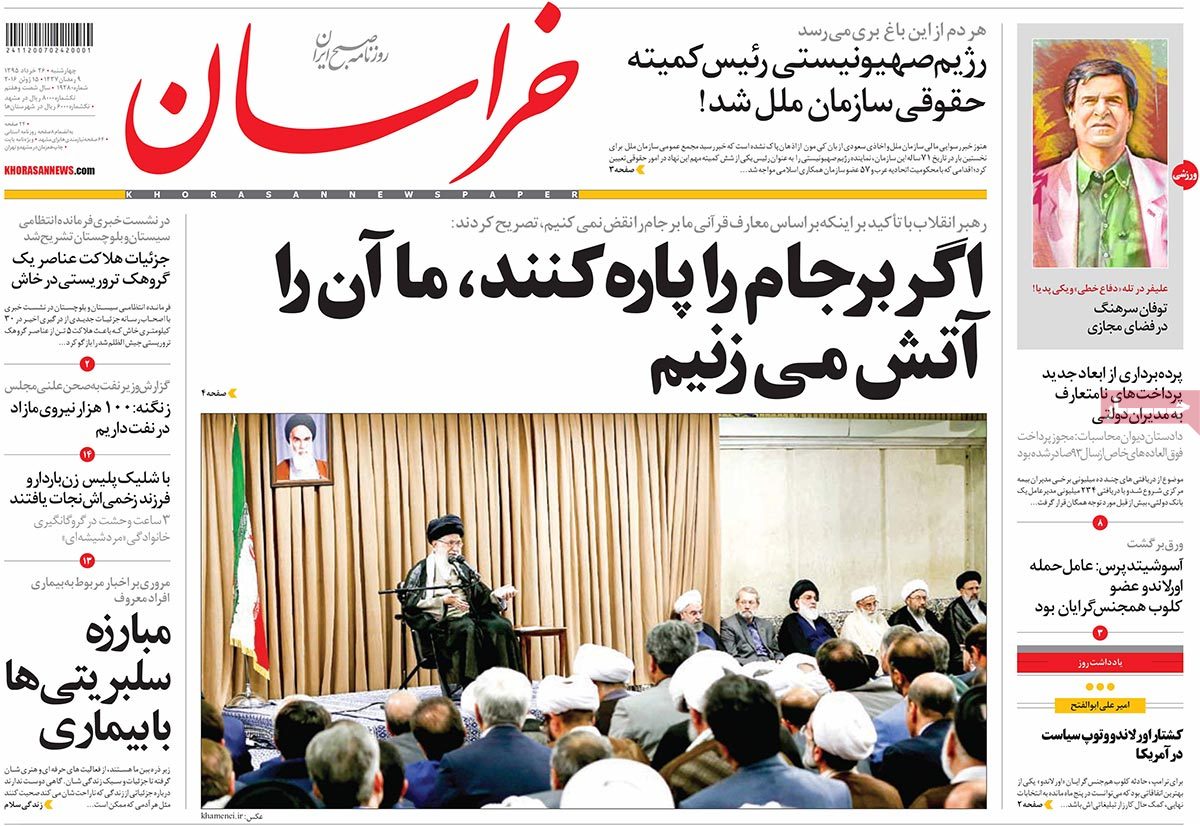
Khorasan:

1- New Scandal for UN: Zionist Regime [Israel] Becomes Chair of UN Legal Committee!

2- Orlando Shooter Was a Member of Gay Club Himself: AP
A Look at Iranian Newspaper Front Pages on June 15


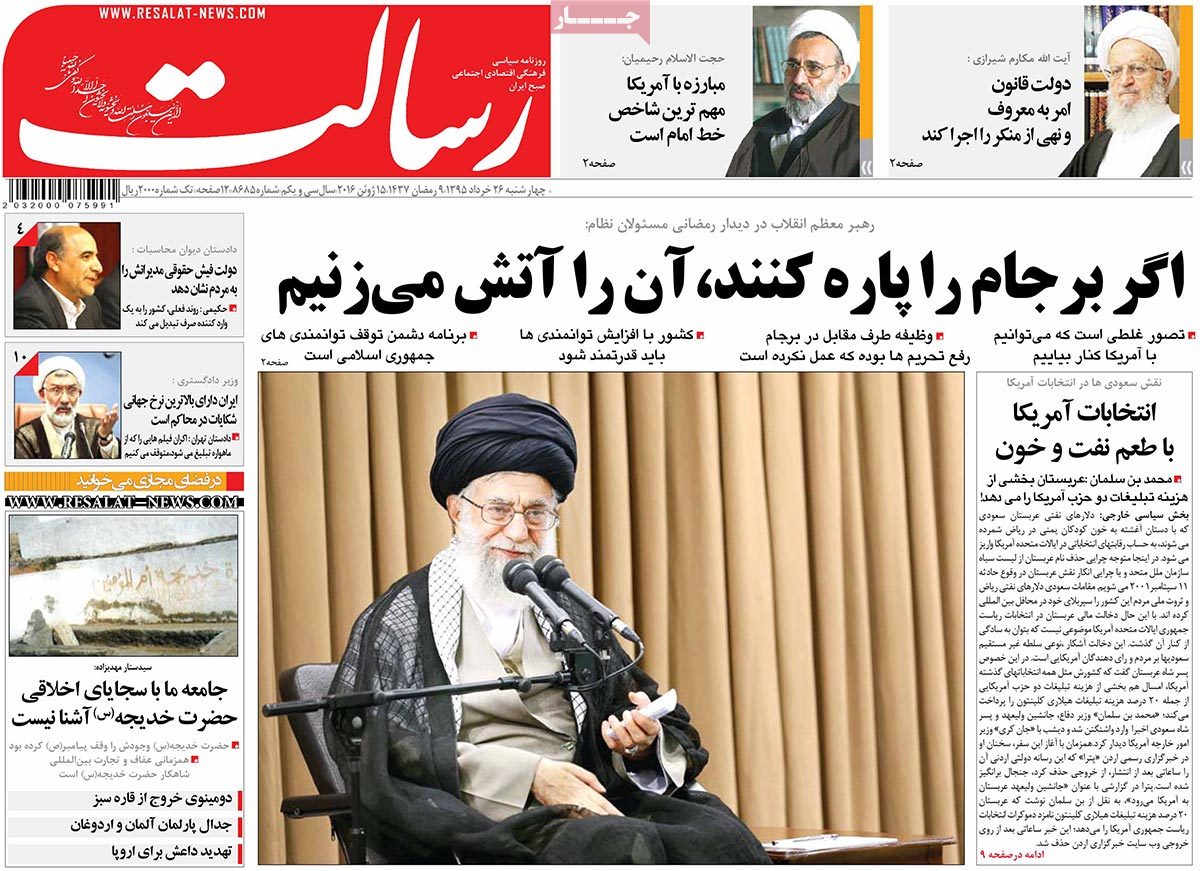
Resalat:

1- Iran Has World’s Highest Rate of Lawsuits Filed: Minister

2- Saudi Role in US Elections: US Polls Taste of Oil and Blood
A Look at Iranian Newspaper Front Pages on June 15


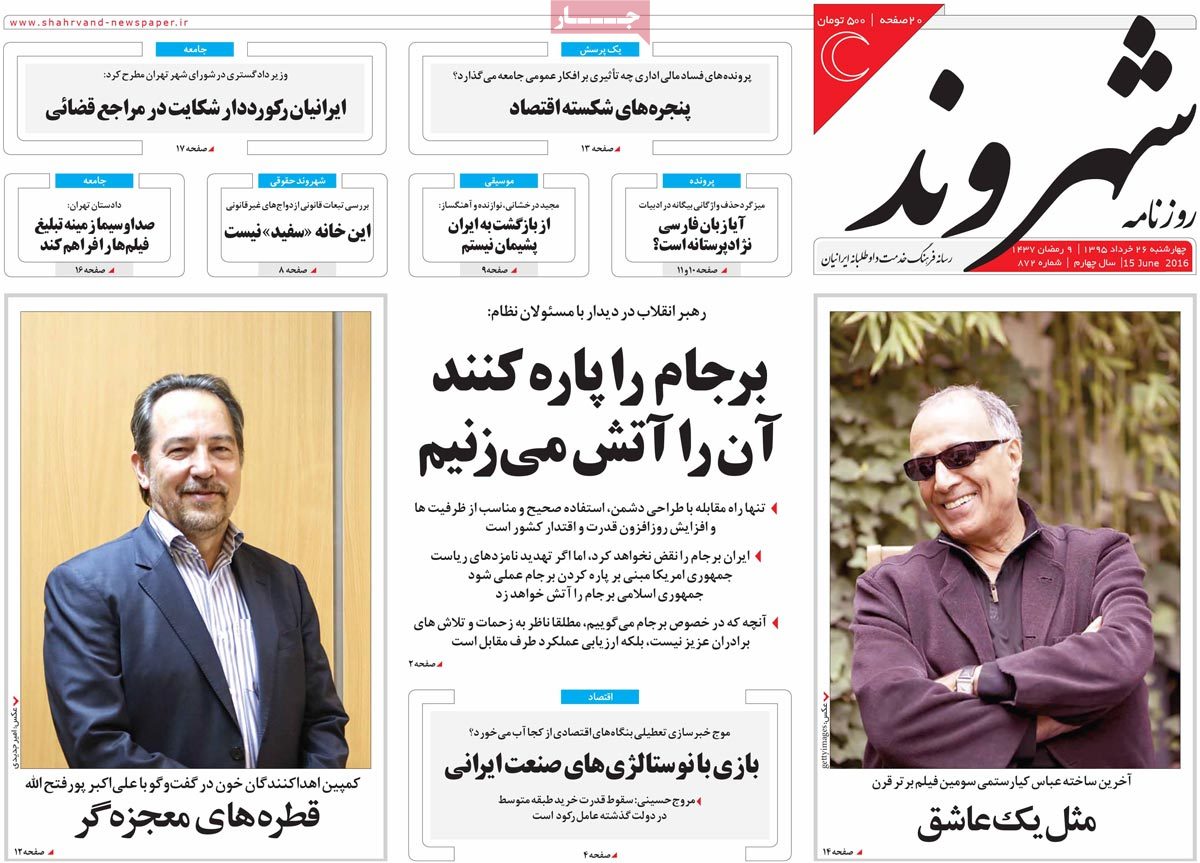
Shahrvand:

1- Like Someone in Love: Kiarostami’s Latest Work Chosen as Century’s Third Best Film

2- Tehran Prosecutor-General Urges IRIB to Pave the Way for Advertisement of Iranian Films
A Look at Iranian Newspaper Front Pages on June 15


Shargh:

1- Ominous Legacy of Former Gov’t: Rafsanjani Underlines Need for Resolving Inflation, Recession, and Unemployment

2- Ahmadinejad Had Access to First-Degree Intelligence Ministry Cases: Former MP
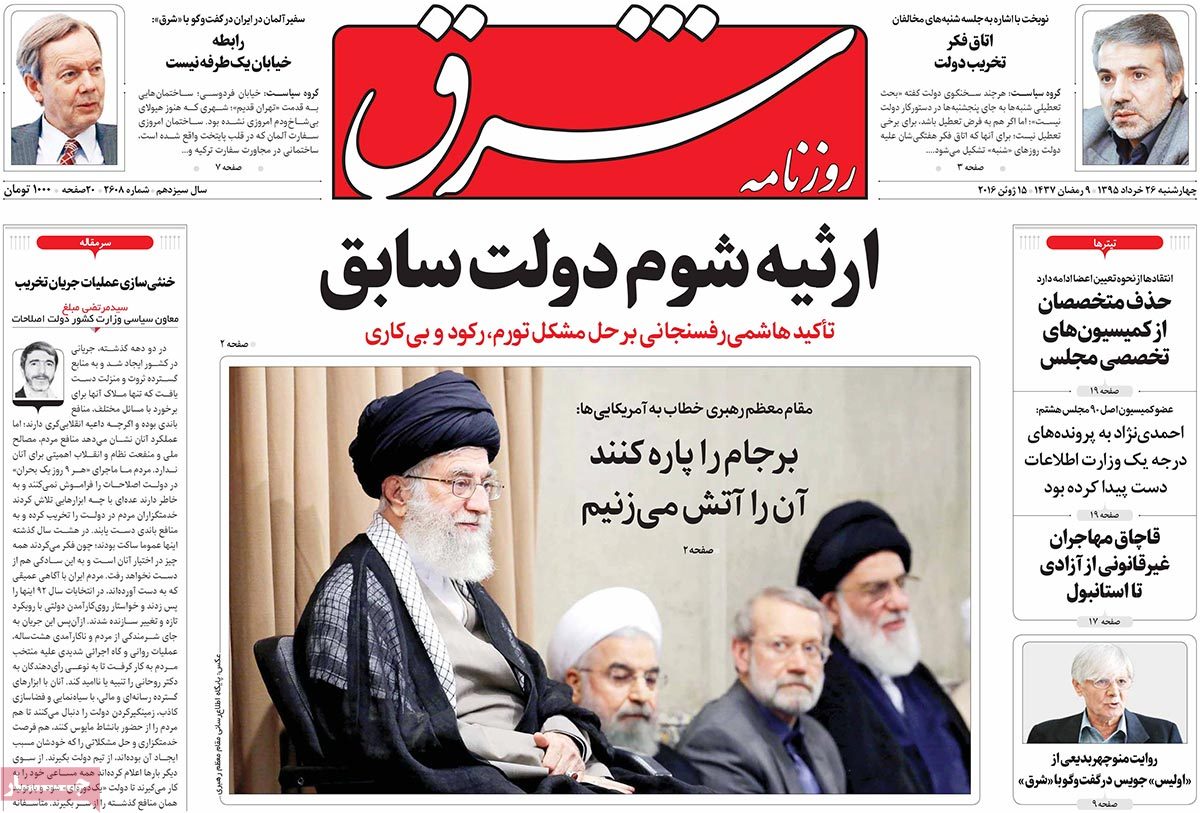
A Look at Iranian Newspaper Front Pages on June 15


Vaghaye Ettefaghieh:

1- Saudis Worried about Collapse of Regional Order and Emergence of Iran: Immediate Challenge in Middle East Is Resolution of Tehran-Riyadh Tension

2- Flight in Crisis: Airlines in Bad Financial Condition
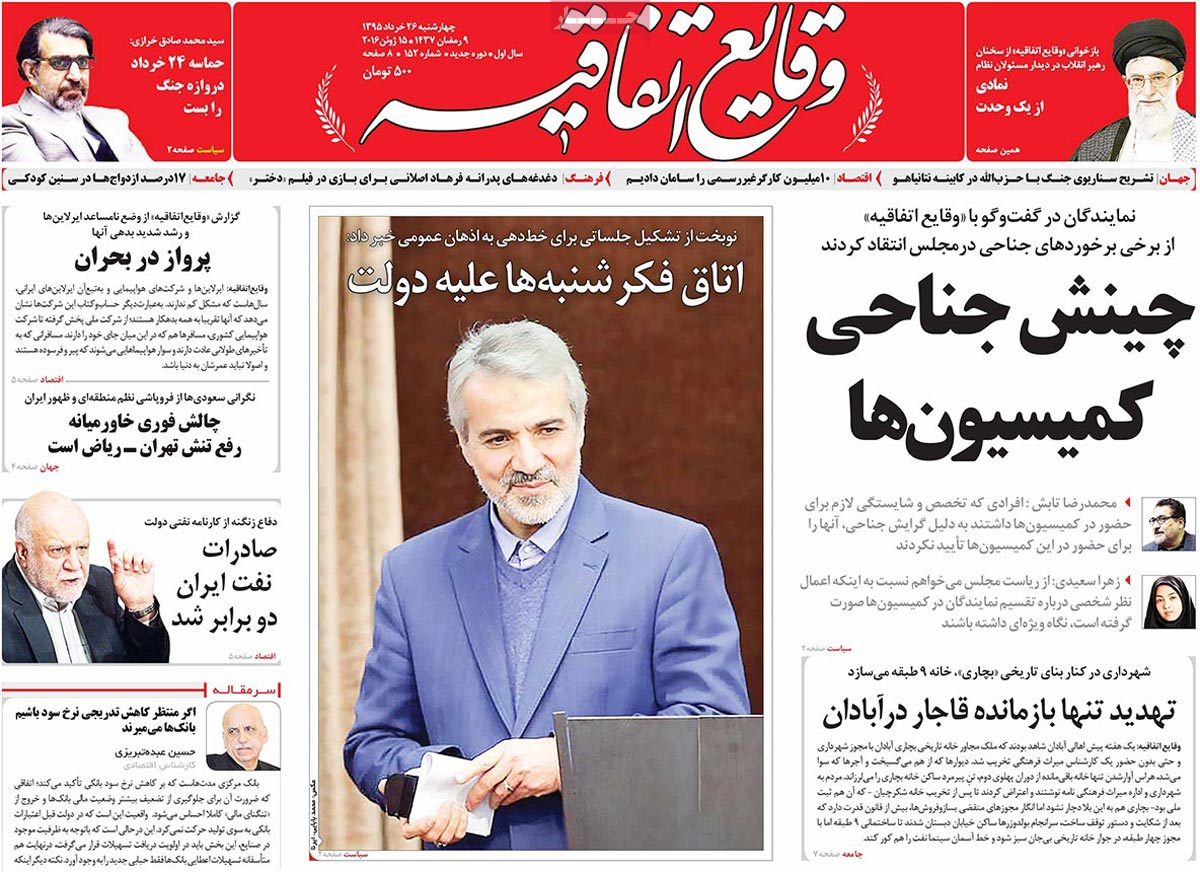
A Look at Iranian Newspaper Front Pages on June 15


Vatan-e Emrooz:

1- US Failed to Fulfil Lion’s Share of Its Commitments: Leader

2- Italy Refuses to Return Iran’s Satellite Mesbah

3- Bin Salman’s Blow to Hillary: Saudis Buy US Presidential Candidates

4- New Aerospace Sanctions: Americans Arrest Iran Chamber of Commerce Member for Buying Plane Parts
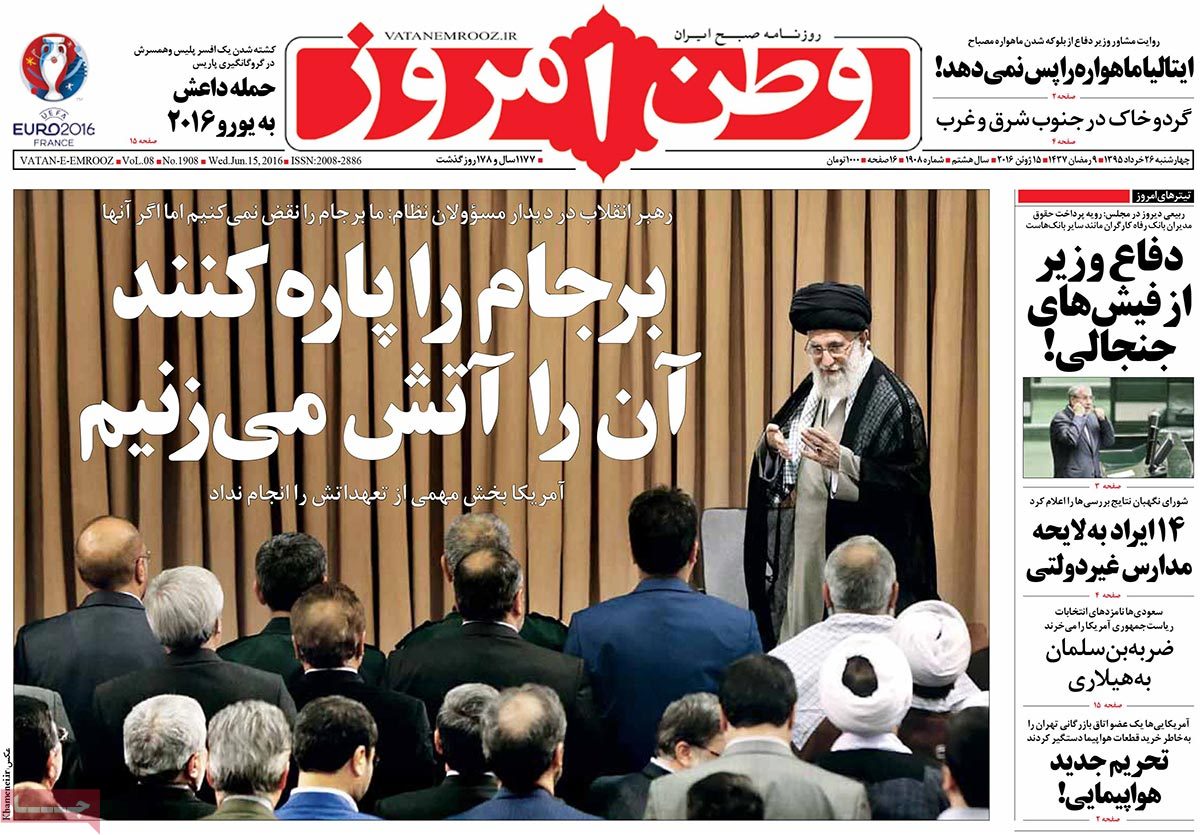

A Look at Iranian Newspaper Front Pages on June 15

Iran Deal Allows for Sales of Passenger Planes: Kirby

aircraft

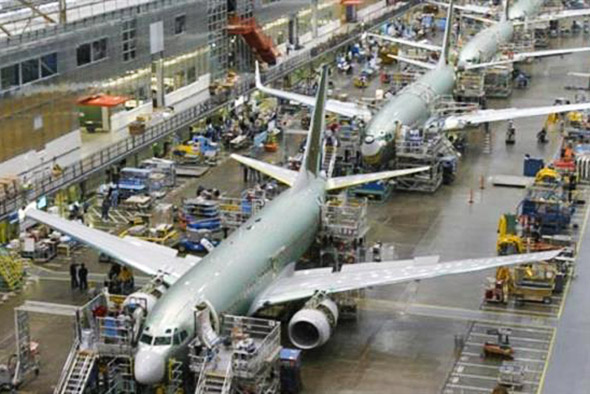
John Kirby said on Tuesday June 14 that the deal included a statement that “Allowed for a case-by-case licensing of individuals and entities seeking to export, re-export, sell, lease or transfer to Iran commercial passenger aircraft … exclusively for commercial passenger aviation.”

His comments followed reports that Iran had reached an agreement with Boeing for the supply of jetliners after months of negotiations.

Iran’s Minister of Roads and Urban Development Abbas Akhoundi said earlier that the deal with Boeing had been finalized, adding that its details will be announced within the next few days.

Akhoundi added that Iran was able to save at least $5m in its last negotiations over the finalization of the purchase.

In January, Iran signed a major deal worth $27bn with aviation giant Airbus to purchase 118 planes from the company.  The deal with Airbus was sealed during a state visit to Paris by Iran’s President Hassan Rouhani.

Apart from Airbus and Boeing, Iran is also negotiating with several other global aviation giants over the purchases of planes, including Bombardier and Embraer.

Iran has a fleet of 250 aircraft, of which 90 are grounded due to the economy or missing parts, Parvaresh further told Reuters.

Of that total, 80% will need to be renewed in the next decade, he said, adding that growth could add even more jets to Iran’s shopping list.

President: Cabinet Shamed by Unemployment

“It’s a shame for the administration that the Iranian educated youth are unemployed,” the President said on Tuesday evening, June 14, at a meeting between Leader of the Islamic Revolution Ayatollah Seyyed Ali Khamenei and senior Iranian officials in Tehran. He was referring to recent comments made by Ayatollah Khamenei voicing concern about the burden of unemployment.

Back in June, at a meeting with the members of Iran’s new Parliament, Imam Khamenei touched on the subject of job opportunities in the country, saying, “The shame that burdens this humble person’s heart, over unemployed youth going home empty-handed, is no less than their burden of shame.”

In last night’s meeting, the Leader referred to economic recession and unemployment as the country’s two major problems. He also explained that such predicaments are blamed on the policies and plans of the country’s various cabinets, rather than the foreign sanctions.

As regards the remedies for recession and unemployment, Imam Khamenei urged compliance with Resistance Economy strategies and serious support for Iranian knowledge-based companies.

If Other Side Tears It Up, Iran Will Burn JCPOA: Leader

Leader

Speaking in a meeting with the heads of the three branches of the Iranian government and the country’ senior officials in Tehran on Tuesday, June 14, the Leader pointed to the threats by some US presidential hopefuls to scrap last year’s nuclear agreement, known as the Joint Comprehensive Plan of Action (JCPOA), saying the Islamic Republic would respond strongly to such a move.

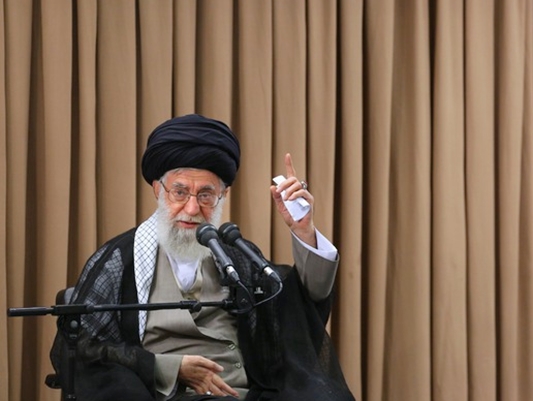
“We will not violate the JCPOA, but if the opposite side violates it – as US presidential candidates are currently threatening to tear up the JCPOA – if they tear up the JCPOA, we will burn it,” the Leader stated, as reported by Press TV.

Referring to the vigorous debate within the country which has surrounded the issue, Khamenei defined his message as being aimed solely at foreign parties, as highlighted by Mehr. “On the JCPOA, both proponents and opponents have engaged in frenetic activity opposing or defending the deal; I directly address foreign parties to the deal and not our negotiators on this issue.”

Ayatollah Khamenei said the US has so far failed to fulfil a major part of its obligations under the JCPOA, while Iran has abided by its commitments, such as regarding its 20% uranium enrichment as well as constraints regarding the Fordow and Arak nuclear facilities.

“Under the JCPOA, the other side was duty-bound to [fully] lift the sanctions, which it has not done. The banking issues have not been solved. The issue of the insurance of oil tankers has been implemented only at a limited level,” the Leader said. “The oil payment and our assets which we have in other countries are not returned to us.”

The Leader emphasized that it is a “misconception that we [the Islamic Republic] can come to terms with the US. We cannot rely on illusions.”

Ayatollah Khamenei said Washington’s issue with Iran is the very existence of the Islamic Republic, which cannot be negotiated.

Elsewhere in his remarks, the Leader also warned of enemy plots to hinder Iran’s progress. “The agenda of the enemy today is to stop or eliminate the capabilities of the Islamic Republic, or at least to prevent their growth,” Ayatollah Khamenei emphasized.

The Leader also stressed the importance of increasing the country’s capabilities.

“I have often reiterated that the country must grow in power and that we must increase our potential,” Ayatollah Khamenei stated, adding that it is only then that Iranian officials can expect the nation to have peace of mind.

Paleolithic Stone Tools Uncovered in Qeshm Island

Paleolithic Stone Tools Uncovered on Qeshm Island

Morteza Rahmati, the director of the Iranian archaeological team, said the team has unearthed massive findings in Qeshm. The oldest are stone tools belonging to the Paleolithic era which date back to 40,000 years ago, the official website of RICHT reported.

Rahmati further said the nomadic families used the site for making tools needed to hunt animals.

“During the recent excavations near villages of Tabl and Salkh, a large number of stone tools were found.”

Called Bam-e Qeshm, the site is a large open-air site located in Qeshm Island’s Global Geopark. Abdolreza Dashtizadeh discovered the site in 2005. He registered it in the National Register of Historic Places (NRHP) of Iran later in 2011.

The team also collected samples  for sedimentological and geomorphological analysis of the site during the digs. The National Museum of Iran supervised the excavations.

A prehistoric period of human history, the Paleolithic era is distinguished by development of the most primitive stone tools discovered. It covers roughly 95% of human technological prehistory. The era extends from the earliest known use of stone tools, probably by Homo habilis initially, 2.6 million years ago, to the end of the Pleistocene era, around 10,000 BP.

Regional Cooperation Key to Marine Conservation

13_Conservation 2

However, the fact that Iran’s main water bodies (the Caspian Sea in the north and the Persian Gulf in the south) are shared with other countries makes protection of sea animals a matter of regional concern.

The Framework Convention for the Protection of the Marine Environment of the Caspian Sea, also known as the Tehran Convention and adopted in 2003, is the first legally binding regional agreement signed by all five Caspian littoral states (Iran, Azerbaijan, Kazakhstan, Russia and Turkmenistan). It lays down the general requirements and the institutional mechanisms for environmental protection in the Caspian region.

“A biodiversity protocol has been devised within the framework of the convention but has not been signed by the member states yet,” said Davoud Mirshekar, director of Marine Ecosystems at the Department of Environment, calling for more cooperation and swift action to save the endangered animals.

To prevent and combat pollution in the Persian Gulf and the Sea of Oman from various sources, the Kuwait Regional Convention for Cooperation on the Protection of the Marine Environment from Pollution, known as the Kuwait Convention, was adopted in 1978 and signed by Bahrain, Iran, Iraq, Kuwait, Oman, Qatar, Saudi Arabia and the UAE. The biodiversity protocol of this convention has been agreed upon and will soon come into force.

According to Mirshekar, the release of pollutants and waste into the seas is the main cause of the reduction of these animals. “No matter where pollutants are released, they reach rivers and seas in the end through precipitation,” he was quoted as saying by ISNA.

Pollution from oil and gas refineries is the most severe issue in the Caspian Sea, which threatens the life of various species, including the Caspian Seal. “The seal is on top of the food chain in the Caspian waters and if it goes extinct, it portends disastrous changes in the region’s environment,” said Amir Sayyad Shirazi, an environmentalist.

He added that even “radioactive substances” have been found in the mammal’s body, pointing to a new kind of pollution affecting the sea.

Mirshekar said lack of food, overexploitation of resources and climate change also contribute to the risk. “Coral reefs and Hara (mangrove) forests are habitats where numerous species reproduce, but as waters become warmer and temperatures exceed the range of tolerance, corals begin to bleach and die. This may in turn pave the way for non-indigenous species to invade the habitats and threaten the survival of native species,” he said.

Dispute Over Cause of Persian Gulf Salinity

13_Salinity

Last month, Parvin Farshchi, deputy for marine environment at the DOE, said the salinity of the Persian Gulf has been increasing for the past two decades and is now 1.5 times more saline than it was 20 years ago and attributed the rise in the water’s salt concentration to “human activities and desalination plants”.

Ziaeddin Almasi, the head of Marine Pollution Office at the DOE, believes climate change is the likely cause of the southern water body’s increasing salinity.

“I believe climate change has a more profound impact on the Persian Gulf’s increasing salt concentration than desalination plants,” he said.

Almasi reasoned that the planet’s rising temperature leads to excessive evaporation in the semi-enclosed body of water, which leads to hypersalinity.

Discussions about the impact of desalination plants along the Persian Gulf coastlines have become more frequent ever since Energy Minister Hamid Chitchian announced plans to transfer water from the Persian Gulf to the drought-hit provinces in southern and central Iran in March.

Chitchian said 50 desalination plants had been constructed along the shores of the Persian Gulf and Oman Sea “to help supply drinking water to 17 provinces.”

Desalination processes produce large quantities of brine, which is normally diluted before it is returned back to the water body it was retrieved from. The problem is that brine is denser than seawater and therefore sinks to the ocean bottom and can damage the ecosystem. Careful reintroduction can minimize the impact, but cannot entirely eliminate it.