Friday, April 10, 2026
Home Blog Page 4441

Academic: Muslim Brotherhood Is the Only Path to Democracy in Arab World

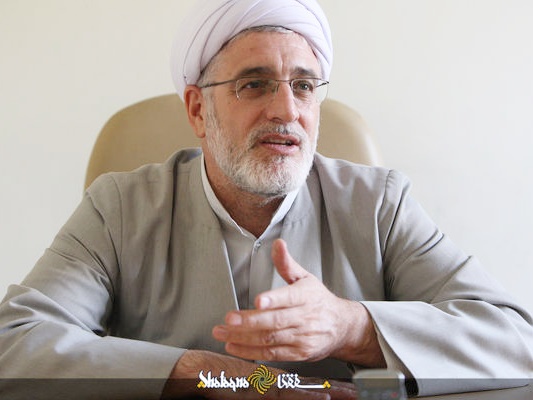
Feyrahi

The first part of his interview with Etemad about Ennahda, the Tunisian version of the Brotherhood, was earlier published in IFP . Here’s the second part, which talks about the importance of the movement in the Arab world.

“Since 1995, the idea of nationalizing Brotherhood movements gradually emerged inside the Movement. Therefore, Brotherhood movements gained more independence inside the countries. […] This led to a sort of paradox inside the Muslim Brotherhood: how could the Movement possibly remain a global network sensitive to the entire Arab world and at the same time gain national independence? This is what Ennahda does: the Party has highlighted the other side of the spectrum, and that is giving independence to Muslim Brotherhood parties inside national states.”

“During the Ennahda Congress, it was declared that Tunisia is preferred to Ennahda. That means Tunisia’s interests have priority over the Party’s interests. Ennahda is a religious party, but at the same time has its roots in Tunisia. If there is a conflict between Tunisia’s interests and those of others, Ennahda would declare itself to stand for Tunisia. This idea has a tendency to independence and giving priority to the concept of nationality.”

“There is a very important question among Muslim movements, and that is the concept of the national state. It was very difficult for the Muslim Brotherhood to accept this concept. There might be problems with the issue even in Shiite communities, let alone Sunni ones, whose problems are much greater. That is because Sunnis had caliphates and did not experience a national government. Therefore, they were not familiar with the concept of nationality.”

“In Tunisia, Ghannouchi seeks to maintain religion and at the same time institutionalize a national state and nationalism. He is doing his best to open the way for this; despite all problems, he has chosen a correct path, while Turkey has problems with the same issue.”

“In a letter Ghannouchi recently sent to Muslim Brotherhood headquarters, he declared his party had decided to suspend its ties with the Movement. It questioned the Muslim Brotherhood’s interference in all countries, asking whether it even has the right to meddle in different places like Syria. It suggests that the Movement should let national movements resolve their issues nationally, because the Muslim Brotherhood interrupts the process of the birth of nationality. […]”

“The Muslim Brotherhood moved towards democratic movements. Radical polarized movements have long existed within Muslim Brotherhood. This tendency towards democracy in the Brotherhood has currently been delayed. […] It is likely that once democratic efforts for the Brotherhood’s operations fail, the radical faction dominate the democratic one. […]”

“The Muslim world has no choice; it should either take the path of democratization seriously or else the crisis of radicalism will continue in the region. There is no other choice at the moment. Especially for the Sunni world, there are no further choices available. If it wants to move towards democratization, the Muslim Brotherhood, particularly its modernist faction, is the only force equipped to manage the democratization inside the Sunni Muslim community. There is no other way, because seculars are not that powerful in the Muslim world […]. Therefore, the only player that can carry out the ideology of democratization is the Muslim Brotherhood. No better choice is there, because there are a number of radical Salafists among Sunnis, and the others are Brotherhood members. If we look at the wiser factions of the Salafists, like the Salafis of Saudi Arabia’s Sahwa Movement or Safar Al-Hawali, we see they are approaching the Muslim Brotherhood under the new circumstances.”

“The Muslim Brotherhood has not stopped working. In Egypt, for example, […] President Sisi is not capable of realizing a democratic evolution; any democratic change needs either secular democratic movements or democracy-seeking Muslims, or the Muslim Brotherhood.”

“The Brotherhood’s operation is currently prevented by the [Egyptian] Army. If the Army decreases its pressure a little bit, the Brotherhood would find time to reconstruct its activities. Even if people refuse to vote for the Movement, it is important, though, that Muslim Brotherhood has been a major pillar of the democratic process. Without the Muslim Brotherhood, democratic Muslims will leave the political arena, because it is only the Muslim Brotherhood that talks about religious democracy.”

“If we could witness an opening up of Egypt’s political atmosphere, the political game there would fall on the shoulders of young secularists and the Muslim Brotherhood. Democratic rhetoric should either be based on religious or radical values; the religious version belongs to Muslim Brotherhood. Therefore, it might receive 50% of votes in one election, and it might lose its popularity in the next. This is not important, however. The important point is that the Muslim Brotherhood is a prerequisite for moving towards democracy in Arab countries.”

“In the Sunni Muslim world, there is no group [other than Muslim Brotherhood] that can create democratic rhetoric and justify it using religion. We are now facing a necessity and scarcity here.”

“In Saudi Arabia, the Muslim Brotherhood has long been suppressed. They tried to create the Sahwa Movement from Saudi Arabia’s Salafism. […] Saudi Arabia wanted to develop a relatively more rational movement inside Wahhabism, but it was not skilled in doing so, and this will soon move towards democracy as well.”

“In Yemen, however, al-Islah [Reform] Party is a very powerful movement. If some room is provided for democracy in Yemen, al-Islah can become a great political player in the country, and even outperform the Houthis.”

“The only exception is Syria. Because of Hafez al-Assad’s crackdown from 1982 to 1986, the Muslim Brotherhood failed to make much progress towards democratization there. Because of the crackdown and the conflicts, the Muslim Brotherhood in Syria was not allowed to be part of the country’s power structure. So it remained radical and adopted extremist stances.”

“However, this has not been the case in other countries. For example in Jordan, if enough space is provided, Amal Party is in a powerful position and has the potential to guide democracy. If you look at Muslim countries such as Algeria, Morocco, Egypt, Yemen, Tunisia, Turkey, and Jordan, you will see that the Muslim Brotherhood is very strong, and is the only potential, and even actual, engine for guiding democratization.”

“There are three conditions for democracy, and if all of them are provided in one place, the process can be successful. First, there should be democratic thought; second, democratic institutions, and finally, bearers of democracy. Inside the Sunni Muslim community, the Muslim Brotherhood is the only place where one can find democratic thought. They can be the carriers of democracy, but they have institutional problems, because the government does not allow their presence in the political arena. However, if such space is provided, the Muslim Brotherhood is the quickest movement to adapt itself to democracy. Otherwise, it has no replacement.”
The Huge Cost of Refugees in Iran

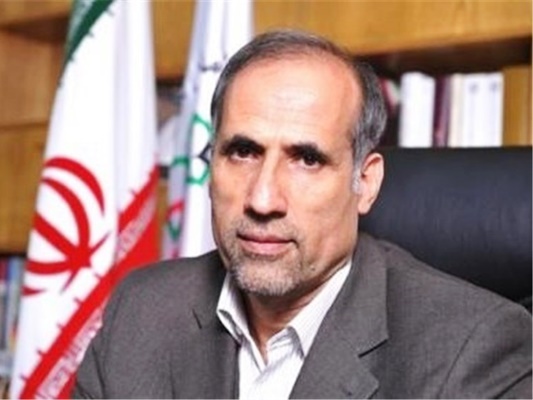
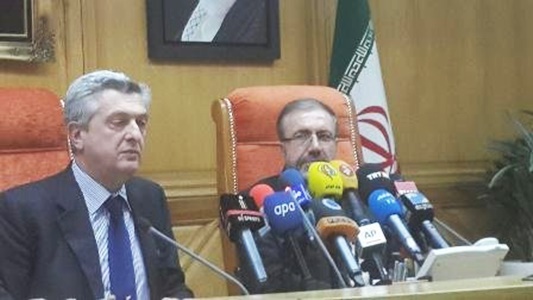
Zolfaghari

Speaking at a joint press conference with the United Nations High Commissioner for Refugees Filippo Grandi on Saturday evening, June 18, Zolfaghari pointed to three types of expenses in connection with the issue of refugees and migrations on Iran.

“Iran has the largest refugee population, with the longest period of nearly four decades, imposing huge costs. The next type [of cost] is that the Islamic Republic of Iran has contributed as much as possible to the reconstruction of Afghanistan and providing its security and development,” he said.

Zolfaghari noted that Iran has also made great efforts in preventing illegal migration to other countries, especially to Europe.

“What we reached as a fundamental solution together with the UNHCR chief today is that the most basic work to solve the refugee problem is for the international community to take responsibility to eliminate insecurity in the region and also deal with extreme poverty in these countries,” he added.

“As long as Afghanistan suffers from insecurity and deteriorating living conditions, refugees will never return home voluntarily,” Zolfaghari added. He called for the international community to help Afghanistan restore security and development and provide better conditions for refugees to come back home.

The second solution, he went on to say, is to help Afghanistan restore its infrastructure and to develop.

Zolfaghari said the other solution is temporary housing of refugees in other countries, which is unfortunately declining, but can significantly help the refugee crisis.

He emphasized that the international community’s assistance to the Islamic Republic of Iran for healthcare, education, livelihood and employment should be increased.

“Iran spends $570 for the education of each Afghan and Iraqi student annually,” he said, stressing that international aid should be increased to provide better services to refugees.

He expressed his satisfaction with the good coordination between the Islamic Republic of Iran and the UN High Commissioner for Refugees, and hoped his trip would help solve the problems of refugees in Iran and the region.

Greco-Roman Wrestlers Win 8 Medals at Romanian Event

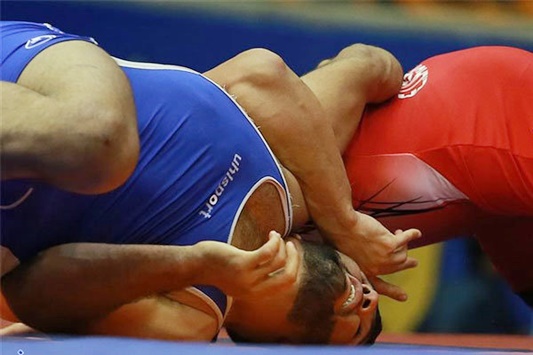
Greco-Roman wrestlers

The sporting event, also dubbed as Ion Cornianu & Ladislau Simon, is being competed in the Romanian capital of Bucharest on 18-19 June.

At the end of the first day of the tournament, Iran’s Azim Garmsiri (71kg), Yousef Ghaderian (80kg) and Mjid Aliyari (98kg) snatched gold medals while Behnam Mahdizadeh (80kg) and Mahdi Fallah (130kg) stood on the second podium.

Meanwhile, Shirzad Beheshti (59kg), Mohammad Ali Geraei (71kg) as well as Mahdi Noori (130kg) managed to bag bronze medals for the Iranian squad.

The first three winners of each weight category will be awarded with medals and diplomas.


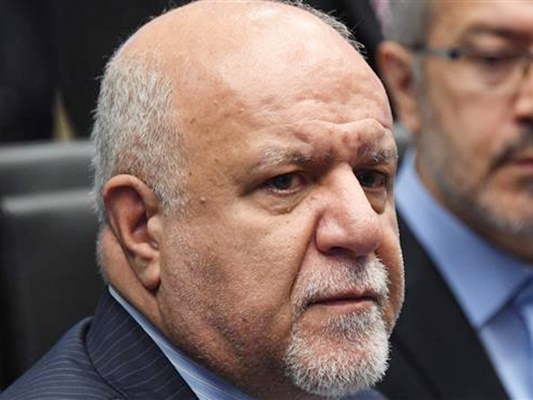
Petroleum Minister: Iran to Increase Oil Supply Despite Low Prices

Zangeneh

On Saturday June 18, Zangeneh, stressed Iran’s resolve to regain its OPEC market share of pre-sanctions levels in 2011, noting that “Some are unhappy about Iran’s production increase and cite that as the reason for price reduction. But even if the oil price hits 20 dollars [per barrel], the plan for an output rise to the level of pre-sanctions periods will continue,” the official IRNA news agency quoted him as saying.

Iran has been ramping up its oil production and reclaiming market share after the lifting of Western sanctions in January with the implementation of an international agreement that put curbs on its nuclear program. Tehran previously expressed concern over market oversupply and low oil prices but also reiterated its right to regain its pre-sanctions market share.

Last week, the minister said Iran’s oil production had surpassed 3.8m bpd, of which about 2m barrels get exported.

Zangeneh added that exports, which stood at 0.97 million barrels per day in 2013, had in effect almost doubled.

Five Million Mark

The latest news comes as the former CEO of Italy’s energy giant Eni SpA has predicted Iran’s oil output to grow significantly.

Paolo Scaroni on June 17 told Bloomberg that Iran’s oil production will reach 5m bpd within three years. Scaroni also pointed to the need for contracts to further develop Iranian oil industry.

This is while Iran’s oil minister has previously said that the country needs an investment of $200 billion over the next five years to implement plans to boost oil and gas production.

Direct Flights Launched between Tehran and Astrakhan

13940625164912516097904

The Tehran-Astrakhan direct flights, which started in early May, will lower the costs of bilateral trade with Russia and provide an easier access to the port city for Iranian merchants, Afkhami Rad said, according to the TPO’s public relations department.

The flights, which are operated two days a week, have been launched at the request of the Iranian private sector, the official noted.

Back in March, the Russian energy minister said the number of direct flights between Iran and Russia will increase from five to nine per week.

Flights from Russia can go to the Iranian cities of Tehran, Isfahan, Mashhad, Rasht and three other cities that Iran will confirm later, Alexander Novak told reporters after meeting Iranian Minister of Communications and Information Technology Mahmoud Vaezi in Tehran on March 14.

From Iran, carriers can fly to Moscow, St. Petersburg, Astrakhan, Kazan, Ufa, Sochi and one other destination at the discretion of the Russian aviation authorities, he said at the time.

Russia’s Deputy Prime Minister Dmitry Rogozin in November 2015 stressed that Tehran and Moscow are resolved to increase the volume of their trade to $3-4bn over the next 3 years.

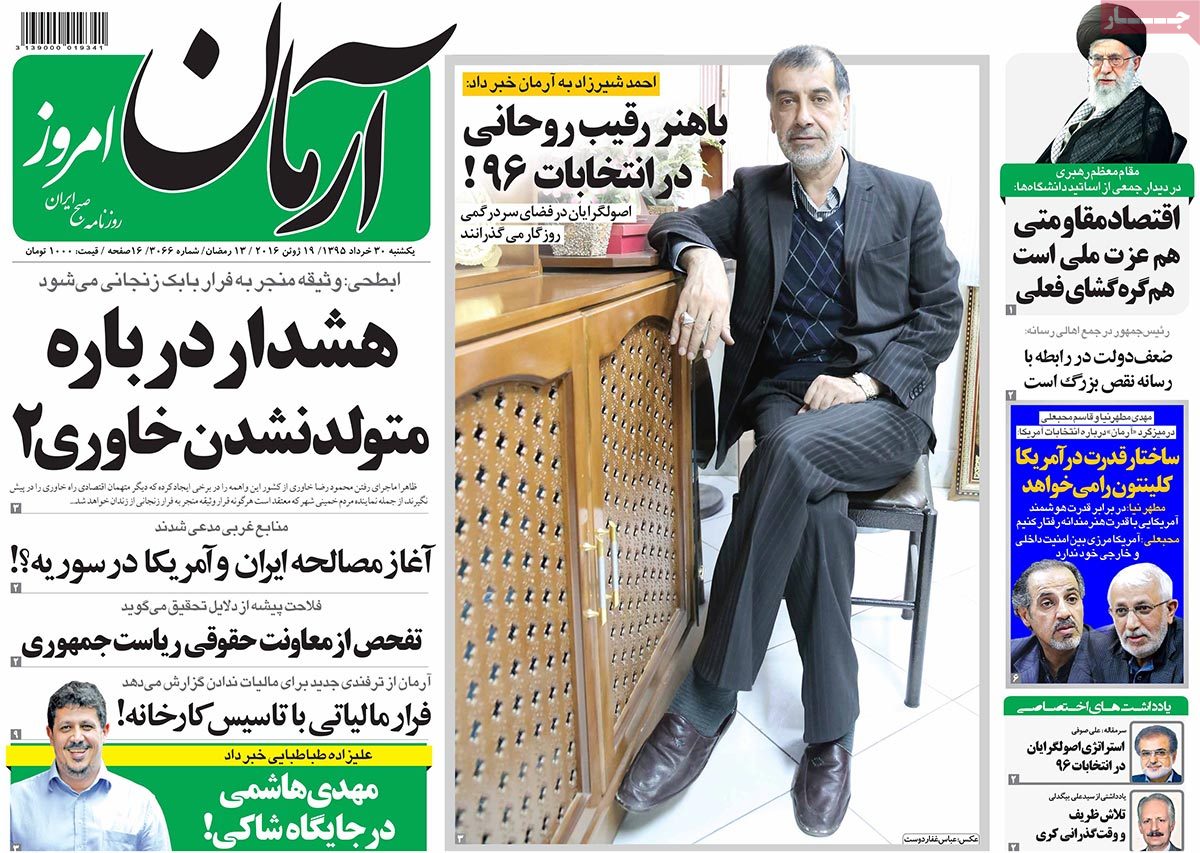
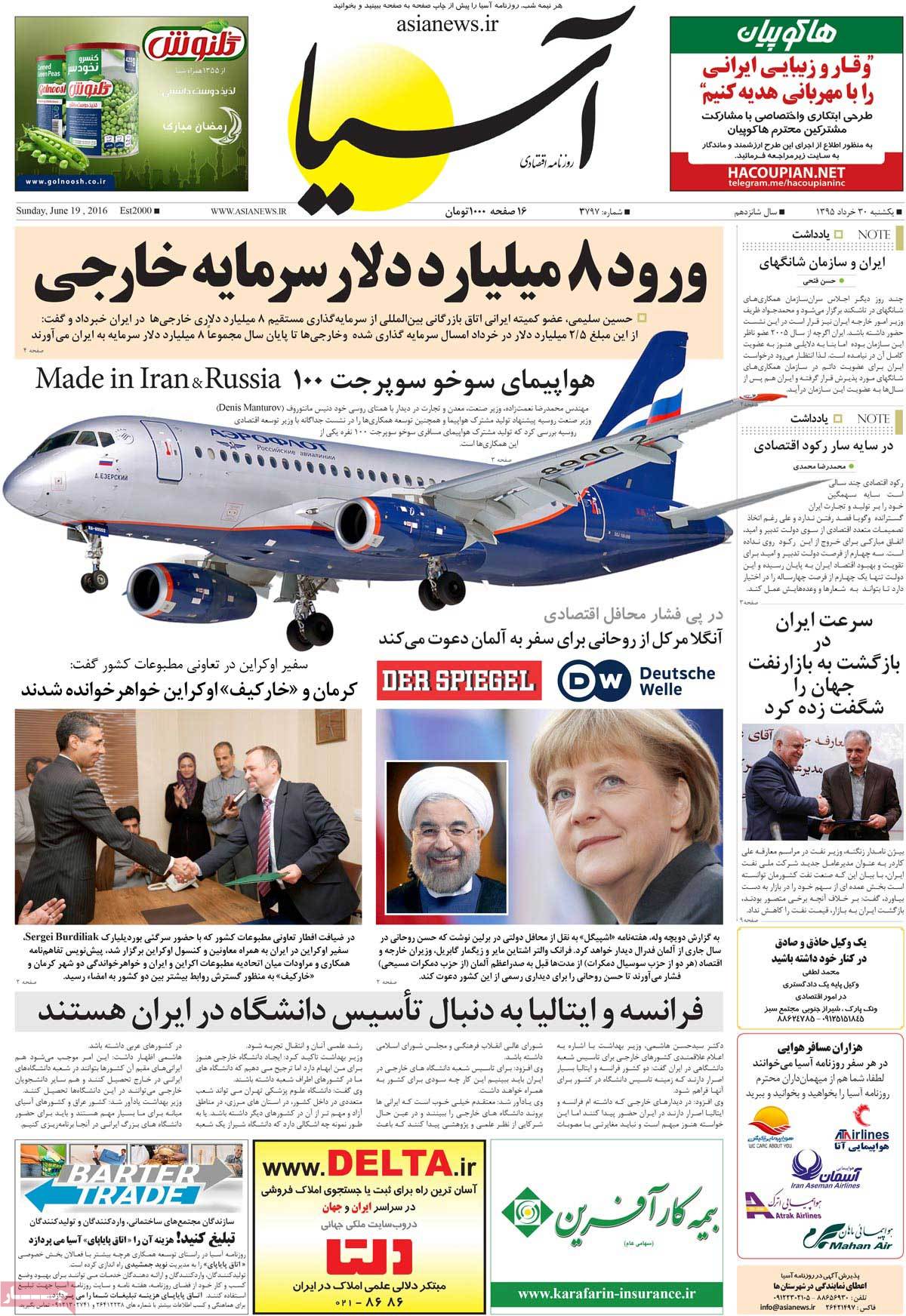
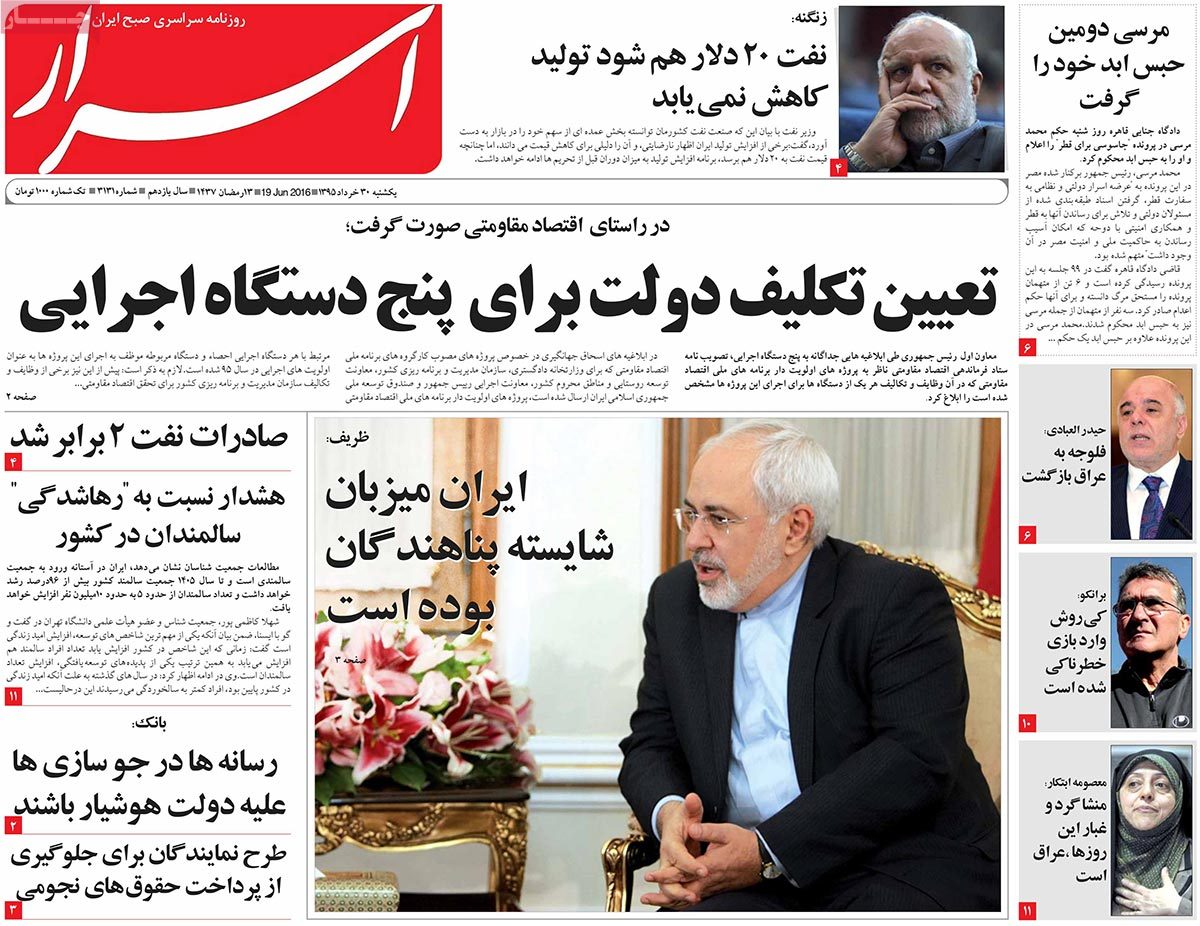
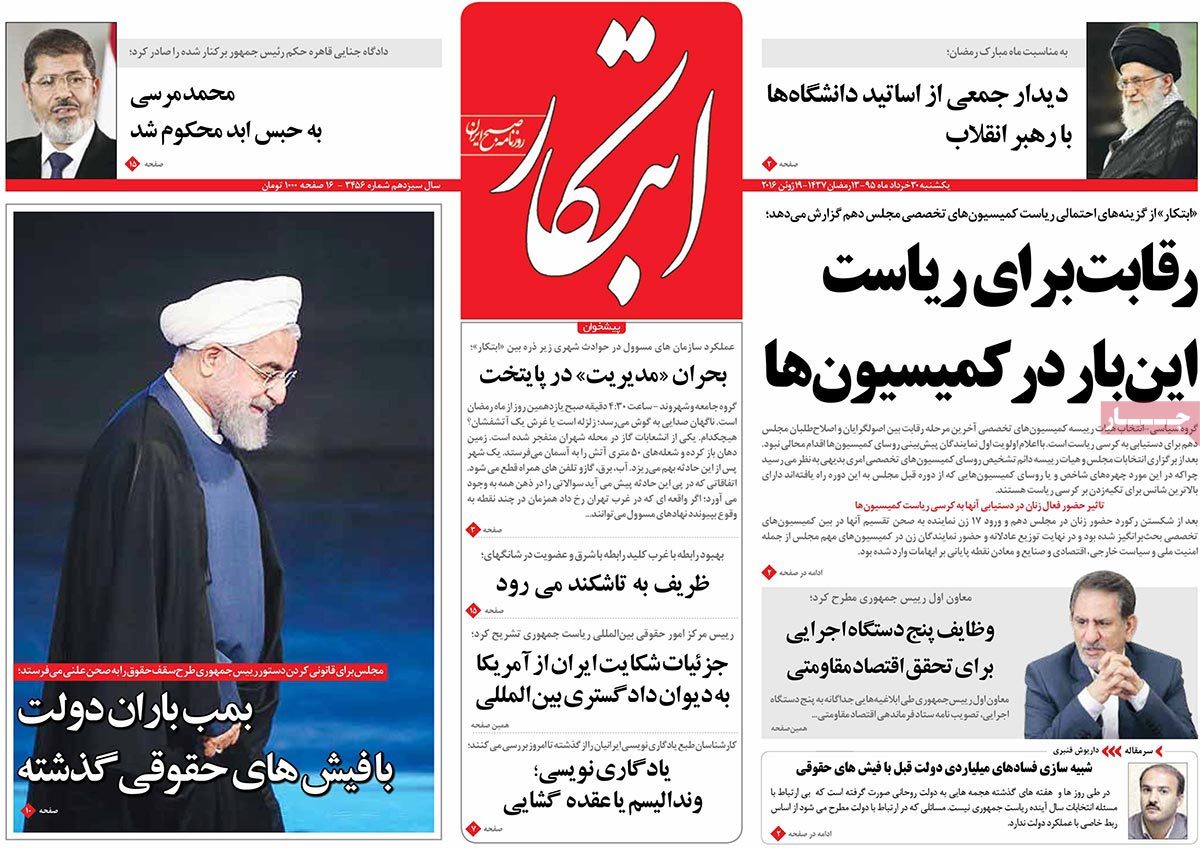
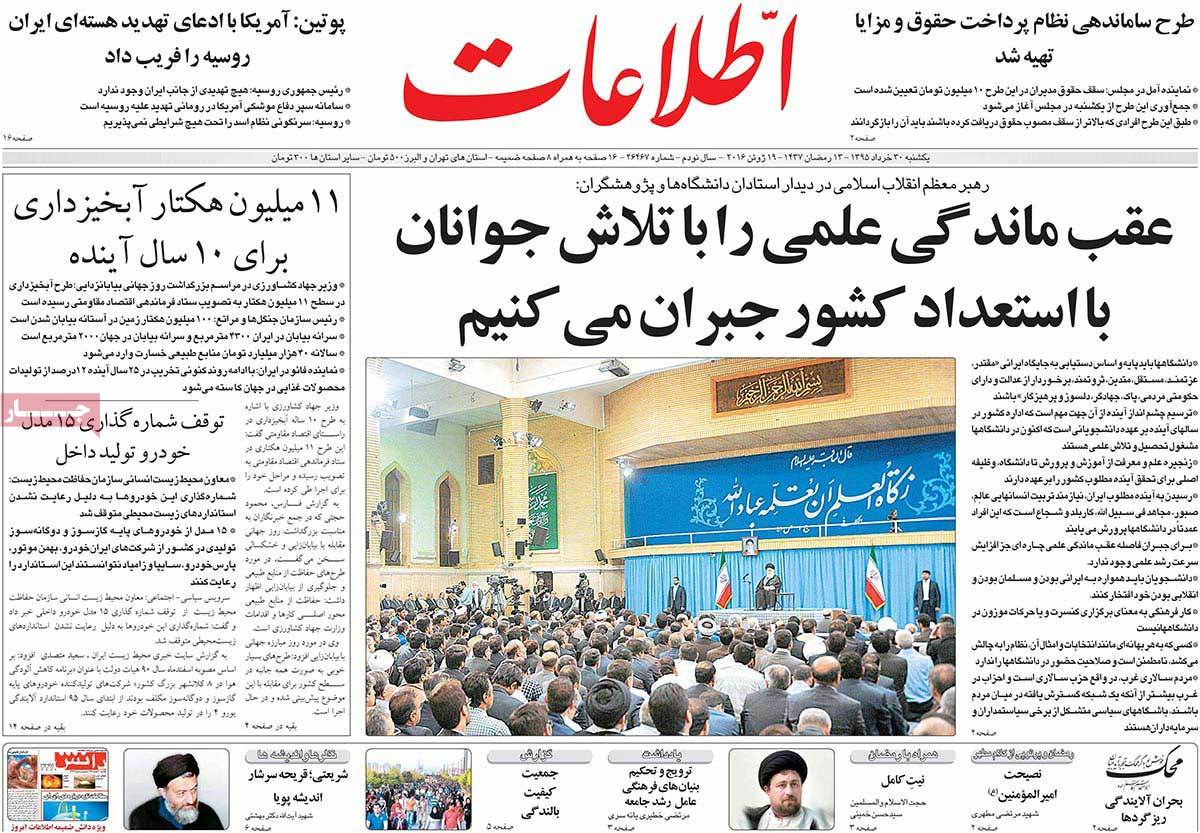
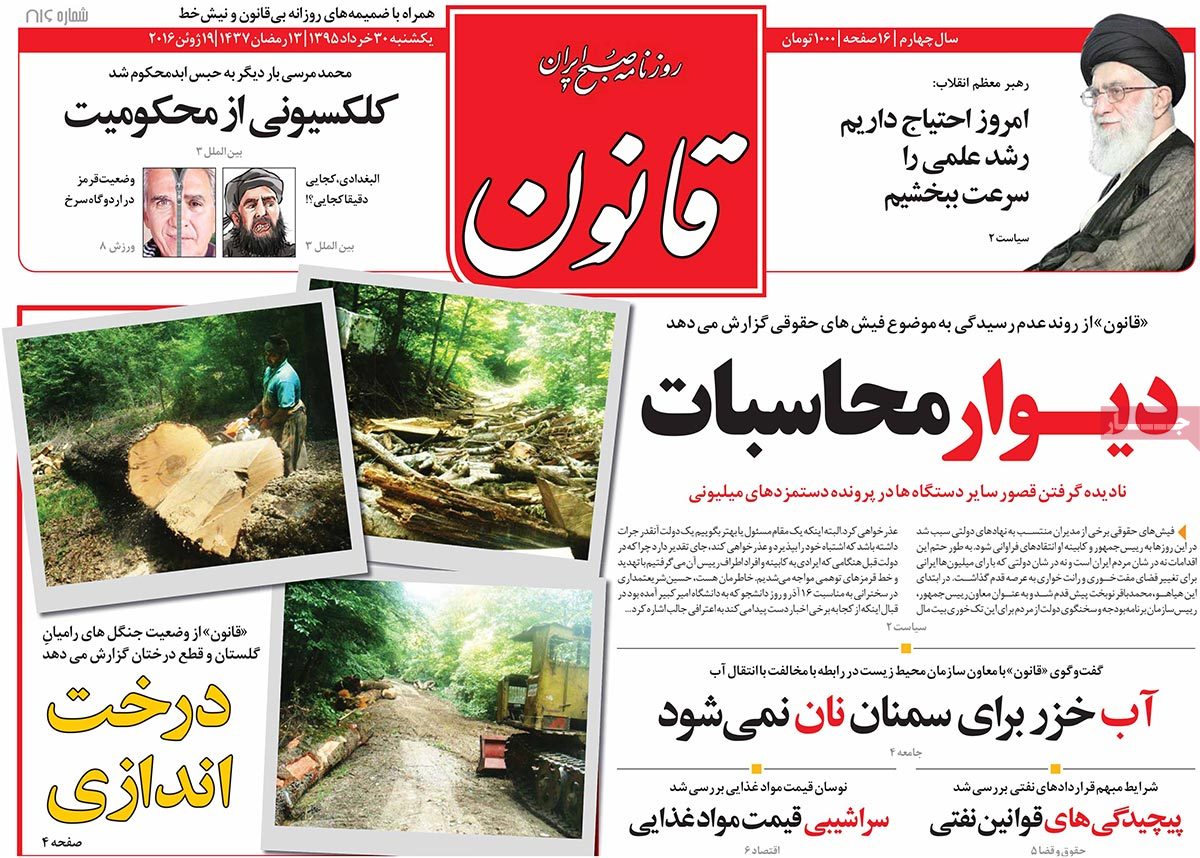
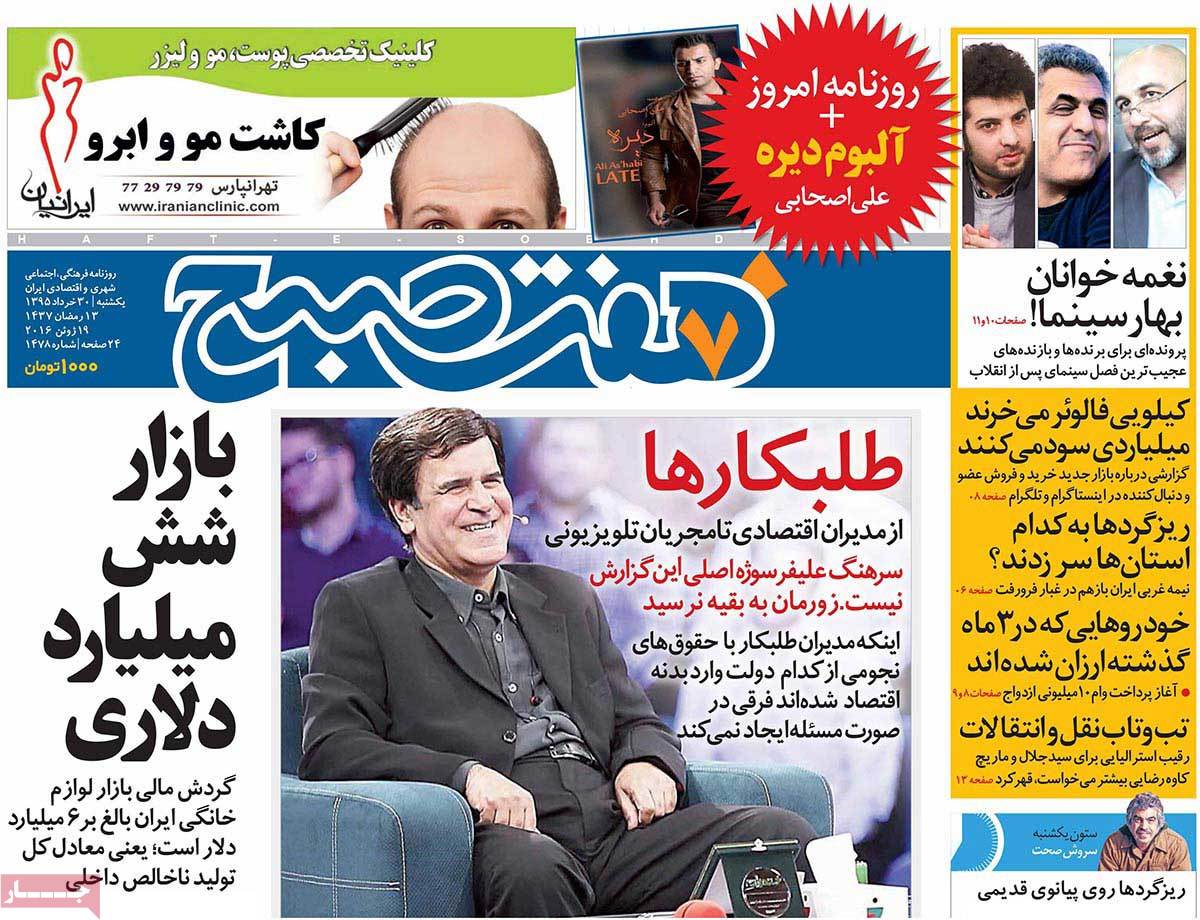
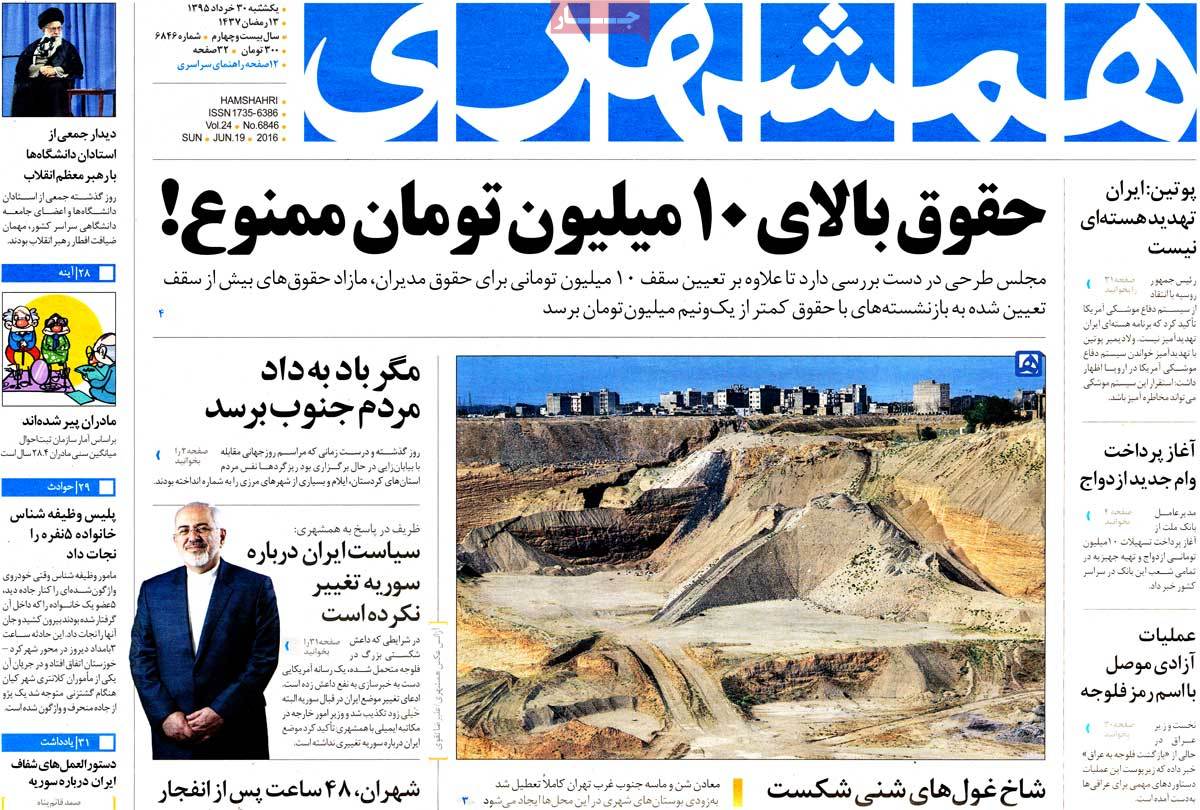
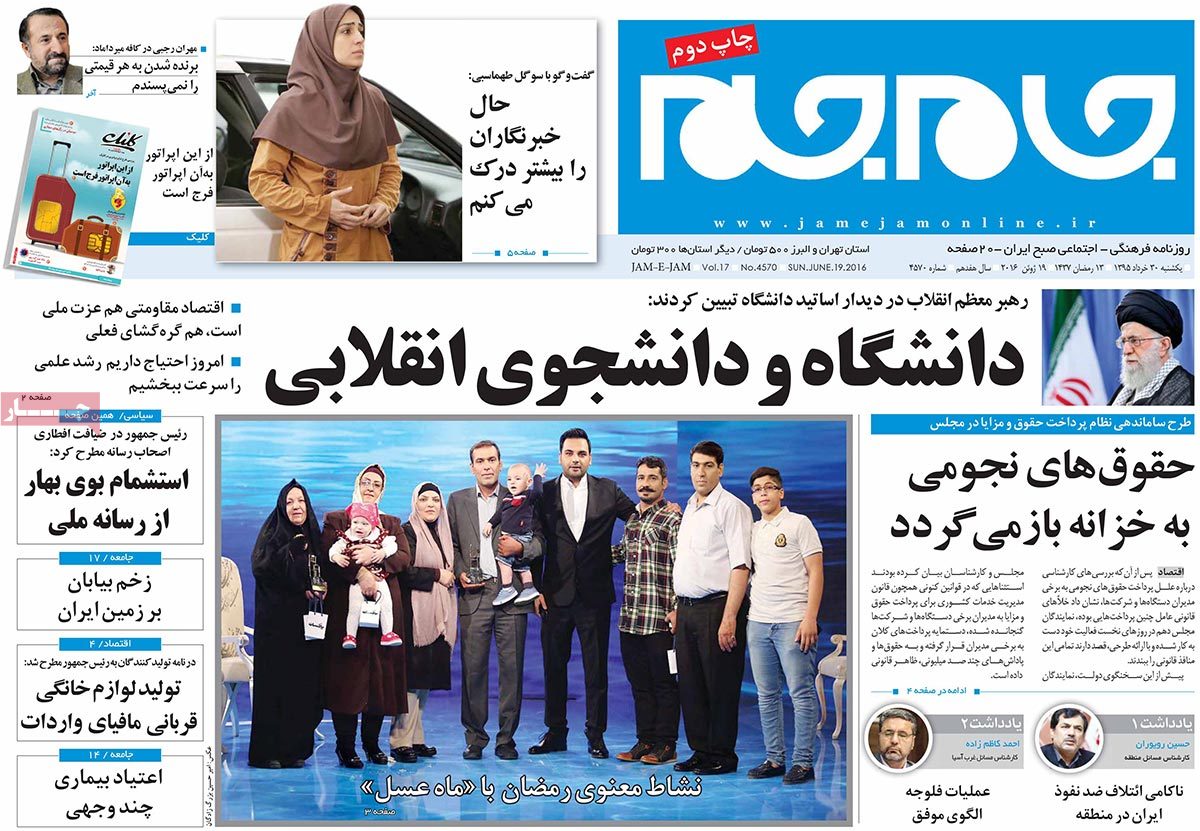
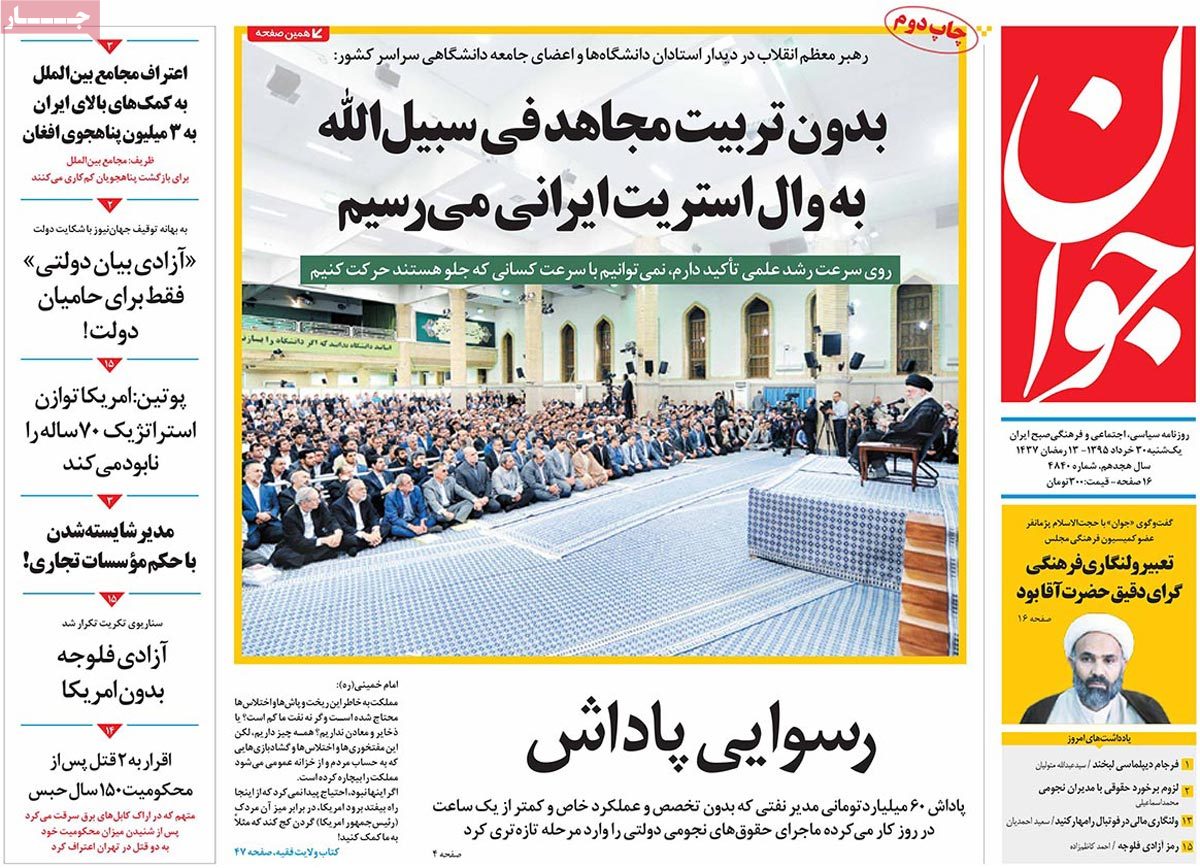
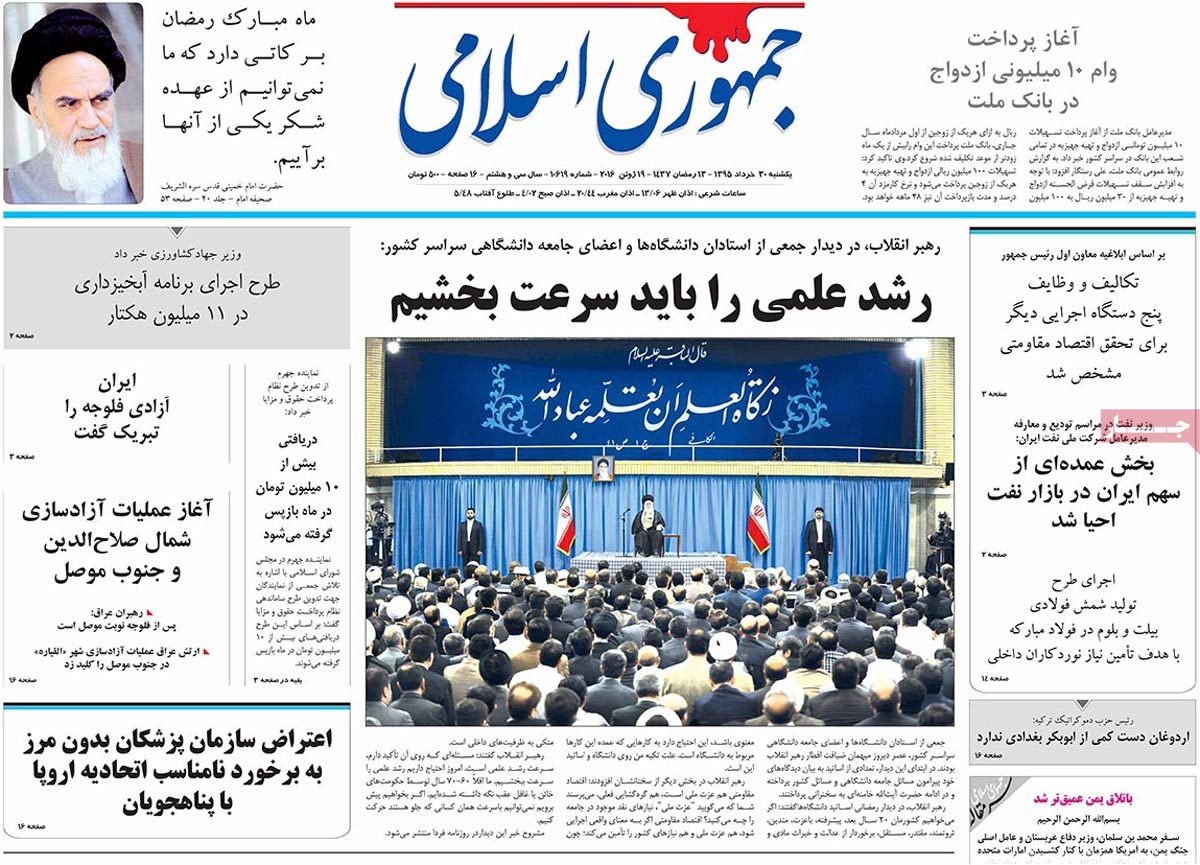
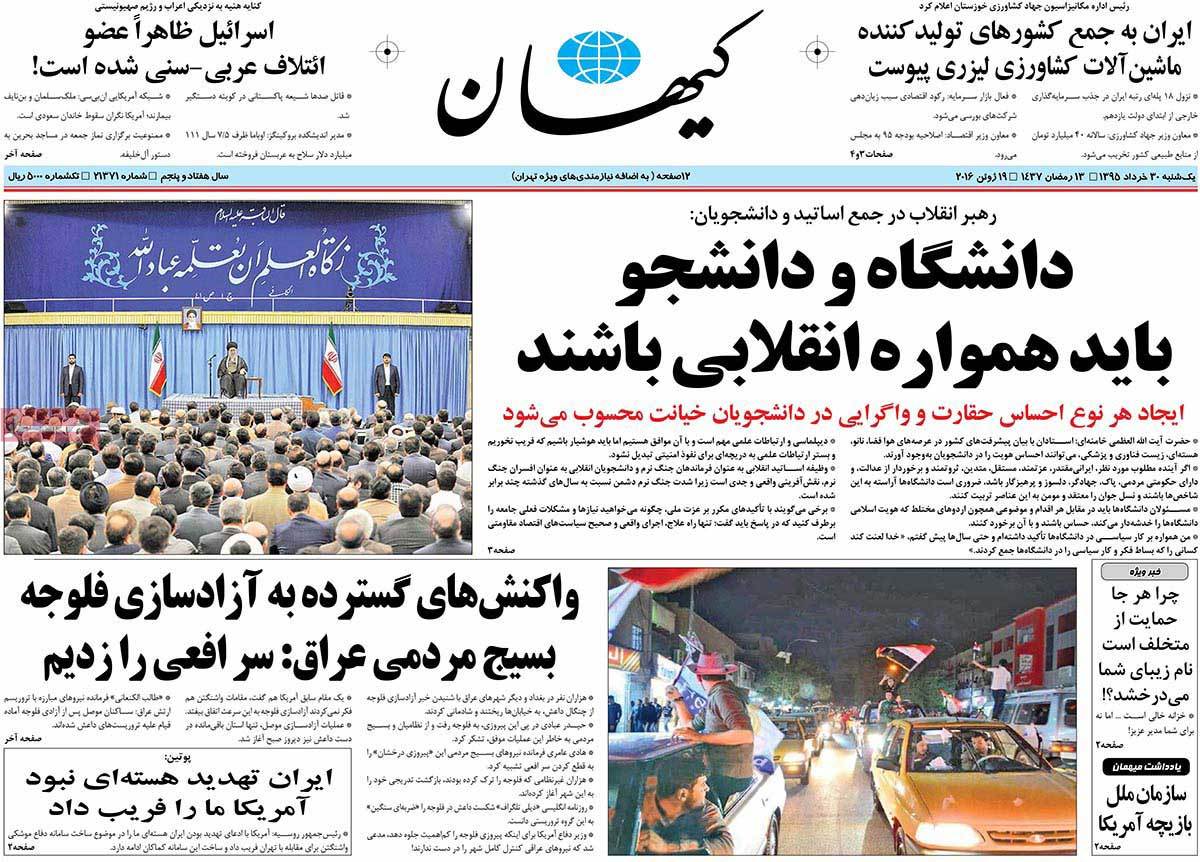
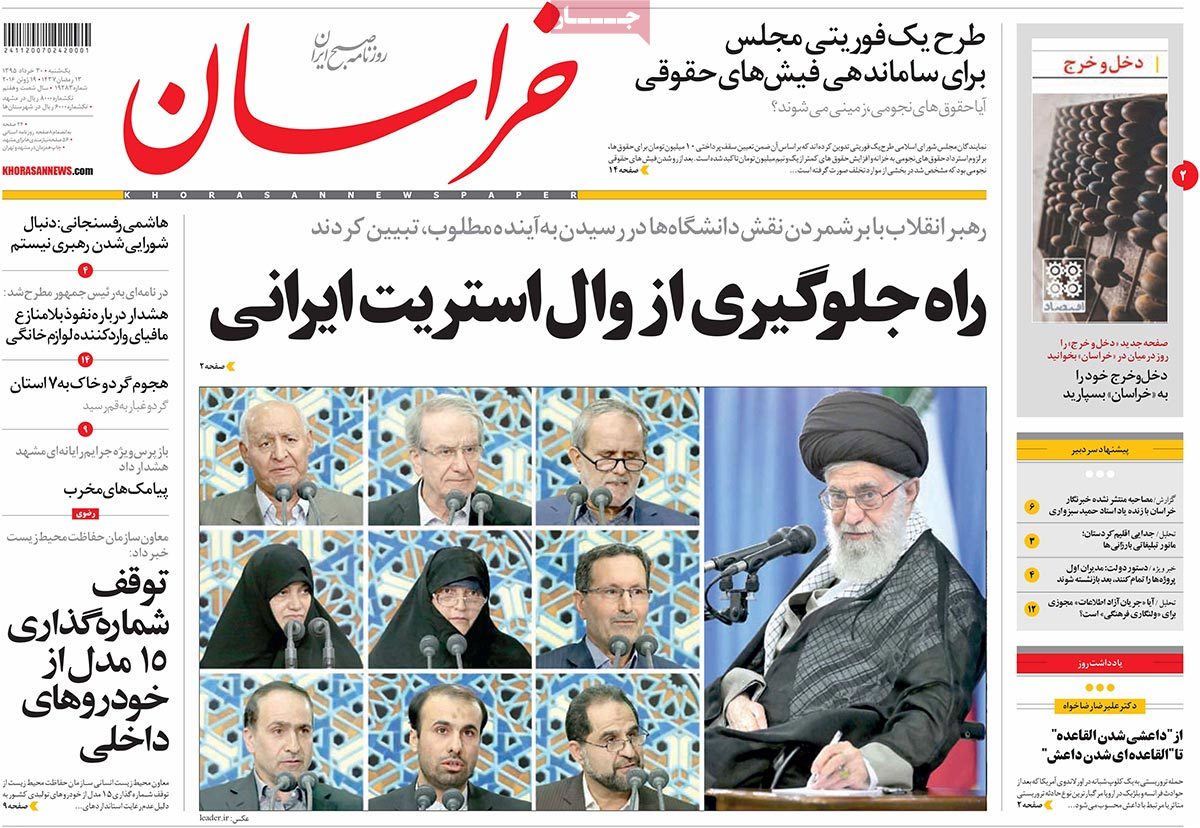
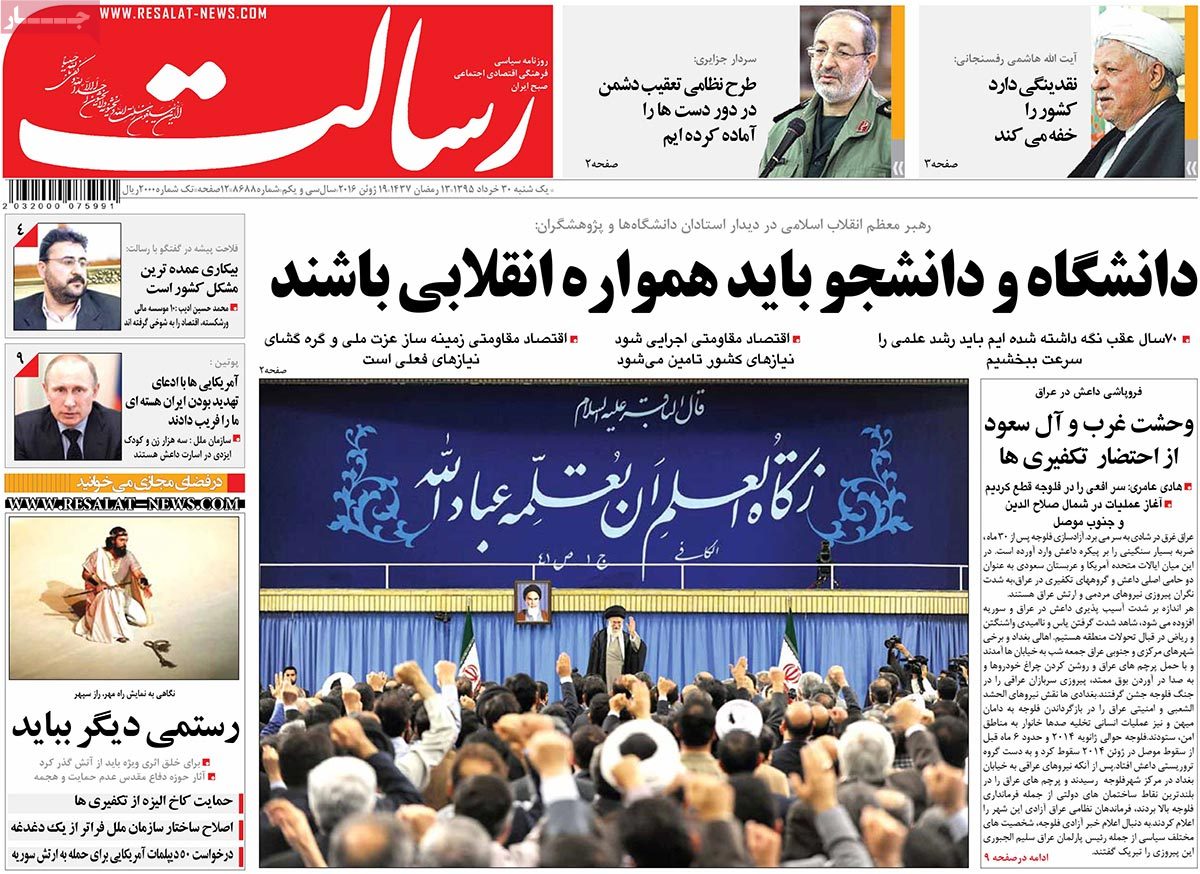
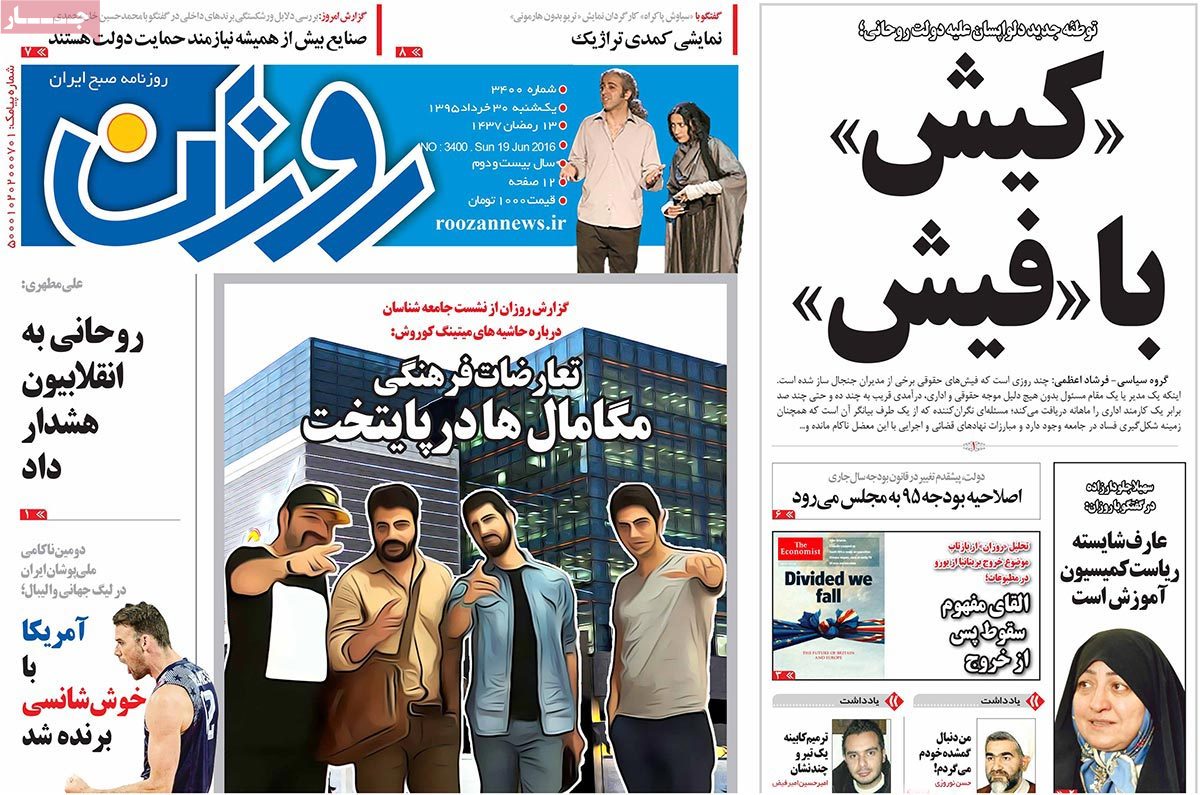
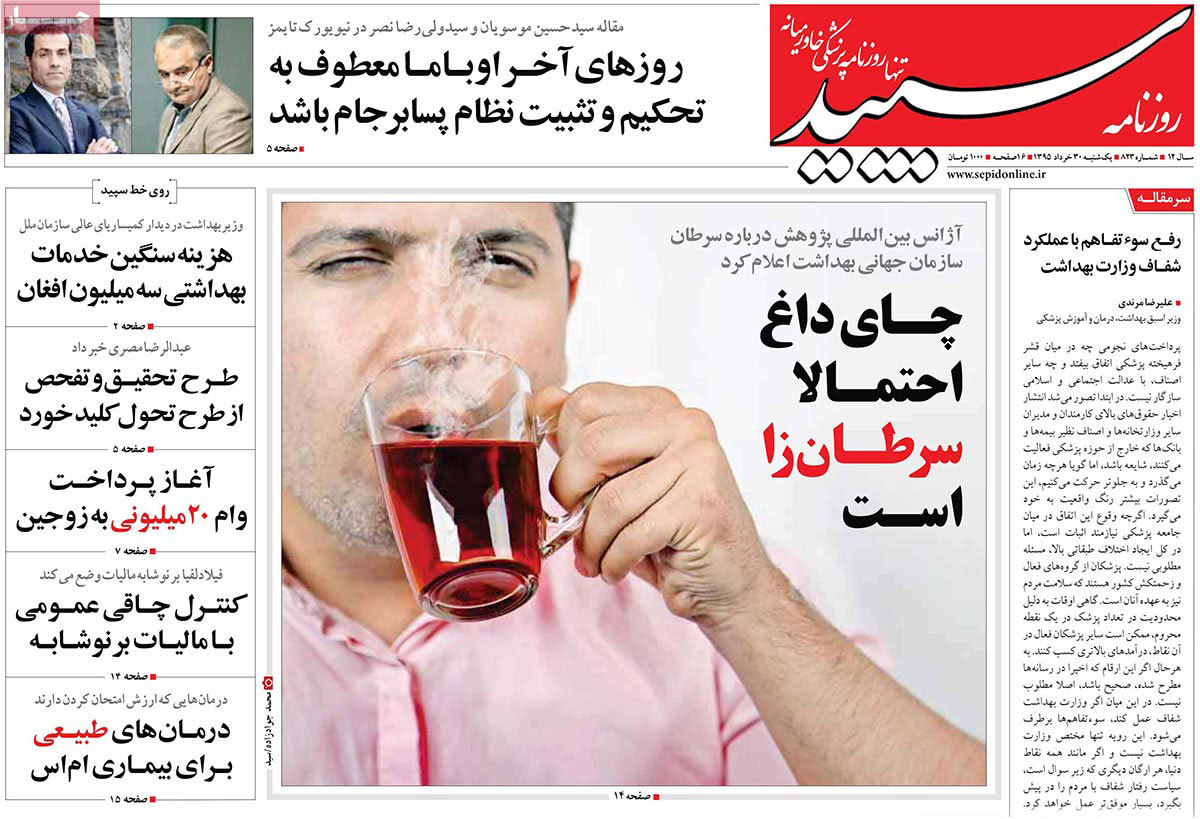
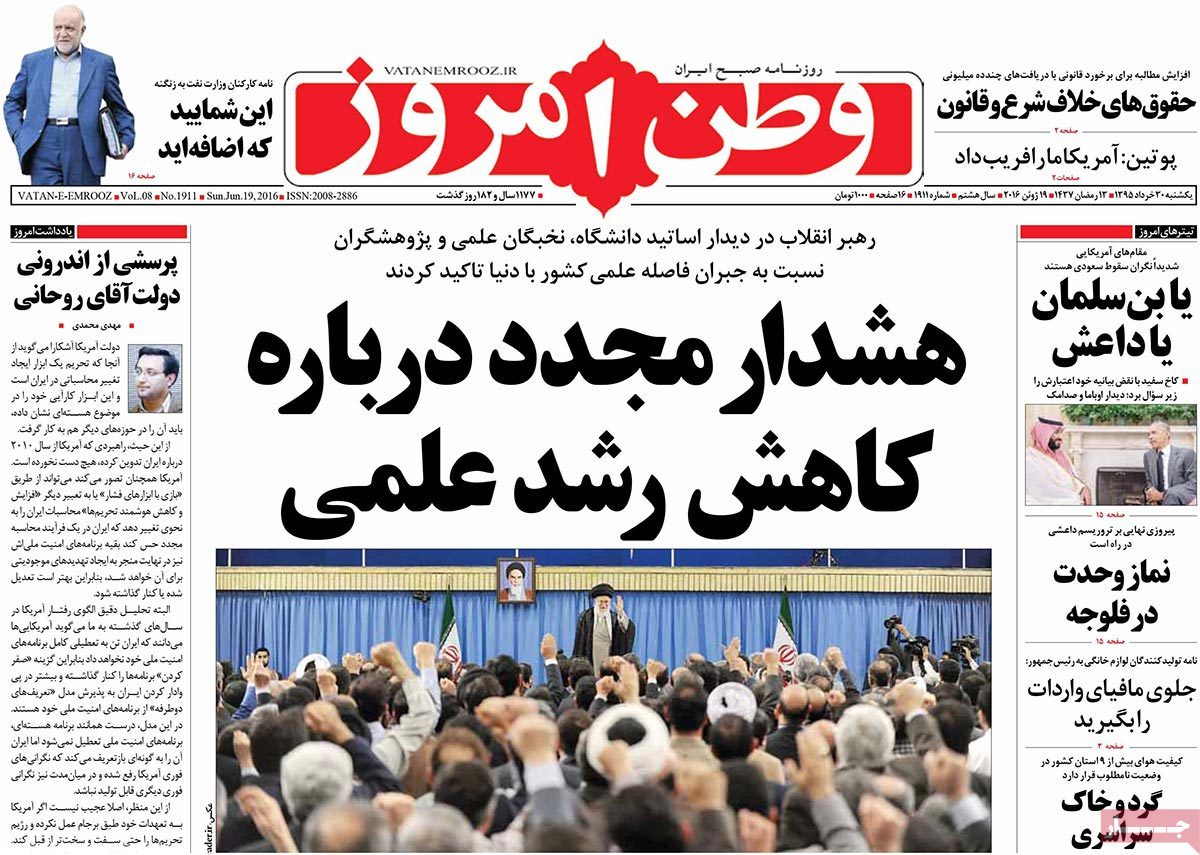
A Look at Iranian Newspaper Front Pages on June 19

Iran Newspaper front pages

The astronomical salaries given to certain executives, as well as their paycheques leaked by certain websites, have remained a top story in many newspapers on Sunday.

Leader of the Islamic Revolution, Ayatollah Seyyed Ali Khamenei, met a group of academics and students. During the meeting, the Leader underlined the need for accelerated scientific growth, which was reported by many outlets today.

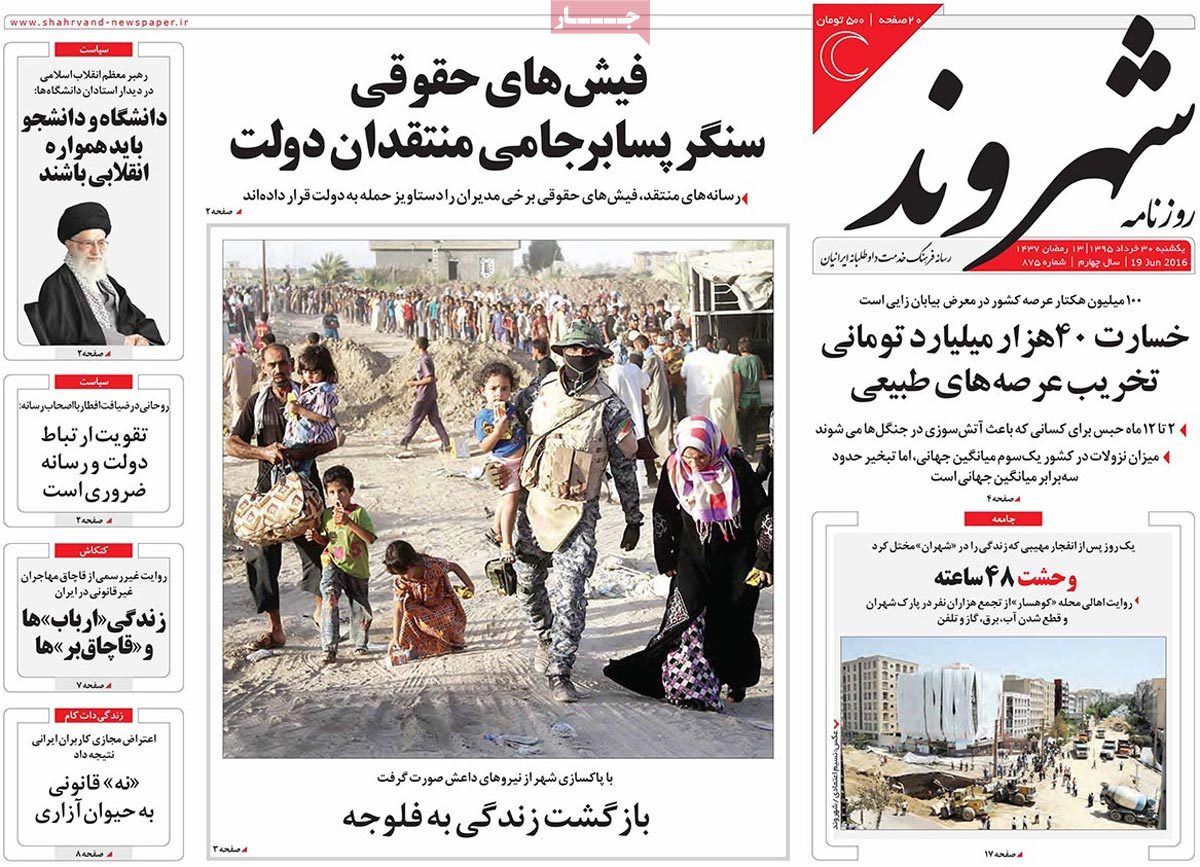
The recent liberation of the Iraqi city of Fallujah, and the subsequent push to retake Mosul was also widely covered.


Abrar:

1- Fallujah Returned to Iraq: PM

2- Obama Confers with Saudi King’s Son on Iran

3- Sale of 100 Passenger Planes to Iran Hinges on US Administration’s Approval: Boeing to Congress

A Look at Iranian Newspaper Front Pages on June 19


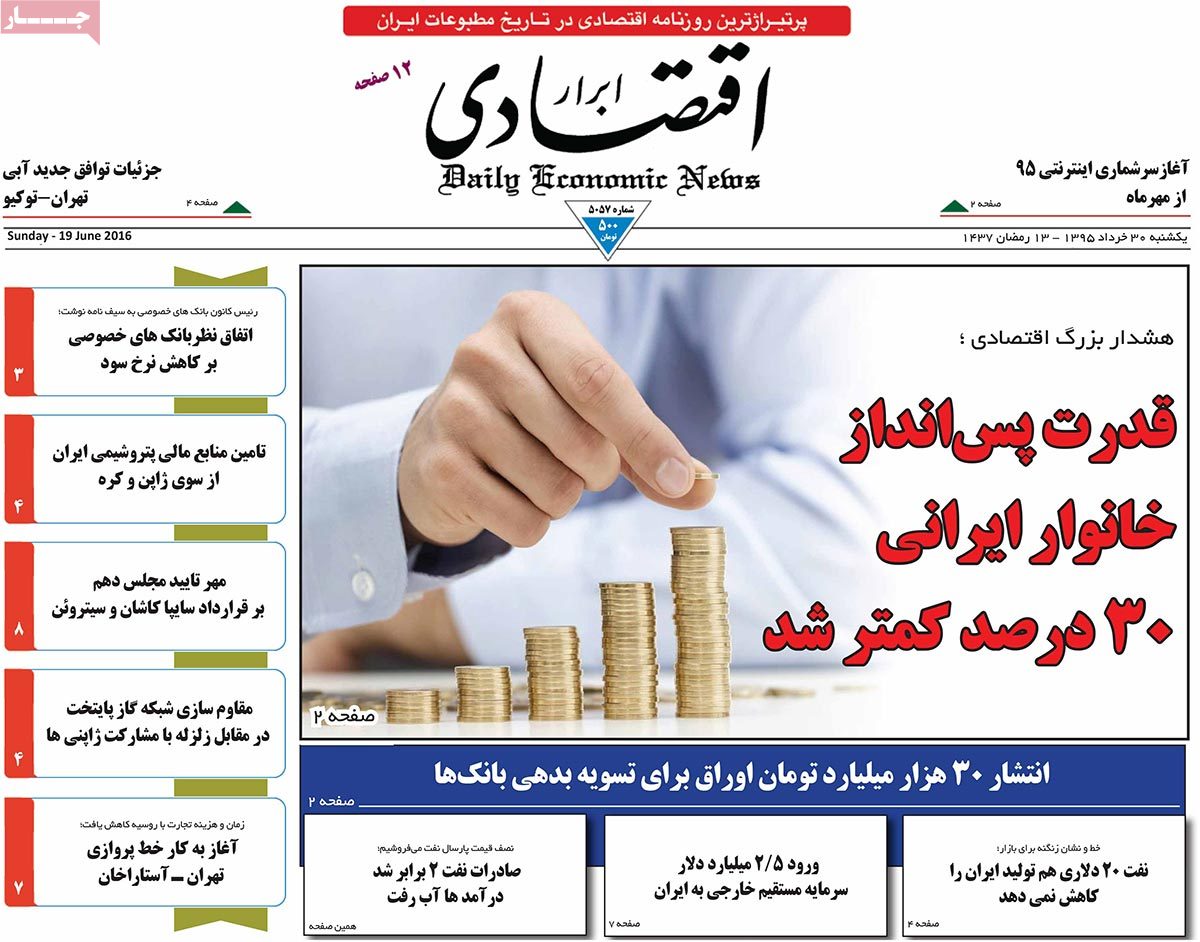
Abrar-e Eqtesadi:

1- 30% Decrease in Iranian Families’ Power to Save Money

2- Details of New Water Agreement between Iran and Japan

3- Japan and Korea to Fund Iran’s Petchem Projects

4- $2.5bn of Direct Foreign Investment Made in Iran

5- Tehran’s Gas Network to Be Retrofitted by Japan

A Look at Iranian Newspaper Front Pages on June 19


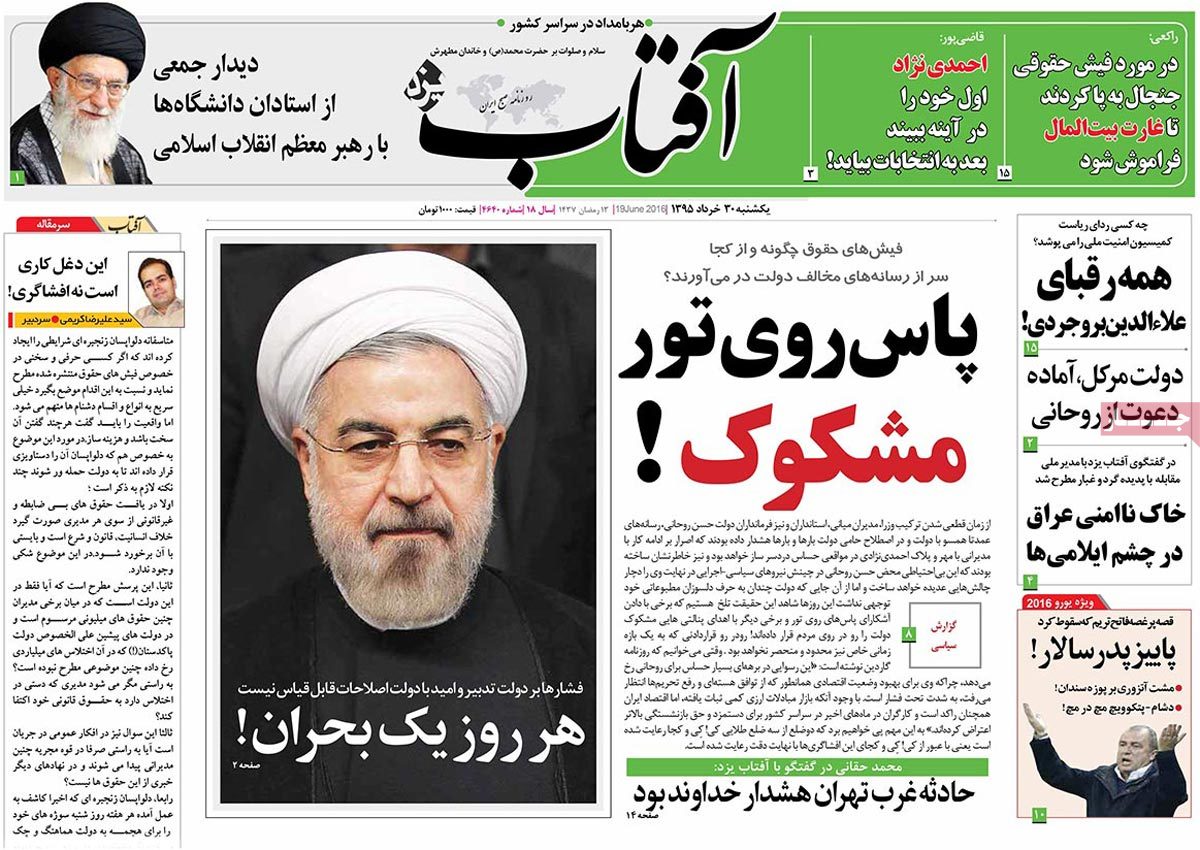
Aftab-e Yazd:

1- How Did Paycheques Leak to Anti-Gov’t Media?

2- Ahmadinejad Should Look at Himself in the Mirror before Running for Presidency: MP

3- Merkel’s Gov’t Ready to Invite Rouhani to Visit Germany

4- Another Crisis Every Day: Increasing Pressure on Rouhani Administration

5- Dust of Iraq’s Insecurity in the Eyes of Iranian People in Ilam Province

A Look at Iranian Newspaper Front Pages on June 19


Arman-e Emrooz:

1- Bahonar Will Be Rouhani’s Rival in Next Year’s Presidential Votes: Politician

2- Power Structure in US Wants Clinton: Analyst

3- Western Sources Claim: Beginning of Iran-US Compromise in Syria?

A Look at Iranian Newspaper Front Pages on June 19


Asia:

1- $8bn Foreign Investment to Arrive in Iran

2- Iran and Russia Mulling Joint Manufacture of Su-100 Superjets

3- After Pressure of Economic Bodies: Merkel to Invite Rouhani to Visit Germany

4- Iran’s Pace of Global Oil Market Return Surprised Everyone: Minister

5- Iran’s Kerman and Ukraine’s Kharkiv Sign Sisterhood Agreement

6- France and Italy to Build Universities in Iran

A Look at Iranian Newspaper Front Pages on June 19


Asrar:

1- Iran Won’t Decrease Its Oil Output Even If Oil Price Falls to $20: Minister

2- Iran Has Been a Good Host to Refugees: Zarif

3- Iran’s Oil Exports Doubled

4- Iraq Is Origin of Recent Dust Pollution: Ebtekar

5- Parliament’s Plan to Prevent Payment of Huge Salaries

A Look at Iranian Newspaper Front Pages on June 19


Ebtekar:

1- Bombarding This Gov’t Using Astronomical Paycheques Authorized by Past Ones

2- Zarif to Visit Tashkent

3- Competition [between reformists and conservatives] for Presidency: This Time in Specialized Parliamentary Commissions

4- “Crisis Management” in Capital City

A Look at Iranian Newspaper Front Pages on June 19


Etemad:

1- Oil Minister’s Message to Global Markets: Decrease in Oil Output, “Never Ever”

2- For Turkey, Kurds Are a More Serious Threat than ISIS: Diplomat

3- It’s Impossible to Control Iraq’s Dust: Environment Dept. Chief

A Look at Iranian Newspaper Front Pages on June 19


Ettela’at:

1- We’ll Compensate for Scientific Underdevelopment with Efforts of Talented Young People: Leader

2- US Deceived Russia by Claiming that Iran Was a Nuclear Threat: Putin

3- Parliament Develops Plan to Regulate Payment System [to avoid astronomical salaries]

A Look at Iranian Newspaper Front Pages on June 19


Ghanoon:

1- We Need to Speed Up Scientific Growth Today: Leader

2- Water Transfer from Caspian Sea to Central Iranian Province of Semnan Won’t Solve Its Problems

A Look at Iranian Newspaper Front Pages on June 19


Haft-e Sobh:

1- $6bn Turnover in Home Appliances Market

A Look at Iranian Newspaper Front Pages on June 19


Hamshahri:

1- No Change in Iran’s Policy towards Syria: Zarif

2- Parliament to Discuss a Plan to Limit Salaries of Executives to $2,900

A Look at Iranian Newspaper Front Pages on June 19


Jame Jam:

1- Astronomical Salaries to Be Returned to Public Funds

2- Fallujah Operation, a Successful Model

3- Failure of Anti-Iran Coalition in Region

A Look at Iranian Newspaper Front Pages on June 19


Javan:

1- Bonus Scandal: Oil Executive Who Worked Only 1 Hour a Day Received a $17m Bonus

2- Int’l Bodies Acknowledge Iran’s Abundant Aid to 3m Afghan Refugees

3- Putin: US Destroys 70-Year-Old Strategic Balance

A Look at Iranian Newspaper Front Pages on June 19


Jomhouri Eslami:

1- Leader Calls for Acceleration of Iran’s Scientific Growth

2- After Fallujah, It’s Time to Liberate Mosul: Iraqi Leaders

3- Yemen Quagmire Deepens

4- Lion’s Share of Iran’s Quota Restored in Global Oil Market

A Look at Iranian Newspaper Front Pages on June 19


Kayhan:

1- Iraqi Popular Forces: We Cut off the Viper’s Head [by retaking Fallujah]

2- Iran Was Not a Nuclear Threat, America Deceived Us: Putin

3- Israel Has Apparently Joined Arab-Sunni Coalition!

4- Iran Joins Manufacturers of Laser-Guided Agricultural Machinery

A Look at Iranian Newspaper Front Pages on June 19


Khorasan:

1- Leader Outlines the Way to Prevent Iranian Wall Street

2- Rafsanjani: I Don’t Seek Leadership Council [rather than a single Leader]

A Look at Iranian Newspaper Front Pages on June 19


Resalat:

1- Universities and Students Should Always Be Revolutionary: Leader

2- We’ve Prepared A Military Plan for Chasing Enemies Away

3- West and Al Saud Family Terrified of Seeing Takfiris’ Destruction

A Look at Iranian Newspaper Front Pages on June 19


Roozan:

1- Cultural Conflicts of Megamalls in Capital City

2- Cabinet Reshuffle: Hitting Several Targets with One Shot

A Look at Iranian Newspaper Front Pages on June 19


Sepid:

1- Drinking Hot Tea Might Lead to Cancer

2- Obama’s Last Days Should Be Spent on Strengthening and Stabilizing Post-JCPOA System: New York Times

3- Heavy Costs of Giving Health Services to 3m Afghan Refugees: Minister

A Look at Iranian Newspaper Front Pages on June 19


Shahrvand:

1- Critics of Gov’t Using Certain Astronomical Salaries as Pretext to Attack Rouhani Administration

2- 2-12 Months of Jail for Those Who Cause Forest Wildfires

3- Life Returns to Fallujah

4- Online Campaigns of Iranian Users Worked: Legal “No” to Animal Abuse

A Look at Iranian Newspaper Front Pages on June 19


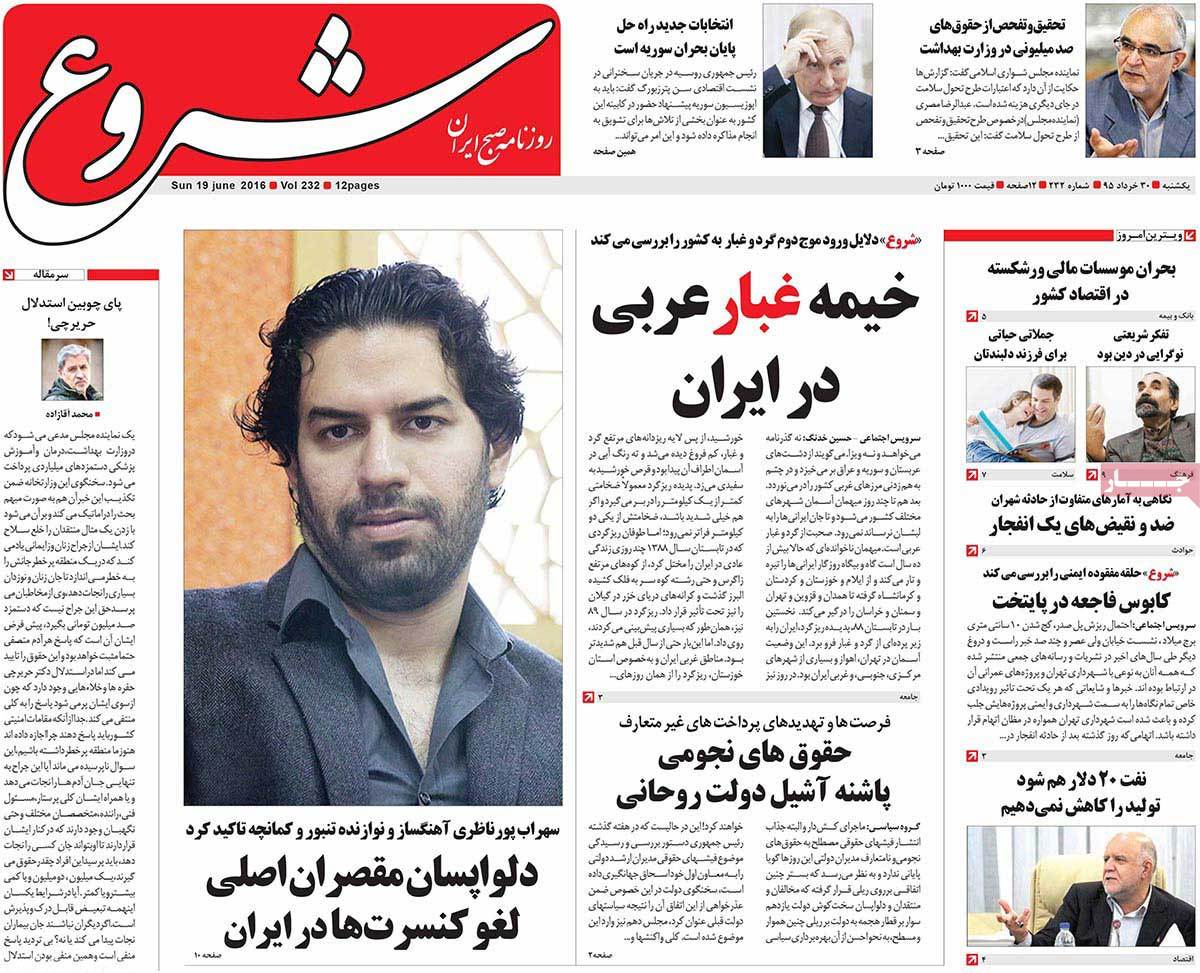
Shorou:

1- Astronomical Salaries, the Achilles’ Heel of Rouhani Gov’t

2- Why Arab Dust Arrived in Iran

3- Nightmare of Disaster in Capital

A Look at Iranian Newspaper Front Pages on June 19


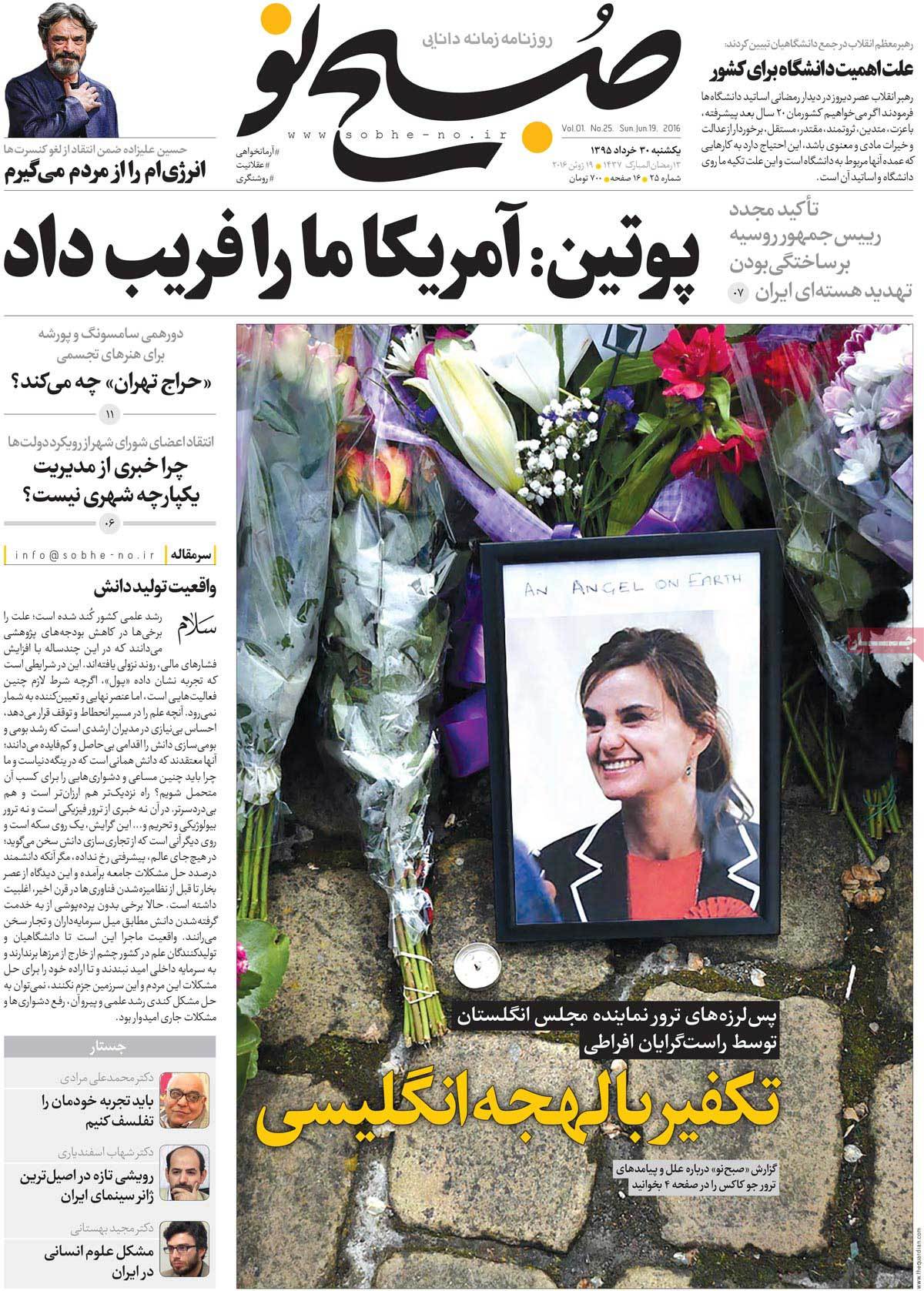
Sobh-e Now:

1- Putin Says US Deceived Russia: Russian Pres. Again Stresses that Iran’s Nuclear Threat Was Fabricated

2- What Does “Tehran Auction” Do? Gathering of Samsung and Porsche for the Visual Arts

3- Takfir in a British Accent: Repercussions of British MP’s Killing by Radical Right-Wingers

A Look at Iranian Newspaper Front Pages on June 19


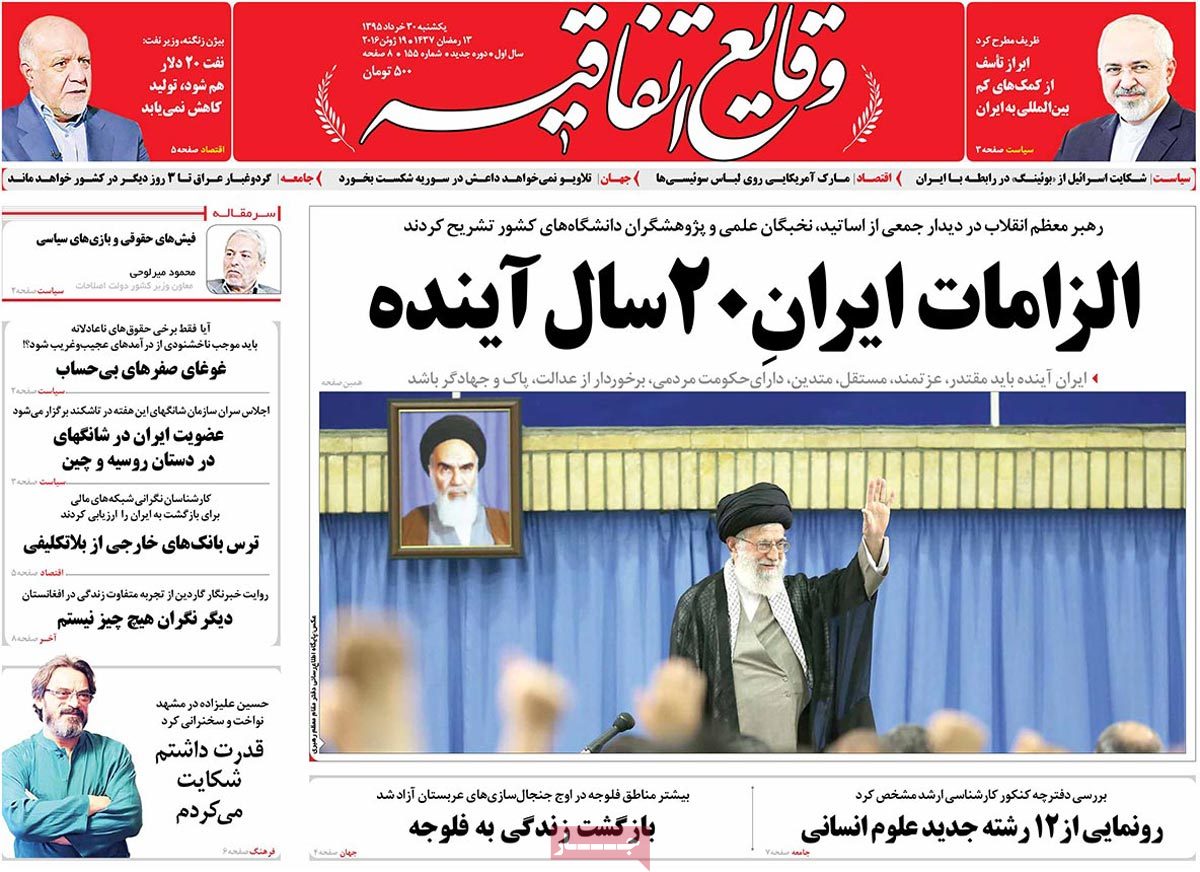
Vaghaye Ettefaghieh:

1- Leader Outlines the Country’s Requirements in Next 20 Years

2- Zarif Expresses Regret over Inadequate Int’l Help for Iran [on refugees]

3- Iran’s Accession to Shanghai Cooperation Organization in Hands of China and Russia

4- Paycheques and Political Games

A Look at Iranian Newspaper Front Pages on June 19


Vatan-e Emrooz:

1- Leader Once Again Warns against Decrease of Scientific Growth

2- [Exorbitant] Salaries against Law and Sharia

3- Obama’s Meeting with the Little Saddam [Mohammed bin Salman]: White House Ruins Its Credibility by Violating Its Own Statement

4- Either Prince Mohammed or ISIS: US Officials Seriously Concerned about Fall of Saudi Arabia

4- Prayers for Unity in Fallujah: Final Victory over ISIS Is Near

A Look at Iranian Newspaper Front Pages on June 19

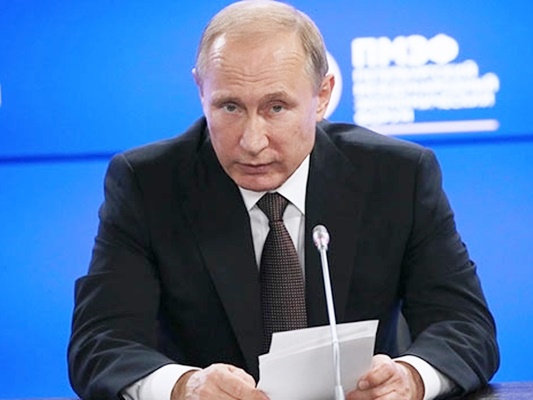
Putin: Iran Has No Nuclear Threat, Americans Fooling Us

Putin

Putin said the US missile defence system being deployed in Europe has the potential of being used as an offensive system, and may be used against the Russian Federation, TASS reported.

“There’s no [nuclear] threat [from Iran], and the missile defence system [in Europe] is still being built, so we were right when we said they were deceiving us, they were not sincere with us referring to the alleged Iranian nuclear threat during the construction of the missile defence system,” Putin said.

“It is actually like this – they tried to deceive us once again,” he said at a meeting with the heads of global information agencies.

“We know approximately which year the Americans will get a new missile that will have a range of not 500km but more, and from that moment they will start threatening our nuclear potential. We know what will be going on, year-by-year. And they know that we know,” Putin underscored.

He stated that the United States, “Despite all our objections, all our proposals on real cooperation, does not want to cooperate with us, rejects our proposals and acts in accordance with its own plans.”

“You may believe me or not, but we have suggested specific variants of cooperation, they have really all been rejected,” Putin said.

He recalled that missile defence system elements had been built in Romania. “What have they constantly said? “We need to protect ourselves from Iran’s nuclear threat.” Where’s the Iranian nuclear threat? There’s none!”

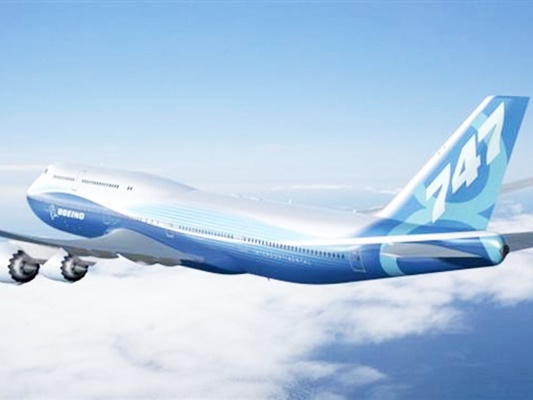
Iran and Boeing Seal Deal for 100 Planes

c0671ae9-2607-4d86-8e69-f7fa5783fcca

Head of Iran’s Civil Aviation Organization (CAO) Ali Abedzadeh told Iran Daily that the deal, which will hand over the planes to Tehran through financing, now awaits US government approval.

“We have 250 planes in the country, 230 of which need to be replaced,” said Abedzadeh, adding that there could be no precise timeline for the contract without US Treasury permission.

He said the reported value of $17 billion for the contract was not final and that more details will be provided after further negotiations.

Boeing confirmed on Wednesday that it was in talks with Iranian airlines interested in buying its passenger planes, according to AFP. The company has requested final authorization from the US Treasury for the sale of aircraft to Iran, Abedzadeh noted.

In February, the American company was granted approval from the US government to explore resuming sales to Iran after US sanctions were partially lifted in January following a deal on Tehran’s nuclear program.

In January, Iran signed a major deal worth $27 billion with aviation giant Airbus to purchase 118 planes from the company.  The deal with Airbus was sealed during a state visit to Paris by Iran’s President Hassan Rouhani.

That agreement is still pending permission from the US Treasury. Airbus needs the approval of OFAC (the US Office of Foreign Assets Control) because more than 10% of Airbus components are of American origin.

Apart from Airbus and Boeing, Iran is also negotiating with several other global aviation giants over the purchases of planes including Bombardier and Embraer.

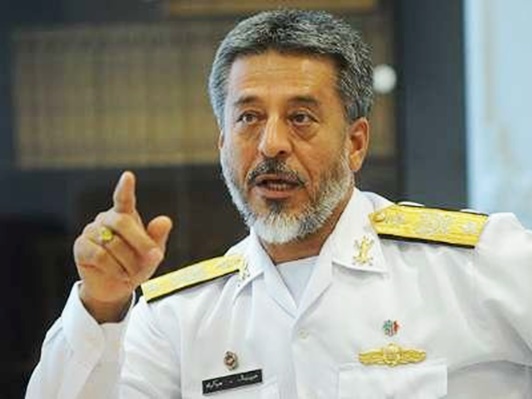
Navy Planning to Extend Presence to Atlantic Waters

Habibollah Sayyari

Speaking to reporters on Saturday June 18, Rear Admiral Habibollah Sayyari highlighted the presence of Navy flotilla 41 in the Gulf of Aden, saying “Iran’s Navy will provide security for ships backed by Iran.”

Underlining that the Navy is equipment-based, he highly praised the attempts to advance knowledge and the equipment for the Navy in line with its strong presence in international waters.

Sayyari underlined that all the equipment and facilities used by the Navy are now home-made, adding, “In addition to the domestic equipment, Iranian Navy is also self-sufficient in education and human resources.”

Noting that education in Iran’s Navy meets global standards, Sayyari said that before the Islamic Revolution, all Navy personnel had to study abroad, however today, in addition to specialized training in the country, other countries also call on Iran to train their personnel.

He spoke of the Caspian Sea as a sea of peace and friendship among the five neighbouring countries, saying, “Caspian security should be provided by the five countries so that no foreign country would even desire a presence there.”

Rear Admiral Sayyari, insisting that the friendly relations between the Caspian littoral states increases the level of security in addition to strengthening the connection between the navies of these countries, said “Establishing fishing and fishery areas, trade, traffic, preventing smuggling, protecting the environment and preventing pollution require security in all aspects.”

Rouhani to Sharif: Iran Welcomes Improved Pakistan Relations

Rouhani

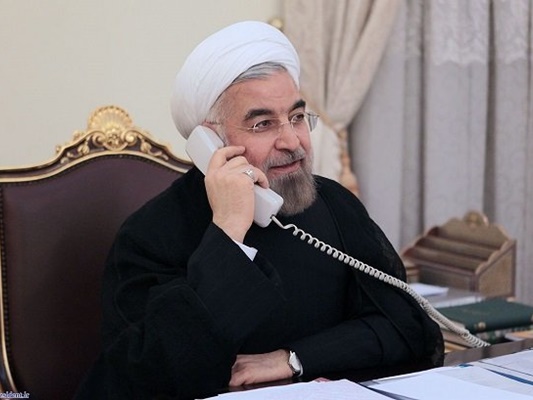
President Rouhani spoke to Nawaz Sharif, Pakistan’s Prime Minister, over the phone on Saturday evening to sympathize with him in his recover from a surgery operation. “Pakistan is a friend and a neighbour with whom Iran has common interests in the region; Tehran-Islamabad relations have been strengthened thank to Your Excellency’s wise policies and statecraft,” Rouhani praised the recovering prime minister.

Nawaz Sharif, for his part, reaffirmed that Pakistan would stand with Iran in the international community and welcomed broader bilateral relations, saying, “For us, Iran is a second home and Islamabad welcomes extending relations with Tehran in all fields of bilateral interest.”