Tuesday, December 30, 2025
Home Blog Page 3916

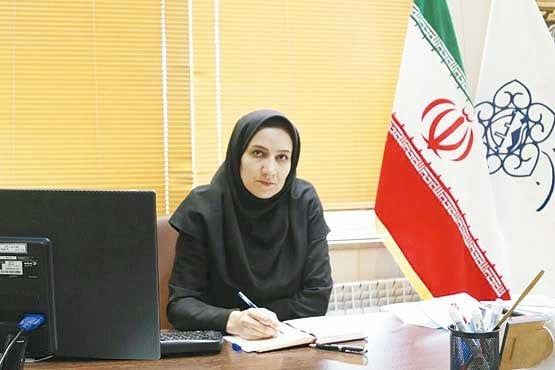
Iran Gets Its 12th Woman Mayor

Iran’s twelfth female mayor was elected for the city of Zanjan, further paving the way for women to reach high managerial posts in the country.

Samaneh Shaaddel has taken the helm of affairs in District Two of the city. She used to be in charge of traffic and transportation affairs at Zanjan Municipality for four years before assuming his recent position. She has also served as the deputy mayor of Zanjan for cultural affairs.

She managed to be elected as the mayor thanks to her competence and experience, according to a Farsi report by the Jame Jam Online news website.

She holds a Master’s degree. She is married and has a 9-year-old daughter. However, her family responsibility has not kept her from making progress; rather, as she herself says, her family has been her biggest supporter and motivation for progress and development.

She is not the first woman to have assumed a top job in Iran. Qualified women have already been designated as deputy provincial governors, governors and mayors, further increasing women’s share of top managerial posts in the country.

Since the 1979 Islamic Revolution of Iran, 11 women (excluding Shaaddel) have served as mayors in the country so far. Shaaddel is the twelfth lady to have been picked as a mayor.

During the recent days, several other women were also picked as the heads of City Councils in such towns as Robat Karim in Tehran province and Gorgan in Golestan province.

Update: Shaaddel is said to have been removed by the new mayor of Zanjan shortly after the widespread reports about her! However, other female mayors have been appointed in other Iranian cities.

The 29-year-old university lecturer Mahna Mohammadi was recently elected as mayor of Spakeh, a town in southeastern province Sistan and Baluchestan with 40,000 population.

Shifteh Badr-Azar was also elected as the mayor of Sahand, a town in East Azarbaijan province.

Among other women elected as new heads of city councils are Setareh Fattahpour in city of Sardasht, Maryam Elahi-Sahar in Soosangerd, Zahra Hatami-Monfared in Mohajeran, Soosan Soleiman-Abadi in Kangavar, and Tahereh Karami in Varnamkhast.
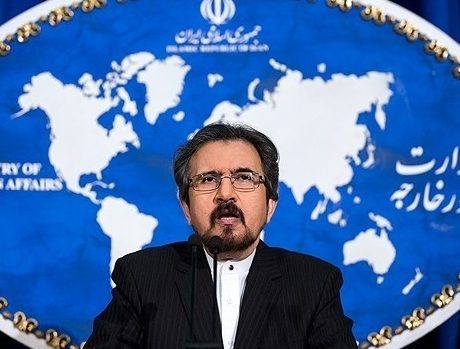

Iran Condemns Saudi Airstrike on Yemen Residential Area

In a statement on Wednesday, Iran’s Foreign Ministry Spokesman Bahram Qassemi strongly condemned the Saudi warplanes’ attacks on a dormitory in Arhab town of Sana’a Province, which left a number of civilians dead and wounded.

He also expressed sympathy with the bereaved families of the deadly attack’s victims.

Qassemi further urged the United Nations and other international organizations to step into the fray and address the slaughter of innocent civilians in Yemen by Saudi Arabia as soon as possible.

“Intensifying deadly attacks on residential areas and civilian targets in Yemen on the one hand and preventing the internationally responsible organizations from sending humanitarian aid to Yemenis on the other hand amount to the stark violation of international and humanitarian laws,” he noted.

He then called on the UN and key players in Yemen crisis to increase their efforts to pressurise Saudi Arabia into stopping its deadly attacks on Yemen and adopt necessary measures to provide security for civilians, particularly women and children in the country.

Iran, Germany to Expand Cooperation on Medicinal Plants

Iran and Germany have agreed to expand their cooperation in mechanization of planting and harvesting of medicinal plants as well as modernization of herbal pharmacy.

According to a Farsi report by the Young Journalists’ Club (YJC), the agreement was made during the meetings of specialized sub-committees of Iran-Germany Joint Agricultural Commission held in Berlin.

In these meetings, the two sides also exchanged views on herbal pharmacy as well as food production and agricultural issues.

On other hand, during the first joint symposium between Iran and Germany on medicinal plants held in Germany, the two sides also explored new ways to expand cooperation in medicinal plants.

On the sidelines of the symposium, Peyman Yousefi Azar, an official with Iran’s Agricultural Jihad Ministry who is also in charge of a national project on medicinal plants, held talks with Frank Marte, the head of JKL Institutes’ Medicinal Plants Department, on the policies as well as capacities and programs of the two sides in this field.

During the symposium, the German side also presented scientific and executive reports on the available capacities to expand cooperation in growing up medicinal plants including peppermint, asparagus.

Iran and Germany also agreed to hold another joint symposium next year between the private sectors of two sides to facilitate cooperation in medicinal plants.

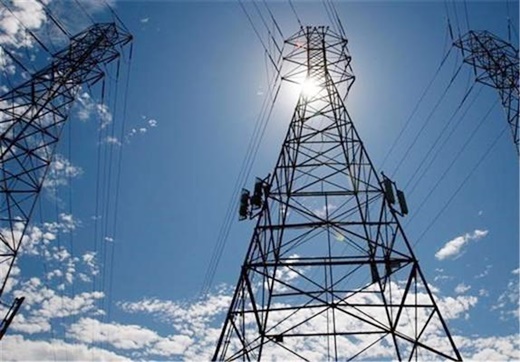
Iran Exporting Electricity to Eight Countries: Report

Power Plant and electricity

Iran, with an output capacity of around 73,000 megawatts of electricity, has secured a good status in the region as far as energy production is concerned.

Iran exported electricity to eight regional countries from 2010 to 2016. The biggest buyer of Iran’s electric power was Iraq with around 5,000 to 8,000 megawatts of electricity imports annually.

According to a Farsi report by the Mashregh News Agency, Turkey is the second biggest importer of electricity from Iran. The Islamic Republic sells up to around 2,400 megawatts of electricity to its northwestern neighbor annually. Iran’s electricity exports to Turkey rose considerably from 2010 to 2013.

Afghanistan ranks third when it comes to importing electricity from Iran. It imports less than a thousand megawatts of electricity on an annual basis. Its electricity imports rose from 2010 to 2014.

The other countries purchasing electric power from Iran are Pakistan, Nakhchivan Autonomous Republic, Armenia, and Turkmenistan.

Lebanese Cleric Hails Iran’s Role in Uniting Muslim States

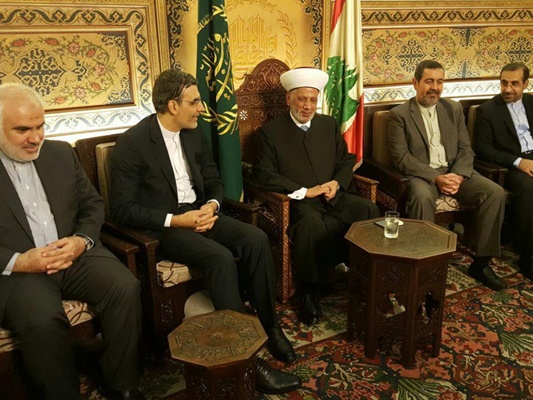
Speaking in a Wednesday meeting with Iran’s Deputy Foreign Minister for Arab and African Affairs Hossein Jaberi Ansari in Beirut, Qabalan referred to the Islamic Republic of Iran as a guarantee for the Muslim world and a chain linking Islamic societies to each other.

“While others have left the scene, we pin our hope on the Islamic Republic of Iran,” he added.

In turn, Jaberi Ansari commemorated Imam Musa al-Sadr, the founder of the SISC, and praised the valuable role and position of Sheikh Qabalan in continuing the Council’s noble path.

Iran’s Persepolis Shares Spoils with Saudi Side in ACL Quarters

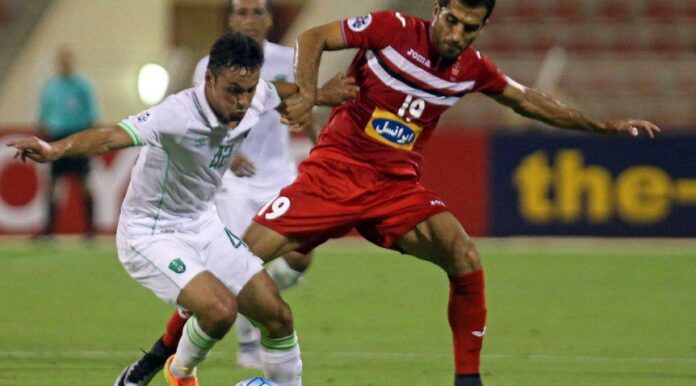
A late equaliser by substitute Godwin Mensha saw Persepolis come from two goals down to draw 2-2 with Saudi Arabia’s Al Ahli in the first leg of their 2017 AFC Champions League quarter-final match held in Muscat, Oman.

Al Ahli took the lead after just two minutes at the Sultan Qaboos Sports Complex when Omar Al Soma slotted home the rebound after Persepolis keeper Alireza Beiranvand parried a shot from Saleh Al Jamaan into the Syrian striker’s path.

Shortly before the hour, recent signing Leonardo da Silva made it 2-0 for the Jeddah-based side by finishing off a pass from Al Jamaan with aplomb, before Persepolis pulled one back in the 72nd minute after Shojae Khalilzadeh headed home from close in.

With just six minutes remaining, Nigerian Mensha fired past Mohammed Al Owais in the Al Ahli goal to cap an excellent comeback for Persepolis and leave the tie firmly in the balance ahead of the second leg in Abu Dhabi in three weeks’ time.

Following the match, Persepolis coach Branko Ivankovic said that he is content with his team’s performance against Al Ahli.

“I am happy because we came back from two goals down. Now, we have a chance to book a place in the competition’s semis,” Branko said in the post-match news conference.

“As I’ve already said, Al Ahli is a dangerous team and takes advantage of players like Omar Al Soma and Leonardo da Silva,” the Croat added.

“I would like to thank my players because they didn’t lost their concentration after receiving two goals. I hope we defeat Al Ahli in the second leg,” Branko concluded.

The Iranian giant will face Al Ahli three weeks later in the second leg in Abu Dhabi.

Lebanon’s Grand Mufti Blasts Muslim World’s Silence on Israeli Crimes

In a Wednesday meeting with an Iranian diplomat in Beirut, Sheikh Derian referred to the Israeli regime as one of the major dangers threatening the Muslim world, and said, “Unity and solidarity among followers of Islamic sects and regional countries is the [only] way to counter these threats.”

“Our brothers and sisters in Palestine and al-Quds are under the Zionist regime’s inhumane attacks while, unfortunately, we in Islamic countries are busy with our disagreements,” the top Sunni cleric went on to say.

“The terrorist and Takfiri groups seek to remove and exclude others, and intend to spoil the bright face of Islam and Prophet Muhammad (PBUH) through their dark thoughts and actions,” he warned.

Iranian Deputy Foreign Minister Hossein Jaberi Ansari, for his part, said two major dangers are currently threatening the Muslim world and regional countries.

“The first danger is the old threat of the Zionist regime and its state-sponsored terrorism, and the second one is terrorist and Takfiri [extremist] groups,” the Iranian diplomat noted, highlighting the great responsibility of top clerics in countering both threats.

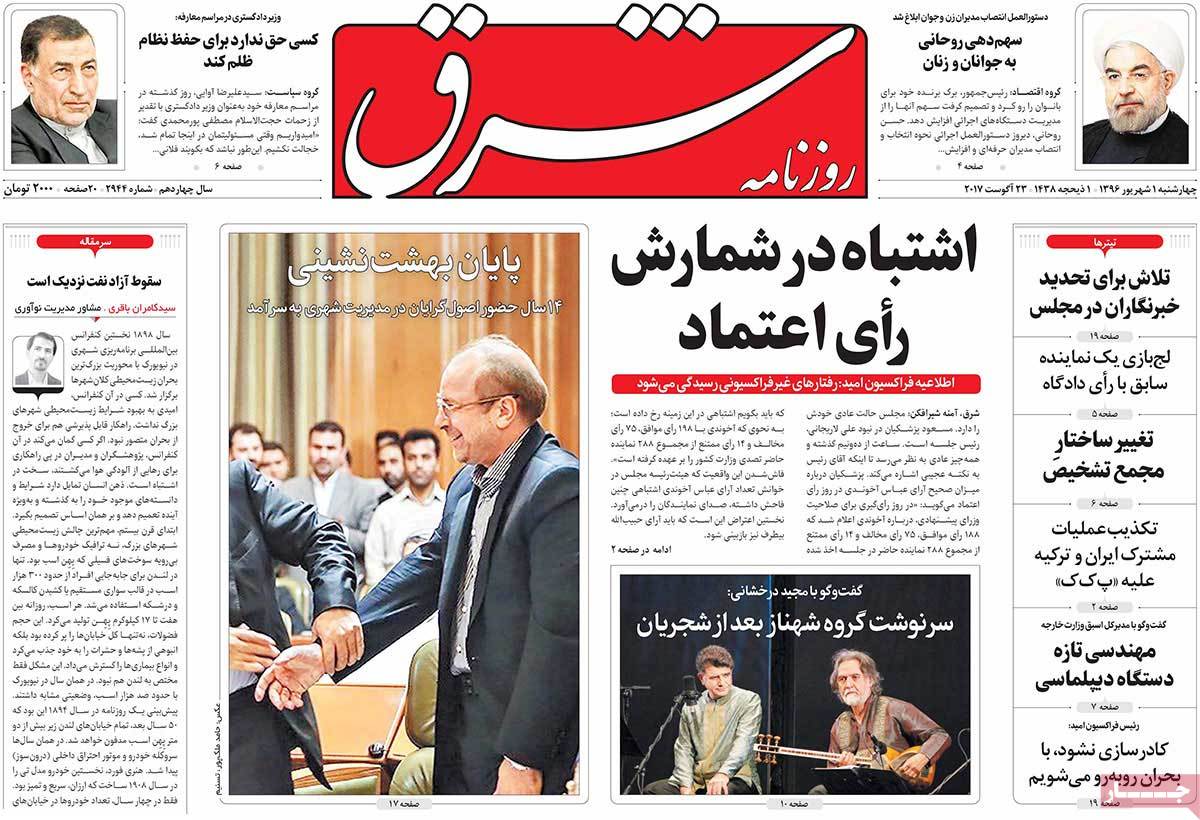
A Look at Iranian Newspaper Front Pages on August 23

The top story today was the remarks made by Iran’s nuclear chief Ali Akbar Salehi who threatened that if other parties to the nuclear deal violate it, Tehran would resume its %20 uranium enrichment in five days.

US President Donald Trump’s new strategy on Afghanistan also received great coverage.

The Iraqi forces’ ongoing operation to retake the city of Tal Afar from ISIS terrorists was also among the top stories in today’s newspapers.

The above issues, as well as many more, are highlighted in the following headlines and top stories:


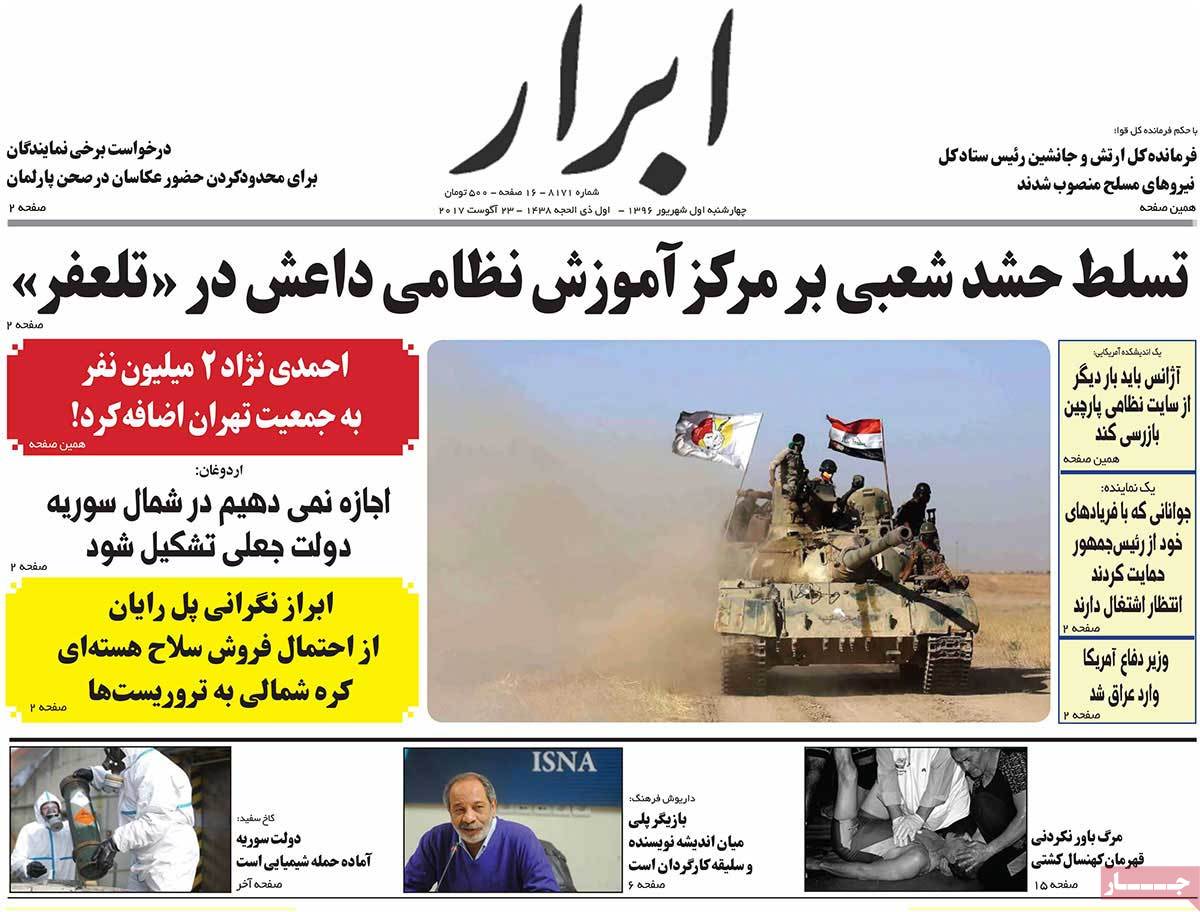
Abrar:

1- Iraqi Popular Forces Take Control of ISIS Military Training Centre in Tal Afar

2- Erdogan: We Won’t Let Formation of Fake Gov’t in Northern Syria

3- MP: Young Supporters of Rouhani Expect Him to Give Them Job

A Look at Iranian Newspaper Front Pages on August 23 - abrar


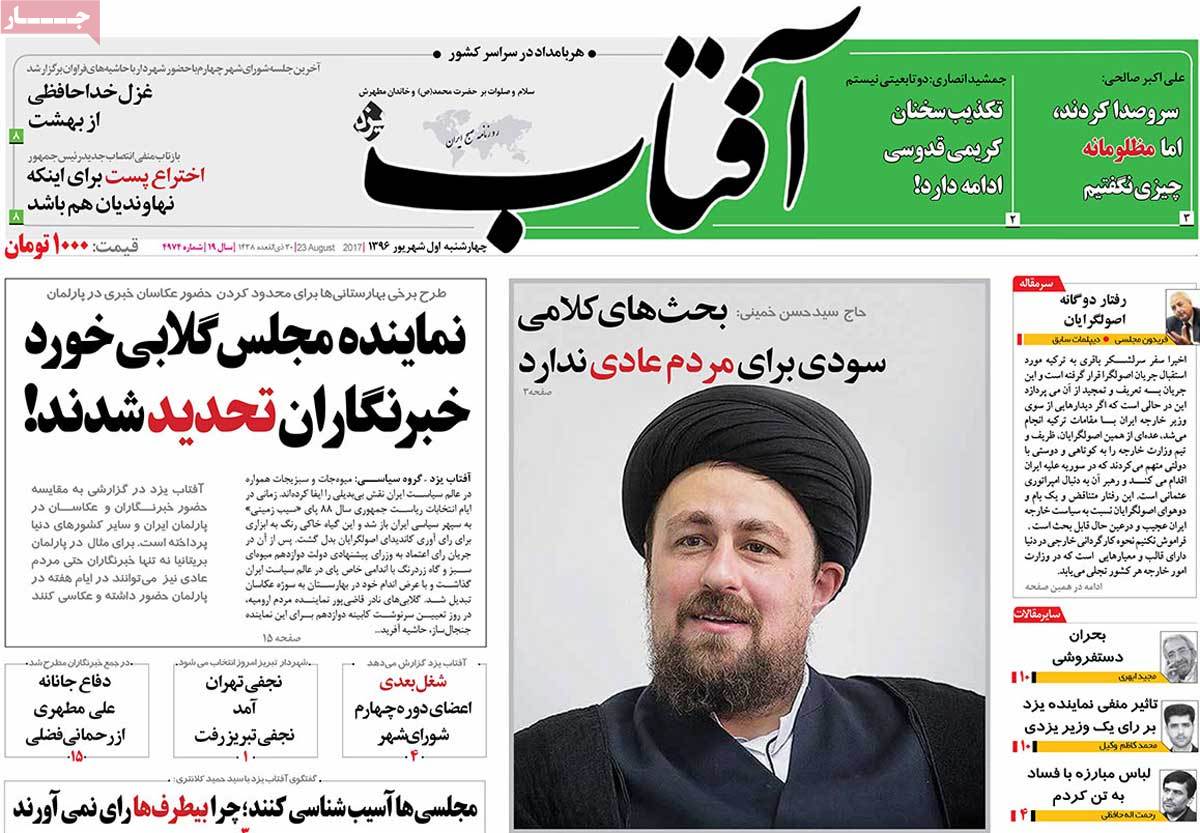
Aftab-e Yazd:

1- MP Eats Pear in Open Session, Photographers Are Restricted!

  • Certain MPs Planning to Limit Photojournalists’ Presence in Parliament

A Look at Iranian Newspaper Front Pages on August 23 - aftab


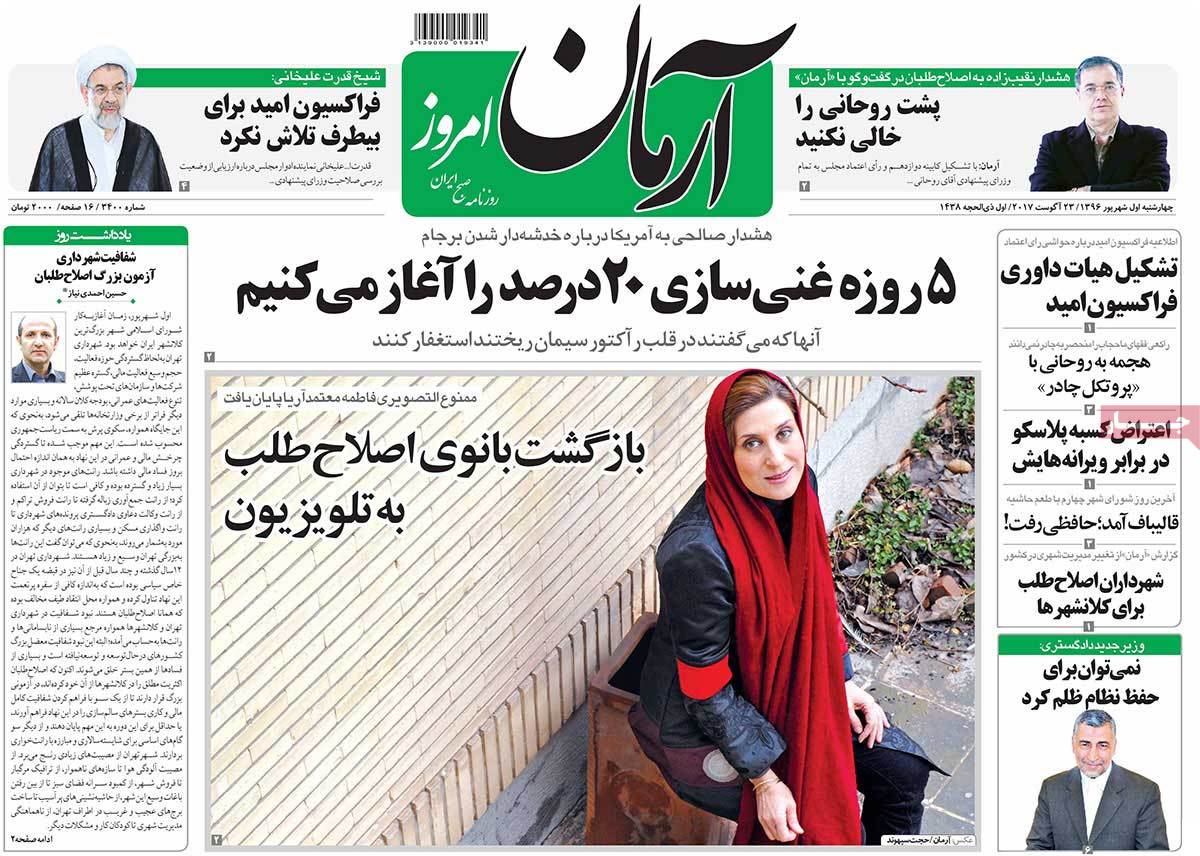
Arman-e Emrooz:

1- Iran Nuclear Chief Warns US against Spoiling JCPOA

  • Iran to Restart 20% Enrichment in 5 Days

A Look at Iranian Newspaper Front Pages on August 23 - arman


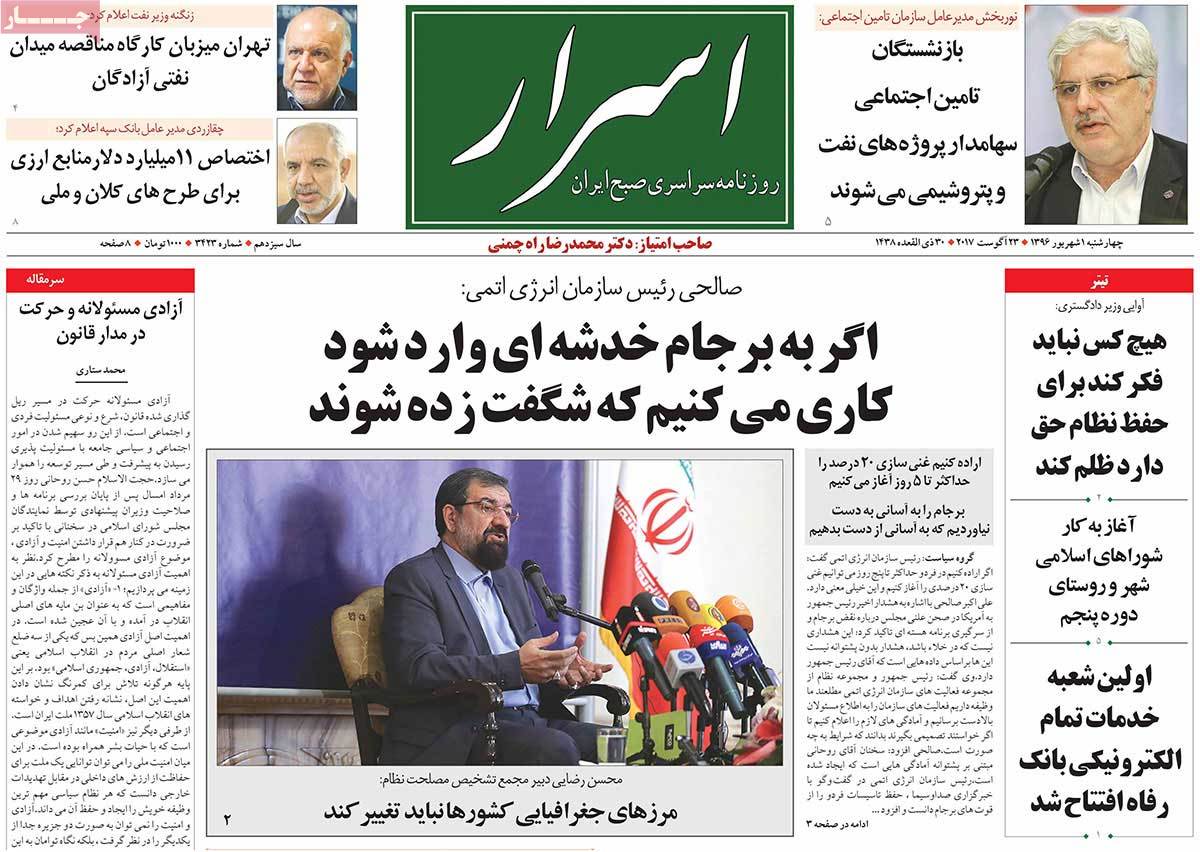
Asrar:

1- Nuclear Chief: Iran to Surprise Other Party If JCPOA Spoiled

2- Official: Geographical Boundaries of Countries Shouldn’t Change

3- Oil Minister: Tehran to Host Briefing on Azadean Oilfield Tender

A Look at Iranian Newspaper Front Pages on August 23 -asrar


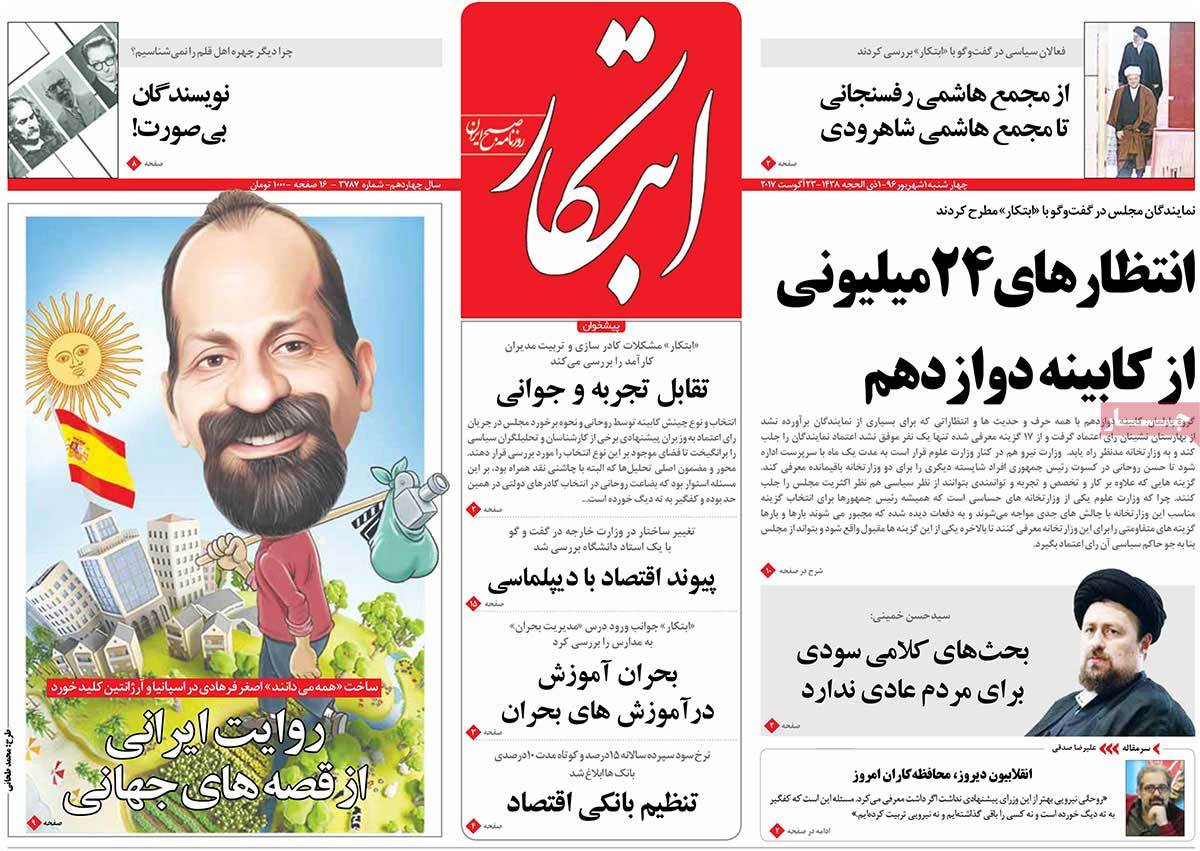
Ebtekar:

1- Iranian Version of Universal Stories

  • Farhadi Starts Filming ‘Everybody Knows’ in Spain, Argentina

A Look at Iranian Newspaper Front Pages on August 23 - ebtekar


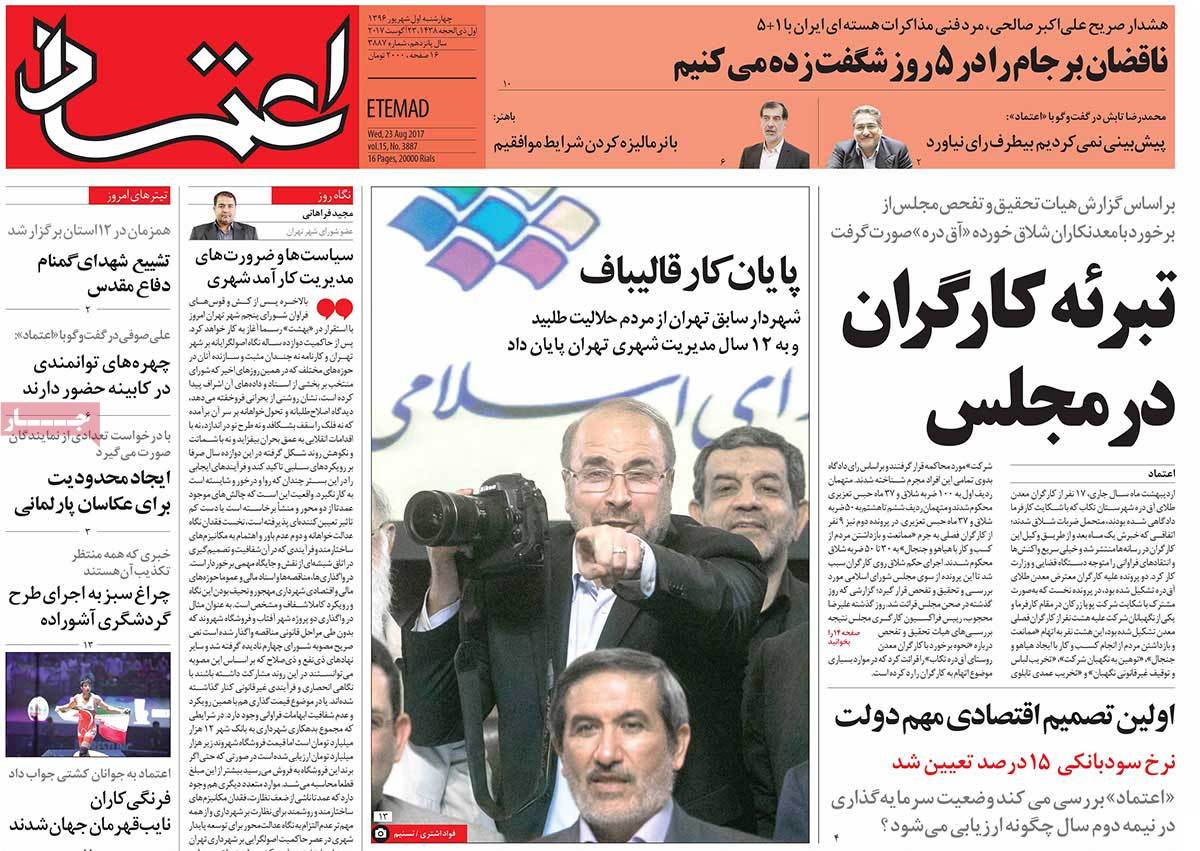
Etemad:

1- End of Qalibaf’s Work

  • Ex-Mayor of Tehran Asks for People’s Forgiveness after 12 Years in Municipality

2- Nuclear Chief Warns Iran May Restart Enrichment in 5 Days

A Look at Iranian Newspaper Front Pages on August 23 - etemad


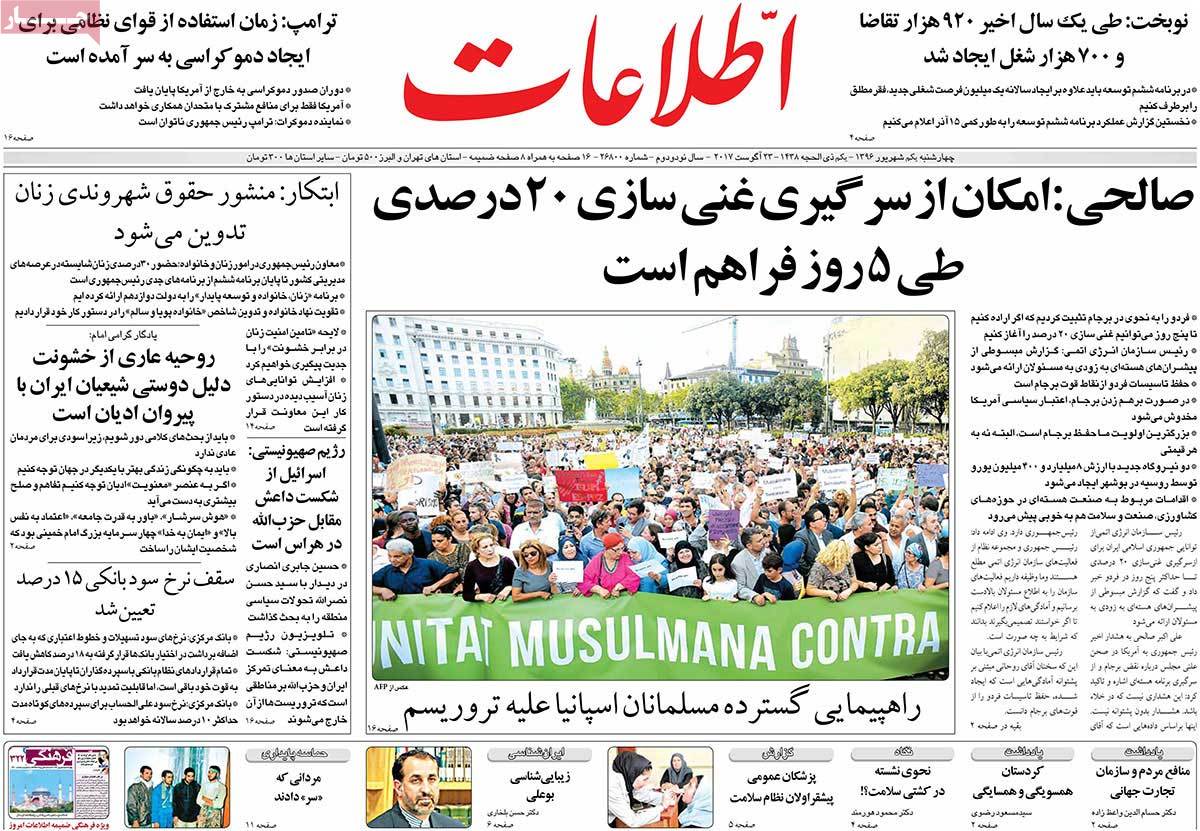
Ettela’at:

1- Nuclear Chief: Iran Can Resume %20 Enrichment in 5 Days

2- Ebtekar: Charter to Be Developed on Women’s Civil Rights

3- Violence-Free Spirit Reason for Iranian Shiites’ Friendship with Followers of Other Faiths

4- Trump: Time Is Over for Use of Military Forces to Create Democracy

A Look at Iranian Newspaper Front Pages on August 23 - etelaat


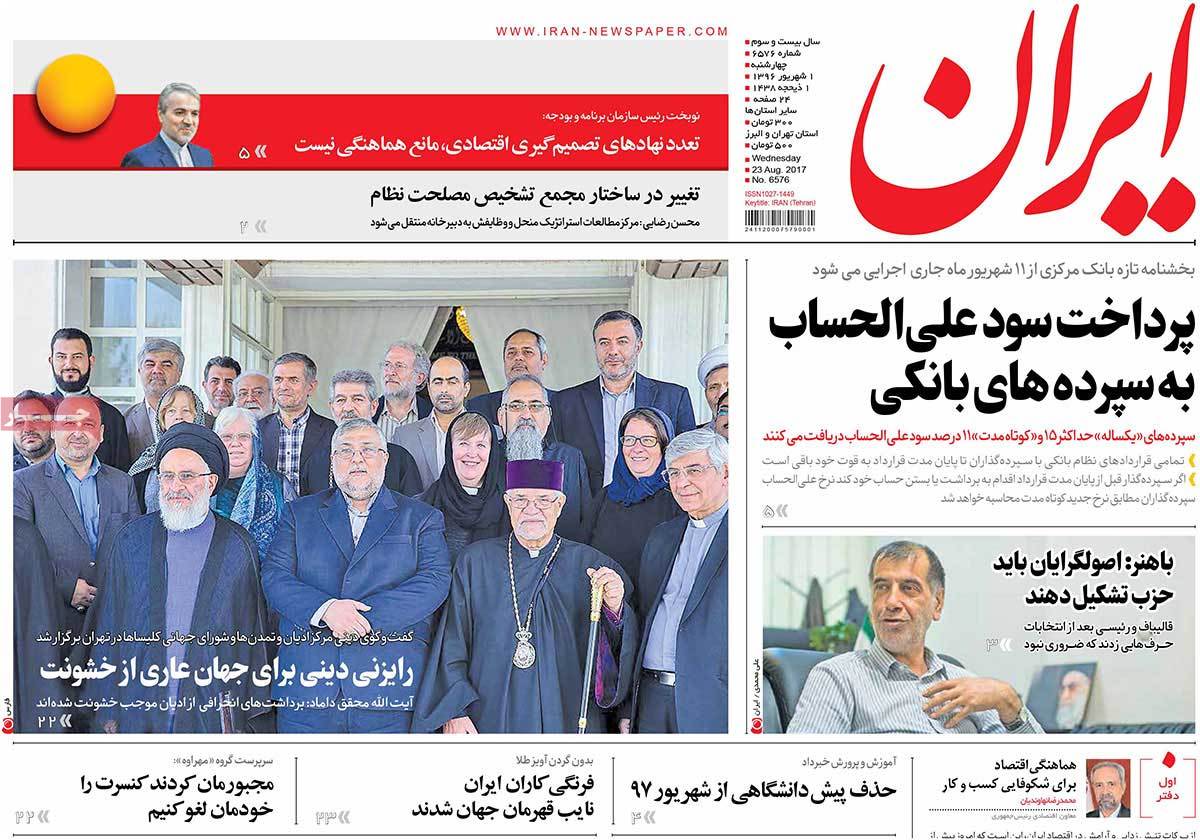
Iran:

1- Religious Consultation for World without Violence

  • Tehran Hosts Religious Dialogue between Centre of Religions, World Council of Churches

A Look at Iranian Newspaper Front Pages on August 23 - iran


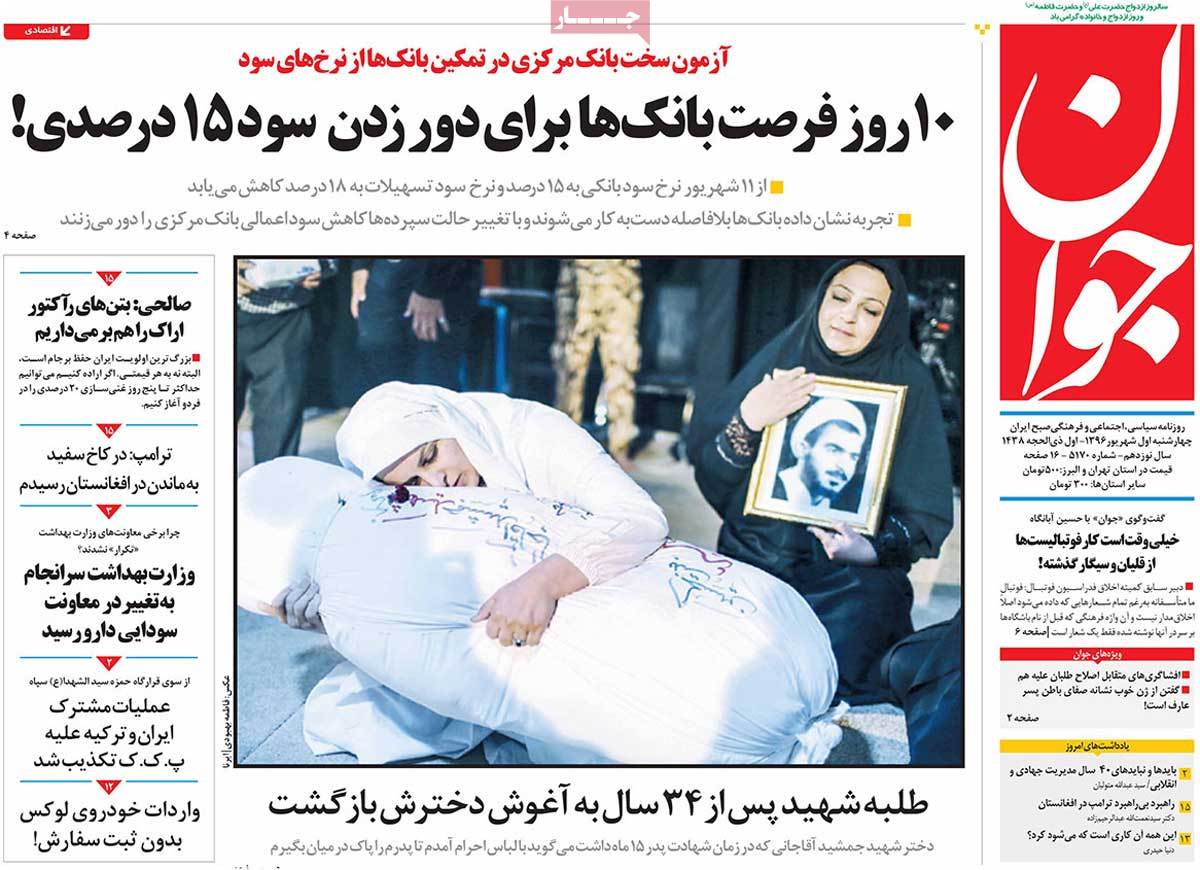
Javan:

1- Iran Nuclear Chief: We’ll Even Remove Arak Reactor’s Cement

2- Trump: I’ve Decided to Keep US Troops in Afghanistan

A Look at Iranian Newspaper Front Pages on August 23 - javan


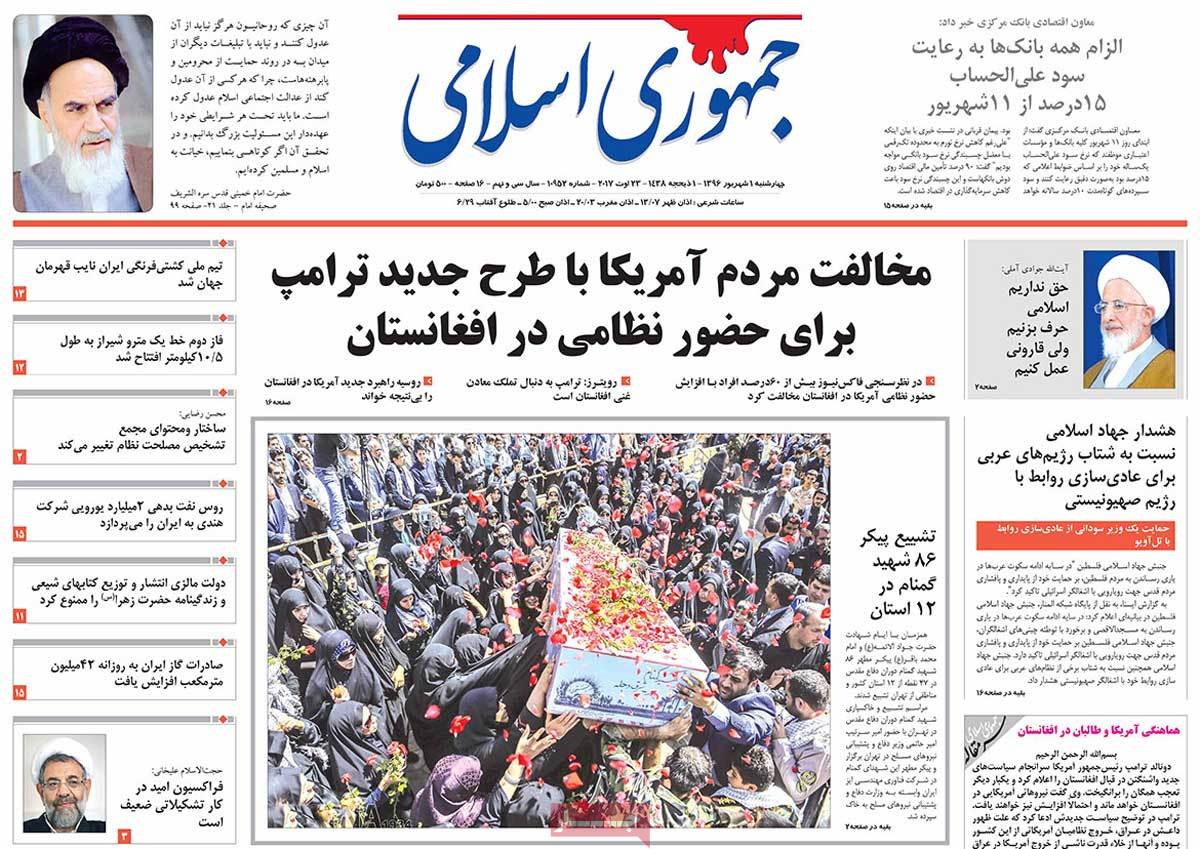
Jomhouri Eslami:

1- American People Opposed to Trump’s New Plan for Military Presence in Afghanistan

2- Iran Greco-Roman Wrestling Team Runner-up in World Championship

3- Iran’s Gas Exports Increased to 42mcm per Day

A Look at Iranian Newspaper Front Pages on August 23 - jomhori


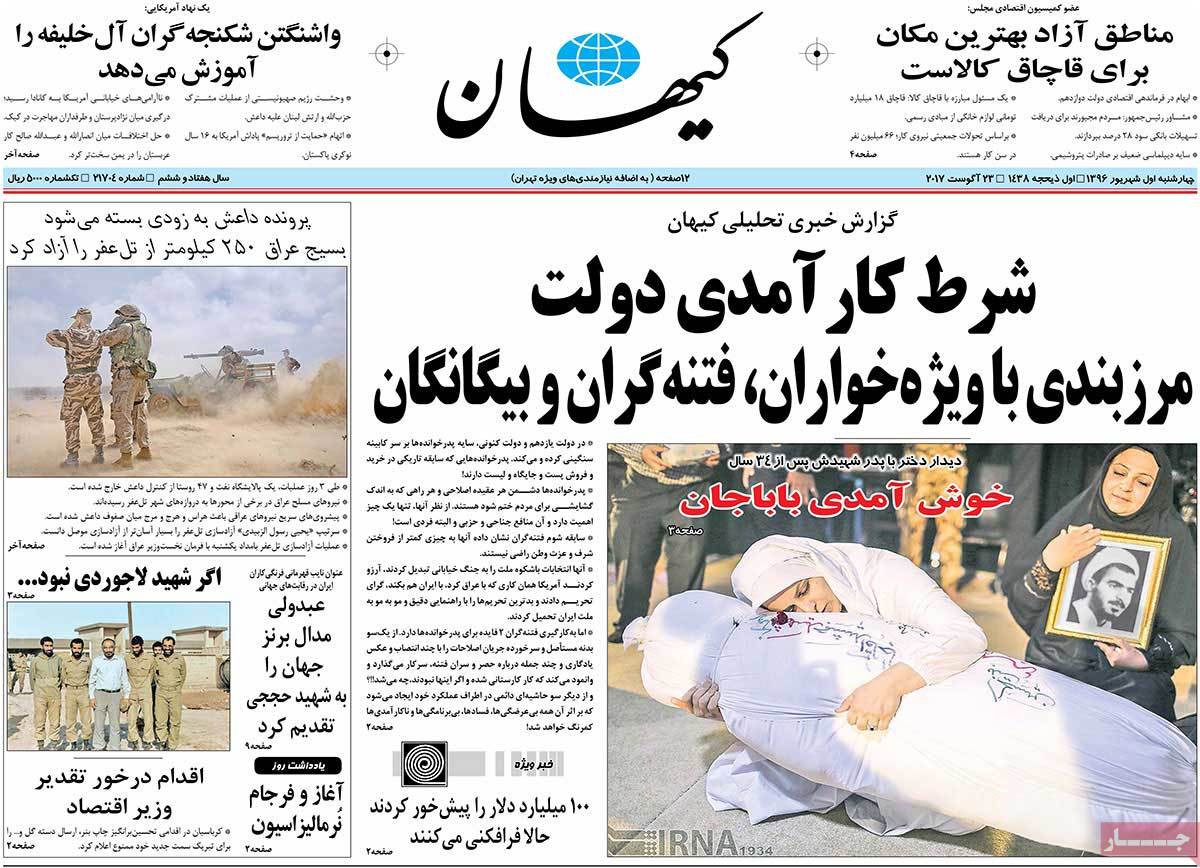
Kayhan:

1- Government’s Efficiency Hinges on Staying Away from Corruption, Aliens, Those Linked with 2009 Sedition

2- Iranian Wrestlers Finish Second in World Greco-Roman Championship

  • Wrestler Abdevali Dedicates Bronze Medal to Martyr Hojaji

3- ISIS Case to Be Closed Soon: Iraqi Popular Forces Liberate 250km of Tal Afar

A Look at Iranian Newspaper Front Pages on August 23 - kayhan


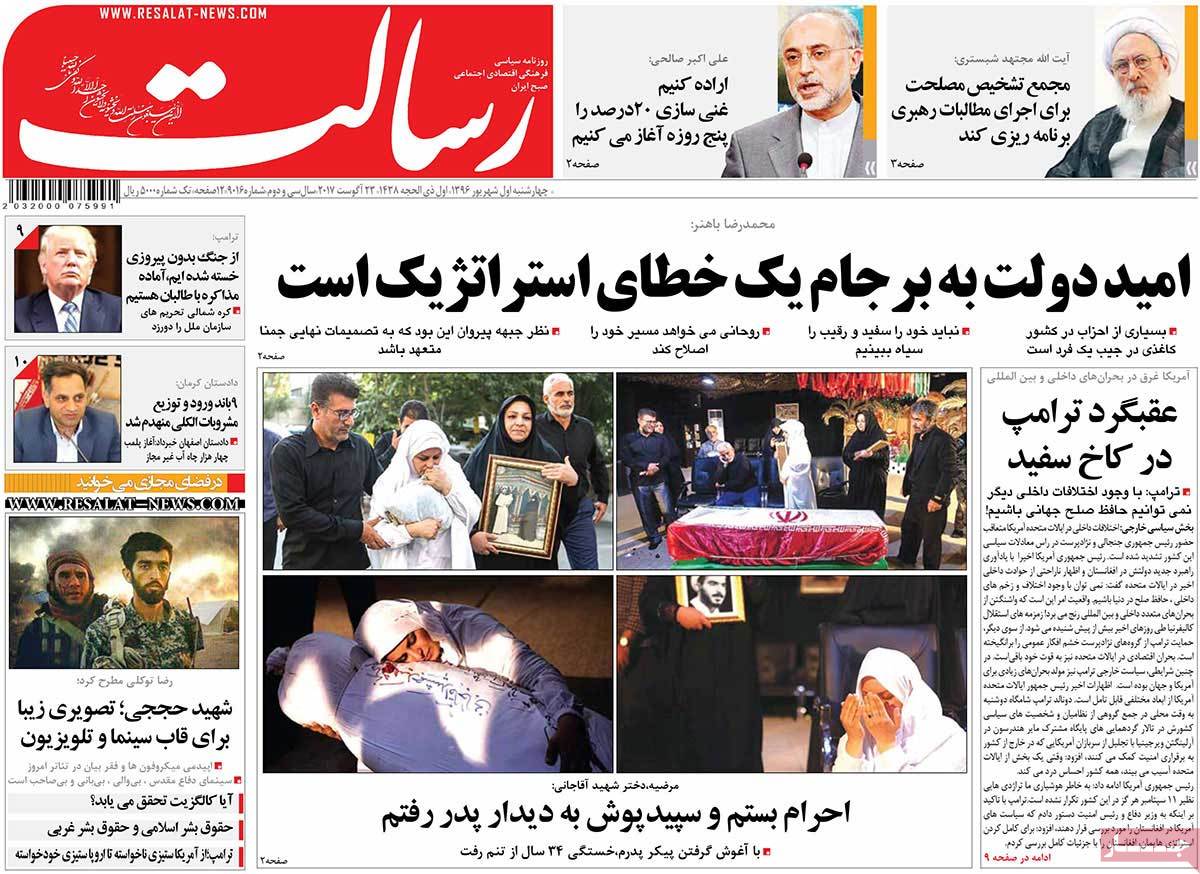
Resalat:

1- Conservative Figure: Government’s Hopeful Attitude to JCPOA Strategic Mistake

2- Trump: US Ready to Negotiate with Taliban; We’re Tire of War without Victory

A Look at Iranian Newspaper Front Pages on August 23 - resalat


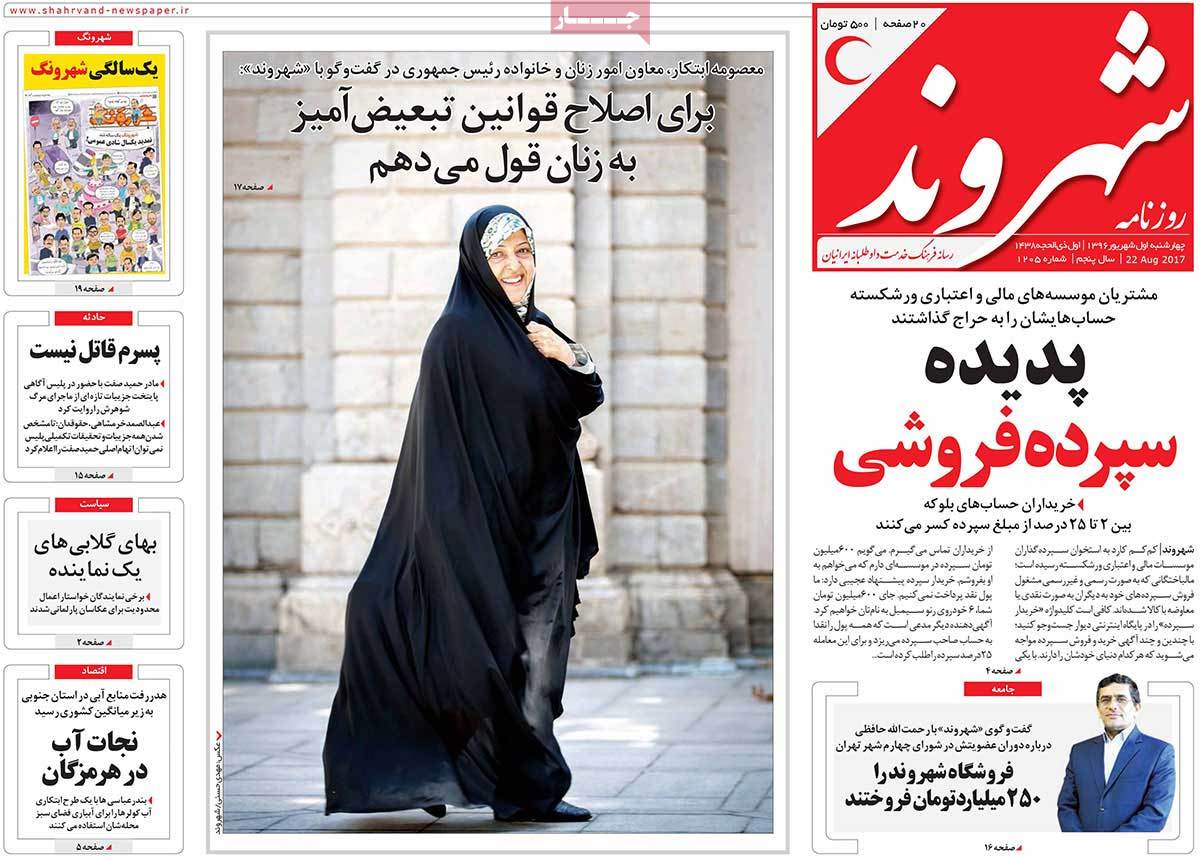
Shahrvand:

1- Ebtekar: I Promise to Modify Laws that Discriminate against Women

A Look at Iranian Newspaper Front Pages on August 23 - shahrvand


Shargh:

1- Justice Minister: No One Allowed to Oppress Others to Save Establishment

2- Rouhani Dedicates Shares to Women, Youths in Ministries

3- Iran Rejects Allegations of Its Joint Operation with Turkey against PKK

A Look at Iranian Newspaper Front Pages on August 23 - shargh

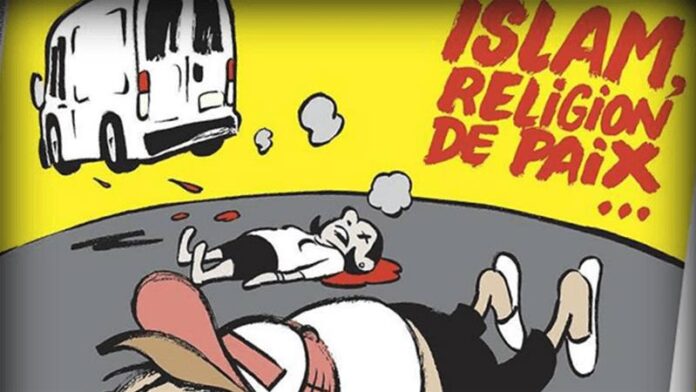
Charlie Hebdo Once Again Provokes Anger among Muslims

The cartoon depicts two people lying on the ground in a pool of blood after having been run over by a white van with the caption “Islam is a religion of peace….. eternal.”

Critics including Muslims and non-Muslims have seen the cartoon as suggesting Islam is an inherently violent religion.

Some of the leading magazines across the world have blamed Charlie Hebdo for publishing the cartoon, arguing that Charlie Hebdo has gone too far as the drawing was “Islamophobic”, “racist” and “revolting”. They say unlike what the staff of Charlie Hebdo maintains, such cartoons only hurt freedom of expression.

Even some of French politicians slammed Charlie Hebdo. Socialist MP Stephane Le Foll called the cartoon “extremely dangerous” and warned such association of ideas between Islam being a religion of peace and the violence of the attack could be used by others.

“When you’re a journalist you need to exercise restraint because making these associations can be used by other people,” he said.

In an editorial, Charlie Hebdo’s editor Laurent Sourisseau explained his editorial choice by saying experts and policy-makers are avoiding asking hard questions out of concern for moderate Muslims. “The debates and questions about the role of religion and in particular the role of Islam in these attacks have completely disappeared,” he added.

The magazine, notorious for its provocative and politically incorrect stance, regularly mocks religions including Islam.

In January 2015, Charlie Hebdo was the target of a terror attack. Two gunmen walked into the magazine’s offices in Paris and opened fire, killing 12. The magazine had previously published a number of controversial caricatures of the prophet of Islam.

Drug Traffickers in Iran Swallow 1.8kg of Opium

“The three narco-traffickers were under police surveillance when they set off on a trip to one of the southern provinces,” said Colonel Hadi Qazvine’I, the drug enforcement chief of Iran’s Hamadan province.

“After reviewing the available information, police found out that the drug traffickers intended to take the narcotics to Malayer by swallowing them,” said the colonel, according to a Farsi report by Khabar Online.

“The smugglers wanted to distribute the drugs in Malayer, buy they were arrested by drug enforcement police Monday afternoon before they arrived in the city,” he said.

They were taken to hospital where x-rays were taken of their stomachs, he noted, adding that the results showed drugs in small packs inside.

“After the drugs were excreted from their bodies, it became clear that each one of them had swallowed around 600 grammes of opium,” he said.

The colonel noted that swallowing is one of the old and very dangerous methods of smuggling illicit drugs.

“As long as narcotics are inside the smugglers’ stomachs, they mustn’t eat or drink anything because eating and drinking will prompt peptic acid secretion, which wrecks the packaging of the drugs.”

“If the packaging of the narcotics inside the stomach is destroyed, the smuggler is sure to die if his/her stomach is not washed out by a doctor promptly,” said the top police official.

It is noteworthy that over three tonnes of narcotics have been seized in Hamadan in the past five months.