Thursday, December 25, 2025
Home Blog Page 3517

Iran Denies Omani FM Will Visit Tehran Friday

In response to ISNA’s question on Tuesday, the Iranian official said the report is false and does not have any real basis.

“No contact has been made so far through formal and diplomatic channels for making the required arrangements for this trip,” he added.

As the relations between Iran and Oman are friendly, he said, the visits of the officials of the two countries are common, and are carried out periodically and continuously at necessary times.

The news of these trips is also announced to the public at the proper time, he stated.

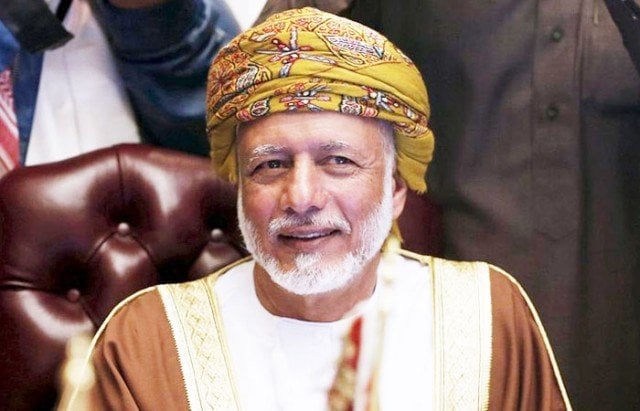
The Omani Foreign Minister recently met the US Secretary of Defence, Jim Mattis, at the Pentagon.

A couple of days ago some Arab media claimed that bin Alawi’s trip to Washington was aimed at reducing tensions between Iran and the US, especially when the Omani official’s trip to the US took place after his meeting with his Iranian counterpart Mohammad Javad Zarif.

Al-Arab Newspaper wrote on Sunday that like what happened in 2013 resulting in the signing of the Iran nuclear deal also known as the Joint Comprehensive Plan of Action (JCPOA), Bin Alawi’s tour of the US was to emphasise Muscat’s preparedness to mediate between Tehran and Washington.

This comes as Omani Foreign Ministry recently wrote on its Twitter page that both sides discussed security and regional issues and also developing ties.

Meanwhile, Bin Alawi announced on Tuesday that his country is ready to mediate between Iran and the US in case the two sides are ready.

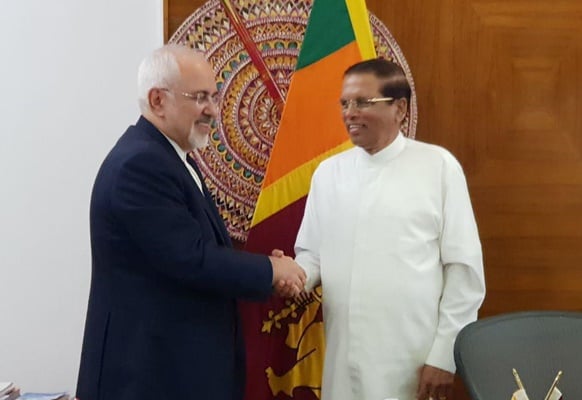
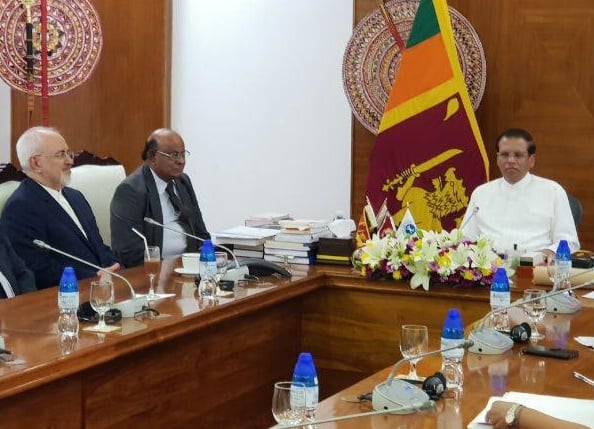
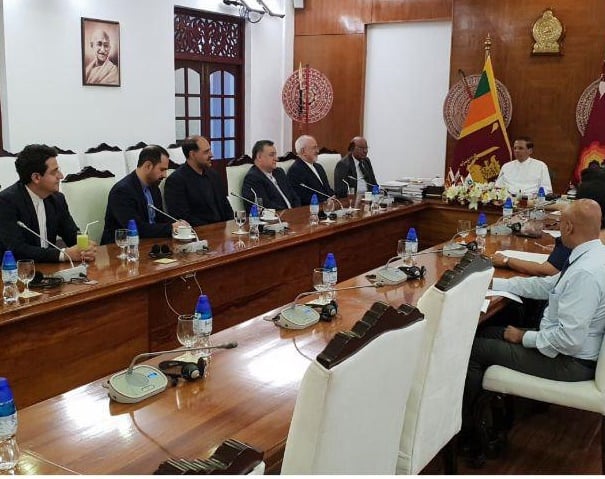
“No Obstacle to Expansion of Sri Lanka’s Ties with Iran”

During the Tuesday talks, Sirisena highlighted the friendly and age-old relations between the two countries and described his trip to Iran in May as a constructive one.

He further underlined the grounds for further expansion of Tehran-Colombo cooperation in different fields, especially in the field of energy, and called for the strengthening of bilateral ties in international organizations.

“There is no obstacle in the way of expanding ties between the two countries,” he said.

Zarif, in turn, relayed greetings from President Hassan Rouhani to Sirisena, and told the Sri Lankan leader that Tehran is keen to enhance its cooperation with Colombo in all fields in line with the interests of both countries.

The Iranian top diplomat referred to the vast and diverse capacities for promotion of cooperation between the two sides, and called for continued interactions in the fields of energy, agriculture, and technical-engineering services.

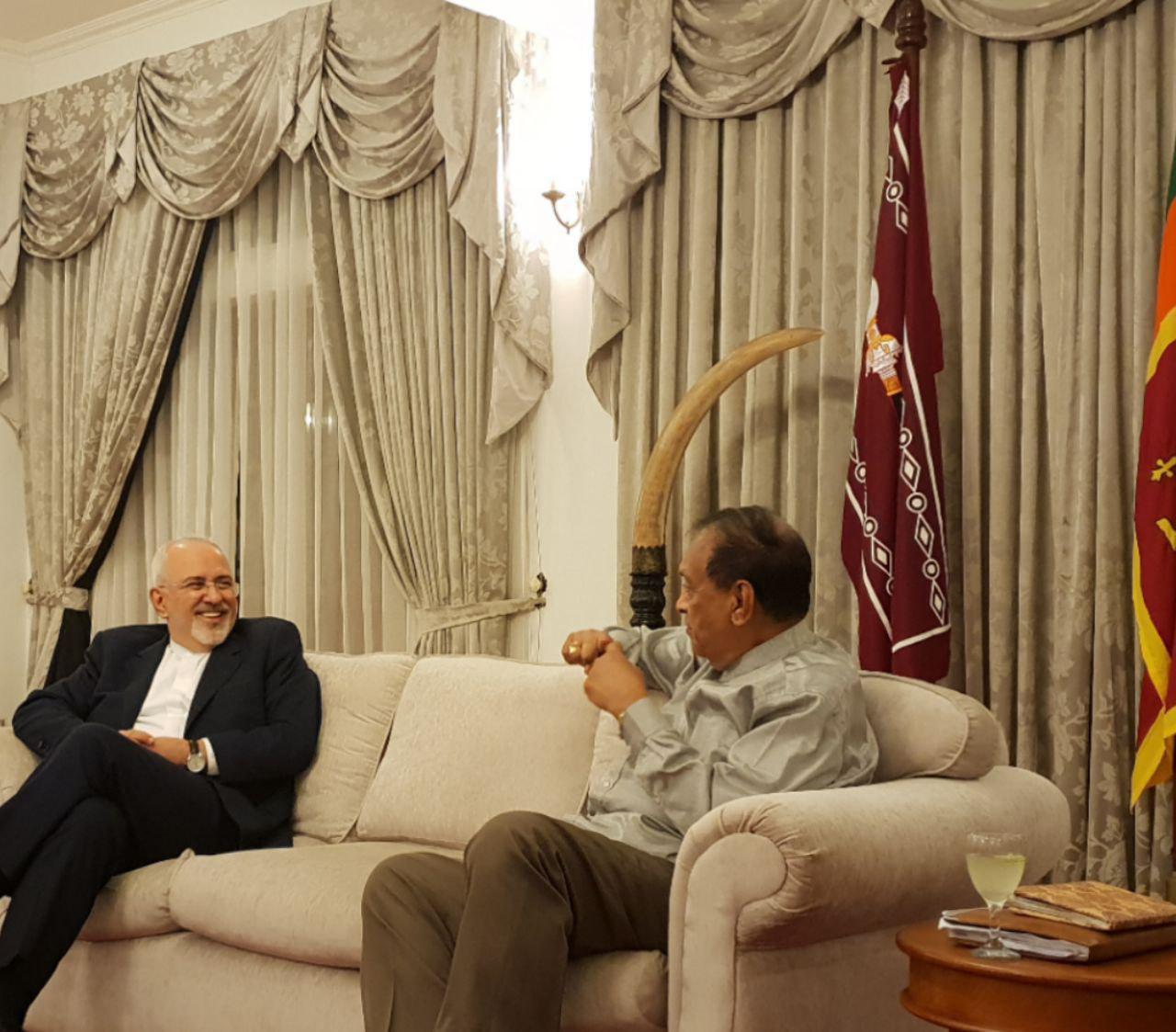
Later in the day, Zarif also held talks with Karu Jayasuriya, the Speaker of the Parliament of Sri Lanka. In this meeting, Zarif and Jayasuriya emphasised the continuation, expansion and boosting of the two countries’ excellent relations in all fields, especially in the parliamentary field.

Zarif and his accompanying delegation attended the Sri Lankan Speaker’s banquet after this meeting.

“No Obstacle to Expansion of Sri Lanka’s Ties with Iran”

“No Obstacle to Expansion of Sri Lanka’s Ties with Iran”

“No Obstacle to Expansion of Sri Lanka’s Ties with Iran”

Iranian Officials Show Mixed Reactions to Trump’s Call for Talks

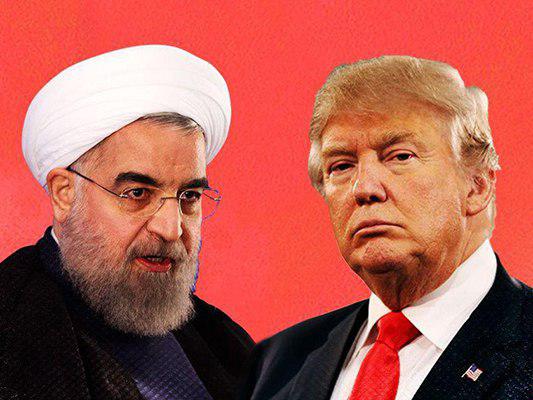
Trump, who has been highly antagonistic towards Iran since he came to power in January 2018, announced his readiness for talks with Iran for the second time in weeks on Monday.

Trump said he would be willing to meet Iran’s President Hassan Rouhani and officials “any time” and “without preconditions” to discuss how to improve ties.

“I would meet with Iran if they wanted to meet,” Trump said Monday at a joint White House press conference with Italian Prime Minister Giuseppe Conte. “I don’t know if they are ready yet.”

“[If] They want to meet, I’ll meet. Any time they want. Good for the country. Good for them. Good for us. And good for the world,” he said.

The remarks raised eyebrows in Iran, who saw the US sending contradictory signals to Tehran.

Trump was making the remarks barely a week after he had threatened Iran that it would suffer untold “consequences,” in response to remarks by Rouhani that the US should not “play with the lion’s tail”.

Trump pulled the US out of the 2015 nuclear deal in May, and is set to re-impose full sanctions in two stages in August and November.

The US is also working to push the world to cut trade with Iran and stop purchasing the country’s oil.

Trump’s statement was soon corrected by US Secretary of State Mike Pompeo, who said he was on-board with the president’s invitation but raised several preconditions for talks with Tehran.

The US will enter into talks with Tehran “if the Iranians demonstrate a commitment to make fundamental changes in how they treat their own people, reduce their maligned behaviour,” he told CNBC on Monday.


Iran-US Talks Shouldn’t Be a Taboo

Heshmatollah Falahatpisheh, a senior Iranian lawmaker, has argued for talks between the two countries, saying a lack of communication between the two sides has never done any good to the two sides.

“Negotiations should not become a taboo in Iran-US ties,” Falahatpisheh told ICANA on Tuesday.

Striking a conciliatory tone towards the US, Falahatpisheh, the chairman of Parliament’s National Security and Foreign Policy Commission, said a military confrontation between Iran and the US is out of the question and the two sides should work to open diplomatic channels.

“Differences between Iran and the US are controlled by third parties. As long as there is no hotline between the two sides, Tehran and Washington’s national interests will be a toy in the hands of those who benefit from escalation of tension between the two powers,” he said.


Iran Shouldn’t Immediately Reject Trump’s Call for Talks

Ali-Akbar Nateq Noori, a veteran moderate politician and a member of Iran’s Expediency Council, also welcomed possible talks between the two sides, but said the decision is to be made by Iran’s Supreme National Security Council.

“We shouldn’t immediately reject the request, because they would then claim that Iran is after violence and war. However, we shouldn’t be overexcited about it either. The issue must be thoroughly considered by the country’s officials,” he noted.


Trump Needs to Respect Iran, JCPOA

This is while an advisor to the Iranian President said late Monday the US needed to reduce hostility towards Tehran and return to the nuclear deal before the two countries could start talks.

Pointing to Trump’s request for talks with his Iranian counterpart Hassan Rouhani during the UN General Assembly in 2017 which was made shortly after Trump delivered a scathing attack on Iran in his first UNGA speech, Aboutalebi said the US’ demand for talks should be accompanied with friendly gestures.

“… After the US withdrawal from JCPOA, there are talks about [holding a] meeting without pre-conditions. Those who believe in dialogue as a method for settling disputes among civilized nations must comply with its requirements,” he said.

“Respecting the great Iranian nation, easing hostilities, and the return of the US to JCPOA will pave the rocky path [to talks],” Aboutalebi said in a tweet on Monday.

Referring to the 2013 phone conversation between Rouhani and Trump’s predecessor, Barack Obama, Aboutalebi said Iran has showed its openness to talks in the past.

Obama and Rouhani spoke by telephone shortly after Tehran and Washington engaged in nuclear talks that led to the 2015 nuclear deal.

Aboutalebi said those talks were meant to be a confidence-building measure that prepares the ground for reaching an agreement by showing the two sides’ good will.

“JCPOA is an achievement of commitment to dialogue. It should be accepted,” he wrote.


Iran-US Talks Not Possible

However, the spokesman for Iran’s Foreign Ministry Bahram Qassemi suggested earlier on Monday, prior to Trump’s statement, that engaging in negotiations with the “current America” is next to impossible.

“With current America and these policies, there will definitely not be the possibility of dialogue and engagement, and the United States has shown that it is totally unreliable,” Qassemi said.

An Iranian government official announced earlier this month Trump has called Rouhani’s entourage during their visit to New York in September 2017 eight times, but to no avail.

This is while US officials have denied any such requests have been made by Trump.

Early this month, Trump said that he expects Iran to call him wanting to make a deal.

“Iran at some point will call me and ask for a deal, and we’ll make a deal,” he said. They are feeling “a lot of pain right now,” he added.

Iran Vows to Protect Syria’s Integrity, Sovereignty

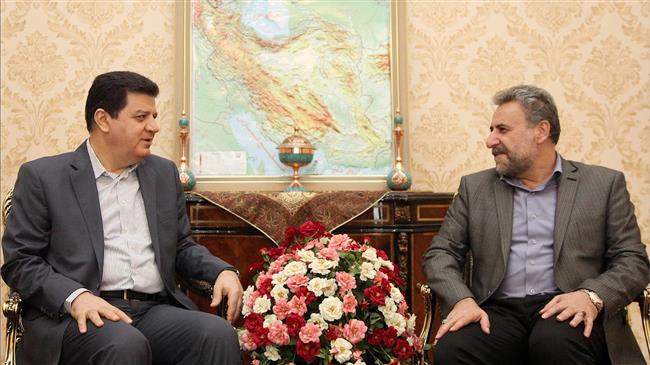
“The Zionist regime (of Israel) seeks a weak Syria and counters whatever leads to the strengthening of the Syrian nation and government,” Chairman of the Iranian Parliament’s Committee on National Security and Foreign Policy Heshmatollah Falahatpisheh said in a meeting with Syrian Ambassador to Tehran Adnan Mahmoud on Sunday.

He pointed to the US measures against Iran over the past four decades and said, “Since the first days after the victory of the Islamic Revolution, the US strategy was to weaken the [Islamic] Revolution and the Islamic Republic and has spared no efforts in this regard.”

The legislator added that the current threats posed by the US administration of President Donald Trump were nothing new for the Iranian nation.

The US president has stepped up his hostile rhetoric against Iran. Just last week, Trump threatened Iran with hardship “the likes of which few throughout history have ever suffered before.”

Trump’s pugnacious Twitter message in all capital letters came late on July 22 after Iranian President Hassan Rouhani warned his US counterpart not to “play with the lion’s tail.”

The Syrian ambassador, for his part, stressed the importance of bolstering relations in all fields and said the US and its allies want to wage an economic war due to their failures in the political arena.

Mahmoud also said the US and its regional mercenaries as well as all those who support terrorism for their own political objectives are liable for recent terrorist attacks in Syria.

The battle against terrorism in Syria is not different from anti-terror campaign across the Middle East, the Syrian diplomat pointed out.

A so-called monitor group has said that the death toll from a spate of attacks and bombings carried out by members of Daesh Takfiri terrorist group in Syria’s southwestern province of Sweida has surpassed 220.

The Britain-based Syrian Observatory for Human Rights, which is close to Syrian opposition, said last Wednesday that three attackers set off their explosive belts in Sweida city, located more than 100 kilometers southeast of the capital Damascus, as other blasts hit villages to the north and east. A fourth bomb explosion hit the city later.

The Lebanese Hezbollah resistance movement and Syrian President Bashar al-Assad on Thursday condemned deadly Daesh attacks in Sweida, saying such crimes are mere attempts to prop up the foreign-backed terrorists, which are suffering one defeat after another on the battlefield.

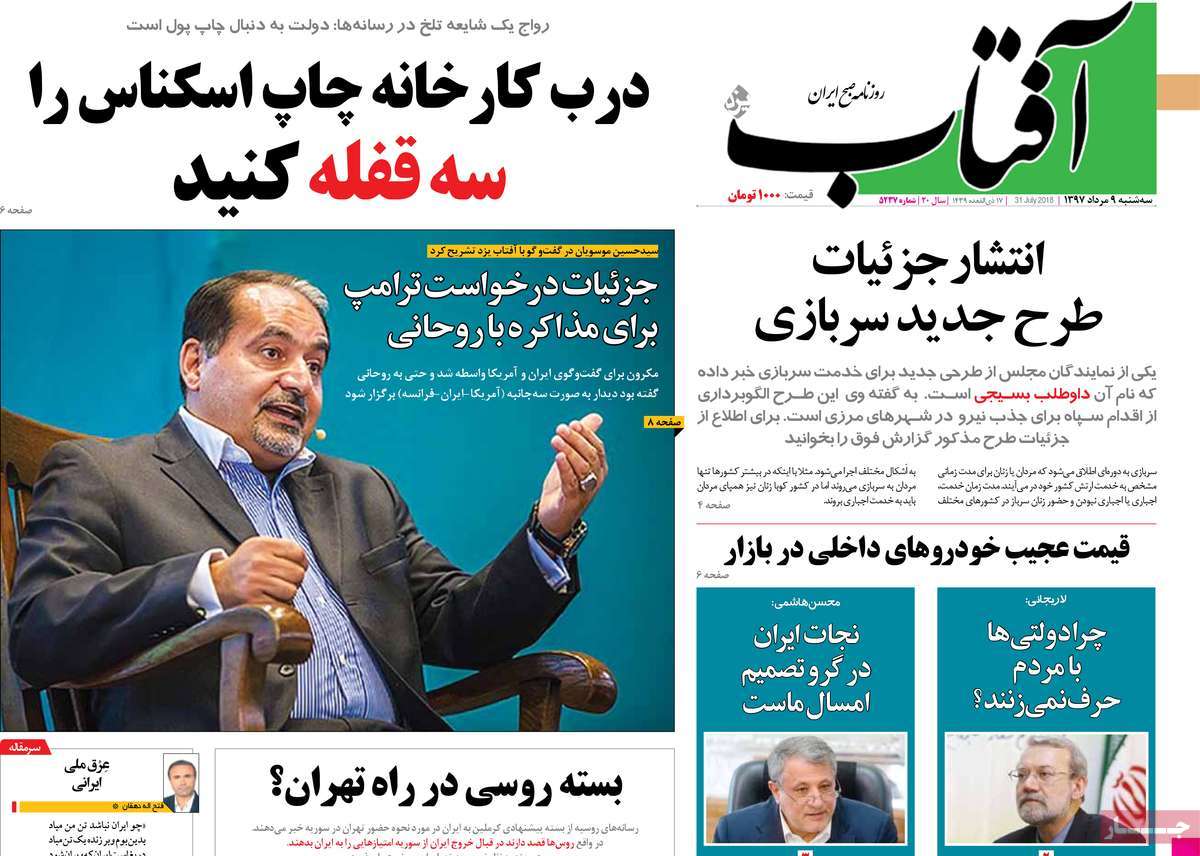
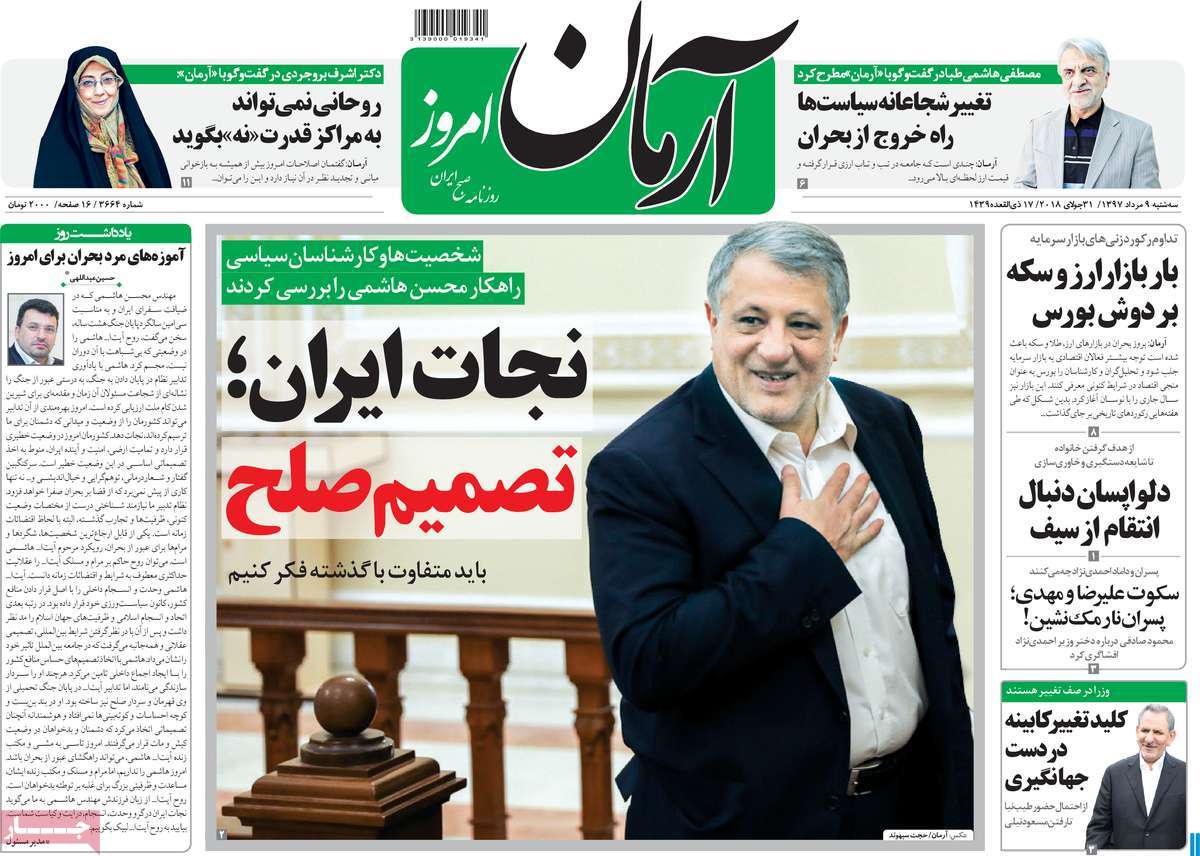
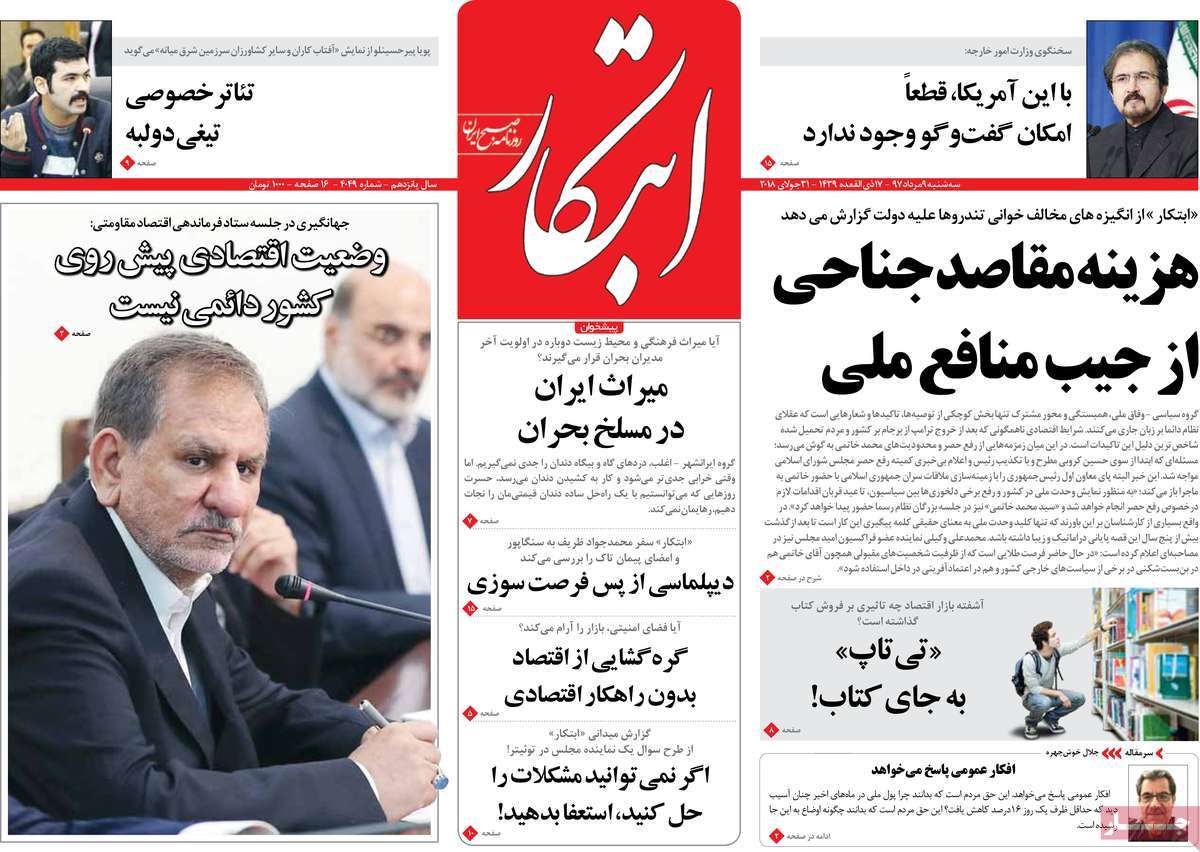
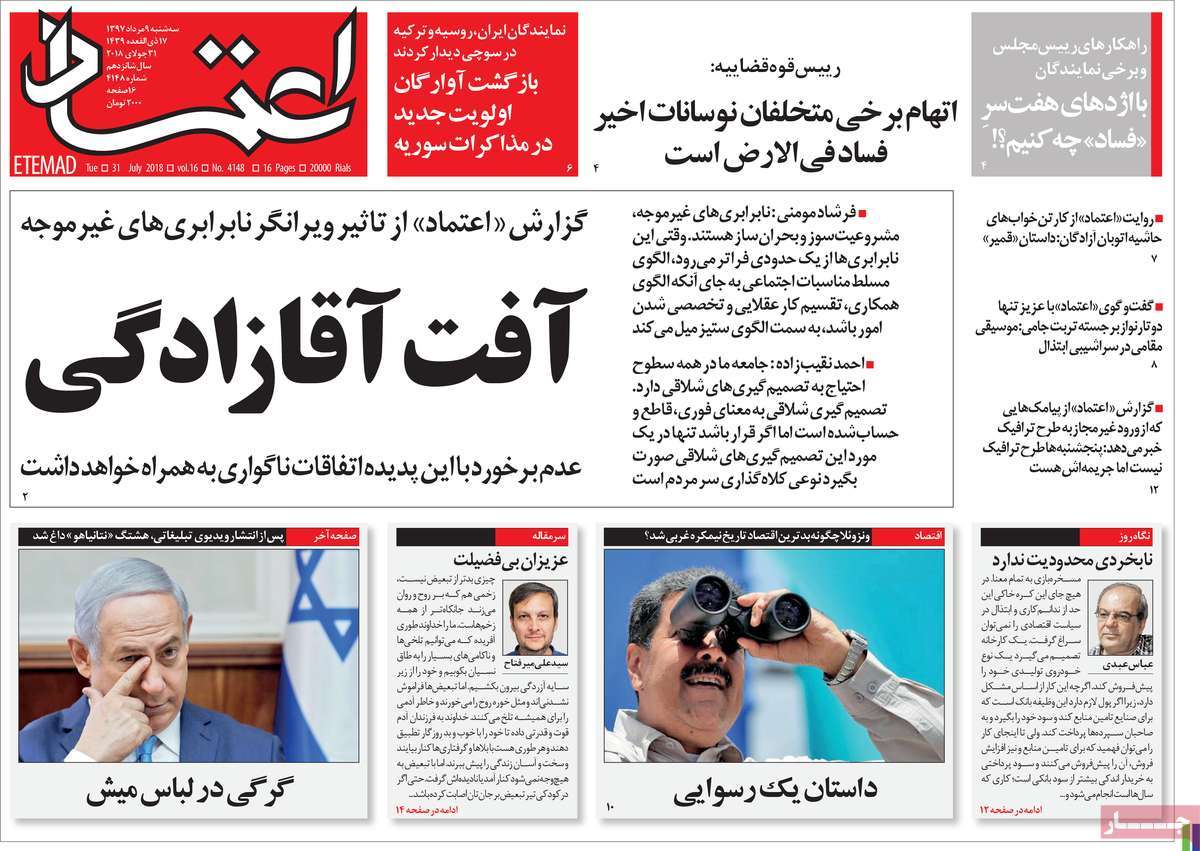
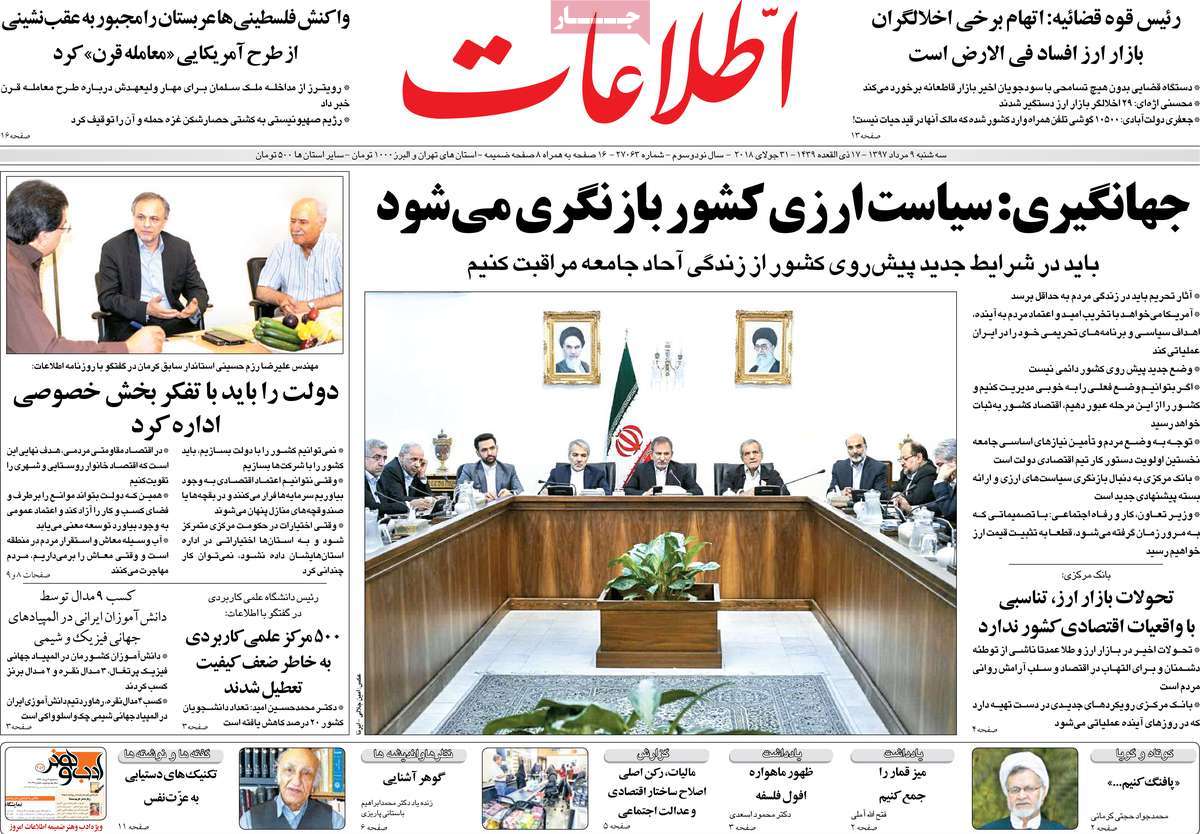
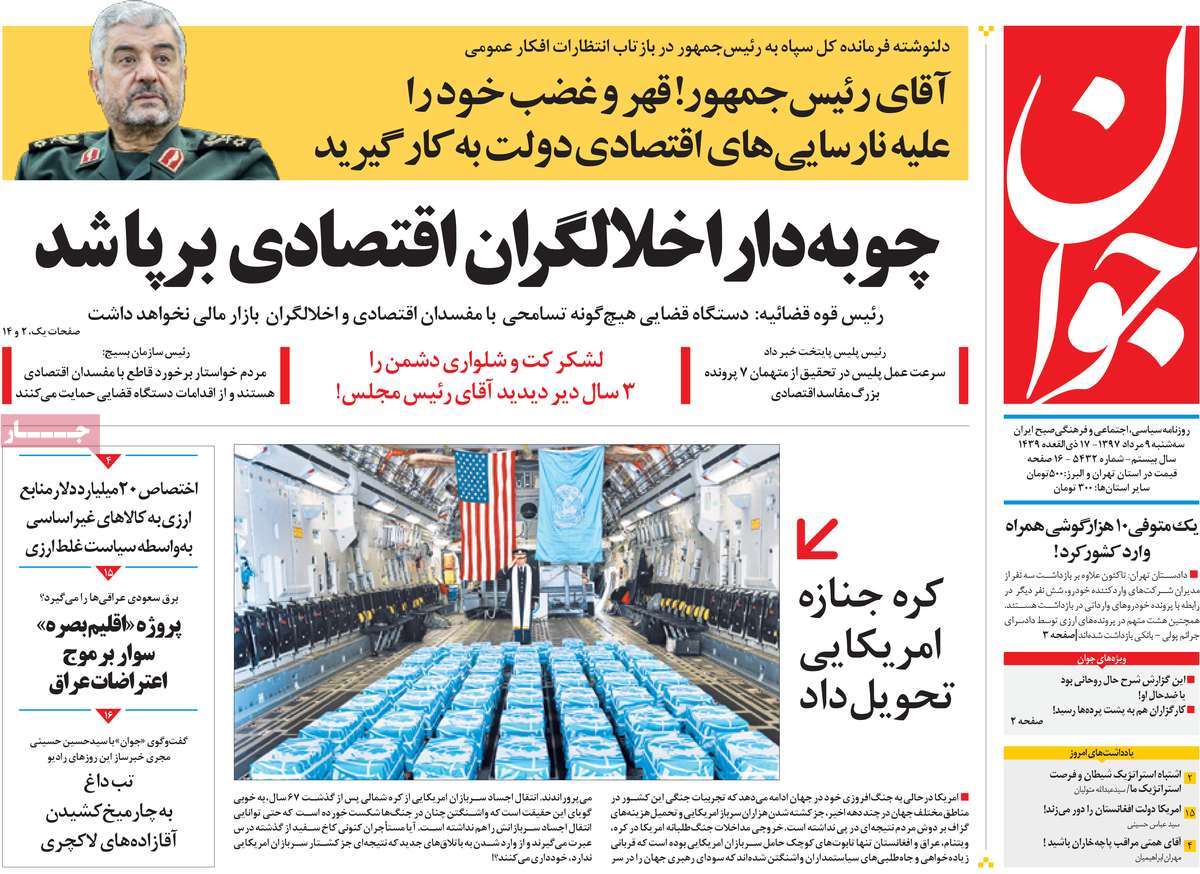
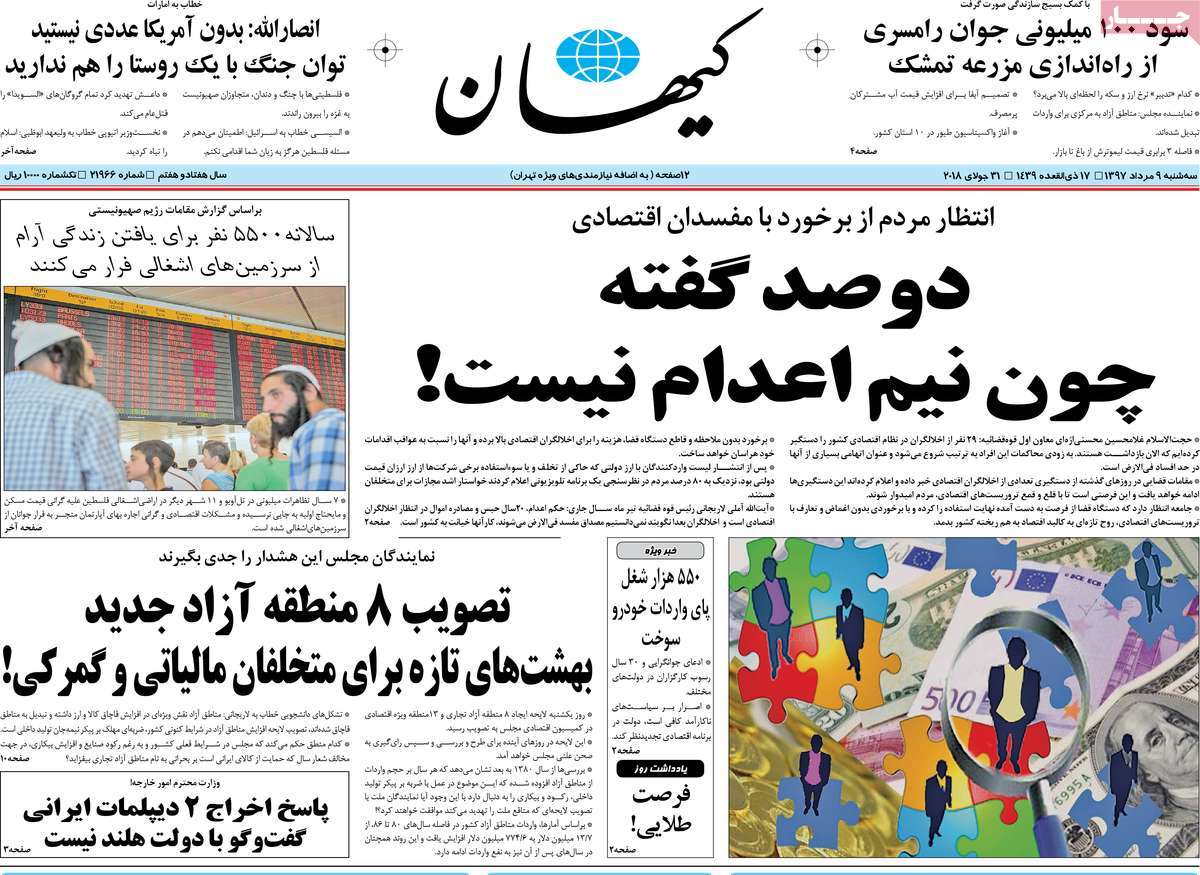
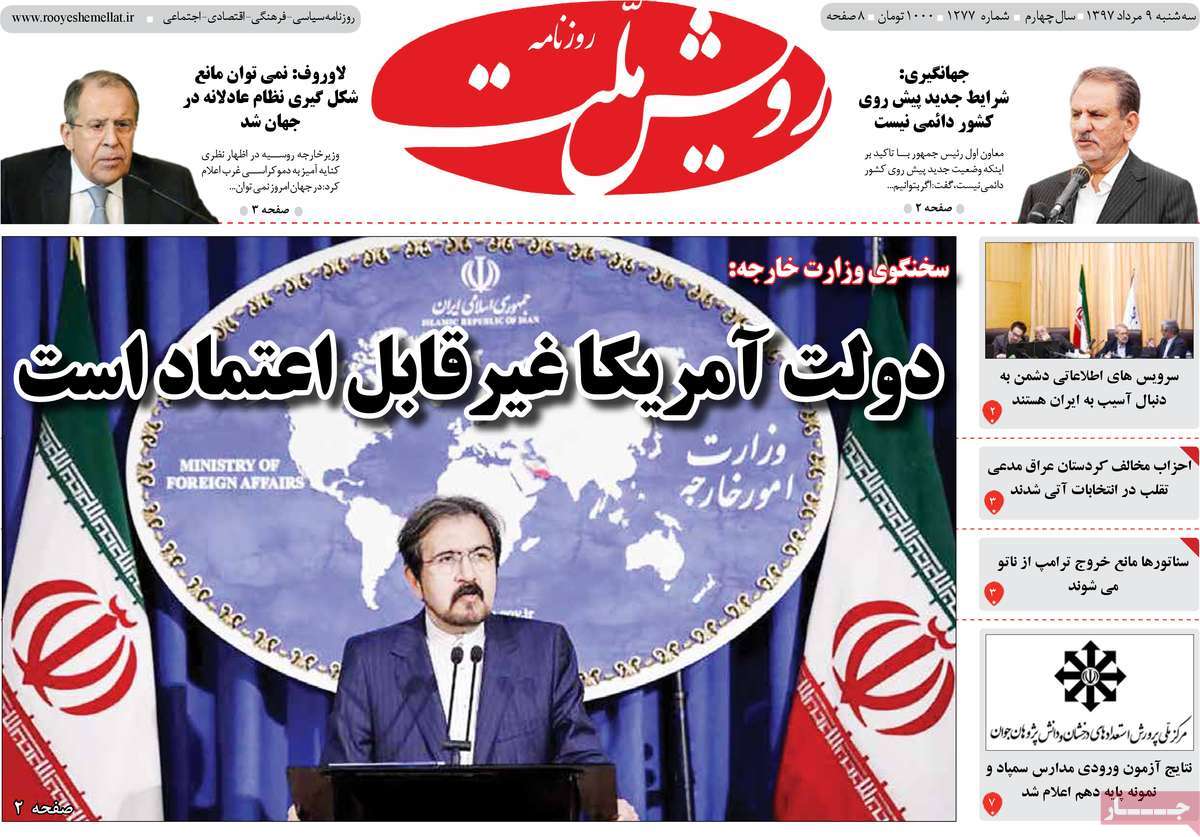
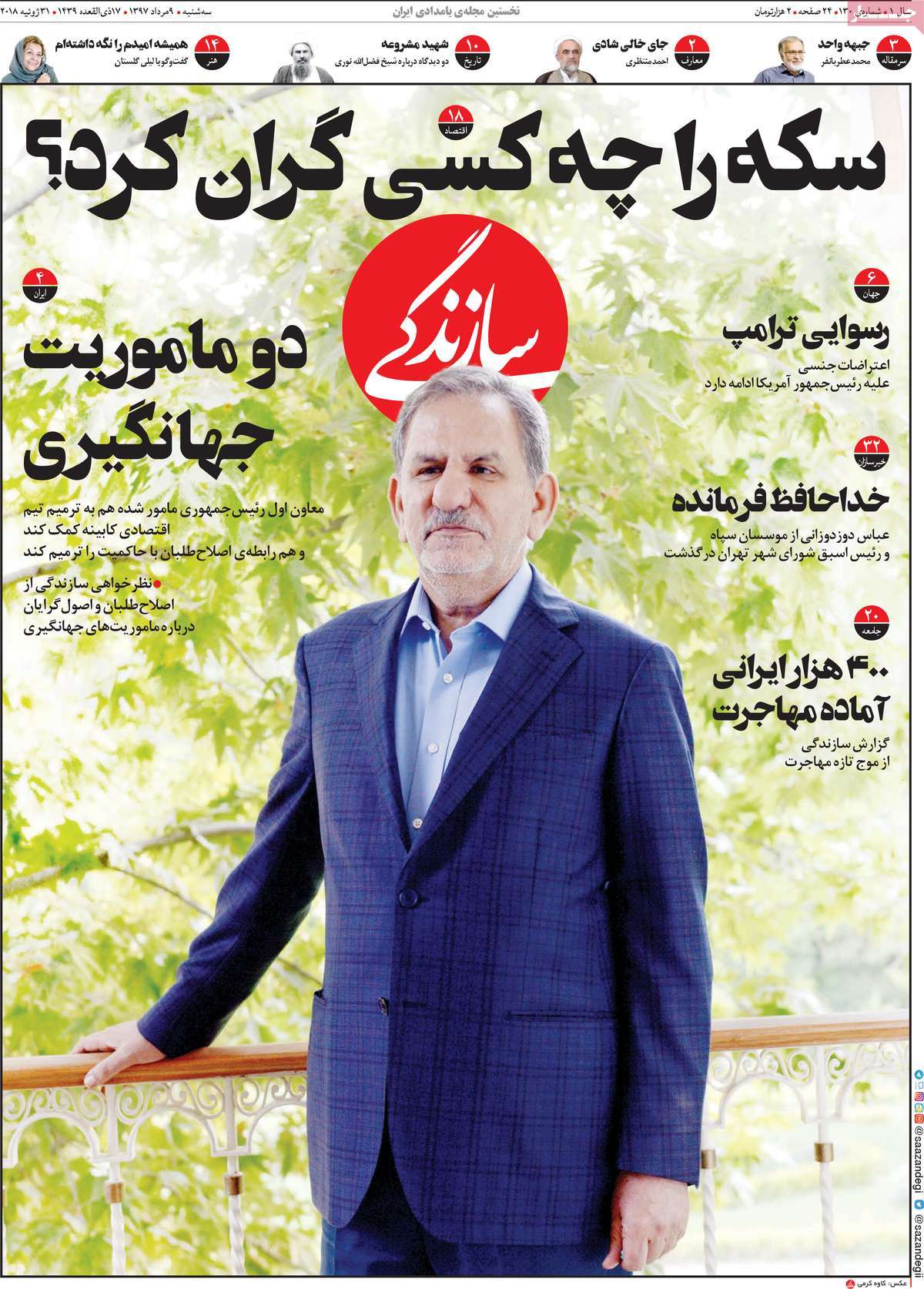
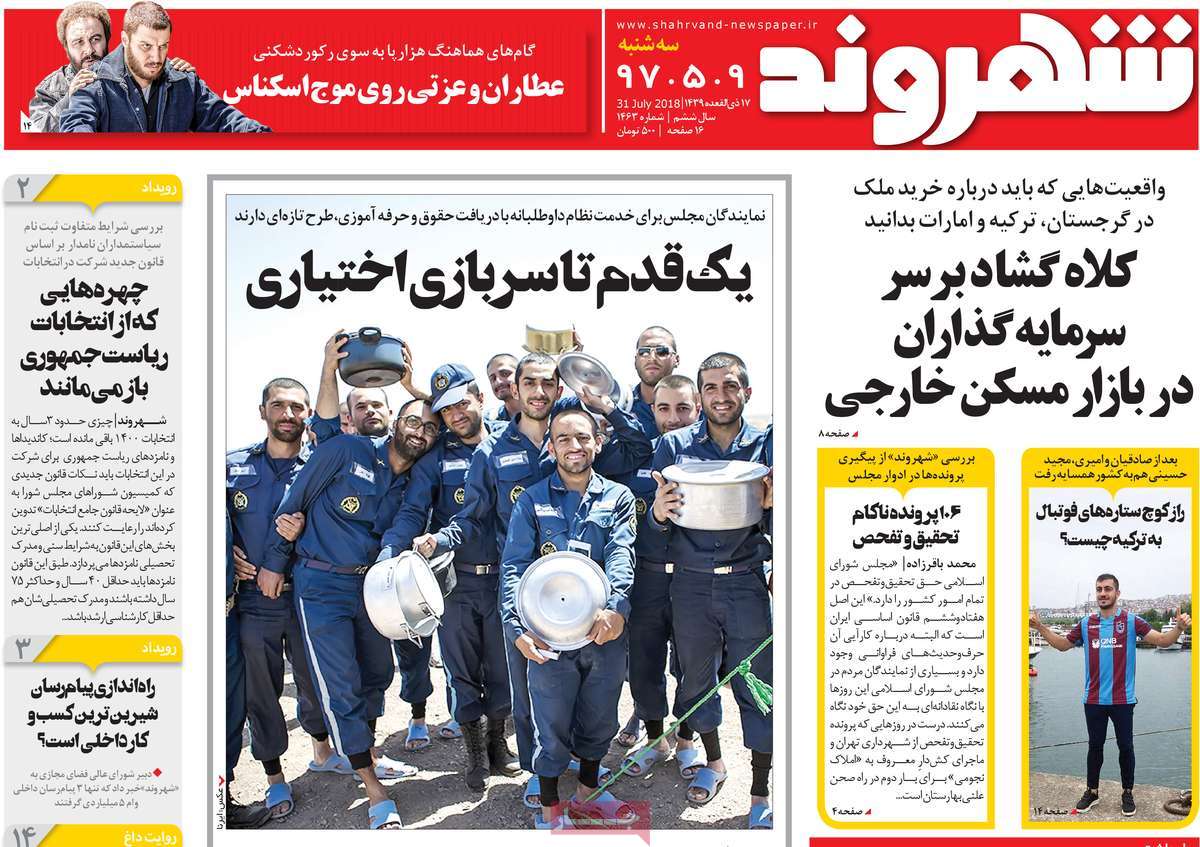
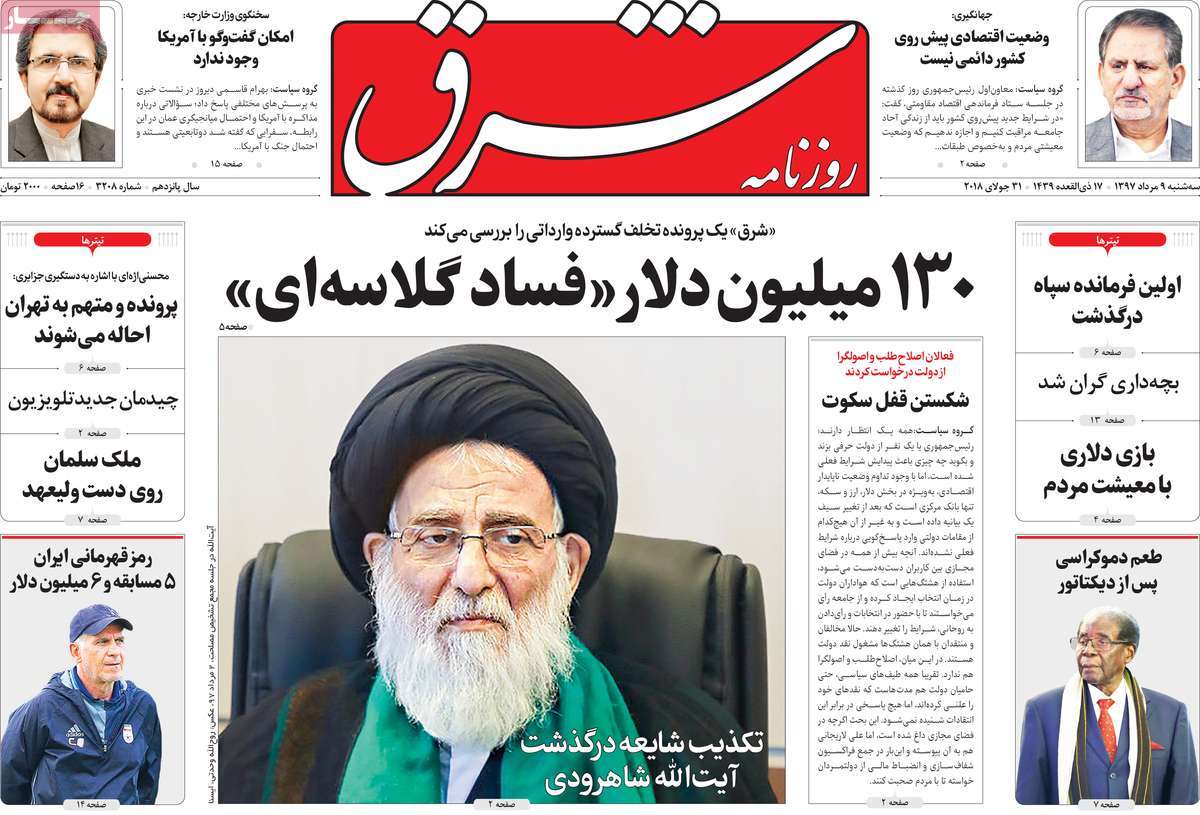
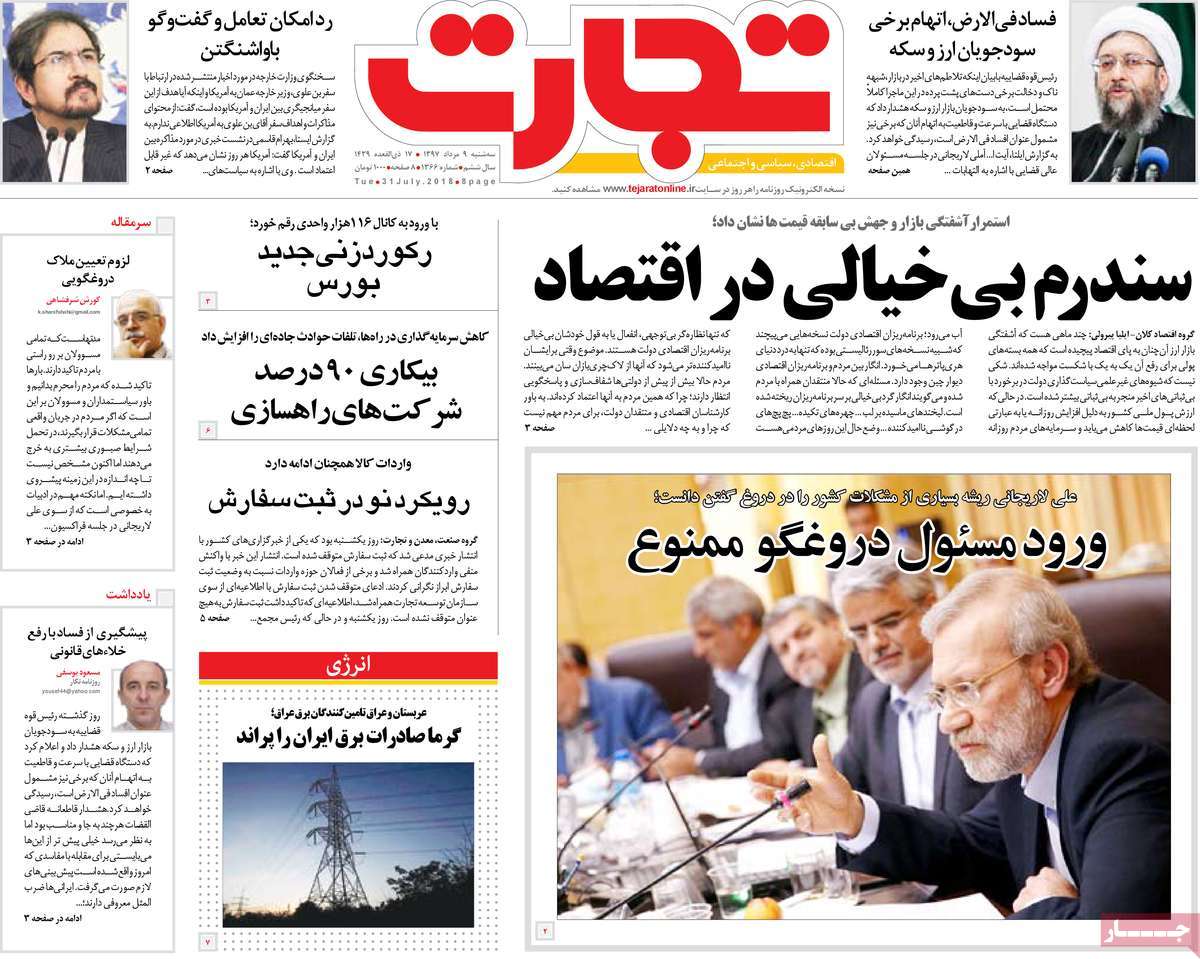
A Look at Iranian Newspaper Front Pages on July 31

A Look at Iranian Newspaper Front Pages on November 19

The ongoing economic crisis in Iran, particularly the price hikes and unprecedented devaluation of the country’s national currency, remained the top story today. Some papers urged the government to break its silence and immediately take appropriate actions to control the situation, and some like Kayhan called for prosecution and even execution of those who disrupt the country’s economy.

Several papers also covered reports on Iran-US direct talks, especially after US President Donald Trump’s call for talks with his Iranian counterpart without any preconditions.

The above issues, as well as many more, are highlighted in the following headlines and top stories:


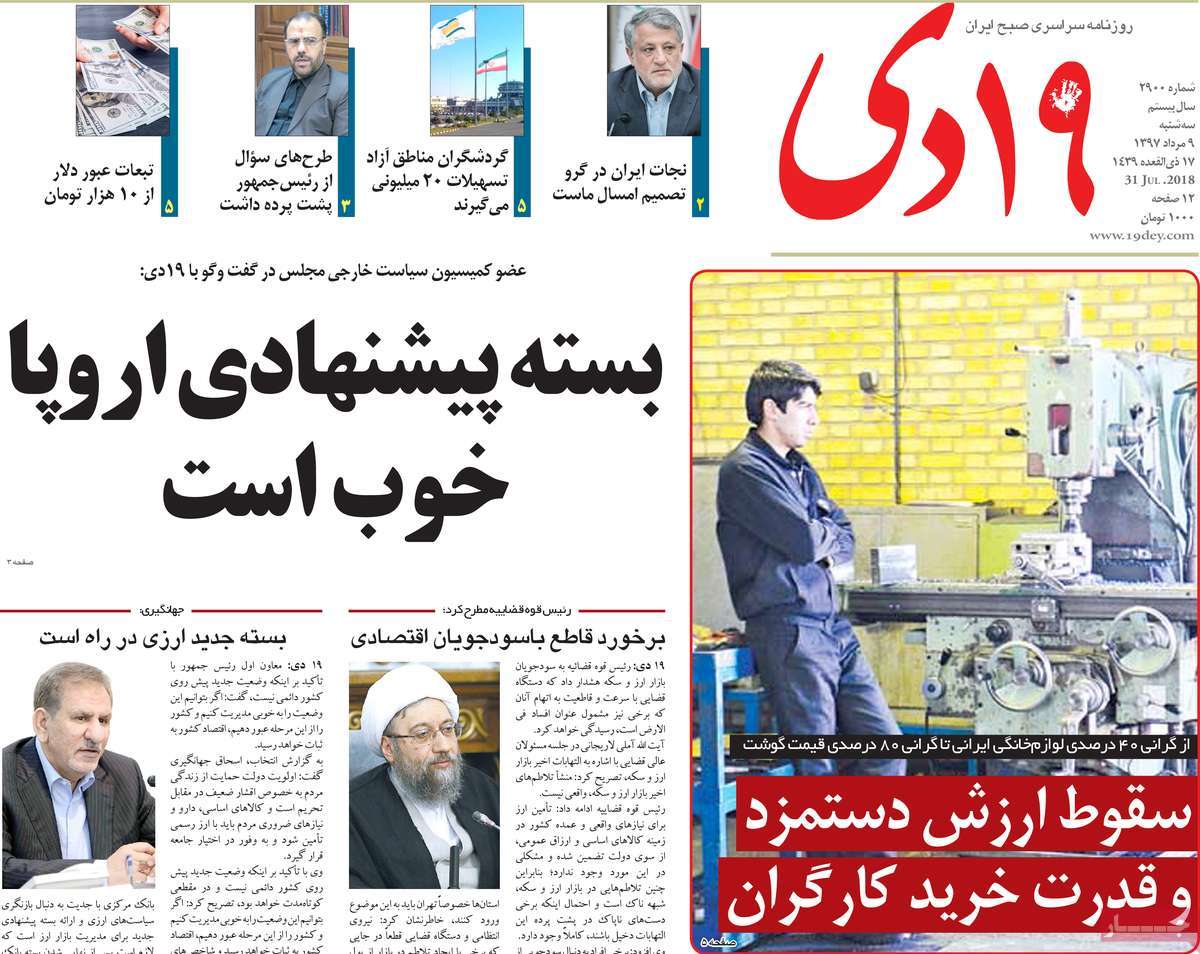
19 Dey:

1- Senior Lawmaker: Package Proposed by EU Is Good

A Look at Iranian Newspaper Front Pages on July 31


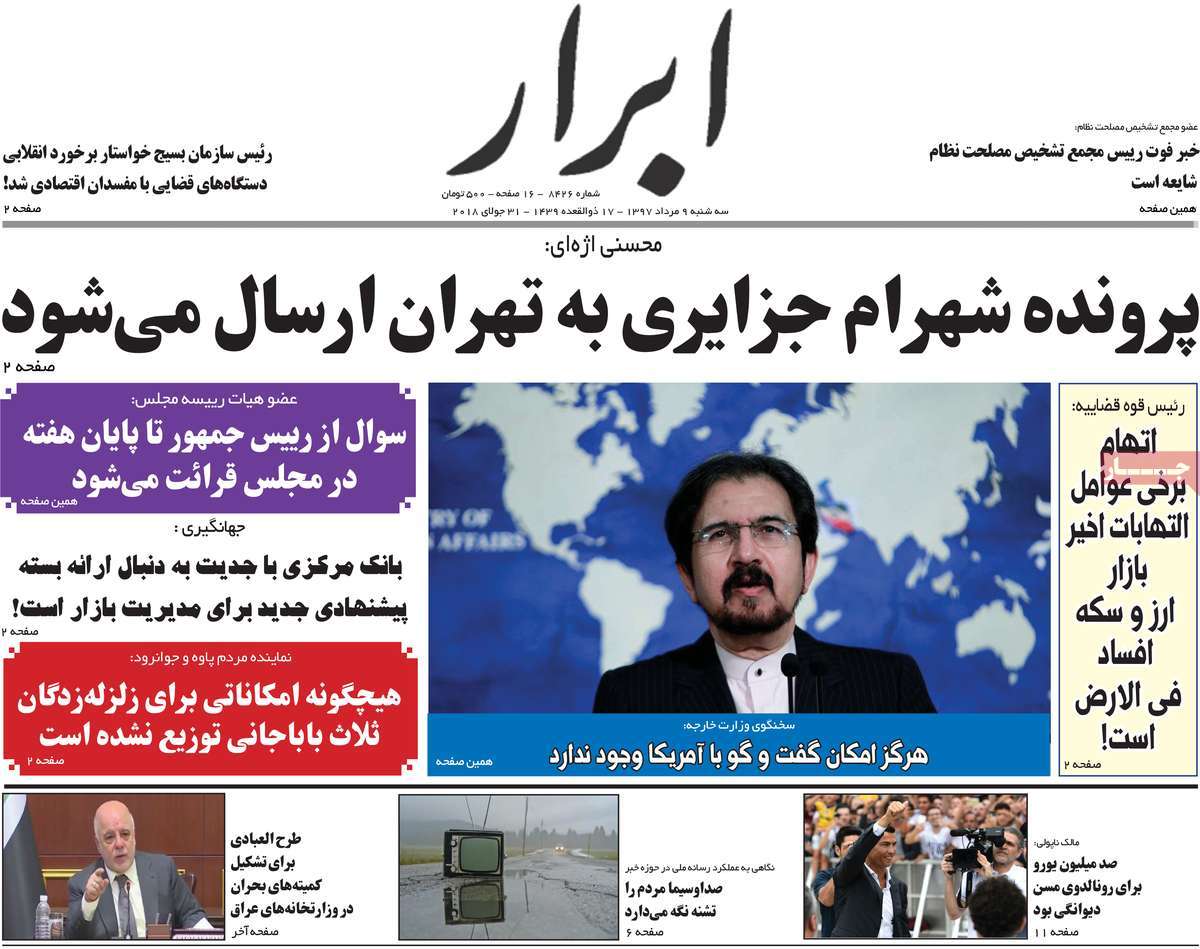
Abrar:

1- Negotiation with US Not Possible: Iran

A Look at Iranian Newspaper Front Pages on July 31


Aftab-e Yazd:

1- Mousavian Gives Details of Trump’s Call for Talks with Rouhani

  • Macron Mediated between Iran, US
  • France Even Told Rouhani Trilateral Meeting Can Be Held

A Look at Iranian Newspaper Front Pages on July 31


Arman-e Emrooz:

1- Key to Cabinet Reshuffle in Jahangiri’s Hands

A Look at Iranian Newspaper Front Pages on July 31


Ebtekar:

1- Iran First VP: New Economic Conditions in Iran Not to Last Forever

A Look at Iranian Newspaper Front Pages on July 31


Etemad:

1- Return of Displaced Syrians, New Priority in Syria Talks

  • Representatives of Iran, Russia, Turkey Meet in Sochi

A Look at Iranian Newspaper Front Pages on July 31


Ettela’at:

1- Iran First VP: The Country’s Forex Policy to Be Revised

2- Palestinians’ Reaction Forces Saudi Arabia to Back Off from Supporting ‘Deal of the Century’

A Look at Iranian Newspaper Front Pages on July 31


Javan:

1- IRGC to Rouhani: Mr President! Use Your Anger to Resolve Government’s Economic Deficiencies

2- ‘Basra Region’ Project Taking Advantage of Iraq Protests

3- North Korea Delivers Body of American Soldier

  • Transfer of American Soldiers’ Bodies from N. Korea after 67 Years

A Look at Iranian Newspaper Front Pages on July 31


Kayhan:

1- Ansarullah to UAE: You Can’t Even Fight against a Village without US’ Help

A Look at Iranian Newspaper Front Pages on July 31


Rooyesh-e Mellat:

1- Lavrov: Formation of Equal System in the World Cannot Be Prevented

A Look at Iranian Newspaper Front Pages on July 31


Sazandegi:

1- 400,000 Iranians Poised to Immigrate

2- Trump’s Scandal: Ongoing Sex Scandals against US President

A Look at Iranian Newspaper Front Pages on July 31


Shahrvand:

1- One Step to Optional Military Service: MPs Propose New Bill for Professional Military Service

A Look at Iranian Newspaper Front Pages on July 31


Shargh:

1- Reformist, Conservative Activists Urge Gov’t to Break Its Silence

A Look at Iranian Newspaper Front Pages on July 31


Tejarat:

1- Continued Chaos in Market, Unprecedented Hike in Prices

  • “Take It Easy” Syndrome in Economy

A Look at Iranian Newspaper Front Pages on July 31

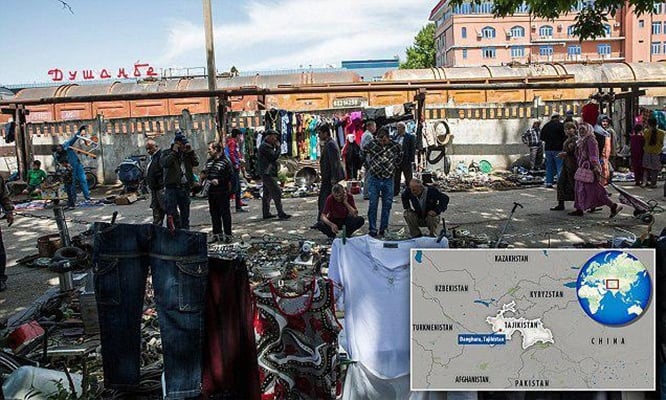
Iran Condemns Terrorist Attack on Foreign Tourists in Tajikistan

Qassemi told reporters on Tuesday that the Islamic Republic denounces any act of terrorism in any part of the world, including the recent attack on foreign tourists in Tajikistan.

Criticising the negative points stated in the Tajik Interior Ministry’s statement against Iran, he said the Islamic Republic strongly denies having any connection with the incident and the existence of a base for providing training on acts of sabotage in Iran.

“Tehran is ready to work with the Tajik authorities to look into the issue,” he added.
Qassemi noted that such baseless statements would harm friendly and fraternal relations between Iran and Tajikistan.

He further expressed the hope that the two sides would work together to strengthen bilateral ties and not let the enemies undermine mutual relations by setting forth such issues.

Four Western cyclists were killed when a car ploughed into them in Tajikistan in what may have been a terrorist act in which the attackers also stabbed their victims after injuring them, the interior minister and the US embassy in Dushanbe announced on Monday.

The tourists, from the United States, Switzerland and the Netherlands, were killed in the Central Asian country on Sunday. Three others, from Switzerland, the Netherlands and France, were injured – one of them from a stab wound.

Tajik security forces killed four suspected attackers on Monday and detained one. In a statement on Tuesday, the interior ministry said it had detained four more suspects and blamed the Islamic Renaissance Party of Tajikistan (IRPT) for the attack.

Citing what it said was the confession of a detained suspect, the interior ministry of Tajikistan claimed the attackers’ leader had been trained in Iran and the group planned to flee to Afghanistan after the attack.

This comes as ISIS has claimed responsibility for the killing of four foreign cyclists.

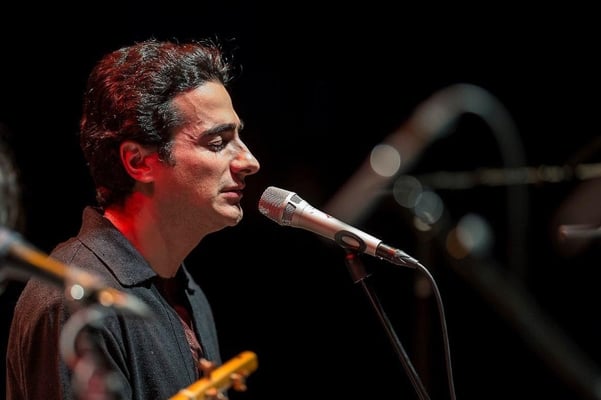
Free Concert for Iranians to Feel Better amid Economic Woes

Amid an economic crisis and an historic devaluation of Iran’s national currency, Shajarian wrote on his Instagram page that he may perform a free street concert if he is given the required permissions.

“Dear people, in these days when Siavash is through the blaze [referring to a story in Ferdowsi’s Shahnameh], I do not know what to do to make people feel better. If there would not be a licence problem, I’ll be at your service to perform a broad street concert for you [for free],” he said.

“Hope we’d feel better next to each other,” he wrote on his page.

Shajarian’s post was immediately welcomed by Iranian officials. Hojjat Nazari, a member of Tehran City Council, hailed the decision and expressed his preparedness to cooperate with the renowned singer. He also recommended that Shajarian holds the concert in a relatively poorer neighbourhood in southern Tehran.

The Culture Ministry’s Music Office also said it is ready to issue the required permissions for Shajarian to hold the outdoor performance.

According to IRNA, several Iranian singers had earlier cancelled their concerts to sympathise with the people who are spending hard days.

However, they were criticized by some who believe instead of cancelling the concerts singers can lower the price of the tickets or hold free programs to create joyful moments for the people.

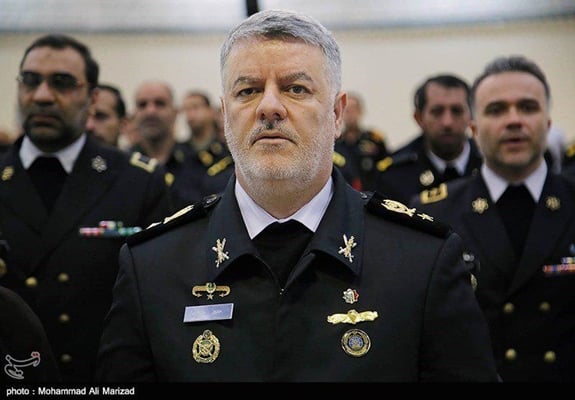
“Keeping Strait of Hormuz Open Hinges on Iran’s Interests”

The closure of the Strait of Hormuz needs some preliminaries, Khanzadi said on Tuesday.

“The effectiveness of a Strait heavily depends on its openness. Sanctions are highly influential on the functions and sanctions against Iran will affect the functions of the Strait of Hormuz,” he added.
“The international community must show its commitment towards the Islamic Republic. We do not consider the US as an effective player in the decision-making process in the Strait of Hormuz, and our actions are dependent on the opinion of the Leader of Iran’s Islamic Revolution,” noted Rear Admiral Khanzadi.

The US has threatened to cut down to zero Iran’s oil exports as part of its efforts to step up pressure on the Islamic Republic.

Iranian President Hassan Rouhani suggested earlier this month that Iran would try to stop oil trade in the region, if the US halts Iran’s oil export.

Speaking in a Tuesday meeting with UK’s new ambassador to Tehran, Rouhani stressed that the Islamic Republic of Iran has never been seeking tension in the region and does not want to create a problem in the world’s waterways, but it will never give up its right to export oil.

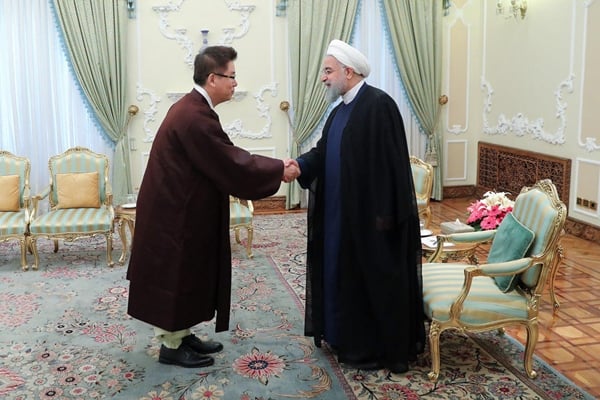
Iran Keen to Boost Ties with S. Korea, Vietnam: Rouhani

In a Tuesday meeting with the new ambassador of South Korea to Tehran, President Rouhani stressed that relations between Tehran and Seoul have always been friendly, and in recent years the ties have expanded and had positive results.

“Today, companies and private sectors of the two countries have good cooperation in different fields, especially energy, and they trust each other.”

“Iran can always be a reliable source of energy for South Korea,” said Rouhani, adding that certainly, the decisions of the new US administration are temporary, while the relations between Iran and South Korea are historical and deep-rooted.

“We should not let political issues and illegal sanctions hurt the historical relations between the two countries,” stated Rouhani, highlighting that efforts to further develop interaction between Tehran and Seoul and accelerate the implementation of the joint agreements.

In turn, the new South Korean Ambassador to Tehran underlined that Iran and South Korea have always had good relations.

He added that the ties between Tehran and Seoul have become much stronger in the past five years, saying, “I will not hesitate to try to expand the cooperation between the two countries in different sectors.”

Iran Keen to Boost Ties with S. Korea, Vietnam: Rouhani

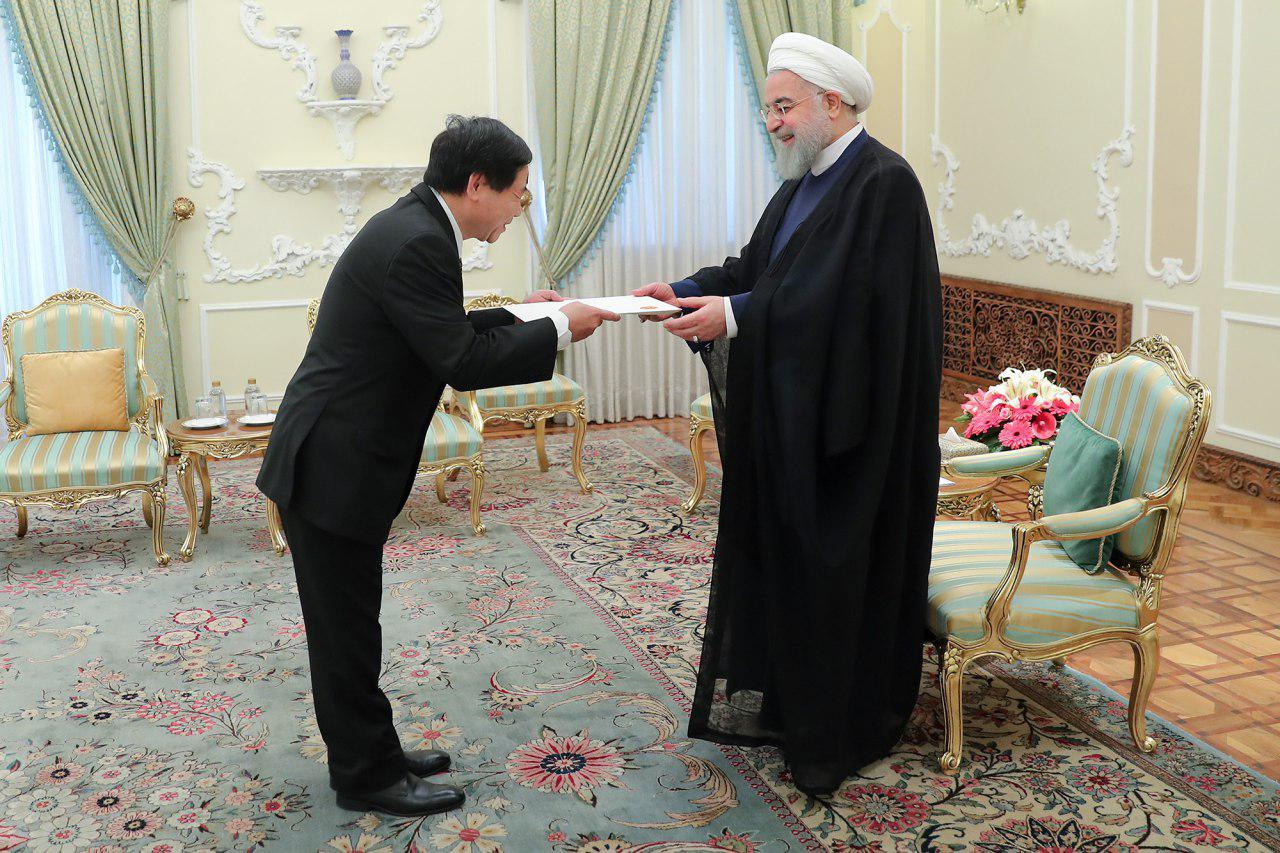
Meanwhile, Vietnam’s new ambassador to Tehran also held a meeting with the Iranian president and submitted his credentials.

In this meeting, President Rouhani said the relations between the two countries have been very well developed in recent years, and in the light of their capabilities, it is a must to further strengthen Tehran-Hanoi ties.

Referring to good agreements reached between the two countries during his visit to Vietnam, Rouhani noted that the two countries have plenty of capacities to meet each other’s needs. “By accelerating the implementation of the agreements, significant steps can be taken in line with the interests of the two nations,” he underscored.

“We hope that there will be good developments in the banking ties and deepening of Tehran-Hanoi economic cooperation. The Islamic Republic of Iran is fully prepared to boost the economic-political and cultural relations with Vietnam.”

The new Vietnamese envoy to Tehran, for his part, said he will do his utmost to expand the cooperation between the two countries in different sectors. He said in this regard, the Vietnamese prime minister has called on companies active in the economic sphere to develop relations with their Iranian counterparts.

Ball in Europe’s Court after US’ Withdrawal from JCPOA: Iran

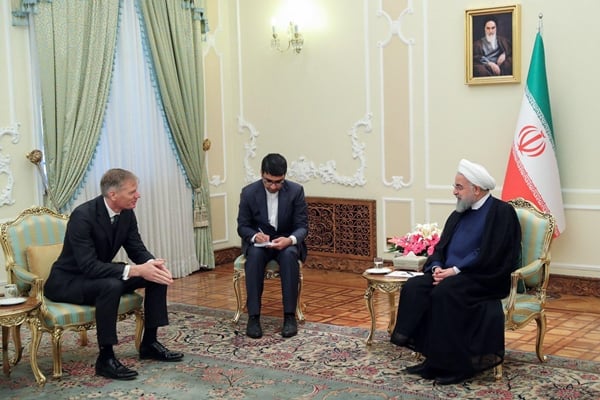
In a Tuesday meeting with UK’s new ambassador to Tehran Robert Macaire, President Rouhani said today is a significant period in history, and it is very important for the Iranian people to see that Europe clearly expresses its position on the actions that must be taken to compensate for the illegal withdrawal of the United States from the nuclear deal.

Rouhani also criticised the failure of some parties in the full implementation of the JCPOA in the commercial and economic sectors and banking relationships.

“The Islamic Republic of Iran is always ready to develop relations with European countries, and now, after the illegal withdrawal of the US, in the short time available, the ball is on the European states’ court.”

Rouhani also described as constructive the meetings and talks of the officials of the two countries regarding bilateral and international issues.

The president stressed that the Islamic Republic of Iran has never been seeking tension in the region and does not want to create a problem in the world’s waterways, but it will never give up its right to export oil.

For his part, Macaire said today, European countries are making unprecedented and great efforts to maintain the nuclear deal, especially in the economic field.

“We are looking for the further development of relations with Iran, and we believe that solving the problems and crises is possible only through dialogue and diplomacy,” he noted, stressing the importance of Iran’s de-escalation policy in the region.