Wednesday, December 24, 2025
Home Blog Page 3503

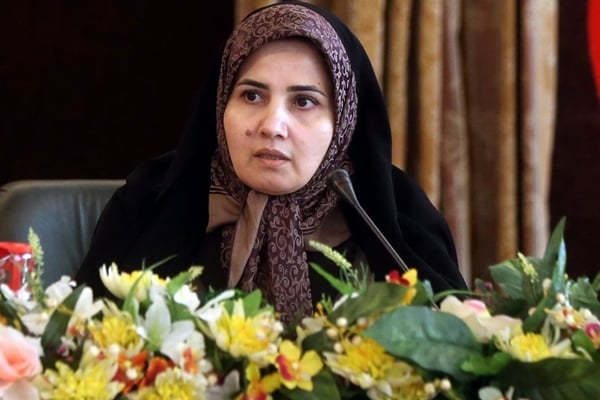
US Owes Iran over $110 Billion in Compensation: VP

“Individuals and private firms damaged by the US’ moves in the past decades have filed complaints in Iranian courts and verdicts have been issued in their favour. By now, the amount of compensation the US must pay has crossed 110 billion dollars,” Laya Joneydi said on Sunday.

Speaking to Khabar Online, Joneidi said that following the US withdrawal from the nuclear pact, Iranian courts will begin handling new complaints against the US, and the debt is going to rise.

Back in early May, US President Donald Trump withdrew Washington from the 2015 nuclear pact with Iran reached by his predecessor Barack Obama and other world powers, and ordered tough US sanctions on Tehran.

The Iranian government has filed a lawsuit in the International Court of Justice against the US alleging that Washington’s decision to re-impose sanctions violates a 1955 treaty between the two countries.

Iran is also challenging a ruling by the US Supreme Court in the ICJ to take its money back.

Last year, the US Supreme Court ruled that Iran’s central bank must turn over $2.1 billion in frozen assets to victims of the 1983 Marine Corps barracks bombing in Lebanon, for which Iran was found liable by US courts.


Iran, US Could Barter Compensations

Joneidi said the Iranian plaintiffs could appoint the Iranian government as their proxy, so the government can ask its US counterpart to compensate for the damages.

The vice president said the American people claiming to be victims of Iran’s terrorism hold some 80 billion dollars in federal court rulings against Iranian government entities and officials.

Asked if the two countries could barter for compensations, Joneidi said this is a possibility.

“If there are serious negotiations and the two sides have strong will, this can be done,” she said.
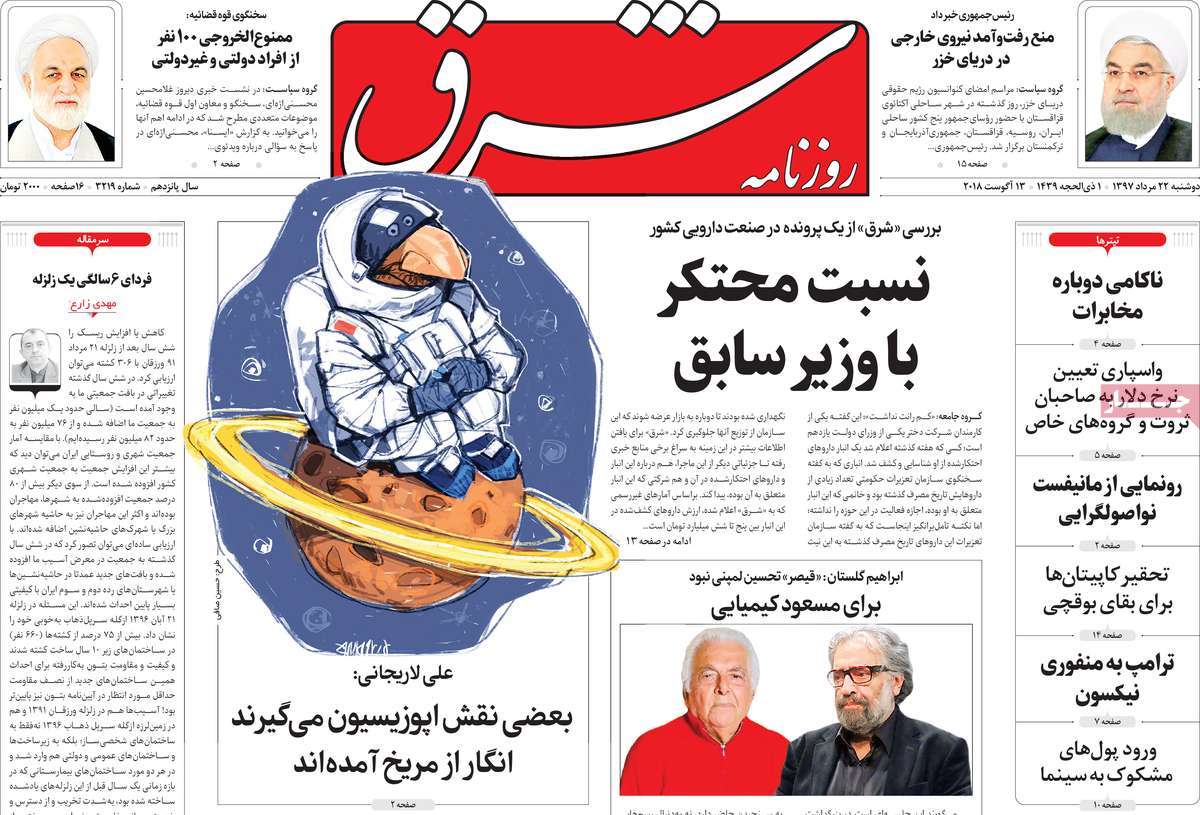
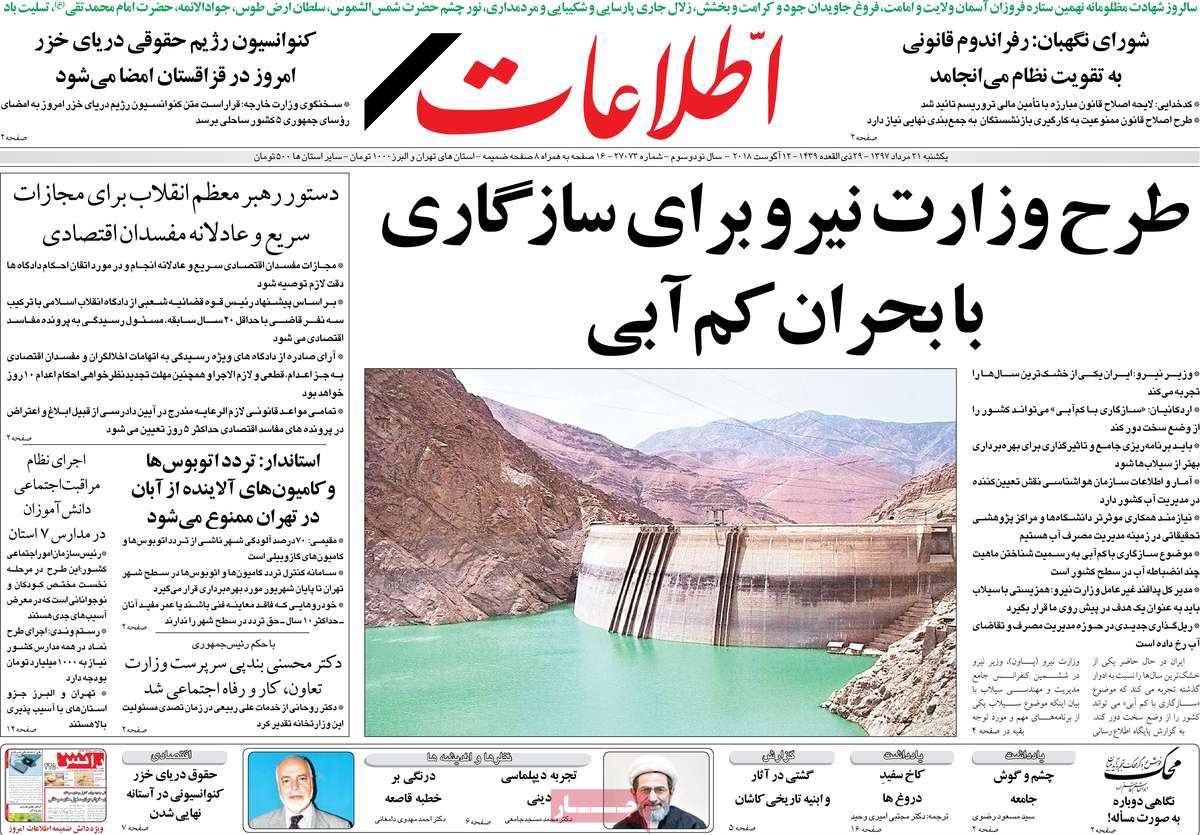
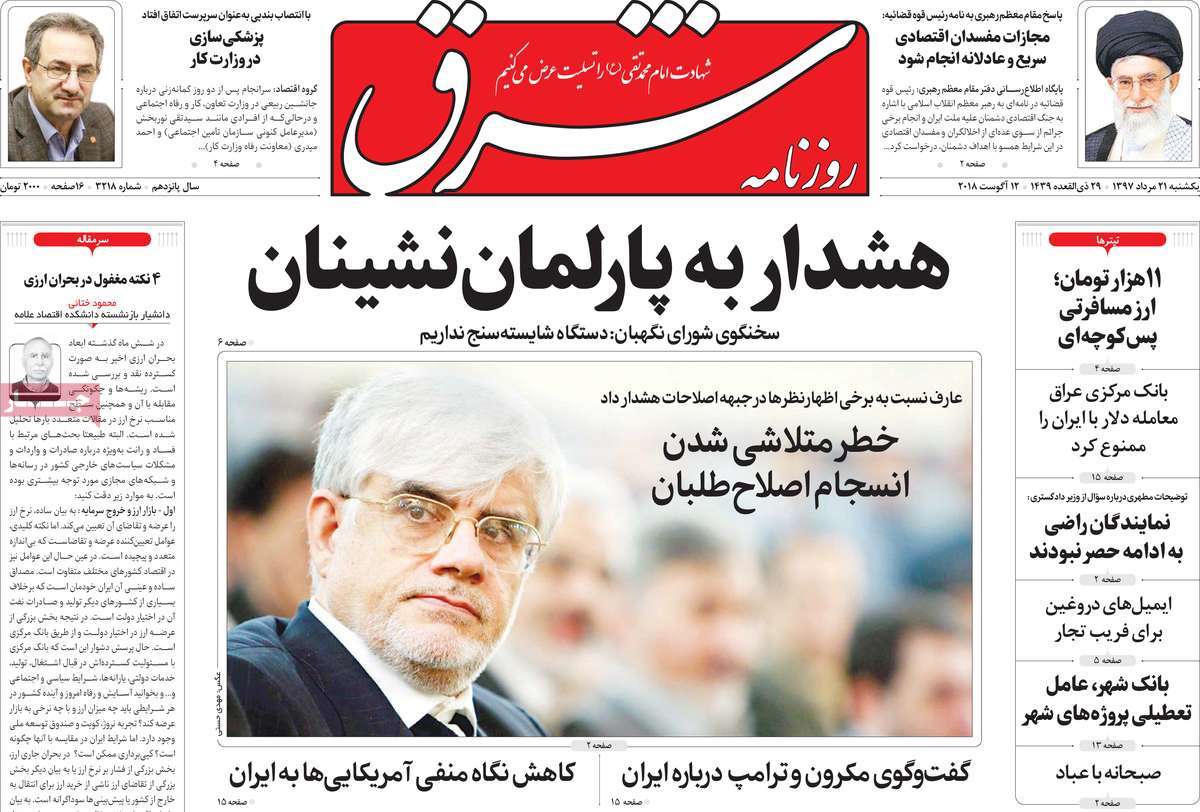
A Look at Iranian Newspaper Front Pages on August 13

A Look at Iranian Newspaper Front Pages on November 19

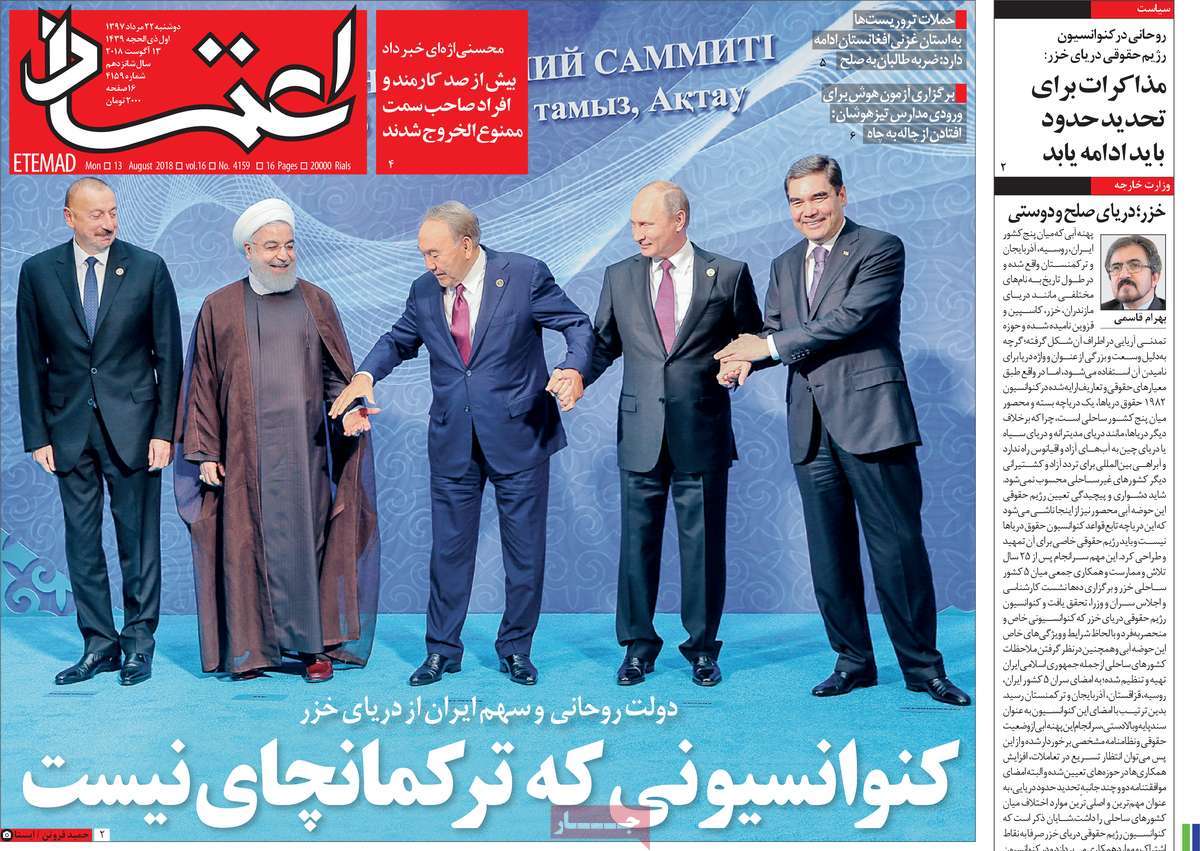
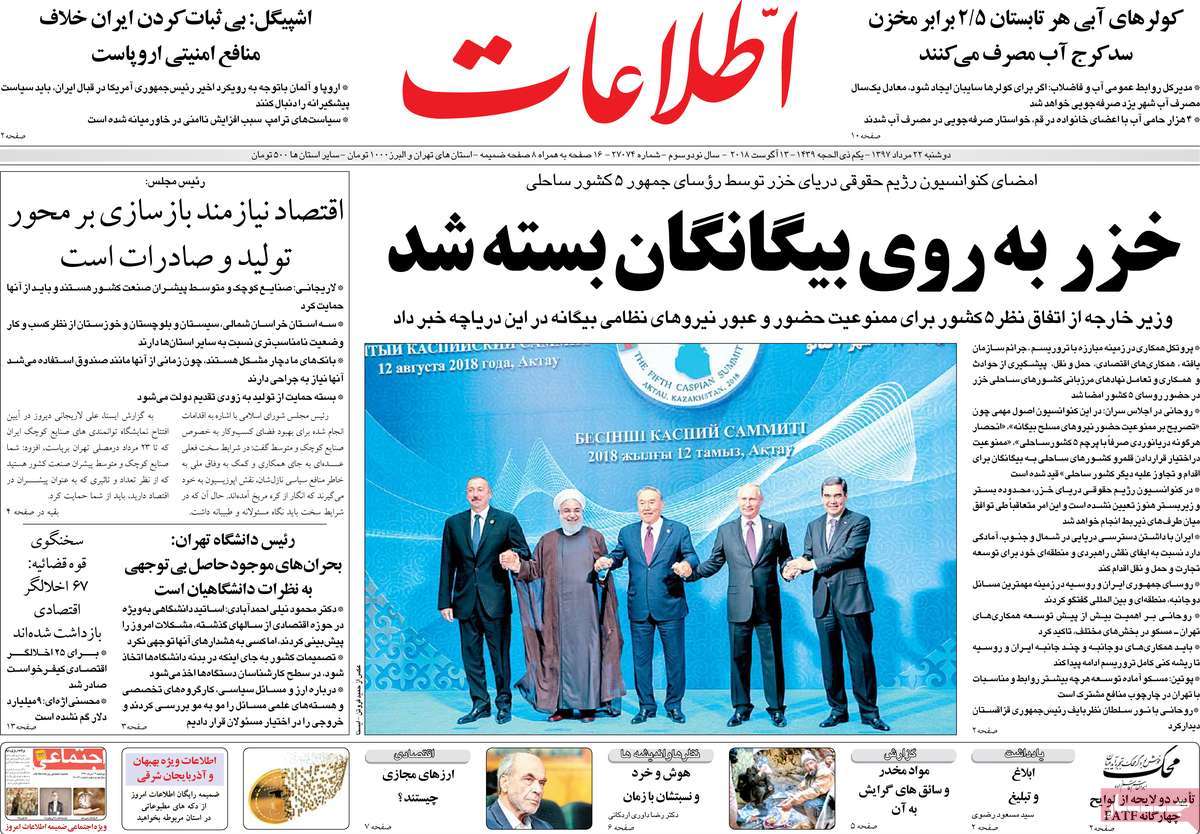
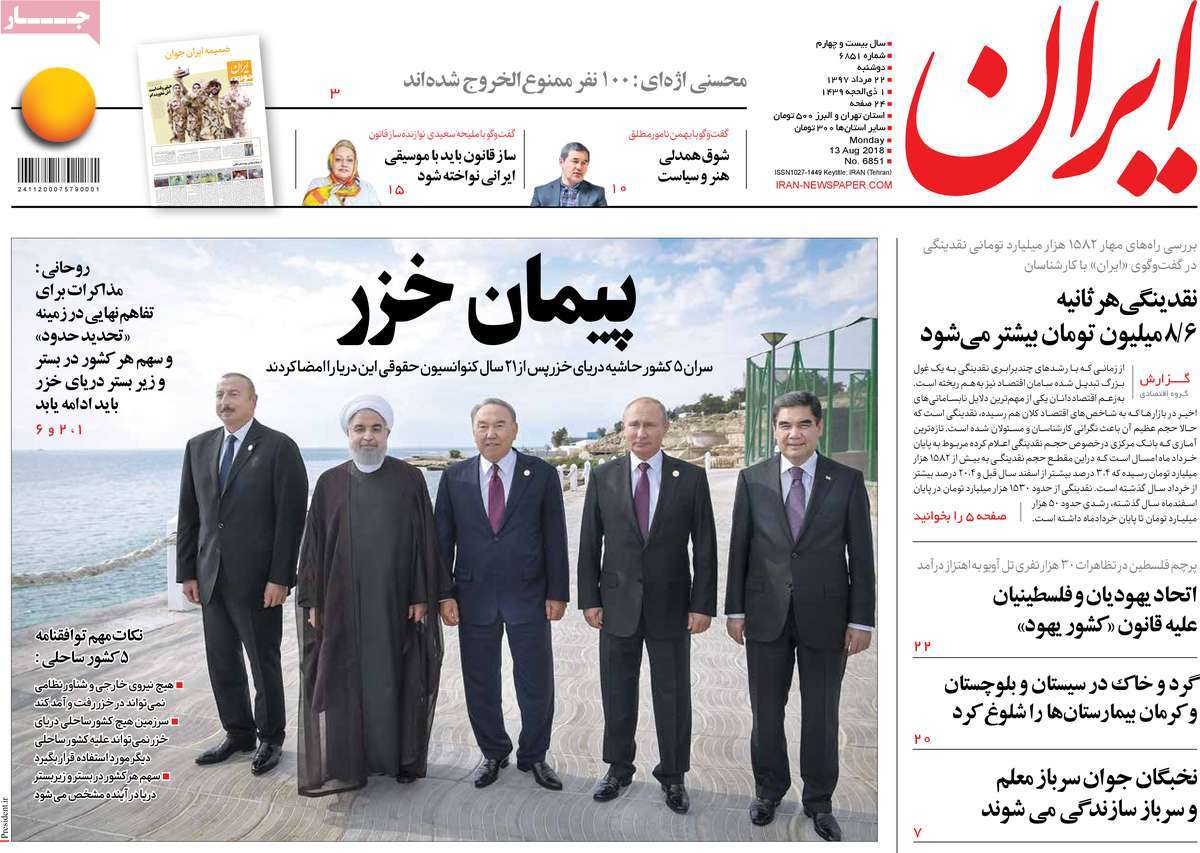
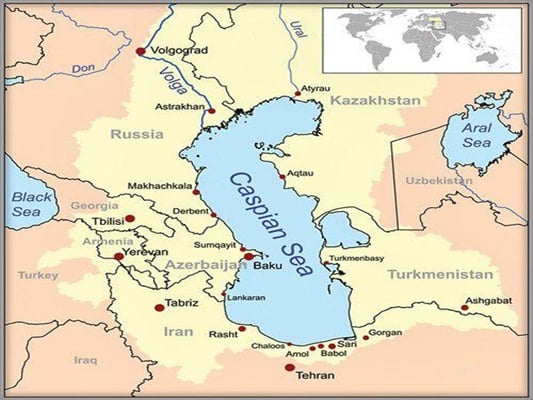
The top story in all papers today was the landmark Convention signed by Iran, Russia, Turkmenistan, Azerbaijan, and Kazakhstan on the Legal Regime of the Caspian Sea.

Many papers covered the details of the agreement, and the ambiguities regarding Iran’s share of the world’s largest lake.

Also a top story was the beginning of the Judiciary’s swift prosecution of those involved in financial corruption.

The social media campaign #Where_Is_Your_Child, which challenges top officials to declare where their children are living and what they do, also received great coverage.

The above issues, as well as many more, are highlighted in the following headlines and top stories:


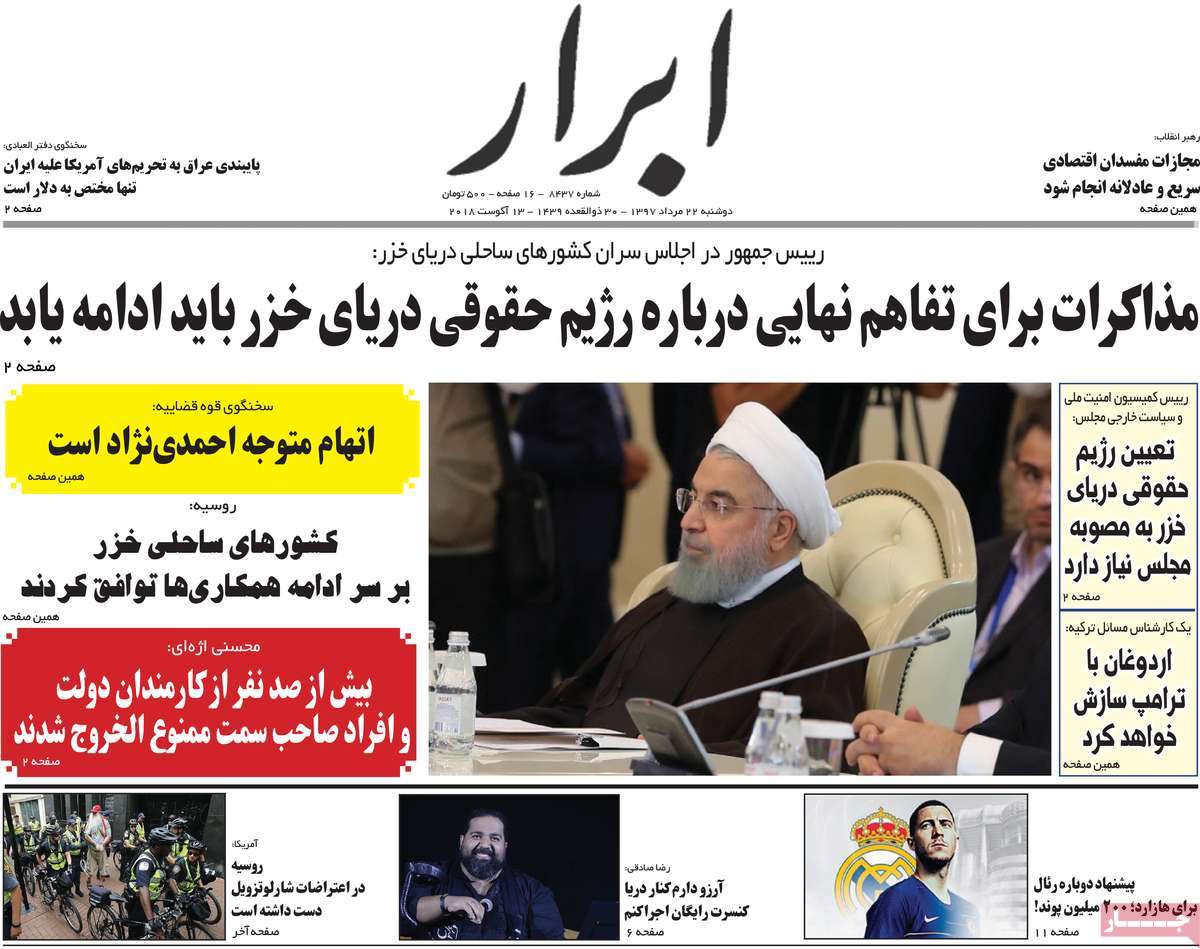
Abrar:

1- Talks for Final Agreement on Caspian Sea’s Legal Regime Must Continue: Rouhani

2- Decision on Caspian Sea Legal Regime Needs Iran Parliament’s Approval

3- Analyst: Erdogan Will Finally Compromise with Trump

A Look at Iranian Newspaper Front Pages on August 13


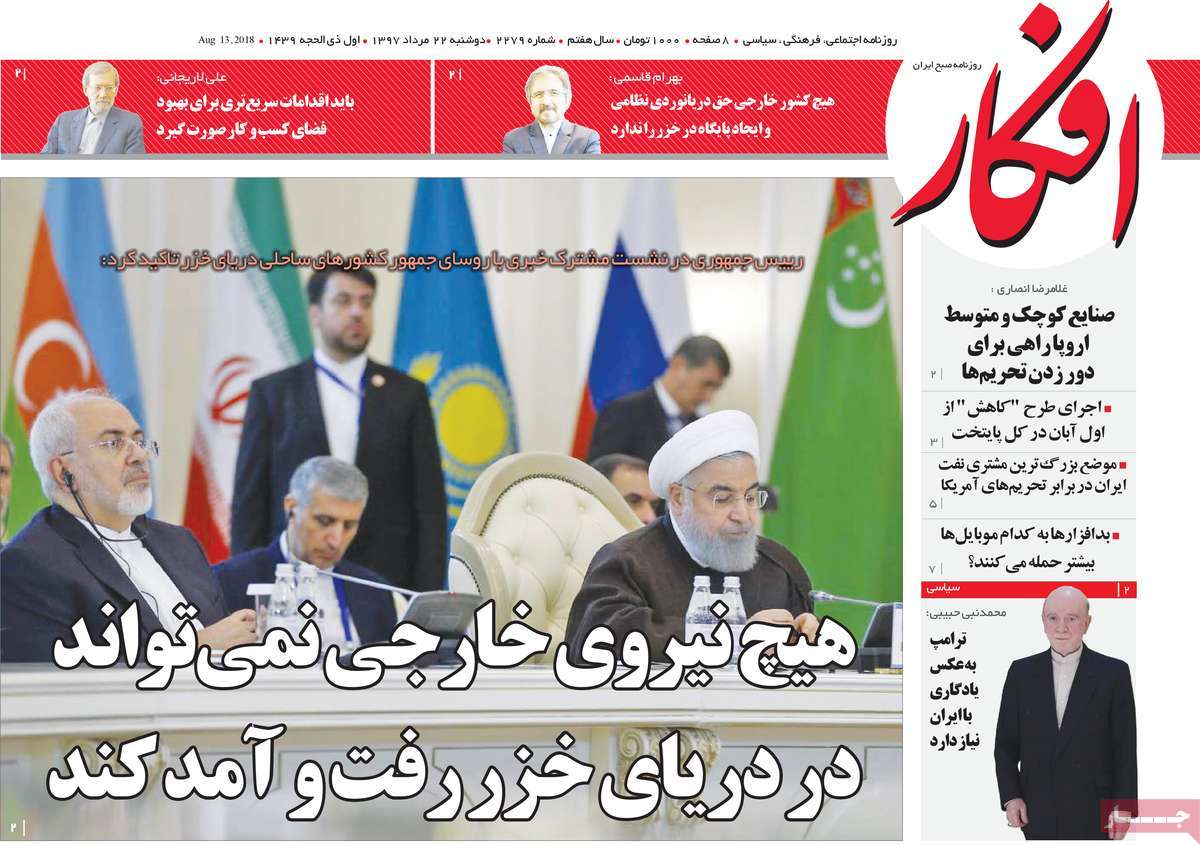
Afkar:

1- No Foreign Force Allowed to Navigate in Caspian Sea

2- European SMEs Best Way to Bypass US Sanctions

A Look at Iranian Newspaper Front Pages on August 13


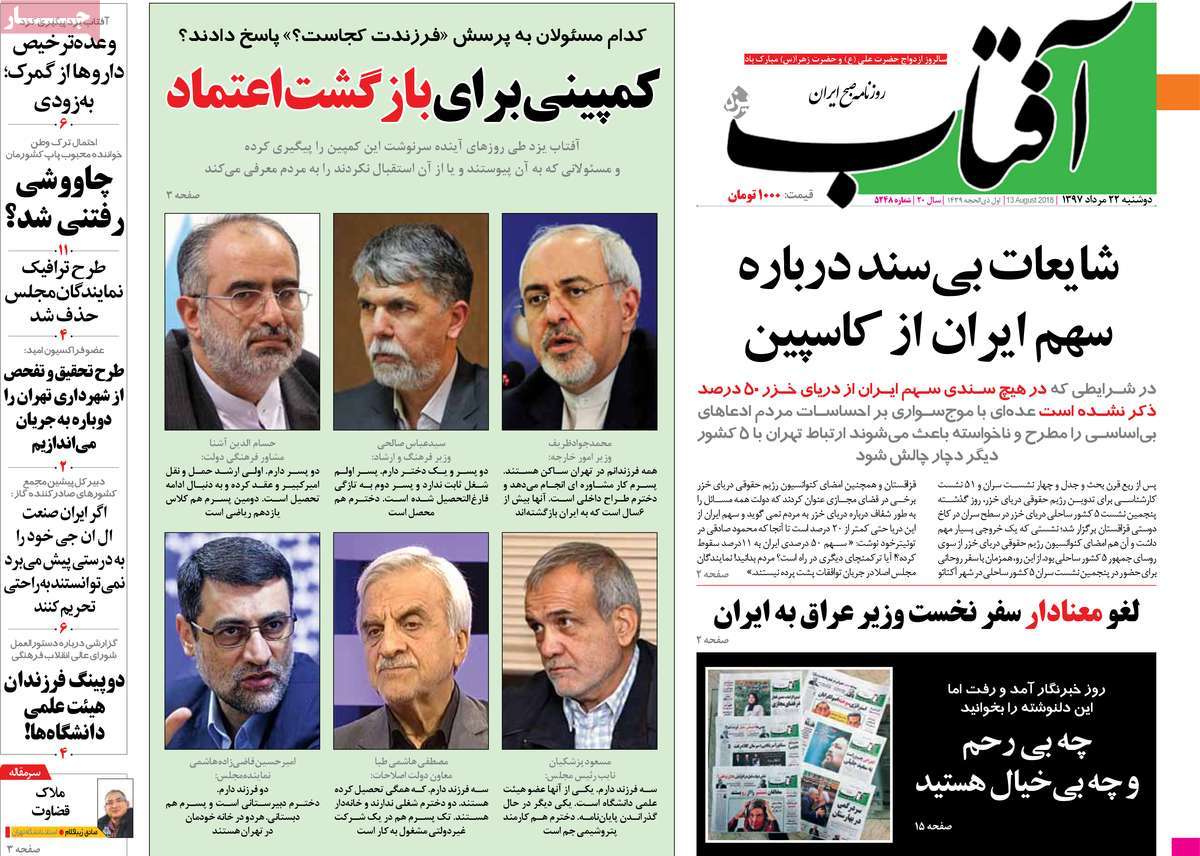
Aftab-e Yazd:

1- A Campaign to Restore Public Trust

* Which Officials Have Responded to “Where’s Your Child” Question?

2- Unfounded Rumours about Iran’s Share of Caspian Sea

3- Significant Cancellation of Iraqi PM’s Visit to Tehran

A Look at Iranian Newspaper Front Pages on August 13


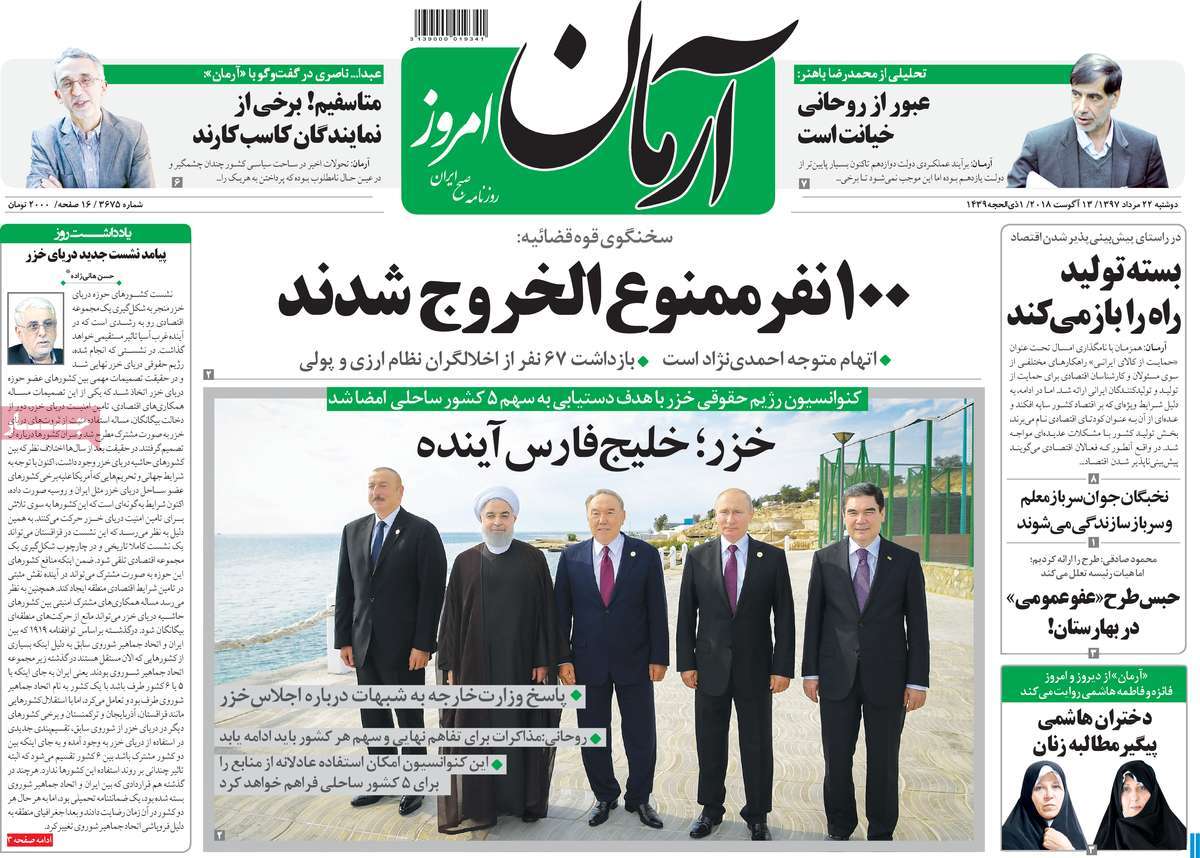
Arman-e Emrooz:

1- 100 People [Officials] Banned from Leaving Iran: Judiciary Spokesman

2- Outcome of Latest Caspian Sea Summit [Editorial]

3- Conservative Politician: It’s a Betrayal to Stop Supporting Rouhani

3- Caspian Sea, The Future Persian Gulf

A Look at Iranian Newspaper Front Pages on August 13


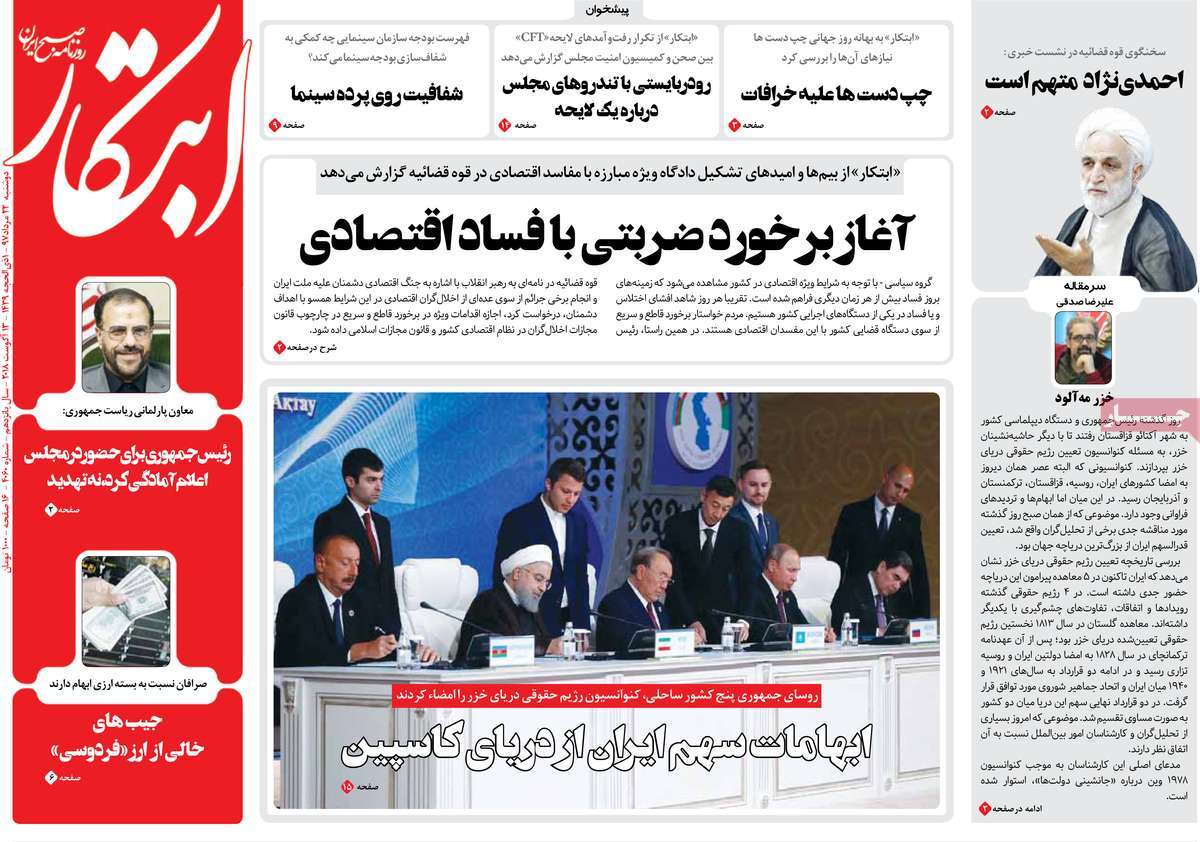
Ebtekar:

1- Iran Starts Taking Swift Action against Financial Corruption

2- Ambiguities Regarding Iran’s Share of Caspian Sea

A Look at Iranian Newspaper Front Pages on August 13


Etemad:

1- The Convention Which Is Not Treaty of Turkmenchay

* Rouhani’s Government and Iran’s Share of Caspian Sea

2- Caspian, The Sea of Peace, Friendship [Editorial by Foreign Ministry Spokesman Qassemi]

3- Taliban’s Attack on Peace: Raids Continue in Afghanistan

A Look at Iranian Newspaper Front Pages on August 13


Ettela’at:

1- Caspian Sea Closed to Aliens

2- Spiegel: Destabilizing Iran against Europe’s Security Interests

A Look at Iranian Newspaper Front Pages on August 13


Iran:

1- Caspian Treaty: Five Leaders Sign Convention after 21 Years

2- Jews, Palestinians Unite against ‘Jewish State’ Law

A Look at Iranian Newspaper Front Pages on August 13


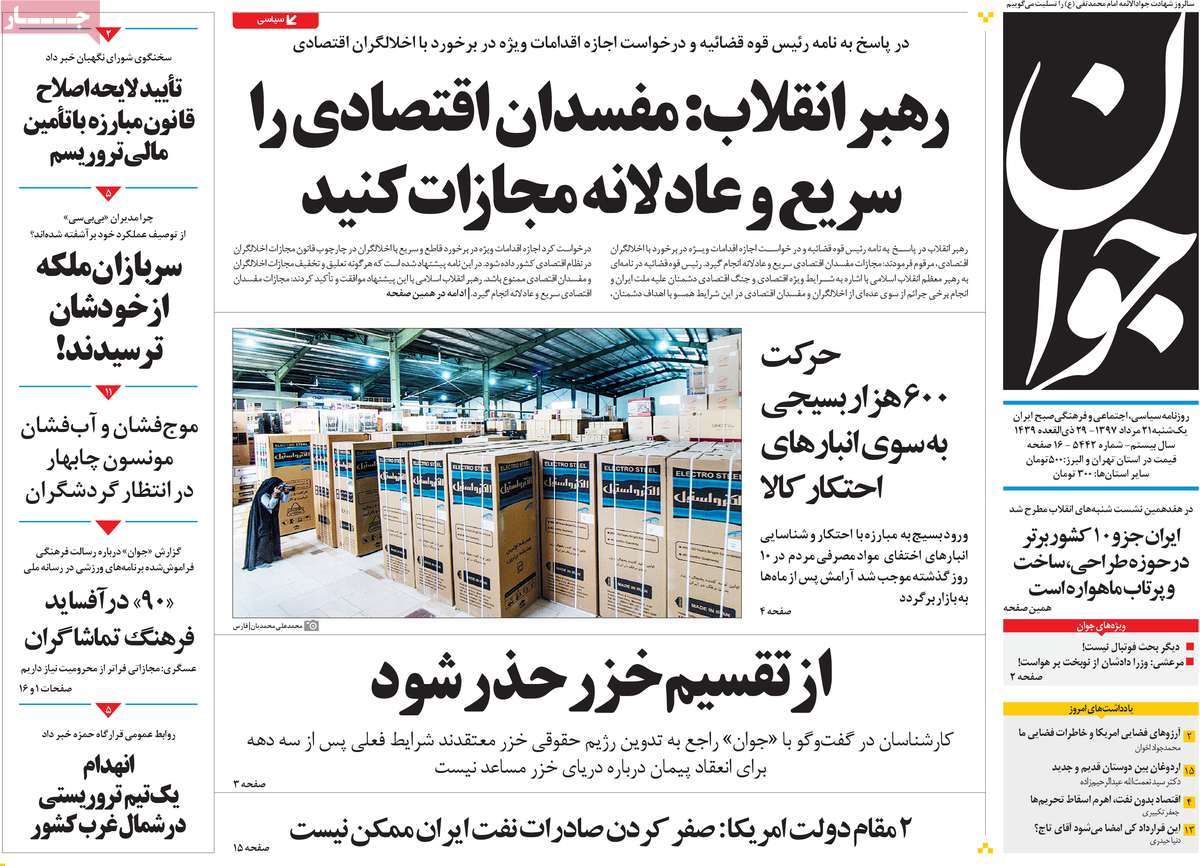
Javan:

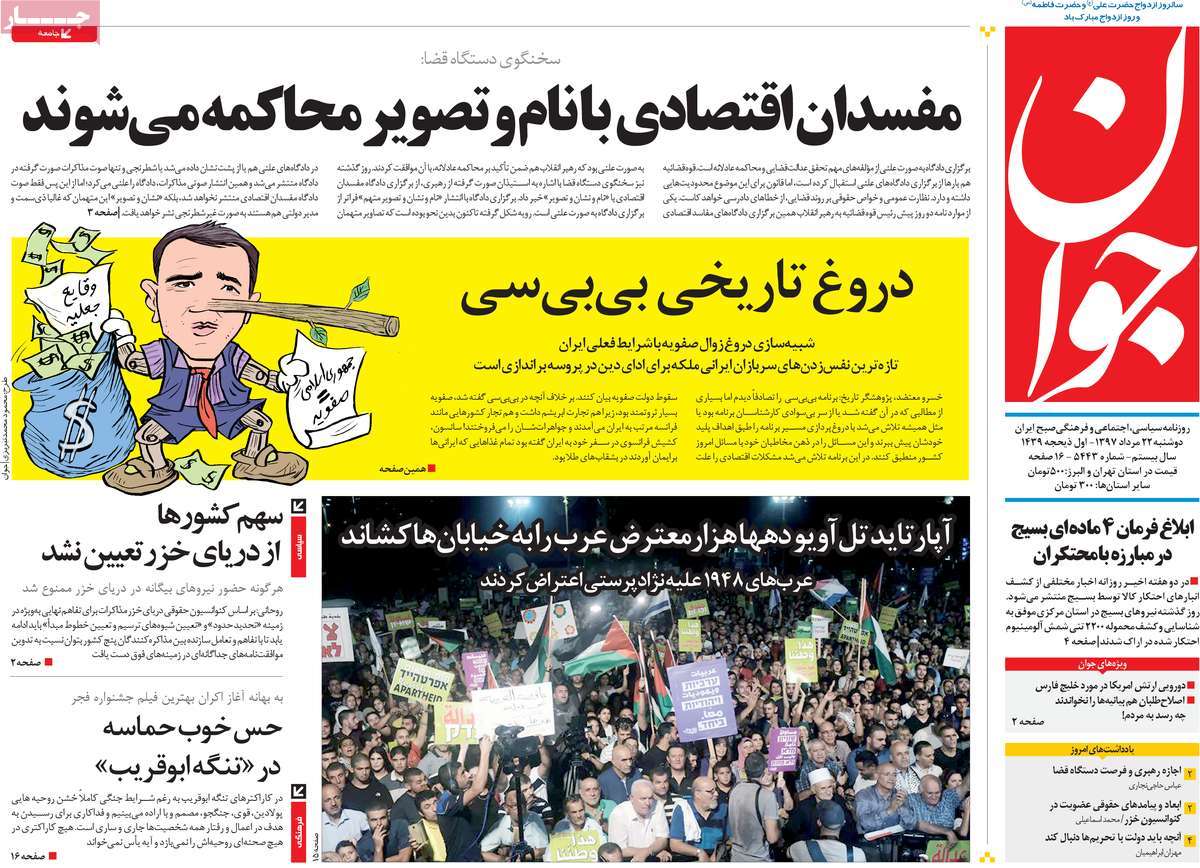
1- BBC’s Historical Lie: Soldiers of Queen Doing Their Best to Overthrow Iran Gov’t

2- Tel Aviv’s Apartheid Takes Tens of Thousands of Arab Protesters to Streets

A Look at Iranian Newspaper Front Pages on August 13


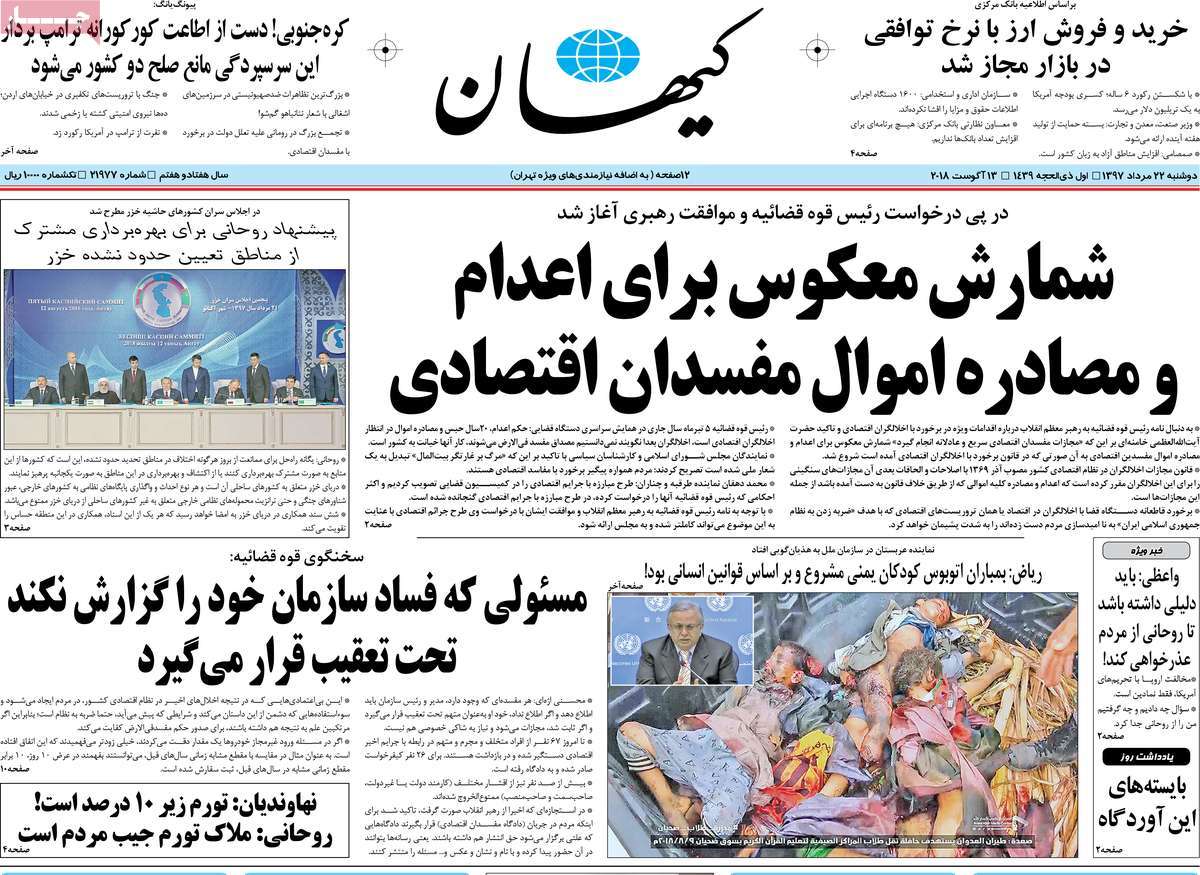
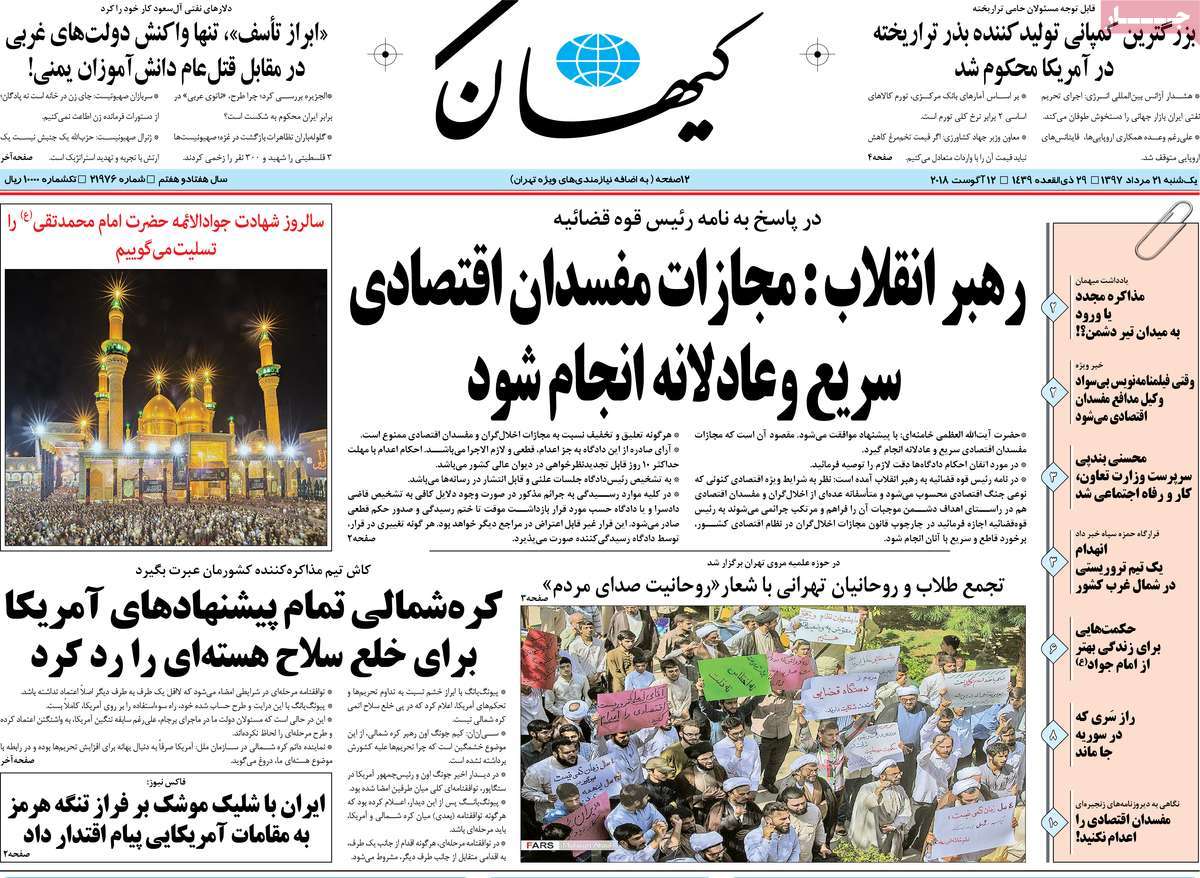
Kayhan:

1- Countdown Begins for Execution of Those Engaged in Financial Corruption

2- Riyadh: Air Raids on Bus Carrying Yemeni Children Legitimate, Based on Humanitarian Laws!

A Look at Iranian Newspaper Front Pages on August 13


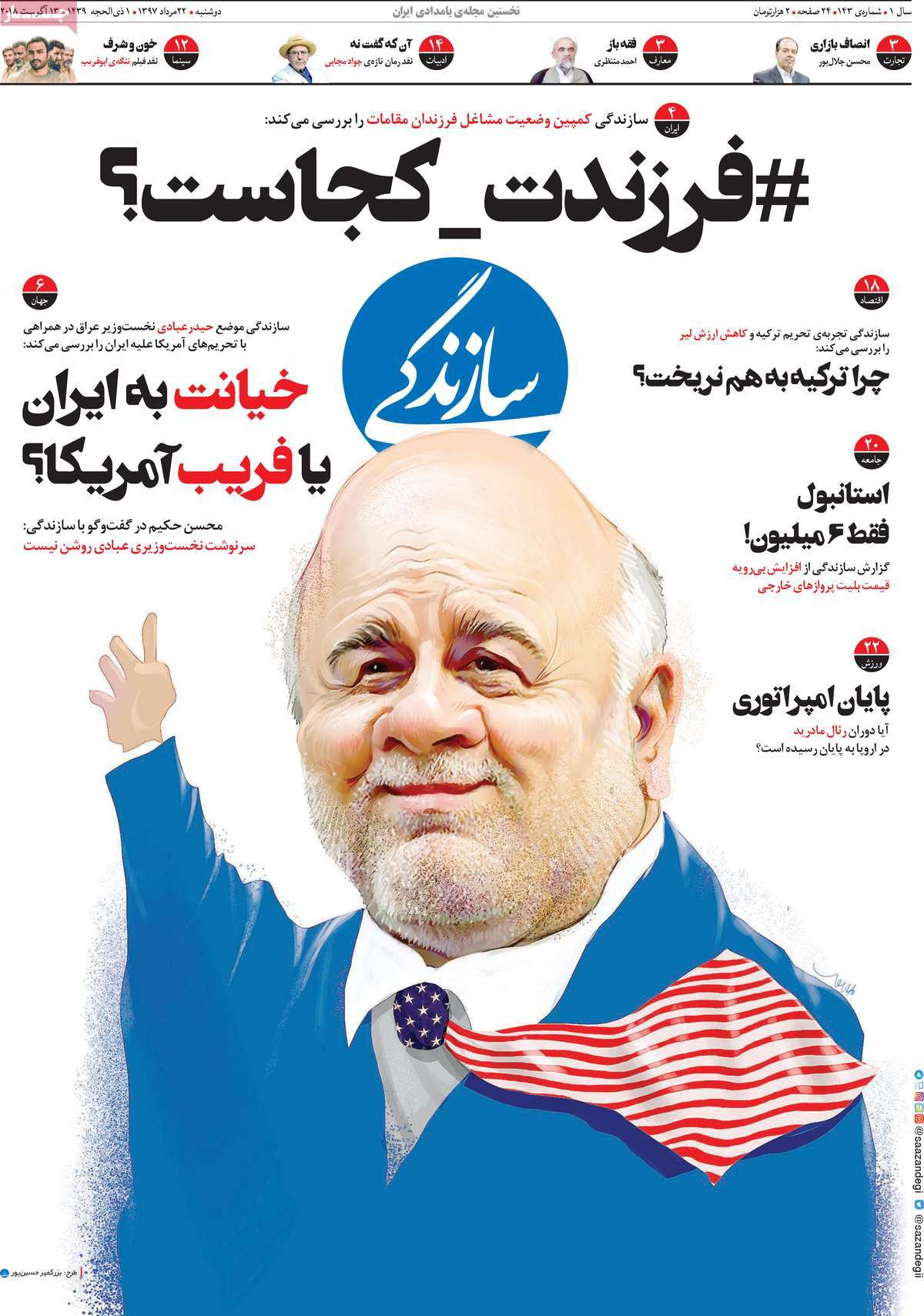
Sazandegi:

1- Where Are Your Children?

* Social Media Campaign Calls on Officials to Announce What Their Children Do

2- Betraying Iran or Deceiving US?

* A Report on Iraqi PM’s Support for US Sanctions

A Look at Iranian Newspaper Front Pages on August 13


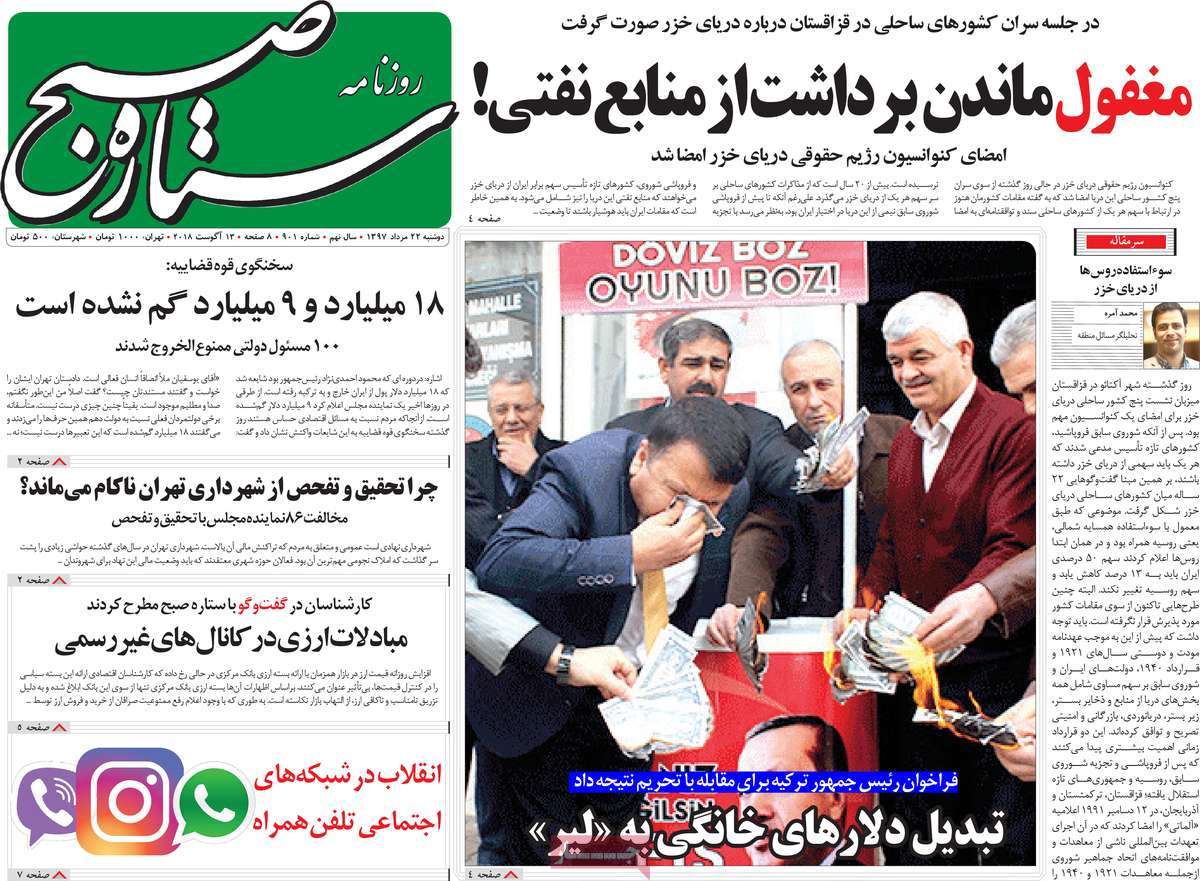
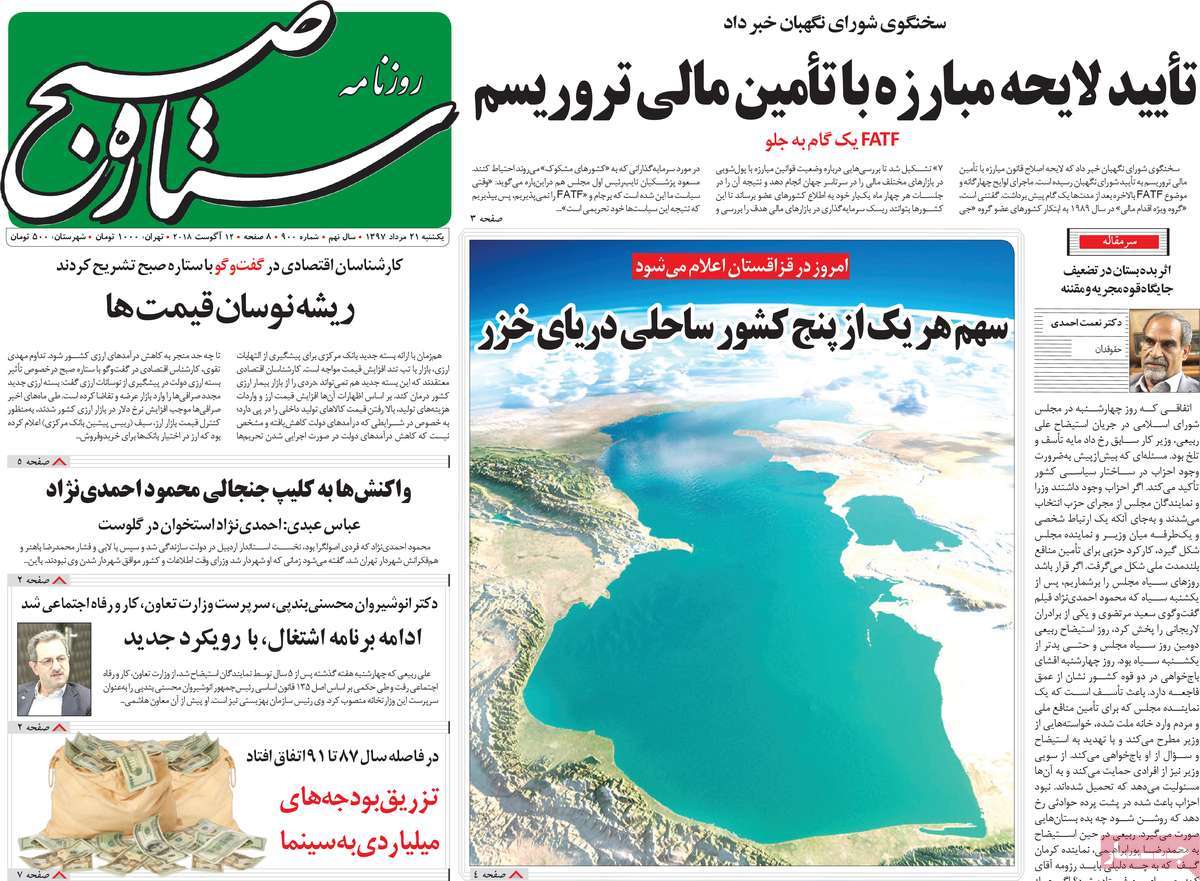
Setareh Sobh:

1- Issue of Oil Extraction from Caspian Sea Ignored in Convention

A Look at Iranian Newspaper Front Pages on August 13


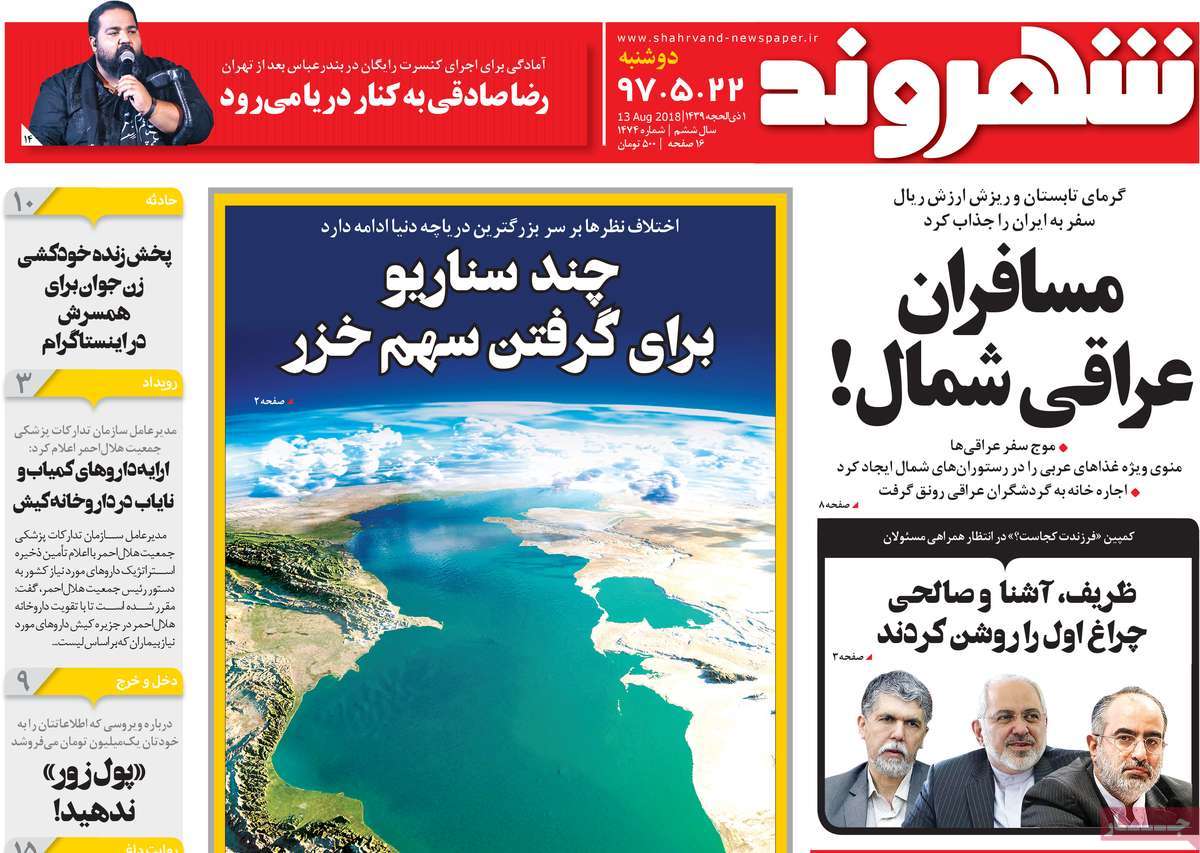
Shahrvand:

1- Iraqis Travelling to Northern Iran for Summer Vacation

2- Several Scenarios on Caspian Sea Shares

3- Young Woman Airs Her Suicide for Husband Live on Instagram

A Look at Iranian Newspaper Front Pages on August 13


Shargh:

1- Manifesto of “Neo-Conservatism” Unveiled in Iran

2- Trump as Hated Now as Nixon Was

A Look at Iranian Newspaper Front Pages on August 13

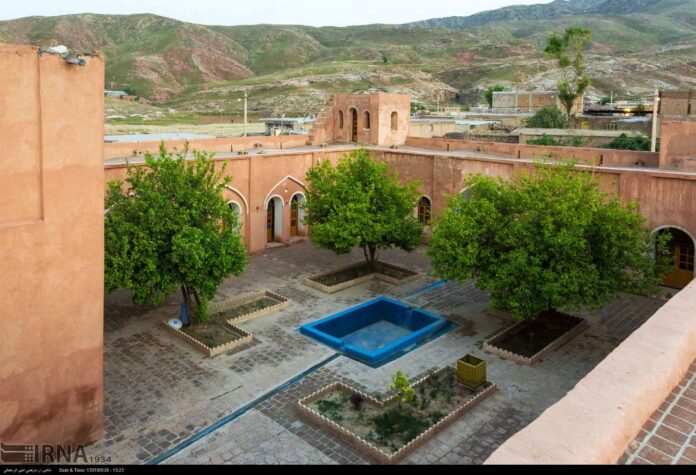
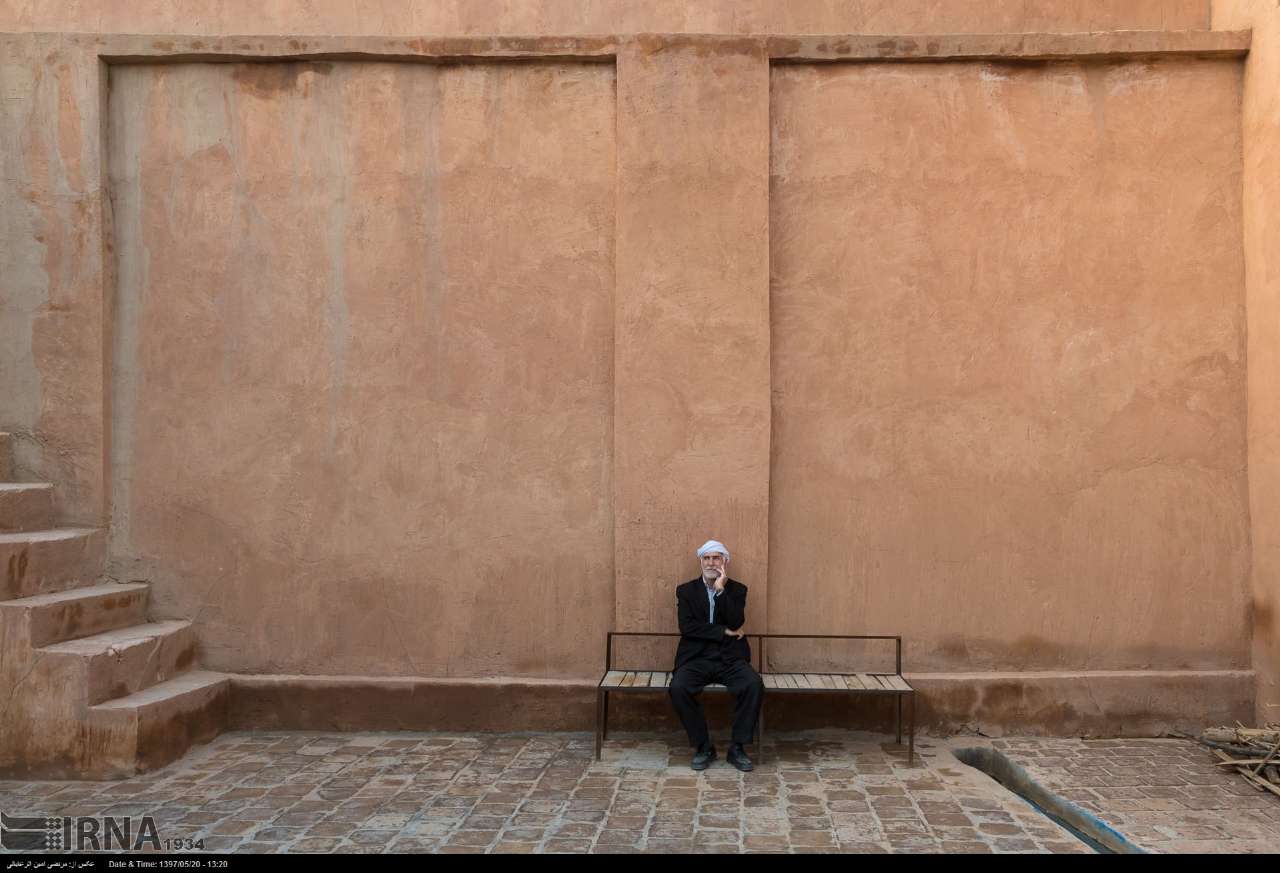
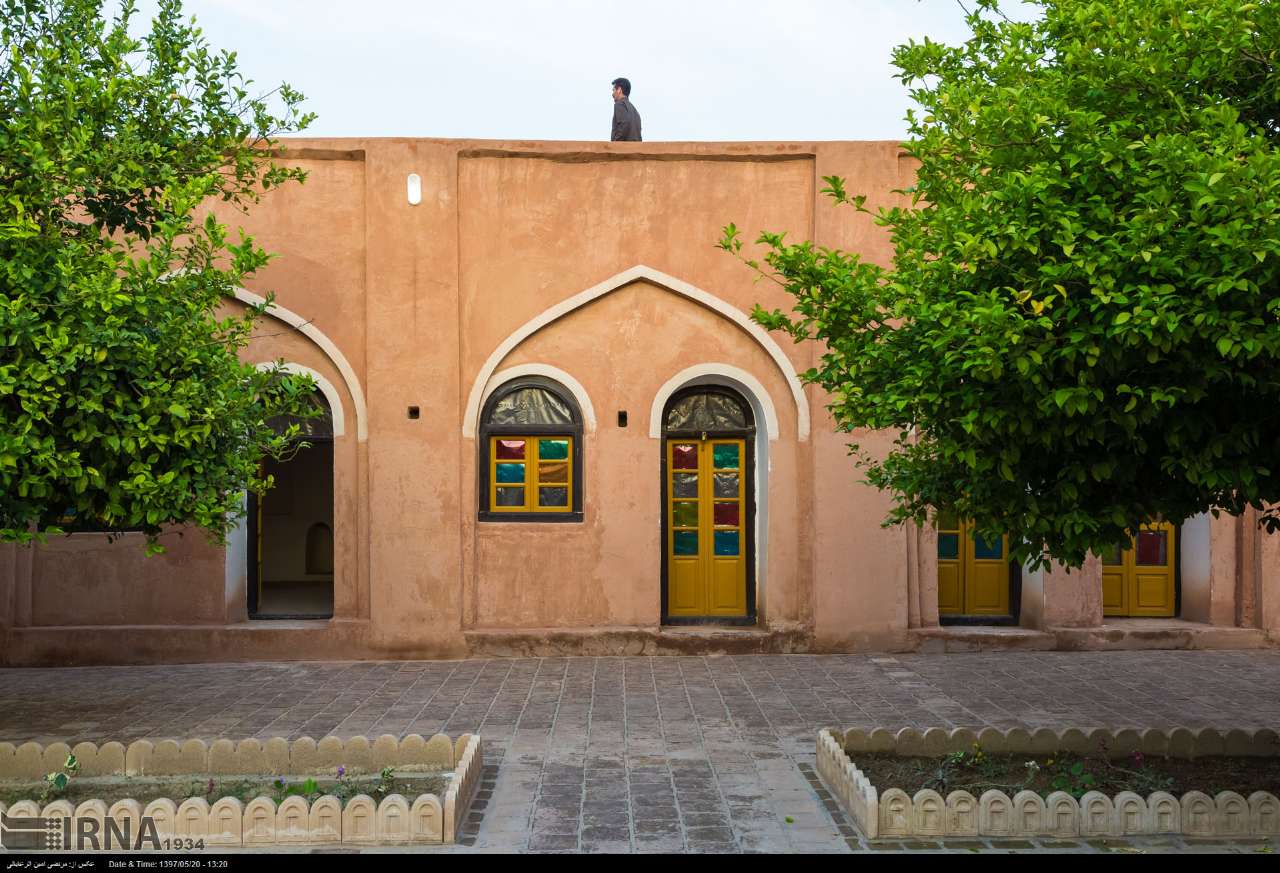
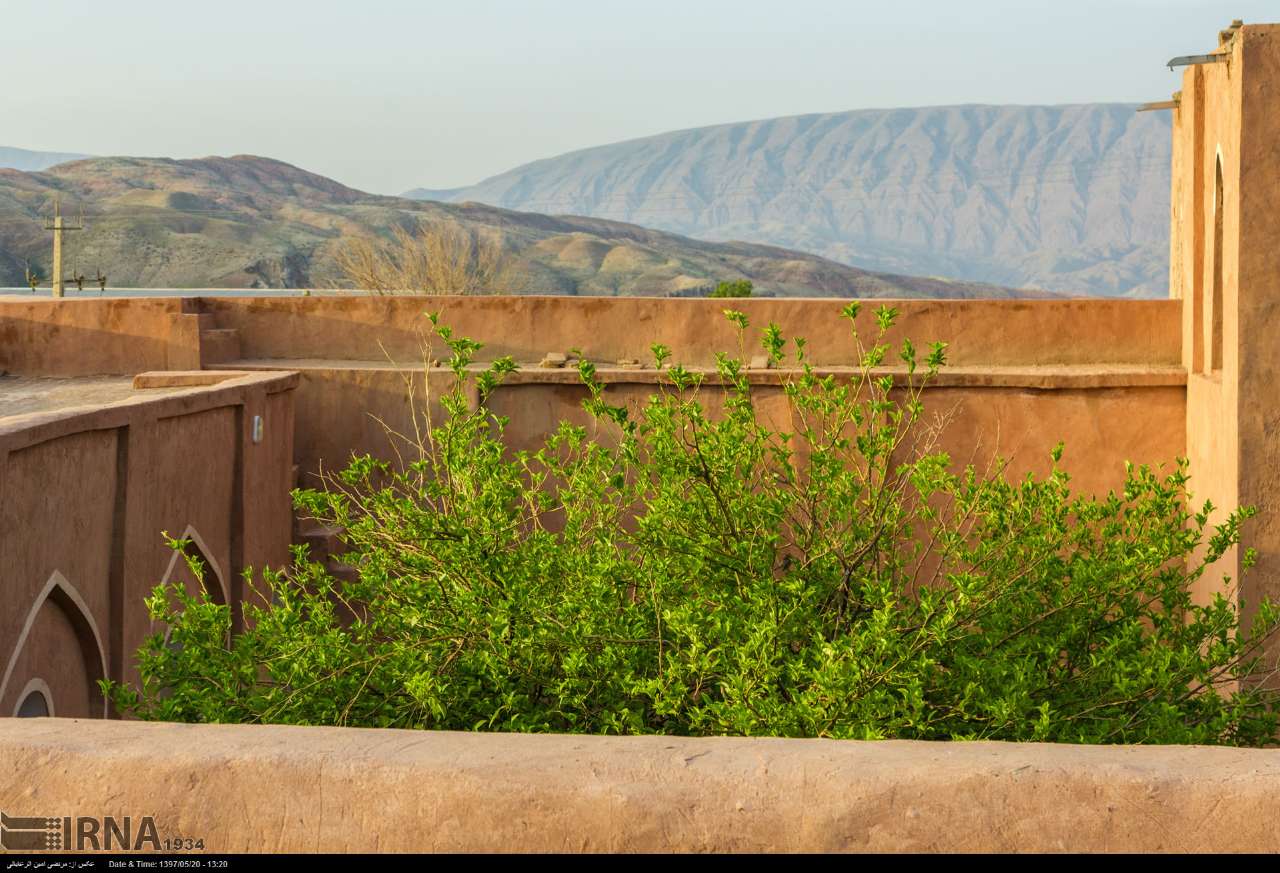
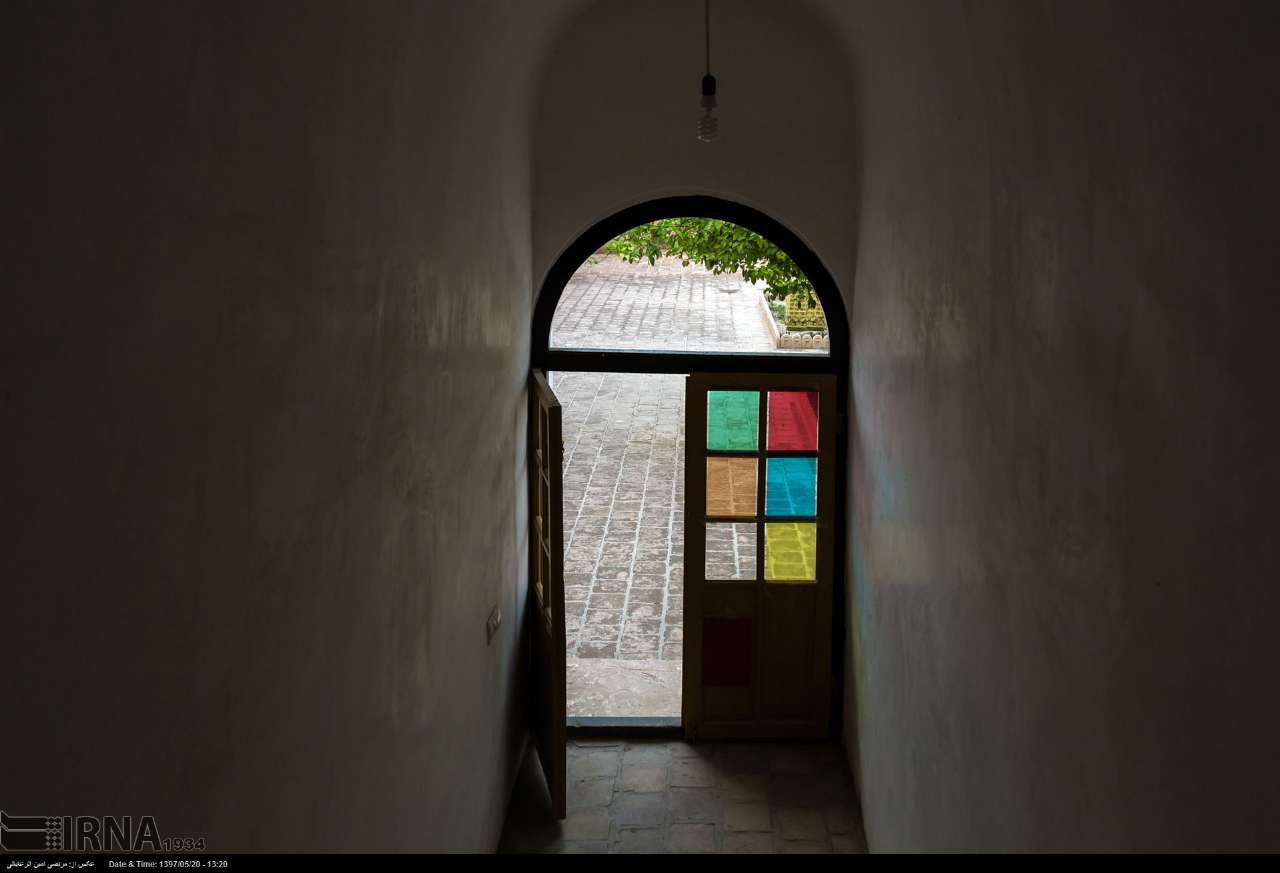
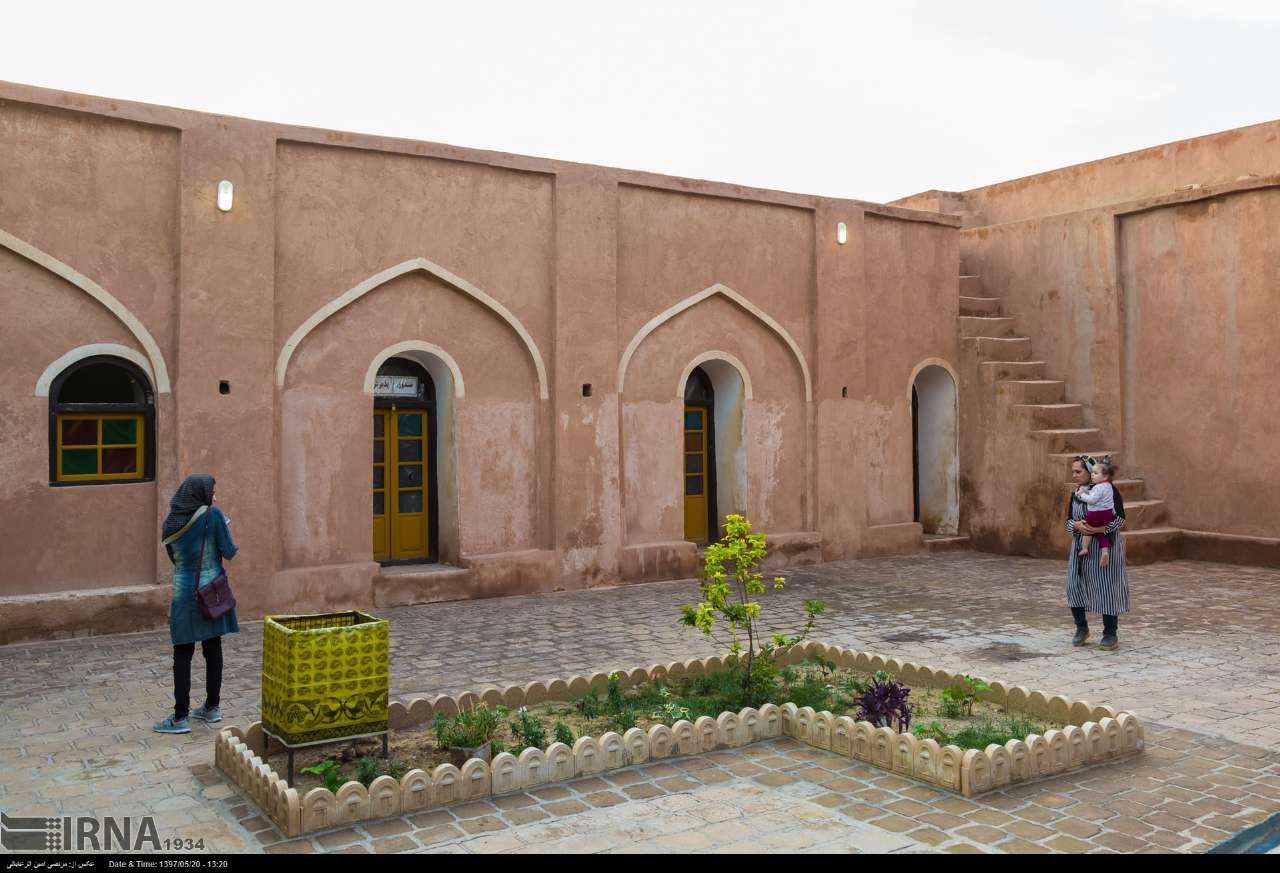
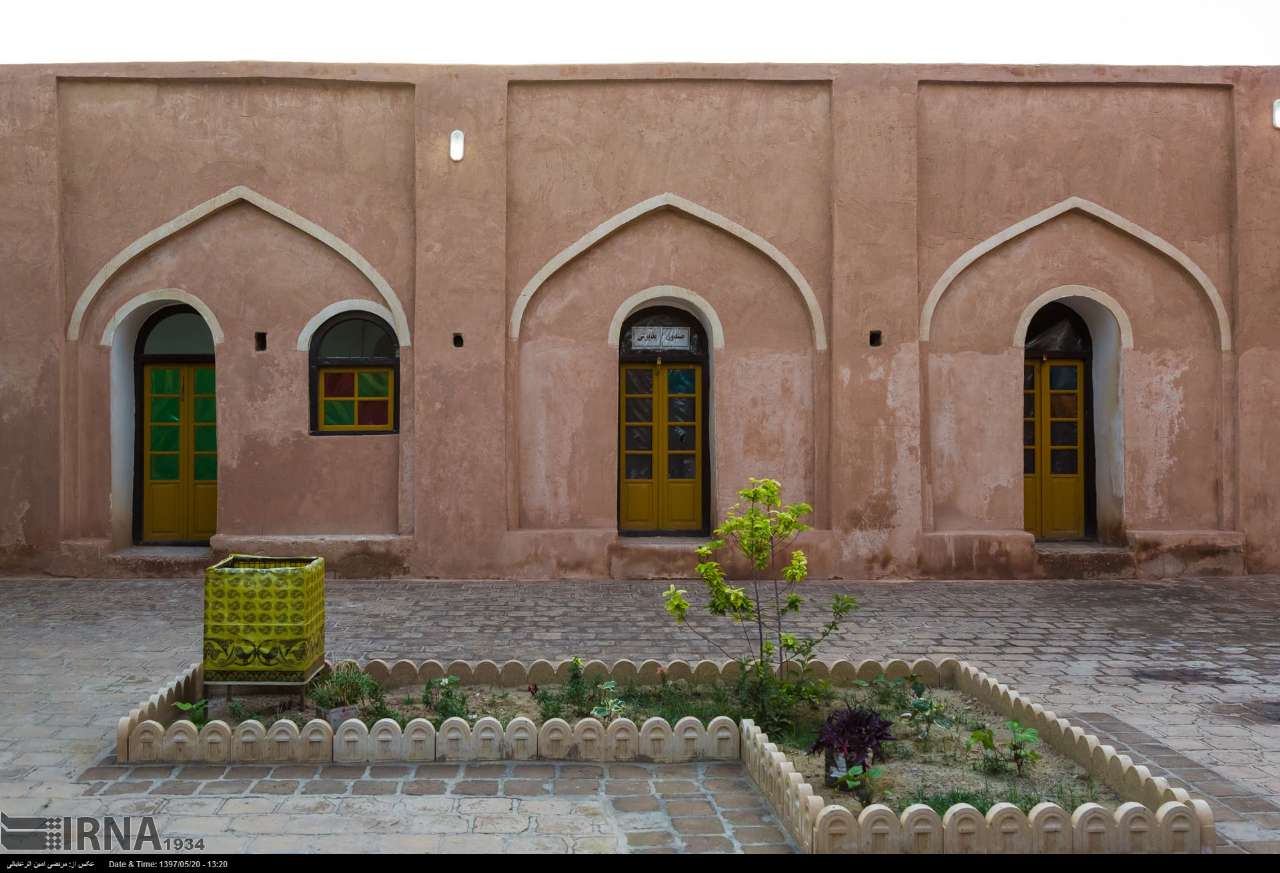
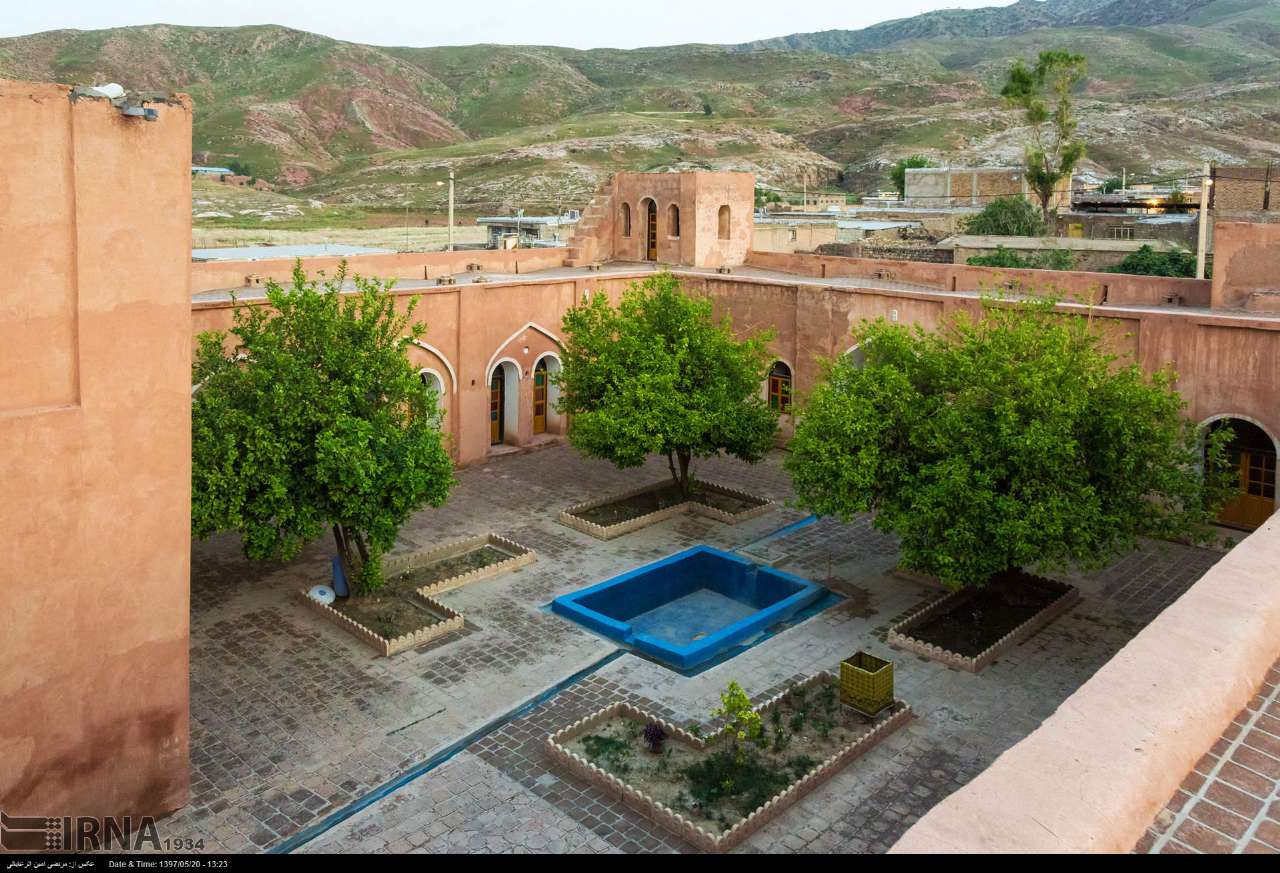
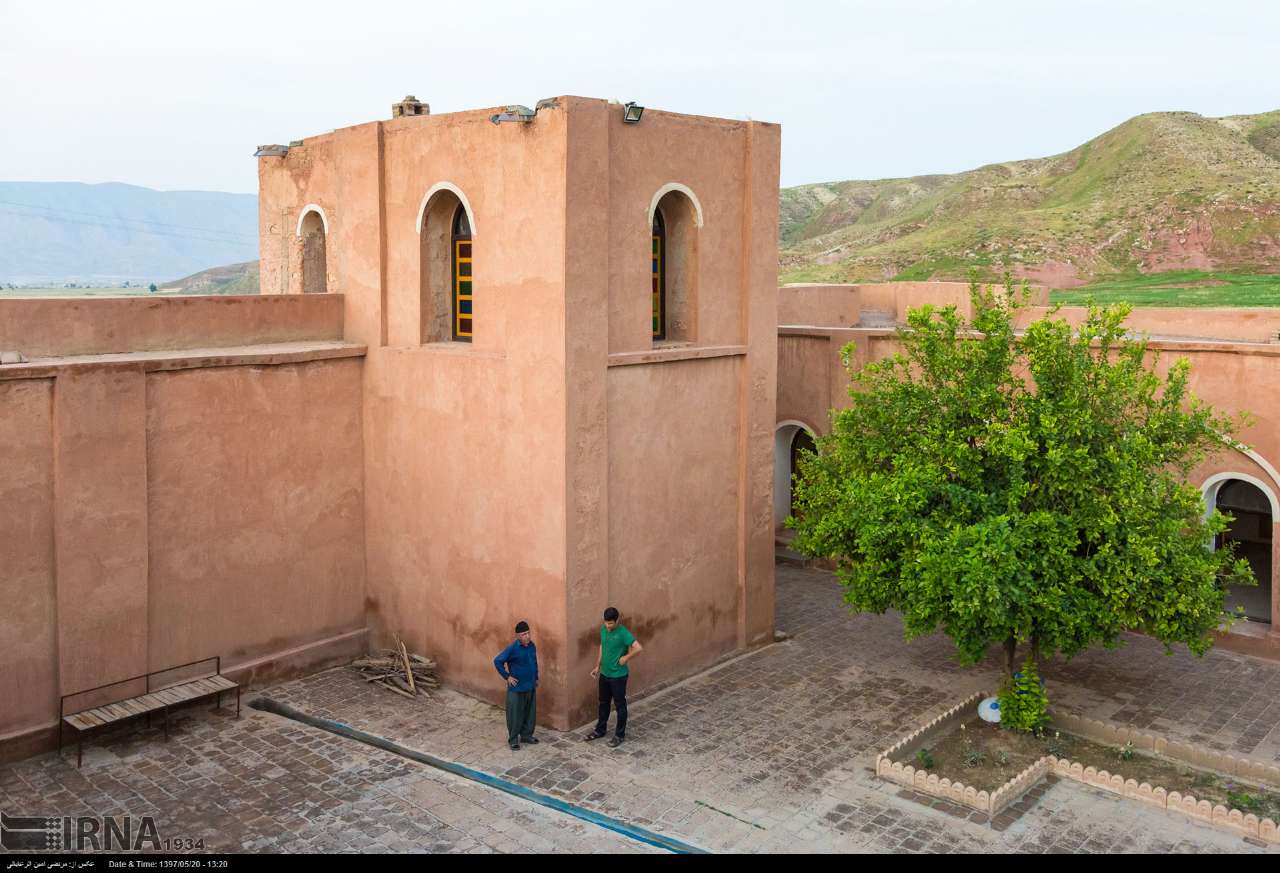
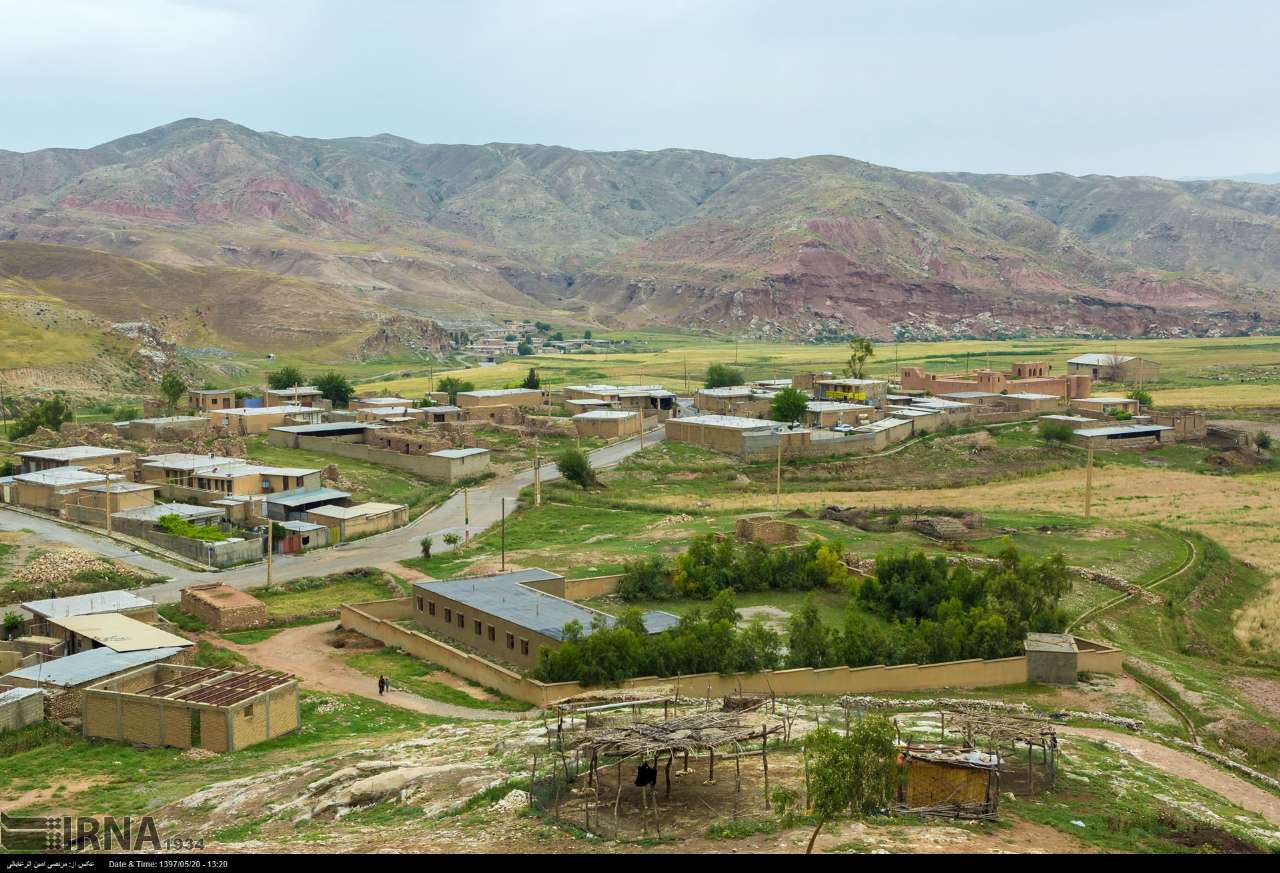
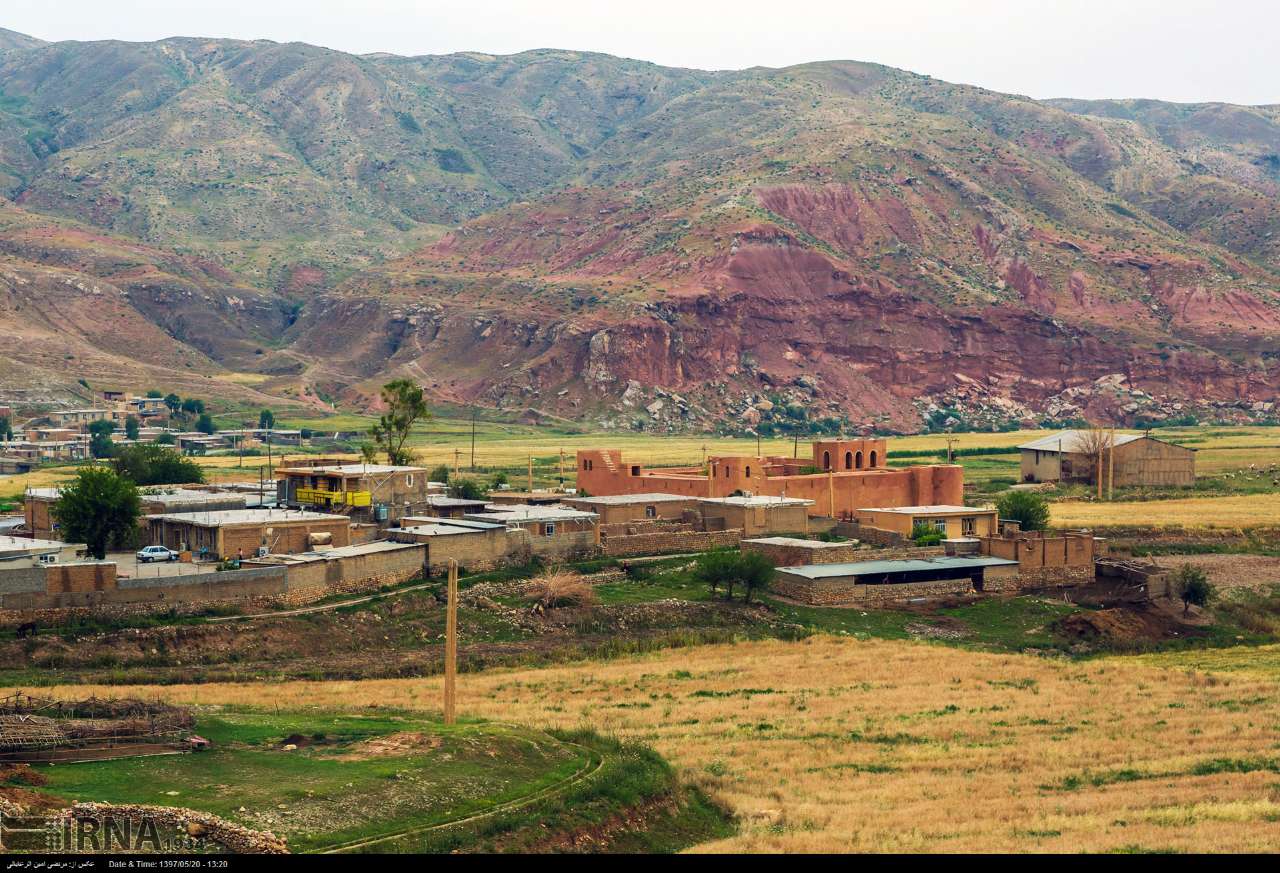
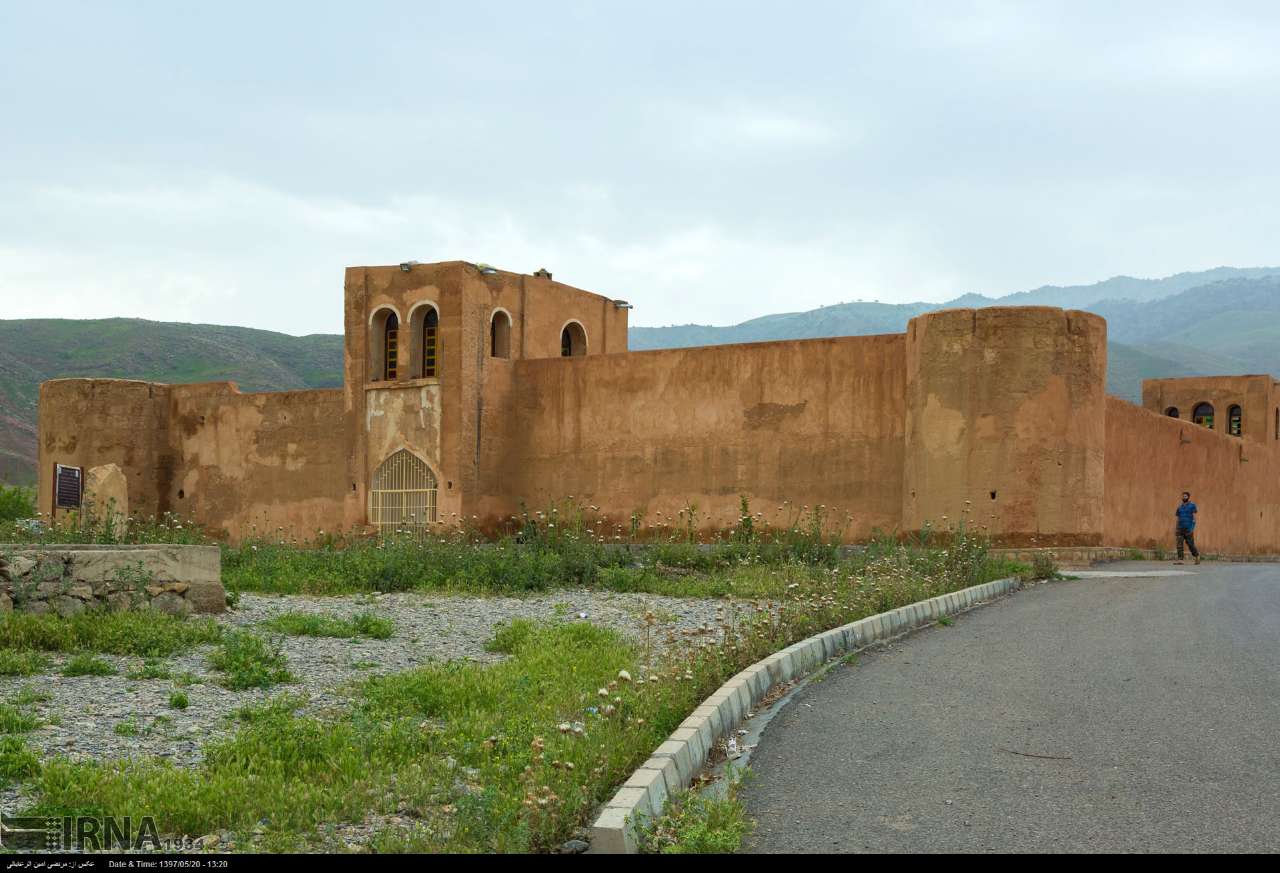
Ancient Castle in Western Iran Boasts Fabulous Architecture

The castle is a historical monument built in the Qajar era.

It is located in a village in Darreh-Shahr town in Ilam province. Based on the manuscript hung at the entrance to the building, it was constructed in 1886 by then ruler Mirgholam Hashemi.

The monument was registered on Iran’s List of National Monuments in 2000.

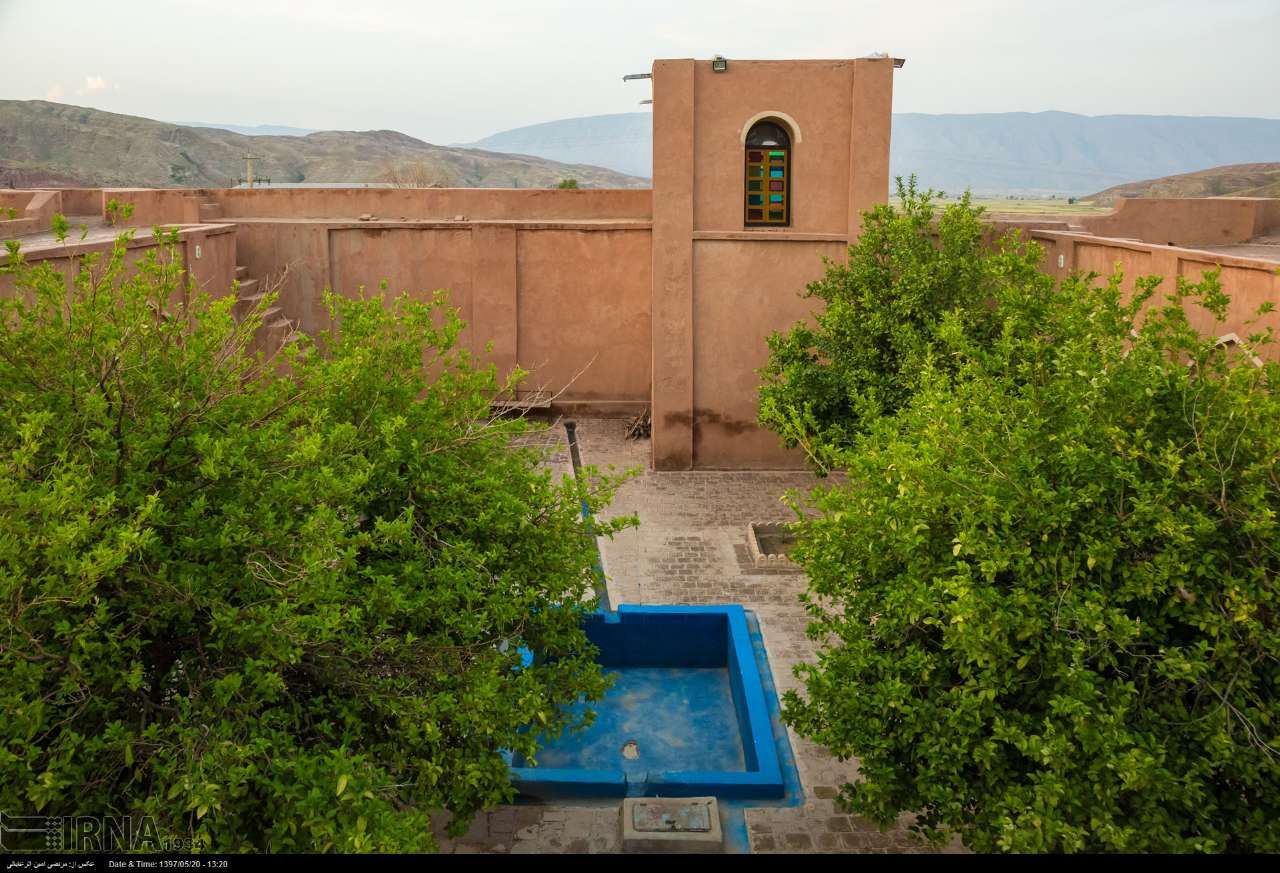
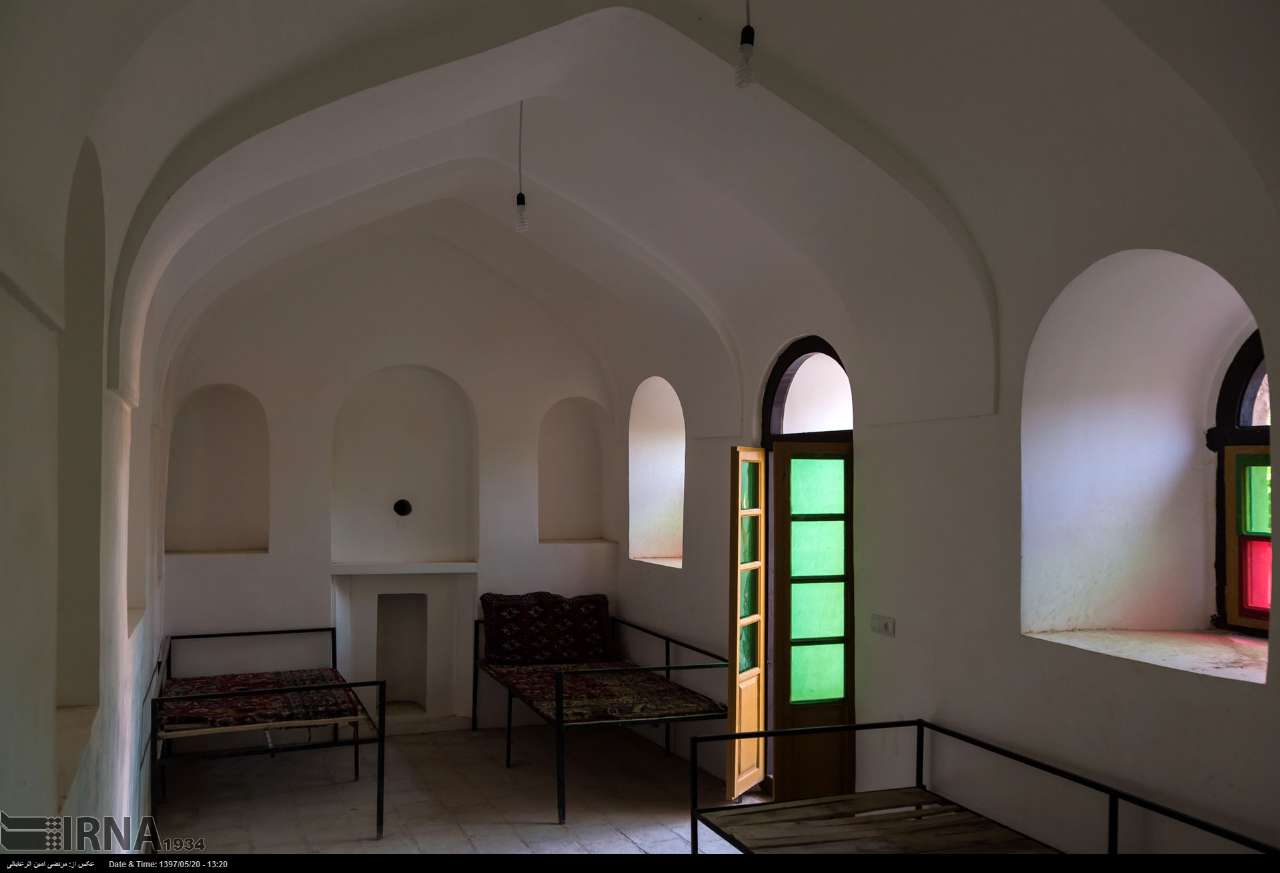
The castle boasts the Qajar-style architecture, with four porches. Made of rocks and plaster, the building was used for both residential and military purposes at the time.

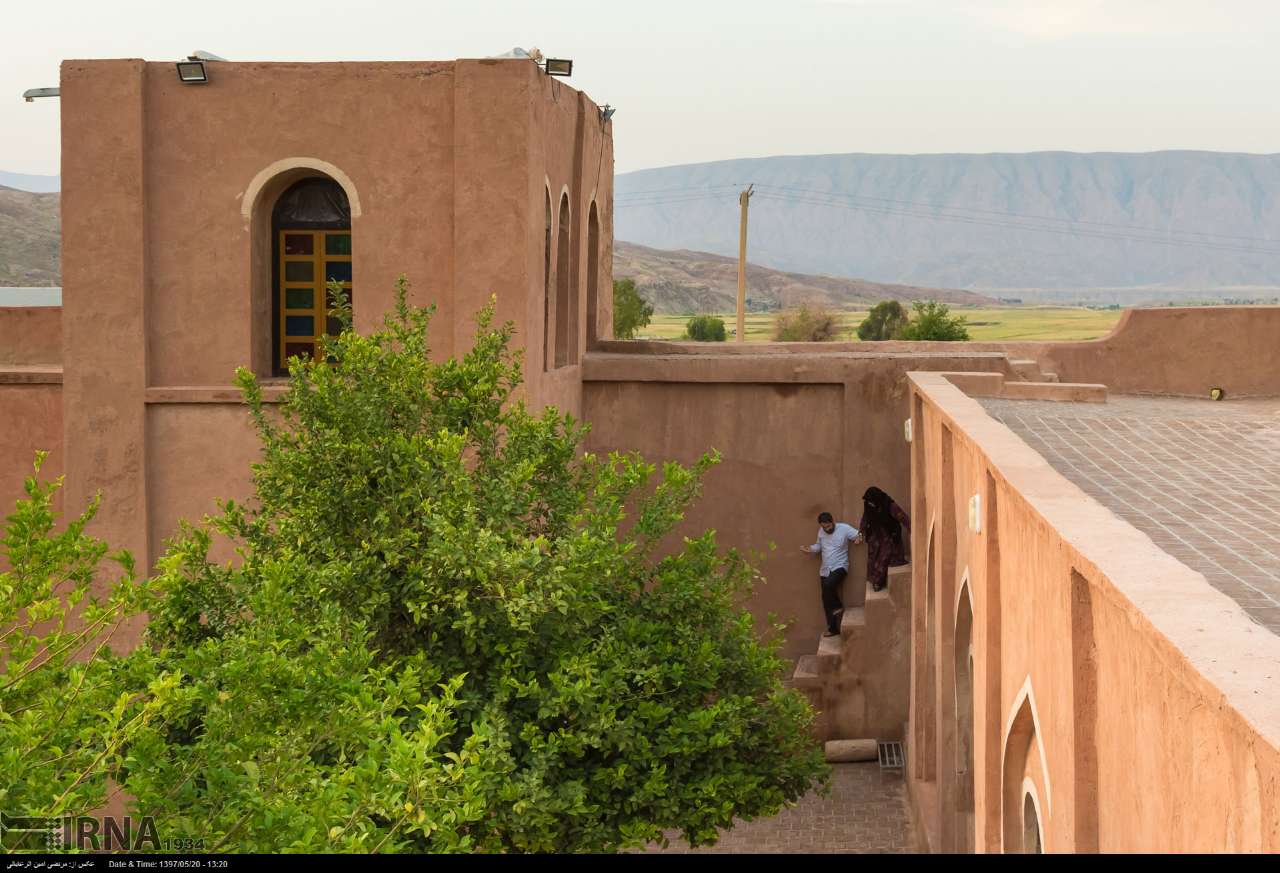
Although the monument is well over a century old, the facade of the building is robust enough thanks to its architectural style and the construction materials used in it, so much so that the outward skeleton of the monument has remained intact.

The façade of the monument has been coated with mud and plaster, and there are no empty spaces on the walls outside.

The castle has two watchtowers at its northeastern and northwestern ends. There are also three chambers for sentries, two on the western wing and one on top of the lintels at the entrances to the northern wing.

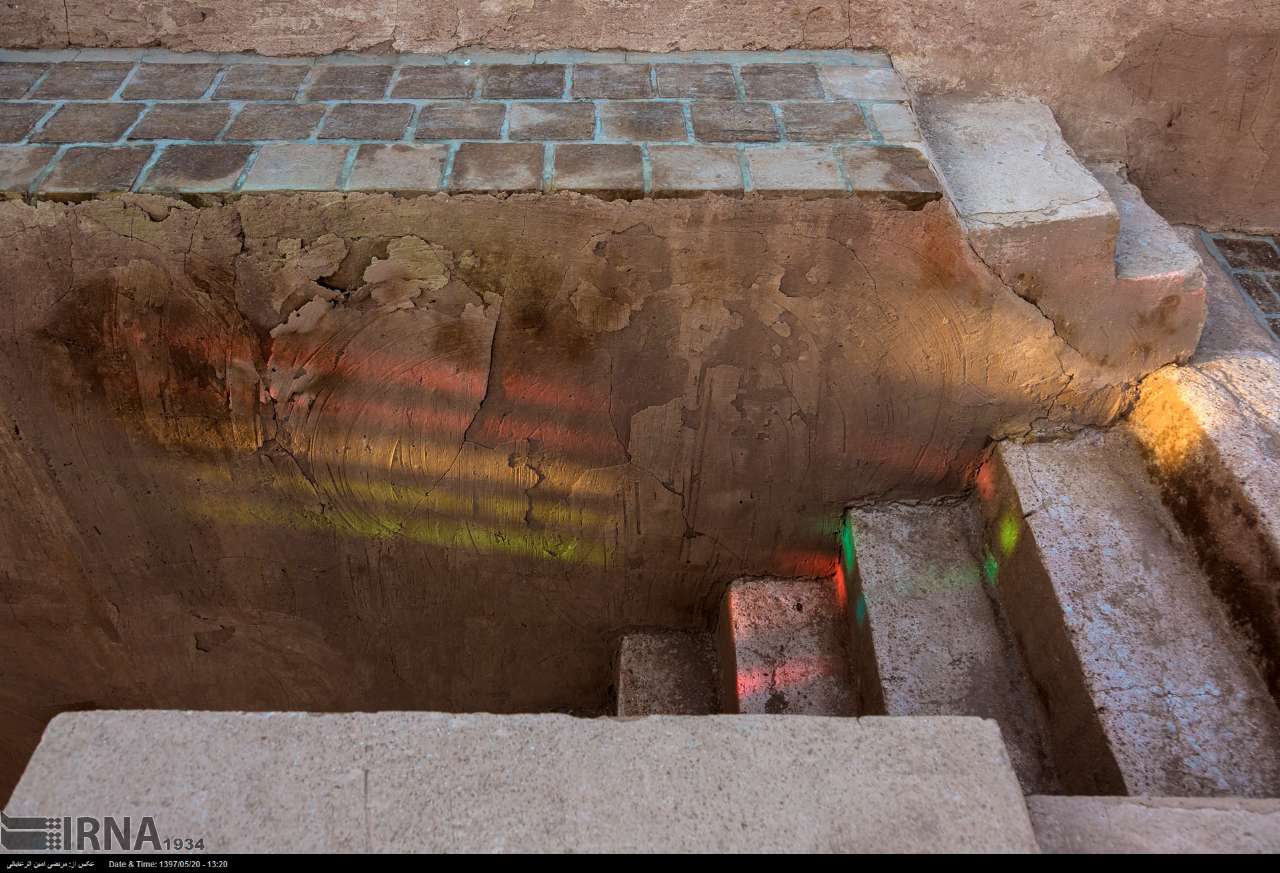
Like in other castles in Ilam, in the middle of the castle’s yard lies a square-shaped pond. Water flows into a canal branching off from a river before it passes under the wall on the castle’s southern wing and flows into the pond. The water then flows out of the pond through the northern wing.

What follows are IRNA’s photos of the castle:

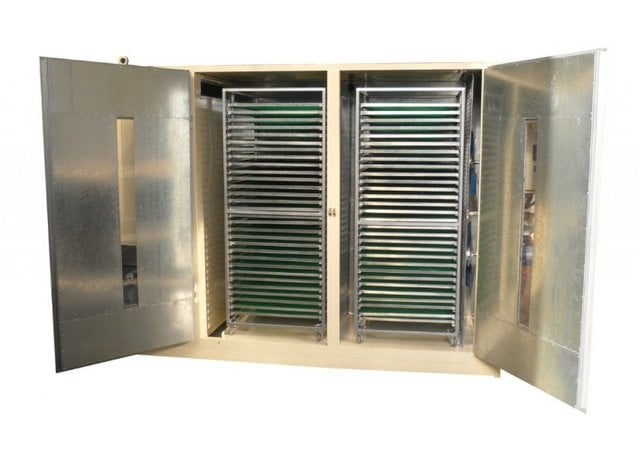
Iranian Researchers Develop Industrial Drier, Breaking US Monopoly

Iranian Researchers Develop Industrial Drier, Breaking US Monopoly

Manager of the project Mehrdad Niakosari says the drier is used to dry different materials, including foodstuffs and medicinal herbs, adding the device could be used to dry materials which are sensitive to heat.

“Unlike what the public may believe, water and, in fact, the radiational-thermal energy of hot water is used to dry things,” he said, as quoted by the Iranian Students’ News Agency (ISNA).

The apparatus has been optimized and is considered a “green” device, said the researcher.

According to Niakosari, the apparatus is fitted with a system which recycles water and returns it to the drier.

For a brief review of Iran’s achievements in various fields of science and technology, check the book “Science and Technology in Iran: A Brief Review

“The temperature at which drying takes place is between 80 to 85 degrees centigrade. The system is equipped with a special polymer which functions like a window; so, heat transfer stops after foodstuffs are dried, keeping them from over-drying and suffering damage,” he added.

He said the technology to manufacture the apparatus had, so far, been monopolized by an American company, but now the monopoly is broken.

“Of course, the apparatus produced in Iran can not only be used as a drier, but has a thickening property, which is a monopoly of Iran,” he said, adding the apparatus has been patented in the United States as well.

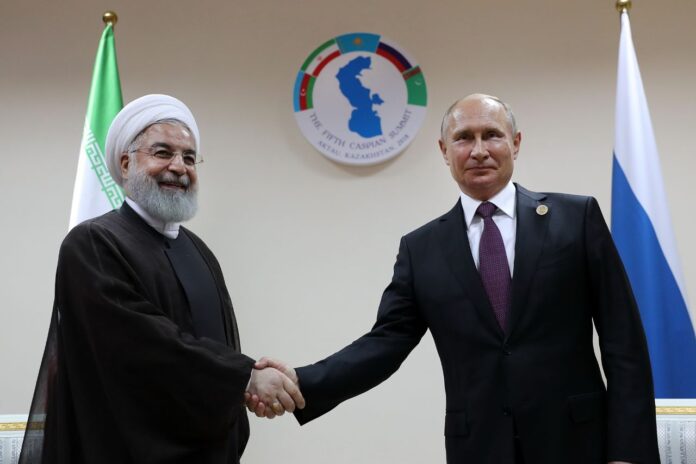
Rouhani, Putin Sit for Talks in Kazakhstan

During the Sunday meeting, Rouhani and Vladimir Putin discussed the most significant mutual, regional and international issues, underlining the need for further expansion of mutual relations between Tehran and Moscow.

The Iranian president said cooperation between Iran and Russia in the Caspian Sea are within the interests of the two sides and added the two sides should attempt to turn the Caspian Sea into a sea of peace and friendship and a source for strengthening of relations and cooperation among the littoral states.

“Mutual and multi-national relations between Iran and Russia in various regional and international issues including regional security and fight against terrorism in Syria have already led to positive results and the cooperation should continue till regional terrorism is eradicated,” he said.
For his part, Putin referred to the growing relations between Iran and Russia in various areas and said Moscow is ready to further expand its relations with Tehran in various fields.

The Russian president also described the Iran nuclear deal as an important international treaty and underlined the need for preserving and strengthening the deal by all involved sides following the US illegal withdrawal.

He also called for further talks between Iran and Russia on regional and international issues.

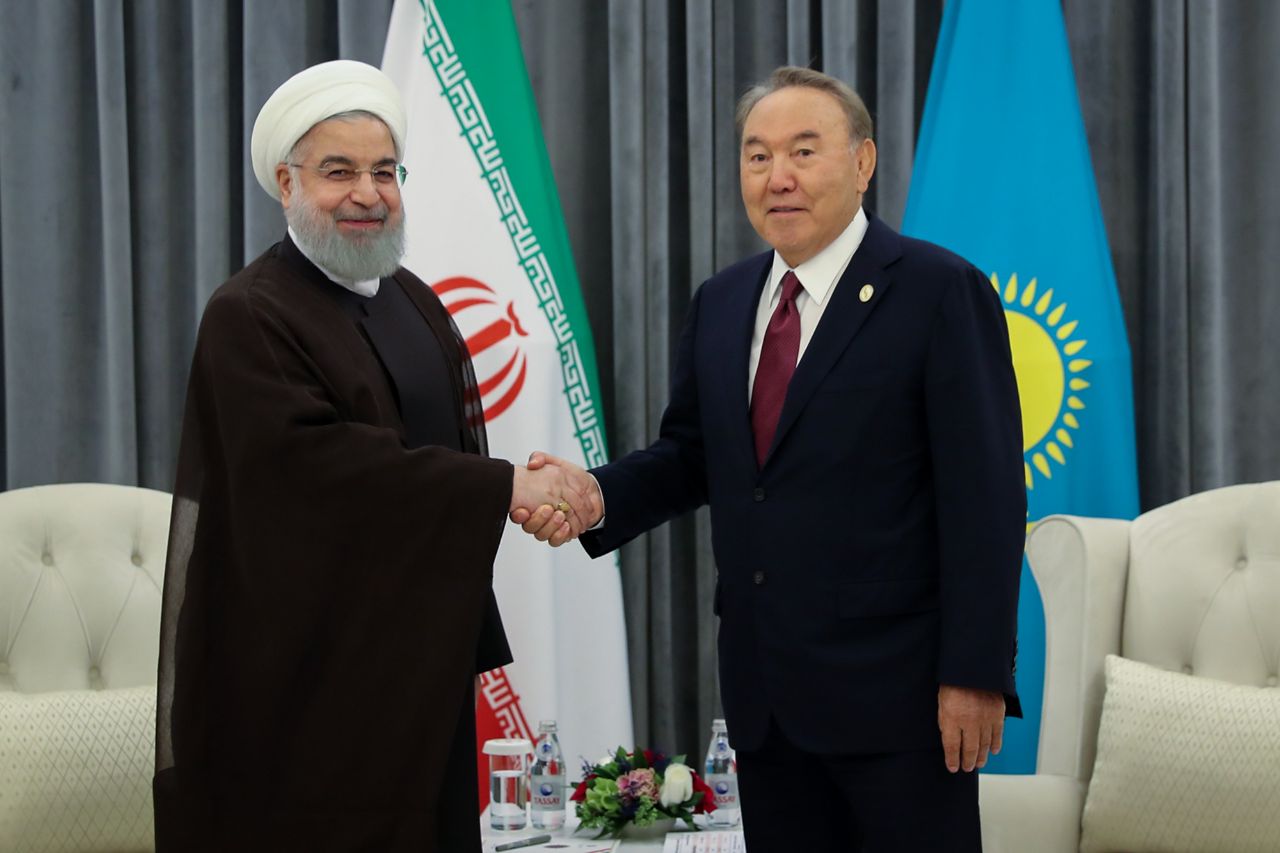
Rouhani, Putin Sit for Talks in KazakhstanIran, Kazakhstan Enjoy Great Transit Capacities: Rouhani

Rouhani also held a separate meeting with Kazakh President Nursultan Nazarbayev on the sidelines of the Caspian Sea Summit.

During the meeting, Rouhani said Iran and Kazakhstan enjoy great transit capacities, and can take advantage of the capacities for meeting their national interests.

He added Tehran attaches huge importance to relations with Astana and added the two countries enjoy lots of cultural and historical commonalities.

President Rouhani praised Astana for its active regional roles particularly in Syria Peace Talks and other security and regional issues and said Kazakhstan has always stood behind the Iranian nation particularly in the case of the JCPOA.

Rouhani then referred to the growing banking ties between the two sides and said Tehran and Astana can take long strides in using their national currencies to expand mutual economic relations.

For his part, Kazakh President Nazarbayev expressed his country’s support for the Iran nuclear deal and said Kazakhstan is after strengthening its ties with the Islamic Republic.

“Despite problems created by the foreign powers for the Iranian nation, we are sure that the grand and historical country of Iran can overcome the problems,” he noted.

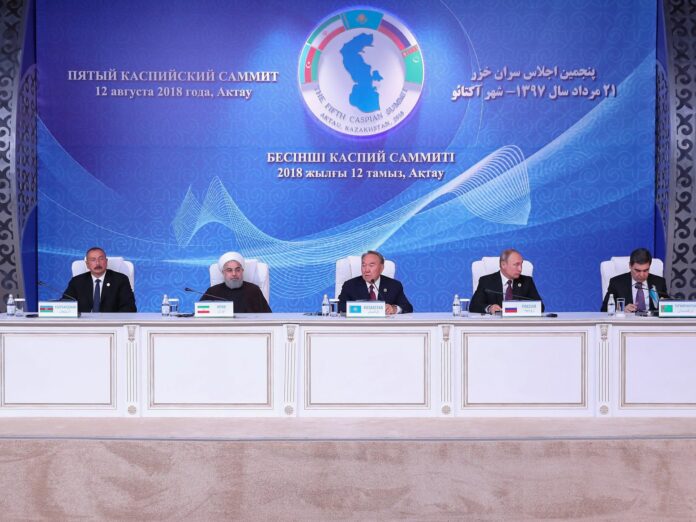
Landmark Convention on Caspian Sea Legal Regime Signed in Kazakhstan

The convention was signed by President Hassan Rouhani of the Islamic Republic of Iran, President Vladimir Putin of the Russian Federation, President Nursultan Nazarbayev of the Republic of Kazakhstan, President Ilham Aliyev of the Republic of Azerbaijan, and President Gurbanguly Berdimuhamedow of the Republic of Turkmenistan.

The signing ceremony was held in Aktau, Kazakhstan, after a meeting between the five leaders on Sunday.

High-ranking officials of the five Caspian Sea littoral states also signed six cooperation documents in the presence of the five presidents.

Protocol of cooperation in the fight against terrorism in the Caspian Sea, protocol of cooperation in the fight against organised crime in the Caspian Sea, agreement between the governments of the Caspian Sea littoral states on economic cooperation, agreement between the governments of Caspian Sea littoral states in the field of transportation, agreement in preventing accidents in the Caspian Sea, and protocol of cooperation and interaction of the border authorities of the Caspian Sea countries were the documents that were signed by the five countries in order to further strengthen their cooperation in the Caspian Sea region.


New Step for Further Cooperation

Speaking in a joint press conference in Aktau, President Rouhani stated that by signing the Caspian Sea Legal Regime Convention, a new step has been taken for better relations between the five littoral countries of the Caspian.

“Today, the five Caspian Sea littoral states took very important steps for strengthening regional security and better relations between each other, as well as taking better advantage of the Caspian Sea.”

“Relations of Iran with Turkmenistan, Kazakhstan, the Russian Federation and Azerbaijan have always been friendly and close and this is the main factor for signing such agreements,” he added.

He also said that one of the very important achievements of the Caspian Sea Legal Regime Convention was that it ensures security and stability in the sea.

“Being explicitly stated that the Caspian Sea belongs only to the five littoral states and also stipulating that no foreign force and military vessel is able to be present in it and that maritime security is exclusive to the five littoral states, and also stressing the fact that the territories of none of the Caspian Sea region state can be used against another country means that the stability and security of the sea is important.”


Tehran Ready to Help Boost Regional Trade

Earlier in the day, Rouhani also told the summit that Tehran is prepared to use its maritime access in the north and south to play a strategic role for development of trade and transportation in the region.

Speaking on Sunday at Caspian Sea Littoral States Summit, President Rouhani said, “Today, this region has turned into a successful model for guaranteeing peace, stability, friendship, good neighbourliness and progress and this summit is another step for further convergence in the region that needs to be strengthened by taking more steps.”

14 Films to Compete in Int’l Section of Children, Youth Festival of Isfahan

According to the Secretariat of the event, 14 short movies from over 10 countries are scheduled to compete in this section.
The line-up of movies to take part in this section of the festival are
as follows:

Short Fiction Films:

”Foot Steps” from Canada

“Just Go” from Lithonia

”Fish” from Spain

“The Man who built dragons” from Spain

”Bui” from Iceland

“Litterbugs” from the UK

“Splinter” from Turkey

Short Fiction Animations:

“New Toy” from Brazil

“The King of the market” from Switzerland

“Corky” from Poland

“My Second Eye” Palestine-Jordan-Germany joint production

“City of Memories” from Denmark

“Arian’s Sky” from Canada

“Dark Dark Woods” from France.

Presided by Alireza Reza Dad, the 31st edition of International Film Festival for Children and Youth is slated to be held from August 30 to September 5 in Isfahan Province.

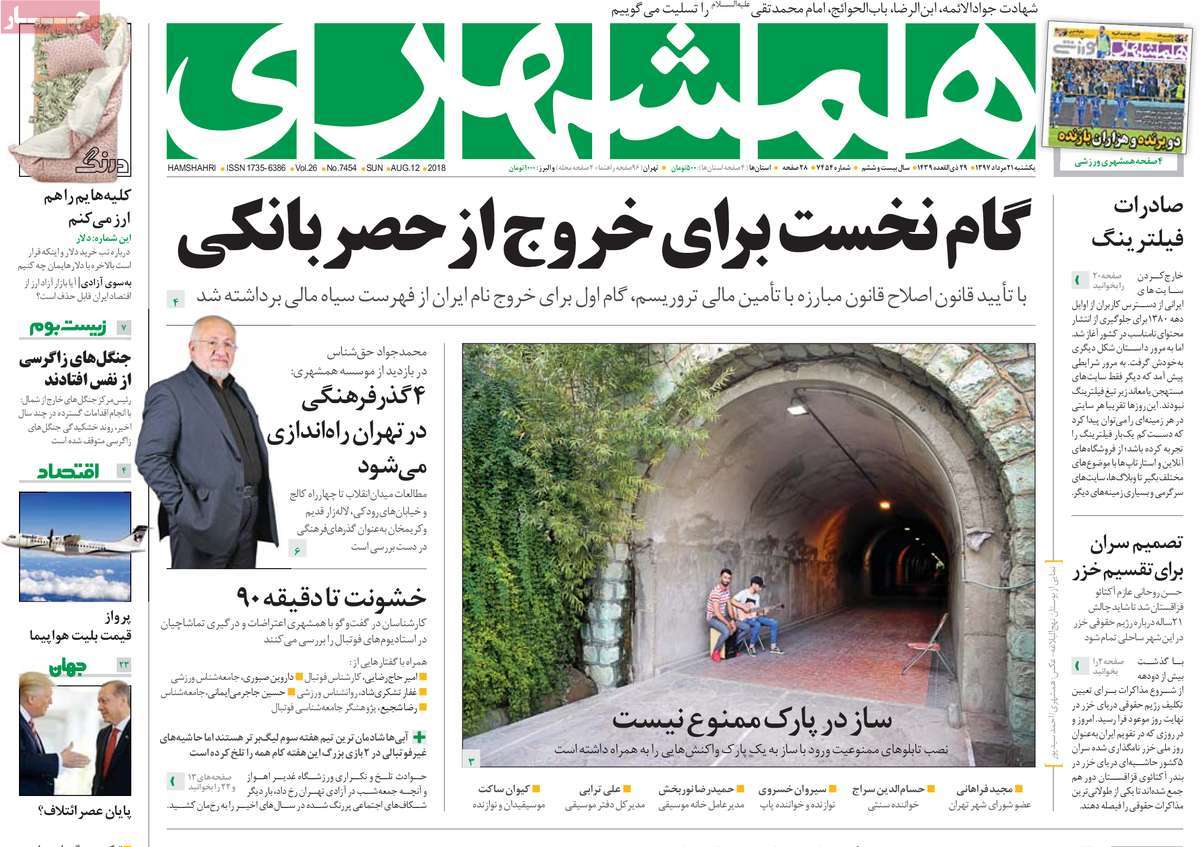
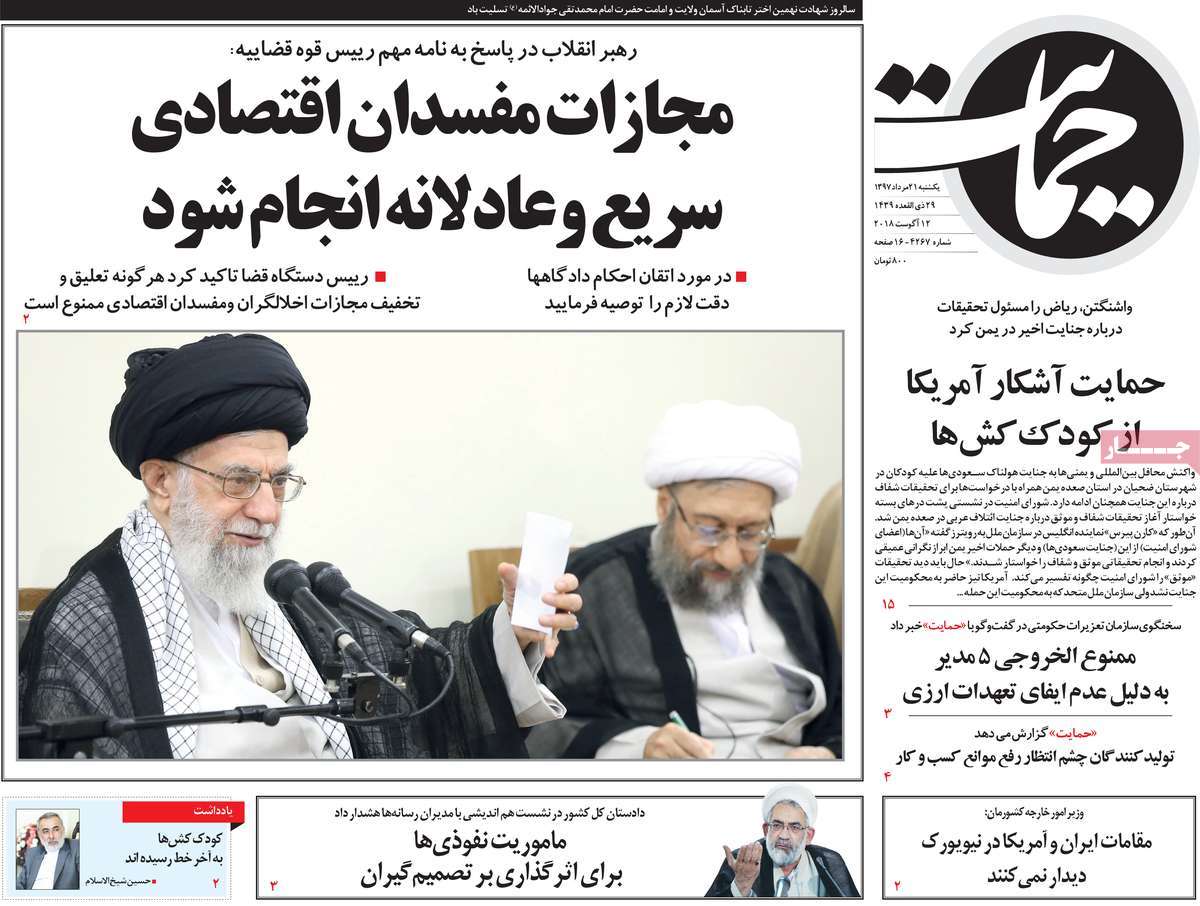
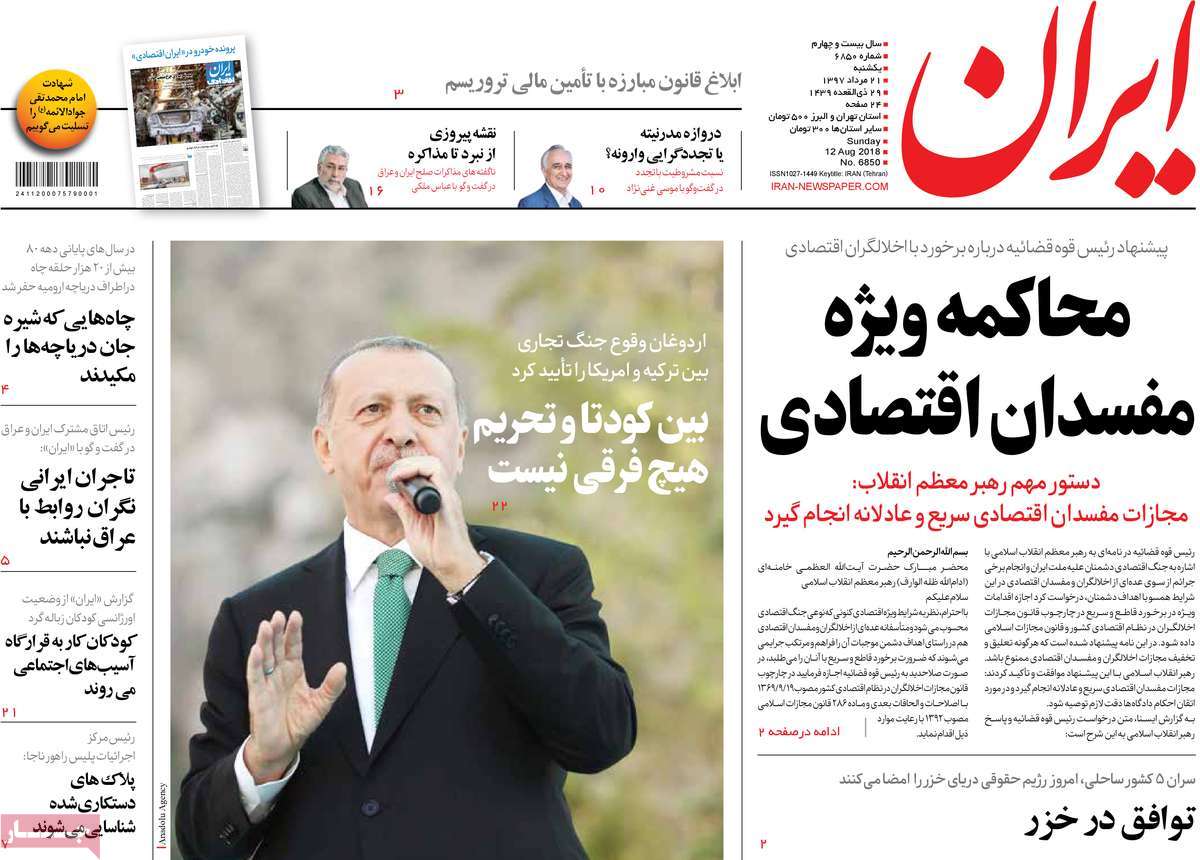
A Look at Iranian Newspaper Front Pages on August 12

A Look at Iranian Newspaper Front Pages on November 19

Newspapers today widely covered the Sunday summit of the heads of Caspian Sea littoral states in Kazakhstan, during which a convention on the sea’s legal regime is to be signed by the five countries.

Also a top story was an order by the Leader of Iran’s Islamic Revolution Ayatollah Seyyed Ali Khamenei to swiftly and justly prosecute those involved in financial corruption.

Several papers also highlighted a decision by Iran’s Guardian Council to approve amendments to the country’s Counter-Terrorist Financing (CTF) law, earlier ratified by the Parliament. The law is part of the FATF standards that need to be implemented by the Islamic Republic.

The above issues, as well as many more, are highlighted in the following headlines and top stories:


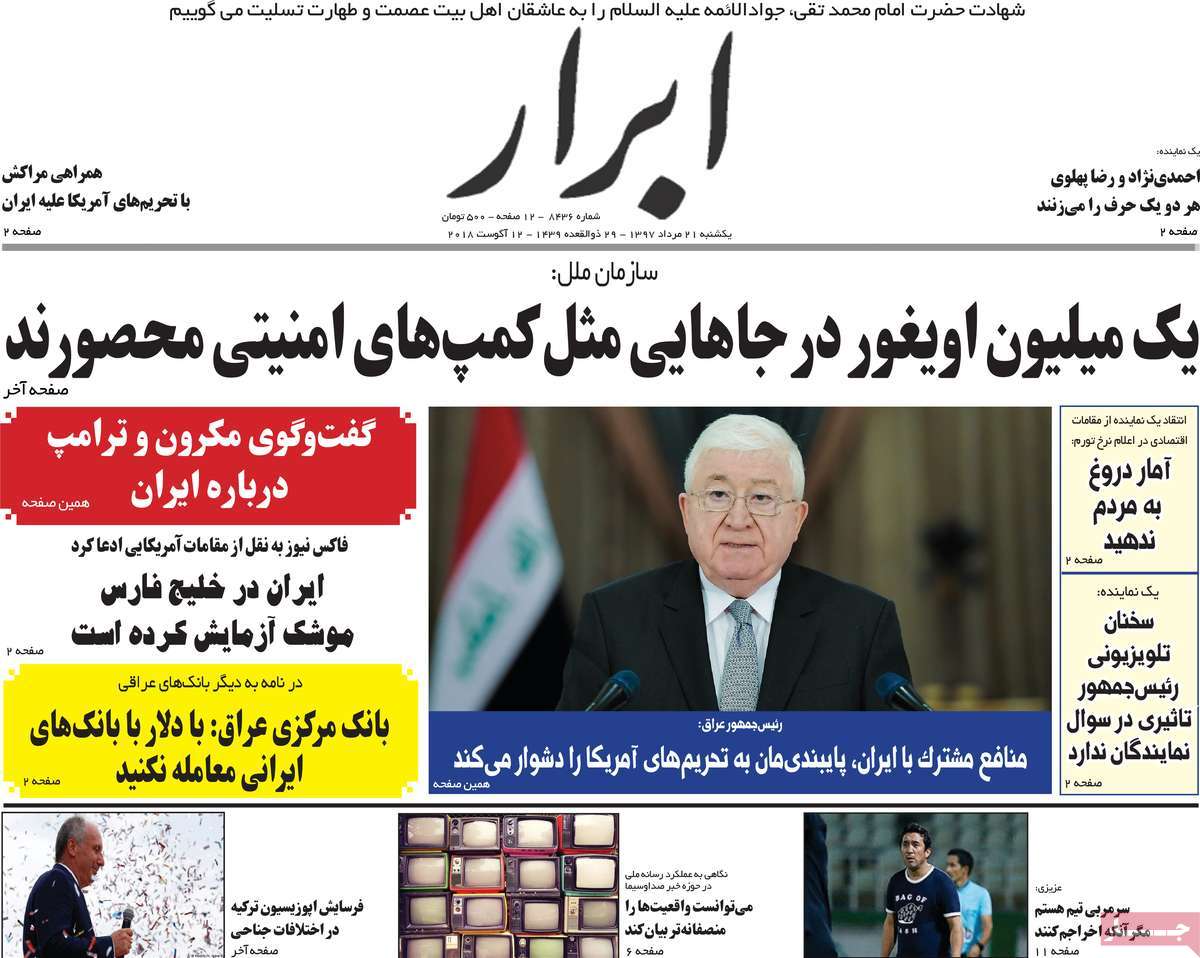
Abrar:

1- Iraq President: Common Interests with Iran Make It Difficult to Obey US Sanctions

2- Macron, Trump Hold Talks on Iran

3- Iraq Central Bank: Don’t Do Business with Iran Using US Dollar

A Look at Iranian Newspaper Front Pages on August 12


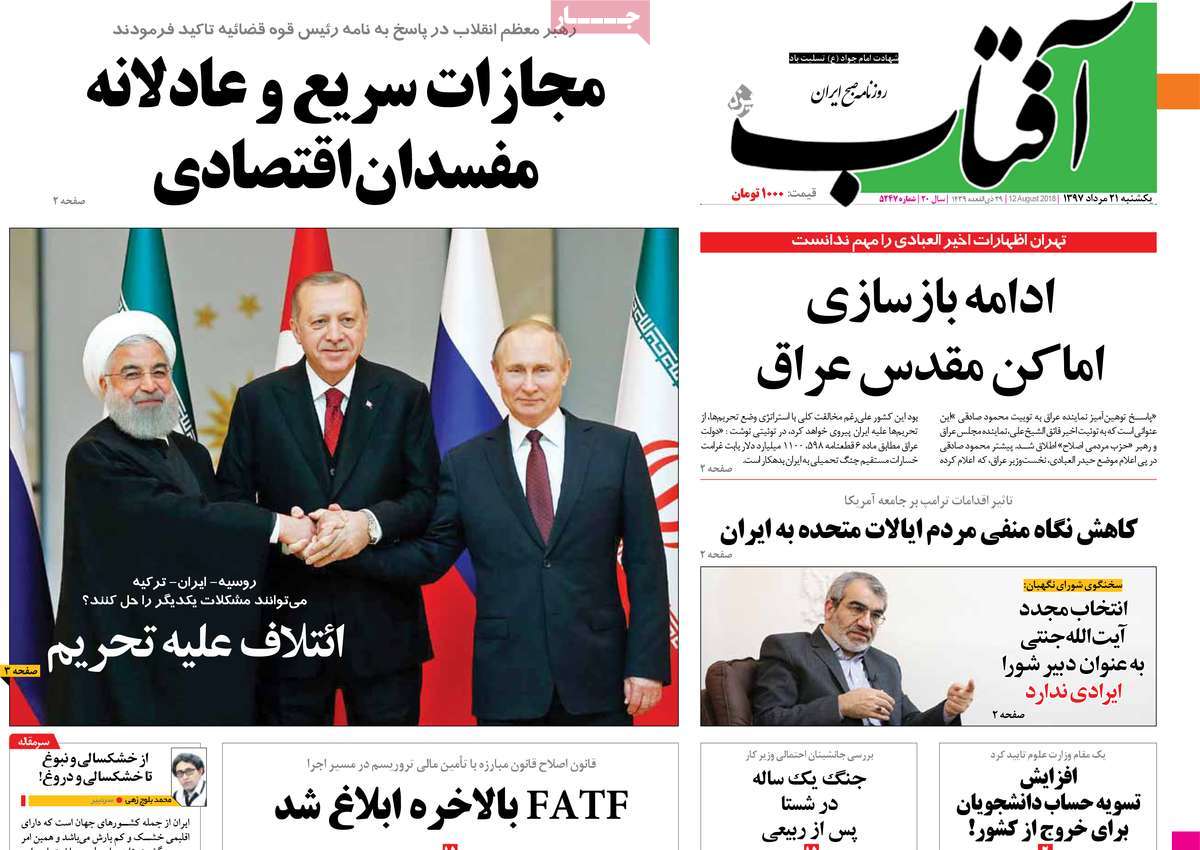
Aftab-e Yazd:

1- Iran Leader Urges Swift, Just Action against Financial Corruption

2- Coalition against Sanction: Can Russia, Iran, Turkey Resolve Each Other’s Problems?

3- Iranian Ministries of Economy, Justice Finally Ordered to Implement FATF

A Look at Iranian Newspaper Front Pages on August 12


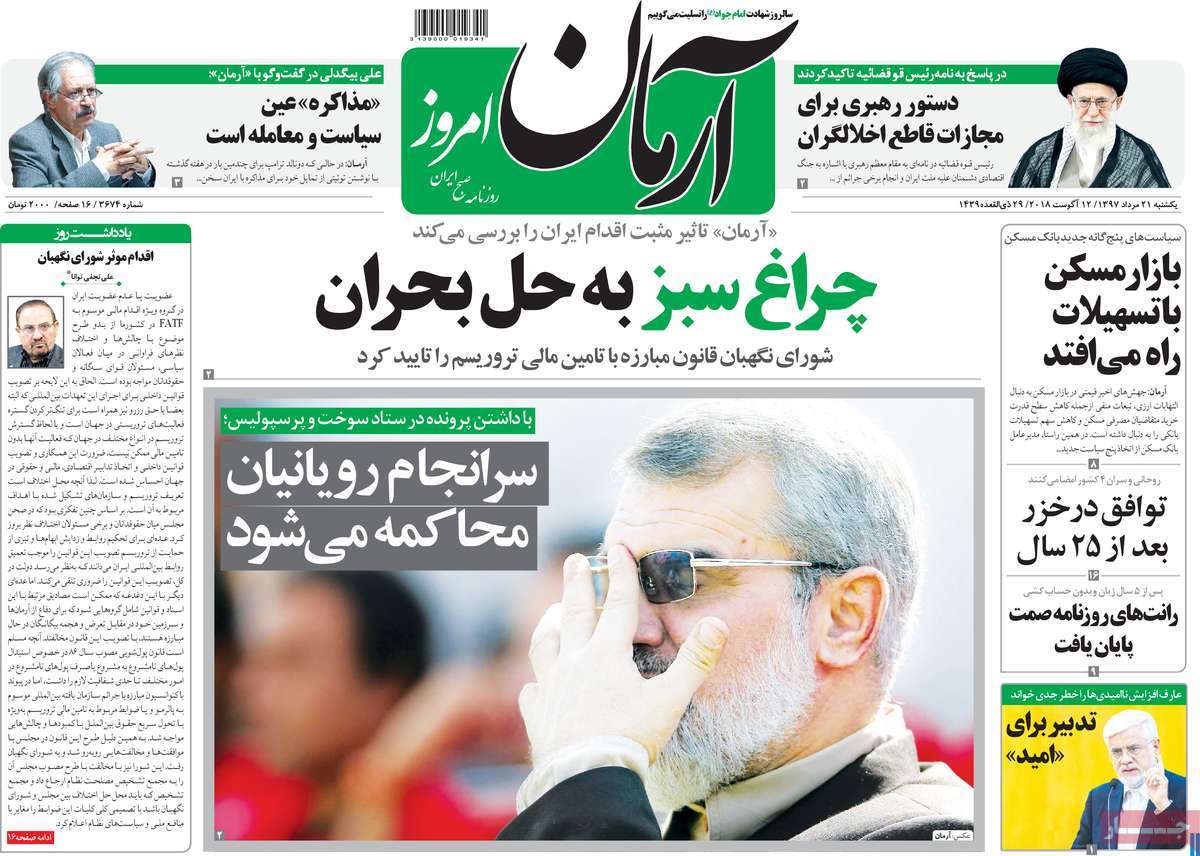
Arman-e Emrooz:

1- Guardian Council Gives Green Light for Settling Crisis

  • CTF Law Finally Approved by GC

A Look at Iranian Newspaper Front Pages on August 12


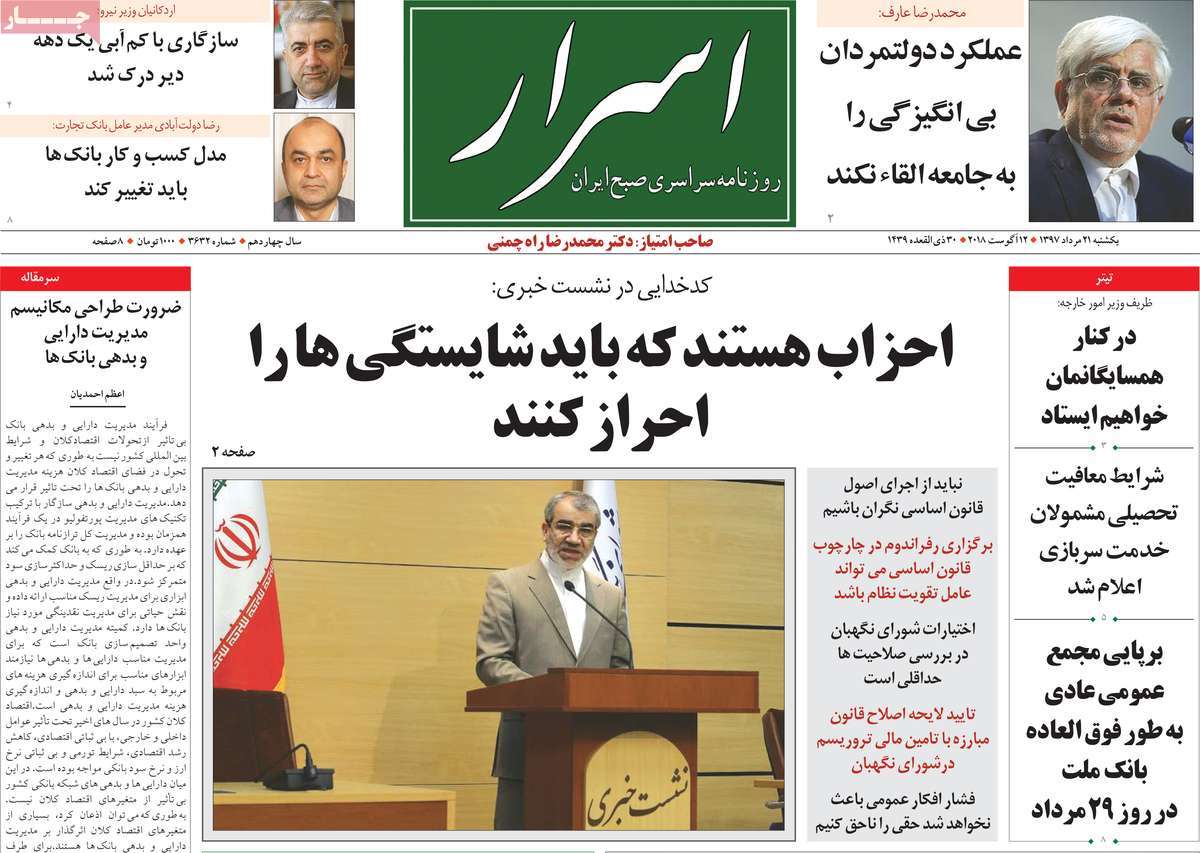
Asrar:

1- Energy Minister: Adaptability to Water Crisis Understood with a Decade of Delay

A Look at Iranian Newspaper Front Pages on August 12


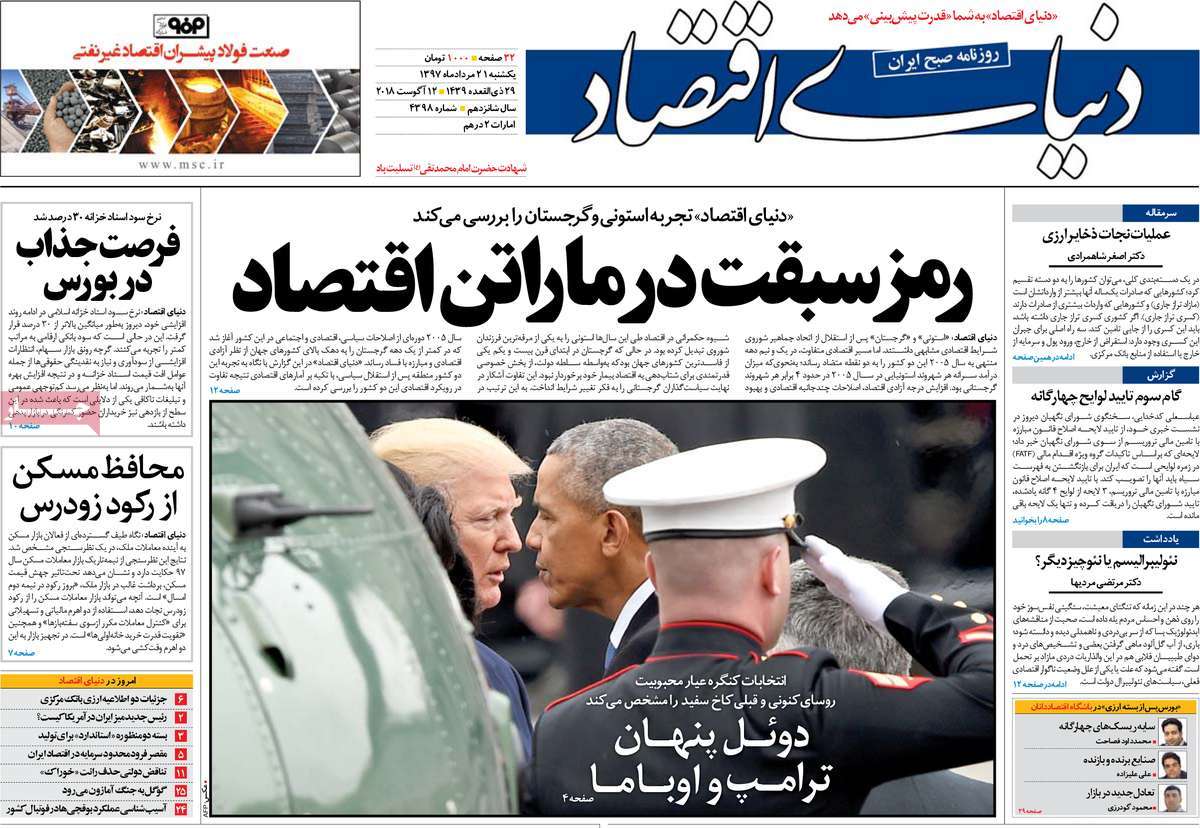
Donya-ye Eqtesad:

1- Hidden Duel between Trump, Obama

  • US Congress Elections to Show How Much They’re Popular

A Look at Iranian Newspaper Front Pages on August 12


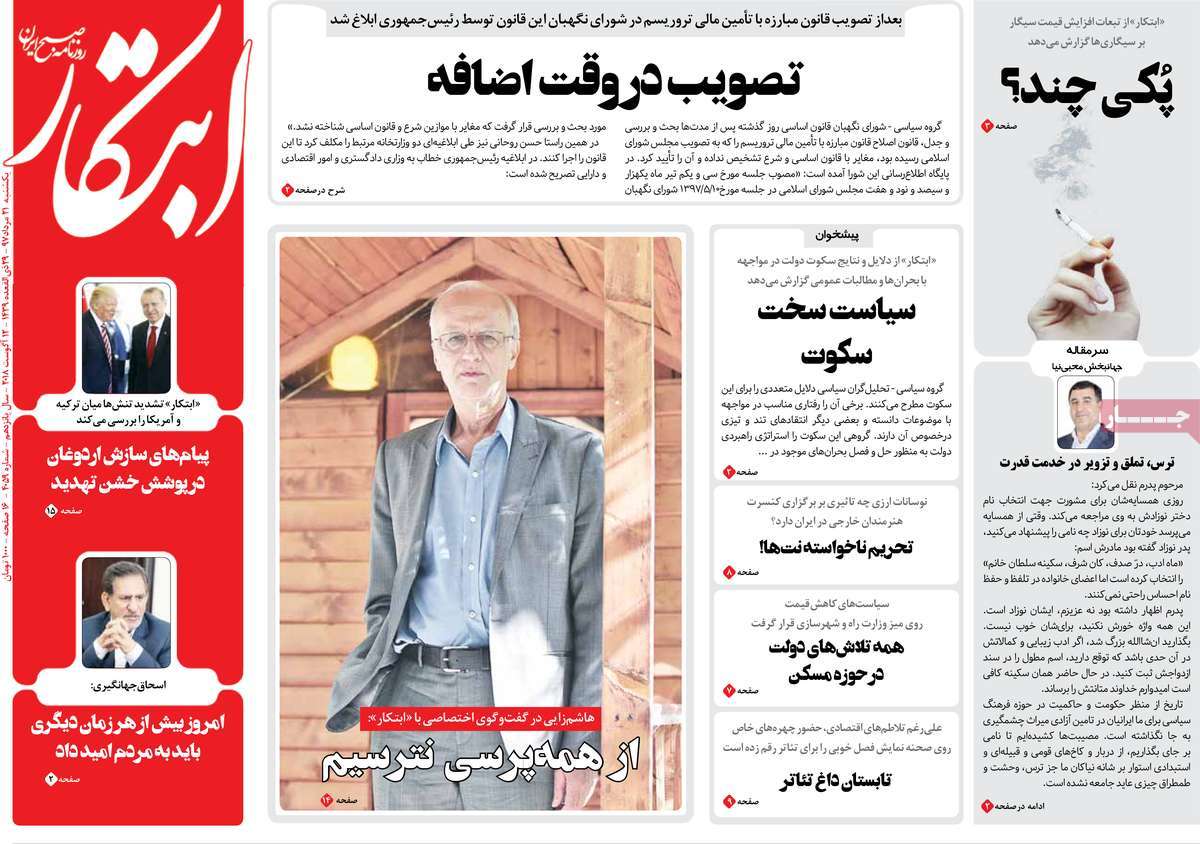
Ebtekar:

1- Erdogan Sending Messages of Reconciliation While Threatening US

  • Escalation of Tension between US, Turkey

A Look at Iranian Newspaper Front Pages on August 12


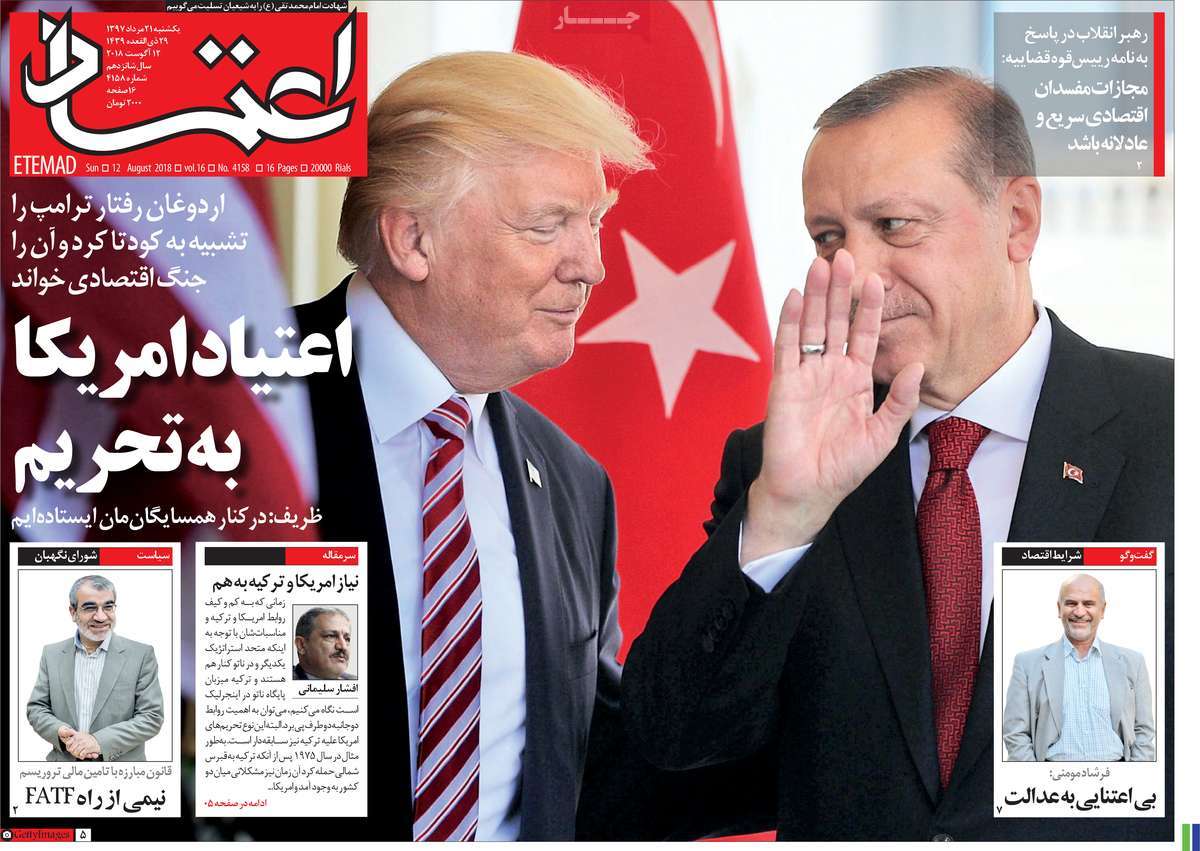
Etemad:

1- US’ Addiction to Sanctions

  • Erdogan Calls Trump’s Move Declaration of Economic War

2- Iran Standing by Its Neighbours: Zarif

A Look at Iranian Newspaper Front Pages on August 12


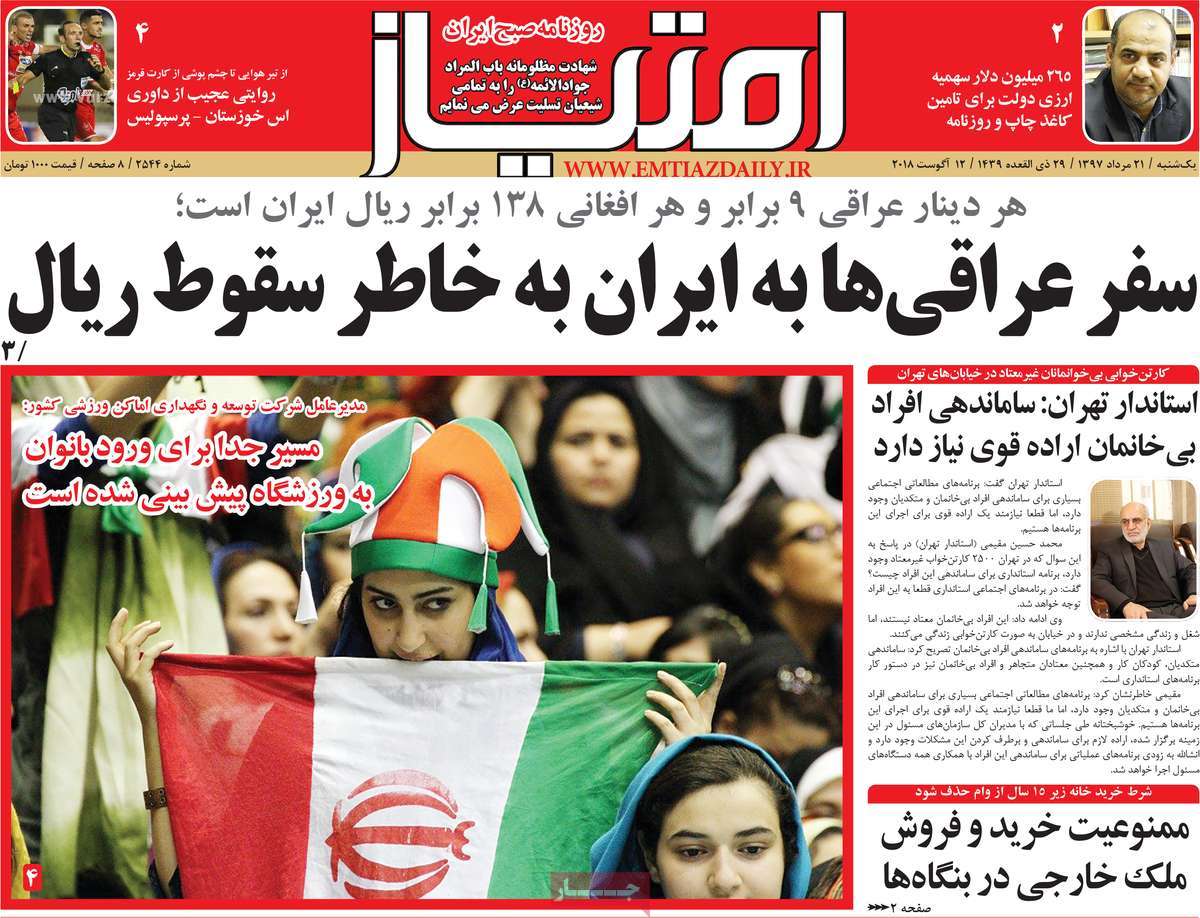
Emtiaz:

1- Iraqis Travelling to Iran after Devaluation of Iranian Rial

  • Iraqi Dinar, Afghanistan’s Afghani More Valuable than Iran’s Currency

A Look at Iranian Newspaper Front Pages on August 12


Ettela’at:

1- Convention on Legal Regime of Caspian Sea to Be Signed in Kazakhstan Today

A Look at Iranian Newspaper Front Pages on August 12


Hamshahri:

1- First Step to Get Out of Banking Siege

  • Iran Takes First Step to Get Its Name Out of FATF Blacklist

A Look at Iranian Newspaper Front Pages on August 12


Hemayat:

1- US’ Blatant Support for Child-Killers

  • Washington Tasks Riyadh with Probing into Recent Crime in Yemen!

A Look at Iranian Newspaper Front Pages on August 12


Iran:

1- No Difference between Coup, Sanctions

  • Erdogan Confirms US Sanctions Beginning of Trade War

2- Official: Iranian Businessmen Shouldn’t Be Worried about Ties with Iraq

A Look at Iranian Newspaper Front Pages on August 12


Javan:

1- Two US Statesmen: It’s Not Possible to Cut Down Iran’s Oil Exports to Zero

A Look at Iranian Newspaper Front Pages on August 12


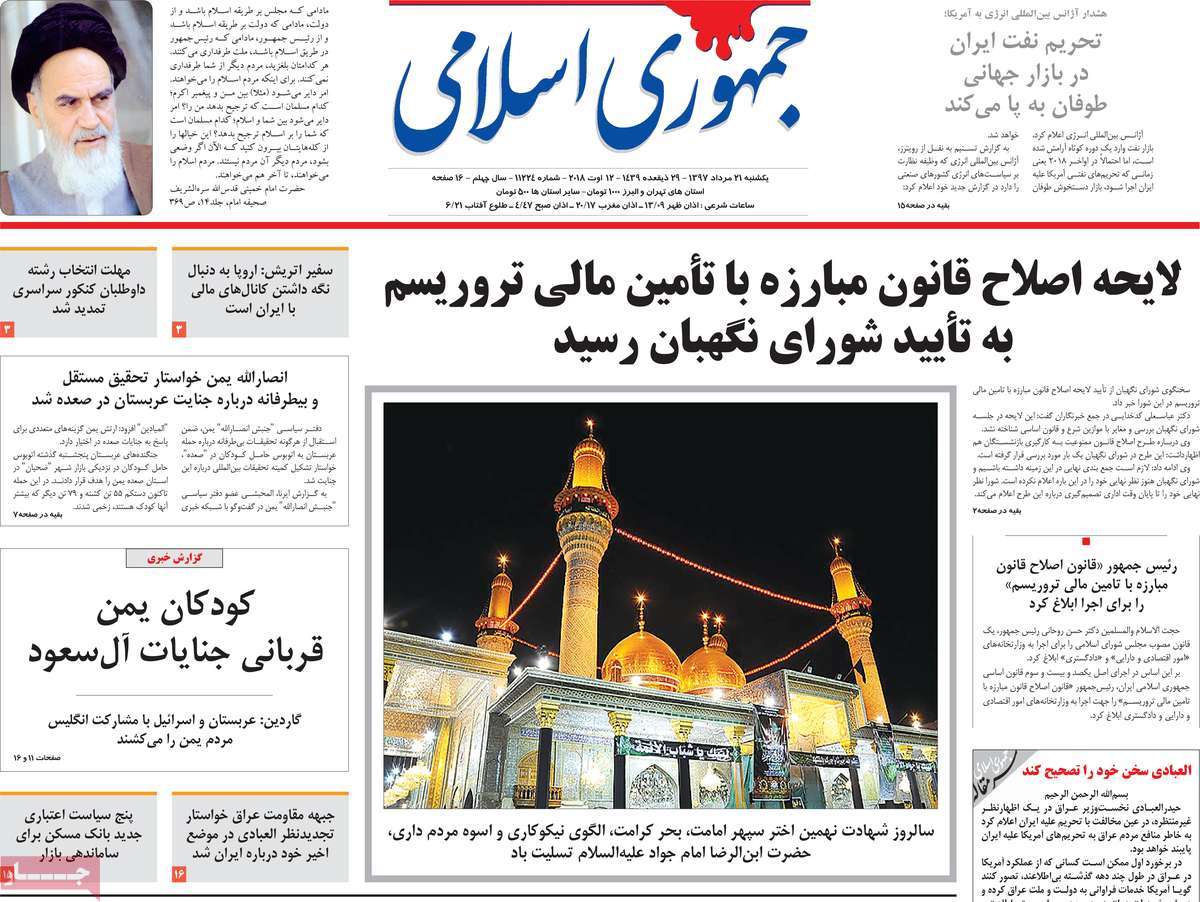
Jomhouri Eslami:

1- IEA Warns US: Bans on Iran Oil Exports to Create Storm in Global Markets

2- Austria Envoy: Europe Seeks to Keep Its Financial Channels with Iran

A Look at Iranian Newspaper Front Pages on August 12


Kayhan:

1- Western Governments Only ‘Express Regret’ over Slaughter of Yemeni Children!

A Look at Iranian Newspaper Front Pages on August 12


Setareh Sobh:

1- Each of Five Caspian Sea Littoral States to Know Their Shares Today

A Look at Iranian Newspaper Front Pages on August 12


Shargh:

1- Aref Warns about Possible Collapse of Reformists’ Solidarity

2- Americans Holding Less Negative View on Iran

A Look at Iranian Newspaper Front Pages on August 12

No Demarcation Included in Caspian Sea Legal Regime Convention: Iran

In a Sunday statement, Qassemi said the issue of dividing up the seabed and resources of the Caspian Sea among littoral states as well as the designation of the line of origin is not on the agenda in the meeting where a convention on the legal regime of the Caspian Sea is to be signed.

He rejected inexpert speculations and propaganda regarding Sunday’s event, saying, “Certain speculations and statements made are not true at all because the convention being signed today by heads of the five littoral states of the Caspian Sea basically determines the general framework for cooperation and the fundamental principles related to the legal regime of the Caspian Sea.”

Qassemi stressed that the large lake is a special one, and thus a special legal regime irrespective of the existing conventions will be drawn up and put into effect.

He dismissed speculations that the convention provides for the determination of boundaries and shares of the Caspian Sea and the division of the body of water among its coastal states.

The spokesman also said it is stipulated in the convention that no foreign country is allowed to operate military or civilian vessels in the Caspian Sea or to establish bases there.

“Furthermore, the five [littoral] countries will not allow other states to use their land, sea territory or airspace to attack any of the coastal nations,” he noted.

“The signing of this convention, which is a strategic document for cooperation among Caspian Sea states, will turn this region to yet another hub of regional cooperation in order to promote peace, stability, security and progress in the littoral countries,” he noted.

The convention, which will be signed on Sunday, is the outcome of more than two decades of negotiations at different levels between the officials of the Caspian Sea’s littoral states.


NATO Ships Not Allowed to Navigate in Caspian Sea

Earlier on Saturday, Iranian Foreign Minister Mohammad Javad Zarif told a meeting of foreign ministers of the Caspian Sea littoral states that the convention stresses the monopoly of the presence and sailing of vessels operating solely under the flag of one of the littoral states.

It also bans on the presence and passing of foreign and non-coastal military troops, including NATO ships, he added.

“This convention does not determine the boundaries of seabed and subsoil and the baselines and its methods, and these issues are to be agreed upon in future agreements,” Zarif noted, expressing the hope coastal countries will soon finalize agreements on these affairs.

“Under the shadow of the positive will of the leaders of coastal countries and the friendly and positive atmosphere of these meetings, we are on the verge of signing the legal regime’s convention and six other agreements and protocols and releasing the statement of the leaders’ summit.”

The foreign minister said, “21 days ago, the protocol for Transboundary Environmental Impact Assessment was signed. These developments herald a bright future for our nations and governments.”

“The signing of the legal regime’s convention is a very important step that put an end to 21 years of negotiations. This convention does not mean all talks and measures have ended. This is in fact a milestone and the beginning of the implementation of agreements, monitoring their implementation and starting talks for new and necessary agreements,” he said.
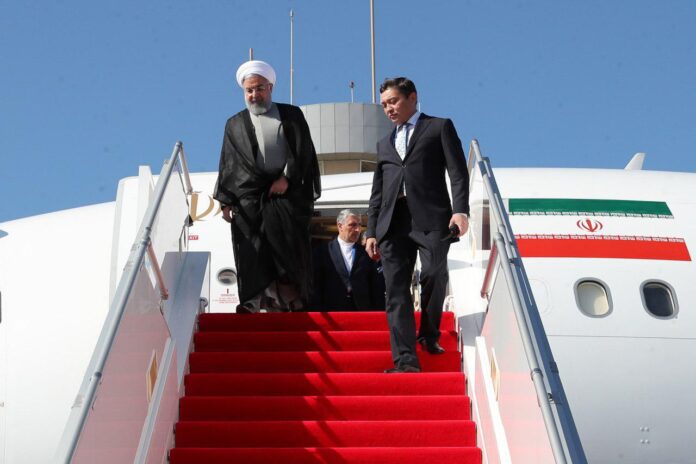
Iran President in Kazakhstan to Sign Landmark Caspian Sea Deal

Iran, Azerbaijan, Kazakhstan, Russia and Turkmenistan have been bargaining over their share of the inland sea since 1991, when the breakup of the Soviet Union rendered obsolete previous agreements between Tehran and Moscow.

The Caspian’s vast hydrocarbon reserves have made a deal complex to achieve in the past decades. The littoral states are yet to finalize agreements on the boundaries of seabed and subsoil of the sea and its baselines, and the issues are not going to be resolved in the deal due to be signed Sunday.

The Iranian president is to outline Iran’s views about the Caspian Sea legal regime in the meeting expected to be held Sunday afternoon.


One Step Forward

Speaking before departing Tehran for Kazakhstan, the President said the convention is a big step forward for settling differences about the Caspian Sea’s legal status.

“This convention totally bans the presence of external warships and this is highly important for national security of the Caspian Sea littoral states,” he said.
Rouhani said the deal gives the Caspian Sea a special legal status, which means the sea will not fall under international laws and the littoral states can decide about it on their own.

“Overall, this is an important convention that takes us one step forward, although some very important issues will be left for the future,” he said.
Rouhani said the leaders of Caspian Sea littoral states are to sign agreements on trade and economy, transit, anti-terror collaboration and border cooperation.

The five countries will also discuss grounds for closer cooperation in tourism and oil and gas sectors, he said.
On the sidelines of the meeting, Rouhani will sit down for talks with Kazakh President Nursultan Nazarbayev. Rouhani will likely meet his Russian counterpart Vladimir Putin as well, Russian Foreign Minister Sergey Lavrov said on Saturday.