Wednesday, December 24, 2025
Home Blog Page 3504

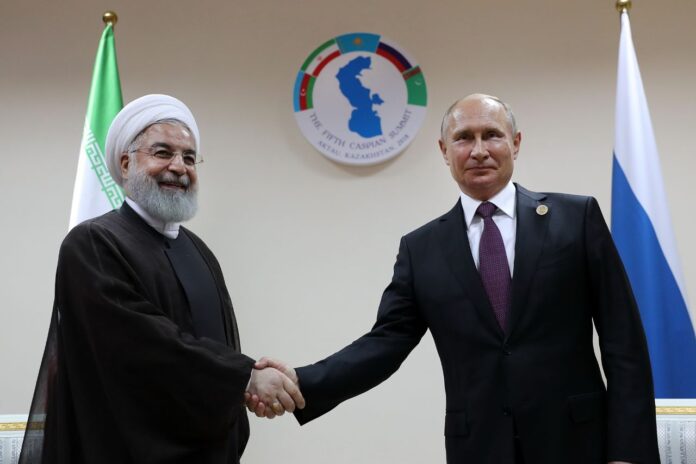
Rouhani, Putin Sit for Talks in Kazakhstan

During the Sunday meeting, Rouhani and Vladimir Putin discussed the most significant mutual, regional and international issues, underlining the need for further expansion of mutual relations between Tehran and Moscow.

The Iranian president said cooperation between Iran and Russia in the Caspian Sea are within the interests of the two sides and added the two sides should attempt to turn the Caspian Sea into a sea of peace and friendship and a source for strengthening of relations and cooperation among the littoral states.

“Mutual and multi-national relations between Iran and Russia in various regional and international issues including regional security and fight against terrorism in Syria have already led to positive results and the cooperation should continue till regional terrorism is eradicated,” he said.

For his part, Putin referred to the growing relations between Iran and Russia in various areas and said Moscow is ready to further expand its relations with Tehran in various fields.

The Russian president also described the Iran nuclear deal as an important international treaty and underlined the need for preserving and strengthening the deal by all involved sides following the US illegal withdrawal.

He also called for further talks between Iran and Russia on regional and international issues.
Rouhani, Putin Sit for Talks in KazakhstanIran, Kazakhstan Enjoy Great Transit Capacities: Rouhani

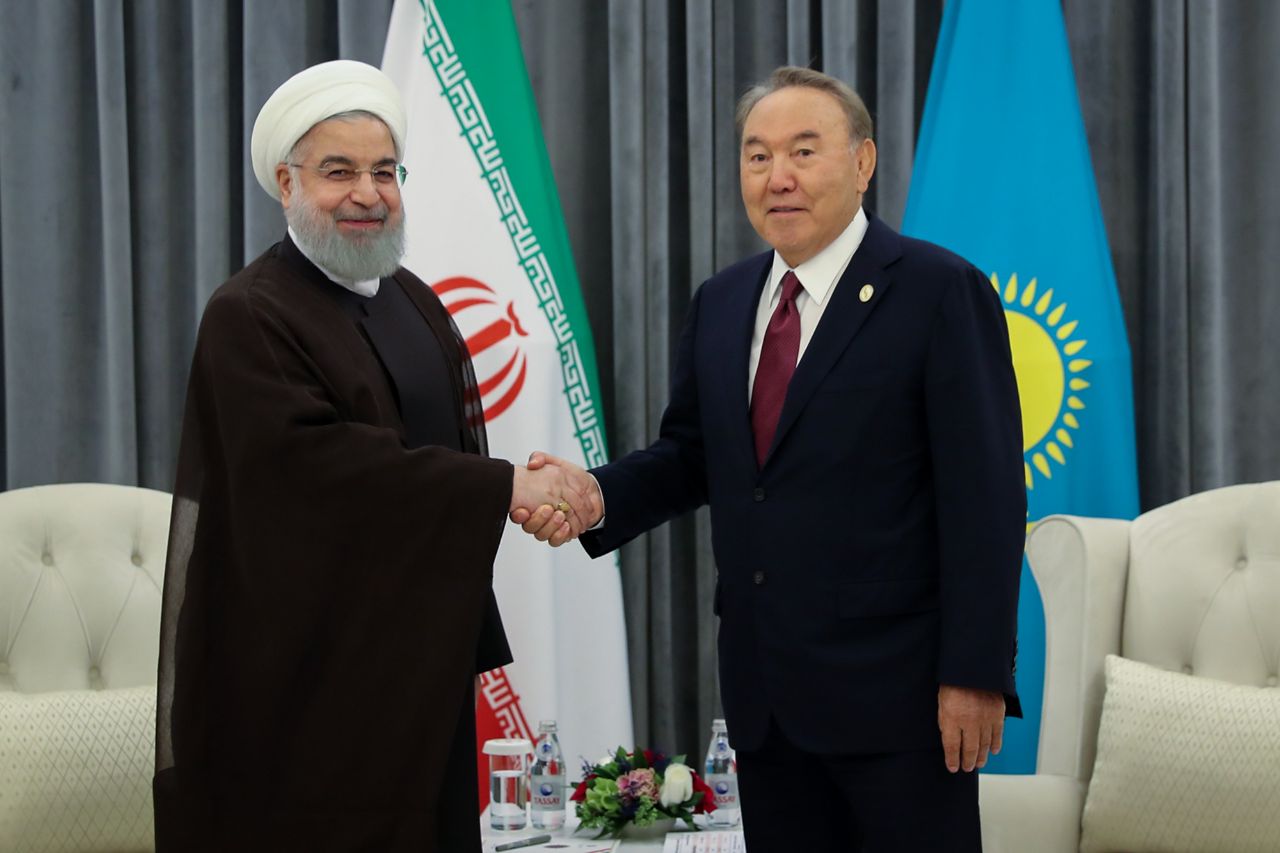
Rouhani also held a separate meeting with Kazakh President Nursultan Nazarbayev on the sidelines of the Caspian Sea Summit.

During the meeting, Rouhani said Iran and Kazakhstan enjoy great transit capacities, and can take advantage of the capacities for meeting their national interests.

He added Tehran attaches huge importance to relations with Astana and added the two countries enjoy lots of cultural and historical commonalities.

President Rouhani praised Astana for its active regional roles particularly in Syria Peace Talks and other security and regional issues and said Kazakhstan has always stood behind the Iranian nation particularly in the case of the JCPOA.

Rouhani then referred to the growing banking ties between the two sides and said Tehran and Astana can take long strides in using their national currencies to expand mutual economic relations.

For his part, Kazakh President Nazarbayev expressed his country’s support for the Iran nuclear deal and said Kazakhstan is after strengthening its ties with the Islamic Republic.

“Despite problems created by the foreign powers for the Iranian nation, we are sure that the grand and historical country of Iran can overcome the problems,” he noted.

Landmark Convention on Caspian Sea Legal Regime Signed in Kazakhstan

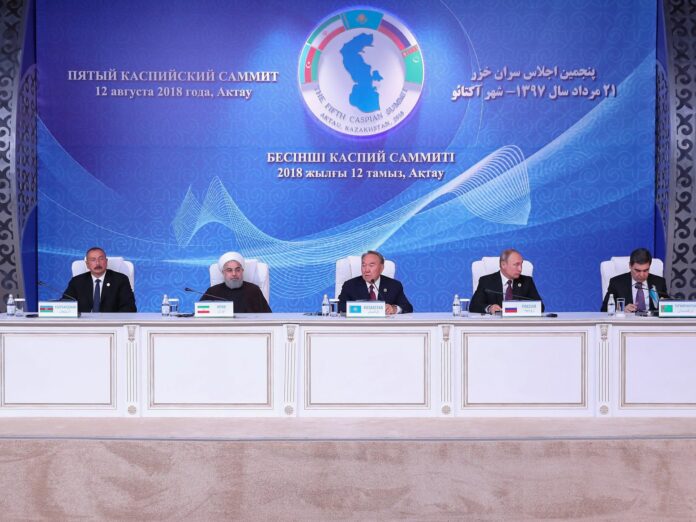
The convention was signed by President Hassan Rouhani of the Islamic Republic of Iran, President Vladimir Putin of the Russian Federation, President Nursultan Nazarbayev of the Republic of Kazakhstan, President Ilham Aliyev of the Republic of Azerbaijan, and President Gurbanguly Berdimuhamedow of the Republic of Turkmenistan.

The signing ceremony was held in Aktau, Kazakhstan, after a meeting between the five leaders on Sunday.

High-ranking officials of the five Caspian Sea littoral states also signed six cooperation documents in the presence of the five presidents.

Protocol of cooperation in the fight against terrorism in the Caspian Sea, protocol of cooperation in the fight against organised crime in the Caspian Sea, agreement between the governments of the Caspian Sea littoral states on economic cooperation, agreement between the governments of Caspian Sea littoral states in the field of transportation, agreement in preventing accidents in the Caspian Sea, and protocol of cooperation and interaction of the border authorities of the Caspian Sea countries were the documents that were signed by the five countries in order to further strengthen their cooperation in the Caspian Sea region.


New Step for Further Cooperation

Speaking in a joint press conference in Aktau, President Rouhani stated that by signing the Caspian Sea Legal Regime Convention, a new step has been taken for better relations between the five littoral countries of the Caspian.

“Today, the five Caspian Sea littoral states took very important steps for strengthening regional security and better relations between each other, as well as taking better advantage of the Caspian Sea.”

“Relations of Iran with Turkmenistan, Kazakhstan, the Russian Federation and Azerbaijan have always been friendly and close and this is the main factor for signing such agreements,” he added.

He also said that one of the very important achievements of the Caspian Sea Legal Regime Convention was that it ensures security and stability in the sea.

“Being explicitly stated that the Caspian Sea belongs only to the five littoral states and also stipulating that no foreign force and military vessel is able to be present in it and that maritime security is exclusive to the five littoral states, and also stressing the fact that the territories of none of the Caspian Sea region state can be used against another country means that the stability and security of the sea is important.”


Tehran Ready to Help Boost Regional Trade

Earlier in the day, Rouhani also told the summit that Tehran is prepared to use its maritime access in the north and south to play a strategic role for development of trade and transportation in the region.

Speaking on Sunday at Caspian Sea Littoral States Summit, President Rouhani said, “Today, this region has turned into a successful model for guaranteeing peace, stability, friendship, good neighbourliness and progress and this summit is another step for further convergence in the region that needs to be strengthened by taking more steps.”

14 Films to Compete in Int’l Section of Children, Youth Festival of Isfahan

According to the Secretariat of the event, 14 short movies from over 10 countries are scheduled to compete in this section.
The line-up of movies to take part in this section of the festival are
as follows:

Short Fiction Films:

”Foot Steps” from Canada

“Just Go” from Lithonia

”Fish” from Spain

“The Man who built dragons” from Spain

”Bui” from Iceland

“Litterbugs” from the UK

“Splinter” from Turkey

Short Fiction Animations:

“New Toy” from Brazil

“The King of the market” from Switzerland

“Corky” from Poland

“My Second Eye” Palestine-Jordan-Germany joint production

“City of Memories” from Denmark

“Arian’s Sky” from Canada

“Dark Dark Woods” from France.

Presided by Alireza Reza Dad, the 31st edition of International Film Festival for Children and Youth is slated to be held from August 30 to September 5 in Isfahan Province.

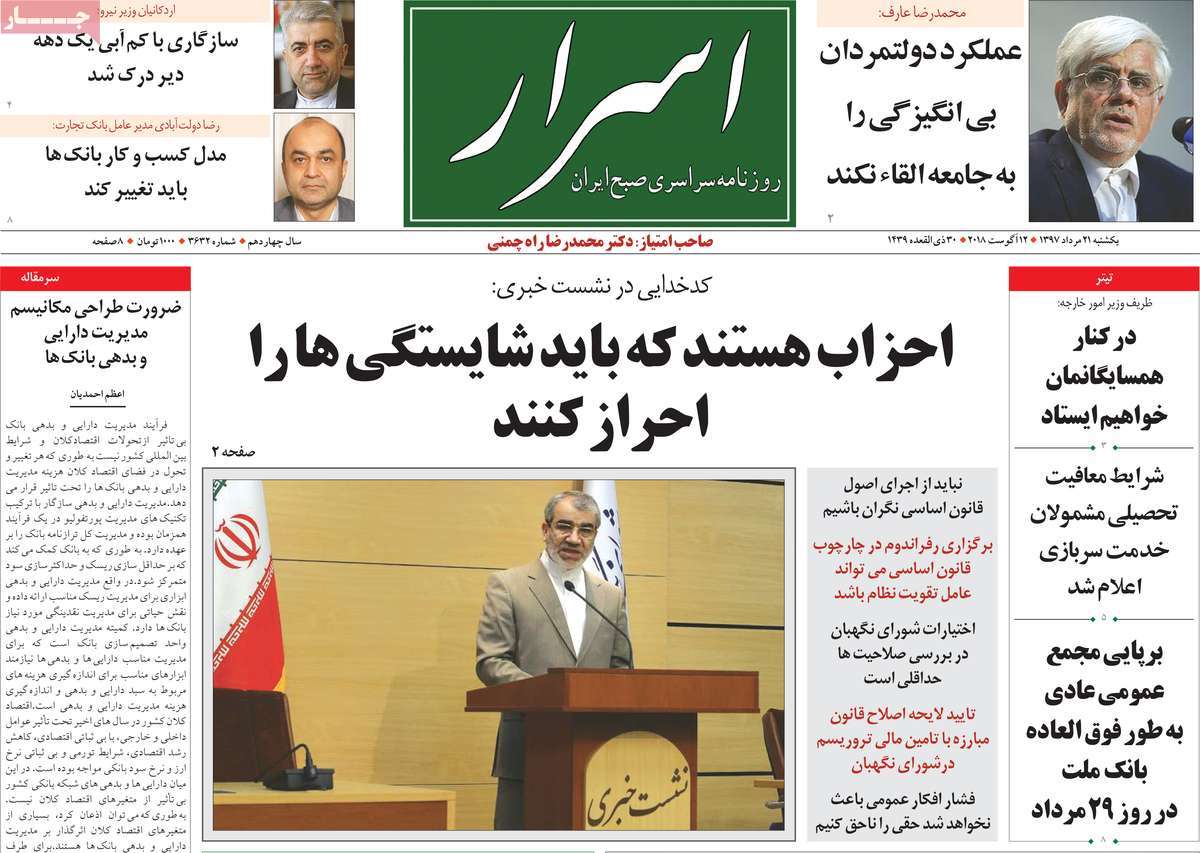
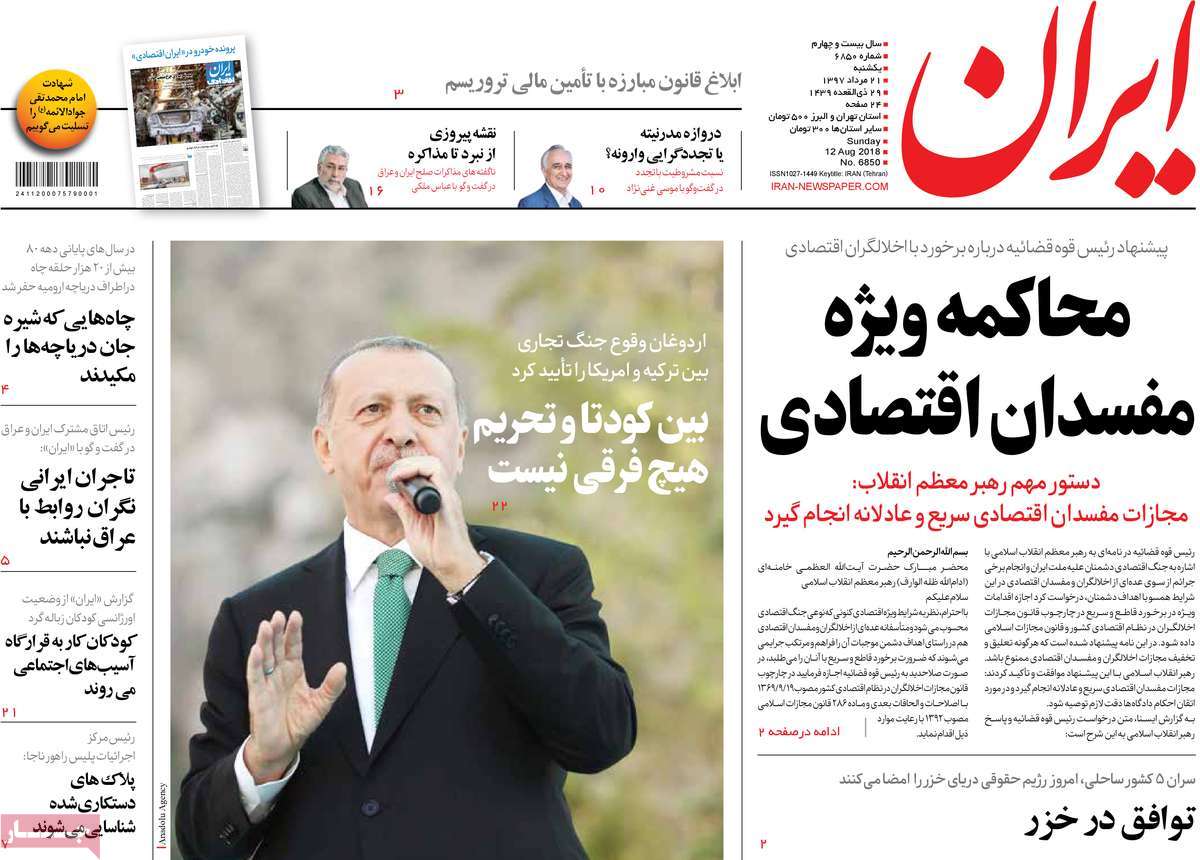
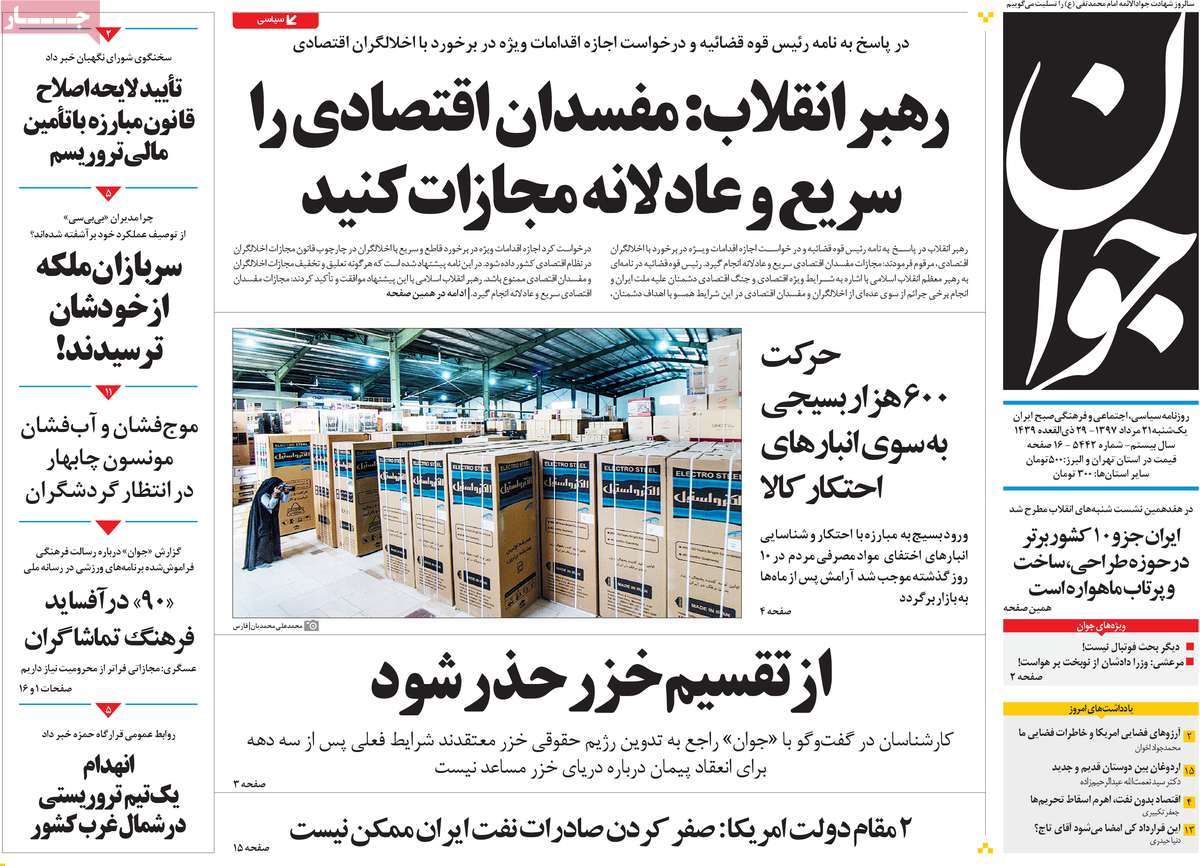
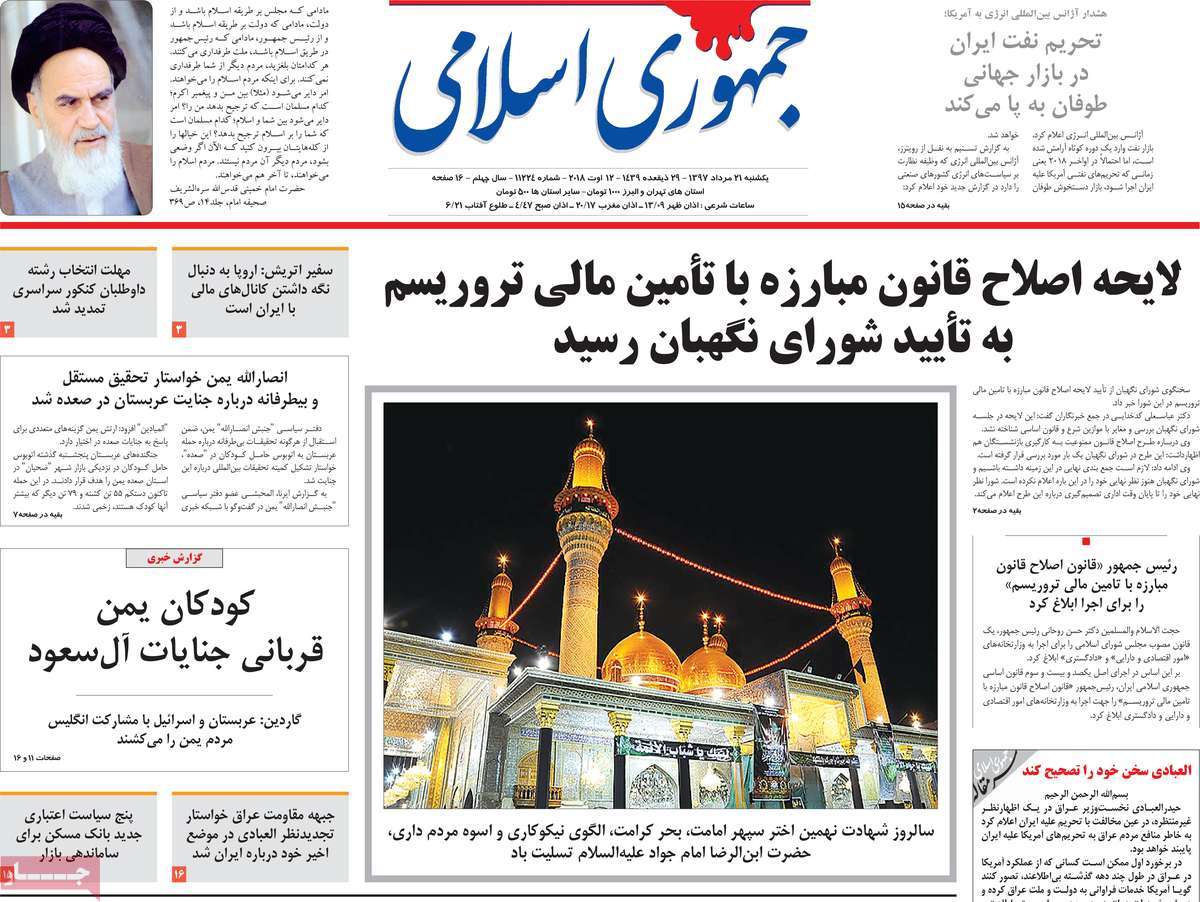
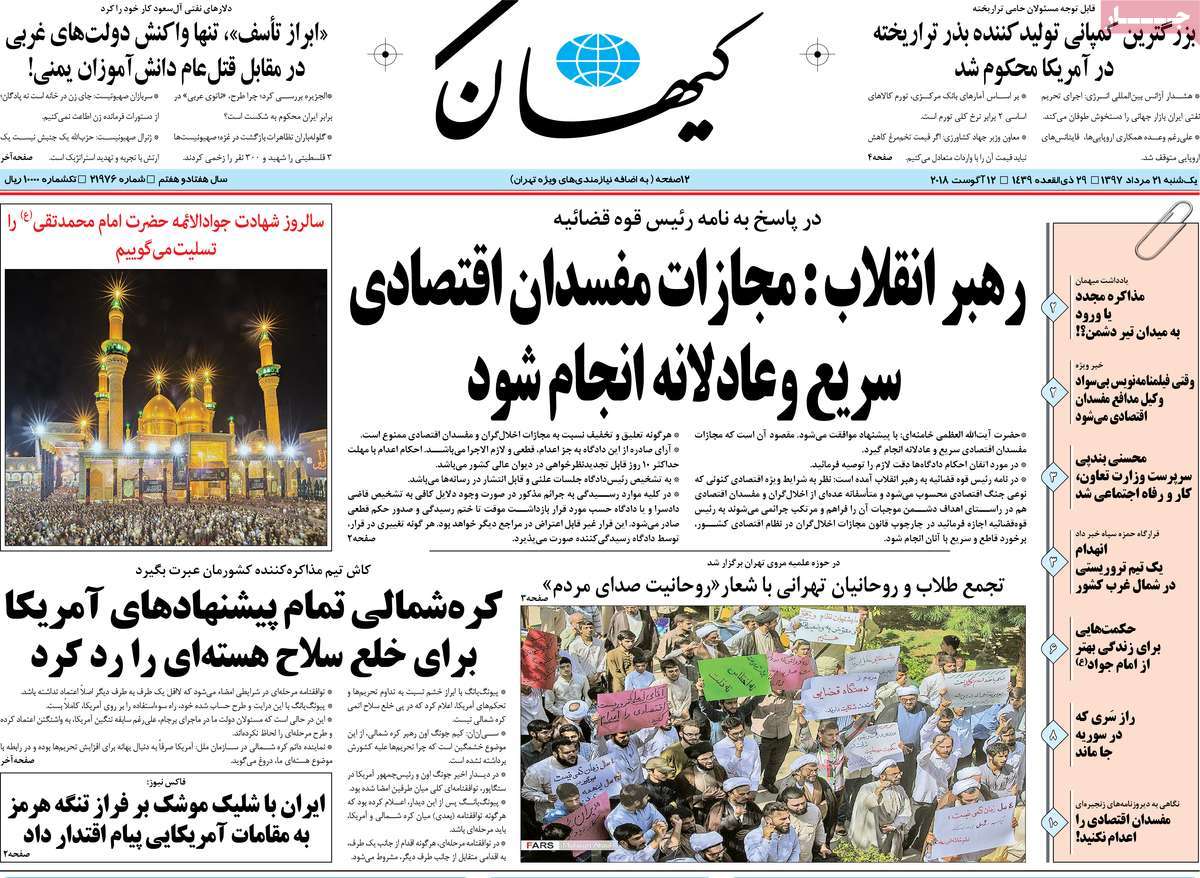
A Look at Iranian Newspaper Front Pages on August 12

A Look at Iranian Newspaper Front Pages on November 19

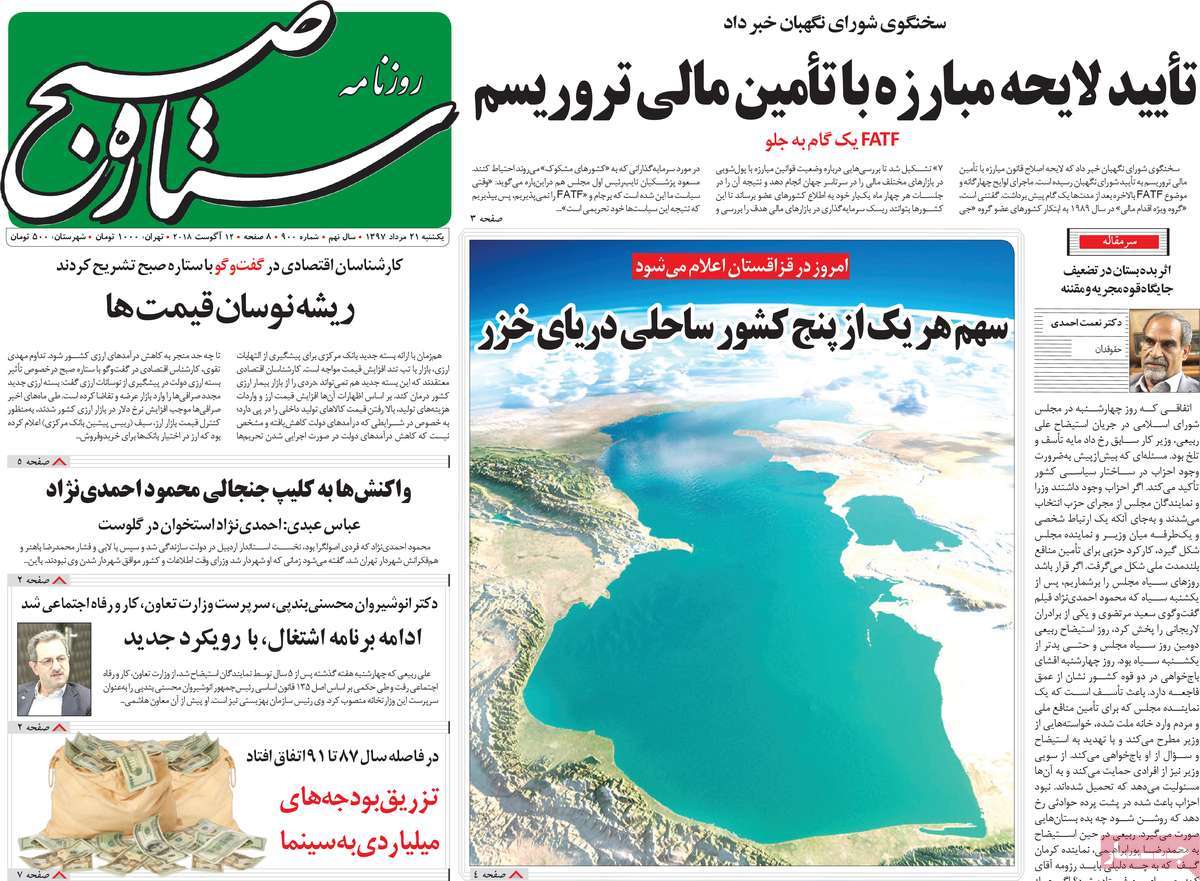
Newspapers today widely covered the Sunday summit of the heads of Caspian Sea littoral states in Kazakhstan, during which a convention on the sea’s legal regime is to be signed by the five countries.

Also a top story was an order by the Leader of Iran’s Islamic Revolution Ayatollah Seyyed Ali Khamenei to swiftly and justly prosecute those involved in financial corruption.

Several papers also highlighted a decision by Iran’s Guardian Council to approve amendments to the country’s Counter-Terrorist Financing (CTF) law, earlier ratified by the Parliament. The law is part of the FATF standards that need to be implemented by the Islamic Republic.

The above issues, as well as many more, are highlighted in the following headlines and top stories:


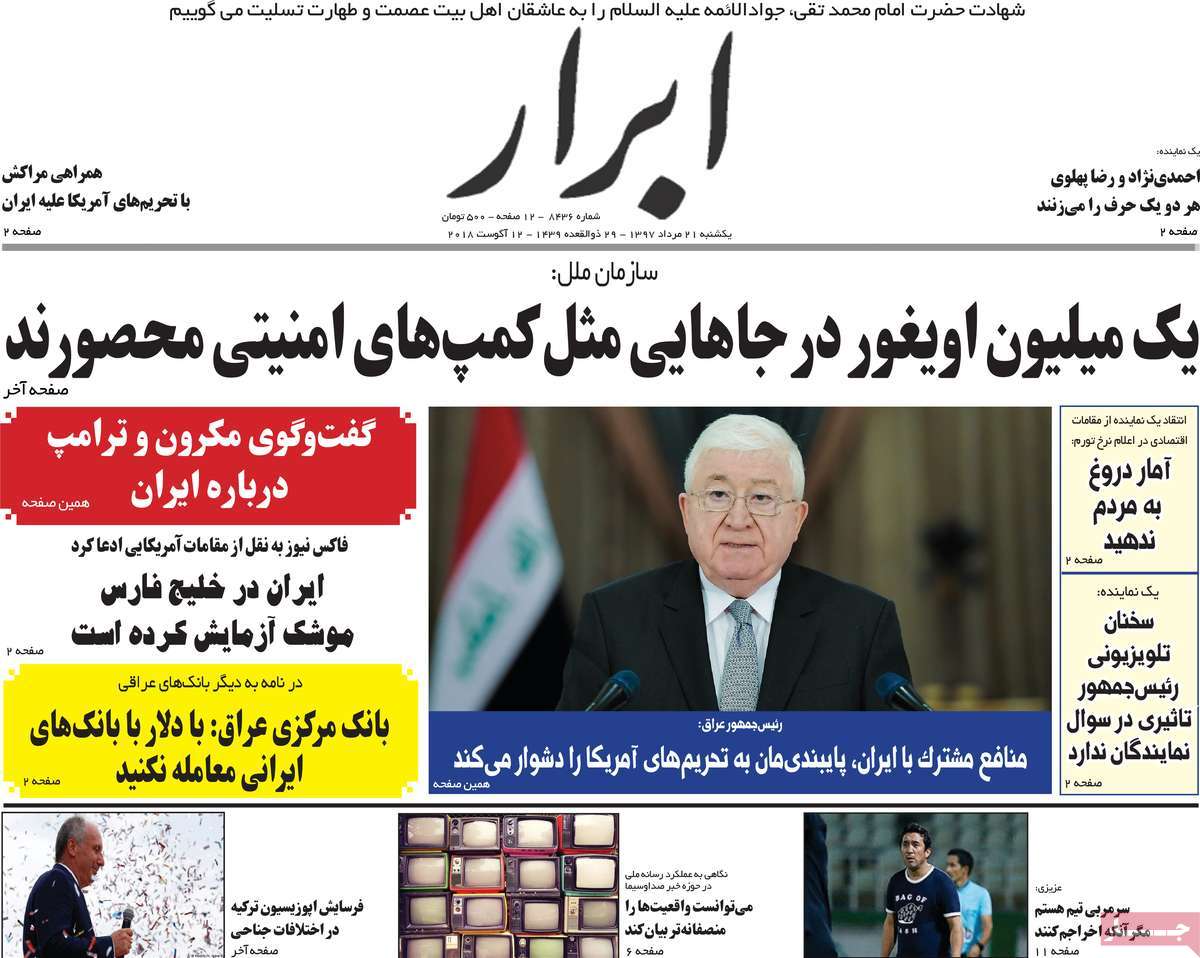
Abrar:

1- Iraq President: Common Interests with Iran Make It Difficult to Obey US Sanctions

2- Macron, Trump Hold Talks on Iran

3- Iraq Central Bank: Don’t Do Business with Iran Using US Dollar

A Look at Iranian Newspaper Front Pages on August 12


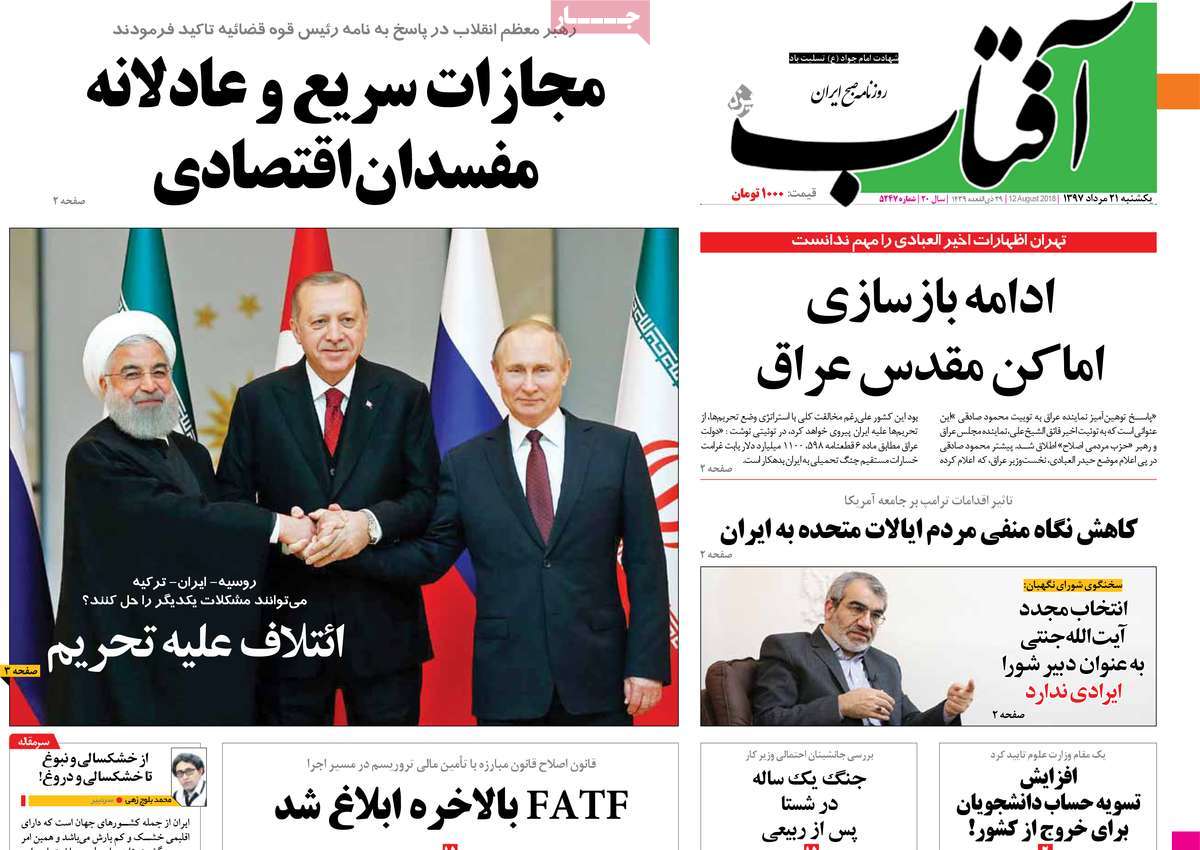
Aftab-e Yazd:

1- Iran Leader Urges Swift, Just Action against Financial Corruption

2- Coalition against Sanction: Can Russia, Iran, Turkey Resolve Each Other’s Problems?

3- Iranian Ministries of Economy, Justice Finally Ordered to Implement FATF

A Look at Iranian Newspaper Front Pages on August 12


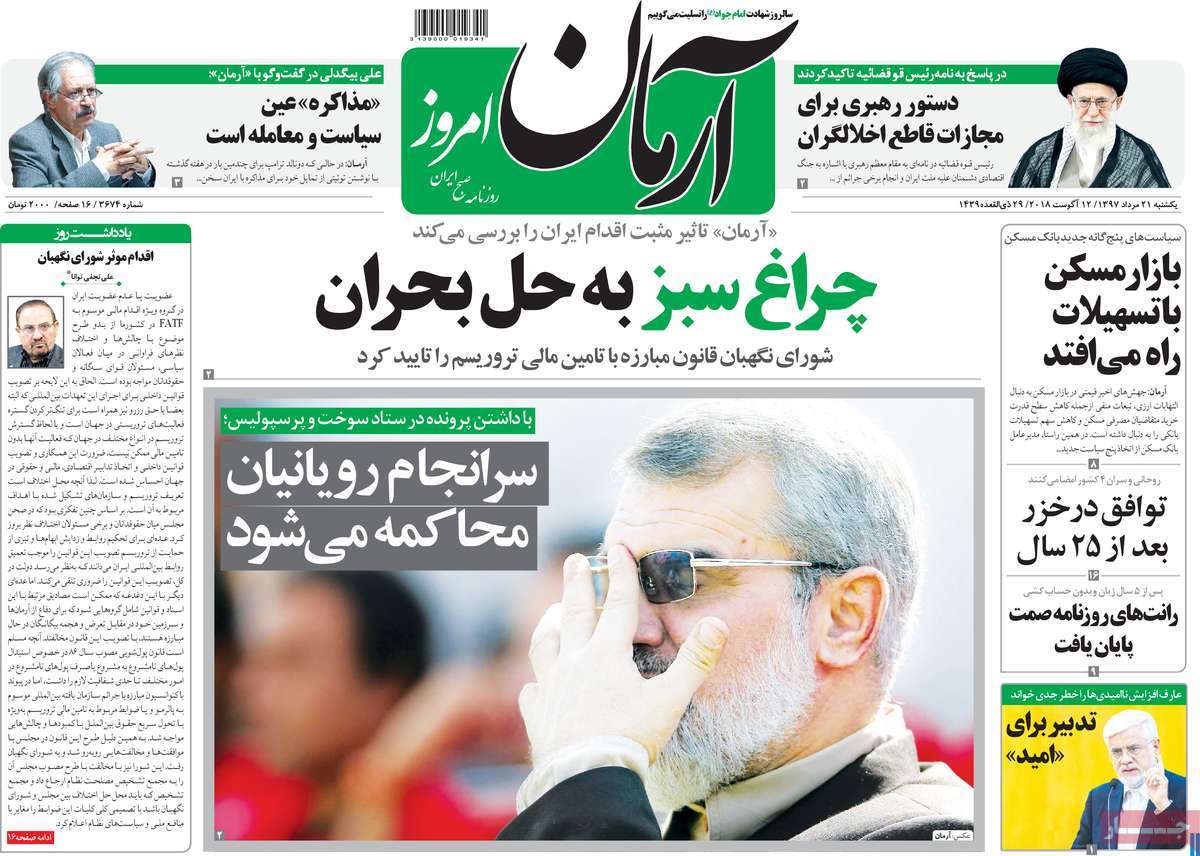
Arman-e Emrooz:

1- Guardian Council Gives Green Light for Settling Crisis

  • CTF Law Finally Approved by GC

A Look at Iranian Newspaper Front Pages on August 12


Asrar:

1- Energy Minister: Adaptability to Water Crisis Understood with a Decade of Delay

A Look at Iranian Newspaper Front Pages on August 12


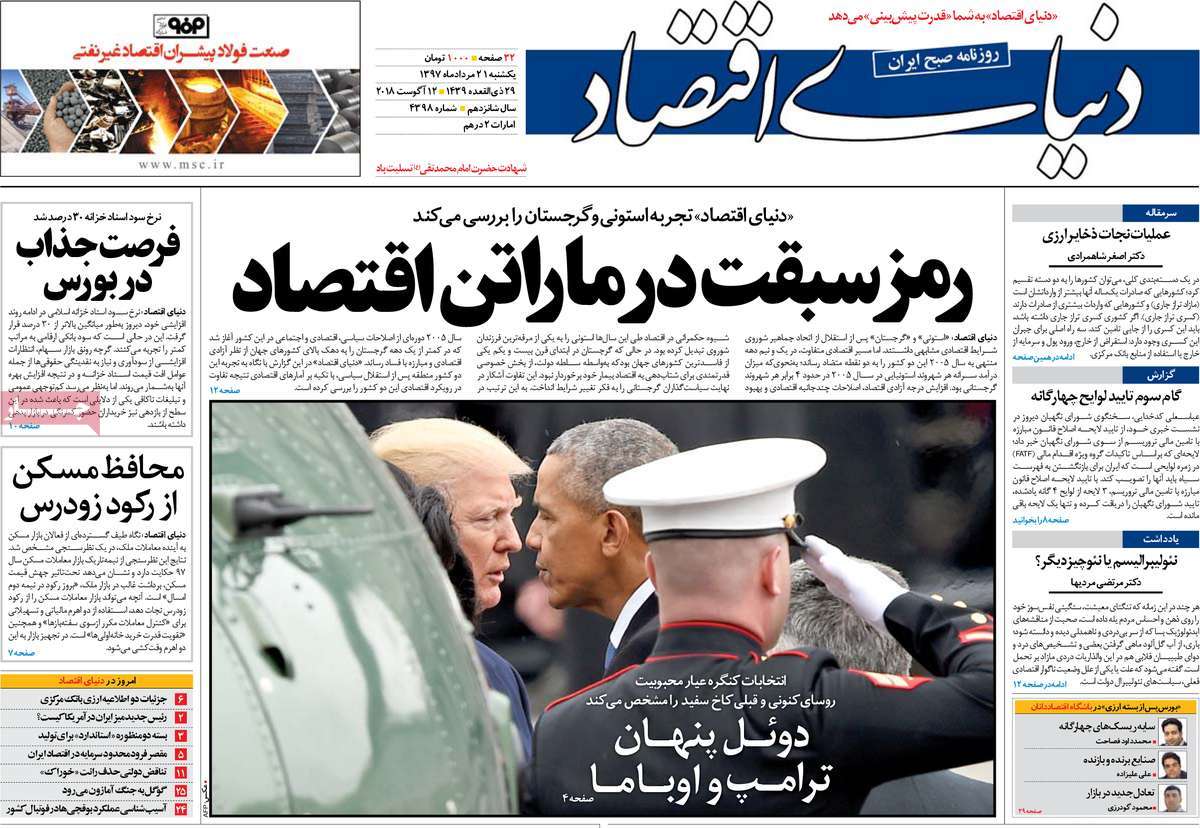
Donya-ye Eqtesad:

1- Hidden Duel between Trump, Obama

  • US Congress Elections to Show How Much They’re Popular

A Look at Iranian Newspaper Front Pages on August 12


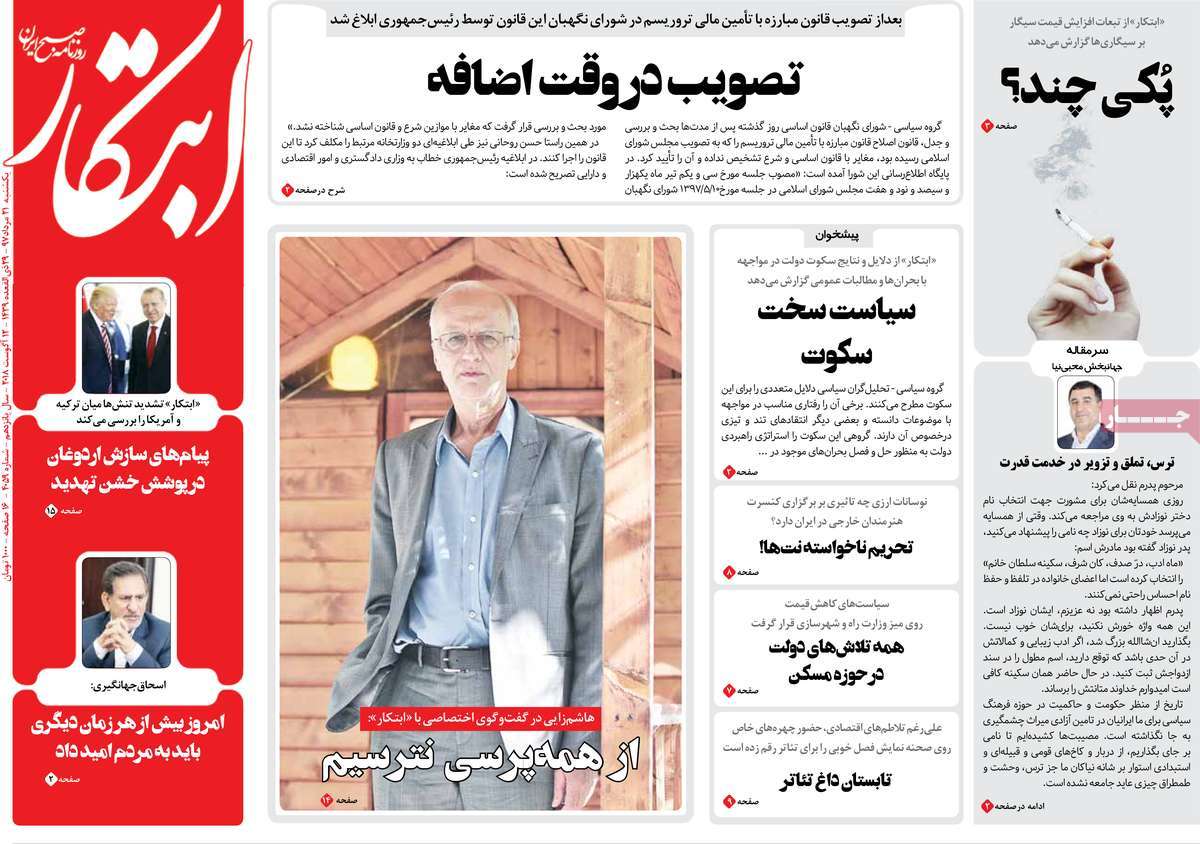
Ebtekar:

1- Erdogan Sending Messages of Reconciliation While Threatening US

  • Escalation of Tension between US, Turkey

A Look at Iranian Newspaper Front Pages on August 12


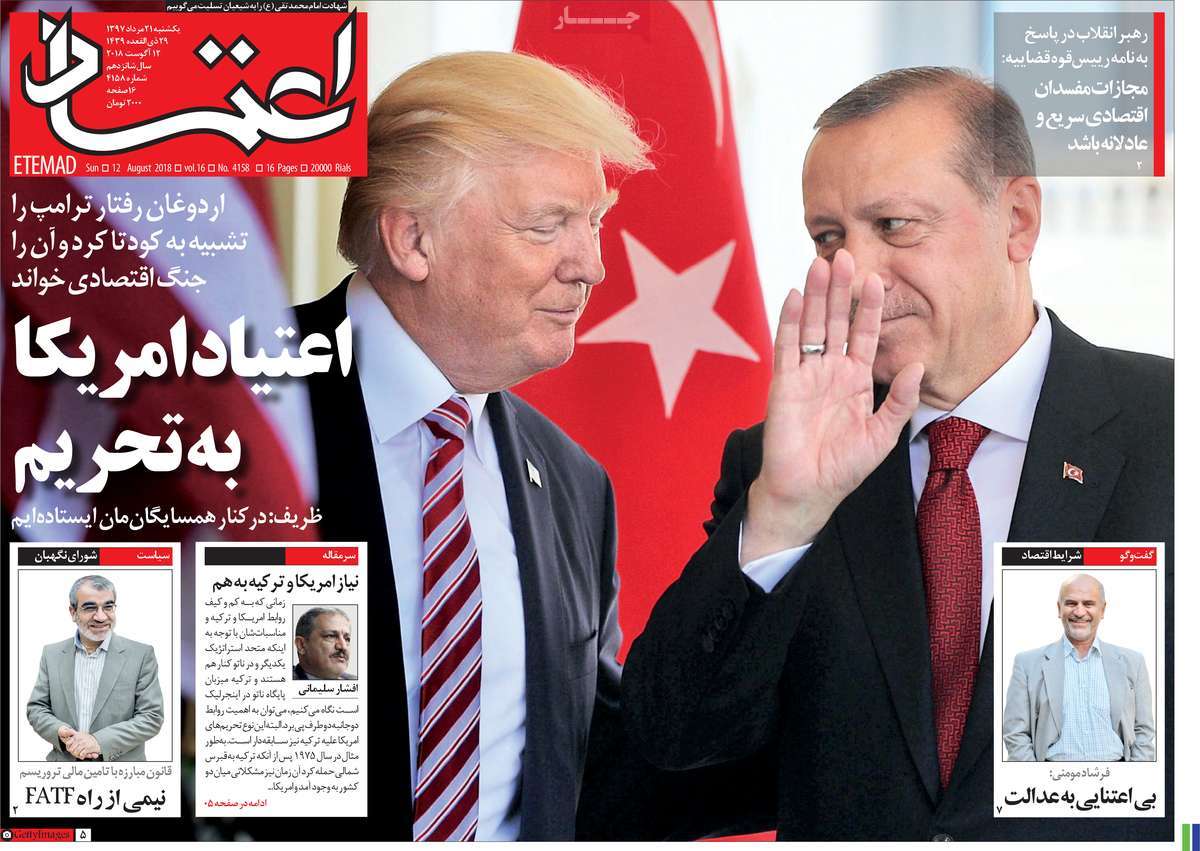
Etemad:

1- US’ Addiction to Sanctions

  • Erdogan Calls Trump’s Move Declaration of Economic War

2- Iran Standing by Its Neighbours: Zarif

A Look at Iranian Newspaper Front Pages on August 12


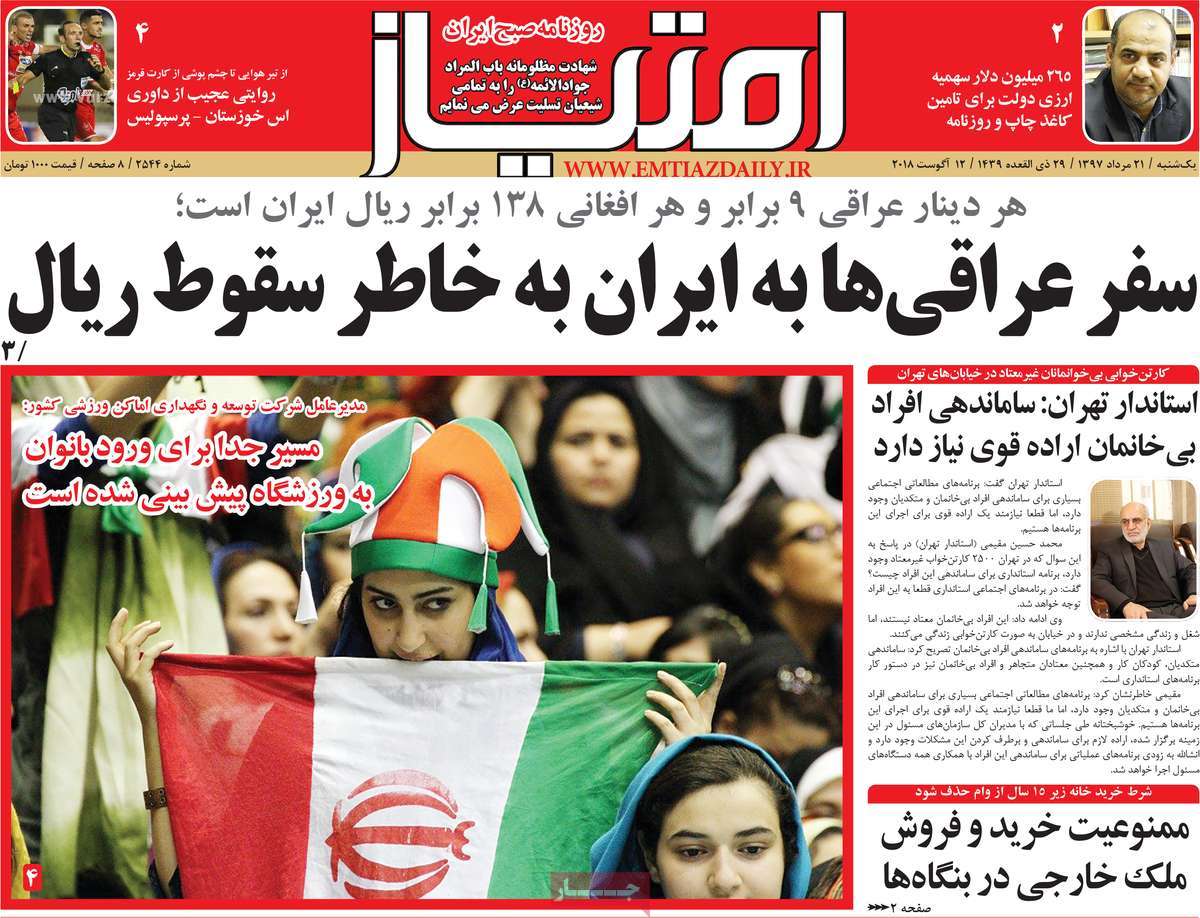
Emtiaz:

1- Iraqis Travelling to Iran after Devaluation of Iranian Rial

  • Iraqi Dinar, Afghanistan’s Afghani More Valuable than Iran’s Currency

A Look at Iranian Newspaper Front Pages on August 12


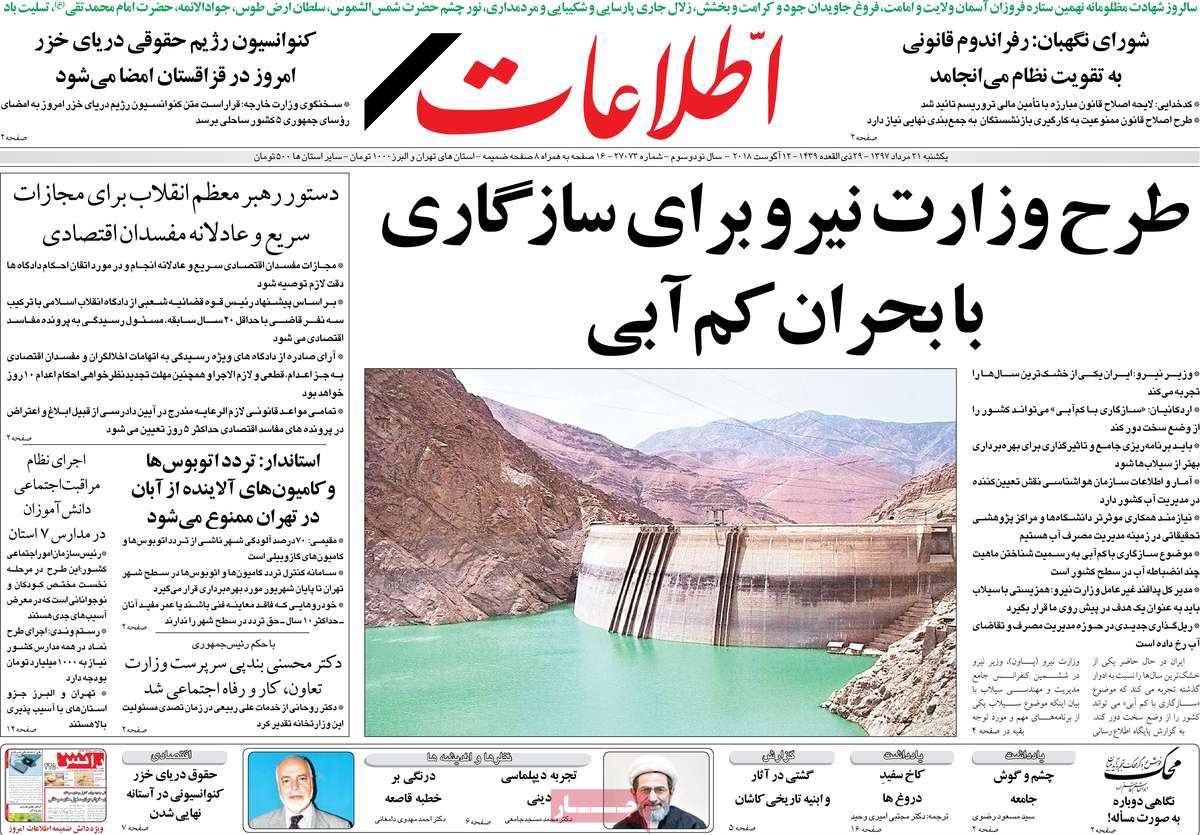
Ettela’at:

1- Convention on Legal Regime of Caspian Sea to Be Signed in Kazakhstan Today

A Look at Iranian Newspaper Front Pages on August 12


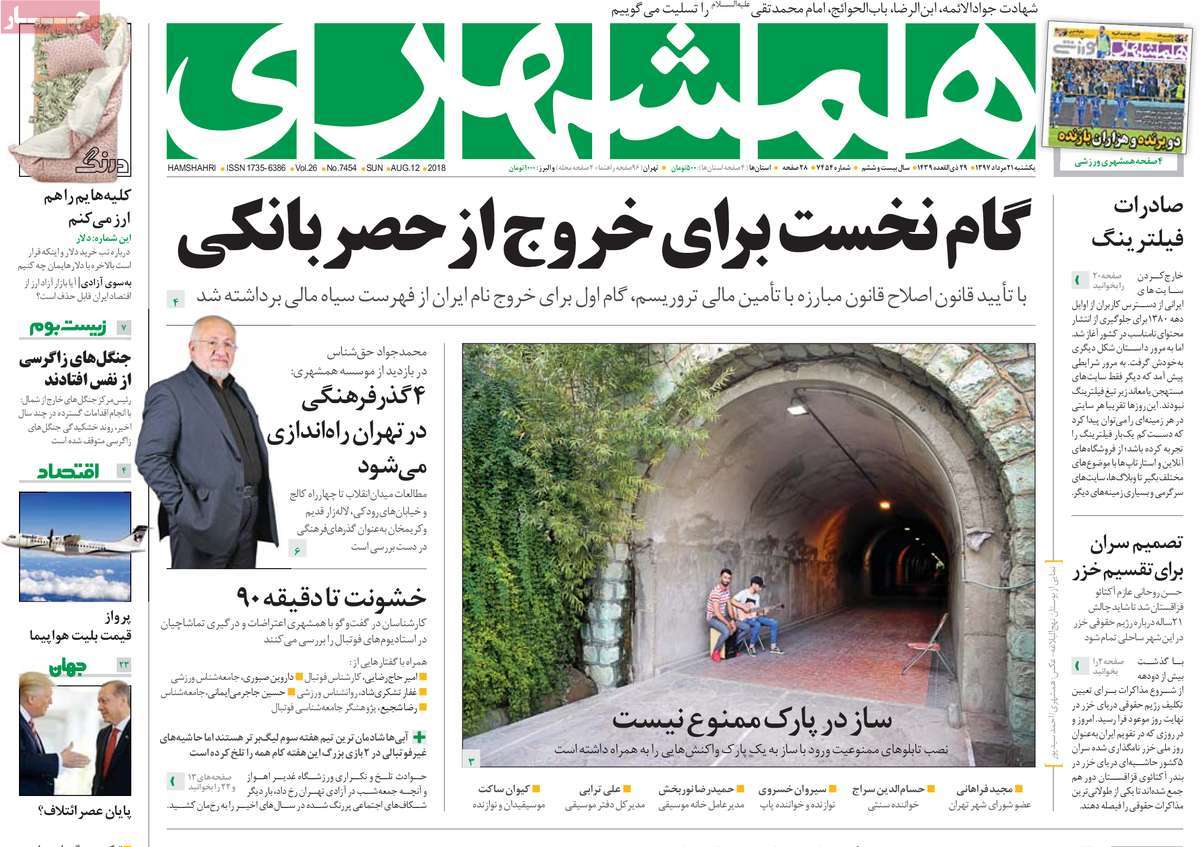
Hamshahri:

1- First Step to Get Out of Banking Siege

  • Iran Takes First Step to Get Its Name Out of FATF Blacklist

A Look at Iranian Newspaper Front Pages on August 12


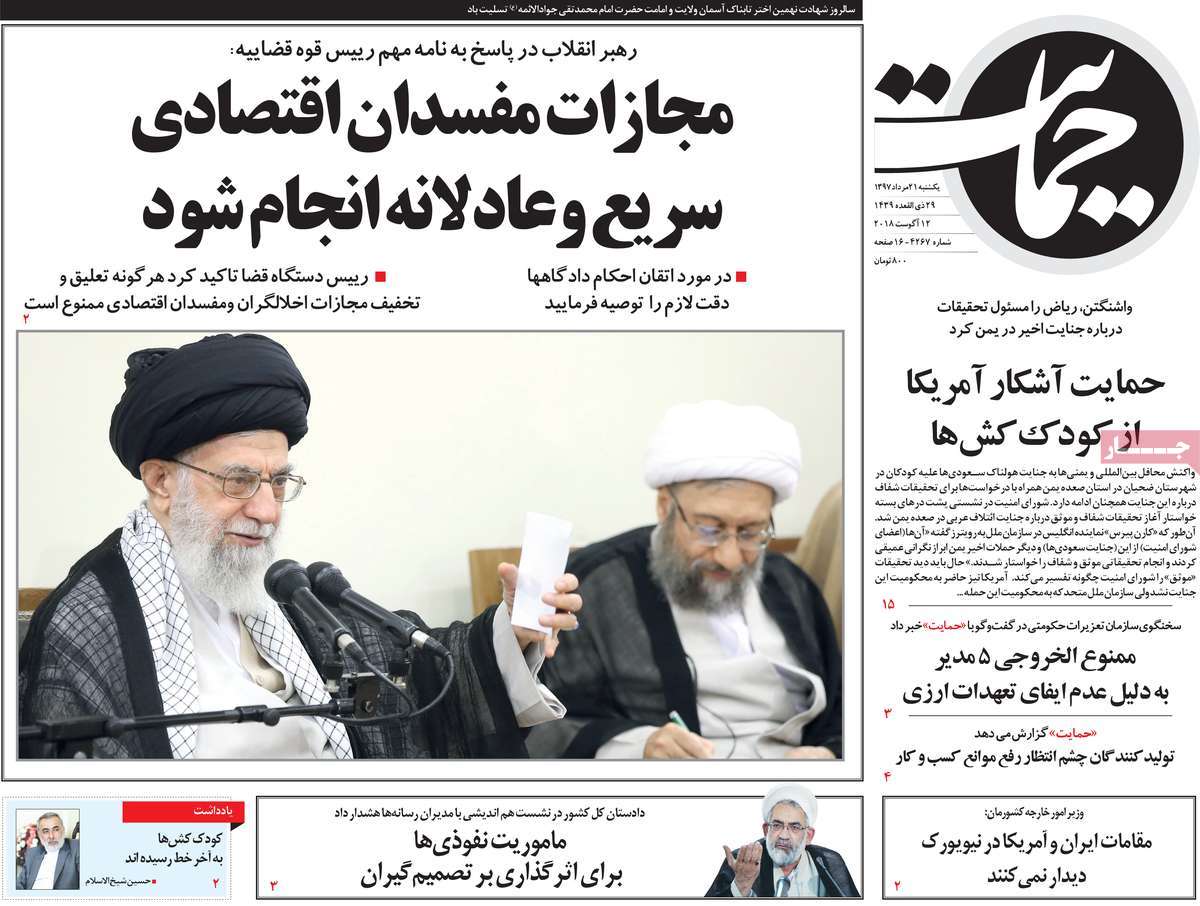
Hemayat:

1- US’ Blatant Support for Child-Killers

  • Washington Tasks Riyadh with Probing into Recent Crime in Yemen!

A Look at Iranian Newspaper Front Pages on August 12


Iran:

1- No Difference between Coup, Sanctions

  • Erdogan Confirms US Sanctions Beginning of Trade War

2- Official: Iranian Businessmen Shouldn’t Be Worried about Ties with Iraq

A Look at Iranian Newspaper Front Pages on August 12


Javan:

1- Two US Statesmen: It’s Not Possible to Cut Down Iran’s Oil Exports to Zero

A Look at Iranian Newspaper Front Pages on August 12


Jomhouri Eslami:

1- IEA Warns US: Bans on Iran Oil Exports to Create Storm in Global Markets

2- Austria Envoy: Europe Seeks to Keep Its Financial Channels with Iran

A Look at Iranian Newspaper Front Pages on August 12


Kayhan:

1- Western Governments Only ‘Express Regret’ over Slaughter of Yemeni Children!

A Look at Iranian Newspaper Front Pages on August 12


Setareh Sobh:

1- Each of Five Caspian Sea Littoral States to Know Their Shares Today

A Look at Iranian Newspaper Front Pages on August 12


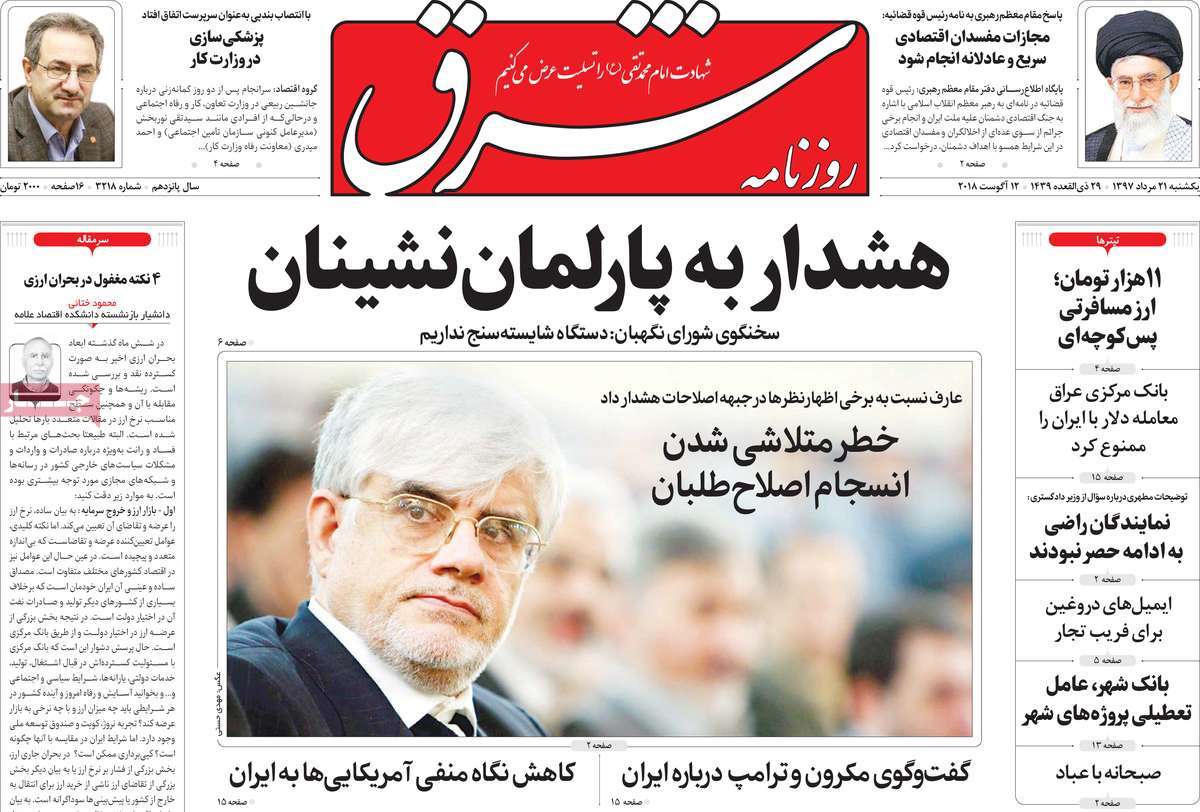
Shargh:

1- Aref Warns about Possible Collapse of Reformists’ Solidarity

2- Americans Holding Less Negative View on Iran

A Look at Iranian Newspaper Front Pages on August 12

No Demarcation Included in Caspian Sea Legal Regime Convention: Iran

In a Sunday statement, Qassemi said the issue of dividing up the seabed and resources of the Caspian Sea among littoral states as well as the designation of the line of origin is not on the agenda in the meeting where a convention on the legal regime of the Caspian Sea is to be signed.

He rejected inexpert speculations and propaganda regarding Sunday’s event, saying, “Certain speculations and statements made are not true at all because the convention being signed today by heads of the five littoral states of the Caspian Sea basically determines the general framework for cooperation and the fundamental principles related to the legal regime of the Caspian Sea.”

Qassemi stressed that the large lake is a special one, and thus a special legal regime irrespective of the existing conventions will be drawn up and put into effect.

He dismissed speculations that the convention provides for the determination of boundaries and shares of the Caspian Sea and the division of the body of water among its coastal states.

The spokesman also said it is stipulated in the convention that no foreign country is allowed to operate military or civilian vessels in the Caspian Sea or to establish bases there.

“Furthermore, the five [littoral] countries will not allow other states to use their land, sea territory or airspace to attack any of the coastal nations,” he noted.

“The signing of this convention, which is a strategic document for cooperation among Caspian Sea states, will turn this region to yet another hub of regional cooperation in order to promote peace, stability, security and progress in the littoral countries,” he noted.
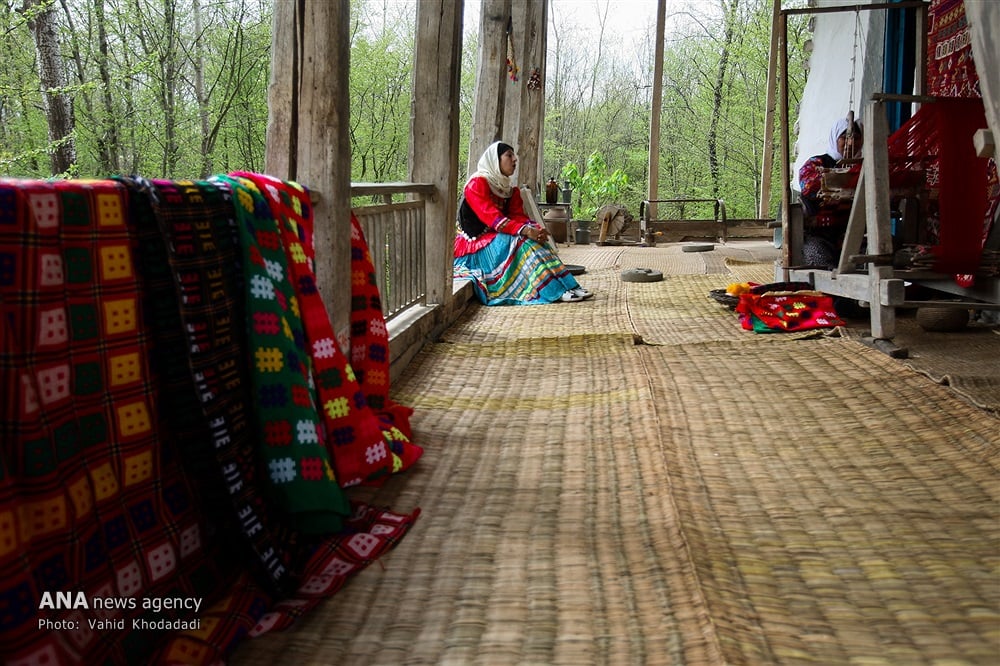
The convention, which will be signed on Sunday, is the outcome of more than two decades of negotiations at different levels between the officials of the Caspian Sea’s littoral states.


NATO Ships Not Allowed to Navigate in Caspian Sea

Earlier on Saturday, Iranian Foreign Minister Mohammad Javad Zarif told a meeting of foreign ministers of the Caspian Sea littoral states that the convention stresses the monopoly of the presence and sailing of vessels operating solely under the flag of one of the littoral states.

It also bans on the presence and passing of foreign and non-coastal military troops, including NATO ships, he added.

“This convention does not determine the boundaries of seabed and subsoil and the baselines and its methods, and these issues are to be agreed upon in future agreements,” Zarif noted, expressing the hope coastal countries will soon finalize agreements on these affairs.

“Under the shadow of the positive will of the leaders of coastal countries and the friendly and positive atmosphere of these meetings, we are on the verge of signing the legal regime’s convention and six other agreements and protocols and releasing the statement of the leaders’ summit.”

The foreign minister said, “21 days ago, the protocol for Transboundary Environmental Impact Assessment was signed. These developments herald a bright future for our nations and governments.”

“The signing of the legal regime’s convention is a very important step that put an end to 21 years of negotiations. This convention does not mean all talks and measures have ended. This is in fact a milestone and the beginning of the implementation of agreements, monitoring their implementation and starting talks for new and necessary agreements,” he said.

Iran President in Kazakhstan to Sign Landmark Caspian Sea Deal

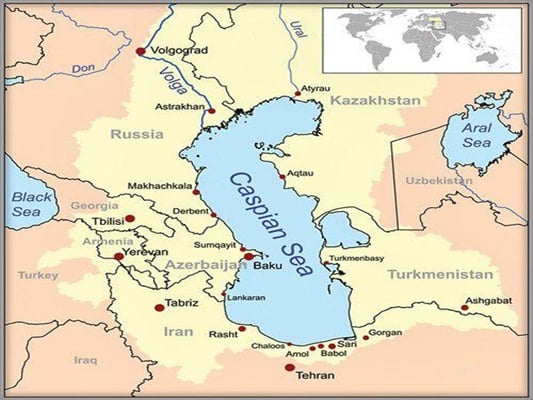
Iran, Azerbaijan, Kazakhstan, Russia and Turkmenistan have been bargaining over their share of the inland sea since 1991, when the breakup of the Soviet Union rendered obsolete previous agreements between Tehran and Moscow.

The Caspian’s vast hydrocarbon reserves have made a deal complex to achieve in the past decades. The littoral states are yet to finalize agreements on the boundaries of seabed and subsoil of the sea and its baselines, and the issues are not going to be resolved in the deal due to be signed Sunday.

The Iranian president is to outline Iran’s views about the Caspian Sea legal regime in the meeting expected to be held Sunday afternoon.


One Step Forward

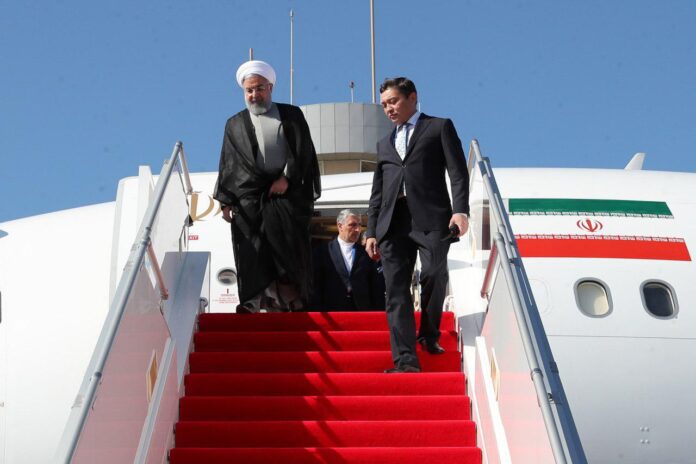
Speaking before departing Tehran for Kazakhstan, the President said the convention is a big step forward for settling differences about the Caspian Sea’s legal status.

“This convention totally bans the presence of external warships and this is highly important for national security of the Caspian Sea littoral states,” he said.

Rouhani said the deal gives the Caspian Sea a special legal status, which means the sea will not fall under international laws and the littoral states can decide about it on their own.

“Overall, this is an important convention that takes us one step forward, although some very important issues will be left for the future,” he said.

Rouhani said the leaders of Caspian Sea littoral states are to sign agreements on trade and economy, transit, anti-terror collaboration and border cooperation.

The five countries will also discuss grounds for closer cooperation in tourism and oil and gas sectors, he said.

On the sidelines of the meeting, Rouhani will sit down for talks with Kazakh President Nursultan Nazarbayev. Rouhani will likely meet his Russian counterpart Vladimir Putin as well, Russian Foreign Minister Sergey Lavrov said on Saturday.

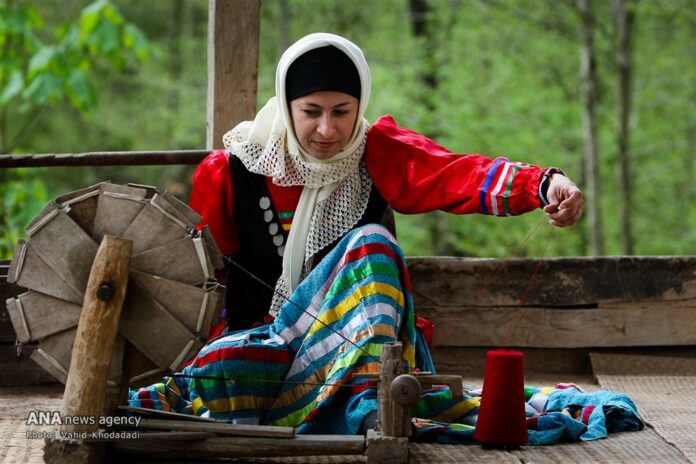
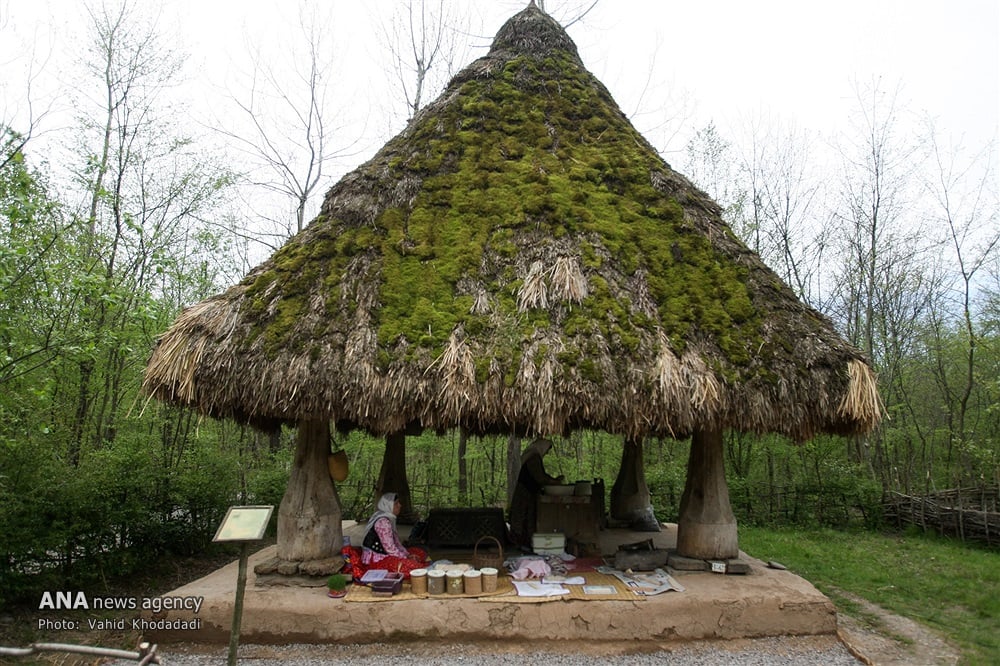
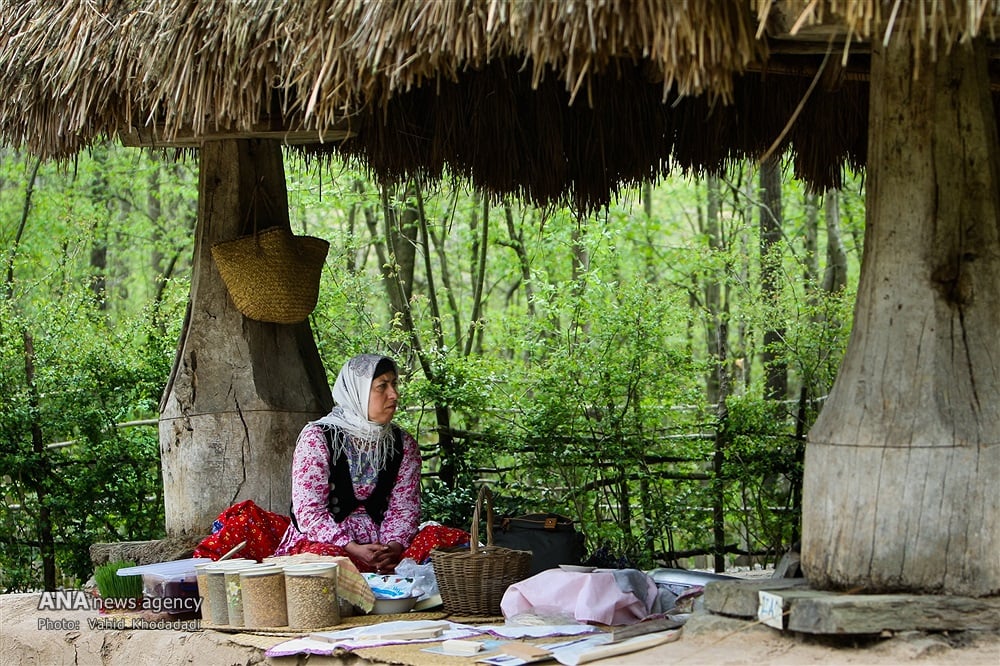
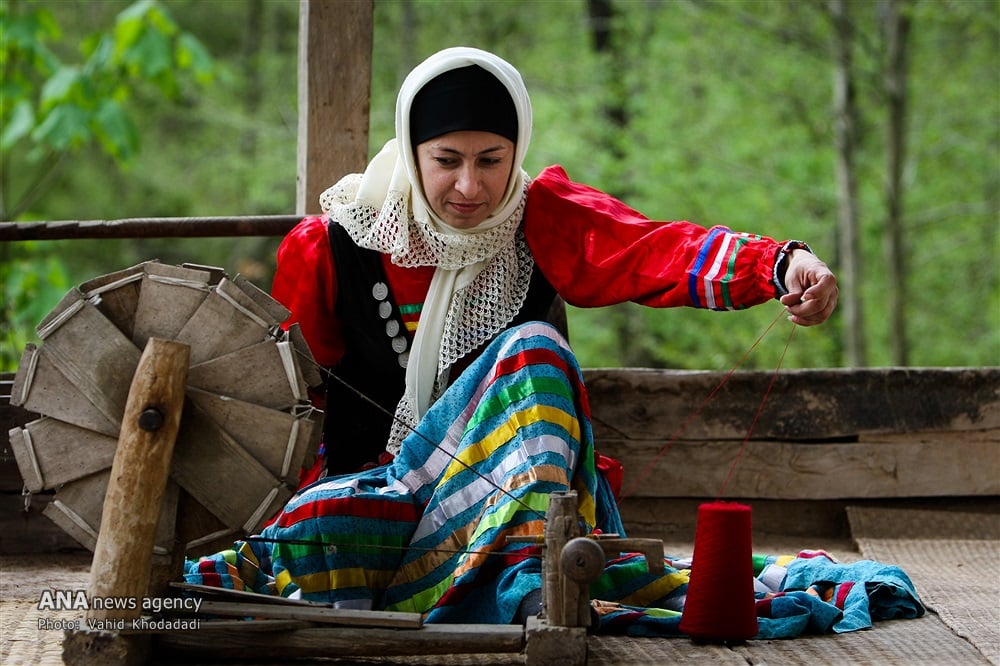
Iran’s Beauties in Photos: Museum of Rural Cultural Heritage

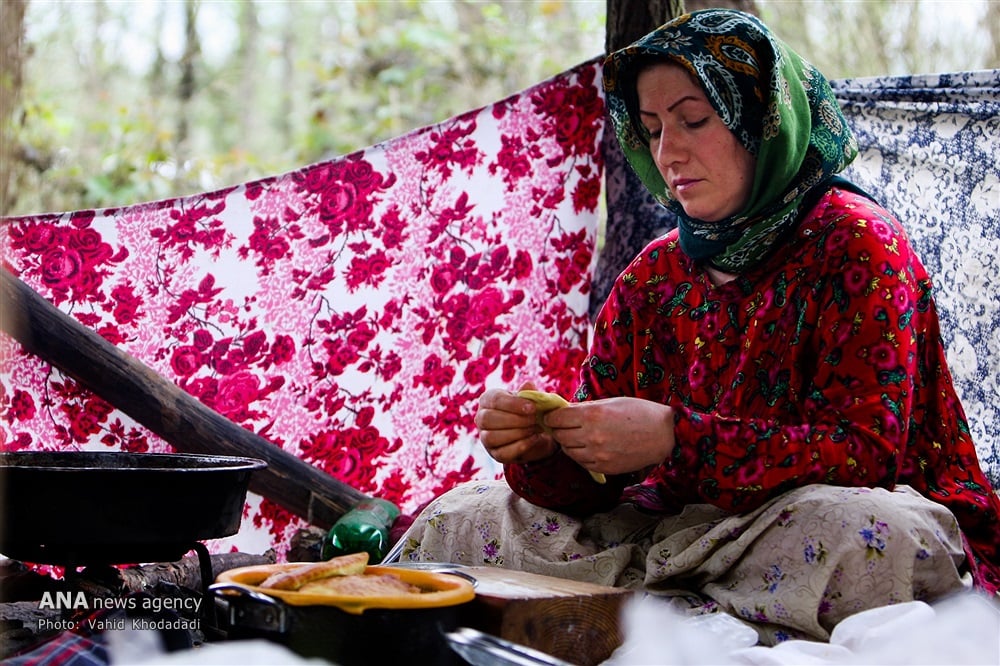
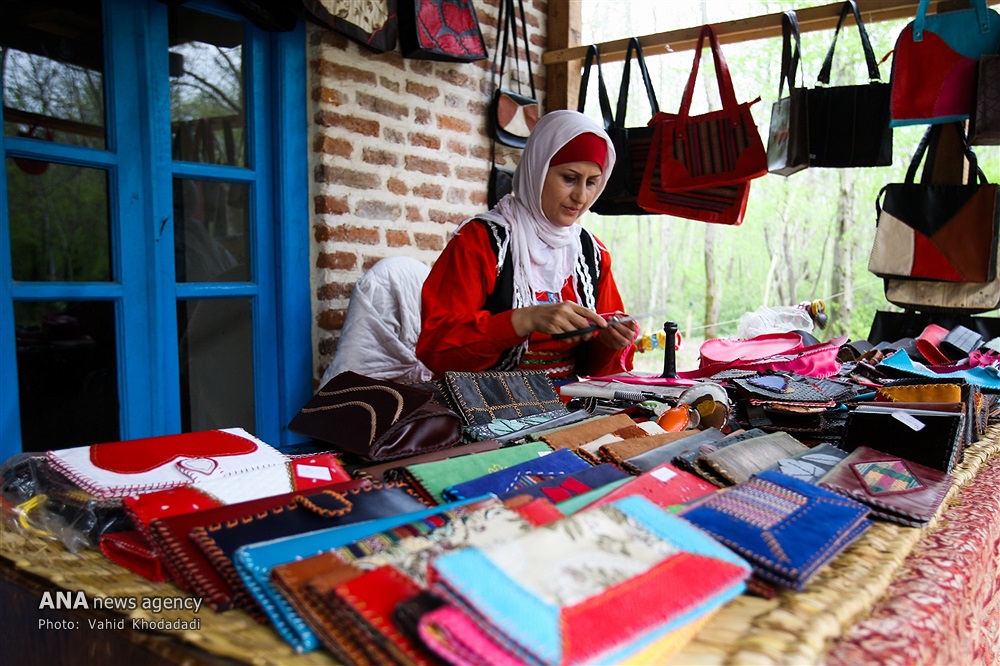
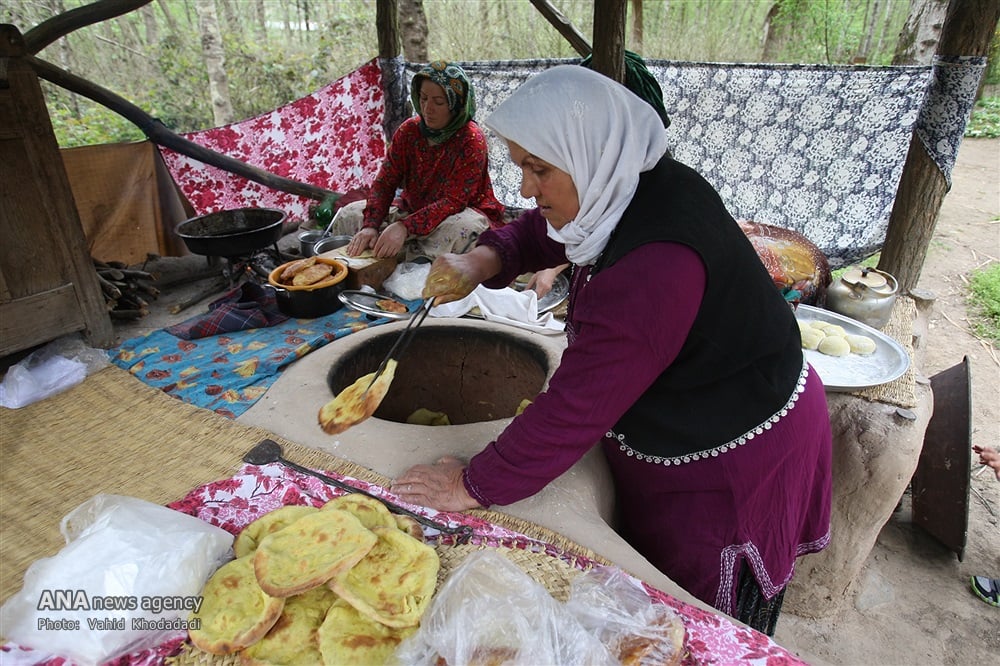
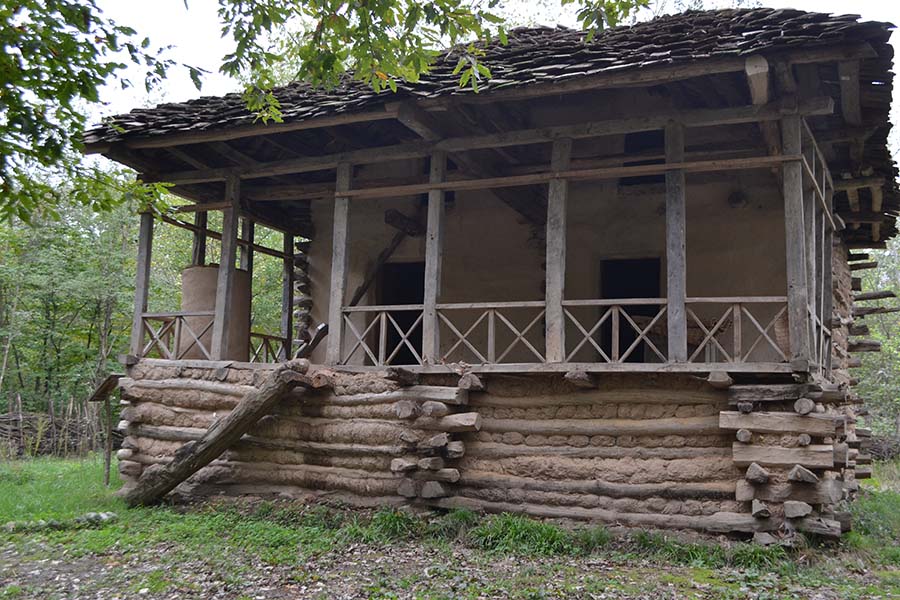
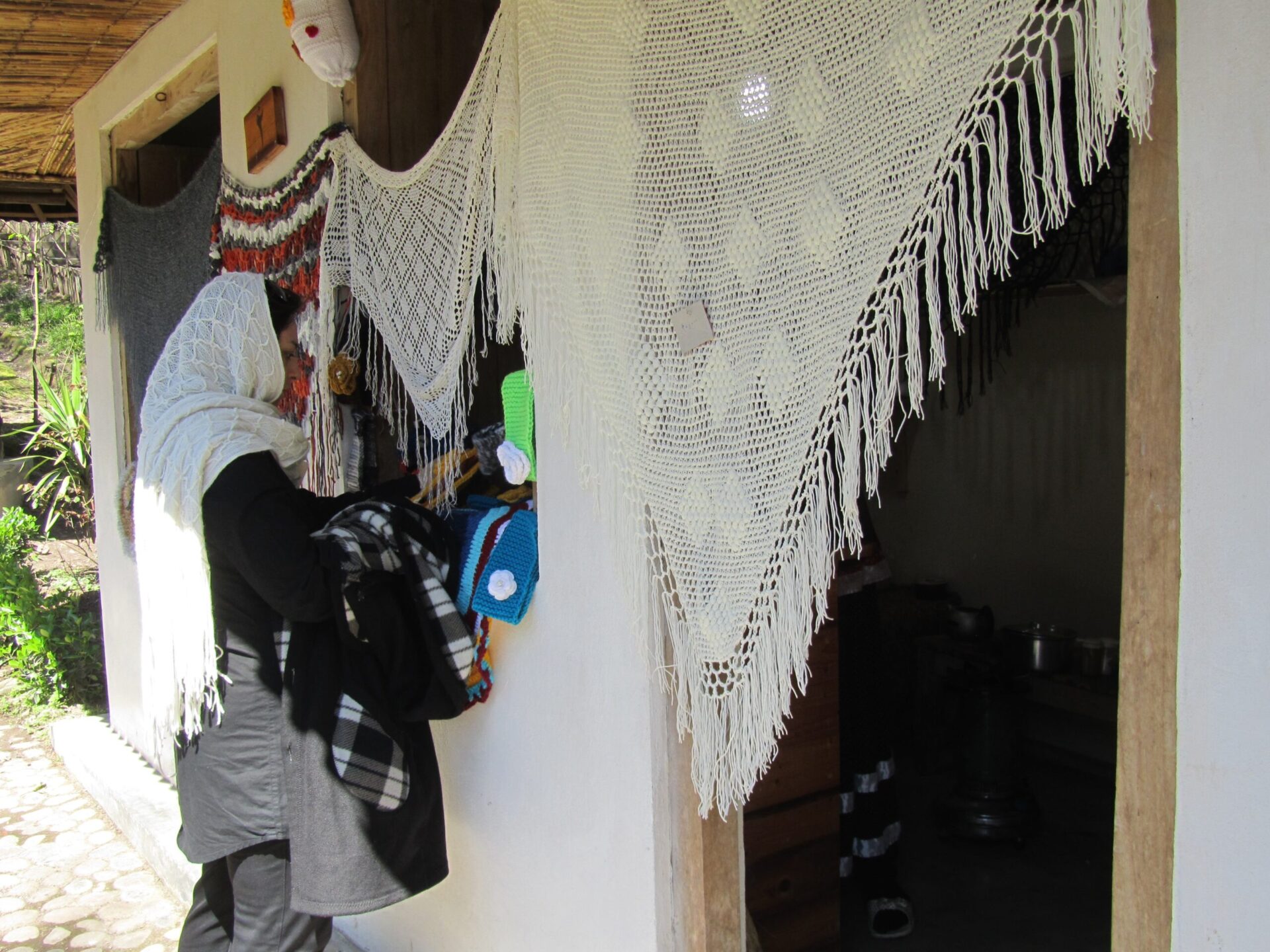
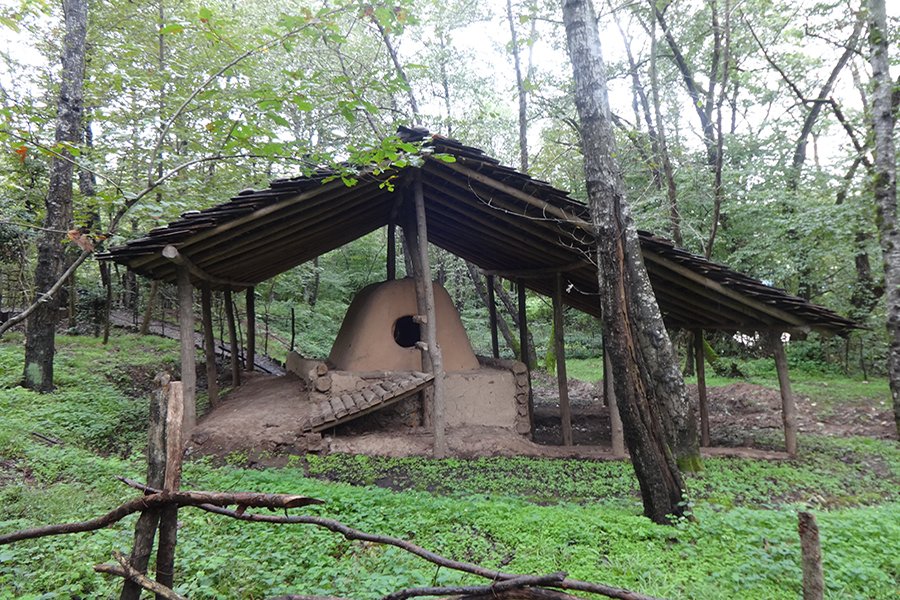
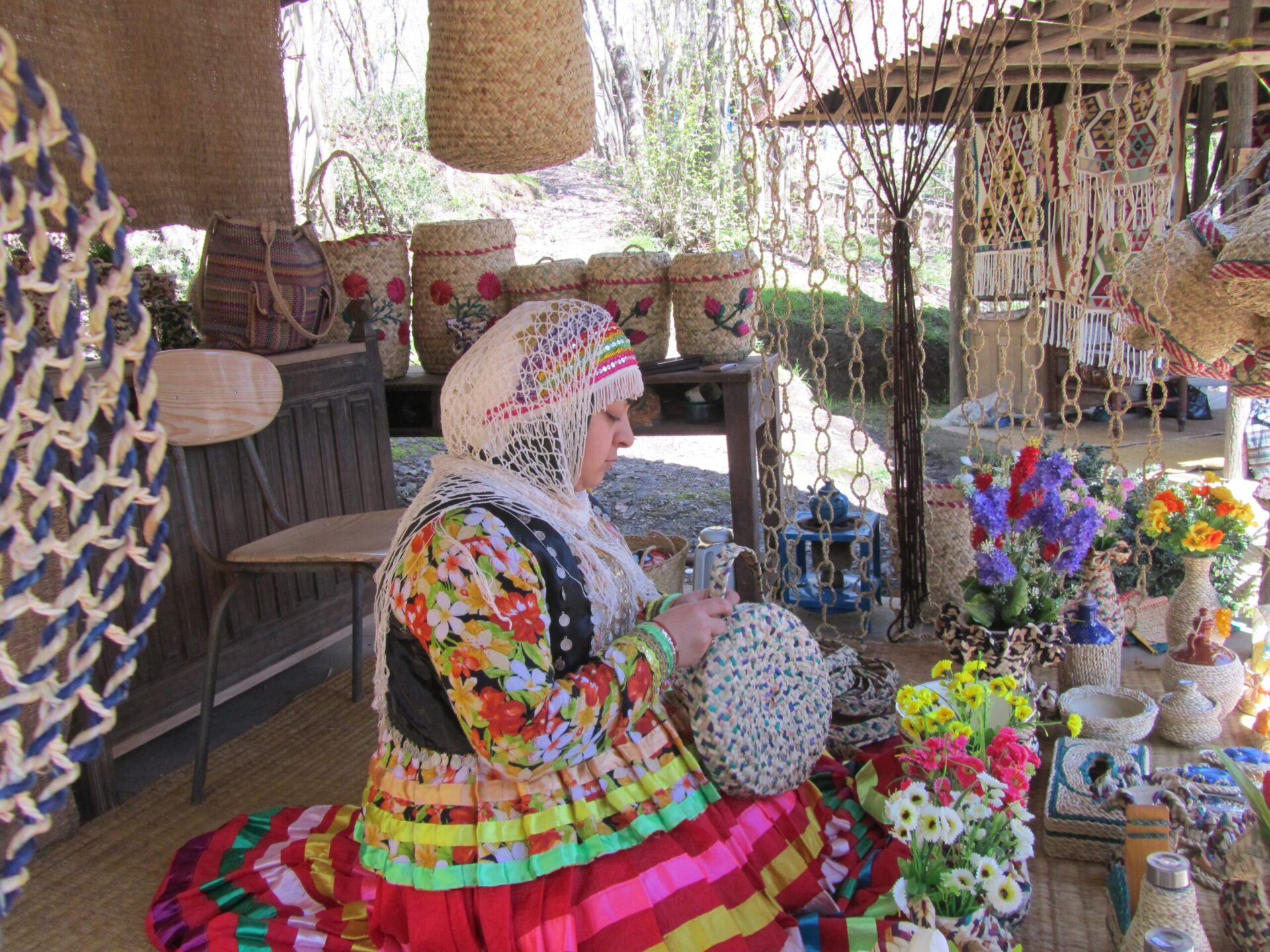
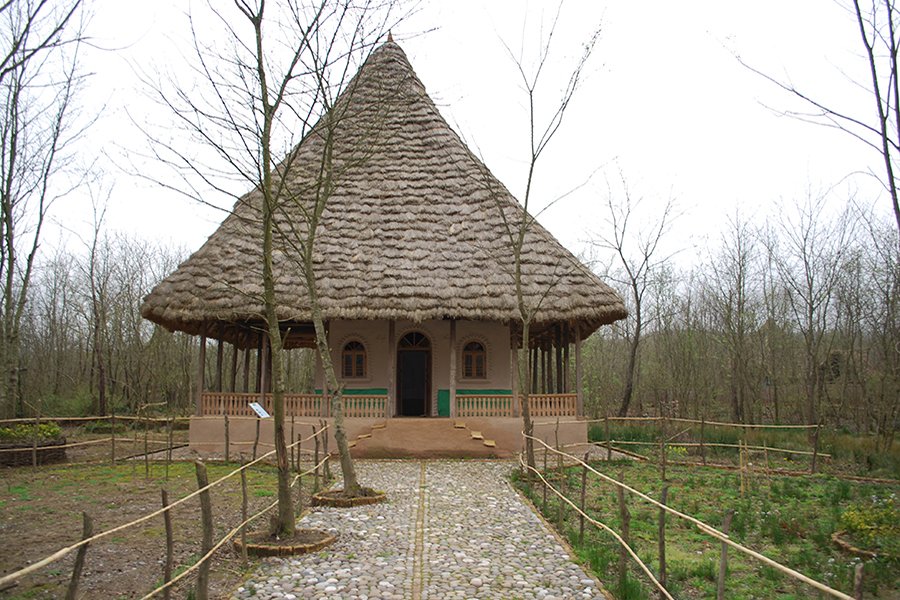
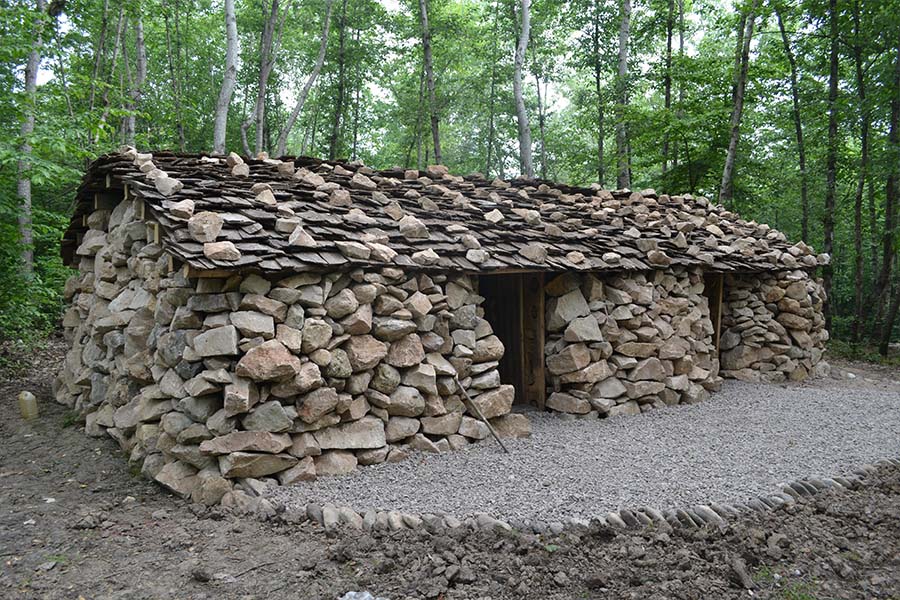
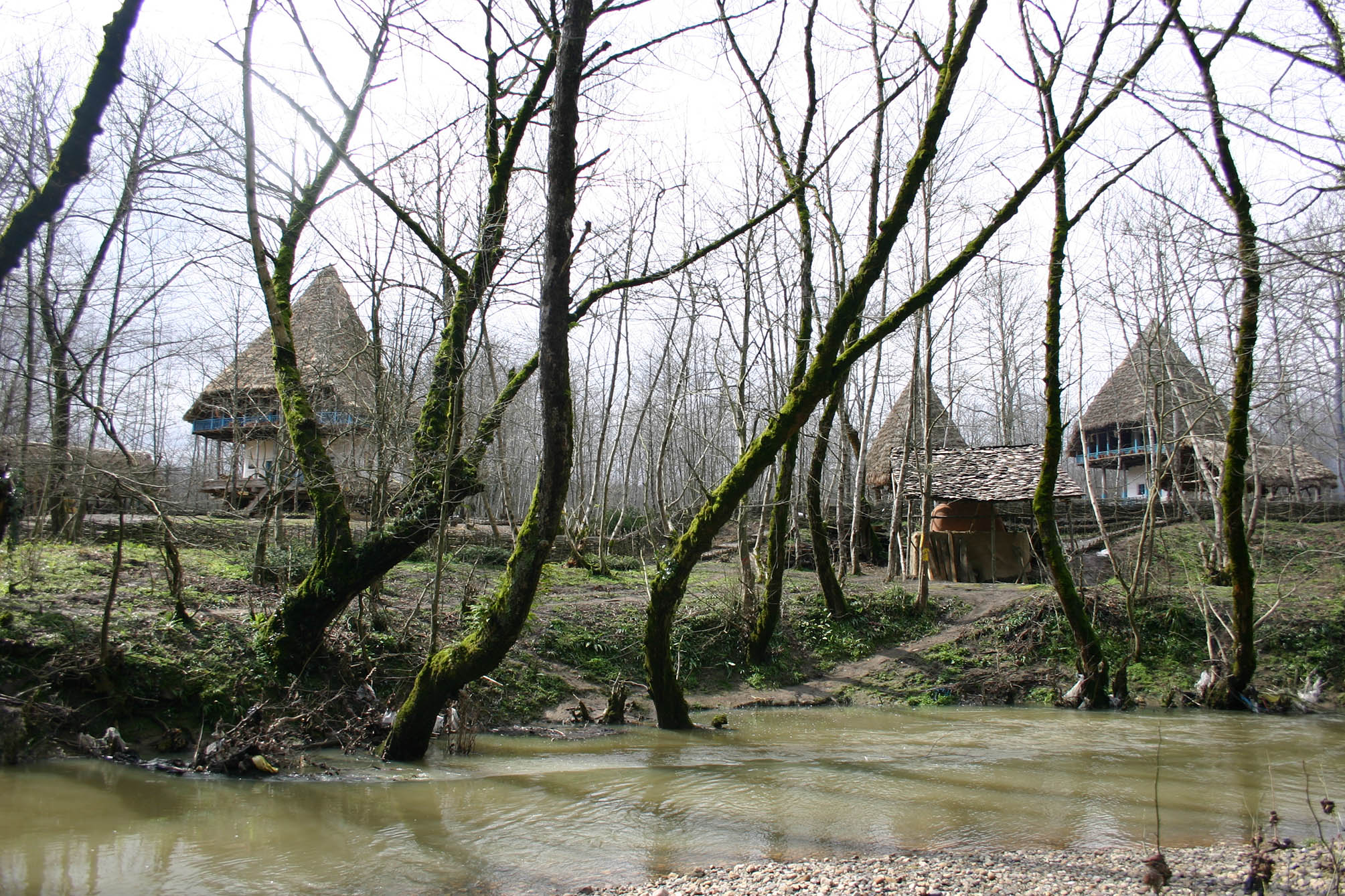
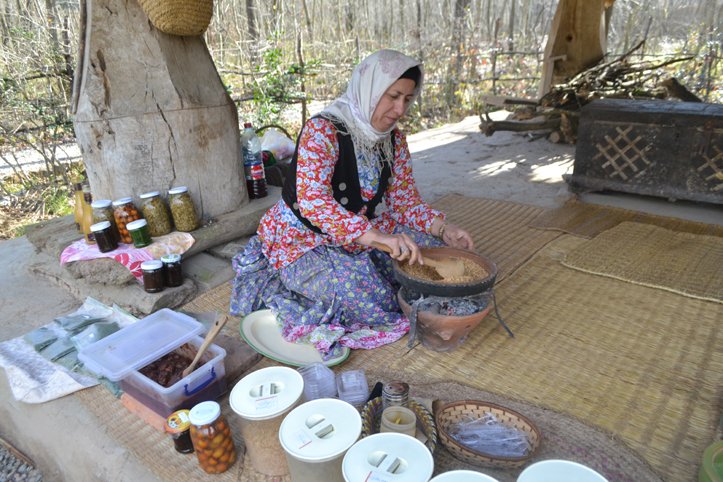
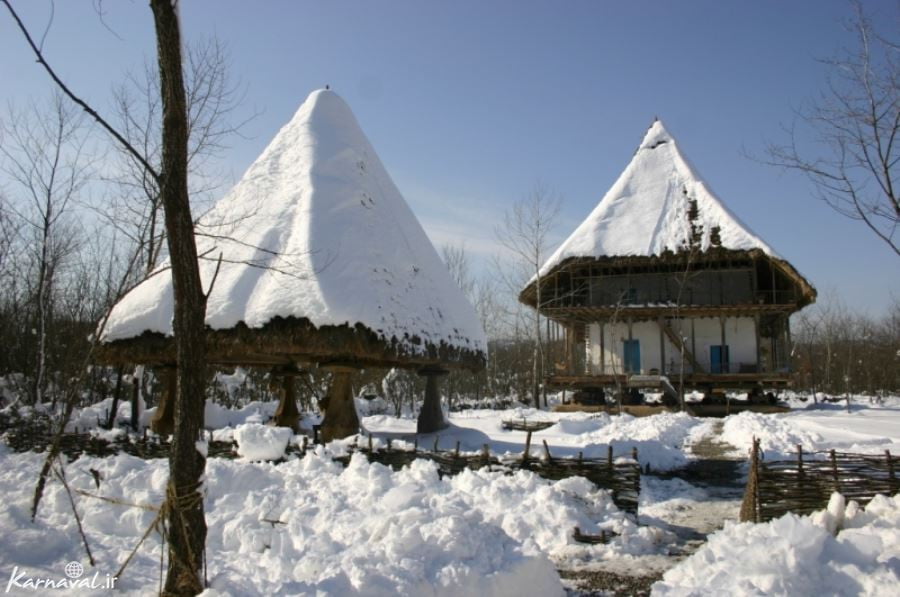
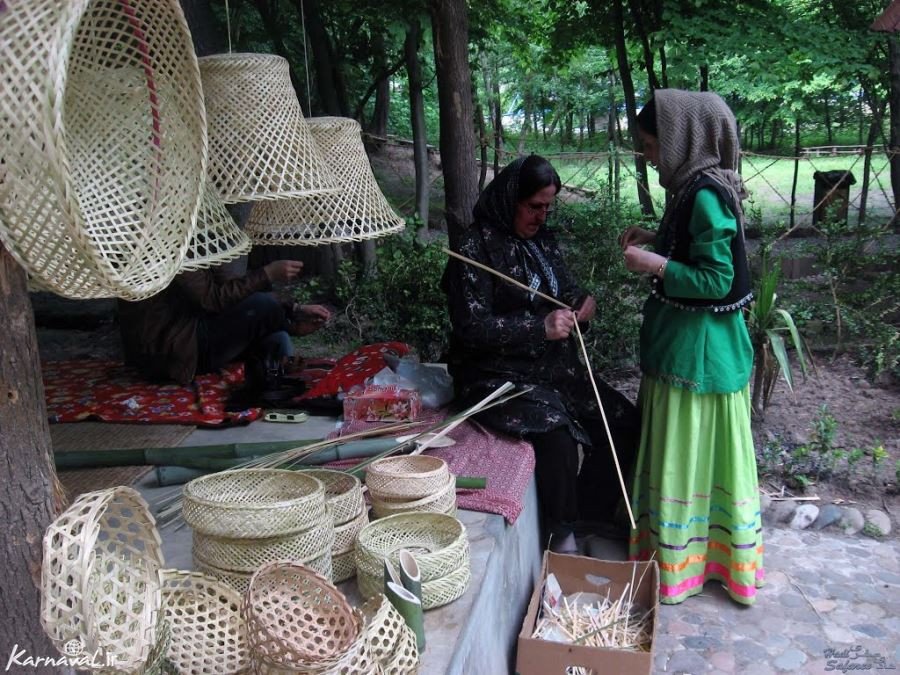
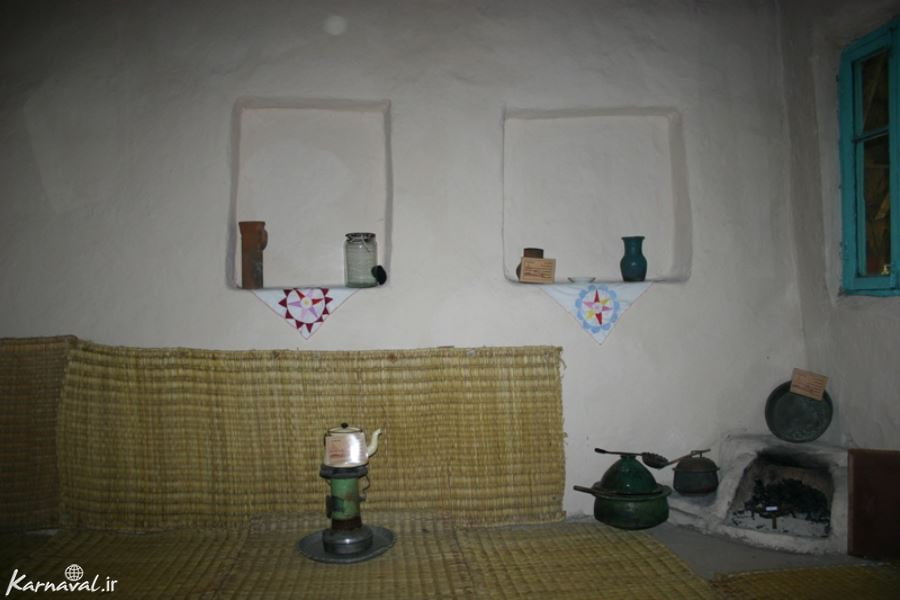
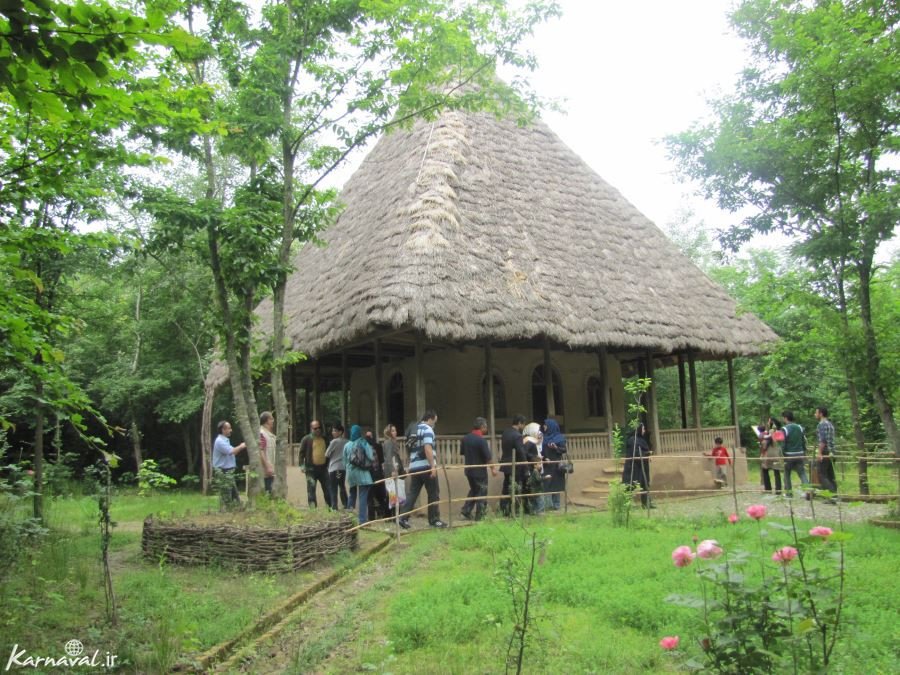
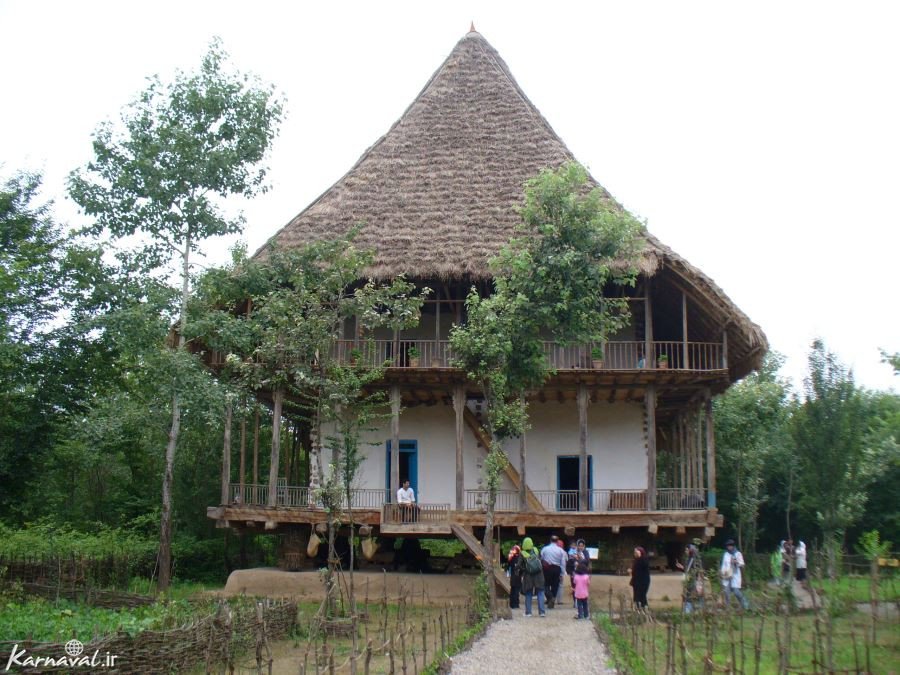
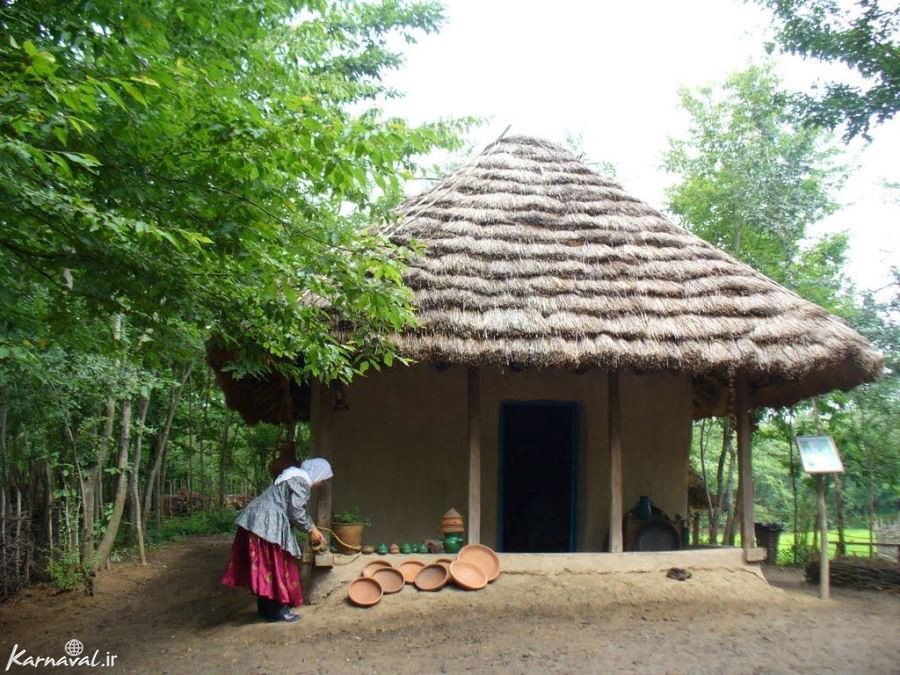
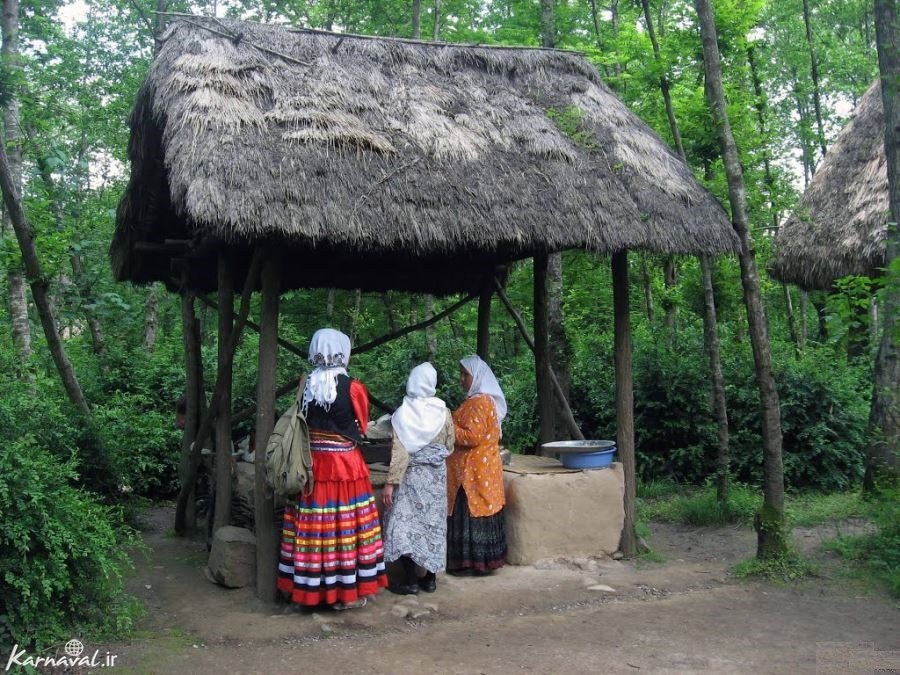
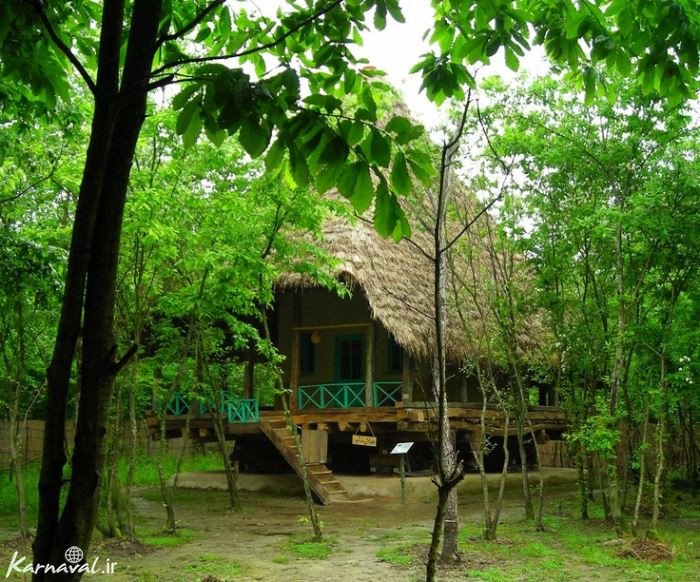
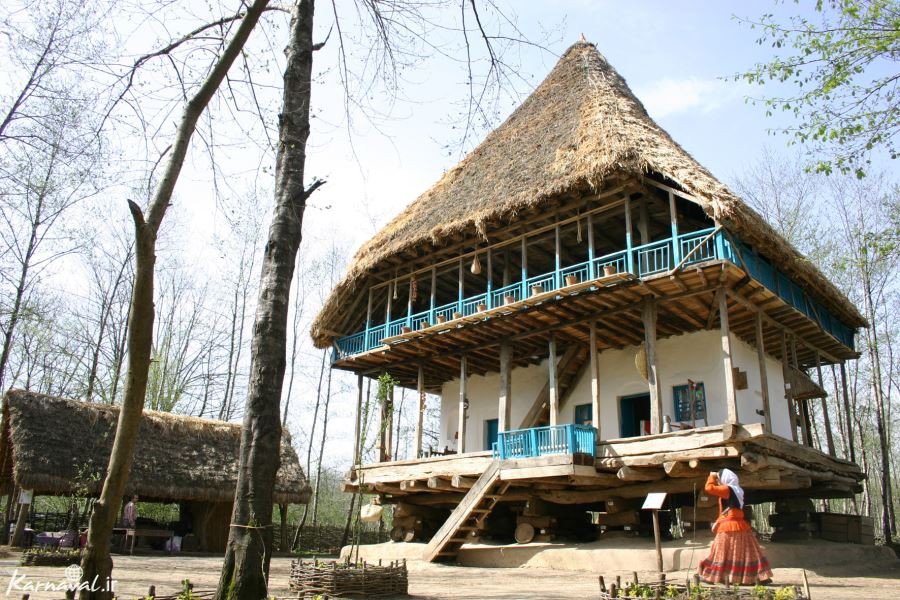
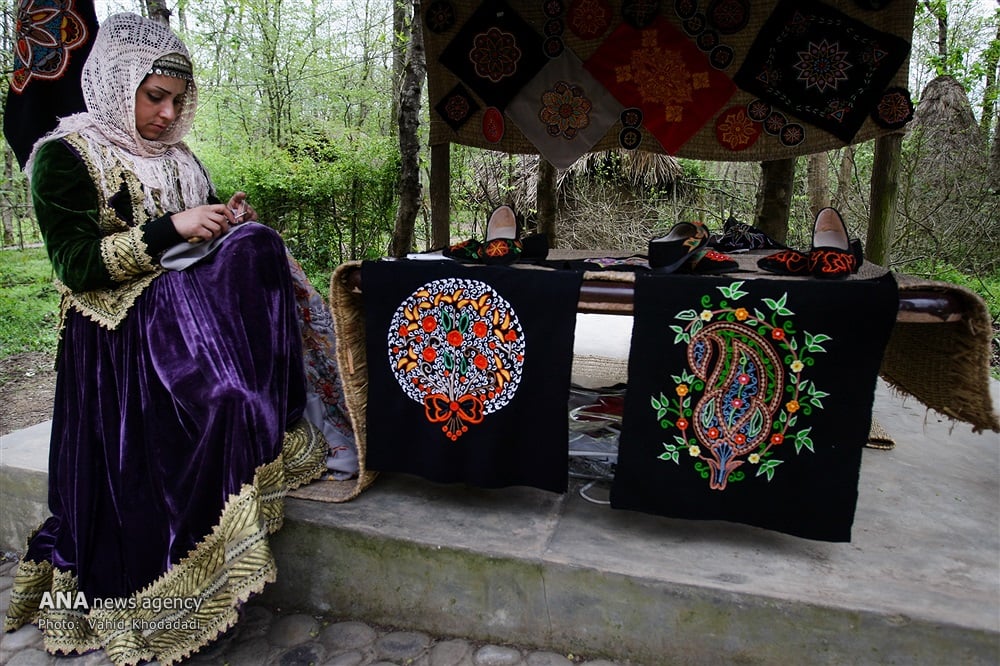
Unique in its own kind in the Middle East and Central Asia, the museum aims to protect and preserve the material and spiritual heritage of residents in Gilan. The idea of setting up such a museum was floated by Dr Mahmoud Taleghani in the wake of the devastating earthquake which rocked the provincial city of Rudbar back in 1990.

“I was tasked with conducting research on the economic, social and cultural consequences of the quake which hit Rudbar and Manjil in June, 1990. Following the disaster, and given my experience regarding museums and the protection of heritage, especially in Europe, I began to cherish the thought of opening this museum to protect the culture [of Gilan],” he said.

The Rural Heritage Museum of Gilan is located in the forest park of Saravan region in the city of Rasht. The museum is constructed in an area of around 260 hectares in a location some 18 kilometres from the Tehran-Rasht Freeway (The Persian Gulf Freeway).

Initial studies on the construction of the eco-museum got underway in 2002 in cooperation with the Cultural Heritage, Handicrafts and Tourism Department of Gilan province, the Gilan Governor’s Office, the University of Tehran, France’s Alsace Eco-Museum, and under the supervision of the United Nations Educational, Scientific and Cultural Organization (UNESCO).

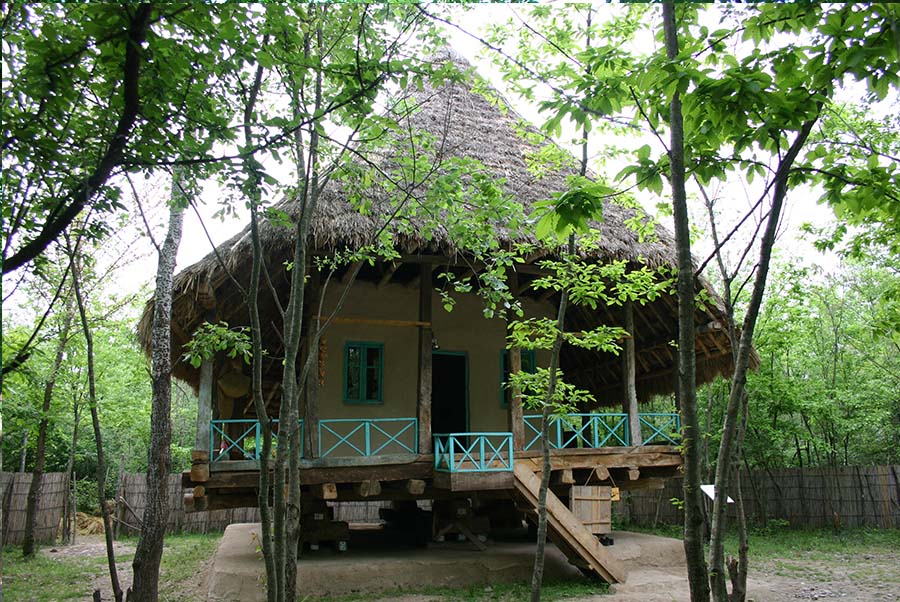
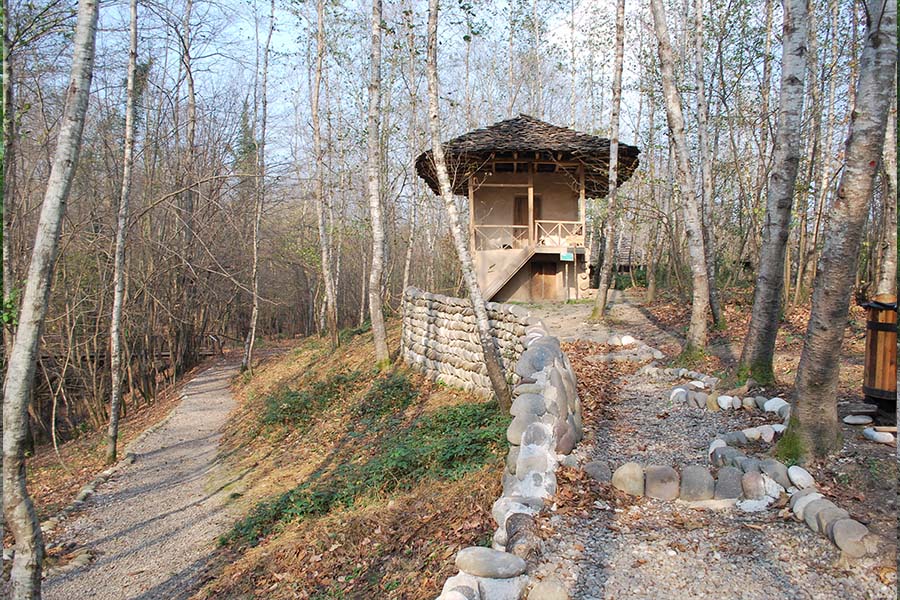
The different parts of the museum are located in different villages. First, the cultural and architectural features of villages in Gilan were studied and nine cultural-architectural domains were identified. Each domain was introduced through the reconstruction of a village at the site of the museum: the East Plain Village, the Central Plain Village, the West Plain Village, the West Foothill Village, the West Mountain Village, the East Foothill Village, the East Mountain Village, the West Coast Village and the East Coast Village.

Work to construct the museum began in 2005, and the first phase of the project became operational one year later. The other parts of the museums were gradually built and inaugurated in the following years until 2016.

The Rural Heritage Museum of Gilan is the first museum in Iran to display the history, culture and lifestyle of people in the open air.

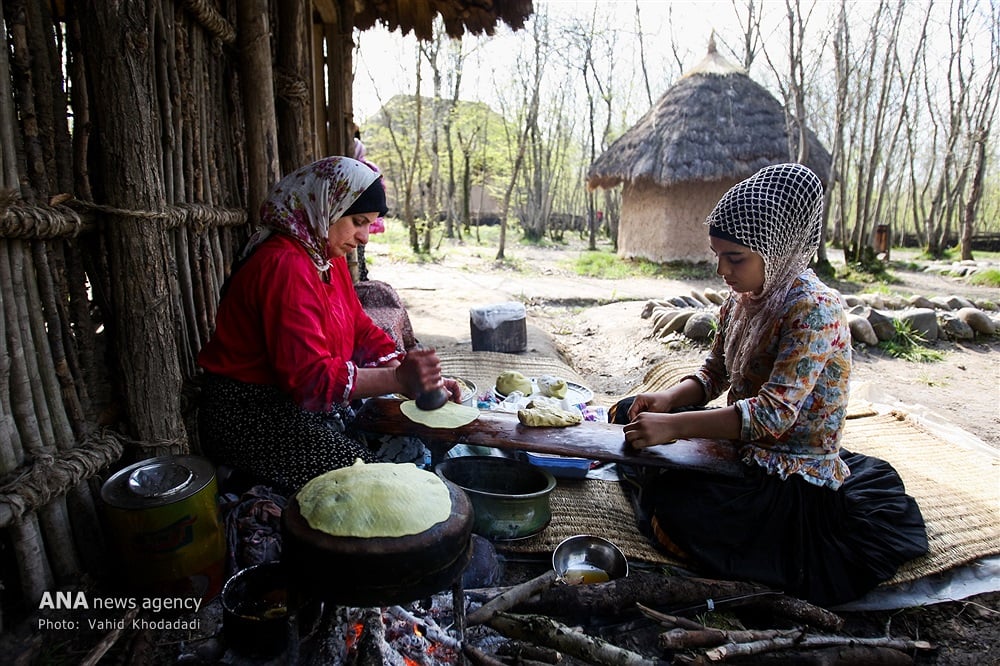
The museum is designed in such a way that it boasts restaurants, tea houses, bazaars, traditional mosques, farms and gardens, handicrafts production and training workshops, grounds for traditional shows and games, research centres for agriculture and husbandry, a research centre for architecture and anthropology, a children’s garden, gardens for growing medicinal herbs and native trees, wood-based architecture and two guest houses inspired by the rural architecture of Gilan, each including 150 units capable of accommodating 3 to 5 people each.

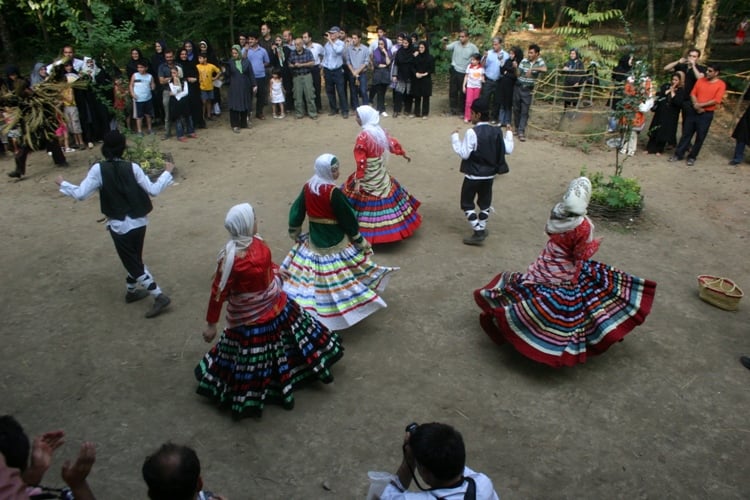
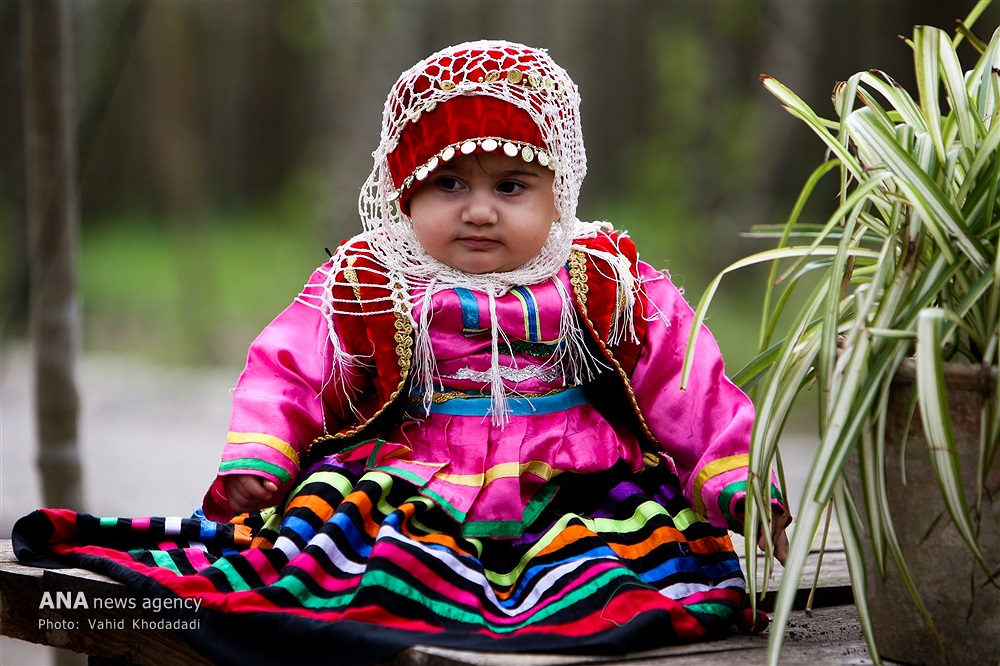
Traditional ceremonies as well as local rituals, celebrations and games are also held in the museum on special occasions.

Although people and visitors are not very interested in visiting museums, the Rural Heritage Museum of Gilan is one of the country’s most frequently visited museums.

What follows are photos of the museum retrieved from various sources:

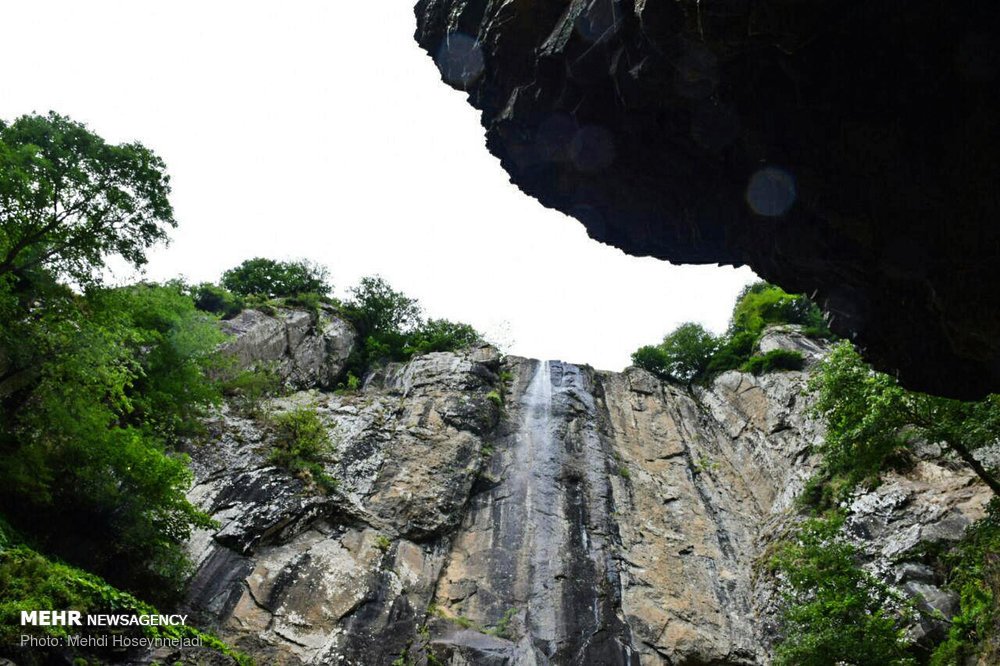
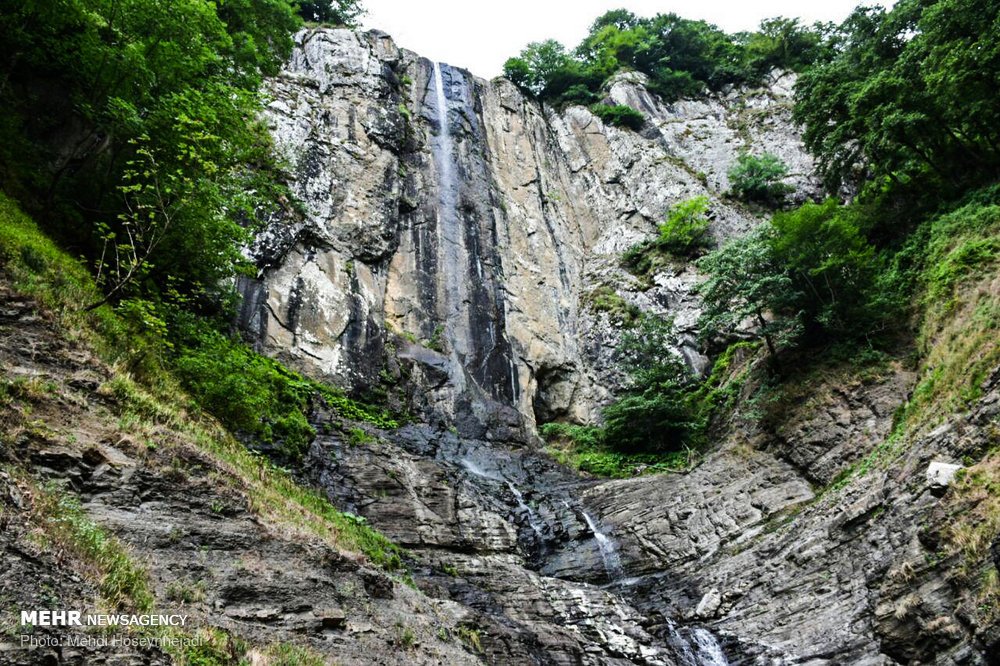
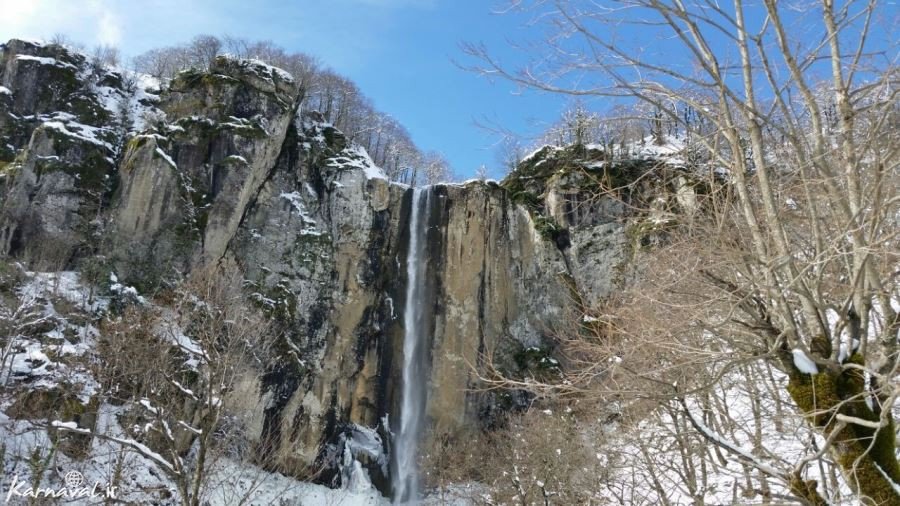
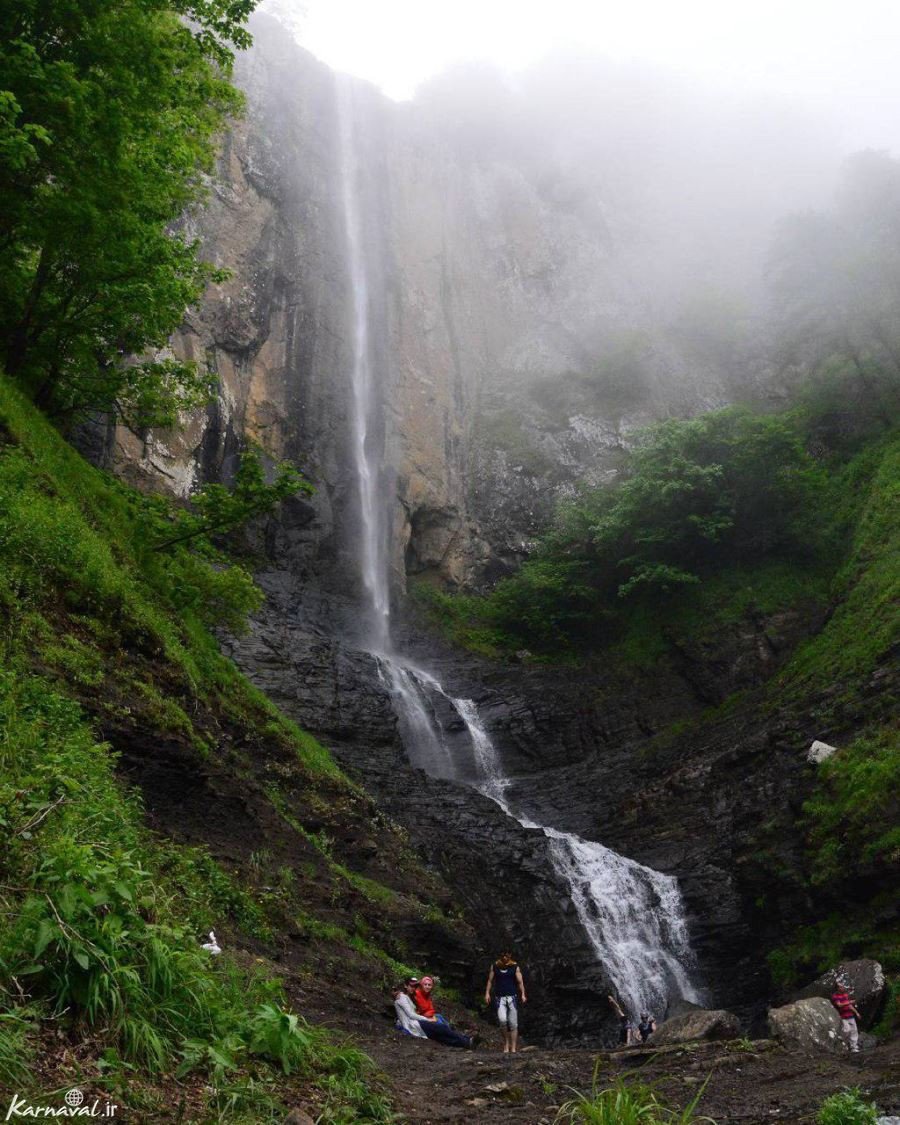
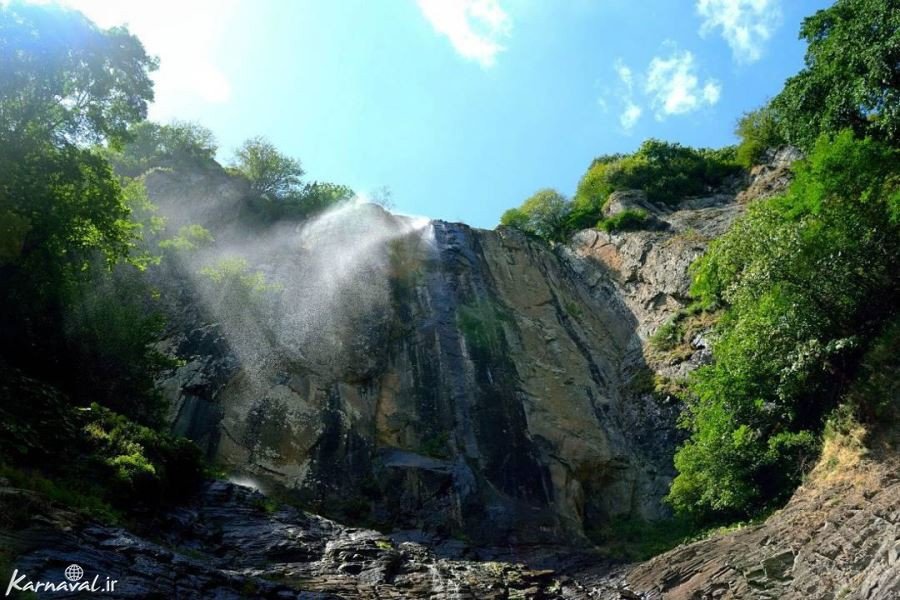
Laton Waterfall; Highest of Its Kind in Iran

Laton Waterfall; Highest of Its Kind in Iran

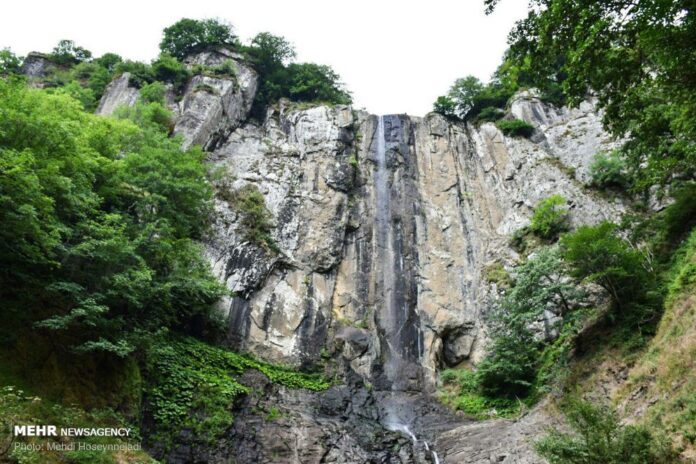
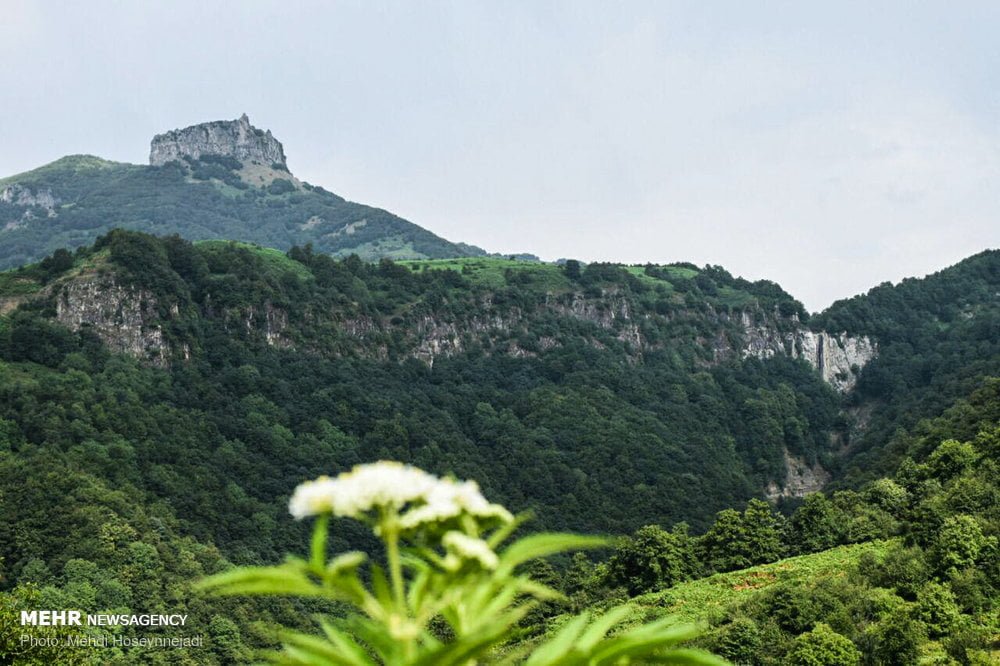
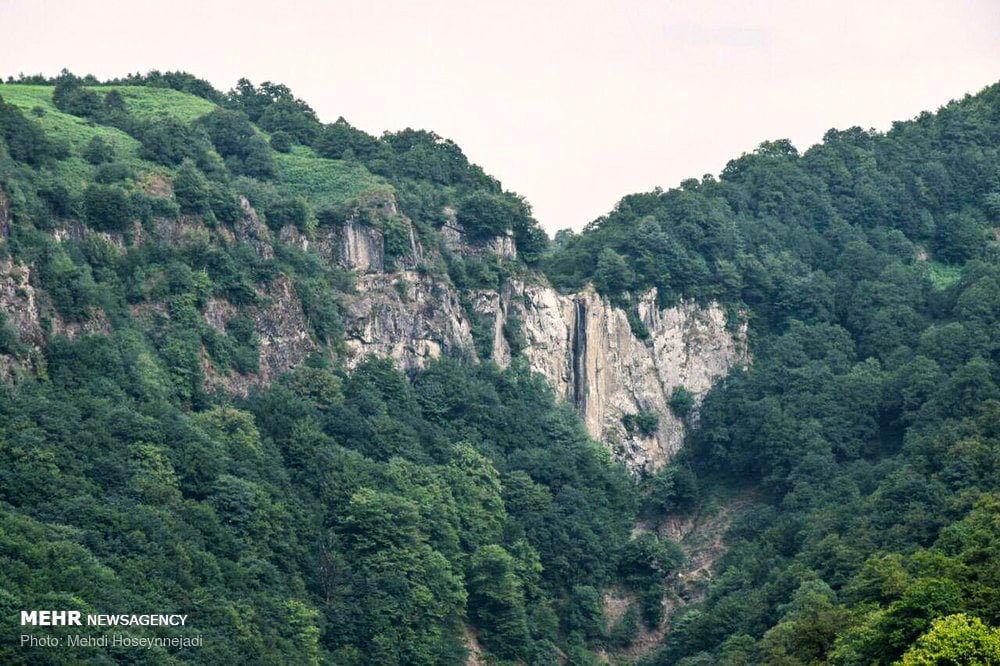
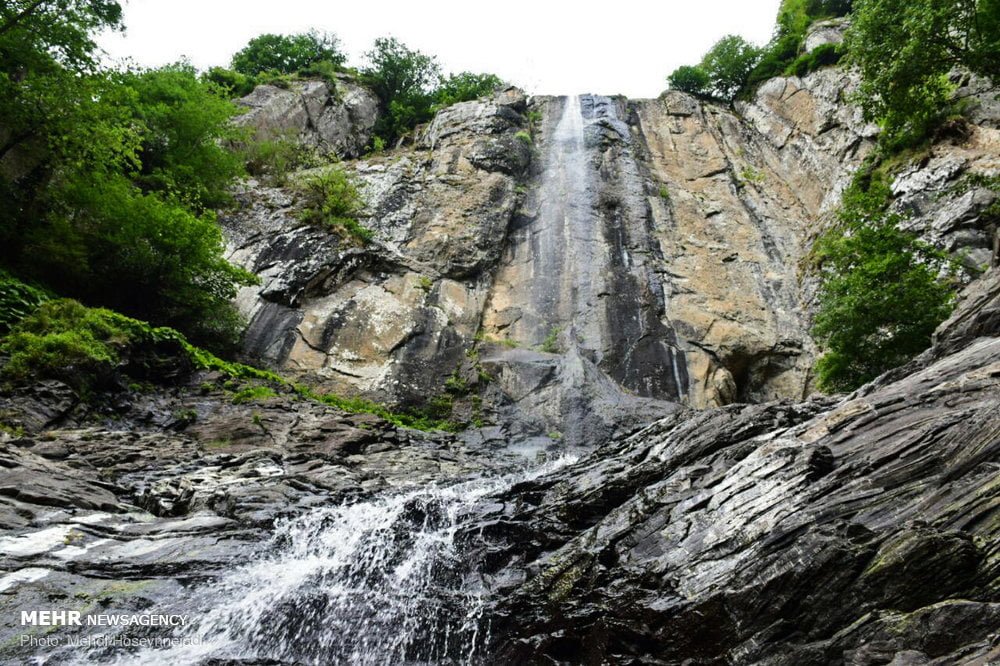
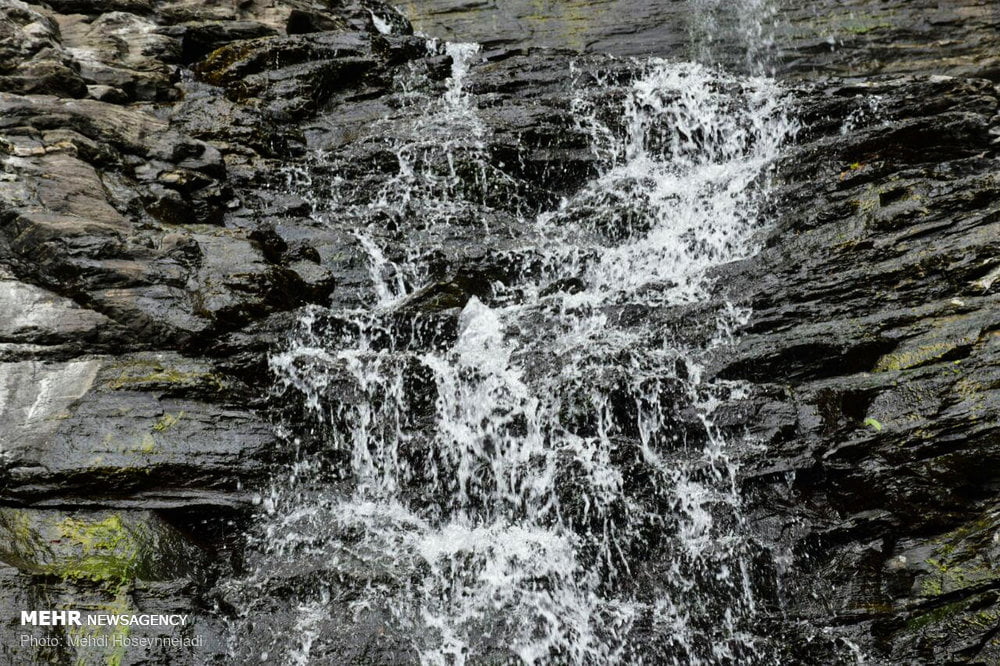
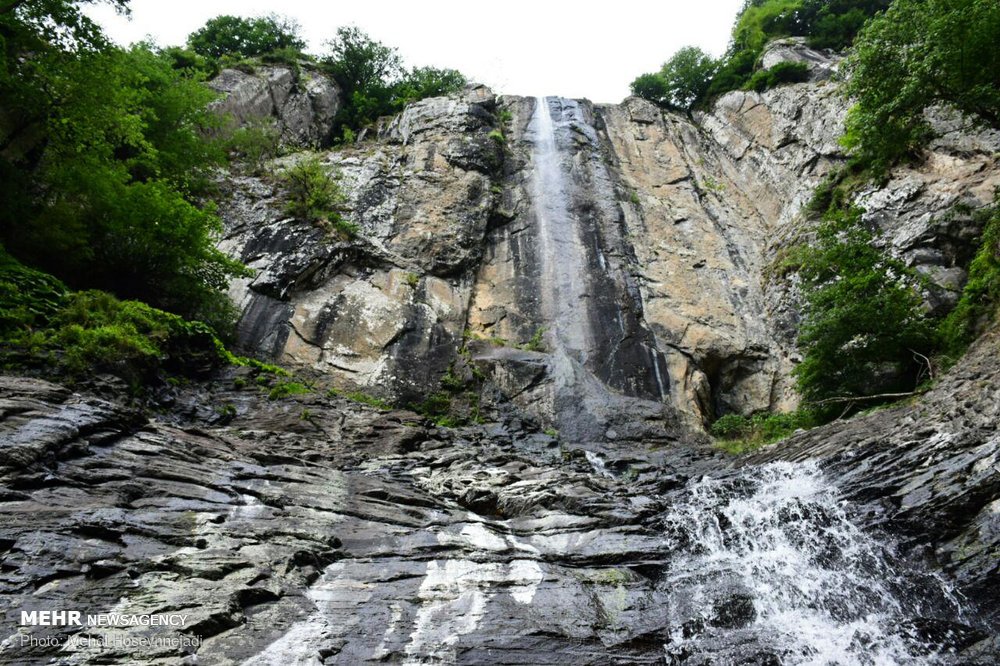
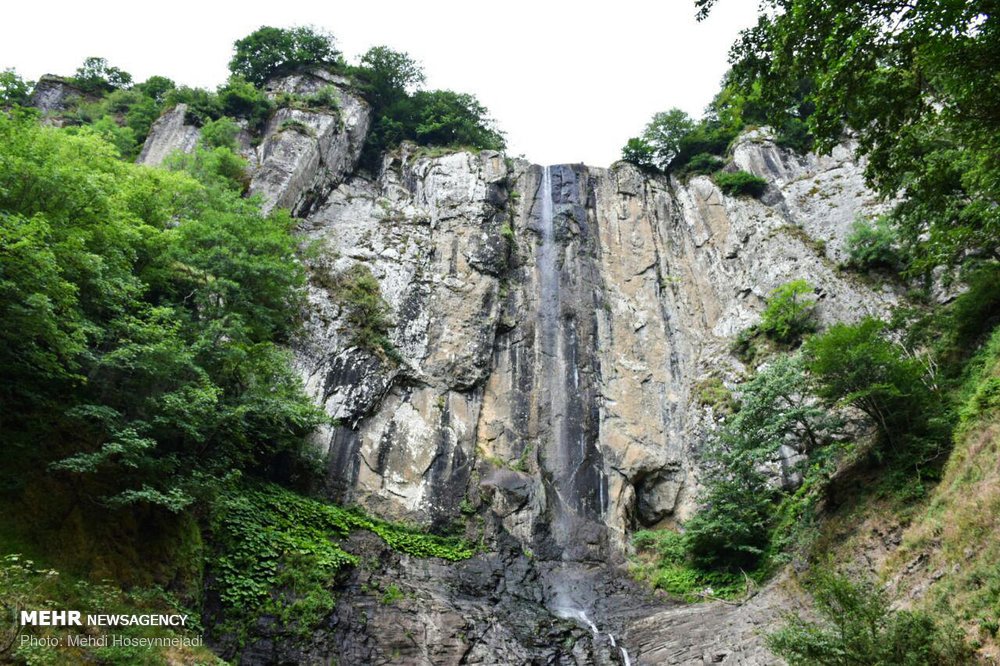
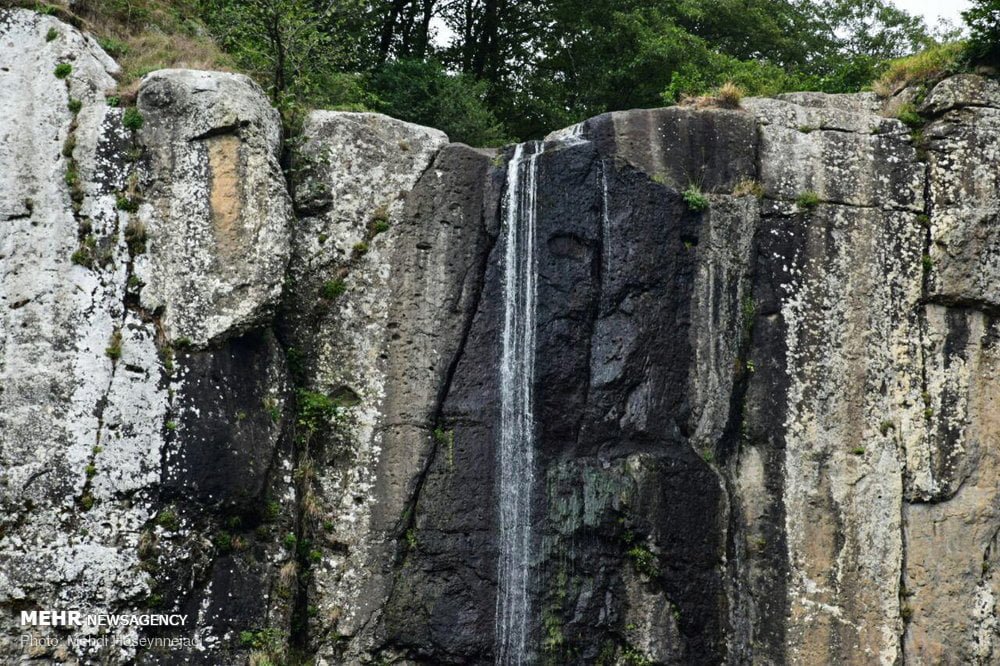
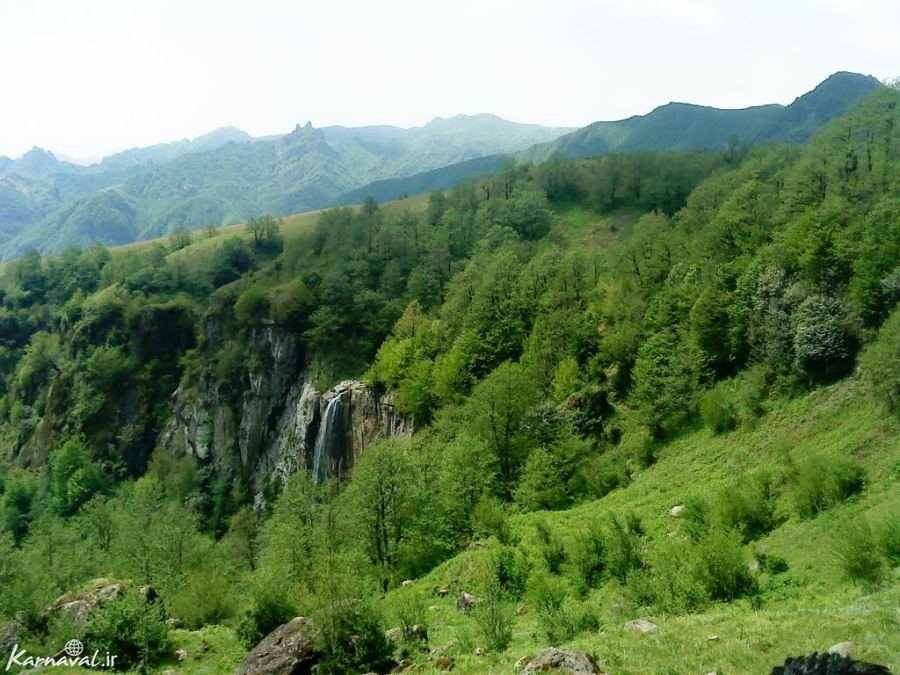
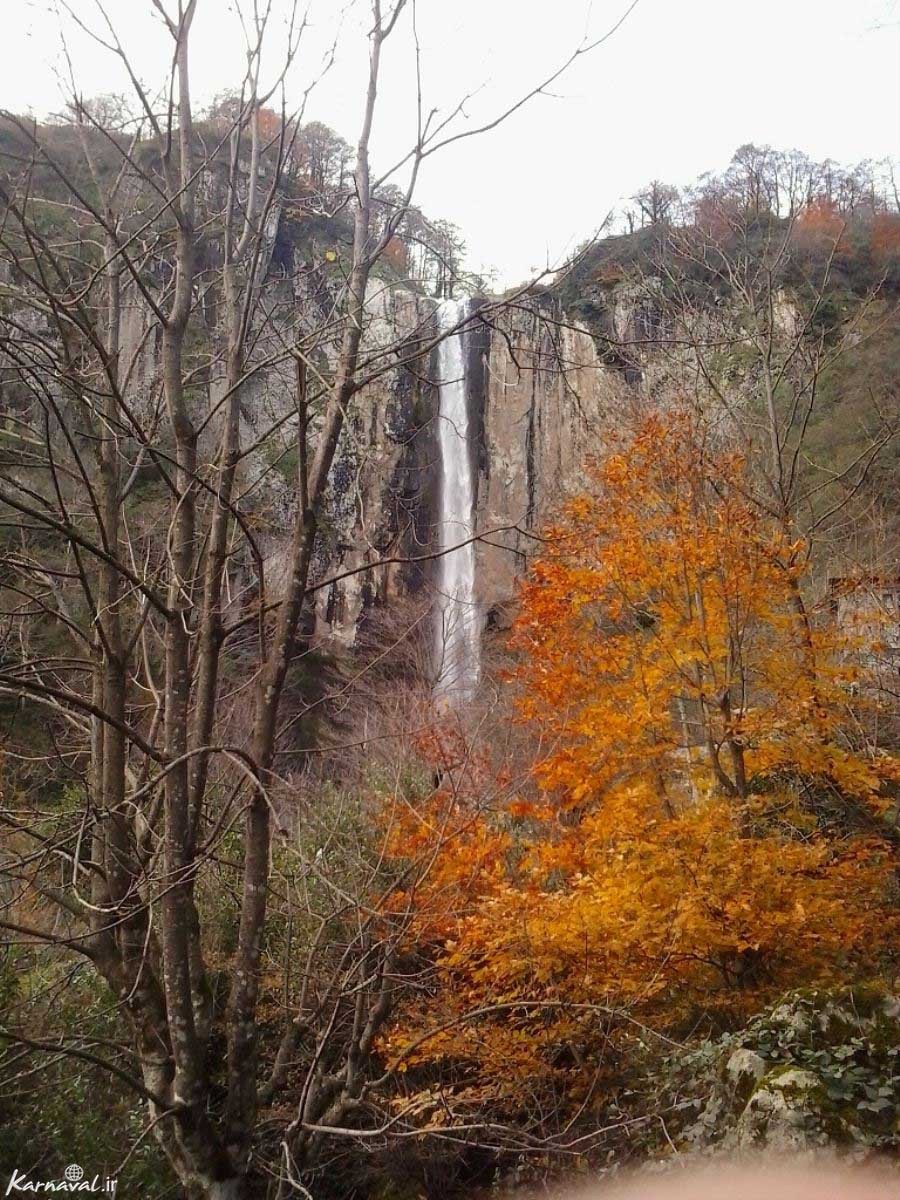
The Laton Waterfall lies 15 kilometres south of the border town of Astara; and 6 kilometres from the Kootah-Koomeh village in Lavandil town, Gilan province.

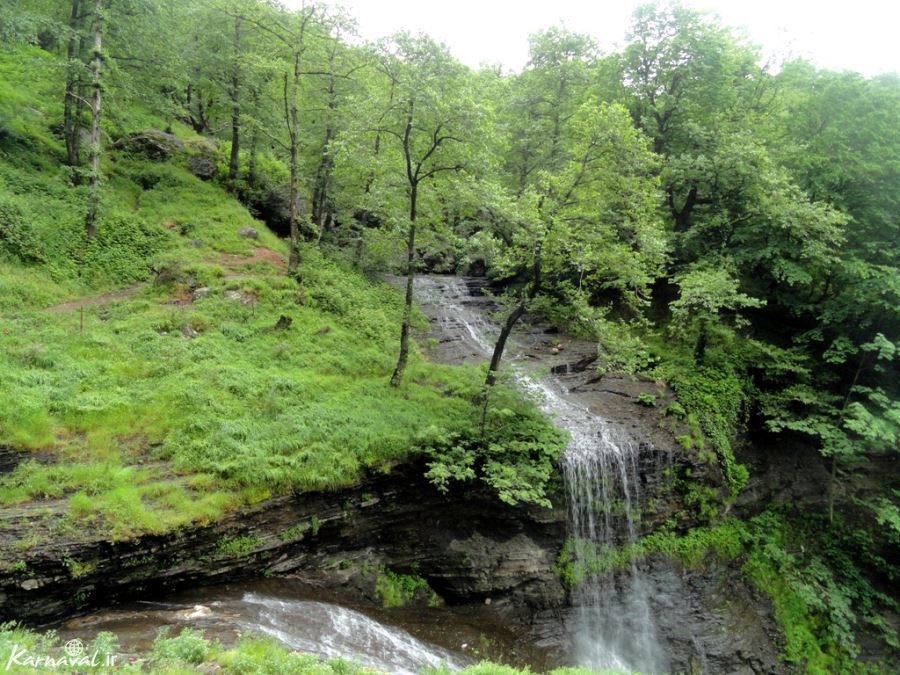
Just 10 metres from Laton lies another waterfall which is 65 meters high. It is wider than Laton with a larger flow of water.

The Laton Waterfall originates from the fabulous Kootah-Koomeh village. It is a five-hour hike to get there.

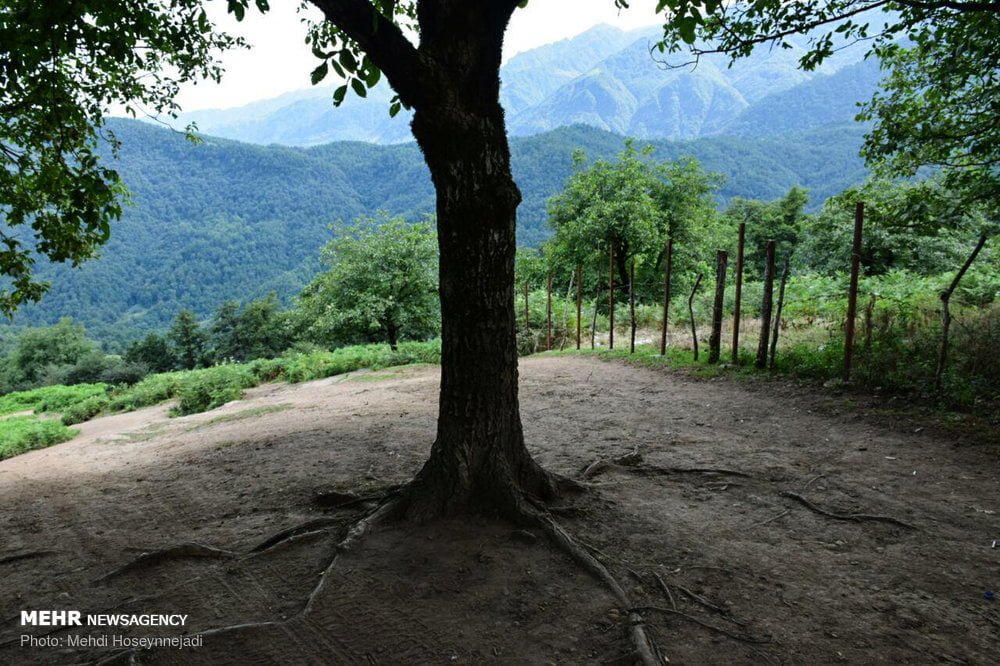
On the path to the waterfall one can see forest hills and the river which is the origin of Laton. The end part of the path, especially the spot between the two waterfalls, is studded with dangerous precipices.

Apricot, quince, pear, walnut, hazelnut, wild apple and plum trees can be seen around the Laton Water fall in different seasons.

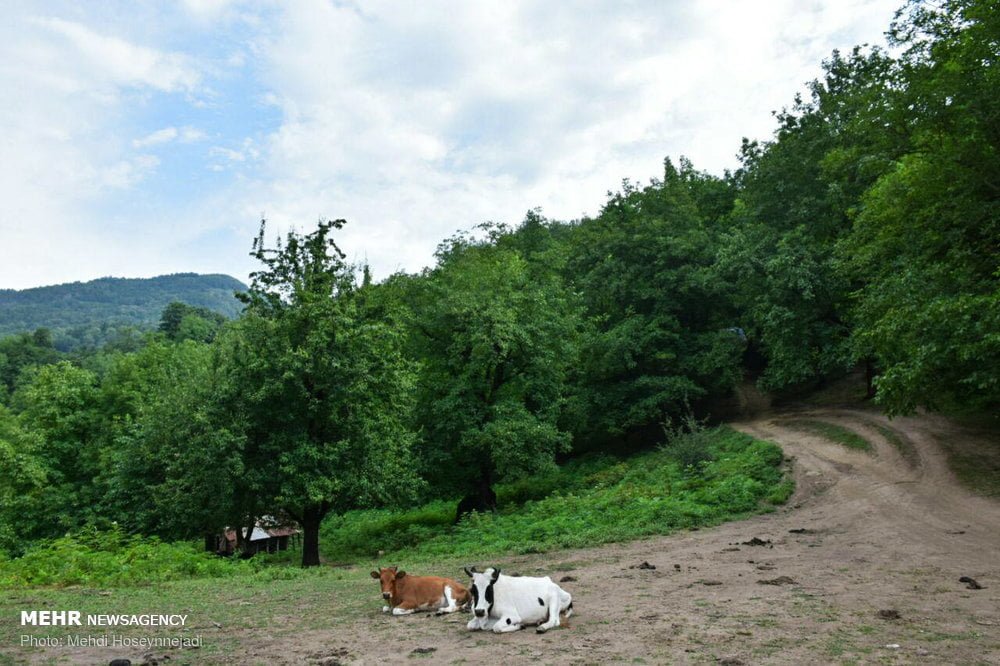
The fauna of that area is also noticeable as animals such as wolves, bears, porcupines and raccoons can be found there. Locals also keep horses, cows and sheep.

The waterfall originates from the eastern slopes of the Spinas Mountain. It flows into the Lavandil River which, itself, originates from the Spinas Mountain and is 17 km long.

Then the waterfall moves along at a sharp slope towards the Kooah-Koomeh village and the town of Lavandil before finally flowing into the Caspian Sea.

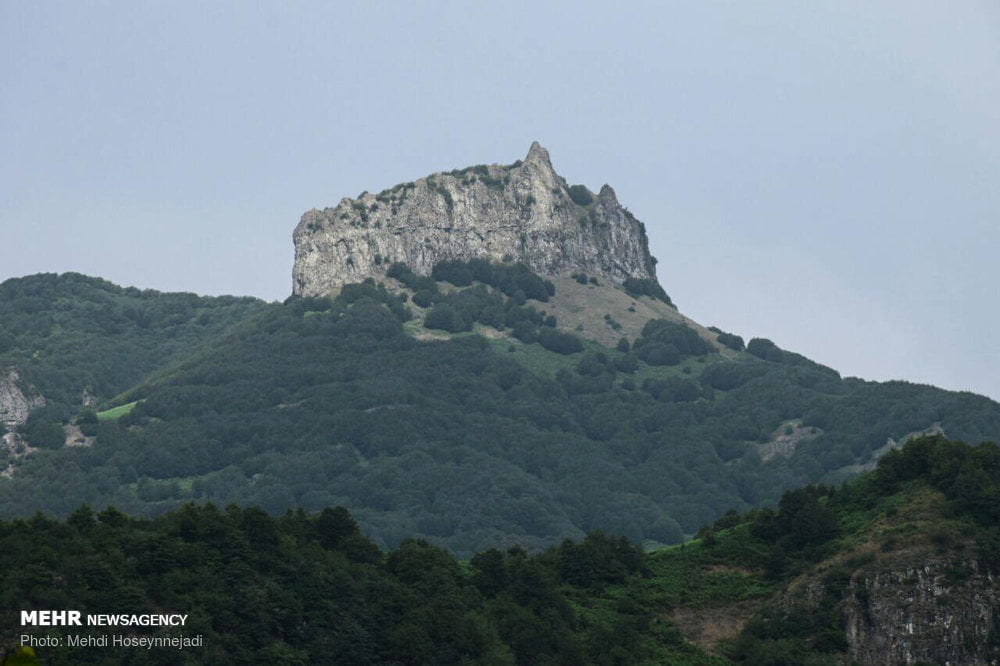
The amount of water flowing into the Laton Waterfall differs at different times of year, but water keeps flowing through it all year round. The Spinas Castle also lies on top of the Laton Waterfall.

What follows are photos of the beautiful waterfall retrieved from various sources:

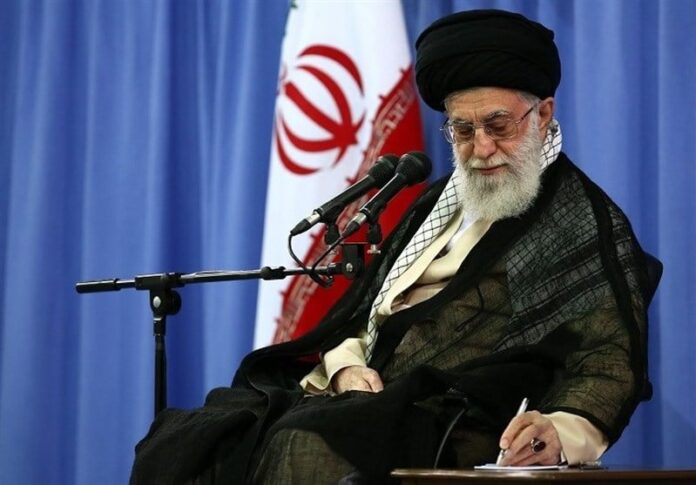
Iran Leader Urges “Swift, Just” Prosecution of Those Involved in Economic Corruption

Ayatollah Seyed Ali Khamenei wrote, “Punishment of convicts of economic corruption must be carried on urgently and justly; and appropriate meticulousness must be given to the designation of sentences by courts,” Khamenei.ir website reported on Saturday.

In a letter addressed to the supreme leader of the Islamic Revolution, the head of the judiciary branch referred to the enemies’ economic war against the Iranian nation and committers of economic corruption in the present situation, working in line with the goals of the enemies. Ayatollah Amoli then requested permission for taking special measures in order to urgently and assertively confront these crimes, within the framework of the penalty laws set for the economic system. In this letter, it is suggested to prohibit any probation or commutation for economic disruptors and corruptors. The leader of the Islamic Revolution agreed with this suggestion and stated: “Punishment of convicts of economic corruption must be carried on urgently and justly; and appropriate meticulousness must be given to the designation of sentences by courts.”

The following is the full text of the letter by the Head of the Judiciary branch:

In the Name of Allah, the Beneficent, the Merciful

Dear Ayatollah Khamenei, the Supreme Leader of the Islamic Revolution,

Greetings,

Considering the present critical economic situation which is regarded as an economic war—as unfortunately, some of the economic disruptors and committers of economic corruption work in line with the goals of the enemies and help the enemies achieve their goals by committing crimes— it is necessary that instant and assertive confrontation be carried out. Theryby, if you deem it proper, please allow the head of the Judicial Branch to act within the framework of the penalty laws for the economic system of the country enacted on December 10, 1990 with later reforms and attachments, and the article 286 of the Islamic penalty laws enacted in 2013, while respecting the following facts:

1. Based on the contents of Act 6 of Article 2 of the aforementioned law, some branches of the revolution’s courts be formed with the presence of three judges (a president and 2 advisors). The court will have a quorum with the presence of two of the members.

2. These branches are located in Tehran, and all the related cases are referred to these branches by the first deputy of the Judicial Branch.

3. According to the discernment of the President of the Court, the sessions are public and can be broadcast by the media.

4. All the observable legal deadlines present in the criminal procedure, such as the notice and protestation are set with a maximum of five days.

5. Contents of the note of article 68 of the criminal laws regarding lawyers will be also applicable in the court.

6. When during proceedings, investigation flaws are revealed in the court, the court can primarily proceed with completion of the investigation.

7. All the charges applied to individuals and legal as well as military entities associated with the referred case, including the principle, partners and deputies are proceeded in one branch.

8. Any probation or commutation for convicts of economic corruption and disruptions is prohibited.
9. In all the cases of procedure for the aforementioned crimes, on the condition of the presence of enough reasons to discernment of the judge of the public prosecutor’s office or the court, as agreed, temporary arrest, ending proceedings, and issuing the final sentence are done. The conclusion cannot be protested in other courts, any change in the final conclusion is applied by the court that previously proceeded the case.

10. Sentences issued by this court—except for capital punishment—are binding and irrevocable. Sentences of capital punishment, with a deadline of 10 days, can ask for reconsideration in the Supreme court.

11. Implementation regulations of this act is prepared and approved by the head of the Judicial Branch.

12. This act is valid for two years following the date of approval.

The verdict is upon you and May God’s peace and mercy be upon you

Sadegh Amoli Larijani

The following is the full text of the response by Ayatollah Khamenei:

In the Name of God

The proposal is hereby approved. The goal is that the punishment of convicts of economic corruptions be carried out urgently and justly. Please advise the courts to observe necessary meticulousness regarding designation of sentences.
God’s peace and mercy be upon you.

Sayyed Ali Khamenei

August 11, 2018

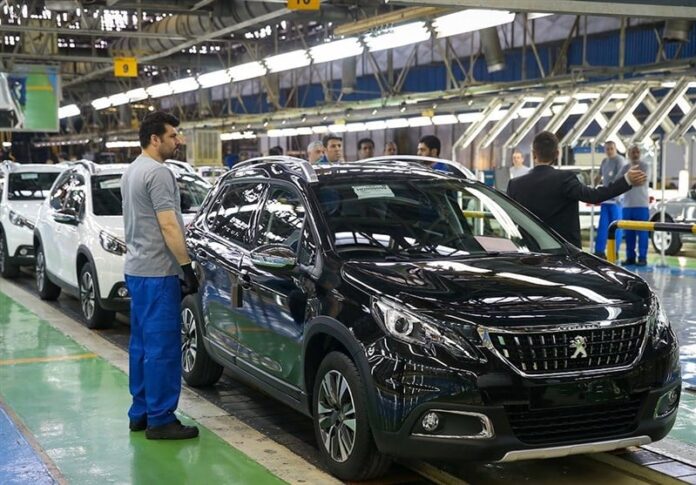
France’s Peugeot Urged to Pay Penalty for Leaving Iran

In an interview with Tasnim, Iranian Deputy Industry Minister Mohsen Salehinia pointed to Peugeot’s refusal to work with Iran under a new wave of US sanctions, saying the French company must pay penalty for cancelling its contract with Iran.

Peugeot must also fulfill its commitment to supplying Iran with the Peugeot 2008 components and providing after-sale services, since the vehicles have been presold in Iran, he added.
According to Salehinia, the French auto-manufacturer has said it will suspend, not terminate, cooperation with Iran in the hope that partnership will resume in future.

Even if the French company intends to provide Iran with a series of car components, the other countries manufacturing various auto parts would refuse to work with Iran, the deputy minister explained.

Back in June, French automaker PSA Peugeot Citroen announced plans to pull out of two joint ventures to sell its cars in Iran in order to avoid the risk of US sanctions.

The retreat followed similar moves by French energy companies Total SA and Engie SA in the wake of US President Donald Trump’s move to pull his country out of the 2015 Iran nuclear deal and re-impose sanctions on Tehran.

In July, the US administration rejected France’s demands for a waiver or exemption for companies seeking to do business in Iran.

Even companies with no business ties to the US find it difficult to operate in Iran because banks are reluctant to finance Iranian operations.

After achievement of the Joint Comprehensive Plan of Action (JCPOA) between Iran and the Group 5+1 (Russia, China, the US, Britain, France and Germany) in July 2015, PSA Peugeot Citroen signed a deal with an Iranian company to make cars in the Islamic Republic.