Saturday, December 27, 2025
Home Blog Page 3266

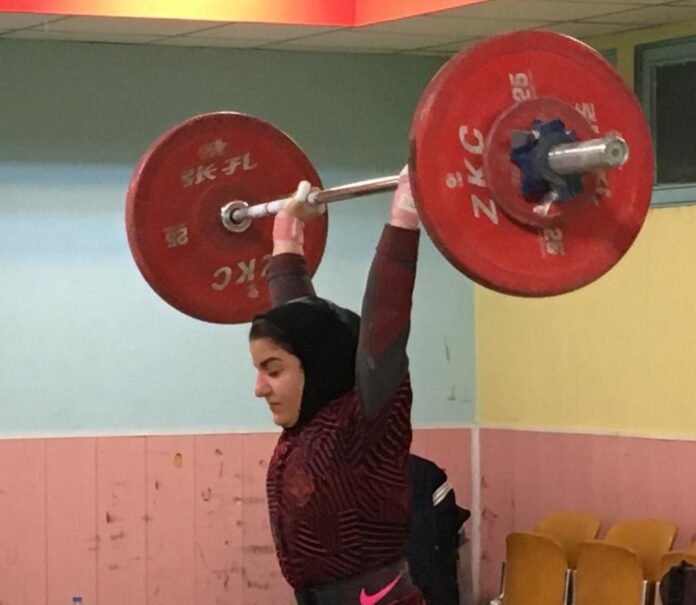
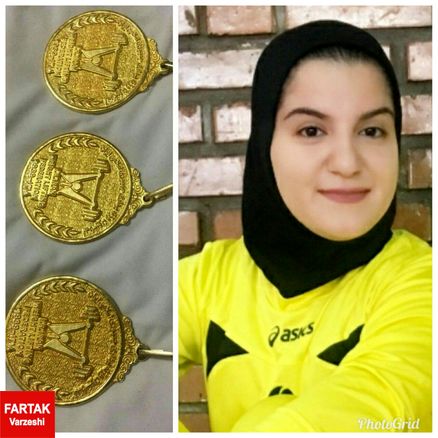
Iran’s First Female Weightlifter Talks of Breaking Taboos

With the emphasis of the International Weightlifting Federation and the Iranian federation’s consultation with the Ministry of Sports, women’s weightlifting was officially started in Iran, and finally a number of Iranian women participated in the 2019 Asian Women’s Championship for the first time.

Poupak Bastami, 27, was the first Iranian female weightlifter who competed in 2019 Asian Women’s Championship in China while wearing hijab.

In an interview with Shahrvand daily, she talks about the experience of appearing in first international competition while observing the Islamic dress code:
Q: Are you happy with the weight you lifted and the title you won?
A: I was in group B, and I won the fourth place among five weightlifters and my overall ranking was 12th. In the snatch move, I could have had better performance, but because of the stress, my coaches advised me to be more cautious.

However, gradually I managed to control my stress and get better. Personally, I was pleased with being able to remain in the course in my first appearance and lift the weights chosen for me. Coaches and experts should comment on my performance, but in the future I will definitely perform better. Perhaps setting a total record of 143kg is a good one, but everyone is hoping Iranian female weightlifters would make more significant progress in the future and even win a medal.

We are a team of weightlifters practicing for a few months, and we can definitely be better in the future. Gradually, we will have a better performance when we gain more experience. The weightlifters from East Asian countries have been practicing and competing for years, and some of them are world and Olympic champions. I was pleased with my clean and jerk record, because I was able to repeat the records I had practiced. All in all, this tournament was a great experience for me.

Q: The presence of Iranian women with hijab has attracted the attention of many media and weightlifting officials. Are you aware of these reactions?
A: I completely realised how much they have focused on me, and this, in fact, increased my stress. When I was getting ready for the competition, all the cameras were zooming in on me and were waiting for me to compete as a weightlifter with hijab. After the competition, foreign media came to me and asked questions.

Q: Did you know your name was listed as the first Iranian weightlifter wearing hijab in the international competitions?
A: Yes, it was agood chance for me to compete as the first athlete and therefore more attention was paid to me. The foreign media also asked this and said that I’ve made history. Thank God I could manage to finish my mission successfully.

Q: How do you assess your future performance?
A: The Asian Championship was a great chance which increased our experience. It improved my motivation and I want to get prepared for the next competition as soon as I return. It is too early to talk about winning medals, but women weightlifters will soon be able to do so.
Iran’s First Female Weightlifter Talks of Breaking Taboos

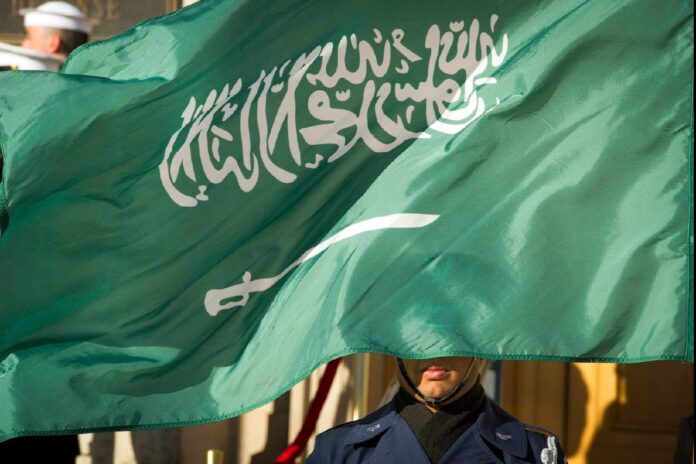
‘Saudis Sending a Message to World with Mass Executions’

Reformist analyst Ahmad Zeidabadi* said the recent mass execution was part of Saudi Arabia’s new strategy to show the world that it is no longer in a defensive position following the scandalous death of Jamal Khashoggi in the Saudi consulate in Istanbul last year.

“After the international outrage sparked following Khashoggi’s death, the Saudi officials were expected to avoid, at least for a while, committing any provocative move which may put them once again under the international limelight,” Zeidabadi said in an opinion-piece published by Fararu website
However, he added, it seems the Saudis have decided to choose another way.

“Now, with the mass execution of nearly 40 people over alleged involvement in terrorist operations and spying for foreign governments, the Saudis have once again sparked the harsh criticisms of human rights groups from across the globe,” Zeidabadi said.

“The Saudi officials knew for sure their move will spark international outcry but despite this, they decided to press ahead with the executions. Now the main question lingering in mind is that why they have decided to do so?”
He maintained that it is mainly part of a larger strategy by Saudi Arabia to continue their sabre-rattling despite the international pressure over the death of Khashoggi.

“They believe that the international criticisms over Khashoggi’s death are gone and now it is the time to show the world as well as the people of Saudi Arabia that nothing has changed in political and security areas for the Arab country,” he noted.

The Iranian analyst said such an approach is common among third-world governments. “These governments pertinaciously pit their authority against the outcries of human rights and press ahead with their goals despite growing criticisms.”

He said the Saudi rulers were certain that given the US and Israel’s need to their support for any possible confrontation with Iran, the global economy’s reliance on their petro-dollar and lack of any opposition alternative inside, the mass execution would have no serious cost for them.

According to Zeidabadi, the calculation is relatively realistic but deeply narrow-minded because due to its notoriety for human rights violations, Saudi Arabia is a good target for various political pressure as soon as the world’s overall political conditions is changed.

Saudi Arabia said on Tuesday it had executed 37 people in a single day “in connection with terrorism crimes,” as a crackdown led by Crown Prince Mohammed bin Salman against pro-democracy campaigners, human rights activists and intellectuals widens in the kingdom.

The Arabic-language Saudi Arabian daily newspaper Okaz, citing a statement issued by Saudi Arabia’s Interior Ministry, reported that the death penalty was implemented “on a number of culprits for adopting extremist terrorist ideologies and forming terrorist cells to corrupt and disrupt security as well as spread chaos and provoke sectarian strife.”

Amnesty International says Saudi Arabia’s execution of 37 of its citizens on alleged terrorism charges is a callous disregard for human life.

* Ahmad Zeidabadi is an Iranian journalist, academic, writer and political analyst and the secretary general of Office for Strengthening Unity.

He is one of the notable figures of the Iranian reform movement.

Zeidabadi has been arrested multiple times, especially after the controversial Iranian presidential elections in 2009. In June 2009, shortly after the election, Zeidabadi was arrested and was later sentenced to six years in prison.

He is the winner of the World Association of Newspapers’ Golden Pen of Freedom Award for 2010 and UNESCO/Guillermo Cano World Press Freedom Prize in 2011.

Iran Ready for Counter-Terror Cooperation in West Asia: DM

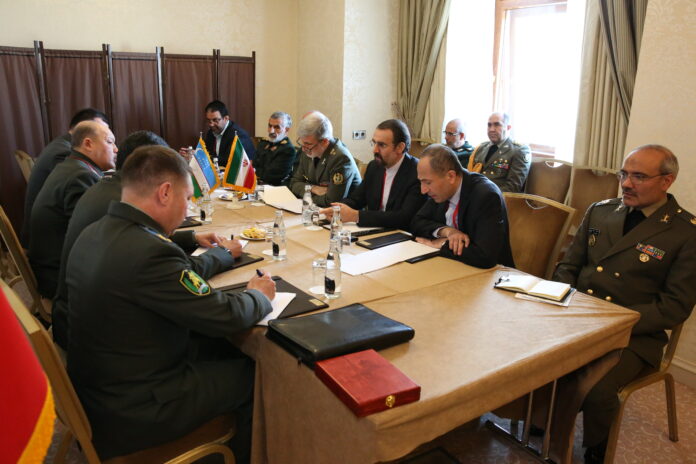
Brigadier General Amir Hatami made the remarks in a meeting with his Uzbek counterpart Bakhodir Kurbanov on the sidelines of the Moscow security conference.

The top Iranian general noted Tehran stands ready to work closely with benevolent regional countries, including Uzbekistan.

He also said extremism and terrorism are the fallout from the US and its allies’ interference in the region.

The two sides further discussed mutual relations as well as regional and international issues.

In the meeting, Iran’s defence chief touched upon the deep historical and cultural bonds between the two countries as well as cordial Tehran-Tashkent ties in political and economic domains.

He said the two sides have a common understanding of regional and global issues, calling for closer cooperation in such areas as defence and security.

The Uzbek security chief, in turn, said the political will of the two sides will set the stage for the further enhancement of bilateral cooperation on political, economic and cultural fronts.

He said the two countries share similar security concerns in the region, expressing hope that Tehran-Tashkent cooperation in fighting terrorism will further expand.

Iran, Japan Hold 11th Joint Consular Meeting in Tokyo

Iranian, Japanese Diplomats Discuss Syria Developments

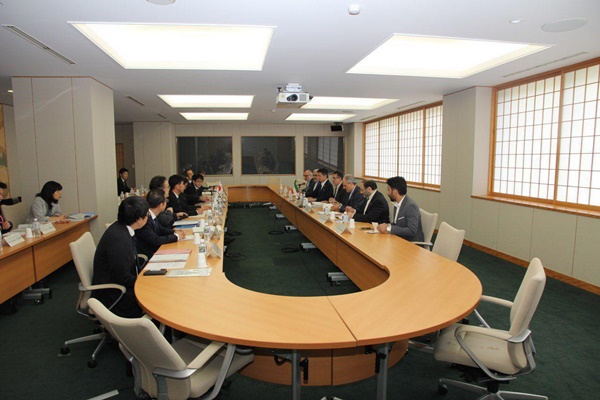
At this meeting, the two sides celebrated the 90th anniversary of the establishment of bilateral diplomatic relations and welcomed mutual cooperation between the two countries on the issues of interest in the consular field.

They also held negotiations and exchanged views on the promotion, consolidation and strengthening of these ties.

Iran, Japan Hold 11th Joint Consular Meeting in TokyoConsular directors of the foreign ministries of the two countries attended the meeting and talked about consular problems, facilitation of visa issuance for nationals of both sides, cooperation in preventing the entry and residence of illegal citizens of the two countries to and in the territory of the other side, and joint cooperation between the Iranian and Japanese police and judiciary to fight against human trafficking and narcotics smuggling.

At the end of the meeting, it was agreed that the next round of consular meeting between the two sides be held in Tehran next year.

Iran Calls for Peaceful Power Transfer in Sudan

“Iran emphasises the need to fulfil the legitimate demands of the [Sudanese] people, peaceful transfer of power, cessation of violent acts and non-interference of any foreign side,” added Mousavi.

He also underlined that the swift transfer of power to civilians and the correction of past decisions, such as deployment of Sudanese troops to kill people in Yemen, is essential in resolving the country’s problems and in fulfilling the wishes of the great people of Sudan.

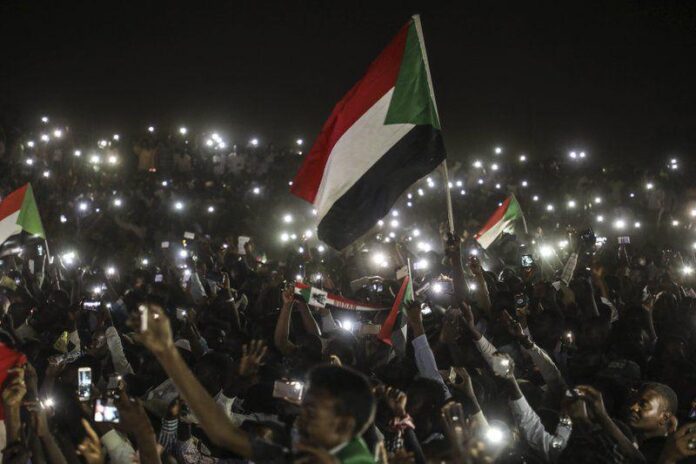
The demonstrations in Sudan initially began in the central town of Atbara on December 19 against a decision by President Omar al-Bashir’s government to triple bread prices.

They swiftly turned into nationwide rallies against his rule. The demonstrations led to the military ouster of President Omar al-Bashir earlier in the month. A transitional military council took over the leadership, and pledged to hold presidential elections in two years. But protesters doubt the army’s sincerity to hand over power.

Best Solutions to Fix iPhone Black Screen

Do you want a quick solution for iPhone black screen? Before finding its solution, you must find out the leading causes of the dead screen.

You may face a black screen issue because of a dead battery. If you have dropped your device accidentally, its screen may turn black. In this case, you will receive calls, but can’t take them because of a black screen. Sometimes, the screen goes black without any apparent reason.

Your screen can turn black because of a hardware or software problem. For hardware damage, you have to visit an Apple store. A software crash may freeze the screen of your iPhone. For a software issue, dr.fone – iOS repair can be the right choice. The complete repair procedure is available at the official website of dr.fone. See these possible solutions to fix your iPhone.

Hard Reset to Fix Black Screen

  • For an unresponsive and dead screen, you can try hard reset to troubleshoot your iPhone. Sometimes, an iPhone DFU mode may help you to factory reset a device. Here are some easy steps for a hard reset.
  • Press the Wake/Sleep button and hold it along with the “Home” button for almost ten seconds.
  • Wait for the Apple logo to appear on the screen.
  • Once your iPhone reboots, you may get rid of iPhone black screen.

Reset iOS Device without a Home Button

The home button is not available in iPhone 7, 8 and X. To reset these models, you will need different buttons.

  • To restart 7 and 7 plus models, press Wake/Sleep + Volume down buttons and hold for a few seconds.
  • For iPhone 8 and X, you have to press volume up button and release, then hit volume down button and release. Now press sleep/wake button and hold for a few seconds until your iPhone boots up.

Restore Factory Settings of iPhone

With the help of iTunes, you can fix the black screen of the iPhone. See these easy steps.

  • Download the current version of iTunes on a PC or Mac. Launch this version to fix iPhone black screen.
  • Connect your iOS device to a computer with one USB cable. The iTunes can detect your device and offer restore option. With a restore button, you can wipe an iPhone. If iTunes can’t recognize your device, try to put your device in a Recovery mode.
  • Once iTunes detects your iPhone, you will get an option to restore your phone. Tap “Restore” to confirm this action.
  • Now iTunes will start erasing your device and install the latest software on your iPhone, such as iOS 12.
  • After completion of this process, the iPhone will restart. Continue and set up your iPhone as a brand new device.

After this procedure, you will lose your data. It is not a safe and better solution. If you don’t have any issue about data loss, just go ahead.

DFU (Device Firmware Upgrade) Mode

In iPhone DFU mode, you can restore devices from any state. DFU is a recovery state that allows people to recover a malfunctioning device. With DFU mode, it will be easy to jailbreak an iPhone. It will return this device to factory settings. For this reason, you have to back up your iPhone before installing an update.

With the use of iTunes, you can put the iPhone in DFU mode. Before starting this procedure, secure your essential data on your PC. See these steps to enter DFU mode:

Run iTunes

  • Connect your iPhone to PC with a cable.
  • Press home and power buttons concurrently for 10 seconds.
  • Now release the power button only and continue pressing a home button for almost 10 seconds.
  • You will get a message (pop-up notification). Let it go. Moreover, you can use DFU tool to activate an iPhone DFU mode.

If your iOS device is trapped in DFU mode, you have to exit from this mode. You can’t restore your iPhone while exiting from DFU mode. To exit from DFU, you can press the home and power buttons together for almost 10 seconds. The dr.fone-repair can be a safe choice to put your iPhone in DFU mode to avoid data loss. It is a safe and convenient solution. Visit their official website to check video tutorial to fix iPhone black screen.

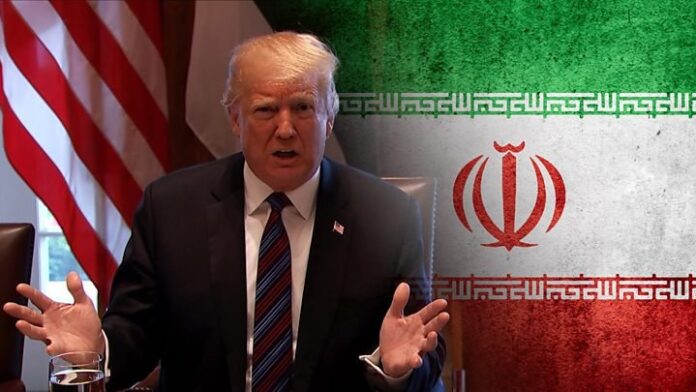
‘Trump’s Hostile Policies Boost Solidarity among Iranians’

“It is highly important to adopt a unanimous domestic stance towards the US move to tighten sanctions on our country. Meanwhile, we need to explore all options available to cope with the new pressure,” Vaezi told reporters on Wednesday.

“In the new fiscal year’s budget, we have adopted mechanisms to cope with these scenarios. So, we should be able to overcome the restrictions,” he said.

The Iranian official said it goes without saying that the US move will inflict some blows on Iran’s economy; however, the American officials are mainly seeking to wage a psychological war against the Islamic Republic.

“Fortunately, thanks to the Islamic Republic of Iran Broadcasting (IRIB)’s efforts to raise public awareness, the US move has not yet managed to deeply affect our economy and market. Meanwhile, all the three branches of Iran’s government as well as other related bodies should brace themselves for the US pressure,” he said.

According to Vaezi, the recent hostile measures by the Trump administration were the US’ last efforts to exert pressure on the Islamic Republic.

The US officials think that by blacklisting Iran’s Islamic Revolution Guards Corps (IRGC), they can inflict a blow on Iran but “as we saw, the move led to further domestic unity in our country.”

Vaezi said the US sought to make division in Iran during the recent floods, but unlike what the American officials had in mind, their measures failed to yield any result for them.

Saudi, UAE Wise Enough Not to Work with Trump against Iran
He then referred to the US oil sanctions and said Iran will decidedly keep its oil exports despite the US sanctions.

“Certain states like Saudi Arabia and the United Arab Emirates which have expressed their preparedness to make up for shortages due to cutting of Iran’s oil exports, are showing their animosity towards us. But at the end of the day, these states are wise enough not to sever further their ties with Iran for a man like Trump who is not clear yet will remain in power after the next two years.”

Vaezi urged Saudi Arabia and the UAE to make a revision in their policy towards Iran and said today a peaceful region is in the interest of all world.

“We are not after any confrontation in the region. So, we call on the two countries to make a revision in their policies,” he said.

Vaezi further noted that the export of oil at the time of sanctions usually paves the way for corruption.

Elaborating on the government’s plan to prevent such corruption, he said a special committee has been set up at the Oil Ministry to closely follow up all the developments in this area. “Meanwhile, we are going to build on our earlier experiences to have a clean oil export,” he added.

Gov’t Welcomes New IRGC Chief
He also pointed to the recent appointment of Major General Hossein Salami as the new chief-commander of the Islamic Revolution Guards Corps (IRGC), and said both the president and the cabinet ministers have warmly welcomed the appointment.

“We knew General Salami from the past … and it seems the IRGC-government cooperation will definitely expand in the future,” he added.

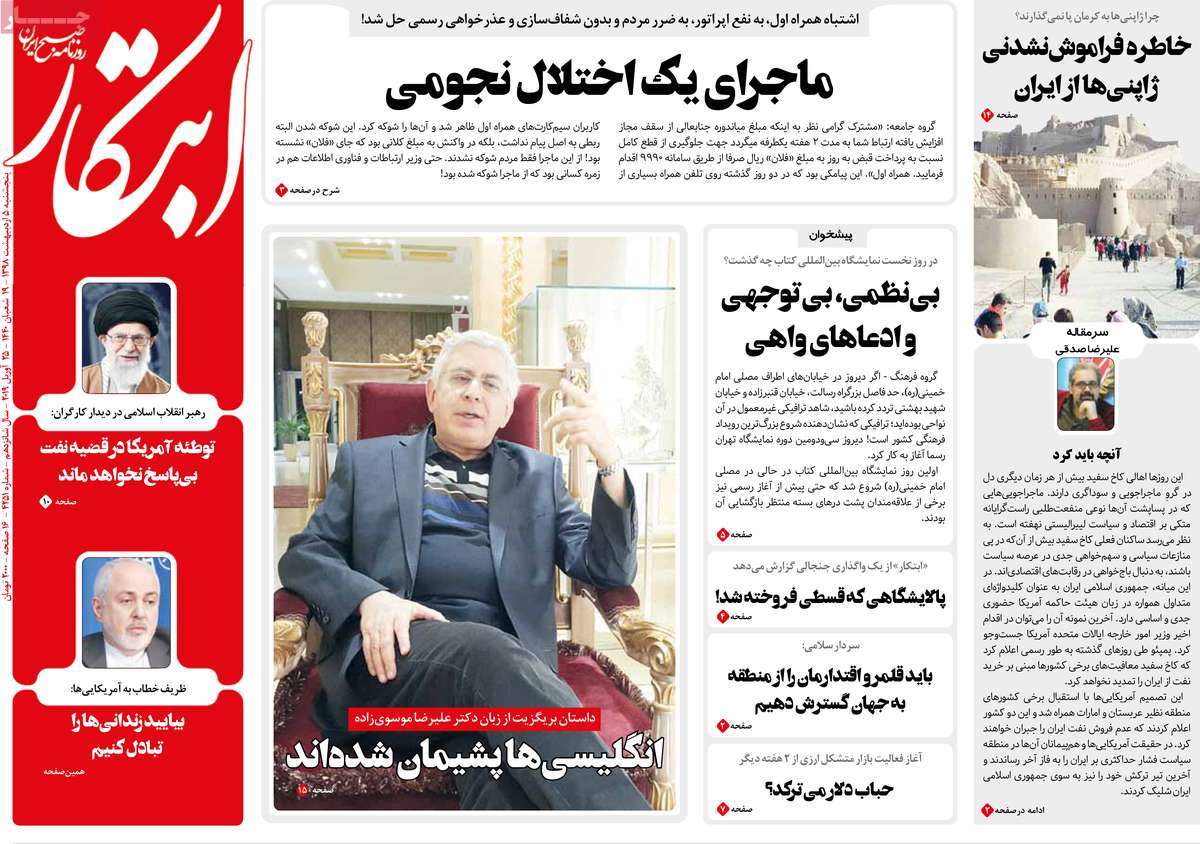
A Look at Iranian Newspaper Front Pages on April 25

A Look at Iranian Newspaper Front Pages on November 19

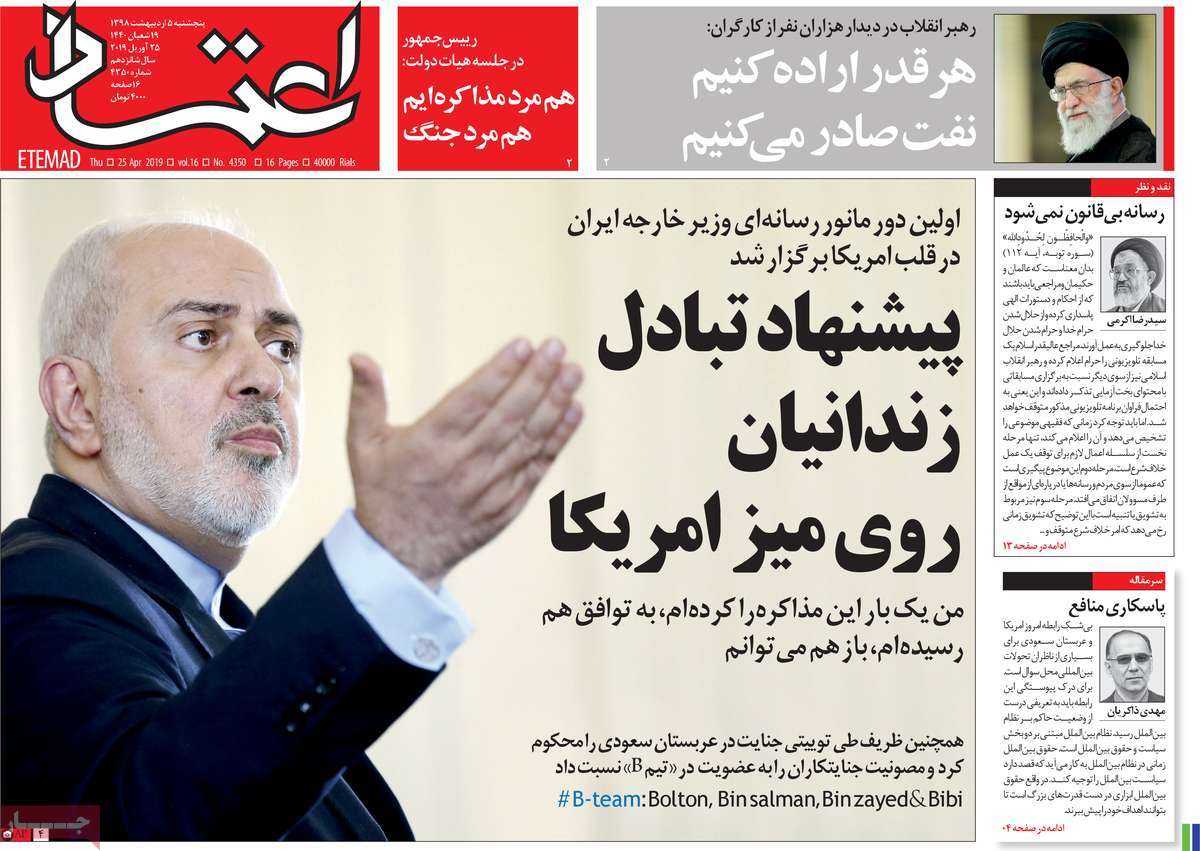
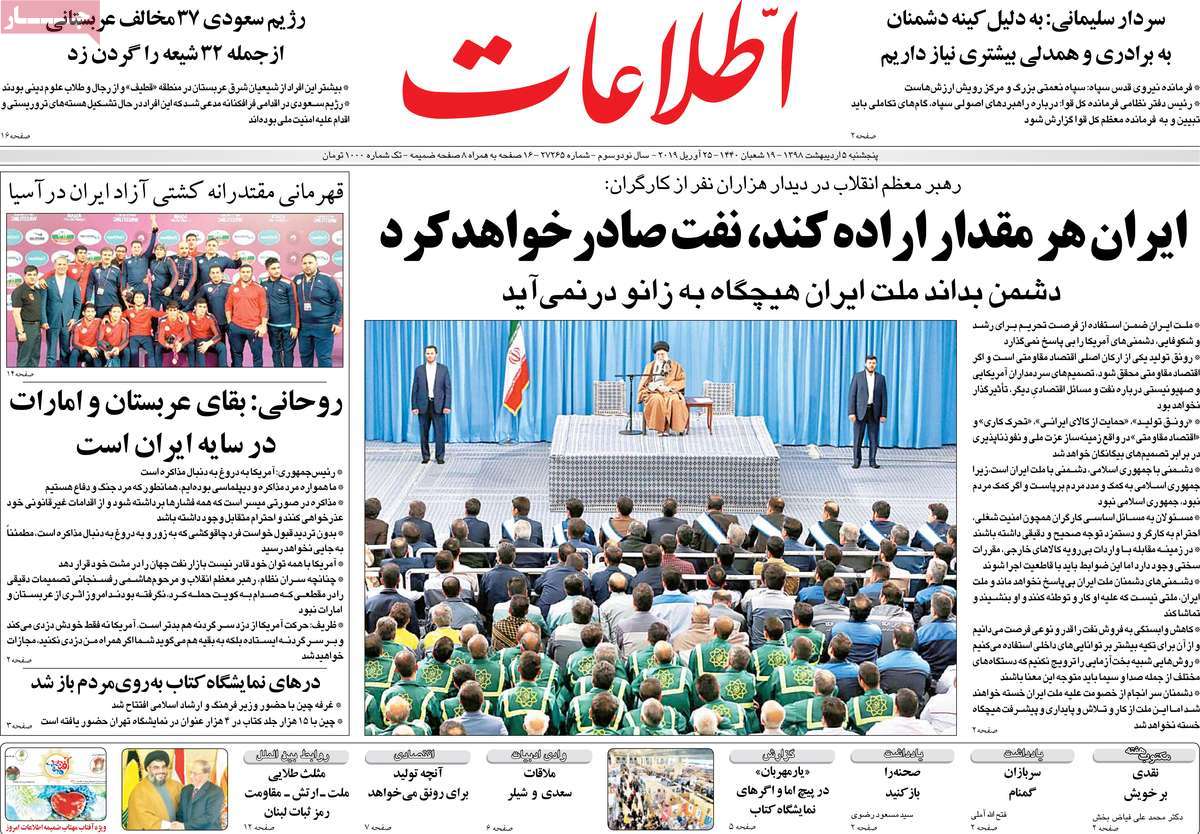
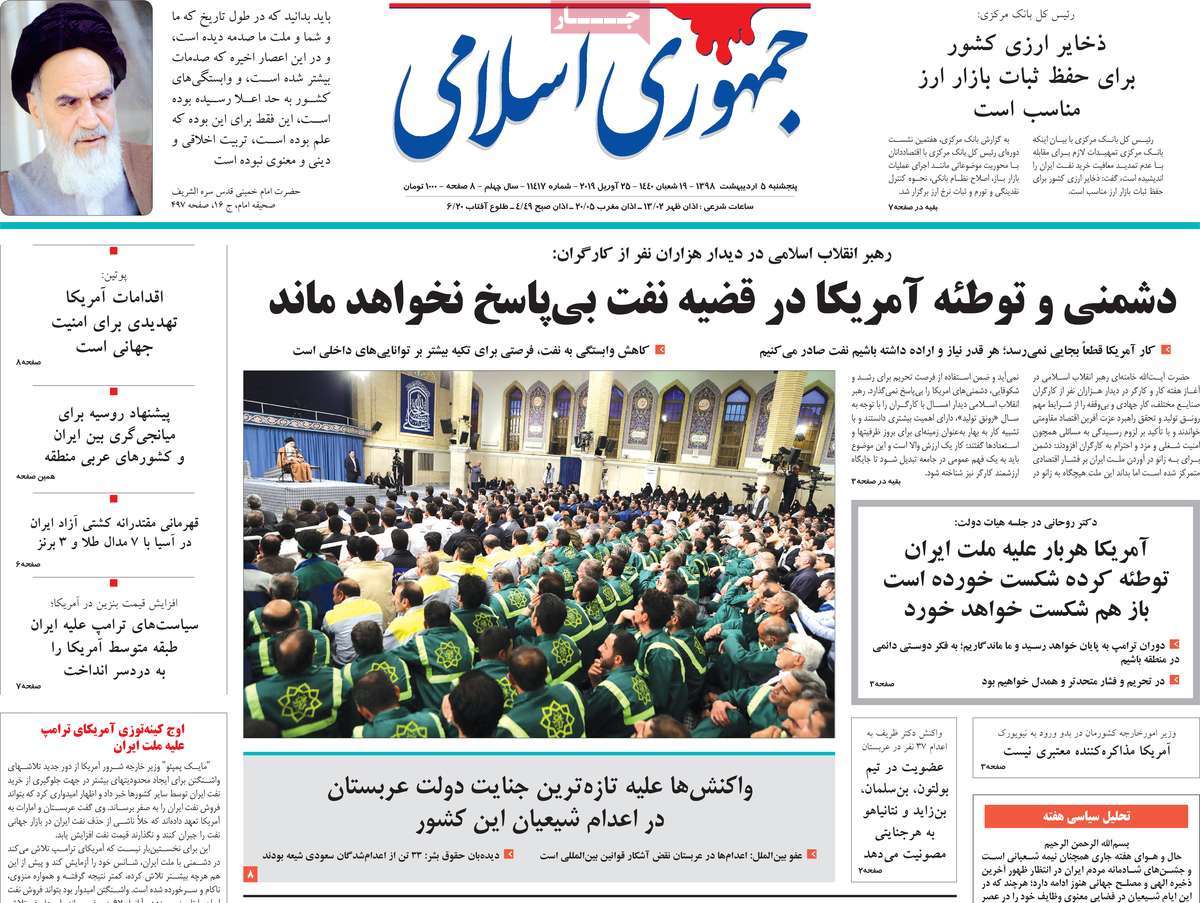
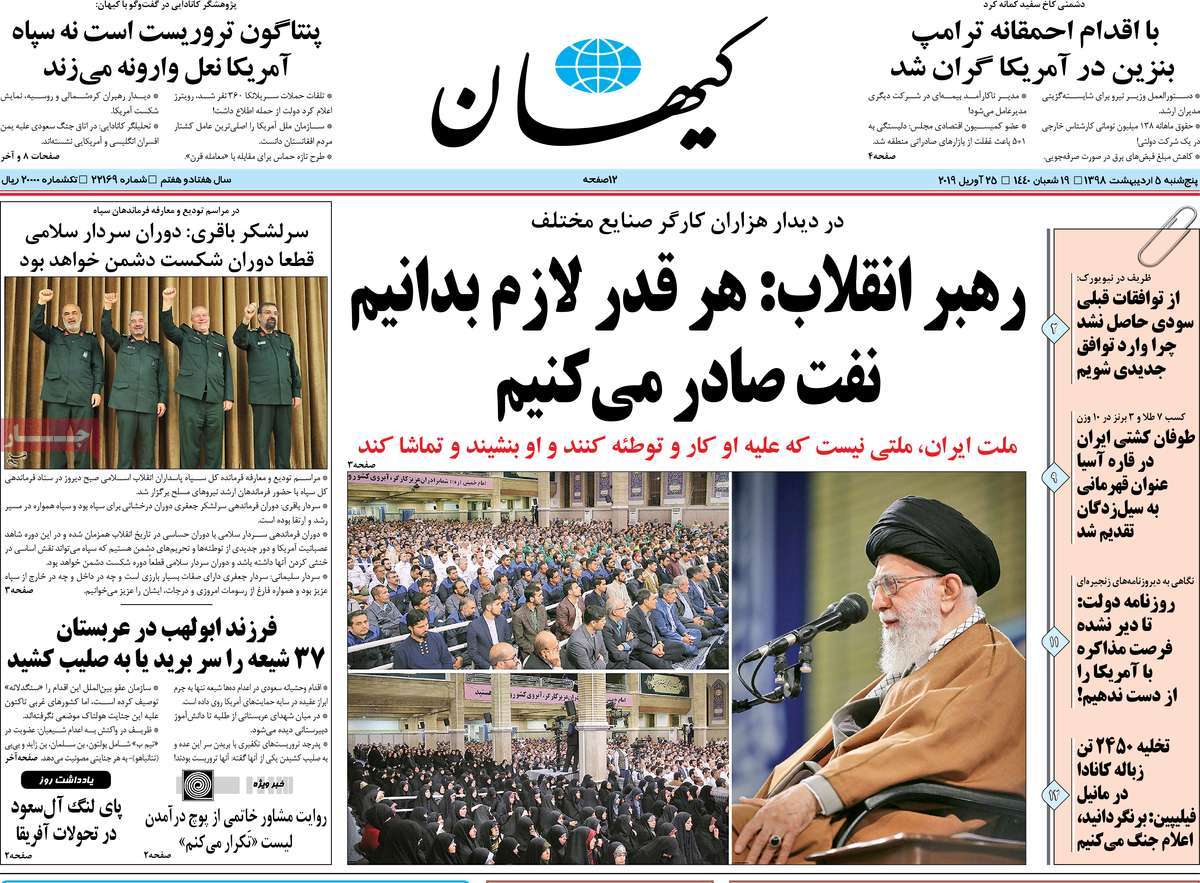
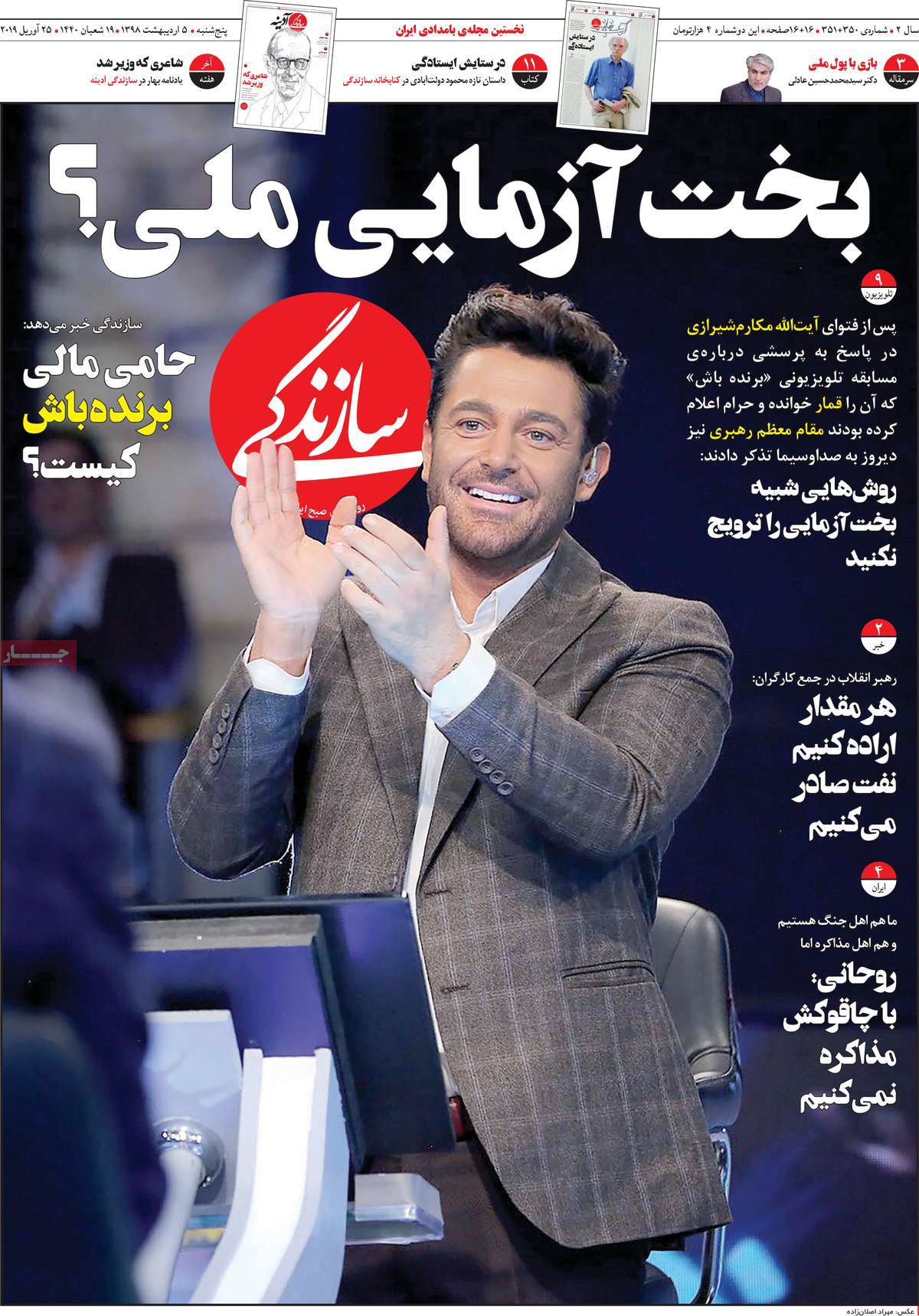
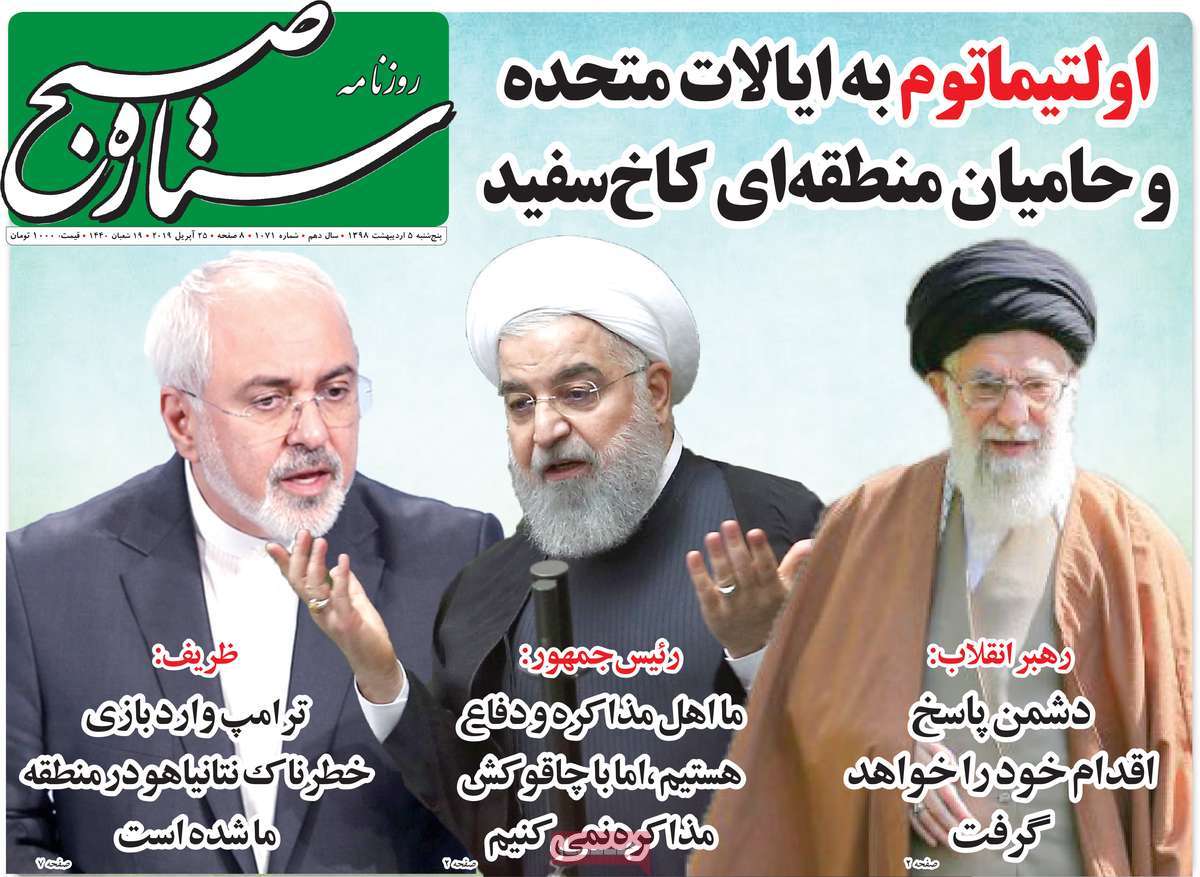
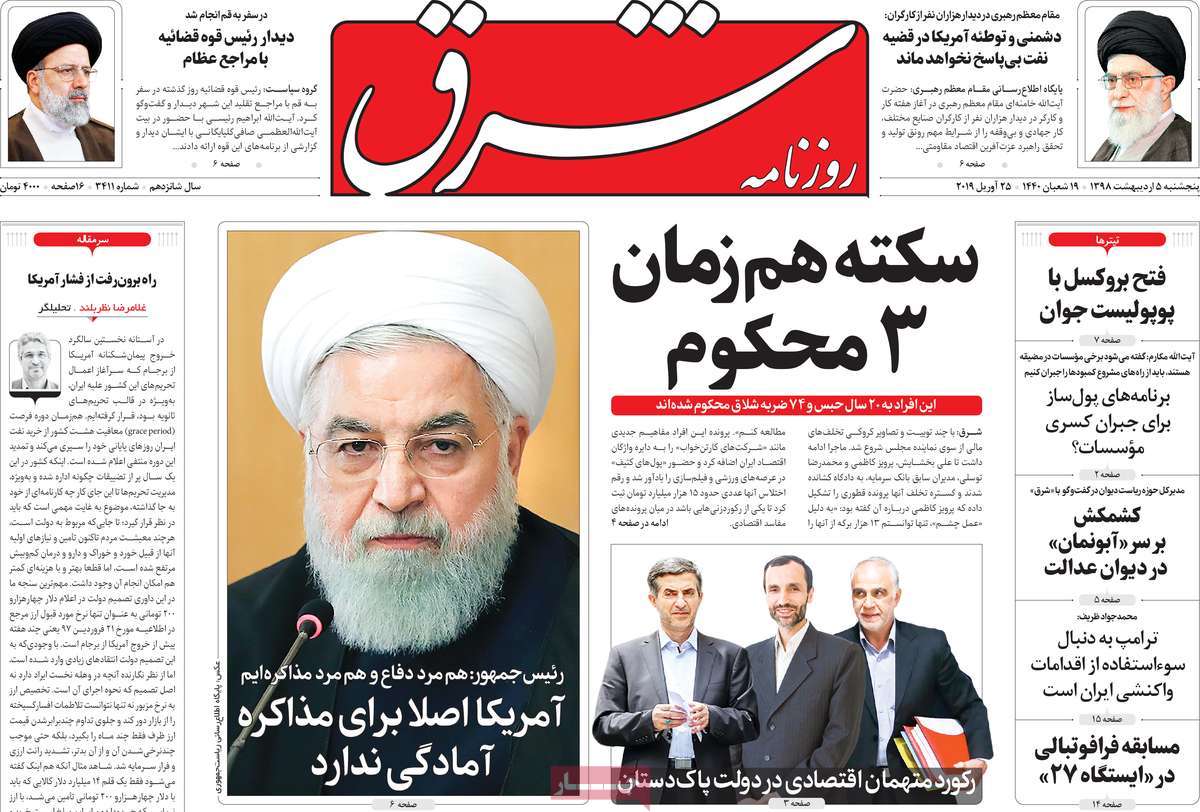
The top story in all newspapers today was the remarks made by the Leader of Iran’s Islamic Revolution Ayatollah Seyyed Ali Khamenei about the US’ sanctions on Iran’s oil exports.

Several papers also covered the comments made by Iranian Foreign Minister Mohammad Javad Zarif during his visit to New York, particularly his offer of a prisoner swap between Tehran and Washington.

Iranian President Hassan Rouhani’s reaction to the support of Saudi Arabia and the UAE for the US’ sanctions on Iran’s oil exports also received great coverage.

The above issues, as well as many more, are highlighted in the following headlines and top stories:

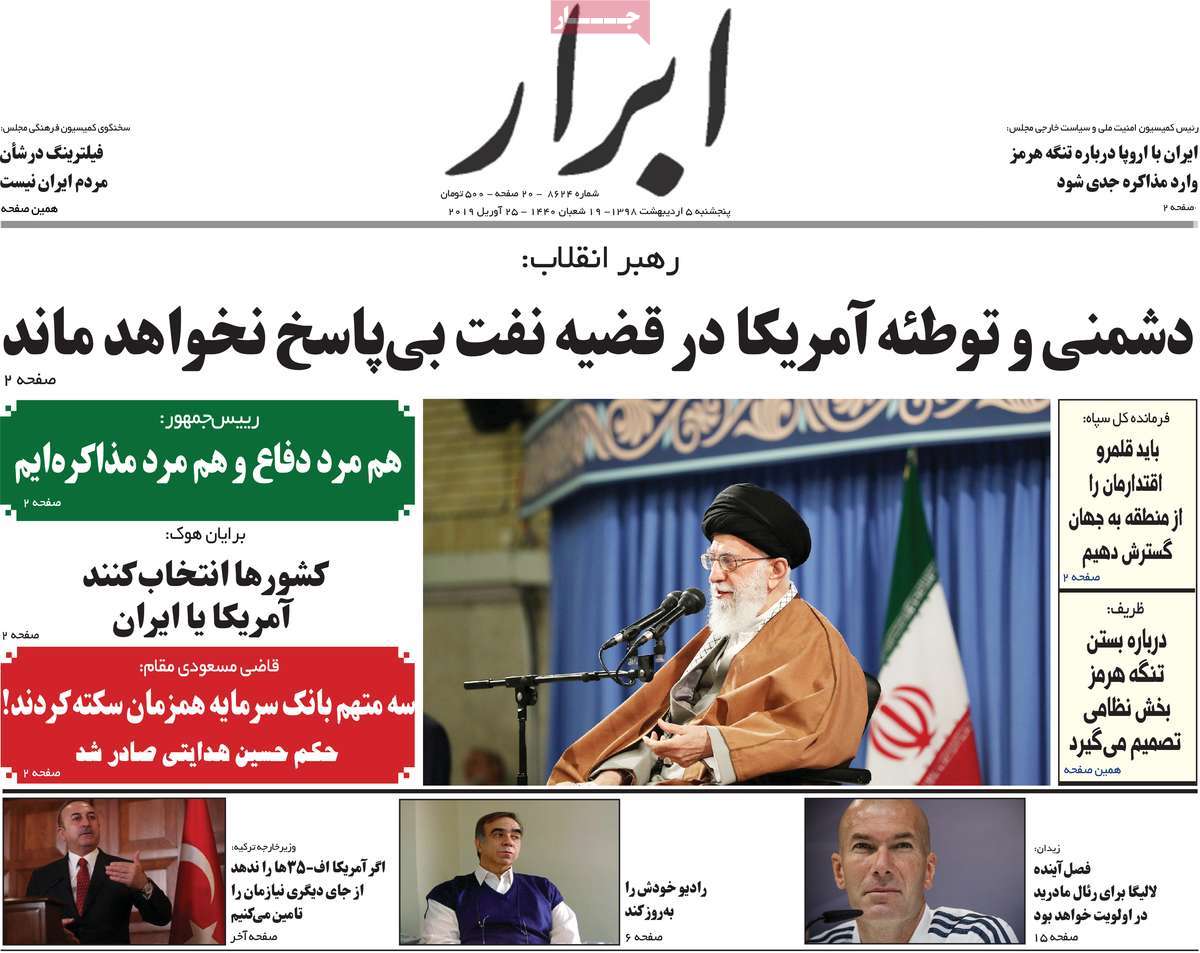
Abrar:
1- Iran Must Engage in Serious Talks with Europe over Hormuz Strait
2- Zarif: Iran’s Military to Decide on Closing Strait of Hormuz
3- Hook: Countries Must Choose between Iran, US
4- Turkey FM: We’ll Supply Our Need from Elsewhere If US Doesn’t Give US F-35

A Look at Iranian Newspaper Front Pages on April 25


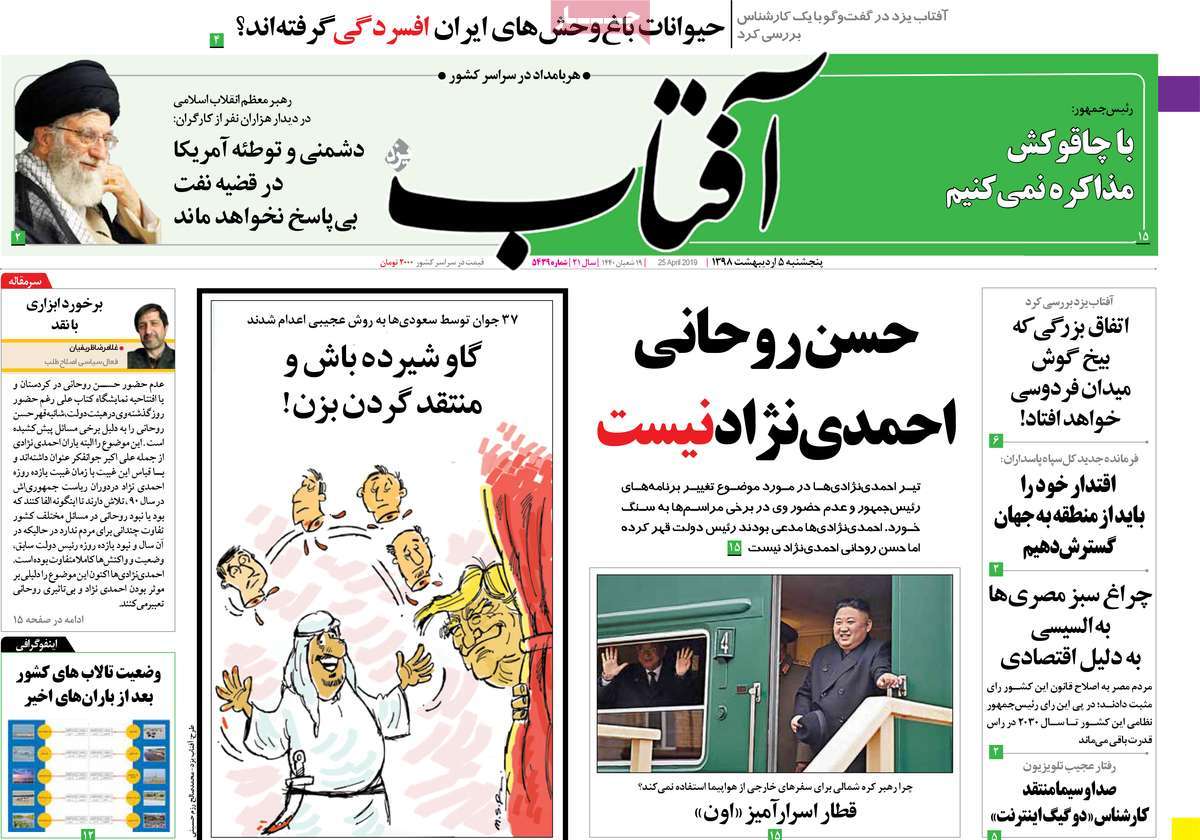
Aftab-e Yazd:
1- Rouhani: We Won’t Negotiate with a Thug
2- US’ Hostility, Plot on Oil Exports Won’t Remain Unanswered: Leader
3- New IRGC Chief: We Should Promote Our Might from Region to Entire World
4- Saudis Can Behead People Freely as Long as They’re Milky Cows
• Saudis Execute 37 Young People in Strange Way

A Look at Iranian Newspaper Front Pages on April 25


Ebtekar:
1- Zarif to Americans: Let’s Exchange Our Prisoners

A Look at Iranian Newspaper Front Pages on April 25


Etemad:
1- Prisoner Swap Offer on US’ Table
• Iran FM’s First Media Gesture in Heart of US
• I Once Negotiated Such a Deal and Succeeded; I Can Do It Again
2- Zarif Condemns Saudi Mass Execution

A Look at Iranian Newspaper Front Pages on April 25


Ettela’at:
1- Saudi Regime Beheads 37 Dissidents, Including 32 Shiites
2- Rouhani: Saudi Arabia, UAE Survived Thanks to Iran
3- Gen. Soleimani: We Need More Brotherhood, Synergy Given Enemy’s Grudge

A Look at Iranian Newspaper Front Pages on April 25


Jomhouri Eslami:
1- Russia Proposes to Mediate between Iran, Arab States
2- Petrol Price Hikes in US: Trump’s Policies against Iran Puts Middle Class in Trouble
3- Reactions to Saudi Government’s Latest Crime
• Amnesty Int’l: Executions in Saudi Arabia Clear Violation of Int’l Law
• HRW: 33 of Those Beheaded Were Shiites

A Look at Iranian Newspaper Front Pages on April 25


Kayhan:
1- White House Official: Trump’s Stupid Move Increased Petrol Price in US
2- Zarif in New York: We Didn’t Benefit from Previous Deals, Why Should We Engage in New One
3- Leader: Iranian Nation Not to Remain Silent When Others Conspire against It

A Look at Iranian Newspaper Front Pages on April 25


Sazandegi:
1- Iran Leader: We’ll Export as Much Oil as We Wish
2- Rouhani: We’re Both Good at War and Negotiation

A Look at Iranian Newspaper Front Pages on April 25


Setareh Sobh:
1- Ultimatum to US, Its Regional Allies
• Zarif: Trump Engaged in Netanyahu’s Dangerous Game in Our Region

A Look at Iranian Newspaper Front Pages on April 25


Shargh:
1- US Not Ready for Talks at All: Rouhani
2- Zarif: Trump Seeks to Abuse Iran’s Reciprocal Acts

A Look at Iranian Newspaper Front Pages on April 25


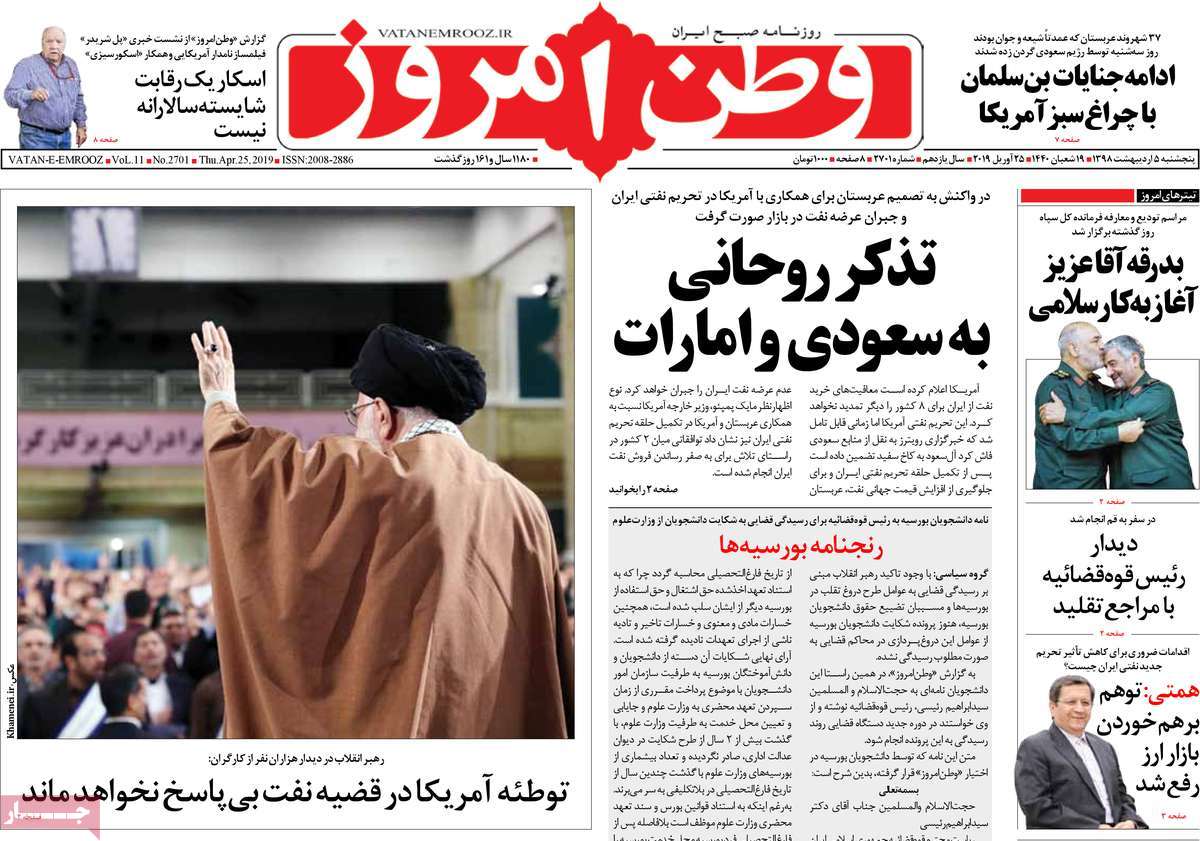
Vatan-e Emrooz:
1- Rouhani Cautions Saudi, UAE after Their Decision to Cooperate with US Sanctions on Iran Oil
2- Bin Salman Continues His Crimes with US’ Green Light

A Look at Iranian Newspaper Front Pages on April 25

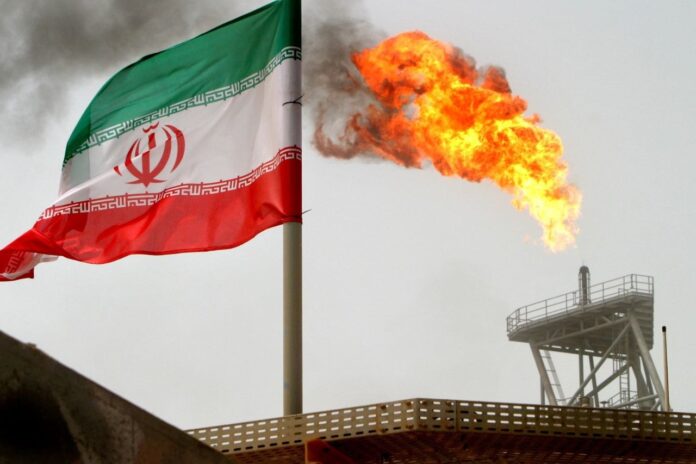
Iran Says Not to Let Any Country Replace It in Oil Market

In a Thursday statement, Seyyed Abbas Mousavi said the positions adopted by Riyadh and Manama bear witness to their blind obedience to the United States and their unawareness of the consequences of their move.

“The Islamic Republic of Iran will not allow any country to replace it in the oil market and holds the US as well as the above-named states responsible for any repercussions with regards to that,” he said.

“The Iranian government and nation will not forget the animosity of some countries in this historic situation,” the spokesman noted.

He also touched upon Riyadh’s mass execution of 37 Saudi nationals, calling it a move similar to what would be done during the Jahiliyyah era.

Mousavi also urged the international community to counter such lunatic actions.

“Saudi Arabia commits such acts in line with the policy of triggering sedition in the region and with the support of the US government, and the regional countries should remain vigilant with regards to the dangerous consequences of such seditious moves,” he warned.

Washington announced days ago that it would not renew waivers that allowed eight countries to buy Iranian oil without facing US sanctions. The White House said in a statement released on Monday that the US president would not reissue Significant Reduction Exceptions (SREs) when they expire in early May, a move aimed at bringing Iran’s oil exports to zero.

Meanwhile, Saudi Arabia and Manama, along with the UAE, have committed themselves to supplying more crude to compensate for any oil shortage that could hit the market due to a possible reduction in Iran’s oil sales because of US sanctions.

Iran’s Judiciary Chief Condemns Saudi Mass Execution

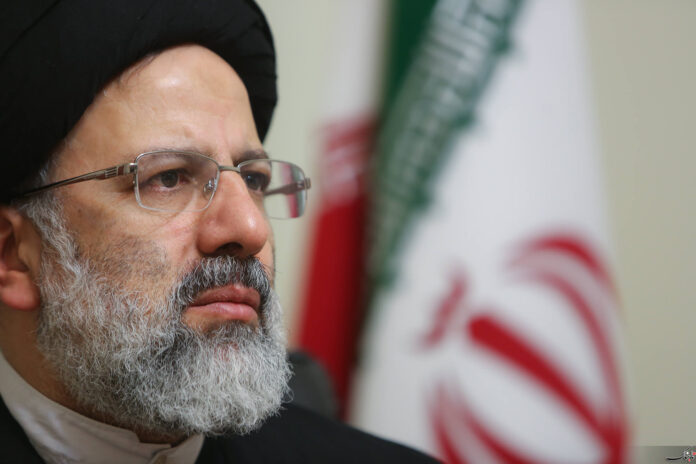
“International organizations should examine which one of the individuals executed by Saudi Arabia under the pretext of terrorism had a terrorist record,” Raisi said in a meeting with heads of justice departments and prosecutors from across Iran.

“Today, what we are seeing [happening] in the Saudis’ unjust judgement system where people are killed in the name of fighting terrorism is a manifestation of selfishness,” he said.

“Based on the reports received, these people were freedom-seeking individuals who sought to fight tyranny and reclaim the rights of people, and today Saudi Arabia has killed them under the pretext of fighting terrorism, and all international organizations have remained silent,” he added.

He said such moves are done by those who claim to be advocates of human rights.

Saudi Arabia executed 37 people in a single day in connection with what it called ‘terrorism crimes.”

The Arabic-language Saudi Arabian daily Okaz, citing a statement issued by the Interior Ministry, said the death penalty was implemented Tuesday “on a number of culprits for adopting extremist terrorist ideologies and forming terrorist cells to corrupt and disrupt security as well as spread chaos and provoke sectarian strife.”

The official Saudi Press Agency (SPA) also said that one of the condemned was crucified after the execution.

Meanwhile, the Arabic-language Ahrar television network, in a post published on its official Twitter page, reported that imprisoned Shiite activists were among those executed by Saudi authorities.