Tuesday, December 23, 2025
Home Blog Page 3247

INSTC Members Agree to Expand North-South Transport Corridor

Addressing the opening ceremony of the seventh INSTC coordination council in Tehran, Eslami said the capacity of the corridor is set to be raised thanks to efforts to expand its railway and port infrastructures.

“Member states have agreed to create a joint company for the INSTC which will increase its capacity,” he told IRIB News Agency.

Eslamai then said he is sure that with the political will of the member states, the INSTC can remove the obstacles in the way of the corridor’s expansion, further facilitating the regional trades.

The Iranian official said all member states attach significant importance to expansion of the corridor, viewing it as a mechanism to boost their mutual trades.

An Iranian deputy roads minister also told IRIB that each country will appoint a government official in charge of its INSTC affairs.

“The official should be introduced to the secretariat in Tehran in one month,” he said.

The official underlined that the participants agreed to make more use of the corridor to expand their trade exchanges and underlined need for homogenizing tariffs and customs charges in all countries, especially in the railroad area.

The INSTC is a 7,200-km-long multi-mode network of ship, rail, and road route for moving freight between India, Iran, Afghanistan, Armenia, Azerbaijan, Russia, Central Asia and Europe.

The route primarily involves moving freight from India, Iran, Azerbaijan and Russia via ship, rail and road. The objective of the corridor is to increase trade connectivity between major cities such as Mumbai, Moscow, Tehran, Baku, Bandar Abbas, Astrakhan, Bandar Anzali, etc.

Pakistan Bans Operation of Anti-Iran Terror Groups in Its Soil

Pakistan’s National Counter Terrorism Authority announced that it will soon launch operations against banned groups, and that terrorists cannot use its territory as a hideout.

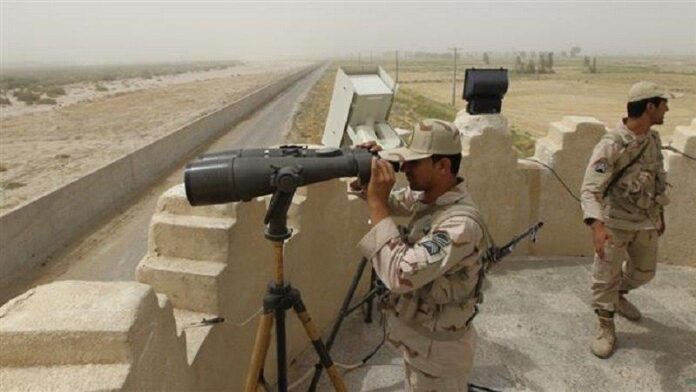
The Jaish al-Adl terrorist group has been launching deadly attacks against Iranian border guards.

Last month, the Pakistan-based terrorists attacked a bus carrying a group of Iranian border guards, claiming the lives of 27 forces.

Following the attack, Iran’s Islamic Revolution Guards Corps accused “Pakistan’s security forces” of supporting the perpetrators behind the suicide bombing.

IRGC Chief Major General Mohammad Ali Jafari urged Islamabad to crack down on militants who killed the border guards or expect military action by Tehran “to punish the terrorists”.

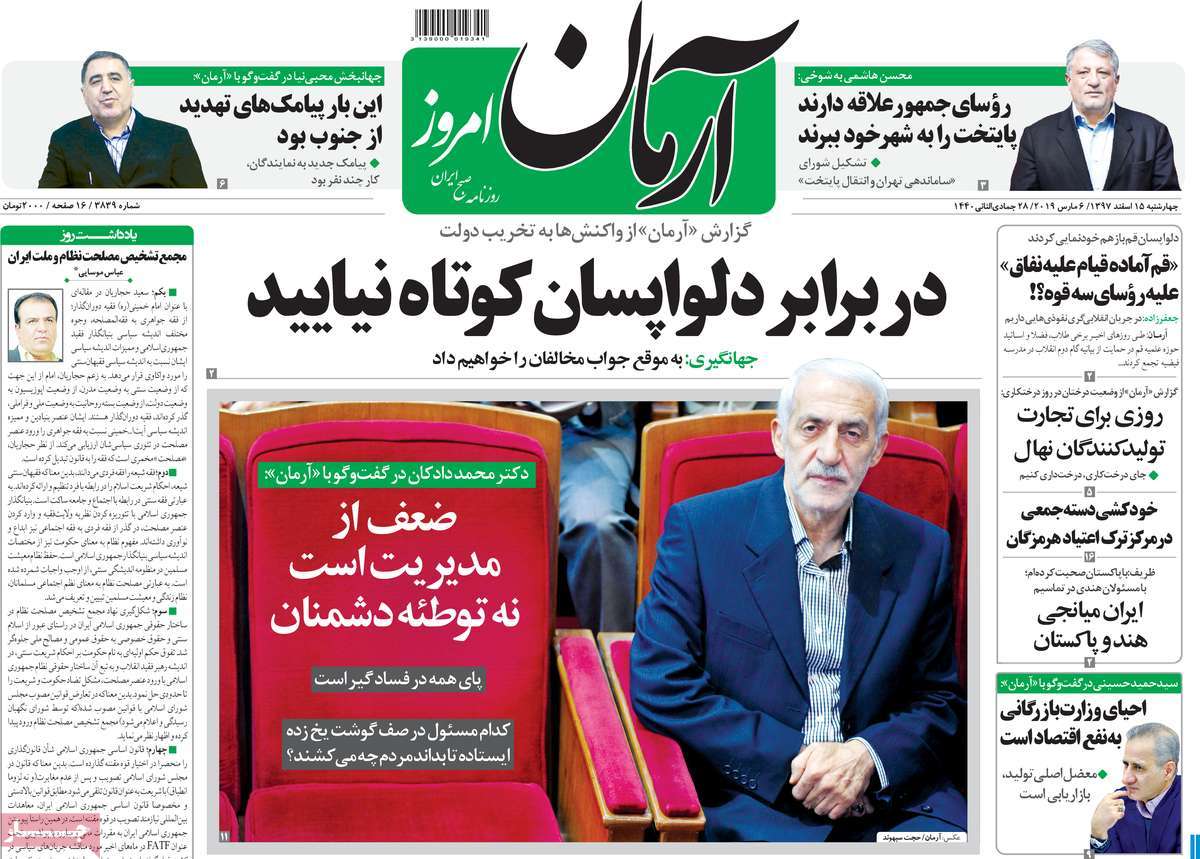
A Look at Iranian Newspaper Front Pages on March 6

A Look at Iranian Newspaper Front Pages on November 19

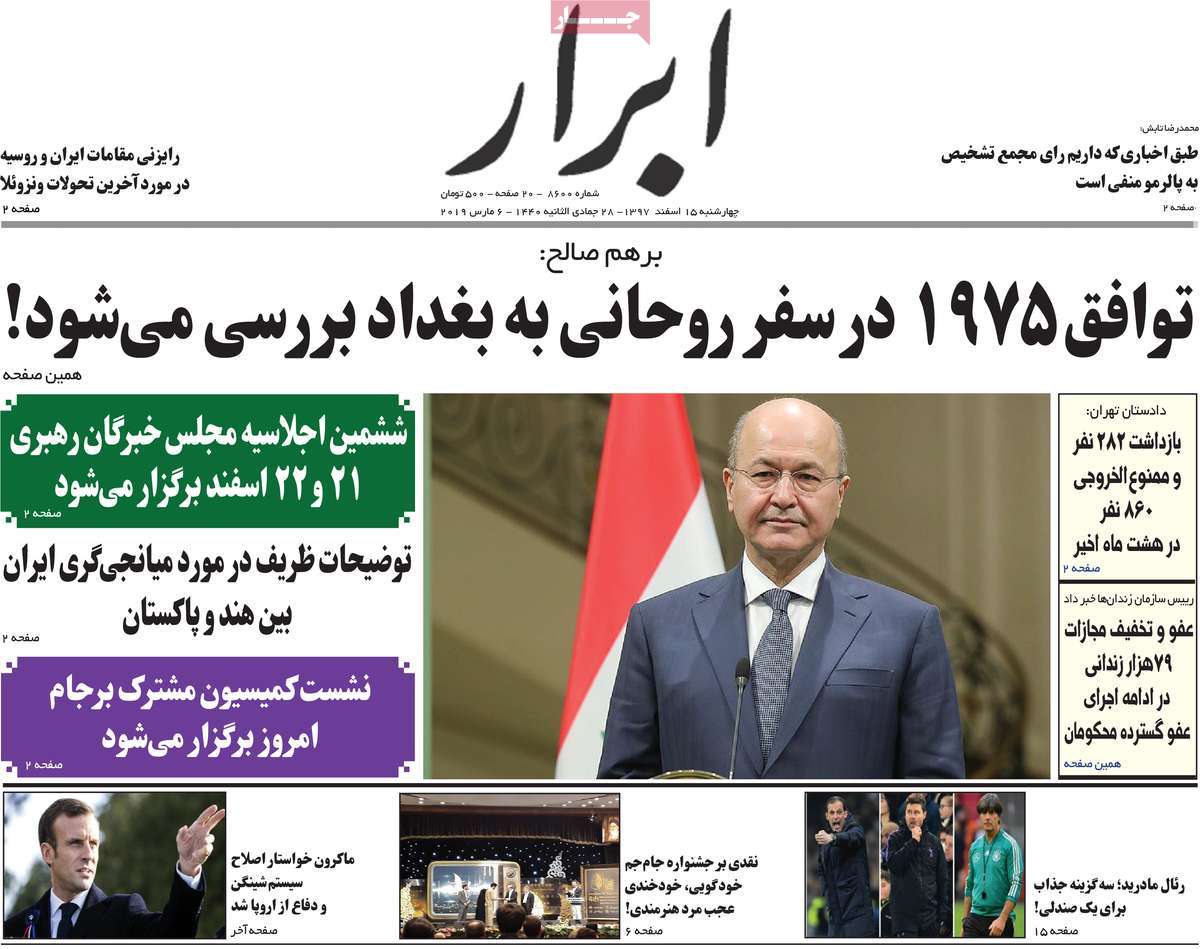
Abrar:

1- Iran, Russia Hold Talks on Latest Venezuela Developments

2- Rouhani to Discuss 1975 Agreement in Baghdad Visit

3- Zarif Talks of Iran’s Efforts to Mediate between India, Pakistan

4- Macron Calls for Revising Schengen System, Defending Europe

A Look at Iranian Newspaper Front Pages on March 6


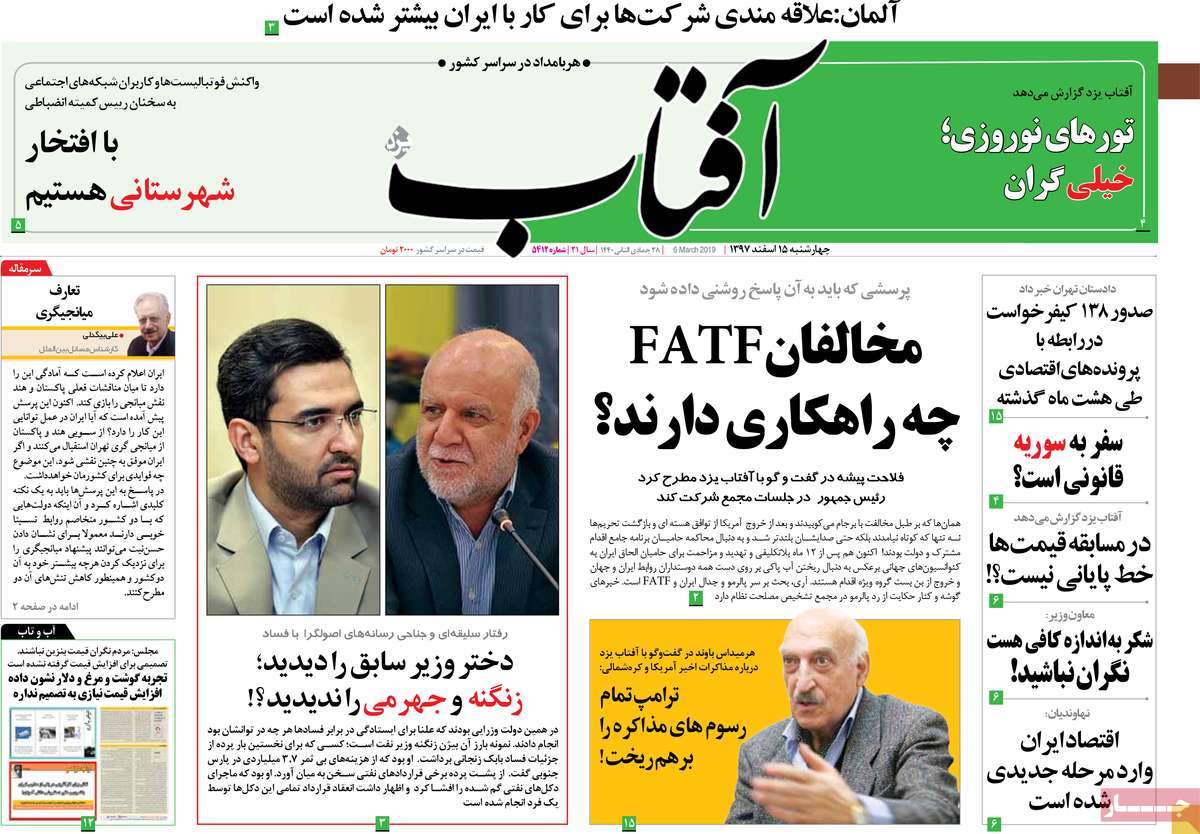
Aftab-e Yazd:

1- Germany: Countries More Interested in Working with Iran

2- Rouhani’s Aide: Iranian Economy in New Level

3- Analyst: Trump Changed All Rules of Negotiation on N Korea

A Look at Iranian Newspaper Front Pages on March 6


Arman-e Emrooz:

1- Iran Mediating between India, Pakistan

  • We’ve Talked to Pakistan, Are in Contact with Indian Officials: Zarif

A Look at Iranian Newspaper Front Pages on March 6


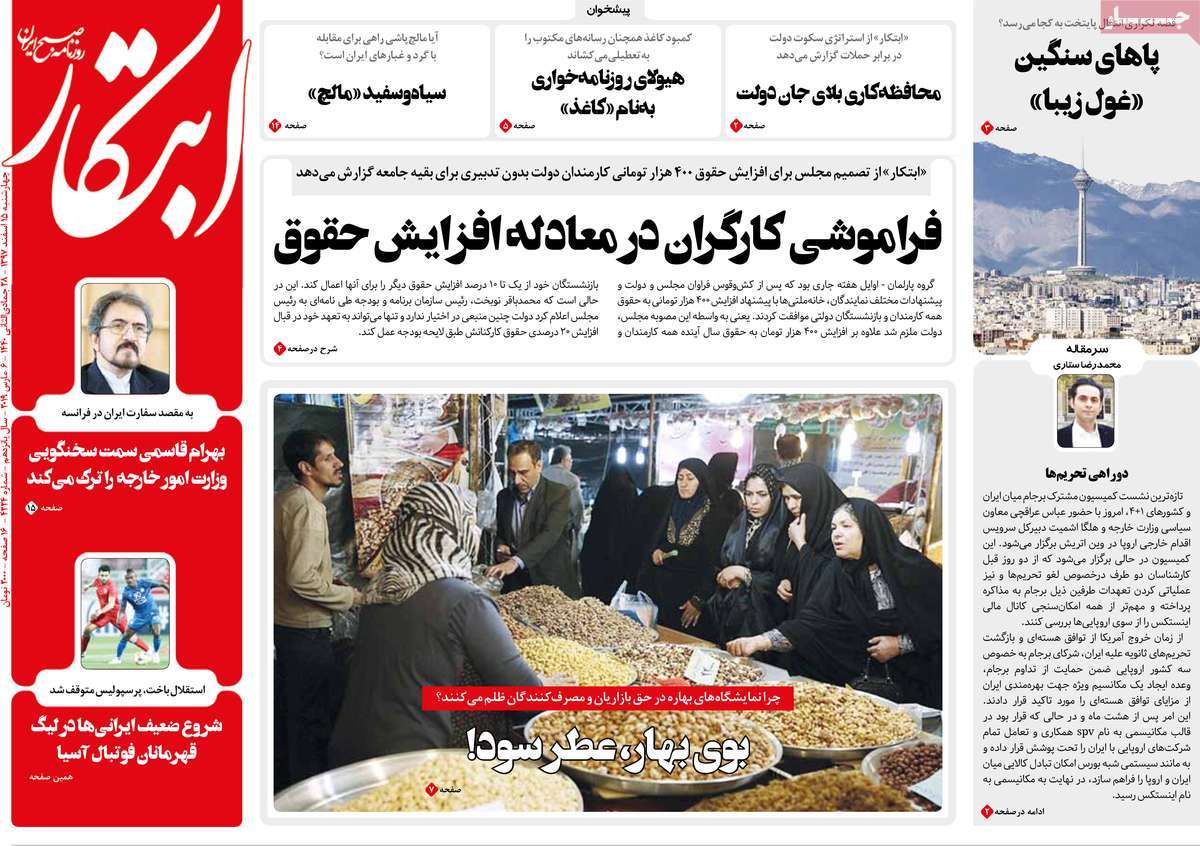
Ebtekar:

1- Foreign Ministry Spokesman Bahram Qassemi to Leave Office, Become Iran Ambassador to Paris

2- Dilemma of Sanctions [Editorial]

A Look at Iranian Newspaper Front Pages on March 6


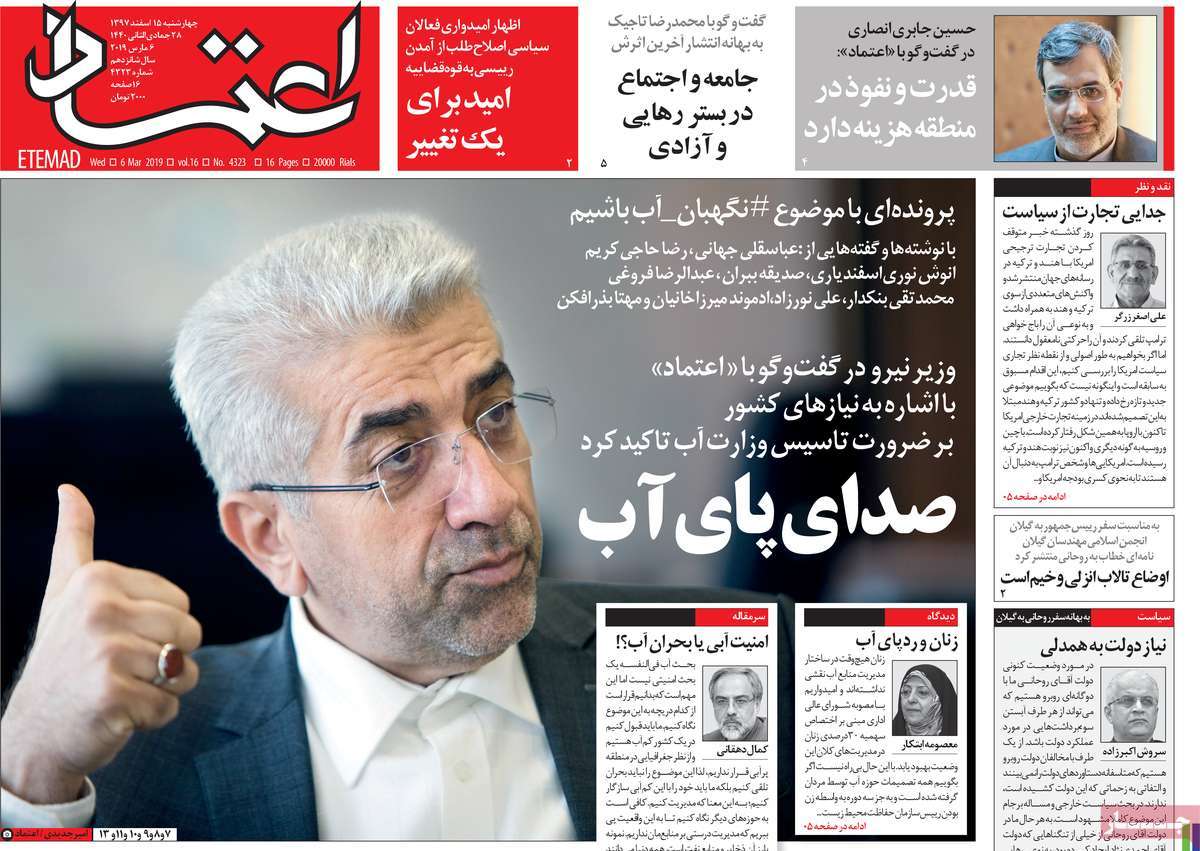
Etemad:

1- There Are Expenses to Pay for Power and Influence in Region: Zarif’s Assistant

2- Trade Apart from Politics: US Stops Preferential Trade with Turkey, India

A Look at Iranian Newspaper Front Pages on March 6


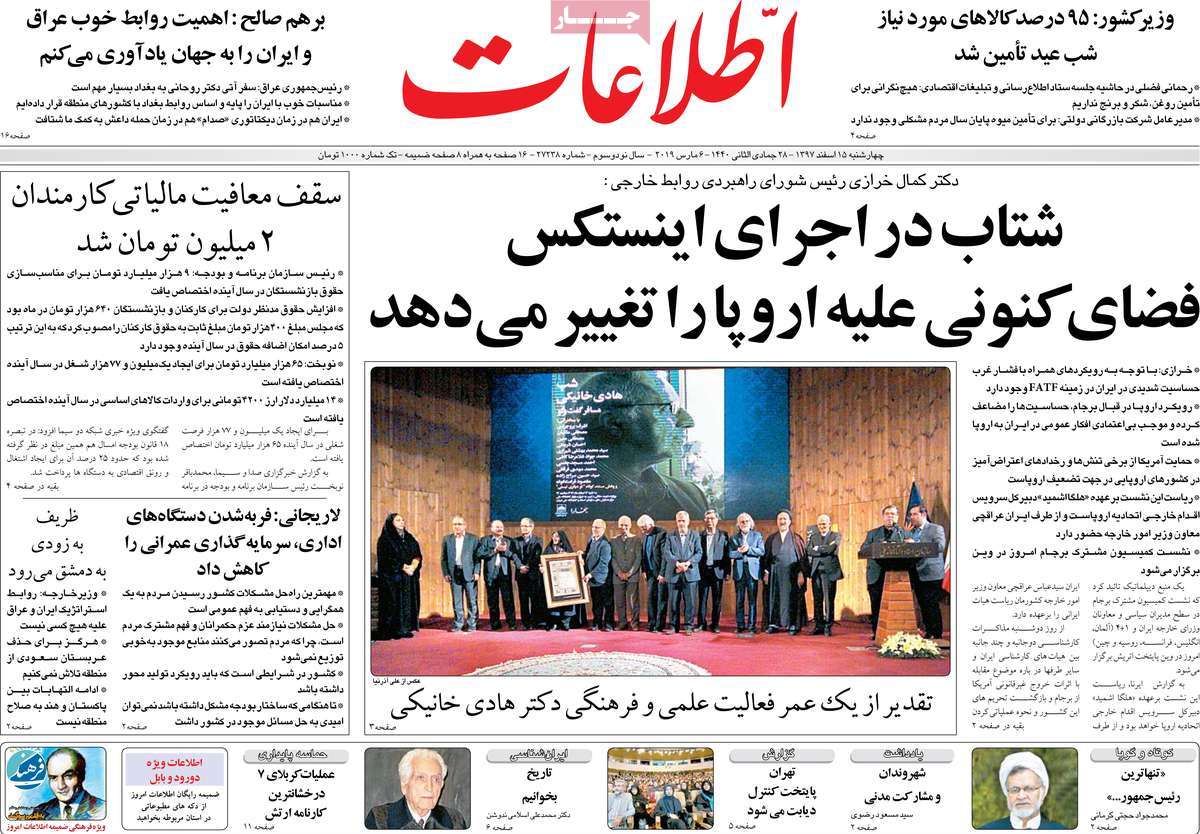
Ettela’at:

1- Barham Salih: I’ll Remind the World of Good Relations between Iran, Iraq

2- Speedy Implementation of INSTEX to Change Current Anti-Europe Atmosphere

3- Tehran to Become Capital of Diabetes Control

A Look at Iranian Newspaper Front Pages on March 6


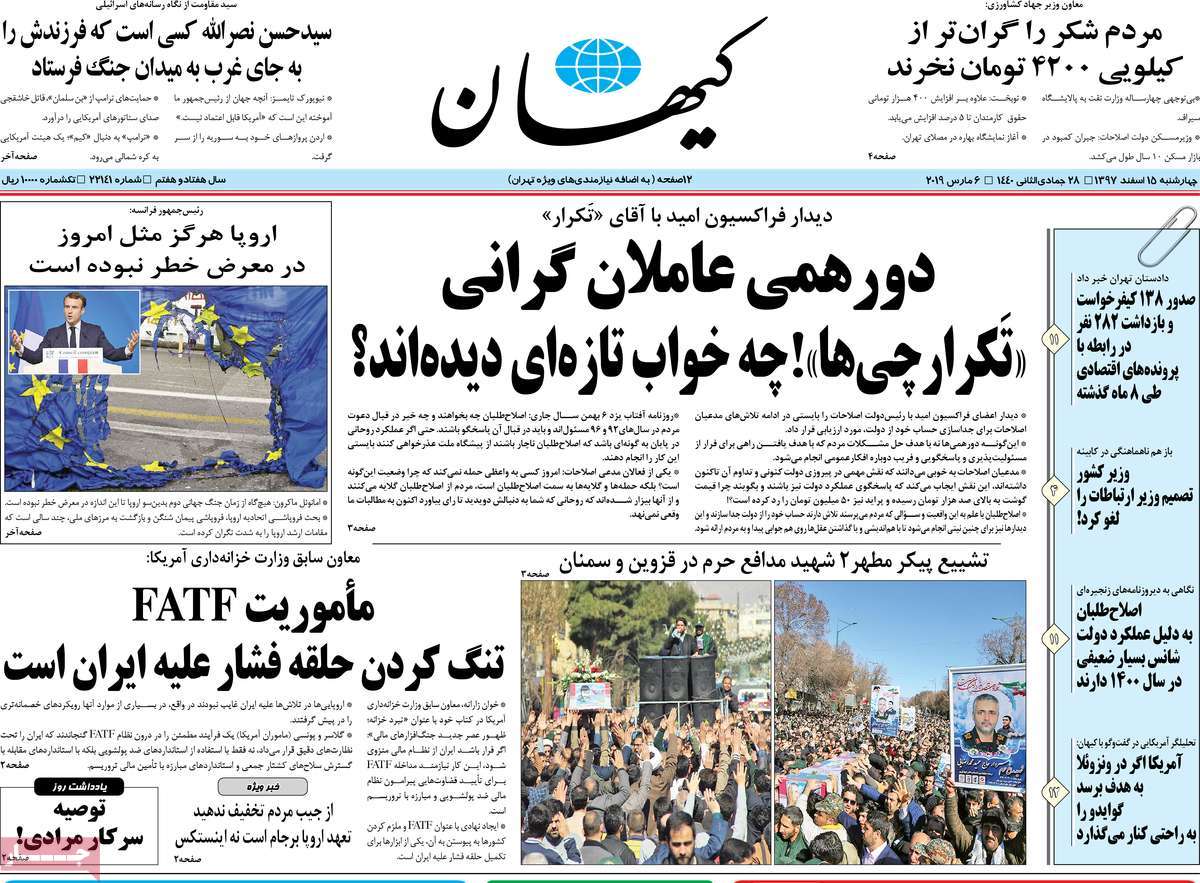
Kayhan:

1- Nasrallah Is the One Who Sends His Son to War Instead of West: Israeli Media

2- French President: Europe Has Never Been in Danger as Much as It Is Now

3- FATF Aimed at Increasing Pressure against Iran: Former US Treasury Official

4- US Analyst: US Will Easily Remove Guaido Once It Achieves Its Goal in Venezuela

A Look at Iranian Newspaper Front Pages on March 6


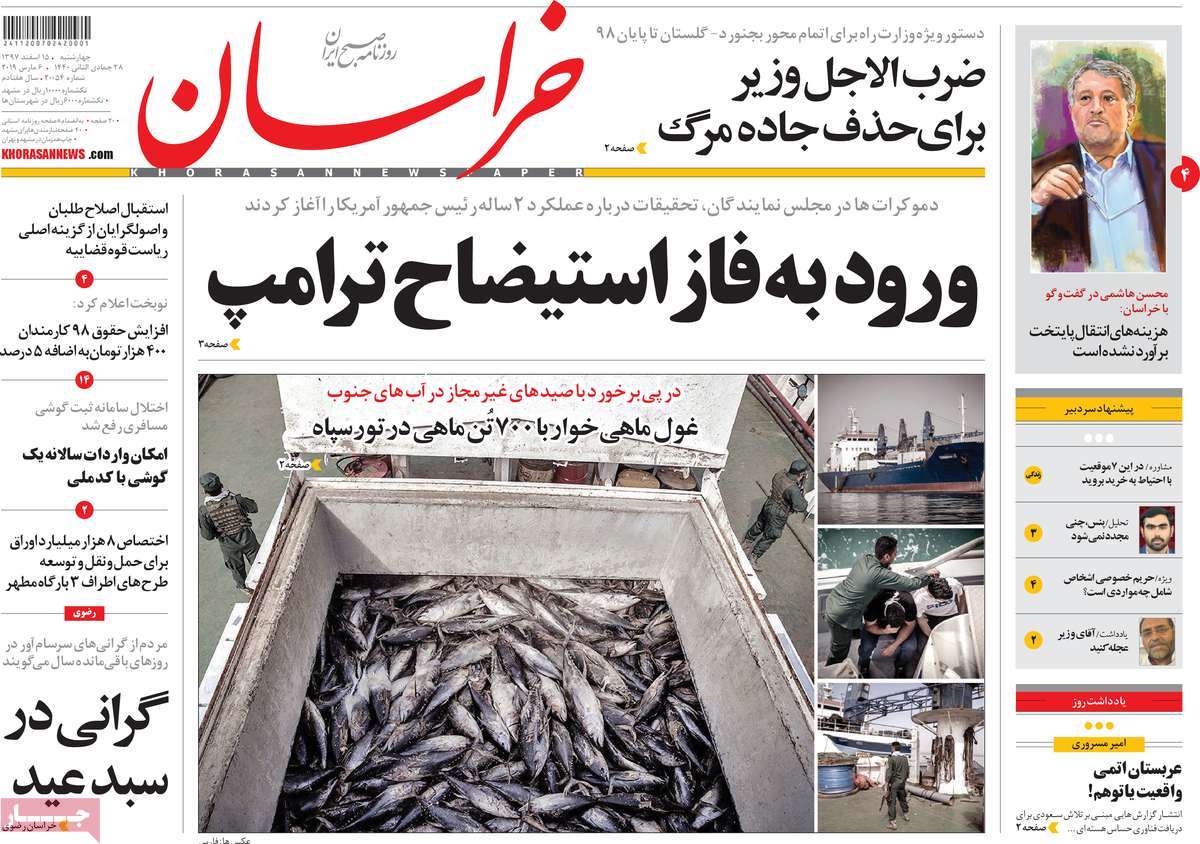
Khorasan:

1- Democrats Start Investigations to Impeach Trump

2- Nuclear Saudi Arabia: Reality or Illusion? [Editorial]

A Look at Iranian Newspaper Front Pages on March 6


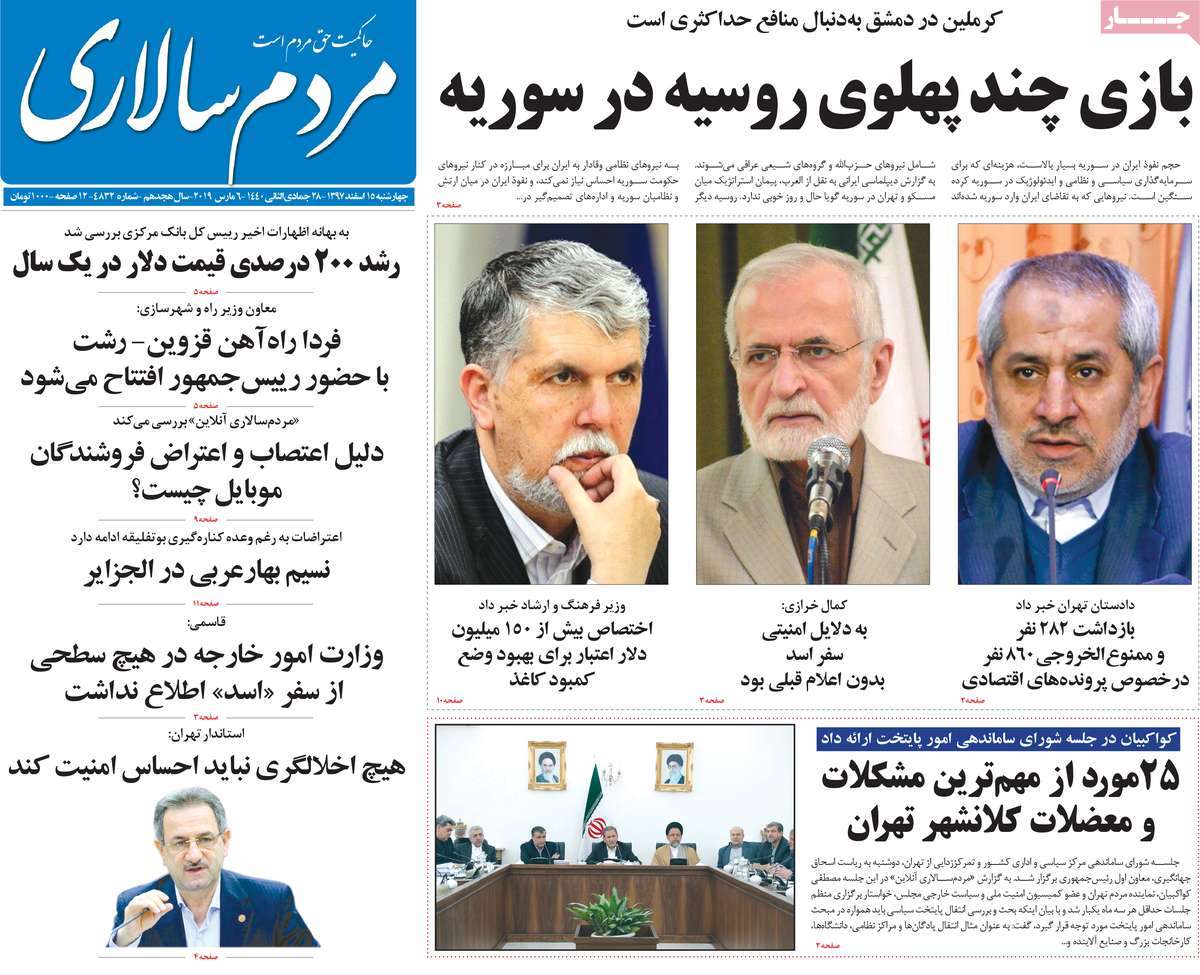
Mardom Salari:

1- Russia’s Multisided Game in Syria: Kremlin Looking for Maximum Benefits in Damascus

2- Iran Leader’s Aide: Assad’s Tehran Trip Was Unannounced over Security Reasons

A Look at Iranian Newspaper Front Pages on March 6


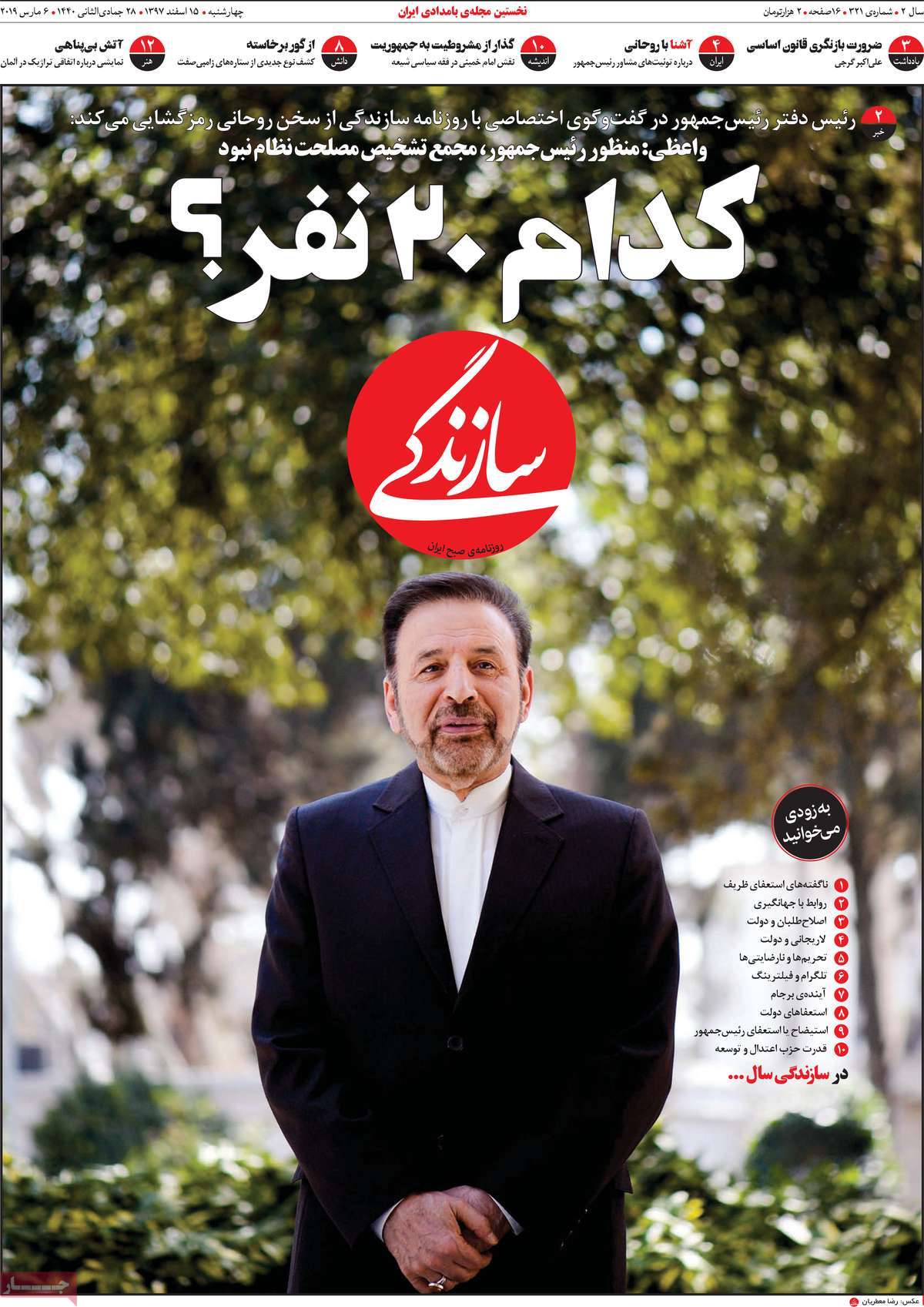
Sazandegi:

1- Rouhani’s Chief of Staff Deciphers Rouhani’s Words about 20 Hardliners

A Look at Iranian Newspaper Front Pages on March 6


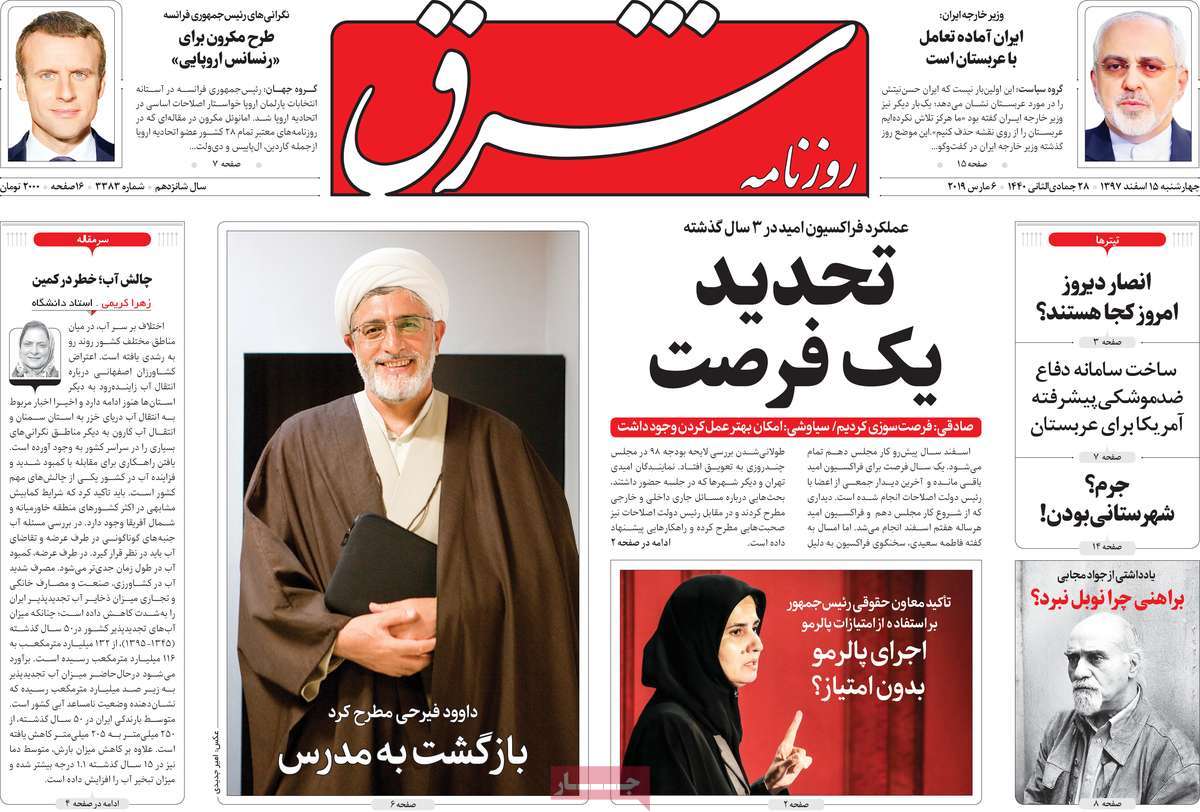
Shargh:

1- FM: Iran Ready for Interaction with Saudi Arabia

2- Macron Calls for European Renascence

3- US to Build Advanced Missile Defence System for Saudi Arabia

A Look at Iranian Newspaper Front Pages on March 6


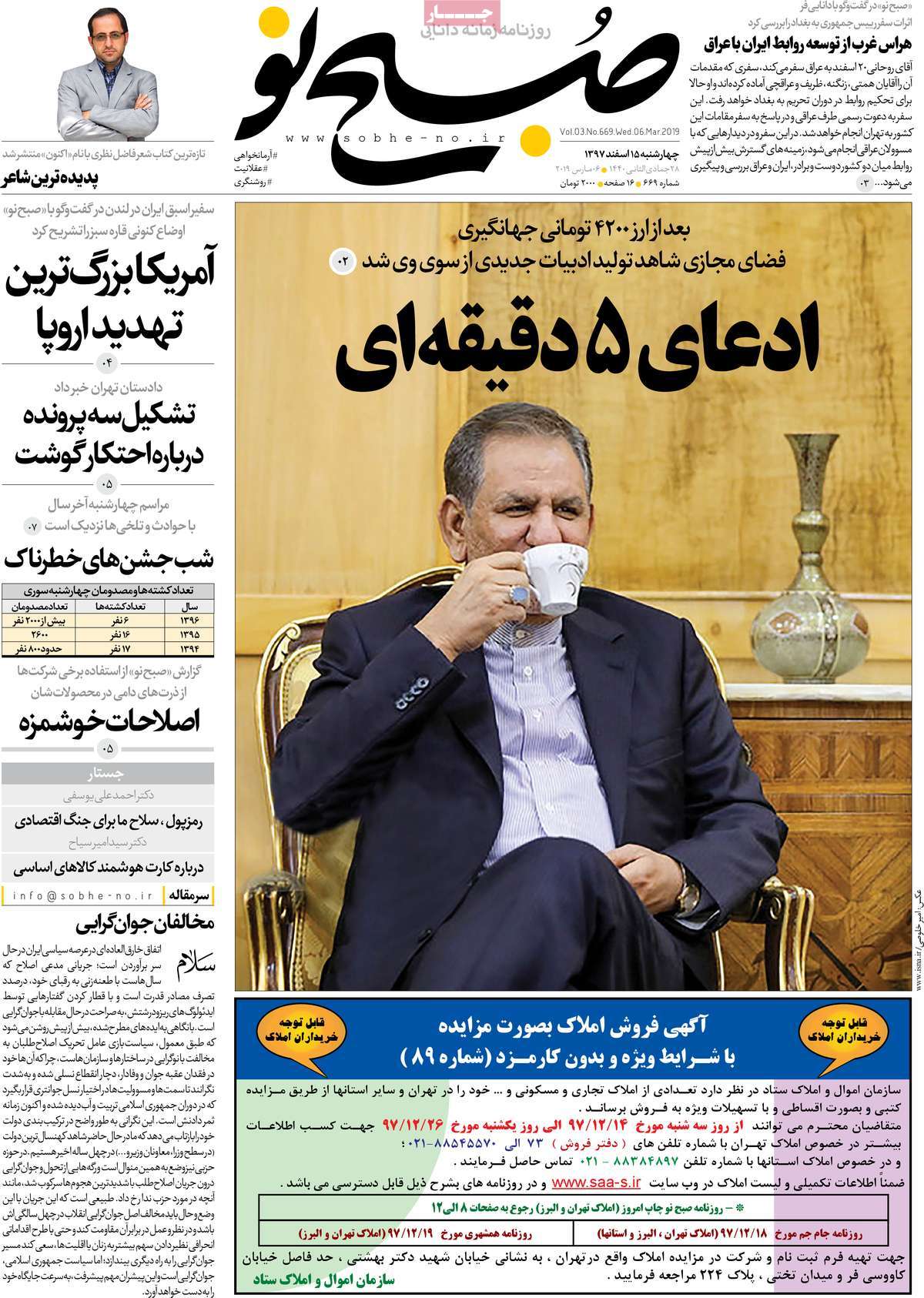
Sobh-e Now:

1- West Afraid of Development of Iran’s Ties with Iraq

2- US Biggest Threat to Europe: Iran’s Former Ambassador to London

A Look at Iranian Newspaper Front Pages on March 6


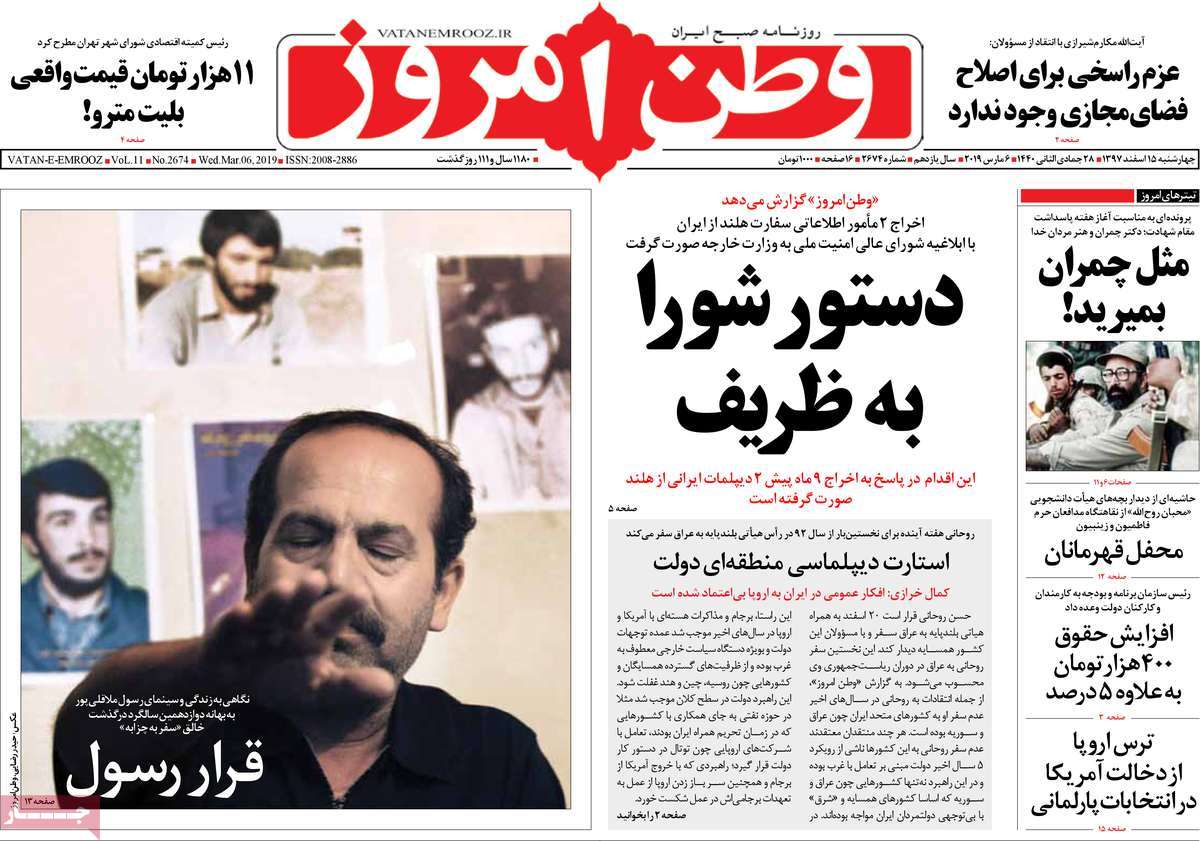
Vatan-e Emrooz:

1- Europe Afraid of US Interference in Parliamentary Elections

2- Supreme National Security Council Orders Zarif to Expel 2 Dutch Diplomats

A Look at Iranian Newspaper Front Pages on March 6

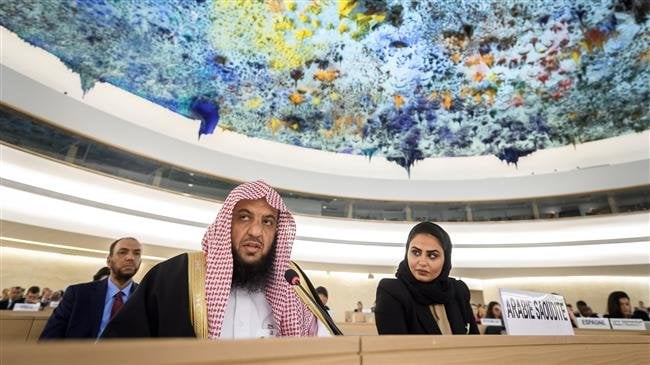
UN to Rebuke Saudi’s Human Rights Violations for First Time

In a joint statement due to be read out on Thursday, European countries will urge Saudi Arabia to release detained activists and cooperate with a UN-led probe into the murder of Khashoggi.

This will be the first rebuke of the kingdom at the Human Rights Council, diplomats and campaigners said.

Iceland has led the initiative, winning support from European countries and possibly delegations from other regions for the criticism of Saudi Arabia, a member of the 47-nation forum, activists said.

“We believe that members of the Council have a particular responsibility to lead by example and put on the Council’s agenda human rights issues that warrant our collective attention,” an Icelandic diplomat told Reuters on Tuesday, adding rights in Saudi Arabia was one such instance and this view was shared by numerous countries.

Iceland was elected last year to take a seat on the council for the first time, replacing the United States which quit because of what it said was an anti-Israel bias.

In a statement welcoming what it said would be the first collective action at the council addressing human rights in Saudi Arabia, Human Rights Watch said rights council members should demand that Saudi Arabia cooperate with probes into Khashoggi’s murder, stop targeting activists, journalists and critics and release wrongfully detained people.

“No State is above the law,” said John Fisher, the group’s Geneva director.

The move comes amid growing concern about the fate of Saudi detainees, identified by watchdog groups as women’s rights activists, after the public prosecutor was reported to be preparing their trials.

Back on Monday, the United Nations human rights experts voiced alarm at Saudi Arabia’s application of its so-called anti-terrorism laws to target activists.

The experts raised the warning during a panel event titled “Saudi Arabia – Time for Accountability,” held on the sidelines of a UN Human Rights Council gathering in Geneva.

They said those being targeted with the laws — which the kingdom has redefined, notably expanding the remit of its security forces and judicial system — included woman. The practice by the kingdom violated the international law guaranteeing freedom of speech, they added.

The kingdom has attracted international opprobrium for its intolerance of dissent. It has nabbed, detained, and reportedly tortured hundreds of dissenters, including civil rights activists, religious rights defenders, and dissident clerics.

Last year, it famously apprehended and incarcerated prominent female activists campaigning in favor of the Saudi women’s right to drive.

Saudis are also under fire for allegations of their role in the assassination of Washington-based journalist and critic of the Saudi government Khashoggi, which was “planned and perpetrated” by Saudi officials at its Istanbul consulate on Oct. 2.

US intelligence agencies believe Crown Prince Mohammed bin Salman ordered the operation to kill Khashoggi, which Riyadh has denied.

Iran Congratulates Ghana on Independence Day

Rouhani extended his “sincere” congratulations in a Wednesday message to Ghana’s President Nana Akufo-Addo.

The Iranian president also expressed the hope that Tehran and Accra would be able to enhance their bilateral relations and mutual cooperation considering the numerous economic capacities.

He also wished health and success for his Ghanaian counterpart, and happiness and prosperity for the people of the African republic.

Ghana was the first western African country to achieve independence. British rule ended on 6 March 1957, when the Ghana Independence Act 1957 transformed the British Crown Colony of the Gold Coast into the independent dominion of Ghana.

Iranian Users ‘Setting Aside’ iPhone Devices as Apps Become Inactive

Mohammad Javad Azari Jahromi said Iranian people liked Apple phones, but the restrictions recently put in place for Iranian companies led to many Iranians set aside their iPhone devices.

However, he added, a detailed report on the issue should be presented by relevant Iranian authorities.

The minister said mobile phones which do not support Iranian ride-hailing and banking applications are doomed to leave the market.

His comments come as almost all Iranian applications have recently become inactive on iPhone products.

Most apps for Iranian iOS users are no longer working, and the owners of those applications have introduced alternative programs for users.

Apple Inc. does not have a presence in Iran due to US sanctions, but its products including iPhones remain much sought-after devices in the country, meaning several thousand Iranian app developers that produce software in Persian contribute to a local Apple ecosystem.

Iranian media and users alike report that Apple has revoked “enterprise certificates” from Iranian apps, bne IntelliNews reports. That has resulted in iPhone users being unable to access locally-made applications including popular apps providing services such as ride-hailing and banking.

This is not the first time that Iranian Apple users have been hit hard. In 2018, Iranian apps were quietly removed from the Apple iOS store. Iranians were able to sidestep that removal by loading applications onto their phones via technician mode. It appears that option may no longer be available because of the latest block put in place by Apple.

The company last year accounted for an estimated 11% share of Iran’s technology market, according to the telecoms ministry.

Google’s mobile operating system Android is run on 89% of smartphones in Iran. Google allows Android developers to publish apps in Iran as long as they do not relate to purchases. The American company has not to date followed Apple’s action against Iranian apps by targeting products placed in its Google Play store. Android is also catered for by local store Café Bazaar, a Persian-language app store.

There are more than 60mn smartphones currently in use in Iran, a country of around 81mn people. Nearly 80mn SIM cards are active in the country.

‘Iran’s Trade with World to Get More Difficult without FATF’

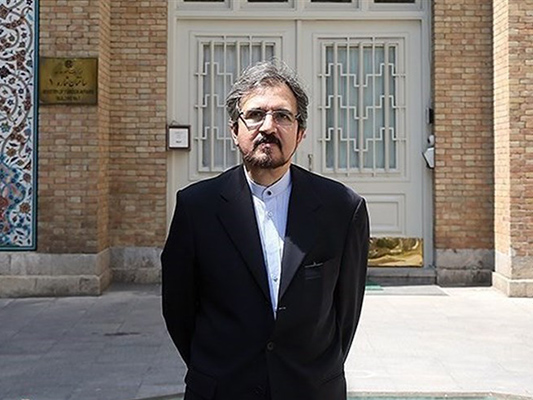
In a Tuesday interview with IRNA, Qassemi said the Foreign Ministry draws on its expertise to insist that accession to the global anti-money laundering body is not expected to eradicate all economic problems of the country completely and overnight.

“But rejecting the FATF will undoubtedly deteriorate the problems we face in establishing trade ties with the world, making it harder, costlier and in some areas impossible,” he said.

The spokesman said by rejecting the FATF, even the Islamic Republic’s partners will face serious and costly problems for establishing legal and transparent ties with Tehran.

“They have explicitly expressed their concern that they might not be able to continue their cooperation with us easily,” he said.

Qassemi then added it seems some factional and political views are contributing to the public concern about the bills proposed by the government to get Iran out of the FATF blacklist.

“But it is critical that all experts and specialists, in concerted efforts, fulfil their national duty to raise [public] awareness and help the respectable members of Iran’s Expediency Council to make the best decision in this regard, guarantee our national interests and promote our security free from any politically-motivated, factional and individual view,” the spokesman said.

According to Qassemi, any decision could undoubtedly leave some positive or negative consequences for Iran. Therefore, he said, the decision makers should accept the responsibility of their decision in full consciousness.

Asked about the Expediency Council’s postponement of its decision on the FATF ahead of the upcoming holidays and the short time left before the deadline set by FATF for Iran to accept or reject the bill, he said the Foreign Ministry never views the issue from narrow partisan or political prisms.

“We raise a view and opinion which puts our national interests as the top priority. So, we have our own expertise-based view which is macro and multilateral,” he said.

The spokesman further noted that any country that seeks to safeguard its interests and status in the world has no way but to accept many international norms and regulations.

Based on the officials’ will and the people’s request, Iran seeks to establish routine ties with other countries and the international community in various areas like economy and trade, he said.

“It should be pointed out that today we are members of many specialized international organizations in various areas including legal, political, disarmament, cultural, trade, economic, air, sea, and land communications. This means we have already accepted to implement special standards of the specialized international bodies and organizations.”

“Now, if we intend to enjoy the least banking and financial exchanges and communications, we have to accept and observe some defined standards which have been accepted by almost all states except for one or two countries,” he noted.

Qassemi then referred to the current special economic conditions and foreign relations of the Islamic Republic in the wake of the US’ re-imposition of its unilateral and illegal sanctions, and said today Iran is engaged simultaneously in negotiations with a number of its neighbors, traditional partners like India, China and Russia, and the European Union to thwart the US illegal sanctions.

“Some good progresses have already been made. The main point is that the mentioned states which have decided not to implement the US’ illegitimate sanctions and keep their trade cooperation with Iran, have joined the FATF. So, they have no way but to work only with those countries which have similarly adopted these standards,” he concluded.

Iranian Vets Perform First Feather Transplant

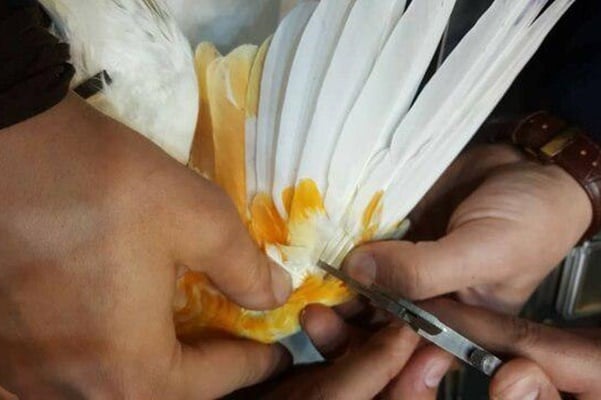
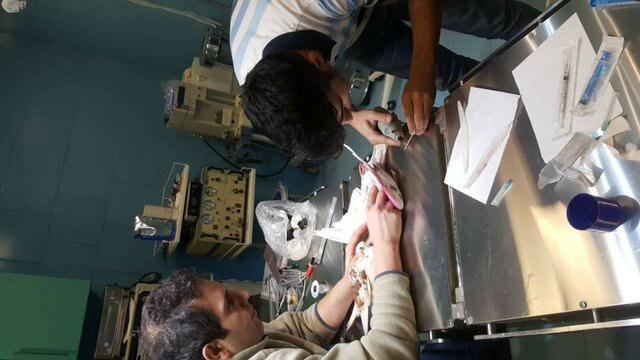
This is the first time that an Iranian team becomes involved in feather transplant in the country.

Saeed Yazdani-Nia, an Iranian vet leading the feather transplant project, says healing the wounds of feathers and the quills, in particular, is overwhelmingly difficult because the birds can’t be allowed to get back to the nature before the healing process is completed and the feathers grow enough.

Birds could be healed through various methods due to the type and grade of the wounds they sustained. There are various methods to perform surgeries and hold special cares before full healing.

“However, before the healing process is completed and the vets consider the birds healthy, there would be no chance for them to get back to the nature even if they have undergone the lengthy recovery process to overcome the first signs of the wounds like those create by bullet hit or bone fracture,” he noted.
Yazdani-Nia went on to say that the process to have the feathers grown enough takes about 12 months.
Feather transplant is a new way to remove the problems created due to long and harsh captivity of birds. British and Australian veterinarian teams have already performed the transplant successfully.

The Iranian vets managed to do the transplant successfully through three various technics: Autograft, Allograft and Xenograft.

The transplants were done on a grey parrot and two pigeons.

The birds underwent and passed a number of tests like bio-mechanical test of feathers.

It’s expected that transplant surgeries could be made on a growing number of wounded birds in the near future. It’s hoped that through the new method, more and more birds could be protected against the dangers from the nature.

Iranian Vets Perform First Feather Transplant

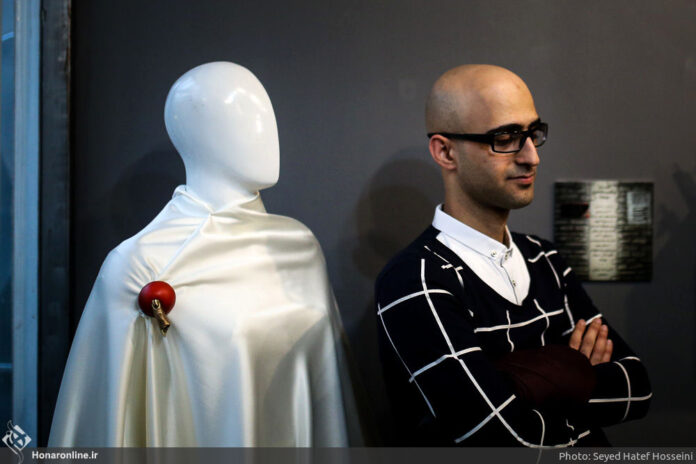
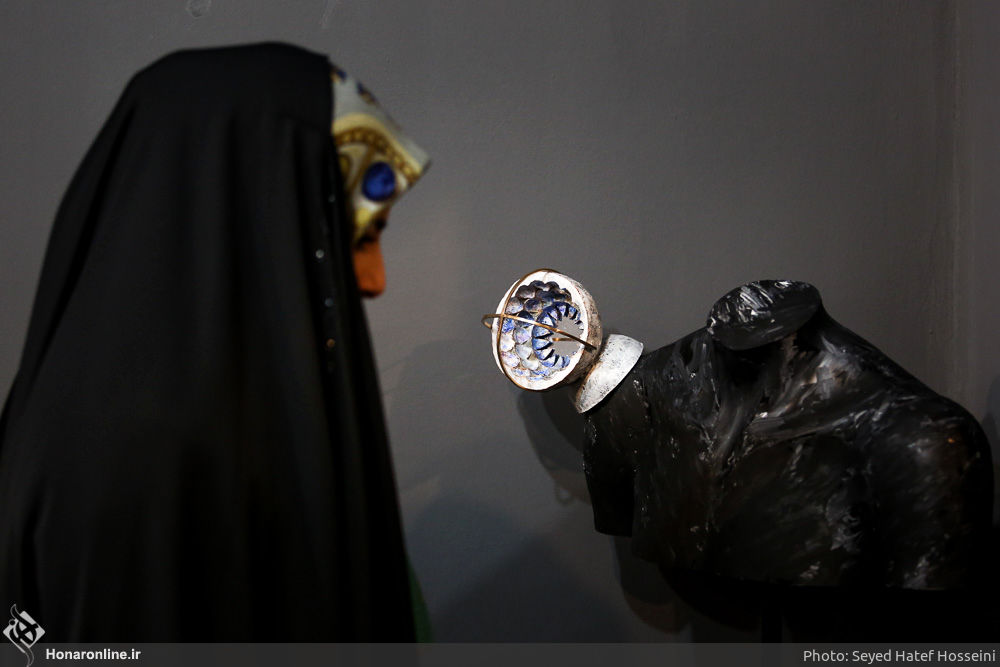
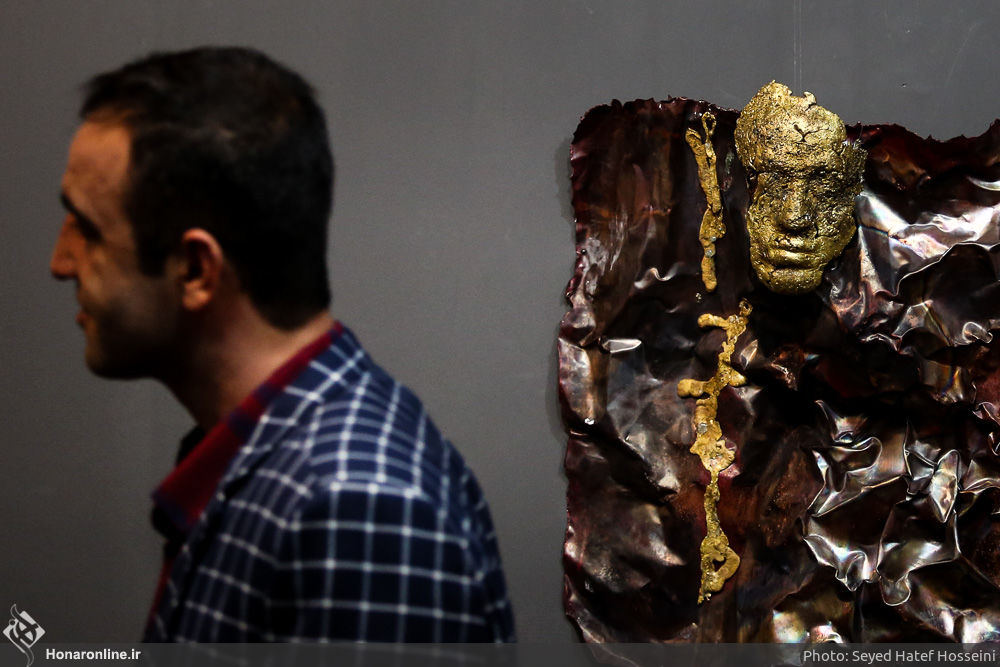
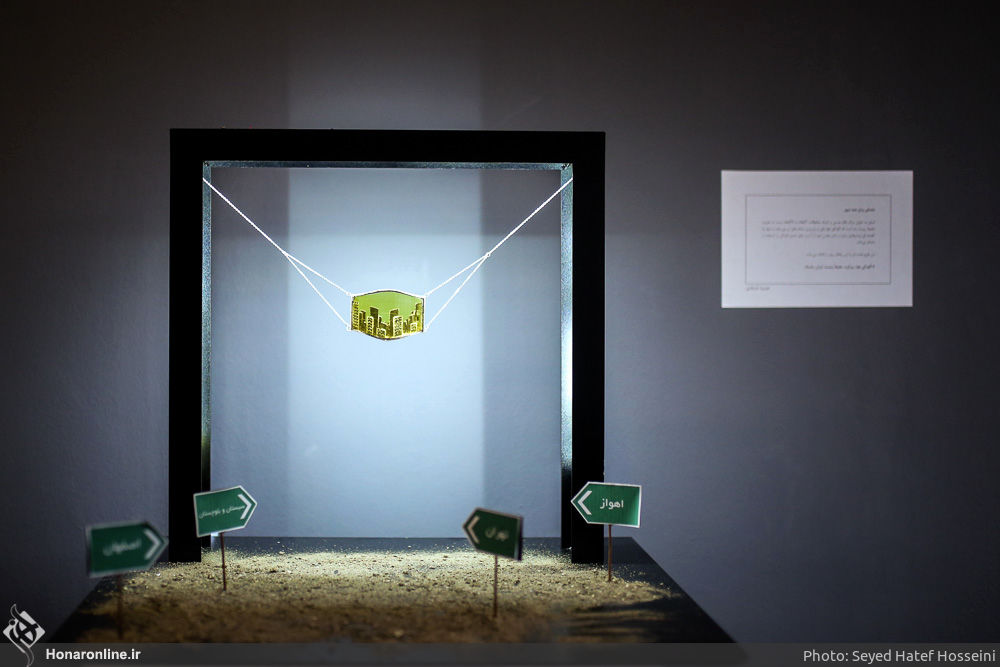
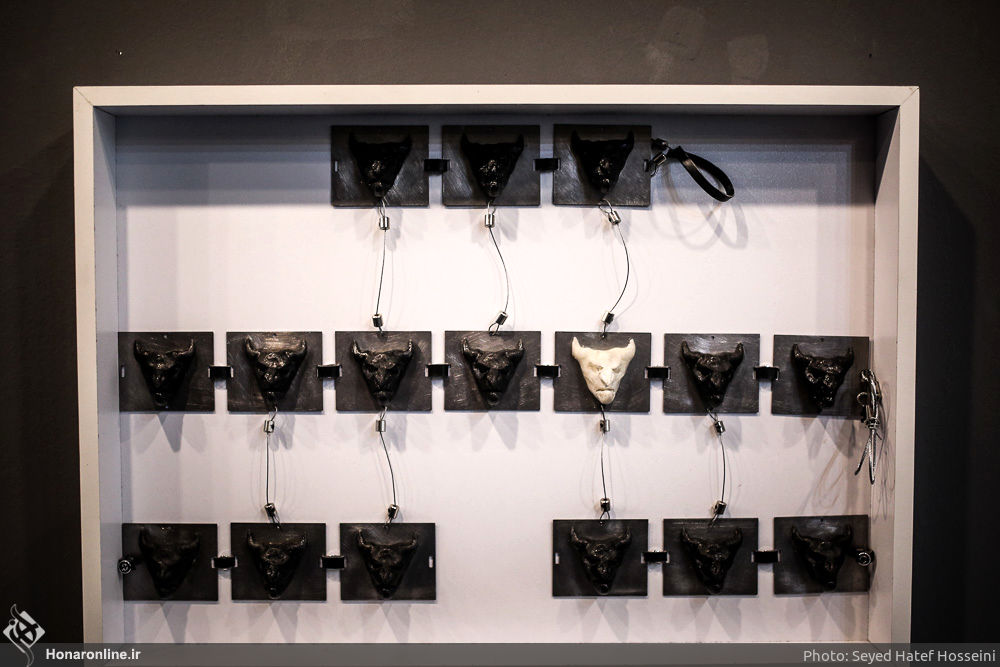
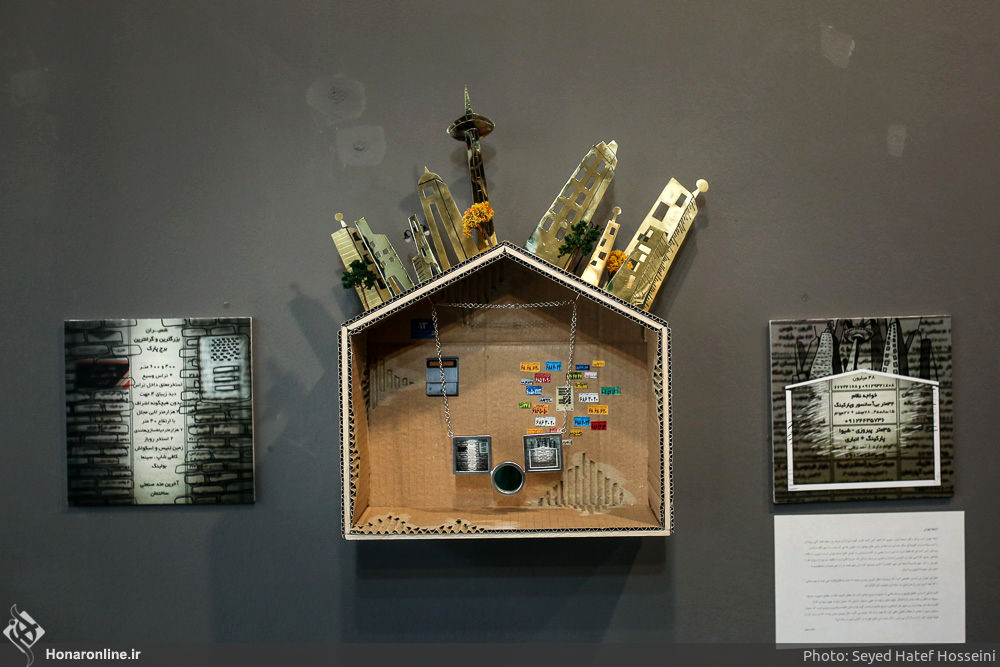
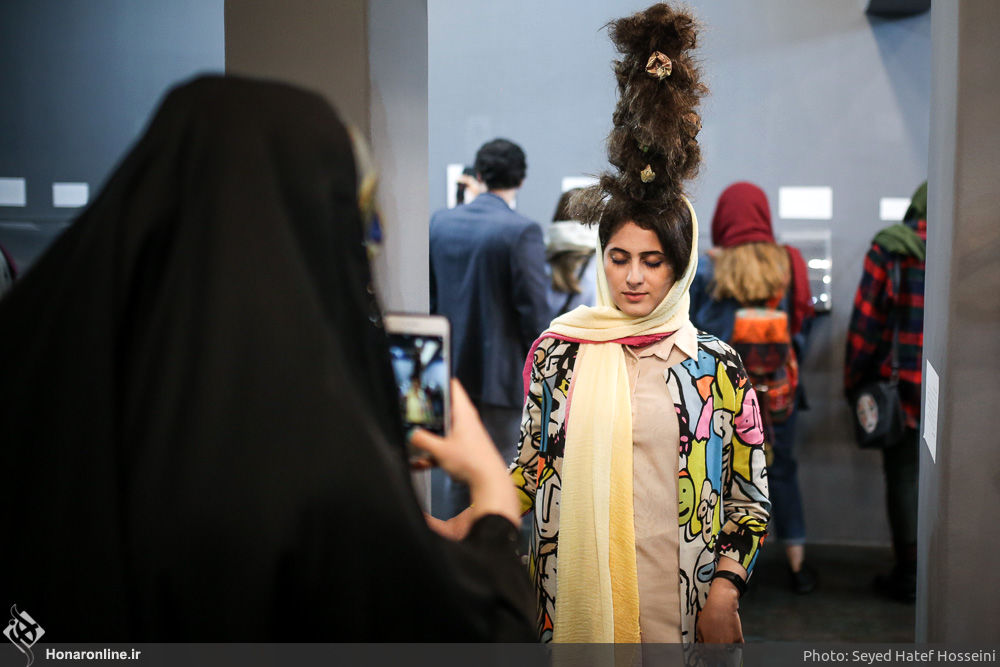
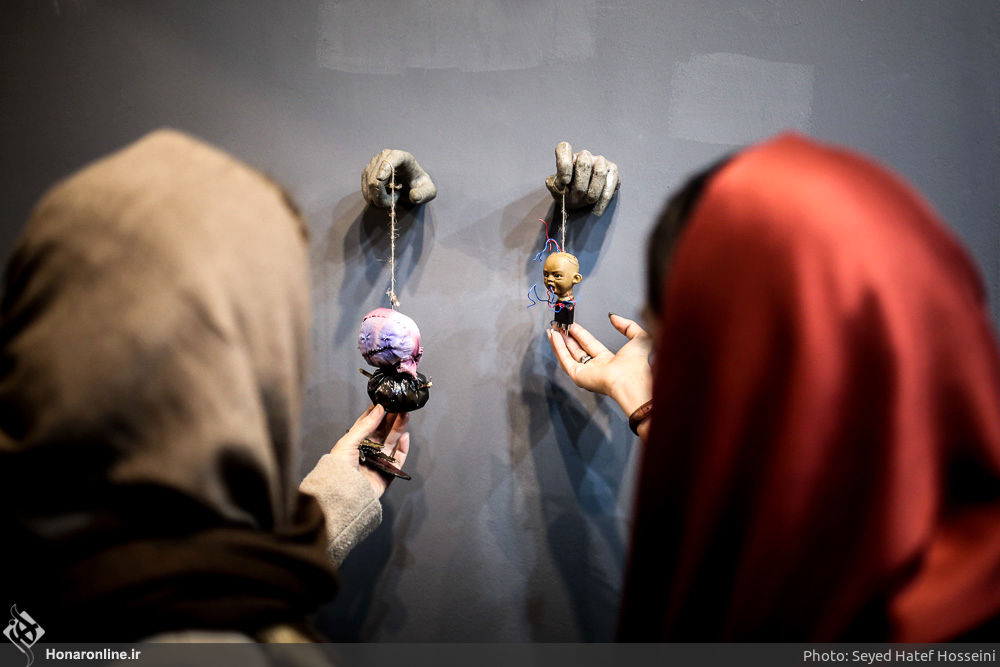
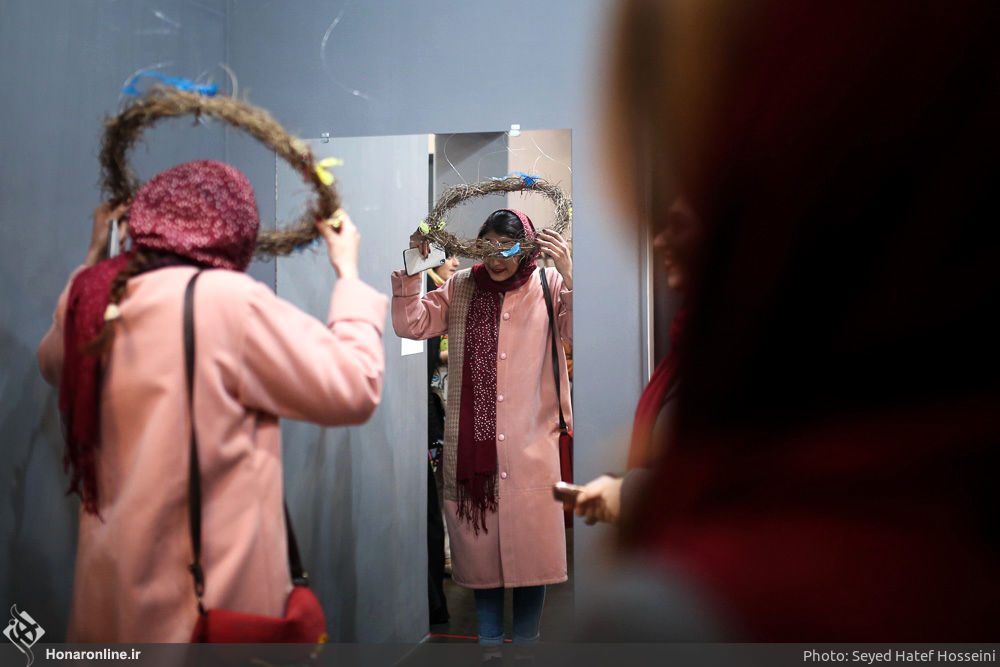
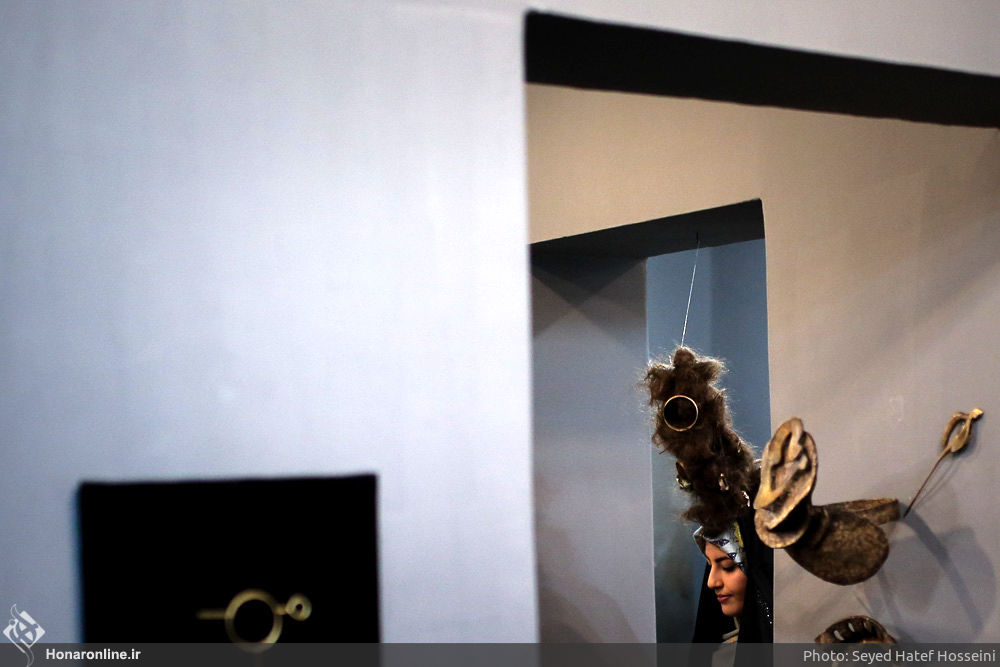
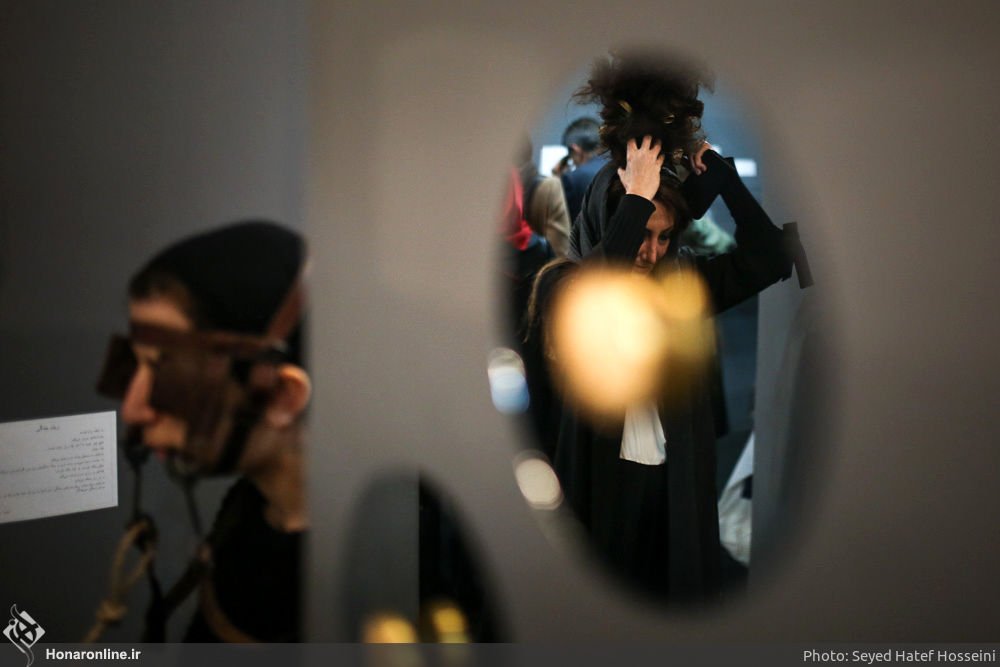
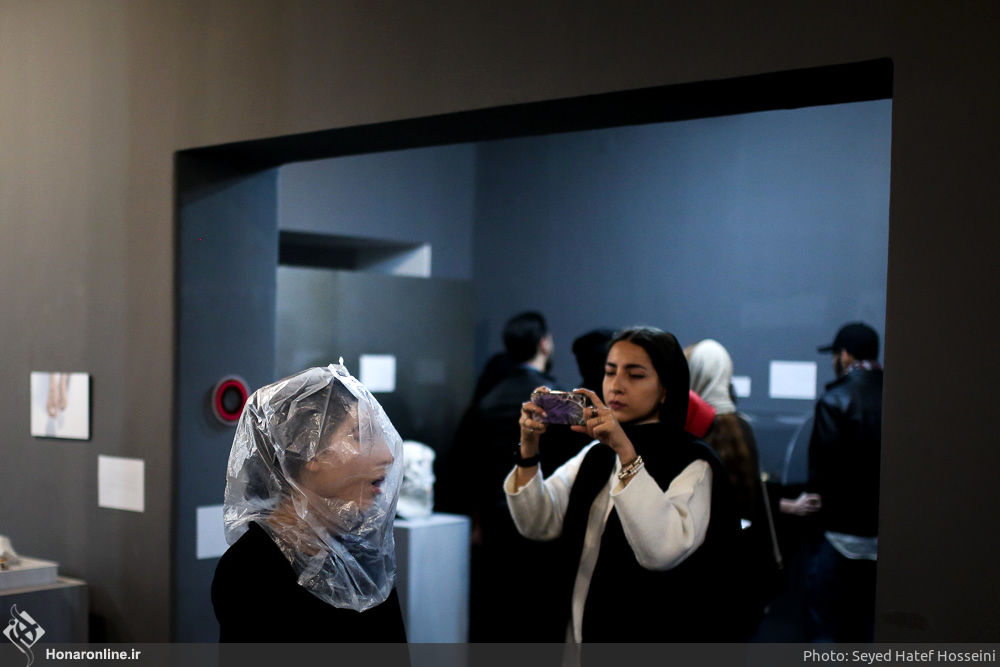
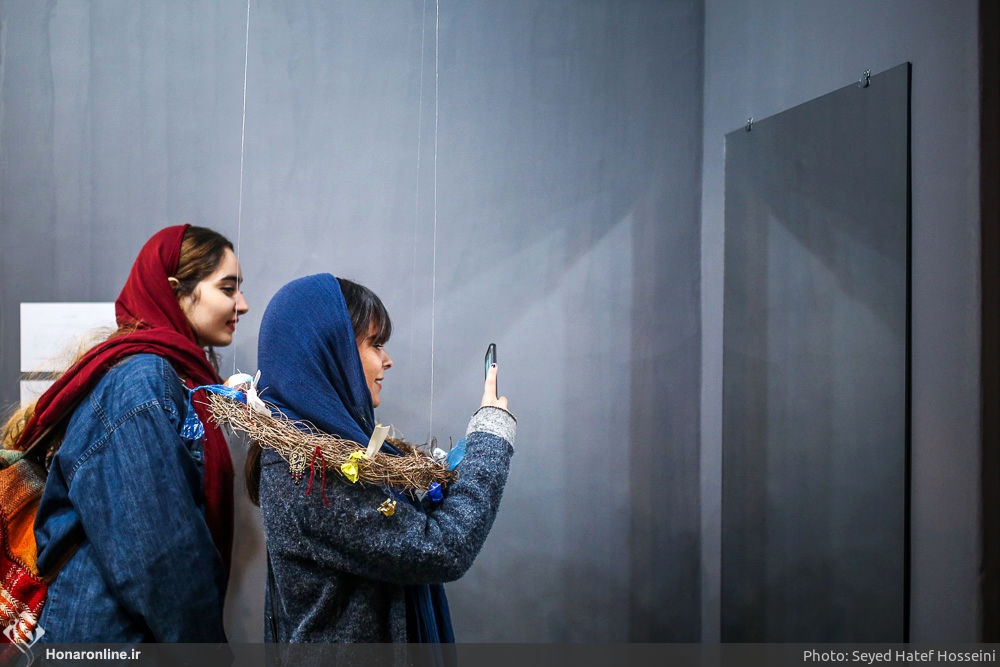
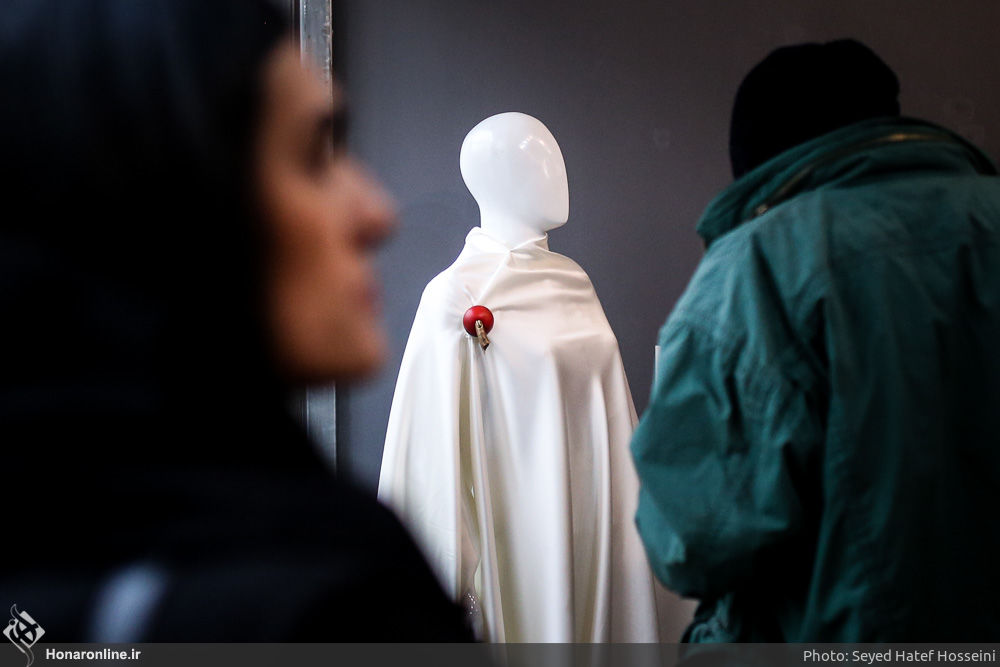
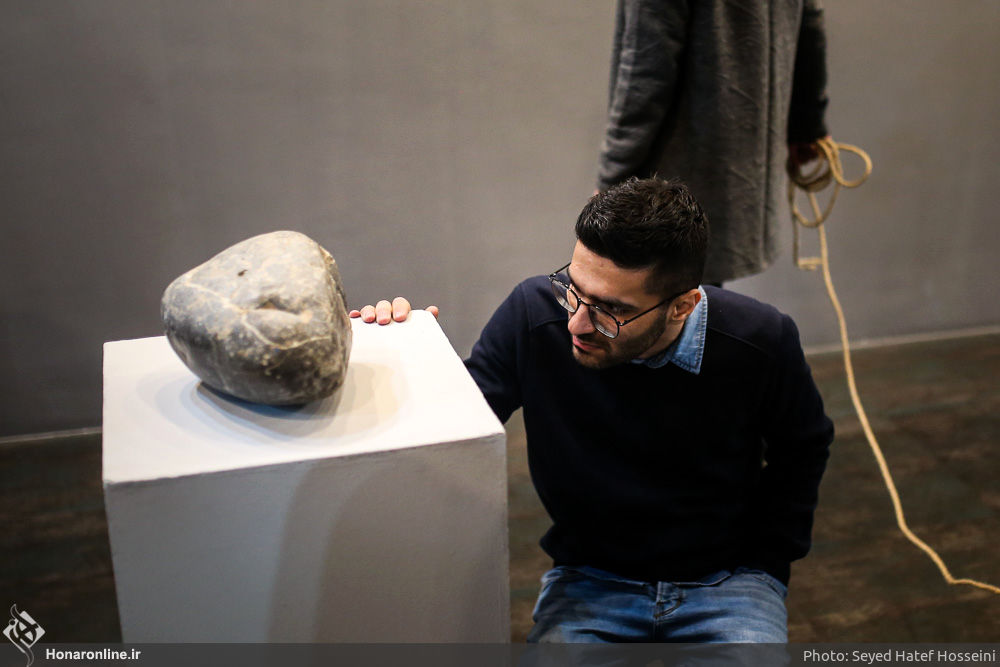
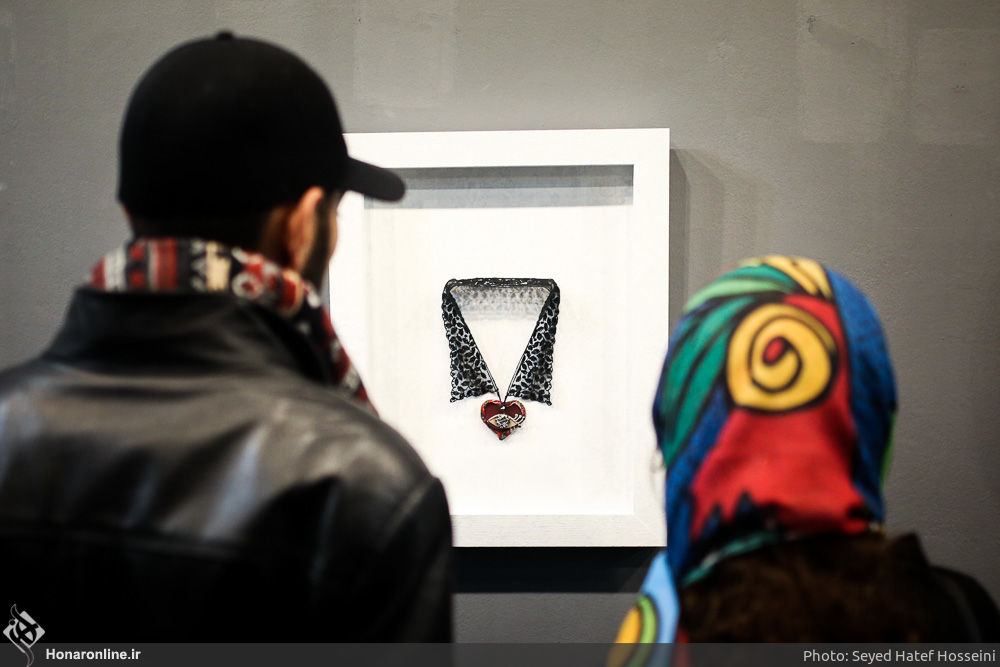
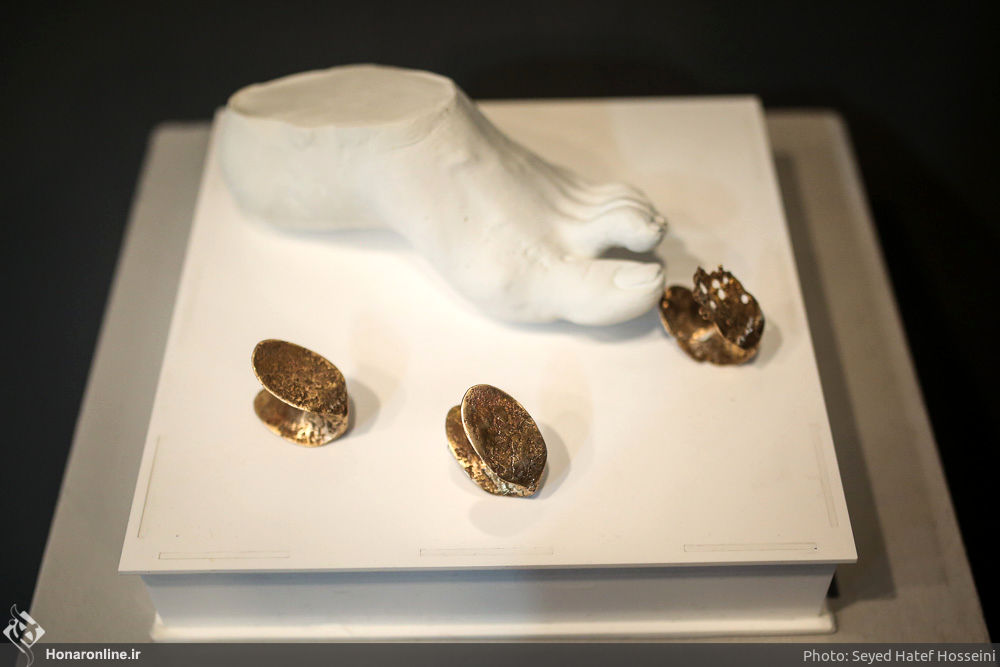
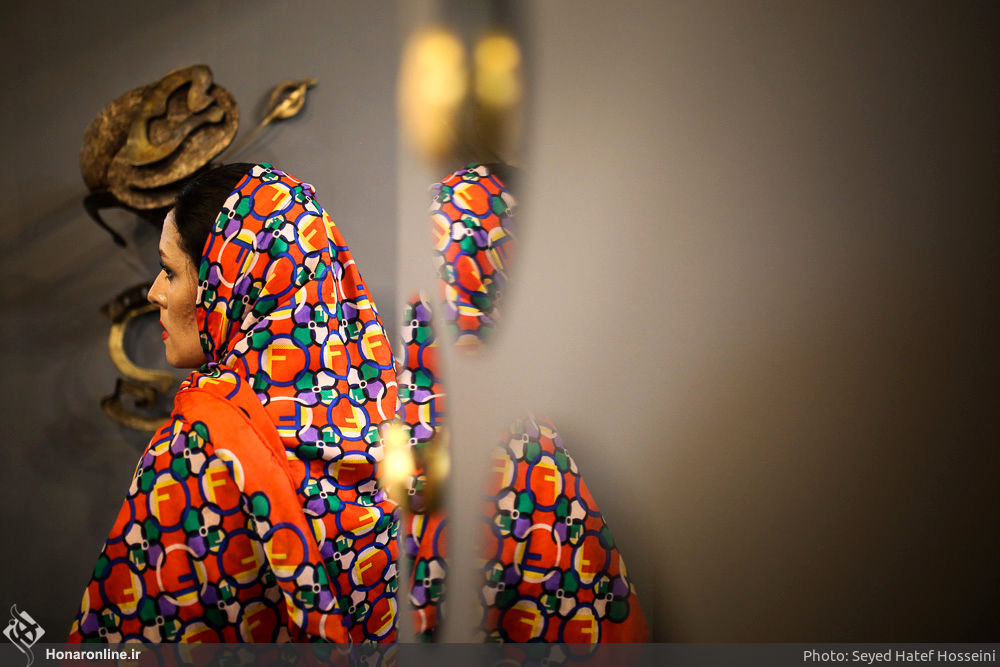
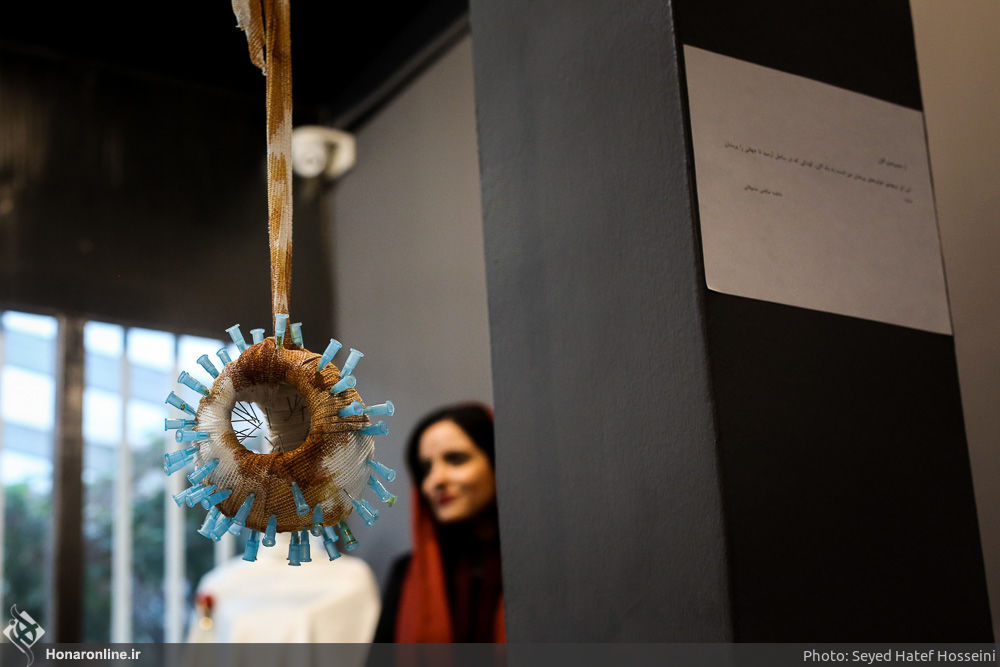
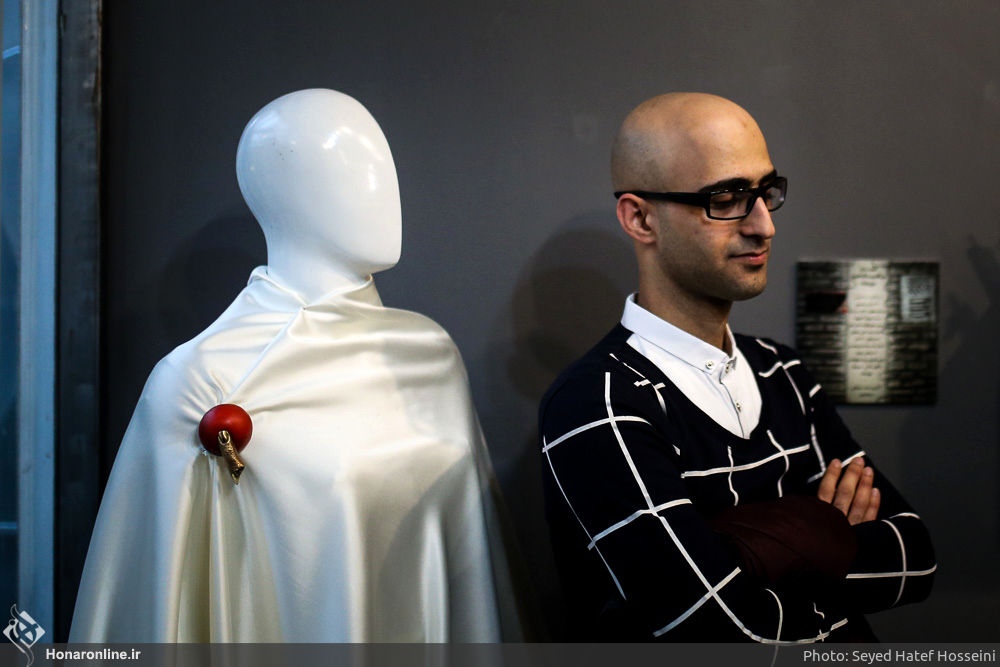
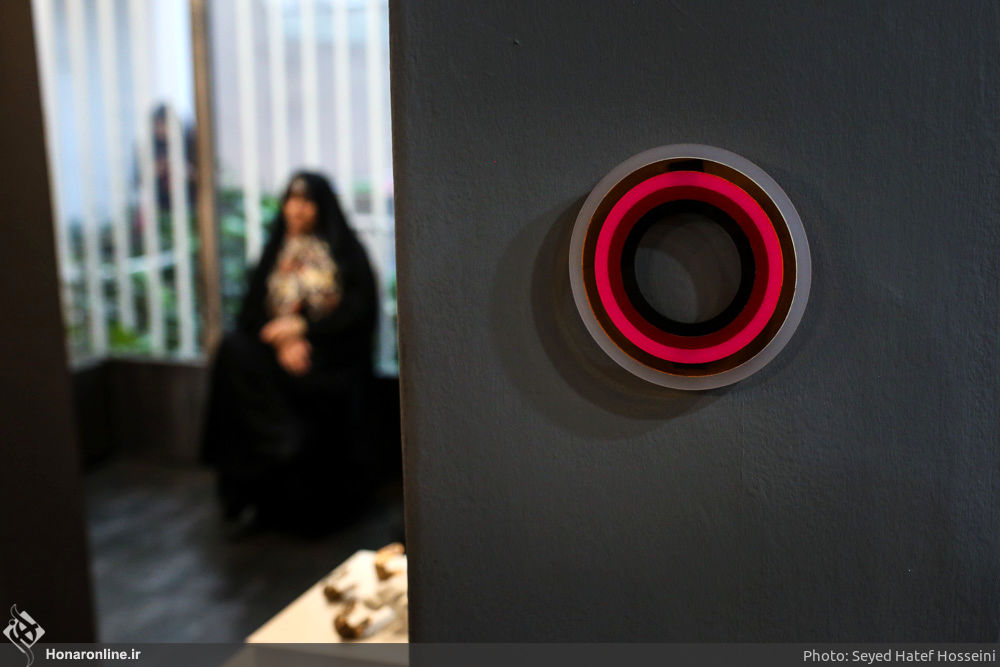
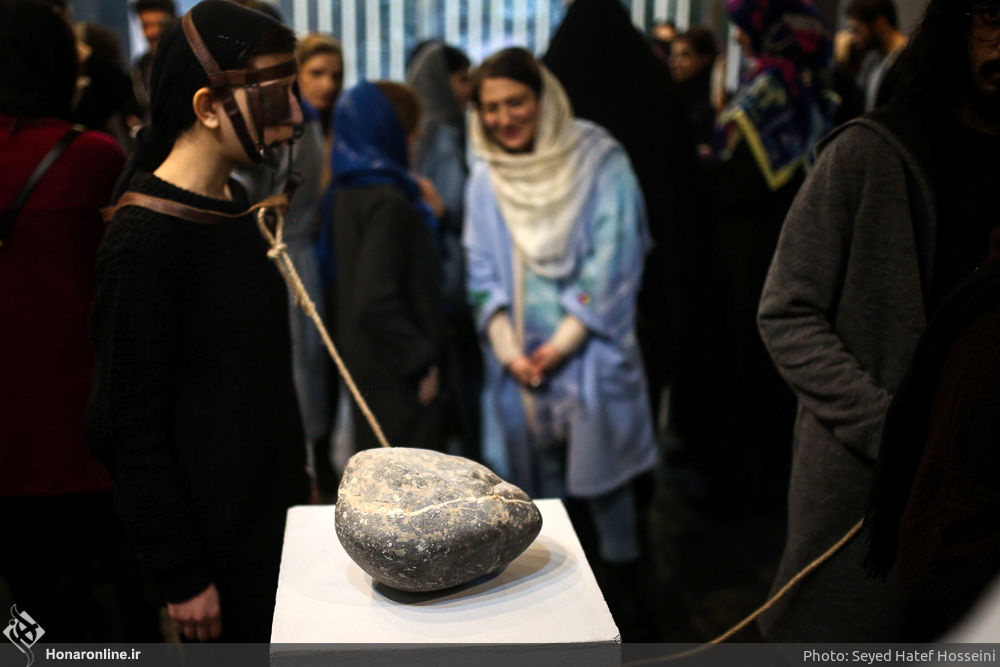
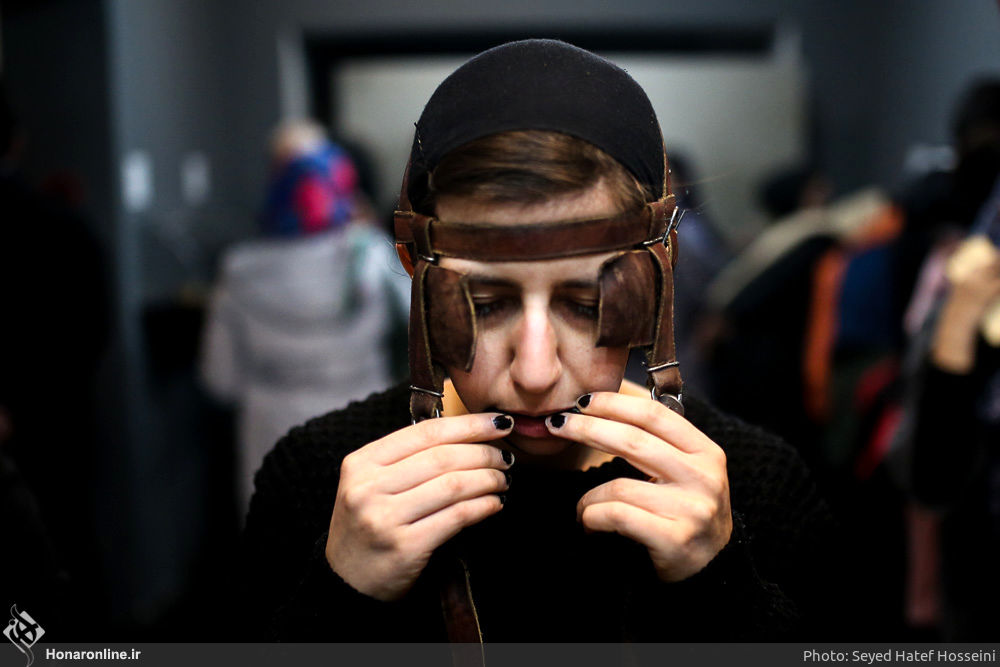
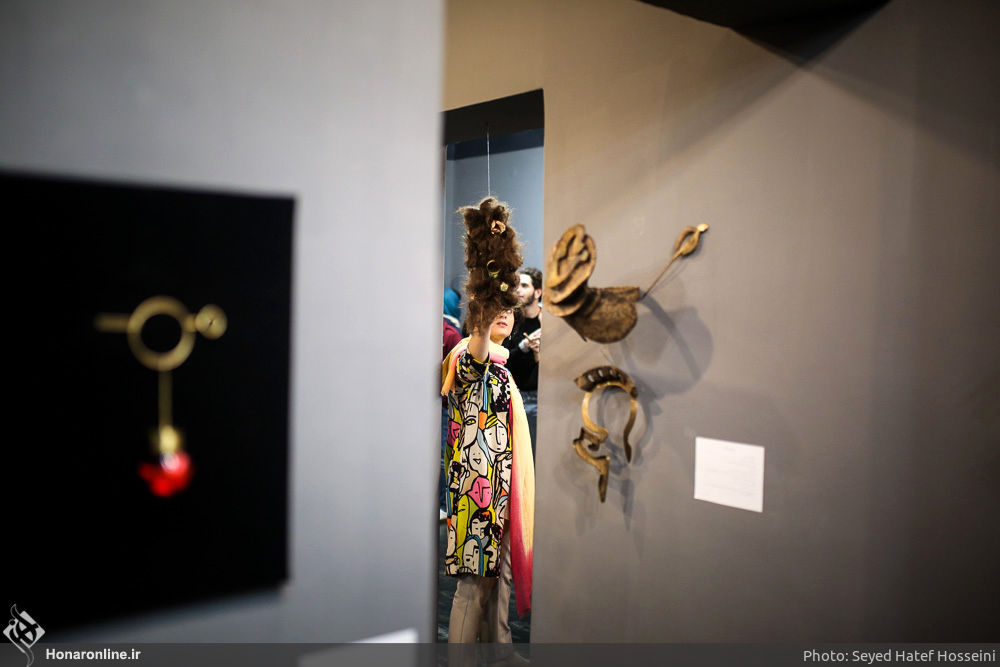
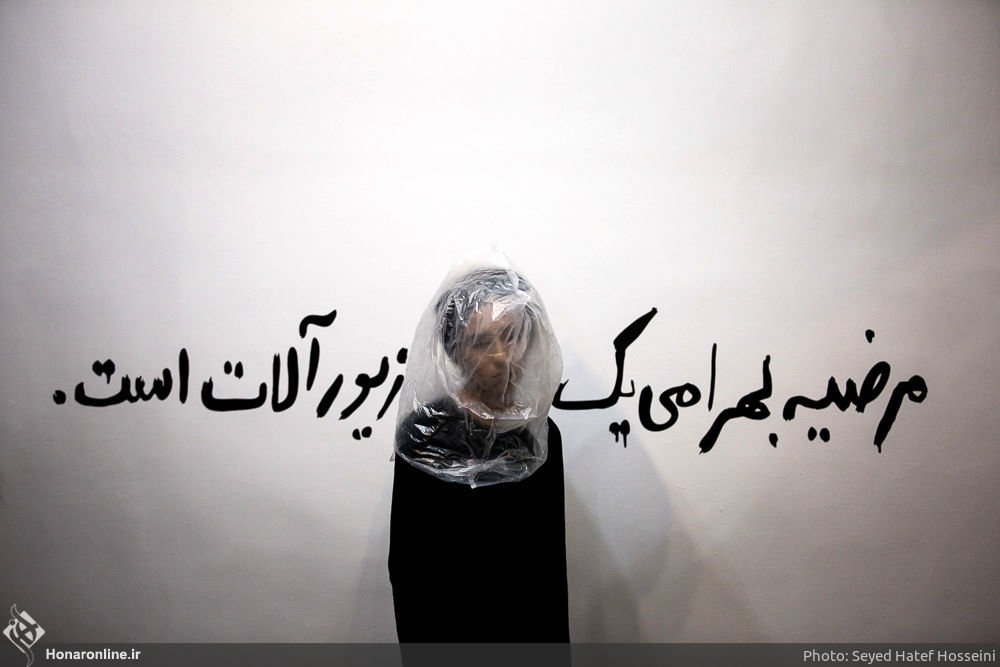
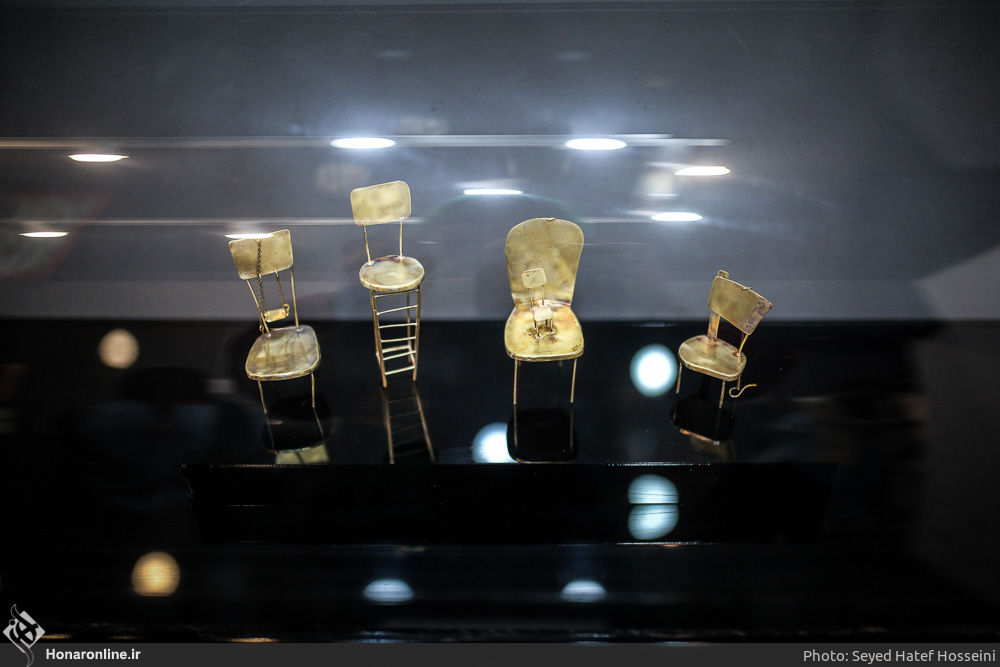
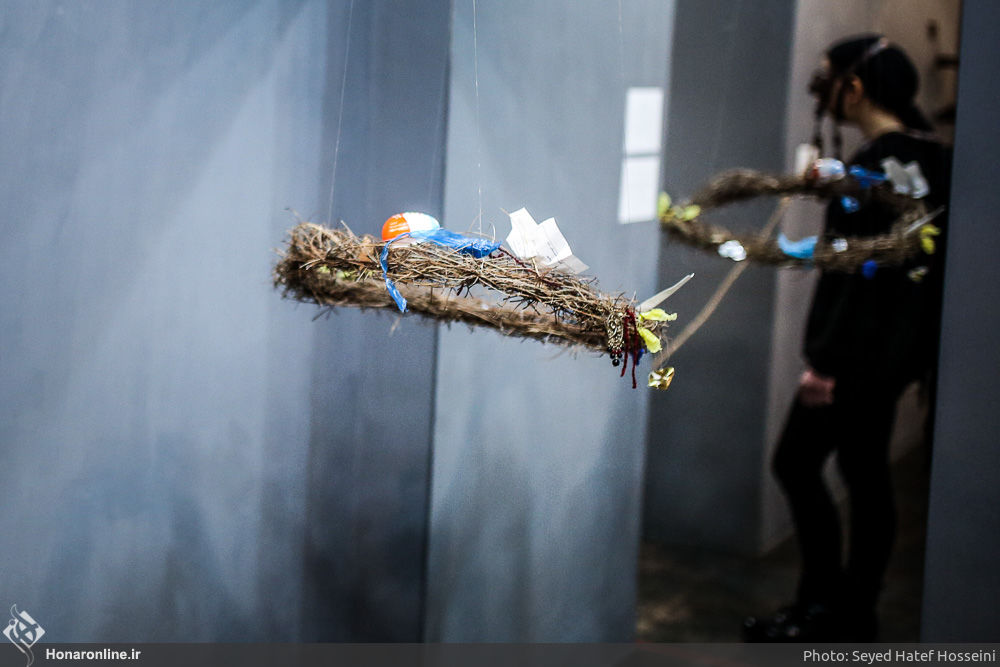
Tehran Hosting Exhibition of Contemporary Art Jewelry

The main goal of the exhibition, the organizers say, is to challenge the modern world’s social, cultural and political issues.

Modern art jewelry builds on the common features of various art forms like sculpture, painting, industrial designing, and fashion designing, and has managed to gain a special and independent status for itself.

Other goals of the event include understanding the current potential in art jewelry, unveiling new trends in this area, getting familiar with the contemporary art practices, ideas, technologies and patterns in art jewelry, offering new insights to visitors with a focus on creativity in choosing raw materials, and combining them together and making unique pieces.

The exhibition also seeks to increase the visual quality of works with a focus on the new concepts of today’s world, pay special attention to non-decorative aspects of jewelry and lay the ground for Iranian artists’ presence in various national and international arenas.

The exhibition will be underway until March 11.

The following photos of the exhibition have been retrieved from Honar Online website:

Iran Must Enjoy Benefits of Implementing Palermo Convention: VP

“Some say there is no need to adhere to the convention when there are similar regulations inside the country. I say the opposite and believe that when we have to meet commitments to the convention inside the country, we should ask other parties to implement the same for Iran,” said Joneydi Tuesday.

She further noted that when a crime occurs or the perpetrator escapes, we should ask the other member states to extradite the perpetrator or give information about the possible crime based on the Convention. “We can also exchange criminals with other countries if we join it.”

“We should be able to benefit from the conventions and to do so we must join the Palermo Convention,” underscored Joneydi.

The United Nations Convention against Transnational Organised Crime, adopted by General Assembly resolution on November 15, 2000, is the main international instrument in the fight against transnational organised crime. It was opened for signature by member states at a conference convened for that purpose in Palermo, Italy.

The convention is further supplemented by three protocols, which target specific areas and manifestations of organised crime: the protocol to prevent, suppress and punish trafficking in persons, especially women and children; the protocol against the smuggling of migrants by land, sea and air; and the protocol against the Illicit manufacturing and trafficking of firearms.