Monday, April 13, 2026
Home Blog Page 3247

A Look at Iranian Newspaper Front Pages on June 3

A Look at Iranian Newspaper Front Pages on November 19

The top story in all papers today was US Secretary of State Mike Pompeo’s call for “unconditional talks” with Iran, which was rejected as a dishonest call by Iranian Foreign Ministry Spokesman Seyyed Abbas Mousavi.

The upcoming visit of Japanese Prime Minister Shinzo Abe to Tehran, which will be the first of its kind since the 1979 Revolution, also received great coverage.

The above issues, as well as many more, are highlighted in the following headlines and top stories:


19 Dey:

1- Larijani: Saudis, Emiratis’ Behaviours Detrimental for Themselves in Long-Run

2- Pompeo Says US Ready for Unconditional Talks with Iran
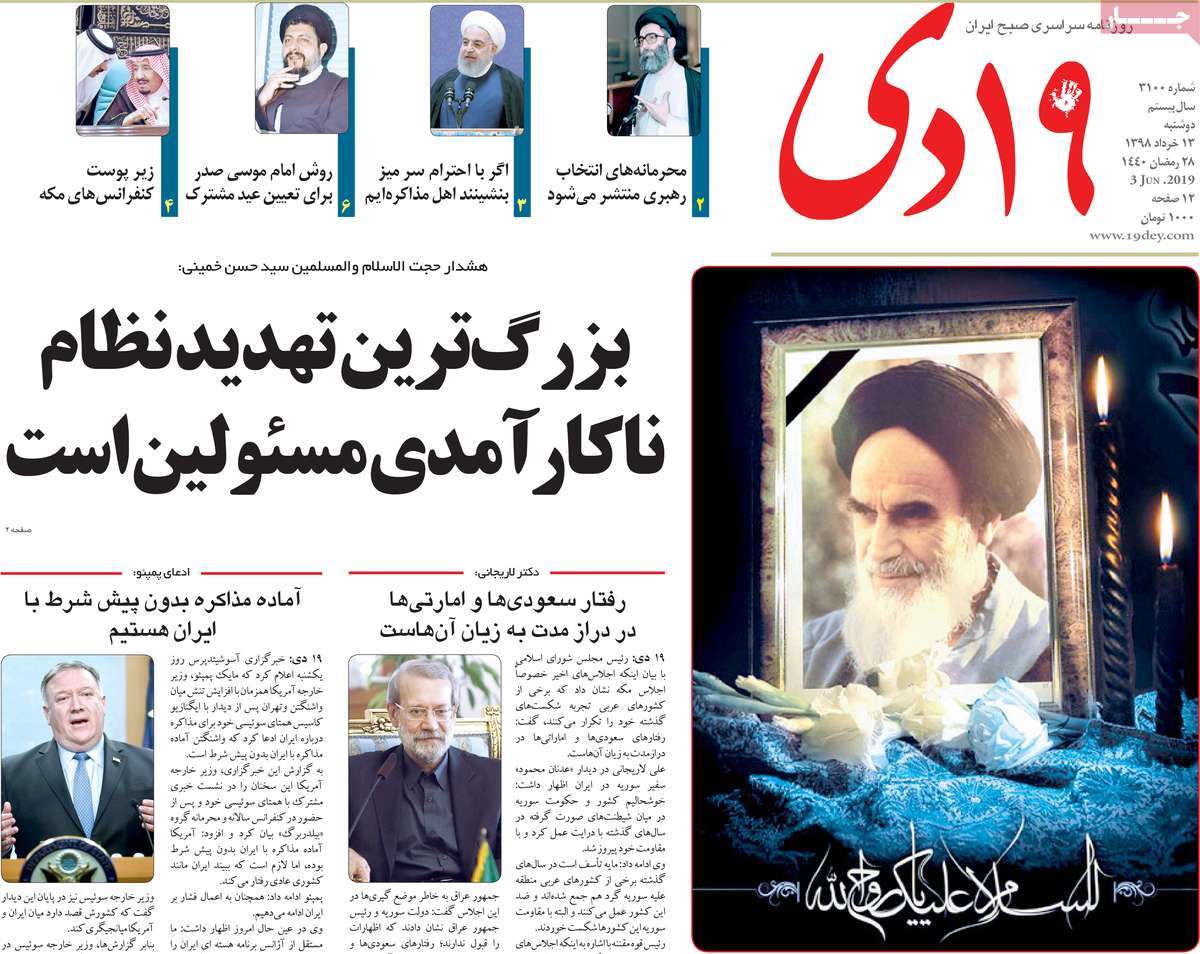
A Look at Iranian Newspaper Front Pages on June 3


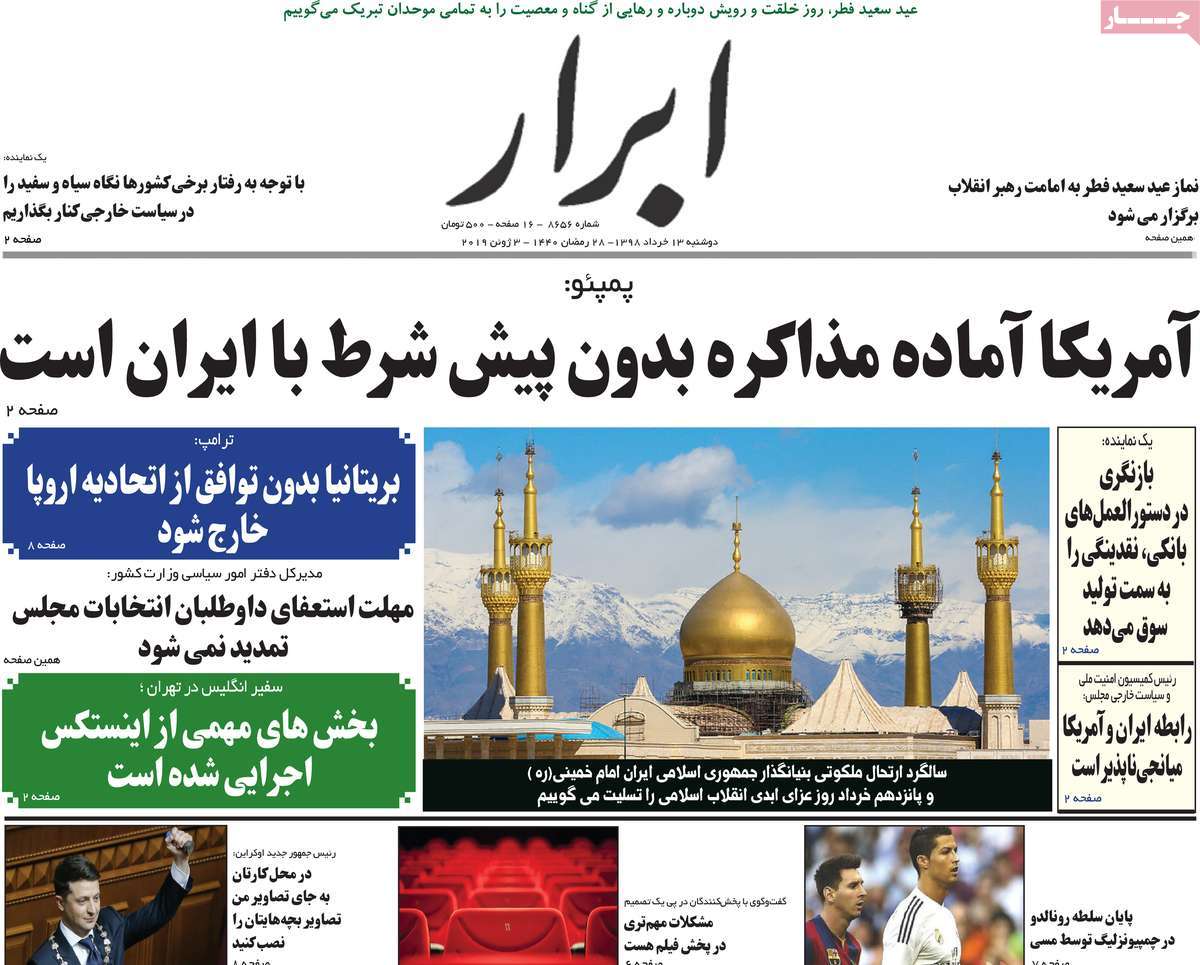
Abrar:

1- Trump: Britain Must Leave EU without Deal

2- UK Ambassador to Tehran: Major Parts of INSTEX Implemented

3- Senior Lawmaker: Iran-US Ties Not Resolvable with Mediators
A Look at Iranian Newspaper Front Pages on June 3


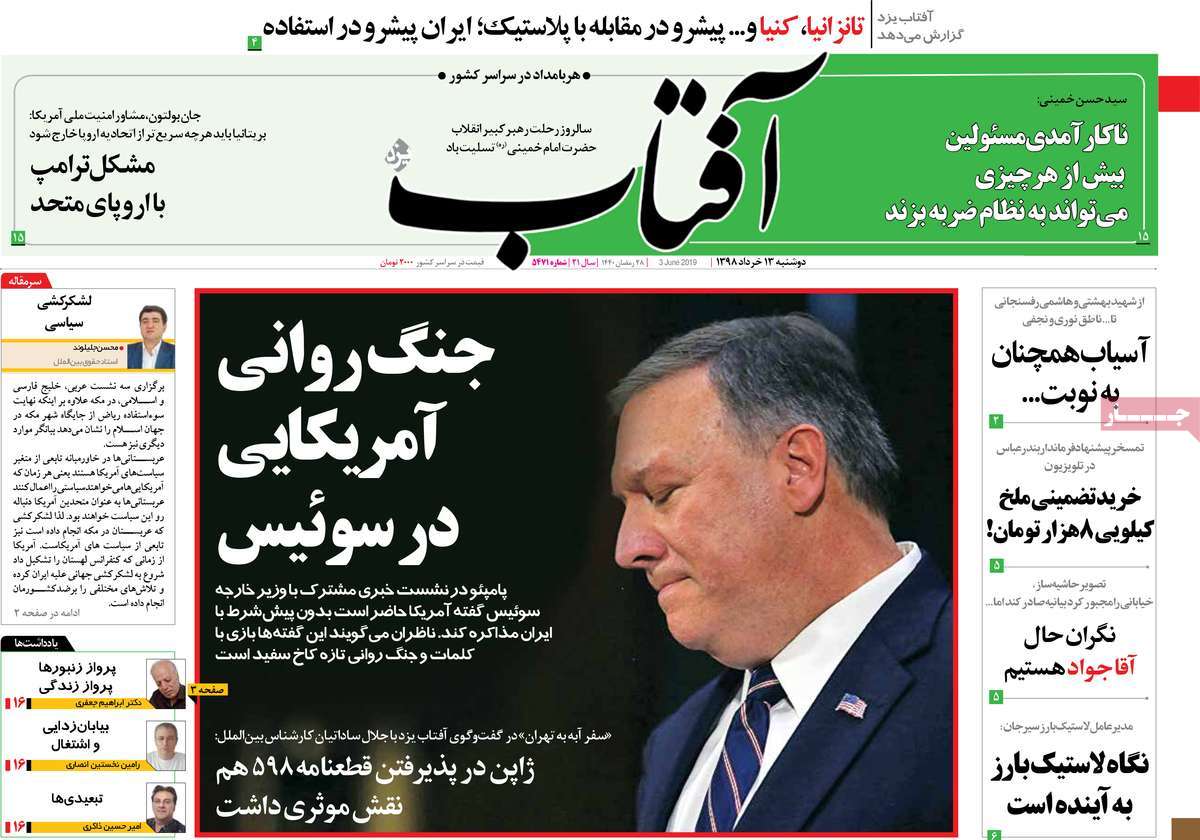
Aftab-e Yazd:

1- US’ Psy-War in Switzerland

2- Review of Abe’s Visit to Tehran

* Japan Played Major Role in Adoption of 598 Resolution
A Look at Iranian Newspaper Front Pages on June 3


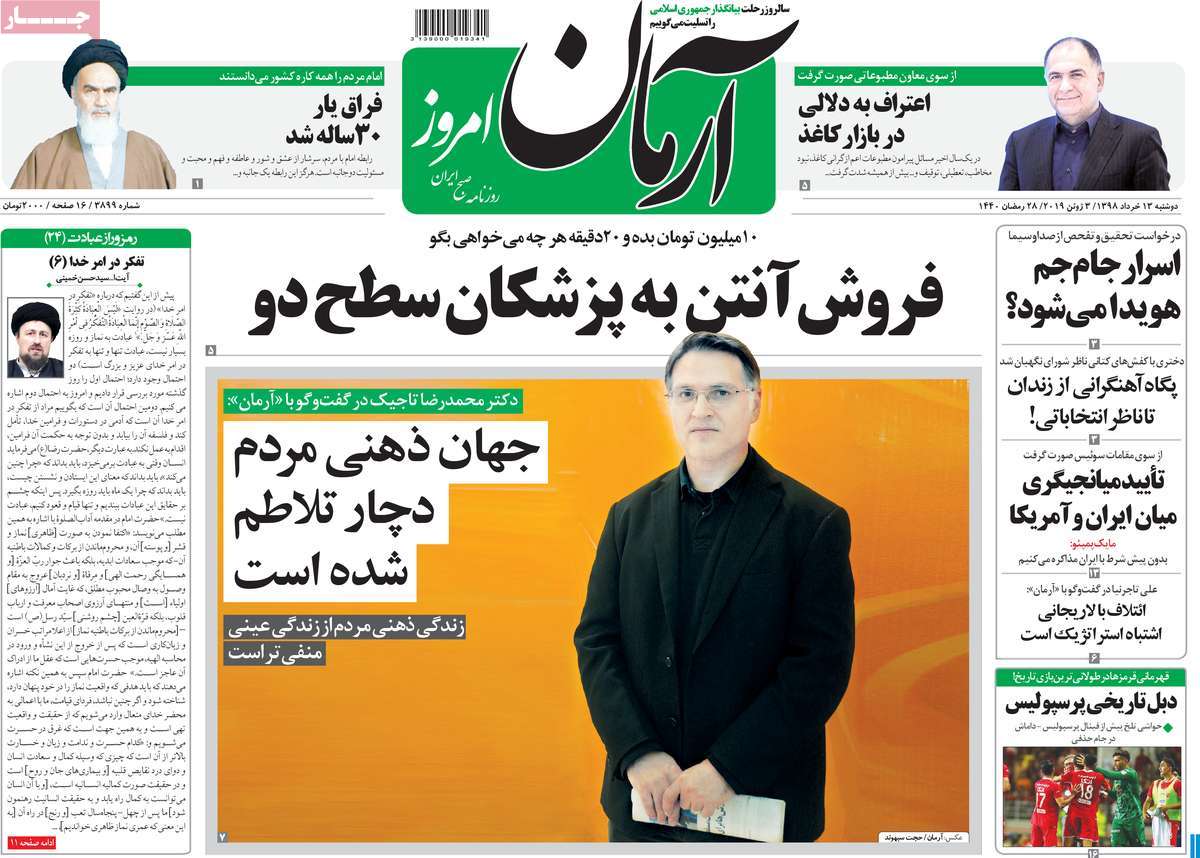
Arman-e Emrooz:

1- Swiss Official Confirms Mediation between Iran, US
A Look at Iranian Newspaper Front Pages on June 3


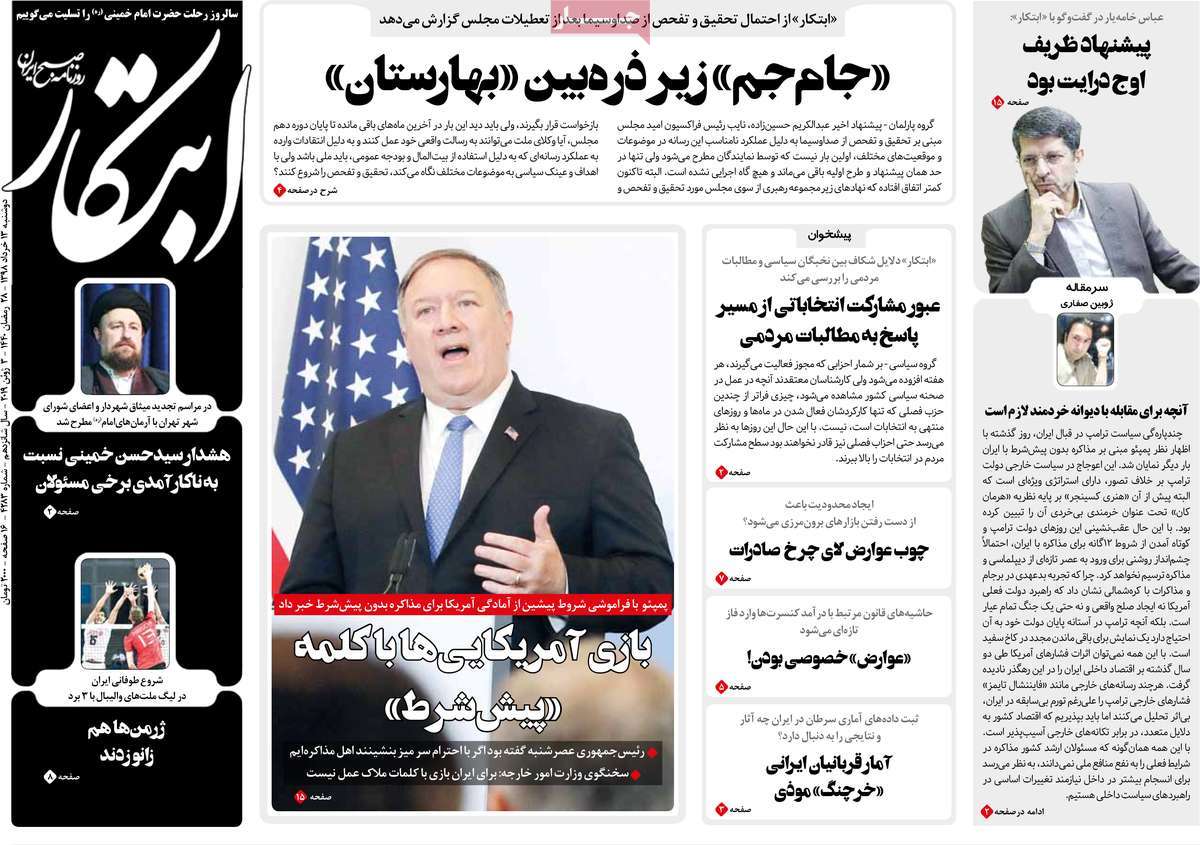
Ebtekar:

1- Americans Playing with Word of ‘Precondition’

* Iran Pays No Attention to Word-Plays: Spokesman

2- Zarif’s Offer Showed His Prudence: Analyst
A Look at Iranian Newspaper Front Pages on June 3


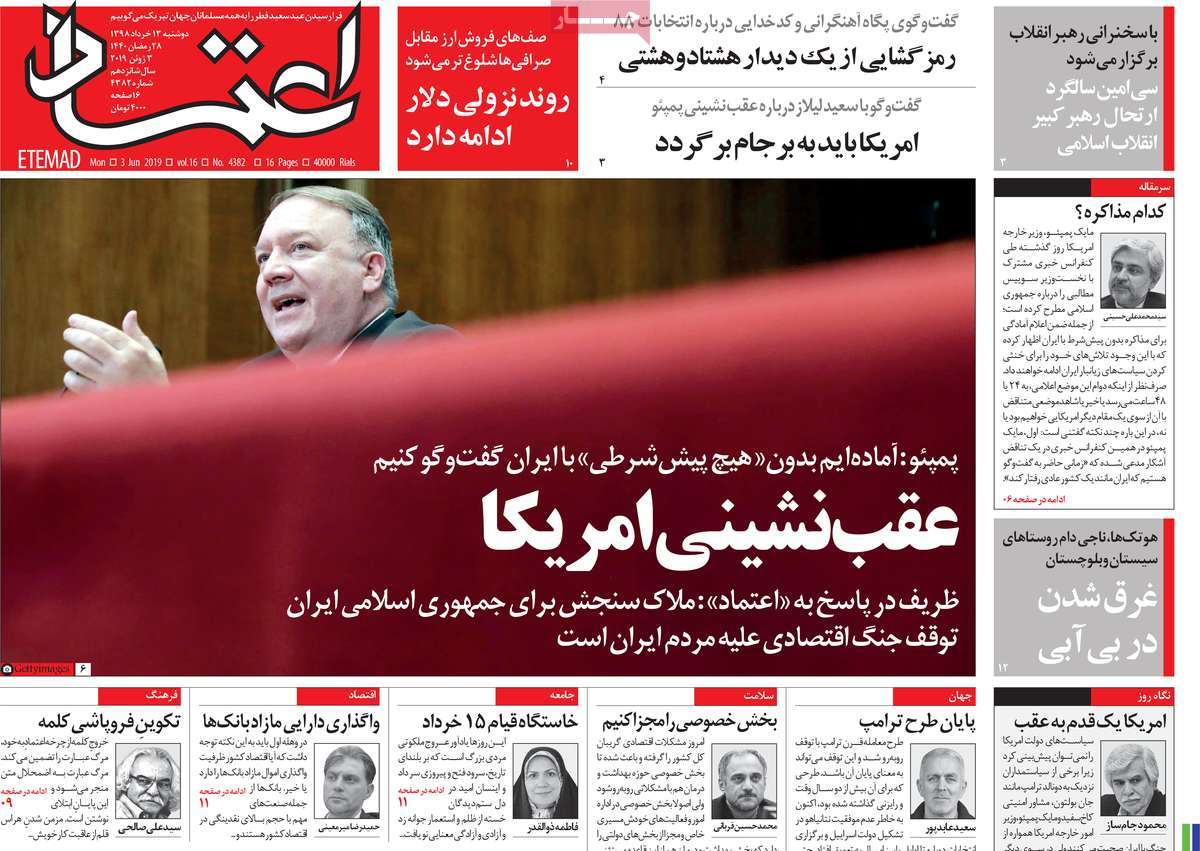
Etemad:

1- US Backs Off

* Pompeo: We’re Ready for Unconditional Talks with Iran

2- Zarif: US Must First Cease Its Economic War on Iranians

3- Analyst: US Must Return to JCPOA First

4- US Dollar Rate Decreasing in Iran Market
A Look at Iranian Newspaper Front Pages on June 3


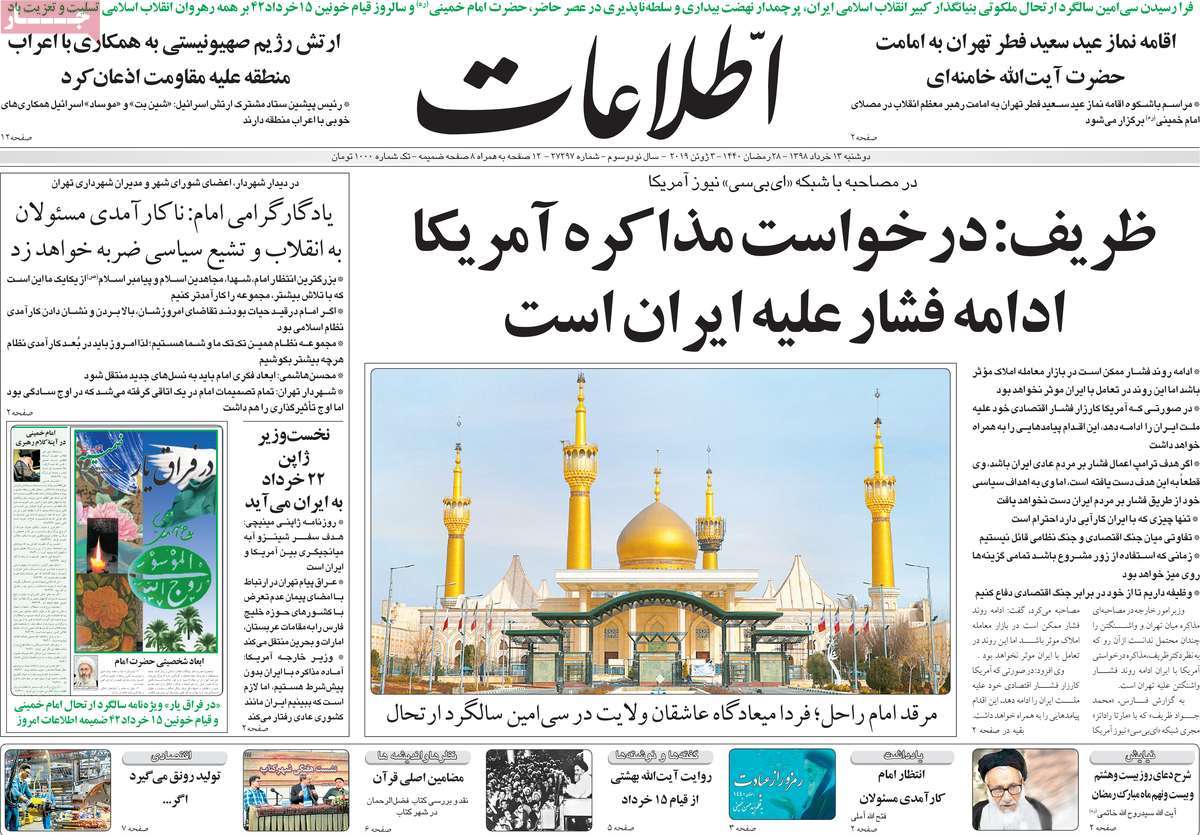
Ettela’at:

1- Zarif to ABC News: US’ Call for Talks Part of Its Pressure against Iran

2- Japan PM to Visit Iran on June 12
A Look at Iranian Newspaper Front Pages on June 3


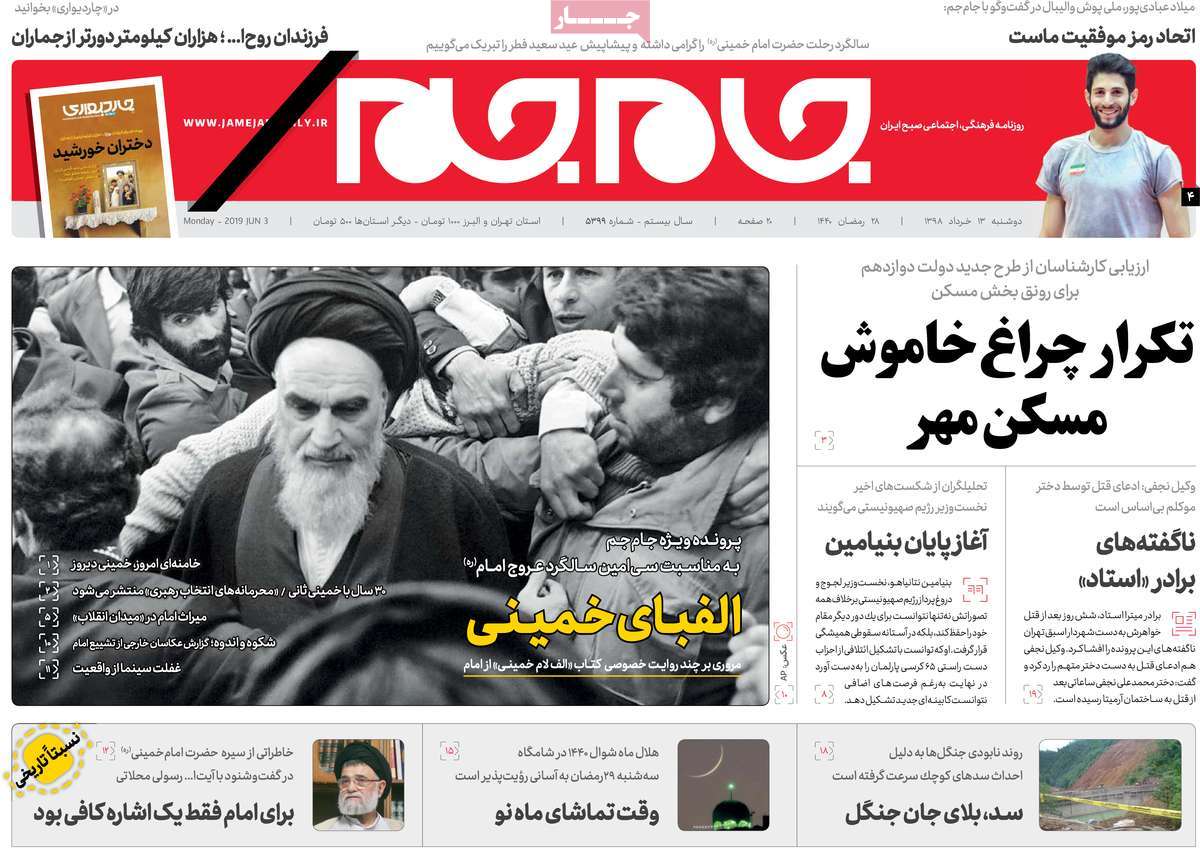
Jame Jam:

1- Alphabet of Imam Khomeini

* A Case on 30th Anniversary of Imam’s Death
A Look at Iranian Newspaper Front Pages on June 3


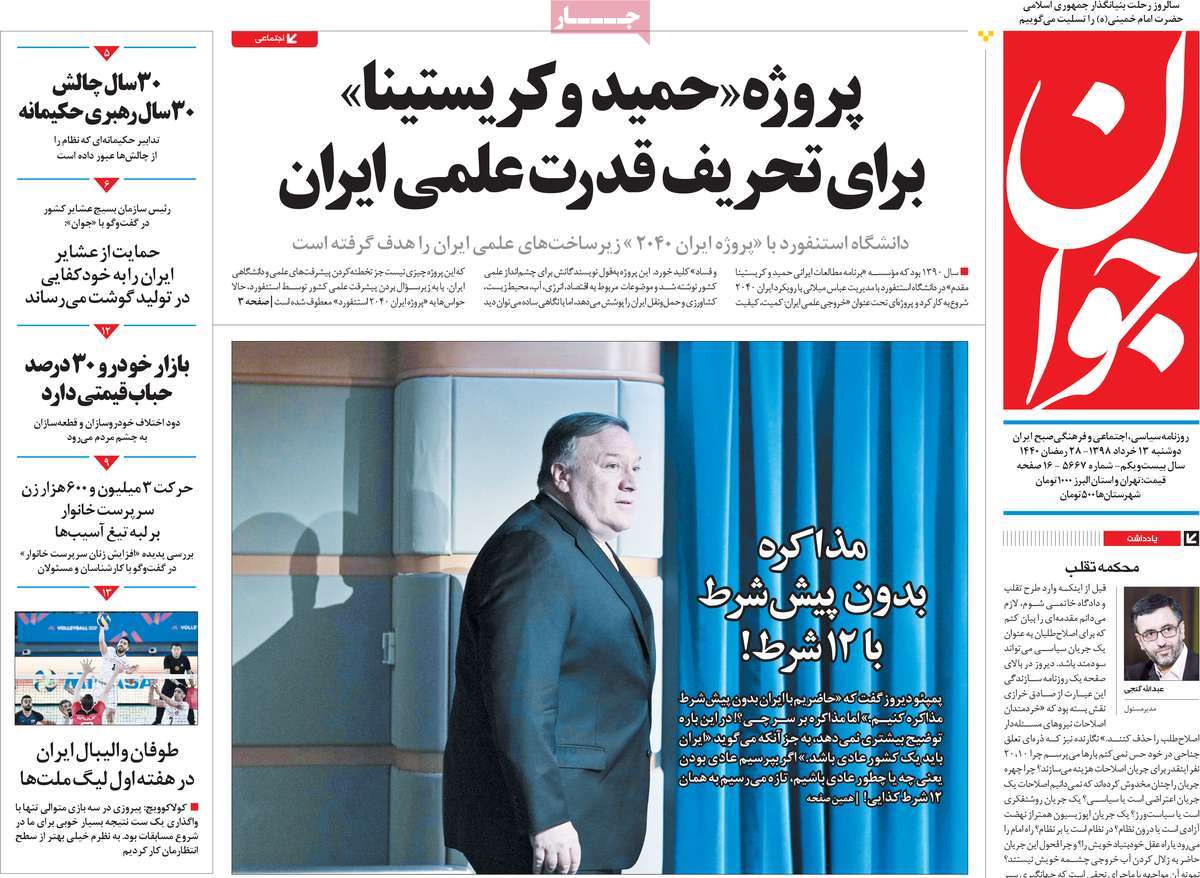
Javan:

1- Stanford University Targeting Iran’s Scientific Infrastructure with Project Iran 2040

2- Unconditional Talks with 12 Preconditions!
A Look at Iranian Newspaper Front Pages on June 3


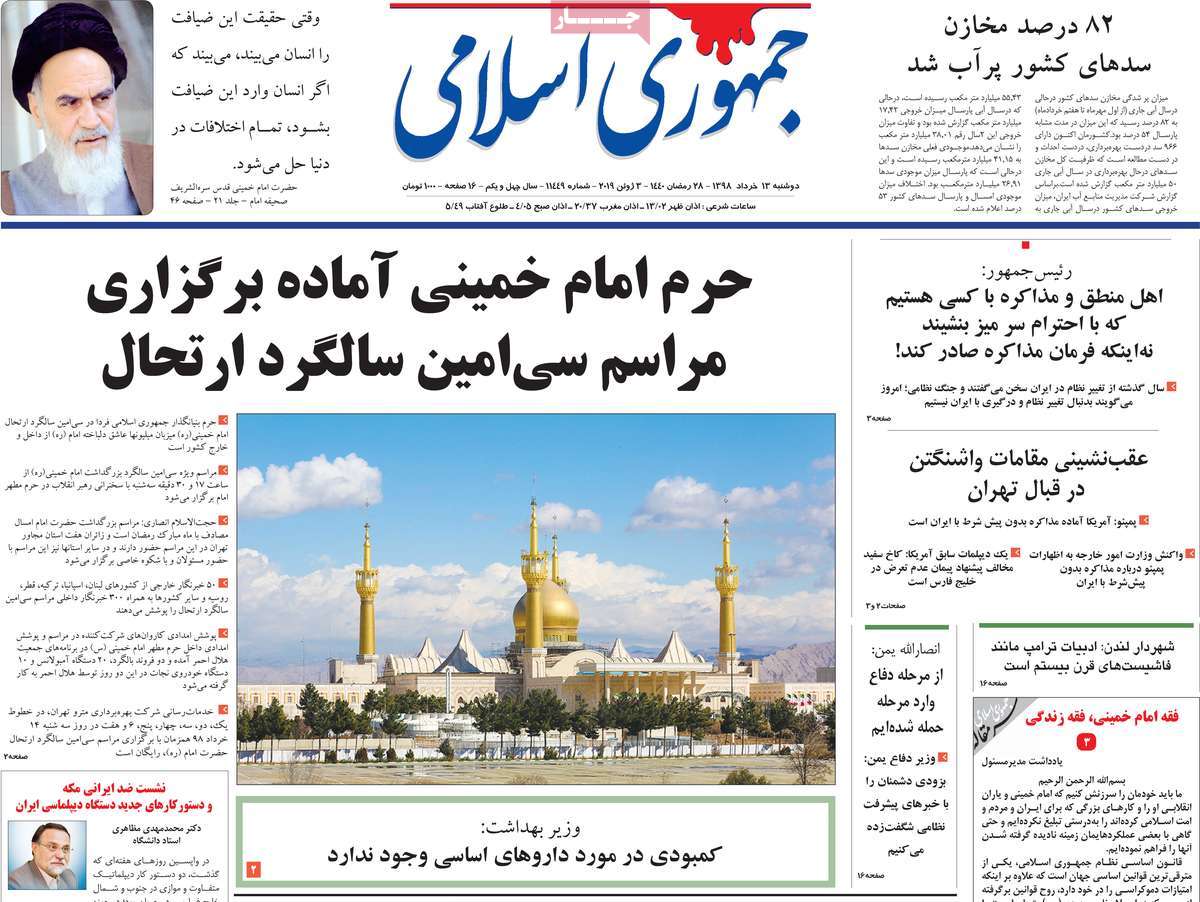
Jomhouri Eslami:

1- Rouhani: We’d Sit for Talks with Those Who Negotiate with Respect

2- Washington Officials Back Off
A Look at Iranian Newspaper Front Pages on June 3


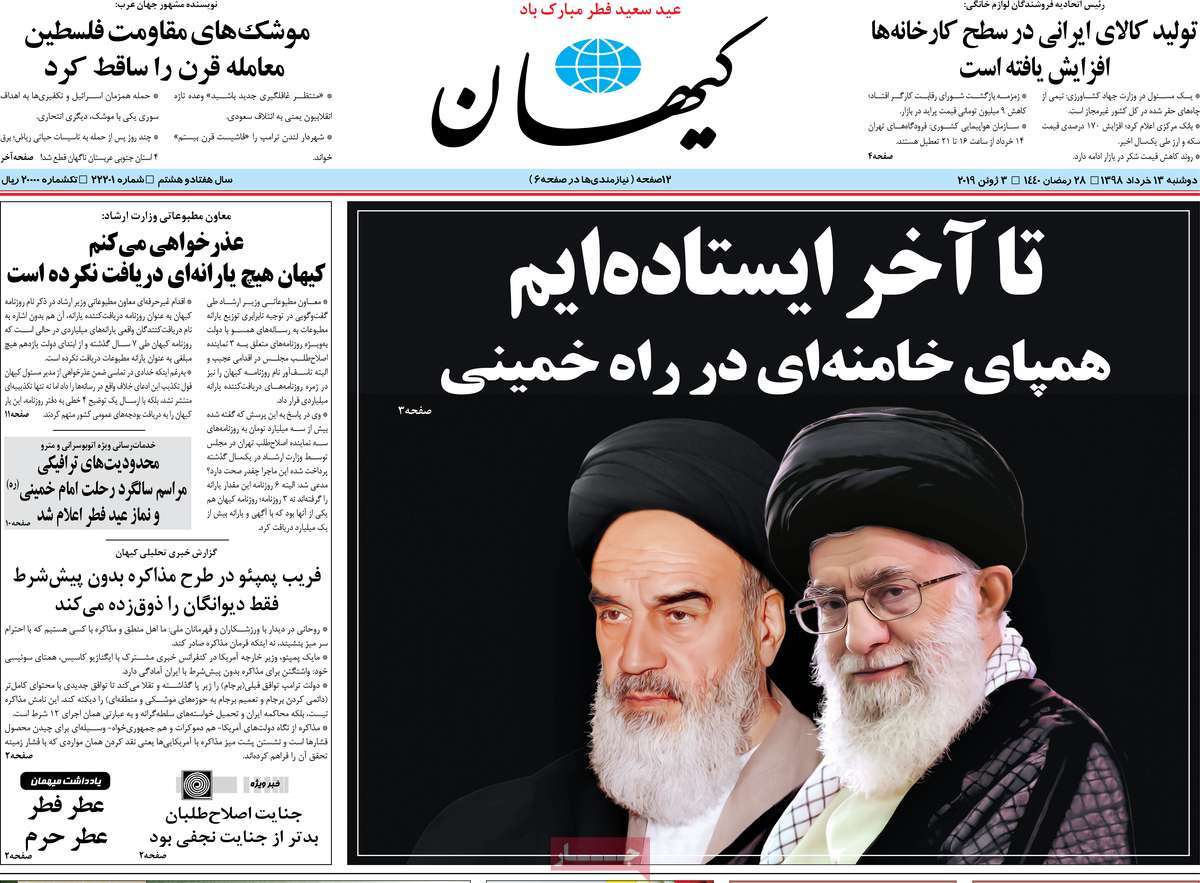
Kayhan:

1- Domestic Production Increased in Factories

2- Only Crazy People Would Be Excited by Pompeo’s Deceitful Offer for Unconditional Talks
A Look at Iranian Newspaper Front Pages on June 3


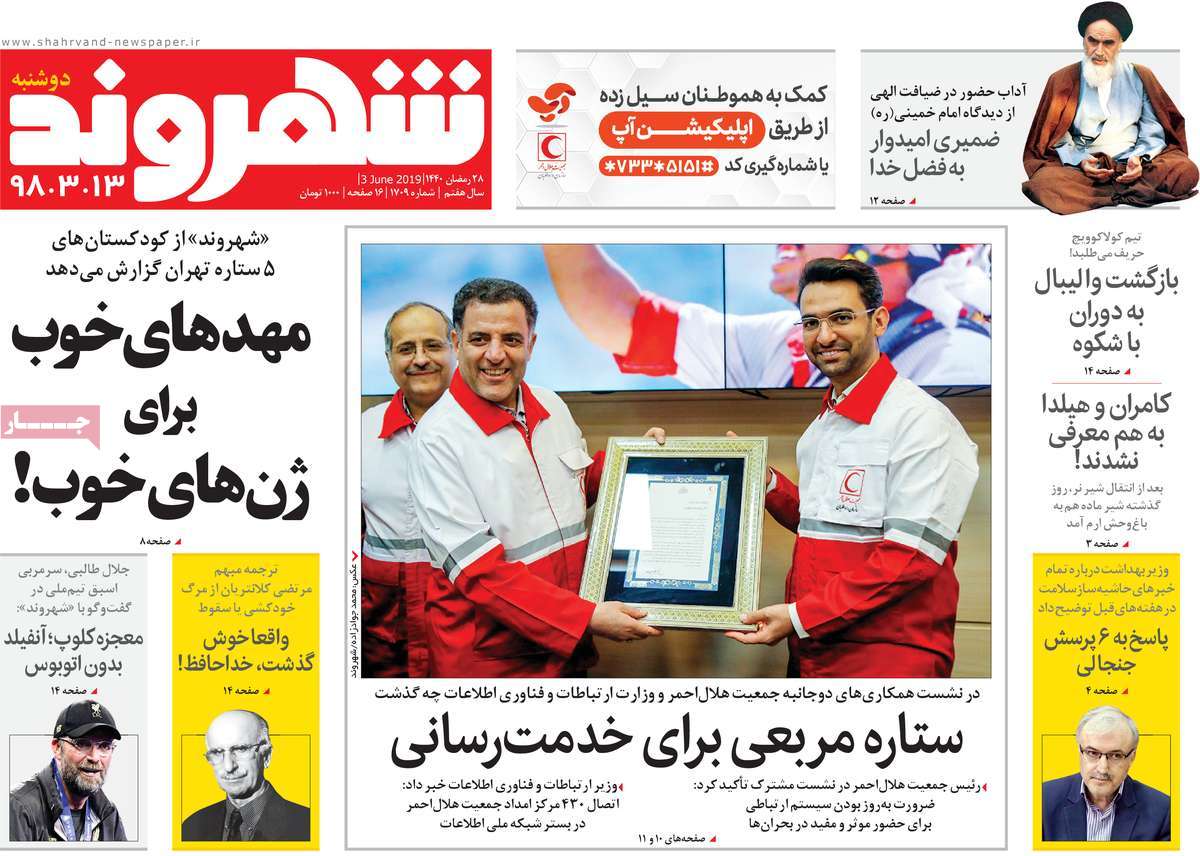
Shahrvand:

1- Persian Lioness Hilda Joins Lion Kamran in Tehran

2- Return of Iran’s Volleyball to Its Era of Glory
A Look at Iranian Newspaper Front Pages on June 3


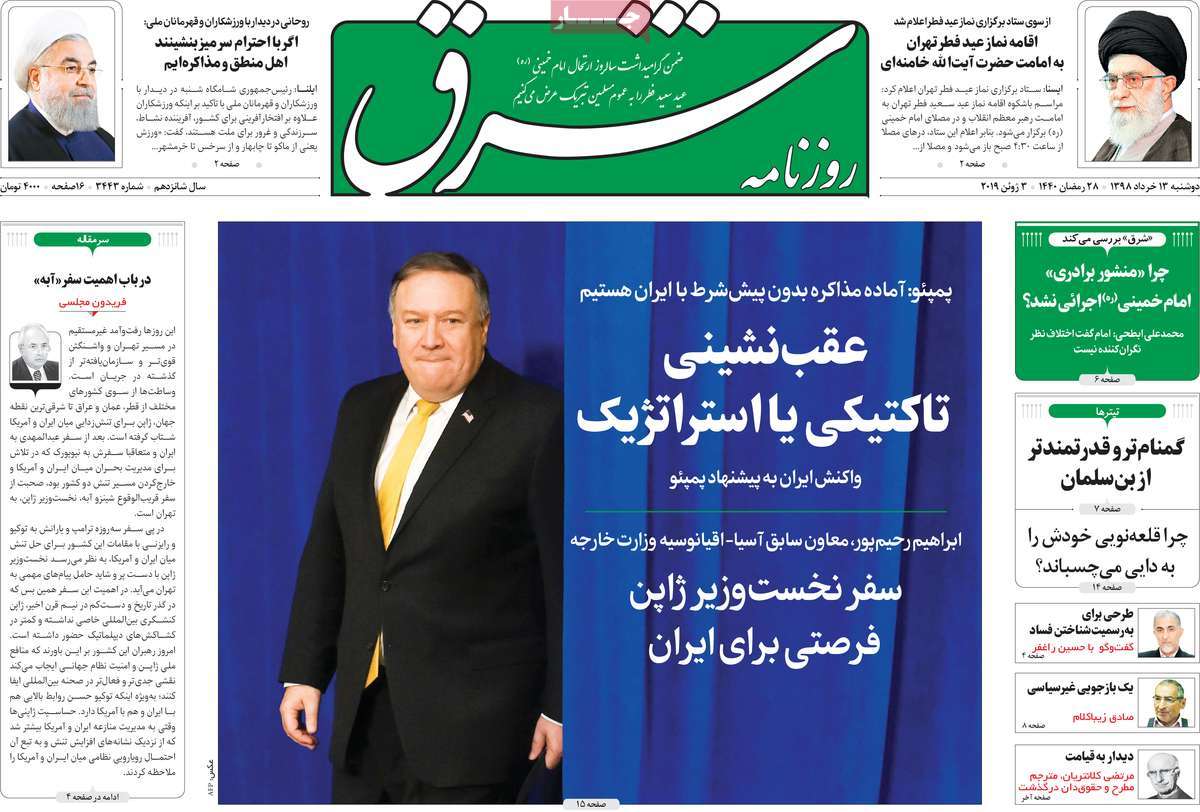
Shargh:

1- Tactical or Strategic Withdrawal

2- Japan PM’s Visit Opportunity for Iran: Former Foreign Ministry Official

3- Why Abe’s Visit Is Important [Editorial]
A Look at Iranian Newspaper Front Pages on June 3

Top General Says Iran-US Negotiation ‘Irrational, Impractical’

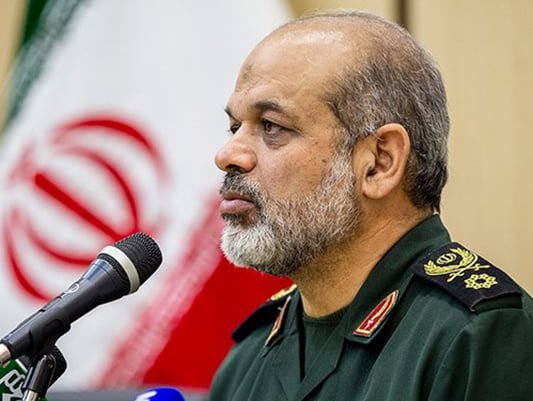
General Ahmad Vahidi

Brigadier General Ahmad Vahidi, a senior IRGC general, has ruled out the possibility of talks with the US over Iran’s defensive capabilities, saying such talks are equal to easily putting our country within the enemy’s range.

“It is clear that no one with common sense would accept such an idea, and no country in the world would negotiate over its defence power. Iran is not an exception,” he told Tasnim.

He said talks with Americans have always proved to be a wrong move.

“During the history of the Islamic Revolution, it’s been proved that even in the cases where negotiation with America has been permitted, it had no result, and the US has once again violated its commitments,” Vahidi said.

Therefore, he added, holding negotiation with the US, especially with the current administration ruling the country, is an irrational and impractical move.

He made the remarks while referring to earlier comments by Leader of the Islamic Revolution Ayatollah Seyyed Ali Khamenei who ruled out the possibility of talks between Tehran and Washington, saying such negotiations will be “fruitless”, “harmful”, and “a total loss”.

“The Islamic Republic of Iran will absolutely not sit for talks with America … because first, it bears no fruit and second, it is harmful,” the Leader said in a meeting with a number of university professors, elites and researchers in Tehran last Wednesday.

The Leader referred to negotiation as a tactic used by Americans to complement their strategy of pressure. “This is actually not negotiation; it’s rather a means for picking the fruits of pressure.”

The only way to counter this trick, he said, is to utilize the means of pressure available for use against Americans. “If they are used properly, the Americans will either stop or decrease pressures.”

However, the Leader warned against being deceived by the US plot, saying that the Islamic Republic must use the leverage at its disposal to counter the US’ pressures; otherwise, being deceived into negotiation would be a “total loss”.

Iranian Animated Works Stand Out at World’s Content Market

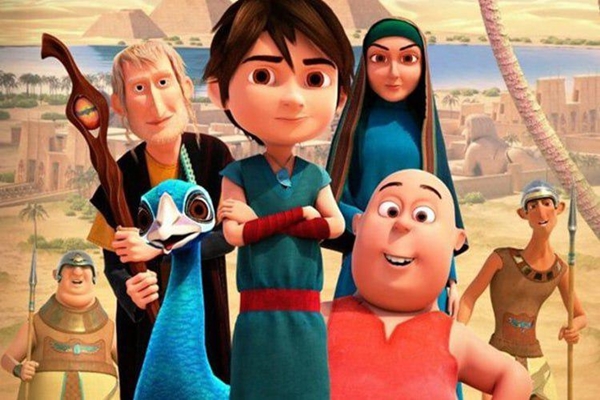
A still from Iranian animated movie Benjamin

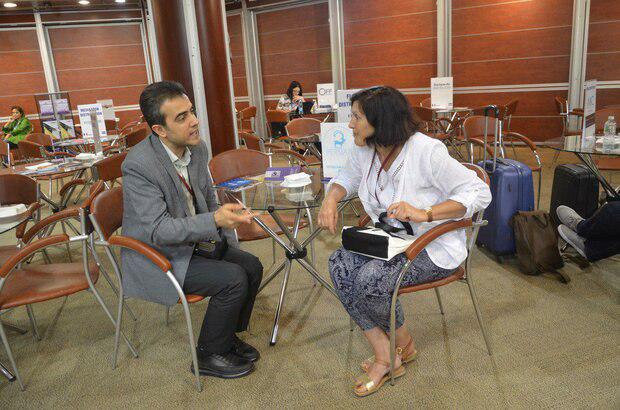
Elena Sunbeam, President and Director of the event, says “Until a year ago, nobody knew that Iran has its own animation industry and has progressed to such an extent.”

According to her, Iran’s animation industry can have a wide market presence in the future.

“This year, Iranian studios attended the event with more discipline and experience; in a way that despite the strong presence of Chinese studios with more assets and facilities, they could attract attentions to their products.”

Mehr News Agency quotes Sunbeam as saying that Iranian studios have good technique and ability, and especially because of their lower cost, they are an attractive option for many international clients.

“All of them should work more on the quality of their products. However, the content that targets a community outside the Middle East must be consistent with the cultural differences and needs of the target countries.”

Iranian Animated Works Stand Out at World’s Content Market

Yemeni Nation Will Definitely Defeat Saudis: Zarif

“The victory of the Yemeni nation is definite,” Zarif said in a meeting of the headquarters for popular support of Yemen held in Tehran on Monday.

“Today we’re all duty-bound to support Yemen because the Yemeni people are defending the human conscience and human values,” he noted.

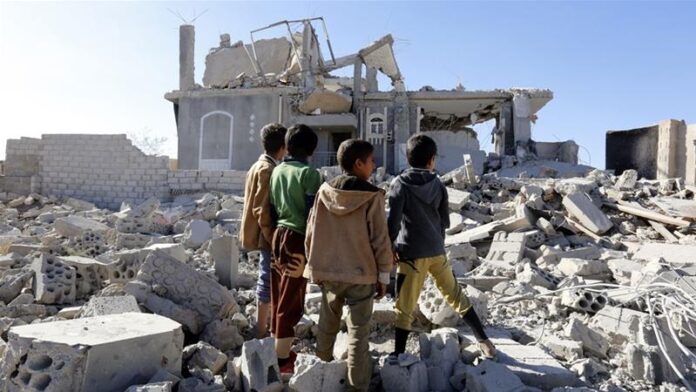
Leading a coalition of its allies, Saudi Arabia invaded Yemen in March 2015 in an attempt to reinstall Hadi, who had resigned amid popular discontent and fled to Riyadh, and to crush the Houthis, who have been significantly helping the Yemeni army against a Saudi-led aggression for the past four years.

The imposed war initially consisted of an aerial campaign, but was later coupled with a naval blockade and the deployment of ground mercenaries to Yemen. Furthermore, armed militia forces loyal to Hadi, in line with invaders, launch frequent attacks against Yemeni people in regions held by Houthis.

The aggression is estimated to have left 56,000 Yemenis dead.

In his Monday remarks, Zarif also noted that the efforts of the Al Saud regime in the region to build a coalition against Iran and Yemen during the recent summits in Mecca will not bear any fruit.

Saudi Arabia recently hosted a couple of “emergency” meetings in Mecca with the aim of building a consensus among Arab states against Iran and its regional influence.

Two statements were released after the conclusion of the talks, which mainly cited concerns about the recent sabotage attacks against several ships off the UAE.

Both Saudi and Emirati officials have blamed the mysterious “sabotage” attacks on Iran while Iran has strongly denied any involvement, and offered to sign non-aggression pacts with the Persian Gulf Arab states.

The statements were rejected by Iraqi President Barham Salih and Qatari Foreign Minister Mohammed bin Abdulrahman Al Thani, who foiled Riyadh’s plot to unite the Arab world against Iran.

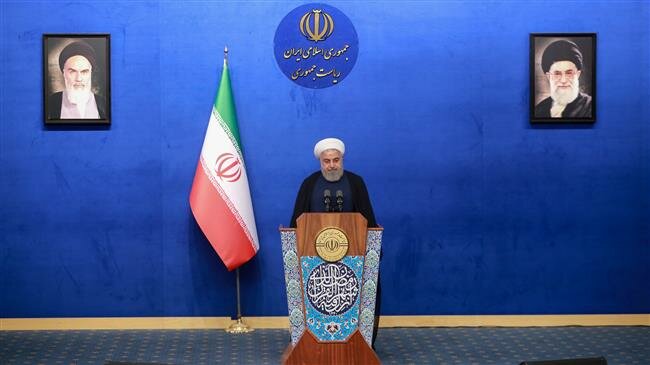
Iran President Urges US to Get Back to ‘Normal Conditions’

“The party who left the negotiating table and upended an agreement must come back to normal conditions,” Rouhani said on Sunday, addressing a group of academics and physicians in Tehran.

Otherwise, he added, Iran is left with no choice but to show resistance.

“I declare as the representative of the Iranian nation that in this period, and for as long as the enemy does not regret its measures in the past, we have no way but to show resistance,” he said.

However, Rouhani said, “if the enemy truly realizes it has taken a wrong and incorrect approach, then we can sit at the negotiating table and solve any issues,” he added.

“The enemies sometimes say they have conditions for negotiations with Iran… but in recent weeks they said they have no conditions. They threatened us as if they were a military superpower, but now they say they do not seek a war,” he said, describing the offer of talks with no preconditions as a sign of Iran’s strength.

His comments came shortly after US Secretary of State Mike Pomope backed off from the 12-point list of “basic requirements” he had put forth as a prerequisite for a new deal with Iran, and said on Sunday that Washington was prepared for unconditional talks.

“We are prepared to engage in a conversation with no preconditions. We are ready to sit down with them,” Pompeo said, addressing a news conference in Switzerland.

He; however, added that the United States would continue working to rein in Iran’s “malign activity.”

“The American effort to fundamentally reverse the malign activity of this Islamic Republic, this revolutionary force, is going to continue,” he said.

In response, Iran described the offer as a game of words, and stressed that it expects a change in Washington’s general approach toward the Iranian nation.

“For the Islamic Republic of Iran, a game of words and expressing covert goals under the guise of new words is not a criterion for action, but a change in the United States’ general approach and practical stance toward the Iranian nation is the criterion,” Iranian Foreign Ministry spokesman Seyyed Abbas Moussavi said.

Moussavi added, “The emphasis put by Mr. Pompeo on the need to continue a campaign of maximum pressure on Iran is indicative of persistence of the wrong approach of the past, which needs to be rectified.”

The United States remarkably stoked tensions with Iran in May 2018 when US President Donald Trump pulled his country out of the nuclear accord, officially known as the Joint Comprehensive Plan of Action (JCPOA), and re-imposed harsh sanctions against the Islamic Republic in defiance of global criticisms.

The tensions saw a sharp rise on the first anniversary of Washington’s exit from the deal as the US moved to ratchet up the pressure on Iran by tightening its oil sanctions and building up its military presence in the region.

Washington has since further increased the pressure on Iran, sending military reinforcements, including the USS Abraham Lincoln aircraft carrier strike group, a squadron of B-52 bombers, and a battery of patriot missiles, to the Middle East.

Speaking weeks after the US withdrawal from the JCPOA, Pompeo laid out 12 tough conditions for any “new deal” with Tehran.

The conditions included withdrawal of Iran’s military advisers from Syria, who have been helping the country’s legitimate government in its fight against terrorist outfits, which have been mostly aided and abetted by the US and its Western and regional allies.

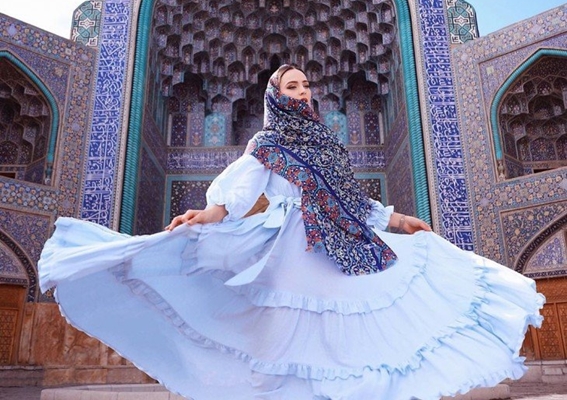
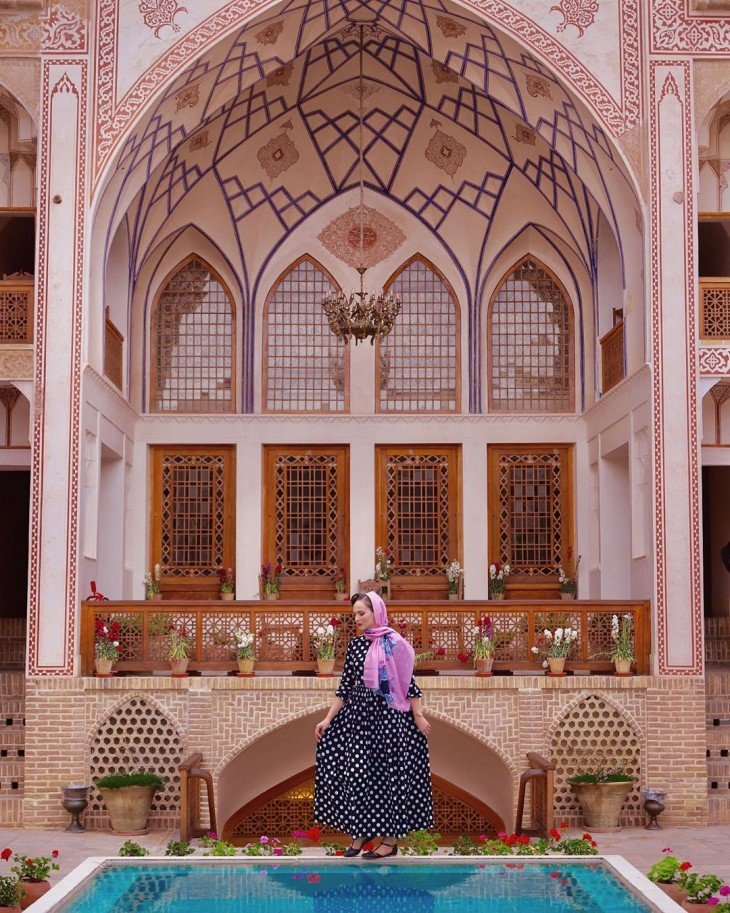
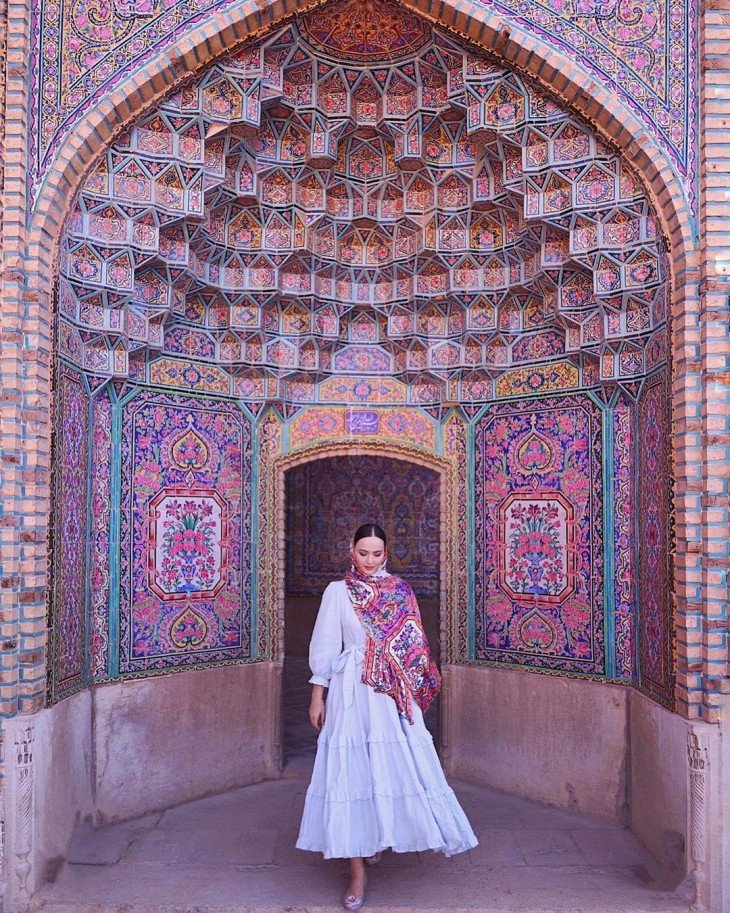
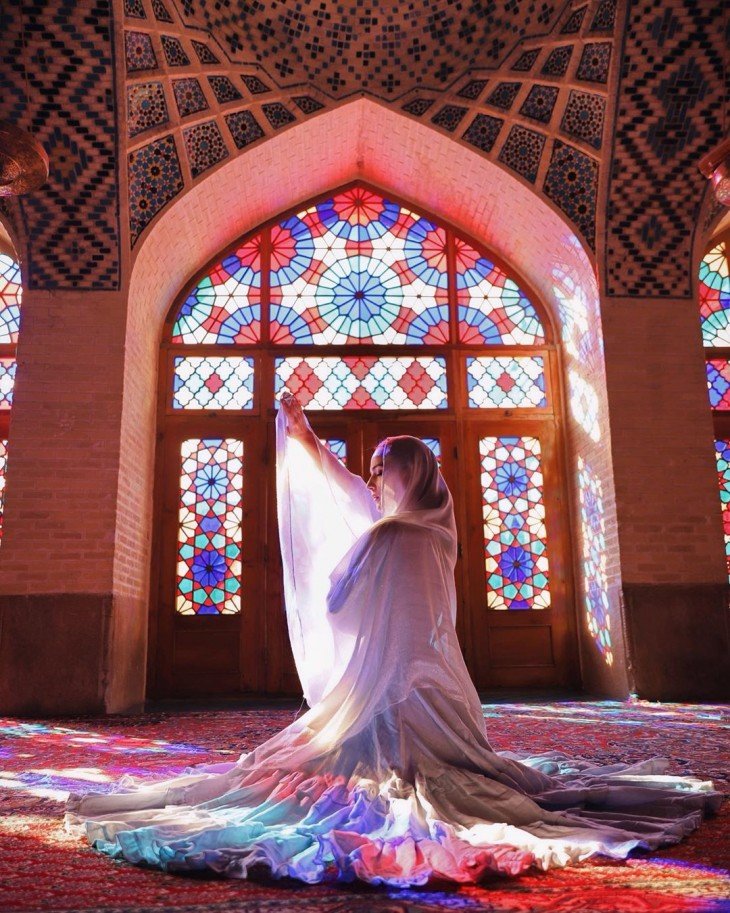
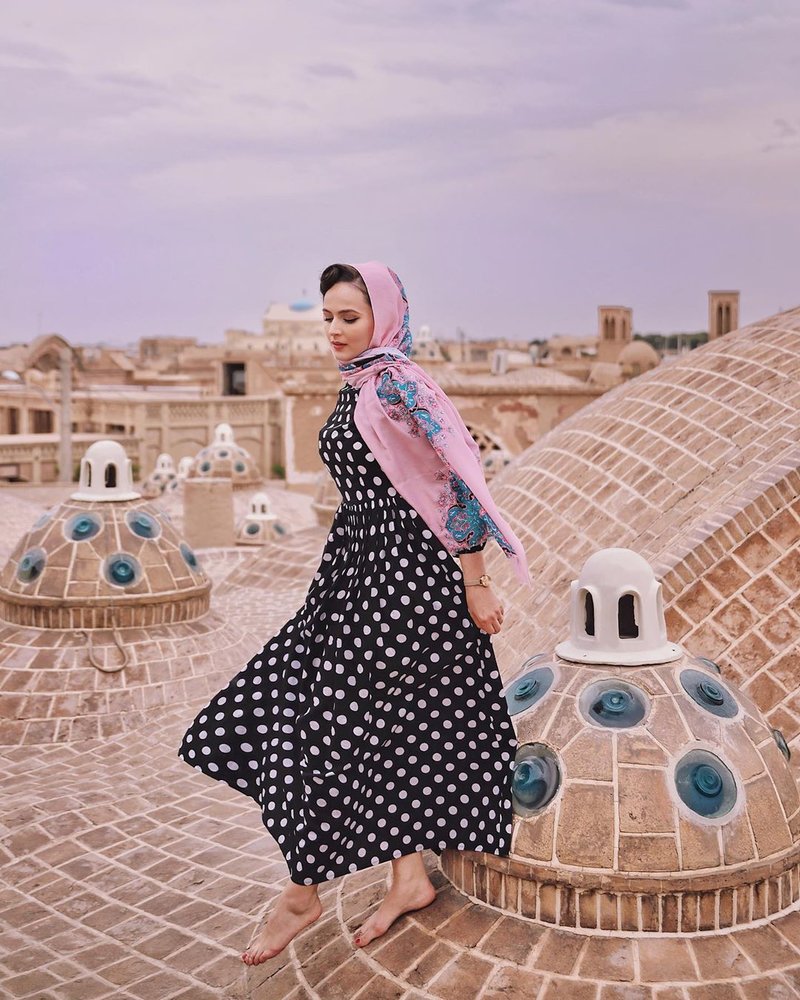
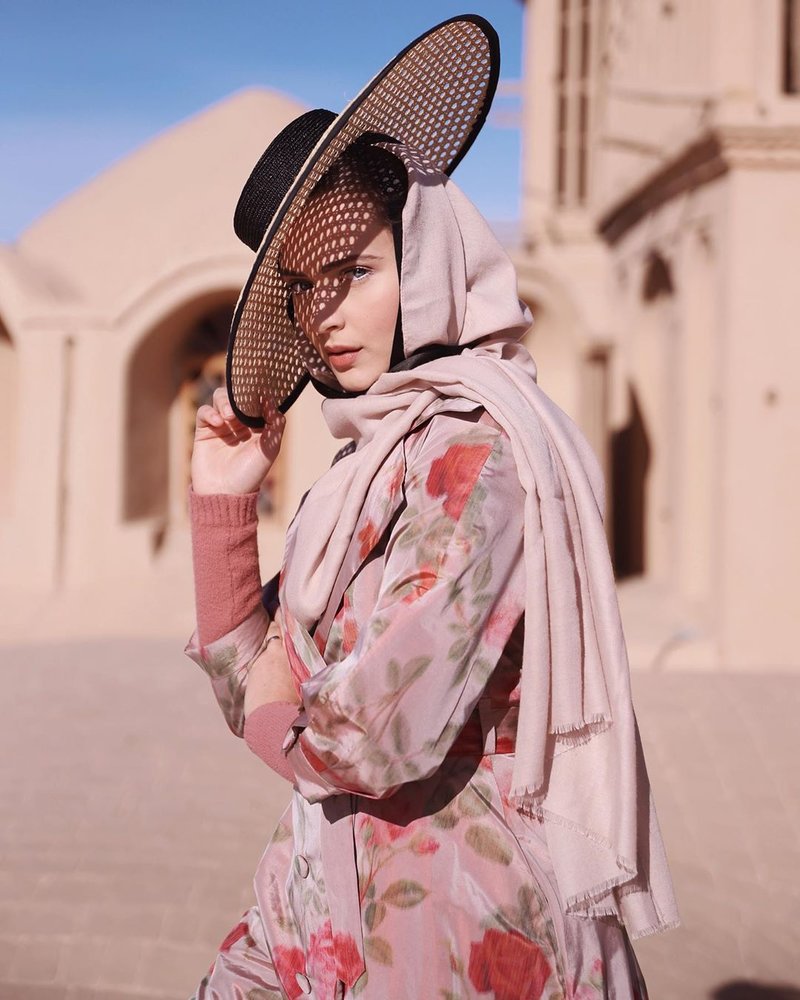
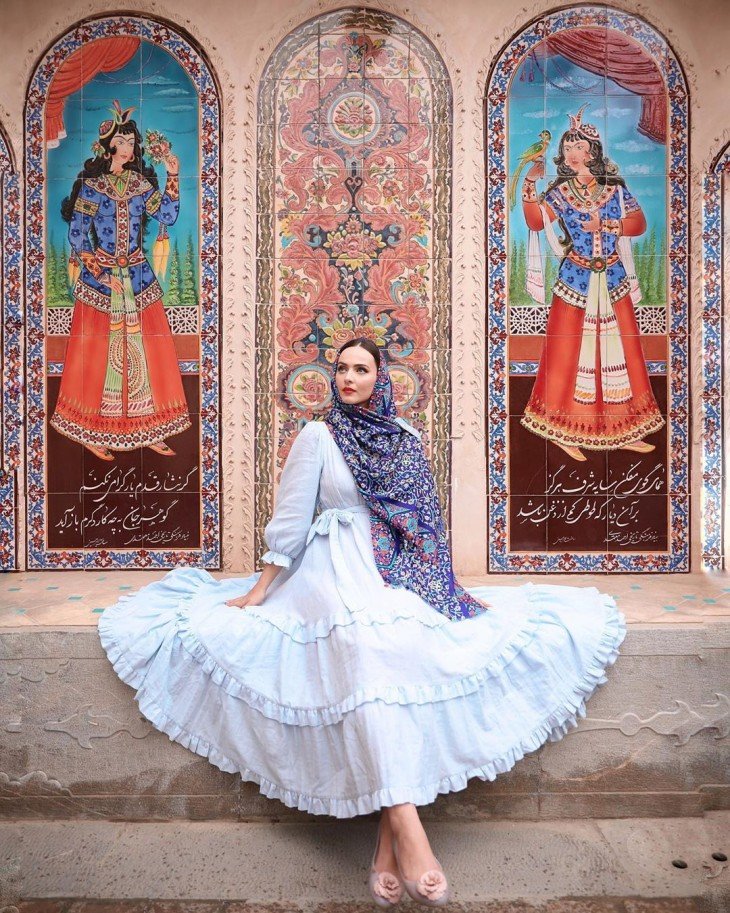
European Model, Photo Blogger in Iran

What follows are the photos Muharemović has published on her Instagram page, showing her in the cities of Shiraz, Isfahan, Yazd and Kashan:

Lazy People Joining Together to Stop Being Idle

There are young girls and boys as well as older men and women’s treatment, them. One is a housewife and the other is a student. Elder people recount their experiences of laziness to motivate the new members.

One has never been able to have a job at the time, and even he used to arrive at school at 11 or 12!  The other one makes you cry when he talks of his unfinished jobs.

Members of this society have told Shahrvand daily about their experiences and achievements after participating in this forum.

One of them says “most of my relatives have seen me often sitting or lying on bed. These are the only images of me in their minds.”

Since many years ago, he liked to live like normal people; but it has remained always a wish. “Masoud” considers laziness to be a disease that affects all aspects of human life. He believes that people realise this when they do not want to stand up and sit on another couch. He considers this lifestyle boring and agonizing. This as many think the lazy people just want to enjoy the everyday life and they have abandoned all aspects of life to enjoy more.  They think the lazy people are happy in the world they have created for themselves.

This is the first time that ‘Sara’ visits a group of people like herself at the same time. She seems calm. “Most of the time, I did not feel well, and I stopped whatever I started to do after a while. I decided to emigrate and I had to learn English first. I enrolled at an institute, but I dropped classes one after the other, and eventually I left it and I started self-studying. I knew that I am an idle person. On the Internet, I was looking for laziness books and I got familiar with a book called “Psychology of Idleness”, and I started to implement some of its instructions. But in the end, it did not last more than a week or 10 days, and now I’m attending this course to treat my laziness forever.”

It is Mahdi’s 52nd day here. He says “My laziness is different from others. My mind is lazy and I cannot focus on anything. I’m not even able to listen to words. My laziness is so severe that sometimes I feel bad. These classes help you understand that there are other people like you, and it’s a bit easier to handle. No one considers laziness as a disease, and all the time people are criticising the lazy people. I was always fined for not having my car’s technical inspection card, but after attending these classes for the first time I renewed the card before it expires, and I am so happy about this. You must be in my shoes to find out how sweet this experience is.”

Another member of this society says: “All that I remember from the past is that I was a sleepy woman who was not even willing to turn on the TV. Zeinab says the only thing I did was to order meals. Although most of the time my husband was ordering the food! I now have a plan. When I wake up, there is something I have to do. We eat at home and we are not forced to order meals anymore. Most importantly, it is about three months that I am brushing my teeth and I’m not angry with myself anymore.”

“My name is Marzieh. I am an idle person who is getting treated.”  Marzieh believes that the most salient symptom of laziness is “postponement”. “The idle people always postpone their tasks.”

She is the manager and founder of an institute, but according to herself, her idealism and laziness have hampered her progress. “I used to find excuses for my laziness to appease myself a bit.”

Anonymous Idle Society has started its job in Iran since 1995. Ahmad, one of the founders of the association, remembers those days very well. “We were three or four lazy people who took part in “Twelve Steps” classes. At those classes, we found out that we are idle. We were gathering at Azadi Square once a week trying to cure our laziness. It continued till one of the guys rented a room, and the classes were held over time in modern forms.”

He laughs and introduces himself as one of the first lazy Iranians. “Through all these years, many people participated in these classes and could cure their laziness. This community is a good opportunity to listen to others without paying money. Nobody will judge you and your experiences. We all were planners, plans that were written but never implemented.”

Oil Price to Hit $100 Once First Bullet Fired in Persian Gulf: Iran

Major General Yahya Rahim Safavi, a top military adviser to Leader of the Islamic Revolution Ayatollah Seyyed Ali Khamenei, said in an interview with Fars on Sunday that America was all but blustering.

“The first bullet fired in the Persian Gulf will push oil prices to above $100 [a barrel], and $100 oil would not be endurable for America, Europe, and America’s friends like Japan and South Korea,” he said.

Safavi also said that the Americans had more than 25 military bases in the region, which hosted over 20,000 personnel, all of which he said were well within Iran’s missile reach.

He said US President Donald Trump knew that any war with Iran would bring about both a military defeat and massive economic costs for America.

The United States recently took a quasi-warlike posture against Iran when it dispatched an aircraft carrier strike group, a bomber task force, and an amphibious assault ship to the Persian Gulf, citing an alleged Iranian threat.

Iran said it posed no threat to anyone but would defend itself against any aggression.

‘Iran standing firm’

Also on Sunday, Major General Mohammad Baqeri, who is the chairman of the Chiefs of Staff of Iran’s Armed Forces, said that the country would not back away from its right to defend itself.

In a message to mark 30 years since the passing of the founder of the Islamic Republic, Imam Khomeini, Major General Baqeri said Iran would not hesitate to defend its independence, territorial integrity, and national security.

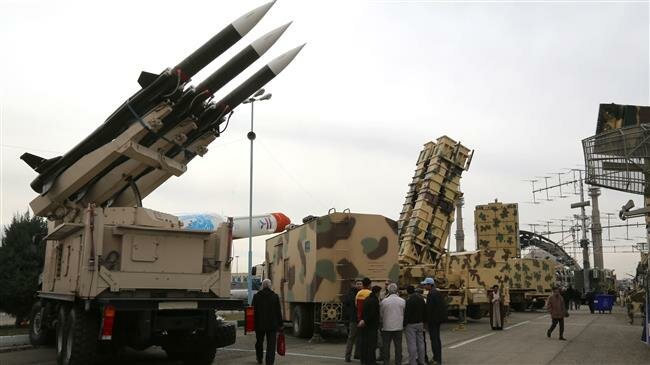
Iran’s missile might ‘non-negotiable’

Separately on Sunday, Coordinating Deputy of Islamic Republic of Iran Army Rear Admiral Habibollah Sayyari said the country’s missile might was non-negotiable.

He dismissed the possibility of holding talks with any foreign country on Iran’s defensive might.

Eight Iranian Cities to Host European Film Week

Eight Iranian Cities to Host European Film Week

Films from 20 European countries are set to be screened during the week as the most significant European cultural event in Iran over the past decade years.

“The European Film Week 2019 is co-organized by Art and Experience Cinema and the European Union National Institutes for Culture (EUNIC),” said the Public Relations Department of the Art and Experience Cinema.

The opening ceremony of the event is to be held in the Iranian Artists Forum in Tehran on June 8 with European ambassadors, filmmakers as well as Iranian artists in attendance.

Two European movies, “The Dark Valley” from Austria and “The Silent Army” from the Netherlands will be screened during the opening ceremony.

European films from Austria, Bulgaria, Belgium, Cyprus, Denmark, Finland, Germany, Greece, Hungary, Italy, Norway, the Netherlands, Poland, Portugal, Sweden, Slovenia, Spain, Switzerland and the United Kingdom will take part in the seven-day event.

The films would be screened in eight Iranian cities of Tehran, Shiraz, Mashhad, Tabriz, Isfahan, Kish, Kerman and Babol.

Meanwhile five workshops are to be held on the sidelines of the event providing a chance for film producers and directors to get in touch with each other and discuss possible cooperation.

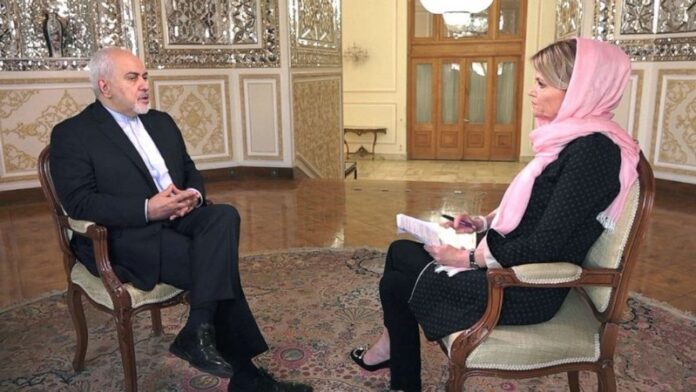
Trump’s ‘Art of the Deal’ Not to Work on Iran: Zarif

In an exclusive interview with ABC News, Zarif also told “This Week” Co-Anchor Martha Raddatz that “there will be consequences” if the United States keeps up its economic pressure campaign against Iran’s people.

Zarif labelled the new US sanctions as “economic terrorism” that “targets ordinary Iranian people” because even though food and medicine are exempted from the sanctions, the financial transactions associated with them are not.

“If the objective of President Trump is to impose pressure on normal Iranians, on ordinary Iranians, he is certainly achieving that,” Zarif said. “But he will not achieve his policy objectives through pressure on the Iranians.”

Zarif, however, said the prospects of potential talks are “not very likely, because talking is the continuation of the process of pressure.”

The foreign minister also noted that Trump’s business experience in real estate — as described in his 1987 book, “Trump: The Art of the Deal” — will not work with Iran.

“This may work in a real estate market. It does not work in dealing with Iran,” he said. “It may work even with in dealing with other countries, for a brief period, not for long term, but it doesn’t work with Iran for a brief period, or in medium or long.

“The only thing that works with Iran is respect,” he said.

Asked what message he would give directly to the US president, Zarif advised against threatening the country.

“I’ve said it before, threats against Iran never work,” he said during the interview. “Never threaten an Iranian. Try respect, that may work.”

Zarif dismissed the US claims that there was a new Iranian threat to the region and countered that it was the US Navy’s presence that was destabilizing.

“We call this place the Persian Gulf for a reason,” said Zarif. “It’s next to us. We have a right to defend ourselves.

“Just imagine if Iran were to come to California coast [or the] Florida coast,” he added. “How do you feel? How would you treat that? The United States is sending nuclear ships to our waters, to our vicinity.”

As for how Iran could respond in the future to what it considers further escalations, the foreign minister told Raddatz his country will take a page from the Trump administration’s playbook.

“I like to keep President Trump guessing because he likes everybody in the world to keep on guessing about what is happening in the United States,” said Zarif.

But Zarif warned that “there will be consequences” if the US continues adding more economic sanctions.

“If the United States decide to cause so much pain on the Iranian people by imposing economic warfare, by engaging in economic terrorism against Iran, then there will be consequences,” he said.

“We don’t differentiate between economic war and military war,” he cautioned. “The US is engaged in war against us, and a war is painful to our participants. We have a very clear notion that in a war, nobody wins. In a war, everybody loses the loss of some will be greater than the loss of others.”

Asked by Raddatz if the consequences he was referring to was the equivalent of the phrase used by American officials that “all options are on the table,” Zarif explained that he was referring to self-defence.

“All options are on the table belongs to the time when the use of force was legal, and that is about 100 years ago,” said Zarif.

“What we say is that we exercise our self-defence. Self-defence is allowed. President Trump has announced that he is engaged in a war and economic war against Iran, and we have an obligation to defend our people against that economic war.”