Sunday, December 21, 2025
Home Blog Page 2831

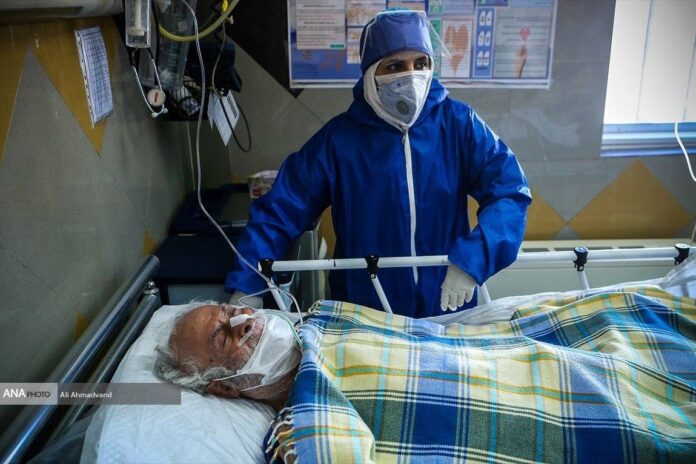
Are HIV Patients Immune to Novel Coronavirus?

Are HIV Patients Immune to Novel Coronavirus?

Health ministry spokesman Kianoosh Jahanpour made the comment on Tuesday when asked about the possibility of HIV-positive individuals being immune to the novel coronavirus.

“Since day one, they have been speaking of using anti-virus drugs for patients infected with HIV, and even in the initial protocol, the Kaletra medicine was used. Kaletra is used for HIV-positive patients as well,” he said.

“Of course, in the reports we have, the effectiveness of Kaletra to control COVID-19 has not necessarily been shown,” he added.

Coronavirus online test
If you are worried that you may have contracted the Coronavirus, take this test right now.

“Three of HIV-positive patients have contracted COVID-19 as well, but I should also say that 1,200 of these individuals have tested negative for the coronavirus,” he added.

“These people have a relative defect in their immune system, and maybe there is some level of immunity in their bodies because of using medicines. Anyway, the number of coronavirus cases among HIV-positive patients has been low, which is noteworthy,” he added.

Iranian Foreign Minister Holds Talks with Afghan Leaders

Iran Afrghanistan leaders

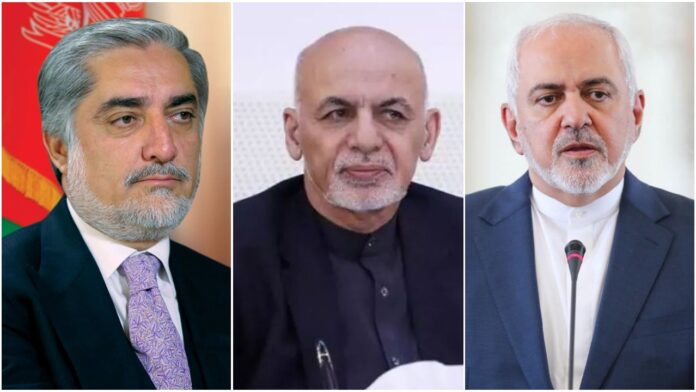
Foreign Minister Zarif held separate telephone conversations with Mohammad Ashraf Ghani and Abdullah Abdullah on Tuesday evening as part of the Islamic Republic of Iran’s attempts to help stabilize the political situation in the Islamic Republic of Afghanistan for the launch of intra-Afghan negotiations.

In the conversations, Zarif congratulated the government and nation of neighbouring Afghanistan on the start of the Islamic holy month of Ramadan, and talked about his latest regional and international consultations over Afghanistan, the bilateral ties between Tehran and Kabul, and the fight against the coronavirus.

US to Get Hard Slap in Face If Trespasses into Iran Waters: Top Cmdr.

US to Get Hard Slap in Face If Trespassing into Iranian Waters

Brigadier General Abolfazl Shekarchi made the comment in response to a recent threat by US President Donald Trump, who had said he had ordered US warships in the Persian Gulf to strike Iranians boats if they every approached American vessels.

“Mr. Trump makes such comments against us off and on as part of psychological warfare and in a bid to stir up public opinion and earning scores in the forthcoming election and distancing himself from US domestic issues,” said general Shekarchi, the senior spokesman for the Armed Forces.

He noted the public opinion should be enlightened that it is the Americans that are violating international rules, and that if they are slapped in the face for something wrong they have done, they deserve it.

He said Iran is dead serious about defending the country.

The top general noted Iran has always criticized its enemies, especially the US, for their presence in the Persian Gulf region.

“What do you want from the countries in the Persian Gulf,” he said.

“All regional countries have a share of the Persian Gulf region and are 100% capable of ensuring its security, but our question is what the Americans are looking for in the region, and what are their warships and aircraft and combat units doing in this region,” said the top general.

“Not only do the Americans not have any answer for this question, but also they have been harassing [our troops] and breach international law,” he said.

“Under international law, different vessels can ply across this region freely if they do no harm, but some of them harass fishermen, disregard environmental issues and even approach military centres of countries in this region,” he underlined.

“Moreover, Mr. Trump sends the message that the US military must counter forces harassing them,” he added.

Iran Says Ready to Send Ventilators, Masks to Armenia

Iran Says Ready to Send Ventilators, Masks to Armenia

Referring to successes gained in production of these stuff, President Hassan Rouhani said the Islamic Republic of Iran is ready to meet the needs of other countries, including Armenia, in the fight against Coronavirus.

He made the statements in a phone conversation with Armenian Prime Minister Nikol Pashinyan on Tuesday afternoon.

Talking about the spread of the coronavirus in many countries around the world and the problems that this disease has created for governments and nations, the two sides stressed the need to develop regional and international cooperation, and touched upon transfer of experiences in dealing with the coronavirus.

Rouhani and Pashiniyan also reiterated that Iran and Armenia, as two neighbouring countries, should help each other more in these difficult circumstances.

They further confirmed that mutual ties are expanding, but put stress on the need for officials to work together in the Joint Commission to develop relations between Tehran and Yerevan.

Coronavirus online test
If you are worried that you may have contracted the Coronavirus, take this test right now.

For his part, Pashiniyan praised the success of the Islamic Republic in combating COVID-19 and the positive results it has achieved.

He also offered congratulations to the government and people of Iran on the arrival of the holy month of Ramadan.


Related Articles:

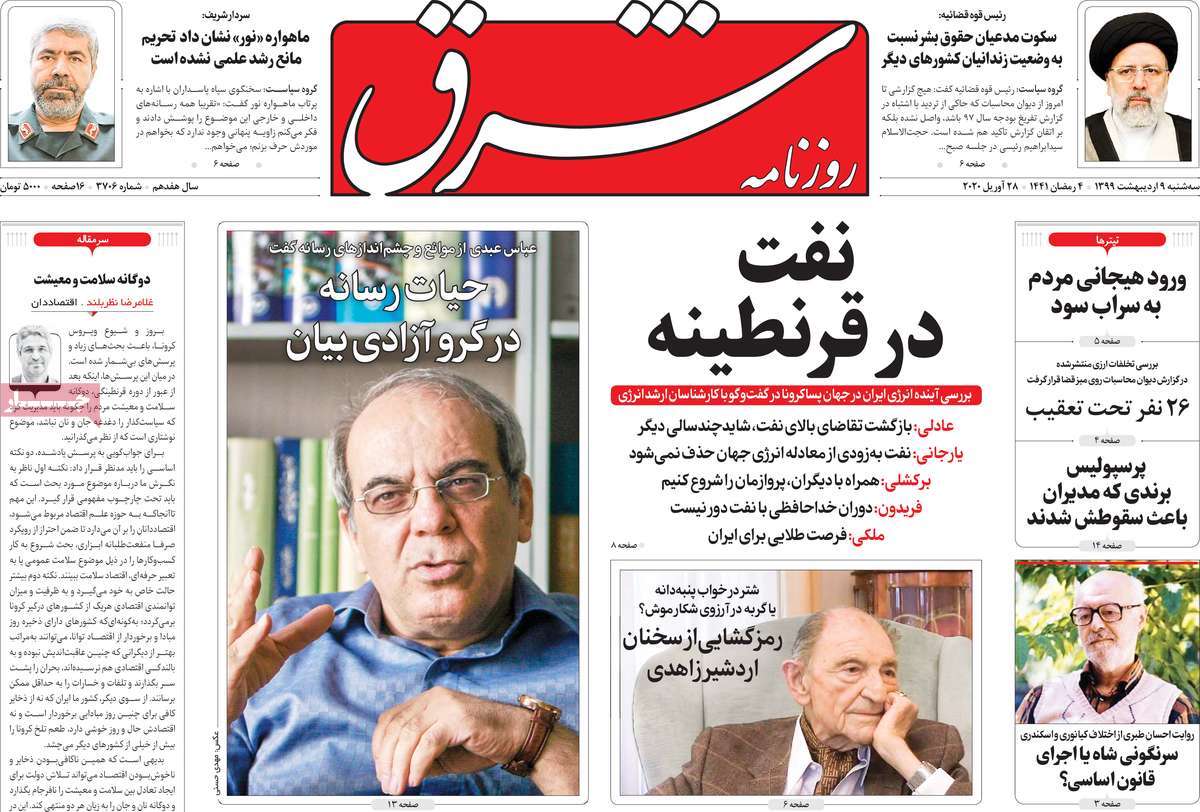
A Look at Iranian Newspaper Front Pages on April 28

A Look at Iranian Newspaper Front Pages on November 18

Iranian Newspapers

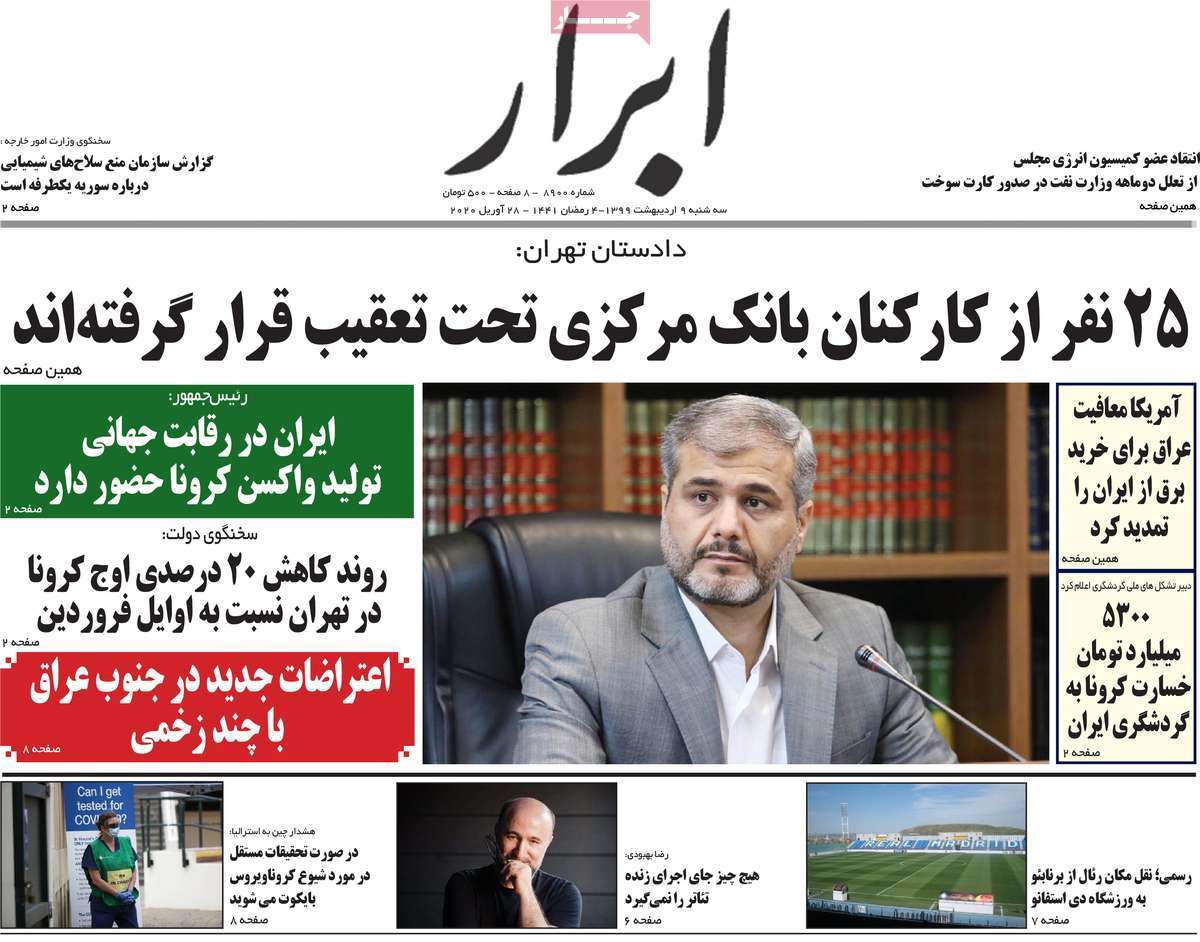
Abrar Newspaper:

1- Gov’t Spokesman: Coronavirus Infections in Tehran Decreased by 20%

A Look at Iranian Newspaper Front Pages on April 28


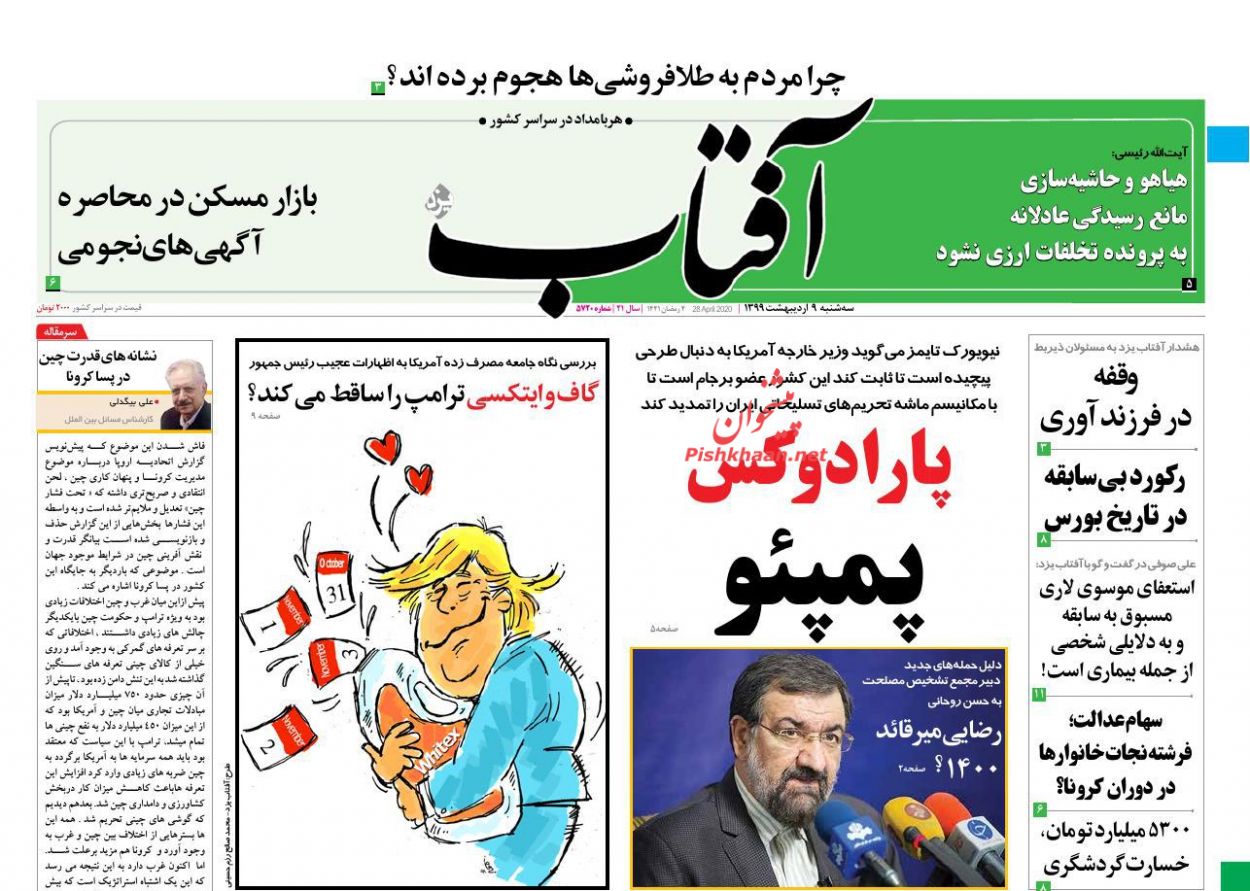
Aftab-e Yazd Newspaper:

1- Will Trump Lose US Elections after His Disinfectant Injection Goof?
2- Signs of China’s Power in Post-Corona Era [Editorial]
3- Pompeo’s Paradox
* US Top Diplomat after Plan to Prove Washington Still Part of JCPOA

A Look at Iranian Newspaper Front Pages on April 28


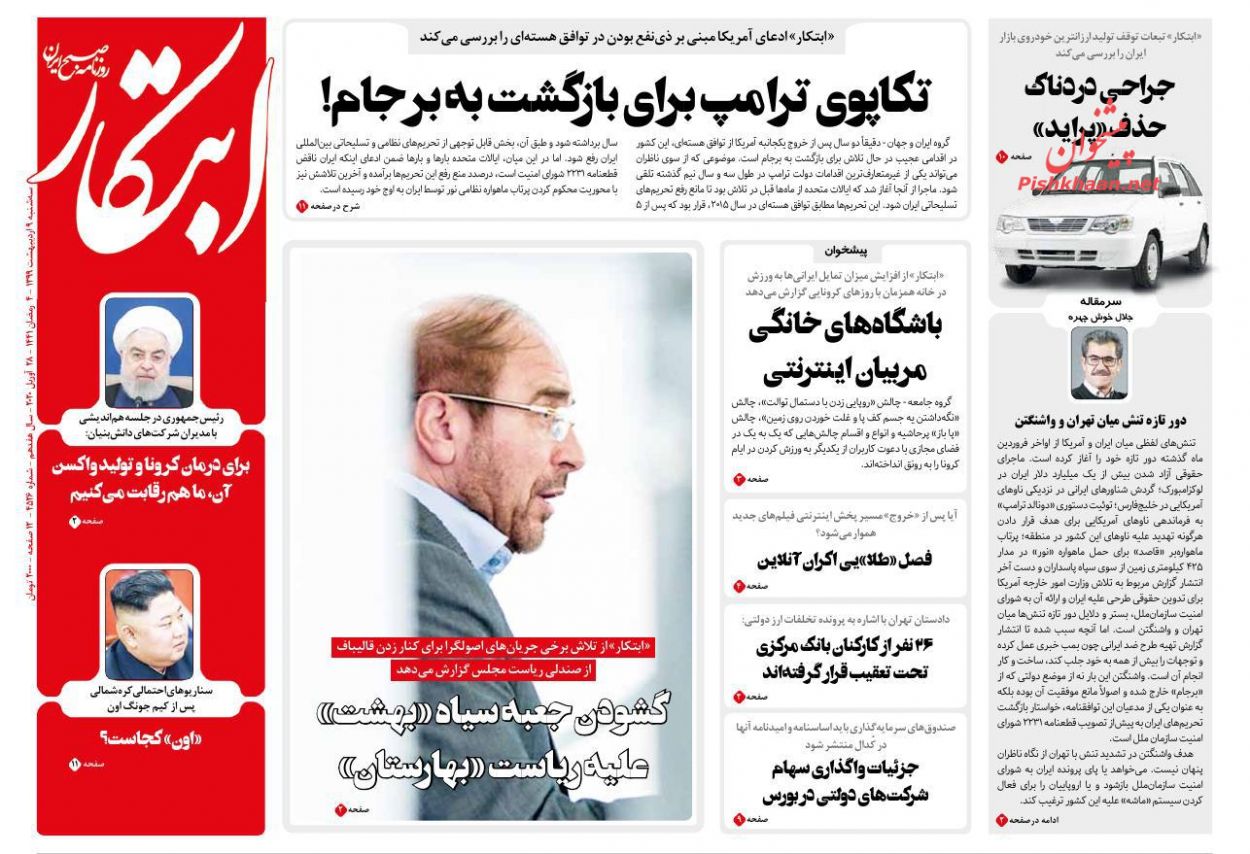
Ebtekar Newspaper:

1- Trump Struggling to Return to JCPOA
2- Where’s Kim? Possible Scenarios for Post-Kim Era in N Korea
3- Rouhani: Iran to Compete with Other States in Developing Corona Vaccine

A Look at Iranian Newspaper Front Pages on April 28


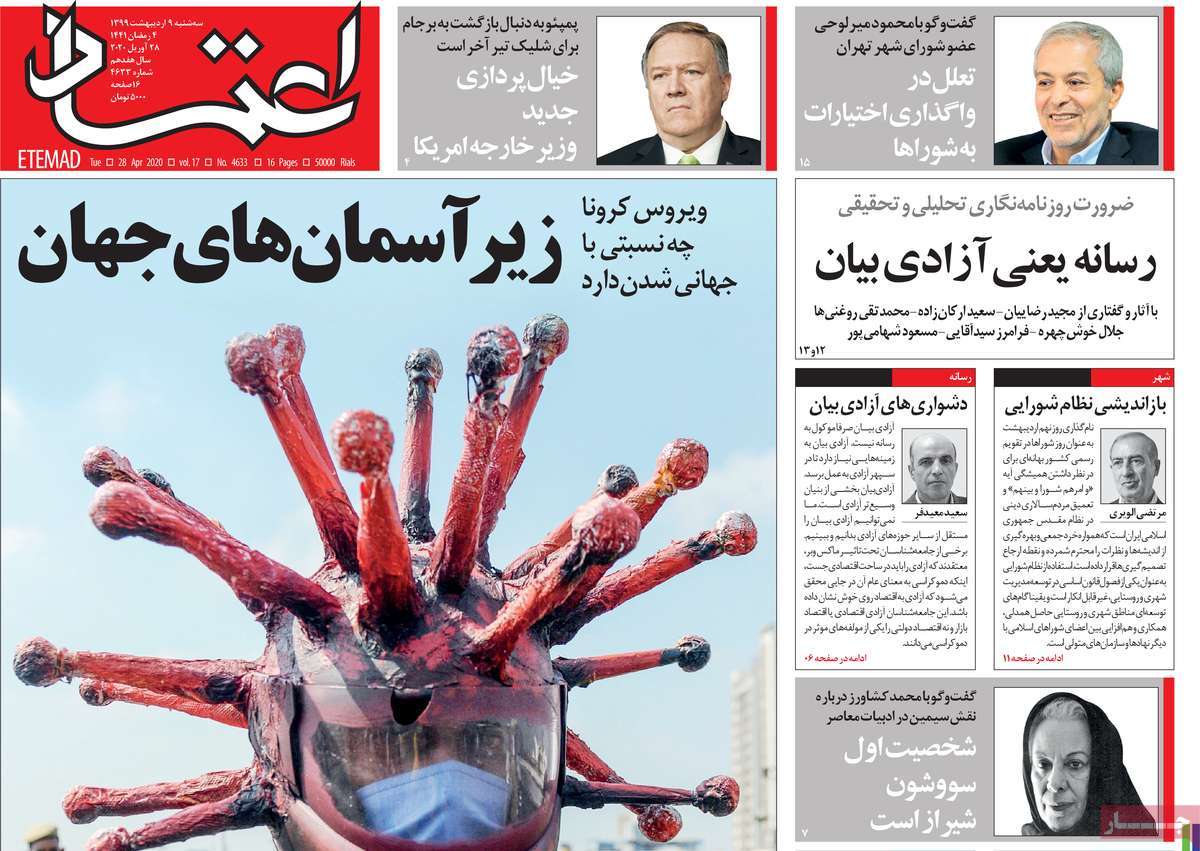
Etemad Newspaper:

1- US Secretary of State’s New Delusions: Returning to JCPOA to Pull Trigger

A Look at Iranian Newspaper Front Pages on April 28


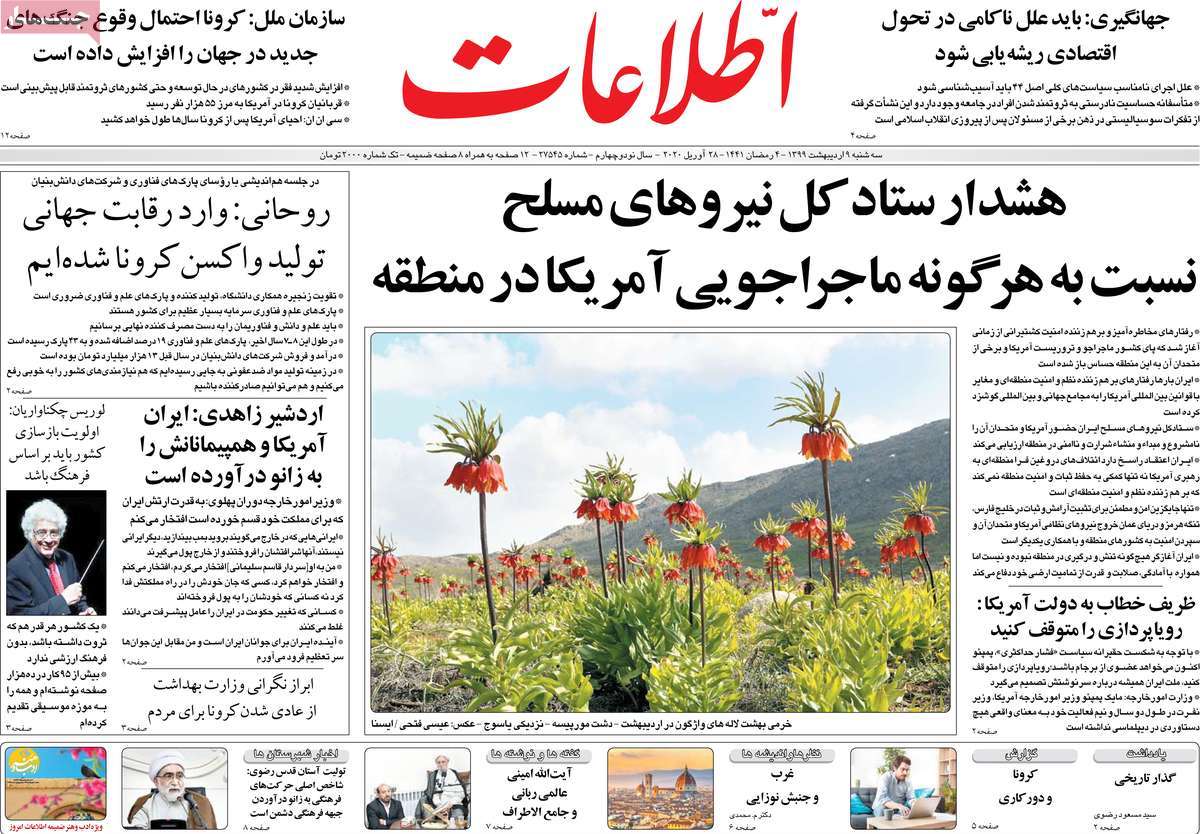
Ettela’at Newspaper:

1- Iran’s Armed Forces Warn about Any US Adventurism in Region
2- Rouhani: We’ve Joined Global Competition for Development of COVID-19 Vaccine

A Look at Iranian Newspaper Front Pages on April 28


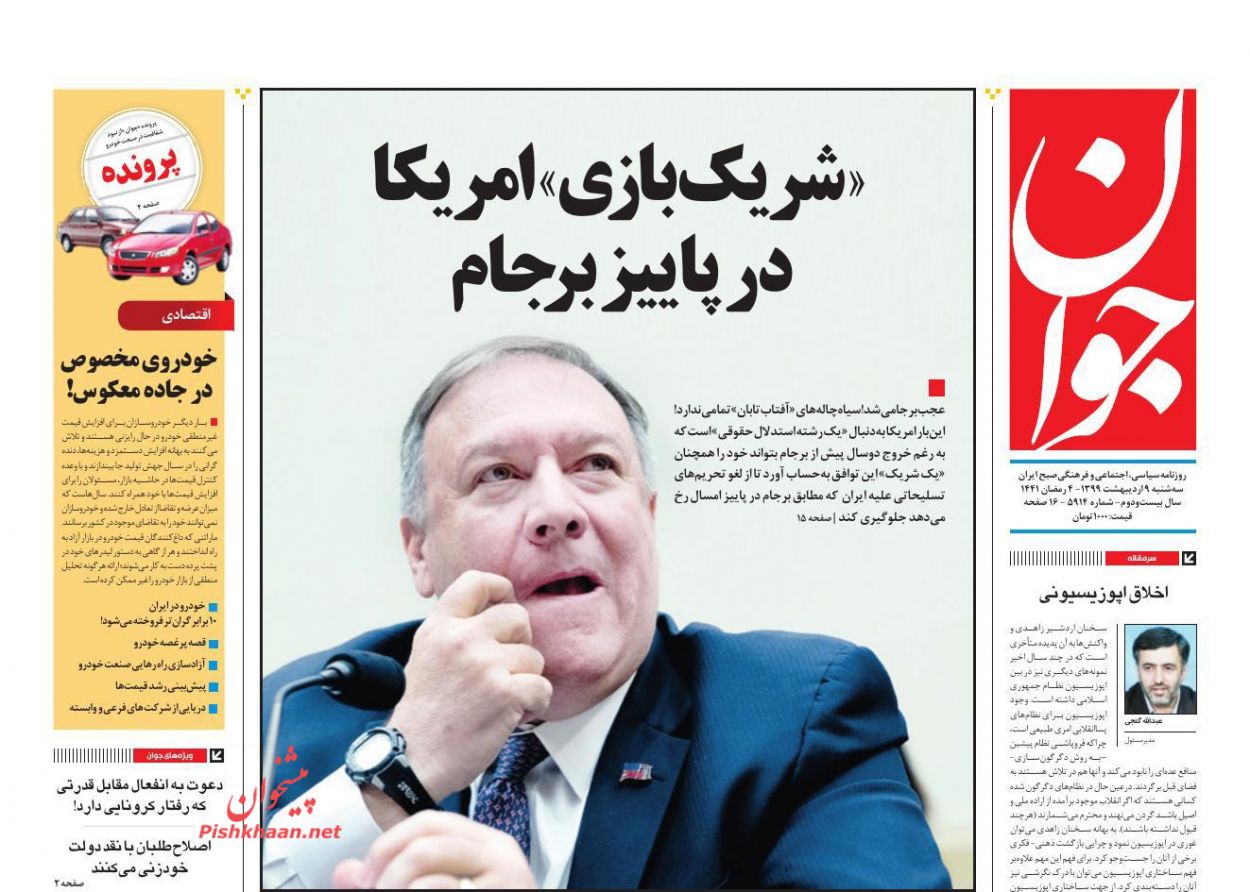
Javan Newspaper:

1- US’ Looking for a Way to Extend Iran Arms EmbargoA Look at Iranian Newspaper Front Pages on April 28


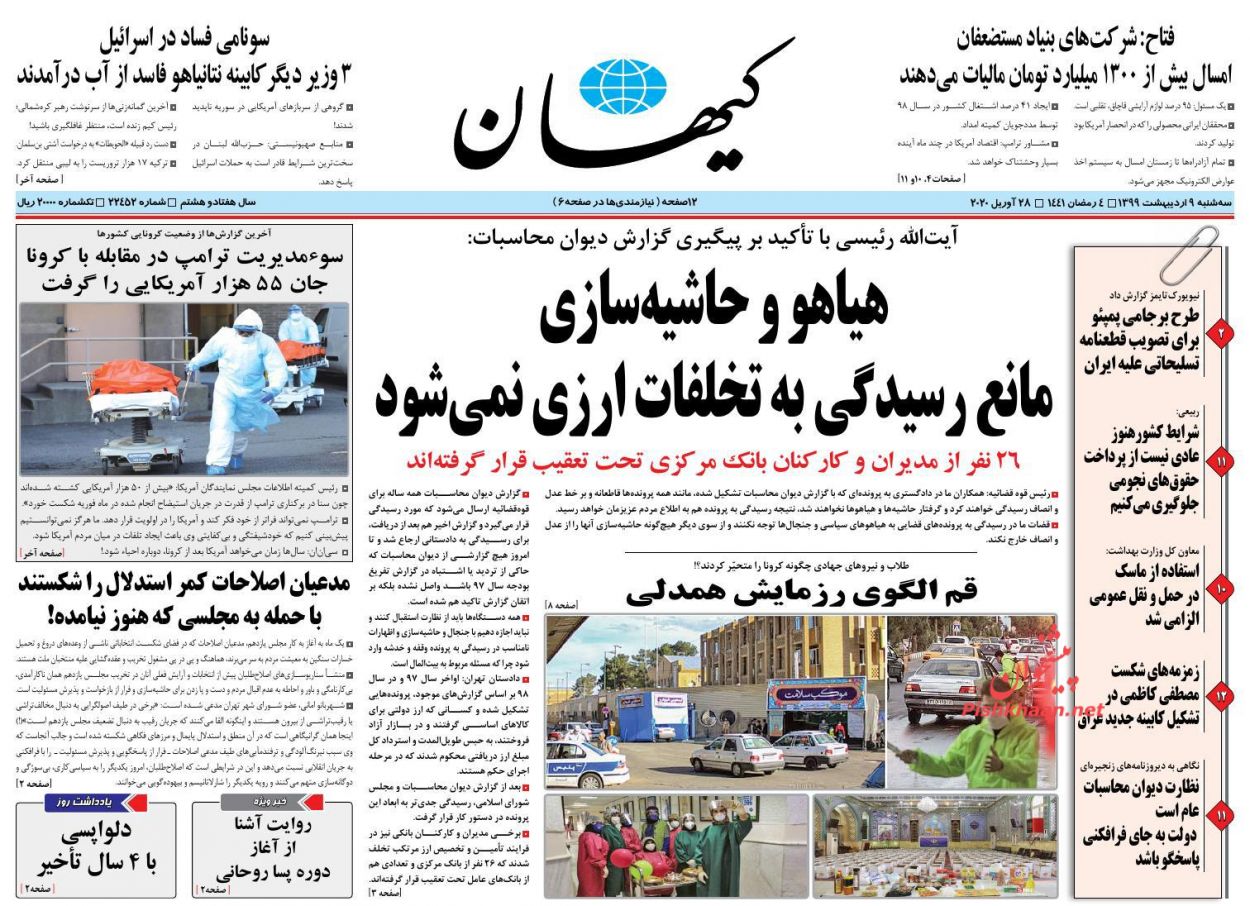
Kayhan Newspaper:

1- Pompeo’s JCPOA Plan to Pass Anti-Iran Arms Bans
2- It’s Now Compulsory to Wear Mask When Using Public Transport
3- Tsunami of Corruption in Israel: Three More Cabinet Ministers Declared Corrupt

A Look at Iranian Newspaper Front Pages on April 28


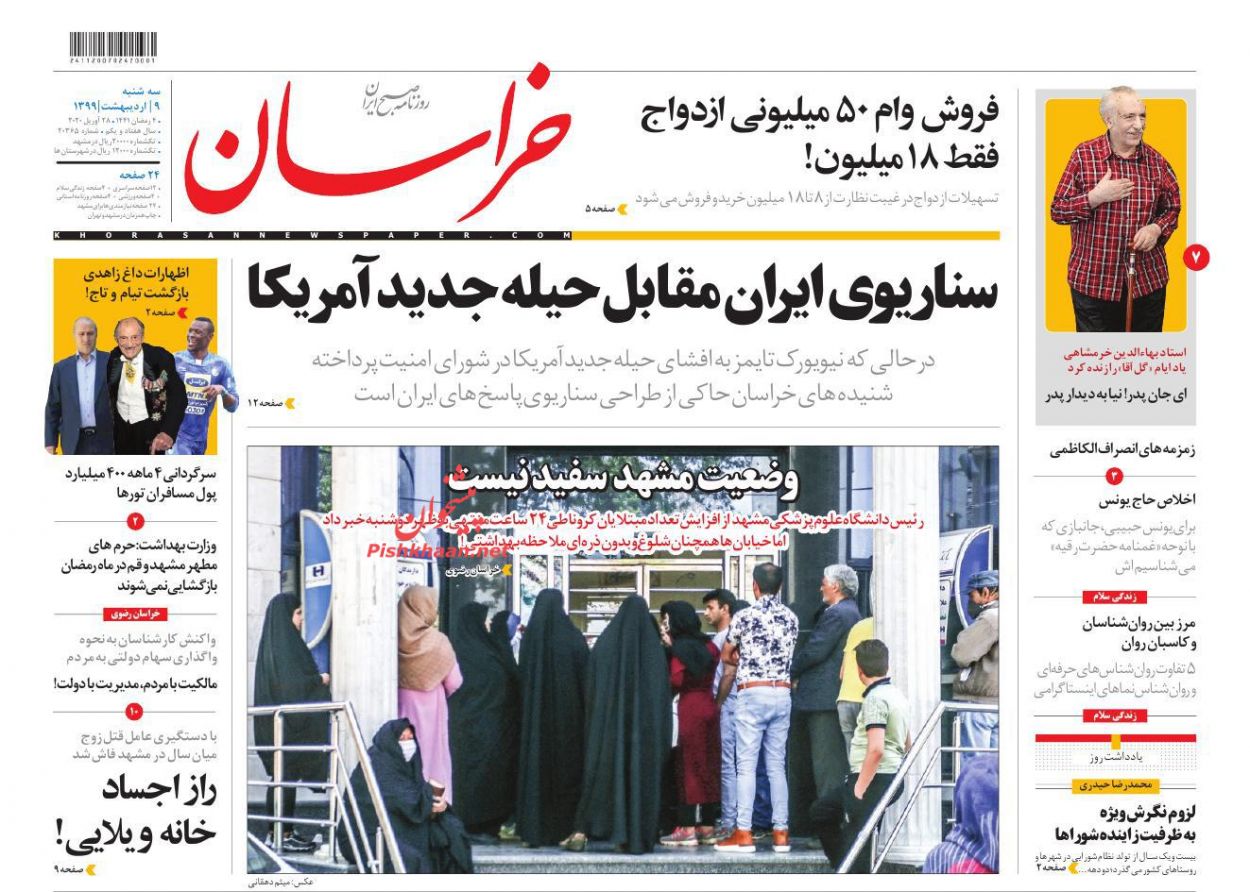
Khorasan Newspaper:

1- Iran’s Scenario against US’ New Deceit

A Look at Iranian Newspaper Front Pages on April 28


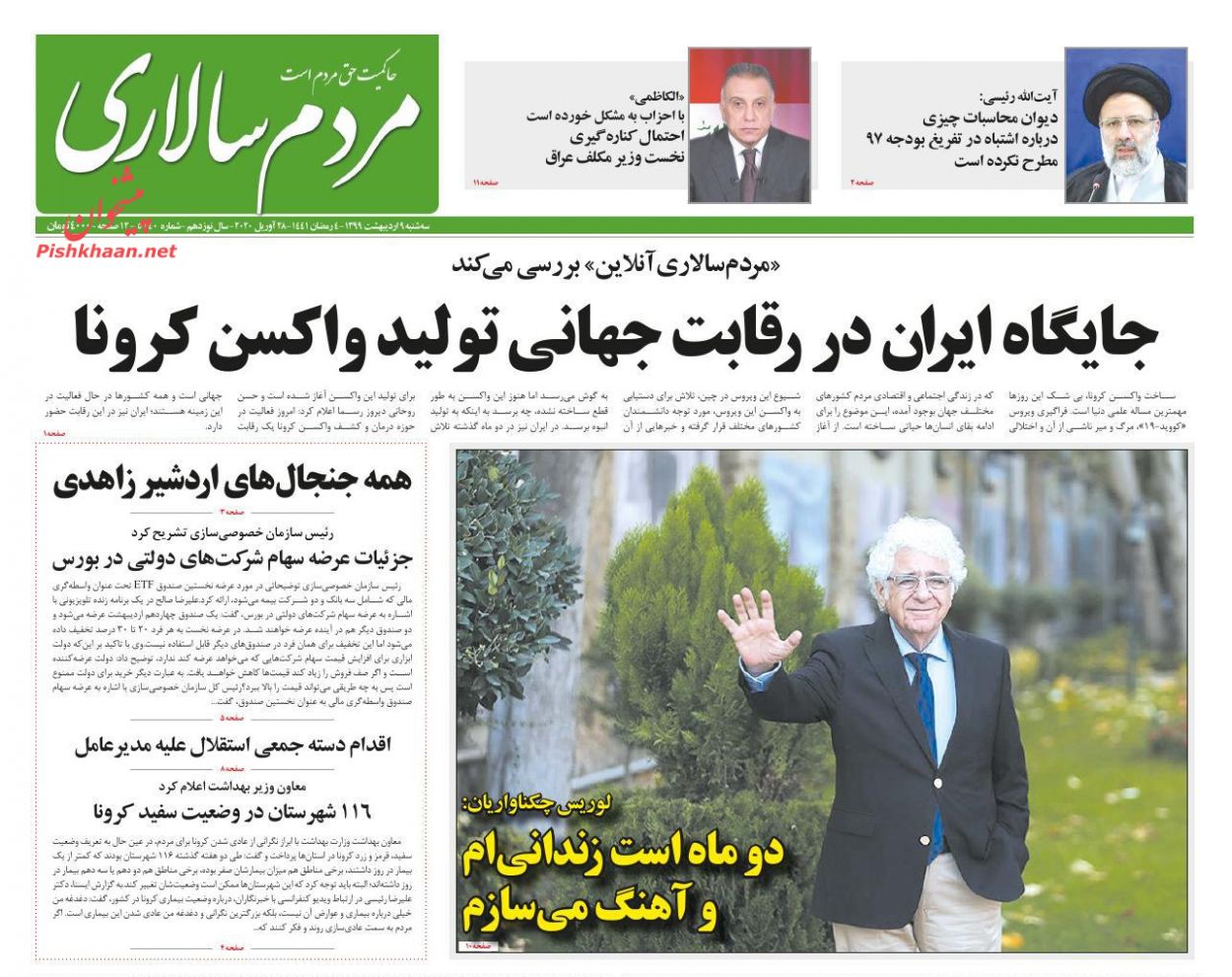
Mardom Salari Newspaper:

1- Iran’s Position in Global Race for Developing Corona Vaccine
2- 116 Towns in ‘White’ Zone of COVID-19 Risk

A Look at Iranian Newspaper Front Pages on April 28


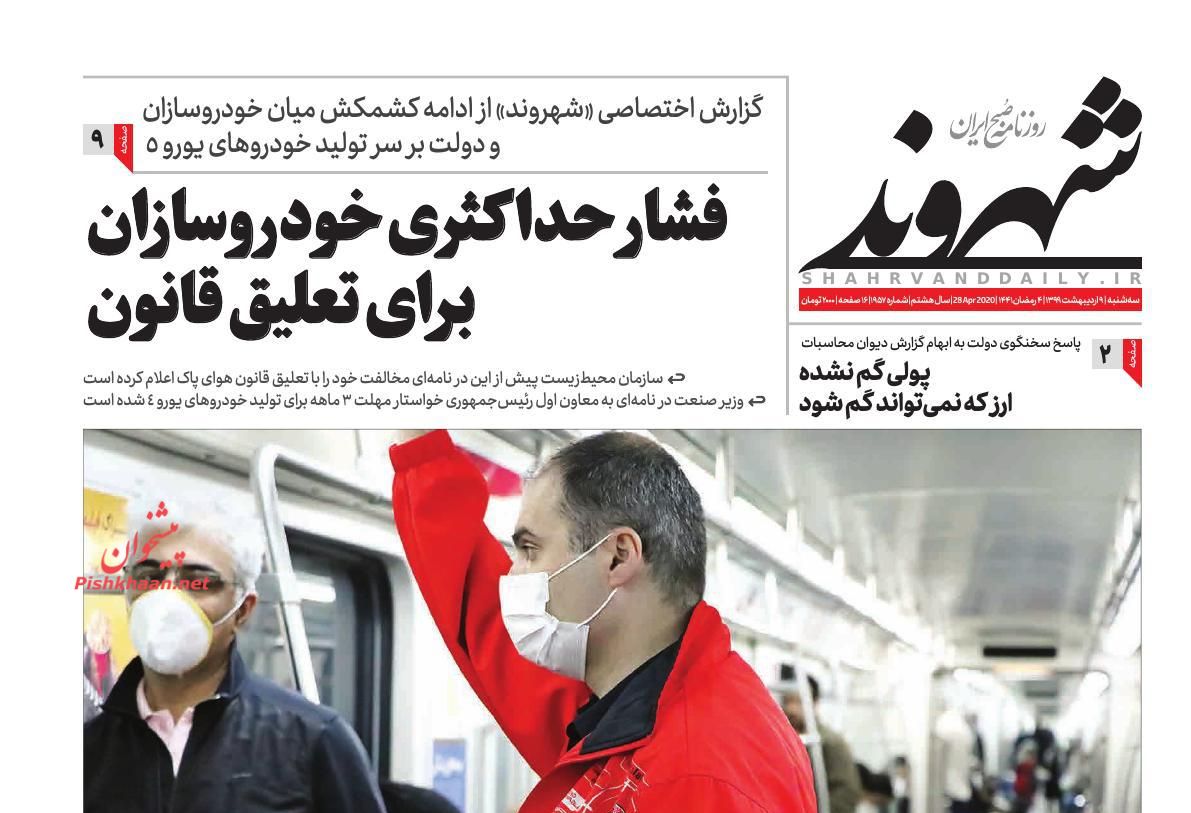
Shahrvand Newspaper:

1- 60 Regions Still in ‘Red’ Condition

A Look at Iranian Newspaper Front Pages on April 28


Shargh Newspaper:

1- Iran’s ‘Nour’ Satellite Shows Sanctions Haven’t Stopped Our Scientific Growth: IRGC

A Look at Iranian Newspaper Front Pages on April 28

Iran Confirms 1,112 New Cases of COVID-19 Infection

Iran Confirms over 2,000 New Cases of COVID-19 Infection

Health Ministry Spokesman Kianoush Jahanpour on Tuesday said 71 people have died in the past 24 hours from the novel coronavirus, raising the death toll to 5,877.

He further noted that 72,439 patients have so far recovered and been discharged from the hospital.

Jahanpour also said that 2,983 patients are in severe conditions of the disease.
So far, 442,590 tests for the novel virus have been taken in the country.

Coronavirus online test
If you are worried that you may have contracted the Coronavirus, take this test right now.

Iran, Russia Reject US ‘Delusional’ Plan for JCPOA

Iran, Russia Reject US 'Delusional' Plan for JCPOA

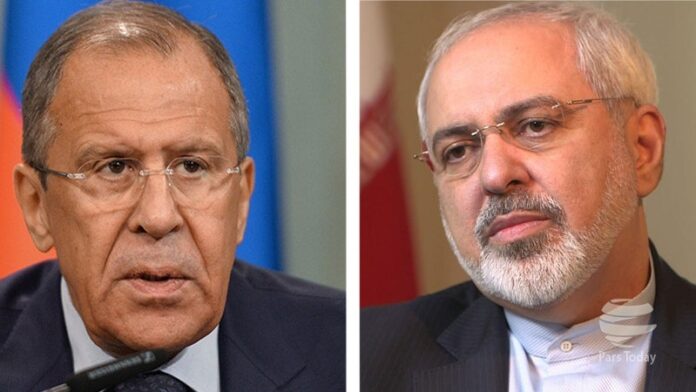
In a telephone conversation on Tuesday, Iranian Foreign Minister Mohammad Javad Zarif and his Russian counterpart Sergei Lavrov talked about the latest political developments in Afghanistan and the ongoing efforts to establish reconciliation and political consensus in that country.

The Iranian and Russian ministers also held consultations about the US’ new delusional plan for the JCPOA, and dismissed it as rejected and impractical.

The reaction from Iran and Russian came after US Secretary of State Mike Pompeo said he is preparing a legal argument that the US would remain a participant in the JCPOA –already renounced by the US president- as part of an intricate strategy to pressure the UN Security Council to extend an arms embargo on Tehran.

According to Pompeo’s plan, bound to be opposed by many of Washington’s European allies, the US would, in essence, claim it legally remains a “participant state” in the nuclear accord only for the purposes of invoking a “snapback” that would restore the UN sanctions on Iran that were in place before the nuclear deal.

Russia has already told American and European officials it is eager to resume conventional arms sales to Iran.

Iran, S Africa Discuss Medical Cooperation in COVID-19 Battle

Iran, S Africa Discuss Medical Cooperation in COVID-19 Battle

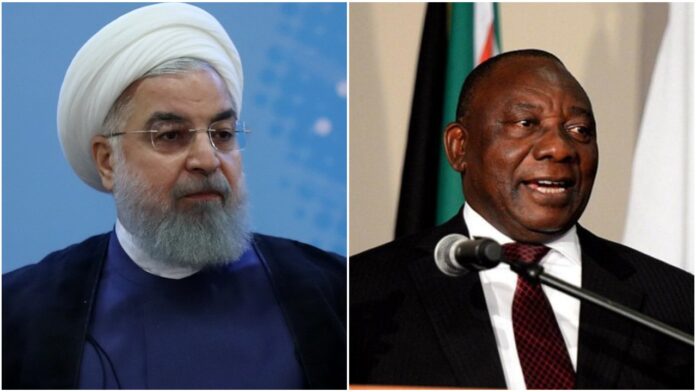
In the telephone conversation on Tuesday, Iranian President Hassan Rouhani and his South African counterpart Cyril Ramaphosa called for the expansion of economic and trade ties between the two countries, stressed the need to share experiences and information in the battle against the coronavirus, and weighed plans for health and scientific cooperation between Iran and South Africa in dealing with the disease.

Hailing the stellar record of economic cooperation between the two countries, the presidents also called for the employment of fresh capacities to promote the mutual cooperation and carry out joint projects.

President Rouhani and Ramaphosa also emphasized the necessity of strengthening international cooperation in order to stand against the anti-human sanctions imposed by the US, oppose the inhumane crimes against the oppressed Palestinian nation, and try to establish peace and calm in Syria and Yemen.

In the conversation, President Rouhani denounced the US government’s inhumane and illegal sanctions against the Iranian nation, saying, “While the world is engulfed by the coronavirus epidemic and the policies must be shifted towards relations with the (other) countries, sadly the US has intensified the unlawful sanctions against the Iranian nation, has violated the world health regulations besides trampling on international rules, and is even preventing the health and medical trade with Iran.”

Iran expects South Africa, as a non-permanent member of the United Nations Security Council, to further oppose the US’ unilateralism and Washington’s illegal sanctions against Tehran at the UN and the other international organizations, President Rouhani noted.

For his part, the South African president said, “We are fully aware of the US’ unjust and illegal measures against Iran and will keep supporting Iran.”

“Now is the time that we must take action together against the common enemy (coronavirus), and it is not the appropriate time to create problems for the nations by imposing sanctions and mounting the pressures,” Ramaphosa underlined.

Researchers Devise Sensor to Detect Cancerous Cells Using Nanotech

Researchers Devise Sensor to Detect Cancerous Cells Using Nanotech

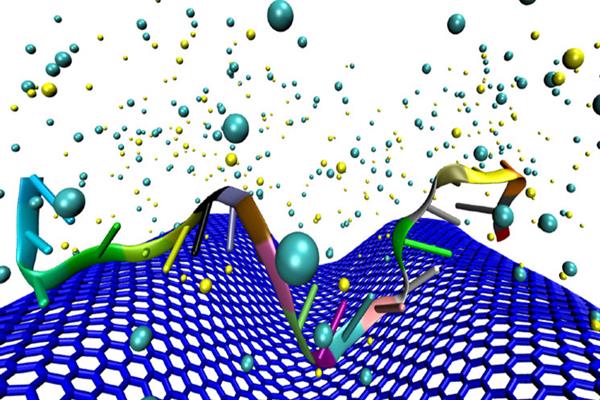
These researchers say they have used nanotechnology to produce this biosensor that can detect different types of cancer.

In this method, they worked on the cell samples of individuals and measured the amount of telomerase enzyme because the high level of this enzyme indicates the presence of cancer.

The research has been conducted with the help of the Fund to Support Researchers and Technologists at the Vice Presidency for Science and Technology. This sensor has been developed as part of a postdoctoral project.

Early detection of cancer is very important for the patient. In the early stages of the disease, the response to treatment is better, and with this sensor the patients can start their treatment process on time.

Reports say cancer was the second leading cause of death worldwide by the end of the last century. In 2004, more than 4 million people worldwide died of cancer, and that number is predicted to reach 12 million by 2030.

30% of those who lost their lives due to cancer had a chance to survive had they been diagnosed with the disease in its early stages. As cancer originates from the body’s own cells that grow inside the tissue and turn into a tumour, the body’s immune system is unable to detect it and does not fight it. In addition, due to the similarity between cancerous tissue and healthy tissue, the diagnosis and treatment of this disease is associated with many complications.

At present, the clinical diagnosis of cancer is based on imaging techniques or cytology and histology of the tissues suspected of being cancerous. Imaging techniques used to diagnose cancer, such as X-rays, mammography, computed tomography (CT), magnetic resonance imaging (MRI), endoscopy, and ultrasound, are less sensitive and have limited ability to differentiate and distinguish between benign and malignant lesions.

A useful and promising way to detect cancer earlier is to identify and detect substances in the blood and other body fluids that appear due to the presence of a tumour. These substances, called markers, can be proteins, carbohydrates, or nucleic acids that can be caused by cell carcinoma. Measuring the concentration level of the marker in saliva, blood, urine, or faces makes it possible to diagnose the disease in its early stages, assess the risk of recurrence, and follow up on treatment. Therefore, presenting a simple, sensitive, accurate, and precise method for the diagnosis of the disease with the help of symptoms is of great importance and can help in the early diagnosis of cancer.

Over 5,000 Poisoned in Iran after Consuming Fake Booze

Over 5,000 Poisoned in Iran after Consuming Fake Booze

Health Ministry Spokesman Kianoush Jahanpour said 525 of the poisoned people have lost their lives.

“At present, 229 of these people are in the wards and 47 in the ICU, but 3,451 have been discharged,” added Jahanpour.

He further mentioned that 95 people have gone blind or visually impaired, and 405 have reveived or are receiving dialysis services.

The sale and consumption of alcoholic beverages is prohibited in Iran. Under the Iranian law, those who produce, buy or sell alcohol can be sentenced to prison. This has resulted in the development of an underground market, where alcoholic drinks are produced in non-standard conditions.