Sunday, December 21, 2025
Home Blog Page 2705

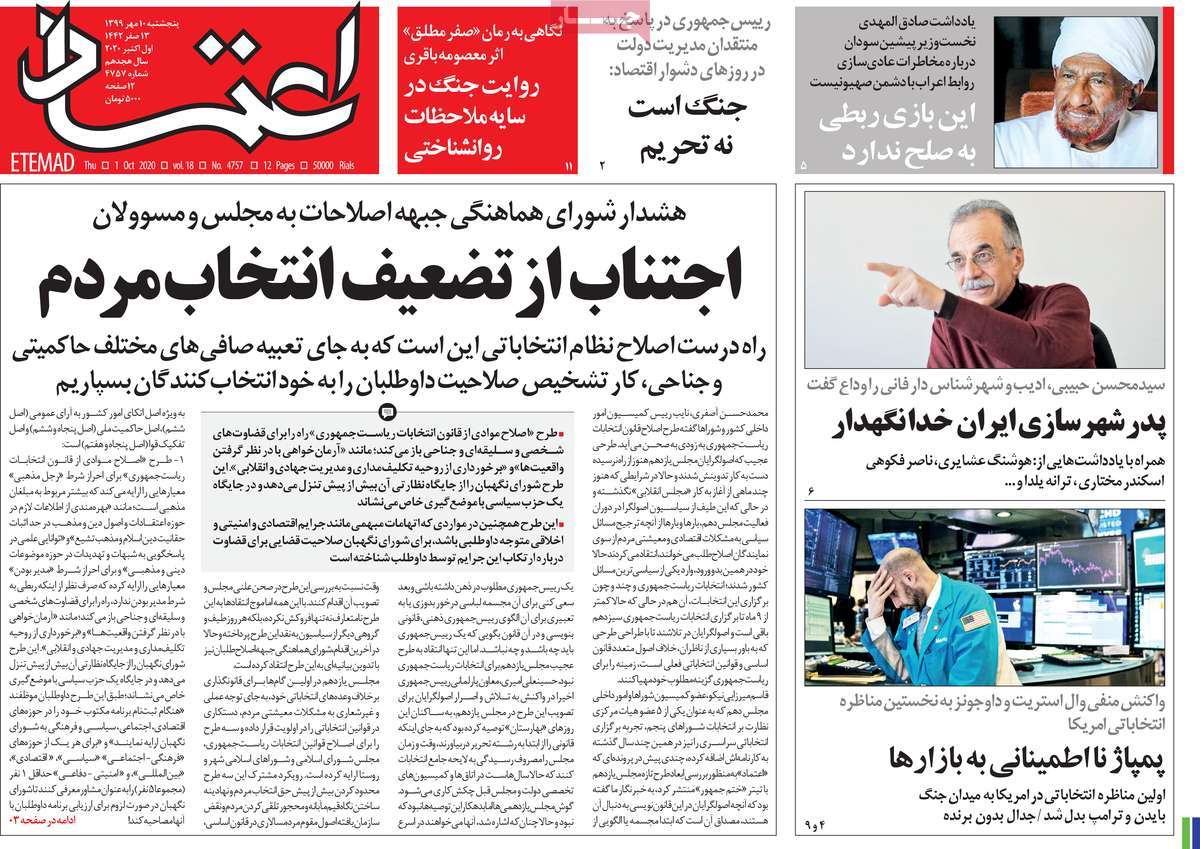
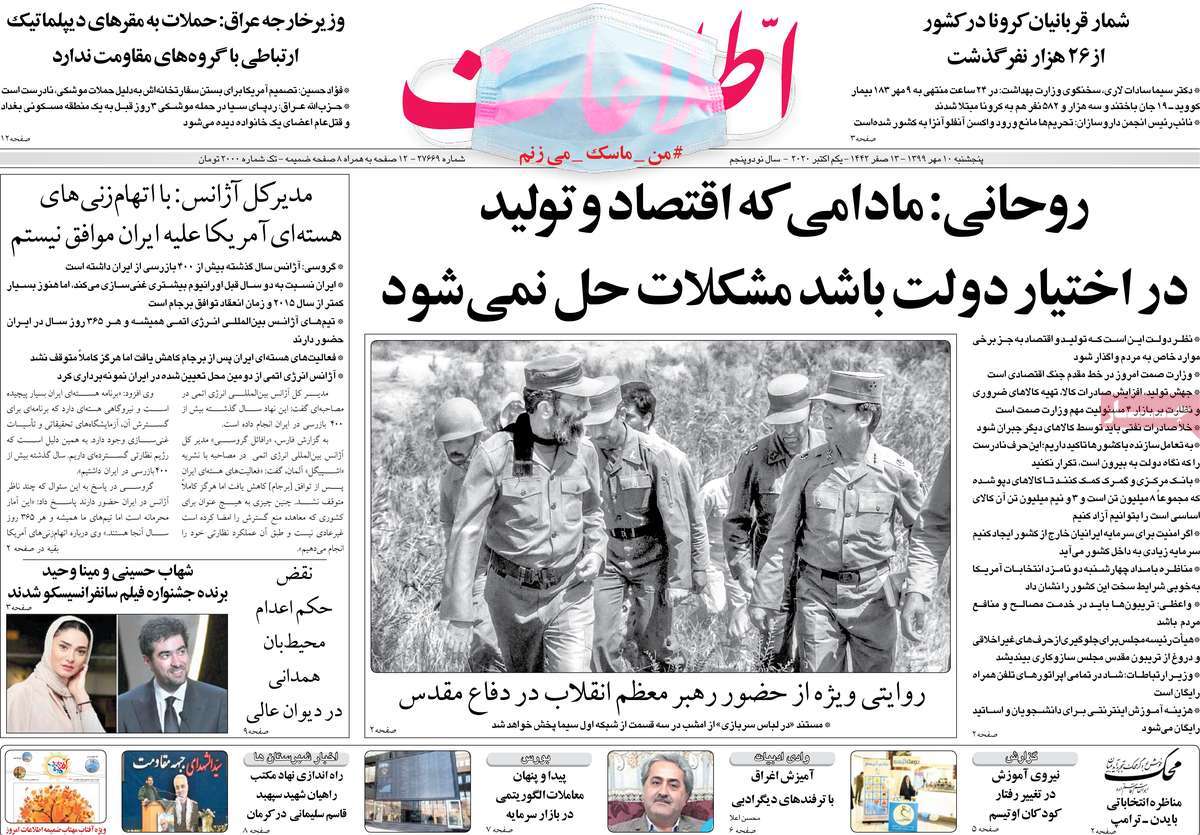
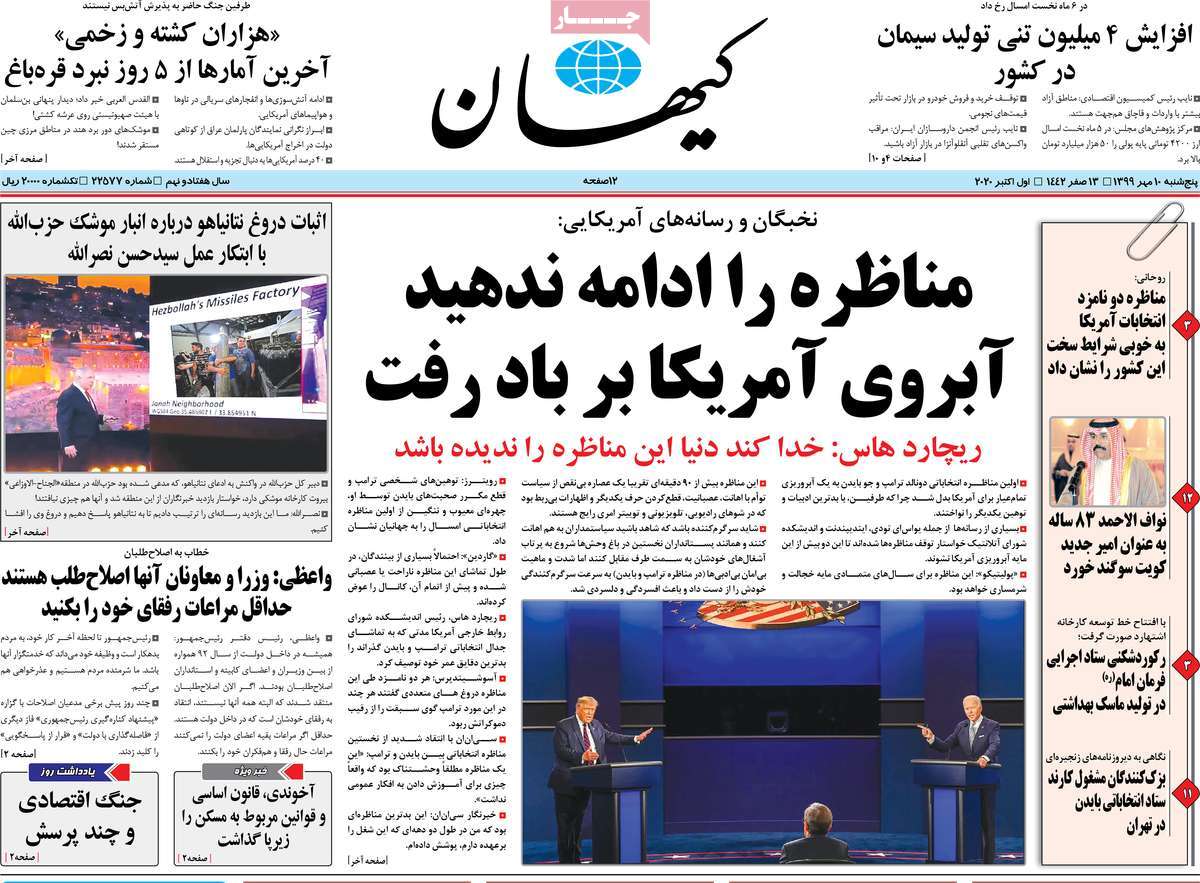
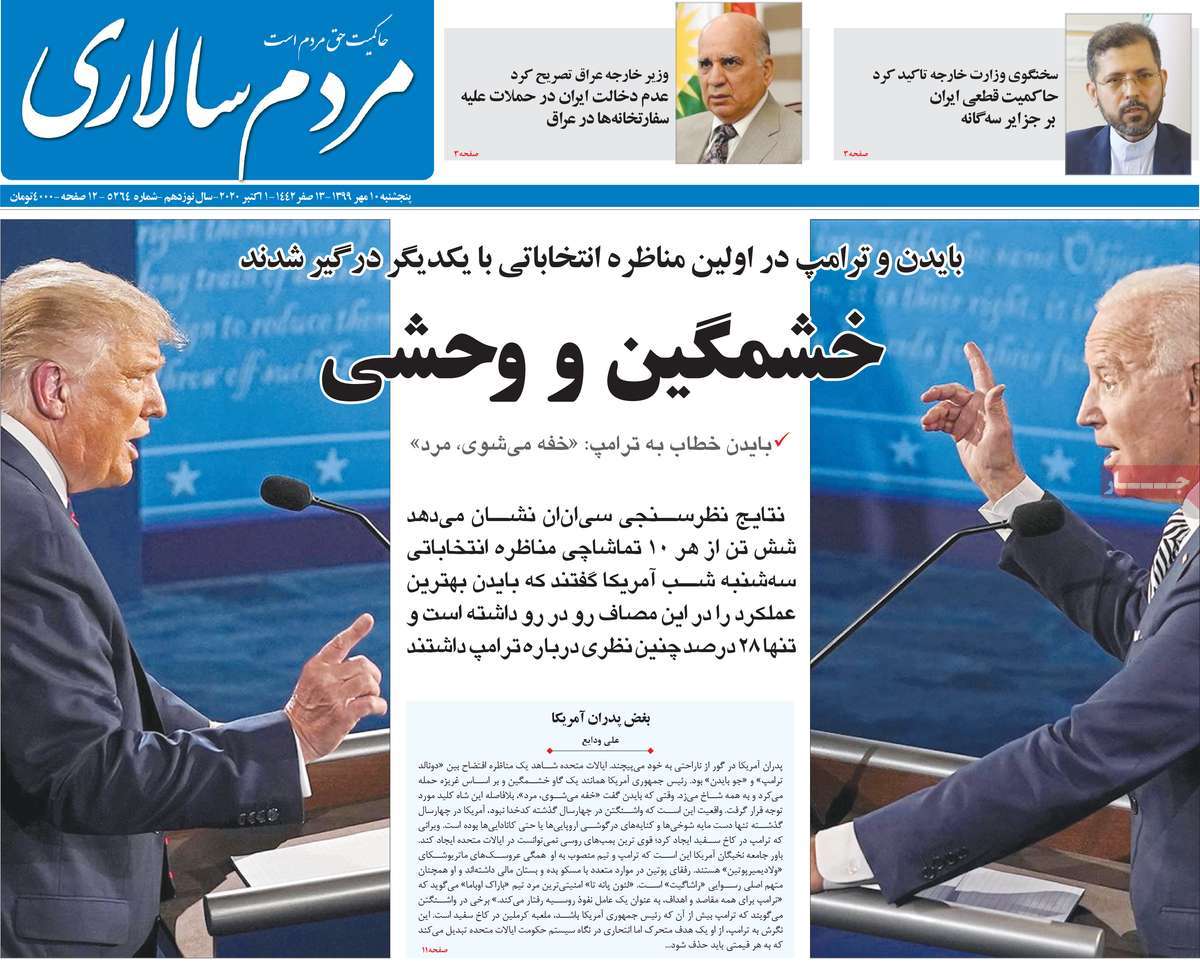
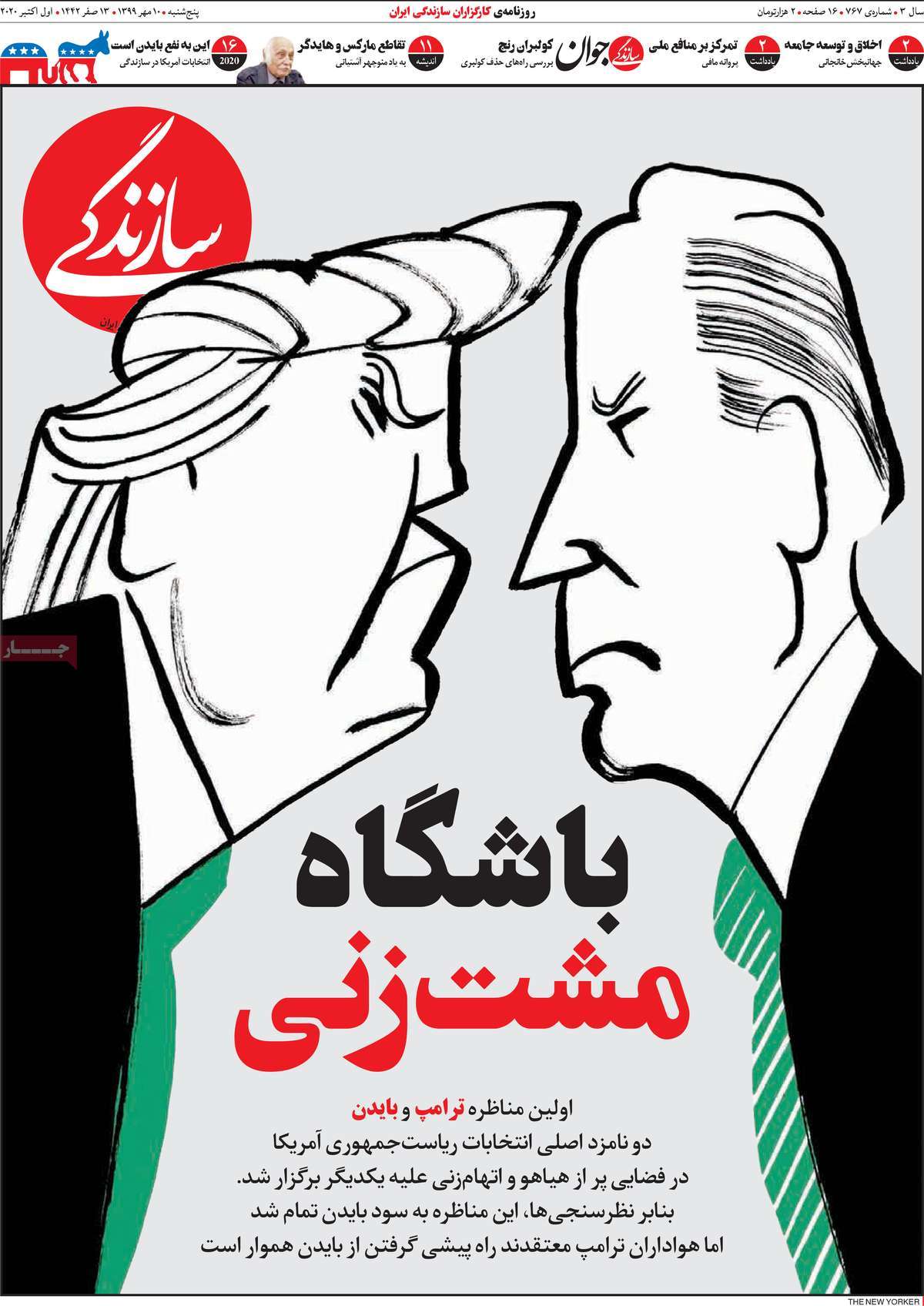
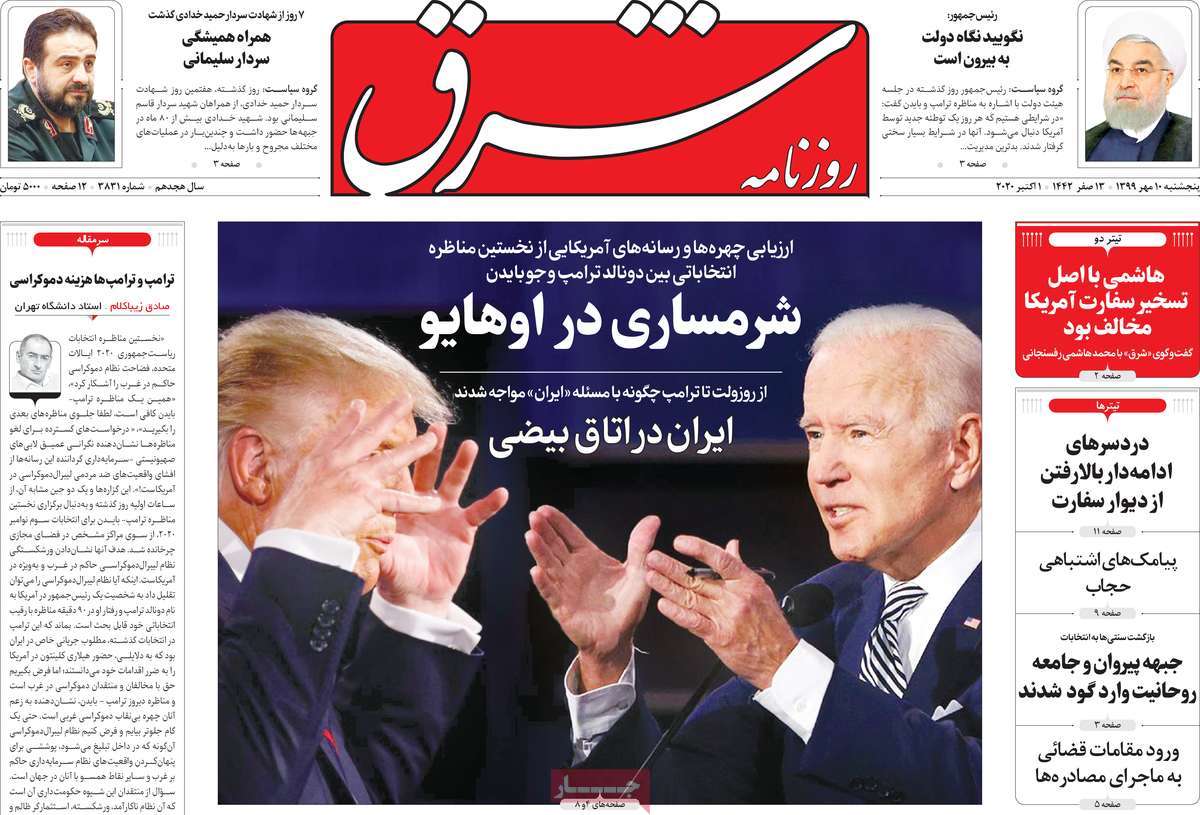
A Look at Iranian Newspaper Front Pages on September 1

A Look at Iranian Newspaper Front Pages on November 18

Iranian Newspapers

Abrar Newspaper:

1- Army Air Defence Chief: Iran Has Had 1,600-Percent Progress in Making UAVs

A Look at Iranian Newspaper Front Pages on September 1


Afkar Newspaper:

1- Iran Leader: We Owe Our Security to Vigilance of Air Defence

A Look at Iranian Newspaper Front Pages on September 1


Aftab-e Yazd Newspaper:

1- We’d Better Fight Ourselves Instead of ‘Coronavirus’ [Editorial]

A Look at Iranian Newspaper Front Pages on September 1


Arman-e Melli Newspaper:

1- US Now Confronting UNSC Instead of Iran: Ex-Diplomat

A Look at Iranian Newspaper Front Pages on September 1


Ebtekar Newspaper:

1- Students to Go to School This Week in All Parts of Iran Except for Red Zones

2- Pompeo’s Special Mission in Mideast: Besieging Iran on Agenda

3- Iran’s Football under Threat of Suspension Once Again

* FIFA Warns Iran’s Football Federation about Interference of Gov’t in Sports

A Look at Iranian Newspaper Front Pages on September 1


Ettela’at Newspaper:

1- Gov’t Defends Women’s Rights against Violence, Aggression: VP

A Look at Iranian Newspaper Front Pages on September 1


Iran Newspaper:

1- People’s Trips in Recent Holidays to Result in Another Peak of Coronavirus Outbreak

A Look at Iranian Newspaper Front Pages on September 1


Javan Newspaper:

1- ‘Death to America’ Chanted in America

2- Iran Exporting Medical Knowledge-Based Products to Four Continents

3- Iran’s Leader Praises Vigilance of Air Defence

A Look at Iranian Newspaper Front Pages on September 1


Kayhan Newspaper:

1- Europe Playing with Iran: Keeping Tehran in JCPOA While Trying to Extend Arms Bans

2- Fire in UAE as First Israeli Flight Lands

A Look at Iranian Newspaper Front Pages on September 1


Mardom Salari Newspaper:

1- US Isolated Thanks to Trump’s Policies

2- Rouhani: All Ministries Must Contribute to Expansion of Foreign Relations

A Look at Iranian Newspaper Front Pages on September 1


Shargh Newspaper:

1- Former DM Dehqan Preparing for Candidacy in 2021 Presidential Votes

2- Coronavirus of US Elections [Editorial]

A Look at Iranian Newspaper Front Pages on September 1

JCPOA Joint Commission Holds Meeting in Vienna

JCPOA Joint Commission Holds Meeting in Vienna

The meeting was co-chaired by Iranian Deputy Foreign Minister for Political Affairs Seyyed Abbas Araqchi and the Secretary General of the European External Action Service Helga Schmid.

Before the beginning of the meeting, Araqchi called on the remaining signatories to the Iran nuclear deal to stand up to Washington’s unilateralism.

He said the meeting has taken on special significance as it coincides with US efforts to reinstate former UN Security Council sanctions on Iran and wreck the Iran nuclear deal.
He also touched upon UNSC members’ opposition to the US-drafted resolution against Iran.

“US attempts in New York [against Iran] will definitely be a serious subject of discussion at the meeting of the joint commission, and we hope the joint commission will be able to reach a single stance and adopt decisions on how to keep moving on this path and counter US efforts as well as attempts by this country to destroy the JCPOA,” added Araqchi.

He expressed hope members of the commission will maintain the same stance they adopted at the UN Security Council meeting in New York and that constructive discussions will take place at the meeting of the joint commission.

US Not Entitled to Activate Snapback Mechanism: Iran

US Not Entitled to Activate Snapback Mechanism

Takht Ravanchi told a Monday meeting of the UN General Assembly that “on August 20th, through a letter to the Council, the US attempted to purportedly initiate a process to re-impose the Council sanctions on Iran. The reaction of Council members was decisive. Through their letters, again 13 members, including the remaining JCPOA participants, as well as Iran and the EU High Representative and the Coordinator of the JCPOA Joint Commission, strongly refuted the legal merit of the US letter.”

“Again, on August 25th, in an open VTC of the Council, the overwhelming majority of its members rejected the admissibility of the US letter,” he added.

“The arguments of the Council members, reflected in their letters and statements, are direct and straightforward: following its withdrawal from the JCPOA, the US is not a “JCPOA participant”, has no right to initiate a process to re-impose Council sanctions, and its letter cannot be considered as the qualified notification for the purpose of OP 11 of Resolution 2231, thus is void of any legal effect now and in the future, period,” the Iranian envoy noted.

“Having failed to convince the Council members through deceptive justifications, pseudo-legal arguments and arbitrary interpretation of Resolution 2231 as well as political pressure and intimidation, now, the US stubbornly argues that the sanctions will return on September 20.”

“Let’s make it quite clear that the legal arguments presented by Council members are rock-solid and the conclusion of the Council President is unambiguous and conclusive: the US is not in a position to initiate anything in the Council,” the envoy noted.

What follows is the full text of his speech:

Statement by H.E. Ambassador Majid Takht Ravanchi
Permanent Representative of the Islamic Republic of Iran to the United Nations
Before the United Nations General Assembly
On Agenda Item 27: “Report of the Security Council”
New York, 31 August 2020

In the Name of God, the Most Compassionate, the Most Merciful

Mr. President,
I thank you for convening this meeting. I also thank the Indonesian Presidency of the Security Council for presenting the report of the Council.

According to the Charter, the Council “shall submit” an annual report to the General Assembly and the Assembly “shall receive and consider” it. The raison d’être of such a strong obligation is nothing but to ensure that the Council is accountable to the Assembly where all Member States are represented and where the Council obtains its power from.

Therefore, by considering the annual report of the Council, the Assembly is in a position to evaluate the effectiveness of the Council’s actions. This is of particular importance this year, given the conclusion of the current report that “in 2019, the international situation remained quite turbulent”.

In certain cases, the Council’s indecisiveness, indecision and ineffectiveness have undermined regional and international peace and security. In this context, I would like to give certain examples regarding the developments of our region, the Middle East. This is crucial as according to the Council’s report, such situations drew the attention of the Council in 2019 and their impact remained severe.

Last year, parallel to the Israeli regime’s unlawful construction and expansion of settlements, its inhumane blockade of Gaza and its other criminal measures towards the Palestinians, the Council’s historic inaction and utter silence towards this crisis has also continued.

Moreover, last year, meddling and destabilizing activities of the U.S. in the Middle East continued, including through the occupation of parts of Syria, looting its oil and imposing unilateral sanctions against that country amid the COVID-19 pandemic.

In 2019, the U.S., on a number of occasions, intruded Iran’s territorial waters and airspace. Furthermore, in early January 2020, its military adventurism heightened placing the region on the verge of an all-out war when the U.S.’s military forces, in a terrorist act at the direct order of the U.S. President, violated Iraq’s sovereignty and horrifically martyred two regional anti-terror heroes, including Major General Qasem Soleimani, which was called by many international lawyers and scholars as a clear violation of the UN Charter and international law. Again, the Council was utterly silent.

In 2019, the United States also continued violating Resolution 2231 and the JCPOA. This is a gross violation of the U.S. obligations under the Charter’s Article 25. It also brazenly continued threatening UN members either to defy that Resolution or face punishment.

In pursuance of this destructive policy, the U.S. now has placed the UN under maximum pressure to ultimately kill the JCPOA. Earlier this month, in violation of Resolution 2231, it first proposed a draft resolution to impose arms embargo against Iran, which was rejected by 13 members of the Council.

Later, on August 20th, through a letter to the Council, the U.S. attempted to purportedly initiate a process to re-impose the Council sanctions on Iran. The reaction of Council members was decisive. Through their letters, again 13 members, including the remaining JCPOA participants, as well as Iran and the EU High Representative and the Coordinator of the JCPOA Joint Commission, strongly refuted the legal merit of the U.S. letter.

Again, on August 25th, in an open VTC of the Council, the overwhelming majority of its members rejected the admissibility of the U.S. letter.

The arguments of the Council members, reflected in their letters and statements, are direct and straightforward: following its withdrawal from the JCPOA, the U.S. is not a “JCPOA participant”, has no right to initiate a process to re-impose Council sanctions, and its letter cannot be considered as the qualified notification for the purpose of OP 11 of Resolution 2231, thus is void of any legal effect now and in the future, period.

Accordingly, the President of the Council, in its open VTC on August 25th concluded that, and I quote “it is clear for me that there is one member which has a particular position on the issues while there are significant number of members who have contesting views. In my view, there is not consensus in the Council thus the president is not in the position to take further action”, end of quote.

Having failed to convince the Council members through deceptive justifications, pseudo-legal arguments and arbitrary interpretation of Resolution 2231 as well as political pressure and intimidation, now, the U.S. stubbornly argues that the sanctions will return on September 20.

Let’s make it quite clear that the legal arguments presented by Council members are rock-solid and the conclusion of the Council President is unambiguous and conclusive: the U.S. is not in a position to initiate anything in the Council.

The U.S. policy regarding Resolution 2231 and the JCPOA challenges the relevance and accountability of the Council.

Therefore, in fulfilling its obligation under Charter’s Article 15(1), the Assembly must pay due attention to the principle of accountability of the Council and its members.

Finally, to enable the Assembly to have a clear account of the overall situation of international peace and security while considering the Council’s report, it is recommended that the introduction of the report be more analytical.

I thank you, Mr. President.

Iran’s COVID-19 Fatalities Down to New Record-Low

132,000 Iranian Patients Recover from COVID-19: Health Ministry

In a press briefing on Tuesday, Sima-Sadat Lari also confirmed 1,682 new cases of infection, raising the total number of infections to 376,894.

So far, she noted, 325,124 patients have recovered from the disease or been discharged from the hospital.

Lari said 3,709 patients are also in critical conditions caused by more severe infection.
The spokeswoman noted that 3,256,122 COVID-19 tests have been taken across the country so far.

She said the high-risk “red” zones include Tehran, Qom, Mazandaran, East Azarbaijan, Isfahan, Yazd, Khorasan Razavi, North Khorasan, Semnan, Gilan, Zanjan, Qazvin, and Kerman provinces.

The “orange” zones also include Lorestan, Ardabil, Golestan, Markazi, Alborz, Hormozgan, Ilam, Fars, Bushehr, West Azarbaijan, Chaharmahal and Bakhtiari, Kermanshah, South Khorasan, Kohgiluyeh and Boyer-Ahmad, and Khuzestan provinces, she added.
Iran Leader Condemns UAE’s Deal with Israel as ‘Betrayal’

Iran Leader Condemns UAE's Deal with Israel as 'Betrayal'

“The UAE betrayed not only the Muslim world, the Arab nations, and the regional countries, but also Palestine,” Ayatollah Khamenei said in a Tuesday speech.

The betrayal won’t last long, but the stigma will stay with them forever, he added.
Ayatollah Khamenei slammed the UAE for opening way for the Zionists’ presence in the region, and forgetting the issue of Palestine, which is the occupation of a country.

“The Palestinian nation is under heavy pressure from all sides, but they act against the interests of Muslim world along with the Israelis and vicious American elements like the Jewish guy in the Trump family [Jared Kushner],” he added.
The Leader finally expressed hope that Emiratis would wake up as soon as possible and make up for what they did.

Iran-IAEA Ties Redefined Following Grossi’s Visist to Tehran: Spokesman

Iran-IAEA Ties Redefined Following Grossi’s Visist to Tehran: Spokesman

The recent trip to Iran by Director General of the International Atomic Energy Agency (IAEA) Rafael Grossi can be examined from different perspectives, a report by Iranian conservative daily Resalat says.

Although some regard the visit as a victory for technical issues over political propaganda, some others had criticisms about the final agreement reached between Tehran and the agency at the close of Grossi’s trip to Iran.

The agreement ushered in a new era in Iran-IAEA relations. As spokesman for the Atomic Energy Organization of Iran (AEOI) Behrouz Kamalvandi says, Iran-IAEA ties are based on three key components: the Safeguards Agreement, the Additional Protocol and the 2015 Iran nuclear deal known as the Joint Comprehensive Plan of Action (JCPOA).

Nevertheless, what was achieved in Tehran was a “new and temporary framework” for the political will of both sides in a bid to resolve concerns and technical issues which both sides knew had political roots. Iran believed it is necessary to remain loyal to the three components; so, a new framework had to be formed which was able to preserve the future of the IAEA’s technical approach toward Iran issues without harming already defined frameworks.

In an interview with the Resalat daily, Kamalvandi elaborated on the Grossi’s trip and the agreement reached.

He said Iran had rejected the IAEA’s demand, a year ago, to inspect two sites in Iran.
“We had announced to the agency that none of those demands was in conformity with those three components; hence, we got into a period of time affected by differences of opinion between the agency and Iran,” he said.

“Furthermore, the information which the agency had based its demand on had no legal ground, and was based on a series of fabricated documents provided by the Israeli regime,” he added.
“So, talks were conducted to make sure that questions and demands [by the agency] are within a legal framework,” the spokesman noted.

“These negotiations were underway in the previous months, and finally, we achieved the desired result during the IAEA director general’s two-day trip and very intensive talks,” he said.

“As a result of the agreement, and after Iran’s concerned were eased, we agreed to voluntarily give the IAEA access [to the sites in question],” he said.

Elsewhere in his remarks, the spokesman said the Iran-IAEA relationship based on a “fundamental framework” and with “proper management” can keep the US from cashing in on every opportunity move forward with its anti-Iran agenda.

US Trying to Reinstate Iran Sanctions, but to No Avail:‌ Official

Iran Rejects Russia's Mediation, Says Has No Plans for Direct Talks with US

Mahmoud Vaezi said all members of the world body have expressed their opposition to Washington’s move.

“The Americans are not entitled to use the mechanisms in the JCPOA, and that’s why their recent attempt at the UN Security Council will definitely fail as all [UNSC] members and the international community are against it,” said Vaezi, the chief of staff of the Iranian president.

The White House says its demand that sanctions be re-imposed on Iran is based on a provision stipulated in the Iran nuclear deal, officially known as the Joint Comprehensive Plan of Action (JCPOA), which the US has withdrawn from. The US is not authorized to use the provision as it is no longer a signatory to the accord.

“In an illogical behaviour, the US government officially pulled out of the JCPOA, and it is clear that the US can no longer use the mechanisms in this agreement,” he said.

“Of course, US statesmen have now realized what a big mistake they made by withdrawing from the JCPOA. Now, in order to cover up this mistake, they make desperate moves which have no legal ground,” he added.
“Since their withdrawal, they have tested this approach several times, and each time they faced global opposition which was almost unprecedented in international history,” he said.
The chief of staff of the Iranian president further lashed out at Washington’s unilateralism.
“The United States’ unilateral policies paves the way for this country’s isolation in the world,” Vaezi said.

He noted the Americans, who claim to be leading the world, have suffered such isolation, which shows Iran’s positions are right and its behaviour legal.

He then slammed the United States for threatening to use sanctions against other countries.

“Overtly threatening to sanctions countries which oppose the US and are not on board with it sets a dangerous precedent in the international system and the [UN] Security Council,” he said.

Vaezi further criticized remarks made by US Secretary of State Mike Pompeo.
“Swayed by the Zionist regime [of Israel]’s extremist approach and desire, the US government makes decisions which are completely illegal and illogical, so it cannot even remain committed to the apparent legal principles of these decisions,” he noted.

Deep Learning Architecture

Deep Learning Architecture

Understandably, we don’t pass a single day without innovation or research. And hence in recent times, it gets difficult to cope up with the latest advancements happening in deep learning.

Deep learning has an extraordinary impact on several high-profile fields, which include research like natural language processing (NLP), speech recognition, face recognition, machine translation, and many more! Let us know about the advancements in deep learning considering the architectures which have been successful in the Computer Vision domain.

  • Among the five deep learning architectures, CNN and LSTM are the oldest yet most widely used architectures.
  • The RNN is useful in Speech recognition, handwriting recognition.
  • LSTM/GRU network is helpful in Natural language text compression, handwriting recognition, speech recognition, gesture recognition, image captioning.
  • CNN is for image recognition, video analysis, and natural language processing.
  • DBN is for Image recognition, information retrieval, natural language understanding, and failure prediction.
  • DSN is mostly for information retrieval and continuous speech recognition.

Let us now study them in brief.

Recurrent Neural Network (RNN)

All the other deep learning architectures are built using the Recurrent Neural Network (RNN) architecture since it is the foundational network architecture. A typical recurrent network and a multilayer network have a primary difference. Rather than entirely feed-forward connections, a recurrent network might have connections that give feedback into the same layers (or into the prior layer). RNNs maintain the memory of past inputs and model problems in time, allowed by the input.

RNNs consist of a rich set of architectures. The primary and critical differentiator is feedback within the network, which could manifest itself from the output layer, a hidden layer, or some combination. RNNs can be trained with standard back-propagation or by using a variant of back-propagation, called back-propagation in time (BPTT), or can be unfolded in time.

LSTM or GRU Networks

Hochreiter and Schimdhuber created LSTM in 1997, but its popularity has grown in recent times as an RNN architecture for various applications. You can find LSTMs in products that you use in your everyday life, such as smartphones. For milestone-setting conversational speech recognition, IBM applied LSTMs in IBM Watson.

The LSTM introduced the concept of a memory cell departing from the typical neuron-based neural network architectures. Retention of value in the memory cell can happen for a long or short time concerning its inputs; this allows the cell to remember its last computed value and what’s essential.

The LSTM memory cell consists of three gates that control how information flows out of or into the cell. The input gate controls the flow of any new information into the memory.

In case an existing piece of information is forgotten, the forget gate controls, allowing the cell to remember new data.

A simplification of the LSTM was introduced in 2014 called the Gated Recurrent Unit (GRU). Getting rid of the output gate present in the LSTM model, the GRU model consists of two gates. Performance of the GRU is similar to the LSTM in many applications, but the difference is that being simpler means fewer weights and faster execution in GRU.

The GRU consists of two gates viz: an update gate and a reset gate. The update gate looks after how much to maintain the previous cell content. The reset gate defines the ways to incorporate the new input with the cell earlier contents. Only by setting the reset gate to 1 and the update gate to 0, a GRU can model a standard RNN.

The GRU can be trained more quickly and can be more efficient in its execution and is way more straightforward than the LSTM.

Convolutional Neural Network or CNN

A Convolutional Neural Network aims to learn higher-order features in the data with the help of convolutions. As the name suggests, the network employs convolution, a mathematical operation. In at least one of their layers, these networks use convolution in place of general matrix multiplication, so these networks are neural networks.

They can identify faces, street signs, platypuses, individuals, and many other visual data aspects. Using optical character recognition, CNNs overlap with text analysis since they are well suited to object recognition and consistently top image classification competitions. They are also useful in analyzing sound or when analyzing words as discrete textual units.

Deep Belief Network or DBN

The DBN includes a novel training algorithm and is a typical network architecture. The DBN is a multilayer network in which each connected layer is a restricted Boltzmann machine RBM). Corresponding to this, DBN is represented as a stack of RBMs.

In the DBN, the raw sensory inputs are represented by the input layer, and each hidden layer learns abstract representations of this input. The network classification is implemented by the output layer, which is treated somewhat differently than the other layers. Unsupervised pre-training and supervised fine-tuning are the two steps of training.

In unsupervised pre-training, to reconstruct its input is trained to each RBM. The next RBM is trained on similar lines, but the first hidden layer is treated as the visible or the input layer. Till each layer pertains, this process continues. Fine-tuning begins when the pre-training is complete.

Deep stacking networks

The DSN is the final architecture, and it is also called a deep convex network. Although it consists of a deep system, a DSN is different from traditional deep learning frameworks. DSN is a deep set of individual networks, each with its hidden layers. This architecture overcomes one of the problems with deep learning: the complexity of training. The complexity of training increases exponentially in a deep learning architecture, so the DSN doesn’t view training as a single problem but as a set of individual training problems.

Conclusion

There are wide and varied numbers of architectures and algorithms in deep learning. We have successfully learned about five of the most popular deep learning architectures.

Iran Asks Niger to Counter US Polices as UNSC President

Iran Asks Niger to Counter US Polices as UNSC President

In a telephone conversation with his Nigerien counterpart Mahamadou Issoufou on Monday evening, President Hassan Rouhani congratulated Niger on holding the rotating presidency of the UN Security Council in September.

“I am confident that the Republic of Niger, as a member of the Non-Aligned Movement, will act quite independently and professionally during its presidency of the United Nations Security Council in the same way that it adopted a very constructive stance on the illegal resolution on extension of Iran arms embargo, and will prevent the US from abusing the United Nations and the Security Council for excessive demands and unilateralism,” President Rouhani added.

The president also highlighted the “constructive and positive” cooperation between Iran and Niger in the international organizations, such as the UN, the NAM and the Organization of Islamic Cooperation, and expressed gratitude to Niger for constant supports for the Joint Comprehensive Plan of Action (JCPOA) and the UNSC Resolution 2231 that endorses the nuclear deal.
“Certain countries’ abuse of the international circles has been the root cause of many problems in the contemporary world,” President Rouhani underscored, saying Tehran and Niamey share the view that the international relations must be based upon justice, righteousness, and human values founded on independence, solidarity and dignity.

Pointing to four decades of close cooperation between the two Muslim nations in various fields such as mineral exploration, health sector, and agriculture, President Rouhani expressed Iran’s readiness to share its experiences in the fight against terrorism and in the battle with the coronavirus pandemic with the republic of Niger.

For his part, the Nigerien president voiced the African country’s readiness to enhance relations with Iran in all fields.

He also highlighted the cooperation between Iran and Niger in the international organizations, including the NAM and the UN, and expressed satisfaction with the common views of the two Muslim nations about various international issues.

Niger has always tried to establish the international cooperation on the basis of major humanitarian values, Issoufou added, saying his country would employ the same strategy at the UN Security Council.