Thursday, December 25, 2025
Home Blog Page 267

Iran’s nuclear safety center: No traces of depleted uranium found in U.S. attacks

US Attack Iran

The Center addressed circulating claims on social media suggesting the use of depleted uranium munitions by the aggressor.

“We inform the honorable people of Iran that our investigations to date have revealed no signs of depleted uranium use,” the statement said.

The Center clarified that depleted uranium, known for its high density and armor-piercing capabilities, is typically employed in specialized munitions fired from tanks or aircraft to enhance warhead penetration.

The statement comes amid growing concerns over the humanitarian and environmental impacts of the the recent United States’ and Israeli regime’s aggression, particularly following reports of advanced munitions used in attacks targeting both military and civilian infrastructure.

Iran reopens airspace as flight operations resume

Iran Airport

Following recent hostilities and the temporary closure of Iran’s airspace due to security concerns stemming from U.S. and Israeli attacks, Amirani confirmed that the country’s aviation infrastructure is rapidly returning to full operational capacity.

“Thanks to the swift action of our specialists, damaged airport facilities were restored to operational status in record time,” he stated.

He further noted that the eastern air corridor of the country is now fully open, while flight operations in the western region are safely active from 5:00 a.m. to 6:00 p.m. daily.

Amirani emphasized that the nation’s radar, navigation, and surveillance systems are in full operational condition and fully prepared to ensure the safe management of all flights.

Iran had temporarily restricted its airspace in response to security risks following coordinated missile and drone strikes by the Israeli regime and the United States, citing the safety of passengers and civil aviation as a top priority.

Iran rejects Trump’s claims of requesting talks as baseless fabrication

Esmael baghaei

Spokesman for the Iranian Foreign Ministry Esmaeil Baqaei stated on Tuesday that no request for a meeting had been submitted to the American side.

He dismissed Trump’s remarks as a desperate attempt to project strength.

“From our side, no request for a meeting has been made to the American side,” Baqaei said.

Trump on Monday claimed during a meeting with Israeli prime minister Benjamin Netanyahu that Washington had set a date for negotiations with Iran and that Iranian officials were eager to talk.

“I think they want to meet with us to make peace,” he claimed.

The US president went further, asserting that Iran’s nuclear program had been completely dismantled and that the International Atomic Energy Agency had confirmed the destruction of a target site.

“I hope the war between Israel and Iran is over. We will have a meeting with Iran and see what happens,” Trump added.

Meanwhile, media outlets reported that Steve Witkoff, Trump’s regional envoy, declared a meeting with Iranian officials would be arranged very soon and could take place as early as next week.

US envoy lauds Lebanon’s response to Hezbollah disarmament proposals

Thomas Barrack, an adviser to US President Donald Trump who serves as Washington’s ambassador to Turkiye and special envoy for Syria, returned to Beirut on Monday after delivering the US proposal during a June 19 visit.

The plan called for the Lebanese group Hezbollah to fully disarm within four months in exchange for a halt to Israeli air strikes and the full withdrawal of Israel’s military from the five positions it continues to occupy in southern Lebanon.

“What the government gave us was something spectacular in a very short period of time,” Barrack told reporters on Monday after meeting Lebanese President Joseph Aoun.

“I’m unbelievably satisfied with the response.”

While Barrack confirmed that he had received a seven-page reply from the Lebanese side, he offered no details on its contents.

Barrack said that he believed both Lebanon and Israel were seeking a path toward de-escalation, adding, “Both countries are trying to give the same thing – the notion of a stand-down agreement, of the cessation of hostilities, and a road to peace.”

The remarks come as tensions remain high as Israel continues to bombard Lebanon despite agreeing to a ceasefire in November.

The conflict between Israel and Hezbollah erupted in October 2023 after the Lebanese group attacked Israel in solidarity with the Palestinian group Hamas in Gaza. It spiralled into full-scale conflict by September the following year, killing more than 4,000 people – including Hezbollah leader Seyyed Hassan Nasrallah and other senior officials – and displacing nearly 1.4 million people, according to Lebanese authorities.

Lebanon’s president and prime minister – both installed earlier this year – have promised to strengthen the state and the army, and said that Hezbollah, long viewed as the most powerful military force in Lebanon, must not be more powerful than the government.

However, Israel has continued to strike Lebanon, claiming its operations are aimed at preventing Hezbollah from rearming. Lebanese health officials say around 250 people have been killed and more than 600 wounded in Israeli attacks since the ceasefire.

Hezbollah has not issued a formal response to the US proposal. However, its leader, Naim Qassem, stated on Sunday that the group would not disarm while Israel continued its aggression.

“We cannot be asked to soften our stance or lay down arms while [Israeli] aggression continues,” Qassem told thousands of supporters during Ashura commemorations in the southern suburbs of Beirut.

Barrack acknowledged that Hezbollah would need guarantees that it could continue operating as a political force within Lebanon.

But signs of de-escalation were absent on the ground. Just hours before Barrack’s arrival, Israel launched a wave of air strikes on southern and eastern Lebanon and carried out a ground invasion into a border village.

Lebanese officials and diplomats announced that the latest military action appeared to be an attempt to increase pressure on Hezbollah ahead of diplomatic discussions.

Iran to register all civilian drones amid spiraling situation

Hezbollah says its drone returns to Lebanon after mission over occupied Palestine

Alaeddin Boroujerdi, a veteran lawmaker, revealed that an estimated 50,000 to 60,000 drones are currently in use across the country.

Given their potential for dual-use, from agricultural applications to unlawful surveillance or even attacks, lawmakers have deemed it necessary to regulate and license all unmanned aerial vehicles (UAVs).

“Much like a knife that can be used either in surgery or in crime, drones also have the potential for abuse, as we’ve seen in recent incidents,” Boroujerdi stated.

The proposed legislation, known as the Remote-Piloted Aircraft Regulation Bill, has already passed through multiple sessions in the parliamentary commission and is awaiting final approval by the Guardian Council. Once enacted, all drone operators will be required to obtain permits, and drones must be registered and traceable.

Boroujerdi emphasized that lawful oversight will help authorities act swiftly and prevent future incidents, especially after the experience in conflict with the Israeli regime and the US last month.

Iranian Armed Forces chief, Qatari defense official discuss regional security, bilateral ties

General Mousavi praised Qatar as a close and friendly nation, expressing appreciation for Doha’s firm stance in condemning recent aggressions against Iran. He also acknowledged Qatar’s continued support for the Palestinian cause.

Highlighting Iran’s position during the recent 12-day conflict, General Mousavi stated that Iran’s legitimacy and defensive actions were supported by Muslims and freedom-seekers worldwide, revealing the disregard of international norms by the US and Israel.

He emphasized that US forces fully backed Israel with intelligence and logistics, yet Iran’s military stood firm against aggression and responded decisively with full force.

Al Attiyah extended condolences for the martyrdom of General Bagheri and other commanders, reiterating Qatar’s condemnation of Israeli attacks.

He stressed that Qatar would not allow its airspace or territory to be used for war and reaffirmed its commitment to diplomacy and peaceful solutions.

Both sides agreed to enhance bilateral military and defense cooperation moving forward.

Senior journalist slams Iranian president for interview with Tucker Carlson

Masoud Pezeshkian

In the interview, President Pezeshkian addressed Iran’s stance on nuclear cooperation, regional tensions with Israel, and the possibility of renewing talks with the US. He stated that Iran had “no problem with negotiations” and expressed hope for a return to diplomacy after recent conflict with Israel and the US.

Shariatmadari rebuked these comments, calling them inconsistent with the country’s declared policies and accusing the president of echoing the views of “pro-Western advisors rather than those of the Iran.”

He specifically criticized President Pezeshkian’s remarks that the Islamic authorities’ fatwa was not directed at individuals like US president, stating instead that figures such as Donald Trump and Israeli Prime Minister Benjamin Netanyahu fall under the fatwa and should face capital punishment.

He further questioned the president’s logic in hoping to resume negotiations with the US, which, he reminded, was complicit in Israeli attacks on Iran.

“Why return to talks with those who ‘blew up the negotiation table’?” Shariatmadari asked.

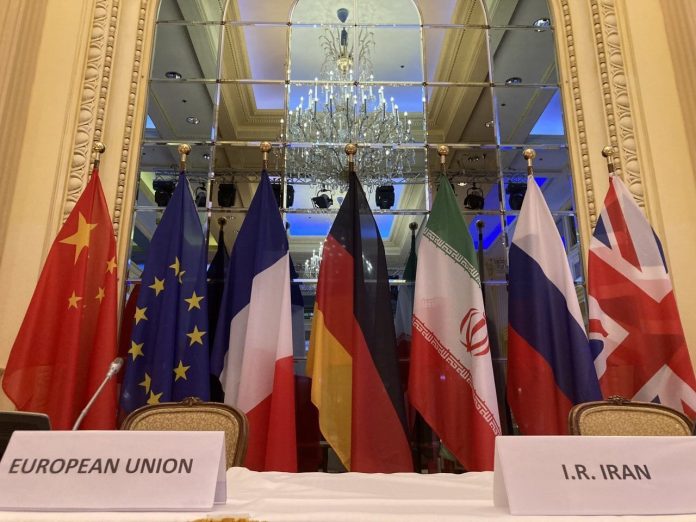
US says has ‘scheduled Iran talks’

Iran US Flags

“We have scheduled Iran talks, and they want to talk,” Trump told reporters, along with Israeli Prime Minister Benjamin Netanyahu at the White House.

“They’ve requested a meeting…and if we can put something down on paper, that will be fine. It’ll be good,” he said, adding: “We’ll see what happens.”

Trump’s Middle East envoy Steve Witkoff also stated that the meeting will take place in the “next week or so.”

Asked about what might make him “have the desire” to carry out another strike on Iran, Trump noted: “I hope we’re not going to have to do that. I can’t imagine wanting to do that. I can’t imagine them wanting to do that. They want to meet…they want to work something out.”

On June 22, US B-2 bombers dropped 14 GBU-57 Massive Ordnance Penetrator (MOP) bombs, also known as bunker busters, on Iran’s Fordo and Natanz nuclear sites, and dozens of submarine-based Tomahawk cruise missiles were fired at its nuclear facility at Isfahan as part of Washington’s campaign against Iran’s nuclear program.

A sixth round of talks between the US and Iran was scheduled on June 15, but Israel launched air attacks on Iranian military, nuclear, and civilian sites on June 13.

The 12-day conflict between Israel and Iran ended with a US-sponsored ceasefire that took effect June 24.

Trump said Iran is “very different now” than it was two weeks ago, adding, “I hope it’s over. Yeah, I think Iran wants to meet. I think they want to make peace, and I’m all for it.”

Turning to Syria, he said the US lifted sanctions on the country at the request of many countries in the Middle East.

“We took the sanctions off (Syria) because we want to give them a chance,” he added.

The president highlighted that he would like to remove tough US “biting” sanctions on Iran “at the right time”.

“I would love to be able to, at the right time, take those sanctions off (Iran), give them a chance at rebuilding, because I’d like to see Iran build itself back up in a peaceful manner and not going around saying, ‘Death to America,’ ‘Death to the USA,’ ‘Death to Israel,’ as they were doing,” he stressed.

Netanyahu meets Trump at White House as Israel, Hamas discuss Gaza ceasefire

Speaking to reporters at the beginning of a dinner between U.S. and Israeli officials, Netanyahu said the United States and Israel were working with other countries who would give Palestinians a “better future,” suggesting that the residents of Gaza could move to neighboring nations.

“If people want to stay, they can stay, but if they want to leave, they should be able to leave,” Netanyahu added.

“We’re working with the United States very closely about finding countries that will seek to realize what they always say, that they wanted to give the Palestinians a better future. I think we’re getting close to finding several countries.”

Trump, who initially demurred to Netanyahu when asked about the relocating of Palestinians, said the countries around Israel were helping out.

“We’ve had great cooperation from … surrounding countries, great cooperation from every single one of them. So something good will happen,” Trump added.

The president earlier this year floated relocating Palestinians and taking over the Gaza Strip to turn it into the “Riviera of the Middle East”. Gazans criticized the proposal and vowed never to leave their homes in the coastal enclave. Human rights groups condemned the plan as ethnic cleansing.

Trump and Netanyahu met in Washington while Israeli officials continued indirect negotiations with Hamas aimed at securing a U.S.-brokered Gaza ceasefire and hostage-release deal.

Netanyahu’s visit follows Trump’s prediction, on the eve of their meeting, that such an agreement could be reached this week.

It was Trump’s third face-to-face encounter with Netanyahu since returning to office in January, and came just over two weeks after the president ordered the bombing of Iranian nuclear sites in support of Israeli air attacks. Trump then helped arrange a ceasefire in the 12-day Israel-Iran war.

Outside, hundreds of protesters, many wearing Palestinian keffiyeh scarves and waving Palestinian flags, gathered near the White House, waving banners that read “Stop Arming Israel” and “Say No to Genocide”. They also called for Netanyahu’s arrest, referring to the International Criminal Court’s arrest warrant against the Israeli leader over alleged war crimes in Gaza.

Trump’s Middle East envoy Steve Witkoff, who played a major role in crafting the 60-day ceasefire proposal at the center of the Qatar negotiations, will travel to Doha this week to join discussions there, White House press secretary Karoline Leavitt told reporters earlier on Monday.

In a sign of continued gaps between the two sides, Palestinian sources stated that Israel’s refusal to allow the free and safe entry of humanitarian aid into Gaza remains the main obstacle to progress in the indirect talks.

The U.S.-backed proposal envisages a phased release of hostages, Israeli troop withdrawals from parts of Gaza and discussions on ending the war entirely.

Hamas has long demanded a final end to the war before it would free remaining hostages; Israel has insisted it would not agree to halt fighting until all hostages are released and Hamas dismantled.

Israel’s war in Gaza has killed over 57,000 Palestinians, according to the enclave’s health ministry. Most of Gaza’s population has been displaced by the war and nearly half a million people are facing famine within months, according to United Nations estimates.

Israel confirms five soldiers killed in Gaza

Israel Army

Two of the soldiers “fell during combat in the northern Gaza Strip,” the Israeli military said in a statement,

It added that three others were killed and two severely wounded in the same incident.

The Israeli army also confirmed that 14 soldiers were wounded during clashes with Palestinian resistance forces.

According to official Israeli army figures, nearly 890 soldiers have been killed and almost 5,860 others injured in Gaza since October 2023.

Since Israel’s war on Gaza began in October 2023, more than 57,500 Palestinians — mostly women and children — have been killed, according to the Gaza Health Ministry.

The International Criminal Court (ICC) issued arrest warrants last November for Netanyahu and his former Defense Minister Yoav Gallant for war crimes and crimes against humanity in the besieged enclave.