Thursday, December 25, 2025
Home Blog Page 2668

Iranian Experts Abroad Establish 160 Start-ups under Cooperation Plan

The 160 firms have become operational in the domains of biotechnology, nanotechnology, stem cells, information and communications technology, energy and advanced materials.

Most of these Iranian entrepreneurs come from the United States, Canada, Germany, Switzerland, Sweden and Britain, said the Science and Technology Department of Iran’s Presidential Office.

They have established the start-ups via the cooperation plan mentioned earlier.

The cooperation program (connect.isti.ir) is aimed at tapping into the scientific and expert potential of Iranian researchers and experts and establishing a link with top scientific, technological and industrial centres of the country.

The program has been growing well with the establishment of a vast network of specialized centres, including the best universities, research centres and knowledge-based companies of the country.

Under the latest figures, more than 120 expert cetnres have joined the program so far. The cooperation will lead to the development of science and technology inside the country as well as drawing on the experience of Iranian expatriates and tapping into the potential of other countries.

Iran Says to Keep Using Nuclear Energy Despite US Claims

Iran to Produce 3k Megawatts of Nuclear Power by 2027
File photo of Bushehr nuclear power plant in southern Iran

The AEOI made the comment in a tweet in response to US Secretary of State Mike Pompeo’s fresh claim regarding Tehran’s use of nuclear energy.

“Scientists in Iran’s nuclear industry, taking heed of the Leader’s guidelines, stand ready to counter the United States’ bullying and unilateralism when it comes to using nuclear energy,” said the tweet.

“A strategic principle for Iran’s Islamic Establishment is to be far-sighted when it comes to using nuclear energy for peaceful purposes, and nuclear power will always be under the Iranian nation’s control,” he said.

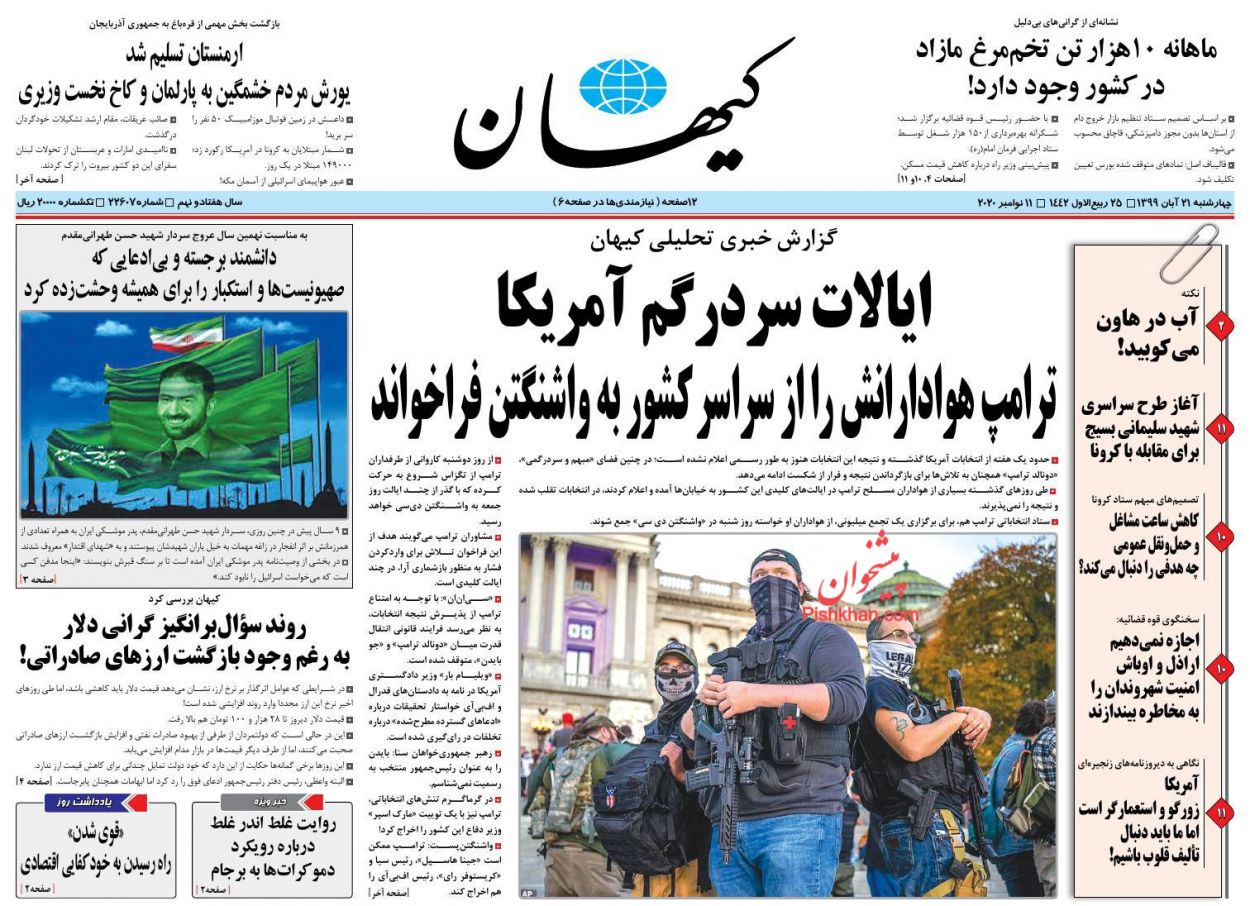
Recently, Pompeo had claimed that Iran, with its nuclear program, was threatening the world holding countries hostage to its nuclear blackmail.

He called on the international community to confront Iran. Earlier, he had claimed and Iran was continuing what he called “its terrorist attacks” across the world and seeking to develop its nuclear program.

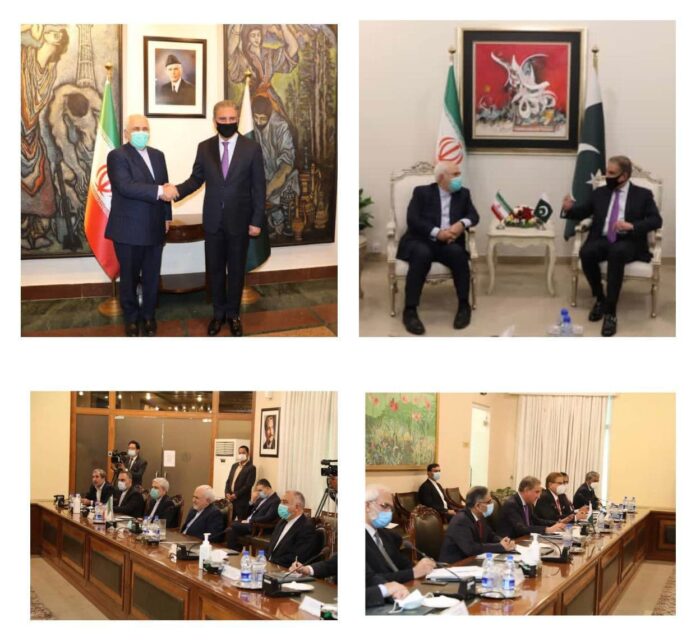
Iran Condemns Terror Attacks on Pakistani Security Forces

In a statement on Friday, Khatibzadeh also offered sympathy to the Pakistani nation and government.

The spokesman said all forms of terrorism are rejected, and that all regional countries must participate in the continuous fight against the perpetrators, organizers, supporters, and sponsors of such terrorist attacks.

Twenty security personnel, including six Army men, were martyred in two terrorist attacks in Balochistan’s Ormara area and North Waziristan tribal district on Thursday and late Wednesday.

Fourteen security men — seven personnel of the Frontier Corps and as many civilian guards employed by the OGDCL — were martyred in an armed attack on their convoy on the Coastal Highway in the Ormara area of Gwadar district on Thursday.

Six troops, including a Pakistan Army captain, were martyred and one suffered injuries when two improvised explosive devices (IEDs) struck their vehicles in North Waziristan tribal district on Wednesday evening.

The ISPR on Thursday also confirmed the martyrdom of six security personnel, including an Army captain, and injuries to one in the Wednesday’s North Waziristan attack.

The military’s media wing said in a brief statement that a convoy of security forces was attacked with improvised explosive devices near Razmak which resulted in the martyrdom of a captain and five soldiers.

The martyrs were identified as Captain Umar Farooq, Naib Subedar Riaz Ahmed, Naib Subedar Shakeel Azad, Havaldar Younas Khan, Naik Mohammad Nadeem and Lance Naik Asmat Ullah.

Iran to Trade Weapons with ‘Many Friends’ Once Embargo Lifted: Envoy

Iran to Trade Weapons with ‘Many Friends’ Once Embargo Lifted: Envoy

“Iran has many friends and trading partners, and has a robust domestic arms industry to ensure its defense requirements against foreign aggression,” Iranian UN mission spokesman Alireza Miryousefi told Newsweek in an interview published on Friday.

The UN restrictions are set to be lifted on Sunday under United Nations Security Council Resolution 2231 which endorses the multilateral nuclear agreement, officially known as the Joint Comprehensive Plan of Action (JCPOA), signed between Iran and major world powers in 2015.

The ban’s removal will follow a largely unsuccessful campaign by US President Donald Trump to convince the remaining signatories to defy the nuclear deal and the Resolution 2231 and keep the ban on Iran’s arms industry in force.

During the 15-member Security Council vote on August 14, the US received support only from the Dominican Republic for its anti-Iran resolution, leaving it far short of the minimum nine ‘yes’ votes required for adoption.

Trump, a hawkish critic of the JCPOA, unilaterally withdrew Washington from the agreement in May 2018, and unleashed the “toughest ever” sanctions against the Islamic Republic to strangle its economy in defiance of global criticism.

Following its much-criticized exit, Washington has been attempting to prevent the remaining signatories from abiding by their commitments and thus kill the historic agreement, which is widely viewed as a fruit of international diplomacy.

“In accordance with the timeline stated in Resolution 2231, Iran will be relieved from arms restrictions as early as Oct. 18. Naturally, from that date, we’ll trade, on the basis of our national interests, with other countries in this field,” Miryousefi said.

He added that the lack of support for Washington’s initiatives was telling of its position vis-à-vis the international community.

Miryousefi added, “It is abundantly clear that the UN—and the overwhelming majority of its member states—reject the US’ so-called maximum pressure policy on Iran,” and that “its attempts to even further violate the JCPOA and UNSCR 2231 have led to its isolation.”

Although Iran has not yet formally announced any specific country to start trading arms, Miryousefi said Tehran had options beginning on Sunday.

Speaking during a cabinet meeting on Wednesday, Iranian President Hassan Rouhani said the country will be free to trade weapons as of Sunday.

The Islamic Republic has achieved self-sufficiency in most areas of its defense sector and is itself an exporter of arms. Tehran says it can meet its strategic needs through the countries it interacts with like Russia and China once the UN embargo is lifted.

The Russian Foreign Ministry spokeswoman said on Thursday that Moscow will consider military technical cooperation with Iran in line with mutual interests after the expiration of the United Nations arms embargo on Tehran.

“We are convinced that all possibilities stemming from the expiration of the provisions of United Nations Security Council Resolution 2231 that are linked with military technical cooperation with Iran will be duly taken into account and used on the basis of mutual benefit and in the interests of the peoples of our two states,” Maria Zakharova said.

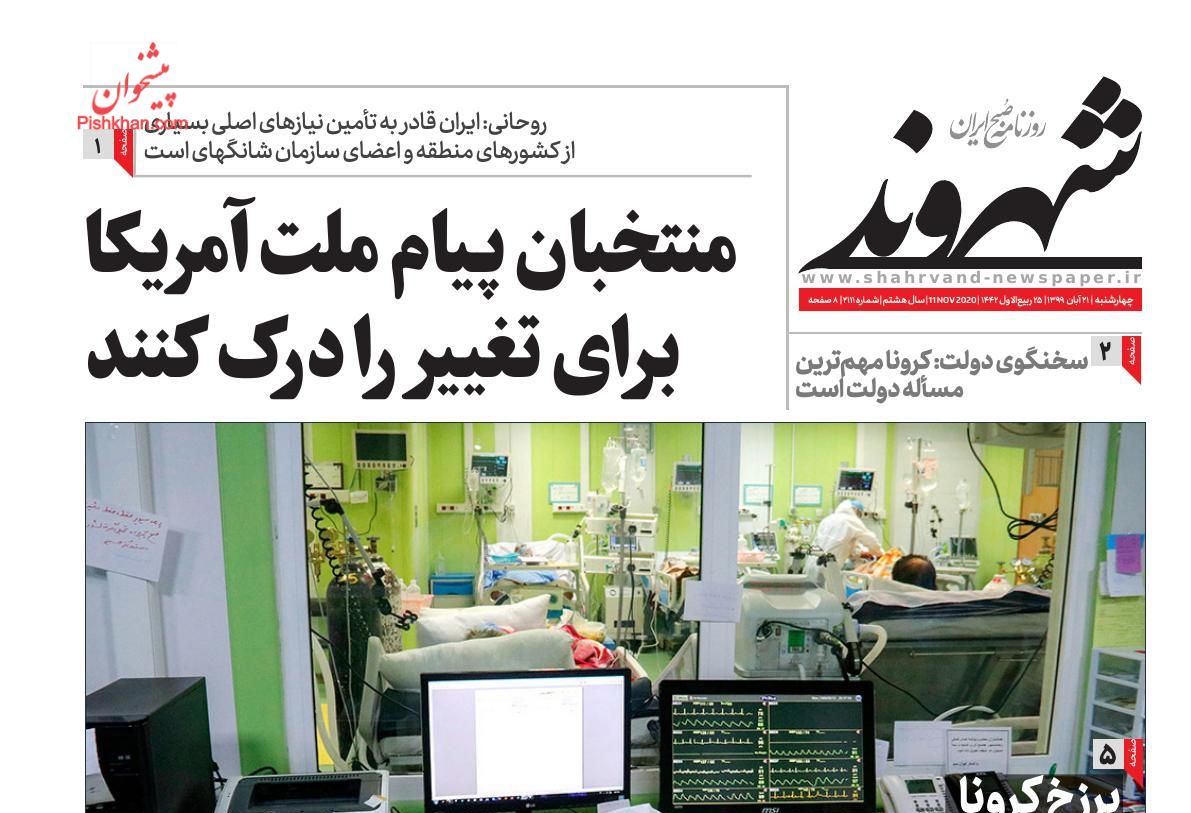
Coronavirus Kills 265 More Iranians in 24 Hours: Ministry

Coronavirus Kills 265 More Iranians in 24 Hours: Ministry

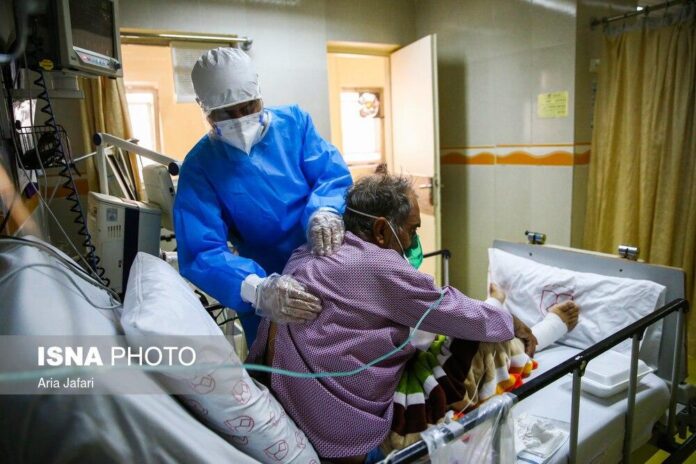
In a press briefing on Wednesday, Sima-Sadat Lari said 522,387 patients have contracted the virus so far, including 4,552 new cases identified in the past 24 hours.

So far, she added, 420,910 patients have recovered from the disease or been discharged from the hospital.

Lari said 4,684 patients are also in critical conditions caused by more severe infection.
The spokeswoman noted that 4,454,570 COVID-19 tests have been taken across the country so far.

She said the high-risk “red” zones include Tehran, Qom, Mazandaran, East Azarbaijan, Isfahan, Yazd, Ardabil, Khorasan Razavi, Khuzestan, Hamadan, West Azarbaijan, Bushehr, Chaharmahal and Bakhtiari, Kohgiluyeh and Boyer-Ahmad, Alborz, Lorestan, Markazi, Ilam, South Khorasan, Kermanshah, North Khorasan, Semnan, Gilan, Zanjan, Qazvin, and Kerman provinces.

The “orange” zones also include Golestan, Hormozgan, Kurdistan, and Fars provinces, she added.a

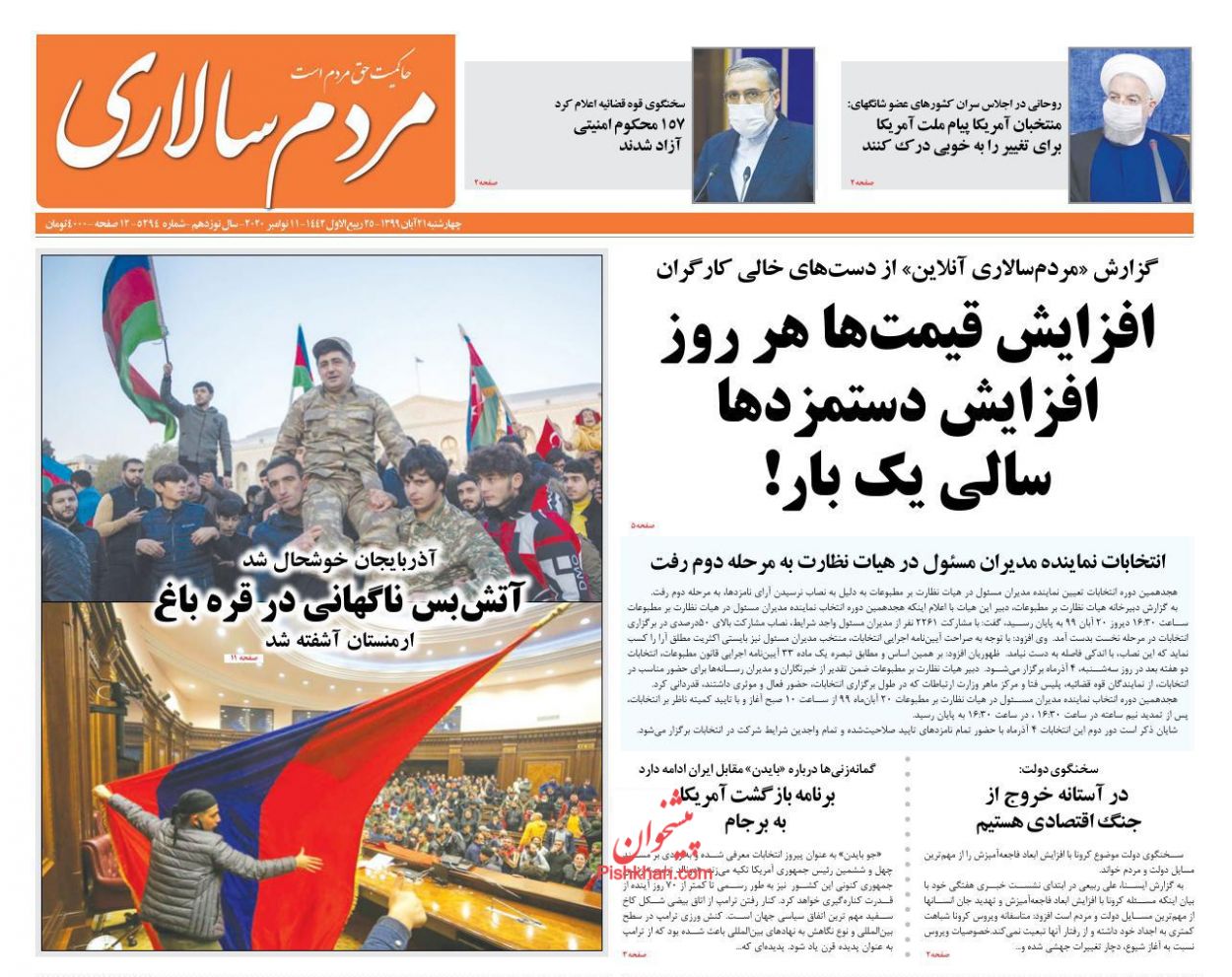
Iran Warns Baku, Yerevan against Repeat of Attacks on Its Border Areas

Iran Warns Baku, Yerevan against Repeat of Attacks on Its Border Areas

“Unfortunately, worrying reports have been received today in this regard, and that is not at all acceptable, ” Khatibzadeh said on Thursday.

He dismissed the rumours that Iran’s border guards have reciprocated, but stressed that “maintaining the security and peace of the Iranian citizens living in the border areas is the red line of Iranian armed forces.”

The spokesman vowed that Iran would not remain indifferent in case of a repeat of such attacks.

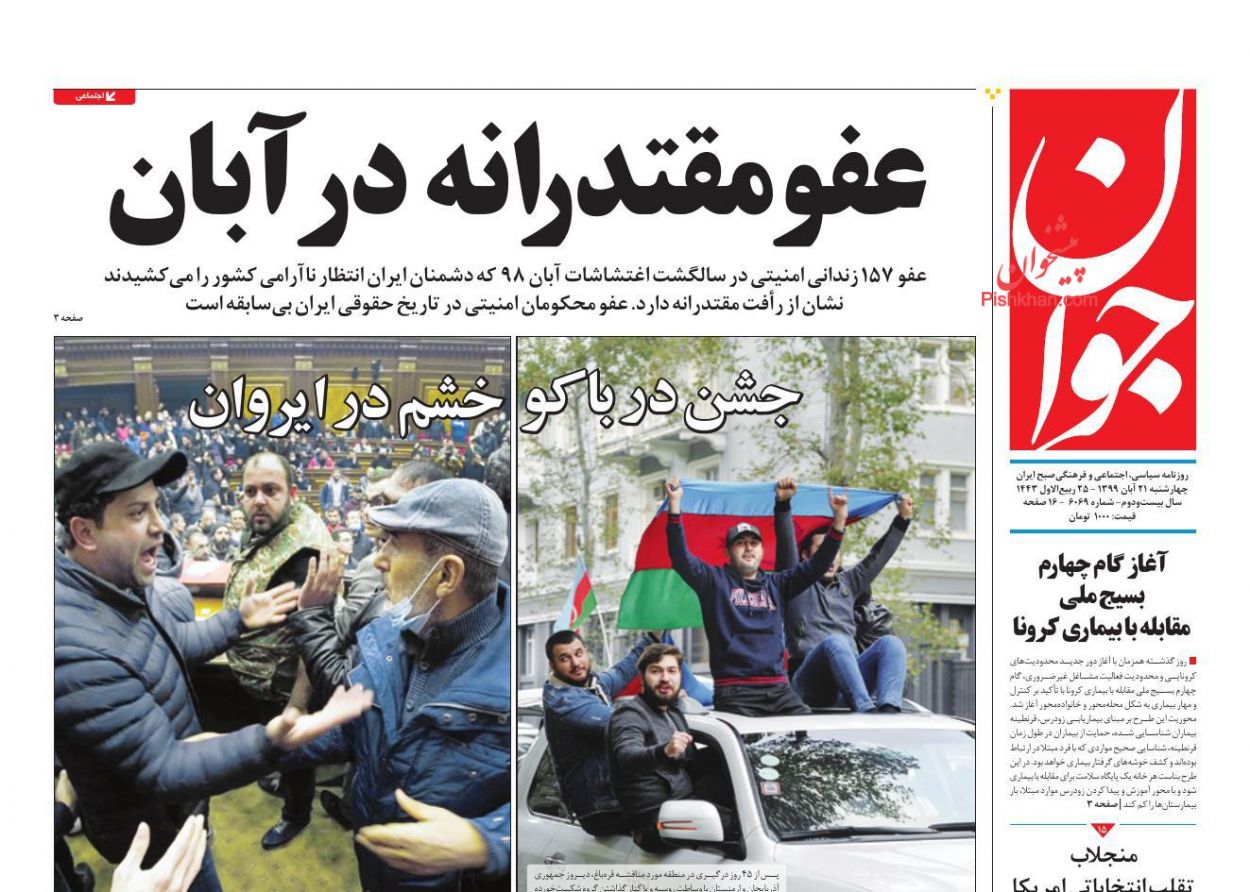
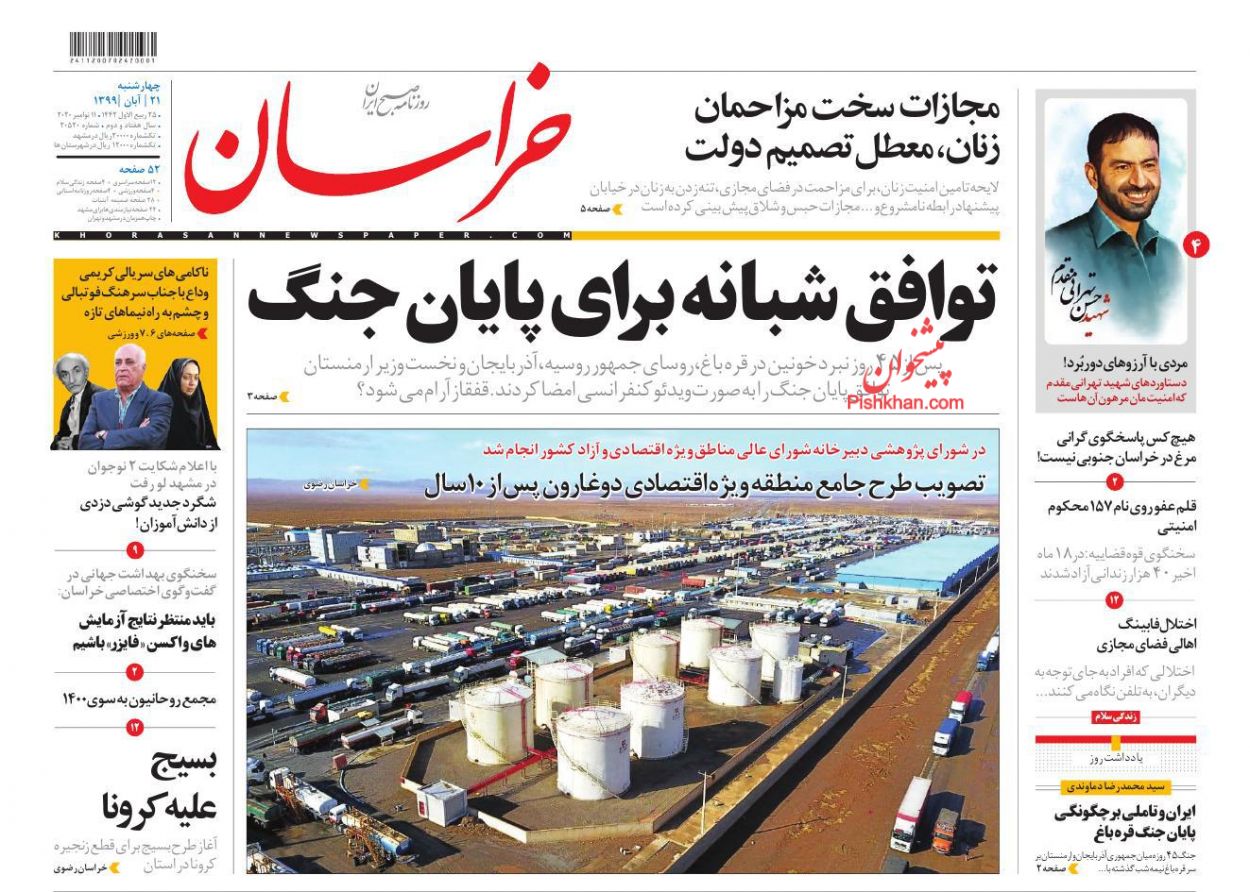
Iran Says Its Joint Initiative with Russia, Turkey Can End Karabakh Dispute

Iran Says Its Joint Initiative with Russia, Turkey Can End Karabakh Dispute

In a telephone conversation on Thursday, Zarif informed his Azeri counterpart Jeyhun Bayramov of the Islamic Republic’s preparedness to help bring about peace and a sustainable solution to the conflict within the framework of Iran-Turkey-Russia regional initiative, as a complement to the OSCE Minsk Group mechanism.

Zarif once again elaborated on Iran’s principled stances and stressed the territorial integrity of the Azerbaijan Republic.

The two top diplomats also stressed the significance and the role of regional initiatives to resolve the decades-old crisis.

Zarif was also briefed by the Azeri foreign minister on the latest on-the-ground developments of the Karabakh dispute.

Iran Reports over 4,600 New Cases of COVID-19 Infection

Iran Reports over 4,600 New Cases of COVID-19 Infection

In a press briefing on Thursday, Sima-Sadat Lari said the virus has killed 256 patients since Wednesday noon, raising the overall death toll to 29,605.

So far, she added, 418,054 patients have recovered from the disease or been discharged from the hospital.

Lari said 4,671 patients are also in critical conditions caused by more severe infection.

The spokeswoman noted that 4,426,779 COVID-19 tests have been taken across the country so far.

She said the high-risk “red” zones include Tehran, Qom, Mazandaran, East Azarbaijan, Isfahan, Yazd, Ardabil, Khorasan Razavi, Khuzestan, Hamadan, West Azarbaijan, Bushehr, Chaharmahal and Bakhtiari, Kohgiluyeh and Boyer-Ahmad, Alborz, Lorestan, Markazi, Ilam, South Khorasan, Kermanshah, North Khorasan, Semnan, Gilan, Zanjan, Qazvin, and Kerman provinces.
The “orange” zones also include Golestan, Hormozgan, Kurdistan, and Fars provinces, she added.
Official Hails Baku’s Call for Iran to Play Pivotal Role in Maintaining Peace

Official Hails Baku’s Call for Iran to Play Pivotal Role in Maintaining Peace

Mahmoud Vaezi, the chief of staff of Iran’s president, said the promotion of cooperation between Iran and Azerbaijan is in line with the interests of both nations.

He stressed the need to respect the Azerbaijan Republic’s territorial integrity, saying Iran stands ready to play a more active role in resolving differences between Baku and Yerevan.

In a phone conversation with the Azerbaijan Republic’s deputy prime minister Shahin Mustafayev, the Iranian official welcomes the establishment of a ceasefire between Baku and Yerevan.

Vaezi called on both sides to maintain the truce and iron out their differences based on dialogue, within international regulations, and by respecting each other’s internationally recognized borders and territorial integrity.

He expressed satisfaction with the trend of implementing agreements signed by Iran and the Azerbaijan Republic, especially the ones discussed in a recent phone conversation between the two countries’ presidents.

“The implementation of these agreements will, undoubtedly, be an effective step in the growing mutual ties,” said Vaezi.

The top Azeri official, in turn, conveyed to Vaezi a message of appreciation from his country’s president, saying his country would like to enhance its cooperation with Iran on all fronts.

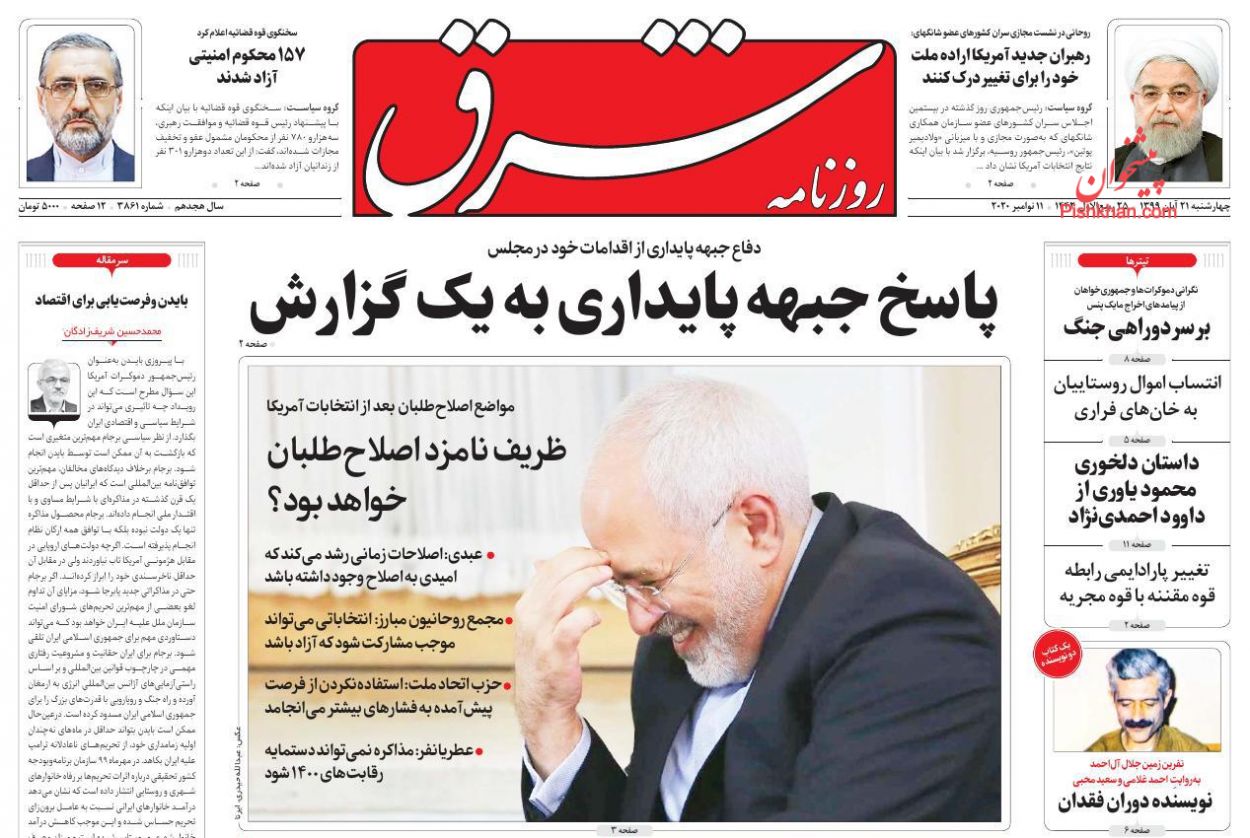
Tehran Urges Its Trade Partners to Release Iranian Frozen Assets

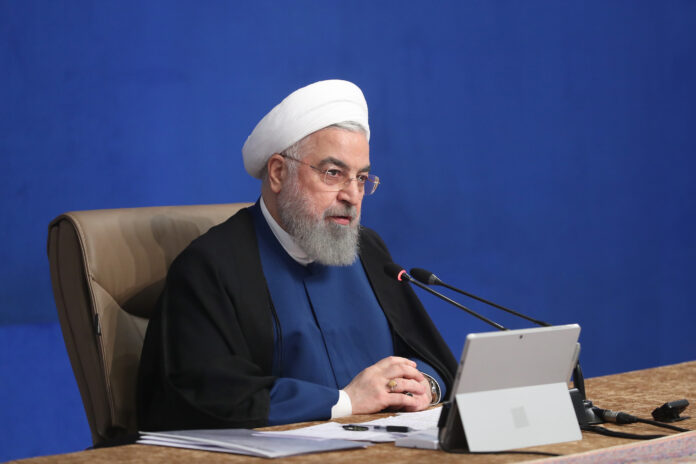
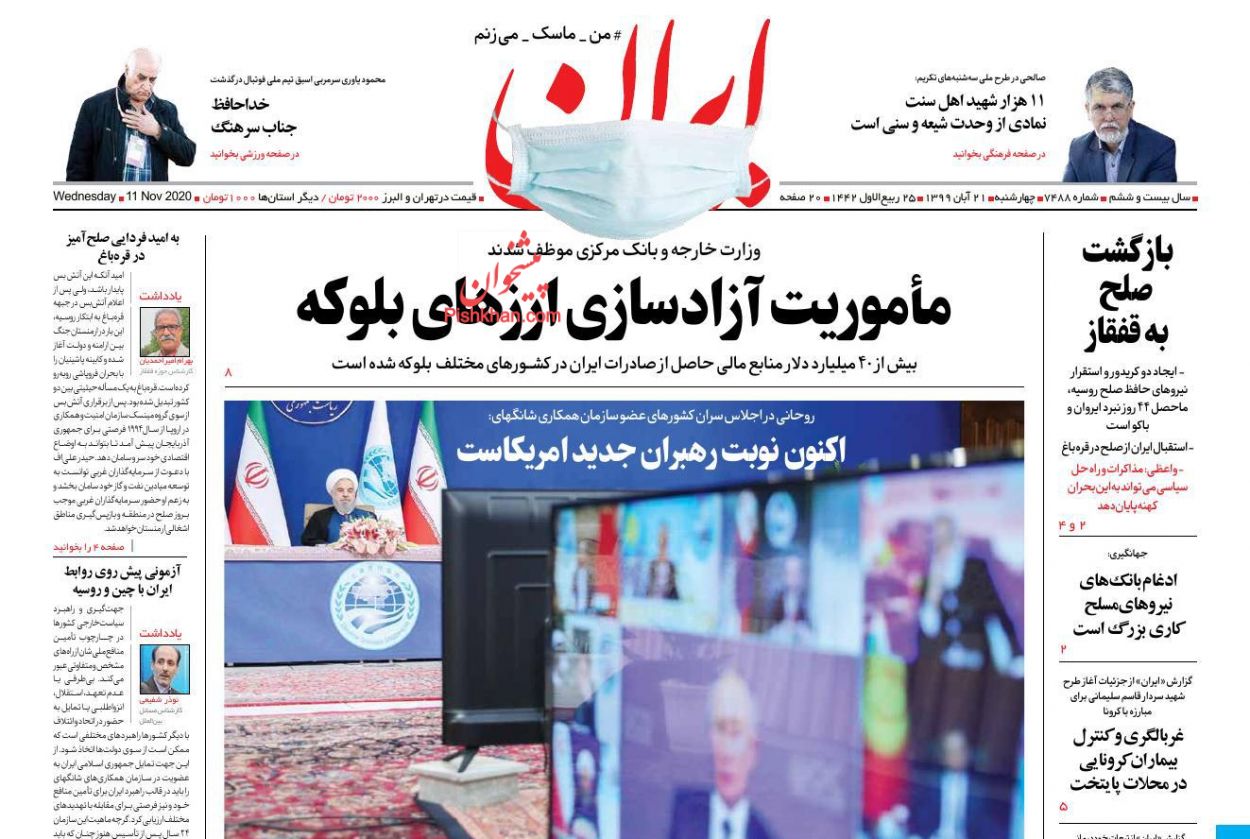
Iran Policies to Remain Unchanged No Matter Who Becomes US President: Rouhani

Otherwise, the president said, scepticism will grow among public opinion regarding the future of Iran’s relations with these countries.

Rouhani made the comments in a Wednesday cabinet session, after he was briefed on the outcomes of Foreign Minister Mohammad Javad Zarif’s trip to China and the visit of Iran’s top banker Abdolnasser Hemmati to Baghdad, where he discussed Iran’s frozen assets in Iraq.

The president expressed pleasure with the achievements of these visits, and tasked all government officials to pursue returning Iran’s money from other countries.

On Monday, Governor of the Central Bank of Iran said his negotiations with the Iraqi officials had yielded “positive” results, and the Arab country had given its approval to release Iran’s frozen assets for the purchase of basic commodities.

Hemmati said he held a trilateral meeting with Governor of the Central Bank of Iraq Mustafa Ghalib Mukheef and Chairman of Trade Bank of Iraq (TBI) Salem Jawad Abdul Hadi Al-Jalabi during his visit to Baghdad.

Iran's Zarif Hails Fruitful Talks in China Trip
Iran’s Zarif Hails Fruitful Talks in China Trip

The Iraqi authorities have agreed to release Iran’s frozen funds for the purchase of basic commodities after extensive talks on trade exchanges, Hemmati added, noting that the Islamic Republic of Iran holds remarkable financial sources in the Iraqi banks earned by the export of electricity and gas.

Under the new agreement, the main obstacle to the release of Iran’s assets in the executive sphere has been removed, as the Central Bank of Iraq and the TBI face no more restrictions, he added.
The assets held in Iraq belong to the Central Bank of Iran, which is the main supplier of the basic demands in various sectors such as industry, agriculture and healthcare, he explained, saying Tehran would begin to withdraw money from those funds according to its needs.

The commodities that are categorized as basic needs are exempted from the cruel and unilateral sanctions imposed by the US, the Iranian official noted.

Also on Wednesday, Foreign Minister Zarif held a phone conversation with his Japanese counterpart Toshimitsu Motegi, during which he urged the Japanese top diplomat to prevent the US from blocking Iran’s assets.

“Iran expects the government of Japan to prevent such unlawful American measure within the framework of the general commitment of countries to the implementation of the UN Security Council resolutions, including the Resolution 2231,” Zarif added.

Foreign Minister Zarif stressed that Iran should be able to use its foreign currency resources held in Japan, condemned the US regime’s illegal restriction on Tehran’s access to those funds, and denounced the limits preventing the purchase of medicine and foodstuff for the Iranian people as a crime against humanity.