Friday, December 26, 2025
Home Blog Page 2485

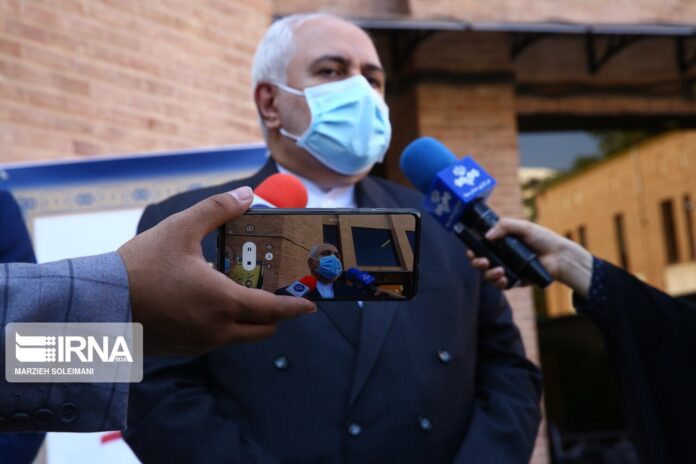
Iranian Diplomat, Omani Foreign Minister Meet in Muscat

In the Tuesday meeting, the latest developments in bilateral relations, the Yemen developments, and regional issues were discussed.

The Iranian official elaborated on Tehran’s latest efforts to resolve humanitarian issues and stop the war in the country, and welcomed Oman’s move to dispatch a delegation to Sana’a and its efforts to contribute to the peaceful resolution of the crisis in cooperation with the UN.

The Omani Foreign Minister, in turn, described his country’s efforts on the Yemen crisis as a step to stop the current humanitarian disaster in Yemen and contribute to the region’s stability.

He also stressed Iran’s effective role in regional developments.

During his trip to Muscat, Khaji also met Sheikh Khalifa Al-Harthy, the Deputy Foreign Minister of Oman for Political Affairs.

In the meeting, the two sides discussed in detail the latest developments in Yemen.

Ali Motahari Officially Endorses Hemmati for President

Motahari is a moderate member of the principlist camp which has thrown its weight behind Hemmati’s rival Ebrahim Raisi. 

“In the current situation of economic pressure, I consider Mr Hemmati as the most appropriate among the seven respectable candidates, seeing that he has held executive economic positions for years, has his hand on the pulse of the national economy and during the recent [US] economic war, is remembered for his all-out fight with the criminal [former US President Donald] Trump and prevented the country from becoming a new Venezuela,” Motahari said.

“Considering his emphasis on relations with the world and its impact on removal of sanctions, revival of the Joint Comprehensive Plan of Action and improving people’s livelihoods plus the significance he attaches to the rights of people and chapter three of the constitution and his right cultural view concerning respect for Islamic teachings and people’s basic freedoms, as well as his ability to get enough votes, with the help of the people, to push the elections into run ups, I ask the dear nation to vote for Mr Hemmati on Friday to improve the economic situation of the country and avoid constraints on people’s freedoms.”

Motahari also took an indirect swipe at the Guardian Council for how it vetted the presidential hopefuls. He said the election is a test for the zeal of the nation, a test given by “those who have plotted against the people and want to see whether they can continue on their path to remove the Republic element [in Iran]”.

Saeed Mohammad: JCPOA Most Damaging Agreement in Iran History

Mohammad told a presidential election campaign rally for Ebrahim Raisi that those who championed talks with the west “signed the most damaging contract in the history of the country and destroyed people’s livelihoods”.

He made the remarks in a reference to the 2015 nuclear agreement between Iran and the P5+1 group of countries. The comments come as the government is holding talks with the remaining signatories to the 2015 nuclear deal to revive the accord.

“Idleness, inertness and inaction has disillusioned people. People like the revolution but they are disillusioned with government officials. The solution is being self-confident and not trusting in foreigners,” he said.

Mohammad, who ran for president but was disqualified by the Guardian Council, also strongly criticised the ongoing talks on the 2015 nuclear deal in Vienna. He warned people not to be misguided by a possible breakthrough in the negotiations, which he described as a “souvenir from Vienna” in the run-up to the Friday elections.

Raisi, the incumbent judiciary chief who is one of the main contenders in the Friday presidential vote, and the IRGC have been critical of the nuclear deal since it was signed in 2015. They have also attacked the government of President Hassan Rouhani for entering talks in Vienna to get the accord back on track and remove anti-Iran sanctions.

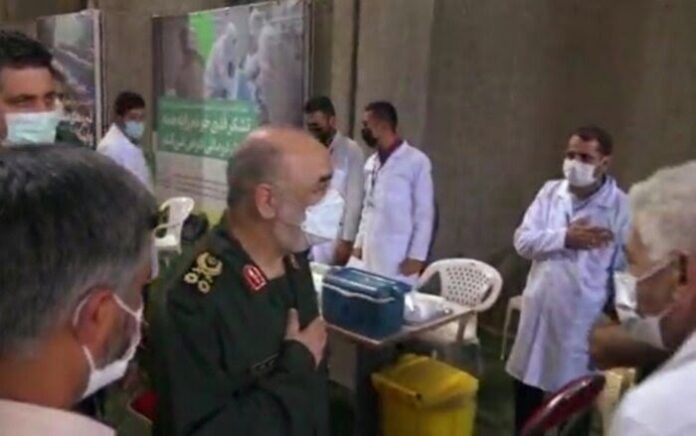
Iran Issues Permission for Emergency Use of Homegrown COVID-19 Vaccine

CovIran Barekat has successfully been tested on animals and has been approved by the Iran Food and Drug Administration for testing on humans. Phase 2/3 (II/III) clinical trial began on 13 March 2021, and the first participants were inoculated on March 29.

Shefa Pharmed Industrial Group, which has developed the vaccine, is affiliated with the Execution of Imam Khomeini’s Order (EIKO) Headquarters, also known as Setad.

Dr. Minoo Mohraz has led the vaccine development project. Mohraz is a physician, scientist, and AIDS specialist, and a Full Professor (Emeritus) of Infectious Diseases at Tehran University of Medical Sciences and head of the Iranian Centre for HIV/AIDS. Dr. Mohraz has also served within the World Health Organization as an expert on HIV/AIDS in Iran and the Eastern Mediterranean.

UNSC Resolution 2231 Says Nothing about Iran Missiles: Spokesman

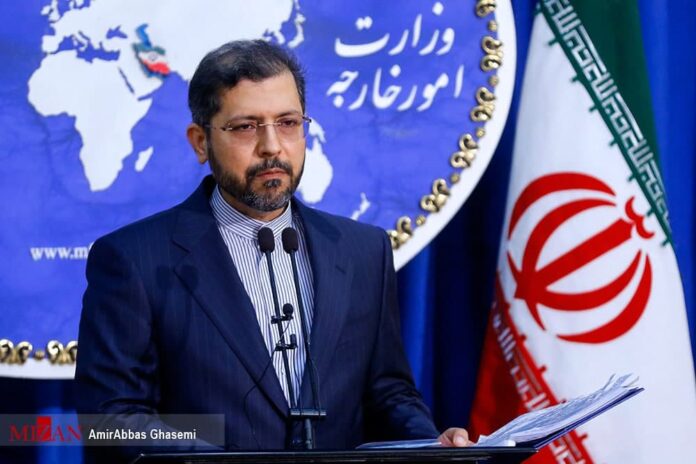
khatibzadeh-Iran

“Certain interpretations of the UN Security Council Resolution 2231, offered by those who well know what subjects the Resolution covers, are both incorrect and very unlikely,” Khatibzadeh told reporters in a press conference on Monday.

“In the Resolution 2231, there is no word of any restriction against Iran’s missile program,” he added.

“Such unlikely interpretations of the clear and explicit words stipulated in the Resolution 2231 will only undermine the credibility of those who make such claims,” the spokesman noted.

Khatibzadeh called on world leaders to stop focusing on such issues, and instead implement their own “long-overdue commitments”.

Iranian Presidential Candidates Trade Barbs in Last Live TV Debate

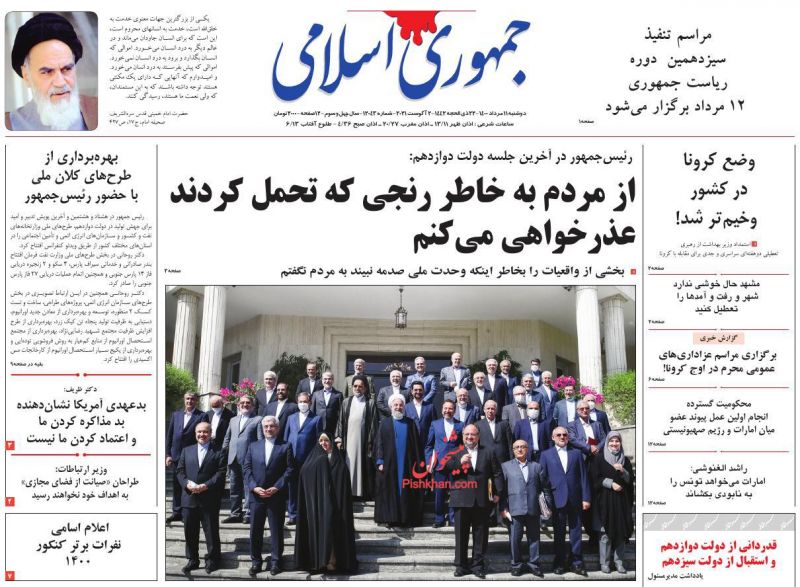
Third Presidential Debate Makes Headlines in Iran

The seven contenders qualified by the Guardian Council to run for president took part in a three-hour live televised debate on June 12 where they took sharp jabs at each other and accused one another of having a poor track record and unacceptable performance during their careers.

Compared to the previous debates, the third debate saw more heated criticisms and arguments.

The candidates sought to gain the upper hand and corner their rivals by using such expressions as “lying,” “astronomical embezzlement,” “political wrangling,” “Pinocchio and his nose,” etc.

In the first part of the debate, the nominees were asked about their plans about people’s seven key concerns, including high prices and the high inflation rate, justice and the social class gap, economic recession and business slowdowns, transparency, tackling economic corruption and rent-seeking, regulating subsidies, unemployment and housing provision.

Accordingly, the candidates offered an overall picture of what measures their administrations will adopt if they win the race.

In part of the debate, one of the candidates criticized the performance of the 12th administration and invited outgoing President Hassan Rouhani to take part in a one-on-one televised debate with him.

Some topics expected to have been discussed in the previous debate were brought up during the third and last debate.

The topics included the filtering of social media networks, the necessity of having easy access to the Internet and cyberspace, and the performance of media outlets.

One of the candidates noted that people have lost their trust in the Islamic Republic of Iran’s Broadcasting Organization (IRIB).

He blasted the IRIB for censoring parts of a documentary film broadcast as part of his campaign activities.

Another candidate accused officials in the current administration of lying.

He said if they were “Pinocchios,” their noses would have grown so long (as a result of lying) that they (their noses) would have circled around the earth multiple times.

Some candidates took a jab at other nominees for holding mass public gatherings as part of their election campaigns amid the coronavirus pandemic.

There were other topics which the presidential contenders expressed their views on.

They included the management of affairs in the post-coronavirus era, the capital market and stock exchange, reforming the administrative system and the need to cut red tape, easing conditions for the youth and striking a balance between women’s economic activities and family values.

What Fox News Calls ‘Suspicious Nuclear Site’ Was Filming Location: Iran

What Fox News Calls ‘Suspicious Nuclear Site’ Was Filming Location: Iran

“A few days ago, Fox News published an exclusive report, accompanied with satellite images, on unusual activity around Sanjarian site in Jajroud. But the images were in fact related to vehicles and equipment at the filming location of “N. Kh.” TV series and its crew,” tweeted Shahrokh Nazemi, the head of the media office of the Permanent Mission of Iran to the UN.

The Fox News cited joint analysis of satellite images by the Intel Lab and the Institute from Science and International Security. Fox News said the images show 18 vehicles at the site in October 2020. It said a new access road was constructed at Sanjarian site and there were more vehicles and excavations in January 2021, which were then covered up in March.

Nazemi also re-tweeted a post by the ResindScientist page that shared YouTube videos of the site showing the excavation site was used as a TV series filming location.

The page also mentioned the vehicles and the trenches, saying they also appear to be part of the filming.

Third Presidential Debate Makes Headlines in Iran

Afkar Newspaper:

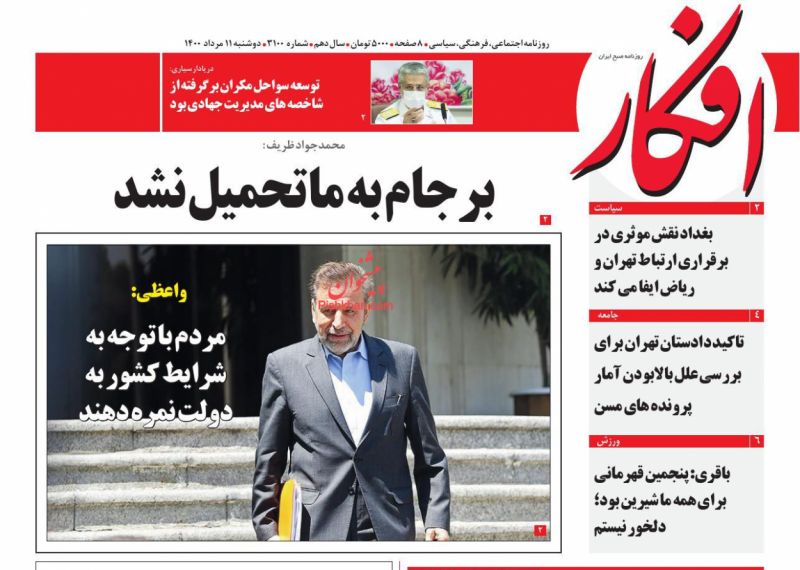
1- Raisi: Countering Corruption Should Start in Executive Branch of Power

Third Presidential Debate Makes Headlines in Iran


Aftab-e Yazd Newspaper:

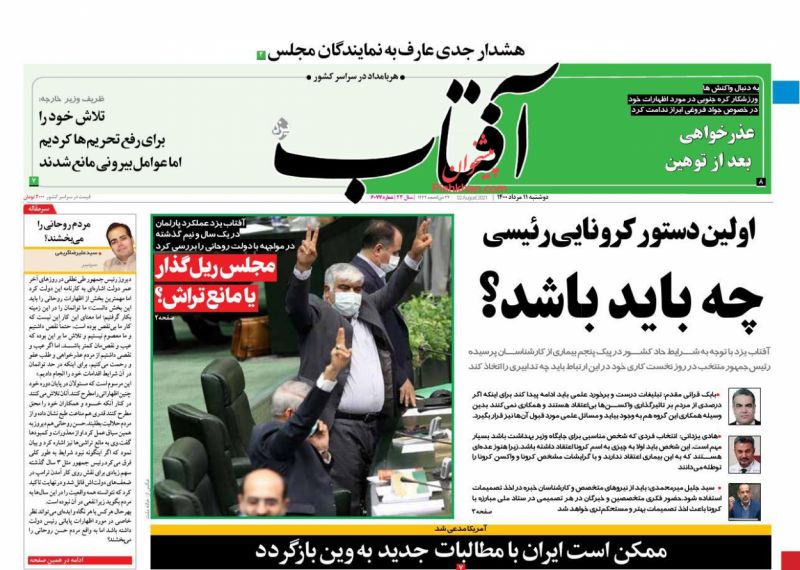
1- End of Dull Debates

Third Presidential Debate Makes Headlines in Iran


Arman-e Melli Newspaper:

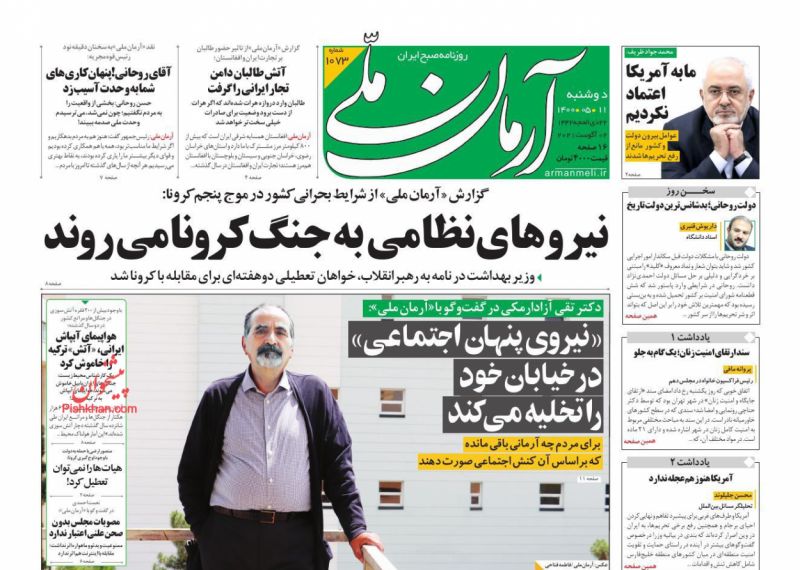
1- They Didn’t Say Anything about Referendum!

* Presidential Candidates Know What People’s Concerns Are

* No Words of Iran-China 25-Year Deal

Third Presidential Debate Makes Headlines in Iran


Asr-e Iranian Newspaper:

1- Jalili: JCPOA Was a Bad Check

Third Presidential Debate Makes Headlines in Iran


Bahar Newspaper:

1- Mohsen Rezaei Looking for Culprits behind Social Ills

Third Presidential Debate Makes Headlines in Iran


Ebtekar Newspaper:

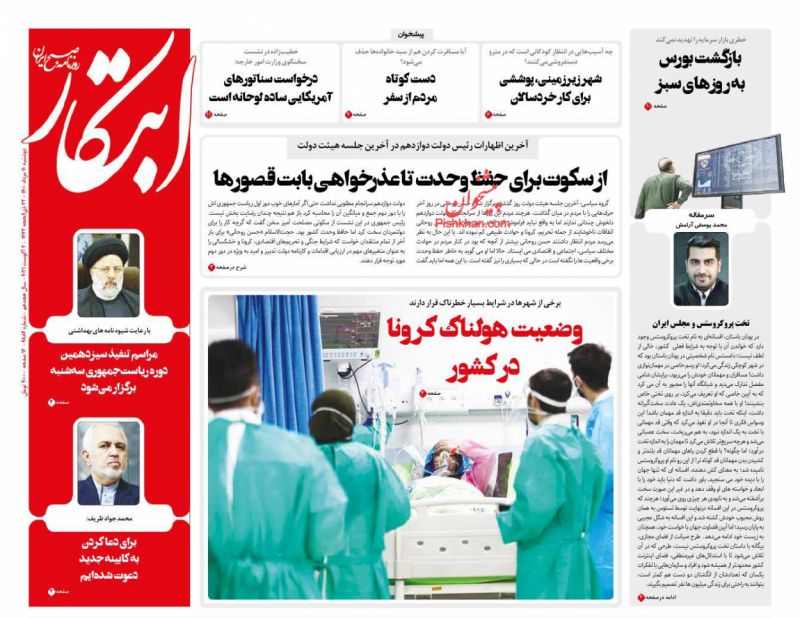
1- Final Round of Debates: No Winner

* Could Third Debate Focused on ‘People’s Concerns’ Help Increase People’s Turnout?

Third Presidential Debate Makes Headlines in Iran


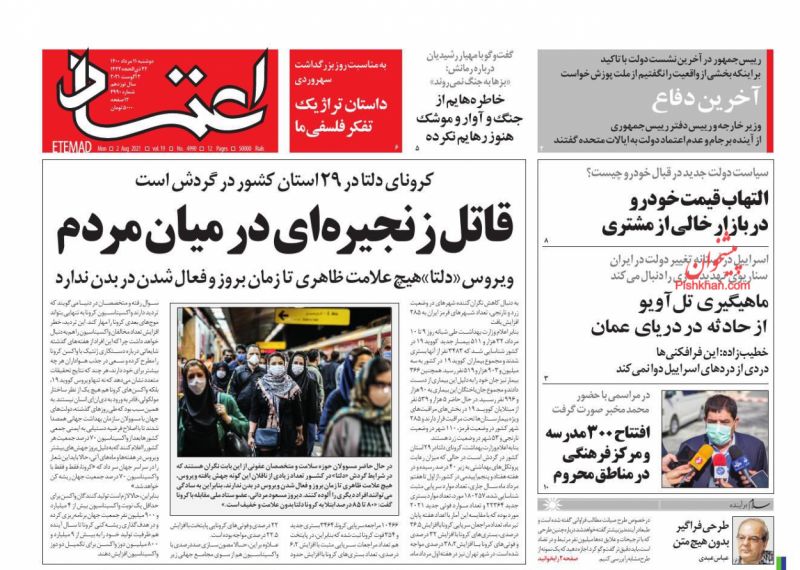
Etemad Newspaper:

1- Terrifying Ambiguities and Stances

Third Presidential Debate Makes Headlines in Iran


Farhikhtegan Newspaper:

1- Say Hello to End of Rouhani’s Term

* No Change in Number of Voters of Reformists/Moderates after Three Debates

Third Presidential Debate Makes Headlines in Iran


Haft-e Sobh Newspaper:

1- Late Sarcasms of Seven Candidates

Third Presidential Debate Makes Headlines in Iran


Hemayat Newspaper:

1- People Can Judge: Seven Candidates Talk about People’s Concerns in Last Presidential Debate

Third Presidential Debate Makes Headlines in Iran


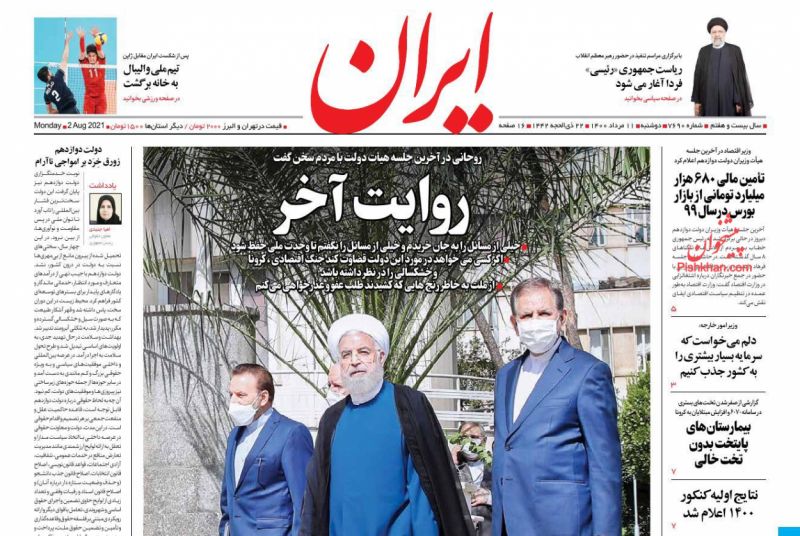
Iran Newspaper:

1- Hot Debate on How to Run Government

Third Presidential Debate Makes Headlines in Iran


Jame Jam Newspaper:

1- Last Debate with Open Ending

Third Presidential Debate Makes Headlines in Iran


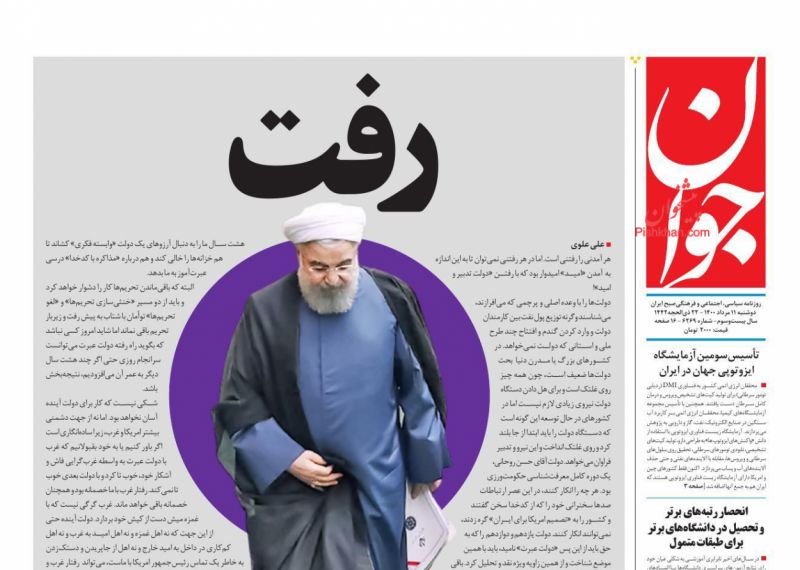
Javan Newspaper:

1- Week of ‘People’s Choice’

Third Presidential Debate Makes Headlines in Iran


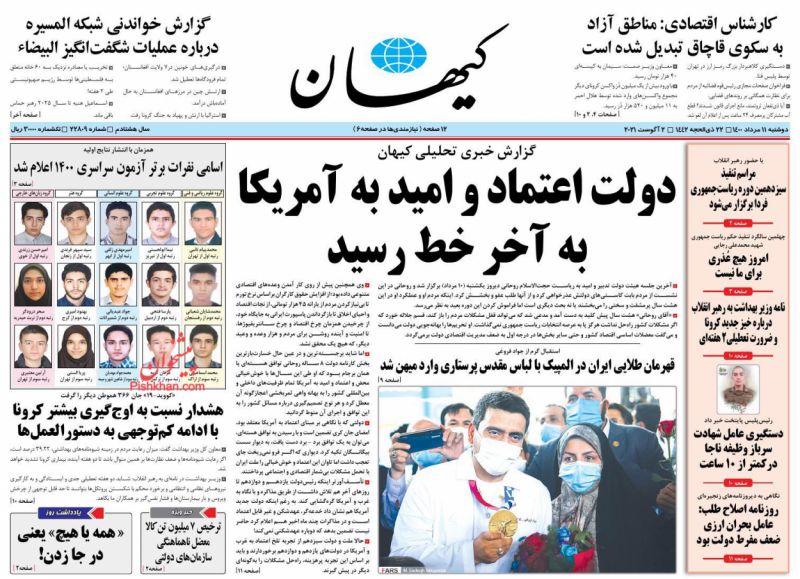
Kayhan Newspaper:

1- Pro-Government Candidates Lost Not Only the Debates but Also Ethics

Third Presidential Debate Makes Headlines in Iran


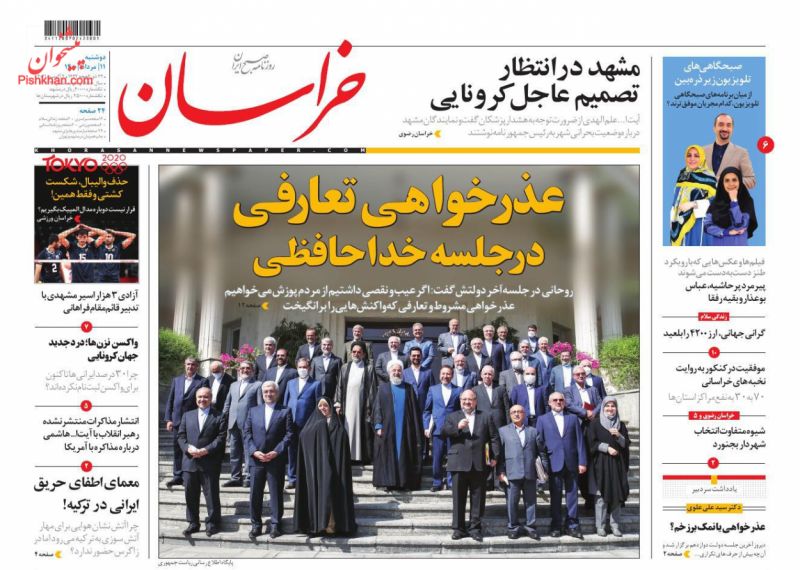
Khorasan Newspaper:

1- Last Debate More Exciting than Previous Ones

Third Presidential Debate Makes Headlines in Iran


Mardom Salari Newspaper:

1- Third Debate Held without Any Response from Government to Criticisms

* Gov’t Didn’t Accept State Broadcaster’s “Eight-Minute” Time Allocated for Response

Third Presidential Debate Makes Headlines in Iran


Resalat Newspaper:

1- Third Presidential Debate Analysed

Third Presidential Debate Makes Headlines in Iran


San’at Newspaper:

1- A Report on Third Presidential Debate: List of Biggest Debtors Presented to Raisi

Third Presidential Debate Makes Headlines in Iran


Seda-ye Eslahat Newspaper:

1- What People Think about Winner of Presidential Debates?

* Poll Conducted after Last Debate [Picture Shows Raisi]

Third Presidential Debate Makes Headlines in Iran


Setareh Sobh Newspaper:

1- Hemmati Elaborates on Behind-the-Scenes of Iran’s Problems in Last Debate

* Hemmati: Don’t Let 1953 Coup Be Repeated on Friday

Third Presidential Debate Makes Headlines in Iran


Shahrvand Newspaper:

1- Somehow Aggressive, Full of Sarcasm, Still Boring

Third Presidential Debate Makes Headlines in Iran


Shargh Newspaper:

1- Last Efforts of Candidates in Third Debate

Third Presidential Debate Makes Headlines in Iran


Siasat-e Rooz Newspaper:

1- From Expression of Views to Taking Gesture of Opposition

Third Presidential Debate Makes Headlines in Iran


Sobh-e Now Newspaper:

1- Hope and Transformation

* What Did Conservatives Talk about in Third Debate?

Third Presidential Debate Makes Headlines in Iran


Vatan-e Emrooz Newspaper:

1- Even Pro-Gov’t Candidates Criticise Rouhani

Third Presidential Debate Makes Headlines in Iran

Ex-President Khatami Urges Reformists to Participate in Iran’s Presidential Vote

“In this cold and desperate atmosphere, and at a time when our society is in need of bliss, hope and enthusiasm to take part in the fateful event, I hope all political and national groups, parties and camps, in this sensitive episode, manage to recognise correctly their responsibility toward the motherland and the people and succeed in fulfilling their responsibility,” Khatami said in a handwritten letter.

Khatami, who led Iran’s reformist government from 1997 to 2005, was addressing his own reformist camp and its supporters.

Last month, a spokesman for the Iranian Reformist Front said they will not be part of the presidential elections as none of their candidates was approved by the Guardian Council to run for president.

Azar Mansouri said in a tweet that “the Reformists are denied the right to actively participate in the elections.”

The Reformist Front picked 14 candidates for the June elections, but seven of them, including Foreign Minister Mohammad Javad Zarif, refused to sign up, and the remaining seven were all disqualified by the Guardian Council.

Now only two candidates, Mohsen Mehralizadeh and Abdolnaser Hemmati, are left from the moderate/reformist camp, none of whom is among the candidates chosen by the Reformist Front.

Zilu – An Original Artform from Iran’s Desert People

Mahdi Najafian, head of the Ferdows Cultural Heritage Organization, in an interview with the Iranian Students News Agency (ISNA), South Khorasan Province, said: “Zilu is a type of rug and floor covering that is woven with thread.

It has major similarities to Hasir mats (made of plant fiber). Zilu is a traditional, historical creation, and one of the original arts of the city of Ferdows. In his travel stories, Nasir Khusraw (1004-1088) mentioned the existence of 400 Zilus in the city of Toon.”

He spoke about the provenance of this artform, saying, “In the weaving and the patterns, Zilu has major similarities to Hasir, mankind’s earliest-known hand-woven item.

Zilu – An Original Artform from Iran's Desert People

It also, like Hasir, was mainly used in holy places like mosques and temples. Therefore, we can surmise that Zilu weaving may have evolved from Hasir weaving, or else perhaps the Zilu industry was inspired by Hasir.”

Most people can tell the difference between Zilu and Kilim, since the two hand-woven products have major differences in their raw materials and also in their weaving styles.

There are complicated weaving techniques in Zilu, ones which are rarely seen in Kilim, or in any other hand-woven product. Zilu, since it’s made of cotton, suits an agricultural and village lifestyle perfectly, whereas Kilim is more adaptable to livestock farming and nomadic lifestyles.

Kilim is made of wool, and is thus suitable for cold regions. Zilu, with cotton thread as its base material, is more appropriate for hot regions, especially on the borders of the desert. It seems, however, that Zilu weaving is at a more developed stage than Kilim.

Zilu mainly uses geometric patterns, and sometimes the designs take the form of inscribed tablets.

Contrary to other Iranian carpet types, Zilu has a limited variety of colours. The colours which are used, like those in other regions, were locally produced.

Generally, Zilu is categorized into three types based on colour and function. White and blue ones are mainly used in mosques and holy places. The red and blue ones are used inside houses, while green and red ones are of the highest quality.

Meybod Zilus

The town of Meybod in the central Iranian province of Yazd is among the major zilu weaving hubs in the country. In December 2018, and after the necessary reviews were conducted, Meybod was introduced as a global town of zilu by the World Crafts Council.

Zilu – An Original Artform from Iran's Desert People

Moreover, the zilu weaving museum at the historical Shah-Abbasi Caravanserai (dating back to the Safavid era) is one of the major attractions of the town.

Some 55 exquisite zilus woven in Meybod are on display at the museum, which is comprised of two sections: the new zilus and the old zilus.

The oldest zilu showcased is the one belonging to the Great Mosque of Meybod. The Zilu dates back more than 615 years.

The following are photos of the museum courtesy of IRNA.