Thursday, December 25, 2025
Home Blog Page 2185

Biden says US will ‘respond decisively’ If Russia invades Ukraine

President Joe Biden meets with Ukrainian President Volodymyr Zelenskyy in the Oval Office of the White House, Wednesday, Sept. 1, 2021, in Washington. (AP Photo/Evan Vucci)

Biden held a phone conversation with Zelensky on Sunday discussing the upcoming talks with Russia on security guarantees, the White House press service reported following the conversation.

“The leaders expressed support for diplomatic efforts, starting next week with the bilateral Strategic Stability Dialogue, at NATO through the NATO-Russia Council, and at the Organization for Security and Cooperation in Europe. President Biden underscored the commitment of the United States and its allies and partners to the principle of ‘nothing about you without you’,” the press service noted.

The American leader also told Zelensky that the US supported Ukraine’s sovereignty and territorial integrity and “made clear that the United States and its allies and partners will respond decisively if Russia further invades Ukraine.”

Additionally, Biden expressed support for confidence-building measures to de-escalate tensions in Donbass and “active diplomacy to advance the implementation of the Minsk Agreements, in support of the Normandy Format.”

Several days prior to this, overnight on December 31, Biden held a phone conversation with his Russian counterpart Vladimir Putin. The conversation lasted 50 minutes. Kremlin Aide Yury Ushakov told journalists that the Kremlin was satisfied with the conversation which generally was constructive. According to him, the upcoming talks on security guarantees were the main subject and both leaders agreed to control them personally and maintain phone contacts.

On January 10, Geneva will host Russian-US talks on security guarantees. On January 12, Russia will discuss its concerns in the security sphere in Europe as well as the Russian projects on security guarantees at a meeting of the NATO-Russia Council in Brussels and on January 13 – at a meeting of the OSCE Permanent Council in Vienna. On December 17, the Russian Foreign Ministry published the draft agreements between Moscow and Washington on security guarantees and the measures of ensuring the security of Russia and NATO member states. These drafts were submitted to Assistant Secretary of State for European and Eurasian Affairs Karen Donfried on December 15.

Lately, in the West and Ukraine, the claims of an alleged possible Russian “invasion” into Ukrainian territory are being touted increasingly more often. Kremlin Spokesman Dmitry Peskov branded such information as the empty and groundless escalation of tension, emphasizing that Russia does not represent a threat to anyone. That said, he didn’t exclude the possibility of provocations being whipped up in order to justify such claims and warned that attempts to resolve the problem in southeastern Ukraine through the use of force would have the most serious consequences.

“Trump belongs in ash heap of history after Gen. Soleimani assassination”

“Martyr Soleimani will live forever; but those who martyred him, Trump and the likes, belong in the ash heap of history, and will be among the forgotten by the history and will get lost. Of course, God Willing, after paying for their actions here in this world,” read the tweet, posted almost exactly on the minutes that marked the second anniversary of General Soleimani’s assassination.

The Iranian commander was assassinated in a US drone strike near Baghdad Airport on January 3, 2020. The then US President Donald Trump claimed responsibility for ordering Soleimani’s assassination.

Rally held in Tehran to condemn US assassination of gen. Soleimani

Tehran-based Swiss embassy represents the United States’ interests in Iran.

The night-time rally was held on January 2, 2022 on the eve of the 2nd anniversary of the assassination of top Iranian general Soleimani by the US.

During the rally, the students chanted slogans such as “Down with the US,” “Down with Israel,” “Revenge, revenge, period!”

General Soleimani and Iraqi commander Abu Mahdi al-Muhandis were killed in a US drone attack on January 3, 2020, outside Iraqi capital Baghdad. The terrorist operation was carried out at the direct order of then US president, Donald Trump.

Raisi orders swift payment of compensation to Ukraine flight victims

During a cabinet meeting on Sunday, Raisi said it was “imperative” to fulfill the legal rights of the bereaved families of the victims of the tragic plane crash and speed up work to pay them compensation.

Raisi ordered the formation of a working group with the participation of a number of ministries and government institutions to follow up on the problems facing the victims’ families.

The order comes on the second anniversary of the tragedy, which saw the passenger plane en route to Kiev crash minutes after takeoff near the Iranian capital, killing all of the 176 passengers and crews on board.

Hours earlier, Iran had launched a missile strike against a US-run base in Iraq and put the country’s air defenses on high alert due to increased American aerial activity in the aftermath of the strike.

Iran acknowledged days later that the mismanagement of an air defense unit’s radar system by its operator was the key human error that led to the accident.

Tehran pledged to pay $150,000 to each of the families of the victims of the Ukrainian Airlines flight.

Iran’s Judiciary has also launched a hearing process since late last year to bring to justice the individuals suspected of involvement in the crash.

Head of Food & Drug Org.: Iran ends Covid vaccine imports

Bahram Daraei said Iranian-made jabs will be sufficient to administer the booster shots to people in Iran. He added that Iranian vaccine producers are going to deliver 15 million doses per month.

Regarding the approval of domestic vaccines in international forums, the head of the Food and Drug Organization said in order to receive international approvals, a series of practical documents based on the documentations of international forums such as the World Health Organization must be prepared.

Daraei noted that these documents have been submitted and that Iran has made good progress in production of Barakat vaccine.

He however noted that reviewing scientific evidence takes time, expressing hope domestic vaccines will receive international approvals.

In response to a question about how much currency domestic vaccine production saves, he said, “If we wanted to supply the vaccine only from abroad, we would need $4 billion to $5 billion a year in foreign exchange. With the efforts of our scientists, our need for imports has been eliminated and the president’s emphasis is on supporting domestic production”.

Nasrallah: US turned to Gen. Soleimani for help to exit Iraq

Sayyed Hassan Nasrallah made the remarks in an interview with Lebanon’s al-Mayadeen TV, a Persian translation of which was published by IRNA for the first time Sunday, on the second anniversary of General Soleimani’s assassination by the US.

Nasrallah was asked about the behind-the-scenes role of General Soleimani in the US military’s withdrawal from Iraq in 2011, eight years after the Americans invaded the country under the guise of fighting terror and eliminating weapons of mass destruction.

The Hezbollah chief said the period between 2003 to 2011 should be remembered as the stage of “resistance against American occupiers,” during which the resistance front “made the United States exit Iraq with humiliation.”

Nasrallah said after an agreement was signed with Baghdad on the withdrawal of US forces, the Americans “spoke with [Iran’s] Quds Force, not directly but via their agents.”

“They told their agents to ask Qassem Soleimani to have a word with resistance forces in Iraq and secure a deadline of 2-3 months for us to leave Iraq,” he said.

“To make it short, the gist of their demand was that ‘we want to retreat from Iraq but we don’t want that to happen under the fire of the resistance,’” Nasrallah added.

Yemeni forces say freed 12,000 sq km of land in 2021

In a statement carried by Yemen’s Arabic-language al-Massirah television network on Sunday, Brigadier General Yahya Saree delivered a detailed report of military achievements made by the Yemeni army forces and their allied fighters from the Popular Committees against the invading Saudi-led military coalition in 2021.

He said that Yemeni forces managed to liberate 12,000 square kilometers in the Arab country’s provinces of Ma’rib, Jawf, Bayda, Hudaydah and Shabwah, adding that the engineering unit carried out 5,010 operations against the enemy’s forces, military bases and the vehicles.

Saree also noted that the artillery unit of the Yemeni army also carried out 21,925 operations against the enemy’s fortifications and gatherings. He further said that the sniper unit of the Yemeni forces, for its part, conducted 13,191 operations in 2021.

The spokesman for Yemen’s army added that during the course of last year, the Yemeni forces carried out 223 offensives against positions held by the Saudi-led coalition and 166 times they foiled the enemy’s infiltration attempts.

According to Saree, the Yemeni air defense unit carried out 1,025 operations against the enemy’s aerial incursions, forcing the invaders to retreat.

He also stated that during the period, the air defense unit managed to shoot down 22 aircraft of the coalition, including six CH-4 spy drones, 12 US-made Boeing Insitu ScanEagle spy drones, a US-made MQ-9 Reaper combat drone, and a Karial spy drone. Furthermore, the unit shot down two Emirati Wing Loong drones and 64 of their small surveillance drones.

Saree also reported that Yemen’s missile unit, for its part, carried out 440 operations, 340 of them against positions held by the enemy inside Yemen and the rest of which conducted against installations and facilities of the enemy outside Yemen, particularly inside Saudi Arabia.

According to the spokesman, Yemen’s drones carried out 4,497 surveillance as well as attack operations against enemy targets, both inside and outside Yemen.

Saree added that joint operations by the missile unit and the drone unit carried out deep in Saudi Arabia led to either killing or wounding 394 Saudi officers and troopers and 745 Sudanese mercenaries in 2021. He added that during the period, more than 24,000 homegrown mercenaries were also either killed or wounded.

The spokesman for Yemen’s army went on to say that in 2021, at least 1749 armored vehicles and personnel carriers of the Saudi-led coalition were damaged and the destruction of 253 types of ammunition and 39 arms depots.

Saree also said that the Saudi-led coalition last year conducted 7,100 airstrikes against the Yemeni nation, leaving scores of civilians either killed or injured. He noted that the strikes, particularly aimed at Ma’rib province, inflicted damage to the impoverished country’s infrastructure.

He added that Yemeni fighters, during the said period, carried out 194 offensives and 382 ambush operations, noting that the Yemeni army and its allied forces carried out the two major offensives of Operation Nasr al-Mobin in three phases and Operation Rabi’ al-Nasr in two phases.

In conclusion, Saree stated that the Yemeni army and its allied fighters from the Popular Committees will resolutely continue their fight until the full liberation of all parts of Yemen from the grips of the invading enemy.

Saudi Arabia and a number of its regional allies – including the United Arab Emirates (UAE) – launched the brutal war on Yemen in March 2015. The campaign was launched to eliminate the popular Ansarullah movement and reinstall Yemen’s Riyadh-backed former President Abd Rabbuh Mansur Hadi.

Ansarullah has been running state affairs in the absence of an effective government in Yemen.
The war has also been carried out in collaboration with a number of Riyadh’s allied states and with arms and logistics support from the United States and several Western countries.

The brutal aggression, which is accompanied by a tight siege, has failed to reach its goals, but it has killed hundreds of thousands of Yemeni people.
The UN says more than 24 million Yemenis are in dire need of humanitarian aid, including 10 million suffering from extreme levels of hunger. The world body also refers to the situation in Yemen as the world’s worst humanitarian crisis.

The war has also taken a heavy toll on Yemen’s infrastructure, destroying hospitals, schools, and factories.

Iran asks Azerbaijan to explain deaths of Caspian seals after naval drills

At a presser on Sunday, Davoud Mirshekar said Iran has asked the Caspian Sea littoral states to offer explanations on the recently-reported deaths of a number of seals, the bodies of which were found on the country’s northern coastlines following Azerbaijan’s naval war games.

The Iranian Department of Environment asked the Foreign Ministry to follow up on the case through the Caspian littoral states, he said. “Among them, Russia was answerable and the cases [of deaths] that were due to natural causes were studied.”

“The Republic of Azerbaijan has so far failed to issue any response and we hope that the Foreign Ministry will continue to pursue the case,” Mirshekar added.

Late last year, local environmental officials in Iran’s northern province of Mazandaran reported that 14 Caspian seals had been found dead on the shorelines, describing the deaths as unusual.

The report came after the naval forces of Azerbaijan Republic staged naval drills in their sector of the Caspian Sea in October 2021.

The International Union for Conservation of Nature and Natural Resources (IUCN) has raised the alarm over the environmental dangers posed to Caspian seals, the sole marine mammals inhabiting the sea.

Many factors such as oil spill, excessive boat traffic, industrial waste, among others, are pushing the species toward extinction, according to environmentalists.

Iran envoy: Economic crisis in Afghanistan paving way for extremism

Iran will not recognize the current Afghan government unless its government is inclusive, Bahadur Aminian said in an interview with TOLO news.

He added Tehran might persuade other countries to recognize the Afghan government if the Islamic Emirate brings reforms to its government structure.

“If a group comes (to power) and the group is (comprised) of a single ethnic group and all other ethnic groups are not included in the government, we don’t accept it, and, therefore, we benevolently call on the Taliban rulers to form an inclusive government,” he continued.

The Iranian ambassador said that the current economic crisis will pave the way for extremism, particularly for Daesh.

“If the economic problems remain, it will cause more migration. If the economic problems remain, they will cause extremism, which will not only threaten Afghanistan but also the region,” the envoy added.

Aminian, however, denied reports that Iranian forces were treating Afghan refugees violently, saying that approximately four million Afghans are settled in Iran.

Iran’s government provided educational opportunities for the Afghan refugees, he added.

Aminian is optimistic over the US withdrawal of Afghanistan and states Tehran considers it part of its revenge against Washington for the killing of Lieutenant General Qasem Soleimani.

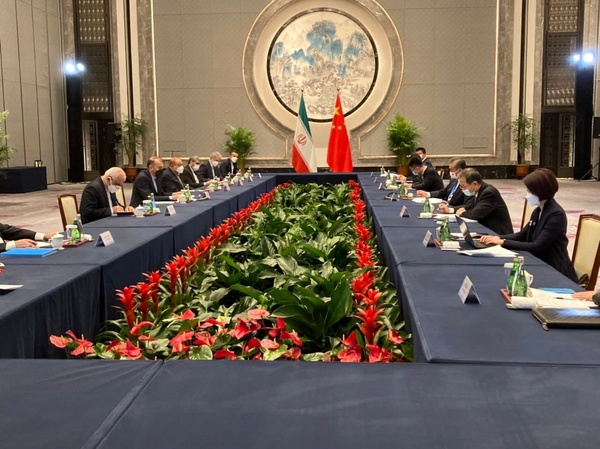
‘Tehran-Beijing partnership pact facilitated Iran SCO membership’

Majid Reza Hariri said after the conclusion of the 25-year agreement between Iran and China, the Islamic Republic’s membership process in the Shanghai Cooperation Organization was quickly accepted.

Hariri added that the document was the result of two years of negotiations between the two sides.

He noted that Iran and China have outlined cooperation in this document, and in fact, they have expressed their desire for long-term cooperation by signing the agreement.

Hariri also spoke about the achievements of signing the comprehensive document. He said after 40 years, the Islamic Republic of Iran has achieved such stability and self-confidence to ink a long-term cooperation document with a foreign country.

Referring to the opposition and rumors surrounding the Iran-China cooperation document, Hariri said this issue is related to Iran’s political situation in the world.

According to the head of the Iran-China Chamber of Commerce, Iran’s allies, including China, emphasize on confidentiality so that their relations with other countries are not affected because Iran is under US sanctions.