Friday, December 26, 2025
Home Blog Page 2162

Iran’s president: Threats and sanctions no obstacle to progress

Raisi made the remark after visiting an exhibition of the IRGC Navy’s capabilities and achievements in Hormozgan Province on Friday.

He said the exhibition is a proof that threats and sanctions are no obstacle to progress.
Raisi added what he saw at the exhibition of the IRGC Navy is a symbol of the country’s clout.

The president noted that Iran’s military and nuclear industries have borne the brunt of sanctions but they have made the biggest progress in spite of the bans.

Raisi noted that what has empowered Iran is its steely resolve.

Raisi also spoke of Iran’s military capabilities, saying people now have no worries regarding threats against the country as Iranian armed forces are keeping close tabs on everything.

During his visit to the IRGC Navy’s exhibition, the Iranian president was briefed on achievements made over the past 1.5 years including the manufacturing of drones, missile systems, electronic warfare systems, rocket- and torpedo-launching vessels, missile-launching warships, speedboats and flying boats.

Iran has beefed up its military capabilities over the past years amid continued saber-rattling by adversaries like the US and the Zionist regime.

AFC officially kicks Iranian giants out of Champions League

The AFC has announced its draw for the Asia Champions League 2022 (ACL2022) with the two giants eliminated from the list.

Two-time Asian Champions League finalists Persepolis from Iran will not play in the 2022 edition after having their licenses to participate withdrawn, according to the AFC.

Tehran-based Persepolis, who lost in both the 2018 and 2020 finals of Asia’s elite club competition, are one of three Iranian clubs to have had their licenses revoked.

Esteghlal, winners of the 1970 and 1991 Asian Club Championship – the forerunner to the Asian Champions League – and Gol Gohar Sirjan are the others.

According to the draw released on Friday, the two clubs Sepahan Esfahan and Foolad Khuzestan will represent Iran in the ACL2022.

Iran FM: Tehran and Beijing enjoy stable and strong relationship

Confucius, a famous educator in ancient China, said: It is always a pleasure to greet a friend from afar.

With the best wishes of the Iranian people to the Chinese friends, I am visiting China on the occasion of the beginning of 2022 and on the eve of the Chinese New Year of the Tiger and 1401 solar year.

Our two countries will celebrate the 51st anniversary of the establishment of diplomatic relations and will enter the second half of the century of bilateral exchange, which opens a new page of our relationship. Especially coinciding with the Chinese Communist Party entering the journey of its second 100 years, the visit will be a promising new horizon for our promotion and development of cooperation in various domains.

Iran and China accomplished the first half century of relations with the meeting of the heads of states of two countries, high-level interactions, talks and consultations on bilateral and regional issues, signing a Comprehensive Cooperation Plan, fulfilling the role as two active actors in the international arena and mediating for reducing international tensions and conflicts. The two countries ‘cooperation in various fields, including the fight against the COVID-19 and the mutual support of each other’s positions in international institutions and organizations, as well as China’s support for Iran’s permanent membership in the Shanghai Cooperation Organization, paved a new way for the second half-century of the relations.

Together, Iran and China resolutely defended their territorial integrity and national sovereignty, protected multilateralism, and opposed unilateralism. They criticized the approach of introducing democracy as a patent of superpowers and, with their indigenous democratic systems, demonstrated to the world true democracy, common values of human society, justice and freedom. Iran and China criticized the sanctions system as The Long Arm Jurisdiction and stood against the double standards of human rights. They called for the fair and effective implementation of international law and the development of a just system of governance. The two countries criticized the politicization of sports issues and emphasized the development of commonalities and common human values.

Now, at the birth of the second half of the century, Iran stands by China as a strategic partner with a foreign policy based on smart and balanced diplomacy, defending its regional interests and those of its neighbors, inspired by the Global Development Initiative with a shared future. For many years the peace and stability in the Persian Gulf and the Middle East has been in danger due to the domination and greed of extravagant superpowers that on the one hand claim sticking to international law and, on the other hand, act in violation of international law and regulations. In such a difficult atmosphere, defending the peace and stability of the region has always been one of Iran’s special priorities.

By implementing the 2015 agreement (JCPOA), Iran sent a message to the world that the pursuing of regional interests is its priority. Even after the withdrawal of the United States from JCPOA, Iran, by adhering to its commitments for two years and sacrificing part of its inalienable rights and interests, has illustrated more and more to the world that it is steadfast in this direction. China’s role as a member of the UN Security Council and as an active player in the international arena, which by a rational and logical approach, during the negotiations that facilitated the reconciliation process and the return of JCPOA’s violators, is really admirable. No matter what happens in the field of international relations, China and Iran, along with their other trade and regional partners, will be on the right side of history, forever. Iran will not allow hegemonic countries to decide for the Middle East or send troops under the guise of peacekeepers, causing tension, unrest and chaos in the region.

We believe that peace and stability in each region will be protected by the actors of that region. What really unites countries is political dialogue and win-win cultural, economic and trade cooperation, not arms rivalries or military and security alliances.

At various points in history, Iran, along with China as a trading partner, has displayed this fact to the world and reiterated that in the new era, the approach of confrontation, militancy and sanctions policy are obsolete and being rejected. Such illegitimate policies have lost its effectiveness leading to a negative reaction from other actors on the international stage. In this regard, Iran welcomes China’s Global Development Initiative and for its implementation proposes a mechanism of cooperation for balanced development. The group of Friends of the Global Development Initiative formed in UN by the suggestion of China could be the core of this cooperation.

In the second half of the century, the various cultural and political commonalities between Iran and China, ground for continuation of cooperation in the following high priority areas:

-Development of economic and trade cooperation and implementation of Comprehensive Cooperation Plan

-Consensus and consultation on various regional and international issues and playing an effective role in mediating relationships to effectively resolve challenges and tensions

-Fight against the COVID-19 and cooperation in joint vaccine production projects

-Helping strengthen the mechanism of cooperation for advancing global development with a common future

-Promoting multilateralism and countering double standards through the proposal to reform the international governance system

-Countering terrorism and extremism and helping bring all oppressed countries back to the international community

-Constructive and effective cooperation in the field of Belt and Road Initiative and helping China to use this project effectively

-Continuation of executive arrangements for Iran’s permanent membership in the Shanghai Cooperation Organization and taking advantage of the opportunity of cooperation with other member countries in accordance with the Global Development Initiative

We hope that in the second half of the century of relations and in the new chapter of cooperation that is based on the consensus of the leaders of the two countries, we see more and more development of cooperation and multi-faceted promotion of relations.

As a great civilization with a cultural history of 7,000 years, and along with China, Iran is ready to take responsibility of the international community’s cultural development. Meanwhile, with the achievements of joint economic cooperation, Iran would play its role in global development and building a shared future worthy of human society.

A shared future, adorned with shared human values.

Blinken: Trump JCPOA withdrawal ‘one of worst decisions in US foreign policy’

“We had stopped them. The nuclear agreement that was reached some years ago by the [Barack] Obama administration put Iran’s nuclear program in a box,” Blinken said in an interview with US public radio station NPR.

“And one of the worst decisions made in recent American foreign policy was to walk away from that agreement,” the secretary of state added.

The Joint Comprehensive Plan of Action (JCPOA) was inked by Iran and six world powers in 2015. Under the deal, Tehran agreed to put limits on certain aspects of its nuclear activities in exchange for the removal of draconian international sanctions imposed against the country.

In 2018, however, the US pulled out of the pact and reinstated sanctions under the so-called ‘maximum pressure campaign’ against Tehran, effectively depriving Iran of the deal’s benefits by forcing third parties to stop doing business with Iran.

Iran remained patient for an entire year, after which it began to take incremental steps away from its nuclear obligations, especially after Europeans failed to salvage the deal under the US pressure.
The Islamic Republic’s decision to ramp up its nuclear activities prompted other parties to revive talks earlier this year.

“And as a result, we are in a challenging situation where, far from getting a new and so-called better agreement – that hasn’t happened – Iran has moved forward with its program in increasingly dangerous ways,” Blinken stated.

Tehran denies seeking nuclear weapons, stressing it wants to master nuclear technology for peaceful purposes.

There are only “a few weeks” left to save the Iran nuclear deal, and the United States is ready to look at “other options” if negotiations fail, the top diplomat noted.

“We still believe that if we can get back in the weeks ahead – not months ahead, weeks ahead – to the JCPOA, the nuclear agreement, that would be the best thing for our security and the security of our allies and partners in the region. But, we’re very, very short on time. The runway is very short,” the US secretary of state said.

Iran has rejected US officials’ remarks about a deadline for reaching an agreement and stressed the country is only after a good agreement.

“So we have, I think, a few weeks left to see if we can get back to mutual compliance. That would be the best result for America’s security. But if we can’t, we are looking at other steps, other options, again, closely coordinated with concerned countries,” he added.

Iranian officials have repeatedly stressed Tehran reserves the right to respond to any adventurism by the United States and Israel.

Iran and the five remaining parties to the JCPOA — Germany, Britain, France, Russia and China — began the talks in the Austrian capital in April with the aim of removing the sanctions after the US voiced its willingness to return to the agreement.

During the seventh round of the Vienna talks, the first under President Ebrahim Raeisi, Iran presented two draft texts which address, separately, the removal of US sanctions and Iran’s return to its nuclear commitments under the JCPOA. Tehran also said it was preparing a third draft text on the verification of the sanctions removal.

The eighth round of talks kicked off in Vienna in late December. The negotiations seek to restore the JCPOA in its original form and bring the US back into the agreement.

Iran insists that the talks must lead to the removal of all American sanctions that were imposed against Tehran following Washington’s unilateral withdrawal from the landmark agreement in May 2018. Tehran has also demanded credible guarantees that Washington will not abandon the deal again.

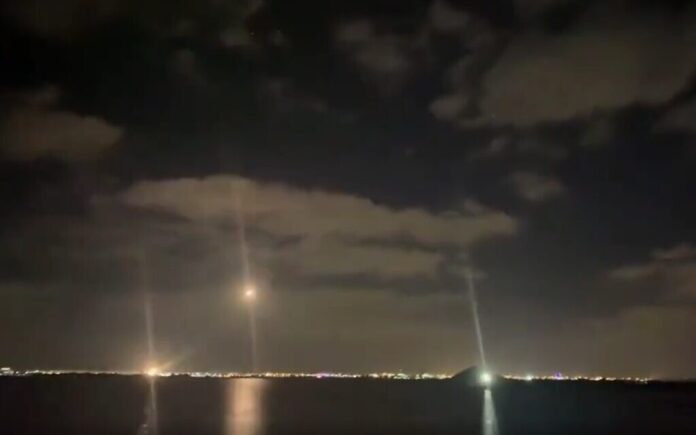
4 rockets target US Embassy in Baghdad

Us Troops

Three of the missiles struck within the perimeter of the US Embassy, the officials stated.

Another hit a school located in a nearby residential complex, injuring a woman and a girl, the official added. The school was in the al-Qadisiyah residential complex near the diplomatic facility.

The officials spoke on condition of anonymity because they were not authorised to talk to the media.

There was no immediate claim of responsibility for the attack.

An Iraqi military statement said the rockets had been launched from the Dora neighbourhood of Baghdad.

In a statement, the US Embassy in Baghdad announced its compound had been attacked by “terrorist groups attempting to undermine Iraq’s security, sovereignty, and international relations.”

The embassy’s C-RAM defence system – supposed to detect and destroy incoming rockets, artillery and mortar shells – was heard during the attack.

The Green Zone hosts most foreign diplomatic missions, including the US Embassy and the premier’s house.

It has been repeatedly targeted by rocket attacks since the assassination of top Iranian anti-terror commander Lieutenant General Qassem Soleimani and Iraqi commander Abu Mahdi al-Muhandis in a US drone attack in January 2020.

Last week, a series of attacks targeted American troops in Iraq and Syria.

Washington blames Tehran-backed armed groups for rocket attacks on foreign diplomatic missions, the US and foreign troops in Iraq.

The armed groups have vowed revenge for Gen. Soleimani’s assassination and have conditioned the end of the attacks on the full exit of American troops from the country.

Baghdad and Washington agreed in a fourth and final round of the strategic dialogue on July 26 to withdraw US forces from Iraq by the end of 2021.

Some 2,500 troops will remain as the coalition shifts to an advisory mission to continue supporting Iraqi forces.

Raisi: Iran won’t tie neutralizing sanctions to Vienna talks

Raisi made the comment in a tweet. He added that at a time when Iran is still under sanctions, the country’s oil sales have to some extent increased.

He added that Iran is no longer worried about the matter and the Islamic Republic is collecting revenues from the oil sales.

The Iranian president however noted that his administration will seriously pursue the issue of removing the bans.

The US under former President Donald Trump imposed hundreds of layers of sanctions against Iran with some bans targeting the country’s oil industry.

The sanctions were part of Trump’s so-called maximum pressure campaign against Tehran whose stated goal was to bring the country to its knees. But the sanctions, as many officials in the US admit, failed to achieve that goal and the US under current President Joe Biden is struggling to return to the Iran nuclear deal from which his predecessor withdrew in 2018.

Ali-Asgari dismisses resignation from Persian Gulf holding as ‘fake’

Ali-Asgari, a former head of the Islamic Republic of Iran Broadcasting, was on Wednesday appointed as the new managing director of the Persian Gulf Petrochemical Industry Commercial Company (PGPICC), drawing criticism.

His installation faced outcry on social media, with Mohammad Sarafraz, also a former IRIB head, ironically tweeting that Ali-Asgari, who prevented the collapse of the IRIB and resolved all its problems, will now address the government’s financial shortages.

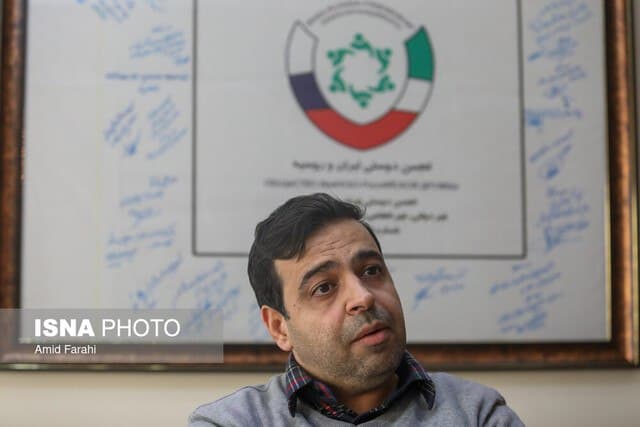
Talking to Fars News Agency, Ali-Asgari said he has started work at the company, holding meetings on its future plans since the first day of his appointment.

“We have plans on the development of the economic company and the work has started,” he underlined.

The PGPICC’s newly-appointed chief added that the company belongs to the Iranian people and its management intends to increase its profits in the first step and its stocks by appropriate plans in the second step.

With more than 15 manufacturing and service companies, the Persian Gulf Petrochemical Industry Commercial Company is the second-largest holding company of its kind in the Middle East.

Minister: Iran, Syria to establish joint free zone

Rostam Qassemi added that the head of Iran’s free zones will pay a visit to Syria to discuss the joint free zone and ink the agreement.

Qassemi, who recently held talks with Syria’s economy minister in Damascus, said he discussed the increase in Iran’s production in Syria, including the manufacturing of tractors and agricultural machinery, the elimination of tariffs, increase in the two sides’ exports, and customs-related issues.

Elaborating on his latest meetings and talks in Syria, Qassemi said he exchanged views with Syrian President Bashar al-Assad on the war-hit country’s economic issues and current economic problems the two countries are faced with.

The two sides made good decisions in the meetings, said the minister, adding, “We agreed to run a joint committee. Of the many memorandums of understanding already signed by the two countries, some have not been implemented and we decided to set up a joint committee to address the problems and give the go-ahead to the MoUs.”

Shifting to his meeting with the Syrian foreign minister, Qassemi said they discussed diplomatic issues between the two countries.

He also said the two sides decided to set up a joint bank in Syria, adding Iranian and Syrian banks will have branches in the two countries.

He also elaborated on a meeting with his Syrian counterpart and said, “Transportation in different sectors is an important infrastructure that plays a major role in the country’s development. The country’s Civil Aviation Organization head would follow up the related executive issues.”

Iran FM in Beijing for talks with Chinese officials

Upon his arrival at Wuxi Airport in China, Iranian Foreign Minister Hossein Amir Abdollahian said by visiting China, he aims to hold talks with Chinese officials over bilateral political ties and also over ways of implementing agreements between the Islamic Republic and China over economic cooperation.

The Iranian foreign minister is visiting China at the head of a high-ranking political and economic delegation and at the invitation of his Chinese counterpart Wang Yi.

Amir Abdollahina is scheduled to hold talks with China’s top diplomat over the latest state of the 25-year cooperation agreement between Tehran and Beijing.

China is Iran’s number one oil customer. The two countries also enjoy close political relations.

Tehran and Beijing have signed a 25-year strategic cooperation agreement which they have pledged to implement.

Under the comprehensive strategic partnership agreement, the Chinese government will increase investment in Iran’s energy, transportation and other key sectors.

The agreement will boost military and intelligence cooperation between the two countries as well.

International and regional issues are also on the agenda of negotiations during Amir Abdollahian’s visit to China.