Saturday, December 27, 2025
Home Blog Page 192

President Pezeshkian says Iran seeking peaceful coexistence with all nations

In a meeting with Iranian expatriates in Minsk on Wednesday, President Pezeshkian stated that the Islamic Republic seeks a peaceful life with all nations, but global powers do not want Iran to follow its path of growth and prosperity.

The president expressed his pleasure in meeting with the Iranian community residing in Belarus. He characterized their presence as a blessing and expressed hope that they would serve as ambassadors of Iranian culture, beliefs, and civilization.

President Pezeshkian hailed the unity and cohesion within Iran as a significant achievement, asserting that this solidarity continues to thrive despite external pressures. He countered the notion that military aggression could lead to the downfall of the Iranian government, stating that enemies believed military attacks would drive people to the streets and shatter the system, but they were mistaken.

Pezeshkian reiterated the principled policy of the Islamic Republic in advocating for peace and avoiding an arms race, affirming that from the very beginning, Iranian authorities declared that they are not seeking weapons and their primary goal is unity and cohesion within Iran’s borders and fostering regional harmony.

Addressing the issue of US maximum pressure policies, he remarked that the United States and its allies mistakenly believe that cutting off Iran would lead to starvation among its people. He asserted that the Iranian nation would continue to persevere through self-reliance and resilience.

The president described Iran’s defensive capabilities as a deterrent against threats, emphasizing that without these capabilities, Iran would face daily bombardments similar to those experienced by the people of Gaza. He added that the Zionist regime, with the support of the United States and Europe, attacked Iran’s nuclear facilities and would not have been able to carry out such an action without their backing.

Pezeshkian lamented the humanitarian crisis resulting from Israeli atrocities, pointing out that nearly 60,000 Palestinians have been killed, and many remain defenseless and impoverished. He highlighted the closure of vital resources like water and food in Gaza, which has led to heartbreaking images of starving children.

In conclusion, President Pezeshkian articulated his vision for Iran as a prosperous, beautiful, and advanced nation for current and future generations. He called for collaboration among all citizens and intellectuals to achieve true independence and national pride.

UK business leaders call for action against Israel over Gaza war

Gaza War

As of Thursday morning, 762 people had signed a statement calling on the UK to cease all arms trade with Israel, sanction those accused of violating international law – ostensibly including Prime Minister Benjamin Netanyahu as he is wanted for arrest by the International Criminal Court, invest in screening to stop the UK financing “complicit” companies, and enforce the United Nations’s principles on business and human rights across the UK’s economic systems.

“We see this not only as a moral imperative, but as a matter of professional responsibility – consistent with our duty to act in the best interests of long-term societal and economic resilience,” the letter reads.

“The UK must ensure that no business – whether through products, services, or supply chains – is contributing to these atrocities, directly or indirectly,” it added.

They have pledged to support the UK government with an “ongoing process of reflection and action – reviewing our operations, supply chains, financial flows, and influence to help foster peace, uphold human rights, and strengthen respect for international law”.

The number of professionals signing the letter is growing as Palestinians in the Gaza Strip face their darkest days. Israel is beginning a feared invasion into Gaza City while thousands endure hunger and famine due to the blockade of the enclave.

Israel’s latest war on Gaza, termed a genocide by leading rights groups, has killed more than 60,000 people in the 22 months since October 7, 2023, when Hamas attacked the occupied territories, during which about 1,200 were killed and 250 taken captive – “grave crimes under international law”, according to the letter.

“However, the Israeli government’s ongoing military campaign amounts to an unrelenting and indefensible assault on civilians, breaching both moral boundaries and the core principles of the Geneva Conventions,” it stressed.

Iranian navy successfully tests cruise missiles in Eghtedar 1404 drill

Iran Navy Forces

According to the Army’s Public Relations Office, naval missile units and surface vessels carried out coordinated strikes using the Nasir, Qadir, and Qader cruise missiles, engaging and destroying surface targets in simultaneous launches from both coastal batteries and naval platforms.

As part of the exercise, the missile boat Genaveh and the destroyer Sabalan executed precision strikes with Nasir and Qadir cruise missiles, while the coastal Velayat-2 system deployed the medium-range Qader anti-ship missile.

Military officials described the Qader as a medium-range, radar-evading cruise missile with high destructive power and advanced targeting accuracy, designed to engage both naval vessels and coastal installations.

The Qadir and Nasir missiles, with long- and short-range capabilities respectively, are also radar-evading systems optimized for precision strikes against maritime targets.

The Army emphasized that the exercise, which comes two months after the Israeli strikes, demonstrates Iran’s growing indigenous missile technology and its ability to conduct complex, synchronized operations under real combat conditions.

Iran denies security incident at Tabriz Air Base

In a statement issued Wednesday, the Army’s Public Relations Office said the large plume of smoke seen earlier in the day resulted from a fire at a municipal workshop near Azarbaijan Square, where piles of rubber and plastic materials had ignited.

The fire caused widespread concern among residents, prompting speculation about a possible security event at the nearby air base, with Israeli strikes on the country in June in hindsight .

Authorities stressed that the situation was quickly brought under control and that the incident posed no threat to public safety or military operations.

The statement added that investigations are underway to determine the cause of the blaze and that any evidence of sabotage or deliberate arson will be handled with “firm legal measures.”

The Army also reassured the public that its forces remain on full alert, emphasizing their readiness to deliver a “decisive response” to any potential threat or hostile action.

US sanctions more ICC judges over cases against Israel

The International Criminal Court (ICC)

“The Court is a national security threat that has been an instrument for lawfare against the United States and our close ally Israel,” Secretary of State Marco Rubio said in a statement, using a term popular with President Donald Trump’s supporters.

Rubio said that the four people targeted from the tribunal based in The Hague had sought to investigate or prosecute nationals from the United States or Israel “without the consent of either nation.”

The four include Judge Nicolas Guillou of France, who is presiding over a case in which an arrest warrant was issued for Israeli Prime Minister Benjamin Netanyahu.

The case was brought forward by the State of Palestine, which is not recognized by Washington but, unlike Israel or the United States, has acceded to the statute that set up the tribunal in The Hague.

Guillou, a veteran jurist, had worked for several years in the United States assisting the Justice Department with judicial cooperation during Barack Obama’s presidency.

Also targeted in the latest US sanctions was a Canadian judge, Kimberly Prost, who was involved in a case that authorized an investigation into alleged crimes committed during the war in Afghanistan, including by US forces.

Under the sanctions, the United States will bar entry of the ICC judges to the United States and block any property they have in the world’s largest economy — measures more often taken against US adversaries than individuals from close allies.

Rubio also slapped sanctions on two deputy prosecutors — Nazhat Shameem Khan of Fiji and Mame Mandiaye Niang of Senegal.

The State Department said the two were punished by the United States for supporting “illegitimate ICC actions against Israel,” including by supporting the arrest warrants against Netanyahu and former defense minister Yoav Gallant.

The Trump administration has roundly rejected the authority of the court, which is backed by almost all European democracies and was set up as a court of last resort when national systems do not allow for justice.

Trump on Friday welcomed Russian President Vladimir Putin to Alaska even though Putin faces an ICC arrest warrant, a factor that has stopped him from traveling more widely since he ordered the invasion of Ukraine.

Rubio slapped sanctions on four other ICC judges in June.

The International Criminal Court on Wednesday denounced new US sanctions against two more of its judges and two prosecutors, calling them a “flagrant attack” on its independence.

“These sanctions are a flagrant attack against the independence of an impartial judicial institution,” the court said in a statement.

The ICC noted it stood “firmly behind its personnel and victims of unimaginable atrocities”.

It added it would “continue fulfilling its mandates, undeterred” and “without regard to any restriction, pressure or threat”.

Iran launches major missile drill Eghtedar 1404

Iranian Navy

The two-day exercise aims to enhance combat readiness, test advanced weaponry, and demonstrate Iran’s defensive and deterrent capabilities.

According to senior commanders, the exercise features simultaneous launches of long-range cruise missiles from both naval vessels and coastal batteries, as well as the operational deployment of the domestically developed Bavar-5 drone.

The unmanned system, introduced two years ago in Tehran and showcased at Russia’s Army-2024 exhibition, is designed for precision strikes.

Various naval units, including surface and subsurface vessels, electronic warfare divisions, and special diving teams, are also taking part in coordinated operations.

Among the missiles to be tested is the Qader, known for its low-altitude sea-skimming capabilities and versatility for ship- or air-based launches, enhancing radar evasion.

Military analysts say the drill underscores Iran’s progress in indigenous missile and drone technologies, achieved despite years of international sanctions.

The drill comes two months after Israel launched an invasion against Iran, which faced retaliatory missile and drone strikes by Iranian forces.

Poll finds most Americans oppose Russia seizing Ukrainian land

Russia Ukraine War

When asked in The Economist/YouGov poll about “how much of Ukraine’s territory” they want Russia to have at the end of the war, 68 percent of respondents said “none of it.”

Twenty-one percent of survey participants said they were “not sure” how much territory Russia should get, 5 percent said they wanted Russia to have “some of” Ukraine’s territory, 2 percent said they wanted Russia to get “half of” Ukrainian territory and 1 percent said they wanted Russia to have “most of it.”

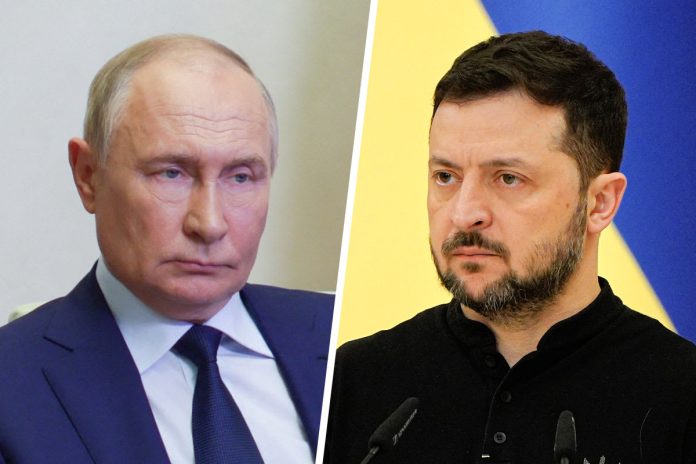
President Trump separately met with Ukrainian President Volodymyr Zelensky and Russian President Vladimir Putin on U.S. soil within the past week. Putin reportedly wants most of the eastern Donbas region as part of a deal, while Ukraine has rejected ceding territory.

Trump is now pushing for Zelensky and Putin to meet face-to-face, as they remain far apart on the terms for peace. Ukraine has demanded a ceasefire before any formal negotiations, a request that Trump previously backed but dropped after meeting Putin in Alaska last week.

Russia has sent signals this week that it’s in no hurry to have Putin meet with Zelensky.

Moscow also announced Wednesday that talks between NATO allies and Ukraine about postwar security guarantees were a “road to nowhere” unless Moscow takes part in the discussions.

The Economist/YouGov poll took place from Aug. 15 to 18, with 1,568 respondents and and a margin of error of 3.5 percentage points.

Most Americans believe countries should recognize Palestinian state: Poll

Some 33% of respondents did not agree that U.N. members should recognize a Palestinian state and 9% did not answer.
The six-day poll, which closed on Monday, found a pronounced partisan divide on the issue, with 78% of Democrats supporting the idea, far more than the 41% of President Donald Trump’s Republicans who agreed.
A narrow 53% majority of Republicans did not agree that all U.N. member nations should recognize a Palestinian state.
Israel has long counted on the U.S., its most powerful ally, for billions of dollars a year in military aid and international diplomatic support. An erosion of U.S. public support would be a worrisome sign for Israel as it faces not only Hamas fighters in Gaza but unresolved conflict with Iran, its regional arch-foe.
A widely condemned Israeli settlement plan that would cut across occupied West Bank land which the Palestinians seek for a state received final approval on Wednesday, according to an Israeli government statement.
The poll was taken within weeks of three countries, close U.S. allies Canada, Britain and France, announcing they intend to recognize a Palestinian state. This ratcheted up pressure on Israel as starvation spreads in Gaza.
The survey was taken amid hopes that Israel and Hamas would agree on a ceasefire to provide a break in the fighting, free some hostages and ease shipments of humanitarian assistance into the Gaza Strip.
Britain, Canada, Australia and several of their European allies said last week that the humanitarian crisis in the war-torn Palestinian enclave has reached “unimaginable levels,” as aid groups warned that Gazans are on the verge of famine.
The United Nations human rights office announced on Tuesday Israel was not letting enough supplies into the Gaza Strip to avert widespread starvation.
Some 65% of the Reuters/Ipsos poll respondents said the U.S. should take action in Gaza to help people facing starvation, with 28% disagreeing. The number disagreeing included 41% of Republicans.
Trump and many of his fellow Republicans take an “America First” approach to international relations, backing steep cuts to the country’s international food and medical assistance programs in the belief that U.S. funds should assist Americans, not those outside its borders.
The war in Gaza began when Hamas-led fighters stormed into Israel on October 7, 2023, killing 1,200 people and taking 251 hostages, according to Israeli figures. Israel’s offensive has since killed more than 62,000 Palestinians, plunged Gaza into humanitarian crisis and displaced most of its population, according to Gaza health authorities.
The Reuters/Ipsos poll also showed that 59% of Americans believe Israel’s military response in Gaza has been excessive. Thirty-three percent of respondents disagreed.
In a similar Reuters/Ipsos poll conducted in February 2024, 53% of respondents agreed that Israel’s response had been excessive, and 42% disagreed.
Officials at the Israeli embassy in Washington and mission to the United Nations did not immediately respond to requests for comment on the poll.
The latest Reuters/Ipsos survey, conducted online, gathered responses from 4,446 U.S. adults nationwide and had a margin of error of about 2 percentage points.

China reiterates opposition to Snapback trigger against Iran

Water facility at Arak

The move would automatically reimpose sanctions against Iran under UN Security Council Resolution 2231.

In an explanatory note circulated at the UN Security Council, China stressed that the current difficulties in implementing the 2015 Iran nuclear, JCPOA, and Resolution 2231 stem not from Iran’s actions, but from the disruption caused by the US and three European countries.

Beijing added that this cannot serve as justification for reinstating previously lifted sanctions.

China warned that attempts to invoke the snapback mechanism could lead to unpredictable and catastrophic consequences, undermining years of diplomatic achievements.

The note underlined that the JCPOA and Resolution 2231 are inseparably linked, and any unilateral effort to trigger snapback outside of the legal framework would constitute an abuse of Security Council powers and would carry no legitimacy.

The Chinese mission further defended Iran’s right as a member of the NPT to peacefully use nuclear energy.

“Retreat of Caspian Sea could lead to desertification of coastal areas”

Caspian Sea

Mojtahedi said water levels along the Caspian coast of Iran have dropped to around 300 meters, warning that a further decline to 500–600 meters could transform coastal areas into arid zones dominated by sand and salt.

Mojtahedi underlined that while the Caspian has historically experienced fluctuations, rising in the 1970s and falling in the 1950s, the current retreat, combined with global warming, poses unprecedented challenges.

He further explained that unlike open seas, where melting polar ice raises water levels, closed basins like the Caspian Sea are more vulnerable to evaporation-induced declines.

The drop in water levels also threatens critical wetlands, including Anzali and Miankaleh, and contributes to wind erosion along the Iranian coast.

He urged the planting of native salt-tolerant species to stabilize soils and called for continuous monitoring of the Caspian Sea’s water levels by scientific institutions.

Reduced snowfall and rainfall in the basin, partly due to warming winters, are further stressing river inflows, intensifying the risk of desertification along the southern coast. A study conducted by the Caspian Sea Studies and Research Center also shows the declining trend in Caspian Sea water levels began in 1996.

Factors such as water management practices, high evaporation rates, and climate change are potential contributors to decreased water flow into the Caspian Sea.