Saturday, December 27, 2025
Home Blog Page 193

Iran’s Navy to launch large-scale missile drill in Indian Ocean

Iran Navy

Rear Admiral Abbas Hassani, spokesperson for the drill, said the operational phase of the exercise will start with the code phrase “Oh Muhammad, Messenger of God” and last two days. It will take place across the northern Indian Ocean and the Sea of Oman.

According to the announcement, surface and subsurface vessels, naval aviation units, coastal and sea-based missile sites, and electronic warfare divisions will participate. The exercise will also feature drone operations and missile launches in line with updated procedures and lessons learned from past maneuvers.

Hassani confirmed that a wide range of precision-guided cruise missiles with short, medium, and long ranges will be tested to strike and destroy surface targets.

He added that the exercise aims to strengthen combat readiness, enhance planning and command capabilities, and demonstrate deterrence. “This drill also seeks to inspire confidence among the Iranian people while relying entirely on domestic expertise,” the spokesman said.

The Navy has staged regular war games in recent years, highlighting its emphasis on expanding missile and drone capabilities.

Iran minister: Oil exports planned according to market conditions

Iran Oil Tanker

“We do not have a single barrel of oil that we cannot sell,” Paknejad said, stressing that all exports are planned according to market conditions.

He also highlighted the inauguration of a $1.6 billion gas recovery project in western province of Ilam, expected to generate $700 million annually by capturing 240 million cubic feet of flare gas.

Paknejad also said the recent decision to allow imports of super gasoline will not affect existing fuel quotas or prices for ordinary consumers.

Speaking on the sidelines of a cabinet meeting on Wednesday, Paknejad clarified that fuel subsidies remain unchanged.

He explained that the private sector, not the government, has been authorized to import super gasoline, referred to as “special gasoline” in cabinet documents, and offer it as a premium service to consumers willing to pay higher costs.

Former Iranian president Mohammad Khatami undergoes heart procedure

Seyed Mohammad Khatami

Mohammad Reza Khatami, himself a prominent reformist figure, said the 80-year-old former president experienced persistent chest pain along with other symptoms indicating a heart condition.

“Following medical examinations, it was confirmed that Mr. Khatami had a cardiac complication caused by a blocked artery. Angioplasty was performed, and thankfully the outcome was very positive,” he told local media.

His brother added that the former president is now under close medical supervision and is continuing treatment.

Khatami, who served as Iran’s president from 1997 to 2005, is widely regarded as the leading figure of the country’s reformist movement.

He remains a symbolic presence in Iranian politics despite facing restrictions on public activity and media coverage in recent years.

US may provide air support for Ukraine under peace accord: Trump

Russia Ukraine War

“When it comes to security, (European allies) are willing to put people on the ground. We’re willing to help them with things, especially, probably, by air,” Trump said, stressing that no U.S. troops would be deployed on Ukrainian soil.

Kyiv has long insisted on binding security guarantees from its allies to prevent Moscow from invading again after a ceasefire. Trump initially dismissed such guarantees as Europe’s responsibility, but has recently shifted his position.

White House Press Secretary Karoline Leavitt stated that U.S. air support remains “an option and a possibility.” She did not specify what form it could take, though air support could involve missile defense systems or a no-fly zone.

Bloomberg has reported that a package of security guarantees for Ukraine could be finalized this week, with European leaders moving quickly after Trump signaled support.

European officials have discussed sending British and French troops to Ukraine, along with contingents from roughly 10 other countries, according to sources cited by Bloomberg.

During talks in Washington NATO Secretary General Mark Rutte said the issue of deploying U.S. or European troops had not been raised. President Volodymyr Zelensky, who arrived in Washington with European leaders, has pressed for firm guarantees as part of any deal.

French President Emmanuel Macron has noted that security guarantees would not include NATO membership but would instead rely on a strong Ukrainian military supported by a “coalition of the willing,” which includes over 30 countries such as Canada and Japan.

Some allies are prepared to send ground troops, while others will provide air and naval support.

European officials have told the Kyiv Independent that a series of meetings among the participant countries of the “coalition of the willing” could take place in the coming days to hash out the details.

Iranian president boosts ties in Belarus, raises border concerns in Armenia

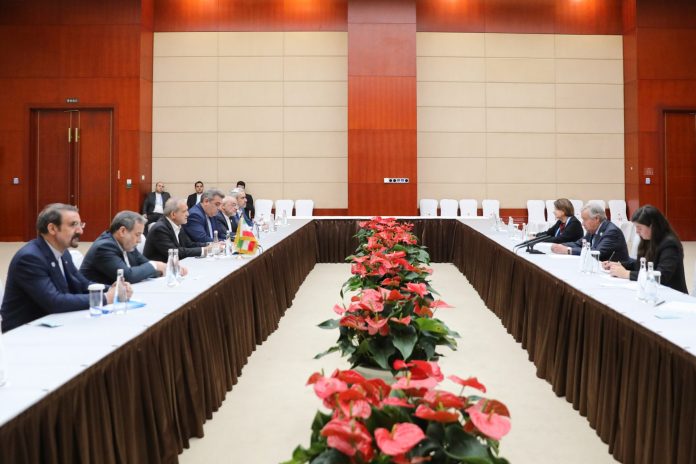
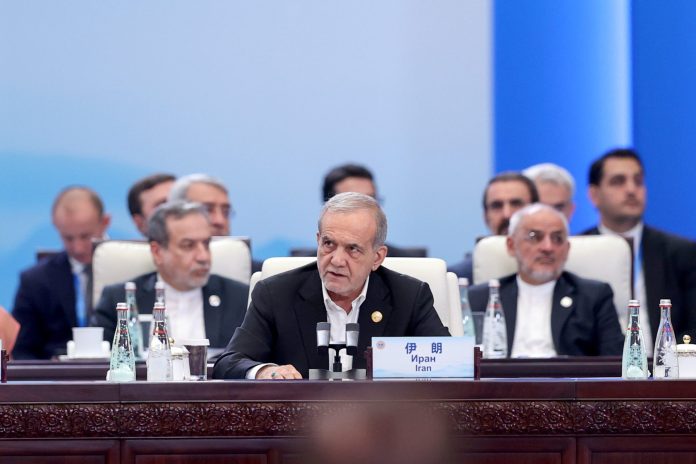
Lukashenko welcomed Pezeshkian with an official ceremony at the presidential palace before the pair held private talks and a joint session with senior delegations.

According to Iranian state media, several agreements and cooperation documents are expected to be signed during the visit. Pezeshkian’s program in Belarus also includes meetings with parliamentary leaders and members of the Iranian community.

The Iranian president stressed that Tehran and Minsk share common views in international organizations such as BRICS and the Shanghai Cooperation Organization, arguing that the frameworks could help both countries expand constructive engagement.

He also criticized unilateral actions by the US and its allies, saying sanctions against Iran and Belarus were designed to weaken independent states.

Before arriving in Minsk, Pezeshkian met Armenian Prime Minister Nikol Pashinyan in Yerevan on Tuesday. In that meeting, he reaffirmed Iran’s support for Armenia’s sovereignty but insisted that concerns over the presence of foreign forces near shared borders “must be completely resolved.”

The remarks came days after Yerevan and Baku signed a US-mediated deal over the strategic Zangezur corridor that connects Iran to Armenia.

Syrian, Israeli officials meet in Paris on de-escalation measures: SANA

The talks centered on reducing tensions, non-interference in Syria’s internal affairs, supporting stability across the region, monitoring the ceasefire in Suwayda province and reactivating the 1974 disengagement agreement between Israel and Syria, according to the report.

The discussions were held under US mediation as part of wider diplomatic efforts to bolster security in Syria and preserve the country’s unity and territorial integrity, the agency added.

While SANA did not specify the identities of the Israeli officials, Israel’s Channel 12, citing two unnamed “informed” sources, stated that Israeli Strategic Affairs Minister Ron Dermer and US Special Envoy to Syria Tom Barrack were set to meet al-Shaibani in Paris on Tuesday night to discuss security arrangements on the border between the two sides, without providing further details.

On July 24, Barrack wrote on the US social media platform X that “I met this evening with the Syrians and Israelis in Paris. Our goal was dialogue and de-escalation, and we accomplished precisely that. All parties reiterated their commitment to continuing these efforts.”

The next day, Israel’s Channel 13, quoting a senior Israeli official it did not name, claimed Dermer had met with al-Shaibani in Paris in the presence of Barrack, describing the meeting at the time as “extremely important.”

The US news outlet Axios reported then that the talks were mediated by US President Donald Trump’s administration and constituted “the most high-level official engagement between Israel and Syria in more than 25 years.”

Axios cited unnamed Israeli officials as saying that the goal was “to reach security understandings regarding southern Syria in order to maintain the ceasefire between Israel and Syria.”

On Aug. 12, al-Shaibani met in Amman, Jordan with Jordanian Foreign Minister Ayman Safadi and Barrack.

The meeting addressed ways to enhance coordination between the three parties, with an agreement reached to form a joint Syrian-Jordanian-US working group to support Syrian government efforts in strengthening the Suwayda ceasefire and pursuing a comprehensive solution to the crisis.

Suwayda has observed a ceasefire since July 19 following a week of deadly armed clashes between Druze groups and Bedouin tribes and Israeli military attacks.

Israel has cited “protection of the Druze” to justify escalations against Syria and expanded its occupation of the Syrian Golan Heights by seizing the demilitarized buffer zone, which Damascus has denounced as blatant interference. Syria has called for enforcing the 1974 disengagement agreement between the two sides.

Israel also launched hundreds of airstrikes targeting Syrian military sites, including air fields, missile systems and air defense installations.

Syria’s transitional administration, formed after the ouster of Bashar al-Assad in late 2024, is working to restore stability across the country after nearly 25 years of authoritarian rule.

Iran president says Caucasus region must not become theater for geopolitical rivalry

“Iran’s position has always been clear, we do not accept any changes to internationally recognized borders in the Caucasus,” the president said at a joint press conference with Armenia’s Prime Minister Nikol Pashinyan in Yerevan, on Tuesday.

“This region should not be transformed into an arena for global power competition,” he asserted.

Pezeshkian reiterated that Iran consistently supports Armenia’s territorial integrity, describing it as a fixed and unchanging policy. “The Caucasus must remain governed by Caucasian nations,” he said, warning that outsourcing conflict resolution to extra-regional powers would only complicate the situation further.

During the meeting with Pashinyan, the Iranian president described the continuation of friendly relations between the two countries as a firm commitment of Iran.

According to a statement by the Iranian presidency, he voiced Iran’s readiness to accelerate the finalization of a strategic long-term cooperation agreement.

He reiterated that the deep historical, cultural, and civilizational ties between Iran and Armenia provide a strong foundation for further strengthening bilateral cooperation based on mutual interests.

Pezeshkian also placed a premium on addressing Iran’s concerns regarding a trilateral deal between Armenia, Azerbaijan, and America to establish a transit corridor connecting Azerbaijan to its exclave Nakhchivan.

“Iran has always sought to stabilize peace and security in the Caucasus region, and will continue to do so.”

Pezeshkian’s visit came less than two weeks after Pashinyan and Azerbaijani President Ilham Aliyev signed a peace deal at the White House in the presence of US President Donald Trump.

That peace deal has escalated concerns about Washington’s interventionist intentions concerning the region.

Pashinyan said Armenia has always been and will remain committed to preserving its friendly and historic relations with Iran.

He said Iran and Armenia possess diverse and complementary capacities that should be harnessed to serve the interests of both nations.

“Cooperation with Iran, under the spirit of good neighborliness and the preservation and enhancement of friendly relations, is of strategic importance to Armenia. Without a doubt, Iran’s concerns regarding the construction of the new corridor will be fully respected.”

He added that Armenia is ready to sign a strategic long-term cooperation agreement with Iran.

Earlier in the day, the delegations of the two countries signed 10 memoranda of understanding on mutual cooperation.

The MoUs, signed on the second day of Pezeshkian’s visit, address diplomacy, economy, mines and industries, road and urban development, healthcare, environment, education, culture, social interaction, and tourism.

Yerevan trip leads to productive deals between Iran, Armenia: President Pezeshkian

In a meeting with Armenian President Vahagn Khachaturyan on Tuesday, Pezeshkian reaffirmed Iran’s commitment to enhancing friendly relations with Armenia. He emphasized that the visit aimed to strengthen the bonds of friendship between the two nations and expressed optimism about the significant and beneficial agreements that emerged from their discussions.

The Iranian president also expressed gratitude to Armenia for its condemnation of the Israeli regime’s aggression against the Islamic Republic, highlighting the hypocrisy of those who accuse Iran while overlooking the atrocities committed by the Israeli regime in Gaza and other regions.

Regarding the presence of the United States in the region, Pezeshkian stated that Iran fundamentally opposes US involvement, citing past experiences that illustrate Washington’s failure to uphold its commitments.

In response, President Khachaturyan conveyed confidence that President Pezeshkian’s visit would further solidify bilateral relations. He acknowledged the enduring quality of cooperation between the two nations since Armenia’s independence.

Khachaturyan noted the rich historical, cultural, and civilizational ties that bind Iran and Armenia, spanning thousands of years of shared experiences. He highlighted the ongoing constructive engagement of Iranian businesses in various sectors within Armenia, suggesting abundant opportunities for further collaboration.

He affirmed Armenia’s commitment to peaceful coexistence and expressed hope that the three republics in the Caucasus could cultivate friendly relations alongside Iran and Turkey, ensuring mutual benefits for all parties involved.

The Armenian president remarked that Israel’s aggression has only strengthened Iranian unity. He said that international principles are easily violated, and unilateralism and bullying have spread across the global stage.

Bipartisan US lawmakers meet with Syria’s president in Damascus

Ahmad Al Sharaa

The Syrian Foreign Ministry on Tuesday posted photos of the lawmakers, the delegation included Sens. Joni Ernst (R-Iowa) and Markwayne Mullin (R-Okla.), and Reps. Jason Smith (R-Mo.) and Jimmy Panetta (D-Calif.)

The lawmakers met with al-Sharaa and other senior officials in the administration, including Minister of Foreign Affairs and Expatriates Assad Hassan Al-Shaibani and Minister of Interior Anas Khattab.

Trump has moved to significantly ease sanctions on Syria in the wake of the ousting of Syrian President Bashar al-Assad in December. But Congress is split over whether to permanently repeal the Caesar Syria Civilian Protection Act, a comprehensive sanctions regime against Syria that was meant to isolate and bankrupt Assad. Trump only has a six-month waiver to suspend those sanctions.

The divide is bipartisan. Some Republicans and Democrats are arguing for a cautious approach to lifting sanctions, to closely watch how al-Sharaa follows through on key commitments to counterterrorism, justice for victims of Assad and protection of minorities.

Rep. Brad Sherman (D-Calif.) put his support behind an initiative from Rep. Mike Lawler (R-N.Y.) that would amend Caesar to give the president more flexibility on suspending sanctions yet retain the ability to implement them if needed. The debate in Congress came shortly after an American citizen was killed among a group of Syrian-Druze in an outbreak of sectarian violence in Suwayda, in southern Syria.

“We cannot expect perfection, we are not looking for Jeffersonian democracy in Syria, but we are also looking for a government to do all it can to prevent seven Druze, including one U.S. citizen, from being executed,” Sherman said last month, referring to the violence.

Still, there seems to be bipartisan consensus for engagement with al-Sharaa and his government. The delegation including Ernst and others follows trips by other lawmakers to Syria in the wake of the ousting of al-Assad, who fled the country in December amid a lightning takeover by al-Sharaa as head of the former-designated terrorist organization Hayat Tahrir al-Sham.

Another Republican lawmaker, Arizona Rep. Abraham Hamadeh, who is of Syrian-Druze heritage, traveled to Damascus earlier this month to advocate for the return of Americans killed in Syria, in particular for Kayla Mueller, who was killed in 2015 while she was a hostage of Daesh (ISIS or ISIS) in Syria. Her family are his constituents. The Trump administration has also pushed for the Syrian government to help locate Austin Tice, an American journalist kidnapped by the Assad regime in 2012. The family believes he is alive.

Hamadeh traveled to Damascus after meetings with Israeli Prime Minister Benjamin Netanyahu in Jerusalem, and urged Syria’s inclusion in the Abraham Accords, to normalize ties with Israel. Netanyahu has ordered airstrikes on Syria in what he says are counterterrorism actions and protections of Syria’s Druze minority. Hamadeh lobbied al-Sharaa to provide for the safe delivery of medical and humanitarian aid to Suwayda.

In April, a pair of Republican lawmakers also traveled to Syria, Rep. Cory Mills (R-Fla.) and Rep. Marlin Stutzman (R-Ind.).

Gaza shelters turned into ‘places of death’ as 540 children killed monthly by Israel: UN

Gaza War

“In Gaza, UNRWA schools have become shelters for hundreds of thousands of people,” UNRWA said in a statement on the US social media company X.

“People sought protection under the UN flag only for these shelters to become a place for death, including for too many children.”

“No place is safe for children in Gaza,” the statement added, calling for an immediate ceasefire.

UN agencies have warned of the devastating impact of Israel’s ongoing military campaign on Gaza’s children, as schools, hospitals, and homes are being relentlessly targeted.

According to Gaza’s Health Ministry, famine has killed at least 266 Palestinians, including 112 children, since October 2023, amid a worsening blockade and severe aid shortages.

Israel has killed more than 62,000 Palestinians in Gaza since October 2023. The military campaign has devastated the enclave, which is facing famine.

Last November, the International Criminal Court issued arrest warrants for Israeli Prime Minister Benjamin Netanyahu and his former Defense Minister Yoav Gallant for war crimes and crimes against humanity in Gaza.

Israel also faces a genocide case at the International Court of Justice for its war on the enclave.