2 dead and 20 wounded in Kremenchuk airstrike: Ukrainian official
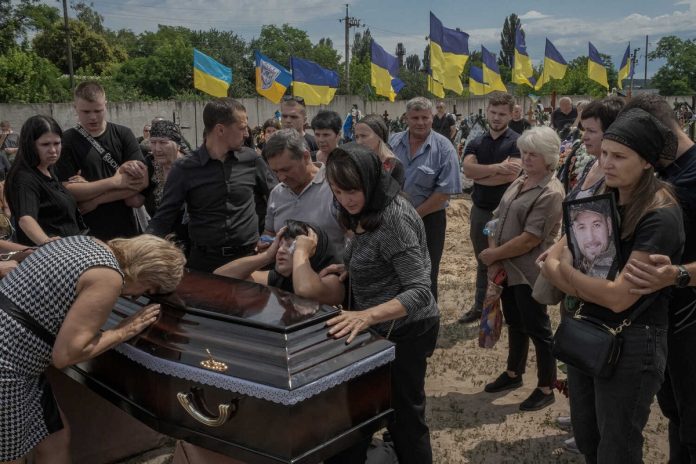
Two people are dead and 20 people are injured following an airstrike on a shopping mall in Kremenchuk, Ukraine, said Kyrylo Tymoshenko, deputy head of the Office of the President of Ukraine.
Of the 20 people injured, nine are in serious condition, Tymoshenko added.
Initial reports from President Volodymyr Zelensky suggested that at least 1,000 people may have been in the building when it was struck.
US to send Ukraine air-defence missiles
The US is planning to send Ukraine sophisticated anti-aircraft missiles to defend against Russian attacks, US National Security Advisor Jake Sullivan has said.
“I can confirm that we are in fact, in the process of finalising a package that includes advanced air defence capabilities,” Sullivan told reporters in Germany.
Sullivan added President Joe Biden had told President Volodymyr Zelensky – who joined the G7 talks by video link – that the US was preparing shipment of “advanced medium- and long-range air defence capabilities”.
Sullivan stated additional aid being prepared due to “urgent need” also included artillery ammunition and counter-battery radar systems, which are used to pinpoint the source of enemy artillery firing.
Russia to face ‘attacks & sabotage operations’: Ukraine
Russia should brace for “attacks and sabotage operations” within its territory, Ukrainian military intelligence head Kirill Budanov told the Financial Times.
He mentioned the murder of a local official in Kherson Region as an example of these attacks, which was treated as an act of terrorism by the city’s authorities.
“Partisan activities” have been emerging within the territories Russia seized since the start of its military operation in Ukraine in late February, Budanov said, pointing to two explosions in Kherson Region, which borders Crimea.
The region has seen two attacks apparently targeting local officials. On June 22, a roadside bomb went off in the town of Chernobayevka as a local administration head was driving by. The official survived, sustaining only light shrapnel wounds. Two days later, the head of the Kherson Region Department of Family, Youth and Sports was killed in a similar attack. An improvised explosive device was planted in his car. On June 24, the local authorities announced they were treating the incident as a terrorist attack.
According to Budanov, these types of attacks will not be limited to territory that was once under Ukrainian control.
Attacks and sabotage operations “are held everywhere, and they were and will be held in Russia and many other places,” he told the Financial Times.
He did not say if Kiev is behind any of the incidents.
The military intelligence chief also said he has “little hope” that Russian forces will retreat and leave the positions they currently hold.
“They will fight as much as they can,” he continued, adding that Russia has “no other option” but to “fight to the end.”
Moscow strikes Kiev rocket plant
Russia’s Ministry of Defense reported on Monday that it successfully carried out a missile strike on a rocket manufacturing plant in Kiev, which was being used to produce ammunition for multiple launch rocket systems.
The strike was carried out on Sunday with four high precision missiles, all of which reached the Artyom rocket-manufacturing plant, located in the Shevchenkovskiy district of Kiev, without damaging civilian infrastructure in the city, the ministry reports.
Russia reacts to reports of new weapons for Ukraine
Russia continues to safeguard its interests, the Kremlin has said in response to reports about Washington’s plans to send new missile systems to Ukraine.
“We didn’t receive any notifications on the matter. As far as actions to defend [our] interests are concerned, [we are] making them on a regular basis,” Kremlin spokesman Dmitry Peskov told reporters on Monday.
Peskov’s statement came after several news agencies reported that the US was purchasing a medium-to-long range surface-to-air missile system for Ukraine.
Peskov stated this month that “flooding” Ukraine with foreign weapons will not change the course of the conflict and will only lead to more suffering and destruction in Ukraine.
NATO will enhance its battle groups in the eastern part of alliance
NATO will enhance its battle groups in the eastern part of the alliance up to brigade levels, NATO Secretary-General Jens Stoltenberg announced Monday.
“We will increase the number of high readiness forces to well over 300,000,” he said at a news conference in Brussels.
This includes “more pre-positioned equipment and stockpiles of military supplies; more forward-deployed capabilities, like air defense; strengthened command and control, and upgraded defense plans with forces pre-assigned to defend specific allies,” Stoltenberg added.
The NATO Response Force comprises around 40,000 troops, according to the NATO website.
“These troops will exercise together with home defense forces. And they will become familiar with local terrain, facilities, and our new pre-positioned stocks so that they can respond smoothly and swiftly to any emergency,” Stoltenberg went on to say, stressing that “this constitutes the biggest overhaul of our collective deterrence and defense since the Cold War.”
These comments come ahead of the NATO summit that will be held in Madrid this week.
The summit will be “transformative,” with many important decisions, including on a new “strategic concept for a new security reality,” Stoltenberg stated Monday, adding that this will include a discussion on China “for the first time.”
“Our new concept will guide us in an era of strategic competition. I expect it will make clear that allies consider Russia as the most significant and direct threat to our security,” Stoltenberg said, adding, “It will address China for the first time. And the challenges that Beijing poses to our security, interests, and values.”
US President Joe Biden and his Chinese counterpart Xi Jinping will likely speak in the coming weeks, the White House announced. While there is no timeframe, the conversation will not happen immediately after the G7 meet, where China was a primary topic of discussion, US national security adviser Jake Sullivan told reporters in Germany.
Mariupol residents “forced to hunt pigeons” to eat: Mayor
Residents in the occupied city of Mariupol are being “forced to hunt pigeons” in order to feed themselves, Vadym Boichenko, the exiled mayor of Mariupol, said in a statement on Monday.
Boichenko stated residents are “using improvised traps” to catch the pigeons and that Russian forces are making “a mockery of people who used to live their life to the fullest before the war — not knowing what hunger or lack of drinking water was.”
“These terrible things are happening in the 21st century, in the heart of Europe, in front of the whole world,” he added.
Russian missile attack causes deaths in central Ukrainian city: Mayor
A Russian missile strike hit a “very crowded” place in the central Ukrainian city of Kremenchuk, causing deaths and injuries, city mayor Vitaliy Meletskiy has said on Facebook.
He added he was at the scene but did not say what had been hit and how many people had been killed or wounded.
A Russian missile strike has hit a crowded shopping centre in the central Ukrainian city of Kremenchuk, President Volodymyr Zelensky has said.
He added more than 1,000 people were in the shopping centre at the time of the attack.
He gave no details of casualties but stated: “It is impossible to even imagine the number of victims.”
Zelensky focused on regaining momentum in months — not years: US national security adviser
Ukrainian President Volodymyr Zelensky was focused on regaining momentum in Ukraine over the coming months — and not years — when he spoke to leaders of the G7 on Monday, according to a senior adviser to US President Joe Biden.
“Zelensky was very much focused on trying to ensure that Ukraine is in as advantageous a position on the battlefield as possible in the next months as opposed to the next years, because he believes that a grinding conflict is not in the interest of the Ukrainian people,” US national security adviser Jake Sullivan said after the meeting.
Earlier, a source familiar with the matter told CNN that Zelensky told leaders he wanted the war to be over the end of the year, before winter sets in.
Sullivan declined to characterize Zelensky’s message. But he stated the Ukrainian president was clear that he wants support in the near-and-medium term, not in the distant future.
“He would like to see his military, and those in the West who are supporting his military, make maximum use of the next few months to put the Ukrainians in as good a position as they can possibly be in with respect to the situation on the ground in both the east and the south,” Sullivan added.
“That’s consistent with the American approach of trying to flow in the necessary material and equipment to put the Ukrainians in an advantageous position on the battlefield. But that’s really what he was focused on,” he continued.
Zelensky’s timeframe was based on battlefield considerations but also the plight of his people, he said.
“I think another really important consideration is just the sense of suffering of the Ukrainian people with each day and week that this goes on,” Sullivan continued, adding, “And so, he’s got an urgency to try to show his people that Ukraine is first of all, holding fast against the Russian onslaught, and secondly, making some progress in areas where they feel that they can, in fact push back against the Russians.”
UK’s defense ministry predicts Russia will use reserve units in Ukraine war
The UK Ministry of Defence (MoD) has projected that Russia will increasingly use its reserve units in its bombardment of eastern Ukraine.
Russia will “highly likely increasingly rely on echelons of reserve forces” in upcoming weeks, the ministry announced in its latest assessment of the conflict.
“Despite a continued shortfall in the number of deployable reservists for Ukraine, the Russian leadership likely remains reluctant to order a general mobilisation,” the ministry said. It added that Russia’s main operational focus remains the eastern Severodonetsk-Lysychansk pocket.
The ministry noted that “consistently heavy shelling suggests Russia is now trying to regain momentum on the northern Izium axis.”
The US will impose “blocking sanctions” on state-owned defense companies and defense-related research organizations and individuals, the White House said in a statement.
“The United States Departments of State and the Treasury will aggressively target Russian defense supply chains by imposing blocking sanctions on major state-owned defense enterprises, in addition to defense research organizations, and dozens of other defense-related entities and individuals,” the statement read.
The US is seeking “to limit Russia’s ability to replace the military equipment” it has already lost during the conflict in Ukraine, the White House said.
The US Department of Commerce will introduce the first restrictions against companies that help Russia bypass sanctions, the White House announced in a factsheet devoted to the Biden administration’s measures against Russia.
The United States will impose visa restrictions on about 500 Russian officials due to the conflict in Ukraine, the White House added
“The US Departments of Treasury and State will implement blocking sanctions on private military companies operating in Ukraine, Russian military units that have been credibly implicated in human rights abuses or violations of international humanitarian law in Ukraine, and Russia-installed senior officials in areas besieged or held by Russia’s forces, including ministers and mayors of contested cities. State will impose visa restrictions on approximately 500 officials for threatening or violating Ukraine’s sovereignty, territorial integrity, or political independence, or suppressing dissent in Russia,” the White House said in a fact sheet.
According to the White House, over 1,000 individuals and entities have already been sanctioned.
The United States announced the introduction of higher tariffs on more than 570 groups of goods from Russia worth about $2.3 billion, the White House reported in a statement on Monday.
“President Joe Biden is also announcing that, pursuant to Congress’s revocation of Russia’s trade status in the US, the US will implement a higher tariff rate on more than 570 groups of Russian products worth approximately $2.3 billion to Russia. These measures will restrict Russia’s ability to benefit economically from sales to the US market and are carefully calibrated to impose costs on Russia, while minimizing costs to US consumers,” the document added.
Russia bars entry to 43 Canadians in sanctions response
Russia sanctioned 43 Canadian citizens on Monday, barring them from entering the country in a tit-for-tat response to Western sanctions on Moscow.
The list, published by the foreign ministry, included the chairperson of Canada’s governing Liberal Party, Suzanne Cowan, and the former governor of the Bank of England and Bank of Canada, Mark Carney.
In April, Moscow sanctioned 61 Canadian officials and journalists. It has barred dozens of other Western politicians, journalists and business figures from entering Russia.
G7 leaders pledge support for Ukraine “as long as it takes”
The G7 is vowing to continue providing support for Ukraine “for as long as it takes” in a joint statement at their summit in Germany.
“We will continue to provide financial, humanitarian, military and diplomatic support and stand with Ukraine for as long as it takes,” the G7 statement on support for Ukraine read.
The leaders also said it would be up to Ukraine to determine a diplomatic path ahead.
“We are committed to helping Ukraine to uphold its sovereignty and territorial integrity, to defend itself, and to choose its own future. It is up to Ukraine to decide on a future peace settlement, free from external pressure or influence,” the statement added.
The leaders said they would work together to help Ukraine defend itself once the war ends.
“With a view to a viable post-war peace settlement, we are ready to reach arrangements together with interested countries and institutions and Ukraine on sustained security commitments to help Ukraine defend itself, secure its free and democratic future, and deter future Russian aggression,” the statement read.
G7 voices ‘serious concern’ over Russia-Belarus nuclear missile transfer
G7 leaders say they are seriously concerned over Russia’s plans to deliver missiles capable of carrying nuclear warheads to Belarus in the coming months.
“We urge Russia to behave responsibly and exercise restraint,” the leaders of the world’s top industrialised nations said in a statement.
“In this regard we express serious concern after the announcement by Russia that it could transfer missiles with nuclear capabilities to Belarus,” the statement added.
Zelensky tells G7 leaders he wants war to finish by the end of 2022
Ukrainian President Volodymyr Zelensky told G7 leaders he wants the war in Ukraine to finish by the end of 2022, according to a source familiar with his remarks.
Zelensky delivered the message virtually at the Group of 7 summit on Monday, which is taking place at the Schloss Elmau castle in the Bavarian Alps.
He called for a major push to end the war before the winter sets in in several months’ time, the source said.
The message was as clear a sign as Zelensky has given about how he sees the trajectory of the war.
Zelensky, who is also planning to address this week’s NATO summit in Madrid, has pressed the West for accelerated sanctions on Moscow and heavy artillery to beat back the Russian invaders.
So far, leaders have decided on new steps to isolate Russia’s economy, including a ban on new imports of Russian gold, and are discussing ways to further limit Moscow’s energy profits by applying a cap on the price of Russian oil.
G7 leaders also plan to announce a lengthy set of new sanctions, including on Russian defense supply chains, Russians responsible for human rights abuses and war crimes, private military companies and new visa restrictions on 500 officials.
Yet how much further leaders will be willing to go in applying new sanctions on Russia remains to be seen.
A European official who spoke to Reuters news agency said Zelensky asked for anti-aircraft defence systems, more sanctions on Russia and security guarantees as he addressed leaders of the Group of Seven summit.
Addressing the summit in the Bavarian Alps via video link, Zelensky also asked for help to export grain from Ukraine and for reconstruction aid, the European official added, speaking on condition of anonymity.
Zelensky has asked the Group of Seven rich nations to further squeeze Russia by capping prices of oil exported by Moscow.
“For us, a consistent position of the G7 countries on sanctions is important. They must be further strengthened, by limiting the prices of oil exported by the aggressor,” Zelensky wrote on his Telegram account after addressing a G7 leaders meeting in Germany via video-link.
He added that “Ukraine feels the support of the G7 countries”.
Kremlin rejects Russia debt default claim
Moscow says it rejects claims that it has defaulted on its external debt for the first time in more than a century.
In a call with reporters, Kremlin spokesperson Dmitry Peskov said Russia made bond payments due in May but the fact they had been blocked by Euroclear because of Western sanctions on Russia was “not our problem.”
If Ukraine loses, all democracies lose: Italian PM tells G7
The G7 countries are united with Ukraine because a defeat in its war against Russia would be a defeat for all democracies, Italian Prime Minister Mario Draghi told leaders on Monday during a session with Ukrainian President Volodymyr Zelensky.
“We are united with Ukraine, because if Ukraine loses, all democracies lose. If Ukraine loses, it will be harder to argue that democracy is an effective model of government,” Draghi was quoted as saying in comments sent by his office.
G7 will ‘continue to increase pressure on Putin’: Scholz
The G7 will keep turning up the heat on Russia over its invasion of Ukraine, the host of the group’s summit in Germany, Chancellor Olaf Scholz, has said.
“As G7 we stand united on Ukraine’s side and will continue our support. For this, we all have to take tough but necessary decisions,” Scholz tweeted, thanking Ukrainian President Volodymyr Zelensky for addressing world leaders by video link.
“We will continue to increase pressure on Vladimir Putin. This war has to come to an end,” he added.
G7 remains ‘united’ in support for Ukraine: Johnson
Prime Minister Boris Johnson has said G7 leaders remain united in their support for Ukraine in the face of Russia’s ongoing offensive on its territory.
Speaking at the G7 summit in Germany, the Prime Minister stated: “What has really struck me in the last couple of days is the amazing consistency of our resolve and the continuing unity of the G7. That has certainly shone through in the conversation in the last couple of days.”
“The logic of the position is so clear. There is no deal that President Volodymyr Zelensky can do, so in those circumstances the G7, the supporters of Ukraine around the world, have to continue to help Ukrainians rebuild their economy, to get their grain out, and of course we have to help them to protect themselves,” he continued.
The PM added the military situation in Ukraine remains “very difficult” but that the Ukrainians are fighting back against the Russian advance.
“The situation in the east, in the south-east of the country remains very difficult, but the Ukrainians have shown that they have incredible ability to push back and change the military position,” he noted.
G7 to hike sanctions on Russia, nears oil price cap deal: US official
The Group of Seven rich democracies will commit on Tuesday to a new package of coordinated actions meant toraise pressure on Russia over its war in Ukraine, and will finalize plans for a price cap on Russian oil, a senior US official said on Monday.
The announcement came amid news that Russia looked set to plunge into its first sovereign default in decades and Ukrainian President Volodymyr Zelensky spoke to address G7 leaders meeting at an alpine resort in southern Germany.
“The dual objectives of G7 leaders have been to take direct aim at (Russian President Vladimir) Putin’s revenues, particularly through energy, but also to minimize the spillovers and the impact on the G7 economies and the rest of the world,” the US official added on the sidelines of the annual G7 summit.
G7 nations, which account for nearly half the world’s economic output, are determined to crank up the pressure on Russia without stoking already soaring inflation that is particularly hurting the global south. The price cap could hit the Kremlin’s war chest while actually lowering energy prices.
G7 leaders will also make an “unprecedented, long-term security commitment to providing Ukraine with financial, humanitarian, military and diplomatic support as long as it takes”, including the timely provision of advanced weapons, the White House announced in a fact sheet.
Western sanctions have hit Russia’s economy hard and the new measures are aimed at further depriving the Kremlin of oil revenues. G7 countries will work with others – including India – to limit the revenues that Putin can continue to generate, the according to the US official.
“This morning’s news around the finding of Russia’s default, for the first time in more than a century, situates just how strong the actions are that the US, along with allies and partners, have taken, as well as how dramatic the impact has been on Russia’s economy,” the official continued.
Civilians in Lysychansk urged to evacuate as Russian forces close in
Civilians in Lysychansk have been urged to leave immediately, as Russian forces gain ground in the last remaining city Ukraine holds in the eastern Luhansk region.
“Due to the real threat to life and health, we call for an evacuation immediately. The situation in the city is very difficult,” Serhiy Hayday, the head of the Luhansk regional military administration, said on Telegram.
He promised civilians they would be taken care of in other Ukrainian cities.
Images and Videos from Lysychansk suggest that some civilians are reluctant to leave their homes, regardless of who controls the city.
There are about 10,000 to 15,000 people still in Lysychansk, with only around 50 people leaving each day, according to Shybiko Valerii, the head of the Ukrainian Lysychansk Military Administration.
G7 leaders agree to support Ukraine indefinitely
The Group of Seven (G7) will pledge to provide support to Ukraine in all possible forms “for as long as it takes,” according to a draft communique of its ongoing summit, seen by Bloomberg.
The three-day meeting of the G7 leaders started on Sunday in Bavaria, Germany, with the Ukrainian conflict dominating the agenda.
“We will continue to provide financial, humanitarian, military and diplomatic support and stand with Ukraine for as long as it takes,” reads the draft of the leaders’ statement.
Russia has warned the US, EU and their allies against providing Ukraine with weapons, saying that it will only prolong the conflict. However, Western leaders have ignored the statements. On Sunday, UK Prime Minister Boris Johnson and French President Emmanuel Macron agreed to continue supporting Kiev militarily to “strengthen their hand in both the war and any future negotiations.”
The G7 leaders appear to have agreed to maintain economic pressure on Russia as it continues its offensive in Ukraine. The British government earlier announced that during the summit the US, UK, Canada, and Japan would ban the import of Russian gold. US Secretary of State Antony Blinken later claimed that the embargo would deprive Moscow of around $19 billion in annual revenue.
According to Reuters, the G7 is also holding “very constructive” talks about a potential cap on the price of Russian oil imports.
German Chancellor Olaf Scholz admitted on Sunday that the Western world is now facing many challenges: falling growth rates, rising inflation, shortages of raw materials and disruption of supply chains. However, he expressed confidence that the G7 “will succeed in sending a very clear signal of unity and decisive action from this summit.”
His remarks were echoed by US President Joe Biden, who claimed that while Russian President Vladimir Putin had been hoping “that somehow NATO and the G7 would splinter,” they haven’t done so and are not going to.
Putin, meanwhile, spoke about the G7 on Friday, claiming that the current economic turmoil around the globe has little to do with the conflict in Ukraine and is the result of “many years of irresponsible macroeconomic policies” adhered to by its members.
EU to discuss options to jointly curb gas demand
European Union Energy Commissioner Kadri Simson says the bloc’s energy ministers will discuss options for how they could jointly curb gas demand, as the bloc grapples with cuts to Russian supplies and prepares for possible further supply shocks.
“I plan to present to ministers the concrete steps that I believe we have to make, both at member states’ side and the Commission’s side, to be better prepared,” Simson said.
Russian energy imports price cap would need broad support: Germany
Germany’s Energy Minister Robert Habeck stated a price cap on Russian energy imports pushed for by the United States would only be effective with sufficient support internationally.
“This is a good idea if enough countries take part,” Habeck noted.
Another official in Russian-run Kherson targeted for assassination
Another official collaborating with the Russian occupation of Kherson has been the target of an assassination attempt.
The Russian state news agency TASS said that a car belonging to Irina Makhneva had been blown up in the town of Kakhovka.
TASS added Makhneva is “in charge of education and culture issues in the new administration.”
It noted she was not hurt.
“The explosive device went off earlier than planned, which saved her life,” TASS reported, quoting the regional police department in Kherson.
On Friday, Dmitry Savluchenko, head of the Kherson military-civilian administration’s family and youth department, was killed in a car blast. There have been several attempts in recent weeks to kill officials in the Russian-backed Kherson administration.
The region has been under the control of Russian forces since the early days of the invasion.
A Ukrainian official, Serhii Khlan, confirmed the attempted assassination of Makhneva.
Khlan, an adviser to the head of the Ukrainian Kherson civil military administration, also said, “The occupiers continue to terrorize the population and put pressure on doctors and educators.”
The director of a school in Nova Kakhovka had been abducted on Sunday, he claimed.
“The appointment of random people to key positions continues,” he added.
The Russians had opened their own bank and created a “tax office” he stated. He also claimed that workers were being pressured to get a Russian passport and accept rubles in payment.
G7 nations are worried about global economic crisis: Scholz
All leaders of the Group of Seven rich democracies are concerned about a looming economic crisis as growth slows and inflation soars, German Chancellor Olaf Scholz said after a working session on the global economy at this year’s annual G7 summit.
“All members are concerned about the crisis we are confronting – falling growth rates in some countries, rising inflation, raw materials shortages, disrupted supply changes – these aren’t small challenges,” Scholz stated in a televised statement.
Russians press on with offensive against Lysychansk and heavy bombardment on other front lines: Ukraine
Russian forces continue to shell the city of Lysychansk and settlements to the south and west of the city as they try to cut off a main highway, according to Ukrainian officials.
Serhiy Hayday, head of the Luhansk regional military administration, said on Monday that Lysychansk was being attacked from the south and was heavily damaged.
Villages in the surrounding area were also being shelled, he added. Three settlements to the west and southwest of the city, close to the highway to Bakhmut, were under fire.
“The Russians do not stop destroying housing, industrial and administrative facilities. There is no hour when the enemy artillery calms down,” Hayday said, adding, “They are trying to blockade the city from the south. We are defending Lysychansk.”
Russian efforts to encircle the troops defending Lysychansk continued with artillery attacks and an attempted ground assault northwards towards Bakhmut, which the Ukrainian military’s General Staff announced had been repulsed.
The General Staff said on Monday that heavy shelling persisted in many areas and the Russians had made minor advances north of the city of Sloviansk, a key target in their offensive operation.
It added that in the Sloviansk direction, the Russians were concentrating efforts on taking the village of Dolnya and were advancing toward another village in the area. This rural area near the Siverskyi Donets river has seen constant fighting for well over a month but the Russians have been unable to make a breakthrough towards Sloviansk.
Elsewhere, cross-border shelling has continued in the Chernihiv region, according to the General Staff, and there has been an airstrike against Slavhorod in Sumy region.
The Russians have used tanks, artillery and mortars to shell areas north of the city of Kharkiv, but an assault on the ground near the settlement of Dementiivka — 20 kilometers (12 miles) north of Kharkiv — failed, the General Staff announced.
Russia trying to regain momentum on Izium axis: UK
A week of consistently heavy shelling suggests Russia is trying to regain momentum on the northern Izium axis, the UK’s defence ministry has announced.
The ministry’s latest intelligence briefing said Russia’s campaign would increasingly rely on different units of reserve forces in the coming weeks. They include Russia’s Combat Army Reserve, which consists of part-time volunteers with units typically ear-marked for rear area security tasks.
Then there is the Human Mobilisation Resource, which the ministry stated is a sizeable pool of all veterans who have served in the regular military in the last five years, adding that “Russian authorities are likely using volunteers from this category to fill out the third battalions within regular brigades.”
“Despite a continued shortfall in the number of deployable reservists for Ukraine, the Russian leadership likely remains reluctant to order a general mobilisation,” the ministry noted.
Over 100 bodies found in Mariupol house: Mayoral adviser
More than 100 bodies have been found in one house in the Russian-occupied city of Mariupol, the mayor’s adviser has stated.
“When examining buildings in the Lioberezhny district, in a house hit by an air bomb at the intersection… more than 100 bodies of those who died from the bombing were found. The bodies are still under the rubble. The occupiers do not plan to seize and bury,” Piotr Andryushchenko wrote on Telegram.
US likely to soon announce purchase of advanced missile defence system for Ukraine
The United States is likely to announce this week the purchase of an advanced medium to long range surface-to-air missile defence system for Ukraine, a source familiar with the matter told Reuters on Sunday.
Washington is also expected to announce other security assistance for Ukraine, including additional artillery ammunition and counter-battery radars to address needs expressed by the Ukrainian military, the source added.
NATO to urge Turkey to let in Nordics, pledge aid to Baltics
NATO leaders will urge Turkey to lift its veto over Finland and Sweden’s bid to join the military alliance when they meet for a three-day summit on Tuesday, diplomats said, as the West strives to send Russia and China a signal of resolve.
Taking place in the shadow of Russia’s war in Ukraine, the Madrid gathering comes at a pivotal moment for the transatlantic bond after failures in Afghanistan and internal discord during the era of former US President Donald Trump, who threatened to pull Washington out of the nuclear alliance.
Negotiations among an often-fractious organisation are still under way, diplomats stated, but leaders also hope to agree to provide more military aid to Ukraine, increase joint defence spending, cement a new resolve to tackle China’s military rise and put more troops on stand-by to defend the Baltics.
Although British and US officials have advised against a Baltic request for permanent multinational forces in the region, the summit is likely to settle on a compromise of promising rapid reinforcements.
Zelensky calls for a more modern air defence system
Ukraine needs a modern air defence system to deter Russian missiles, President Volodymyr Zelensky has said, after a weekend that saw Moscow step up attacks across Ukraine.
In his nighttime address, Zelensky decried Sunday’s attack on Kyiv, which killed a 37-year-old man and wounded at least six people, stating that “the second army of the world triumphantly ‘defeated’ a kindergarten and an apartment building”.
“Missiles also hit the Mykolaiv region, the Chernihiv region, Odesa, Cherkasy. Artillery and mortar shelling did not stop in the Kharkiv region, in the Sumy region, in Donbas, in the south of our state,” he noted in his nightly address, adding that Russia had fired 62 missiles at Ukraine within 24 hours.
“Part of the missiles were shot down. But only part. We need a powerful air defence – modern, fully effective. Which can ensure complete protection against these missiles … And partners need to move faster if they are really partners, not observers,” he continued.
EU ministers to meet as Russian gas supply cuts loom
Energy ministers from the European Union will meet this week to attempt joint plans to fight climate change.
The previously scheduled will also give the officials a chance to discuss emergency plans to reduce gas demand, which the EU is expected to draw up in coming weeks in case of further cuts in supply from Russia.
The energy ministers’ meeting on Monday, and environment ministers’ meeting the following day, are also expected to agree on common positions on proposed laws to meet a 2030 target to cut net emissions by 55 percent from 1990 levels. The laws would expand renewable energy, revamp the EU carbon market and ban sales of new cars running on fossil fuels from 2035.
Brussels says the energy supply crisis this year caused by Russia’s invasion of Ukraine means the 27 EU countries should move even faster to wean themselves off fossil fuels. But the threat of an economic slump from surging energy prices has also made some countries more cautious about swift change that they fear might bring more disruption.
Russia misses deadline on debt payments
Russia has missed the deadline on payment of its foreign-currency sovereign debt for the first time in a century as the 30 day grace period on about $100m of two bond payments due on May 27 expired on Sunday.
The deadline is considered an event of default if missed, according to Bloomberg.
Russia has struggled to keep up payments on $40bn of outstanding bonds since its invasion of Ukraine on February 24, which provoked sweeping sanctions that have effectively cut the country out of the global financial system and rendered its assets untouchable to many investors.
The Kremlin has repeatedly announced there are no grounds for Russia to default but is unable to send money to bondholders because of sanctions, accusing the West of trying to drive it into an artificial default.
While a formal default would be largely symbolic given Russia cannot borrow internationally at the moment and doesn’t need to, thanks to rich oil and gas revenue, the stigma would probably raise its borrowing costs in future.
Ukraine war pushes France to rethink coal power station closure
France has become the latest country to reconsider its energy options because of the war in Ukraine.
The energy transition ministry announced it was considering reopening the station at Saint-Avold in eastern France during the northern winter, “given the situation in Ukraine” and its effect on the energy markets.
“We are keeping open the possibility of being able to put the Saint-Avold station back in action for a few hours more if we need it next winter,” said a ministry statement, confirming a report on RTL radio.
But France would still be producing less than one percent of its electricity through coal power, and no Russian coal would be used, the statement added.
Putin to make first foreign trip since Ukraine invasion
President Vladimir Putin will visit two small former Soviet states in central Asia this week in what would be the Russian leader’s first known trip abroad since ordering the invasion of Ukraine.
Pavel Zarubin, the Kremlin correspondent of the Rossiya 1 state television station, stated Putin would visit Tajikistan and Turkmenistan and then meet Indonesian President Joko Widodo for talks in Moscow.
Erdogan to meet with leaders of Sweden, Finland before NATO summit
Turkish President Recep Tayyip Erdogan will attend a round of talks with the leaders of Sweden, Finland as well as NATO’s secretary general ahead of the Western alliance’s upcoming summit in Madrid, according to a presidential aide.
Ibrahim Kalin, a spokesman for Erdogan, told the broadcaster Haberturk that the meeting will take place in Madrid on Tuesday, a day before the NATO gathering.
“There will be a four-way summit in Madrid at the leader level upon the request of the NATO Secretary General with the attendance of our president,” he said.
But Erdogan attending the talks with Sweden, Finland and NATO “does not mean we will take a step back from our position”, he added.
Finland and Sweden applied for NATO membership in response to Russia’s invasion of Ukraine. But their bids have faced opposition from Turkey, which has been angered by what it says is Helsinki and Stockholm’s support for Kurdish fighters and arms embargoes on Ankara.
Kalin also noted he and Deputy Foreign Minister Sedat Onal would attend a round of talks with the Swedish and Finnish delegations in Brussels on Monday.
Johnson warns Russian victory in Ukraine would be “absolutely catastrophic”
Allowing Russian President Vladimir Putin to succeed in his invasion of Ukraine would have “absolutely catastrophic” consequences for the world, British Prime Minister Boris Johnson warned in a CNN interview on Sunday.
Speaking to Jake Tapper on CNN’s “State of the Union” hours after Russian missiles hit Kyiv, Johnson urged Americans, Britons and others in the West to maintain resolve in punishing Moscow, despite the effect the war has had on global oil prices.
“I would just say to people in the United States that this is something that America historically does and has to do, and that is to step up for peace and freedom and democracy,” Johnson stated.
“And if we let Putin get away with it, and just annex, conquer sizable parts of a free, independent, sovereign country, which is what he is poised to do … then the consequences for the world are absolutely catastrophic,” he added.
He earlier promised further financial support for Ukraine — including another $525 million in guarantees for World Bank lending later this year, according to Downing Street.
Johnson also cautioned against fatigue over the war, saying “Now is not the time to give up on Ukraine.”