
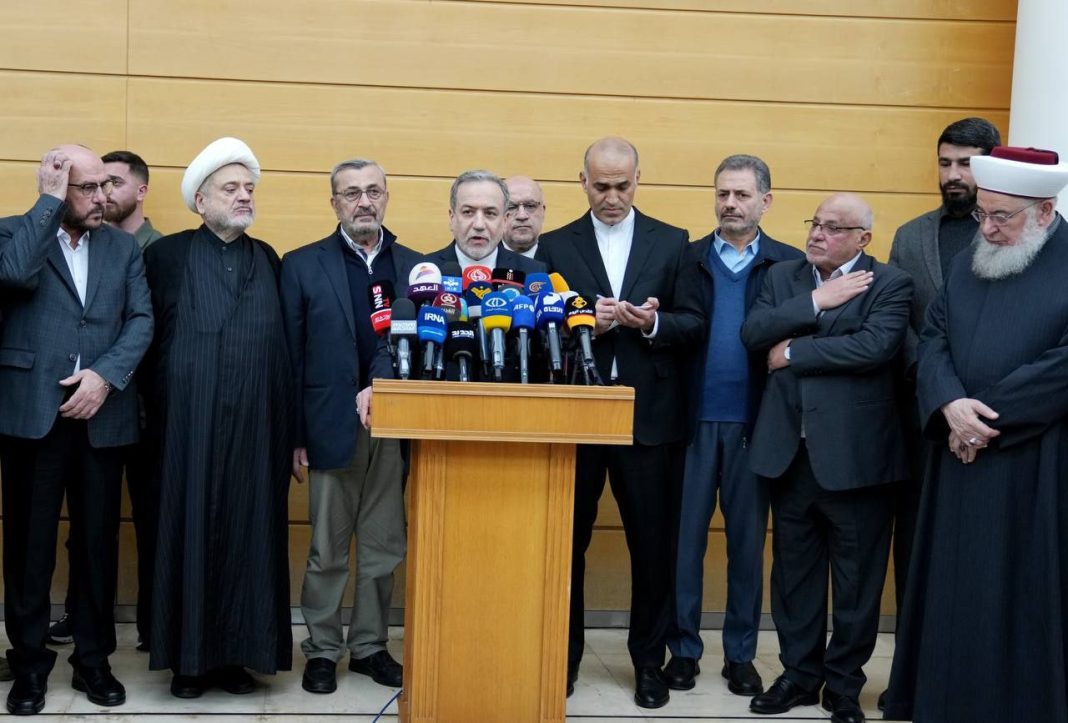
Araqchi arrived at Beirut’s Rafik Hariri International Airport on Thursday, January 8, where he was welcomed by Lebanese officials.
Speaking to reporters upon arrival, Araqchi said he would meet Lebanese officials over the course of Thursday and Friday, adding that his primary objective was to consult closely with them on regional developments.
“Today and tomorrow, I will meet with Lebanese officials, and the first goal is consultations with our Lebanese friends about regional developments,” he said.
He also thanked Khalil Hamdan, a representative of Lebanese parliament speaker Nabih Berri, for the reception and remarks at the airport.
Meanwhile, Araqchi warned that the region was facing serious challenges and threats that he said were clearly emanating from the Israeli regime.
“Our region is facing serious challenges and threats, threats that are specifically coming from the Israeli regime and perhaps have never been this serious,” he said.
He added that over the past two years, seven countries in the region, including Iran and Lebanon, had been attacked by the regime.
Araqchi said parts of Lebanese territory remain under occupation by Israeli soldiers and that a ceasefire in place over the past year had been repeatedly violated.
“Parts of Lebanese territory are still under occupation by Zionist soldiers, and over the past year the ceasefire that was established has been repeatedly violated,” he said.
He said the main purpose of his visit was to hold close consultations with senior Lebanese officials on these challenges and threats.
Separately, Araqchi described Lebanon as a key country in the region, saying it plays an important role in regional peace and stability.
He added that Iran was in consultations with all countries in the region and that his visit to Lebanon came at a very sensitive time.
Turning to bilateral relations, Araqchi said the second objective of his visit was to advance ties between Iran and Lebanon.
“Iran and Lebanon have long had political relations and economic and cultural ties, and we are seeking to expand these relations, especially economic relations,” he said.
He said Iran was pursuing comprehensive relations with the entire Lebanese government and that he would meet Lebanon’s economy minister during the visit to expand economic and trade cooperation.
Meanwhile, Araqchi said both countries possess rich cultures and civilizations, adding that cultural exchanges could help deepen friendship and interaction between the two nations.
“Iran and Lebanon also enjoy rich cultures and ancient civilizations, and cultural exchanges can help expand friendship and deep interactions between our two countries,” he said.
He reiterated Iran’s support for Lebanon’s territorial integrity, national unity and independence.
“Iran will always support Lebanon’s territorial integrity, national unity and independence, and the Lebanese government’s position toward Iran has always been the same,” he said.
He added that Tehran sought to expand relations based on mutual respect and shared interests.
Responding to a question about Israeli regime threats against Lebanon, Araqchi said Iran would hold close consultations with Lebanese officials on the issue.
In response to another question about threats by the United States and the Israeli regime against Iran, Araqchi said both had already attempted to attack Iran and failed.
“The United States and Israel once tried attacking Iran and they failed,” he said.
“Every time they repeat this experience, they will get the same result,” he added.
He said Iran was fully prepared for any scenario, while stressing that Tehran was not seeking war.
“We are not seeking war, but we are prepared,” he said.
He also said Iran was open to negotiations, provided they were based on mutual respect.
“We are also ready for negotiations, but negotiations that are based on mutual respect,” he said.
“Whenever the Americans accept that negotiations are different from dictation, negotiations can begin,” he added.
