Saturday, December 27, 2025
Home Blog Page 5023

‘Fish and Cat’ bags NETPAC

fish and cat cover - shahram mokri

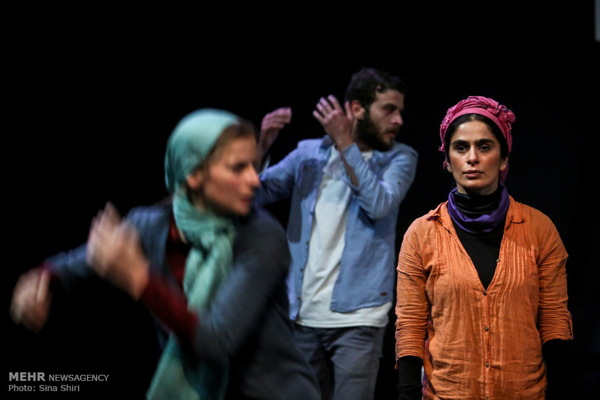
Acclaimed Iranian cinematic production ‘Fish and Cat’, directed by Shahram Mokri, has been selected as the best film at the Iranian Film Festival Australia (IFFA).

The film has received the NETPAC Award at the festival.

NETPAC (Network for the Promotion of Asia Pacific Cinema) is the festival’s only award.

Several successful Iranian films were screened in Sydney, Melbourne, Adelaide, Brisbane and Canberra for a month and finally ‘Fish and Cat’ was selected as the best work.

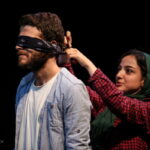
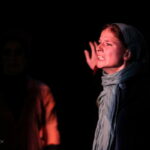
The 127-minute movie depicts the story of a group of university students who face different problems during their trip to the north of Iran.

Produced by Kanoon Iran Novin, ‘Fish and Cat’ has been screened in over 40 international festivals so far.

fish and cat screenshot - shahram mokri
‘Fish and Cat’ screenshot – Shahram Mokri

The film has won the FIPRESCI Award and the Youth Jury Award at the 28th Fribourg International Film Festival in April 2014.

Mokri won the special jury prize for this film at the 10th Dubai International Film Festival (DIFF) in December 2013.

It won the best film award at the 13th Lisbon and Estoril Film Festival in Portugal in November 2013.

The 70th Venice International Film Festival honored the film with the Special Orizzonti Award for Innovative Content in September 2013.

Iran has refuted the claim that it denied four British MPs a visit to Iran

Iran Officially Announces Termination of UN Arms Embargo

A well-informed source at the Iranian Foreign Ministry has dismissed reports by a US newspaper that Iran has not allowed four British parliamentarians to pay a visit to Tehran, Islamic Republic News Agency reported on November 10.

The unnamed official denounced the report as an invention based on unfounded claims, reiterating that the application for the visit was handed in to the Islamic Consultative Assembly, which decides on visits by foreign parliamentary delegations.

Détente and dialogue among civilizations are examples of moderation

Mohammad Khatami
Mohammad Khatami

Constant critiquing is a pillar of reformism as humans and societies evolve gradually, former President Mohammad Khatami told a host of young members of the National Trust Party on Saturday. The following is a partial translation of a report the Iranian Student News Agency (ISNA) filed on the comments of the former president on reforms, moderation, openness and acceptance of critical views:

Failure to keep up with the times causes enormous damage. One can be progressive and at the same time study past developments and draw an object lesson from what has happened in the past.

If we hold on to the past and fail to move forward, our country and the establishment will sustain tremendous losses. The tension that was created in the aftermath of the 2009 [presidential elections] hurt our society to a great extent. […] The massive losses we have suffered have their roots in remaining fixated on the past and failing to move forward.

Reforms are not limited to a single party or group; they are a continuation of a long historic process that, God willing, will continue into the future.

For a trend to turn into a prevailing discourse, the historic, social and psychological stage should be set. For instance, reforms are a discourse that goes back to the pre-Constitutional era. Although there are differences over details, reforms continue to be part of the post-revolution trend. […]

Only when a society accepts parties, can it have energized partisan activities. In other words, everyone should accept our democracy is in line with Islam and parties are an integral part of such democracy. […]

We need to reach a consensus that the most appropriate form of government is a democracy. That doesn’t mean that democracy is free of faults, rather, it is the most useful and least costly form of governance. In a society with such a magnificent culture and past, one cannot expect a democracy incompatible with the faith of citizens.

Freedom of thought, expression and assembly are requirements of democracy. Civil institutions act as a go-between in state-public relations. […]

Today certain groups talk about the Islamic caliphate in the name of Islam, whereas the late Imam Khomeini championed a system of which republicanism was an essential part. Human societies have gone through many stages before developing the ability to digest democracy.

The yardstick here is democracy and self-determination which are the core principles of the Constitution. […]

Self-determination means that people elect their rulers and the government which represents people is accountable to them. An Islam from which our revolution has emerged differs from the Islam which is in power in other places. […] By the Islamic Republic we mean an Islam which conforms to republicanism and people’s right to self-determination.

Those who stand up for the integrity of Islam and the revolution and those who safeguard the interests of our nation should say, loud and clear, that Iranians are no ISIL, no Taliban and do not make superficial interpretations of Islamic rules. Islamic values and rules, especially those which have been underlined by God and the Prophet, should take hold in society. Justice is one of those rules. It does not simply cover economic justice or a charity economy.

Recognition of people’s right to self-determination and efforts to pave the way for this right to be exercised are the core principles of justice. […]

Ethics is another yardstick. Lack of morality is clearly evident in today’s international relations. The question of human rights is played up where the interests of some are at risk; they resort to anything and go on the offensive. Conversely, they tolerate gross human rights breaches and lend support to the rights violators. This is a jarring example of unethical conduct.

It is not a good practice that occupation and force are given legitimacy. What is our problem with Israel today? […]

It is politically incorrect for the usurper to be recognized as legitimate thanks to the occupation, oppression and displacement of people. During my presidency, I floated the idea of a referendum that would have allowed everyone living in occupied and Palestinian territories including Jews, Muslims and Christians to cast one vote.

We have no bones to pick with Jews. On the contrary our religions have a lot in common. Anti-Semitism has no place in the history of Iran and Islam. Of course, there have been oppressive governments which have trampled the rights of Muslims, Jews and followers of other religions. This has nothing to do with Islam and Islamic culture.

Zionism does not represent Judaism; rather it’s a dangerous political and racial movement. […]

We are in favor of an Islamic republic in which justice and morality prevail, one in which rulers are fair, one which urges the public to behave justly and promote morality and fairness. We need to reveal our nature to make it known to everybody who we really are. We need to talk among ourselves. […]

As part of this system, we support interaction as we maintain our own identity. One would lose their identity if they uttered something against their beliefs. This is not called interaction, and no fair person would do that.

We need to interact and set aside our differences. Every Iranian should accept that those who view the Constitution as a national convention are Iranians even if they do not approve of the charter a hundred percent. Such an attitude will help solve many of our problems.

Our Constitution is not a disposable item. It is a momentous legacy of our revolution. We need to place it at the center of our interactions. It well-defines the structure of the establishment. Today critiquing the establishment is the best form of promoting virtue and preventing vice.

Our system is popular, revolutionary and Islamic. We all believe in it, but criticizing its components is a necessity of the reformist approach.

Within the reformist camp, radicalism is a possibility just like any other movement. […] Radicalism is unacceptable when and where it is practiced. It brings about moral destruction and deals a blow to human and material resources. It turns opportunities into threats. We do not welcome tensions, but we protect our interests even if we have to risk our lives. We never carry out the first strike. We need to find common ground even with our enemies. We need to get rid of these costly hostilities. Of course, if someone wants to bully us, we will make a firm stance.

Détente and dialogue among civilizations are examples of moderation. Economic moderation is achievable when development is encouraged with an eye to social justice. […]

Moderation is a human, logical and Islamic method. Moderation is found where we can accommodate others. It is not a question of “I” alone. “We” is what matters. We have differences, but we have to stand alongside each other as we develop a mutual understanding. It needs a method of moderation, not one of violence and repulsion. […]

Iran rejects US think tank claim on nuclear activities

Iran Centrifuges
Iran Centrifuges

The Atomic Energy Organization of Iran (AEOI) has rejected claims by a US think tank that the Islamic Republic has violated the terms of the November 2013 interim nuclear agreement.

The Washington-based Institute for Science and International Security (ISIS) recently alleged, based on an analysis of a recent report by the International Atomic Energy Agency (IAEA) about Iran, that the Islamic Republic “may have violated (the interim deal) by starting to feed (natural uranium gas) into one of its advanced centrifuges, namely the IR-5 centrifuge.”

“Under the interim deal, this centrifuge should not have been fed with (gas) as reported in this safeguards report,” the ISIS stated.

On Sunday, Behrouz Kamalvandi, the AEOI spokesman, rejected the allegation, saying that injection of natural uranium gas into an IR-5 centrifuge at a research facility is within the framework of the interim deal between Iran and the five permanent members of the UN Security Council – France, Britain, the United States, Russia and China – plus Germany.

“By doing so (injection), Iran has breached neither the Safeguards Agreement nor the Joint Plan of Action reached in Geneva last year.”

Kamalvandi also stated that Iran has made “no pledge to halt its research and development activities.”

The ISIS claim comes as the Arms Control Association, a Washington-based research and advocacy group, has also rejected the allegation.

“The latest IAEA report says clearly that no enriched uranium is being withdrawn from the machine,” the association has said.

Iran says it produces low-enriched uranium to make fuel for nuclear power plants.

As one of the first countries to join the nuclear Non-Proliferation Treaty (NPT), Iran signed its Safeguards Agreement with the IAEA in 1973. The accord came into force in 1974. Safeguards are activities by which the IAEA seeks to verify that a state is not diverting nuclear material or equipment to produce nuclear weapons.

None of the reports released by the IAEA have said that Iran’s nuclear program is geared toward non-civilian purposes.

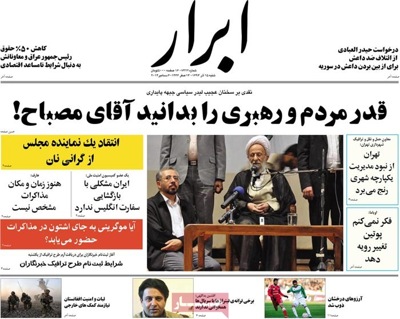
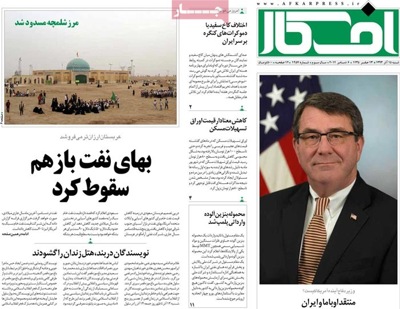
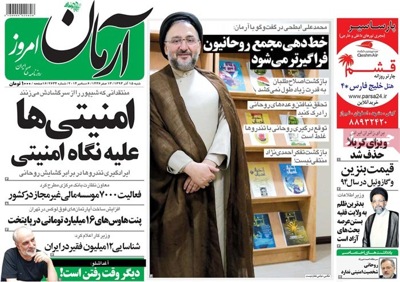
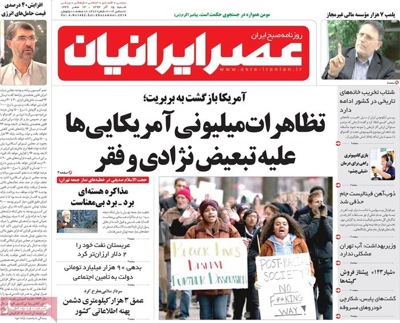
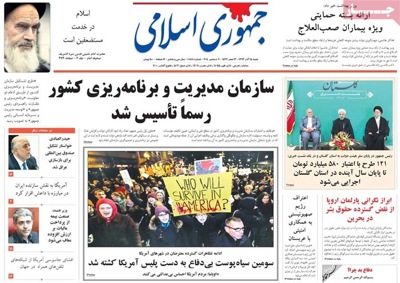
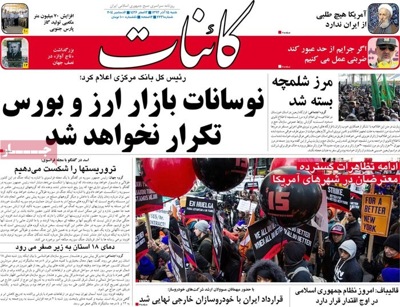
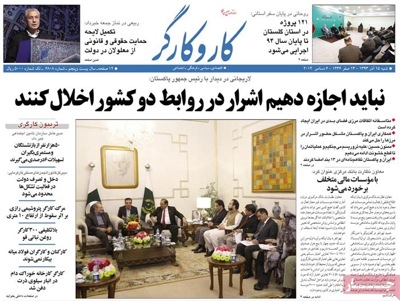
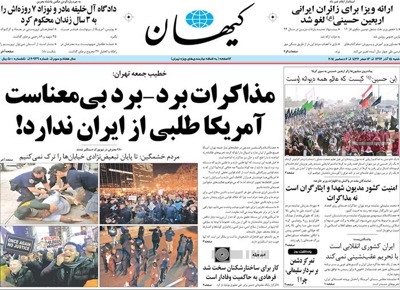
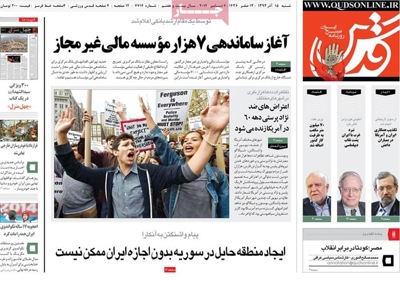
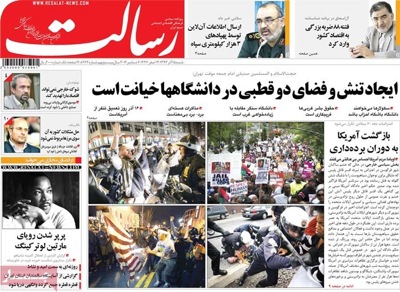
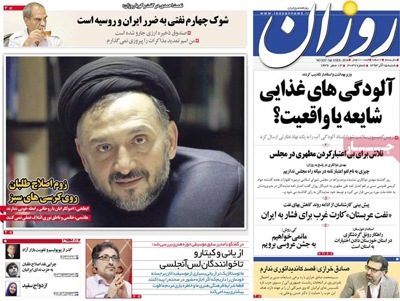
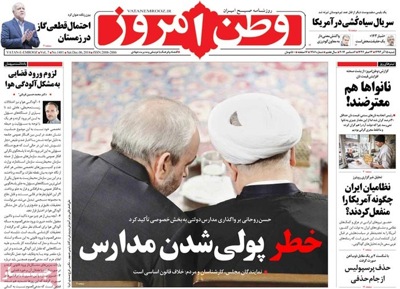
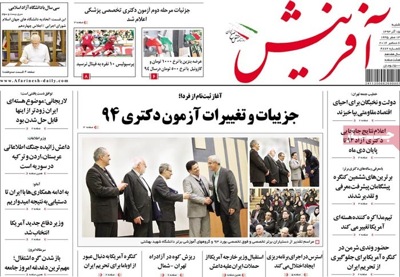
A look at Iranian newspaper front pages on Nov. 9

Iranian Newspapers Headlines

A decree by the Supreme Leader naming Mohammad Sarafraz as a replacement for Ezzatollah Zarghami, the outgoing president of Iran’s national broadcaster, dominated the front pages of Iranian newspapers on Sunday. The opening ceremony of the 20th Exhibition of Press and News Agencies was given front page coverage by most dailies too. Also in the news were remarks by Iran’s deputy foreign minister Seyyed Abbas Araghchi in the lead-up to the talks between representatives from Iran, the US and the EU in Muscat, Oman over Tehran’s nuclear program.

Afarinesh: Iran has started to run smart Internet filtering software.

A look at Iranian newspaper front pages on Nov. 9


Afkar: “If all sanctions are lifted and Iran’s nuclear case is sent back to the IAEA, Tehran will consider implementing the Additional Protocol,” said Iran’s ambassador to the International Atomic Energy Agency Reza Najafi.

A look at Iranian newspaper front pages on Nov. 9


Aftab-e Yazd: “I go to the Ministry of Culture and Islamic Guidance one last time [to see if I can secure the go-ahead of officials to release The Colonel],” said Mahmoud Dowlatabadi, the renowned Iranian writer.

Aftab-e Yazd: “Talks in Muscat will be so decisive,” said Seyyed Abbas Araghchi prior to the negotiations between representatives of Iran, the US and the EU in the Omani capital.

A look at Iranian newspaper front pages on Nov. 9


Arman-e Emrooz: Former President Mahmoud Ahmadinejad is said to have talked with his predecessor, Mohammad Khatami on the phone. The conversation seems to be part of Ahmadinejad’s efforts to secure the support of Reformists as he plans a political comeback.

A look at Iranian newspaper front pages on Nov. 9


Asia: “We allow the media to supervise themselves,” said Ali Jannati, the minister of culture and Islamic guidance.

Asia: Tough nuclear talks open in Muscat, Oman on Sunday. The countdown is on for the November 24 deadline.

A look at Iranian newspaper front pages on Nov. 9


Asr-e Rasaneh: Iran and Turkmenistan have agreed on a new gas deal under which Iran’s imports of natural gas from the Central Asian country will not drop in winter.

Asr-e Rasaneh: The value added tax (VAT) code will be reformed by yearend (March 20, 2015).

A look at Iranian newspaper front pages on Nov. 9


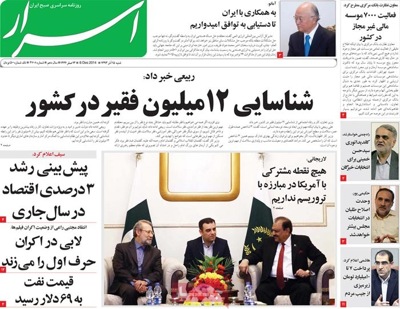
Asrar: “We hope to see fair interaction by the new IRIB president with the [eleventh] government,” said Ali Jannati, the culture minister.

A look at Iranian newspaper front pages on Nov. 9


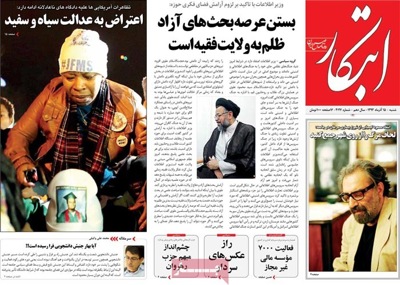
Ebtekar: Iran’s Deputy Foreign Minister Seyyed Abbas Araghchi said that Iran and P5+1 see eye to eye on Tehran’s nuclear case and that the only option on the table is a [final] deal.

Ebtekar: Islamic Revolution Leader Ayatollah Seyyed Ali Khamenei has appointed Mohammad Sarafraz as the president of Islamic Republic of Iran Broadcasting (IRIB).

A look at Iranian newspaper front pages on Nov. 9


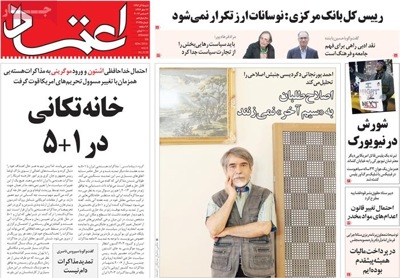
Etemad: The Guardian Council has once again warned those who are preparing to run for parliament that the oversight body would take into account the would-be candidates’ possible involvement in the 2009 post-election unrest when it weighs their credentials.

Etemad: “Reforms would continue. We will defend Iran’s national interests with our lives,” said former President Mohammad Khatami in a meeting with young members of the National Trust Party.

A look at Iranian newspaper front pages on Nov. 9


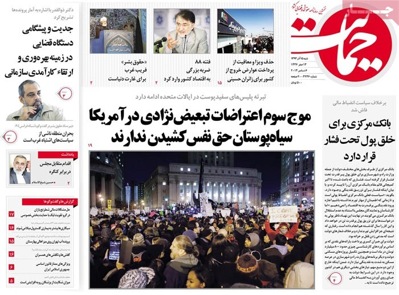
Hemayat: “The European Union has put three Iranian banking and science institutes that were delisted before back on its sanctions list,” writes the daily, saying that those who claim to seek dialog are now throwing up obstacles in the way of talks.

A look at Iranian newspaper front pages on Nov. 9


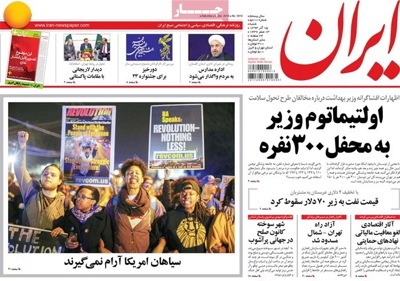
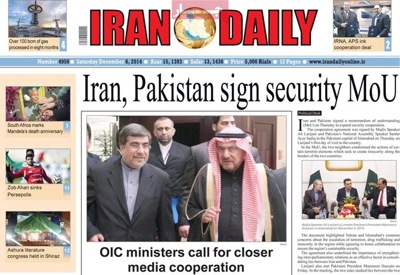
Iran Daily: Forty-five countries import Iranian saffron.

A look at Iranian newspaper front pages on Nov. 9


Jahan-e Eghtesad: Urban areas experienced a 31.4 percent rise in average Iranian household expenses in the 12 months to March 21, 2014.

A look at Iranian newspaper front pages on Nov. 9


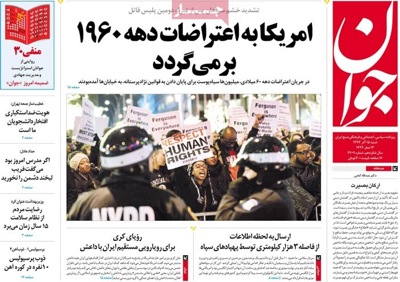
Javan: “Agreement will remain elusive if four sets of sanctions against Iran are not removed,” said Iran’s Araghchi in reference to sanctions slapped on Tehran by the UN Security Council, the European Union, the US Congress and the US president.

A look at Iranian newspaper front pages on Nov. 9


Kaenat: Iran’s Minister of Labor, Cooperatives and Welfare Ali Rabiei, has in a clean-up decree ordered officials to collect those who sleep rough from the streets.

A look at Iranian newspaper front pages on Nov. 9


Kayhan: The Saudi government has removed Abdul Aziz Khoja, its minister of culture and information, from his post to ease the wrath of Shiites.

A look at Iranian newspaper front pages on Nov. 9


Khorasan: A $150,000-plus fine has been issued for two physicians who charged patients fees in excess of tariffs.

A look at Iranian newspaper front pages on Nov. 9


Resalat: “A package of [government’s financial] support for patients suffering from refractory diseases will take effect in the near future,” said the Iranian health minister.

A look at Iranian newspaper front pages on Nov. 9


Roozan: “It is harmful to keep the [loyal] friends of the revolution confined,” said former [reformist] President Mohammad Khatami.

Roozan: Big US corporations (Apple, Boeing and General Electric) are seeking a share in Iran’s market.

Roozan: “No one dares to impeach the minister of culture and Islamic guidance,” said Parliament Speaker Ali Larijani.
A look at Iranian newspaper front pages on Nov. 9


Sharq: An Iranian female athlete, Hamideh Abbasali, has secured a silver medal in the final match of +68 Kg class of 2104 Bremen World Karate Championship, earning the first world medal for an Iranian woman ever.

A look at Iranian newspaper front pages on Nov. 9


Taadol: “Any return to the pre-Geneva Joint Plan of Action era is a dangerous scenario,” said Iran’s senior nuclear negotiator Seyyed Abbas Araghchi in an interview with Tehran-based Arabic-language News Network Alalam.

Taadol: “Predictability has returned to the Iranian economy,” said Mohammad Nahavandian, the chief of staff of President Rouhani.

A look at Iranian newspaper front pages on Nov. 9


Tafahom: Iran ranks 48th in the world in terms of attracting foreign tourists.

Tafahom: “Media outlets are expected to disclose the hideousness of social disorders,” said Speaker of the Islamic Consultative Assembly Ali Larijani.

Tafahom: As many as 110 foreign firms have taken part in the 14th International Electricity Exhibition of Iran in Tehran [which opened on November 8 and will run through November 11].

A look at Iranian newspaper front pages on Nov. 9


Vatan-e Emrooz: The holy city of Quds seems to be bracing for a third Intifada.

Vatan-e Emrooz: The US Central Intelligence Agency (CIA)has rejected as incorrect the content of Argo, a 2012 American political thriller directed by Ben Affleck. [CIA gives the ‘real’ account of ‘Argo’ on Twitter, read some media headlines.]

A look at Iranian newspaper front pages on Nov. 9


Iran director Gharibpour to perform Sa’adi puppet opera

Behrouz Gharibpour - Puppet Opera

Iranian theater director Behrouz Gharibpour is planning to stage his new puppet opera show, which is inspired by the life of the classical Persian poet Sa’adi.

The show will feature 100 puppets, numerous voice actors, and at least 20 distinct roles with the musical theme.

Gharibpour and his team are currently preparing the appropriate music and designing the puppets.

The music has been designed to introduce different countries such as Egypt, India, and China, where the poet had traveled to.

Sa’adi is remembered as a great panegyrist and lyricist, the author of a number of masterly odes portraying human experience, and particular odes collected in Ghazaliyat (Sonnets) and Qasa’id (Odes).

Gharibpour had earlier performed an opera inspired by the life of Persian lyric poet Hafez Shirazi.

Behrouz Gharibpour is considered one of the pioneers of traditional Persian puppet theater, known for his extensive research on Qajar puppetry.

Gharibpour has staged his Qajar style puppet play with Aran Puppet Theater Group in numerous domestic and foreign festivals.

Macbeth, Mowlavi and Ashura as well as Rostam and Sohrab are among his better-known works.

Sa’adi opera is scheduled for release in January and the team is working hard to present the play for the 2015 Fajr Theater Festival.

Iran animation ‘Hard Dream’ wins at Noor film festival

The Hard Dream - Animation Poster

Iranian director Behrouz Bagheri’s animated short film, The Hard Dream, has bagged award at the 7th Annual Noor Iranian Film Festival (NIFF) in Los Angeles.

Bagheri’s second production in short films, The Hard Dream, received the Best Animation award of the festival.

The drama depicts the story of a robot, working in a repair garage, who wishes to become a human.

The animation has been screened in 93 international film festivals and won 12 awards, including a highly prestigious award at the 2014 Scottish Mental Health Arts and Film Festival.

The film was showcased at the 2014 Fuencaliente Rural Film Festival in Spain, CutOut Fest International Animation Festival in Mexico as well as London Film Festival.

The Noor Iranian Film Festival supported by a non-profit, non-religious, and non-political organization, was created to shed light on Persian culture.

The 7th Noor Iranian Film Festival took place from October 17 to 22, 2014.

Government intervention in media runs counter to principles of sustainable security: Iranian Minister
Ali Jannati at 20th Press Exhibition

Government intervention in media runs counter to the tenets of sustainable political and social security and the government believes the media should be tasked with supervising their own performance, Minister of Culture and Islamic Guidance Ali Jannati said in a speech at the inaugural of the 20th Exhibition of Press and News Agencies on Saturday. The following is an excerpt of a report Mehr News Agency filed on the comments of the culture chief:
Freedom is part of human instinct. In quest of freedom, honorable individuals are even ready to risk their lives. Many individuals have made the ultimate sacrifice as they have tried to shake off the yoke of dependence and constraint.

Responsible freedom is a smart motto chosen for this year’s exhibition, because it defines freedom within the framework of norms. Commitment to the truth and independence in decision-making without factional bias constitute freedom. […] Publication of news in line with norms as well as legal and moral frameworks and avoidance of rumors are the pillars of responsible freedom, which is touted by many media outlets around the world.

The government and the Islamic Republic do believe in the freedom of the press in keeping with laws and this government [led by President Rouhani] tries to turn such commitment into reality.  Responsible freedom is not unbridled freedom. The media hold the government accountable for what it does; responsible freedom means the press should be held accountable for what they do too. The press should not turn into the pawns of political parties and at the same time claim to represent the public opinion.

Journalists need a transparent social convention to facilitate their workings; […] Formulation of a moral code of conduct can help promote professionalism and tamp down plagiarism and eliminate the possibility of failure by some managers to respect the rights of journalists or the lack of commitment on the part of some journalists to the institutes they work for.

The government plans to send a motion to parliament laying out the formation of a media guild that governs the relations between journalists and members of the public. Work ethics and commitment to moral standards are mostly absent in the Iranian press. Professional ethics should be a top priority of the Iranian press.

The government should privatize many media outlets it owns. Promotion of the private sector is a progressive pillar of the Iranian Constitution that needs more attention.

The Cultural Commission of the Cabinet has approved the Free Access to Information bill, which had been shelved for up to four years. The directives of the bill are expected to be approved by the Cultural Commission within a week. That would make the government more accountable to the press.

No medium seeks unconditional freedom: Deputy Minister

Dr. Hossein Entezami

Hossein Entezami, the Deputy Minister of Culture and Islamic Guidance in charge of the Press Department, told journalists Saturday introduction of new sections is what sets out this year’s Exhibition of Press and News Agencies from those held in the past. The following is the translation of part of a report on Entezami’s comments Mehr News Agency posted online after the opening ceremony of the 20th Exhibition of Press and News Agencies on November 8:

“No medium in our country seeks unconditional freedom,” said Hossein Entezami, the deputy minister.

He went on to say, “This year the exhibition has seen the debut of some publications like those focused on religion, thinking, and children in the event.”

As for the motto of “Responsible Freedom” – picked for this year’s exhibition – he reiterated that “This motto was crafted in the Policymaking Council with the help of The Coordination Council of the Media Management Organization. This year, we have tried to make decisions in the exhibition in cooperation with relevant guilds active in this line of work. In doing so, this motto was brought up which in fact reflects the approach of media toward the freedom of speech.”

“Undoubtedly, none of our fellow colleagues in media demands unconditional freedom in expressing opinions, releasing news and information. As a matter of fact, such claims are falsely associated with media by those who do not want media to work well. However, our media mostly believe in complying with the law,” he stated.

“One of the other distinctions between this year’s event with those of the past is that in order to lend support to private media, there is a relatively huge difference between the fees charged for exhibition booths from private and public media,” he concluded.

Two libraries, mobile and immobile, pursue one goal: book reading

iranian mobile book library

People are on the same page when it comes to book reading. Different countries with different book reading rates put much stress on the central role books play in any given society. In Iran too, books are viewed as culturally important.

Tasnim News Agency has recently filed two separate reports in which books take center stage. The first one is on a book donation program and the second focuses on a tourist bus which is expected to take books to villages to encourage book reading. The partial translation of the two separate reports (released on October 30) comes below:

iranian children in rural area - south khorasanA plan to donate books to school libraries in rural areas and deprived regions got underway in South Khorasan Province for a second consecutive year concurrent with ceremonies to mark the Book Week.

A provincial branch of the Institute for the Intellectual Development of Children and Young Adults (IIDCYA) in Birjand said that the book donation plan comes in cooperation with schools.

The manager of the provincial IIDCYA said that book reading is one of the main activities in the institute’s cultural centers, adding the new creative plans have seen in recent years a rise in the interest students have developed in book-related activities.

And in a related story, an official with the Islamic Council in Mashhad said that a bookmobile which is a tourist bus is expected to immediately head for villages to promote the culture of book reading, adding this needs the support of related government agencies.

Mohammad Fani said that some villages have had a poor book reading record, adding a deal clinched between the council and the association of libraries could help people develop the book reading habit.

A tourist bus could hit the roads if it is given sufficient support by the provincial offices of the ministry of culture and Islamic guidance and the Cultural Heritage, Handcrafts and Tourism Organization in Khorasan Razavi Province.

We need to set the stage for urban and rural mosques to house a library, he underlined, saying God would have replaced the Prophet’s miracle [Holy Koran] if there had been anything weightier than books.