Saturday, December 27, 2025
Home Blog Page 5022

Will president’s new pick for Science Ministry get a nod from parliament?

Iran Parliament

President Hassan Rouhani in a letter to parliament introduced Dr. Fakhreddin Ahmadi Danesh-Ashtiani as his new nominee to lead the Ministry of Science, Research and Technology, the Islamic Republic News Agency (IRNA) reported on November 11.

Dr. Fakhreddin Ahmadi Danesh-Ashtiani

“According to parliamentary regulations, the Islamic Consultative Assembly has 10 days to analyze the plans of the proposed minister and organize a vote of confidence which is most likely to be held on either November 18 or 19,” said Vice President for Parliamentary Affairs Majid Nasirpour.

Ahmadi Danesh-Ashtiani was deputy science minister at the helm of the planning and finance departments under President Khatami.

Earlier the chamber failed to vote for Mahmoud Nili Ahmadabadi, a replacement candidate introduced by the government of Prudence and Hope to take over the science ministry after Reza Faraji-Dana was impeached on October 29, ten months after the Islamic Consultative Assembly endorsed him for the portfolio.

Ja’far Mili-Monfared, President Rouhani’s first pick for the job, failed to garner a vote of confidence from the chamber too.

Iran’s Siamand Rahman has won IPC ‘Athlete of the Month’ vote

Siamand Rahman - world’s strongest Paralympian

In a poll conducted by the International Paralympic Committee (IPC) Iran’s Siamand Rahman, the world’s strongest Paralympian, secured more than 60 percent of the public vote to become October’s ‘Athlete of the Month, the Islamic Republic News Agency (IRNA) reported on November 11.

The gold medalist in Men’s +107 kg in the 2014 Asian Para Games in South Korea garnered 63.9 percent of the vote.

His fellow Iranian Sareh Javanmardi, a female Paralympic shooter, placed second with 34.3 percent of the vote.

Iran marks Nat’l Quality Day, vowing to improve quality of domestic products

Mohammad Shariatmadari - National Quality Day Ceremony

A ceremony to celebrate National Quality Day in Iran has failed to pick a top unit this year, as it has been the case during the past [few] years. The ceremony attended by the health minister, a number of MPs and a host of university professors as well as producers and industrialists evaluated the performance of over 100 production units and organizations and found only two of them eligible for a bronze statuette.

The participants underlined a special look at quality and the role it plays in economic development, calling for a new approach to the quality of items and services in the country. The following is a partial translation of a report filed by SMT daily on Monday November 10 on what some participants had to say:

Mohammad Shariatmadari
M. Shariatmadari – Vice-president for Executive Affairs

Quality plays a matchless role in reducing poverty

Vice-president for Executive Affairs Mohammad Shariatmadari, said in the ceremony that society should view quality as public discourse.

He said that quality and standards are instrumental for business institutions to achieve profitability. They play a key role in eradicating poverty, too. […]

A classified list of harmful actions and products is being drawn up

At the ceremony Health Minister Seyyed Hassan Hashemi took the stage and said:

The Health Ministry is making a confidential list of products and actions it deems harmful to public health and will later hand it over to related officials.

I hope those in charge take heed of that list because the items on it harm people’s souls, minds and bodies.

I also hope the side effects of these items on people’s health could be minimized.

The Health Ministry has on its agenda plans to improve [the quality of] domestically produced or imported food supplies. To that end, the ministry and the Iranian National Standards Organization should pursue common goals.

Seyed Hassan Hashemi - Iran Health Minister
Seyed Hassan Hashemi – Iran Health Minister

Plans to reduce the public consumption of salt, sugar and oil, and efforts to promote a better lifestyle are the main topics of the food quality improvement plan. The cooperation of the Iranian National Standards Organization is needed to make considerable improvements in the quality of air, water and roads.

Enrichment of foodstuffs

Hashemi went on to say:

We are trying to implement plans to enrich food with micronutrients. A majority of Iranians suffer from vitamins A and D deficiencies; that’s why the ministry is trying to alleviate the problem through food fortification projects.

As for other food-related programs of the Health Ministry, I should say that plans will be carried out in cooperation with the Agriculture Ministry and the National Standards Organization in ten regional hubs in the country to upgrade the quality of agricultural products and lessen the effects of pesticides and herbicides on food products.

By implementing a nutrition facts plan, we will label food items to let consumers know if the products they are having are approved by the Health Ministry in terms of the amount of fat, sugar and salt they bear.

As part of a soon-to-be-announced plan to transform the healthcare system, foodstuff production processes will be supervised.

Customer satisfaction does not necessarily mean that products are qualitatively perfect, because customers may be unaware of the fake items. To oversee the quality of products and services, they should be exported to foreign destinations so that these items could be assessed in a competitive market.

Nayereh Pirouzbakht - Head of Standard
Nayereh Pirouzbakht – Head of Standards Org.

A new approach to quality is needed      

Head of the Iranian National Standards Organization (INSO) Nayereh Pirouzbakht was another speaker at the ceremony. She said:

A new quality approach should be adopted in the country to be pursued by all institutions and organizations. The National Standards Organization cannot deal with the question of quality alone; it calls for a collective will.

People expect the National Standards Organization to not only set standards but also manage and evaluate the quality of products. A new department has been established at INSO of late to focus on quality.

[…]

Farshid Shokrkhodaee - Secretary of INQA
Farshid Shokrkhodaee – Secretary of INQA

Two bronzes awarded

Secretary of Iran National Quality Award (INQA) Assessment Committee Farshid Shokrkhodaee, for his part, said:

The INQA is awarded to an institution which is graded over 700. So far, none of the institutions has secured the golden prize and only two units (Avrand Plastic Co. and Isfahan Province Gas Company which managed to secure the four-star “Recognized for Excellence” certificate) were given the bronze statuettes for scoring at least 500 out of 1,000 [on the basis of the EFQM Excellence Model].

Quality in Iran faces multiple challenges such as inattention to the concept of quality management; failure to develop standards for services; inability to manage new resources such asscience technology; inability to analyze data and learn from the results; and failure to promote the concept of quality in agriculture, animal husbandry, and construction industries.

National assessment of quality is a new concept which points up the significance of quality management. The assessments are not done just for the sake of granting awards; rather, they seek to identify and highlight the upsides of business institutions and organizations.

[…]

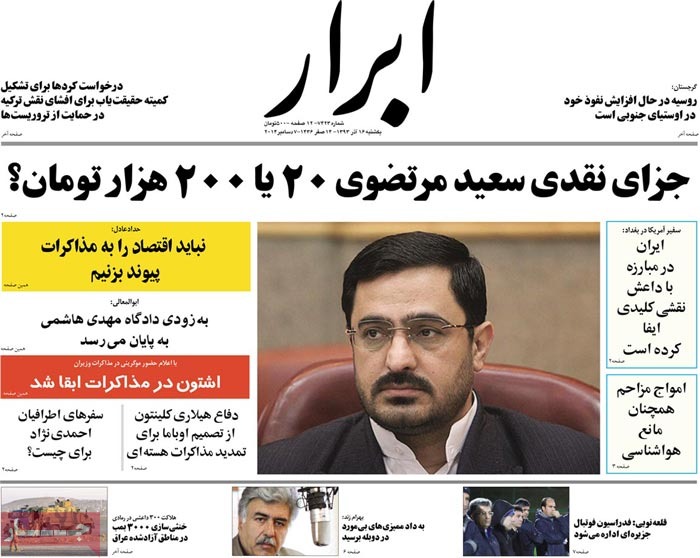
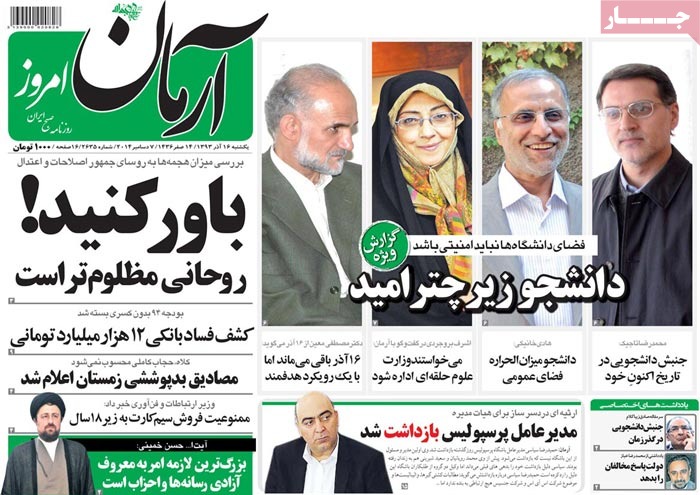
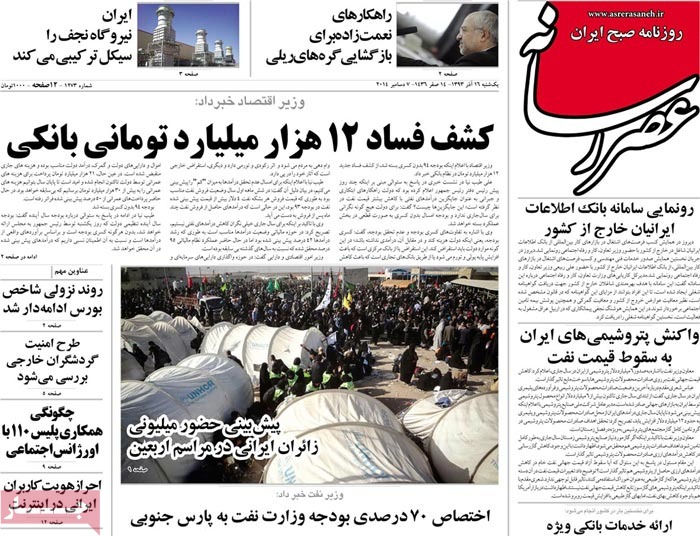
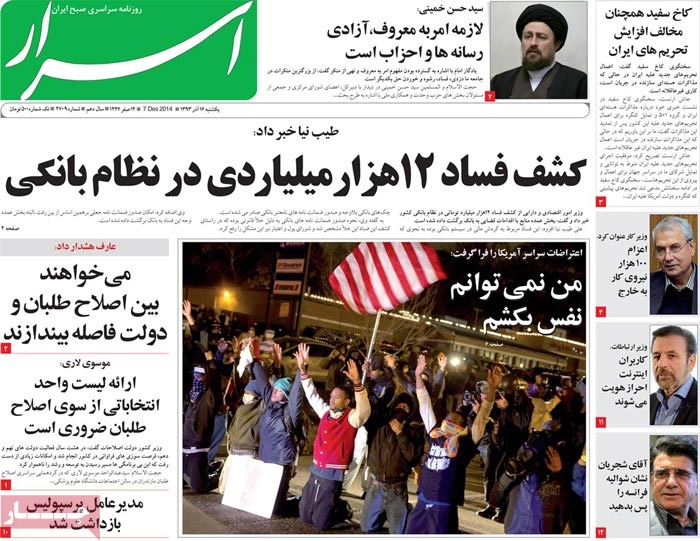
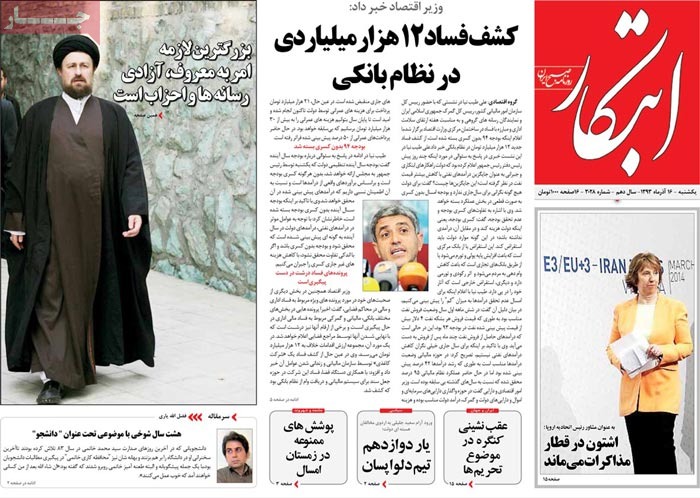
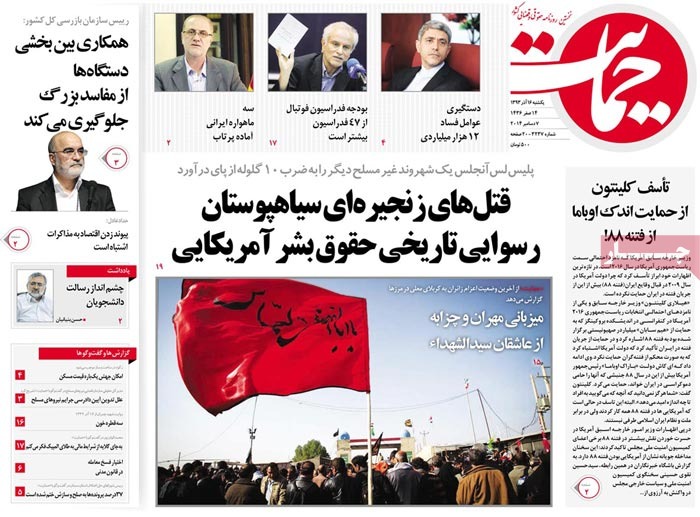
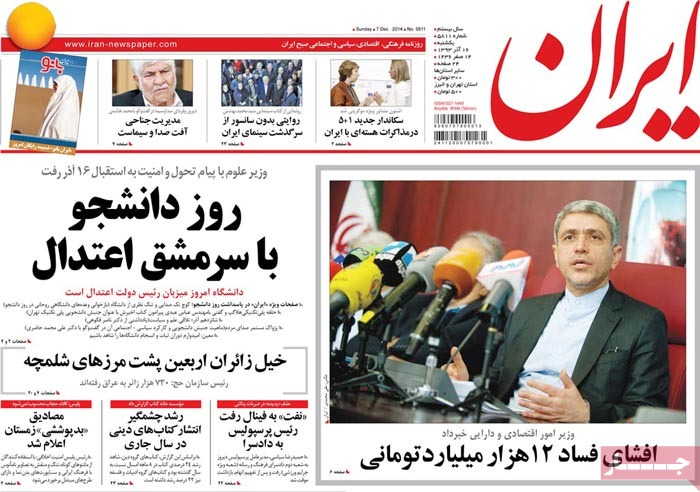
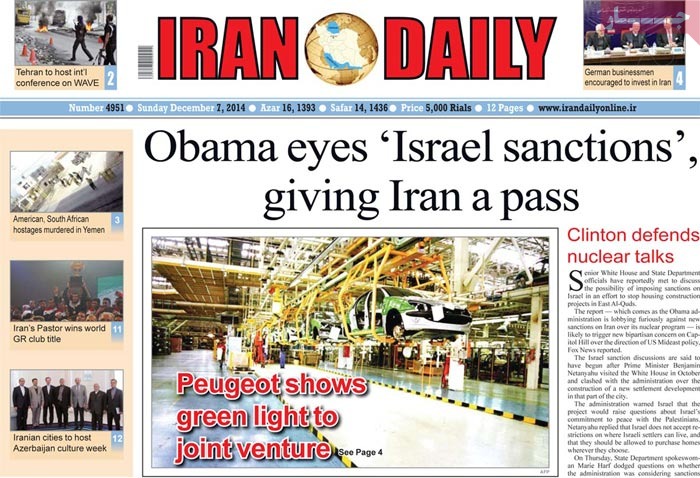
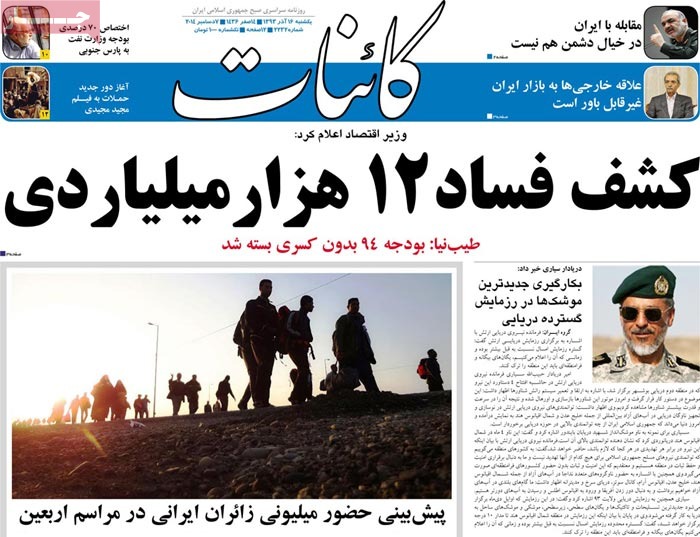
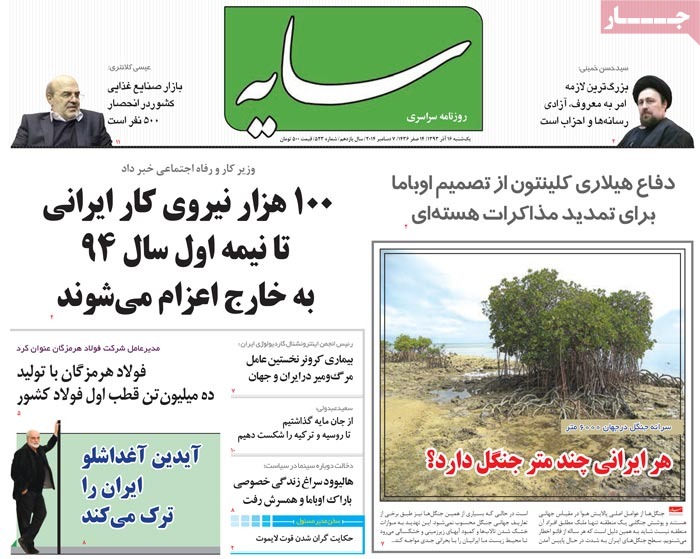
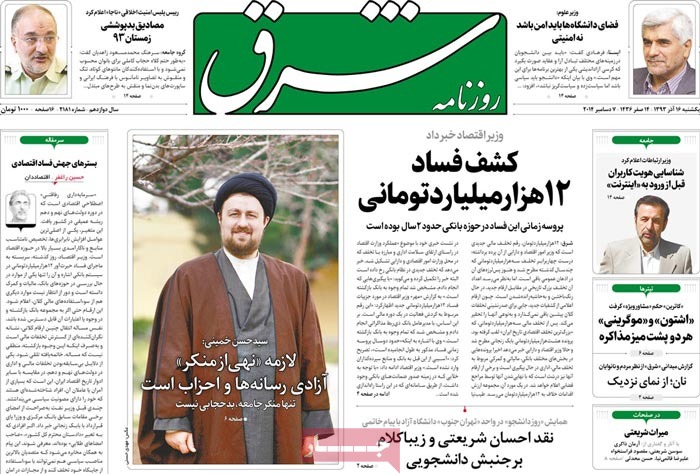
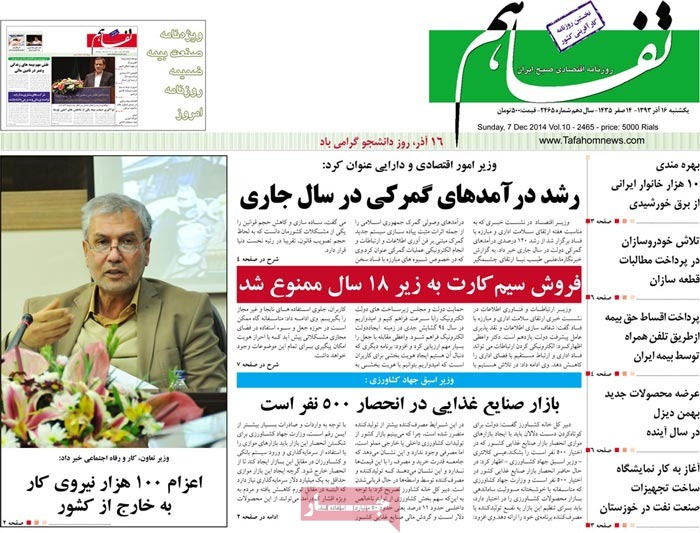
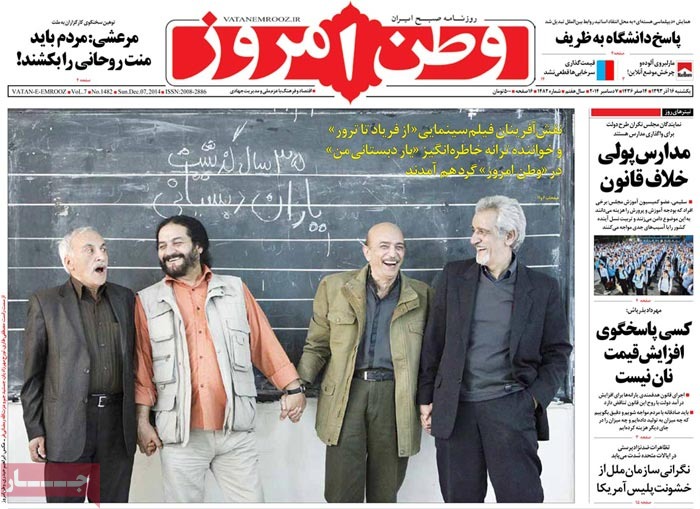
A look at Iranian newspaper front pages on Nov. 11

Iranian Newspapers Headlines

An order by President Hassan Rouhani to have the Management and Planning Organization revived appeared on the front pages of many Iranian newspapers on Tuesday. Supreme Leader’s meeting with Iraq’s Nouri al-Maliki and his praise for the former Iraqi prime minister’s decision to quit in order to prevent his country from plunging into chaos also grabbed headlines. Finally, the comments of the judiciary spokesman that recent acid attacks in Isfahan have had neither political nor religious motivation drew a lot of front-page attention too.


Abrar: “Time is gone when governments followed a security approach to dealing with non-governmental organizations,” said Masoumeh Ebtekar, the director of the Environment Protection Organization.

Abrar: Iraqi officials have confirmed that Abu Bakr al-Baghdadi, the leader of the IS terrorist group, has been wounded.

A look at Iranian newspaper front pages on Nov. 11


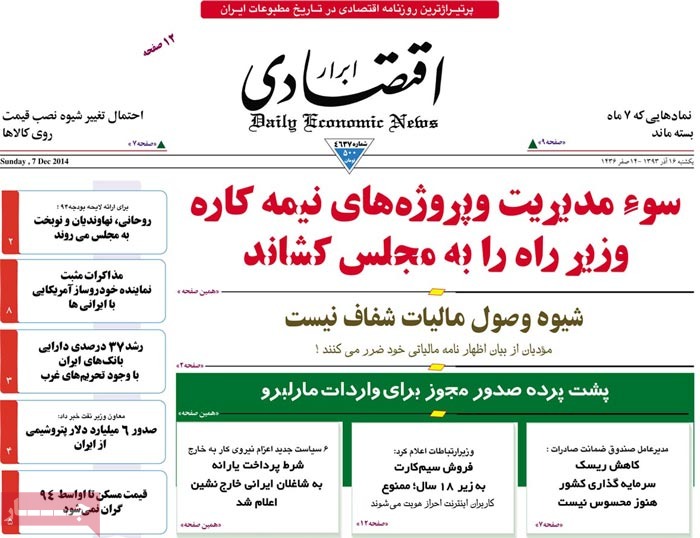
Abrar-e Eghtesadi: Iran’s oil revenues are projected to drop by as much as $1.6 billion in the last quarter [ending on March 21, 2015].

A look at Iranian newspaper front pages on Nov. 11


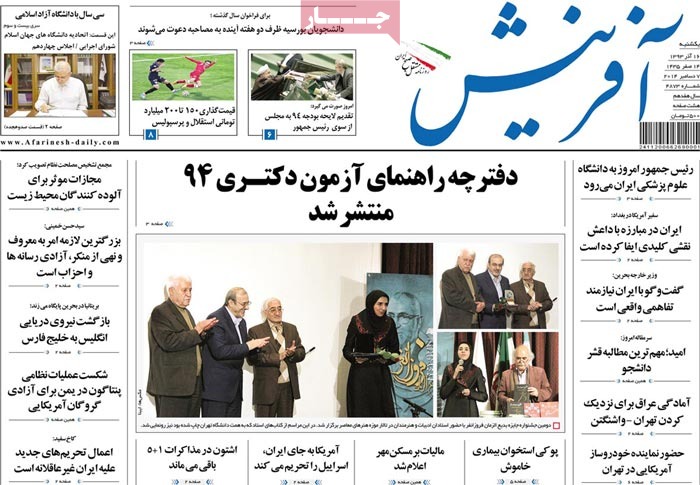
Afarinesh: Iranian Parliament Speaker Ali Larijani has said, “Iran’s missile capability is a deterrent and a source of stability in the region.”

Afarinesh: The health minister has inaugurated the most advanced public ophthalmology clinic in Iran. In a symbolic move, Seyyed Hassan Hashemi, an ophthalmologist himself, has operated on a patient there.

Afarinesh: Chairman of the Expediency Council Akbar Hashemi Rafsanjani has blamed the Islamic countries’ lack of development on religious divisions.

A look at Iranian newspaper front pages on Nov. 11


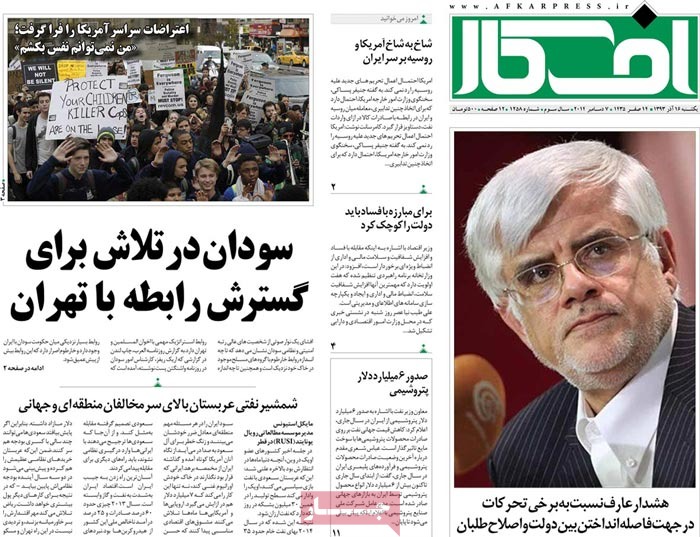
Afkar: Iranian First Vice-President Eshagh Jahangiri and his Iraqi counterpart Nouri al-Maliki have stressed cross-border cooperation to counter common enemies.

A look at Iranian newspaper front pages on Nov. 11


Aftab-e Yazd: President Rouhani has ordered the Management and Planning Organization to be reinstated.

A look at Iranian newspaper front pages on Nov. 11


Arman-e Emrooz: “[Former President Mahmoud] Ahmadinejad dragged Iran’s economy into a dangerous game,” said Dr. Mohammad Khoshchehreh, an economist and politician who previously served as an advisor to Ahmadinejad.

Arman-e Emrooz: If a bill proposed by a host of Iranian MPs clears the Islamic Consultative Assembly, dog walking would be punishable by 74 lashes.

A look at Iranian newspaper front pages on Nov. 11


Asia: Representatives of European electricity giants are in Iran; deals worth as much as $20 billion are likely to be signed.

A look at Iranian newspaper front pages on Nov. 11


Asr-e Iranian: Parliament and government see eye to eye on not allowing I am not Angry to hit the screen.

A look at Iranian newspaper front pages on Nov. 11


Asrar: For the first time since the victory of the Islamic Revolution [in 1979], Iran’s tourism balance has landed in the positive territory.

Asrar: “Iran has the most powerful missile systems in the region,” said Ali Larijani, the speaker of the Islamic Consultative Assembly.

A look at Iranian newspaper front pages on Nov. 11


Bani Film: Ordre national du Méritehas a special place in my trophy cabinet, said noted Iranian director Dariush Mehrjui.

A look at Iranian newspaper front pages on Nov. 11


Ebtekar: The number of European tourists who have arrived in Iran has registered a 200% increase over last year.

Ebtekar: After conclusion of talks between representatives of Iran, the EU and the US, the foreign minister of Oman, where the talks were held, said there has been a major step forward.

Ebtekar: With nuclear talks in high gear, opponents of [President Rouhani’s] government have stepped up their attacks against the administration, with one saying, “We won’t allow them to celebrate a nuclear deal.”

A look at Iranian newspaper front pages on Nov. 11


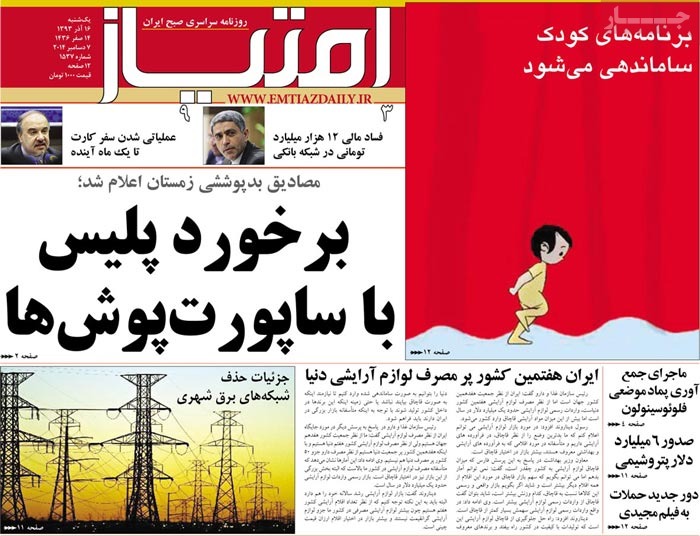
Emtiaz: The number of Iranian senior citizens stands at more than 6 million. A national strategic document on the elderly will be completed shortly.

A look at Iranian newspaper front pages on Nov. 11


Esfahan Emrooz: In the first seven months of the year there have been as many as 75 million road trips across Isfahan Province.

A look at Iranian newspaper front pages on Nov. 11


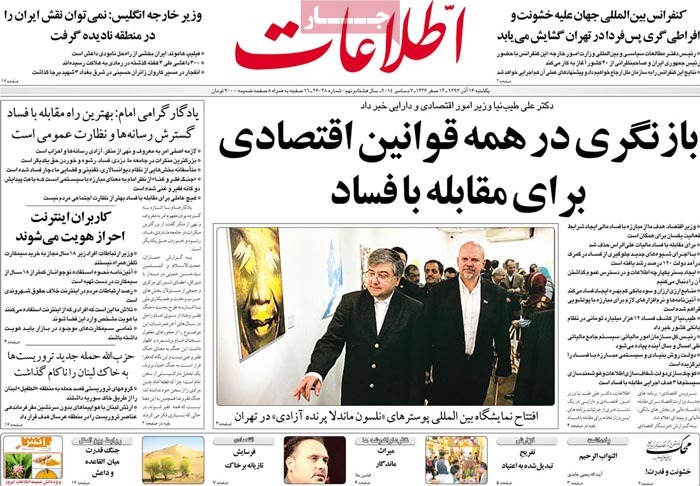
Ettela’at: “Efforts to create unity in Iraq should continue,” the Supreme Leader told visiting Iraqi Vice-President Nouri al-Maliki.

Ettela’at: The Ministry of Science, Research and Technology has criticized the wording of the Fifth Development Plan for its failure to allocate enough budget to research.

A look at Iranian newspaper front pages on Nov. 11


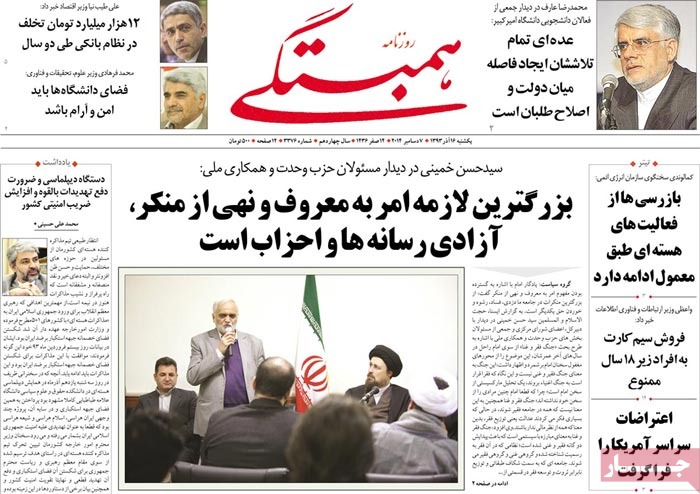
Hambastegi: “As many as 5 million Iranians are suffering from diabetes,” said a Health Ministry official.


Hamshahri: Iranians set an early record in natural gas consumption. In case consumption does not ease off, shutoff of gas supplies in the coldest days of the winter is a real possibility.

A look at Iranian newspaper front pages on Nov. 11


Hemayat: The Judiciary will deal with acid attackers and media outlets that spread falsehood, vowed the judiciary spokesman.

Hemayat: “IS is a plot to interfere with Iraqi progress and development,” said Iranian Judiciary Chief Ayatollah Sadegh Amoli Larijani at a meeting with visiting Iraqi Vice-President Nouri al-Maliki.

A look at Iranian newspaper front pages on Nov. 11


Iran: Diplomats have been upbeat about nuclear talks in Muscat, Oman.

A look at Iranian newspaper front pages on Nov. 11


Iran Daily: Iranian version of US drone enters service. [The maiden flight of the domestically modified version of RQ-170 Sentinel came after Iran brought down the American unmanned aerial vehicle in a controlled fashion in December 2011]

A look at Iranian newspaper front pages on Nov. 11


Jahan-e Sanat: Iran’s welfare index puts it in 107th place on a global list of 142 countries.

A look at Iranian newspaper front pages on Nov. 11


Jamejam: “Punishments awaiting those found guilty of staging acid attacks are set to become more severe,” said the Iranian Judiciary spokesman.

A look at Iranian newspaper front pages on Nov. 11


Javan: Despite transparent commitments by Iran, the US stuck to the weapon of sanctions.

A look at Iranian newspaper front pages on Nov. 11


Jomhouri Islami: The Iraqi foreign minister has said that Abu Bakr al-Baghdadi has been killed.

A look at Iranian newspaper front pages on Nov. 11


Kaenat: The Iranian oil minister has handed over a message by President Rouhani on the global oil market to the Qatari Emir.

A look at Iranian newspaper front pages on Nov. 11


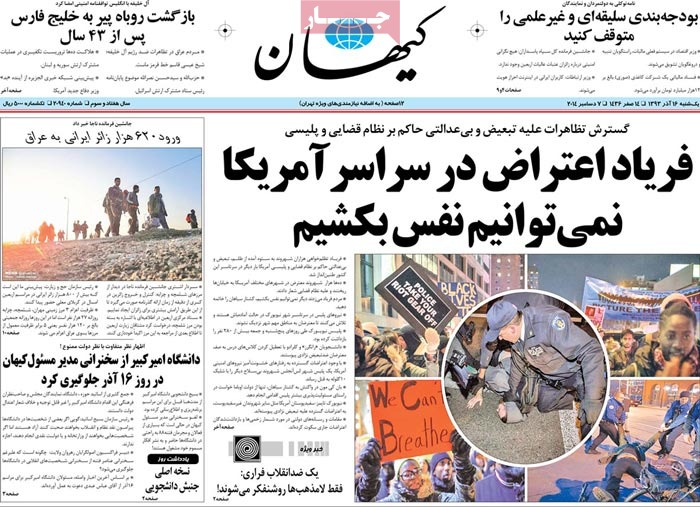
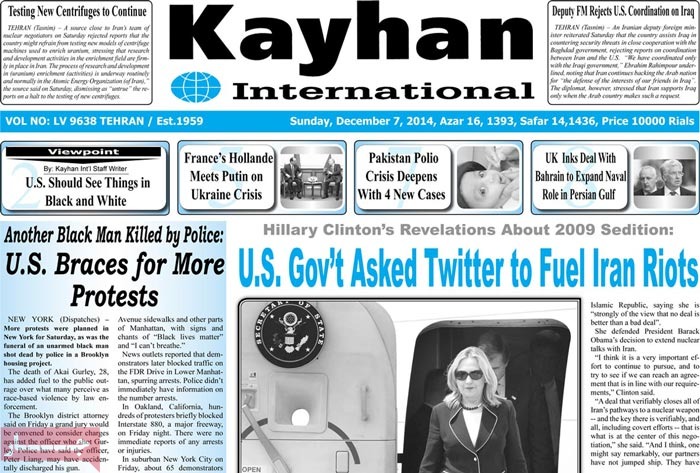
Kayhan: In Spain, some 80 percent of Catalans have voted for independence in an unofficial referendum.

A look at Iranian newspaper front pages on Nov. 11


Mardomsalari: “In the end, we will make progress,” said Iranian Foreign Minister Mohammad Javad Zarif of nuclear talks between Iran and P5+1.

A look at Iranian newspaper front pages on Nov. 11


Qods: Acid attacks in Isfahan have been neither politically nor religiously motivated, said the Judiciary Spokesman Gholamhossein Mohseni Ejei.


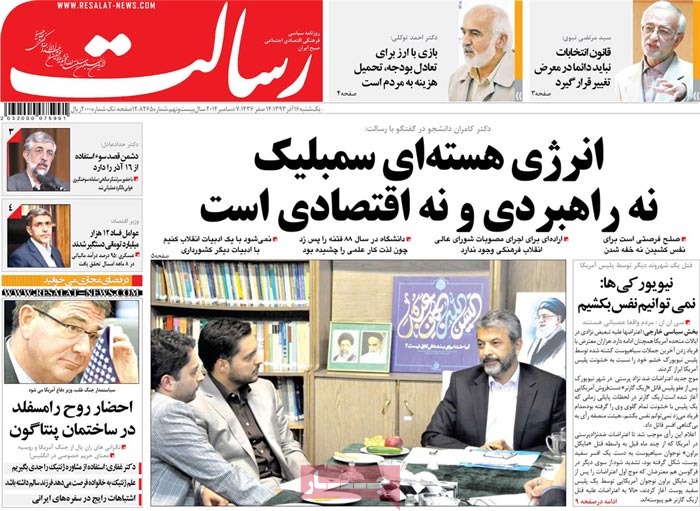
Resalat: Iran’s men Kumite team have finished first in the 22nd World Karate Championships in Bremen, Germany.

A look at Iranian newspaper front pages on Nov. 11


Roozan: “The comments of [former President Mahmoud Ahmadinejad] set the case against my client in motion,” said the attorney of Mehdi Hashemi [a son of Akbar Hashemi Rafsanjani].

A look at Iranian newspaper front pages on Nov. 11


Iran, Iraq should join hands to counter enemies’ plots: Iran’s Vice President

Eshagh Jahangiri at a meeting with Nouri al-Maliki

Iran and Iraq should boost coordination and expand Tehran-Baghdad cooperation to counter the enemies’ plots in the region, Iranian First Vice President Eshagh Jahangiri says.

“The Islamic Republic of Iran closely monitors issues in Iraq and regards Iraq’s stability and security as its own security and stands by the Iraqi government and nation under the current difficult conditions,” Jahangiri said in a meeting with Iraq’s Vice President Nouri al-Maliki in Tehran on Monday.

“We believe that collective security and stability in the region will be achieved only through joint regional cooperation,” he added.

Jahangiri stressed the importance of safeguarding Iraq’s territorial integrity through unity, expressing hope that the Iraqi officials’ wisdom would lead to the settlement of the country’s problems as soon as possible.

The Iranian vice president further called on regional countries to bolster cooperation to eliminate terrorism.

Maliki, for his part, pointed to the existing sensitive situation in the region and called on regional countries to converge in order to counter terrorist groups including the ISIL militants.

He said Tehran and Baghdad have great opportunities to improve economic, political, security, social and cultural relations and noted that the two sides have taken major steps to achieve this goal.

The ISIL terrorists currently control large areas of Iraq. The group sent its militants into Iraq in June, seizing large parts of land straddling the border between Syria and Iraq.

The ISIL militants have been carrying out horrific acts of violence, including public decapitations, against Iraqi communities such as Shias, Sunnis, Kurds, and Christians.

The Iraqi army has managed to make a number of gains in the fight against the ISIL militants in recent weeks.

Iraq security important for neighbors: Iran Majlis speaker

Ali Larijani at a meeting with Nouri al-Maliki

Iran’s Majlis Speaker Ali Larijani has underlined the importance of a secure Iraq to its neighbors, saying Tehran has thrown its weight behind efforts toward that end.

“Establishment of security and stability across Iraqi territories is important for all the neighboring countries from the regional point of view and Iran has spared no effort in this respect,” Larijani said at a Monday meeting with visiting Iraqi Vice President Nouri al-Maliki in Tehran.

He pointed to the existing friendly ties between Iran and Iraq in different political and economic arenas as well as the ample potential for the further growth of such relations.

Larijani also touched on the presence of ISIL terrorists in Iraq and the so-called coalition led by the US against the Takfiri group, adding, “The terrorist and inhumane activities of the group knows no borders and mere airstrikes cannot purge the region from the filth of [ISIL].”

The top Iranian lawmaker praised the Iraqi nation’s resistance against ISIL and expressed optimism that calm and peace will soon be restored to Iraq.

Maliki, for his part, lauded Iran as a great country and a friend of Iraq at different junctures in the post-Saddam era, noting that all Iraqis consider Iran as a real ally during difficult times and crises.

He noted that the Iraqi nation’s campaign will soon put an end to the terrorist actions of ISIL, which indiscriminately targets all ethnicities in the country.

The ISIL terrorists currently control large areas of Iraq. The group sent its militants into Iraq in June, seizing large swathes of land straddling the border between Syria and Iraq.

The ISIL militants have been carrying out horrific acts of violence, including public decapitations, against Iraqi communities such as Shias, Sunnis, Kurds, and Christians.

The Iraqi army has managed to make major gains in the fight against the ISIL militants in recent weeks.

No progress made in trilateral nuclear talks in Oman: Iran top negotiator

Abbas Araqchi

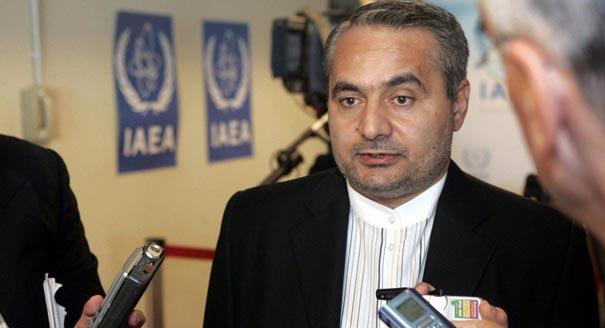
Senior Iranian nuclear negotiator Abbas Araghchi tells Press TV that no progress has yet been achieved in trilateral talks between Iran, the US, and the EU over Tehran’s nuclear energy program.
Speaking to Press TV correspondent on Monday, Araghchi said negotiations in the Omani capital, Muscat, were useful, however, no headway was made.

He said the sides are now “working on solutions” after months of talks on different subjects, adding that the Iranian side believes that “negotiations in the past two days and discussions were very useful. But we are not still in a position to say that we have made progress. It’s yet to be done in the coming days. We would be available as much as needed here in Oman or in any other place before the November 24 deadline. We are still hopeful.”

The top negotiator noted that a lot of work has remained to be done and more expert-level and bilateral meetings are required.

Araghchi added that the process of striking a comprehensive deal on Iran’s nuclear energy program needs “lots of goodwill by all parties and of course readiness to make difficult decisions.”

On Monday, Iranian Foreign Minister Mohammad Javad Zarif, US Secretary of State John Kerry and EU negotiator, Catherine Ashton, wrapped up two days of discussions.

They were due to hold a joint press conference following the talks. However, it was canceled with no clear breakthrough in the discussions.

Araghchi further described the issue of uranium enrichment as a “key question” for the other side and the lifting of sanctions slapped on Iran as a “very important key question” for Tehran.

Referring to different aspects of sanctions, Araghchi said the sides have to find a solution about “how and when these sanctions are removed.”

“It’s a fact that based on a possible comprehensive solution all the sanctions should be lifted,” he said, expressing hope that the negotiating sides could find a settlement to the issue of enrichment.

“Iran would certainly continue its enrichment, but the question is the capacity of this enrichment which should be determined based on our practical needs and that would be something we are very hopeful to come to at the end of these negotiations.”

The US State Department spokeswoman, meanwhile, said the talks were “tough, direct and serious.” Jen Psaki told reporters in Washington that the US remained focused on making progress, and there’s still time to do so.

In response to a question about the political will on the part of the US to find a resolution to the dispute over Iran’s nuclear activities, Araghchi said that the other side, including Washington, apparently has “enough seriousness” and shows “political will and determination.”

“We have seen political determination in all parties in P5+1, but how these political determination or political will is translated into those difficult decisions that the other side should make [is] yet to be seen.”

The negotiations were aimed at facilitating a final deal over Iran’s nuclear energy program before the November 24 deadline.

The extent of Iran’s uranium enrichment as well as a timetable for the removal of US and EU sanctions were high on the agenda of the Oman negotiations.

Representatives of Iran and the five permanent members of the UN Security Council – Russia, China, France, Britain and the US – plus Germany will hold further talks at deputy level on Tuesday.

Iran lawmakers urge full removal of sanctions

Iran parliament
Iran parliament

An overwhelming majority of Iranian lawmakers have called for the removal of the entire sanctions against Tehran immediately after a comprehensive agreement has been reached between Iran and P5+1.

In a statement on Sunday, more than 200 legislators called on Iranian nuclear negotiators “not to accept any restrictions on [uranium] enrichment research and development as well as other research activities related to nuclear fuel cycle” in the country.

They stressed the importance of refusing any inspection by the International Atomic Energy Agency (IAEA) of Iran’s nuclear sites “beyond the IAEA Safeguards Agreement and the Non-Proliferation Treaty (NPT).”

The statement emphasized that activities at Iran’s Arak heavy water plant and Fordow nuclear facilities should continue in order to supply fuel to Tehran Research Reactor (TRR) and serve medical, scientific, industrial and agricultural purposes.

The statement comes as Iran’s Foreign Minister Mohammad Javad Zarif, US Secretary of State John Kerry and the EU representative, Catherine Ashton, kicked off trilateral talks in the Omani capital, Muscat, on Sunday to exchange views on the outstanding issues hindering a final deal on Tehran’s civilian nuclear work.

In an exclusive interview with Press TV on his way to Muscat, Zarif said the illegal sanctions slapped on the country over its nuclear energy program have failed to meet the goals of those countries that imposed them.

The top Iranian diplomat said the removal of sanctions is a main theme of the Muscat talks, noting that the extent of Iran’s enrichment activities is another key topic in the negotiations.

Iran slams EU’s fresh bans against Iranian institutions, companies

Ms. Marzieh Afkham

Iran has strongly condemned the European Union’s latest move to impose fresh sanctions on a number of Iranian institutions and companies despite the ongoing negotiations between representatives of Iran, the US and the EU in the Omani capital, Muscat.

“Under the circumstances that the nuclear negotiations are going on and efforts by the negotiating parties are underway to reach an acceptable agreement, this move by the European Union is questionable and contradicts the purpose of talks and the opposite side’s commitments,” Iran’s Foreign Ministry Spokeswoman Marzieh Afkham said on Sunday.

She added that EU’s move to impose bans on a number of Iranian entities was a sign of “unusual insistence” on EU’s past policies and an “astonishing move” at the current juncture.

Iran has voiced objection to the European Union through its embassy in Brussels.

Afkham’s remarks came after the Council of the European Union announced on November 7 that the bloc has imposed sanctions on Iran’s Sina Bank, Power Plants’ Equipment Manufacturing Company, Naftiran Intertrade Company (a.k.a. Naftiran Trade Company) (NICO), and Naftiran Intertrade Company Srl.

It added that an Iranian businessman, Sorinet Commercial Trust Bankers, and Sharif University of Technology should be included again on the list of persons and entities subject to restrictive measures on the basis of a new statement of reasons.

Iran’s Foreign Minister Mohammad Javad Zarif, US Secretary of State John Kerry and the EU’s representative, Catherine Ashton, kicked off trilateral talks in the Omani capital, Muscat, on Sunday to exchange views on the outstanding issues hindering a final deal on Tehran’s civilian nuclear work.

Sources close to the Iranian negotiating team say the main stumbling block in the way of resolving the Western dispute over Iran’s nuclear energy program remains to be the removal of all the bans imposed on the country, and not the number of centrifuges or the level of uranium enrichment.

Tehran wants the sanctions entirely lifted while Washington, under pressure from the pro-Israeli lobby, insists that at least the UN-imposed sanctions should remain in place.

Iran resolute on final deal based on full nuclear rights: Iran’s FM

Mohammad Javad Zarif

Iranian Foreign Minister Mohammad Javad Zarif has expressed the Islamic Republic’s firm determination to reach a final agreement with P5+1 which will fully safeguard the country’s nuclear rights.

“We are determined to find a solution based on our country’s full nuclear rights,” Zarif said in a meeting with Minister Responsible for Foreign Affairs of Sultanate of Oman Yusuf bin Alawi bin Abdullah in Muscat on Sunday.

He briefed his Omani counterpart on the process of the nuclear talks between Iran and P5+1, adding that Tehran has entered into the negotiations with goodwill and acted with all seriousness.

Iran and the five permanent members of the six countries – France, Britain, the US, Russia, China, and Germany – have been holding talks to work out a final deal aimed at ending the longstanding standoff over the Islamic Republic’s nuclear energy program as a November 24 deadline draws near.

On Sunday, Iran’s Foreign Minister Mohammad Javad Zarif, US Secretary of State John Kerry and the EU representative, Catherine Ashton, kicked off trilateral talks in the Omani capital to exchange views on the outstanding issues hindering a final deal on Tehran’s civilian nuclear work.

Zarif and bin Alawi further discussed the latest developments in the Middle East, particularly the adverse consequences of terrorist acts on regional countries.

They said positive relations between Tehran and Muscat will play a role in strengthening cooperation among regional countries.