Saturday, December 27, 2025
Home Blog Page 5024

Iran to continue uranium enrichment: Iranian top negotiator

Abbas Araqchi

A senior Iranian nuclear negotiator says the Islamic Republic will move ahead with its uranium enrichment work to meet the country’s industrial needs.

“Iran’s [uranium] enrichment will continue. This issue has been agreed upon by both sides,” Abbas Araqchi said on Saturday, referring to Tehran and six world powers discussing Iran’s nuclear energy program.

He said the nuclear negotiations between Iran and P5+1 group are focused on determining the level, extent and capacity of uranium enrichment as well as the time span for Iran to produce industrial-scale enriched uranium.

Araqchi, who is also the deputy foreign minister for legal and international affairs, said Iran’s needs would decide the extent of enrichment.

Touching on the issue of anti-Iran sanctions, Araqchi said Iran seriously seeks the lifting of all sanctions slapped on the Islamic Republic.

“We continue to believe that all the sanctions must be lifted and we do not accept any instance of sanctions to remain in place,” he said, adding that the negotiations are under way to work out an “acceptable” mechanism for the lifting of the entire sanctions.

Iran and the five permanent members of the UN Security Council – France, Britain, the US, Russia, and China – plus Germany have been holding talks to work out a final deal aimed at ending the longstanding standoff over the Islamic Republic’s nuclear energy program. The two sides have set November 24 as the deadline to reach the deal.

Iran and the six other countries are set to open a new round of nuclear talks in Muscat, Oman, on November 11.

Sanctions failed to yield intended results: Iran’s FM

Mohammad Javad Zarif

Iran says the illegal sanctions slapped against the country over its nuclear energy program have failed to meet the goals of those countries that imposed them.

The anti-Iran bans are not part of a solution, Iran’s Foreign Minister Mohammad Javad Zarif said, speaking to Press TV on his way to the Omani capital, Muscat, for further talks on the Islamic Republic’s peaceful nuclear activities with P5+1.

The sanctions are illegal and have failed to bring about the results intended by those that imposed them, the Iranian foreign minister added.

“It is important for the West to understand that sanctions have never contributed to the resolution of this issue. Sanctions are not a part of solution. Sanctions are the most important part of the problem. They’re illegal in nature. They must be removed. They have not produced any positive result. The only things that sanctions have produced for the West are about 19,000 centrifuges.”

On Sunday and Monday, Zarif and US Secretary of State John Kerry will meet in Muscat together with the former European Union’s Foreign Policy Chief Catherine Ashton, who chairs the nuclear negotiations with the Islamic Republic.

The top Iranian diplomat said the removal of sanctions is a main theme of the talks, noting that the extent of Iran’s enrichment activities is another key topic at the talks.

Iran believes a final deal over its nuclear energy program can be reached if the other side has the political will to do so, Zarif added, noting that his Sunday meeting with Kerry and Ashton will center on bringing the viewpoints of both sides closer together.

Following the talks, Ashton will chair a meeting on Tuesday, also in Muscat, of political directors from P5+1 – France, Britain, the United States, Russia, China, and Germany.

Last November, Iran and P5+1 clinched an interim nuclear accord, which took effect on January 20 and expired six months later. However, they agreed to extend their talks until November 24 as they remained divided on a number of key issues.

Larijani: Iran, P5+1 could reach agreement through serious talks

Ali Larijani
Ali Larijani

The speaker of the Islamic Consultative assembly says that Iran and P5+1 could reach a final agreement if they pursue serious talks.

Ali Larijani, who was speaking in the opening ceremony of the 20th Exhibition of Press and News Agencies in Tehran on Saturday, said that Iran and P5+1 have stepped into the right path, adding an agreement would be within reach if they pursue serious talks.

Mehr News Agency reported the remarks of the top parliamentarian on November 8. IFP has picked and translated part of what the parliament speaker had to say in the ceremony.

The top MP said that the two sides have made some progress in the talks. He said this could be a good opportunity to solve the dispute [over Iran’s peaceful nuclear program], adding that the settlement of this case could solve other issues as well.

Larijani reiterated that such a solution is contingent on the fact that Iran should enjoy nuclear technology, saying that Iran is not after nuclear weapons, nor does it seek new laws beyond the current international rules and regulations.

He went on to hope that the talks could end conclusively in the presence of well-experienced experts, saying that if so, positive results would be produced.

He then disputed the so-called anti-ISIL coalition led by the US, saying it seems highly unlikely to solve regional problems.

If Iran helps Iraq and Syria eliminate their enemies it is because Iran does not want to experience insecurity within its borders, he said, adding that insecurity in the region would affect Iran in one way or another.

He said the problem would be totally solved if certain countries are prevented from supporting terrorists, adding Iran takes proud in its support for Iraq and Syria [to take on the Islamic State of Iraq and the Levant terrorists].

Larijani said Iran has acted in good faith, saying the anti-ISIL coalition seems unlikely to help defuse the crisis.

As for the role of media, he said that people’s life is intertwined with media, saying media is not something for fun.

He also thanked the government for working on a piece of law which allows the release of information, saying that media would grow stronger if freedom of thought prevails in society.

[…]

Abr Jungle of Shahrood; a dream of walking on clouds

Abr Jungle of Shahrood

Cloud forests often exhibit an abundance of fogs covering the ground and vegetation. These forests usually develop on the saddles of mountains. A few hours before the sunset, when temperatures fall, clouds rush into the forest. The settling clouds are so thick that it seems you are walking on them. Jungles veiled in clouds provide visitors with a golden opportunity to enjoy, explore, and learn about these wonderful ecosystems.

Young Journalists Club filed a descriptive account of Abr Jungle on October 22. What you will go through is the translation of part of this report:

Abr Jungle of Shahrood (2)To many tourists, Abr Jungle (Cloud Forest) is among the most beautiful natural scenery of Iran and the entire world. […]

Iran’s Cloud Forest is located 45 km north of Shahrood, between Shahrood and Azad Shahr.

Leaving behind the gardens in Bastam [a city in Shahrood County], you will see clouds over far-off mountains and along the 4,000-meter Shahvar Mount as if they have been trapped in the sharp claws of the mountain, a scene which promises you are getting closer to the dreamy cloud forest.

The Forest which stretches on an expanse 35,000 hectares in area is part of the ancient [Caspian] Hyrcanian [mixed] forests which have encircled the northern slopes of the Alborz Mountain like a belt, covering the southern coasts of the Caspian Sea.

The Hyrcanian forests used to cover 3.7 million hectares, but that figure has now dropped to 1.8 million. The forests are home to old woody plants such as beech, oak, alder, elm, cherry tree, checker tree, English yew, tilia, etc.

The forest which is situated at a high altitude from sea level has low temperatures in hot seasons. Abundant springs flow in the forest which is all but unique because of its diverse vegetation ecology.

[…]

Abr Jungle of ShahroodJuniper, a tree native to the region, is seen everywhere like clouds in the sky; you will be surrounded by thick fog, let’s say the clouds.

You feel a sense of coolness, freshness and aroma which are associated with the proximity of the clouds to your face, something which turns into raindrops on your eyes and hair. […]

Midway through the night, the clouds begin to pack their bags, so to speak. It is the time when the surrounding valleys become clearly visible. The clouds keep drifting around.

Valleys get full of clouds and then become empty. Fast-moving clouds make the jungle look like the lab of an alchemist. […]

Fire, wind, soil and water; night could be a new addition to the Four Elements. Nothing is in short supply in the cloud jungle.

The sun rises to admit that the earth’s law is still holding in this land. It seeks to remind everybody that even in this dreamy land night falls and day breaks. It comes out of the mountains and clouds stay for a while, and then […]

In broad daylight, the forest is littered by hills which are thick in some places and sparse in others.

Abr Jungle of ShahroodInside the thick forests, you cannot believe that you are in Semnan province, not far from Iran’s Central Desert and Khar Touran National Park [a biosphere reserve]. Right there you will realize why Shahrood is called “a small continent”.

Maran Castle, which was built by the Elamites at the mountain summit, is seen from a distance. At sunrise, the castle is enveloped in clouds and this evokes the images of a ship wandering [aimlessly] in the Pacific Ocean.

Shorshor Waterfall is cascading [over the rocks] at the bottom of a valley which has remained intact due to its insurmountability.

UNESCO to put Shush on World Heritage List

Shush Ancient City

The United Nations Educational, Scientific and Cultural Organization (UNESCO) is planning to inscribe the ancient Iranian city of Shush on the 2015 World Heritage List.

A delegation of UNESCO experts visited Shush in southern Khuzestan Province a few days ago to register the historical city on the World Heritage List.

Director and Representative of the UNESCO Cluster Office in Tehran Esther Laroche and the evaluator at the International Council on Monuments and Sites Gen Tang were among the visitors.

Deputy Head of Iran’s Cultural Heritage, Handicrafts and Tourism Organization (ICHHTO) Mohammad Hassan Talebian and the General-Director of Khuzestan Cultural Heritage Afshin Heidari accompanied the delegation during the three-day visit.

The UNESCO World Heritage Committee had earlier nominated the city in 2012; however, the site could not enter the final list.

The historical city of Shush, called “Susa” in Old Persian, is one of the oldest-known settlements of the region and the world which covers 400 acres of land.

The city was the capital of the Elamites and subsequently the winter capital of Achaemenians for some 2800 years.

Since about 150 years ago, first a French archeological mission and then Iranian archaeological teams have carried out excavations in the city which led to retrieving artifacts, buildings and objects from various periods, shedding more light on the Elamite history and culture.

In December 330 BCE, the Alexander of Macedonia captured Susa and plundered the city; seizing some 40,000 talents of gold and silver from the treasury.

Armenian monastic ensembles of Iran, Bam and its cultural landscape, Bisotoun, Naqsh-e Jahan Square, Pasargadae, Persepolis, Sheikh Safi al-din shrine, Shoushtar historical hydraulic system, Soltaniyeh, Tabriz historic bazaar complex, Takht-e Soleiman, Tchogha Zanbil and the Persian garden are some of the Iranian historical heritage sites that have been inscribed on UNESCO’s World Heritage List so far.

World Heritage Site is a title given to locations which have “outstanding universal value” to all of humanity, according to UNESCO’s description.

Two Persian leopards have been fitted with GPS tracking neckbands

Persian leopards with GPS tracking (1)

The news website of Iran Environment and Wildlife Watch has posted a report on a research project aimed at collecting information about mature male leopards in Tandooreh National Park in the northeastern province of Khorasan Razavi. The following is the translation of part of the report:

Persian leopards with GPS tracking (2)The research project – the doctoral thesis in zoology of Mohammad Sadegh Farhadinia – got underway last year. Ever since Dr. Iman Memarian, a veterinarian, and his assistant Alireza Shahrdari-Panah, Arash Moharrami, a project assistant and Nima Asgari, a cameraman and a documentarian have been working on it. In the early stages of the project, Hooman Jokar, an expert in setting animal traps, helped the research team as well.

“Leopards are as one of the most widely-studied mammals in the world. However, in mountain areas of West Asia there is still a lot about them to be explored. It is almost impossible to study Persian leopards in mountainous regions of Iran without modern, specialized equipment,” said Farhadinia.

“Among other things, GPS tracking neckbands are of great importance because they allow us to record and analyze the movements of leopards as well as the temperature and its relation with the extent of the animals’ physical activity. Such information enables us to accurately calculate the number of calories the leopards need to survive,” he added.

“The project is designed to size up the health of the leopards, the amount of energy they need and should gain on a daily basis, and the vastness of the territory they require to meet their needs.” – Mohammad Sadegh Farhadinia

“Apart from the Protection of Asian Cheetah Project carried out in Bafgh, [a city in Yazd Province], in 2007, this project is unprecedented in Iran. In other words, there may be some problems ahead in terms of applying the six GPS tracking neckbands we plan to fit the animals with. There is no need to point out that we already went through a lot placing orders for the tracking devices because of restrictions caused by sanctions,” he further said.

Farhadinia went on to say, “The project is designed to size up the health of the leopards, the amount of energy they need and should gain on a daily basis, and the vastness of the territory they require to meet their needs.”

As for the GPS tracking neckbands, he stated, “By global standards, the neckbands should be no heavier than three percent of the animal’s total weight to prevent any disorder in behavior or interference in the movement of the animal. After comprehensive studies and extensive correspondence with the neckband-producing firm, fortunately, the weight of neckbands used in this project does not go beyond one percent of the total weight of leopards and batteries on them can last for over a year.”

Persian leopards with GPS tracking (3)“GPS attached to the neckbands switches on between eight and 24 times a day and records the location of leopards. The process does not involve any noise and lasts only for a short time. Another interesting feature of such neckbands is that one year after they are fastened they automatically come off the animal’s neck. Thus, there is no need to capture the animal alive and give it an anesthetic to have the neckband removed,” said Farhadinia.

He concluded, “The two leopards studied in the project are doing well, roaming across their territory.”

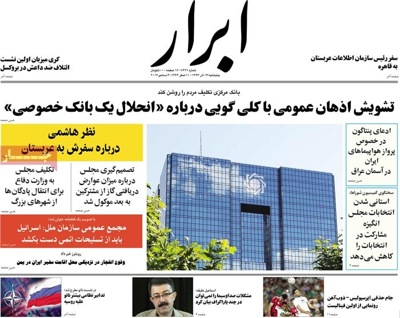
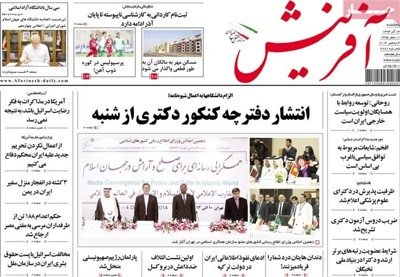
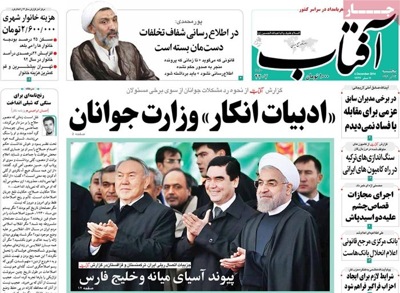
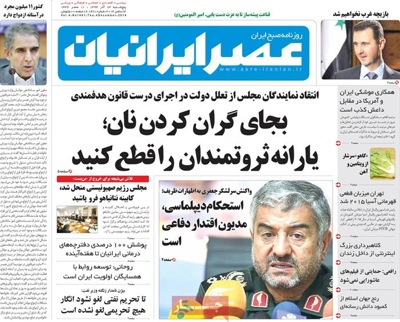
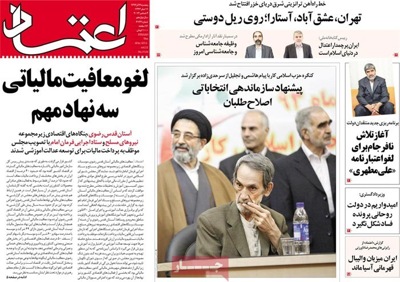
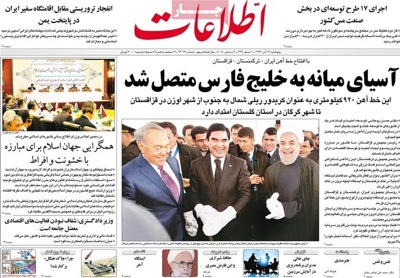
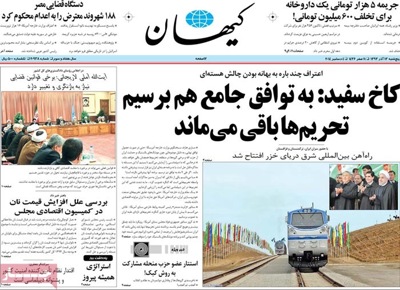
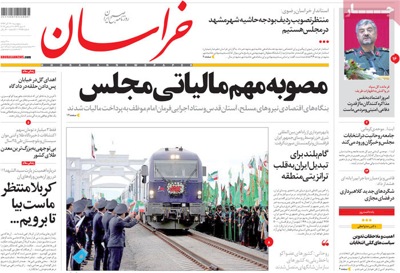
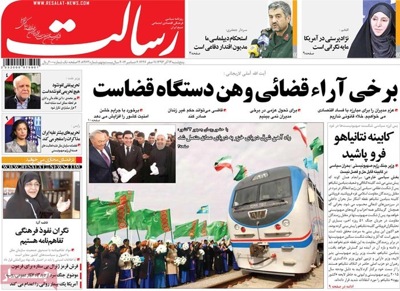
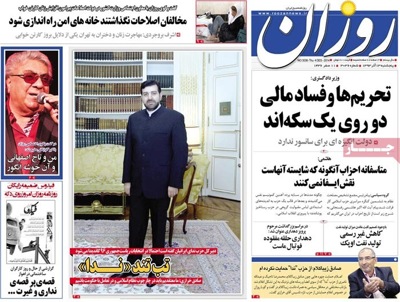
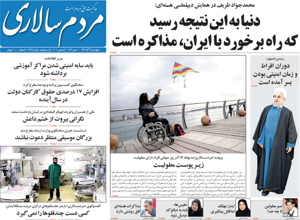
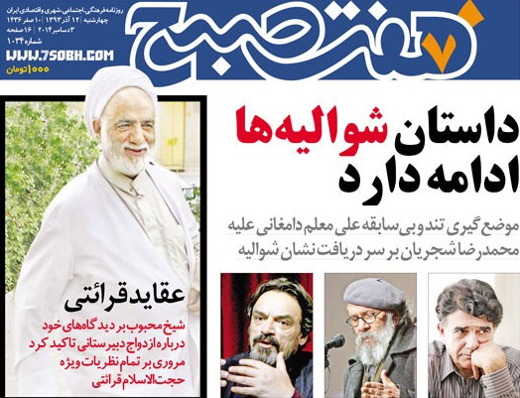
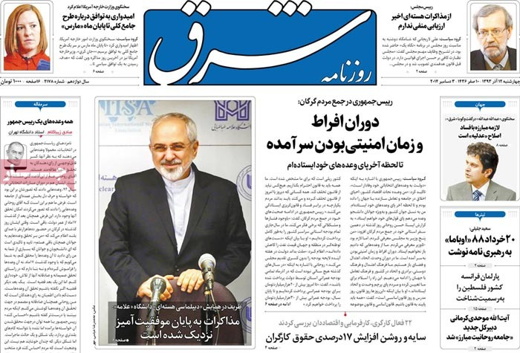
A look at Iranian newspaper front pages on Nov. 8

Iranian Newspapers Headlines

News about the opening of the 20th Exhibition of Press and News Agencies on Saturday was on the front pages of many Iranian newspapers. Also grabbing headlines were the letter Obama is said to have sent to the Supreme Leader and the flurry of diplomatic activity and comments ahead of a November 24th deadline for a nuclear deal between Iran and P5+1.


Afkar: Six foreign political figures are expected to visit the 20th Exhibition of Press and News Agencies that opens at Tehran’s Grand Musalla later on Saturday.

Afkar: The Wall Street Journal reports that President Obama has sent a letter to Iran’s Supreme Leader about the fight against IS.

Afkar Newspaper


Arman-e Emrooz: Changes of government should not result in change of policy and strategy, said Chairman of the Expediency Council Ayatollah Akbar Hashemi Rafsanjani.
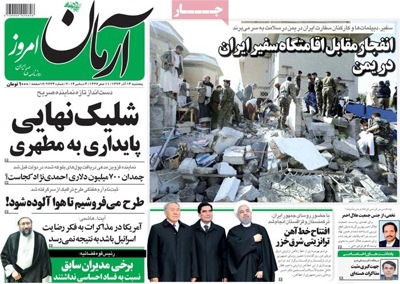
Arman Emrooz Newspaper


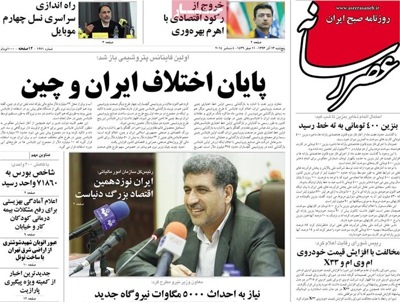
Asia: Various sectors of the economy will soon experience a boom, the Iranian minister of economy and financial affairs vowed.

Asia Newspaper


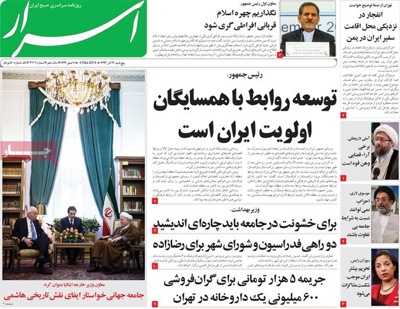
Asrar: “Security conditions are ideal in Sistan and Baluchestan Province,” said the Iranian prosecutor general.

Asrar Newspaper


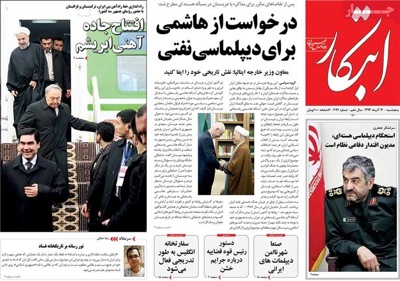
Ebtekar: “I am a bit at odds with my father,” said Ali Jannati, the minister of culture and Islamic guidance.

Ebtekar Newspaper


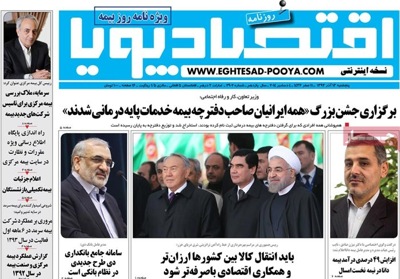
Eghtesad-e Pooya: Iran’s business position in global rankings has improved 22 notches, said the minister of economy.

Eghtesad-e Pooya Newspaper


Etemad: In a bid to end smuggling fuel, the government has revoked as many as six million cards used to purchase gasoline at the pump.

Etemad Newspaper


Ettela’at: Former British Foreign Secretary Jack Straw has said Iran is part of the solution, not the problem.

Ettela’at: The volume of water behind dams that supply Tehran’s water is 40 million cubic meters less than last year.

Ettelaat Newspaper


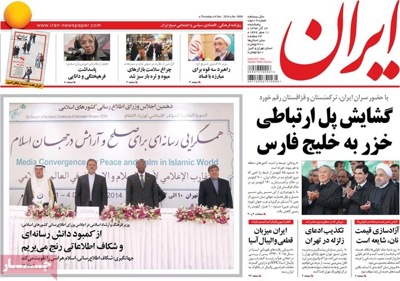
Farhikhtegan: The reason why parliament did not vote for the proposed ministers of science goes beyond the case involving scholarships, said the managing editor of Ettela’at daily, the oldest newspaper in Iran.

Farhikhtegan Newspaper


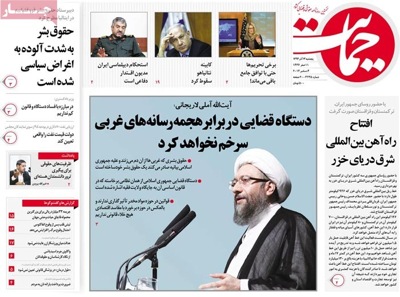
Hemayat: The deputy head of the Judiciary has urged the Iranian nuclear negotiators to speak from “a position of authority”.

Hemayat: The wording of a final deal with P5+1 should be approved by parliament, said the chairman of the chamber’s National Security and Foreign Policy Committee.

Hemayat Newspaper


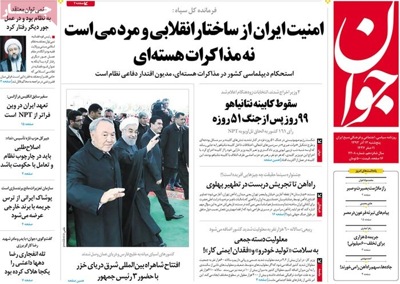
Javan: Rainfall has increased 120% over the past 56 days.

Javan Newspapert


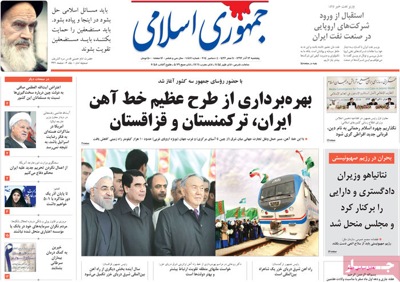
Jomhouri Islami: IS terrorists suffer back-to-back defeats in Iraq and Syria.

Jomhouri Islami Newspaper


Mardomsalari: The secretary general of Mardomsalari (Democracy), a reformist party, has called on Ayatollah Rafsanjani to run for the chairmanship of the Assembly of Experts.

Mardomsalari Newspaper


Sharq: For the first time an Iranian female karate player, Hamideh Abbasali, will fight for a world gold medal.

Sharq: The tenure of Ezzatollah Zarghami at the helm of IRIB (national broadcaster) comes to an end today (Saturday, November 8).

Sharq Newspaper


Tejarat: Seven veteran European diplomats tell President Obama time is ripe for a nuclear deal with Iran.

Tejarat Newspaper

Germany Hopeful about Iran-P5+1 Final Deal by Nov. 24

Martin Schaefer - German FM Spokesman

German Foreign Ministry Spokesman Martin Schaefer said his government “is still hopeful” that a lasting nuclear accord with Iran could be reached by a November 24 deadline.

“Some of the Western sanctions against Iran were lifted according to the Geneva interim agreement on November 24, 2013 and we expect the two sides to reach a final agreement in this round of talks,” Shaefer said on Friday.

The German foreign minister spokesman underlined his country’s firm determination to reach a final deal with Iran.

He urged all sides to show flexibility in their positions in a bid to ink a deal as there was still some time left until November 24.

Iran and P5+1 (the US, Russia, China, France and Britain plus Germany) are set to open a new round of negotiations in Oman on November 11.

Iran and the six major world powers have already held 8 rounds of nuclear negotiations after inking an interim agreement in Geneva on November 24, 2013, and have less than three weeks to strike a final deal before a November 24 deadline.

Tehran and the six powers have already held seven rounds of talks in Vienna, and one more round in New York on the sidelines of the UN General Assembly. They are now preparing for their 9th round of negotiations slated to be held in Masqat, Oman, on November 11.

The Geneva agreement took effect on January 20 and expired six months later on July 20. In July, Tehran and the six countries agreed to extend negotiations until November 24 after they failed to reach an agreement on a number of key issues.

Iran’s Sarakhs Trade Zone Welcomes Foreign Investment

Iran Sarakhs Free Trade Zone

“Iran’s Sarakhs Free Trade Zone (FTZ) is open to foreign investment,” Head of Iran’s Trade Promotion Organization Valiollah Afkhamirad announced.

“Sarakhs Zone is ready to accept and cooperate with foreign investors who are willing to take part in the Zone’s trade, economic and industrial activities,” Afkhamirad said on Thursday.

He described the gas refinery and Sarakhs airport as advantages of the city and said double efforts should be made to identify the competitive potential in order to attract foreign investors to the area.

Sarakhs special zone with an area of 5,290 hectares is located in northeast of Iran and connects ports in the Gulf of Oman and the Persian Gulf to Central Asia, the Caucasus and Russia.

During the first half of the current year (March 21-September 22) 6,982 tons of different products including construction materials, tea, nuts and chocolate were produced in companies stationed in Sarakhs Special Economic Zone, showing an increase of 217% as compared to the same period last year.

Sarakhs Special Economic Zone due to its geographical location which is in the heart of ECO member countries is the best golden gate for entry into Central Asia, China and Russia and a connection bridge to major trade markets of Central Asia for the Persian Gulf states in south of Iran, Europe in the west and Afghanistan and Pakistan on the eastern side.

Sarakhs started its activity as a special zone simultaneously with the operation of Mashhad-Sarakhs-Tajan railway in the presence of leaders and representatives from more than 100 world countries in 1996.

Sarakhs Special Economic Zone is situated 150 km east of Mashhad and 15 km from the city of Sarakhs and borders Turkmenistan in the north and east.

Russia: Iran, P5+1 determined to reach nuclear deal

Russian Deputy Foreign Minister Sergei Ryabkov

Russian Deputy Foreign Minister Sergei Ryabkov says Iran and P5+1 have “enough political will” to reach a comprehensive nuclear deal before the November 24 deadline.

“I have no doubt that they have enough political will and interest to work out the final solution by the established date,” Ryabkov told RIA Novosti on Thursday.

He added that Moscow has received “signals” in recent days from “Tehran, Washington and European capitals [that] indicate that all participants at the talks are at the low start and ready for a sprinter run.”

Ryabkov also stressed that his country is prepared to help find a solution to end the impasse over the Iranian nuclear energy program during the next round of talks in Oman.

“We have shown a great commitment to these talks and their participants respect the Russian position. I believe that we could help find a solution [to the Iranian nuclear issue] at the final stretch,” Ryabkov.

Iran and the five permanent members of the UN Security Council – France, Britain, the US, Russia, China – plus Germany are set to open a new round of discussions over the Islamic Republic’s civilian nuclear work in Oman on November 11.

The two sides have been holding talks to work out a final deal aimed at ending the longstanding standoff over the Islamic Republic’s nuclear energy program as a November 24 deadline draws near.