Friday, January 2, 2026
Home Blog Page 5022

Iranian bishops fully support nuclear team

letter

A host of high-ranking Assyrian and Armenian bishops in Iran have sent a letter to US President Barack Obama to express their full support for the ongoing nuclear talks between Iran and six world powers, describing the conclusion of a possible accord as a step forward toward establishment of sustainable peace.

Fars News Agency (FNA) on November 24 filed a report on the letter sent by the bishops of the Christian Assyrians and Armenians to the US president. The missive, which bears the signatures of the priests of Iran’s Christian community and their representatives in the Islamic Consultative Assembly, has some highlights as follow:

The experience [members of] the Christian community have gained from social life in Iran shows that despite the existing [anti-Iran] media hype, Muslim Iranians enjoy an old civilization and rich culture and have strong faith in Islamic principles and religious teachings.

Iran’s traditions which have been established based on religious beliefs and teachings have left a deep ideological and ethical impact on the country’s ruling system, political life and social relations. A case in point is the country’s religious tolerance which has manifested itself in the direct presence of people representing religious minorities in parliament; freedom to practice their faith, live their own communal life, and learn their mother tongue and their religious principles.
A fatwa issued by the Supreme Leader and the commander-in-chief of the armed forces banning the supply, purchase, production or use of atomic weaponry is yet another proof that like other divine faiths Shiite clerics disapprove of and reject weapons of mass destruction, chemical and nuclear arms included.

The fatwa is of great essence in Islamic traditions since it is binding on Muslims and they are required by their faith to comply with such edicts.

We, the archbishops of the Armenian and Assyrian churches in Iran, together with our representatives in the Islamic Consultative Assembly, fully support the ongoing nuclear talks with P5+1. Any possible deal which would come out of the talks will be a step forward in efforts to establish sustainable peace. A fair result of the talks could see tolerance and constructive interaction take the place of pervasive violence in the region.

New Yorker analyst: The collapse of nuclear talks unlikely

Hooman Majd
Hooman Majd

The November 24 deadline is upon us and the negotiations are reaching the hours of truth, with the two sides saying some gaps remain unfilled. There is a growing possibility that yet another interim agreement is concluded and talks are extended for a couple of months. Failure of the talks still remains an option, albeit not strong enough to be a factor in the calculus of Iran or the West.

Fars News Agency (FNA) filed an interview with Hooman Majd, a New York-based Iranian-American writer and journalist, on Monday November 24 on speculations over the nuclear negotiations and the slim chance of the talks breaking down.

Majd, who is an analyst with the New Yorker, said that chances for the talks to fail are slight and that the [positive] effects of a possible deal are of great importance for both Iran and the West. The following is a partial translation of what Majd had to tell FNA:

Parties to the talks are trying to clinch an agreement which could appease the critics.

For the time being, it is impossible to predict the result of the talks, because even the negotiators don’t know if they could ink a final deal. What is certain, though, is that both the US and Iran want to reach an agreement they could defend in the face of criticism. Another point is that neither party is willing to give in to what the other side is calling for.

A deal seems more likely to be concluded thanks to a strong political will on both sides following intense talks. It remains to be seen if the negotiators could strike a comprehensive accord or they agree to the framework of a deal and leave the details for future talks. I think the chances of reaching one of these two are more than 50 percent and the odds of a breakdown are less than 20 percent.

An agreement will carry weight for the two sides. It would mean the West’s regional interests can be put in order and the two countries can cooperate in areas of mutual interest and reduce tensions.

Whether a possible deal could mark the beginning of a thaw in US-Iran relations remains to be seen, but it could produce positive economic and political results for Iran. It will also boost the legitimacy of the Iranian establishment at home and abroad and will open the door to broader efforts to effectively deal with problems the region is facing.

If talks end inconclusively, the two sides will face dire consequences. Iran will probably be hit with more sanctions and isolation. As for the US, it will face obstacles in its efforts to stabilize the region and support its allies.

If so, tensions will mount and the specter of a war or conflict will continue to hover over the region. The total breakdown of the talks is the worst-case scenario one can imagine.

Why did Saudi foreign minister travel to Vienna uninvited?

Saudi Foreign Minister Saud al-Faisal to Vienna

In reaction to a surprise trip by Saudi Foreign Minister Saud al-Faisal to Vienna [the venue of ongoing nuclear talks between Iran and P5+1] and his talks with US Secretary of State John Kerry, Alef, a news website, said, “the presence of the uninvited guest on the sidelines of the Vienna talks” translated into a thank-you message from Washington to Riyadh for the latter’s efforts to send crude prices tumbling and thus put pressure on Iran and Russia.

Donyay-e Eghtesad newspaper described Saudi Arabia as a disruptor of the nuclear talks in Vienna which tries “to prevent the sides from arriving at an agreement”. It says that Saud al-Faisal is in the Austrian capital to represent Israel.

Presence of Saudi official belittled the kingdom: MP

Tasnim News Agency quoted Esmail Kosari, a member of the National Security and Foreign Policy Committee of the Iranian parliament, as saying, “The presence of the Saudi top diplomat in the venue of the nuclear talks amounts to disrespect for the kingdom.”

He went on to say, “Saudi Arabia should know that its petrodollars will not always pay off. It needs to wait and see the future of the talks more tactfully.”

Americans are selling the nuclear deadlock to Saudis

Fars News Agency filed a report on the reason why the Saudi foreign minister flew to Vienna to meet with his US counterpart. It said, “The West is trying to pitch the snag over the nuclear talks to the Saudis. Saudi Arabia and other sheikhdoms in the Persian Gulf are the ones who have to pay a price for the excessive demands of the Americans.”

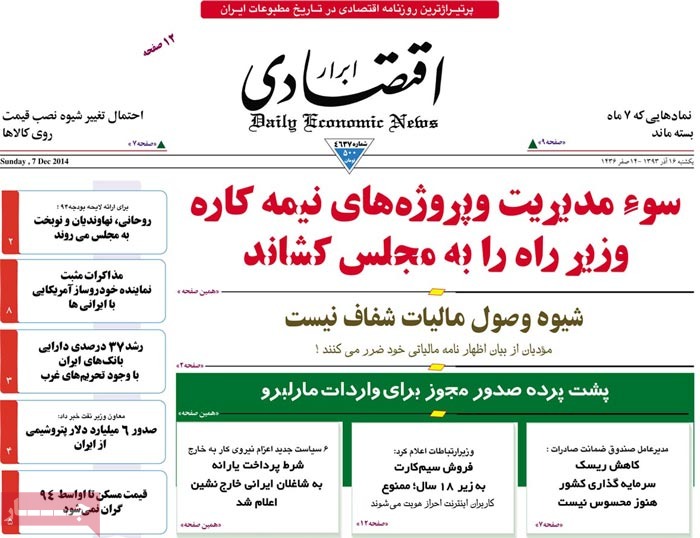
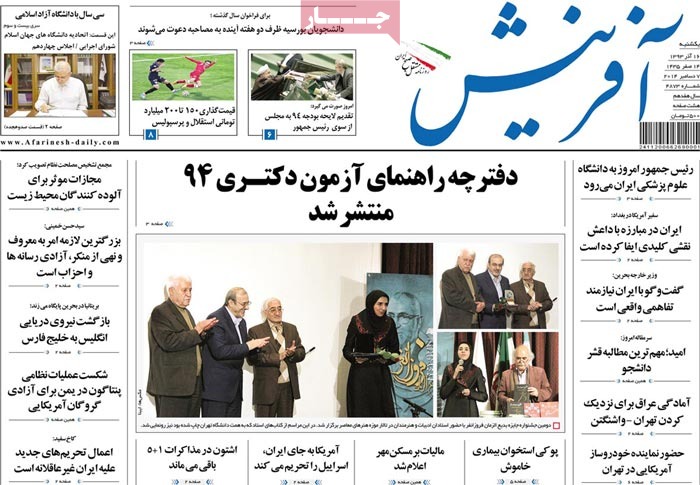
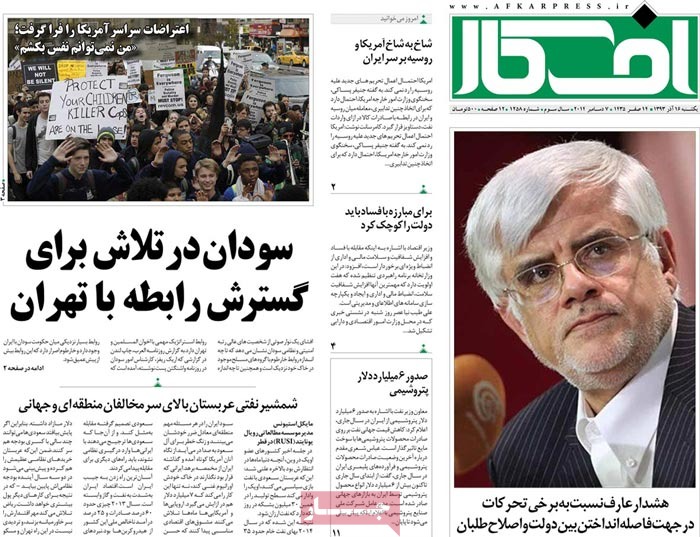
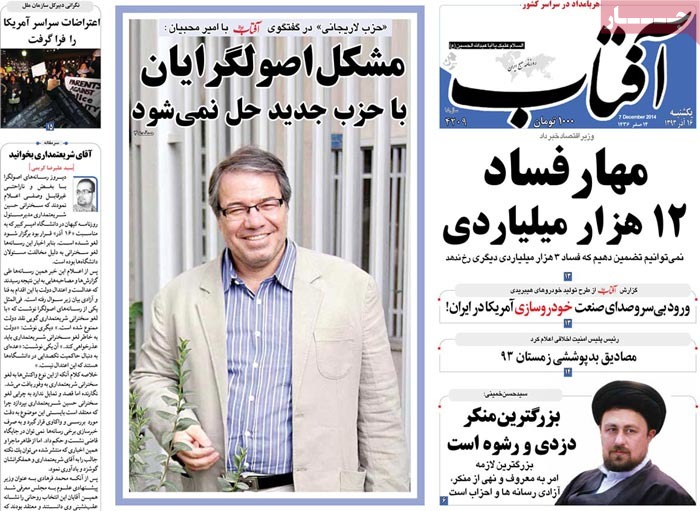
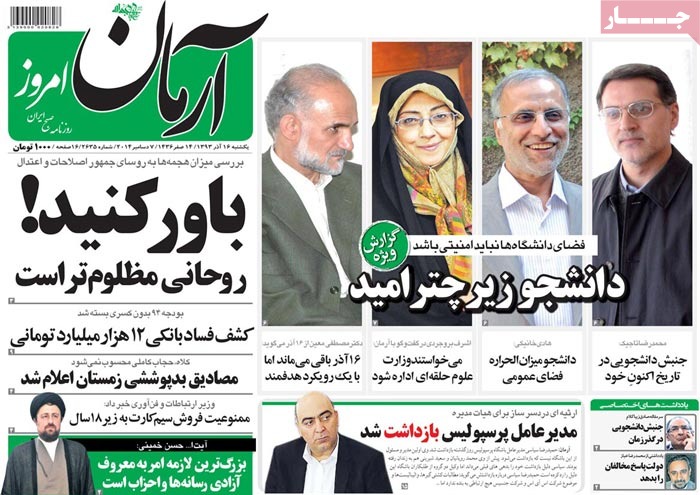
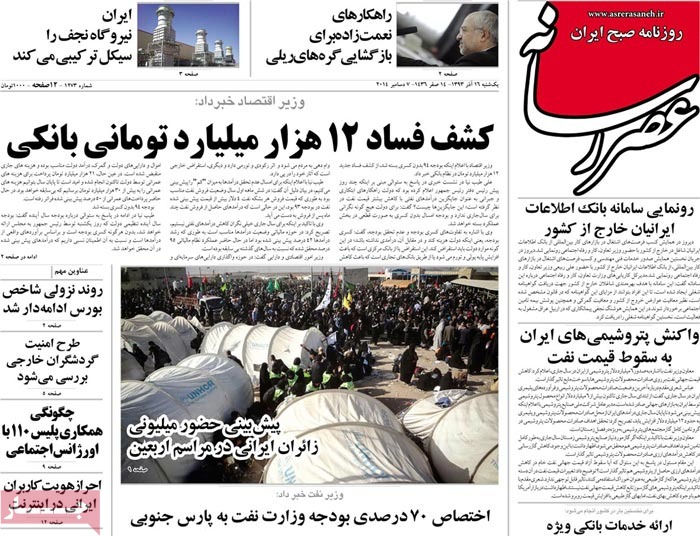
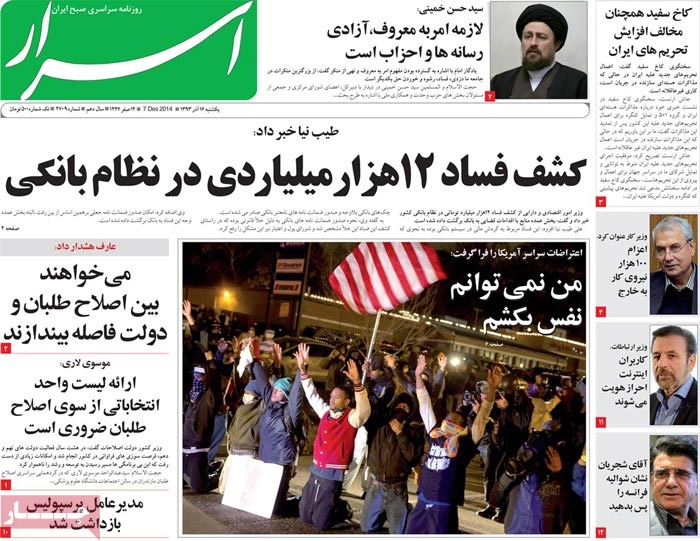
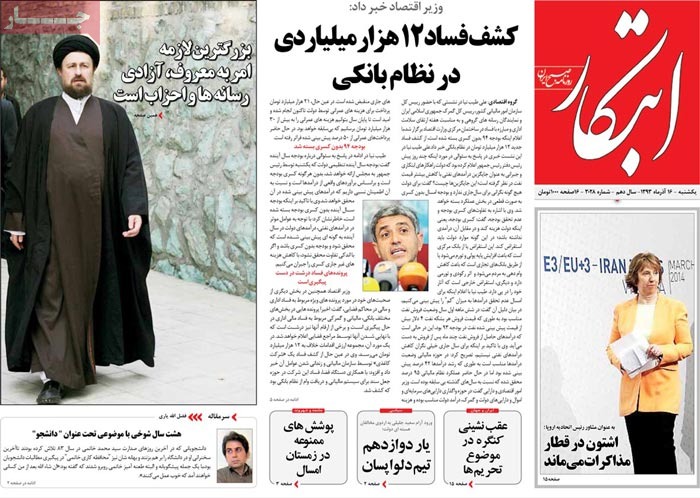
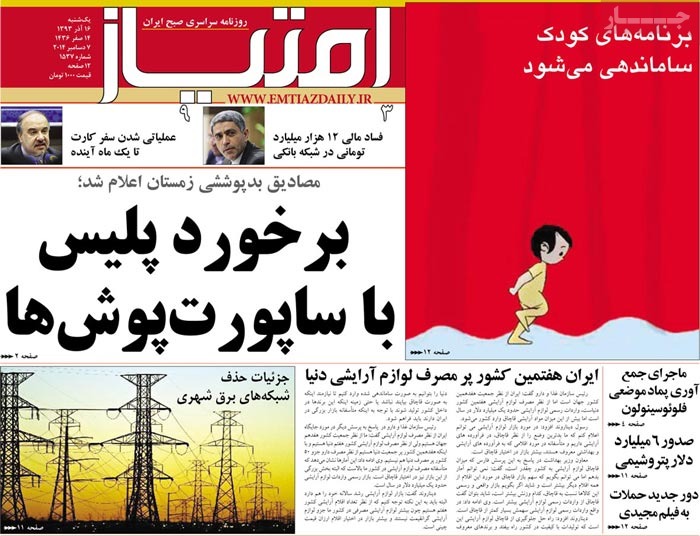
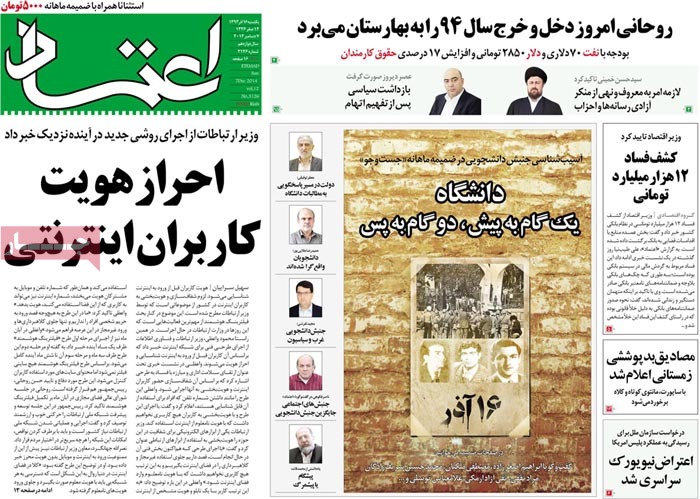
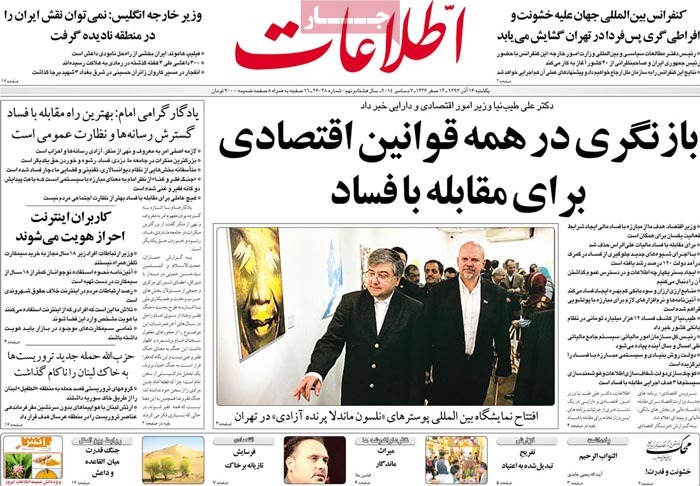
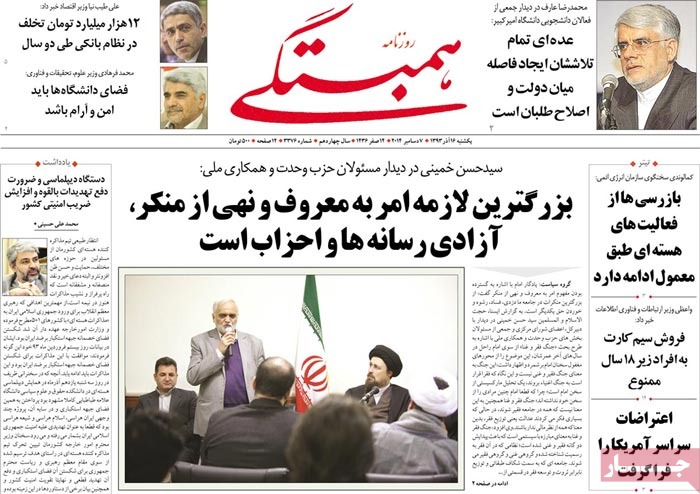
A look at Iranian newspaper front pages on Nov. 24

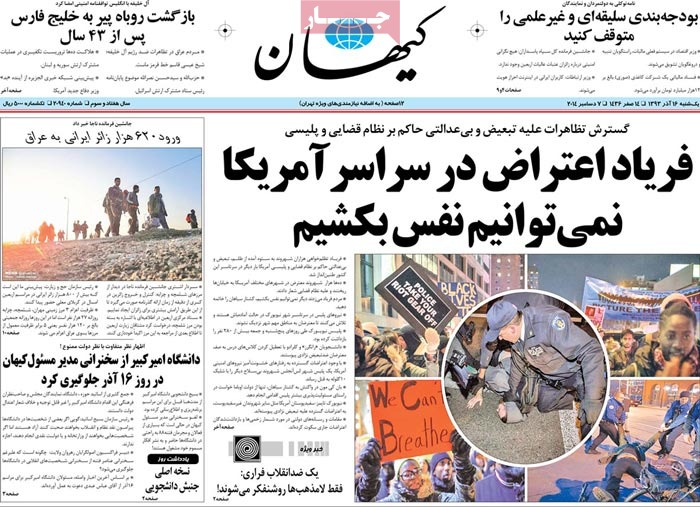
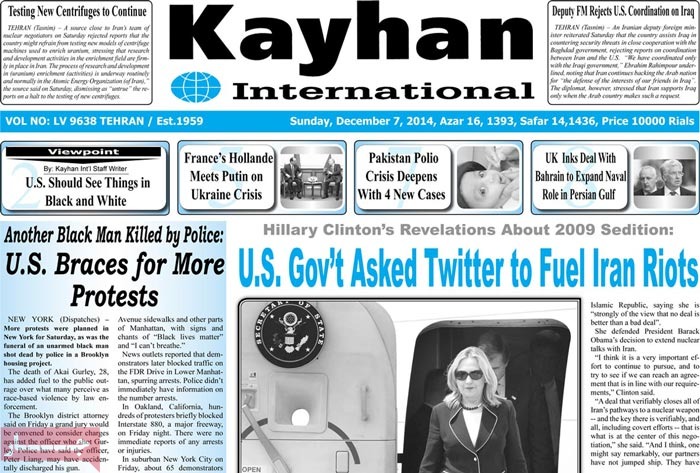
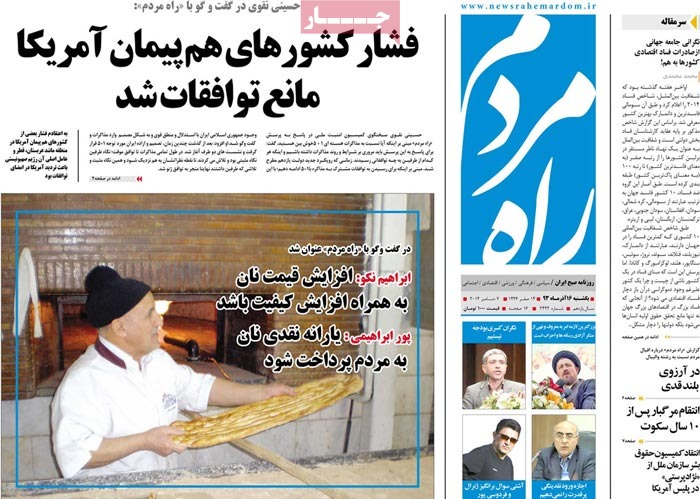
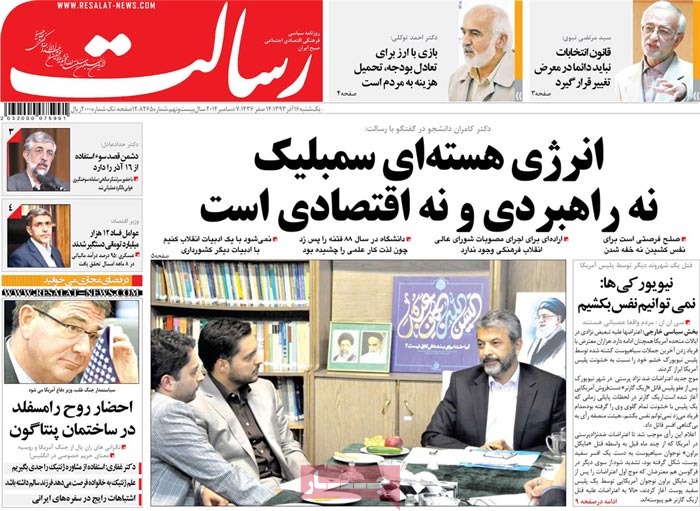
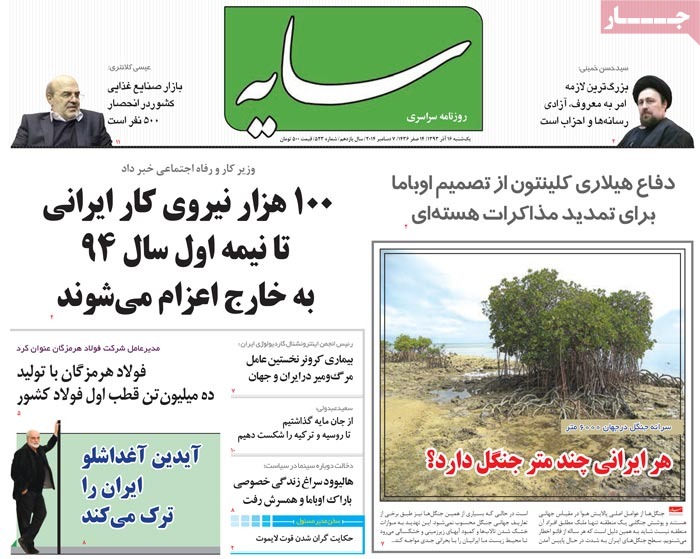
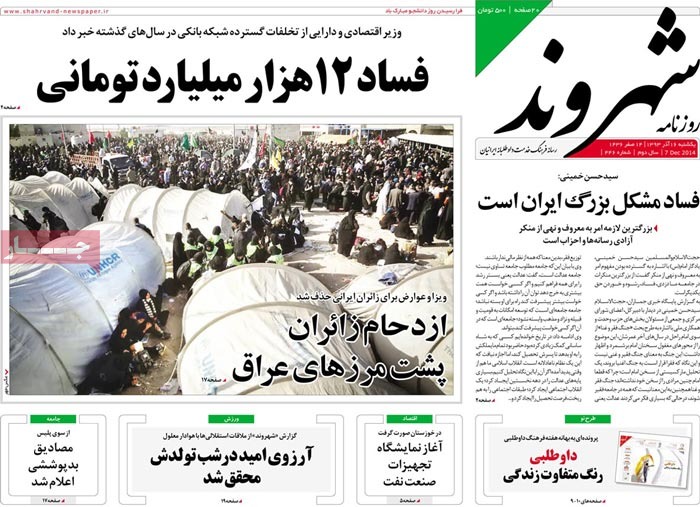
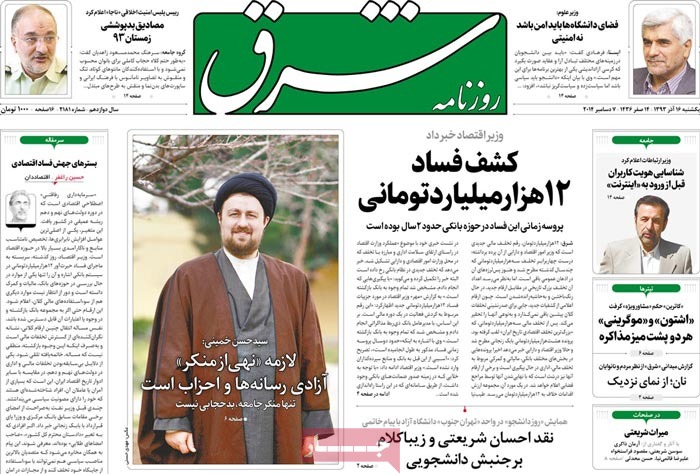
Iranian Newspapers Headlines

The home stretch of ongoing nuclear talks ahead of an end-of-the-day deadline and the guesswork surrounding the results stayed in the front-page headlines Monday. A victory by the Reds against the Blues in the capital’s 79th derby was also in the news. Another headline which appeared on the front pages of some Iranian dailies was a global conference in Qom, central Iran, where Muslim scholars gathered to discuss Takfiri and extremist groups.

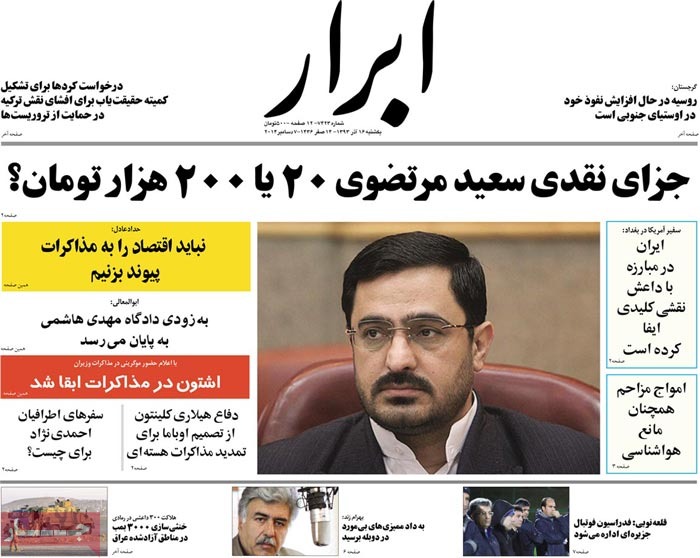
Abrar: “Extension of the Geneva Interim Agreement will be on the table as an option if a final deal is not inked [between Iran and P5+1],” said a member of the Iranian negotiating team.


Abrar newspaper 11 - 24


Afarinesh: “Any comprehensive nuclear deal should get the approval of parliament,” said the chairman of parliament’s nuclear subcommittee.

Afarinesh: For the first time direct flights will be established between three German cities and Iranian cities of Mashhad and Tehran.


Afarinesh newspaper 11 - 24


Afkar: The University of Tehran will play host to a national conference on Iran’s elite researchers on November 27.


Afkar newspaper 11 - 24


Donyay-e Eghtesad: “An uninvited guest in Vienna [talks],” reads the daily’s banner headline, speculating about the presence of Saudi Foreign Minister Saud al-Faisal in the Austrian capital.


Donyayae eghtesad newspaper 11 - 24


Ebtekar: The Saudis are in Vienna fearing a nuclear deal is clinched between Iran and P5+1. [The Saudi top diplomat was in the Austrian capital for talks with US Secretary of State John Kerry ahead of the November 24 deadline].


Ebtekar newspaper 11 - 24


Esfahan Emrooz: More than anybody else, [President] Obama needs a nuclear deal [with Iran].


Esfehane emruz newspaper 11 - 24


Ettela’at: “The Takfiri current [a reference to the Islamic State of Iraq and the Levant (ISIL)] is an enemy of Islam, Muslims and humanity,” the Global Conference of Muslim Scholars’ View on Takfiri and Extremist Currents announced.

Ettela’at: The pro-Israeli lobby in the US is trying to make nuclear talks between Iran and P5+1 collapse.

Ettela’at:Iran’s Science and Culture Hall of Famers (known as Unforgettable Faces) have thrown their weight behind Mohammad Farhadi, President Rouhani’s fifth pick for the Ministry of Science, Research and Technology.


Ettelaat newspaper 11 - 24


Farhikhtegan: “I’m confident that if we reach a deal that is verifiable […], that not only can I persuade Congress, but I can persuade the American people that it’s the right thing to do,” said President Obama in reaction to the possible conclusion of a final nuclear deal.


Farhikhtegan newspaper 11 - 24


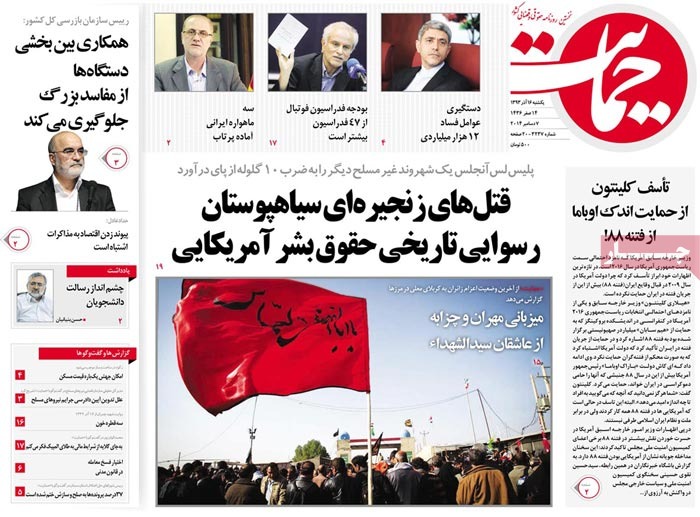
Hemayat: Judiciary Chief Ayatollah Sadegh Amoli Larijani has highlighted the need for Muslim nations to form an Islamic judiciary union.


Hemayat newspaper 11 - 24


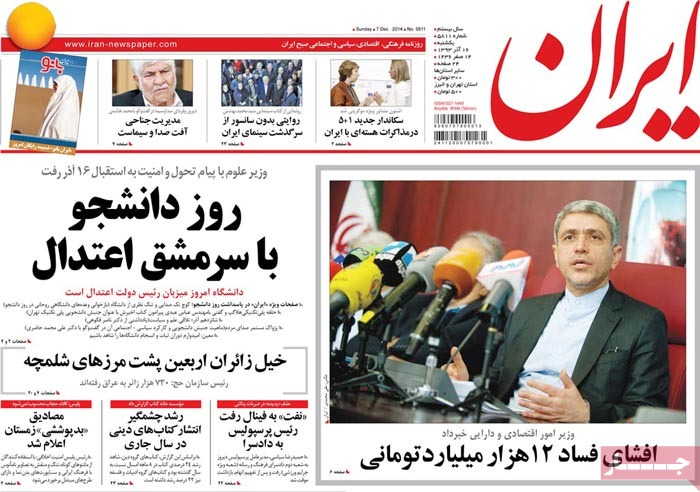
Iran: Iran sets out conditions for the presence of foreign carmakers in the Iranian market: 40-percent customization of cars at the start of the contract; 85-percent customization in a five years’ time; car exports from Iran; improving part-making capabilities; and a regional monopoly for Iran as far as car manufacturing goes.

Iran: Vienna, the venue of the ongoing nuclear talks, the final stopover of seven foreign ministers.


Iran newspaper 11 - 24


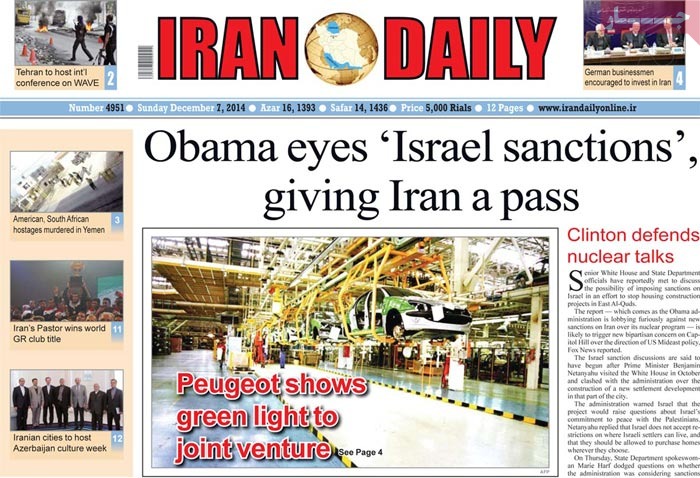
Iran Daily: Uphill struggle to secure historic deal.


Iran daily newspaper 11 - 24


Jahan-e Sanat: Minister of Culture and Islamic Guidance Ali Jannati has asked Iranians to buy works of arts rather than gold.


Jahane sanaat newspaper 11 - 24


Jomhouri Islami: “Iran has purchased plane parts from Boeing at an official price,” said the Chairman and Managing Director of Iran Air, Iran’s flagship carrier.


Jomhurie eslami newspaper 11 - 24


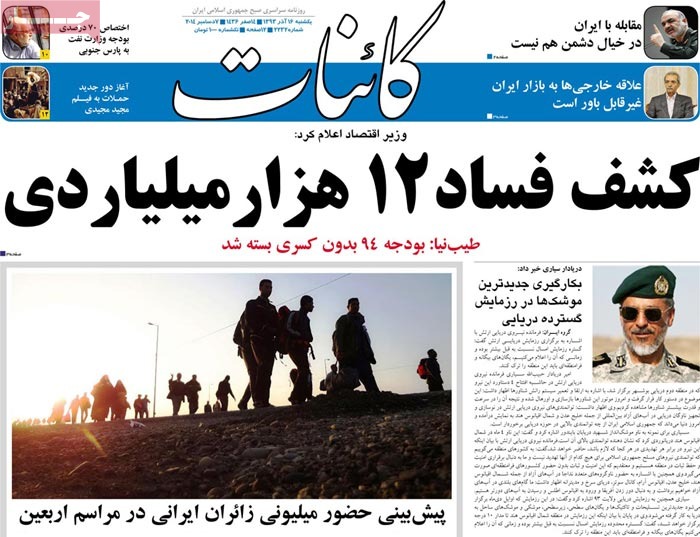
Kaenat: “Iran will raise its gas processing capacity two-fold in three years,” said the managing director of the National Iranian Gas Company (NIGC).


Kaenat newspaper 11 - 24


Kayhan: Iranian students have warned in a rally outside Tehran Research Reactor (TRR) that a final nuclear deal should not be inked at the expense of the country’s atomic achievements.


Kayhan newspaper 11 - 24


Khorasan:“We have started to review the Constitution in order to plug its possible loopholes,” said Abbasali Kadkhodaei, a member of the Supreme Board of Arbitration and Adjustment of Relations among the Three Branches of Government and a former spokesman of the Guardian Council.


Khorasan newspaper 11 - 24


Mardomsalari: “A 33-month spell has been broken”, writes the daily about the capital’s 79th derby between Esteghlal and Persepolis in which the former was defeated 2-1, the first win after almost three years.

Mardomsalari: “The military service completion cards of 59 football players have been revoked,” the Military Conscription Organization announced.


Mardom salari newspaper 11 - 24


Roozan: “The experience and knowledge of the first generation of the revolution should be tapped into to develop an understanding of the late Imam’s way of thinking.”


Ruzan newspaper 11 - 24


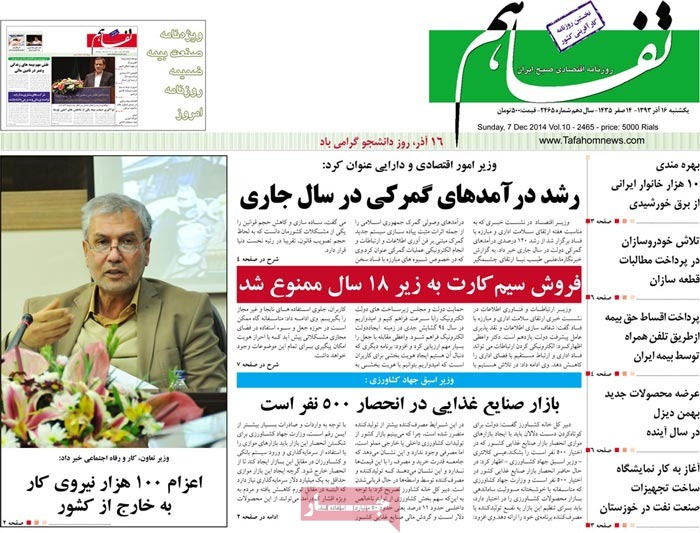
Tafahom: “We will not consider the interests of certain individuals or groups when we try to serve the interests of the establishment and contribute to the cause of sustainable security,” said the intelligence minister.


Tafahom newspaper 11 - 24


Coverage in Iranian press of the final day of Vienna nuclear talks

Iran Talks in Vienna

The items below, released in stages on November 24, appear in reverse chronological order:

13:15 GMT Fars News Agency: Nuclear talks between Iran and P5+1 came to an end in Vienna. The negotiations have been officially extended until July 1, 2015. Every month, $700 million in Iran’s frozen assets will be released.

12:23 GMT Fras News Agency: On the last day of Vienna nuclear talks, European markets have their eyes riveted on the outcome of the negotiations.
12:20 GMT Tasnim News Agency has quoted Deputy Director of Russian Foreign Ministry’s Second Departmenton Asian countries Konstantin Alekseyev as saying that Moscow seeks to promote nuclear cooperation with Tehran. Recalling nuclear talks between Iran and P5+1, he described the clinching of a deal as tough, but he underlined Moscow’s emphasis on compromise.

12:15 GMT Iranian Students’ News Agency (ISNA) has quoted sputniknews.com as reporting the remarks of Chinese Foreign Minister Wang Yi, who said China hopes to see a comprehensive agreement clinched on Iran’s nuclear program and has brought its own proposals to the table, but more time may be needed because of technical difficulties standing in the way.

12:11 GMT Iranian Students’ News Agency (ISNA): Top diplomats of P5+1 were to hold talks by noon (Vienna local time). Prior to that meeting, Foreign Minister Mohammad Javad Zarif held separate meetings with EU’s top negotiator Catherin Ashton and US Secretary of State John Kerry. Zarif is highly likely to meet foreign ministers of P5+1 after their gathering.

12:07 GMT Shahrvand (newspaper of Iran’s Red Crescent Society): “The world is in anticipation of a ‘White Message [of peace]’”. The daily characterizes the meeting between Zarif and Kerry as decisive.

11:59 GMT Javan daily tells Iranian negotiators: “Don’t rush. Republicans and Democrats are the two sides of the same coin of animosity toward Iran.”

11:42 GMT Fars News Agency: A source close to the Iranian negotiating team says the deadline to reach a comprehensive deal won’t be extended any more than a few hours or days at most.

11:35 GMT Fars News Agency: A Western diplomat has confirmed reports that the Geneva deal will be extended, saying a political statement will be released shortly to report progress in nuclear talks.

11:20 GMT Fars News Agency: Top diplomats of China and Russia have held talks about the ongoing nuclear talks in Vienna.

10:57 GMT Haft-e Sobh: “A meeting on board the private plane of Saudi Foreign Minister Prince Saud al-Faisal, who flew to Vienna, with US Secretary of State John Kerry indicates that a country [which claims to wield a lot of clout and influence] in the region has started to get panicky about the prospects of an accord between Iran and P5+1 so much so that it is taking measures which defy all diplomatic norms.

10:42 GMT Tasnim News Agency has quoted the Independent’s Robert Fisk as saying, “Whatever happens with the nuclear talks, it [Iran] will again be the most powerful nation in the Muslim Middle East one day. People should plan to invest in the new Iran. If the Americans and the Iranians can reach agreement, Iran could again be the policeman of the [Persian] Gulf.”

10:20 GMT Aftab-e Yazd has quoted the Iranian Students’ News Agency (ISNA) as reporting the remarks of Mohsen Rezaei, the secretary of the Iranian Expediency Council and a former Commander of the Islamic Revolution Guard Corps (IRGC) during the 8-year war between Iran and Saddam’s Iraq. Rezaei said, “Whatever the outcome of the nuclear talks, it is the result of the Supreme Leader’s backing and coordination among all forces contributing to the revolution.” He went on to say that if the talks failed, the buck stops with the Americans and some regional countries.

10:20 GMT Aftab-e Yazd has quoted Mohammadreza Bahonar, a principlist MP, as saying, “The stance and red lines of the establishment are obvious and Iran’s negotiating team won’t overstep these lines.”

10:07 GMT Khabaronline (a news website) has cited Laura Rozen, an Iran nuclear expert and a journalist with Al-Monitor [an online newspaper], as saying that prior to the negotiations in Vienna at Muscat talks both sides faced some differences, but it was clear that they both wanted the talks to be conclusive. She expressed optimism over the outcome of the talks and said a comprehensive deal between Iran and P5+1 will be finally clinched.

10:05 GMT The Islamic Republic News Agency (IRNA) has quoted France 24 as reporting that the continuation of Vienna nuclear talks is useful for both sides. The French TV service said walking away from the talks by either side will have consequences.

In that case, the West would be unable to monitor Iran’s nuclear facilities. Continued nuclear talks have other advantages too. One such advantage is the apparently unlikely alliance between Persian Gulf states, including Iran and Saudi Arabia, two regional rivals, in the battle against ISIL in Iraq.

In fact, failure of the talks can spell an end to such unconventional cooperation and help ISIL blaze its way into other parts of the region.

09:10 GMT Fararu (a news website) has quoted the Islamic Republic News Agency (IRNA) as reporting that at the bilateral talks between Iranian Foreign Minister Mohammad Javad Zarif and US Secretary of State John Kerry, Iranian photographers were initially denied entry to the venue of the talks by Kerry’s bodyguards. But, they were allowed to snap photos after Zarif intervened.

08:57 GMT Fars News Agency: The Chinese foreign minister, who arrived in Vienna on Monday, met Foreign Minister Mohammad Javad Zarif at Vienna’s Coburg Hotel.

08:46 GMT Tasnim News Agency referred to a brief report posted by Russia’s Itar-Tass which quoted a source close to the talks as saying that Iran and P5+1 have failed in this round of talks and a final document is unlikely to be agreed in time. The source added that extension of talks is being discussed and might take months.

08:41 GMT Tasnim News Agency has quoted Itar-Tass as reporting that Russian Foreign Minister Sergey Lavrov and US Secretary of State John Kerry have discussed in detail at a meeting in Vienna the course of negotiations between Iran and P5+1 which is nearing completion.

08:34 GMT Fars News Agency has quoted Russian Foreign Minister Sergey Lavrov as saying that Russian President Vladimir Putin and President Rouhani will have a phone conversation later Monday.

08:30 GMT Tasnim News Agency has highlighted a repeated remark by Foreign Minister Mohammad Javad Zarif as saying that the diplomats will forge ahead with bargaining to the end and the outcome of the talks will be determined at the last moment.

08:23 GMT Fars News Agency has cited an official close to the Iranian negotiating team as saying that Iran and P5+1 prefer striking a deal in Vienna.

08:18 GMT Tasnim News Agency has quoted the Jerusalem Post as reporting that Israel would consider military option against Iran in case of ‘a bad deal’.

08:15 GMT Dispatches: China’s Foreign Minister Wang Yistarted the final day of the talks in Vienna with a working breakfast with Mohammad Javad Zarif. He will later have separate meetings with US Secretary of State John Kerry and Russian Foreign Minister Sergey Lavrov.

Failure of the talks amounts to a victory for us: Javan daily

Javan Daily
Javan Daily

In an editorial on Sunday November 23, Javan, a daily that reflects the viewpoints of the Islamic Revolution Guard Corps described the prospects of nuclear talks between Iran and P5+1 as anything but bright, saying, “By the November 24 deadline, the desirable result which is the lifting of sanctions won’t materialize.”

Javan blamed a lack of independent political will in the United States for the bleak prospect and said the domineering role of the “Zionist will” is bound to thrust the latest round of talks into a deadlock.

Still, the daily claimed, “No matter what the result of the talks, we will emerge as winners.” It went on to say: “We would have felt defeated if we had been in pursuit of nuclear arms. That has never been the case. The religious aspect of the issue [a fatwa by the Supreme Leader banning the development and use of nuclear weapons] is so compelling that we will never pursue atomic weapons.”

The daily went on to describe “failure to lift the sanctions” as a kind of victory, citing that it would set the stage for the resistance economy to be taken more seriously. “That in turn will help secure growth and development which amounts to victory,” the paper said.

On the one hand, Javan said victory in the talks hinged on “termination of all sanctions”, and on the other, described failure to clinch a deal that does not remove all the sanctions imposed on Iran as a “victory” too, citing the following:

– We are victorious because talks with six major powers have resulted in their acceptance of Iran’s authority.

– We are victorious because the insight and capabilities of the Iranian people are bolstered. A first-hand experience of Western animosity toward Iran and Islam will stiffen the resolve of our nation to be more prepared to launch a constant battle against the West and the world of barbarism.

– We are victorious because overoptimistic individuals at home will hit the end of the line. Those who support the West are now wiping the sweat beads of shame off their foreheads […] will no longer say, “The world is a stage for interaction and give and take. They will accept that hegemonic powers have deep-rooted problems with the Islamic Revolution.”

– We are victorious because the resistance economy [a strategy geared toward more economic growth devised by the Supreme Leader and placed on the agenda of the government] will get off the ground. And those who seek to reach a deal with the West and render such an approach to economy inert will be disappointed.

– We are victorious because the current generation and those who come in the future will overcome their doubts as to why the Den of Espionage [the US Embassy in Tehran] was taken over in late 1979 and that will vindicate the revolutionaries.

– We are victorious because once again it will be proven that the problem of the West with the Islamic Revolution revolves around the existence of the latter.

– We are victorious because a lack of agreement would prove that Iran has made efforts to build trust and our representatives at the talks have insisted on their rational core principles.

The daily concludes the piece by saying, “Now the Iranian nuclear negotiators feel they are involved in a holy war, and the nation views them as triumphant warriors on the frontline.”

Iran’s Zarif, US Kerry hold direct talks in Vienna

Iran-US-Zarif
Iran-US-Zarif

Iranian Foreign Minister Mohammad Javad Zarif and US Secretary of State John Kerry have held their first direct talks in the Austrian capital, Vienna, amid breathtaking negotiations over Tehran’s nuclear program.

The top Iranian and American diplomats held bilateral talks on Sunday as Iran and P5+1 continue last-ditch nuclear negotiations before the Monday deadline for a final agreement.

Zarif, Kerry and EU nuclear negotiator, Catherine Ashton, sat down for nuclear talks at Vienna’s Coburg Hotel earlier on Sunday.

Earlier in the day, Kerry briefly left closed-door Iran nuclear talks to update Saudi Arabia’s Foreign Minister Prince Saud al-Faisal on the negotiations. The Saudi minister flew to Vienna from Paris solely for the briefing.
The US secretary of state will later meet with Russian Foreign Minister Sergei Lavrov.

Iran and P5+1– Russia, China, France, Britain, the US and Germany — have been holding talks in Vienna over the past six days to hammer out a comprehensive deal on Tehran’s nuclear program. Diplomats say the two sides have made progress but big gaps still remain.

Sources close to the Iranian negotiating team say the main stumbling block in the way of resolving the dispute over Iran’s nuclear energy program remains to be the removal of all the bans imposed on the country, and not the number of Iran’s centrifuges or the level of uranium enrichment.

Tehran wants the sanctions entirely lifted while Washington, under pressure from the pro-Israeli lobby, insists that at least the UN-imposed sanctions should remain in place.

An Iranian diplomatic source told Press TV on Sunday that the extension of Tehran’s nuclear talks with the six countries beyond the Monday deadline is not on the agenda of Vienna discussions.
Iranian-British national, Ghoncheh Qavami, released on bail

Ghoncheh-Qavami-Iran

Iranian-British national, Ghoncheh Qavami, has been released on bail in the Iranian capital Tehran, her mother says.

In an interview with the Iranian Students’ News Agency (ISNA) Susan Moshtaqian, Ghoncheh Qavami’s mother, confirmed on Sunday that a judge had set bail at one billion rials (about $ 37,000).

This comes days after Tehran Prosecutor’s Office rejected media propaganda on reasons behind the arrest of Qavami, saying she had been taken into custody for her anti-Iran activities.

Moshtaqian went on to say that “my daughter is freed until the appeals court issues the final verdict.”

She added that Bench 26 of the Islamic Revolution Court has sentenced Qavami to one year in jail and an additional two-year restriction on leaving Iran on charge of “propaganda against the [Islamic Republic] establishment.”

In a statement issued on Tuesday, the judicial body dismissed foreign media reports that the 25-year-old woman had been detained for merely trying to attend a men’s volleyball game at a stadium in Tehran, calling such reports irrelevant to Qavami’s case.

Investigations show that Qavami had a role in anti-Iran activities, said the statement, adding, she also “attended gatherings and demonstrations against the [Islamic] establishment.”

According to the statement, the defendant also faces charges of having links to the programmers and promoters of anti-Iran satellite channels, including BBC Persian.

Police had also seized a cellphone from her, which contained several photos and videos related to the elements behind the 2009 post-election unrest in Iran, added the statement.

An extension of nuclear talks is not to the benefit of Iran: Principlist website

Alef news website-IranTalks

On Saturday November 22, eaworldview.com [a news website featuring daily news and analysis about Syria, Iran and the wider Middle East as well as US and Russian foreign policy] quoted reliable sources as saying that Iran was considering a new proposal by P5+1. It said although the proposal did not enshrine a comprehensive deal, it entailed progressive mechanisms in specific areas which would support an extension of the negotiations until March.

With the countdown to the deadline for a nuclear deal on, Alef, a news website run by Ahmad Tavakoli [a very influential Iranian MP], posted an analysis under the heading of “Is the extension of nuclear talks to the benefit of Iran?” What comes below is the translation of the piece in its entirety:

These days, most international media report that an extension of nuclear talks is likely. The question is in case a comprehensive deal is not concluded with the West, would an extension of the talks be a good alternative?

It seems that extension of the Geneva Interim Agreement at a time when no progress has been made would not be to the benefit of the government, rather it would help the West buy time. Such a concession would keep sanctions in place and constrain Iran’s peaceful nuclear program once more to make Tehran acquiesce to the excessive demands of America.

Vienna 8 nuclear talks are being held as many believe that talks in Muscat could have marked the end of the confrontation between Iran and the West. However, the showdown did not come to an end there, leaving the knot to be untied at the negotiating table in Vienna.

With only a couple of days left before a November 24 deadline, there are only three options ahead for the negotiating sides: Striking a final deal and putting an end to nuclear talks which are in their 12th year; extending the talks and postponing the final accord until later; or failing [to reach a deal] and returning to where the two sides were before the Geneva Interim Agreement.

Out of the three options, none can be regarded as the definite outcome of the Vienna talks, but an analysis of each can indicate which one can possibly offer the best solution.

As for the first option, to clinch a final deal, the West, the US in particular, are required to abandon excessive demands and as President Rouhani said at the close of a Cabinet meeting they should not use their internal problems as a pretext to make excessive demands.

Generally, Iran has done what it was required to do. There has been as much transparency as possible in Iran’s atomic program. There is only one part left, the same outstanding issue that Director General of the International Atomic Energy Agency (IAEA) Yukiya Amano pointed out on November 20. However, as a diplomat close to Iran’s negotiating team told the BBC Iran has put off final cooperation with the IAEA until a final deal has been clinched. To put it simply, that is Iran’s last trump card against the West. If Iran fulfilled this request [bowing to a tougher inspection regime], it would have met all Western demands and would be left with no bargaining chip if a deal was not struck.

In case Iran and the West failed to cut a final deal, they would have to opt for either of the two remaining options: an extension of the Geneva deal or a return to where they were before that agreement.

It seems that an extension of the Geneva Interim Agreement would be more to the benefit of the other side than Iran. With oil prices at their lowest in years, Europe does not import Iranian oil as much as it did three years ago and does not have any concerns about its energy supplies in the upcoming winter. The question is why they wouldn’t want to keep Iran in the present conditions.

Realistically thinking, we should not count much on optimistic analyses that America is in pursuit of a deal with Iran. Of course, America could restore peace and stability to the region with the help of Iran at a lower cost.

So we should know that keeping Iran in these conditions won’t harm American or Western interests. Will it have the same impact on Rouhani’s government? Definitely not, particularly, for a president who swept to power on a platform of interaction with the world, believing that he could untie the nuclear knot his own way.

What should be done?

In case Iran and the West fail to cut a comprehensive deal in the time left, Iran’s negotiating team could seriously contemplate the option of not extending the Geneva Interim Agreement. Because failure to strike a comprehensive deal would mean that no knot has been untied and disagreements over fundamental matters – especially the lifting of sanctions and scale of Iran’s uranium enrichment – remain unresolved. That would also mean that ten months after the Geneva deal the views of the two sides are far from close.

The release of some of Iran’s frozen assets was the only positive aspect of the Geneva deal for Iran. Although no further new sanctions were slapped on Iran, the absence of further sanctions was exposed to lots of ifs and buts thanks to Obama’s policies on sanctions.

Unfortunately, a major problem associated with the performance of Iran’s negotiating team was that they postponed bargaining over the lifting of sanctions until the eleventh hour. If they had done it from day one, the other side would have been on the defensive and would have been denied the chance to make excessive demands.

We are of the opinion that bargaining over the outright removal of sanctions could have been made from the get-go instead of talking about ‘suspension’ rather than ‘removal’ of sanctions a few months ahead of the deadline.

All in all, an extension of the Geneva Interim Agreement has a clear message for the West: The motto of Iran’s government and nation is based on the fact that we try our utmost to get things transparent and in the absence of a deal, it would dawn on the world that the West is turning to excuses to confront Iran.

An extension of the talks without knots being untied, would in fact put Iran in a weaker position. It’s time for Iran to seriously consider the option of no deal and think of new solutions or at least draw a distinction between what it says and what it does.

Crossing the point of no return

Sharq newspaper
Sharq newspaper

Sadegh Ziba KalamSharq, a reformist daily, dedicated its editorial on November 23 to nuclear talks under way between Iran and world powers in Vienna. What comes below is the translation of the brief analysis by Sadegh Zibakalam, a university professor and political analyst:

Many years ago when I was studying chemical engineering, there was a subject on elastic properties of some materials such as rubber bands which are so elastic that even after being stretched they return to the point where they have been. But when they are overstretched, they won’t return to their original point after being released.

The elasticity in question reminds me of our nuclear dossier. Aside from a small number of individuals who are not much willing to see a deal cut in Vienna because of their partisan considerations and interests, many of my fellow Iranians have been following the news coming out of ongoing nuclear talks in Vienna with curiosity, enthusiasm, hope or even fear.

A considerable number of Iranians including poor, rich, young, old, educated, uneducated, businessmen and civil servants wait for news about the outcome of nuclear talks with fear or hope.

Interestingly, we all hope that the talks between Iran and P5+1 produce results and finally untie the more-than-a-decade-old nuclear knot. All Iranians and those who want to hear good news from Vienna negotiations should be told that we hope that following 15 months of marathon talks, anticipation and patience, news about a final deal will finally emerge from Vienna.

Nonetheless, it is possible that agreement over some key differences might not be reached and the much-expected general deal might not be struck.

Although such a prospect seems unpleasant, it is a relatively serious possibility. The important question here is “What if it is declared that a general deal has not been clinched?” Would the failure to cut a deal on November 24 mean that the talks have failed and Iran’s nuclear dossier will remain open?

The present analysis seeks to answer that question in the negative. Some at home might argue that President Rouhani and his negotiating team have wasted 15 months and caused Iran’s nuclear programs to miss out on invaluable time to make progress. They might make other critical comments along these lines; similar to numerous comments made after the principlist government of Mahmoud Ahmadinejad rose to power in 2005.

However, if no deal is clinched on November 24, it would not mean that the talks have been inconclusive or that they are gridlocked. As a matter of fact, the last 15 months have been positive. Our nuclear case is similar to the subject of elastic materials in chemical engineering. Even if no deal is struck in Vienna, Iran’s nuclear case has reached a point that it will not return where it was before the 11th government came to power.