Friday, January 2, 2026
Home Blog Page 5021

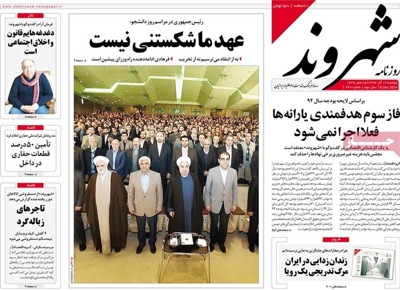
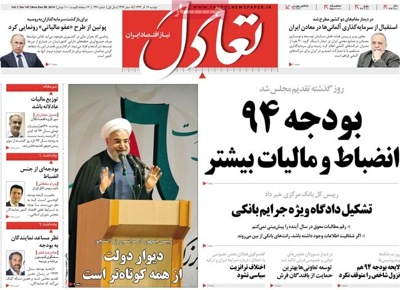
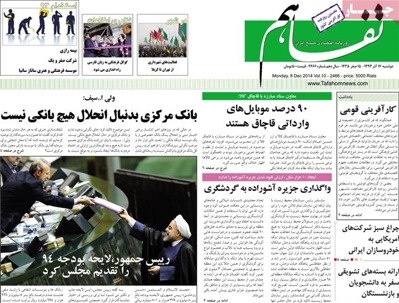
A look at Iranian newspaper front pages on Nov. 25

Iranian Newspapers Headlines

After days of speculations about the outcome of nuclear talks between Iran and world powers, which finally came to an end on November 24, all Iranian dailies, without exception, gave extensive coverage to the Vienna negotiations. The two sides have agreed to extend the negotiations for another seven months; every month, $700 million in Iran’s frozen assets will be released, they reported.

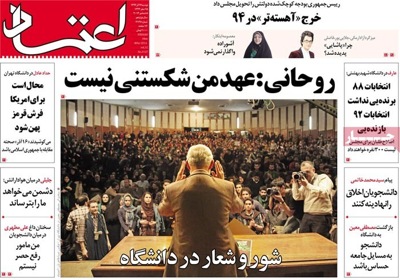
Abrar: “Mohammad Farhadi [President Rouhani’s fifth choice for the Ministry of Science, Research and Technology] will run the ministry with new faces in managerial positions.”


Abrar newspaper 11 - 25


Afarinesh: “Disagreements have undermined Islamic countries,” said Chairman of the Expediency Council Akbar Hashemi Rafsanjani in a meeting with Chairman of the Supreme Judiciary Council (SJC) of Qatar.


Afarinesh newspaper 11 - 25


Afkar: “We still look at the process of nuclear talks positively,” said Vice-Speaker of the Iranian Parliament Mohammad Hassan Abutorabi.


Afkar newspaper 11 - 25


Arman-e Emrooz: “Seven-day negotiations have been extended for seven months.”

Arman-e Emrooz: “We are victors; the world has no choice but hold talks with Iran,” said President Rouhani.


Armane emruz newspaper 11 - 25


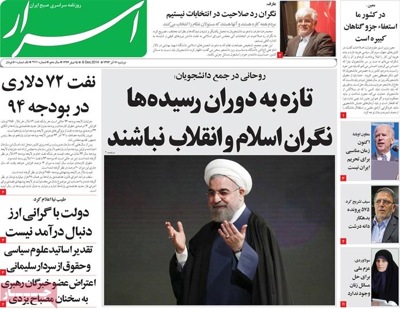
Asrar: “I am opposed to the hardline approach of the Islamic Revolution Stability Front [an ultra-principlist party],” said Ali Motahari, a principlist MP representing Tehran in parliament.

Asrar: “Cash subsidies by the government will continue next year [starting on March 21, 2015],” said Government Spokesman Mohammad Bagher Nobakht.


Asrar newspaper 11 - 25


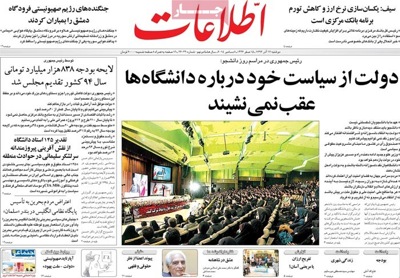
Ettela’at: “Winners of Jalal Al-e-Ahmad Literary Awards [given to the best Iranian authors each year] have been named.”

Ettela’at: “Some economic sanctions slapped against Iran have been lifted,” said the economy minister.


Ettelaat newspaper 11 - 25


Hambastegi: “The performance of Iran’s negotiating team reflected the decisions of the establishment,” said the Iranian defense minister.


Hambastegi newspaper 11 - 25


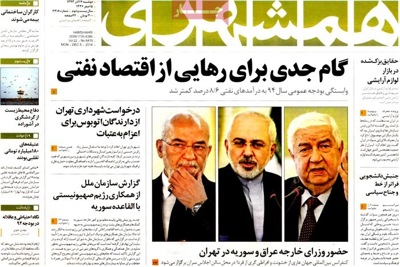
Hamshahri: “The Chinese are reigning on Iran’s car market.”


Hamshahri newspaper 11 - 25


Hemayat: “Tehran and Doha have cut judicial deals.”


Hemayat newspaper 11 - 25


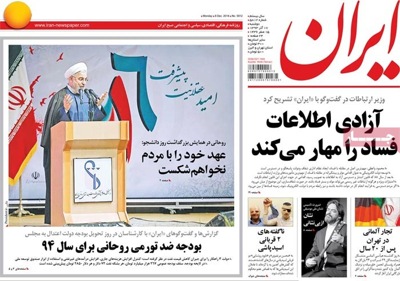
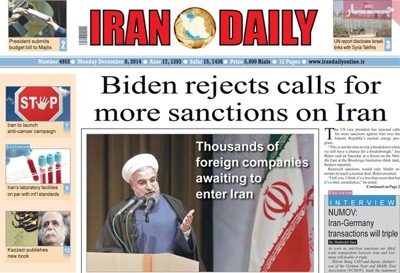
Iran Daily: “[Gov’t Spokesman]: Development budget to rise by 20%”


Iran daily newspaper 11 - 25


Jahan-e Sanat: “Release of $700 million in Iran’s frozen assets on a monthly basis has marked the finish line of Vienna marathon nuclear talks.”


Jahane sanaat newspaper 11 - 25


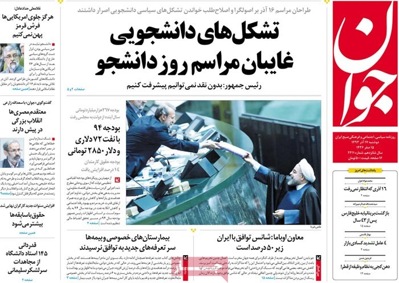
Javan: “On the closing day of a global conference in Qom, in central Iran, Muslim scholars, who gathered to discuss Takfiri and extremist groups, have laid emphasis on consensus among Sunnis and Shiites to confront extremist groups.”

Javan: “Seven-month artificial respiration is given to nuclear diplomacy.”


Javan newspaper 11 - 25


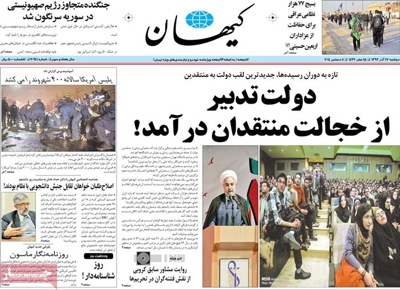
Kayhan: “We should not turn to foreigners in our quest for dignity and authority,” said Commander of the Islamic Revolution Guard Corps Major General Mohammad Ali Jafari.

Kayhan: “The village chief [a reference to America] proved untrustworthy; sanctions have been extended;” read the banner headline of the daily.


Kayhan newspaper 11 - 25


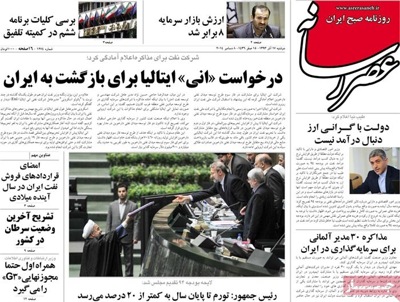
Khorasan: “Mobile data tariffs have dropped by 80 percent.”


Khorasan newspaper 11 - 25


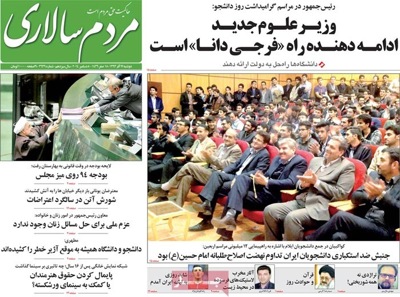
Mardomsalari: “The Islamic Republic of Iran is looking for peaceful relations in the future,” said Chairman of the Expediency Council Akbar Hashemi Rafsanjani.
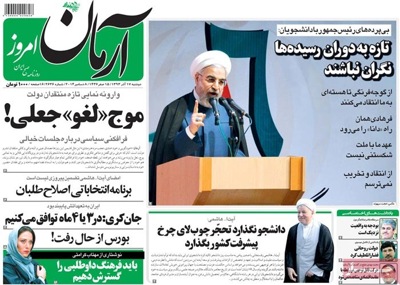
 

Mardom salari newspaper 11 - 25


Rah-e Mardom: “Mohammad Farhadi [President Rouhani’s fifth pick to lead the Ministry of Science, Research and Technology] will get confirmation from parliament,” said a number of MPs.


Rahe mardom newspaper 11 - 25


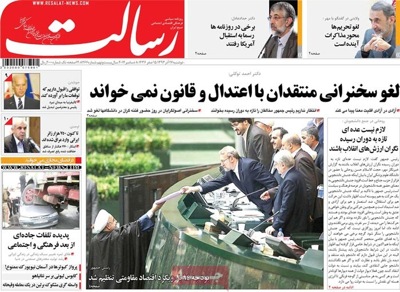
Resalat: “The International Atomic Energy Agency (IAEA) has realized that the information offered by the terrorist Mojahedin-e Khalq Organization was unreliable.”


Resalat newspaper 11 - 25


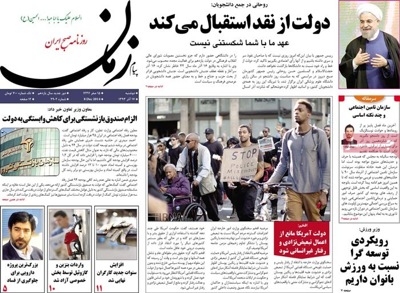
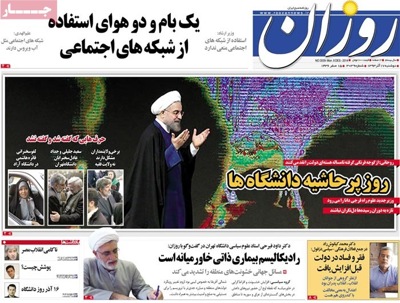
Roozan: “Disrupting the economic system of the country is the new charge facing Saeed Mortazavi, a former Tehran prosecutor.”

Roozan: “Commanders of the Islamic Revolution Guard Corps (IRGC) and Basij (volunteer force) have taken a harsh stance against America in a series of anti-US conferences.”


Ruzan newspaper 11 - 25


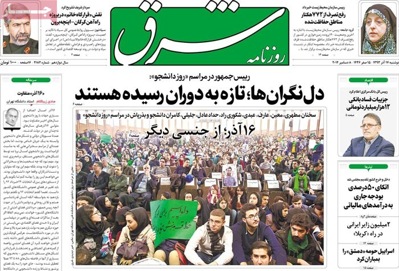
Sharq has described extension of nuclear talks as “renewal of hope”.


Shargh newspaper 11 - 25


Tehran Times: “Oil advances for a third day as Iran seeks OPEC production cut.”

Tehran Times: “Iran accounts for about 40% of Islamic banking assets: IMF, WB.”


Tehran times newspaper 11 - 25


Vatan-e Emrooz: “US Secretary of Defense Chuck Hagel has been forced to resign.”

Vatan-e Emrooz: “The Geneva Interim Agreement has been extended for another seven months; one year into the Geneva deal, the achievement amounts to nothing.”


Vatane emruz newspaper 11 - 25


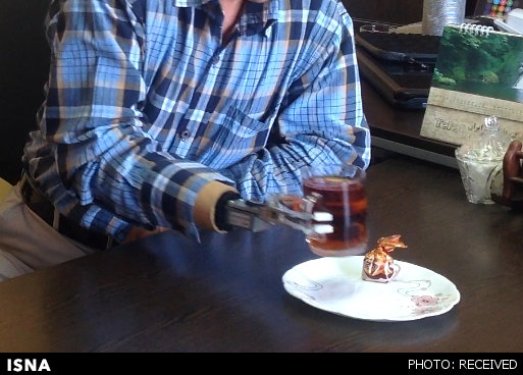
Iranian neurosurgeons successfully perform DBS surgery

Iranian neurosurgeons

Neurosurgeons at Shiraz University of Medical Sciences successfully conducted a Deep Brain Stimulation (DBS) surgery on two patients.

Dr. Ali Razmkon who led this surgical team called this operation one of the most advanced in medical sciences and said, “due to the sensitivity of this operation, very few centers in Iran are able to do it, and for the very first time it was performed in Shiraz on two 22-year-old patients diagnosed with dystonia, a neurological movement disorder.”

He pointed to similar operations done on these two patients with Parkinson and tremor prior to the main surgery and said, “with the success of these two surgeries, the second phase of operations started on a 22-year-old woman who had difficulties moving her limbs and could not walk on her own.”

“The other patient, too, genetically suffered from serious movement disorder, and so far no effective treatment has been identified for this kind of ailment,” he said.

Dr. Ali Razmkon maintained that more than 70 percent of these patients’ disorders have been treated during this 10-hour surgery and expressed hope for their complete recovery in the near future.

“Patients afflicted with Parkinson’s disease, movement disorders, tremors, dystonia, obsessive compulsive disorder, severe depressions and certain types of seizures resistant to treatment can undergo operation with the help of this surgical procedure,” he said.

Iranian mobile games popular among gamers

mobile game

Three Iranian mobile games with more than 450,000 downloads in less than 3 months have become extremely popular with Iranian gamers.

Fighting Cocks, Granny & the Grim Reaper, and Lazy Balls are three Iranian games which have hit the Café Bazaar (an Iranian application market for Android platform) since August, and managed to attract a large number of game enthusiasts within such a short span of time.

According to the developers of Fighting Cocks, this game with more than 350,000 downloads is the most popular Iranian game. This competitive online game is an interesting adaptation of Cocks Fighting but in a whole new style and without violence, developed at Yara Kish Company.

Lazy Balls and Granny & the Grim Reaper with 50,000 downloads each are the second and third most popular Iranian mobile games.

Granny & the Grim Reaper is a 2D Android game with beautiful graphics and has been developed by Fanoos Game.

Lazy Balls, developed by Rayan Afzar Kabir, has a simple gameplay with 80 levels in which players try to obtain the highest score.

With support from Iran National Foundation of Computer Games, game companies and developers in Iran were able to reach great achievements in less than ten years and attract a large audience among the Iranian gamers.

Zarif: Nobody questions Iran’s enrichment program

Iran-Zarif-nuclear

Iranian Foreign Minister Mohammad Javad Zarif says Iran has the right to have an enrichment program under any deal with P5+1.

Zarif made the remarks at a press conferences at the end of week-long talks between Iran and P5+1 – Russia, China, France, Britain, the US, and Germany– in the Austrian capital Vienna on Monday.

“I do not believe that anybody any longer questions Iran’s enrichment program. We believe that right of Iran to the peaceful nuclear energy, including uranium enrichment, is enshrined in the NPT (Non-Proliferation Treaty), which does not require anybody’s recognition. The right is there. What is important is for Iran to be able to implement that right, to exercise that right without the threat of sanctions and pressure which are, in our view, illegal,” Zarif stated.

“I believe everybody has worked hard particularly over the last week… in order to overcome rather important differences” between Iran and P5+1, Zarif said, adding, that the discussions centered on two objectives — ensuring that Iran’s nuclear program remains peaceful and sanctions imposed on Iran are lifted.

“We have always said that Iran has no strategic interest in nuclear weapons and nuclear weapons don’t serve our strategic interests,” Zarif further said, adding, “Nuclear weapons are against every principle of our faith and our beliefs.”

“We seek to develop nuclear energy for peaceful purposes,” Zarif noted.

The Iranian foreign minister further touched upon the issue of illegal sanctions imposed on Iran, saying, “The sanctions are not only misguided… but are totally ineffective.”

“Sanctions do not resolve the problem,” Zarif stated. “Only, and I stress, only a negotiated resolution” can lead to the termination of standoff between Iran and the West over Tehran’s nuclear energy program.

“We believe that a negotiated resolution is within reach,” he asserted.

A political agreement between Iran and the six countries is within reach with a positive-sum rather than zero-sum perspective, said the Iranian foreign minister, adding that four months are enough to resolve outstanding issues in the nuclear negotiations.

The top diplomat further said that the rest of a now extended seven-month deadline would be used to put complicated technical issues into a final agreement.

In their last round of talks before a November 24 deadline, Iran and P5+1 held nearly a week of intense negotiations in Vienna on how to tackle the remaining obstacles that exist in the way of reaching a comprehensive agreement.

At the end of the talks, the two sides agreed to extend the Joint Plan of Action to July 1, 2015.

President Putin: Iran has right to enrichment on its own soil

Russian-President-Putin

Russian President Vladimir Putin has emphasized Iran’s right to enrichment on its own soil.

The Russian president made the remarks in a Monday telephone conversation with Iranian President Hassan Rouhani after Iran and the Sextet of world powers agreed to extend the nuclear talks for seven months.

“It matters that the negotiations lead to Iran’s achievement of its rights, especially in the area of enrichment, and enrichment on its own soil is Iran’s right,” Putin stated.

He further said that during the talks between Iran and P5+1 the two sides “lacked only time for reaching a comprehensive agreement.”

Putin expressed hope that the negotiations culminate in an acceptable agreement that encompasses the interests of all sides.

The Iranian president also expressed hope that the talks lead to a comprehensive agreement which is in favor of all nations, the Middle East, and the world.

In their last round of talks before a November 24 deadline, Iran and P5+1 — Russia, China, France, Britain, the US, and Germany — held nearly a week of intense negotiations in Vienna on how to tackle the remaining obstacles that exist in the way of reaching a comprehensive agreement.

At the end of the talks, the two sides agreed to extend the Joint Plan of Action to July 1, 2015.

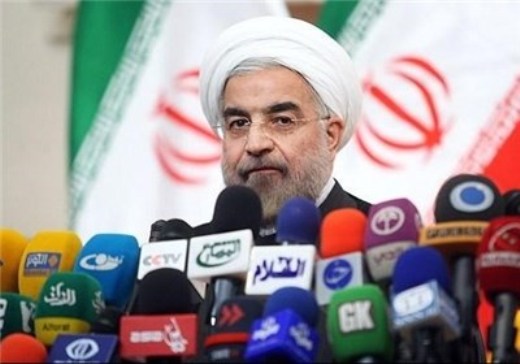
Iran will not bow to pressure, sanctions: Rouhani

Iran-Rouhani
Iran-Rouhani

“Today, the opposite negotiating sides have reached the conclusion that pressure and sanctions on Iran will not bear fruit,” Rouhani said in a live television interview on Monday after Iran and the six countries agreed to extend the nuclear talks for seven months.

He added that the Islamic Republic would never give up its nuclear rights, saying that the country’s nuclear facilities would certainly remain operational and Iran would never stop its centrifuges.

He noted that Iran pursues two main objectives in its talks with the P5+1 group, which include keeping its nuclear technology and lifting sanctions on Tehran.

“At present, no one in the world has any doubt that Iran must have nuclear technology, including enrichment on its soil, and no one has any doubt that sanctions must be lifted,” Rouhani added.

The Iranian president also pointed out that the Iranian nation will be the final winner in the negotiations with the P5+1 countries over Tehran’s nuclear program.

Rouhani emphasized that the path of nuclear negotiations would lead to a final agreement, noting that all the sides in the nuclear talks had consensus on the extension of the nuclear talks as an effort to reach a final goal.

“Iran’s logic is one of negotiations and dialog; and nuclear talks will be continued with seriousness until a final agreement is struck,” he said.

Stressing that the latest round of nuclear talks in Vienna was positive, Rouhani added that although the negotiating sides failed to reach a final agreement, they managed to take steps forward because the conditions now are “completely different from [what they were] three months and six months ago, logics have come closer together and may of gaps have been filled.”

The sides took steps to reach an understanding and a final agreement “but reaching a written and final agreement needs time,” he added.

In their last round of talks before a November 24 deadline for reaching a comprehensive nuclear deal, Iran and the P5+1 countries — the United States, Russia, China, Germany, France and Britain — held nearly a week of intense negotiations in Vienna on how to tackle the remaining obstacles that exist in the way of reaching an agreement.

At the end of the talks, the two sides agreed to extend the Joint Plan of Action to July 1, 2015.


Iran committed to Joint Action Plan: US

Kerry-Iran-Nuclear

Speaking at a Monday press conference in Vienna after the last round of nuclear negotiations, Kerry pointed to criticism of the Joint Plan of Action (JPOA), signed between Iran and the P5+1 last November, noting, “The interim agreement wasn’t violated. Iran has held up its end of the bargain, and the sanctions regime has remained intact.”

“We want the people of Iran to get the economic relief that they seek and to be able to rejoin the international community. We want to terminate the sanctions. Yes, we want to terminate the sanctions,” the secretary of state said.

“Today, Iran has no 20-percent enriched uranium; zero; none; and they have diluted and converted every ounce that they have and suspended all uranium enrichment above five percent,” Kerry said, adding, “Today, IAEA (International Atomic Energy Agency) inspectors have daily access to Iran’s enrichment activities and a far deeper understanding of Iran’s program.”

“That is how you build trust and that is how Iran made the decision to do it,” Kerry said, pointing out that the IAEA inspectors “have been able to verify that Iran is indeed living up to its JPOA commitments.”

He lauded the achievements made in the course of latest round of nuclear negotiations, saying, “In these last days in Vienna, we have made real and substantial progress and we have seen new ideas surface.”

“Progress was indeed made on some of the most vexing challenges that we face and we now see the path toward potentially resolving some issues that had been intractable,” the top US diplomat noted, adding, “We believe a comprehensive deal that addresses the world’s concerns is possible. It is desirable.”

He also praised the efforts by all the parties engaged in the talks, including the efforts devoted by Iranian Foreign Minister Mohammad Javad Zarif, saying, “The Iranian foreign minister has worked hard and he has worked diligently, has approached these negotiations in good faith and…that is what it takes to try to resolve the kind of difficult issues here.”

“We are jointly – the P5+1 six nations and Iran – extending these talks for seven months with a very specific goal of finishing the political agreement within four months.… At the end of four months, if we have not agreed on the major elements by that point in time – and there is no clear path – we can revisit [to see] how we then want to choose to proceed,” Kerry said.

The nuclear talks between Iran and the P5+1 group of countries ended in Vienna on Monday with the two sides agreeing to extend the Joint Plan of Action to July 1, 2015.

Iran, the United States, Russia, China, Germany, France and Britain held nearly a week of intense negotiations on how to tackle the remaining obstacles that exist in the way of reaching an agreement.

Under the Joint Plan of Action reached between the two sides in November 2013, a final comprehensive deal aims to give assurances that Tehran’s nuclear program is exclusively peaceful and, at the same time, lift all sanctions imposed against the Iranian nation over the country’s nuclear energy program.

Iran has repeatedly said its nuclear program is for peaceful purposes, including generating electricity and making radioisotopes for its cancer patients.

Iran complies with interim nuclear agreement: IAEA

Iran-IAEA-Vienna

The IAEA issued a positive report on Monday hours after Iran and the P5+1 ended breathtaking negotiations in the Austrian capital, Vienna, and agreed to extend the Joint Plan of Action to July 1, 2015, in order to reach a comprehensive deal on Tehran’s nuclear program.

The UN nuclear agency’s confidential report, obtained by Reuters, said Iran has lowered the stockpile of low-enriched uranium gas and taken other action as part of a series of moves agreed under the terms of the preliminary agreement.

Iran has always shown goodwill to clear any ambiguities about its nuclear program and the country’s nuclear facilities have been under constant IAEA supervision.

Iran and the P5+1 group of world powers – Russia, China, France, Britain, the US and Germany — held talks in Vienna over the past seven days to hammer out a comprehensive deal on Tehran’s nuclear program.

Under the Joint Plan of Action reached between the two sides in November 2013, a final comprehensive deal aims to give assurances that Tehran’s nuclear program is exclusively peaceful and, at the same time, lift all sanctions imposed against the Iranian nation over the country’s nuclear energy program.

Iran has repeatedly said its nuclear program is for peaceful purposes, including generating electricity and making radioisotopes for its cancer patients.

Iran, P5+1 make progress in nuclear talks: German FM

Frank-Walter-Steinmeier

“We have made progress, new ideas have been put on the table,” Steinmeier said on Monday at the end of seven days of talks between Iran and the six countries over Tehran’s nuclear program.

“The ideas have the capacity to bridge several differences that are still there. But because there are technical details, we have to say that the new ideas must be tested by experts,” he added.

The German minister said Iran and the P5+1 failed to bridge all the gaps but they are in the “right direction” and the atmosphere of the Vienna talks has been very constructive.

He urged the two sides to make use of the chance they have made in order to end a decade-long dispute over Iran’s nuclear issue.

“We are hoping to use this chance but we also have a responsibility not only towards ourselves but also towards all states in the world and the region and countries which have justifiable concerns about Iran’s nuclear program,” Steinmeier added.

He emphasized that both Iran and the P5+1 should resume intensive talks in the coming days and weeks, noting that a few months should be used to reach a framework that can later be complemented by a few details.

“But that at this moment, nobody is disappointed at the talks and I think all the participating parties believe there’s a chance to reach an agreement,” the German minister pointed out.

Meanwhile, Russian Foreign Minister Sergei Lavrov said on Monday that “substantial progress” has been made in the Vienna nuclear talks but Iran and the P5+1 have failed to reach a final agreement.

“Substantial progress was made,” Lavrov said, adding that he expects the sides would manage to agree on the “basic principles” of a final document in three or four months.

The nuclear talks between Iran and the so-called P5+1 group of countries – Russia, China, France, Britain, the US and Germany — ended in Vienna on Monday with the two sides agreeing to extend the Joint Plan of Action, which they signed last November, to July 1, 2015.

Iran nuclear talks to resume in December: Hammond

UK-Hammond

Hammond made the remarks on Monday after an agreement between Iran and the six world powers to extend the nuclear talks to July 1, 2015.

“There will be no pause, we will have meetings through December, we are determined to get to the outline of an agreement within the next three months and then spend the remaining period of the extension working out the precise detail and the technical schedules that would have to be done anyway,” he said.

Hammond expressed regret over the fact that the two sides did not reach a final agreement before the deadline, but hailed the significant progress the parties made in the latest round of negotiations.

“Well it’s a disappointment (failing to meet the Monday deadline) but as you say, there has been momentum and there has been good will on both sides and the atmospherics are positive,” he said.

In their last round of talks before a November 24 deadline for reaching a comprehensive nuclear deal, Iran, the United States, Russia, China, Germany, France and Britain held nearly a week of intense negotiations in Vienna on how to tackle the remaining obstacles that exist in the way of reaching an agreement.

Under the Joint Plan of Action reached between the two sides in November 2013, a final comprehensive deal aims to give assurances that Tehran’s nuclear program is exclusively peaceful and, at the same time, lift all sanctions imposed against the Iranian nation over the country’s nuclear program.

Iran has repeatedly said its nuclear program is for peaceful purposes, including generating electricity and making radioisotopes for its cancer patients.