Friday, January 2, 2026
Home Blog Page 5023

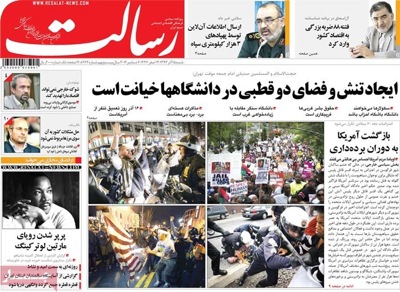
A simple game with complicated players: Editorial

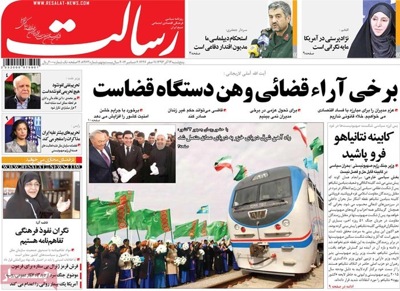
Resalat Daily

Resalat newspaper in its editorial on November 22 focused on the complexity, or rather lack thereof, associated with the ongoing nuclear talks, stressing that talks over Iran’s nuclear program are originally part of a simple problem which requires a simple solution, but that other factors have complicated the negotiating process. The following is a partial translation of the editorial:

[…]

The multiple-variable equation emerging in the talks is not the direct result of an innate complexity of the nuclear talks, nor is it because of extraterrestrial or metaphysical factors!

“Complexification of nuclear talks” is a process spearheaded by the West in three areas: “Official diplomacy”, “Public diplomacy” and “Secret diplomacy”.

That a simple equation has turned into one with multiple variables is not the consequence of a hard riddle; rather, it has been created as a result of the complex role played by those involved in the talks.

[…]

[As the talks are coming closer to their end,] negotiators may encounter the following in the remaining days: “total breakdown of the talks”, “conclusion of a final deal”, “finalization of an interim deal identical to the Geneva Agreement”, and “an agreement on general outlines”.

As things stand, the first two options seem out of the question. On the one hand, P5+1 believes that it is far from logical to walk away from the talks now that they have made some breakthroughs, and on the other hand, preconditions needed to reach a final, detailed deal are practically impossible to meet.

Excessive demands by Washington and failure of P5+1 to make up their mind in a real, diplomatic way to guarantee the conclusion of a final deal are largely to blame for the suspenseful state of affairs.

This situation has pushed the last two options into the game. In other words, “a reason for extension”, and not the extension itself, will be the main dividing line between Vienna talks (the one prior to the first deadline back in July) and the current negotiations (ahead of the second deadline on November 24).

This cuts both ways. On the upside, it would offer a bigger chance [to Iran] to concentrate more on gaps and not to get excited in dealing with the West (the party with excessive demands in the talks).

On the downside, however, it would create fissures in nuclear talks and produce fresh frictions. More importantly, failure by the US to make a crucial decision coupled by feet-dragging on the part of Washington and its fellow P5+1 members – which keeps them stuck in the talks which were held ahead of a first deadline – clearly indicates that they are not yet ready to accept the inalienable rights of the Iranian nation. Under these circumstances, Iran’s lack of confidence in P5+1 is growing progressively.

The sway the ill-intentioned regional and international players hold with what is going on in the nuclear talks explains why the parties involved still remain split and why members of P5+1 are trying to put a spanner in the works.

There are glaring examples which reveal the true colors of the players who have sat around the negotiating table facing Iranian diplomats, among them: A recent backchannel warning by Saudi officials to Paris that Riyadh would decrease its arms purchases from France in case a nuclear deal is signed with Iran; extensive consultations between the Zionist regime and US officials; and [the formation of] a European troika trying hard to prevent the conclusion of a deal with Iran.

In the meantime, other factors are also responsible for the creation and continuation of the current state of affairs: the passive role Russia and China play in the talks, and in some cases Moscow’s deterring role in resolving the outstanding questions such as the way Iran’s basic needs are to be met and the way the UN Security Council sanctions [against Iran] should be lifted (something which arises from miscalculations by Russia and China merely seeking to serve their own interests).

At this point it is clear that the Islamic Republic of Iran should not let its guard down in dealing with ill-intentioned players in the nuclear talks.

Also, P5+1 members should bear in mind that the destructive role they play in doubting the unquestionable rights of the Iranian nation is closely watched in the court of the world public opinion.

Deep-seated popular distrust of the US and its European allies, and the serious questions [the Iranian nation] wants to put to Russia and China should be the first and foremost priority of the Iranian team when they sit down for nuclear talks.

Backpedalling from this attitude, which has been adopted based on the lofty teachings of the Islamic Revolution and comments of the late Imam Khomeini and the Supreme Leader, would prompt the other party to display more rebellious intransigence and ask for more concessions.

An expo of hand-woven carpet in Qom

Iran-Qom Carpets Expo

Looms, warps and woofs are just the means to weave a floor covering of any kind, but it is love which helps the threads, running lengthwise and crosswise, to create a work of art which is matchless: a hand-woven carpet.

Khabaronline posted a photo gallery of an exhibition of hand-woven Persian carpets in the central city of Qom (November 17-22). Here are some of the photos:


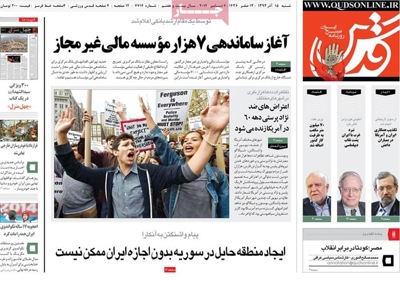
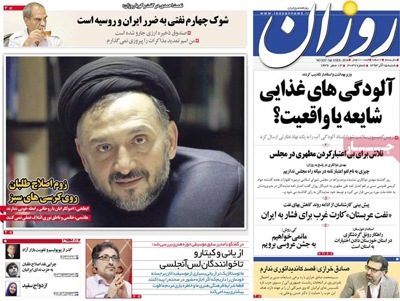
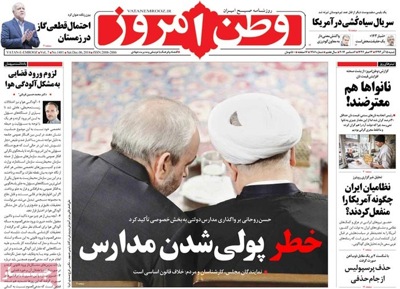
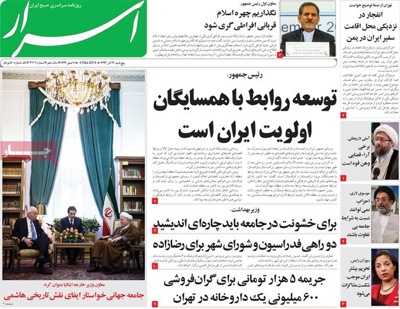
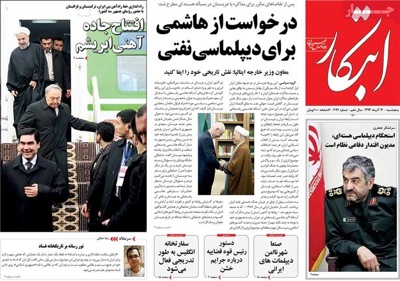
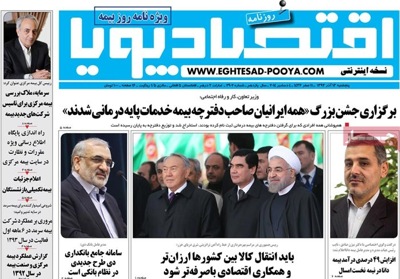
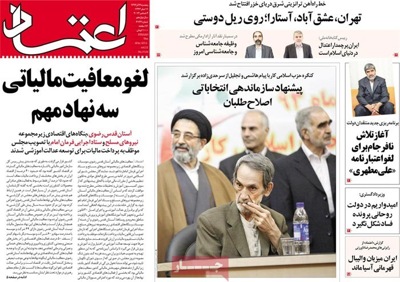
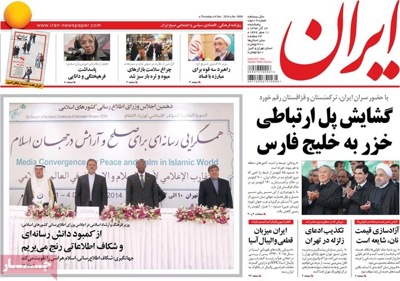
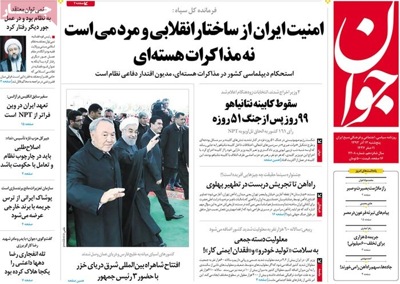
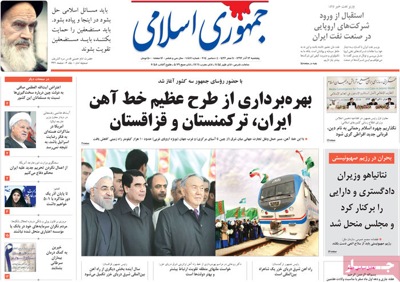
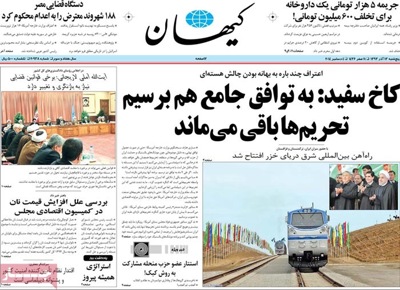
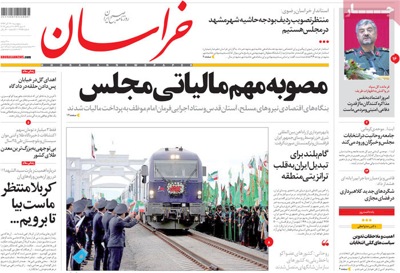
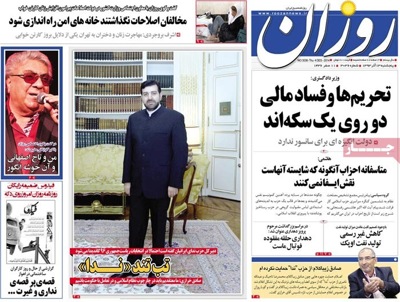
A look at Iranian newspaper front pages on Nov. 23

Iranian Newspapers Headlines

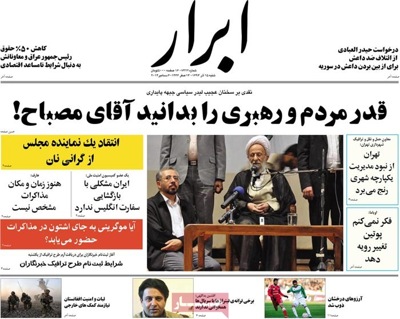
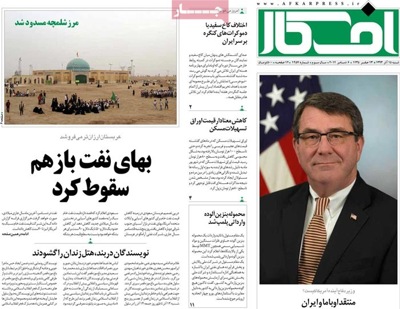
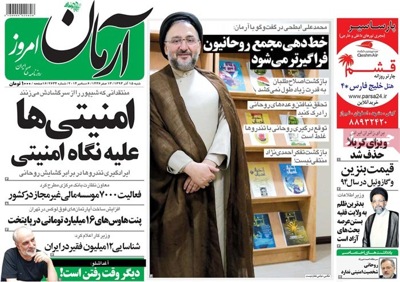
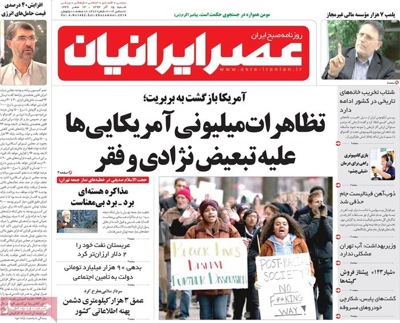
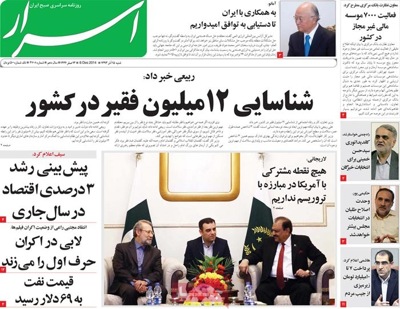
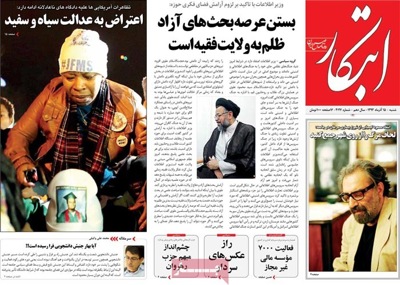
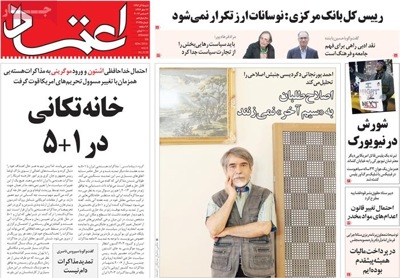
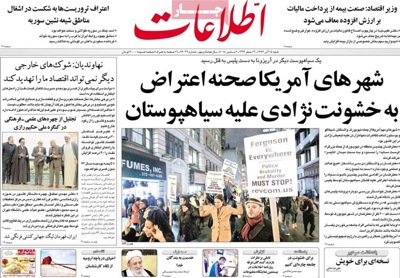
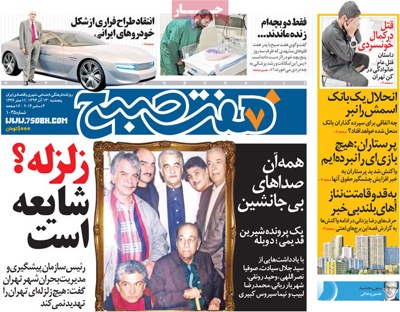
With a November 24 deadline for a nuclear deal approaching fast, the press coverage of ongoing talks between Iran and P5+1 in Vienna has become more extensive by the day; speculations about whether or not a final deal will be struck and analytical reports about the likely impact of different probable outcomes on the Iranian nation were splashed across the front pages of newspapers on Sunday. A decree by the Supreme Leader which allowed acting Minister of Science, Research and Technology Mohammadali Najafi to carry on running the ministry until a minister gets confirmation from parliament grabbed headlines too. News about a much-anticipated soccer derby pitting two archrivals of the capital – Esteghlal and Persepolis – against each other later Sunday was another top story of the day.

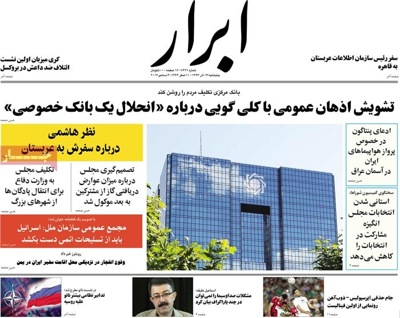
Abrar: “Parliament is likely to grant a vote of confidence to Mohammad Farhadi [President Rouhani’s fifth pick to lead the Ministry of Science, Research and Technology],” predicted Mohammad-Reza Bahonar, a principlist MP.


Abrar newspaper 11 - 23


Afarinesh: “All [that was achieved in] nuclear talks over the last year was put on the line thanks to a political shift in America,” said Chief of Staff of the Iranian Armed Forces Major General Hassan Firuzabadi.

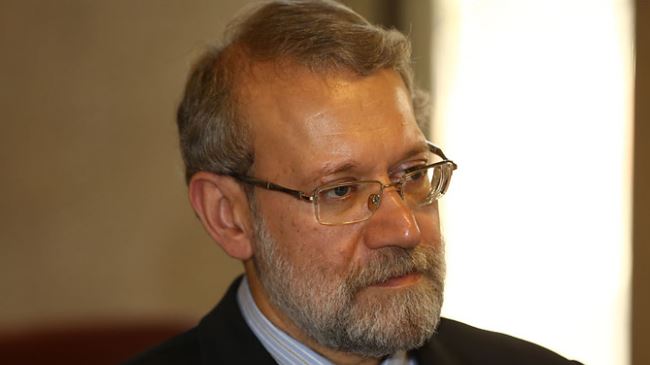
Afarinesh: “The battle against terrorism by the countries which have played a role in its emergence is not possible,” said Parliament Speaker Ali Larijani.
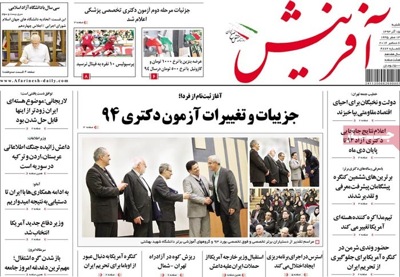
 

Afarinesh newspaper 11 - 23


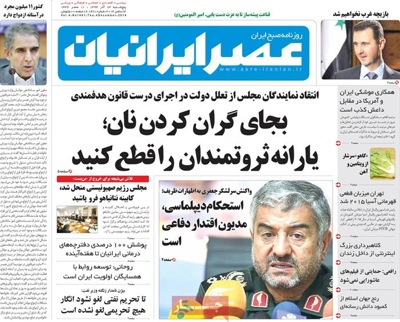
Arman-e Emrooz: “With the Supreme Leader’s go-ahead, acting Minister of Science Mohammadali Najafi has been reinstated temporarily until a minister secures a vote of confidence from parliament to take over the ministry.”
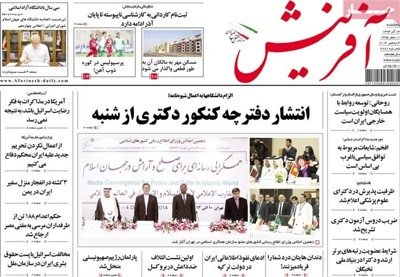
Arman-e Emrooz: “Foreign Minister Mohammad Javad Zarif has been playing a jihad-like role in nuclear talks,” said Chief of Staff of the Armed Forces Major General Hassan Firuzabadi.


Armane emruz newspaper 11 - 23


Asr-e Eghtesad has quoted the minister of industry, mines and tradeas saying that his ministry is in talks with some African countries which want to invest in Iran’s mining sector.


Asre eghtesad newspaper 11 - 23


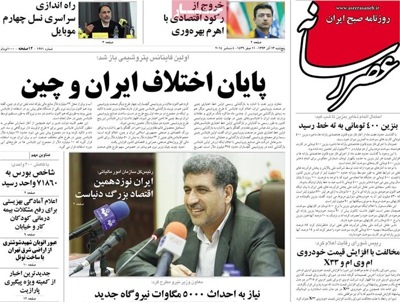
Asr-e Rasaneh: “The Money and Credit Council will definitely lower interest rates,” said the president of the Supreme Council on State-run Banks.


Asre resaneh newspaper 11 - 23


Emtiaz: “One hundred and fifteen movies will be vying for top prizes in the 33rd edition of Fajr International Film Festival in February, 2015.”
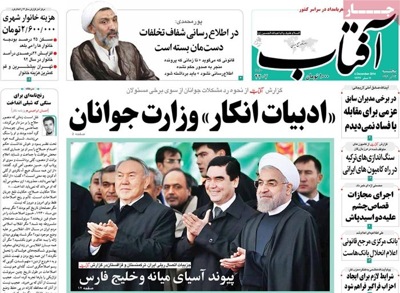
 

Emtiaz newspaper 11 - 23


Etemad: “Iran’s Paralympic shooter, Sareh Javanmardi, has been chosen as Asia’s best female athlete of the year.”
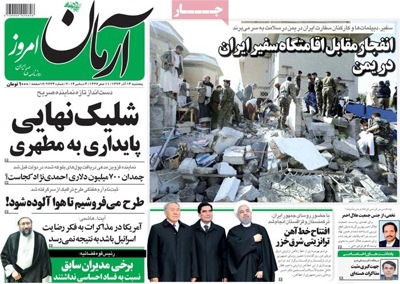
 

Etemad newspaper 11 - 23


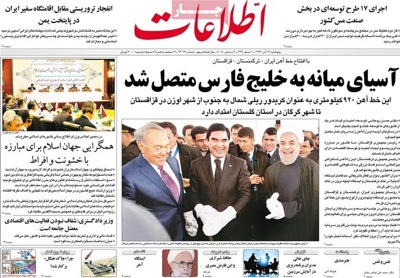
Ettela’at: “Iran’s navy has been equipped with state-of-the-art torpedoes,” said Commander of the Iranian Navy Rear Admiral Habibollah Sayyari.


Ettelaat newspaper 11 - 23


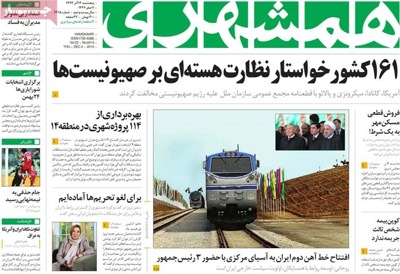
Hambastegi: Five days into nuclear talks between Iran and world powers in Vienna, Foreign Minister expressed hope, “God willing things will look up.”


Hambastegi newspaper 11 - 23


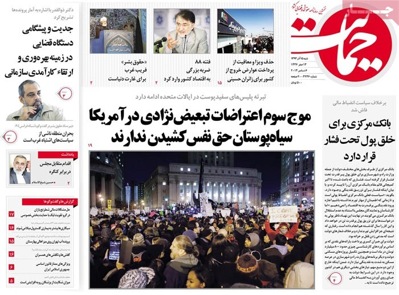
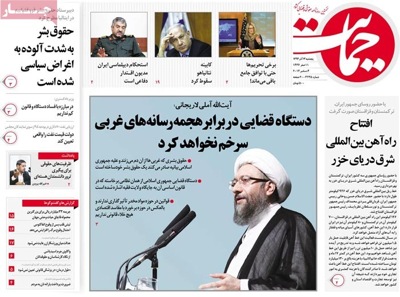
Hemayat: “The plan to grant justice minister more powers has been dismissed by the Guardian Council on the grounds that it is unconstitutional.”


Hemayat newspaper 11 - 23


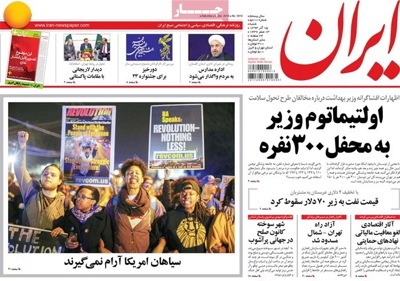
Iran: “Esteghlal and Persepolis [the most famous football clubs of the capital and long-time city rivals] will square off today. Will the spell of goalless draws be finally broken?”


Iran newspaper 11 - 23


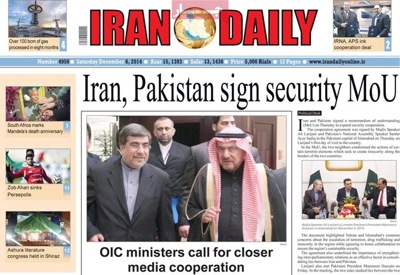
Iran Daily: “German FM: Iran, West never closer in more than 10 years.”


Iran daily newspaper 11 - 23


Jahan-e Sanat: “The budget plan for next year [starting March 21, 2015] has been finalized in the Planning Department of the Presidential Office to be handed to the government for confirmation.”


Jahane sanaat newspaper 11 - 23


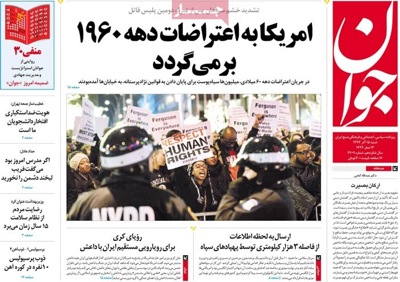
Javan: “The Iraqi army has launched a military offensive to wrest control of Ramadi [a central city] from ISIL fighters.”


Javan newspaper 11 - 23


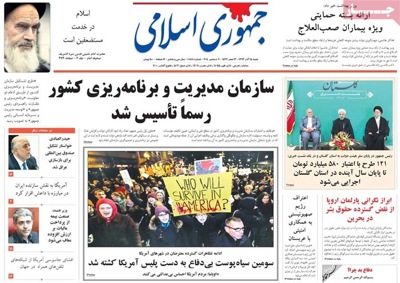
Jomhouri Islami: “Fateh (Conqueror) submarine and Damavand destroyer are set to be unveiled,” said Commander of the Iranian Navy Rear Admiral Habibollah Sayyari.


Jomhurie eslami newspaper 11 - 23


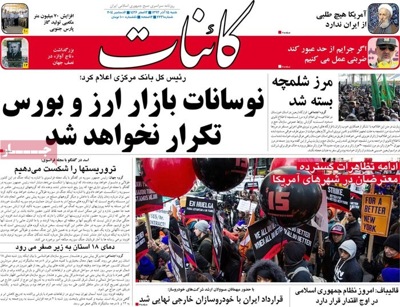
Kaenat: “The country will be blanketed in snow; more rain is on the way,” forecast Iran’s Meteorological Organization.

Kaenat: “There are footprints of palm oil in dairy plants,” warned the director of Iran’s Food and Drug Administration.


Kaenaat newspaper 11 - 23


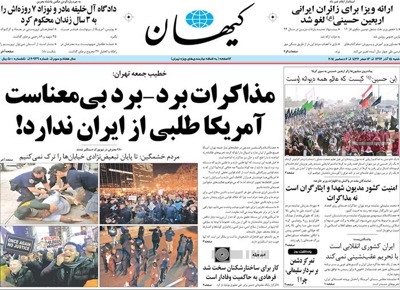
Kayhan: “The period in which doctors were so special has come to an end, their threat to leave the country is only a bluff,” said Health Minister Hassan Hashemi in response to threats by doctors who are unwilling to comply with medical tariffs to leave the county to practice medicine elsewhere.

Kayhan has put an analytical report about the latest developments of nuclear talks in Vienna under the heading of ‘America is in pursuit of both an agreement and sanctions’.


Kayhan newspaper 11 - 23


Mardomsalari: “Oil Minister Bijan Namdar Zanganeh is to have a meeting with his Saudi opposite number in the run-up to the 166th OPEC ministerial meeting scheduled to be held in Vienna on November 27.”


Mardom salari newspaper 11 - 23


Rah-e Mardom posed a question on its front page under the headline “Is a November 24 deadline [between Iran and P5+1 to clinch a deal] a beginning or an end?”


Rahe mardom newspaper 11 - 23


Roozan: “Foreign Minister Mohammad Javad Zarif will hand Iranian people an immortal victory,” predicted Chairman of the State Expediency Council Hashemi Rafsanjani.


Ruzan newspaper 11 - 23


Tejarat: “Iran will find its way out of recession by March 21, 2015,” said Governor of the Central Bank of Iran Valiollah Seif.


Tejarat newspaper 11 - 23


A large haul of smuggled birds was seized in southern Iran

smuggled birds
smuggled birds

The environmental police in the southern Iranian province of Sistan and Baluchestan have seized 380 birds while inspecting a dhow in the Sea of Oman. What appears below is the translation of a report posted by the website of Iran Environment and Wildlife Watch on the story on November 24:

Maritime police in cooperation with environmental police in Chabahar [the provincial capital of Sistan and Baluchestan] intercepted an Iranian dhow in the Sea of Oman. The search of the vessel turned up 140 falcons and 240 houbara bustards. Eight Iranian and Pakistani nationals were taken into custody.

“The birds had been smuggled out of Pakistan and were en route to Arab countries in the Persian Gulf. The dhow has been confiscated and its crew, an Iranian captain and Pakistani owners of the haul, are being interrogated,” said Director General of the Environment Protection Department of Chabahar Saeed Mahmoudi.

“Unfortunately, as a result of improper shipment, a number of the birds died, but the rest of them were handed to the provincial environment department and are now in the care of experts and environmental police,” he added.

“An adequate amount of food has been supplied and the birds are being cared for and fed by experts. The seized birds are likely to be released into the wilderness in southern Iran after they have received enough care and food,” he concluded.


An extension of nuclear talks is not to the benefit of Iran: Principlist website

Nuclear Talks
Nuclear Talks

On Saturday November 22, eaworldview.com [a news website featuringdaily news and analysis about Syria, Iran and the wider Middle East as well as US and Russian foreign policy] quoted reliable sources as saying that Iran was considering a new proposal by P5+1. It said although the proposal did not enshrine a comprehensive deal, it entailed progressive mechanisms in specific areas which would support an extension of the negotiations until March.

With the countdown to the deadline for a nuclear deal on, Alef, a news website run by Ahmad Tavakoli [a very influential Iranian MP], posted an analysis under the heading of “Is the extension of nuclear talks to the benefit of Iran?” What comes below is the translation of the piece in its entirety:

These days, most international media report that an extension of nuclear talks is likely. The question is in case a comprehensive deal is not concluded with the West, would an extension of the talks be a good alternative?

It seems that extension of the Geneva Interim Agreement at a time when no progress has been made would not be to the benefit of the government, rather it would help the West buy time. Such a concession would keep sanctions in place and constrain Iran’s peaceful nuclear program once more to make Tehran acquiesce to the excessive demands of America.

Vienna 8 nuclear talks are being held as many believe that talks in Muscat could have marked the end of the confrontation between Iran and the West. However, the showdown did not come to an end there, leaving the knot to be untied at the negotiating table in Vienna.

With only a couple of days left before a November 24 deadline, there are only three options ahead for the negotiating sides: Striking a final deal and putting an end to nuclear talks which are in their 12th year; extending the talks and postponing the final accord until later; or failing [to reach a deal] and returning to where the two sides were before the Geneva Interim Agreement.

Out of the three options, none can be regarded as the definite outcome of the Vienna talks, but an analysis of each can indicate which one can possibly offer the best solution.

As for the first option, to clinch a final deal, the West, the US in particular, are required to abandon excessive demands and as President Rouhani said at the close of a Cabinet meeting they should not use their internal problems as a pretext to make excessive demands.

Generally, Iran has done what it was required to do. There has been as much transparency as possible in Iran’s atomic program. There is only one part left, the same outstanding issue that Director General of the International Atomic Energy Agency (IAEA) Yukiya Amano pointed out on November 20. However, as a diplomat close to Iran’s negotiating team told the BBC Iran has put off final cooperation with the IAEA until a final deal has been clinched. To put it simply, that is Iran’s last trump card against the West. If Iran fulfilled this request [bowing to a tougher inspection regime], it would have met all Western demands and would be left with no bargaining chip if a deal was not struck.

In case Iran and the West failed to cut a final deal, they would have to opt for either of the two remaining options: an extension of the Geneva deal or a return to where they were before that agreement.

It seems that an extension of the Geneva Interim Agreement would be more to the benefit of the other side than Iran. With oil prices at their lowest in years, Europe does not import Iranian oil as much as it did three years ago and does not have any concerns about its energy supplies in the upcoming winter. The question is why they wouldn’t want to keep Iran in the present conditions.

Realistically thinking, we should not count much on optimistic analyses that America is in pursuit of a deal with Iran. Of course, America could restore peace and stability to the region with the help of Iran at a lower cost.

So we should know that keeping Iran in these conditions won’t harm American or Western interests. Will it have the same impact on Rouhani’s government? Definitely not, particularly, for a president who swept to power on a platform of interaction with the world, believing that he could untie the nuclear knot his own way.

What should be done?

In case Iran and the West fail to cut a comprehensive deal in the time left, Iran’s negotiating team could seriously contemplate the option of not extending the Geneva Interim Agreement. Because failure to strike a comprehensive deal would mean that no knot has been untied and disagreements over fundamental matters – especially the lifting of sanctions and scale of Iran’s uranium enrichment – remain unresolved. That would also mean that ten months after the Geneva deal the views of the two sides are far from close.

The release of some of Iran’s frozen assets was the only positive aspect of the Geneva deal for Iran. Although no further new sanctions were slapped on Iran, the absence of further sanctions was exposed to lots of ifs and buts thanks to Obama’s policies on sanctions.

Unfortunately, a major problem associated with the performance of Iran’s negotiating team was that they postponed bargaining over the lifting of sanctions until the eleventh hour. If they had done it from day one, the other side would have been on the defensive and would have been denied the chance to make excessive demands.

We are of the opinion that bargaining over the outright removal of sanctions could have been made from the get-go instead of talking about ‘suspension’ rather than ‘removal’ of sanctions a few months ahead of the deadline.

All in all, an extension of the Geneva Interim Agreement has a clear message for the West: The motto of Iran’s government and nation is based on the fact that we try our utmost to get things transparent and in the absence of a deal, it would dawn on the world that the West is turning to excuses to confront Iran.

An extension of the talks without knots being untied, would in fact put Iran in a weaker position. It’s time for Iran to seriously consider the option of no deal and think of new solutions or at least draw a distinction between what it says and what it does.

New submarine, destroyer to join Iran Navy soon: Cmdr.

Fateh submarine and Damavand destroyer

The commander of the Iranian Navy says a new domestically-manufactured submarine and a home-made destroyer will soon join the country’s naval fleet.

Rear Admiral Habibollah Sayyari said at a press conference on Saturday that Iran will soon unveil Fateh (Conqueror) submarine and Damavand destroyer.

Sayyari added that two newly-overhauled SH combat helicopters and an anti-surface AB212 helicopter will soon be at the disposal of the Iranian Navy.

Fateh, which weighs nearly 500 tons, is Iran’s latest semi-heavy submarine.

In recent years, Iran has made major breakthroughs in its defense sector and attained self-sufficiency in producing important military equipment and systems.

Iran has so far launched different classes of home-made advanced submarines including Fateh, Ghadir, Qaem, Nahang, Tareq and Sina.

In January 2013, Iran also unveiled the combat helicopter Toufan 2 (Storm 2), which enjoys modern and advanced technologies, including high-precision targeting capability.

The Islamic Republic has also conducted several military drills to enhance the defense capabilities of its armed forces and to test modern military tactics and equipment.

Iran says its military might poses no threat to other countries, stating that its defense doctrine is based on deterrence.

Iran ready to send arms to Iraq in battle against terror

General Hassan Firouzabadi

A high-ranking Iranian military commander says the Islamic Republic is ready to legally provide military equipment to Iraq to help Baghdad in its fight against terrorism.

“We are ready, if requested by the Iraqi government, to send weapons and [military] equipment to Iraq through legal channels,” Iranian Armed Forces’ Chief of Staff Major General Hassan Firouzabadi told reporters on Saturday.

He added that Tehran provided military advice to Baghdad, noting that Iraq’s security is intertwined with that of Iran.

The top commander said Iran also lent support to Iraq’s Kurdistan Regional Government (KRG) with the approval of the Iraqi central government to support Kurds’ fight against the ISIL militants.

The ISIL terrorists control large parts of Syria’s east and north. ISIL also sent its Takfiri militants into Iraq in June, seizing large swathes of land straddling the border between Syria and Iraq.

The Iraqi army has so far made gains in the fight against the ISIL militants, pledging to continue the battle against the extremist violent group.

The extremist group has threatened all communities, including Shiites, Sunnis, Kurds and Christians during its advances in the violence-torn Arab state.

Influential daily warns nuclear negotiators to insist on removal of sanctions

Iran-Nuclear-Talks
Iran-Nuclear-Talks

The editorialist of Kayhan argues that imposition of unfair sanctions against Iran was not simply because of Iran’s nuclear program – rather those sanctions were rooted in the hegemonic nature of the US administration and the revolutionary nature of our country.

On the campaign trail when candidate Rouhani raised hopes by promising that sanctions would be lifted, seasoned individuals knew that those simplistic pledges would lead nowhere. They also knew that the victory of Hassan Rouhani in presidential elections would result in no changes in America’s policies to favor Iran’s interests.

Without naming names, the editorialist recalls the early months of Rouhani’s presidency and says, “Back then, simply by virtue of opposition [to the olive-branch approach of President Rouhani and his colleagues] you would be accused as benefitting from continued sanctions.” But more than one year on, the pessimistic can easily see that those statements were anything but the truth!

Hossein Shamsian, the editorialist who seems to have little hope of talks between Iran and P5+1 producing a deal in Vienna, or even at a later stage – In fact, he seems to have been pessimistic about a solution to the dispute in the first place – says what candidate Rouhani said on the campaign trail was different from what actually happened. The president had said, “The wheels of people’s lives should spin, so should the centrifuges.” The solution to the nuclear issue lies in direct talks with the headman [a reference to the US], he argues.

Thanks to gray areas in the Geneva Interim Agreement, which has been the basis of talks over the past year, scope of enrichment and not “removal of sanctions” has been given priority in the negotiations.

kayhan newspaper 2014-11-22Kayhan, which is widely known to reflect the viewpoints of principlists and the most important political and policymaking center in the Islamic Republic of Iran, goes on to describe efforts made in 10 rounds of nuclear talks so far, and says: “So far, the agenda of the talks has changed much to our detriment. Besides, the hasty drafting of the Geneva Agreement resulted in nothing but serious restrictions on Iran’s nuclear activities, loss of a large chunk of the country’s nuclear treasure in return for some words, and of course the return of a few billion dollars of our own money in long-term installments.

“Still, that is not all. Over the past year since the conclusion of the deal, despite all its shortcomings, the agreement has not been implemented equally by both sides. As the president has said by the admission of senior Western officials Tehran has acted in full compliance with its commitments, but P5+1, especially the US, have time and again ignored their commitments and taken new hostile measures against Iran such as imposition of sanctions and disruption to Iranian trade.”

The editorial goes on to say, “In these circumstances, now that we are at a sensitive juncture to secure a deal, a few points are worth mentioning about the Vienna talks:

1. America has implied, in the clearest language possible, that it is not trustworthy. How can one be clearer? President Obama signed an extension to Iran sanctions, and US senators sent a letter to President Obama calling on him to put Iran’s missile program on the agenda of the talks.

2. As talks continue and we keep making concessions, America’s international arms, that is to say the UN and the International Atomic Energy Agency, are pulling out all the stops in cooperating with the West. They are trying to set the stage, legally, for imposition of America’s will on the Iranian people. The biased and untruthful report of the UN nuclear agency which comes on the back of numerous inspections suggests that the IAEA is unable to comment on the nature of Iran’s nuclear program.

3. Some anti-national-interests behaviors and comments at home have prompted Americans to believe we need to strike a deal at any cost. Such an approach has simply given rise to the excessive demands of the enemy. They don’t even bother to pay attention to the approach of the Iranian government, the numerous concessions it has made and the broken taboos, the most glaring example of which is the American failure to grant visa to Iran’s choice as representative to the United Nations.

4. As Sirus Nasseri [a senior nuclear negotiator during the presidency of Reformist Mohammad Khatami] has said haste in drafting the agreement, like what happened in the first Geneva deal, is an experience that should not be repeated. Concerns that a hastily-drafted deal might not be legally compelling enough and thus be open to interpretation and abuse, are legitimate.

5. What people expected from so many comings and goings and several rounds of talks which involved the breaking of the taboo of holding talks with the Great Satan was not a few photos with the US secretary of state or a return of a few billion dollars of their own money. The most important thing that the president promised during his campaign and was reiterated later by himself and other officials was that unfair sanctions would be lifted. Frankly, if the sanctions are not terminated, we have achieved nothing.

Sareh Javanmardi named Asia’s top female athlete of 2014

Sareh Javanmardi

Iran’s Paralympic shooter, Sareh Javanmardi, has been named Asia’s best female athlete of the year thanks to two gold medals she won at the 2014 Asian Para Games which were held in Incheon, South Korea in October.

The Iranian Student News Agency (ISNA) reported on November 22 that Sareh’s brilliant performance in the Asian Games earned her the much-coveted title.

She claimed a gold medal in the Mixed 50 meter pistol SH1 and finished first in the Women’s P2-10m Air Pistol-SH1.

Also, Iran’s Paralympic Committee won the Asian Paralympic Committee (APC) award in 2014. It was credited for the remarkable showing of the Iranian Men’s Team in Incheon Asian Para Games.

The awarding ceremony will take place in Asian Paralympic Committee (APC) on December 2 in Abu Dhabi, UAE.

Iran owes its independence to Sheikh Safi al-Din Ardabili

Hossein Nasr
Hossein Nasr

A conference on “Islamic Spirituality and the Needs of Humanity Today” was held in Imperial College London on November 17 to commemorate Sheikh Safi al-Din [Ishaq] Ardabili, an Iranian mystic and poet (1252–1334).

Seyyed Hossein Nasr, a professor at the George Washington University who has penned Islam in the Modern World, was a speaker at the get-together which marked the 700th anniversary of Ardabili’s demise.

Ettela’at newspaper filed a report on November 22 on Nasr’s speech at the conference, which convened at the invitation of the London Academy of Iranian Studies (LAIS) and in cooperation with the Muslim Students Association.

Islamic Spirituality and the Needs of Humanity TodayHere comes a partial translation of the speech in which Nasr referred to the Sheikh’s big help to Iranian society and said that Iranians should remain grateful to him for his substantial contribution to Iran’s independence:

Sheikh Safi al-Din immeasurably helped Iran gain independence. He was a mystic who had a central role in building the culture and civilization of the world of Islam. His lofty teachings continue to be used in efforts to build and develop the Islamic civilization and culture.

The Sheikh, who has been a great scholar in Iran and the world of Shiism, was the pioneer of the idea of proximity between Islamic denominations.

What the Sheikh taught was based on the Holy Koran and the traditions of the Household of the Prophet Muhammad (PBUH). Islamic spirituality is the backbone of Islamic art, knowledge and ethics. Islamic mysticism and spirituality is also the pure essence of the Iranian literature.

Attention to the environment makes no sense in the absence of an Islamic spiritual thinking. According to the Islamic thinking, nature, which has been created by God, is animate; thus it is sacred and should be respected. […]

Extremism in the world of Islam which has manifested itself in the horrible acts of terror committed at the hands of the Islamic State of Iraq and the Levant (ISIL) [militants] in Syria and Iraq has been produced jointly by money and ignorance.

[…]