Sunday, April 12, 2026
Home Blog Page 4978

Larijani urges stronger unity among Palestinian groups

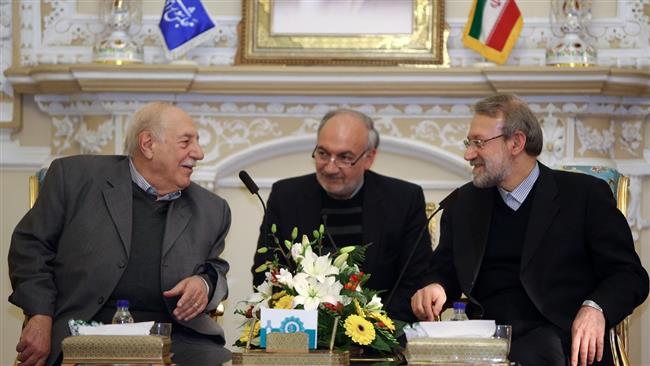
Larijani-palestine

Iran’s Parliament Speaker Ali Larijani, has emphasized the need for stronger unity and solidarity among all Palestinian groups against the occupying regime of Israel and its Western allies.

In a meeting Monday with Ahmed Jibril, the head of the Popular Front for the Liberation of Palestine-General Command (PFLP-GC), in Tehran, Larijani praised the Palestinian nation’s resistance in the face of the Israeli occupation.

He further said the Muslim world attaches great significance to the liberation of Palestinian lands from the Israeli occupation, adding that Iran’s foreign policy “is to stand by the Palestinian people and support them” against Israeli bullying and the regime’s evil nature.

The top Iranian parliamentarian also condemned the Israeli regime’s recent aerial assault that killed several members of Lebanese resistance movement Hezbollah during a field reconnaissance mission in Syria’s southwestern city of Quneitra on Sunday.

The new Israeli crime shows the Zionist regime is working hand in glove with the Takfiri terror groups operating against the Syrian government, Larijani said, adding, “The axis of [anti-Israel] resistance should be strengthened through stronger unity and cohesion among Palestinian, Syrian, and Lebanese forces.”

On Sunday, an Israeli military helicopter fired two missiles into Amal Farms in the strategic southwestern city of Quneitra, close to line separating the Syrian part of the Golan Heights from the Israeli-occupied sector.

Hezbollah said in a statement that 25-year-old Jihad Mughniyeh, the son of slain Hezbollah top commander Imad Mughniyeh, and five other fighters lost their lives in the fresh Israeli aerial assault against Syria.

Jibril, in turn, thanked the Islamic Republic for backing the Palestinian cause and the liberation of Israeli-occupied al-Quds, adding that the Palestinian nation will always be grateful for Iran’s unwavering support.

The Palestinian official also pointed to the latest developments in the Middle East, describing the ongoing crises in Iraq and Syria as a plot hatched by the hegemonic powers against the anti-Israel resistance front in the region.
Tehran working to answer IAEA’s remaining questions: Iranian nuclear chief

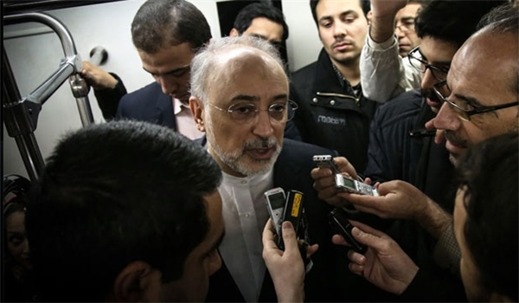
Salehi-IAEA

Head of the Atomic Energy Organization of Iran (AEOI) Ali Akbar Salehi announced on Monday that Tehran is working on responses to the only two remaining questions of the International Atomic Energy Agency (IAEA).

“The IAEA had 18 questions and we have responded to all of them but two; they say that they haven’t been convinced and need more answers and we are trying to respond to them,” Salehi told reporters in Tehran.

Stressing that the IAEA is regularly inspecting different nuclear sites in Iran, he said the UN nuclear watchdog has a resident inspector in Iran who is replaced every two weeks.

In relevant remarks in November, the Caretaker of Iran’s Permanent Mission to the UN Gholam Hossein Dehqani underscored that Tehran would continue its cooperation with the IAEA to remove any ambiguities about the country’s peaceful nuclear program.

Addressing the UN General Assembly in the presence of Director-General of the IAEA Yukiya Amano in New York, Dehqani rejected alleged military dimensions to Iran’s nuclear program, saying that Iran had no weapons program.

[…]

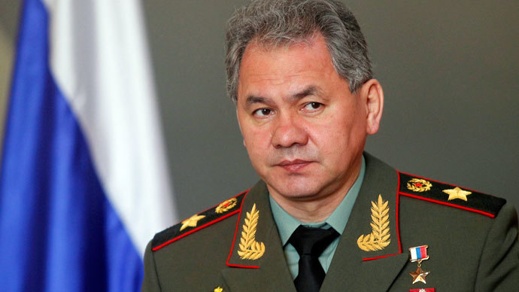
Russian defense minister’s Iran visit helps boost strategic cooperation

Russian Defense Minister Sergei Shoygu

Iran and Russia face common regional and international threats, due mainly to their geopolitical positions. The two countries need to expand their security cooperation so that they can ensure stability in the region and tap into such stability to promote regional cooperation.

Ties with Iran are important to Russia, since Iran is a key regional country which connects Asian countries to the Middle East on the one hand and links the former Soviet republics in the north to the Persian Gulf in the south on the other.

That lends added importance to a trip by Russian Defense Minister Sergei Shoygu to Tehran [on Monday]. According to the Iranian embassy in Moscow, he is scheduled to meet with his Iranian counterpart Brigadier General Hossein Dehghan and Chief of Staff of the Iranian Armed Forces Major General Hassan Firuzabadi.

The Islamic Republic News Agency (IRNA) on January 18 ran a report on military cooperation between Iran and Russia which is to be boosted by the Russian defense chief’s trip to Tehran. The following is a partial translation of the report:

The visit by the Russian official comes in response to a trip last year by the Iranian defense minister to Moscow. The exchanges involving the two countries’ officials are indicative of mutual trust in Iran-Russia ties and the strong determination of the two Caspian neighbors’ leaders to enhance relations and diversify their cooperation.

[…]

Experts say that at the current juncture Iran and Russia need to upgrade their ties more than ever, arguing that the existing challenges Russia faces – especially from the West in recent months – render the synergy between the two countries all the more important.

[…]

In ties between Iran and Russia, drugs smuggling takes on political and security importance since Russia believes that the US is likely to smuggle narcotics from Afghanistan to Russia to create a tenuous situation in Russia by feeding addiction.

Russian officials have time and again expressed dissatisfaction with the fact that drugs cultivation in Afghanistan has increased more than forty-fold during the US-led occupation of the country.

[…]

This is good reason for Russia to attach great significance to expanded cooperation with Iran as far as the fight on drugs trafficking goes. Moscow classifies the issue of drugs as a top national security matter.

[…]

Another consequential point in Iran-Russia ties is their common stance on ISIS which is currently flexing its muscles in Syria and Iraq and endangering the security of the entire Middle East through its terrorist activities.

[…]

Media sources say that hundreds of Russian nationals, especially those of Chechen origin, are taking part in terrorist activities in Syria and Iraq as part of the ISIS armed units. These forces along with ISIS warlords have announced that they intend to create a caliphate in Russia’s Caucasus region.

[…]

Russian officials take note of the fact that if Iran had not stood up to terror groups, the terrorists would have built on schemes hatched by the West and the US to attack the Caucasus. That would have eroded the relative stability that prevails in the Caucasus today. That’s why Moscow pays particular attention to cooperation with Iran, especially on security and military fronts.

[…]

The trip by the Russian defense minister to Iran, which is the first foreign trip by a senior Russian official this year, shows that Moscow is determined to develop all-out ties with Tehran and raise bilateral relations to strategic levels. Mutual respect and care for the other side’s interests are central to ties between the two friendly neighbors.

We are entitled to blue skies

blue sky

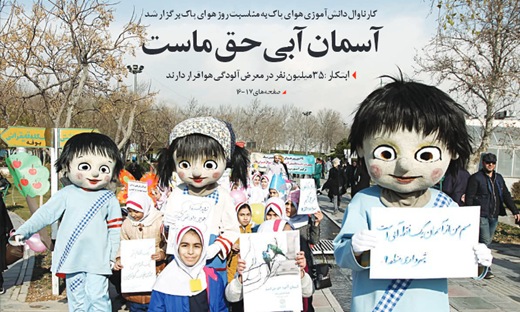
A number of Iranian students staged a small rally on a Tehran street on Sunday to call on adults, including urban officials, to do more to ensure their right to clean air. The rally came on the eve of January 19 which marks the Clean Air Day in Iran. The following is a partial translation of a report the Monday edition of Shahrvand daily ran on the carnival of clean air:

“Polluted air is disgusting. We want clean air,” chanted students in a Tehran park, as they expressed their resentment at air pollution.

The children also called on adults to do what it takes to help the city breathe in clean air.

They were carrying placards which among other things read, “Clean air and earth is our wish” and “Where is the blue sky of our city?” At the rally, the very young participants were asked to draw in deep breaths, and try not to cough in the process.

The students were urged by organizers to use public transport, stop littering and plant trees if they want to make pollution of air and water a thing of the past. The event came to an end with the students planting houseplants.

Iran beat UAE 1-0, win top spot in AFC Asian Cup 2015 Group C

Iran-UAE

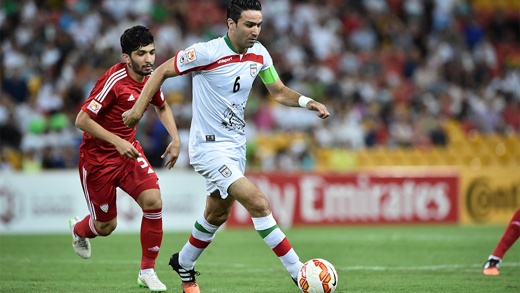
Iran defeated the United Arab Emirates 1-0 in the final round of the AFC Asian Cup Group-C at the Brisbane Stadium on Monday (January 19).

The win against the UAE in the final Group C encounter helped Iran finish at the top of the group standings, thus avoid holders Japan in the quarter-finals.

The two sides, which had won both of their games already, were guaranteed places in the quarter-finals regardless of Monday’s result.

The UAE needed a draw to finish top of the group, but it was a must-win game for Iran if they were to avoid meeting the reigning champions and red-hot favorites Japan, as they are heavily favored to top Group D.

Also on Monday, Bahrain beat Qatar 2-1 in Sydney to finish third in Group C in a match between two already eliminated teams.

Welfare Organization has built 68,000 apartments for welfare families in 10 months

houses
Homayoun Hashemi
Homayoun Hashemi

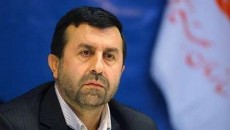
On January 19, the Islamic Republic News Agency (IRNA) quoted Homayoun Hashemi, the head of the State Welfare Organization of Iran, as saying that his organization has provided welfare families with as many as 68,000 apartments this year [started March 21, 2014]. The following is a partial translation of what Hashemi had to say to IRNA:


An additional 31,000 apartments are set to be handed over to welfare families who meet the requirements.

If the finances needed for electrical wiring and water and gas pipes are provided in time, the apartments will be poised for delivery by March 21, 2015.

Up to 80,000 of the 200,000 apartments the Welfare Organization has committed to constructing have already been handed to families and the rest is under construction.

The families who have more than one disabled member and those which are run by women will be given priority. Fortunately, thanks to the contribution of benefactors, the organization has gone beyond its commitments as far as housing is concerned.

A commission which specializes in housing has been set up and tasked with sizing up the older buildings to have them renovated if needed.

Iran slams Zionist airstrikes in Golan Heights

Iran Issues Statement on US Bid to Reinstate UN Sanctions

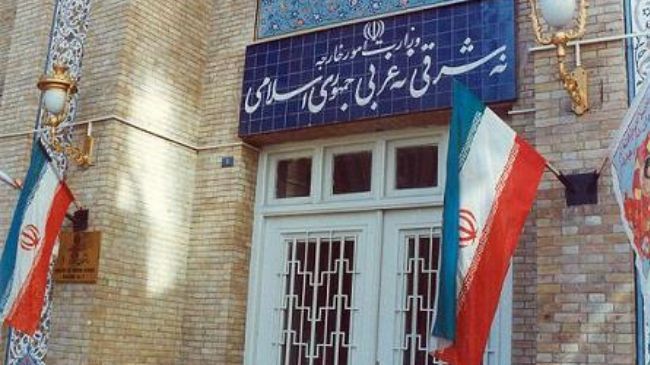
The Iranian Foreign Ministry on Monday strongly condemned the Israeli helicopter strike near the border town of Quneitra in the occupied Golan Heights in Syria which killed a number of the Lebanese Hezbollah resistance movement fighters.

The ministry in a statement also condoled with families of martyrs and expressed sympathy with those who survived the terrorist act.

‘The terrorist act indicates that the Syria war is a part of confrontation with the Zionist regime and that Hezbollah has stood firmly on the path of Jihad and martyrdom in the face of the occupation and foreign interference in the affairs of other nations,’ the statement added.

According to reports, a military helicopter gunship operated by the Israeli army fired two missiles into Amal Farms in the strategic city of Quneitra, situated some 60 kilometers (37 miles) south of the capital, Damascus, on Sunday. Two remote-controlled reconnaissance drones buzzed overhead as the airborne assault took place.

Following the attack on Sunday, Hezbollah announced that several of its fighters were martyred in the airstrike.

‘A group of Hezbollah combatants were martyred in a Zionist rocket attack in Quneitra, and their names will be revealed later,’ said a message on Hezbollah’s Al-Manar news channel, adding that they were killed during a field reconnaissance mission in the Amal Farms village of Quneitra.

Meanwhile, a Hezbollah official said Jihad Mughniyeh, the son of Hezbollah’s slain top military commander, Imad Mughniyeh, and a field commander were killed in the attack.

A Lebanese security source said the strike destroyed one Hezbollah vehicle entirely and damaged another.

The Tel Aviv regime has carried out several airstrikes in Syria since the start of the nearly four-year-old foreign-backed insurgency there.

Damascus says Tel Aviv and its Western allies are aiding Al-Qaeda-linked militant groups operating inside Syria.

The Syrian army has repeatedly seized huge quantities of Israeli-made weapons and advanced military equipment from the foreign-backed militants inside Syria.

The country has been grappling with a foreign-backed deadly crisis since March 2011. The violence has so far claimed the lives of nearly 200,000 people, according to the UN.

Sliding crude prices at the expense of alternative energies

Saudi Oil

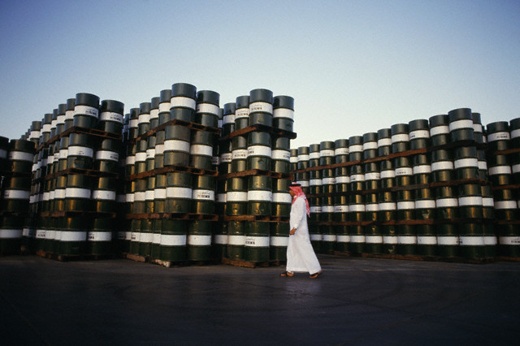
Mohsen Renani, an economist and a university professor, says that falling oil prices have not been hatched by Saudi Arabia. On January 17, Sharq newspaper filed an interview with Renani on who is to blame for the drastic drops in crude prices. The following is a partial translation of what he said in the interview:


Mohsen RenaniI think the drop in oil prices is neither a plot nor something outside the analysis I offered in The Political Economy of Iran Nuclear Dispute [a book written by Mohsen Renani]. What is certain is that a rise in oil production by Saudi Arabia and Libya has contributed to plummeting prices.

Naturally, the conflict between Russia and Ukraine can affect the oil market, but such an effect will come in the form of a hike in prices, not a drop. Russia, the world’s biggest crude producer, produces more than 10 million barrels per day, so any tension Russia gets engaged in will push up crude prices.

The abrupt plunge in prices seems likely to have been the result of overproduction by Libya and Saudi Arabia and the massive flow of [US] shale oil into the market.

The downward spiral of oil prices, which is something natural, started prior to Saudi Arabia’s decision [to keep its output unchanged]. The recent incidents just expedited the falling trend.

I do not buy arguments that Saudi Arabia refused to prevent price drops by reducing its output only to deal a blow to Russia, Syria and Iran.

Saudi Arabia, which mainly depends on oil revenues, has a long-term plan to sell oil for at least 40 years. Under this plan crude prices should not climb.

If oil prices go up, the production of alternative energies will be accelerated and oil will be removed from the global consumption basket or, to say the least, its share will be minimal. Thus Riyadh can no longer sell oil. That’s why the kingdom has to keep oil prices at a balanced level so that it can export oil in the next 40 years.

This is the way Saudi Arabia has generally looked at its oil output in the past four decades. To serve its long-term interests, Saudi Arabia does not seek a drop in production and an increase in prices.
This is the reason why Saudi Arabia has sped up the downward trend of prices. Even if Saudi Arabia did not cause the drop, the prices would naturally decline slowly.
Riyadh believes that prices should hover at around $50 instead of slumping to $35 or lower in three or four years due to the inflow of alternative energies. If so, the shale oil is removed from the production cycle or at least its production slows down and Saudi Arabia can export oil in the next 10 years.

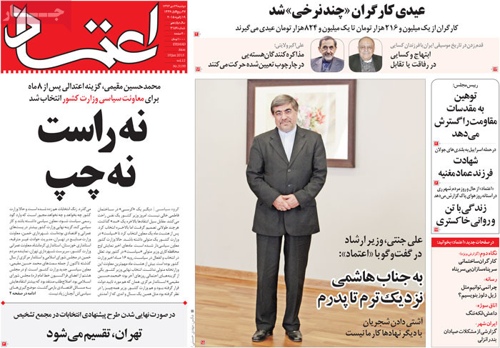
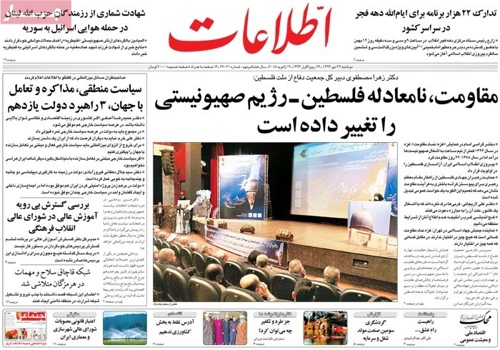
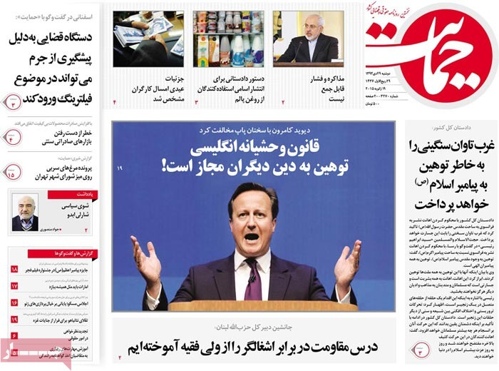
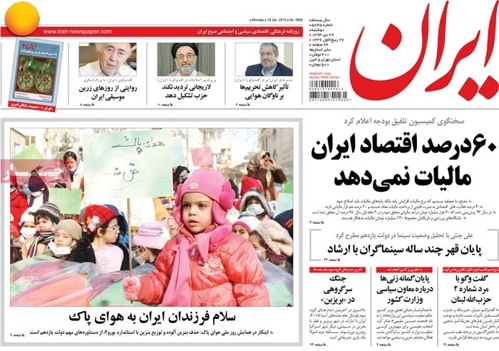
A look at Iranian newspaper front pages on Jan. 19

Iranian Newspapers Headlines

Appointment of a deputy interior minister months after the seat was vacated was the front-page news of many dailies on Monday. Also dominating the front pages of several newspapers were the martyrdom of a number of Hezbollah combatants in an Israeli raid on Syria, and the amount of annual bonuses laborers will receive at the end of the year.


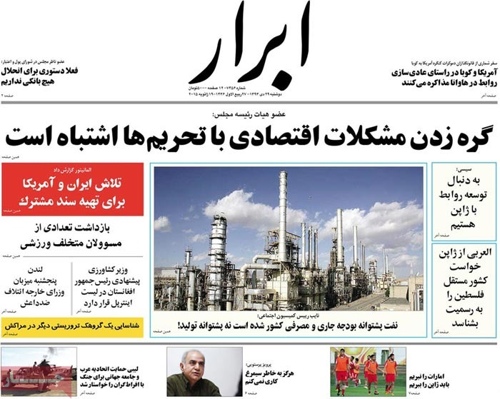
Abrar: “For now, there are no orders to dissolve any bank,” said an observer member of the Money and Credit Council. [His comments came after the Central Bank of Iran reported that one bank and a number of financial institutes are operating without proper permits.]


Abrar newspaper 1- 19


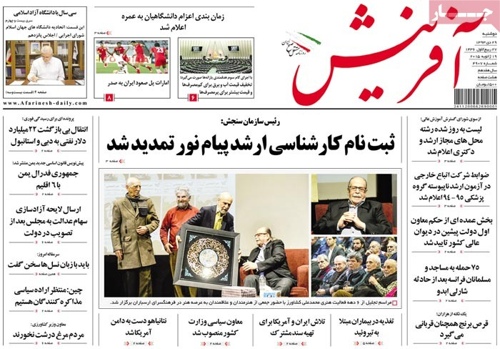
Afarinesh: The Supreme Court has upheld the main part of the ruling issued in the case of former first vice-president [Mohammad Reza Rahimi under Mahmoud Ahmadinejad].

Afarinesh: A ceremony has been held in honor of Mohammad Ali Keshavarz whose artistic career has spanned six decades.


Afarinesh newspaper 1- 19


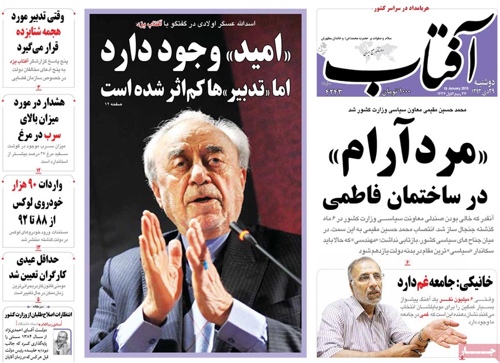
Aftab-e Yazd: Mohammad Hossein Moghimi has been named deputy interior minister for political affairs.

Aftab-e Yazd: The amount of lead in poultry is 47 percent more than the standard level.

Aftab-e Yazd: Between 2009 and 2013 some 90,000 luxury cars were imported.


Aftabe yazd newspaper 1- 19


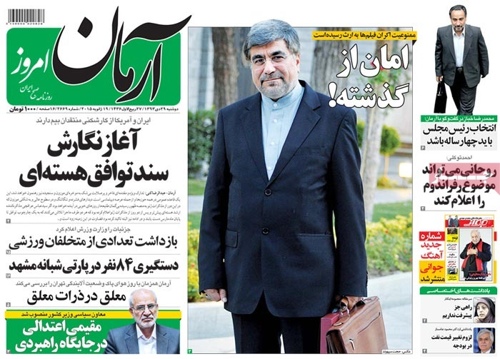
Arman-e Emrooz: The Ministry of Sports and Youth Affairs has announced that a number of individuals who have committed major sport offenses have been arrested.


Armane emruz newspaper 1- 19


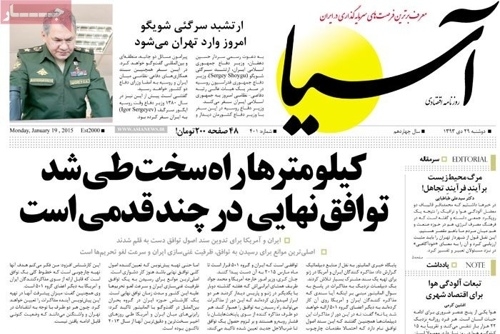
Asia: Russian Defense Minister Sergey Shoygu arrives in Tehran on Monday.


Asia newspaper 1- 19


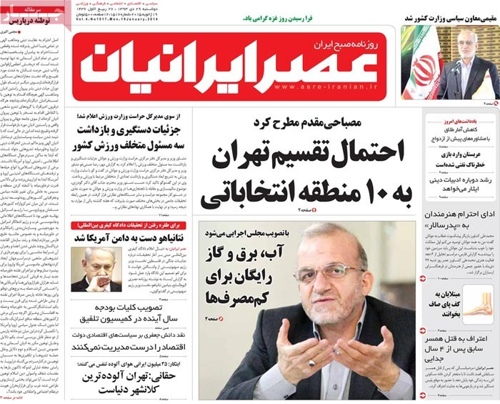
Asr-e Iranian: “After the go-ahead of parliament, water, electricity and gas offered to households with low consumption will be free,” said an MP.


Asre iranian newspaper 1- 19


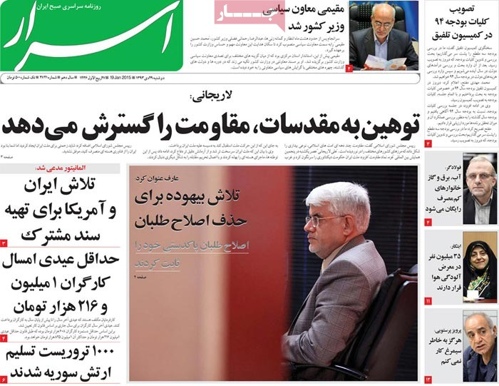
Asrar: “As many as 35 million people are exposed to pollution,” said the director of the Environment Protection Organization.


Asrar newspaper 1- 19


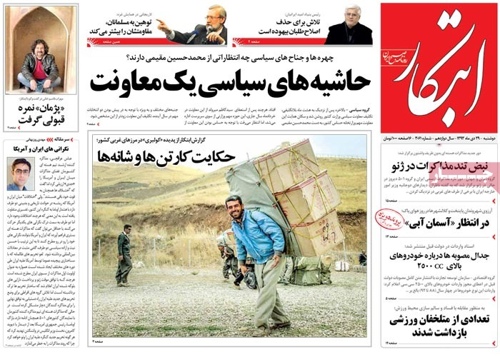
Ebtekar: “Efforts to eliminate reformism [from the political equation] are useless,” said Mohammad Reza Aref, a senior reformist leader.

Ebtekar: “Hurling insults at Muslims will only render them more defiant,” said Parliament Speaker Ali Larijani.


Ebtekar newspaper 1- 19


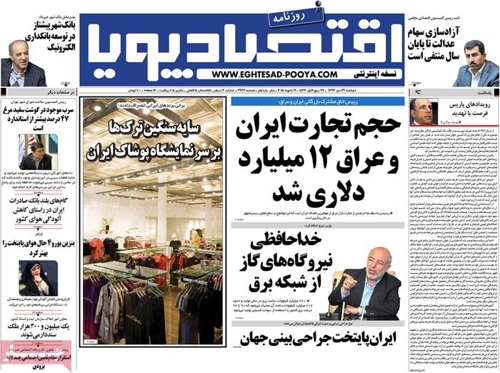
Eghtesad-e Pooya: The volume of trade between Iran and Iraq has hit the $12 billion mark.


Eghtesade puya newspaper 1- 19


Etemad: “Nuclear negotiators are moving ahead within the framework [the establishment] has set,” said Ali Akbar Velayati, a senior advisor to the Supreme Leader.

Etemad: “I am closer to Mr. Hashemi [Rafsanjani] than to my father,” Minister of Culture and Islamic Guidance Ali Jannati said.


Etemad newspaper 1- 19


Ettela’at: A gun-running ring has been busted in Hormozgan Province.

Ettela’at: The Supreme Cultural Revolution Council has met to discuss the explosive growth of higher education in the country.


Ettelaat newspaper 1- 19


Hemayat: “The West will pay a dear price for hurling insults at the Prophet Muhammad,” said the Iranian attorney general.


Hemayat newspaper 1- 19


Iran: To mark the Clean Air Day, Iranian children have staged a symbolic rally.


Iran newspaper 1- 19


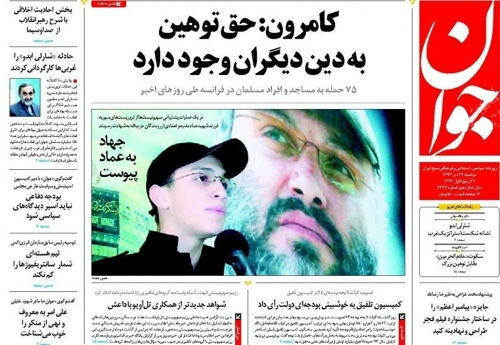
Javan: The son of Imad Mughniyeh [a senior member of Lebanon’s Islamic Jihad Organization and Hezbollah] and a number of Hezbollah combatants were martyred in a Zionist operation in support of terrorists in Syria. Jihad Mughniyeh has joined his father.


Javan newspaper


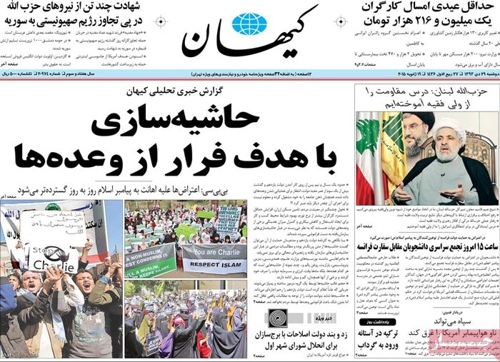
Kayhan: Students will gather outside the French embassy in Tehran at 15:00 local time on Monday to protest against the French government’s support for sacrilegious measures of Charlie Hebdo.


Kayhan newspaper 1- 19


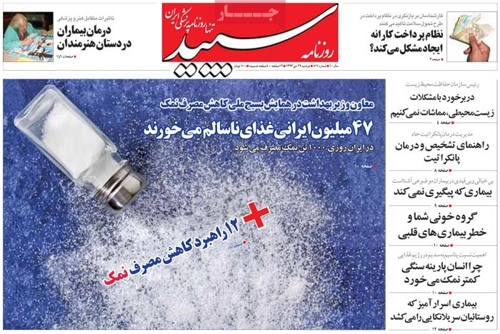
Sepid: “As many as 47 million Iranians have unhealthy eating habits,” said a deputy health minister.


Sepid newspaper 1- 19


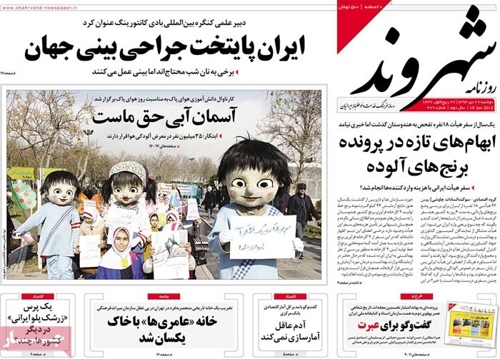
Shahrvand: “Iran is the Rhinoplasty capital of the world,” said the secretary of an international body contouring congress.


Shahrvand newspaper 1- 19


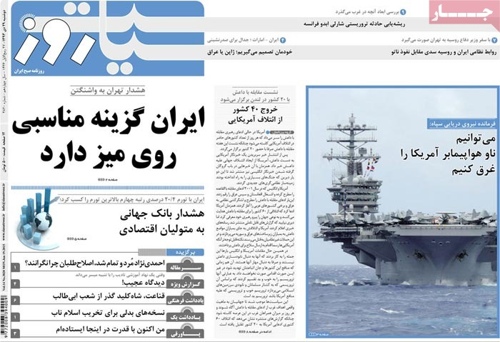
Siasat-e Rooz: “We can sink a US aircraft carrier,” said the commander of the naval forces of the Islamic Revolution Guard Corps.


Siasate ruz newspaper 1- 19


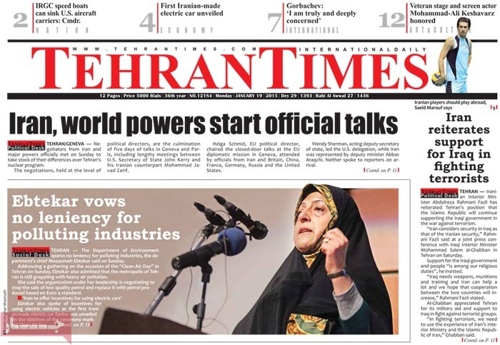
Tehran Times: First Iranian-made electric car unveiled.

Tehran Times: Iran reiterates support for Iraq in fighting terrorists.


Tehran times newspaper 1- 19


Next rounds of nuclear talks in Davos, Munich

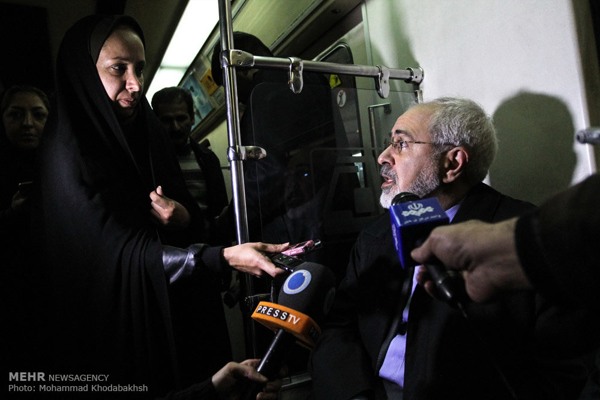
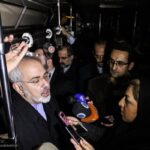
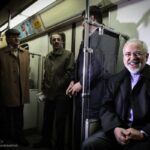
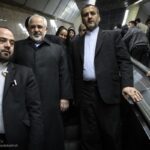
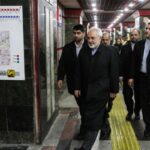
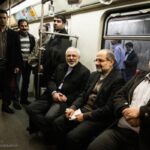
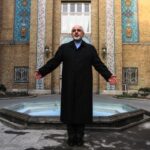
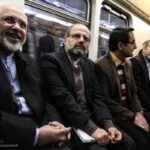
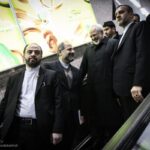
Zarif-Metro 8

Foreign Minister Mohammad Javad Zarif says that the next rounds of negotiations between Iran and 5+1 will be held in Davos and Munich.

Talking to reporters on Monday, he made the remarks when using a Tehran metro line to work. He used the public transportation to mark the ‘Day of Clean Air’ which is celebrated every year in Iran on January 19.

Zarif also said that his talks with his American counterpart John Kerry had been ‘open and frank’, adding that they discussed details and focused on complicated issues.

As it is always the case with international talks, he added, the details are the most difficult part of discussions.

The Iranian top diplomat further said that the overall pattern of negotiations has been already established, adding that Iran has the right to nuclear enrichment and continue its nuclear program. He also stressed the need for the removal of sanctions against Iran once an agreement is reached.

For the next remaining months of the deadline, he said, parties involved in the talks have to focus on details.

It will take long hours to discuss the details such as the number of centrifuges, the foreign minister noted.

“It is a source of pride for the nation to see that the best Western scientists are spending hours and hours to scrutinize what the young Iranian experts have been discussing with them,” Zarif said.

He said what Iran has always emphasized is that the parties to the talks with Iran have to admit the fact that they have to stop bullying if they want to get to any results in the negotiations.

“They could never indulge in the talks and continue their pressures on Iran simultaneously,” he said.

Zarif said this issue seems to be settled with Iran’s partners in the talks as they are just discussing methods now.

The Iranian foreign minister expressed hope that favorable results could be attained in due course of time though it might seem very difficult.