Monday, December 29, 2025
Home Blog Page 4973

Crisis of succession brewing on the Red Sea

Malek Abdollah-Saudi

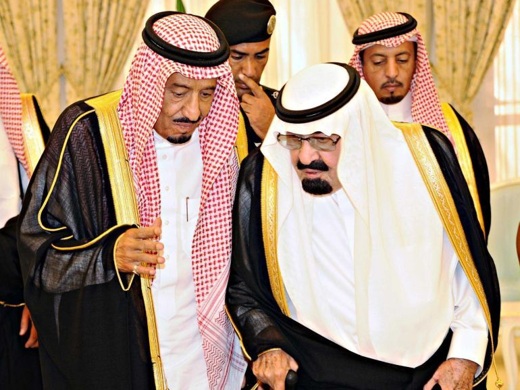
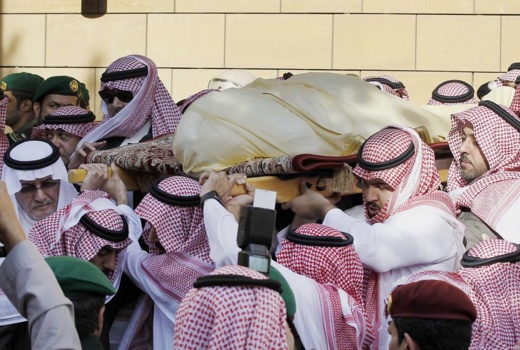
There are rumors about Saudi King Abdullah’s state of health. Some go as far as suggest that the monarch is already dead and some say he’s slipped into a coma. Riyadh is not the only capital worried about the monarch’s health and who succeeds him. Many countries in the region and around the world are closely following the news coming out of the kingdom.

The question of succession is not an easy one and the rise to power of whoever succeeds King Abdullah will have a deep impact on regional issues. On January 6, Ebtekar, a reformist daily, published an interview featuring the views of Hossein Rouyvaran, a Middle East expert. The following is the translation of the report:

Hossein Rouyvaran, an expert in Middle Eastern affairs, believes there are some factors that complicate the question of succession.

First, the ailing monarch has set up a council that names the king and the heir to the throne. So the succession won’t be automatic as is the case in other monarchies.

Second, the current crown prince Salman Al Saud is suffering from Alzheimer’s and eventually many won’t approve of his accession to the throne. Of course, one should not forget the fact that King Fahd was suffering from the same disease toward the end of his reign. Back then Crown Prince Abdullah ran the day-to-day administration of affairs. That the selection of Salman is bound to draw objections makes the question of succession more challenging.

Third, Prince Muqrin bin Abdulaziz, second in line to the throne, is another factor. Naming a second heir to the throne is unprecedented in Saudi history, but that is what King Abdullah has done. Prince Muqrin is not a member of the ruling elite.

Accession to power is dynastic in Saudi Arabia. So far all Saudi monarchs have written wills naming all their sons to rule one after another after their demise. Their sons have not necessarily been from the same mother. The first three kings, Faisal, Khalid and Fahd were mothered by the same woman. Abdullah’s mother came from Al Rashid family. But Muqrin’s mother used to be a slave and his inclusion in the club of elite has drawn objections.

Fourth, the grandsons of Faisal bin Abdulaziz Al Saud are demanding changes to the power structure. That has created serious challenges to the Saudi political establishment. A new generation of leaders needs to replace the old princes to settle the serious challenges the political system is faced with.

The sons of Sultan bin Abdulaziz, a former crown prince, led by Bandar, those of Prince Nayif led by Interior Minister Muhammad Nayif, and the sons of Faisal led by Foreign Minister Saud al-Faisal are going to great lengths to pave the way for the rise to power of a third generation.

Foreign factors are at play too. By keeping oil prices low Saudi Arabia has helped lift the West out of recession and put it on the path to growth. The West seeks to see a reliable individual rise to power in Riyadh.

So, in addition to domestic variables, foreign elements are exerting efforts to make sure someone who listens to the voice of the West rises to power. That has further complicated the selection of a new king.

Anyone who rises to power will need time to solidify his position. Buying time to cement his foothold will definitely be a pillar of the policies the next king adopts. So the next king will try to ease disagreements. Whoever takes that position won’t try to pursue the controversial policies of his predecessor as strictly and that amounts to an opportunity for Iran.

So, a change of guard in Saudi Arabia might result in solutions to some regional crises. If the ailing king dies, Iran will definitely adopt a logical stance and won’t celebrate his passing. Rather, it will send a delegation to attend the king’s funeral. Saudi Arabia is a key regional player and one cannot ignore the kingdom.

Iran is in favor of a Saudi kingdom that pursues Muslim unity. As long as Saudi Arabia acts in a sanctimonious way and follows divisive rather than uniting policies in the world of Islam, it will remain on a collision course with Iran. But if and when Riyadh quits this policy, Iran and Saudi Arabia can be the best of friends.

Iran has condemned terrorist attack in France

Marziyeh-Afkham
Marziyeh-Afkham

According to the Islamic Republic News Agency (IRNA) Iranian Foreign Ministry Spokeswoman Marzieh Afkham on January 7 condemned Wednesday’s terrorist attack in Paris and said any act of terrorism targeting innocent individuals runs counter to the teachings of the Muslim faith. The following is the translation of a report the official news agency released on the statements of the spokeswoman:

Foreign Ministry Spokeswoman Marzieh Afkham described as unacceptable any abuse of freedom of expression, fanaticism, and disrespect for individuals endeared by followers of different faiths. She also condemned lack of respect for divine religions and their values.

The spokeswoman went on to say that such behaviors [what happened in Paris on Wednesday] are a continuation of a wave of extremism and violence that spread across the world in the past decade. “Unfortunately wrong polices and double standards in dealing with violence and fanaticism have fanned the flames of such measures.”

She recalled President Rouhani’s World against Violence and Extremism initiative and expressed hope leaders of the world will avoid double standards and adopt a unified approach to dealing with the root causes of violence and extremism.

A thousand health centers with physicians on hand are to open in rural areas

Health minister

On January 6, Javan, a daily, quoted Health Minister Seyyed Hassan Hashemi as saying that a thousand health centers will open in rural areas with physicians who are to take up residence in such villages to offer medical services. The following is the translation of what the minister said about the initiative as well as other moves envisioned in the Healthcare Transformation Plan:

“One of the key principles of the Healthcare Transformation Plan which was approved in the 11th government and is now underway was provision of towns home to less than 100,000 with easy access to midwives, doctors and basic medical services like health centers, dietary supplements for pregnant women and newborn infants.

“After the passage of the Administrative Healthcare Plan, as many as 7 million people who had not been provided with any health coverage were insured by the healthcare insurance.

“Among other measures, promotion of hoteling services at hospitals, renovation of run-down hospitals, introduction of proper medical tariffs, provision of medical emergency services by air, natural birth delivery and plans to encourage doctors to stay in deprived areas to offer services are baby steps toward the implementation of the plan.

“In spite of 44-percent inflation, medical fees and tariffs all but stayed the same between 1985 and 2010, because governments and parliaments in charge over that period did not pay enough attention to reviewing and raising tariffs. Besides, for as many as 1,700 medical services, no tariff was set.

“By the release and implementation of the booklet featuring the relative assessment of healthcare services, we seek to raise medical tariffs, secure the satisfaction of doctors and put a lid on illegal medical fees which are charged by some doctors.

The implementation of the Healthcare Transformation Plan has won 70-percent public approval. At first, doctors and nurses were not much pleased because of the amount they were paid. However, with the passage of time things have started to look up. We hope that we can earn their satisfaction through the cooperation of complementary insurance companies with the government.

“Based on figures released by the Statistical Center of Iran, the implementation of the plan has seen copayment fall by 31 percent.”

Iran must be immunized against sanctions: Ayatollah Khamenei

Supreme Leader

Leader of the Islamic Revolution Ayatollah Seyyed Ali Khamenei says Iran needs to be immunized against sanctions imposed on it over its nuclear program.

“Sanctions have created problems for the country but if the enemy sets a condition for the removal of them in return [for Iran] to back down on basic… issues, including Islam, independence or scientific progress, definitely the [national] pride of no official will accept that,” Ayatollah Khamenei said in an address to thousands of people in Tehran on Wednesday.

The Leader said that the only way that Iran could counter enemy’s power is for the country to be immunized against sanctions.

Ayatollah Khamenei underlined the need for weaning Iran’s economy off petrodollars and said officials should know that the enemy will move ahead if Iran retreats even an iota.

“We should act in a way that even if the enemy does not lift sanctions the nation’s progress, prosperity and welfare will remain unharmed,” said the Leader.

Ayatollah Khamenei also slammed US officials for what he called their shameless rhetoric that they won’t lift anti-Iran sanctions all at once even if Tehran gives concessions over its nuclear program.

The Leader said he does not disagree with the continuation of nuclear talks between Iran and six world powers.

The next round of nuclear talks between Iran and the P5+1 group of world powers will be held on January 18.

Nuclear negotiators from Iran and P5+1 – the US, Russia, China, France, Britain and Germany – wrapped up their latest round of talks on Tehran’s nuclear program in Geneva on December 17, 2014.

The three-day Geneva discussions were held almost three weeks after Tehran and the six countries failed to reach a final agreement by aNovember 24 deadline despite making some progress.

The two sides agreed to extend their discussions for seven more months until July 1, 2015. They also agreed that the interim deal they had signed in Geneva in November 2013 should remain in place during the negotiations.

Iran’s FM, Afghanistan’s National Security Adviser Meet in Tehran

Iran-Afghanistan-Flags

Iran’s Foreign Minister Mohammad Javad Zarif on Tuesday met with Afghanistan’s national security adviser Mohammad Hanif Atmar in which they discussed different bilateral and regional issues.

During the meeting in Tehran, Zarif stressed the Islamic Republic of Iran’s preparedness to expand relations with neighboring countries, including Afghanistan and develop cooperation to enhance stability and security in Afghanistan.

He also referred to the presidential elections in Afghanistan and said, “The outcome of popular votes (in Afghanistan) led to the formation of the national unity government and we support and welcome what is based on the will and desire of (Afghan) people”.

Afghanistan’s two main presidential candidates Ashraf Ghani and Abdullah Abdullah in September last year signed a treaty to create government of national unity. The deal that shares power between the two politicians ended months of turmoil over a disputed election that destabilized Afghanistan.

Hanif Atmar, for his part, appreciated Iran’s continued friendship with Afghanistan during the turbulent years in the latter country, saying, “We will never forget the Islamic Republic of Iran’s help and kindness.”

Hanif Atmar added that deepening ties with Tehran is a priority for the national unity government.

“We will never allow a threat to be posed to Iran from Afghanistan,” he further stressed.

The Afghan official also renewed an invitation to Iran’s top diplomat to visit Kabul.

Lake Orumiyeh’s surface area is growing

Urumieh Lake

On January 6, Ebtekar, a daily, quoted an environment expert in charge of natural habitats at West Azerbaijan Environment Protection Department as saying that Lake Orumiyeh is no longer shrinking. The following is an excerpt of what Hojat Jabari, had to say about the largest lake in the Middle East:

The lake’s water surface area has expanded almost 100 percent, standing at 1,800 square km over last year’s 900 km². The lake has experienced a 7-meter fall in its water level of late. Thanks to rainfall in the fall, it presently stands at 1,270.55 meters above sea level, 31 centimeters up over September 2014 when it was 1,270.24 meters.

Measured over the past 15 months, at its deepest point the water does not go beyond four meters, a drastic drop in comparison with 15 meters in the years before the lake was gripped by the crisis.

Lake Orumiyeh, one of the largest salt lakes in the world, has been ravaged by severe droughts over the recent years. Some 90 percent of the surface area of this beautiful huge lake which used to be as vast as 5,700 km² has dried up and approximately as little as two billion cubic meters of water is left in it.

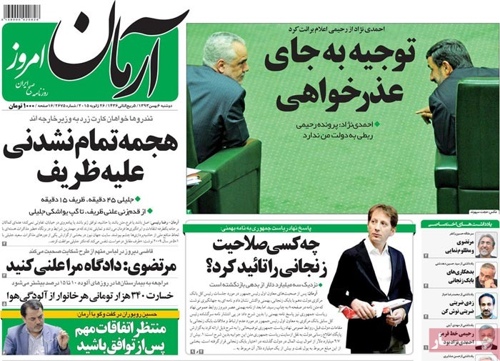
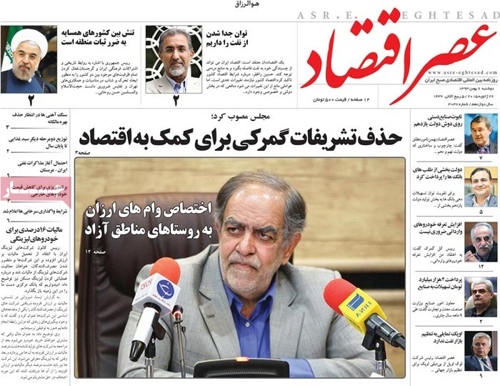
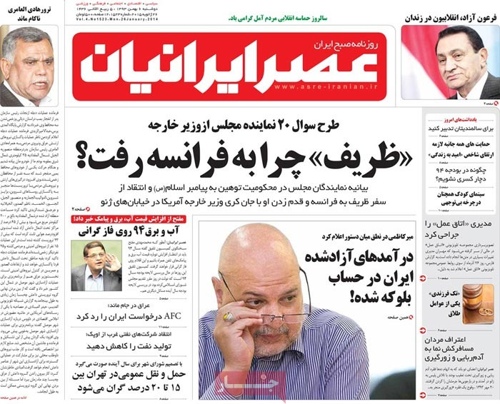
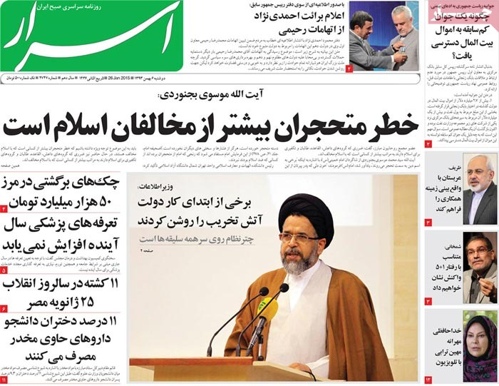
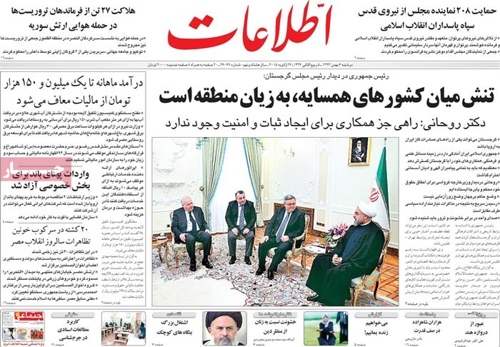
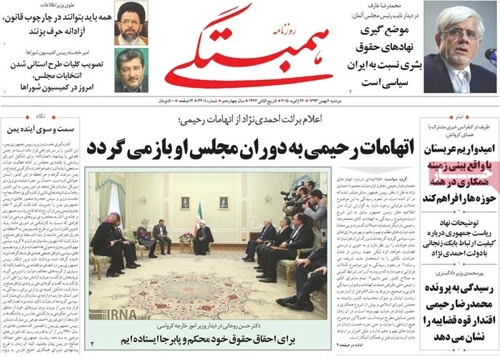
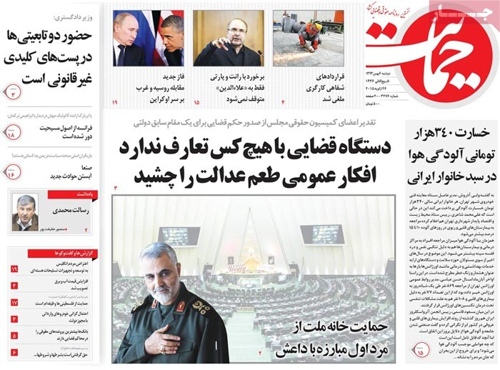
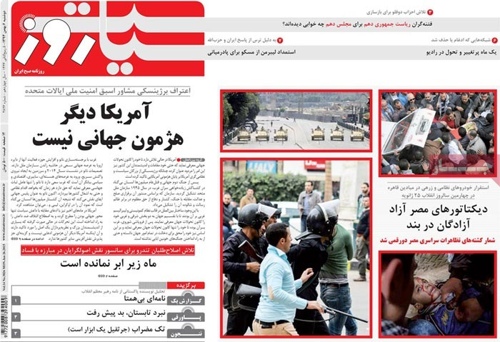
A look at Iranian newspaper front pages on Jan. 7

Iranian Newspapers Headlines

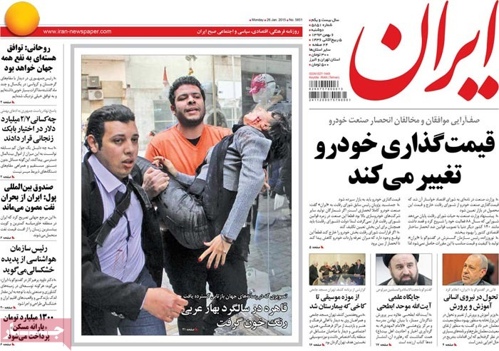
The presence of Foreign Minister Mohammad Javad Zarif in parliament to answer questions by MPs about how nuclear talks with P5+1 are managed was on the cover of many Iranian newspapers on Wednesday. The apparently unstoppable drop in crude prices on global markets and a plan by MPs to cut the dependence of the country’s budget on oil revenues made front-page headlines too.


Abrar: Turkish President Recep Tayyip Erdogan is expected in Iran later in January.


Abrar daily-1-7-2015


Abrar-e Eghtesadi: Japanese refineries have renewed their purchase of Iranian oil for 2015.


Abrar Eghtesadi


Asr-e Rasaneh: The head of the Chamber of Commerce has warned about the growth of corruption.


Asre Resaneh daily-1-7-2015


Donyay-e Eghtesad: “Advancing factional goals at the expense of national interests is an unforgivable sin,” Foreign Minister Zarif told an open session of parliament.


Donyaye Eghtesad daily-1-7-2015


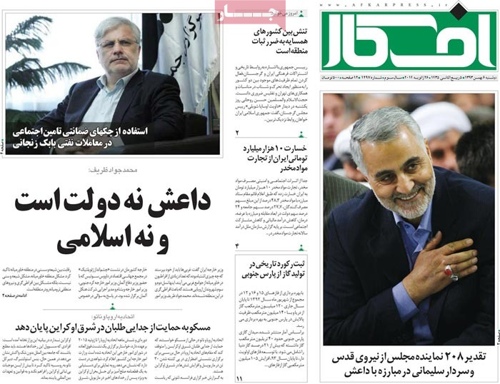
Ebtekar: “Next round of nuclear talks [between Iran and P5+1] will open in Geneva on January 18,” said Iranian Deputy Foreign Minister Seyyed Abbas Araghchi.


Ebtekar daily-1-7-2015


Eghtesad-e Pooya: “We do not pursue factional interests in nuclear talks,” Foreign Minister Mohammad Javad Zarif told MPs.


Eghtesad Pouya daily-1-7-2015


Emtiaz: Imports of rice and sugar have been banned.

Emtiaz: Tehran Stock Exchange continues its free fall.


Emtiaz daily-1-7-2015


Ettela’at: License plates won’t be issued to five makes of car because they pollute the air.


Ettelaat daily-1-7-2015


Hambastegi: “The Intelligence Ministry nips any security threat in the bud,” vowed the Iranian intelligence chief.


Hambastegi daily-1-7-2015


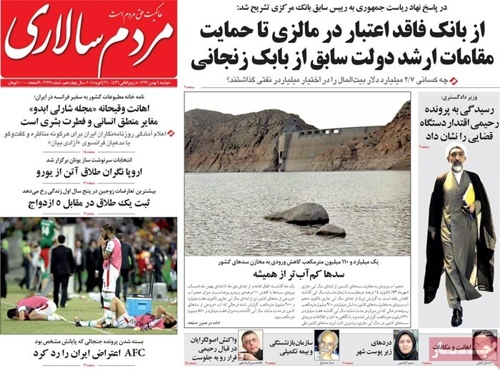
Hemayat: In a statement 230 MPs reiterated that the continued house arrest of the seditionist leaders [presidential candidates who disputed the results of the 2009 elections and sparked widespread unrest] is legal.


Hemayat daily-1-7-2015


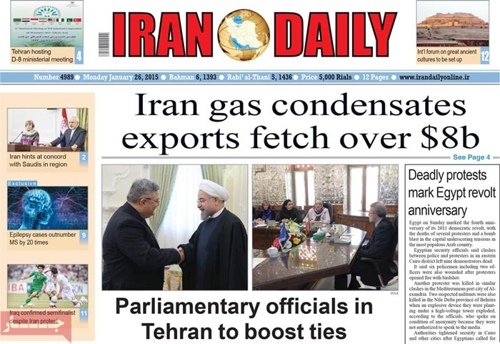
Iran Daily: Forty foreign enterprises ready for gas investment [in Iran].


Iran daily Newspaper-1-7-2015


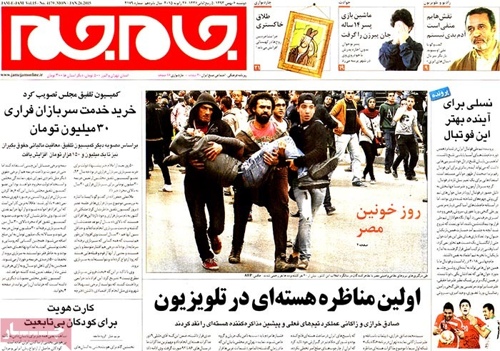
Jamejam: The licences of five doctors who kept overcharging patients even after the Health Ministry urged them to stop have been revoked permanently.


Jame Jam daily-1-7-2015


Javan: The judiciary has released a statement in response to an open letter principlist MP Ali Motahari sent to it with regard to the continued house arrest of those who sparked post-election unrest in 2009. Motahari does not seem to know the difference between house arrest, detention and punishment, the statement says.


Javan daily-1-7-2015


Jomhouri Islami: The explanations of Foreign Minister Zarif about the trend of nuclear talks in parliament satisfied the MPs.

Jomhouri Islami: “Extremism is a deadly virus. The Muslim world is now grappling with the scourge of division,” said Chairman of the Expediency Council Akbar Hashemi Rafsanjani in a gathering of Azad University officials.


Jomhouri Eslami daily-1-7-2015


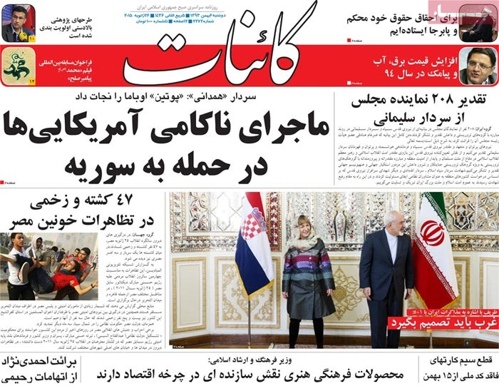
Kaenat: The Iranian Oil Ministry says it is in talks with Afghanistan to sell crude oil to our neighbor to the east.


Kaenat daily-1-7-2015


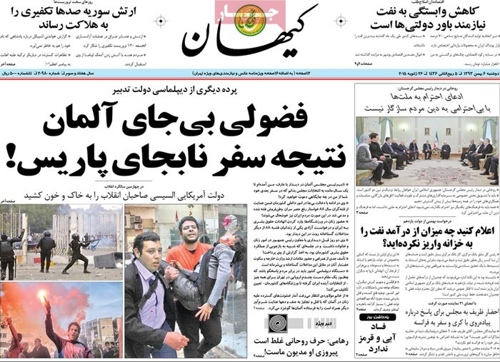
Kayhan: The Bahraini regime has crushed protests against continued detention of [Shiite cleric] Sheikh Ali Salman.


Kayhan: “Government should stop threats and interference; parliament has a duty to supervise,” said Parliament Speaker Ali Larijani in reference to illegal withdrawal by the government of money from the National Development Fund.


Kayhan daily-1-7-2015


Khorasan: Oil prices have dipped below $50 a barrel.


Khorasan daily-1-7-2015


Resalat: “Some 10 million high-income individuals have been identified,” said the minister of welfare.

Resalat: Police say a huge soccer betting ring that operated across the nation has been busted.


Resalat daily-1-7-2015


Sharq: Parliament has unveiled a plan to cut the dependence of the country’s budget on petrodollars.


Shargh daily-1-7-2015


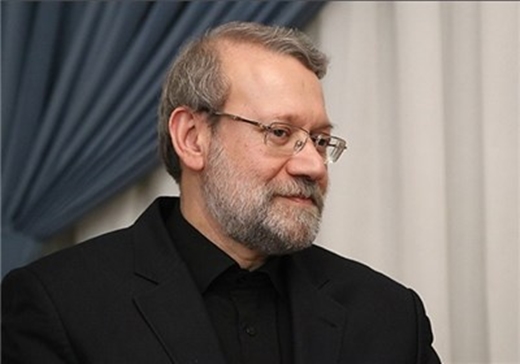
Restoration of security in Iraq benefits the entire region: Larijani

Larijani-Iraq health miniter

Parliament Speaker Ali Larijani said on Tuesday that the Iraqi government’s success in restoration of peace and security to the country will benefit the entire region.

Larijani made the remarks in a meeting with Iraqi Minister of Health Adilla Hamoud Hussein.

The Iranian speaker hailed the recent achievements of Iraqi forces in the fight against terrorist groups.

Larijani voiced Tehran’s support for the government of Baghdad in campaign against terrorism and said, “Iran feels duty-bound to support the Iraqi government and nation and Iraq can count on Iran’s support.”

Meanwhile, the Iraqi minister appreciated Iran’s support for the Iraqi government, saying Iran has played a key role in establishment of stability in Iraq.

Hamoud Hussein said that the Iraqi nation is in dire need of humanitarian aid from the Islamic Republic of Iran, especially medical supplies, as the country is faced with a wave of terrorist attacks.

Interaction, independence and dignity are our ideals

Seyyed reza akrami
Seyyed reza akrami

President Rouhani’s comments that our ideals are not tied to centrifuges have drawn a strong reaction from principlists. Seyyed Reza Akrami, a statesman, in a political note in Mardom-e Emrooz daily on January 6, sought to clarify the president’s comments made at a conference on Iran’s economy on Sunday. The following is a partial translation of the note that originally appeared under the heading Interaction is Our Ideal:

With regard to the president’s comments Sunday that “Our ideals are not tied to centrifuges,” three points need to be mentioned to shed light on what the president meant.

First, we live in a country whose vastness, strategic position, resources and diverse climatic conditions make it unique. We have 14 neighbors including Russia, Pakistan, Iraq and countries on the Persian Gulf. That lends added importance to our strategic position.

Second, we are a country of 80 million. That a large percentage of our population is young gives us a big advantage.

Third, we staged a revolution almost 36 years ago. Since the very beginning our motto has been Independence, Freedom and Islamic Republic. That means we want to lead a dignified, reputable life in the world. […]

I believe the important statement the president made in his speech was that we have diverse talents, but unfortunately they remain mostly untapped. The president said not everything in the country should be tied to enrichment and centrifuges.

Instead, detailed planning on the basis of resistance-based economy and firm resolve are needed to help these talents blossom. He meant we shouldn’t remain fixated on a single technology like nuclear centrifuges. […]

He believes our independence does not merely hinge on nuclear technology. We managed to enrich uranium when we were under sanctions. That shows we can forge ahead even when limitations are in place.

Failure of other countries to supply spare parts to our aviation industry won’t ground our air fleet; keeping oil prices low won’t cripple our economy; slapping technological restrictions on us won’t spell an end to our enrichment capability.

In the toughest of conditions, we have proved that we can master uranium enrichment, a technology only a handful of countries have developed.

However, since we seek to interact with the rest of the world, we agreed to replace 20 percent enrichment with 5 percent enrichment. We accepted supervisions beyond what is stipulated in the nuclear Non-Proliferation Treaty.

Those measures were simply designed not to provide an excuse to those who sought an excuse to accuse us of seeking to develop nuclear bombs. Interaction with the world under the banner of the Islamic Republic is an ideal of ours. We don’t have to limit ourselves to one technology.

I believe Independence, Freedom and Islamic Republic remain our ideals that have nothing to do with nuclear talks which in turn are not linked to these mottos. That we want to be independent, lead a dignified life, remain free under the banner of the Islamic Republic and interact with countries in the world is our ideal.

Iran MPs support foreign minister over nuclear talks

Zarif-Majlis

On Tuesday, Iranian Foreign Minister Mohammad Javad Zarif showed up in an open session of parliament to answer questions by lawmakers about the process of nuclear talks.

After Zarif’s explanations, the first deputy speaker of parliament, Mohammad Reza Bahonar, asked lawmakers to vote Aye or Nay for his explanations.

Out of 229 legislators present, as many as 125 MPs endorsed Zarif’s remarks while 86 were naysayers. The rest abstained.

A lawmaker from the northeastern city of Mashhad, Javad Karimi Ghoddousi, posed questions to Zarif on behalf of other legislators.

Nuclear negotiators from Iran and P5+1- the United States, France, Britain, Russia, China and Germany – wrapped up their latest round of talks on Tehran’s nuclear program in the Swiss city of Geneva on December 17, 2014.

The three-day Geneva discussions were held almost three weeks after Tehran and the six countries failed to reach a final agreement by a November 24 deadline despite making some progress.

The two sides agreed to extend their discussions for seven more months until July 1, 2015. They also agreed that the interim deal they had signed in Geneva in November 2013 should remain in place during the negotiations.