Monday, December 29, 2025
Home Blog Page 4969

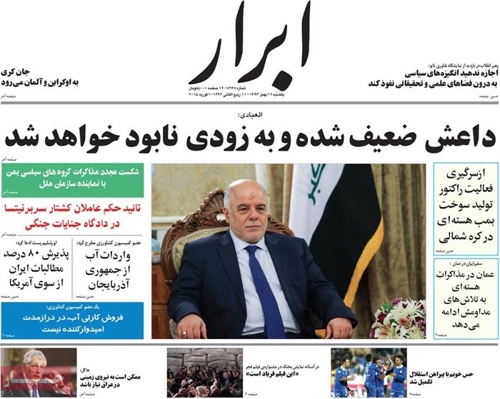
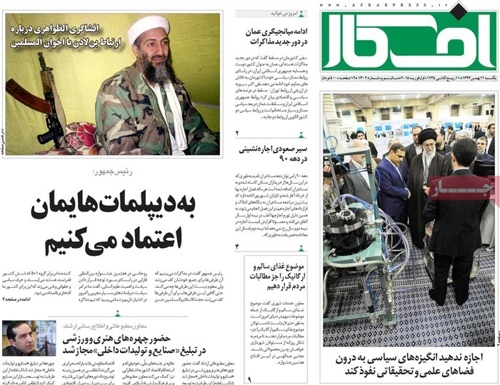
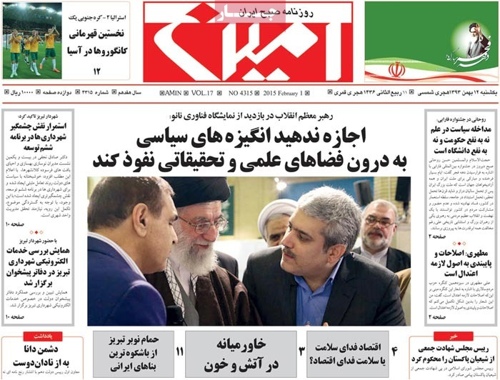
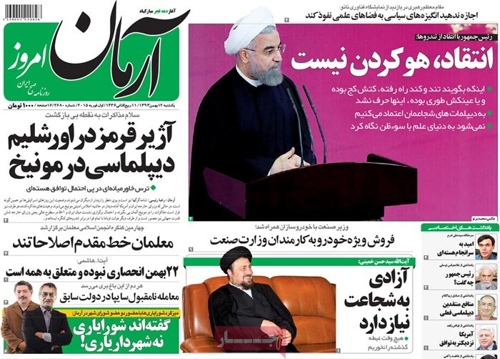
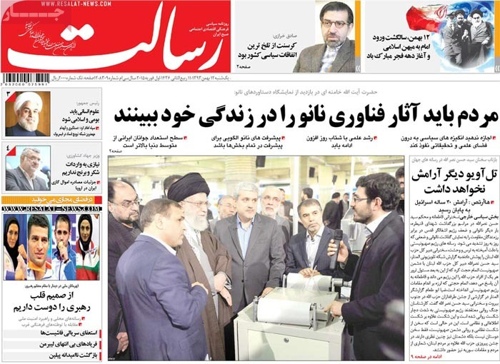
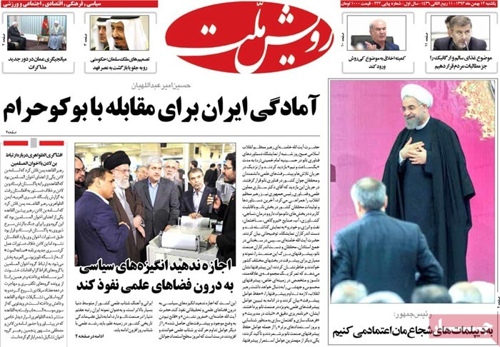
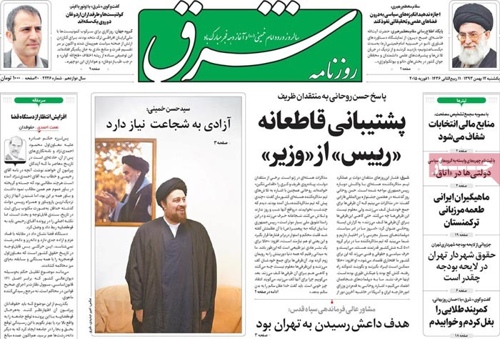
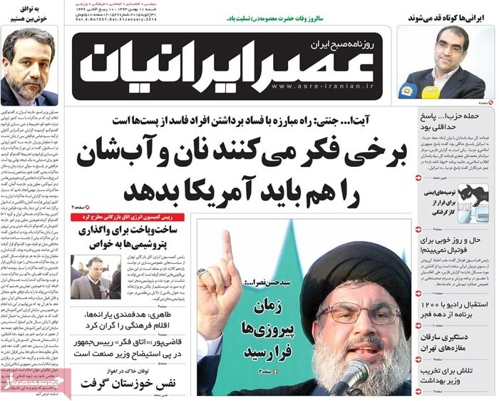
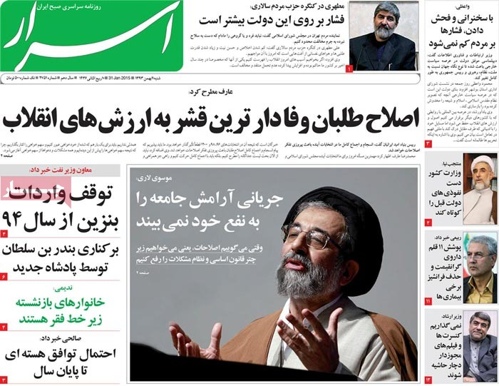
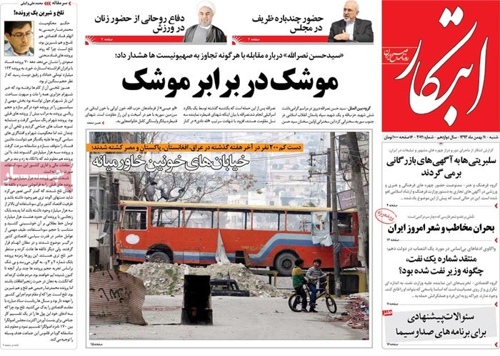
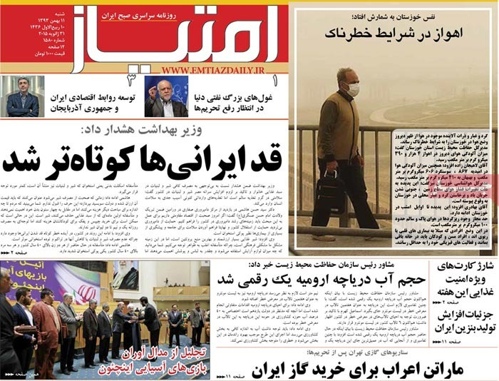
A look at Iranian newspaper front pages on Jan. 11

Iranian Newspapers Headlines

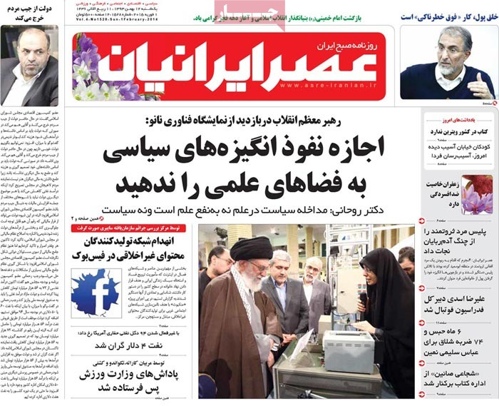
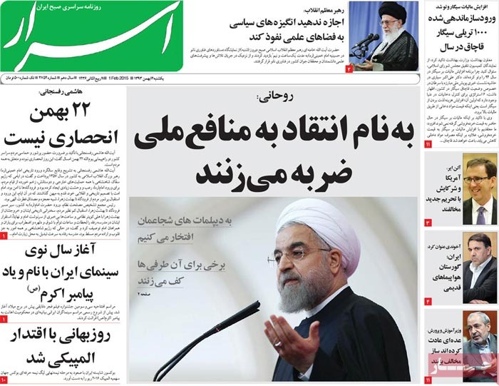
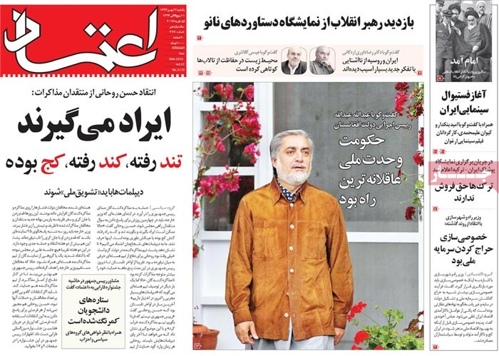
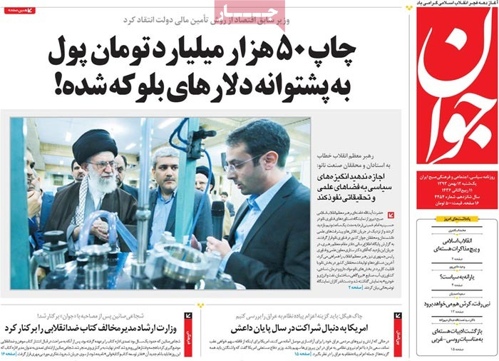
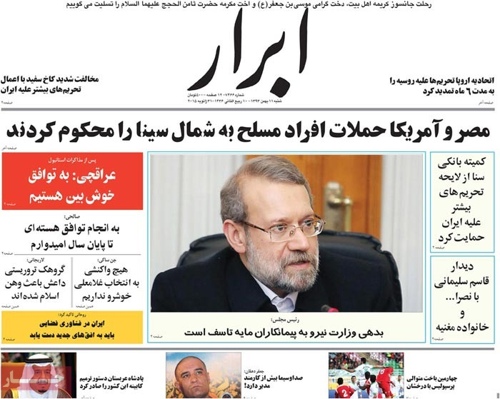
A meeting between the Supreme Leader and visiting Venezuelan President Nicolas Maduro dominated the front pages of the Iranian newspapers on Sunday. In the meeting Ayatollah Khamenei slammed the recent decline in oil prices as politically-motivated. The comments of President Rouhani at a meeting with his Venezuelan counterpart also drew front-page attention. The upcoming sale of the capital’s two most popular football clubs – Persepolis and Esteghlal – was on the cover of dailies too.


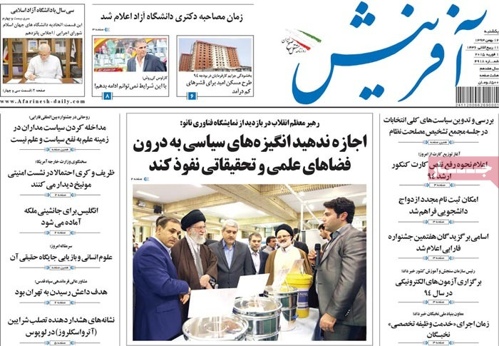
Afarinesh: “Security problems are to blame for capital flight,” said Parliament Speaker Ali Larijani.

Afarinesh: “Half-finished projects are to be handed over to the private sector,” said a member of a parliamentary committee dealing with budgetary issues.


Afarinesh newspaper 1- 11


Afkar: Officials with the Supreme Leader’s office have inspected the country’s nuclear facilities.

Afkar: Austrian exports to Iran have registered a 15 percent hike.


Afkar newspaper 1- 11


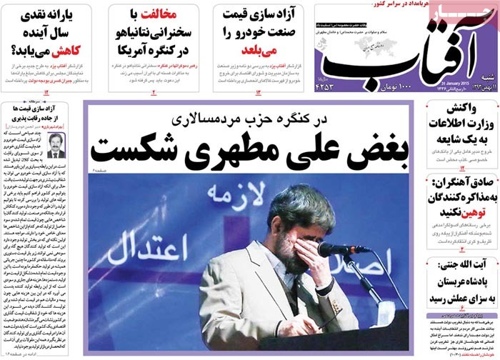
Aftab-e Yazd: China has overtaken the UAE as the biggest exporter to Iran.

Aftab-e Yazd: “Our dignity does not hinge on economic issues,” said the commander of the Islamic Revolution Guard Corps.
 

Aftabe yazd newspaper 1- 11


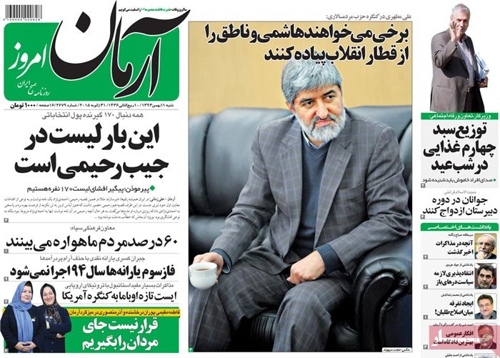
Arman-e Emrooz: Laborers gathered together outside parliament in protest at an amendment to the Labor Law.


Armane emruz newspaper 1- 11


Ebtekar: Cancer is to blame for 15 percent of all Iranian deaths.


Ebtekar newspaper 1- 11


Eghtesad-e Pooya: Exports of Iranian hand-woven carpets are up by 24 percent.


Eghtesade puya newspaper 1- 11


Emtiaz: Iranian bank debts are up 24 percent.


Emtiaz newspaper 1- 11


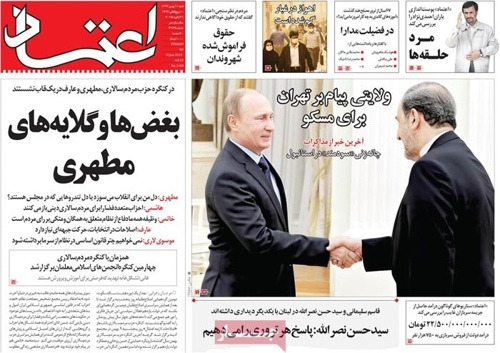
Etemad: At a meeting with the visiting Venezuelan president, the Supreme Leader underlined concerted efforts to counter [a recent] drop in oil prices.


Etemad newspaper 1- 11


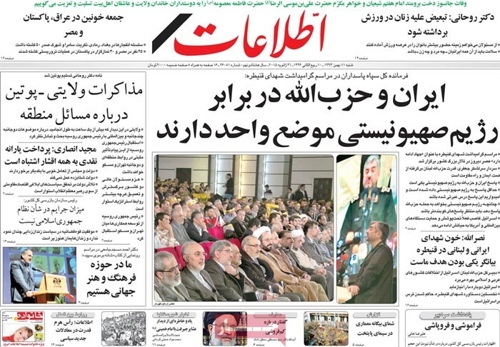
Ettela’at: Persepolis and Esteghlal, two Tehran-based football clubs whose popularity goes beyond the borders of the capital, will be sold to the highest bidders in less than two months.

Ettela’at: “The Health Ministry cannot prop out the healthcare system on its own,” said Health Minister Hassan Hashemi.


Ettelaat newspaper 1- 11


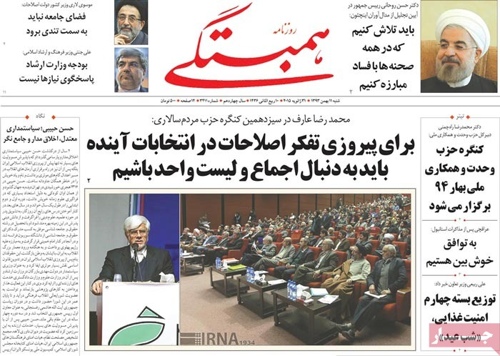
Hambastegi: “Mohammad Reza Shajarian [an internationally-acclaimed vocalist] has the approval of the Ministry of Culture and Islamic Guidance,” said a deputy culture minister.


Hambastegi newspaper 1- 11


Hemayat: Terrorists are now haunting the very same countries that supported them in the past.


Hemayat newspaper 1- 11


Iran Daily: Kish energy show to host US, European companies.


Iran daily newspaper 1- 11


Javan: Homa, a state-of-the-art Iranian RQ-7 drone, has taken to the sky.


Javan newspaper 1- 11


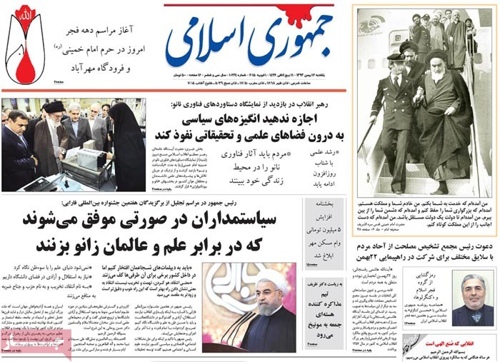
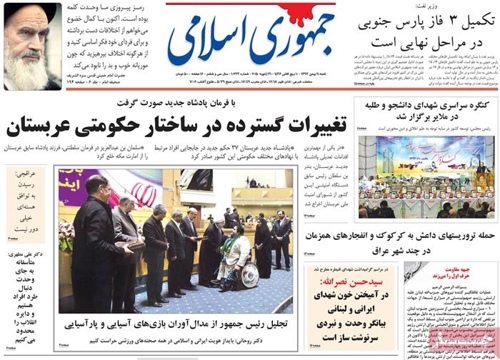
Jomhouri Islami: “Cooperation of OPEC members which follow the same line can help foil major power plots against this organization,” President Rouhani told his Venezuelan counterpart.


Jomhorie eslami newspaper 1- 11


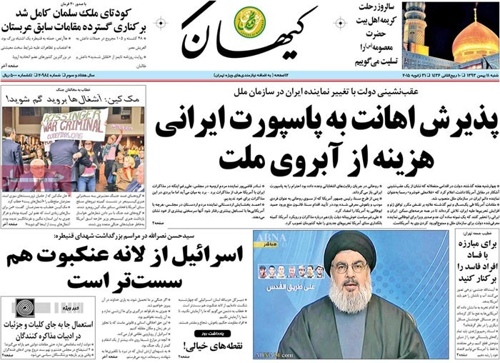
Kaenat: “Iran will not tolerate terrorists,” said the speaker of the Islamic Consultative Assembly.


Kaeenaat newspaper 1- 11


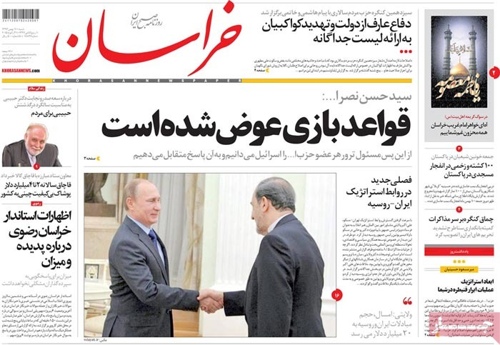
Mardom-e Emrooz: US Secretary of State John Kerry has met with Sultan Qaboos bin Said of Oman ahead of a meeting with his Iranian counterpart Mohammad Javad Zarif.


Mardome emruz newspaper 1- 11


Sepid: A ceremony to celebrate the universality of health insurance in Iran will be held on January 12. President Rouhani will be in attendance.


Sepid newspaper 1- 11


Shahrvand: Officials with the Iranian water and wastewater organization have urged the public to pray for rain.


Shahrvand newspaper 1- 11


Sharq: Iranian police have arrested a man who hacked into as many as 1,508 bank accounts.


Shargh newspaper 1- 11


Iran has answered all IAEA questions: Nuclear chief

Salehi

“Western countries attached a political history to our country’s nuclear issue, while we answered all their 18 technical questions,” said the head of the Atomic Energy Organization of Iran, Ali Akbar Salehi, in a televised program on Saturday.

He said the six countries are still expecting answers from Iran as they have politicized the issue. “The P5+1 group has announced that there is still room for discussion on two questions. The IAEA has, however, almost accepted all the answers.”

Salehi underlined that Iran’s nuclear issue can be settled through political will.

“Our country’s nuclear issue is not technical and can be resolved only through political will,” he noted.

Nuclear negotiators from Iran and P5+1– the US, Russia, China, France, Britain and Germany – wrapped up their latest round of talks on Tehran’s nuclear program in Geneva on December 17, 2014.

The three-day Geneva discussions were held almost three weeks after Tehran and the six countries failed to reach a final agreement by a November 24 deadline despite making some progress.

The two sides agreed to extend their discussions for seven more months until July 1, 2015. They also agreed that the interim deal they had signed in Geneva in November 2013 should remain in place during the negotiations.

Iran steadfast in maintaining unity

Larijani

Iran’s parliament speaker has underscored that different views of certain regional countries would not influence Tehran’s determination to maintain unity among people.

Speaking to reporters upon his arrival in the northwestern city of Orumiyeh on Saturday, Ali Larijani said that the issue of unity is regarded as one of the main tenets of the Islamic Revolution.

Iran will remain committed to pursuing unity “although others in the region may sometimes have not an accurate view on the subject, however, that will not change our attitude,” the speaker added.

He also hailed a long history of peaceful coexistence among diverse sects, religions and denominations in West Azarbaijan province in light of Islam.

Larijani further blamed “foreign trends” for trying to disrupt peaceful coexistence across the Middle East region in recent decades, but made it clear that Iran focuses on unity as the cornerstone.

His comments came after an international unity conference in Tehran that brought together hundreds of Muslim clerics and scholars to discuss the ways to promote sense of rapport in the Islamic world.

Also on Friday, Supreme Leader of the Islamic Revolution Ayatollah Seyyed Ali Khamenei renewed the call for unity among Muslims, and stressed that focusing on the interest of the Islamic Ummah (community) will consequently benefit all Muslim nations.

The Supreme Leader also described as a “big mistake” the foreign policy that certain regional states have adopted to oppose Iran.

“In contrast to such unwise policies, the Islamic Republic continues to pursue its foreign policy on the basis of friendship and fraternity with all Islamic countries, including regional governments,” the Leader added.

Common enemies use oil as political tool: Leader to Maduro

Supreme Leader-Rouhani-Venezuela

In a meeting with visiting Venezuelan President Nicolas Maduro on Saturday, the Leader noted that the steep fall in global oil prices in a very short period of time is “politically motivated” and “is not economic.”

“Our common enemies are using oil as political tool and definitely play a role in this sharp fall in oil prices,” Ayatollah Khamenei added.

The Leader also praised Venezuela’s efforts against the Israeli regime, and described such efforts as the reason for the hegemonic powers’ hostility toward the Latin American country.

“The Islamic Republic of Iran’s definite decision is to continue and increase all-out cooperation with Venezuela,” the Leader noted.

Ayatollah Khamenei also described the late Venezuelan president, Hugo Chavez, as “Iran’s good friend” and further appreciated Maduro’s continued resistance against the plots hatched by the enemies.

Maduro, for his part, thanked the Islamic Republic of Iran for its assistance to and support for Venezuela, saying that the two countries should continue expanding relations by using the existing capacities.

Touching upon the issue of oil, he said his government is making efforts to bring about a consensus among member states of the Organization of the Petroleum Exporting Countries (OPEC) as well as other oil-exporting states to return crude prices to an acceptable level.

Muhammad, a giant step by Iranian cinema toward Muslim unity

Prophet Mohammad Movie
Majid Majidi
Majid Majidi

Muhammad, a 2015 Iranian movie directed by Majid Majidi, revolves around the childhood of the Muslim Prophet. The movie’s pre-production began in October 2007 and its filming was completed six years later. Muhammad opens to the Valley of Abu Talib where Muslims were under siege, flashes back to the years before the birth of the Prophet and takes the viewers to the days in Mecca when Muhammad was a child.

Foreign big names have joined the Iranian film crew, among them Vittorio Storaro, an Italian cinematographer; Scott E. Anderson, a visual effects supervisor; Giannetto De Rossi, an Italian make-up artist; A. R. Rahman, an Indian composer and musician; Sami Yusuf, an Iranian-born British singer; and Michael O’Connor, an English costume designer.

The film which intends to show the compassionate face of Prophet Muhammad (PBUH) is set to premiere at the 33rd Fajr International Film Festival in Iran later this year. There are unconfirmed reports that the movie will be screened abroad afterward.

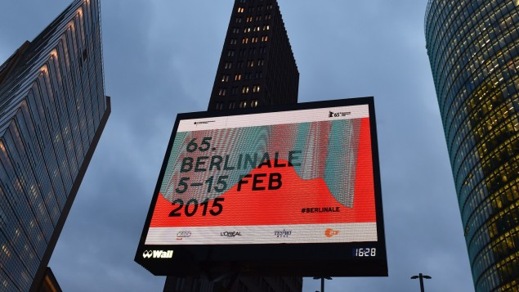
Majidi, the Oscar-nominated Iranian filmmaker, didn’t rule out reports that Muhammad will hit the screen at the Berlin International Film Festival. He also said that Sony Pictures has put forward proposals for the global screening of the movie.

The movie is shot in a village near Qom in central Iran. Mohsen Shah-Ebrahimi, the movie’s set designer, says he found the village on Google Earth. Two towns have been built near the village to serve as the filming location of Iran’s biggest-budget production to date (some $21 million).

As for the film location, Mohammad-Mehdi Heydarian, executive producer, says that other countries including Turkey have asked to use Muhammad’s location for shooting TV series, but the location cannot be used for other movies before the film’s public screening.

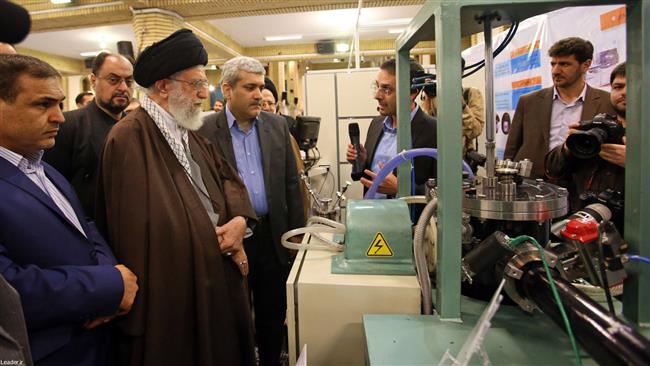
The Supreme Leader has paid a visit to the location to get a first-hand account of the backstage of Muhammad.

Concerning the childhood of the Prophet which has been depicted in the movie, Majidi says he wanted to address a wide segment of the people of the Muslim world, making a film which can match up to international standards.

“I talked with a large number of experts in Islamic studies, historians as well as Sunni and Shiite scholars [in Iran and foreign countries] as I conducted a two-year study on different aspects of the Prophet’s life. I picked the part which causes no controversy between Shiites and Sunnis, trying to inspire consensus between Muslims from a cultural angle”, Majidi said.

The movie has triggered opposition in certain Muslim nations even before making it onto the big screen. Majidi, however, has invited the Muslim scholars in the Cairo-based Al-Azhar University to watch the movie before passing judgment about it.


Signs of divergence in a conference on convergence

Arman newspaper-1-10-2015

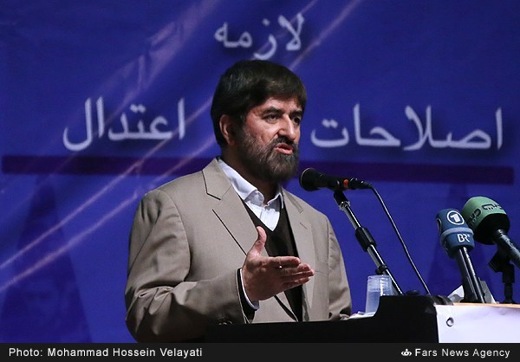
A fifth gathering of principlists aimed at securing convergence was held in Tehran on Thursday (January 8).

The gathering drew reformist and principlist reaction. The following is the translation of a report Arman-e Emrooz, a reformist daily, filed on the gathering:

The gathering which was originally meant to secure convergence among principlists seems to have revealed cracks in their ranks. Most of those who attended the gathering had failed in their bid to win elected office in recent elections and represented the Islamic Coalition Party, the Combatant Clergy Association, and the coalition of the Supporters of Imam and the Leader.

The no-shows

Tehran Mayor Mohammad Bagher Ghalibaf, who secured a sizeable number of votes in the 2013 elections, was one of the most prominent principlists conspicuous by his absence.

Saeed Jalili [a onetime secretary of the Supreme National Security Council and a presidential hopeful in 2013] and Kamran Bagheri Lankarani [a former health minister under Ahmadinejad] stayed away from the gathering too.

[…]

That Ayatollah Mohammad Taghi Mesbah Yazdi, who delivered the keynote speech at a previous such gathering, was absent was indicative of simmering tensions in the ranks of principlists. Mohsen Rezaei [a former commander of the Islamic Revolution Guard Corps] and his associates were no-shows too.

The most important principlists absent from the gathering were Ayatollah Movahedi Kermani, the secretary general of the Combatant Clergy Association, Ali Akbar Velayati, a 2013 presidential contender, and Parliament Speaker Ali Larijani.

Those who showed up

What was conspicuous in the gathering was the extensive presence of Ahmadinejad supporters. At a time when traditional principlists have no one to forge an alliance with, and infighting is brewing in their ranks, supporters of the former president seem to be perfect candidates to unite with.

When the organizers of the gathering set their sights on the long list of no-shows, they were swift to point a finger of blame at reformists.

For instance, Koohkan said identification of Ahmadinejad as a principlist is a ploy by reformists [to divide principlists]. It comes despite the fact that Ahmadinejad and his supporters have repeatedly said he is not part of the principlist camp.

What did those who showed up say?  

[…]

In the wake of the gathering, in response to a question as to why Mousavi and Karroubi [two presidential candidates who disputed the results of the 2009 vote and sparked widespread unrest] are not tried, Ayatollah Ahmad Alam al-Hoda told reporters, “You cannot ask for your own trial. Trial comes after prosecutors issue an indictment. Individuals cannot ask for a trial. These individuals are accused of committing offenses. The accused never appeal for their trial.

“Whenever the Supreme National Security Council agreed to prosecution and the judiciary chief ordered a trial in their case, they would be put on trial. They need to be interrogated.”

Before that, Seyyed Reza Taghavi told the gathering failure to get together for such meetings is not the proper way to get things done. Shunning others creates hurdles.

Aligned OPEC members can stabilize oil prices: Iran

Rouhani-Venezuela

“Undoubtedly, cooperation among aligned countries in the OPEC, while neutralizing plans by certain powers against OPEC, can help stabilize an acceptable oil price in 2015,” Rouhani said on Saturday.

The Iranian president made the remarks in a meeting with Venezuelan President Nicolas Maduro in Tehran, where both officials underlined the necessity for the further enhancement of economic, political and cultural relations between Tehran and Caracas.

Rouhani said promotion of ties with the Latin American countries, including Venezuela, is among priorities of his administration.

He also called for the expansion of cooperation between Tehran and Venezuela at the international level, which he said would serve the interests of the Middle East and Latin America and can help restore security to the world.

“The two countries (Iran and Venezuela) are against terrorism and extremism in the world and are cooperating in the establishment of stability and security across the globe,” said Rouhani.

For his part, the Venezuelan president called on the oil exporting countries to help restore stability to oil prices.

After leaving Tehran, Maduro is expected to visit other member states of the Organization of the Petroleum Exporting Countries, including Saudi Arabia, to discuss oil price slump.

Oil prices have plunged about 50 percent since June last year over increased supplies by certain countries such as Saudi Arabia, the largest OPEC producer, and a lackluster global economic growth.

OPEC, which pumps out about 40 percent of the world’s oil, has so far refrained from cutting its production to balance the market due to opposition from Saudi Arabia.

King Abdullah is likely to pass away within three days: Saudi hospital officials

Malik Abdullah King

A Saudi social networking user, who seems to have sources at the Saudi royal court, has quoted well-placed medical sources as saying that Saudi King Abdullah is likely to pass away within three days.

According to Fars News Agency, Mujtahid, a Saudi national whose stories on his Twitter account have proved reliable in the past said the next three days are crucial in whether the monarch can survive on life support.

The Saudi king was rushed to a medical facility in Riyadh two weeks ago. Saudi officials do not provide updates on his health.


Mojahed

Principlists eye convergence in preparation for victory in 10th legislative elections

Iranian Principalists

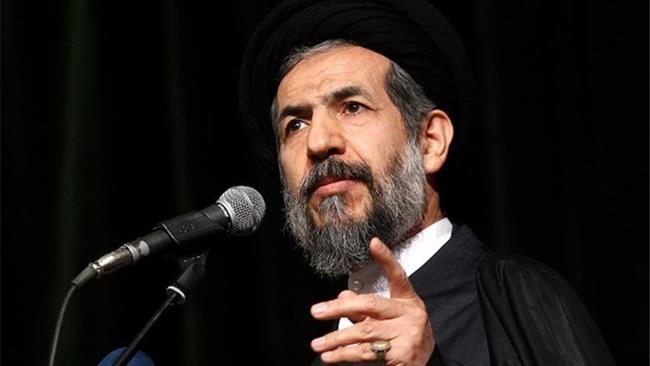
A fifth gathering of principlists aimed at securing convergence was held in Tehran on Thursday (January 8).

Principlist heavyweights attended the gathering which came as the conservative camp prepares for a strong showing in parliamentary elections in early 2016.

Gholamali Haddad Adel [chairman of parliament’s Principlist Caucus], Esmail Kowsari [a member of parliament’s National Security and Foreign Policy Committee], Seyyed Reza Taghavi [chairman of the policy-making council of Friday prayer leaders], Mohammad Nabi Habibi [leader of the Islamic Coalition Party], Mostafa Mohammad Najjar [a former defense and interior minister under Ahmadinejad], Asadollah Badamchian [a member of the central council of the Islamic Coalition Party], Mohammad Reza Bahonar [a vice-speaker of the Islamic Consultative Assembly], and Hossein Allahkaram [chairman of Hezbollah Coordination Council] were some of the principlist big shots who attended the meeting.

The gathering drew principlist and reformist reaction. The following is the translation of a report Javan, a principlist daily, filed on the gathering:

Alam al hoda
Ayatollah Ahmad Alam al-Hoda

Speaking at the gathering Ayatollah Ahmad Alam al-Hoda, a member of the Assembly of Experts [who is widely known for his tough stance against reformism and reformist figures] said, “We are united because in words and deeds we don’t act in a partisan way. It is the love of the Prophet’s household and the leader that brings us together.”

[…]

He went on to say, “From the past to the present, clergymen from the Combatant Clergy Association and the Society of Seminary Teachers have led the principlists. Veterans have always made the decisions and younger figures have appeared on the political stage.”

[…]

On the sidelines of the gathering, Ayatollah Alam al-Hoda said that classifying principlists as moderate and otherwise is a ploy designed to drive a wedge among them.

He went on to say that Ahmadinejad is history. He never was any more than he was: a figure. He defied the Supreme Leader and collapsed. […]

Taghavi
Seyyed Reza Taghavi

Another speaker at the gathering was Seyyed Reza Taghavi who said the price individuals pay for tolerance and accommodation is less than the price they pay for dispute.

He added, “Politics is the art of dealing with those who oppose you. Those who do not have the ability to accommodate those who hold opposing views should stand down.” […]


Haddad
Gholamali Haddad Adel

And the third speaker was Gholamali Haddad Adel who said, “We are here to stand up for the inalienable rights of the Iranian people. Today our focus is on the right to peaceful nuclear technology and to keeping the centrifuges spinning.

“The Supreme Leader of the Islamic Revolution has underlined that right. If the enemies sense that there are individuals among us who might budge in the face of their bullying tactics, they will crank up the pressure as we step back. And that is in contrast with our motto of independence. Besides, their bullying will be unstoppable.

“The Supreme Leader believes that our budging on one front won’t be the end of the story. They would expect us to step back further and further until their satisfaction is guaranteed.

“If we fail to resist their threats today, tomorrow they may threaten us to drop the term Islamic from the official title of the country, or they will refer the case to the Security Council. If we want to stand up to them, we’d better do that today to prevent things from getting more complicated.

“The Supreme Leader singled out nine criteria for principlism a few years ago. We need to take account of those principles all the time. Of course, depending on the conditions the country is in, more principles might be added to the list.  For instance, commitment to resistance-based economy is one such principle.

“As principlists we need to develop in-depth insight into the conditions in order to secure unity. Today, the conditions we are in are not the same as the past. Our decisions today should be in line with our conditions today. A principlist victory should be the basis of our efforts in the upcoming parliamentary elections.”

[…]

On the sidelines of the gathering, Mohammad Reza Bahonar told reporters, “Sometimes questions are raised that spark controversy and might drive us away from our principles and play into the hands of those who seek to divide us. We need to make sure we do not publicize such questions.”

In conclusion, the daily said it wouldn’t be surprising to see the reformist camp scramble to target principlists and their unity in the days and weeks to come.

Whenever I reach the end, I start from scratch

Niyusha Tavakoli

Newsha Tavakolian, an established photojournalist and art photographer, started her experimental career at 16. After a while she pursued it professionally in Iranian and foreign media. Two decades on, her social recognition and awareness has catapulted her into the ranks of the outstanding photographers.

She was named the fifth laureate of the 2014 Carmignac Gestion photojournalism Award, but returned the €50,000 prize money in protest at insistence by Edouard Carmignac – the French investment banker and head of the Carmignac Foundation – on editing her images, changing her texts and titling the project.

Zanan-e Emrooz magazine released an interview with Newsha in its 7th issue (December 2014) about her career and life. The following is a partial translation of the interview:

Why did you pick photography? Was anybody in your family who did photography?

At first I knew nothing about photojournalism. I did it for money. My parents were in Germany for my dad’s surgery, and my siblings and I were in Iran. Apart from financial problems, I found the education system annoying. Later I learned that I was suffering from Dyslexia¹ at school but nobody knew about it. Back then I didn’t want to rebel; it was just a normal reaction to the tough conditions of the time…. after dropping out of school, I took photography at my mom’s suggestion and used everything as a subject for photography. […]

Once you said you always wanted to narrate the story of your subjects. Are your recent collections your narration of the characters? […]

My first work was Mothers of the Martyrs Collection: photos of mothers whose sons had been martyred. The undeniable resemblance between mothers and sons was interesting. […] Two reverse trends: a son who has remained in his youth with a cheerful face and a mom who looks emaciated because of the loss of her son. I just selected the backgrounds for the pictures and there was no other intervention on my part. […]

I just show part of their lives and leave the remainder to the imagination of the audience. I like to see viewers get involved in the story of my photos, not just their beauties. None of my photos has a strange surreal atmosphere. They feature the familiar scenes we pass by each day, but we now pause to watch the photos and they make us think.

For instance, the visitors of the Look Collection (2011) told me they felt as if they were watching themselves in those photos. This shows that I have successfully represented a typical character type in the photos. Drawing on my experiences in photojournalism and social documentaries, I’ve reached this point. My photos feature the middle class; that’s why more people identify with the characters in my work. […]

What would have you done if you weren’t a photographer? 

I would’ve been a Flamingo [a 1940 popular song and jazz standard] singer because of its somber grief. Just now I try to sing through my photos. I think grief is the strangest and deepest feeling in the world. […]

The media, especially foreign media, have written a lot about you. The fact that you are a woman and an Iranian has been the reason why they focus on you. How do you think these two features have affected your current image?

I had to fight against the clichés. First I had to prove myself in Iran and then go beyond the cliché phrase of ‘exotic Iranian women’. It was a prolonged fight with no instantaneous rebellion. My male colleagues would tie my success to my gender. That was an insult – I don’t deny the role of gender, though – but my strenuous efforts shouldn’t be ignored.

You are first introduced with the very exotic, attractive components, but a feature that goes beyond gender shows itself after a while, something which is evident in your works.

Those who use new exploitation methods play up your works by the definitions they offer. You need to be smart enough not to be misused by anybody even if their attention may earn you global fame.

I’m an Iranian woman, but never have I focused on it. If others magnify these aspects of my life, it’s not because of my insistence. I’ve never been allured by the temptation of advancing my agenda based on my femininity, but the fact is that women are less involved in photography than men! […]

As a photojournalist, you not only covered the news on Iran but also news stories in the region, including the Iran-Iraq war. How was it like?

Back then I was 21. In Iraq I was accompanied by two American women. When we left Iraq after the war, they had other projects to work on and show themselves, but I came across closure of newspapers [in Iran] and a stagnant situation in which you would be consumed by inaction.

After one and a half years I realized that I’d spent too much time on something which I couldn’t change. I admitted that I was living in this country with all limitations and I needed to redouble my efforts to work here. […]

I refocused my efforts on upgrading my works. You cannot believe how terrible I was in photography and how much I worked on it. I’m the harshest critic of myself. I relentlessly review my works in order not to let others find any faults with them; I don’t let anybody undermine my self-confidence either. I constantly evaluate and challenge my works, and I think this is a forwarding method.

At the time of war, I was among the first photographers who were in Iraq. I sent my photos through my agency to Time and Newsweek magazines. They didn’t know I was a girl. Well, this heartened me because my works were put above my gender.

[…]

Where do you think the world is heading with too many photos available? Today mobiles and tablets don’t miss even one single moment.  ….

I don’t walk down this path. I don’t produce a big volume of photos. I’m stingy in photography. I feel responsible for taking any photo.

I’m stingy even in sending the feed to my eyes and mind. I wouldn’t look at just any video or photo because I wanted to train my eyes.

You are not supposed to watch anything just to spend time or relieve tiredness; otherwise your sight will get sick, just like you don’t eat anything just to fill your stomach. Perhaps these photos are helpful for future historians not to encounter any ambiguity […]

As a professional photographer, is your life affected by news? Is news still tragic for you?

Pieces of bad news send chills down my spine. I’m still involved in photojournalism. It is a labor of love. Let me give you an example. After a tough period of hard work – a four-month trip to 13 countries for filming and photography for an educational project – and facing problems with the Carmignac Foundation, I was in the Netherlands where I decided to go to the beach and have a rest. It coincided with the crash of a Malaysian airliner in Ukraine. The families of the Dutch nationals who were onboard the [doomed] plane went to the airport to ask about their loved ones.

I rushed to the airport when I heard the news. I was unaware that I had no camera, so I collected one at the airport and started to take photos. Nobody was waiting for my photos.

About one month ago I went to Iraq for a personal project. I didn’t snap the most important photo I could take and wrote it instead*.

You’ve travelled to many countries. Have you ever thought about migration given that your husband is not Iranian?

I’m still in Iran because it is the only place where I can use all my senses: anger, happiness, concerns, etc. My Iran photos are the strongest. It’s hard for me to let go of what I’ve developed an interest in. Luckily my husband is interested in Iran too.

I like Iran despite its shortcomings to which I don’t turn a blind eye. This society’s problems bother me and I cannot remain indifferent to them. If I live here and like it, I should do whatever I can for it. […]

Tell us about what you’ve changed in yourself through your own constructive criticism.

Whenever I hold a camera, I imagine it’s my first time. […] Each day I try to gain new things. It all started when I returned from Iraq. I could either suffer from postwar depression or forget whatever I had experienced in order to return to normal life. I chose the intentional forgetfulness in order not to be entrapped by sentimentalism, and not to regret the past. Never do I think about the past. I face the future. Each time I reach the end, I start from scratch.

1. Dyslexia or developmental reading disorder is characterized by difficulty with learning to read. This includes difficulty with phonological awareness and decoding, orthographic coding, auditory short-term memory, language skills/verbal comprehension, and rapid naming.
* A Thousand Words for a Picture That I Never Took, Newsha Tavakolian, Sharq newspaper.