Monday, December 29, 2025
Home Blog Page 4970

Principlists eye convergence in preparation for victory in 10th legislative elections

Iranian Principalists

A fifth gathering of principlists aimed at securing convergence was held in Tehran on Thursday (January 8).

Principlist heavyweights attended the gathering which came as the conservative camp prepares for a strong showing in parliamentary elections in early 2016.

Gholamali Haddad Adel [chairman of parliament’s Principlist Caucus], Esmail Kowsari [a member of parliament’s National Security and Foreign Policy Committee], Seyyed Reza Taghavi [chairman of the policy-making council of Friday prayer leaders], Mohammad Nabi Habibi [leader of the Islamic Coalition Party], Mostafa Mohammad Najjar [a former defense and interior minister under Ahmadinejad], Asadollah Badamchian [a member of the central council of the Islamic Coalition Party], Mohammad Reza Bahonar [a vice-speaker of the Islamic Consultative Assembly], and Hossein Allahkaram [chairman of Hezbollah Coordination Council] were some of the principlist big shots who attended the meeting.

The gathering drew principlist and reformist reaction. The following is the translation of a report Javan, a principlist daily, filed on the gathering:

Alam al hoda
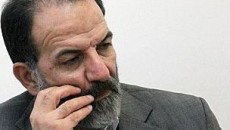
Ayatollah Ahmad Alam al-Hoda

Speaking at the gathering Ayatollah Ahmad Alam al-Hoda, a member of the Assembly of Experts [who is widely known for his tough stance against reformism and reformist figures] said, “We are united because in words and deeds we don’t act in a partisan way. It is the love of the Prophet’s household and the leader that brings us together.”

[…]

He went on to say, “From the past to the present, clergymen from the Combatant Clergy Association and the Society of Seminary Teachers have led the principlists. Veterans have always made the decisions and younger figures have appeared on the political stage.”

[…]

On the sidelines of the gathering, Ayatollah Alam al-Hoda said that classifying principlists as moderate and otherwise is a ploy designed to drive a wedge among them.

He went on to say that Ahmadinejad is history. He never was any more than he was: a figure. He defied the Supreme Leader and collapsed. […]

Taghavi
Seyyed Reza Taghavi

Another speaker at the gathering was Seyyed Reza Taghavi who said the price individuals pay for tolerance and accommodation is less than the price they pay for dispute.

He added, “Politics is the art of dealing with those who oppose you. Those who do not have the ability to accommodate those who hold opposing views should stand down.” […]


Haddad
Gholamali Haddad Adel

And the third speaker was Gholamali Haddad Adel who said, “We are here to stand up for the inalienable rights of the Iranian people. Today our focus is on the right to peaceful nuclear technology and to keeping the centrifuges spinning.

“The Supreme Leader of the Islamic Revolution has underlined that right. If the enemies sense that there are individuals among us who might budge in the face of their bullying tactics, they will crank up the pressure as we step back. And that is in contrast with our motto of independence. Besides, their bullying will be unstoppable.

“The Supreme Leader believes that our budging on one front won’t be the end of the story. They would expect us to step back further and further until their satisfaction is guaranteed.

“If we fail to resist their threats today, tomorrow they may threaten us to drop the term Islamic from the official title of the country, or they will refer the case to the Security Council. If we want to stand up to them, we’d better do that today to prevent things from getting more complicated.

“The Supreme Leader singled out nine criteria for principlism a few years ago. We need to take account of those principles all the time. Of course, depending on the conditions the country is in, more principles might be added to the list.  For instance, commitment to resistance-based economy is one such principle.

“As principlists we need to develop in-depth insight into the conditions in order to secure unity. Today, the conditions we are in are not the same as the past. Our decisions today should be in line with our conditions today. A principlist victory should be the basis of our efforts in the upcoming parliamentary elections.”

[…]

On the sidelines of the gathering, Mohammad Reza Bahonar told reporters, “Sometimes questions are raised that spark controversy and might drive us away from our principles and play into the hands of those who seek to divide us. We need to make sure we do not publicize such questions.”

In conclusion, the daily said it wouldn’t be surprising to see the reformist camp scramble to target principlists and their unity in the days and weeks to come.

Whenever I reach the end, I start from scratch

Niyusha Tavakoli

Newsha Tavakolian, an established photojournalist and art photographer, started her experimental career at 16. After a while she pursued it professionally in Iranian and foreign media. Two decades on, her social recognition and awareness has catapulted her into the ranks of the outstanding photographers.

She was named the fifth laureate of the 2014 Carmignac Gestion photojournalism Award, but returned the €50,000 prize money in protest at insistence by Edouard Carmignac – the French investment banker and head of the Carmignac Foundation – on editing her images, changing her texts and titling the project.

Zanan-e Emrooz magazine released an interview with Newsha in its 7th issue (December 2014) about her career and life. The following is a partial translation of the interview:

Why did you pick photography? Was anybody in your family who did photography?

At first I knew nothing about photojournalism. I did it for money. My parents were in Germany for my dad’s surgery, and my siblings and I were in Iran. Apart from financial problems, I found the education system annoying. Later I learned that I was suffering from Dyslexia¹ at school but nobody knew about it. Back then I didn’t want to rebel; it was just a normal reaction to the tough conditions of the time…. after dropping out of school, I took photography at my mom’s suggestion and used everything as a subject for photography. […]

Once you said you always wanted to narrate the story of your subjects. Are your recent collections your narration of the characters? […]

My first work was Mothers of the Martyrs Collection: photos of mothers whose sons had been martyred. The undeniable resemblance between mothers and sons was interesting. […] Two reverse trends: a son who has remained in his youth with a cheerful face and a mom who looks emaciated because of the loss of her son. I just selected the backgrounds for the pictures and there was no other intervention on my part. […]

I just show part of their lives and leave the remainder to the imagination of the audience. I like to see viewers get involved in the story of my photos, not just their beauties. None of my photos has a strange surreal atmosphere. They feature the familiar scenes we pass by each day, but we now pause to watch the photos and they make us think.

For instance, the visitors of the Look Collection (2011) told me they felt as if they were watching themselves in those photos. This shows that I have successfully represented a typical character type in the photos. Drawing on my experiences in photojournalism and social documentaries, I’ve reached this point. My photos feature the middle class; that’s why more people identify with the characters in my work. […]

What would have you done if you weren’t a photographer? 

I would’ve been a Flamingo [a 1940 popular song and jazz standard] singer because of its somber grief. Just now I try to sing through my photos. I think grief is the strangest and deepest feeling in the world. […]

The media, especially foreign media, have written a lot about you. The fact that you are a woman and an Iranian has been the reason why they focus on you. How do you think these two features have affected your current image?

I had to fight against the clichés. First I had to prove myself in Iran and then go beyond the cliché phrase of ‘exotic Iranian women’. It was a prolonged fight with no instantaneous rebellion. My male colleagues would tie my success to my gender. That was an insult – I don’t deny the role of gender, though – but my strenuous efforts shouldn’t be ignored.

You are first introduced with the very exotic, attractive components, but a feature that goes beyond gender shows itself after a while, something which is evident in your works.

Those who use new exploitation methods play up your works by the definitions they offer. You need to be smart enough not to be misused by anybody even if their attention may earn you global fame.

I’m an Iranian woman, but never have I focused on it. If others magnify these aspects of my life, it’s not because of my insistence. I’ve never been allured by the temptation of advancing my agenda based on my femininity, but the fact is that women are less involved in photography than men! […]

As a photojournalist, you not only covered the news on Iran but also news stories in the region, including the Iran-Iraq war. How was it like?

Back then I was 21. In Iraq I was accompanied by two American women. When we left Iraq after the war, they had other projects to work on and show themselves, but I came across closure of newspapers [in Iran] and a stagnant situation in which you would be consumed by inaction.

After one and a half years I realized that I’d spent too much time on something which I couldn’t change. I admitted that I was living in this country with all limitations and I needed to redouble my efforts to work here. […]

I refocused my efforts on upgrading my works. You cannot believe how terrible I was in photography and how much I worked on it. I’m the harshest critic of myself. I relentlessly review my works in order not to let others find any faults with them; I don’t let anybody undermine my self-confidence either. I constantly evaluate and challenge my works, and I think this is a forwarding method.

At the time of war, I was among the first photographers who were in Iraq. I sent my photos through my agency to Time and Newsweek magazines. They didn’t know I was a girl. Well, this heartened me because my works were put above my gender.

[…]

Where do you think the world is heading with too many photos available? Today mobiles and tablets don’t miss even one single moment.  ….

I don’t walk down this path. I don’t produce a big volume of photos. I’m stingy in photography. I feel responsible for taking any photo.

I’m stingy even in sending the feed to my eyes and mind. I wouldn’t look at just any video or photo because I wanted to train my eyes.

You are not supposed to watch anything just to spend time or relieve tiredness; otherwise your sight will get sick, just like you don’t eat anything just to fill your stomach. Perhaps these photos are helpful for future historians not to encounter any ambiguity […]

As a professional photographer, is your life affected by news? Is news still tragic for you?

Pieces of bad news send chills down my spine. I’m still involved in photojournalism. It is a labor of love. Let me give you an example. After a tough period of hard work – a four-month trip to 13 countries for filming and photography for an educational project – and facing problems with the Carmignac Foundation, I was in the Netherlands where I decided to go to the beach and have a rest. It coincided with the crash of a Malaysian airliner in Ukraine. The families of the Dutch nationals who were onboard the [doomed] plane went to the airport to ask about their loved ones.
I rushed to the airport when I heard the news. I was unaware that I had no camera, so I collected one at the airport and started to take photos. Nobody was waiting for my photos.

About one month ago I went to Iraq for a personal project. I didn’t snap the most important photo I could take and wrote it instead*.

You’ve travelled to many countries. Have you ever thought about migration given that your husband is not Iranian?

I’m still in Iran because it is the only place where I can use all my senses: anger, happiness, concerns, etc. My Iran photos are the strongest. It’s hard for me to let go of what I’ve developed an interest in. Luckily my husband is interested in Iran too.
I like Iran despite its shortcomings to which I don’t turn a blind eye. This society’s problems bother me and I cannot remain indifferent to them. If I live here and like it, I should do whatever I can for it. […]
Tell us about what you’ve changed in yourself through your own constructive criticism.
Whenever I hold a camera, I imagine it’s my first time. […] Each day I try to gain new things. It all started when I returned from Iraq. I could either suffer from postwar depression or forget whatever I had experienced in order to return to normal life. I chose the intentional forgetfulness in order not to be entrapped by sentimentalism, and not to regret the past. Never do I think about the past. I face the future. Each time I reach the end, I start from scratch.

1. Dyslexia or developmental reading disorder is characterized by difficulty with learning to read. This includes difficulty with phonological awareness and decoding, orthographic coding, auditory short-term memory, language skills/verbal comprehension, and rapid naming.
* A Thousand Words for a Picture That I Never Took, Newsha Tavakolian, Sharq newspaper.

Outstanding architectural projects of 2014

Isfahan-Architecture

The 7th annual World Architecture Festival in Singapore is the biggest event in this field and has hosted 300 select designs from different countries in 30 categories. The Iranian Students’ News Agency (ISNA) filed a report on January 5 about the 3-day festival attended by five Iranian designs. The following is the translation of the report with a photo gallery of some designs:

Among the five Iranian projects presented at the festival, Isfahan Dreamland Commercial Center designed by Farshad Mehdizadeh and Raha Ashrafi was chosen as the best design in the category of Commercial Mixed Use (Future Project).

Unlike today’s commercial centers in Iran which are designed as box-like structures with no interaction with the outside and largely unaffected by it, the project in question is a series of arches and roofs which are mainly designed to put to good use the public space through integrating it into the interior.

Inspired by historical arched Iranian markets which affected the structure of the city and were affected by it, the architecture project creates a maze where the structure and the urban space meet.

This year’s winner in the category of Future Project of the Year was Art Gallery of Greater Victoria from Canada.

Official underlines rise in number of health tourists to visit Iran

Health tourism

The number of foreign health tourists visiting Iran will considerably increase in the near future, a senior Iranian official announced.

“Over 500,000 health tourists are likely to visit Iran in the coming months,” Health Ministry Official Jalal Naeli said, addressing Health Tourism Conference in the northeastern Iranian city of Mashhad on Thursday.

In October, Iranian Vice-President and Director of the Cultural Heritage, Handicrafts and Tourism Organization (ICHHTO) Masoud Soltanifar announced that the number of foreign tourists visiting Iran considerably increased last year.

“Iran earned $6 billion in revenues from tourism industry in the past Iranian calendar year (ended on March 20),” Soltanifar said at the time.

Stressing the necessity for making efforts to increase the figure by 25 percent in current Iranian year, he said that the number of tourists visiting Iran and those investing in this industry increased significantly in the past year.

Soltanifar also said that implementation of 900 tourism projects are currently underway in different parts of the country with 195,000 billion rials in finances.

Larijan: France incidents result of West’s behavior in Syria

Iran-Ali-Larijani

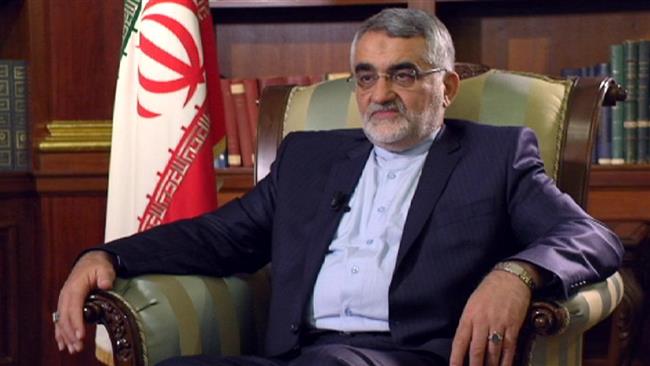
Parliament Speaker Ali Larijani said what is happening in France now is the result of the West’s behavior in Syria.

He made the remarks in his speech to the closing ceremony of the 28th International Islamic Unity Conference in Tehran on Friday.

He said the incidents in France in the past few days – which he described as an absolutely insane act of terrorism – are the outcome of what the West did in Syria.

Pointing out that the West now seeks to shout even more insults at Islam rather than making an apology for its behaviors, he said what the two terrorists did had nothing to do with Islam.

Thus, he added, the West had no right to offend the Holy Islam.

The speaker said that the West is behaving vengefully instead of trying to correct its mistake, thus wasting the chance to solve problems.

Stressing that Muslims were now determined to decide for their own destiny, he said France incidents were a proof of the fact that it was wrong for the West to support terrorists in Syria and provide arms for terrorists.

He said terrorists got their arms from the West or their puppets in the region so it is for the West now to answer why it supported terrorists.

He stated that Tehran was against terrorist groups from the very beginning and they at times even clashed with Iran.

The parliament speaker further referred to disparity and lack of convergence on the part of the governments as one major problem for the Islamic world.

He said some countries are now talking of opposing Iran’s policies but the question is whether hostility to Iran should be given top priority at the present juncture where the West is pressing these very same countries.

He said that unfortunately these countries which are even unable to analyze their own situation and use their own resources in a proper way are selling off their oil in return for nothing just for the Western countries to accumulate their own benefits.

They think that by doing so they are going to press Iran over its nuclear talks with the West but they are mistaken as Iran has endured conditions much worse than the present ones, Larijani added.

Noting that presently Iran’s non-oil exports stand at 50 billion dollars per year, he said situation has drastically changed in Iran so it is unbecoming of Islamic states to behave maliciously towards another Muslim country.

Praising the fact that the process of democratization has gained new momentum in Islamic countries, he referred to extremism and radicalism as the major threats to the Muslim world and regretted that enemies are misusing this as an instrument.

The 28th International Islamic Unity Conference concluded work here on Friday after issuing a statement on necessity of real solutions to Islamic world issues.

The international conference kicked off in Tehran on Wednesday with the participation of hundreds of Sunni and Shia scholars and intellectuals from more than 60 countries.

The participants discussed ways to promote unity and solidarity in the Muslim world and focused on problems facing the Islamic world, such as the threat posed by the Takfiri militants.

The theme of this year’s conference was United Muslim Ummah: Challenges and Strategies.

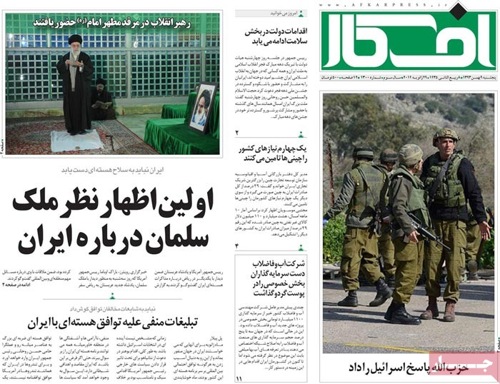
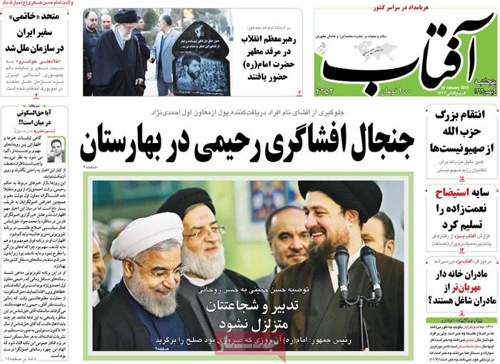
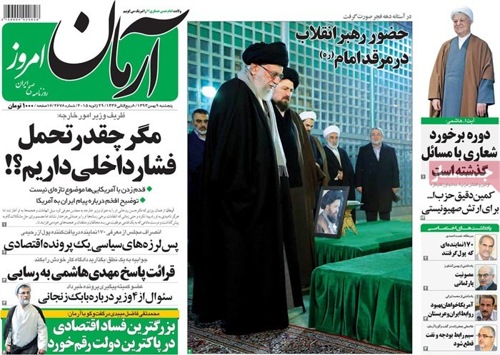
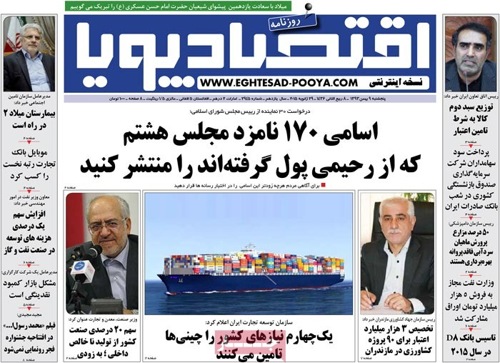
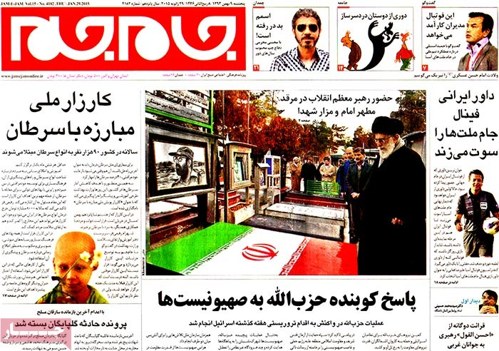
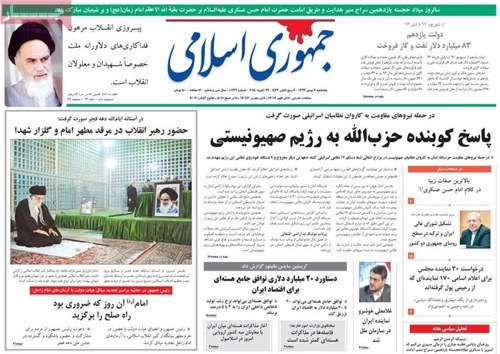
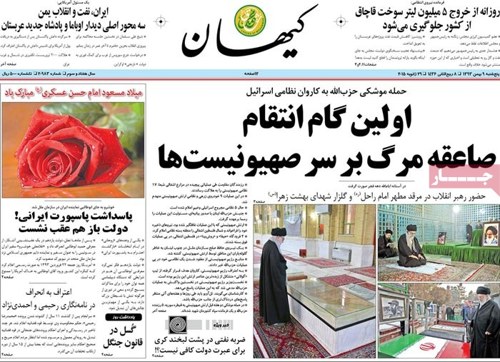
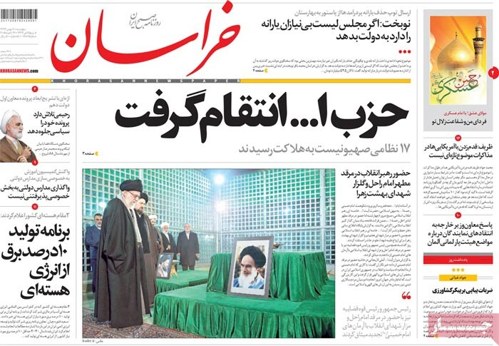
A look at Iranian newspaper front pages on Jan. 10

Iranian Newspapers Headlines

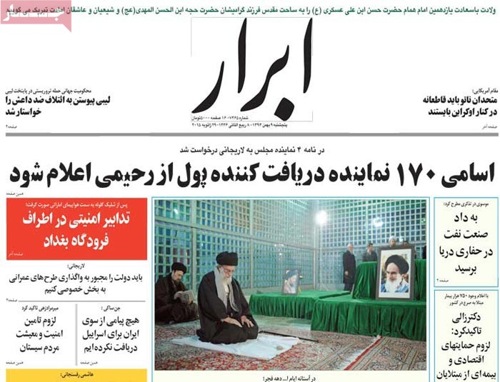
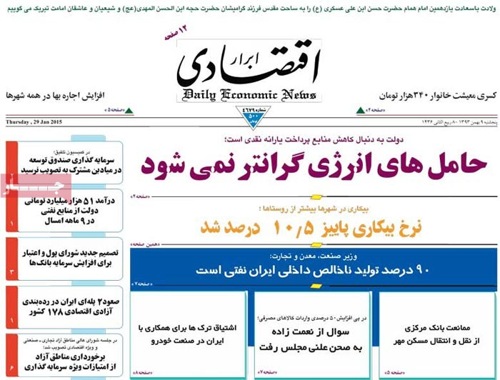
The comments of the Supreme Leader on the growing need for Muslim unity appeared on the cover of all Iranian newspapers on Saturday. The bloody incidents in France that claimed the lives of 20, including three terrorists, over the course of three days also dominated the front page of almost every daily. An announcement by the deputy foreign minister that the Iranian and American top diplomats are to meet on January 14 also made front-page headlines.


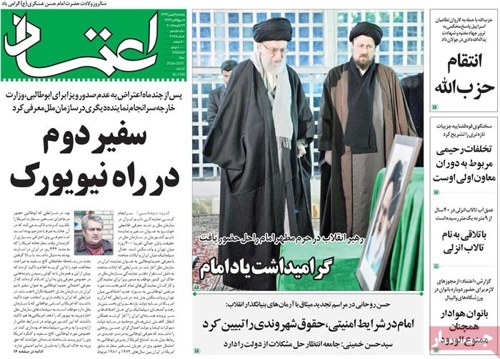
Arman-e Emrooz: “Regional countries which are anti-Iranian are committing a big mistake,” said Supreme Leader Ayatollah Seyyed Ali Khamenei.


Armane emruz newspaper 1- 10


Ebtekar: The Iranian president has condemned the terrorist attacks in France.


Ebtekar newspaper 1- 10


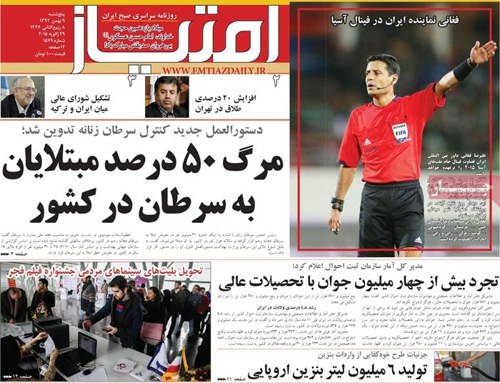
Emtiaz: “One fifth of all marriages end in divorce,” said the deputy minister of youth affairs and sports.


Emtiaz newspaper 1- 10


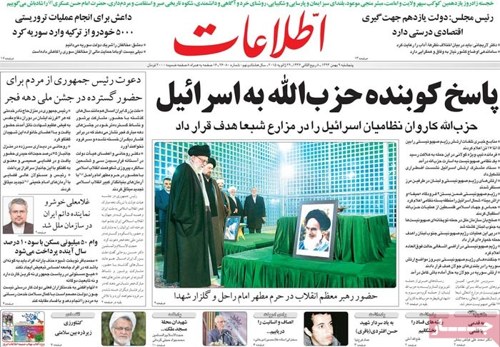
Ettela’at: The Iranian parliament speaker has told a conference on Islamic unity in Tehran that the World of Islam should adopt a common stance on terrorism.


Ettelaat newspaper 1- 10


Hambastegi: “Violence and terrorism are condemnable in the region, in Europe and in America,” President Hassan Rouhani said.

Hambastegi newspaper 1- 10


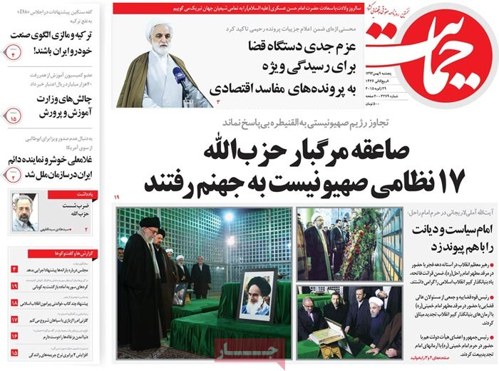
Hemayat: “The Shiism that is linked to MI6 and the Sunnism that is in the pay of the CIA are both anti-Islamic,” said the Supreme Leader.


Hemayat newspaper 1- 10


Jahan-e Sanat: “The Muslim world needs unity more than any other time,” said the Supreme Leader in a meeting with state officials and members of the public.


Jahane sanaat newspaper 1- 10


Kaenat: “Ground will be broken on two nuclear power plants next year [starts March 21],” said Director of the Atomic Energy Organization of Iran Ali Akbar Salehi.

Kaenat: Iranian Foreign Minister Mohammad Javad Zarif and US Secretary of State John Kerry will hold talks on Wednesday [January 14].


Kaenaat newspaper 1- 10


Kayhan International: Foreign intelligence behind Shia-Sunni rift: Ayatollah Khamenei.


Kayhan international newspaper 1- 10


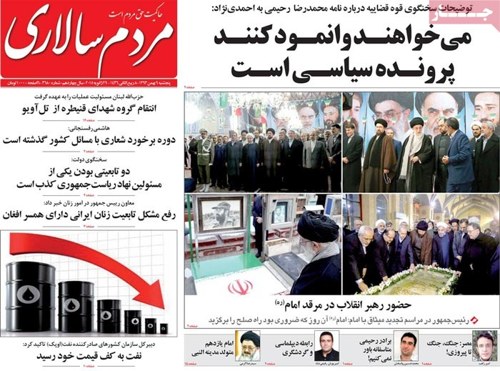
Mardomsalari: Iran stands ready to export natural gas to Pakistan, but has not written off the compensation Pakistan owes it.

Mardomsalari: Veteran voice artist Ahmad Rasoulzadeh has passed away.


Mardom salari newspaper 1- 10


Mardom-e Emrooz: Principlists say the political shelf life of Ahmadinejad has expired.

Mardom-e Emrooz: Renowned Iranian actor Peyman Moadi has said he would not appear in any movie which has an anti-Islamic or anti-Iranian theme.


Mardome emruz newspaper 1- 10


Payam-e Zaman: “Iran supports nations that stand up to terrorism,” President Rouhani said at a meeting between state officials and the Supreme Leader.


payame zaman newspaper 1- 10


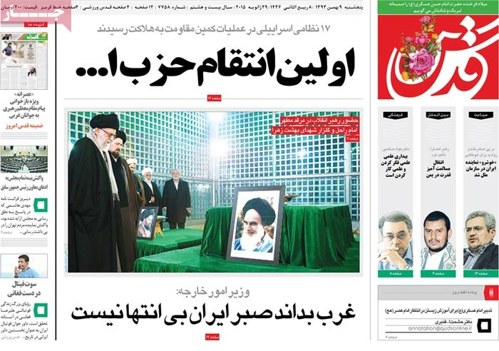
Qods: The hostage drama in Paris has come to a bloody end.


Ghods newspaper 1- 10


Resalat: “Training Syria’s moderate opposition is a new mistake,” said the Iranian deputy foreign minister.


Resalat newspaper 1- 10


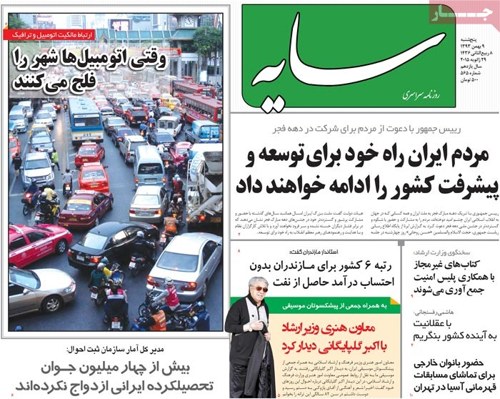
Sayeh: “By blocking websites one cannot stand up against the Cultural Onslaught,” said the minister of culture and Islamic Guidance.

Sayeh: A Chinese economic delegation has signaled Beijing’s readiness to invest in Iran’s Shahid Rajaee Port.


Sayeh newspaper 1- 10


Sepid: Five physicians have been barred from practicing medicine for three months for failing to abide by the Health Ministry’s instructions.


Sepid newspaper 1- 10


Shahrvand: Snow and blizzard have hit 17 Iranian provinces.


Shahrvand newspaper 1- 10


Italian Companies Eyeing Investment in Iran

Iran-Italy

A senior Italian trade official has acknowledged that the Iranian economy is growing despite Western sanctions, stressing that a large number of Italian companies are ready to invest in Iran.

“We did not expect to see the Iranian people and companies in such welfare and comfort: rather we thought that the sanctions have paralyzed the life and economy of Iran,” Head of the Italian Chamber of Commerce Silvano Pascuno said on Thursday.

“Today we are witnessing a reverse condition and have been surprised; therefore next year we will come to Tehran along with two or three times as many businessmen,” he added.

He reiterated that the Italian companies like other European firms have been under pressure due to the sanctions imposed against Iran.

“The Italian companies have come to Iran with the help of the Italian government and after their close observations of Iran they are interested in cooperating in the field of industry, heavy machineries and other economic areas,” Pascuno said.

In November, Iran’s Ambassador to Rome Jahanbakhsh Mozaffari enumerated the various advantages of the Iranian market for investment, including oil and gas projects, and invited the Italian companies to seize the existing opportunities.

During a seminar to introduce Iran’s economic potential to the Italian businesses in Rome on Thursday, Mozaffari encouraged Italian companies to play a more active role in the Iranian markets.

During the meeting, members of Iran-Italy joint trade chamber discussed existing potential for bilateral economic cooperation, referring to Iran as a proper place in the region for investment and production.

Zarif, Kerry to meet in Geneva on January 14

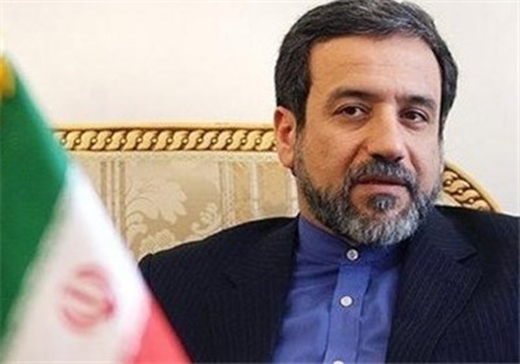
Abbas Araghchi

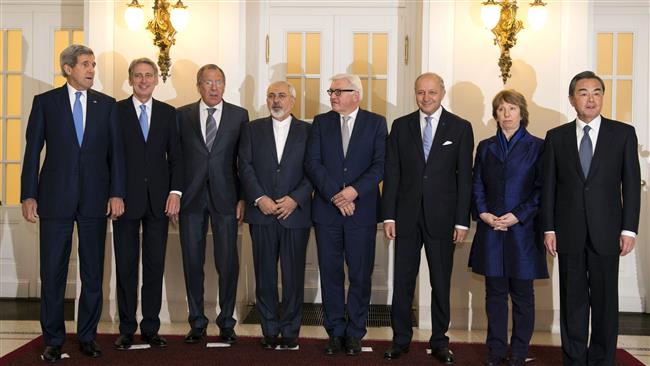
Iranian Foreign Minister Mohammad Javad Zarif and US Secretary of State John Kerry will hold a bilateral meeting in the Swiss city of Geneva on January 14 for talks on Tehran’s peaceful nuclear program, a top Iranian negotiator said.

Seyyed Abbas Araghchi, a senior member of the Iranian team of nuclear negotiators and a deputy foreign minister, announced on Friday that the top Iranian and US diplomats will travel to Geneva to “offer the necessary guidance” before their deputies hold nuclear talks.

According to Araghchi, negotiating teams from Iran and the US are slated to hold bilateral meetings in the Swiss city from January 15 to 17.

Later on January 18, Iran and the group of six world powers (Russia, China, the US, Britain, France and Germany) will resume nuclear talks in Geneva at the deputy ministerial level, he added.

Araghchi also unveiled plans for bilateral meetings between Iran and Russia ahead of the Geneva talks.

“On Monday, January 12, Sergei Ryabkov, Russia’s deputy foreign minister and that country’s representative in the nuclear talks, will travel to Iran for bilateral nuclear negotiations,” he noted.

Negotiations on Iran’s peaceful nuclear program will resume after a one-month hiatus. The parties concluded a round of deputy-level talks in Switzerland on December 17.

The talks in Geneva was the first round of negotiations between the two sides after they wrapped up a week of intensive nuclear talks in Vienna on November 24 without reaching a long-awaited deal they were supposed to hammer out by the November 24 deadline.

The parties, however, decided to extend for more 7 months the deadline for signing a comprehensive agreement.

Negotiations between Iran and the sextet aim to hammer out a final agreement to end more than a decade of impasse over Tehran’s peaceful nuclear program.

Iran ready to annul visa requirements with neighbors

Hassan Qashqavi

“The Islamic Republic of Iran is prepared to waive visa [requirements] or facilitate the process of issuing visas for all countries, especially the neighbors, if they take similar action,” said Hassan Ghashghavi, Iranian Deputy Foreign Minister for Consular, Parliamentary and Iranian Expatriates’ Affairs.

Ghashghavi cited Kuwait as an example, saying that Iran is planning to annul visa requirements for Kuwaiti nationals as the Arab country no longer requires Iranian visitors to obtain visas.

The high-ranking Iranian diplomat, who was addressing a national conference on health tourism, said that Iran has nearly halved tariffs for issuing health visas compared to the fees charged for ordinary visas.

“…this shows Iran’s cooperation … to ease traveling to Iran for foreign nationals,” he said.

He noted that Iran is a safe destination for foreign tourists as there has been no report of any incident for foreigners visiting the country over the past few years.

Terrorism, violence in name of Islam reprehensible: Rouhani

Rouhani

“We condemn extremism, violence and terrorism whether in Palestine, Lebanon and the Levant or in Paris and the US,” Rouhani said in a meeting with the delegates to the Islamic Unity Conference in the Iranian capital, Tehran, on Friday.

“Those who are unrightfully killing people and carrying out acts of violence and extremism in the name of Jihad, religion or Islam are, wittingly or unwittingly, treading the path of [promoting] Islamophobia and [are actually] fighting against Islam,” he added.

Rouhani once again reaffirmed the Islamic Republic’s support for nations that stand up and resist terrorism.

“We are very happy that Muslim people in the region from Iraq, Syria, Lebanon and Palestine to Pakistan and Afghanistan resist extremism, violence and terrorism and achieve new victories on a daily basis,” the Iranian president stated.

Rouhani emphasized that Iran condemns any person who supports terrorism and violence whether in the regional countries or in Europe and the US.

The Iranian president’s remarks came after masked gunmen stormed the Paris headquarters of the satirical weekly, Charlie Hebdo, on Wednesday, gunning down a dozen people, including eight journalists, two police officers, a maintenance worker and a visitor.

A policewoman on Thursday also succumbed to injuries she sustained in a separate shooting in southern Paris.

On Friday, a shootout, followed by a hostage-taking at a kosher grocery shop northeast of Paris, left at least two people dead.